




Abstract
Objective
This study aims to elucidate the current research focus, emerging hotspots, and trends in the field of gastric cancer nursing through bibliometric and visual analyses.
Methods
Data were sourced from the Web of Science Core Collection (WoSCC), and CiteSpace was used to conduct a comprehensive visual analysis of publication frequency, geographic distribution, institutional participation, key terms, trends, and areas of interest.
Results
A comprehensive analysis was conducted on 241 articles published between 2003 and 2024, representing contributions from 439 authors across 39 countries and regions. Among the top five authors by publication volume, Sung Kim from South Korea was the most prolific, having authored three articles. The most frequently occurring keywords were “gastric cancer” and “quality of life.” Keyword clustering revealed “postoperative recovery” and “self-reported experience” as the most prominent clusters. Notably, research on “symptoms” began emerging in 2022 and remains active, representing a newly developing area that is anticipated to become a key research focus in gastric cancer management.
Conclusions
This study presents a bibliometric overview of gastric cancer nursing research from 2003 to 2024, highlighting contributions by countries, institutions, authors, and journals. It also identifies dominant research themes and emerging trends. In particular, the investigation of risk factors and symptom cluster analysis have gained traction, providing valuable directions for future research in this field.
Introduction
Gastric cancer (GC) is a prevalent malignancy within the digestive system. Recent global cancer statistics indicate that its incidence and mortality rates rank fifth worldwide (Bray et al., 2024). In China, GC ranks fifth in incidence and third in mortality rate (Zheng et al., 2024). Studies have revealed a growing trend of GC affecting individuals under 50 years of age in countries such as the United States, Canada, and the United Kingdom (Anderson et al., 2018; Camargo et al., 2011). In addition to Helicobacter pylori, GC incidence is associated with genetic predisposition and lifestyle factors, such as tobacco use and alcohol consumption (Anderson et al., 2018; Deng et al., 2021; Hooi et al., 2017; Huang et al., 2018; López et al., 2023; Wu et al., 2022). The subtle presentation of early GC symptoms, combined with low screening uptake, results in the majority of diagnoses occurring at an advanced stage. Prognosis at this stage is poor, with an overall five-year survival rate below 5% and a median survival duration of approximately 8 months (Charalampakis et al., 2018; Li et al., 2021). Advanced GC often involves metastatic spread, high intratumor heterogeneity, and resistance to chemotherapy (Stahl et al., 2015).
For advanced GC, surgical resection remains the only curative treatment available (Ji & Ji, 2022), although it is often accompanied by postoperative complications. Studies have reported complication rates ranging from 9% to 31% (Bartlett et al., 2014; Sivakumar et al., 2021; Sah et al., 2010), which negatively impact short- and long-term survival. Chemotherapy remains a cornerstone of treatment for advanced GC, but its effectiveness is modest, with a median overall survival of approximately 8 months (Wang et al., 2019). This modality is frequently associated with adverse effects, including gastrointestinal and dermatologic complications. Targeted therapy and immunotherapies are emerging as global research focuses, and drug resistance remains a significant barrier to treatment success (Wang et al., 2019). Immunotherapy can also lead to immune-related adverse events, hyperthyroidism, colitis and severe dermatological reactions (Postow et al., 2015). Approximately 33.6% of patients with GC report significant psychological symptoms, which adversely affect their overall well-being and survival (Kim et al., 2017; Liu et al., 2021; Wikman et al., 2015). Unfortunately, these psychological needs are frequently overlooked in clinical care (Li et al., 2024). Patients with GC also face considerable financial burden. Treatment-related expenses—including surgery, chemotherapy, radiotherapy, supportive care, and long-term follow-up—are compounded by decreased productivity and insufficient caregiving support (Bordonaro et al., 2021), collectively imposing a substantial economic burden.
In conclusion, the implementation of effective nursing interventions is essential to enhance patients’ quality of life, alleviate treatment-related discomfort, and improve overall treatment outcomes. The “Report on the Development of Malignant Tumor Disciplines in China (2023)” (Liang et al., 2023) indicates that research in GC nursing primarily focuses on perioperative interventions and nutritional support. Fu et al. (2022) incorporated traditional Chinese medicine techniques into perioperative nursing care for patients with GC. Their findings suggest that these methods significantly reduce complication rates and enhance patient quality of life. Zhang et al. (2023b) applied advanced cognitive interventions, sleep therapy, psychological support, and medication management in patients with GC undergoing chemotherapy. Their results show that these approaches can effectively reduce the patients’ physical and psychological side effects of chemotherapy. Wei et al. (2023) developed a bundled perioperative care strategy based on evidence-based nursing principles by synthesizing existing studies (Liang et al., 2023). Xu et al. (2024) categorized 96 patients into two prognosis-based groups. The findings showed that a body mass index of ≥28.00 kg/m², a hospital stay of 10 days or longer, and two or more preoperative complications were independent risk factors for poor prognosis post-surgery. Despite advancements in GC management—supported by continuous improvements in perioperative care, chemotherapy, and nutritional protocols—there remains a lack of systematic evaluation of contributions from different countries and institutions. Furthermore, there is a pressing need to identify high-impact journals and landmark articles and to summarize current research priorities and future directions. This initiative would aid in identifying new research gaps, guiding submissions, and shaping evidence-based policy development in this area.
Bibliometrics is a quantitative method that uses mathematical and statistical techniques to analyze academic literature and identify the interrelationships among scholarly works. It includes the analysis of publication volume, citation frequency, references, and patents to uncover trends in research, innovation, and knowledge dissemination (Wang et al., 2021). Bibliometrics has emerged as a powerful tool for analyzing research trends (Pellegrino & Gravina, 2024). This study adopts bibliometric methods to systematically explore prevailing themes and evolving trends in GC nursing, offering insights to guide future investigations in this field.
Methods
Data Source
The Web of Science is widely recognized as one of the most reputable databases, encompassing a vast collection of high-quality journal literature from around the world. It is extensively used in bibliometric studies and the visual analysis of scientific literature. Notably, the file format exported from the Web of Science Core Collection (WoSCC) is most compatible with the formatting requirements of CiteSpace software. Accordingly, data for this study were sourced from the WoSCC, including information such as title, author, publication year, journal, country/region, keywords, abstract, and references.
Retrieval Strategies
Data were retrieved from the WoSCC database, encompassing records compiled up to July 31, 2024, and downloaded on August 5, 2024. This approach was intended to reduce potential biases arising from daily fluctuations in database updates. The search terms used were as follows: ((((((((((((((((TS = (supplementary)) OR TS = (Stomach Neoplasm)) OR TS = (Gastric Neoplasms)) OR TS = (Gastric Neoplasm)) OR TS = (Neoplasm, Gastric)) OR TS = (Neoplasms, Gastric)) OR TS = (Neoplasms, Stomach)) OR TS = (Cancer of Stomach)) OR TS = (Stomach Cancers)) OR TS = (Cancer of the Stomach)) OR TS = (Gastric Cancer)) OR TS = (Cancer, Gastric)) OR TS = (Cancers, Gastric)) OR TS = (Gastric Cancers)) OR TS = (Stomach Cancer)) OR TS = (Cancers, Stomach)) OR TS = (Cancer, Stomach))) AND ((TS = (nursing)) OR TS = (nursings)) OR TS = (care)). The search was restricted to English-language publications and research articles and review articles.
Two researchers independently conducted a thematic relevance screening by reviewing the titles and abstracts of the identified literature. Discrepancies were resolved through discussion or consultation with a third researcher. The finalized literature set was then imported into CiteSpace for analysis (see Figure 1A).

(A) Flowchart of search strategy in screening publications. (B) Number of publications.
Analysis Tool
The data obtained from WoSCC were converted into a plain text format for export. These files, containing detailed records and references, were saved in the input folder. Using Microsoft Excel (version 2021; Microsoft Corporation, Redmond, Washington), we compiled data on the number of publications, institutions, authors, total citations, keyword clusters, and keyword emergence maps. Annual publication trends and a stacked bar chart representing publication volumes by country were also generated. Additional bibliometric and visual analyses were conducted using CiteSpace. CiteSpace is a visualization tool developed by Professor Chaomei Chen at Drexel University (USA), with development beginning in 2003 and continuing through regular updates (Chen, 2004). This tool facilitates intuitive exploration of research focal points and the evolutionary trajectories within specific disciplines (Ma et al., 2021). CiteSpace enables structural and temporal network analyses of countries, regions, authors, co-cited authors, journals, co-cited journals, co-cited references, and keyword clusters. A notable feature of CiteSpace is burst detection, which identifies sudden surges in research activity, thereby revealing temporal trends and research hot spots. This study employed CiteSpace version 6.2.6, with the following parameters: time span (2003–2024), years per slice (1), g-index (k = 25), link retaining factor (LRF = 3), look-back years (LBY = 8), e = 2.0, and pruning method (Pathfinder).
Results
Analysis of Publication Years
As shown in Figure 1A, the study covers the period from January 1, 2003, to July 31, 2024. A comprehensive search of the WoSCC database yielded 6,975 articles. However, 466 articles were excluded for being non-article papers, non-review literature, or non-English publications. Following a thorough review by two researchers and after the removal of duplicate entries, 241 articles were ultimately selected, comprising 216 original research articles and 25 review articles. As illustrated in Figure 1B, the publication volume steadily increased from 2004 to 2021, peaking at 33 articles in 2021. However, from 2021 to 2024, there has been a gradual decline in publication output. Notably, the 2024 dataset is incomplete, limiting the accurate evaluation of the trend for that year.
Bibliometric Analysis of Countries and Institutions
A detailed analysis reveals that 39 countries have contributed scholarly articles on GC nursing. The top five countries by publication volume are China (67 articles), the United States (43 articles), South Korea (29 articles), Japan (22 articles), and United Kingdom (19 articles). Collectively, these countries account for 180 articles, representing 57% of the total output, as presented in Table S4 and visualized in Figures 2A and B. The country/region and institution map generated by CiteSpace uses the node size to indicate publication frequency and line thickness to reflect the strength of the collaborative links. The node colors range from purple (earlier publications) to yellow (more recent publications). A surge in publication volume has been observed for China in recent years, followed closely by Japan. Some nodes are encircled by a purple outer ring, which reflects the node's centrality—an indicator of its importance within the research network. Countries with notable centrality include the United States (centrality = 0.17), the United Kingdom (centrality = 0.36), and Italy (centrality = 0.13), as illustrated in Figure 3A. Yonsei University Health System ranks first among institutions in publication output, followed by the National Cancer Center of Korea, Yonsei University, Samsung Medical Center, and the Veterans Health Administration (VHA) in the United States. Together, these five institutions produced 31 articles. The VHA demonstrates the most extensive collaborative network in Europe and the United States. However, the collaborative efforts between Europe, the United States, and Asia remain limited (see Figure 3B and Table S5).
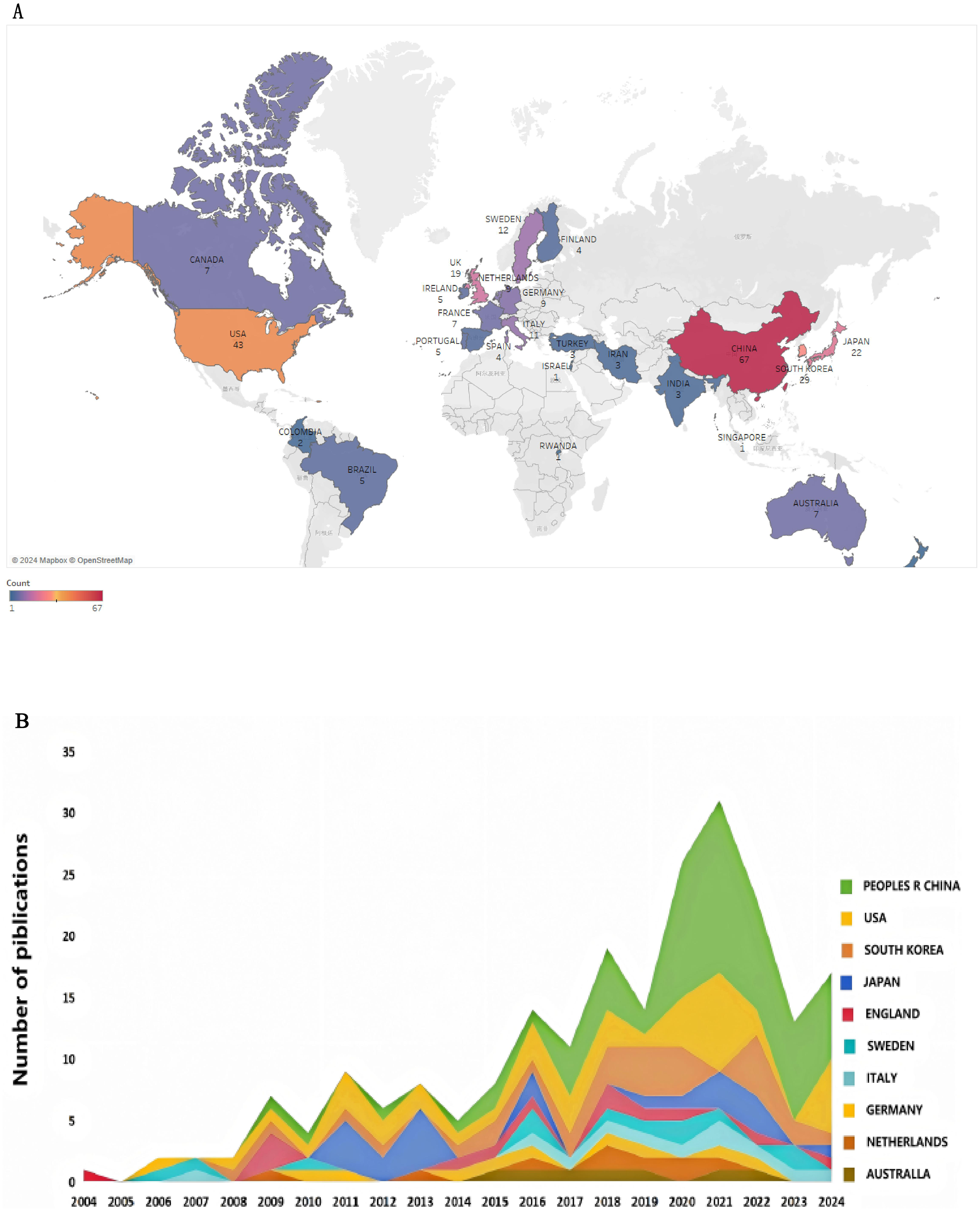
(A) The world map displaying the contribution of each country based on publication counts. (B) The annual number of publications in the top 10 most productive countries from 2004 to 2024.

(A) Node graph of publication status of each country. (B) Institutional publication node graph. (C) Author published node graph. (D) The co-citation network and the clustering of these authors.
Bibliometric Analysis of Authors and Co-Authors
A total of 439 authors contributed to the publication of the 241 articles included in this study. The five authors with the highest publication counts are Takahiro Higashi (Japan), Natalie G. Coburn (Canada), Dong-Woo Choi (South Korea), Sung Kim (South Korea), and Waddah B. Al-Refaie (United States), each with three publications. The leading contributor is Sung Kim, who conducted a longitudinal cohort study published in the Annals of Surgery, focusing on changes in the quality of life among patients following radical gastrectomy in South Korea (see Table S1, Figure 3C).
Co-citation analysis facilitates the identification of highly cited scholars within a discipline and maps their influence. CiteSpace software was configured using the g-index (k = 25) for parameter selection, as illustrated in Figure 3D. In this visualization, the size of each node or label represents the citation frequency, with larger nodes indicating more frequent citations. Links between the nodes depict co-citation relationships among the authors. The most frequently cited author is British researcher D. Cunningham, affiliated with the Royal Marsden Hospital NHS Foundation Trust. Other frequently cited scholars include Ferlay J. (France), Sung H. (USA), Jemal A. (USA), and MacDonald J.S. (USA). Notably, Sung H., Jemal A., and Mortensen K. (Norway) are associated with red nodes in Figure 3D, reflecting a significant number of short-term citations.
Bibliometric Analysis of Co-Cited Journals
The top five co-cited journals are Journal of Clinical Oncology (Impact Factor 42.1), Annals of Surgery (7.5), New England Journal of Medicine (96.2), CA: A Cancer Journal for Clinicians (503.1), and Gastric Cancer (6.0). Centrality refers to the importance of a node within a citation network and is measured by how often a node appears in the shortest paths (Brandes, 2001). Among these, the journal Cancer (Impact Factor 6.1) has the highest centrality score (0.46), indicating strong influence in the field (see Table S2).
Bibliometric Analysis of Co-Cited References
The five most frequently co-cited references are authored by Sung H., Mortensen K., Kim G. M., Cunningham D., and He X. L. The report by Sung H. et al., analyzing the incidence and mortality of 36 cancer types across 185 countries in 2020, has the highest centrality. Burst detection indicates a substantial short-term increase in citations of the article by K. Mortensen. References were clustered by title, and the top five clusters identified were “guideline-recommended GC care,” “quality cancer care,” “precision-based tertiary care,” “chemotherapy,” and “survey studies” (Figure 4A, Table S3).

(A) Literature co-cited topic clustering. (B) Keyword node graph. (C) A cluster analysis of keywords.
Bibliometric Analysis of Keywords
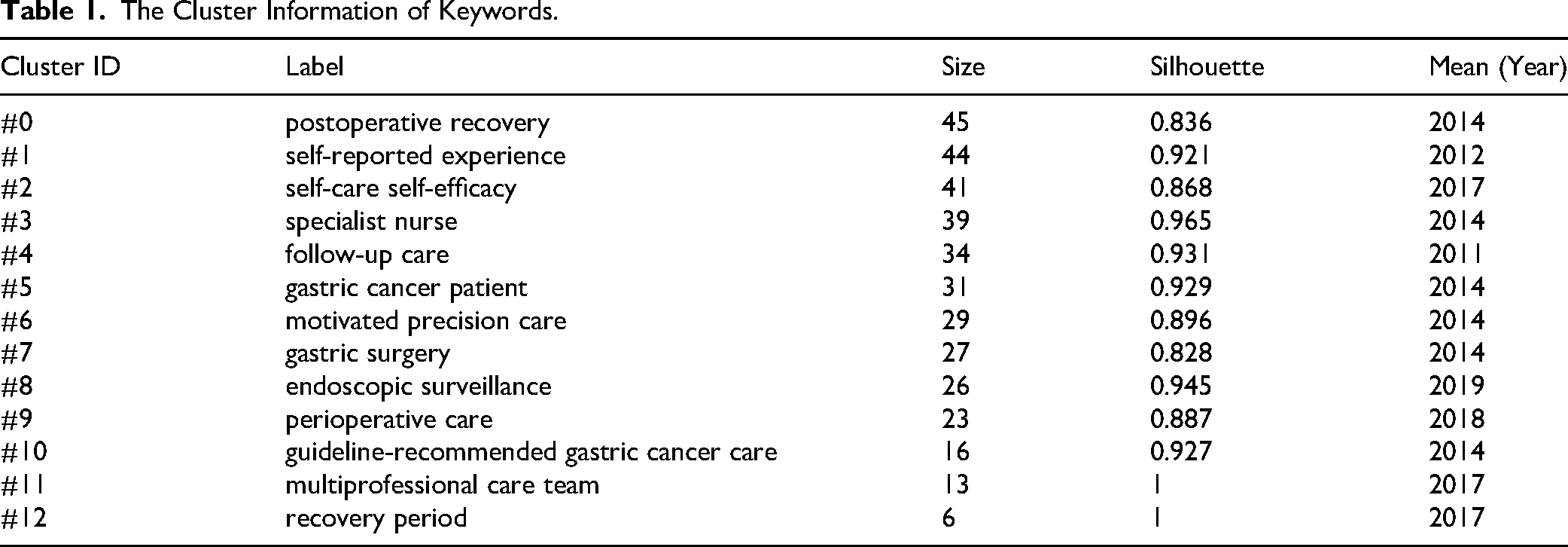
Keyword node analysis revealed the most frequent terms to be: “gastric cancer,” “quality of life,” “surgery,” and “impact” (Figure 4B, Table S6). Clustering of keywords produced 13 distinct groups, the five most prominent being “postoperative recovery,” “self-reported experience,” “self-care self-efficacy,” “specialist nurse,” and “follow-up care” (Figure 4C, Table 1). The two key indicators used to assess the clustering structure are modularity (Q-value) and average silhouette (S-value). A Q-value > 0.3 and an S-value > 0.7 indicate strong clustering (Li et al., 2021). This study yielded a Q-value of 0.7518 and an S-value of 0.9063, confirming the network's robustness. Table 2 lists the top 16 keywords ranked from 2004 to 2024, with “risk” showing the highest burst strength and a sustained rise since 2020. Long-standing keywords include “management,” “carcinoma,” and “gastric surgery,” each maintaining prominence for five years. Currently, “risk,” “diagnosis,” and “symptoms” are recognized as major research hotspots, with “symptoms” emerging as a recent trend starting in 2022.
The Cluster Information of Keywords.
The Top 18 Keywords With the Strongest Citation Burst.

Discussion
This study employed CiteSpace software to conduct a comprehensive bibliometric analysis of research hotspots and trends in GC nursing over the past two decades. By systematically organizing and visually mapping the data, this analysis identified major research themes, influential authors, highly cited literature, and emerging trends in the field.
Trends in Publication Volume
A total of 241 GC nursing-related articles were retrieved from the WoSCC database, spanning the period from January 1, 2003, to July 31, 2024. The findings demonstrate a general upward trend in publication volume, with a notable peak observed in 2021. This trend aligns with the research trajectories reported by Guoyang Zhang, Yizhen Chen, Chenyuan Wang, Kai-Lin Jiang, and their collaborators (Chen et al., 2023; Jiang et al., 2024; Wang et al., 2024; Zhang et al., 2023a). The increasing demand for nursing care in this field can be attributed to the rapid development of minimally invasive surgical techniques for GC, the growing application of targeted and immune-based therapies, and the introduction of the Enhanced Recovery After Surgery (ERAS) protocol, coupled with the persistent global burden of gastric cancer. The publication peak in 2021 likely reflects clinical studies that analyzed data collected between 2018 and 2020, a period of heightened research activity (Hyun & Park, 2021; Wang & Zhou, 2021; Zhang et al., 2021; Zhu et al., 2021). The COVID-19 pandemic notably accelerated studies on home-based care and virtual follow-up services. Although data collection experienced delays during the pandemic, digital methodologies were increasingly refined. Processes such as data management, statistical analysis, and manuscript preparation remained largely uninterrupted during quarantine, creating a conducive environment for scholarly publication despite the challenges posed to traditional medical practices.
Contributions From Various Nations and Organizations
An analysis of national publication volumes reveals that China, the United States, South Korea, Japan, and the United Kingdom are the leading contributors to research in the field of GC care. Notably, in 2024, China experienced a marked increase in the number of publications in this domain. The country's ongoing demographic shift toward an aging population has rendered elderly individuals especially susceptible to GC. In recent years, sustained advancements in medical technology, the maturation of the nursing profession, supportive health policies, and targeted financial investments have collectively created a favorable external environment for research in GC nursing.
Yonsei University Health System (YUHS) (The First & the Best YONSEI UNIVERSITY HEALTH SYSTEM) was founded in 1885 by American missionary Dr. H.N. Allen and is recognized as Korea's first modern medical institution. YUHS is known for its robust research infrastructure, cutting-edge medical technology, and leadership in medical education and research across South Korea (UNIVERSITY & SYSTEM, 2021). In 2020, South Korea ranked among the top five countries for new GC diagnoses (Lin et al., 2024), a trend largely attributed to the high seroprevalence of Helicobacter pylori and the prevalent consumption of nitrite-rich pickled food (Yim et al., 2007). CiteSpace analysis identified the most frequently cited article as “The moderating role of social support on depression and anxiety for GC patients and their family caregivers” (Jeong & An, 2017).
High-Impact Authors and Literature
The five leading authors in terms of publication output are Higashi Takahiro (Japan), Coburn Natalie G (Canada), Choi Dong-Woo (South Korea), Al-Refaie Waddah B (USA), and Kim Sung (South Korea), each averaging three publications. Higashi Takahiro authored three articles primarily focused on developing and evaluating a quality measurement system for cancer care in Japan (Higashi et al., 2013a, 2013b; Iwamoto et al., 2016). Notably, Kim Sung has achieved the highest citation count for his research, which examined changes in the quality of life of 465 patients who underwent total or partial gastrectomy at 3 and 12 months post-procedure (Kim et al., 2012). In collaboration with Kim Young-Woo, Lee Jun Ho, Bae Jae-Moon, Noh Jae-Moon, and other researchers, Kim Sung co-authored a study that examined nursing satisfaction and quality of life among GC patients (Kim et al., 2017). This research provides significant insights for clinical nursing practice. These authors are affiliated with the same institution, which may indicate inherent limitations in their collaborative reach.
Co-citation of authors refers to the phenomenon in which two or more authors are collectively referenced in the bibliographies of a single paper or across multiple publications, thereby establishing a co-citation relationship. In the present research, the authors Cunningham D. (Bölke et al., 2008), Ferlay J (Ferlay et al., 2013), Sung H., Jemal A., and Ajani J.A (Ajani et al., 2017) have been identified as the five most prolific contributors within the co-citation network. Cunningham and Ferlay J. are affiliated with the United Kingdom and France, respectively, while the other three individuals are based in the United States. Cunningham’s 2010 study demonstrated the highest citation frequency and centrality. This research examined the effectiveness of capecitabine and oxaliplatin in treating advanced esophagogastric cancer and has received 121 citations in the WoSCC. Among the top five authors, Sung H. and Jemal A. (Sung et al., 2021) have experienced a notable increase in co-citation in recent years, likely due to their focus on cancer statistics.
In the context of co-citation analysis within academic literature, the most frequently referenced works include “Global Cancer Statistics 2020” (Sung et al., 2021) and a publication providing evidence-based recommendations for optimal perioperative care following gastrectomy (Mortensen et al., 2014). Both articles are considered highly influential contributions to the field. The journals with the highest citation frequency and concentration within this domain are primarily specialized publications focused on surgery and GC, along with general medical and oncology journals. Notably, the Journal of Clinical Oncology stands out as the most cited journal, indicating its role as a key source of high-quality research that advances this area of study.
The Analysis of Research Hotspots
Keyword clustering analysis revealed key focal areas in the field of GC management, including postoperative recovery, self-reported experiences, self-care, self-efficacy, specialized nursing roles, continuity of care, and patient-centered experiences. These themes reflect a unified effort among nursing professionals and researchers to enhance the overall care quality for individuals diagnosed with GC, particularly in postoperative recovery and long-term care strategies.
Perioperative Recovery From GC
A meta-analysis conducted by researchers from West China Hospital of Sichuan University demonstrated that a fast-track recovery nursing model was more effective than traditional nursing approaches for both laparoscopic and open GC surgeries (Chen et al., 2014). In 2011, Japanese researcher Takanobu Yamada and colleagues published a study in Gastric Cancer examining the effects of the ERAS protocol during the perioperative phase of GC surgery. Their findings indicated that ERAS significantly improved postoperative recovery compared to conventional care practices (Yamada et al., 2012). Similarly, a study conducted by South Korean researcher So Hyun Kang and colleagues implemented a multimodal ERAS perioperative nursing program for patients undergoing laparoscopic distal gastrectomy, reporting substantial benefits over standard nursing care (Kang et al., 2018).
Self-Protection Ability and Self-Efficacy
Self-protection ability refers to an individual's confidence in successfully accomplishing a specific task or goal. Research has shown that improving self-efficacy enhances treatment adherence, strengthens self-care capabilities, and reduces psychological symptoms in cancer patients (Lev et al., 2001). A study conducted by Chinese scholar Huijuan Qian and colleagues found that, among patients with GC and colorectal cancer, depression severity had the most pronounced negative impact on both self-care and self-efficacy.
Precision Nursing
Precision nursing is gaining traction in the management of GC, as evidenced by improvements in patients’ quality of life, symptom relief, treatment optimization, and the provision of personalized psychological and social support. Chinese researcher Yanli Lu (Lu et al., 2023) and colleagues implemented a comprehensive three-tiered nursing program aimed at significantly enhancing the nutritional status of patients with GC, bolstering immune function, and facilitating expedited recovery following surgical intervention. Similarly, Chinese researcher Chen Yujing (Chen et al., 2020) and colleagues conducted an analysis of the supportive care needs of individuals diagnosed with GC and the factors influencing those needs. By evaluating patients’ experiences with symptoms and anxiety levels regarding disease progression, they developed tailored nursing interventions to address specific requirements.
Multidisciplinary Nursing Team
With the advancement of medical technology and growing patient expectations, there is an increasing emphasis on improving the overall quality of life. A research study conducted by Lithuanian scholars, including Augustinas Bausys (Bausys et al., 2023), and published in the British Journal of Surgery, presented a randomized controlled trial examining the effects of home prehabilitation on postoperative complications following GC surgery. The intervention group was managed using a multidisciplinary approach. The findings revealed that this group demonstrated greater adherence to neoadjuvant therapy, a reduced rate of postoperative complications at 90 days, and improved quality of life compared to the control group.
Hotspots and Future Development Trends
CiteSpace's burst detection capability facilitates the identification of evolving research trends within a specific field, transitioning from a macro to a micro perspective and from singular to plural phenomena. This tool effectively identifies emerging research trends and key topics that develop over a defined temporal framework. The most frequently occurring phenomenon is “risk,” characterized by an outbreak period from 2020 to 2024, and continues to the present. This includes concerns such as the risk of anxiety and depression following GC surgery and the risk factors associated with frailty in elderly patients before surgical intervention (An et al., 2022; Liu & Wang, 2022). The second prominent theme is “impact,” which had a developmental timeframe from 2011 to 2018 and peak attention observed in 2017 and 2018. Research suggests that nursing interventions significantly affect postoperative physical recovery, quality of life, and treatment adherence in patients with GC. Moreover, further exploration of the various factors influencing these outcomes is essential (Xin & Zhao, 2024; Zhang et al., 2021; Zhao et al., 2024). The emergence of “symptoms” spans from 2022 to 2024, identifying it as a recent area of interest. The term “symptom cluster” refers to the simultaneous occurrence of multiple symptoms. Nursing researchers are increasingly shifting their focus from managing individual symptoms to managing symptom clusters experienced by GC patients undergoing chemotherapy (Fu et al., 2022; Kalantari et al., 2022; Ma et al., 2024). It also explores interventions and management strategies aimed at improving patients’ quality of life, with the goal of developing appropriate nursing measures (Kalantari et al., 2022). The CiteSpace analysis suggests that future research should adopt a prospective, longitudinal design with a substantial sample size to examine changes in symptoms and related risk factors.
Implications for Practice
This study employed bibliometric analysis to synthesize the prevailing trends in GC nursing over the past two decades. The findings contribute to a clearer understanding of the field's developmental trajectory and may facilitate resource optimization and evidence-informed policy development. From a policy perspective, establishing an integrated, multidisciplinary care framework that prioritizes patient-centered approaches is essential. This framework should involve a multidisciplinary team comprising healthcare nursing specialists, nutritionists, and psychological counselors, and other healthcare professionals. The goal is to develop standardized procedures and quality assessment systems across institutions. Efforts should also be made to create a continuity-of-care network that bridges home, community, and hospital settings. There is a pressing need to enhance specialized nursing education in oncology by strengthening curricula focused on precision nursing for GC, basic genomics, and symptom management at both undergraduate and graduate levels. This will help cultivate a new generation of highly competent nurses capable of interpreting genetic reports and managing adverse effects from targeted therapies. Additionally, nursing education should incorporate digital health technologies and data analysis skills. Curricula must include training in remote monitoring, patient-reported outcomes, and the application of basic artificial intelligence tools to transform nurses into data-literate, evidence-informed practitioners. Finally, it is vital to strengthen evidence-based practice and research competencies among nurses. Promoting active involvement in clinical research and improving the ability to apply best-available evidence will further elevate nursing practice and accelerate the advancement of the nursing profession.
Strengths and Limitations
This study, based on two decades of global research data on gastric cancer treatment, objectively highlights the developmental background and evolutionary patterns in the field. It identifies research gaps and future prospects, providing evidence to guide topic selection, resource allocation, and clinical application. However, certain limitations remain in its application. This study utilized the WoSCC database, recognized for its comprehensiveness, systematic approach, and authoritative nature, as the sole data source. This research was limited to Research Articles and Review Articles, as these categories typically provide comprehensive titles, abstracts, keywords, and other relevant information that facilitate research theme extraction, keyword clustering analysis, and burst detection. It is important to acknowledge that this methodological choice may have led to the exclusion of certain relevant articles. Furthermore, the study is restricted to literature published in English, which may have resulted in additional data loss. Nonetheless, the majority of publications relevant to GC nursing are included in this study, effectively reflecting the prevailing research focal points and developmental trajectories within the field.
Conclusion
Nursing research plays an essential role in the management of GC and offers significant opportunities for progress, particularly through multidisciplinary collaboration and precision nursing. Countries such as China, the United States, South Korea, Japan, and the United Kingdom have made substantial contributions to this domain. Among institutions, the YUHS in South Korea stands out as the leading contributor to publication output. Recent research trends have centered on identifying risk factors and analyzing symptom clusters, offering actionable insights to improve clinical outcomes. To advance the field further, it is crucial to strengthen international collaboration and inter-institutional communication. Doing so will facilitate knowledge sharing and drive innovation, ultimately enhancing care for patients diagnosed with GC.
Supplemental Material
sj-docx-1-son-10.1177_23779608251376122 - Supplemental material for Two Decades of Research in Gastric Cancer Care: A Bibliometric and Visualized Analysis
Supplemental material, sj-docx-1-son-10.1177_23779608251376122 for Two Decades of Research in Gastric Cancer Care: A Bibliometric and Visualized Analysis by Wang Nan, Wang Yanan, Han Zhuo and Wang Weihua in SAGE Open Nursing
Footnotes

Author Contributions
Wang Nan: paper writing and data analysis. Wang Weihua: study design and revise manuscript. Wang Yanan: data collection. Han Zhuo: study design and data processing.
Funding
The authors disclosed receipt of the following financial support for the research, authorship, and/or publication of this article: This work was supported by the National Natural Science Foundation of China (Grant Number 82273375).
Declaration of Conflicting Interests
The authors declared no potential conflicts of interest with respect to the research, authorship, and/or publication of this article.
Data Availability
The data used to support the findings of this study are available from the corresponding author upon request.
Supplemental Material
Supplemental material for this paper is available online.
References
Supplementary Material
Please find the following supplemental material available below.
For Open Access articles published under a Creative Commons License, all supplemental material carries the same license as the article it is associated with.
For non-Open Access articles published, all supplemental material carries a non-exclusive license, and permission requests for re-use of supplemental material or any part of supplemental material shall be sent directly to the copyright owner as specified in the copyright notice associated with the article.
