




Abstract
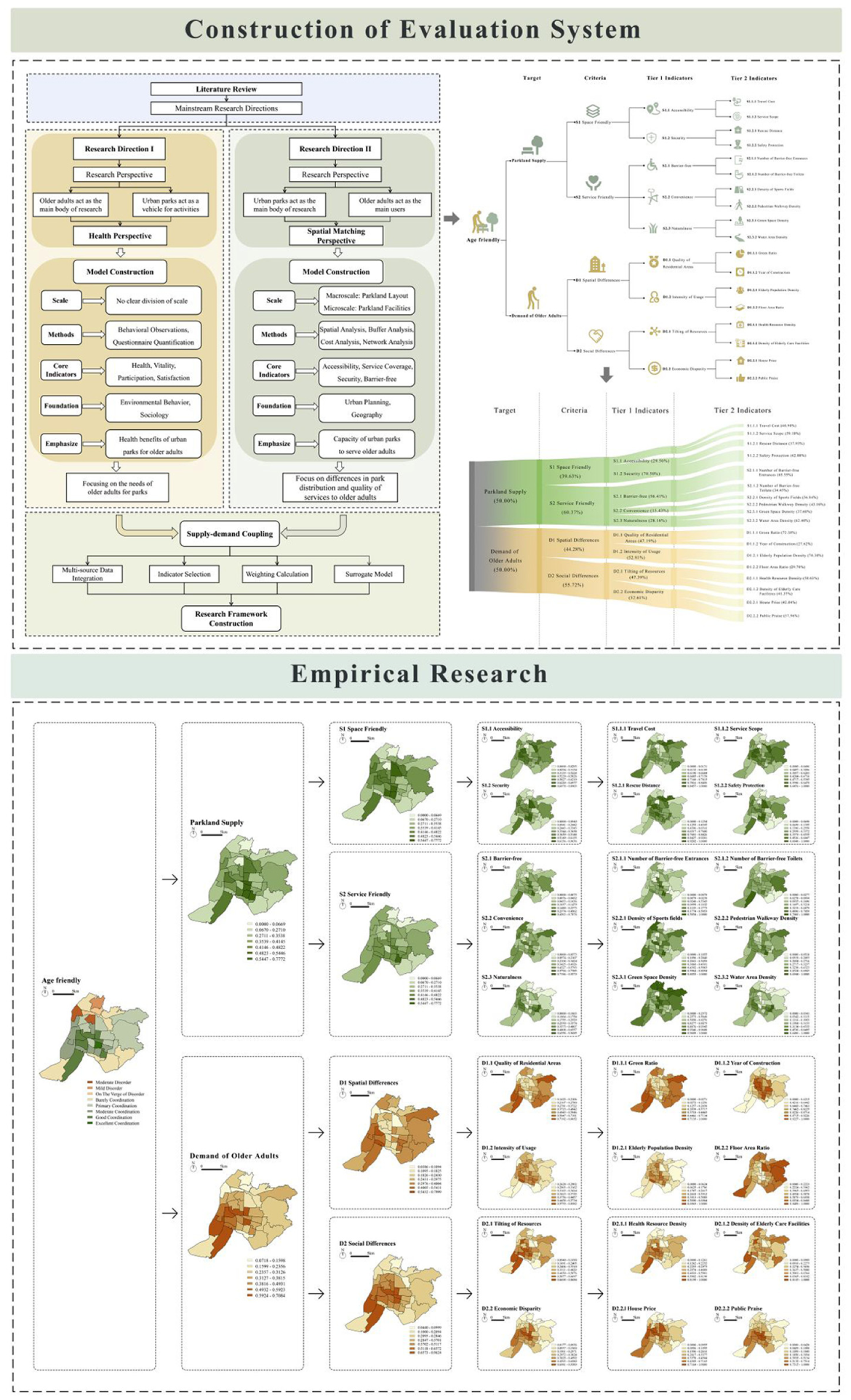
In response to the global challenge of population ageing, active ageing has emerged as a key strategy. Urban parks, as core elements of an age-friendly city’s physical and social infrastructure, play a vital role in enhancing older adults’ well-being. This study aims to construct a framework for age-friendly park development integrating dual supply–demand perspectives. The framework systematically defines Space Friendly and Service Friendly attributes under the supply dimension, and Spatial Differences and Social Differences under the demand dimension. Space Friendly denotes the accessible, safe, and comfortable physical design of parks. Service Friendly encompasses soft services such as management, maintenance, and programming. Spatial Differences address heterogeneous demands arising from geographic location and park type. Social Differences focus on diverse needs stemming from socio-economic status. By utilizing the Coupling Coordination Degree Model (CCM) and the Entropy Weight Method, this study developed a comprehensive evaluation system. The model results indicated that Space Friendly and Service Friendly were weighted at 39.63% and 60.37%, respectively, while Spatial Differences and Social Differences were weighted at 44.28% and 55.72%, respectively. The results in the research area indicated that 8.11% of the blocks fell into the Disorder Recession Class, 24.33% belonged to the Transitional Development Class, and 67.56% were classified under Coordinated Development Class. Overall, the age-friendliness of park resources in the study area was relatively high. Nevertheless, significant spatial disparities existed between the central areas and peripheral areas. Based on the characteristics of different blocks, this study proposed targeted optimization strategies. By offering quantitative tools and strategic guidance, this research provides an interdisciplinary method on evaluating age-friendliness of urban park resources.
Get full access to this article
View all access options for this article.