




Abstract
Age-Friendly Cities and Communities (AFCC) is a key global WHO initiative aimed at fostering environments that promote healthy aging for everyone. As AFCC initiatives continue to expand, there is an increasing need to enhance monitoring and evaluation systems to effectively assess their progress and impact. However, significant knowledge gaps persist, particularly in the development of evaluation methods and AFCC indicators. Drawing on discussions and outcomes from an international, interdisciplinary expert meeting on age-friendly environments held in Shanghai in May 2024, this article offers a synthesis of key insights and reflections. We present examples from AFCCs in the Western Pacific and Nordic regions, and recommendations to enhance monitoring and evaluation with a focus on indicators. This includes defining clear objectives, addressing the diverse needs of target groups, tailoring evaluation methods, and assessing both the processes and outcomes of AFCC initiatives. Regarding AFCC indicators, we argue that several areas require further attention, including the need for a robust framework that emphasizes equity and inclusivity and the varied experiences of older adults. For example, this framework should guide the development of indicators that address older adults’ needs during life transitions, reflect societal transitions, and leverage interconnected age-friendly domains to promote health and well-being. We recommend developing AFCC indicators through participatory and developmental processes that encourage stakeholder engagement, particularly involving older adults. Research is needed to develop context-specific indicators and evaluation tools through local and regional studies, validate the indicators across diverse contexts, and incorporate global best practices for using indicators to achieve policy impact.
Introduction
Population aging is a demographic shift that comes with complex challenges and opportunities. Healthy aging, as a key approach to address the challenges associated with aging, emphasizes improving and maintaining the functional ability that enables well-being in old age (World Health Organization [WHO], 2021). While the healthcare sector plays a crucial role in promoting healthy aging, it is essential to recognize that health and well-being are significantly influenced by factors in other sectors of society, such as economic security, housing, neighborhood environment, and social services. Thus, even if cross-sectoral collaborations are in place and functioning, further action is needed to align them with the goal of creating age-friendly cities and communities that foster healthy aging.
Various practices promote health and well-being across the lifespan, with the aim of recognizing the diverse capacities and circumstances of older adults. These practices focus on anticipating and responding equitably to their needs and preferences, respecting their decisions and choices, and protecting the most vulnerable (WHO, 2023). These efforts are supported by the World Health Organization (WHO) Global Network for Age-Friendly Cities and Communities (GNAFCC), which offers a promising approach to promoting AFCC initiatives. As of December 2024, 1705 cities and communities in 60 countries have joined the GNAFCC, implementing policies and programs to become more age friendly (WHO, n.d.a).
Monitoring and evaluating AFCC initiatives remains challenging and understudied. A survey of 102 members of GNAFCC found significant challenges: 26 of 83 responding communities reported difficulties in monitoring their programs, and 39 struggled to evaluate outcomes and impact (WHO, 2018). Despite the expansion of monitoring and evaluation efforts, critical reviews of the AFCC literature highlight a lack of empirical research on evaluating the impact of specific processes (i.e. engage and understand, plan strategically, act and implement, and evaluate) or long-term outcomes for older adults and other stakeholders (Golant, 2014; Lui et al., 2009). Although older adults are recognized as key stakeholders in monitoring and evaluation systems, evaluation of the effectiveness of their involvement is scant, particularly in terms of challenges in translating that involvement into meaningful influence (Kong et al., in press). Optimizing monitoring and evaluation systems for AFCC initiatives is crucial for making decisions, sustaining progress, and enhancing the effectiveness of initiatives. Thus, there is a need to expand the understanding of the characteristics of effective processes, the conditions under which they work, how they operate, and who benefits from them (Lehning and Greenfield, 2017). There is a demand for improved technical guidance and evaluation tools to strengthen monitoring and assessment practices.
The Western Pacific and Nordic regions represent valuable and different perspectives on age-friendly environments. Both regions include super-aged countries, such as Finland and Japan, where older adults make up >21% of the total population (United Nations Population Division, 2024). The Western Pacific is home to some of the world’s fastest-aging societies (e.g. Brunei Darussalam, Singapore, South Korea, and Vietnam) (Xu et al., 2023). The diverse sociocultural, economic, and technological contexts of these regions have shaped varied approaches to foster age-friendly environments. Although a limited number of cities and communities in these regions are formal members of the GNAFCC, several age-friendly environment initiatives showcasing various perspectives and practices do exist. Bringing together experts from these regions can facilitate a richer exchange of ideas and experiences in monitoring and evaluating AFCC initiatives.
This article aims to synthesize and reflect on discussions and outcomes of the Expert Meeting on Fostering Age-Friendly Environments: Bridging Science, Policy, and Implementation, hosted by the Nordic Centre, Fudan University, Shanghai, China (May 27–31, 2024). With a particular focus on AFCC indicators (a key tool for monitoring and evaluation), the meeting sought to share scientific evidence and practical knowledge of initiatives on age-friendly environments from the Western Pacific and Nordic regions, explore how evidence can be translated into context-appropriate policy and programs, and discuss key issues surrounding monitoring and evaluation. In the meeting context, monitoring and evaluation covers multiple angles: assessing local and national programs, evaluating specific interventions like campaigns, and examining the role of support mechanisms for member cities and communities. We used the discussions and reflections to provide insights into advancing AFCC initiatives through improving monitoring and evaluation systems and refining AFCC indicators.
The state-of-the-art on monitoring and evaluation of AFCC initiatives
Several countries such as Canada and Ireland through their affiliate programs have implemented monitoring and evaluation programs for AFCC initiatives at the national and provincial levels (Gibney and Shannon, 2018; McDonald et al., 2023; Menec et al., 2014; Orpana et al., 2016). In the Netherlands, the Age-Friendly Cities and Communities Questionnaire (AFCCQ) was developed and validated as a tool to measure and monitor urban age-friendliness (Dikken et al., 2020). The AFCCQ has been adapted in various country contexts, reflecting emerging global expertise and interest in using the tool to inform age-friendly policy and practice (WHO, n.d.b). These initiatives, often based on the WHO framework but tailored to specific national contexts, demonstrate that AFCC initiatives can be assessed quantitatively, qualitatively, and critically to determine if expected outcomes are being achieved and identify factors influencing implementation. Evaluations vary in focus, with some emphasizing the process and assessing the implementation, procedures, and operations of the initiatives (Menec and Brown, 2022). Others are concentrating on outcomes, and measuring the impacts on older adults’ health and well-being as well as on systems and organizations (Dellamora et al., 2015). A scoping review of the literature on AFCC initiatives found that most studies focused on North America, Western Europe, and Australia (Forsyth and Lyu, 2024), underscoring the importance of exploring perspectives from underrepresented regions.
Various sets of AFCC indicators have been developed to help stakeholders build capacity and provide tools for evaluating progress (Fallahi et al., 2024; Gibney and Shannon, 2018; Kim et al., 2022; Lee and Kim, 2020; Orpana et al., 2016). The Age-Friendly Environments in Europe: Indicators, Monitoring and Assessments toolkit (World Health Organization Regional Office for Europe, 2018) offers a general structure for selecting an indicator set, and encourages national governments to design their own toolbox of indicators, assessment instruments, and information systems (World Health Organization Regional Office for Europe, 2018). The toolkit facilitates the assessment and comparison of AFCC on the global level, serving as a catalyst for change in communities at any stage of becoming more age-friendly (Kano et al., 2018) and providing a common language. The WHO indicators have been adapted to align with community needs and priorities while considering operational feasibility and actionability at local, national, and regional levels (Cuadrado et al., 2022; Fujihara et al., 2025; Orpana et al., 2016). However, as the global interest in indicators grows, concerns have emerged from both technical and political perspectives. These include issues related to the validity, reliability, and transparency of the indicators, and the use of indicators to govern actors, societies, and states (te Lintelo et al., 2020). Thus, it is necessary to critically reflect on these indicators to assess their relevance, usability, and adaptability in addressing societal challenges and the needs of older adults in diverse contexts across the globe.
Developing context-relevant AFCC indicators is an extensive and participatory process involving iterative planning, screening, and evaluation phases (Orpana et al., 2016). Literature reviews were often utilized to identify existing AFCC indicators or characteristics from different contexts (Fallahi et al., 2024; Orpana et al., 2016; Rugel et al., 2022). Those indicators include self-reported and objective measures (Hansmann et al., 2024). Participatory approaches were employed to screen, prioritize, validate, or revise AFCC indicators based on importance, feasibility, and potential impact. For instance, multiple rounds of consultations with experts and stakeholders from diverse backgrounds were conducted in Canada to rank and refine the indicators (Orpana et al., 2016). In Taiwan, expert opinions were gathered and analyzed using a modified Delphi method to revise AFCC indicators (Huang et al., 2022). In South Korea, a regional survey of older adults was carried out to select AFCC indicators with sufficient reliability (Lee and Kim, 2020). Community-based environmental assessments were conducted in several studies (Buckner et al., 2019; Kim et al., 2022; Rugel et al., 2022) to identify specific needs and environmental features of different communities, ensuring that AFCC indicators accurately reflect each community’s unique characteristics and needs. In addition, the Social Economic and Environmental Impact Tool (SEE-IT) provides a framework for local authorities to conduct ex-ante and ex-post evaluations of age-friendly interventions in co-creation with community stakeholders (Ferri Sanz et al., 2018). A literature review identified 25 environmental assessment surveys that differed significantly in topics addressed, total number of questions, questions per domain, rigor, and availability (Dellamora et al., 2015). Despite these efforts, a knowledge gap remains regarding the specific actions stakeholders can take to collaboratively customize AFCC indicators for greater relevance and effectiveness.
Methods
The expert meeting in Shanghai, China, focused on evidence-informed approaches to creating age-friendly environments, bringing together policymakers and scholars from two Nordic and 11 Western Pacific countries with expertise in aging and health research or policy development (for details, see Online Supplementary Material). A central component of the meeting was three 50-minute panel discussions on AFCC indicators, each addressing one of the key domains (WHO, 2007): social, physical, and service environments. Each panel included five to six experts and was moderated by WHO officers from the Western Pacific. The discussions were guided by three key questions: (1) How relevant is the WHO framework of AFCC indicators to your country? (2) Which indicators are essential, and what new domains and indicators should be considered in response to societal transitions? (3) What are the key challenges and opportunities affecting the use of AFCC indicators in monitoring and evaluation? Following the panels, a 20-minute session with panel moderators synthesized key insights and identified cross-cutting areas. Data were collected during the meeting. The panel discussions were transcribed in real-time using a digital speech-to-text service, producing written records for cross-referencing and analysis. A deductive thematic analysis (Braun and Clarke, 2006) of these records was performed, focusing on two analytical areas: evaluation and monitoring systems, and themes requiring greater attention for indicator refinement. Supplementary data on AFCC evaluations from selected Nordic and Western Pacific countries were provided by participants after the meeting, see Online Supplemental Material.
Findings
Key recommendations to strengthen monitoring and evaluation
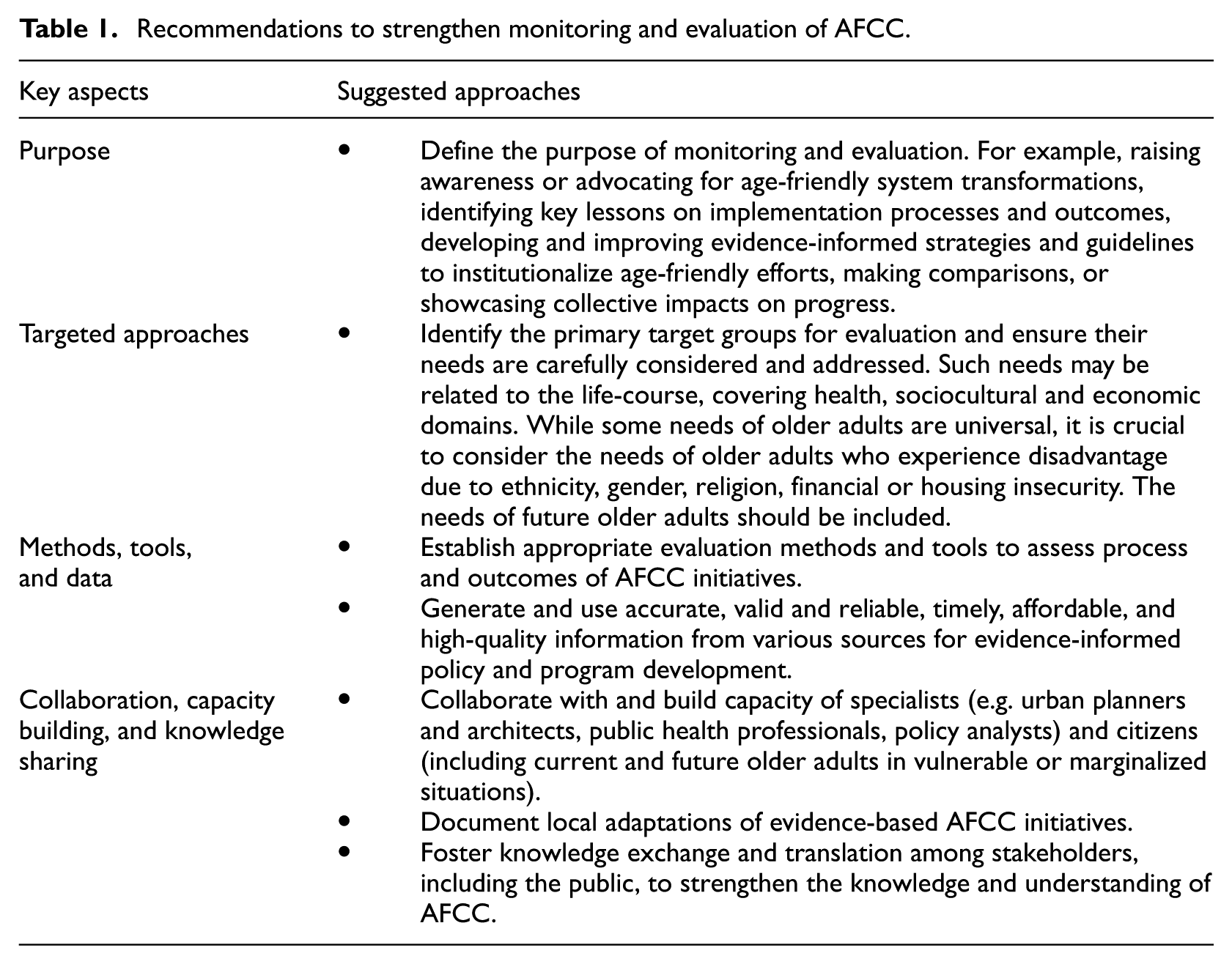
Key recommendations that show promise for future use of AFCC monitoring and evaluation in diverse contexts are, for example, defining the purpose of monitoring and evaluation and identifying the primary target groups for assessment, see Table 1. Such recommendations have the potential to enhance the understanding of evaluation practices across cultures and help institutionalize activities. Evidence-informed approaches to monitoring and evaluation were emphasized (see Online Supplemental Material).
Recommendations to strengthen monitoring and evaluation of AFCC.
Areas for improvement in AFCC indicators
Effective monitoring and evaluation can be guided by indicators that measure the extent to which a city or community is becoming more age-friendly. In this context, we focus on indicators designed for community and city-level use, grounded in the perspectives of policymakers, researchers, practitioners, and older adults. However, AFCC indicators can risk oversimplifying comparisons between countries and regions, reducing the complexity of age-friendliness to standardized rankings. Global indicators that fail to account for resource limitations and other contextual factors may offer limited insight into local conditions, particularly in low- and middle-income countries. This underscores the importance of engaging older people in developing context-specific indicators to ensure relevance and effectiveness.
Most of the AFCC domains are interrelated, which is often insufficiently considered in evaluations. For instance, improvements in neighborhood environments can enhance social interaction and participation, delaying the need for social services and health care. Consequently, focusing on a single domain without acknowledging its interactions with others can lead to an incomplete understanding of how various factors jointly affect the well-being of older adults and their communities. Practical evaluations of AFCC initiatives often encounter challenges as different municipal departments tend to operate in silos and may downplay the impact of such interconnectedness. This can diminish the effectiveness of AFCC initiatives and result in resource and process redundancies. To address such issues, it is essential to develop a framework of AFCC indicators based on a systems-thinking approach (Thelen et al., 2023). The framework should emphasize the connections between indicators, promote a comprehensive understanding of the association of person–environment fit and well-being as people age, and advocate for inter-sectoral collaboration in monitoring and evaluation.
There is still room for improvement in AFCC indicators because the existing toolkit (WHO, 2015) tends to be inadequate in capturing the complex realities of older adults’ experiences, needs, and preferences across countries, regions, and cultures. As in any field considering aging and old age, recognizing that older adults are a heterogeneous population segment with diverse life situations and experiences is essential. While, for example, volunteering and employment measures are valuable, they may not capture informal work, especially care work, or the desire of older adults to extend their working lives beyond retirement. Similarly, lifelong learning occurs in informal settings, such as through online resources and community activities, often invisible to education-related indicators. Digital connectivity indicators, which typically measure Internet access, may not capture critical issues such as digital literacy, affordability, and the actual use of technology by older adults. Additionally, a strong focus on health and social services could overlook other essential services, such as infrastructure, culture, and public benefits. Moreover, indicators should be sensitive to accurately reflect the diversity among older adults, such as their ethnicity, disabilities, generational backgrounds, and levels of skill.
Indicators tend to be static, but individuals experience changes in personal needs, capabilities, and resources. Critical life transitions—such as leaving paid work, becoming a caregiver, or onset of a chronic illness—may increase the complexity and diversity of needs, and affect an individual’s capacity to respond to them. There is thus a need to consider indicators that assess how well individuals adapt to life-course changes, while also being foresight-oriented to monitor the availability of support systems that help older adults navigate transitions. For example, indicators should consider measures of preparedness, including aspects such as pension plans, savings, care plans, testaments, and housing accessibility, which can vary significantly across families and communities. An evidence-based approach should ensure the regular review and adaptation of indicators to remain responsive to changing conditions.
Turning to the societal perspective, multiple sets of AFCC indicators address community needs and priorities. However, given notable period effects, social development and global change there is a constant need to incorporate issues such as climate change, migration, urban aging, rural depopulation, war and terror situations, digitalization, macro-economic changes, and changes in family structures and intergenerational relations in the refinement of AFCC indicators.
Monitoring and evaluation also relate to equity and inclusion, which are aspects that are not sufficiently addressed by existing frameworks of AFCC indicators. Few indicators specifically track, for example, older women, informal caregivers, older adults in vulnerable situations, and those experiencing multiple disadvantages based on the intersection of age with marginalizing social positions. This underscores the need for analyses based on age, gender, location, socio-economic status, ethnicity, disability, and other relevant factors. To this end, indicator frameworks should enable policymakers and societal planners to recognize the importance of equity and inclusion, incorporate and cross-tabulate relevant indicators, and evaluate and compare outcomes on core AFCC indicators across communities and population segments.
Addressing changes requires indicator flexibility, but there are challenges in using flexible operational definitions. Many AFCC indicator guidelines prioritize flexibility in their definitions to enable cities and communities to tailor them to specific contexts. However, flexible indicator definitions can hinder valid comparisons between cities and communities and may even result in deviation from the intended purposes. Thus, the importance and efforts of cross-national adaptation and testing should not be underestimated. Despite the need for adaptability and the challenges involved in adapting AFCC indicators, it is essential to anchor them to a robust framework that centers core indicators aligned with their intended purposes, while adopting a person- and community-centric approach to evaluation.
Recommendations to customize AFCC indicators
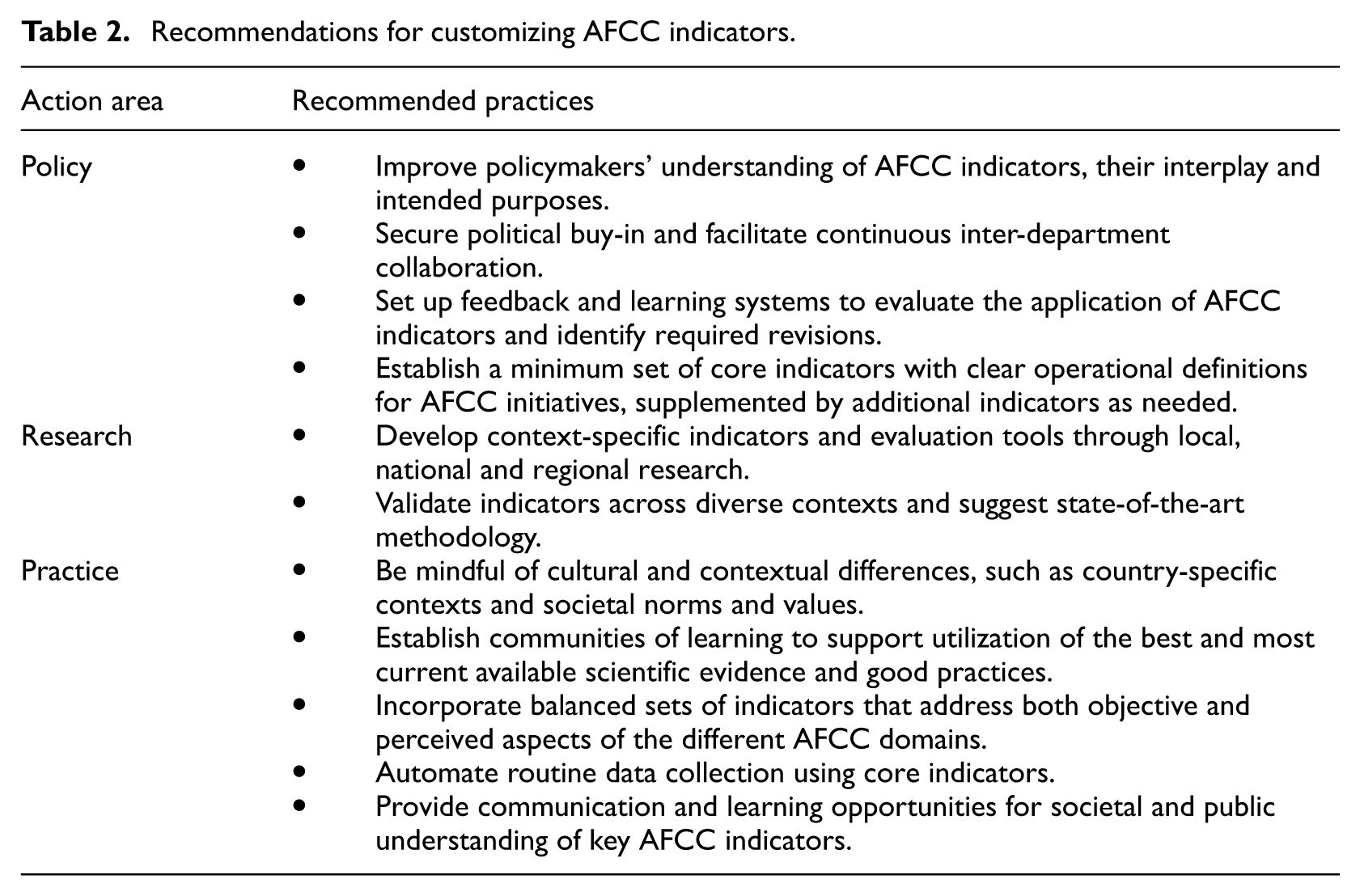
Customizing AFCC indicators involves aligning policy, research, and practice to ensure indicators are context-sensitive, culturally relevant, and adaptable, while fostering collaboration and public engagement (see Table 2).
Recommendations for customizing AFCC indicators.
Conclusion
In this article we present a synthesis and reflections on findings from the Expert Meeting on Fostering Age-Friendly Environments: Bridging Science, Policy, and Implementation, with a particular focus on monitoring and evaluation. Our paper contributes to advancing conceptual understanding and provides practical examples for developing and implementing meaningful and impactful monitoring and evaluation of AFCC initiatives. Specifically, we propose recommendations to improve monitoring and evaluation of AFCC. A considerable part of the findings concerns how to develop indicators that are purposeful, targeted, adaptable to local contexts, collaborative and participatory, data-informed, sensitive to diversity at all levels, equity-focused, and, to some extent, comparative. The findings highlight gaps in AFCC indicators, including their insufficient focus on the evolving needs and capacities of current and future older adults, potential new domains relevant to AFCC, period effects and ongoing societal transitions. Meanwhile, it is essential to acknowledge concerns regarding AFCC indicators, as they can exert pressure on targets to perform and conform and influence perceptions of what is considered socially legitimate or best practice. Although our article is shaped by expert opinions and a regional focus, these perspectives offer valuable insights that can inform and inspire global efforts to advance AFCC initiatives.
Supplemental Material
sj-docx-1-usj-10.1177_00420980251375852 – Supplemental material for Towards evidence-based approaches to monitoring and evaluatingage-friendly cities and communities: Reflections from the Western Pacific and Nordic Regions
Supplemental material, sj-docx-1-usj-10.1177_00420980251375852 for Towards evidence-based approaches to monitoring and evaluatingage-friendly cities and communities: Reflections from the Western Pacific and Nordic Regions by Wenqian Xu, Minna Zechner, Thava Viknaraj Sivabalan, Lian Leng Low, Changwoo Shon, Honglin Chen, Arlind Reuter, Diane Turner, Elisa Tiilikainen, Emi Kiyota and Susanne Iwarsson in Urban Studies
Footnotes
Acknowledgements
The authors thank Veli-Matti Palomäki and Xian Xu for organizing the expert meeting. The authors further thank the WHO for co-sponsoring the expert meeting and acknowledge Mikiko Kanda, April Siwon Lee, Sunghun Yun, and Ruikan Yang from the WHO for moderating the discussions. Special thanks go to Siti Munawwarah Binti Hj Md Tarif, Stephanie Sison, Jinhee Kim, Puxiang Ren, and Yan-Yan Chen for their valuable input to panel discussions. We also extend our appreciation to Xiaoyue Hu, Taobo Wang, and Chunyan Kong for their support with notetaking and transcription during discussions.
ORCID iDs

Funding
The authors disclosed receipt of the following financial support for the research, authorship, and/or publication of this article: The Council of Nordic Centre, co-sponsored by the World Health Organization Regional Office for the Western Pacific.
Declaration of conflicting interests
The authors declared no potential conflicts of interest with respect to the research, authorship, and/or publication of this article.
Data availability statement
The meeting report, meeting program and presentations are available upon request from the corresponding author.
Disclaimer
The views and opinions expressed in this article are those of the authors and do not necessarily reflect the views or positions of any entities they represent.
Supplemental material
Supplemental material for this article is available online.
References
Supplementary Material
Please find the following supplemental material available below.
For Open Access articles published under a Creative Commons License, all supplemental material carries the same license as the article it is associated with.
For non-Open Access articles published, all supplemental material carries a non-exclusive license, and permission requests for re-use of supplemental material or any part of supplemental material shall be sent directly to the copyright owner as specified in the copyright notice associated with the article.
