




Abstract
This article proposes moving beyond the tyranny of economic imperatives towards a human needs-based framework to assess cities and envision their development. Existing calls for such a transition lack a foundation able to capture the various dimensions of human life in cities, which can be provided by the concept of human needs. We ask whether cities deliver satisfiers that make them good places to cater for the full range of human needs in a similar way to how they cater for economic needs. The article develops a framework that allows us to address that question. We show how the main debates in human needs theory are illustrated by urban phenomena, and search for a human needs model which is able to advance those debates and tackle the problem specifically in cities. Then we highlight the specifically urban aspects of needs satisfaction processes and construct a table of indicators to assess how cities fare in that respect, ensuring global comparability as to whether, as well as local contextualisation as to how, needs are satisfied.
Introduction
The rise of the so-called ‘urban age’ and its raft of theoretical concepts, development proposals and policy agreements reflect the notion that cities are the places where current societal promises and problems play out and their futures will be determined (Caprotti, 2018). However, hierarchical thinking in urban economics, often favouring the largest cities, the most dynamic activity sectors and the pursuit of material priorities over other aims, has limited the ways in which the qualities of cities are assessed and their future is envisioned.
Agglomeration effects in cities improve economic performance measures – productivity, employment, income – and the return on individual pursuits is bigger. Both people and firms may become better off in cities (Glaeser, 2011) and the merit is given to free markets and growth-oriented policies, downplaying the role of public service delivery and the vast inequalities that underlie the net gains. The attractiveness of cities is therefore assessed mainly through economic aspects (including attempts to quantify non-economic dimensions) and people are modelled as rational agents pursuing instrumental ends (Cardoso et al., 2019). As a result, future urban development is strongly dominated by technical, economic and efficiency lenses (Caprotti, 2018; Rossi, 2016). In these paradigms, the city is a planning and engineering problem to be solved ‘smartly’, in order to strengthen business-as-usual paradigms of growth and sustain the imperative of efficient and accelerated flows.
How urban spaces respond to the material, profit-oriented needs of individuals and firms has been widely studied. But this happened at the expense of assessing a broader range of criteria, limiting the interest in cities to a narrow dimension of human life. The dominance of this approach in urban research and policy is increasingly being contested by different alternatives, as ‘neo-liberal’, ‘global city’ and even ‘pandemic urbanisms’ fail to meet the needs and ambitions of a substantial part of the urban population. 1 Indeed, neither did cities emerge only to satisfy capitalist productive and consumer economies, nor are the motivations and agency of people moving to cities reducible to an economic progress framework. Explaining the concentration of people in cities requires a broader perspective. It is urgent to examine how cities serve people beyond market imperatives, and to find a broader framework of urban evaluation that puts economic priorities in their proper place, as one of the many dimensions of human life and well-being.
This article argues that the concept of human needs is a strong contender for such a framework. Human needs have been defined in many ways, from universal drivers of human life in societies to merely subjective cultural constructs (Doyal and Gough, 1991). But in general, they refer to the set of requirements – personal, economic, social and political – for people to avoid serious harm, realise their aims, lead a satisfactory life and participate in societal development. Needs tend to be seen as constant and potentially universal (Tay and Diener, 2011), while the ways to satisfy them – the satisfiers, in the disciplinary vocabulary – change according to time, place and context. Different lists of needs have been created by psychologists, sociologists, economists and political scientists and their representation, either as a pyramid going from basic to advanced needs (Maslow, 1943) or as a network of interdependent elements (Max-Neef, 1992), has been widely questioned. How many needs exist, and whether some are subsets of more fundamental needs, is also not agreed upon (Ryan and Deci, 2000), although many scholars see subsistence, protection, affection, leisure, understanding, participation, creation, identity and freedom as a fair summary.
The human needs dimension is certainly implied in assumptions that cities make us ‘richer, smarter, greener, healthier and happier’ (Glaeser, 2011) but all these qualities are still framed as by-products of underlying economic progress mechanisms, rather than a direct valorisation of all the needs of human beings. Here, we are reminded that people have a variety of economic, but also social, physical and psychological needs, whose satisfaction drives their life choices, including living in cities. We therefore ask whether cities might deliver satisfiers that make them good places to meet the full range of human needs, in a similar way that they meet the needs of economic agents. We do not know the answer to this question – and will not answer it here – because the literature on how cities fare regarding different human needs is fragmented, often focusing on local contexts, specific needs and normative answers about their ‘best’ satisfiers. Lacking an integrated human needs approach to cities, we do not know how to observe them through this lens. Sketching such a framework is the main objective of this article, with the ultimate hope that the answer to our question is positive.
Many calls for alternative, human needs-based urban development values exist, focusing on sustainability, resilience, happiness and well-being, spatial justice etc. (Caprotti et al., 2017; Kaika, 2017; UN-Habitat, 2016). Of particular interest in a period of global overconsumption and environmental risks is Gough’s (2020) use of human needs to determine a lower and upper threshold for human well-being on the planet. Other scholars engage with minimum requirements for needs satisfaction (Rao and Min, 2018) or particular subsets of needs (Brand-Correa and Steinberger, 2017; Sahakian and Anantharaman, 2020). However, considering their disciplinary origins, these studies mostly focus on material conditions (which are undoubtedly central to needs satisfaction) and their respective solutions (‘what to do’). With notable exceptions (see e.g. Ottaviani, 2018), the grouping together of well-being, sustainability and needs debates is often underwritten by ‘progress-towards’ assumptions about a desirable end state for cities and ambitions for a technical fix for urban development that serves human life better. Important as that is, here we take a less prescriptive position, theoretically more fundamental and exploratory and substantively more open to multiple trajectories and multiple profiles of needs satisfaction in cities.
The article continues by listing the main debates in current human needs theories and the requirements of a framework that responds to them. In the third section, we show how some distinctive urban features illustrate these requirements and exacerbate their challenges, justifying the urgency of advancing the human needs debate in cities. In the fourth section, we argue that, among several approaches to human needs, a suitable model which responds to the theoretical challenges of the discipline and can tackle the problem in cities already exists, namely the Human Scale Development theory of Max-Neef (1992). We highlight the nexus between the properties of this framework and the processes of human needs satisfaction in cities. The fifth section sketches a way to operationalise the framework so that it becomes a useful tool to assess and envision how cities may satisfy human needs, searching the literature for the fundamentally urban aspects of needs satisfaction and building a table with their respective (provisional) indicators. We finish by discussing the limitations of our approach and proposing a research agenda on human needs satisfaction in cities. The underlying challenge is how to develop cities as systems to cater for human needs within environmental, resource and social justice constraints. With this contribution, we aim to discuss what questions should be asked in order to face that challenge.
Human needs theories: Main debates
A large body of literature has focused on human needs to address socio-economic and ethical issues, such as poverty, well-being, social exclusion, human rights and sustainability. This literature stems from different perspectives on the topic provided by philosophy (from early Greek philosophers to Marx, Rawls or Habermas), social studies (Ormel et al., 1999), psychology (Maslow, 1943), religion (Batson and Stocks, 2004) and economics (Max-Neef, 1992; Sen, 1985). Five main challenges have consistently dominated the debate, as detailed below.
The exact meaning of ‘human need’
No consensus exists about the exact meaning of ‘human need’. Doyal and Gough (1991) relate this ambiguity to the different ways in which this term is employed: as an intrinsic, mostly universal, individual motivational driver; as a societal prerequisite to attain a set of objectives; or as a normative policy priority to be executed (Gasper, 2007). These interpretations correspond to the different lenses that may be used by psychologists, sociologists and political scientists, respectively, but are not mutually exclusive. Some authors, like Max-Neef (1992), propose a matrix of needs and different categories of need satisfiers to reflect these individual, societal or political outlooks. Available satisfiers depend on whether a ‘need’ in a certain context is expressed by individual attributes, material assets, objective actions or societal interactions. In that framework, all interpretations coexist but some need our attention more than others at different times and places.
(Non-)hierarchical relations between human needs
Models take opposing views on the relation between needs, contesting whether they follow a strict hierarchy. In his famous formulation, Maslow (1943) develops a pyramid in which satisfying basic needs (like protection and subsistence) is a prerequisite to attain higher levels of satisfaction (like status or self-actualisation). Up to a point, very basic needs have to be satisfied in order to avoid serious harm (Doyal and Gough, 1991). But beyond that, the preference for the sequence and extent of needs satisfaction is up to individuals and their interaction with contextual factors, including power relations and other people’s needs. For instance, we may risk basic needs, such as safe housing, in order to satisfy higher ambitions such as finding better jobs – and sometimes not even for our own sake but for our children. Critics of Maslow therefore see needs as an interrelated system of trade-offs between non-hierarchical priorities, subject to changes in time and external influences, whose satisfaction is partly independent of each other (Tay and Diener, 2011). Linear and individualistic pyramids, such as that of Maslow, neglect this complexity.
Subjective versus objective definitions of human needs satisfaction
Theories assess differently whether needs satisfaction should be defined subjectively, as the fulfilment of preferences and desires which lead to perceived well-being, or objectively, as the attainment of concrete necessities which allow a fully functioning life (Diener, 2007). Clearly, levels of needs satisfaction may be assessed by well-being studies as much as policy evaluations – the differences are more in the position of the observer than in the substance observed. However, the subjective perception of needs satisfaction, while associated with well-being (Tay and Diener, 2011), is not a simple function of the objective presence of satisfiers (Okulicz-Kozaryn, 2013). Veenhoven (2000) finds other factors affecting this non-linear relation. He extends the common distinction between qualities present in the environment (objective satisfiers) and those perceived by individuals (subjectively), to include the opportunities for, and outcomes of, a satisfactory life. The result is a matrix of four qualities of life: liveability of the environment (satisfiers), life ability (capabilities), utility of life (externalities) and appreciation of life (happiness).
Human needs between theory and application
There are questions about the disciplinary standing and social purpose of needs satisfaction theories: critiques of Maslow’s model and its offspring note how it is ‘packaged as an eye-pleasing pyramid’ (Bouzenita and Boulanouar, 2016: 63), a ready-to-serve model widely used in advertising, business studies, marketing and other related disciplines. In other words, it is an academic tool, useful to generalise about human psychology and whose main purpose is to be applied to the subject by the observer. However, authors who employ human needs as a core concept of welfare economics, development studies and sustainability highlight their socio-political embeddedness and the role of individual and collective capabilities – real-world opportunities to be and do as desired (Max-Neef, 1992; Sen, 1985). For these authors, rather than distant academic lenses, needs satisfaction theories should be realistic, social and able to be appropriated by policymakers and communities as work-in-progress tools to improve lives and minimise environmental harm.
The universality of human needs
Despite the criticisms of well-established ‘universal’ human needs lists as ethnocentric (Hofstede, 1984) and based on western culture, namely the ‘highly individualistic society of the U.S. in the 1950s’ (Bouzenita and Boulanouar, 2016: 63), comparative studies suggest that the basic needs commonly accepted in the literature, though vaguely formulated, are indeed universal (Tay and Diener, 2011). There remains, however, the easily graspable fact that ‘needs’ do seem to vary according to place, time and socio-political context. The question then is what changes exactly – what is different about the ‘needs’ of a contemporary capitalist society and those of pre-industrial societies, and in what sense do ‘needs’ differ across western and eastern cultures or the Global North and South?
In summary, the open debates in human needs satisfaction theories suggest moving towards a framework that responds to the following requirements:
Captures several parallel meanings of ‘needs’ as individual drivers, societal and spatial prerequisites and policy aims, in the sense that these can be employed individually or combined according to the purpose of the approach.
Provides a non-hierarchical and systematic model of fluid and interrelated needs, allowing frequent priority changes and trade-offs between people, households and extent of satisfaction in order to be fulfilled.
Considers objective and subjective needs satisfaction and the factors interfering in their relation, as well as the opportunities for, and useful outcomes of, needs satisfaction for individuals and groups.
Departs from laboratorial lenses and readily applicable models to become a useful societal tool, able to diagnose inequalities and development priorities and be adopted – and adapted – by communities.
Allows compatibilisation between the potential universality of human needs and their contrasting manifestations and forms of satisfaction in different historical, social and cultural contexts, specifying what actually changes.
Linking human needs satisfaction to cities
A framework fulfilling these demands would be quite appropriate to observe and evaluate the processes of human needs satisfaction, especially in cities. This is because there are some predominantly urban phenomena that offer clear illustrations of the debates mentioned above and that justify why cities are locations where the human needs lens becomes highly relevant and its challenges can be witnessed and tackled – namely challenges which have an impact on social and spatial justice if they remain unaddressed. To guide the reader, we address five discussions in urban studies which relate to the five requirements above in the same order:
In societal settings, but especially in cities, people do not satisfy their needs and ambitions as isolated beings freely employing individual agency, but in a complex ecosystem which includes the effects and constraints of social agglomeration and interaction, and unbalanced power relations between groups, political norms and cultural values. For each of these categories, different facilitators or inhibitors of needs satisfaction are available – satisfying the need for protection (shelter), for instance, can depend on the individual motivation to actively search for a place to live, the available housing stock, the social hierarchies in the community and the political-economic system regulating the access to, and delivery of, housing. Which satisfiers represent each category and have a stronger role in fulfilling the need in question varies according to place and time, even if the underlying need remains constant.
What cities offer in terms of needs satisfaction is never a clear sequence of separate elements allowing a rational either/or choice and a linear climb of Maslow’s hierarchy, but a suboptimal bundle of entangled satisfiers and dissatisfiers forcing trade-offs between different needs (Storper, 2014), with changing importance over time and distributed priorities among groups. A good illustration is residential location choices, where the satisfaction of different needs is negotiated by households deciding whether good schools, spacious houses or leisure amenities are more important. This is not a just system, however, as choices are more limited for some people and in some spaces, to a point that even the assumption that basic needs must always come first has exceptions: many vulnerable urban dwellers may reduce satisfaction of basic subsistence needs to ensure that the educational needs of their children are met; and rural dwellers in some parts of the world may endanger the need for shelter in the name of an uncertain migration to cities to satisfy needs for freedom and identity.
The misalignment between the objective presence of satisfiers and people’s perception of their level of satisfaction increases with the complexity of urban settings. For instance, subjective well-being is not only related to one’s predisposition or achievements but also to the perceived conditions of the nearby community (Nieuwenhuis et al., 2017). Moreover, in cities, Veenhoven’s (2000)‘opportunity/capability’ and ‘outcome/utility’ factors particularly affect the link between satisfiers and satisfaction. On one hand, cities gather both opportunities and restrictions affecting the ability to choose one’s life course – the subsistence or protection provided by a well-equipped city under an authoritarian regime may be less valued if needs for freedom and leisure are not satisfied. On the other hand, the clustering and diversity of urban activity generate externalities which may scale up the outcomes of needs satisfaction: as shown by endless stories of urban innovators (Hall, 1998), an individual contribution to culture, technology or the economy can result in larger and unanticipated satisfiers for society.
Developments in recent decades in urban governance have increased the demand for local participation and shared structures of decision-making, echoing the debate about the social purpose of human needs models. Top-down approaches are often seen as place-blind and, especially in large metropolitan areas, too focused on the narrative of economic success, with little regard for other needs (Peck, 2016) and for groups who do not contribute to that narrative. Indeed, the withdrawal of collective responsibility and public intervention in the city is often framed as a bottom-up empowerment of free and rational citizens (Amin, 2013). But passing on responsibility to individuals without providing them with the necessary devices to develop their capabilities – such as a useful framework of needs satisfaction that allows communities to choose priorities and measure progress – is often a way to encourage the belief in better urban futures while perpetuating spatial and social injustices.
The question whether human needs are universal or place- and time-specific closely resembles the ongoing debate on whether cities have general features recognisable everywhere or each city is unique and irreducible. That debate was recently resumed by Scott and Storper (2015), arguing for the distillation of a universally valid ‘nature of cities’, and a series of scholars in the post-colonialist field strongly criticising the notion of ‘a universal grammar of cityness’ (Mould, 2016; Robinson and Roy, 2016; Roy, 2016: 200). This is a wide-ranging discussion outside the scope of this article, but the perspective of the opposing fields is strikingly similar to the human needs debate mentioned above – one stressing universality based on invariants of human activity and behaviour (and needs) in interaction with space, the other arguing that such generalisations are numbed by a Eurocentric lens, depoliticise societal constructs that affect specific locations, become blind to social and spatial injustices and make urban theory bland and useless in practice.
Human Scale Development as a human needs framework
Given these striking parallels, a well-suited approach to analyse needs satisfaction in urban environments must exist. Moving beyond the limitations of the still-popular ‘pyramid’ approach and its offspring, as well as from some existing approaches discussed earlier which we see as too specific and normative, we argue that a good candidate is the human needs framework by the Chilean economist Manfred Max-Neef (1992). Developed as an alternative to the dominant economic governance models which had prevailed in Latin America until the 1980s – Chicago-school neoliberalism and state-led developmentalism – Max-Neef proposes a new orientation based on bottom-up diagnosis and local actions aiming at the satisfaction of complementary economic and non-economic needs. This approach, based on his earlier Human Scale Development theory (Max-Neef, 1989), is at the core of sustainability thinking, including urban sustainability (Guillén-Royo, 2016). Max-Neef’s model is certainly not the only possible way to assess needs satisfaction for cities, but, following the sequence above, we can identify five advantages of applying it. They respond to the five main demands of human needs theory and, importantly, offer a way to tackle them as framed by their association with urban phenomena.
Parallel meanings of ‘need’
Max-Neef employs a set of nine ‘axiological’ needs broadly in agreement with much literature (subsistence, protection, affection, understanding, participation, leisure, creation, identity and freedom), which nonetheless manifest themselves differently according to four ‘existential’ categories: they may entail being in a certain state, having a certain asset, doing a certain action or interacting with a certain setting. These categories cover the spectrum of need satisfiers as emerging, respectively, from individual attributes, available economic goods, personal or collective agency and societal interaction, which come together and interact, more strongly and more problematically, in cities. In addition, the model is designed to identify (and address) the feedback relations between those categories of satisfiers.
Non-hierarchical system of needs
Human needs are treated as an interrelated system, moving from a linear to a systemic approach needed to evaluate the bundles of entangled satisfiers and dissatisfiers presented by cities and escape the ‘tyranny’ of economic needs as the main measure of well-being. Except for subsistence (to protect life), ‘no hierarchies exist within the system. On the contrary, simultaneities, complementarities and trade-offs are characteristics of the process of needs satisfaction’ (Max-Neef, 1992: 199). Adopting this logic in contemporary cities is also important because when hierarchical models assume that lower needs must always be satisfied first, otherwise higher levels can never be reached, they legitimise economic growth models of any kind, including those based on unjust and unsustainable policies (Van Gameren, 2013).
Different roles and interactions of satisfiers
Max-Neef qualifies the interaction between different need satisfiers in this interlinked system. Satisfiers are rarely singular, directly meeting only one need. They can be synergetic, satisfying several needs at the same time; inhibiting, satisfying one need while restricting another; or pseudo-satisfiers, providing a false perception of needs satisfaction. These qualifications are useful to understand the effects of needs satisfaction processes in cities, especially the alignment between actual satisfiers and perceptions, opportunities and outcomes, mentioned above: neighbourhood associations satisfy the need for participation, and may synergistically stimulate affection, leisure, creation and identity needs satisfaction; intrusive urban policing satisfies the need for protection but can reduce opportunities for freedom and participation; and typically urban fashions and fads pseudo-satisfy a perceived need for identity but may, in the end, harm the very need they were aimed at.
Adaptability and adoptability
The model was designed with regional and national development in mind, both economic and non-economic, in response to economic schools of thought in the Global South which failed to serve the majority of people. Rather than abstract and academic, it has a real-world ambition whose ‘emphasis is on empowering civil society to nurture this form of development. [...] to develop further the potential role of social actors, social participation and local communities’ (Max-Neef, 1992: 198). The model is practical and flexible and ‘may serve, at a preliminary stage, as a participative exercise of self-diagnosis for groups located within a local space’ (Max-Neef, 1992: 205). Cities, as places of concentration of community organisations and participatory processes, may profit from using this tool to assess needs satisfaction according to their priorities rather than relying on top-down intervention.
Universal needs and contingent satisfiers
The theory establishes that human needs are constant and universal, while their satisfiers vary according to time, place and context. As Caprotti (2018: 3) argues, a concept of human needs which is useful to envisage urban futures must be ‘both place-specific and related to broader agendas, and [allow] contextualisation in place-specific geographical and other factors’. The nexus between universal needs and contingent satisfiers ensures comparability between cities across the world as to whether and how much they satisfy human needs – which are the same in New York and Johannesburg – but is granular enough to avoid generalisations about what best satisfies needs in different places, allowing a more grounded operationalisation of the framework – whether in New York or in Johannesburg. As Max-Neef (1992: 203) writes, ‘satisfiers are what render needs historical and cultural’.
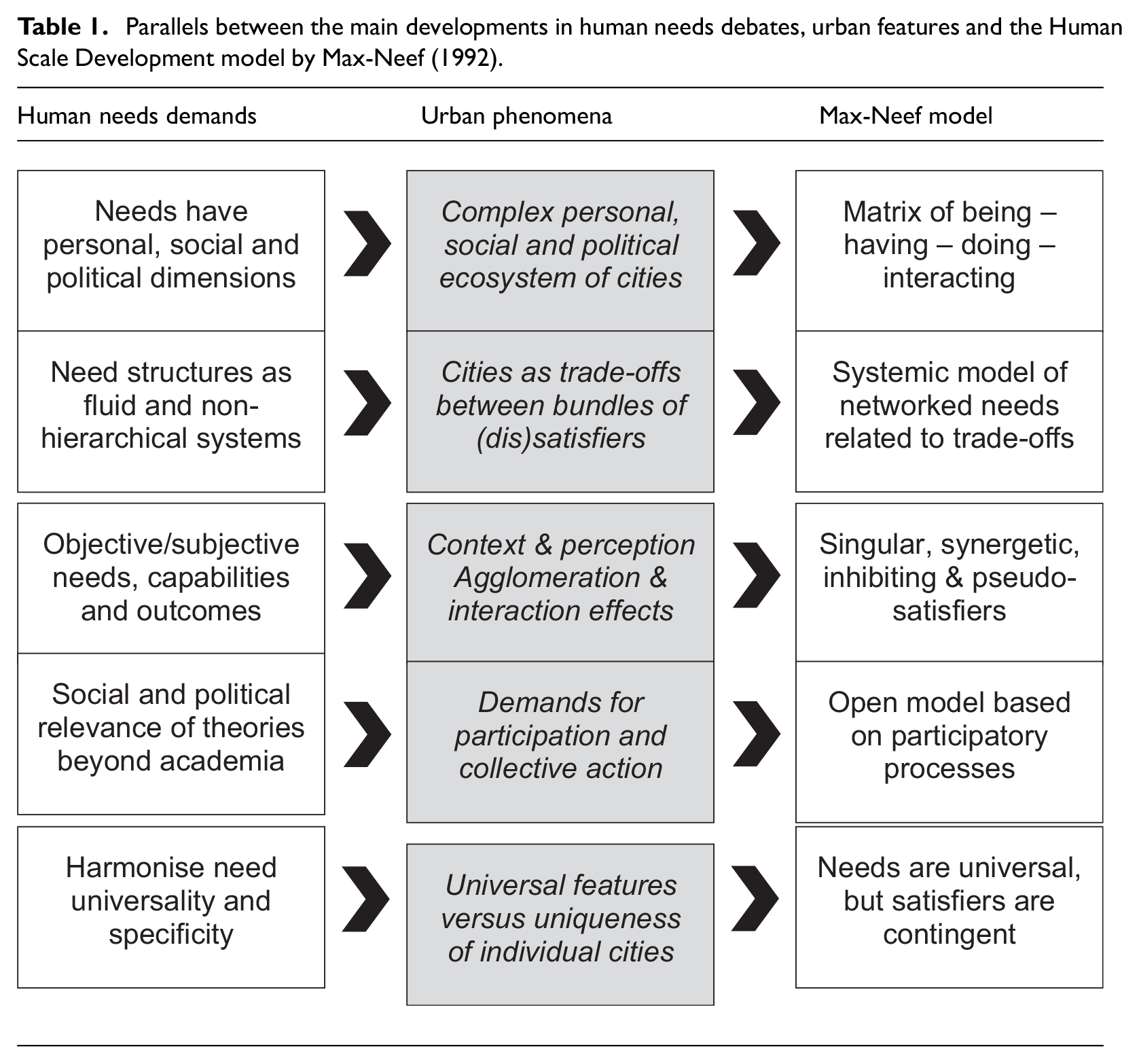
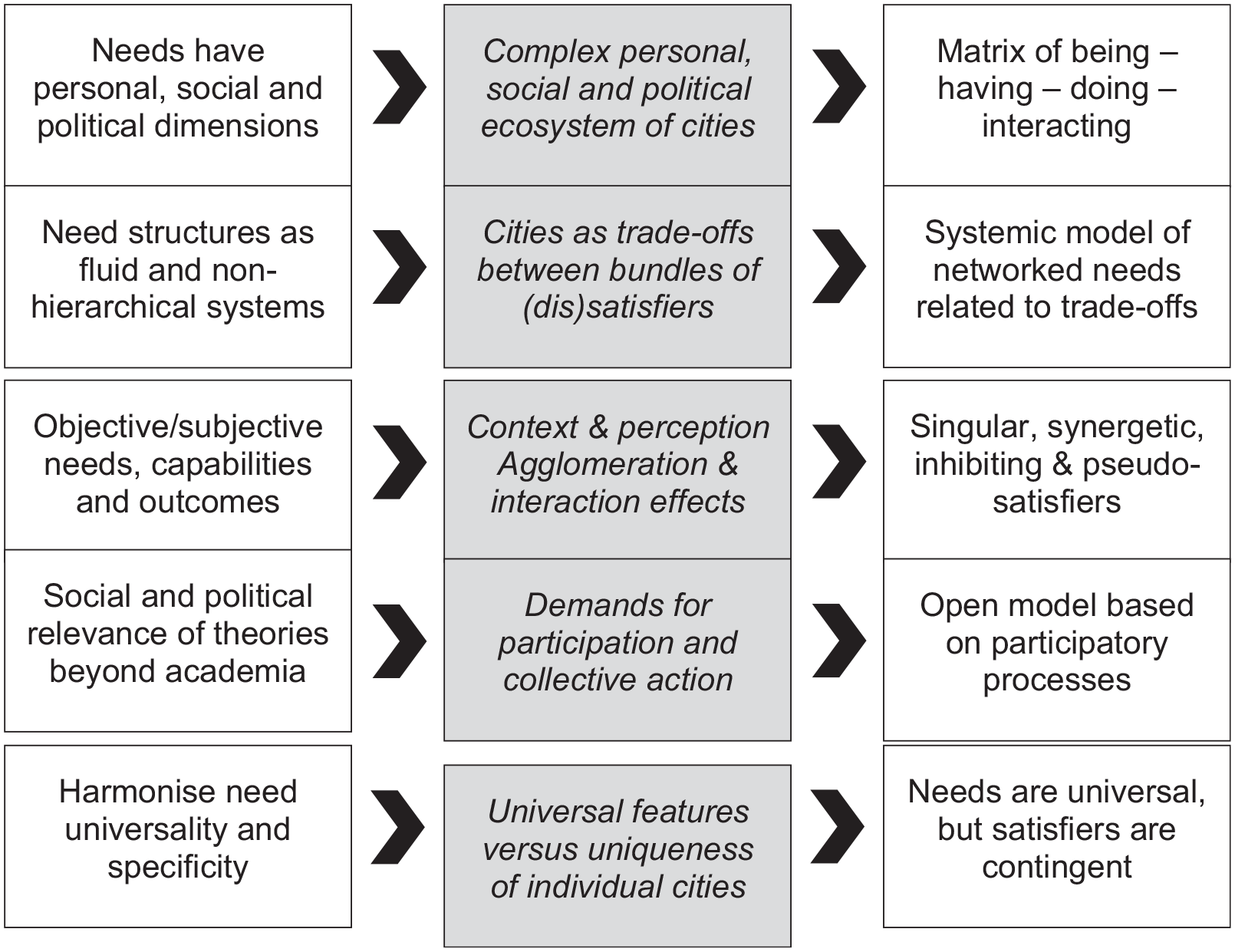
Other approaches have some of these advantages – see for instance the IBEST project in Grenoble, France (Le Roy et al., 2015; Ottaviani, 2018), where we recognise advantages two, four and eventually five – but Max-Neef still provides the most suitable model for our purposes. Table 1 summarises the main debates in human needs theory, the characteristics of cities which mirror these debates and the components of Max-Neef’s human needs model, thus justifying the suitability of the proposed approach and the urgency of discussing cities from a human needs perspective.
Parallels between the main developments in human needs debates, urban features and the Human Scale Development model by Max-Neef (1992).
Human needs satisfaction in cities: Operationalising the concept
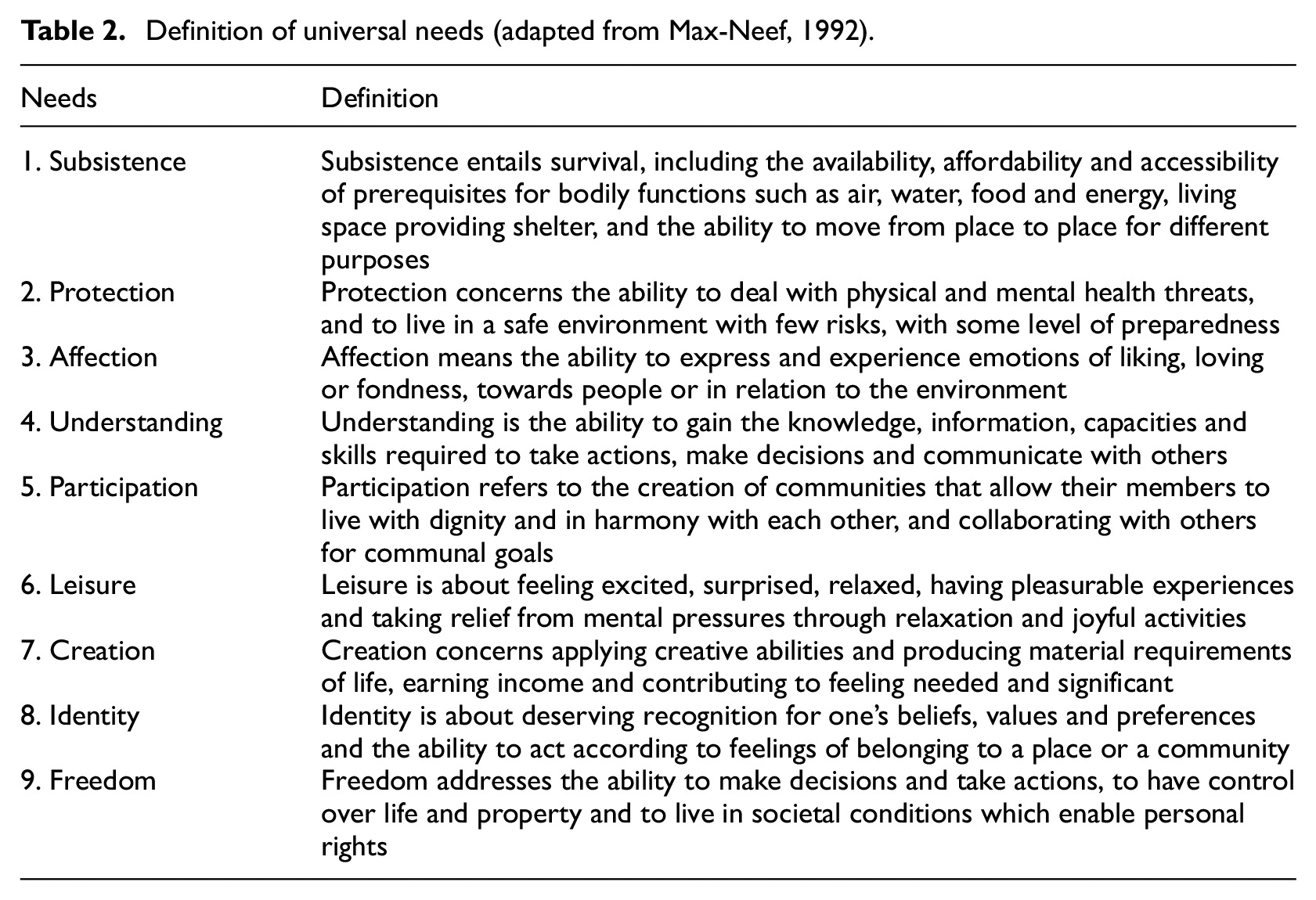
We can now start drafting what a useful system of human needs satisfaction for cities would look like. The aim is to explore the fundamentally urban dimensions of needs satisfaction or, in other words, in what way human needs are manifested in (and by) cities. That will make the concept of human needs satisfaction operational for our purposes. Moreover, following the centrality of participatory processes in Max-Neef, this initial sketch can provide a framework to guide different cities in the search for their unique list of satisfiers and dissatisfiers, as well as for ways to evaluate their presence, effects and interactions. We start from the definitions of human needs in Table 2 as derived from the discussion so far.
Definition of universal needs (adapted from Max-Neef, 1992).
The emerging questions are, then, (1) what specific dimensions do these universal and broadly formulated needs take in cities (i.e. what operative concepts need to be considered); (2) what are the relevant indicators for their (dis)satisfaction, regardless of the personal traits, economic goods, social interactions or political structures that actually materialise these indicators in a given time and place; and (3) where do they stand in the being-having-doing-interacting classification? The search for answers requires a short review of the literature, to find out which aspects of human needs have been more consistently seen as relevant and specific to cities.
Dimensions of human needs satisfaction in cities
Starting with subsistence, the list of specifically urban dimensions is long. The challenges of air and water quality, water shortages, energy infrastructures, food systems and food security in cities are the most predominant for what we could call the physiological dimension of subsistence (Collier and Venables, 2016; Duh et al., 2008). Cities have a mixed record, facilitating accessibility, variety and affordability, while magnifying inequalities and depleting finite resources. Two other important dimensions of subsistence are shelter and mobility. These also have urban features and challenges in the sense that cities offer satisfiers – in the form of housing and transportation, respectively – unlike what is offered in other places (from built infrastructure to markets and regulations). However, their record is often harmed by high costs, inadequate conditions and poorly distributed access (UN-Habitat, 2016).
Protection is a wide-ranging need, but some of its dimensions are exacerbated in cities. One of them is health– cities typically cluster healthcare services and favour longer life expectancy (Singh and Siahpush, 2014), while facing unique challenges in terms of air pollution, disease transmission and sanitation. Security and safety also include distinctively urban aspects of the need for protection. Crime and conflict have an urban specificity in the sense that cultural and social diversity and high inequality stimulate social conflict (Beall et al., 2013), whereas the role of policing and mass surveillance is also more visible in cities. Regarding safety, exposure to natural hazards has urban features related to the possible high impact on people, property and infrastructure (Allan et al., 2013), but also to the type of resources that can be used to increase the level of preparedness and reduce risks (Satterthwaite, 2000).
The need for affection has some clearly urban manifestations. Relations between individuals have long been seen as different in cities, inspired by classic sociological distinctions between Gemeinschaft (traditional societies, few but strong bonds) and Gesellschaft (urban societies, many but weak bonds), Mumford-type views on urban alienation and, more recently, empirical work about the factors contributing to partner matching (Gautier et al., 2010), divorce rates, and social isolation and loneliness in cities (Scharf and de Jong Gierveld, 2008). The operative dimension here can thus be labelled as intimacy– related to interactions between individuals in cities. A second dimension, which we call aesthetics, regards the interaction with the environment – we do feel affection towards places (Florida et al., 2013), and the urban image (type of built environment, green and blue areas, etc.) strongly predicts place attractiveness and attachment (Marlet and van Woerkens, 2005).
Cities provide some specific milieus to materialise the need for understanding. Understanding is about the opportunity to acquire existing knowledge, mostly through education, and to produce and disseminate new knowledge, leading to innovation. Many forms of knowledge formation are possible outside cities, but the association between urban space and knowledge is one of the most widely studied topics in urban economics. Mechanisms requiring urban agglomeration, such as ‘sharing, matching and learning’ (Duranton and Puga, 2004: 2064), contribute to productivity, interaction opportunities and knowledge spill-overs towards innovation, and cities also concentrate many institutional settings for knowledge acquisition (schools, universities, research institutes, firms). The challenge lies again in urban inequalities, as the access to these opportunities is polarised and cities may also trap entire communities in low education conditions (Glaeser and Saiz, 2004).
As a complex form of human community, the need for participation is very present in cities. Again, Tönnies’ (1887) sociological model of Gemeinschaft versus Gesellschaft illustrates the types of interaction experienced by urban dwellers – with their closest community and with the urban society at large. Covering the full spectrum is quite germane to cities: at one end, people engage in trivial and transitory bonds with relative strangers, which enables access to a variety of social resources and triggers collective action (Coleman, 1994) but is problematic for community engagement, care and trust levels (Morris et al., 2018). At the other end, strong and stable bonds are limited (Putnam, 1995), but, provided that segregation does not impede community-building, people of all walks of life are likely to find appropriate reference groups to develop links and participate in social life. A persistent reference group hinges on religion. Religion can satisfy types of existential unrest transversal to all needs (Batson and Stocks, 2004), but is also a powerful satisfier of participation, including for those who are excluded from the city’s economic life, and has been central for centuries in the making of cities and their collective institutions, such as universities, hospitals and welfare structures.
The main dimensions of the need for leisure are recreation and relaxation, related to both the provision of, and access to, amenities. Perceived well-being in cities is correlated with the quality and diversity of amenities (Lee, 2010), which also tend to encourage population and employment growth (Carlino and Saiz, 2019). Larger cities offer more indivisible amenities (parks, sports and cultural centres, etc.), efficiently providing satisfiers for a great number of people. But the unequal distribution of, and access to, such amenities is also a specifically urban manifestation of the satisfaction process for leisure. Different kinds of amenities serve recreation or relaxation needs and we may wonder whether the greater adherence of urban dwellers to activities like entertainment, restaurants or shopping (Morris et al., 2018) amounts to induced demand or rather signals a greater need for leisure in response to the negative impact of other dissatisfiers.
The need for creation is closely related to the need for understanding, as it also entails the mobilisation of knowledge. What makes this need distinctive in cities is the dimensions of creativity and productivity. The urban diversity of people, events, spaces and interactions triggers creative activity and provides the locales to apply, demonstrate and extend it (Hall, 1998) – and sometimes selectively exclude some forms of creativity (Peck, 2005). Productivity, on the other hand, can be equated with earning an income by applying one’s skills. What matters to operationalise the human needs model is that cities have been shown to have a positive impact on productivity and income (Melo et al., 2009) and to offer fast ‘escalators’ for career progress (Fielding, 1992). However, these escalators have a limited capacity due to competition and selection effects (Behrens and Robert-Nicoud, 2014).
The need for identity involves two processes seen from two opposite directions: the individual need to position oneself in a social context and attach to a community –belonging– and the collective need to acknowledge different individual identities as equally valid and with rights to the city –recognition. Regarding the first, cities are places of tensions between unusually strong place attachments (Rollero and De Piccoli, 2010), through spaces, memories and institutions (see here again the role of religion and religious buildings as both a symbolic and physical aggregator of people and activities, hence cities), and a weakened sense of belonging caused by isolation, loneliness (Corcoran and Marshall, 2017) and the mix of cultural and social groups. The recognition aspect entails a great variety of struggles between oppression and acceptance – involving sexualities, ethnicities, classes, corporativisms – all of which are more likely to be exacerbated and multiplied and to confront power in cities. Indeed, Rossi (2018) has noted the urban roots of many forms of intolerance, anti-progressivism and populism we know today.
Finally, the need for freedom has been associated with moving to cities, especially in the West, as illustrated by the old German adage ‘Stadtluft macht frei’. This is the dimension of autonomy, quite specific to cities in terms of how it expresses its promises – fewer restrictions by norms and values, interaction beyond bounded groups, tolerance for personal choices and lifestyles (Karp et al., 2015) – but also its challenges, especially the limitations to individual autonomy when the choice of the best ‘bundle’ on offer is constrained by affordability and accessibility. The second dimension of freedom in cities regards liberty, the right to personal control over one’s life and property and a democratic stake on collective life. Cities may facilitate political uprisings and networks (Glaeser and Steinberg, 2017; Nicholls, 2008), while being also locations where bureaucratic control, surveillance and, in some cases, regulated discrimination are more heavily applied.
A matrix of needs, operative dimensions and satisfiers for cities
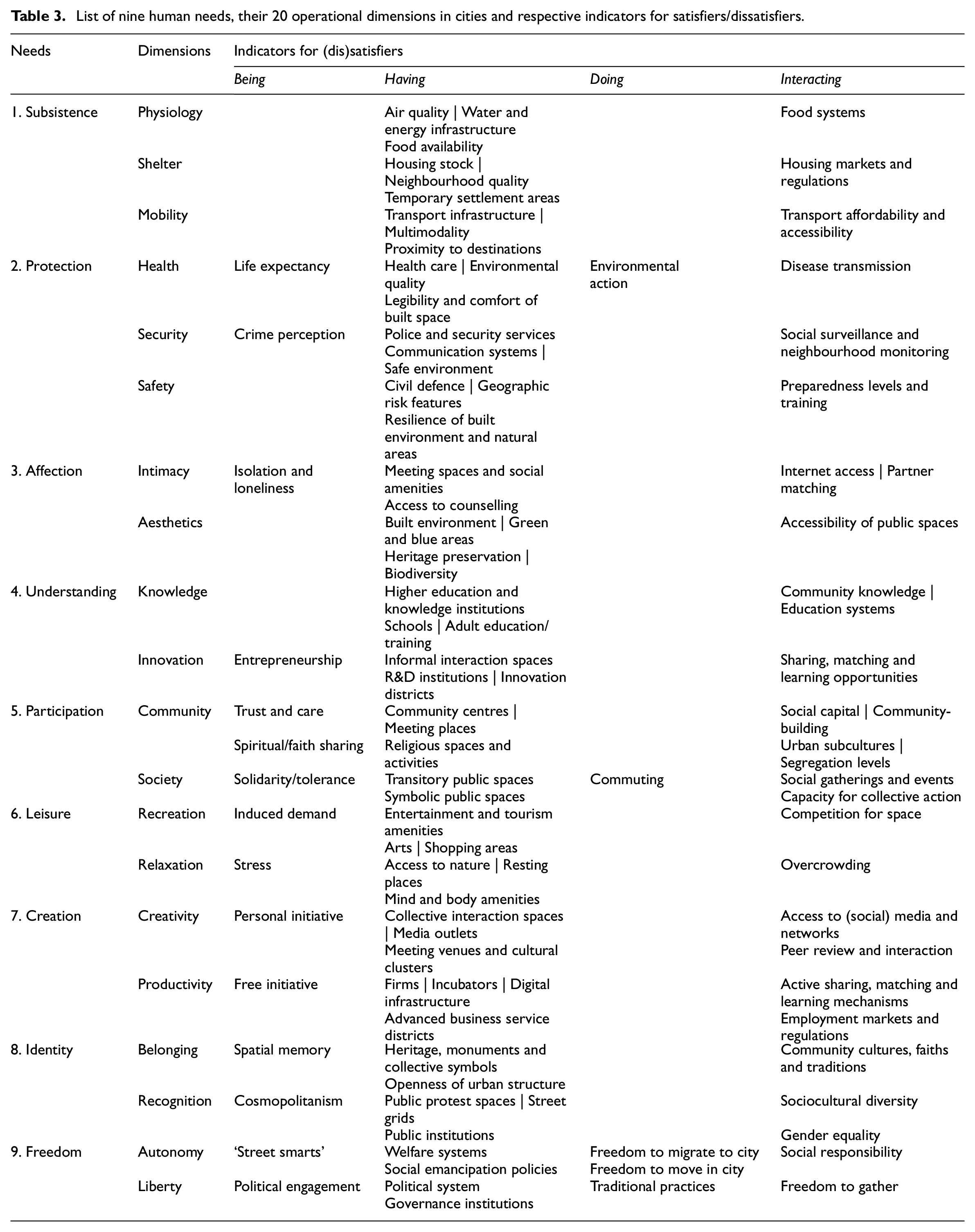
As this review shows, the question whether cities can cater for human needs better than other places is not answerable. As expected, it depends on the need in question, as well as on place, time and context. We can certainly cherry-pick research to show that cities meet human needs particularly well or particularly badly. But such a discussion is not the purpose here. The aim has been to discover in what dimensions and through what processes and means cities can cater for human needs. Table 3 represents our first results. They are certainly incomplete, debatable, too synthetic and sometimes inconsistent. That is the nature of work-in-progress models aimed at further transformation. But the effort has produced a valuable draft framework for an alternative way to evaluate cities that focuses on human needs beyond the dominance of economic or technical factors. From the outset, some features stand out in the matrix developed below:
Most need satisfiers are indeed not singular, as argued by Max-Neef. Digital infrastructure has been put under Creation-Productivity but is synergistic for Participation, Understanding and other needs. Police and security services appear under Protection-Security but, according to their materialisation, may be either synergistic or inhibiting for Freedom. Community traditions appear under Identity-Belonging but can they be also pseudo-satisfiers for Freedom-Autonomy?
Many indicators do not have a clear place in the ‘existential’ axis of the matrix. Notably, Doing and Interacting categories tend to share many satisfiers, indicating that objective action in cities is very much about interaction with others. Also, the Being category, related to individual attributes, is not as easy to differentiate as pertaining specifically to the city.
As anticipated by the focus of the literature review, most satisfiers that do have a clear place in the horizontal axis belong to the Having category, stressing two inescapable facts: first, that cities are powerful spatial entities and, ultimately, locations where material devices, goods, systems and objects – objective satisfiers – are clustered and interact. Second, that cities rely heavily on the delivery of public collective services, which are as essential to satisfying basic needs as to enabling the functioning of the most advanced profit-seeking ventures (Storper, 2016).
The level of abstraction in the formulation of the indicators is variable. Some are quite concrete and others quite vague, and this needs further reflection. Moreover, it is possible that some concepts are considered important due to cultural bias – that assessment might be conducted by readers around the world.
List of nine human needs, their 20 operational dimensions in cities and respective indicators for satisfiers/dissatisfiers.
Conclusions and future research concerns
This article argued for the urgency of explaining cities from a human needs perspective. There are strong limitations in seeing the purposes, promises and problems of cities merely through an economic lens, based on efficiency and growth-oriented agglomeration mechanisms, or through technical lenses, where the city becomes an engineering problem. This contribution advanced the growing literature arguing for a broader human-based urban perspective but still lacking a theoretically solid and cross-disciplinary framework to implement it. To achieve that, we integrated the encompassing concept of human needs in some key urban debates.
After discussing the main developments in current human needs theories, the article showed how urban settings provide an ideal arena where the challenges emerging from these developments play out and become relevant. Then it explored a suitable framework that both advances the disciplinary debates and is able to tackle the problem of human needs specifically in cities. This groundwork served to ‘urbanise’ the list of human needs, searching for important dimensions through which these broadly formulated terms are manifested in cities. Finally, the article started to operationalise the framework by exploring the aspects of each need that the literature has regarded as fundamentally urban and drafting a list of relevant indicators for urban satisfiers and dissatisfiers.
The framework eventually proposed (Table 3) has indeed the attributes that respond to the main challenges of human needs theory and to the features of cities which illustrate and exacerbate them:
It supports categorical distinctions between needs satisfaction processes as related to personal attributes, economic goods, societal interactions and political actions.
It accepts needs satisfaction processes in cities as a fluid system of trade-offs in space and time, where the roles of the inseparable bundle and the collective body, rather than the individual satisfier and the individual agent, are decisive.
It qualifies the role of different need satisfiers according to their scope, change over time and potential interaction effects with other needs.
It is devised as a flexible roadmap able to be locally adapted by participatory communities and policymakers rather than a general model to apply analytically.
It considers the broad validity of the indicators as well as the diversity of satisfiers that will materialise them in each city, period and context, allowing for comparability across places as well as specificity of measurements, evaluation and priorities.
Theoretical progress, cross-disciplinarity opportunities and policymaking
A future research agenda that takes up the ideas proposed in this article can be expected to work on several problems.
It is important to qualify the synergistic, inhibiting or pseudo-satisfying qualities of urban need satisfiers in order to ask important questions about social and spatial justice in the city. Needs satisfaction processes come with inextricable bundles of satisfiers and dissatisfiers which are bound to serve the interests of some groups while harming or neglecting others. The awareness that satisfiers are rarely in a linear relation with one need, which they fulfil or not, but rather interact with other (dis)satisfiers and affect other needs, provides a basis to evaluate who benefits from which needs satisfaction process, who has the capabilities, why and at what cost. In addition, humans in complex environments, such as cities, are not rational agents able to process all the relevant information and optimise their choices. We take cognitive shortcuts when looking at the information before us until we achieve an acceptable alternative, a process known as satisficing (Simon, 1956). Translated as publicly available information for citizens, sorting out the complex interactions of satisfiers may increase the quality of the sub-optimal strategies used by people negotiating their needs satisfaction in cities (see the notion of improving social choices, e.g. through data technology, in Storper, 2014).
We can take advantage of the scope of our model to create links with different disciplines relevant for cities. Note that the being-having-doing-interacting axis of our matrix closely relates to the distinction between the four qualities of life defined by Veenhoven (2000):
The attributes entailed in Being play a similar role in the set to that of the Satisfaction/Perception quadrant in the four qualities model.
The economic goods categorised in Having are related to the elements of the Liveability/Environment dimension.
The individual and collective actions of Doing have their parallel in the carriers of the Capability/Ability quadrant.
The societal relations and progress relevant for Interacting are implied in the Utility/Externality dimension of Veenhoven’s matrix.
Deepening the nexus between these four pairs of concepts may help us frame four important urban topics from a human needs perspective: in the same order, (1) happiness and well-being, (2) urban development and liveability assessments, (3) urban political geographies, and (4) agglomeration economies and diseconomies.
Progress is also needed on the issue of measurement of needs satisfaction. Except for some objective satisfiers which can be compared and ranked across cities, the fulfilment of human needs is hard to assess. It depends, on one hand, on qualitative attributes, actions and interactions, and on the other, on subjective perceptions. See for instance the need for protection/security as represented by urban crime levels – to check how well this need is satisfied, we need statistics about several types of crime, but also to consider their spatial distribution, the sociocultural aspects that value differently the seriousness of each crime, and the local perception of crime, which may differ from the real numbers. Among several possibilities to study this, we see a promising path in the analysis of large news text corpuses. In recent years, the digitalisation of media sources has created a large body of available information which can be associated with geographical locations – geotagged social media posts are a good example. Computer-aided analysis allows researchers to retrieve millions of such entries and classify them not only according to location and topic, but also to tone, sentiment, trend, bias and other factors. Considering that news outlets are present in virtually every city, that they report, directly or indirectly, about every human need and that they are culturally embedded in the context they report on, news corpuses are a promising point of access to comparative analysis that follows the principle of universal needs rendered by contextual satisfiers.
Finally, and directly following from the research agenda on measurement, is the utilisation of the human needs framework to produce policy recommendations. Comparisons between cities seem key here. Through universal needs materialised by contingent satisfiers in each city and the ability of the model to be locally transformed, we sketched a fairer way to compare cities in different economic, political and geographical contexts. Many existing comparative frameworks consistently rank the same cities at the top, following indicators designed according to their own strengths and interests and either turning the aims and purposes of other cities into impoverished versions of the same strengths and interests or neglecting them as peripheral. The universal nature, contingent applicability and socio-spatial flexibility of the human needs perspective allows us to produce encompassing urban policies that are globally comparable in their response to needs satisfaction while still allowing us to be sensitive to local conditions and ultimately to learn from any city. This is the human needs-based urbanism that will help develop the kinds of cities we really need.
Footnotes
Declaration of conflicting interests
The author(s) declared no potential conflicts of interest with respect to the research, authorship, and/or publication of this article.
Funding
The authors would like to thank the Dutch Research Council NWO for generously supporting their work (VIDI grant number 452-14-004).
