




Abstract
Situated in interdisciplinary literatures on climate urbanism and future making, this article examines the multi-sited case of climate-corporate futuring in contemporary global urban climate governance. Drawing on a dataset of five workshops on climate resilience organized by two globally facing urban think tanks, the article analyzes critically the contingent and frustrated process by which global in urban climate governance sought to construct “best practice” and manufacture climate commonsense for the world of cities. Such a multi-sited endeavor of co-producing consensus across space is argued to be a methodological and defensive maneuver as professionals seek to adapt to, and capitalize on, climate-changing urban futures. Fleshing out such authoritative geographies of climate knowledge in interurban space reveals the process by which liberal-corporate alliances dominant in transnational climate networks seek to foreclose, from the inside out, more just urban climate futures. They do so by operating across and beyond cities, in stark contrast to extant research that remains trained on the city. It reveals, ultimately, the spatial and institutionalized consolidation of a particular splice of elite financialized coastal urbanism made to stand in for the 21st-century world of cities.
Introduction: A global-urban syndrome at work
A casual survey of planning and policy documents in contemporary municipal governance, largely cyclical and short-termist in nature, may well generate the sense that the 22nd-century remains some distance away. But in an air-conditioned room in Singapore’s central business district, 2100 loomed large before 25 practitioners that had been assembled from the real estate industry for a private forum on “climate resilience.” On the cusp of a cascading combination of economic, ecological, and health (poly)crises that were to mark the next six years, during that balmy afternoon the Head of Sustainability and Economic Performance of a think tank wove for this audience a compelling tale. Confronted by climate-changing futures that would hasten dramatically rates of flooding, exemplary benchmarks were being set by the largest private development in U.S. history: Hudson Yards of Manhattan, New York.
… As these climate and resilience goals are being developed, some of the biggest, newest, fanciest developments in New York are already planning for 2100. In Hudson Yards, they’ve been able to do the level of hardening necessary so that if another superstorm Sandy hit, it would have very minimal damage … They value business continuity above all else … so that the economic activity that is being driven in developments like this can be continued and not be disrupted by an extreme weather event. —Head of Sustainability and Economic Performance, Urban Grounds, August 2019, Singapore
Co-organized by two self-styled “think and do” tanks traversing the global urban policy landscape, this forum marked the start of their multi-city endeavor to cultivate a sense of institutional leadership in the emergent field of urban climate resilience. In the minds of the think tank actors, this would be accomplished by forging several “best practices” in climate resilience for cities worldwide. Based respectively in Washington, DC and in Singapore, we refer to these organizations as Urban Grounds and Sustainable Urbanism. A key term in the United Nations-led process, climate resilience referred to “the ability to anticipate, prepare for, and respond to hazardous events, trends, or disturbances related to climate” (United Nations, 2016). As far as interventions went, this was a capacious enough umbrella. During the workshops, though, it was indexed largely to a very limited part of the “urban,” specifically the financialization of downtown cores and commercial real estate through the project of “green,” or climate, capitalism (Knuth, 2019; Sapinski, 2015). As the account of Hudson Yards suggests, the think tanks’ efforts centered real estate investors and developers as cutting-edge actors, which were acclaimed during that forum for “going above and beyond New York’s current resilience guidelines” in the spirit of “future proofing their development against future regulation and future climate risk.”
This multi-city process of governing urban climate futures would be sutured together through workshops held in five wealthy coastal cities: Singapore, New York, Rotterdam, Hong Kong, and Miami. The group had been curated with purpose. Over the course of a year, these self-described comparative efforts would culminate in the codified form of an agenda-setting textbook. In organizational parlance it was defined and marketed as a “practical guide,” structured around 10 “principles” for cities worldwide to implement a financialized form of climate resilience. Contrary to fleeting mentions of “best practice” in critical scholarship, this was redolent of a more systematic co-production across space, generated through five cities upheld in the industry as spatial origins of “good governance.” Such climate futures would be refined first with(in) a select, specialist group of professionals, before being abstracted and circulated across the world of cities under the veneer of pragmatism and seamless replicability.
Climate resilience in this global urban context has two interrelated dimensions: how built environments are to be reworked for new accumulation projects; and the shifting place of elites in the climate capitalist project. Our intervention is situated in the interstices of both projects, which surfaces the question of spatiality. Existing work on urban climate resilience has addressed the topic largely as a methodological matter that begins from single-site, or comparative, studies of cities. Yet doing so risks understating the ways whereby state and corporate actors frequently interact with each other through in-between expert spaces in order to co-produce urban climate futures. They restrict neither their ambitions nor their activities to specific cities. Notwithstanding the multiple dimensions of global urbanism, our intervention targets the in-between spatiality that is frequently traversed by peripatetic elite actors, and their “intersubjectively embedded common sense” (Peck, 2014: 398) resultant precisely of this syndrome-like spatiality. As we show, the multi-city process took shape through different methods of “futures research” (Andersson, 2019), which amount to a particular center of calculation in the global urban landscape. We conceptualize this as an interurban process of climate-corporate futuring. At stake is the spatiality of imagining more progressive urban futures. Humanity’s urban future is not necessarily decided in cities or by cities (in the conventional use of the term) but in the spaces beyond and between them. In this article, we immerse ourselves and dissect some of these interurban and in-between spaces in which urban futures are imagined, realized, and (un)made through more or less global, situated, and transparent processes largely handled and controlled by a new category of operative units, namely international “think and do” tanks, in a nondescript space amidst global public institutions and corporate elite circles.
To follow these actors and their futuring techniques, we adopt a relational comparative perspective (Hart, 2018). Doing so discloses the displacement of a global challenge—here, climate change—onto a particular splice of elite interurban space, which was then marshalled strategically to stand in for cities worldwide. It amounted, ultimately, to a strategy of containment of difficult global problems that the actors insisted could be addressed through pragmatic planning. Traveling through a multi-sited dataset, the analysis ventures into the “black box” of consensus making that resulted in the report. This reveals three things: how actors manage competing futures in pursuit of particular urban climate futures; the spatio-scalar sensibilities at work in shoring up parameters of pragmatism; and the ambiguous, slippery positionality of actors in an interurban space that is in many respects untethered from actual cities.
Consequently, the article offers a relational comparative reading of the multi-sited endeavor undertaken by Urban Grounds and Sustainable Urbanism. Doing so contributes to critical climate resilience scholarship to scrutinize mainstream narratives of resilient infrastructures and initiatives, as well as to unsettle orthodox preoccupations with urban density in pursuit of real property as adequate responses to decarbonization (Frisch, 2023; Knuth et al., 2020). It also attests to the expanding place of real estate investment trusts in the financialization of property (see Aalbers et al., 2023). It contributes as well to futures research in critical studies of capitalism by elucidating the multi-sited spatial and scalar dimensions that were crucial to the think tanks’ methodology of futures research. Proceeding in four parts, it first sketches a schematic for studying the phenomenon of climate corporate futuring, via literatures from climate futures in urban studies research and interdisciplinary scholarship on the role of corporate actors undertaking futures research within the history of capitalism. Two empirical sections follow, the first of which stages a meta-analysis of methodology through the workshops to pin down the “moving target” of climate change. The next section traces two key categories of co-production in climate corporate futuring: temporalities; and spatio-scalar dimensions. Together they show how practitioners sought, via the scripting of best practices for climate-changed futures, to stabilize and navigate contradictions inherent to climate urbanism. The analysis discloses ultimately the practices of climate corporate futuring, centered on a dominant slice of elite coastal urbanism in the landscape. The fourth section concludes the article.
Climate corporate futuring
A great deal of work in urban studies looks to the future, which is typically invoked as an aspirational placeholder for problem solving. Much of the existing research on climate urbanism frames cities and urban communities as receiving sites of corporatized climate initiatives, subject invariably to forms of friction and reworking (e.g. Meerow et al., 2016; Ranganathan and Bratman, 2021). While this usefully illustrates grounded contestation, it cannot account for how climate corporate futures are being rewritten in elite spaces from the ground up. Just as these processes of implementation are contested, they also demarcate a phenomenon to which practitioners are responding in real time. Inseparable from the corporatization of urban climate futures exists an elite urban morphology that often elides in-depth critical scrutiny. In the spatial, scalar, and institutional contexts of global urbanism, the sheer latitude of climate change constitutes simultaneously a multiscalar challenge of governance and a regulatory vacuum. Consistent with how climate adaptation is constructed increasingly as a problem best addressed by financiers (Bigger and Millington, 2020; Cohen et al., 2022; see Bernards, 2024), this governance gap is leveraged variously by a new range of actors, institutions, social movements, and forms of capital (Davidson and Gleeson, 2015).
This contemporary stage has been characterized by critical urban scholars as that of “climate urbanism” (Long, 2021; Long and Rice, 2019), or “strategic urbanism” (Bulkeley, 2022: 264). Both speak to two overarching issues of our case study, which is situated in the context of the rise of transnational municipal networks since the 1990s (Kern and Bulkeley, 2009). First, how the neoliberalization of economic development in municipal governance has become inseparable from various climate initiatives at the global scale (Bulkeley and Betsill, 2013), many of which are categorized as “climate resilience” (Bigger and Webber, 2021; Sharma, 2023). Second, how the interventions of municipal governments are commonly described as transcending their national governments, amounting to concrete, heroic examples of modern-day city diplomacy (Acuto et al., 2017; Koelemaij et al., 2023). The most prolific of these networks have consistently platformed issues of climate change and sustainability (Acuto et al., 2024), often by championing the use of marketized measures as a mitigation measure under a corporate project of climate capitalism (Bryant and Webber, 2024; Sapinski, 2015). This extension of transnational networking has been coupled with a horizontal “blending” of public and private spheres of governance (Davidson and Gleeson, 2015), which explains why so many actors in this field have tended to import corporatized practices and policies from other sectors (e.g. public-private partnerships, credit rating). Common examples of climate corporate organizational forms include the C40 Climate Leadership Group (Leal and Paterson, 2024) and the Rockefeller Foundation’s Global Resilient Cities Network (Leitner et al., 2018; Webber et al., 2020).
The corporatization of climate urbanism takes shape through the active, transnationally networked promotion of cities as visible and viable sites of climate mitigation and adaptation. A widespread rationale in orthodox policy conversations is that cities are major sites of production of carbon emissions; therefore, they are also effective and efficient sites to address climate change, invoking a governance gap resultant of a “failure to act” by nation-states (Long and Rice, 2019). This reasoning pervades corporatist measures to secure and defend physical and digital infrastructures from the manifold risks of climate change. It pivots on a strategic ambiguity that permeates discussions of cities in global governance, which are typified by competing and often contradictory definitions and functions (Acuto et al., 2023). It hinges, too, on a strategic scalar slippage rooted in how climate change as a global problem is frequently displaced onto the spatial scales of the “urban” in order to absolve decision makers at other scales of responsibility (Holgersen, 2025). This persists in large part through cross-border entrepreneurial state–corporate coalitions keen to underwrite the future of climate capitalism at particular spatial scales. In this regard, recent critical scholarship from the nascent literature on urban climate resilience is instructive for its examination of the governance of built environments via financialized modes of corporate intervention, in the spirit of what the industry calls “future proofing.” Two pertinent insights can be drawn. First, how climate risk is governed through the built environment and real property development under climate capitalism (Knuth, 2019; Taylor, 2020). Retrofitting emerges as a central yet contradictory instrument of speculation when attending to brownfield land, raising questions of durability and devaluation (Knuth, 2019). Second, how actors make sense of “unruly” climate risk via speculative, debt-financed instruments of state capital (Taylor, 2020), such as through the use of insurance and municipal bonds.
Congruent with the polyvalence of climate futures, the marshalling of forms of crisis management and valuation remains complex and contested. Far from a top-down imposition, a consensus on climate corporate futures has been co-produced by corporate and state actors. This temporality of co-production is telling of the pace at which climate change has been rendered an object of policy and corporate intervention. The sheer speed is captured in Long and Rice’s (2019: 33) description of urban climate action on a global scale: “Within a relatively short period of time, interurban networks, development agencies, and global financial institutions synthesized an urgent narrative of climate action that emphasized defensive, technological, climate-oriented infrastructure development and mitigation policies.” Where the “urban” is concerned, the new range of stakeholders involved in climate resilience is noteworthy both for its expanded range of industry sectors and the distinctive spatiality afforded by interurban relations. The actors of our study hail from sectors of finance, consultancy, and philanthropy—sectors that have gravitated towards climate adaptation as a circuit for realizing profitable exchange and ideological recuperation in what Cohen et al. (2022) conceptualize as “reparative accumulation.” As part of ongoing efforts to secure legitimacy, corporate actors consciously piggyback off larger consensuses such as the 2015 Paris Agreement and the United Nations’ overlapping schemas on COP, the Urban Age, and Climate Resilience (Gabor, 2021). Such factors account in part for the durability of this climate consensus and, by extension, the endurance of this corporatist common sense.
For their own part, municipal governments are incentivized to participate in consensus building because doing so allows them to leverage refurbished modes of investment and regulation (Long and Rice, 2019; Peck, 2014), bolstered by the promise of access to potentially new sources of expert information and capital (Beal and Pinson, 2014). They operate alongside a new host of multi-sited initiatives, networks, and think tanks that are invested in perpetuating a distinctively interurban morphology: though all cities stand on the frontlines of climate change, only a few can be forerunners of climate change leadership. From the practitioner’s perspective, such cities, ideally, would be capable of enacting policies and disseminating grounded expertise to municipal peers (Bok and Coe, 2017; Whitney, 2022). Beyond purely technical matters, though, they should also serve symbolically as intermediaries between new sources of financialized capital, states, and local actors to develop bankable infrastructural projects. To the extent that there exist “superstar” cities and their lagging counterparts, this hierarchy speaks to the inherent centralization, unevenness, and ultimately power dynamics of networks (Koelemaij et al., 2023; Leffel et al., 2023; Leitner and Sheppard, 2002). Crucial to these operations, our analysis suggests, is an interurban dynamic that takes shape not merely within individual cities but through the spaces between and beyond cities. These efforts at consensus making tend to be undertaken in shared interurban fora—workshops, conferences, summits—that bring together stakeholders across multiple spatial scales, from select cities and international institutions. Repetition is banal yet critical to the “sedimentation” of common sense (Hall and O’Shea, 2013). Workshops are a common tactic of translating common sense into less abstract forms of knowledge and practice. With respect to the participants (re)invited and the content (re)circulated, the degree of curation is sustained, translating into what Death (2011: 2) describes of climate summits as “the disciplining of political participation towards norms of consensus and cooperation.”
Our case centers what has been described as a small, elite group of superstar cities precisely to disclose what happens from the inside-out of consensus making. To offer a complementary perspective to approaching the urban as a category of practice (Wachsmuth, 2014), we turn to interdisciplinary scholarship on the history of capitalism that discusses how elites manage the future via transnational practices. From this perspective, conferences and workshops constitute a key methodological mechanism for corporate actors of the climate capitalist project to gather in shared, curated spaces to make sense of the future. In order to navigate their place in the history of capitalism, corporate actors undertake “futures research” to respond to uncertainty and manage risk and social relations across space and time (Andersson, 2019, 2020; Berg Johansen and De Cock, 2018; Folkers, 2025). Historical work offers a useful counterpoint to unsettle both presentist and single-site accounts by showing that international institutions have for decades sought to manage the future. Andersson’s (2019, 2020) successive interventions, for instance, chart the tools of futures research deployed via the OECD’s Interfutures Project and Shell’s scenarios technique in response to radical propositions of the 1970s. Such communicative and performative tools were envisioned as “transnational artifacts” (Andersson, 2020), attempts to conjure into being new capitalist worlds as they circulated in a field co-produced by international organizations, multinational corporations, and national planning commissions. In the corporate context, such practices are mobilized to navigate competing temporalities, namely how business-as-usual timelines might accommodate climate-changed futures (Berg Johansen and De Cock, 2018; Frisch, 2023). A great deal of recent research, unsurprisingly, has gravitated to climate finance futures and how corporate actors respond to climate uncertainties. This might take the form of how risk is understood and performed (Nyberg and Wright, 2016), or how companies construct imagined business futures in response to decarbonization (Frisch, 2023) and the incommensurability of translating futures between the realms of climate and finance (Folkers, 2025).
Climate corporate futuring manifests through a sector of interurban space that exceeds individual cities. This in-between spatiality constitutes a source of power, indexed as well to the collective legitimacy derived from an elite group of cities that are in many cases viewed as forerunners of climate leadership, in strategic and symbolic measure. From the perspective of the think tanks, the ability to fine-tune climate futures with(in) this cutting-edge group was tantamount, almost, to placing a finger on the industry’s pulse. It is, after all, what emboldened the think tanks to rationalize repeatedly the necessity of best practices of climate resilience for cities worldwide, together with the co-production of parameters of “pragmatism” within which future practices would be envisioned. The think tanks, in other words, leveraged the positionality of elite cities to lay claim to climate-resilient urban futures worldwide. Insofar as the state and corporate actors of our study approached future making via climate resilience and real estate speculation, they overlapped with cognate communities of philanthropy that included the Rockefeller Foundation’s Global Resilient Cities Network and the C40 Group, as well as financial services firms. Indeed, workshop participants were sourced knowingly from these professions. The actors of our study responded to climate uncertainty less by operating on a tabula rasa blank slate—a common narrative in urban studies scholarship—and more by consolidating the ideological grounds for a transnational capitalist class of developers and a mobile labor force. They may not engage in planning or policymaking per se—though they do circulate freely across those realms—but they are operating in a space orthogonal to these communities. In this liminal space they could deliberate shared challenges and principles, towards the ambition of stabilizing the institutional grounds of what counted as best practice in urban climate resilience globally.
Our analysis is limited to state and corporate actors hailing from highly developed coastal cities—which we maintain is significant precisely to unveil the often-shrouded workings of power close to practice—within an interurban center of calculation over urban climate futures worldwide. It therefore discloses how these intermediary actors seek to manage spatiality and temporality, across public and corporate spheres. Our argument is derived primarily from participant observation data of focus groups and fieldnotes; and a critical review of nearly 300 pages of workshop reports collected from five international closed-door workshops that took place from August 2019 to February 2020 in Singapore, Rotterdam, New York, Hong Kong, and Miami. The database was inductively analyzed to ascertain the discourses and narratives that informed the workshop participants’ discussions of the best practices and challenges of climate policy where real estate development was concerned. The first three workshops were held in person; the latter two, which coincided with the onset of the COVID-19 pandemic, took place virtually. The first author attended the Singapore workshop in person—where they conducted a focus group—and attended the rest of the workshops virtually. This was part of a larger 23-month global ethnographic study of the urban solutions industry (Bok, forthcoming), which informs the data analysis.
Studying a syndrome
With occasional involvement by representatives of an international climate cities network, the workshops were envisioned by the think tanks as a multi-city, fact-finding exercise. From these “stakeholder workshops” the organizers hoped to glean comparative insights on implementing transferable principles of urban climate resilience worldwide. Of greatest interest were the principles trained towards preserving and even heightening the value of built environments in a climate-changing environment. For the think tanks, this was a methodological and defensive response to the economic and environmental contradictions of capitalist urbanization, climate change, and the perceived urgency of safeguarding financialized real estate assets. We approach this endeavor as a meta-methodological maneuver in the vein of corporate “futures research” that discloses the efforts of consensus making in situ. Doing so takes seriously the spatial and scalar dimensions of multi-sitedness, which were considered crucial to the practitioners themselves as an appeal to more-than-local salience for cities worldwide.
We refer to the two tanks respectively as Urban Grounds and Sustainable Urbanism: the former for its longstanding celebration of property developers in matters of urban redevelopment; the latter for how it envisions itself as a global hub of urban sustainability. Both organizations were well versed in traversing global-urban networks. This they did primarily through organizing events to bring together state actors and transnational capital. One inspiration for this particular collaboration—their fifth to date—stemmed from a visit to Urban Grounds in Washington DC in 2018, where the Director of Sustainable Urbanism met their CEO and Head of Sustainability and Economic Performance, a former CEO of a U.S. real investment trust. Earlier collaborations had addressed issues of urban mobility and health, with a stronger focus on Singapore; now, both organizations were seized by the ambition of doing something that spoke to the world. And there seemed to be nothing of greater planetary significance than the “wicked future” of climate change. Thus the think tanks gravitated summarily to the agenda of climate change adaptation, which they fashioned as the urgent task of building climate resilience.
Another motivation was Urban Grounds’ desire to influence more greatly the place of real estate capital in the emergent climate resilience agenda. In the context of a crowded global landscape of urban climate solutions dispensed daily—ranging from newer players such as the Rockefeller Foundation to comparatively traditional Dutch and Japanese planning experts—actors are generally less concerned with prescriptive technical solutions than they are with co-producing more diffuse and malleable institutional norms. From their perspective, the former is unsettled easily by place-specific realities but the latter is polyvalent enough to accommodate social-spatial diversity, which is consistent with Cox’s (2022) interpretation of urban resilience as “plastic”, or what Sharma (2023) calls an “indeterminate” concept. The appeal to institutional norms further discloses a particular motivation of the think tanks—one with “extrospective” reach (McCann, 2013). Yet it was also markedly self-conscious. During the Miami meeting, the Vice-President of Urban Grounds’ Climate Resilience Division mulled over the stakes at play: This type of assessment highlights the huge importance of Urban Grounds as an influencer of both the public sector—regulators, city planners, etc.—and the private real estate development industry—developers, investors, lenders, etc. Urban Grounds is probably a unique entity in its credibility and ability to “look at the system.” So we better get this right. (Vice-President of Urban Resilience, Urban Grounds, August 2020, Miami (virtual))
Simultaneously casual and aspirational, the Vice-President’s assumption of the role of “influencer” said something about consensus making. It was a gesture, first, to the intermediary positionality of an organization such as Urban Grounds to move seamlessly, chameleon-like, between the public and private sectors governing built environments. It was also an articulation of the organization’s presumed power to shape and stabilize climate-changing futures worldwide in cooperation with the interests of real estate capital. This can be attributed to the cultivation of an institutional sense of leadership in the crowded and contested field of urban climate governance. In the final report, Urban Grounds chose to advance their own definition of resilience that referenced the National Academy of Sciences and the International Panel of Climate Change, rather than resort to the more prolific definition associated with the Rockefeller Foundation. While both definitions are essentially similar in advocating for the “bouncing back” of cities in response to “shocks and stresses,” the definition preferred by Urban Grounds grounded resilience in a systems approach. For the think tanks, an incentive for doing so was aligned with recent scholarly assessments of global urban governance that have emphasized the significance of exercising power less through technical policies and more through indirect influence over the decision-making capacities of municipal governments from afar (e.g. Baker et al., 2025; Webber et al., 2020). In this case, the exercise of power was both a way to carve out a niche in a crowded landscape and an appeal to a wider field— “looking at the system” —or the interurban as a spatio-institutional field of action, norm making, and the management of expectations from elsewhere.
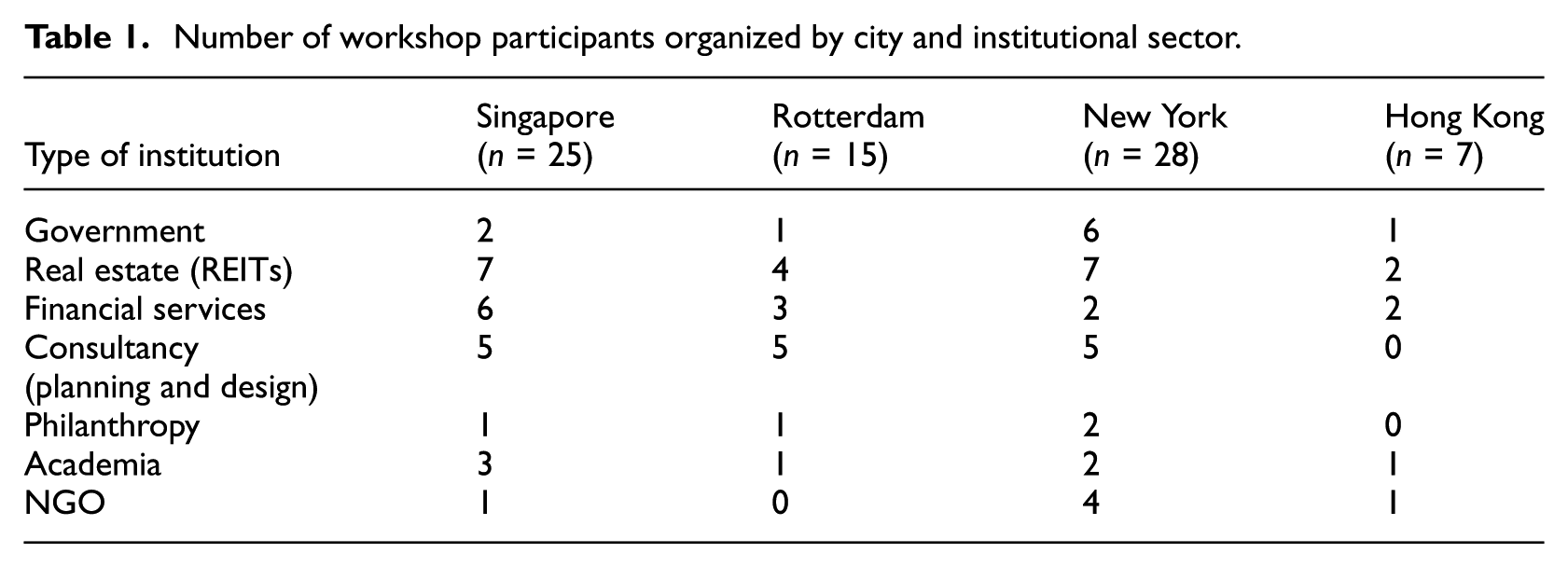
Through the five workshops, the interurban process of “look[ing] at the system” would manifest ultimately in the form of a textbook-esque report of market-centered “best practices” for municipal governments and real estate developers and investors worldwide to implement climate resilience. Suffused by an ambient blend of opportunism and anxiety circling the massive devaluation of fixed capital against the backdrop of rising temperatures and sea levels, at every workshop it was reiterated to participants that their collective goal was to construct a “practical guide” towards climate-resilient urban futures. Repeatedly emphasized was the need to cater to the “business perspective” —namely real estate, banking, insurance, and finance. The workshops were invitation-only. Participants were sourced primarily from several groups: real estate developers and investment trusts, financial services firms, planning and design consultancies, policymakers at different levels of government, and philanthropy. These were the central players working both to translate fixed capital into instruments of real estate speculation (Knuth, 2019) and to circumvent threats of obsolesce to built environments (Weber, 2002). A smaller number included participants from academic institutions, nonprofits, and community organizations that worked on climate resilience. Table 1 provides a breakdown of the workshop participants and the institutional sectors from which they hail.
Number of workshop participants organized by city and institutional sector.
Each workshop followed a largely similar format. After short 10-minute presentations from lead representatives of the participating cities, participants would break up into focus groups for the next 45 minutes. They were handed sticky notes and instructed to distill at least five best practices for climate resilience. At the end of the focus groups, a representative from each group would present highlights to the room, which were then collated by the organizers. The focus group participants were assigned five main questions, which are reproduced verbatim below:
What are the motivations for cities to work on climate resilience, and the types of government structure and Funding?
How do cities/businesses identify climate-related risks, develop climate resilience strategies and measure performance?
How do cities/businesses engage stakeholders on climate resilience?
How can businesses contribute to climate resilience and financing?
Share business projects that address climate resilience.
Driven by a liberal “rationalization” logic that favors ideals of cooperation to share knowledge and harmonize tensions of accumulation (Jessop, 2002), in the international policy field elites are aligned strategically with the scope and scale of transnational organizational structures such as the networks of C40 Cities and the Rockefeller Foundation’s Global Resilient Cities Network (Goh, 2021). Indeed, representatives from these networks gave presentations and participated repeatedly in focus groups across the five cities. They advocated consistently for the bridging of “challenges in the public sector and private sector solutions.” During one of the focus groups in the Singapore workshop, the Rockefeller representative championed a systems approach in which the future-proofing efforts of large developers and asset managers would spill over to the rest of cities. Such sentiments resonate with scholarly arguments regarding the role of networks in reproducing neoliberal urban agendas (Leitner and Sheppard, 2002) and “econo-cratic” pathways of climate resilience (Davidson and Gleeson, 2015). Such interurban spaces are enrolled by state and corporate elites to gather and deliberate their response to the climate crisis (Sapinski, 2015), the mundanity of which is revealed through who is selected to be in the room. A crucial aspect of the discursive and ideological work that such actors undertake includes the (re)production of knowledge that informs and legitimates certain types of governance—here, the deepening entrenchment of real estate capital, green finance, ESG investing in municipal governance—while simultaneously delegitimizing alternative forms of economic and social governance.
The five cities in question had been chosen as “case studies” based on the organizers’ familiarity with them, along with their prolific presence in international climate networks. Publicly the comparative rationale described them as “coastal cities facing similar challenges [that] would offer a good mix and a wide range of strategies.” A sense of commensuration (Espeland and Stevens, 1998) of this cross-continental coastal urbanism was constructed through several tactics. These included the establishment of shared physical and economic threats, such as rising sea and temperature levels by 2100, the extent of risk-prone flood-prone areas, coastal defense infrastructures, and drainage infrastructures. These were written up unequivocally as profiles of “risk assessment” that would, according to the organizers, constitute the bases for transferable best practices. The exact methodology was left unexplained the workshops. In a banal sense, city representatives made sure to reinforce each other’s perceived similarities during workshops. During the Singapore meeting, for instance, representatives from Rotterdam and Hong Kong spoke jointly of their vulnerability to urban flooding from increased rainfall. Crucial also to the co-production of consensus was a casual yet consistent sense of repetition across space. At times this bled through in the reinforcement of unproven claims and statements made in previous workshops, which speaks also to the ramped-up policy cycles of modern governance (Jessop, 2002) that manifested here in the circumvention of fact checking.
Significant too was the management of context, which compelled the organizers to negotiate similarity and difference across space. Each workshop was structured around a different focus. From Singapore arose the importance of regulation; from Rotterdam, community engagement; retrofitting and finance from New York; and insurance from Miami. In search of a unified, consistent format, the published report downplayed city- and country-specific differences in favor of structuring the city reports through the 10 best practices. In the style of reverse engineering, these were supplemented post hoc by a string of examples from across the world to construct arguments for worldwide applicability. 1 Rather than the type of comparative urbanism addressed in scholarly literatures (e.g. Cook and Ward, 2012), at work here was an orthodox, corporate comparativism that sought to foreclose the world of cities through a corporatized vision of climate resilience. It hinged on the enrolling of geographical difference into the larger vision of climate resilience.
Perhaps the greatest illustration of this shone through in the militant emphasis on a “new normal” of urban climate resilience, which hinged on speculative financial instruments such as green bonds and the Rockefeller Foundation’s “resilience dividend” for nature-based solutions. Duly embedded in the workshop write-ups and in the final report was the link to The Resilience Dividend: Being Strong in a World Where Things Go Wrong, authored by Judith Rodin, the former President of the Rockefeller Foundation. Underwritten by the think tanks, from within this interurban center of calculation, it was but one example of the mundane, steady, supportive efforts at the consolidation of a certain common sense of climate resilience: a financialized one that made the involvement of private-sector partners appear inevitable and necessary. In real time this was the entrenchment of a particular form of expert knowledge in the project of climate capitalism, achieved by bringing together elite actors across borders and sectors to realize consensus making (Sapinski, 2015: 269; see Carroll and Sapinski, 2010). The resilience dividend was first mentioned during the New York group discussions as a way for municipal governments to conceive of climate adaptation not in terms of risk but as a collective “climate opportunity.” In the drafts preceding the final report, this was expanded inexplicably to all five cities in a cohesive sense. This was elaborated as the collective opportunities and benefits of responding to climate change, specifically through “the use of value capture models to spur private investment for climate resilience for the commons.”
In the final report, resilience dividends were framed as “benefits” that included mundane, vague priorities of economic growth, job creation, improved social infrastructures, and strengthened community benefits. Bringing the resilience dividend to fruition was a tripartite compact of value creation for real estate capital, municipal governments and urban communities, and other private-sector partners. Examples of nature-based solutions were plucked from Queens, New York, the World Bank’s Kenya Agricultural Carbon Project, and a “green workforce” of retrofitting across Southern and Eastern European countries. Alongside Webber et al.’s (2020) critique of the myth of win-win-win holism across state, capital, and labor that fuels the resilience dividend, the disparate fashion in which the think tanks’ report was pieced together from cities, countries, and continents exhibited a peculiar spatial and scalar dynamic. Stage by stage, the radius of the resilience dividend was stretched further and further, almost exponentially: first from a small group of New York financiers to their compatriots in Singapore, Hong Kong, Rotterdam, and Miami—and then to the world. It was synecdoche in situ.
Even prior to finalization, the unfinished report warranted mention at several international forums, mobilized as a neoliberalized governing technology of climate capitalist politics for the world of cities beyond the workshops themselves. One was organized by the Rockefeller Foundation’s Global Resilient Cities Network, where its CEO applauded (literally) these efforts at commonality and consensus-finding: What we found enables our network to deliver change and drive investment in resilience, that makes cities more stable and protects vulnerable communities—it’s having a common definition for our shared goals. It’s important to zoom in on what we mean by climate resilience. (January 29, 2021, emphasis in original)
In the context of the ongoing COVID-19 pandemic, the next speaker, the then-Special Envoy for International Water Affairs, was so moved by the impetus of commonality as to declare: “It’s time for science and solidarity!” (January 29, 2021). Read in the wider political and economic climate of evolving 21st-century urban entrepreneurialism, this report was lauded as an achievement of consensus, yet also a curiously insider one. Emblematic of the existing regulatory void in climate governance, here was an opportunity for the think tanks and the five coastal cities to refine a shared reputation for leadership in this international policy field (Camponeschi, 2023). It was reiterated at the workshops: “The motivation for cities is that competition is global. If the city is not doing anything, it will not attract people. For some cities, climate resilience is a very important issue” (Singapore workshop). This is consistent with the entrepreneurial shift from sustainable urbanism to climate urbanism identified by Long and Rice (2019). So if cities “must act, and be seen to act” (Peck, 2014: 398 original emphasis), then participation in such an international and consciously inter-referential endeavor would be interpreted as one visible and symbolic example of doing “something.”
To varying degrees, government officials from the five cities were further socialized in this interurban space. They were encouraged to enroll in masterclasses in risk assessment and to engage more deeply with the C40 Cities Adaptation Network’s seminars on public–private partnerships for urban climate resilience. This resonates with the example in Cox (2022 302) of how Moody’s analysts equated involvement in reputable, knowledge-sharing networks with “credit-positive” behavior. Their logic was that sustained participation in such climate networks would somehow feed into more “comprehensive” resilience strategies. Yet several instances at the workshops drew attention to a more pervasive sense of moral responsibility—or “responsibilization” (Keil, 2014; Peck and Tickell, 2002)—in response to increased pressure on the part of municipal governments in this current stage of urban entrepreneurialism which overlaps with activities of city diplomacy (Koelemaij et al., 2023). As part of a pitch for Miami’s status as a global leader for construction innovation, at the Miami workshop one participant worried openly: The argument I commonly hear is … If we cannot come up with solutions, with all the capital and innovation we possess, what hope is there for our neighbors with far less resources up and down the coasts, and in the islands?
No one at that meeting had ready answers. Their sole recourse, it seemed, remained rooted in the faith that the solutions derived from an elite coastal urbanism would yield benefits for cities elsewhere. So deeply entrenched was this “associative” network ontology (Vorley et al., 2012) of spillover solutions, sustained in large part by the continued enrolment of an audience. The curation of this community of elite coastal urbanism, in other words, banked on a corresponding cultivation of an audience for which it would set policy and planning agendas. Over and over, from New York to Singapore to Rotterdam, almost as though to reassure themselves, the participants asked: if we don’t do it, then who will?
Co-producing pragmatism in urban climate resilience
Following its stated objective of establishing a worldwide project of urban climate resilience, the document that was launched a year later remained largely abstract. Its 10 principles were intended not as facsimiles but as guiding institutional norms and market-ready sensibilities that ideally would be put into practice in close cooperation with real estate and finance capital. For reasons of anonymization, we do not reproduce the principles verbatim. Instead, we synthesize several key elements to illustrate what this common sense asserts. First, encouraging the use of market-based solutions, public–private participation, and the mainstreaming of green finance to spearhead innovations in climate resilience. Second, the articulation of the importance of a common vision of a climate-resilient city that would accommodate without complications diverse values and multiple stakeholders towards societal benefits. Third, infusing climate-resilience thinking into multiple levels of urban and regional government and building life cycles, across multiple industry sectors, and across governance cycles. Fourth, more transparent, standardized data would translate into better policy decisions.
From these it seemed that the think tanks envisioned nothing short of a paradigm shift in global urban governance. If the orthodox, practitioner-driven project of climate resilience has so far been charted under circumstances of “environmental, socioeconomic, and political uncertainty and risk” (Meerow et al., 2016: 38), then the staged co-production of this document is one illustration of how practitioners navigate ideologically present and future uncertainty through efforts at stabilization. Hence the latent sense of unease and anxiety in reiterative appeals to pin down this incipient policy agenda through the work of definition, the normalization of new forms of speculative finance, and the singling out of stakeholders. Such efforts are inseparable from the foreclosure and delegitimization of alternative climate futures imagined beyond speculative finance. This sense of foreclosure recalls Paprocki’s (2018) acknowledgement of a “central paradox” in expert claims to climate change adaptation: a lack of knowledge of what the future holds is accompanied by the discursive construction of inevitability. More than the mere greening of corporate strategies, therefore, this overarching articulation of pragmatism was in reality the co-production of agendas to shield from critique fields of policy and accumulation (Rodgers, 2014). Together with the invocations of elite common sense, two dimensions of governance stood out. First, the negotiation of temporal challenges bound up in attempts to stabilize the “moving target” of climate change as a novel object of policy intervention. Second, the management of tensions between social, political, and economic spheres so as to harmonize the economic and environmental contradictions of this particular project of climate resilience.
Proofing futures
If, similar to all forms of economic activity, planning for climate resilience remains an inescapably forward-looking endeavor
2
(Folkers 2025), then how did these state and corporate actors manage forms of uncertainty? Climate change especially has the propensity to be framed as a “moving target,” which made it difficult to design suitable solutions, in the sense that the public and private sectors were “always playing catch-up” with climate science forecasts. This was framed in relation to discussions of “future proofing,” or “climate proofing.” The challenge, simultaneously material and temporal, of retrofitting the built environment arose during the Rotterdam workshop, where the New York representatives posed the question: While New York offers some ideas on the process of retrofits, it is challenging to systematically upgrade existing infrastructure and buildings, which makes up a significant majority of real estate. What can be done to mitigate and adapt aside from complete renewal?
Disrepair turned out to be the premise of the New York workshop: “To maintain the viability of their properties, owners across the city will need to invest in resilience retrofits that enable buildings to withstand localized weather extremes.” Here, the involvement of NYC participants reiterated the place of “resilient retrofits” in mainstream climate adaptation, linking this to discussions on value, risk, insurance, and finance. Participants, hailing largely from the real estate industry, were asked to discuss practices sponsored by cities that they thought would be useful in informing their retrofitting strategies and financing opportunities.
Framed as a feedback-gathering exercise, the workshop organizers wanted to know what would motivate building owners to advance resilience retrofits. Retrofitting was framed as one of three sustainability programs developed by New York, namely the Carbon Challenge and Retrofit Accelerator that provided advisory services to assist major building owners in streamlining energy efficiency improvements (see also Camponeschi, 2021). The impetus of recovery—couched in the cultivation of demand for “a functional city that must survive trough climate impacts” —was described as a “multi-stakeholder, multi-generational challenge.” This was framed as an opportunity to link the sustainability and resilience agendas in dense built environments: to achieve this, cities were told that they had to “wear two hats, planning and working together with the private sector to mitigate (i.e., reduce emissions) and prepare for long-term detrimental effects (adapt to warming) … [the] sharing of best practices between the two could enhance the partnership.” To ascertain the future state of climate-resilience initiatives, workshop participants consistently used as a proxy for decision making the availability of reliable data. During the NYC and Miami meetings, participants lamented the U.S. Federal Emergency Management Agency’s (FEMA) lack of high-quality flood maps that had granular enough data. FEMA, too, only showed retrospective instead of prospective data, and was subject to politics. But getting microclimate data below the zip-code level for more accurate risk assessments would require the hiring of private boutique firms to undertake such analyses, which only large companies could afford: could the state step in to provide reliable and detailed sources of data?
During the Hong Kong workshop, it was pointed out that the Hong Kong government, hindered by the lack of a centralized database, did not have readily available information for data sharing with the community. This was used to rationalize a standardized methodology for risk assessment to build climate resilience. While some upheld the role of the state as the only stakeholder to collect data reliably, another focus group raised the possibility of tapping alternative sources for data for risk assessment, such as the insurance sector. In Miami, one participant encouraged cultivating the insurance market to “reward better design,” since doing so would result in spillover solutions. There was some pushback against the notion that data was the issue: one of the Miami meeting participants argued that the issue was more that the private sector did not know what was cost effective, reflecting more generally the difficulty of managing the temporality of large-scale, multi-billion-dollar infrastructural projects that “may or may not happen, while in the meantime trillions of dollars of commercial real estate assets remain vulnerable to floods, natural hazards, climate change impacts,” which was turned into an argument for bold, local action on climate resilience: “boots-on-the-ground resilience.”
Managing socio-spatial spheres
Searle (2014: 73) argues that building images, value predictions, and comparisons exceed representation; instead, they are “technologies for a speculative trade in future building,” performative tools that project narratives of progress and thus encourage onlookers to buy into a promise. From its very inception, this multi-city endeavor was grounded in a purposive separation of the political and economic spheres of the climate resilience project that the think tanks had charted across real estate developers, investors, and entrepreneurial urban governments. Central to this quest was the prospect that a revisioning of capitalism in the image of ecological modernization, spearheaded by private real estate capital, could not only successfully separate growth from its ecological contradictions but could simultaneously reconcile multiple tensions between economy and environment (Knuth, 2019). Certain tensions and antagonisms were downplayed or repressed—the most pronounced of which surely was the narrative that an uptick in real estate development and the reduction of emissions were compatible propositions.
Across the cities, several of the workshop participants emphasized the overt importance of “depoliticizing” climate change adaptation. In Rotterdam, as part of raising societal awareness of climate change, focus groups noted that insurance companies and the finance sector should be included in discussions of climate resilience. As part of the cultivation of this political environment, it was stressed: “Climate change adaptation programs should be depoliticized. Aside from focusing on near-term challenges within election cycles, politicians should start discussing funds for climate adaptation publicly, which can serve to motivate action among various stakeholders.” Several months later, during the Miami workshop, a participant mentioned: “I believe the idea that freeboard should be ‘optional’ and not mandated is ludicrous for new construction. The whole thing needs to be taken out of the political sphere and depoliticized.” By depoliticization, some participants emphasized how climate change should be a nonpartisan issue. This resonates with discussions in international political economy of the role of international organizations in downplaying politics in technical debates in order to secure certain organizational ideals (Louis and Maertens, 2021). Typical in technocratic renditions of climate resilience policy—and technocratic planning more generally—are the artificial separations between the spheres of the political and the economic. For Weinstein et al. (2019: 275), such separations are linked to practices of risk management, aimed at insulating questions of development from flood risks. In the case of flood risk reduction, this allows municipal governments to elide economic and environmental contradictions in policy making by “adopt[ing] the language of ‘resilience’ in high-level plans and strategy statements while simultaneously overlooking elite-led development that encroaches on ecologically sensitive areas and exacerbates flood risk” (Weinstein et al., 2019: 275). This strategy of depoliticization across multiple levels of governance (Wood, 2016) takes shape through separations of the political and the economic (see Swanson, 2008) that are simultaneously spatial and social.
Such invocations can be read as efforts at selective environmental crisis management that are simultaneously a way for experts to manage a legitimacy crisis. If, as Collier et al. (2016: 33) argue, the framing of post-Sandy reconstruction in NYC was a problem of design that illustrated “a particular approach to organizing experts and publics in planning for complex, large-scale infrastructural projects,” this involved the calculative expectation of an “active public” mediating between a more passive public and experts. This pragmatic rendition of climate resilience involved assembling an idealized community of “resilient citizens,” attuned and receptive to the strand of elite commonsense cultivated (see Theodore and Peck, 2012). In Rotterdam, one contributing factor of a climate-resilient city was the involvement of resilient citizens: specifically, people who were (already) convinced of the urgency of impending disasters and the need to take action. This functionalist theme of community engagement was echoed during the Hong Kong workshop, which emphasized that solutions were more likely to work with an actively participating community. Public awareness of climate change issues, it was argued, should be cultivated through a combination of formalized education and workshops, which would seamlessly translate into consumer demand to drive business adoption of resilient practices. Communities were typically portrayed as homogenous social formations, free of racialized and gendered differences, with one exception highlighted in a focus group discussion during the NYC workshop on the public health risks of climate change, such as heat illness, that were more likely to affect communities of color in Flatbush. This insight did not make it into the final report (see also Camponeschi, 2021; Goh, 2021 on the New York and Rotterdam cases).
Discussions during the New York workshop defined a diverse community of stakeholders as consisting of private companies, NGOs, and environmental justice community advocates. The latter, envisioned as “end users,” would enhance community planning and resilient design. The rationale was twofold. Citizens familiar with the fine differences between climate adaptation and mitigation would contribute towards the level of preparedness possessed by local communities to cope with climate change, through resilience embodied from below. And climate-resilient “solutions” could be recovered successfully, or “catalyzed from the ground up,” from localized communities— “quicker pockets of climate resilience” —already attuned to the ethos of resilience and recovery, though during the Miami meeting the stalling of climate resilience initiatives was blamed on citizen pushback and lawsuits. In Singapore, one conclusion that was reached was that communities should think about what they could do in their own capacity to mitigate climate change, and how citizens, as aware and prepared local communities, could contribute more broadly to an unspecified “recovery process.” In Miami, there was some consideration of the contradictions between expensive commercial real estate and local communities left vulnerable to sea-level rise and climate change, though this was linked to the continued viability of the downtown core, namely how workers living downtown would continue to sustain commercial real estate in a future with much higher sea levels; geared primarily to capitalizing on the rising importance of property as a financial asset (Harvey, 1989). Concerns were raised, following a Climate Vulnerability and Adaptation Study for Bay Harbor Islands in Miami-Dade County, over whether local communities were able to make huge changes and investments in infrastructural investments: “Would this be part of a ‘domino effect’ where multiple communities surrounding the core need to retreat, making the continued viability of the core more difficult?”
Critics of the pro-market inclusion of “community” in neoliberal urbanism would view this as a broader project to manage civil society and the escalating economic and social contradictions of neoliberal projects, while simultaneously evading underlying inequalities of community vulnerability (Ranganathan and Brathurst, 2021: 2). Specifically, “community” tended to be cast as a “flanking, compensatory mechanism for the inadequacies of the market mechanism” (Jessop, 2002: 444–445). Consistent with extant critiques of sustainable urbanism, here was the idealized cultivation of an “active, responsible, and environmentally conscious citizenry” (Temenos and McCann, 2012: 1392). Collier et al. (2016) view this as the management of “active publics,” through which “design” was deployed as a cynical tactic to secure public acquiescence. Similar to the public meetings discussed in Collier et al. (2016) that used familiar design strategies to elicit feedback and interaction, the workshop segments preceding the focus group discussions mobilized projections and visual representations to make their arguments.
These discussions of interurban space fleshed out a particular splice of elite coastal urbanism—for those who could pay for it. Reflecting on the capacity to finance many of the infrastructural initiatives that had been recommended, a participant at the Singapore meeting said: I’m not concerned about Singapore, because I know Singapore will have the resources to do it. Hong Kong, Rotterdam, New York will do it. But what about cities like Dakar, Calcutta, Mumbai, or Bangkok? These are governments which are so overwhelmed by maintaining a minimalist standard of public services that climate resilience is nowhere on their radar. How can public–private partnerships be used as a tool to actually finance, maintain, and operate some of the standard resilience infrastructures that is badly needed in these cities?
In response, another participant from the Global Resilient Cities Network saw this as the importance of having cities like Singapore and Hong Kong be “leaders.” Such comments resonate with existing scholarly concerns regarding the devaluation of rural futures implicated in climate adaptation agendas (e.g. Paprocki, 2018), and correspondingly the devaluation of a variety of urban futures beyond this particular segment of elite coastal urbanism.
Conclusion: Stabilizing climate-changing urban futures
Indeed, the article’s opening quote lauded precisely the enclave-like, privatized “islanding” of future proofing Hudson Yards, where the Head of Sustainability and Economic Performance elaborated: It’s a really good example … They have enough on-site power generation in storage that this area can island itself, possibly indefinitely, but guaranteed for at least 45 days after an extreme weather event, so if the power and water get cut off, this development can handle that for 45 days, which is pretty unique in New York. They have their own on-site energy, water, and waste-processing facilities, so they still rely on the larger grid for all of those services, but if needed they can also island their water and waste.
If such cities are upheld as exemplars of climate resilience for the rest of the world, then these preoccupations also overlap with an individualized form of “defensive urbanism,” motivated to secure spatially and temporally the continuity of economic activity and the viability of financialized real estate (Knuth, 2020). The corporatized forms of future making documented in this article were trained precisely towards such institutional ends of consolidation. Using the case of climate-corporate futuring, via the multi-sited efforts of think tanks to generate a worldwide consensus of climate resilience exclusively from the experiences of five elite wealthy coastal cities, this article has charted the relational co-production of elite commonsense in urban climate governance. Integrating literatures from urban studies on climate finance and “future studies” work, we examine both the “urban” and “future making” as categories of practice, as the practitioner-advocates of our study have done in seeking to establish best practices for building climate resilience worldwide. These were codified in the form of a textbook that was later circulated and given imprimatur status via transnational climate networks of the C40 and the Rockefeller Foundation, among others.
The spatiality of co-producing parameters is pertinent in two ways. First, by foregrounding repeatedly the significance of co-production of best practice for managing urban coastal futures, the actors that are the subject of this study were working with a particular definition of the urban. Insofar as these corporate actors were grappling with the “urban,” this tended to be a reductive process that equated cities with real property and downtown cores. Such definitions of the urban should not be taken for granted, and should instead be approached as a category of practice (Wachsmuth, 2014). Doing so discloses the defensive efforts and ideologies at work to secure the privileged life in response to the threats posed by climate change to massively devalue real estate and fixed capital (Shatkin, 2019; Weinstein et al., 2019), tantamount to a contemporary form of anti-urbanism (Davis, 1998). Second, a critical geographic orientation reads consensus building not as the inevitability of a unidirectional process of policy convergence. By the very virtue of socio-spatial differentiation, the process of reproducing policy norms across cities is subject to dynamics of translation and intermediation. Importantly, a relational comparative perspective of the multi-sited endeavor of consensus making documented here is less focused on the specific cities themselves, directing attention instead to the interurban landscape on which the think tanks had set their sights: the spaces between and beyond cities. Part of this ideological work involves the establishment of “shared narratives” (Camponeschi, 2023) and “shared understandings” (Cox, 2022) of climate resilience. The actors discussed here go a step further in their programmatic ambitions of co-producing policy and planning parameters, fashioned as an elite strain of common sense in the evolving realm of urban climate governance that strives, systemically, to suppress viable alternatives.
Such assertions of climate leadership and futurity are emblematic of an interscalar power hierarchy: it characterizes the organizational structure of transnational municipal networks; it manifests in uneven spatial development; and it is unlikely, ultimately, to be shaken by the dissemination of best practices without a corresponding transfer of material wealth and resources to less well-resourced cities.
Our discussion reveals the importance of corporate comparativism in the making of elite commonsense in urban climate governance, a meta-analysis distinctive from extant urban studies debates in comparative urbanism for its attention to interurban space rather than city-centric case studies. It fleshes out, ultimately, how this manufacturing of commonsense for the world of cities pivots on a particular splice of elite financialized coastal urbanism, one embedded from a sense of responsibilization in this late stage of urban entrepreneurialism. At work here, therefore, is the ceaseless co-production of authoritative geographies of knowledge governing for urban climate futures in the 21st-century world of cities. It illustrates how the practitioner-advocates are responding methodologically to a climate-changing world. And if such efforts seem coherent, it is because they stem from an insider consensus that is contingent upon larger, more durable consensuses such as the Sustainable Development Goals, and the importance of private finance for sustainable urbanism via the Wall Street Consensus. Within event spaces analyzed here, this insider consensus is fashioned through practices as banal as the management of the participants of focus groups, or those considered authoritative enough to speak in urban climate governance. Such forms of stabilization must be analyzed below surface-level impressions of best practice: hence the significance here of entering this particular “black box” of urban climate governance.
Footnotes
Acknowledgements
A previous version of this article was presented at the meeting of Humanity’s Urban Future in Vienna, Austria on December 13, 2024; and at the workshop on “Ideational geographies” at the University of British Columbia on June 13, 2025. We are thankful to all participants for the discussions that ensued. We are grateful to the four reviewers for their suggestions, and to Michele Acuto for his editorial support.

Funding
The authors disclosed receipt of the following financial support for the research, authorship, and/or publication of this article: We gratefully acknowledge funding provided by the Canadian Institute for Advanced Research (Grant number: CF-0464) and the UBC Doctoral Fellowship. The usual disclaimers apply.
Declaration of conflicting interests
The authors declared no potential conflicts of interest with respect to the research, authorship, and/or publication of this article.