




Abstract
Urban planning faces increasing uncertainty as cities grapple with climate change, technological disruption, and widening social inequalities. While futures and foresight methods are widely used in strategic planning, their integration into urban studies remains limited. This paper examines how participatory foresight can enrich urban studies by integrating collective imagination into scenario planning. Using London’s mobility futures to 2050 as a case, it explores how structured foresight methods, including trend scanning, weak signal analysis, and participatory workshops, can generate scenarios that move beyond technocratic projections to embed governance, equity, and lived experience. Four scenarios, namely Symbiotic Progress, Innovation in Devastation, Regeneration Stagnation, and Business-as-Usual, demonstrate how collective imagination reshapes foresight outputs, challenging assumptions and highlighting tensions in London’s transport futures. The findings contribute empirically by showing how diverse publics alter scenario content, and conceptually by positioning participatory foresight as a framework for interrogating power and imaginaries in urban planning. The paper argues for embedding participatory foresight more systematically into urban scholarship and practice to navigate uncertainty and advance equitable, sustainable mobility futures.
Introduction
Urban environments are increasingly shaped by rapid technological innovation, ecological disruption, and shifting socio-economic dynamics (Harvey, 2012; Soja, 2000). These pressures demand planning approaches capable of addressing uncertainty, complexity, and uneven impacts. Futures and foresight methods, despite being long established in strategic planning and policy contexts (Schwartz, 1996; Van der Heijden, 2010), remain underexplored within urban studies. Yet scholars argue that urban scholarship requires methodological tools that can anticipate disruptive change and interrogate how different futures are imagined, governed, and contested (Dixon and Tewdwr-Jones, 2021; Greenfield, 2013; Goodspeed, 2020).
This article examines how participatory foresight can contribute to more resilient, sustainable, and equitable urban futures. It argues that collective imagination, achieved through participatory workshops and co-design processes, enriches scenario planning by embedding diverse perspectives into urban decision-making (Chambers, 2012; Healey, 1997; McPhearson et al., 2021). Rather than relying on technocratic projections alone, participatory foresight provides a lens to explore how social, technological, and ecological factors intersect in shaping urban futures (Basu and Bale, 2018; Frantzeskaki and Newton, 2020).
The case of London’s mobility futures to 2050 provides the empirical foundation for this study. London has been the focus of multiple foresight exercises, including London Futures and the Mayor of London’s long-term transport strategies (Mayor of London, 2018; Transport for London, 2023). However, these exercises have often prioritized technical feasibility and policy priorities, with limited engagement of the public in shaping alternative futures. By contrast, this article explores four participatory scenarios, namely Symbiotic Progress, Innovation in Devastation, Regeneration Stagnation, and Business-as-Usual, to illustrate how collective imagination reshapes foresight outputs and challenges dominant assumptions.
By situating participatory foresight within debates in urban studies on governance, equity, and sustainability (Dixon and Tewdwr-Jones, 2021; Healey, 2017; Soja, 2000), the article contributes both empirically and conceptually. Empirically, it demonstrates how structured participatory methods generate scenarios that embed lived experience and equity concerns. Conceptually, it positions participatory foresight as a framework for interrogating the role of imaginaries in urban governance and planning (Bell and Paskins, 2013; Goodspeed, 2020).
The article proceeds as follows: the section “Literature review and conceptual framework” reviews relevant literature and develops a conceptual framework linking foresight, urban studies, and imaginaries; “Methodological framework” outlines the methodological framework, including trend scanning, weak signal analysis, forecasting, and participatory workshops; the section “Scenario analysis” presents the four London mobility scenarios; “Discussion” discusses the added value of collective imagination for urban studies, before the final section concludes by reflecting on implications for research and practice.
Literature review and conceptual framework
Urban studies has increasingly turned its attention to how cities imagine and plan for their futures. Yet, despite proliferating visions in policy and corporate contexts, the integration of structured futures methods into urban scholarship remains partial. This section reviews the literature on scenario planning and foresight in urban contexts, examines debates on urban imaginaries, and explores participation and governance in shaping urban futures. It concludes by outlining the conceptual positioning of participatory foresight as both methodological and theoretical intervention.
Scenario planning and urban foresight
Scenario planning emerged in corporate and defense strategy as a way of exploring deep uncertainty (Schwartz, 1996; Van der Heijden, 2010). Its application in cities has grown, particularly in relation to climate resilience, infrastructure, and mobility transitions. Goodspeed (2020) shows how participatory modelling and simulation can expand urban planning beyond narrow forecasts, while Dixon and Tewdwr-Jones (2021) argue that scenarios enable planners to address long-term structural uncertainties. Rather than citing earlier national programs not listed in the references, here we note related policy-practice syntheses such as Dixon et al. (2018), which exemplify how scenarios are being mobilized at city scale. Nevertheless, critics suggest that many urban applications of foresight remain overly deterministic, privileging technological or ecological drivers while neglecting governance and lived experience (Voros, 2021). This study therefore treats scenario planning not as neutral forecasting but as a means of interrogating alternative imaginaries of urban transformation.
Urban imaginaries and critical urban futures
The “urban imaginary” highlights how visions of the future shape planning agendas and legitimize governance. Soja (2000) emphasizes how imaginaries are embedded in wider spatial and social logics, while Harvey (2012) frames them as struggles over the right to the city. Basu and Bale (2018) argue that imaginaries are inherently political, privileging dominant perspectives while marginalizing others; Bell and Paskins (2013) likewise show that imaginaries matter because they determine which pathways become accepted as policy horizons. In Against the Smart City, Greenfield (2013) critiques techno-utopian imaginaries that obscure governance complexity and exacerbate inequities, and Dixon and Tewdwr-Jones (2021) warn against “aspirationalimaginaries” that ignore structural constraints. Together, this literature underscores that the central question for urban futures is not only what futures are imagined but whose imaginaries become legitimized.
Participation, governance, and co-futuring
Urban foresight is increasingly viewed as a site of contestation over participation and governance. Frantzeskaki and Newton (2020) emphasize that sustainable urban transformations require institutionalized co-creation. Dixon et al. (2018) advance “co-futuring” as a framework for embedding foresight into governance, while Goodspeed (2020) shows how participatory digital tools can democratize scenario-building. These approaches resonate with participatory and communicative planning traditions (Chambers, 2012; Healey, 1997), which stress dialogue and empowerment. Yet they also point to tensions: whose voices are included, which knowledge is prioritized, and how participatory foresight is linked to governance structures. Without institutional mechanisms, participatory workshops risk producing symbolic inclusion rather than substantive influence on policy.
Conceptual positioning: Participatory foresight
This paper positions participatory foresight (the method/framework) as both a methodological and conceptual contribution to urban studies, with collective imagination treated as its principal outcome. Methodologically, participatory foresight moves beyond predictive forecasting (Goodspeed, 2020) to embrace exploration and uncertainty. Conceptually, it reframes urban imaginaries as co-produced rather than elite-driven (Dixon and Tewdwr-Jones, 2021; Basu and Bale, 2018). Following Bell and Paskins (2013), the imaginaries legitimized through planning shape which policies are enacted; participatory foresight redistributes this imaginative power, ensuring diverse publics help define long-term trajectories. In line with Frantzeskaki and Newton (2020) and Dixon et al. (2018), we treat participatory foresight not merely as an engagement exercise but as a mode of governance that interrogates power relations in producing urban futures.
Gap and contribution
Despite growing scholarship on urban imaginaries and foresight methods, integration between these strands remains limited. Futures work in urban contexts often leans to the descriptive, while critical urban studies treats futures as discursive artefacts without structured methodological grounding. This paper addresses this gap by applying participatory scenario planning to London’s mobility futures to 2050. Empirically, it demonstrates how collective imagination enriches scenarios with insights planners might otherwise miss. Conceptually, it positions participatory foresight as a framework for interrogating power, equity, and governance in the making of urban futures.
Methodological framework
This study employed a structured foresight process combining desk-based research with semi-structured expert interviews and participatory workshops with stakeholders. Methods included trend analysis, identification of weak signals, exploratory forecasting, scenario development, and participatory co-imagination (Figure 1).
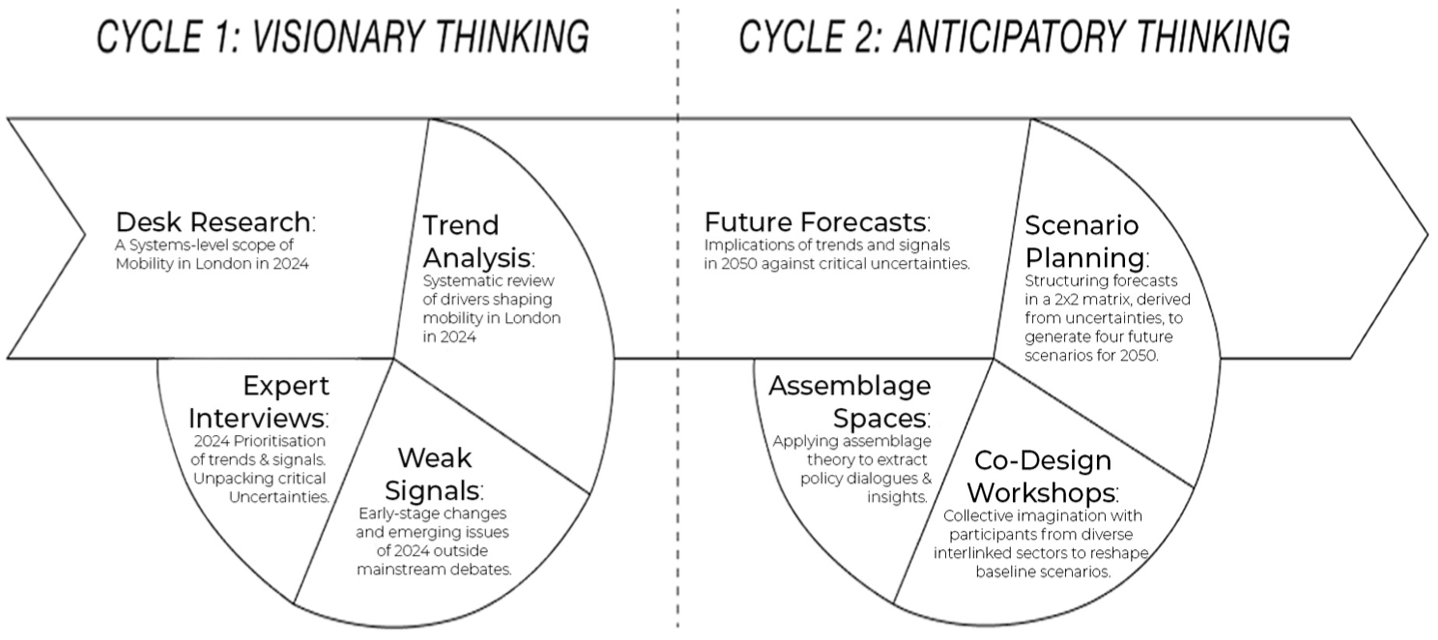
Methodological framework of the study.
These methods were chosen not as predictive tools but as structured ways to explore uncertainties and pluralize imaginaries, consistent with established foresight practice (Curry and Hodgson, 2008; Miles et al., 2016; Schwartz, 1996). By integrating futures methods with participatory planning traditions (Chambers, 2012; Healey, 1997), the study foregrounded the role of participatory voices in shaping London’s mobility futures.
Whereas traditional foresight exercises risk privileging expert or technocratic perspectives, this research integrated both expert interviews and co-design workshops to ensure diverse imaginaries were represented. Expert participants contributed sectoral knowledge of transport systems, sustainability transitions, and policy frameworks, while workshop participants brought disciplinary and community-oriented perspectives from design, planning, social services, and futures practice. This combination enriched the scenarios with both institutional expertise and lived or professional insight, ensuring that the resulting futures were not only analytically robust but also socially grounded. The structure of these engagements is summarized in Table 1. A more detailed summary of outputs from expert interviews can be found in Online Appendix 1.
Overview of participatory methods.
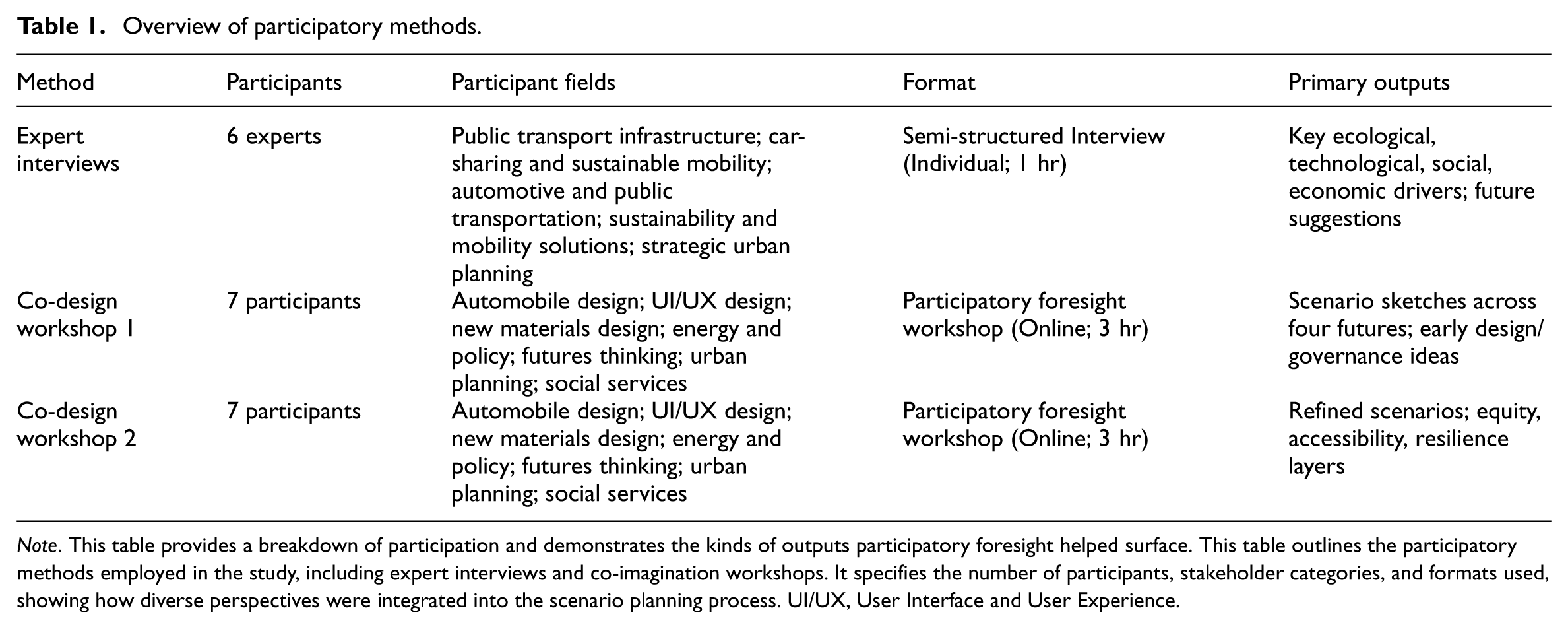
Note. This table provides a breakdown of participation and demonstrates the kinds of outputs participatory foresight helped surface. This table outlines the participatory methods employed in the study, including expert interviews and co-imagination workshops. It specifies the number of participants, stakeholder categories, and formats used, showing how diverse perspectives were integrated into the scenario planning process. UI/UX, User Interface and User Experience.
Trend analysis
The first stage involved horizon scanning to identify major drivers shaping London’s mobility futures, including climate change, digital innovation, and demographic shifts. Trends were identified through a review of academic literature, policy documents, and industry foresight reports (International Energy Agency, 2023; UN Habitat, 2022; World Economic Forum, 2023). These were supplemented by grey literature from consultancy foresight reports (Accenture, 2024; McKinsey & Company, 2020). Consistent with Goodspeed (2020), trends were not treated as deterministic forecasts but as starting points for constructing multiple futures.
Additionally, previous foresight exercises in London, such as the Greater London Authority’s Infrastructure Plan 2050 (Greater London Authority, 2014) and the Government Office for Science’s Future of Cities program (Government Office for Science, 2016), relied heavily on expert modelling and policy analysis. While these initiatives provided valuable insights into infrastructure investment pathways and long-term demographic trends, they tended to foreground technical and economic considerations while underplaying questions of governance, equity, and lived experience. By contrast, this study places participatory foresight at the center of its methodology. The workshops were designed to not simply validate expert-driven scenarios, but to actively reconfigure them through the contributions of diverse publics. This orientation reflects a shift from foresight as technical forecasting to foresight as a collective, co-produced exploration of urban imaginaries.
Weak signals analysis
To complement the trend analysis, the study identified weak signals, which are considered early signs of possible disruption that are not yet mainstream. Sources included policy blogs, experimental pilots, and niche innovation projects (Department for Digital, Culture, Media & Sport and Department for Science, Innovation and Technology, 2021; NHS England, 2023). Unlike trends, which describe established dynamics, weak signals highlight emergent phenomena with uncertain trajectories (Miles et al., 2016; Voros, 2021). This distinction is widely recognized in foresight literature, where weak signals are valued for expanding the imaginative space of scenarios.
In this study, no quantitative scoring or plotting of Weak Signals was undertaken. We distinguished Weak Signals from trends by maturity and institutionalization (i.e., their limited uptake and uncertain trajectories), and we used them qualitatively as prompts and boundary objects during incasting and workshop deliberation. Their function was to broaden plausibility, introduce edge cases, and foreground uncertainties that might otherwise be missed in a trend-only approach. These Weak Signals informed (but did not determine) the identification of critical uncertainties discussed in the section “Critical uncertainties and future forecasting” and helped the selection of the two high-impact, high-uncertainty drivers used to construct the 2 × 2 matrix.
Critical uncertainties and future forecasting
Building on trends and weak signals, the study used exploratory forecasting to articulate potential trajectories for London’s mobility system. Forecasting was not employed to predict a single outcome but to consider a range of plausible pathways under conditions of uncertainty (Schwartz, 1996; Van der Heijden, 2010). This aligns with Dixon and Tewdwr-Jones’ (2021) call for foresight in planning to serve as a deliberative tool, framing forecasting as a way to provoke debate rather than offer prediction.
Two high-impact uncertainties that were identified were: (1) Ecological drivers’ response to climate change; and (2) Technological drivers’ adoption in mobility systems. These were selected during initial expert interviews with six mobility experts from fields including Public Transport Infrastructure, Car-Sharing and Sustainable Mobility, Automotive and Public Transportation, Sustainability and Mobility Solutions, and Strategic Urban Planning.
For each uncertainty, future forecasting exercises were carried out by extrapolating the future of various associated trends and weak signals to assess plausible trajectories of each driver, such as drawing on London’s net-zero commitments, London’s Ultra Low Emission Zone (ULEZ) policy debates, and trials of emerging mobility technologies. This resulted in multiple forecasts projected for each driver, per uncertainty, and the next step was to understand how these individual projections might appear as collective “scenarios,” or in assembled spaces in the future.
Scenario planning
The core of the methodology was scenario development, structured around a 2 × 2 matrix contrasting the kind of change driven by ecological versus technological factors. This approach is common in foresight practice (Curry and Hodgson, 2008) and allows exploration of interactions between key uncertainties. Building on assemblage thinking (DeLanda, 2006), scenarios were not treated as static end-states but as evolving socio-technical assemblages. Four scenarios were generated: Symbiotic Progress, Innovation in Devastation, Regeneration Stagnation, and Business-as-Usual (Figure 2).
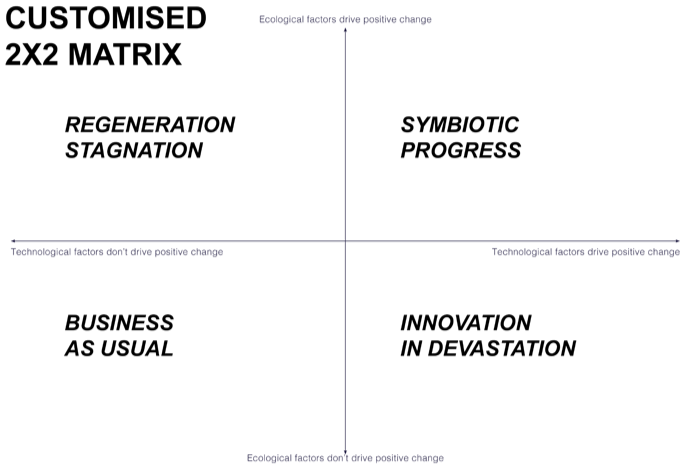
2 × 2 Matrix for mapping critical uncertainties in London’s mobility futures.
The previously forecasted futures of individual drivers helped develop the 2 × 2 matrix, along with iterative analysis of secondary sources (Climate Change Committee, 2017; UNEP, 2023). The plausibility of each scenario would be validated and detailed via participatory workshops with stakeholders from interconnected sectors. This ensured that the yielded four scenarios were grounded in empirical evidence while also opening imaginative space for alternative trajectories.
Participatory co-imagination workshops
Finally, the scenarios were tested and enriched through two participatory workshops with diverse stakeholders including planners, students, NGO representatives, and early-career professionals. The workshops were structured to enable collaborative reflection on the plausibility, risks, and opportunities of each scenario. Participants identified blind spots in expert-driven narratives and introduced concerns such as equity, accessibility, and governance legitimacy.
The workshops followed a structured protocol:
Introduction and orientation to scenario logics and framing.
Group discussions elaborating scenario narratives with lived experiences.
Incasting exercises identifying social and equity implications.
Reflection and comparison across scenarios.
Sessions lasted three hours each and were documented through audio recordings, facilitator notes, and participant sketches. Outputs were coded thematically and directly integrated into scenario narratives. For example, in the Symbiotic Progress scenario, workshop participants highlighted concerns about accessibility for disabled users, leading to the addition of inclusive design features and public ownership models in the final narrative.
This approach draws on participatory action research traditions (Chambers, 2012), communicative planning (Healey, 1997), and recent literature on co-futuring (Dixon et al., 2018). It treats workshops not merely as validation but as sites of knowledge co-production and collective imagination (McPhearson et al., 2021).
Ethical considerations
Ethical approval was obtained from the host institution’s review board. All participants provided informed consent, and anonymity was preserved in reporting. Workshop design emphasized inclusivity and accessibility, including options for remote participation and the use of visual prompts to support engagement.
Summary of methodological contributions
This methodological framework demonstrates how foresight tools can be operationalized in urban studies through participatory processes. By combining trend analysis, weak signals, forecasting, and co-imagination, the study ensured that scenarios were both empirically grounded and collectively envisioned. Documenting the rationale for method selection, participant recruitment, and integration of insights also strengthens the transparency, credibility, and replicability of futures research in complex urban contexts.
Scenario analysis
The scenarios developed in this study—Symbiotic Progress, Innovation in Devastation, Regeneration Stagnation, and Business-as-Usual—explore how London’s mobility futures to 2050 could unfold under different ecological and technological conditions. They are not predictions but structured provocations designed to surface tensions, challenge assumptions, and reveal blind spots in planning (Schwartz, 1996; Van der Heijden, 2010). Each scenario integrates empirical evidence from policy and foresight reports and insights from participatory workshops.
Symbiotic progress: High ecological resilience, fast technological adoption
In this scenario, London achieves a rare alignment between ecological recovery and rapid technological innovation. By 2050, the city has transitioned to a near-zero carbon mobility system powered by renewable energy and electrification. Shared autonomous shuttles, demand-responsive buses, and micro-mobility corridors have replaced much of the private car fleet, while urban rewilding has transformed former road space into green corridors. In this future, technological adoption is not an end in itself but a driver of ecological restoration, reducing emissions, improving air quality, and supporting climate adaptation (International Energy Agency, 2023; UN Habitat, 2022).
Yet, the workshops revealed that a purely planner- or expert-driven articulation of this scenario risked veering into what Dixon and Tewdwr-Jones (2021) describe as “aspirational imaginaries” of future cities: utopian and technologically determined, but socially thin. Participants challenged this by emphasizing that technological transitions cannot be assumed to deliver equity. Disabled residents highlighted risks of exclusion if vehicles were not designed for universal accessibility, while community representatives voiced concerns about affordability and governance accountability. These interventions reshaped the scenario into one of inclusive progress, where ecological and technological synergies are actively mediated by governance and public ownership models.
This transformation echoes Healey’s (1997) conception of collaborative planning, where planners act not as technical experts prescribing solutions but as facilitators of dialogue among diverse publics. Collective imagination reframed Symbiotic Progress not just as a green-technological utopia but as a socially embedded vision in which mobility systems are designed for inclusivity and resilience. Workshop participants suggested, for example, modular interiors in autonomous vehicles to accommodate wheelchairs and prams, and co-operative models for running electric shuttle services in lower-income boroughs. Such contributions grounded the scenario in lived realities, expanding its value beyond efficiency to encompass equity and social justice (Banister, 2011; McPhearson et al., 2021).
The policy dialogue here is instructive. The scenario resonates with the Mayor of London’s Transport Strategy (Mayor of London, 2018), which promotes “healthy streets” and reductions in car dependency, and with the Infrastructure Plan 2050 (Greater London Authority, 2014), which emphasizes long-term sustainability. How-ever, the enriched scenario goes further by embedding inclusivity and governance as central pillars. Where existing policies risk prioritizing infrastructure delivery and economic competitiveness, Symbiotic Progress, when collectively imagined, foregrounds accessibility, distributive equity, and community control as essential components of a resilient mobility system.
Innovation in devastation: Low ecological resilience, fast technological adoption
This scenario imagines a London in 2050 where rapid technological change fails to prevent ecological decline. Climate adaptation lags behind rising flood risks and heatwaves, while biodiversity loss continues to erode the city’s ecological fabric. At the same time, advanced mobility technologies like autonomous vehicles, AI-driven routing, and premium electric pods are widely deployed, but their benefits accrue unevenly. Affluent boroughs showcase seamless, personalized transport services, while disadvantaged areas struggle with degraded public infrastructure and limited access to innovation (Accenture, 2024; NHS England, 2023).
The workshops underscored that this trajectory cannot be understood as a simple failure of environmental governance. Rather, participants highlighted how technological adoption, when decoupled from ecological resilience, generates deepened inequalities. Community advocates described how mobility systems risk becoming “techno-gated communities on wheels,” accessible only to those who can afford premium subscriptions. Others noted that ecological degradation would disproportionately affect low-income groups, who rely most heavily on public transport systems vulnerable to disruption from heat or flooding.
Such insights resonate with Basu and Bale’s (2018) argument that urban imaginaries are not neutral but reflect the perspectives of those empowered to articulate them. Planner-led foresight might have framed Innovation in Devastation as a story of maladaptation, but collective imagination revealed how lived experiences of exclusion transform the narrative into one of social fragmentation. Greenfield’s (2013) critique of smart cities is also apt here: technological fixes, he warns, often serve elite interests and exacerbate existing inequalities rather than solving systemic problems. The workshops made visible precisely this dynamic, showing how ecological decline and unchecked technological roll-out interact to amplify inequities in mobility access.
The policy dialogue is equally revealing. London’s Ultra Low Emission Zone (ULEZ) expansion has been contested on grounds of fairness, with critics arguing that low-income drivers are disproportionately burdened. Similarly, congestion charging and electric vehicle incentives have been criticized for privileging those able to afford cleaner vehicles (London City Hall, 2023; Transport for London, 2021). Innovation in Devastation pushes these tensions to their logical extreme, showing a future where policy levers fail to mitigate inequality and technological adoption entrenches spatial and social divides. This scenario thus serves as a warning: without ecological resilience and equitable governance, technological innovation alone cannot secure just or sustainable mobility futures.
Regeneration stagnation: High ecological resilience, slow technological adoption
In this trajectory, London achieves notable ecological recovery by 2050 through grassroots action and community-led governance, but technological innovation remains limited. Streets are reclaimed for cycling and walking, microgrids supply renewable energy to local transit systems, and rewilded public spaces improve air quality and climate resilience. Rather than being driven by large-scale infrastructure projects, these gains emerge from neighborhood-level initiatives, such as community-managed bus cooperatives or borough-specific rewilding programs.
The workshops, however, challenged the assumption that grassroots-led ecological resilience is universally beneficial. Participants emphasized that local capacity to implement sustainable mobility solutions would vary sharply across the city. Affluent boroughs might develop resilient, low-tech systems supported by strong civic organizations, while less resourced areas could fall behind, facing deteriorating public services, and limited alternatives. One participant described it as “a patchwork quilt of futures stitched unevenly across the city,” highlighting fragmentation as a central risk.
This resonates with Frantzeskaki and Newton’s (2020) work on grassroots innovations in sustainability transitions, which emphasizes both their transformative potential and their dependence on enabling institutions. Without redistributive governance, bottom-up resilience may reproduce inequalities rather than resolve them. Soja’s (2000) arguments about uneven spatial justice are particularly pertinent here: even within a broadly resilient ecological future, disparities in resources and governance can produce unequal outcomes across space.
Policy dialogues in London reinforce these concerns. The Greater London Authority has promoted decentralized governance through initiatives such as the London Environment Strategy, yet capacity varies significantly between boroughs. Wealthier areas are better positioned to attract investment and mobilize civic action, while deprived boroughs often lack the institutional resources to sustain such transitions. The Regeneration Stagnation scenario therefore illustrates both the promise and peril of localism: ecological gains are real but uneven, and without redistributive frameworks, decentralization risks entrenching urban inequality.
Business-as-usual: Low ecological resilience, slow technological adoption
The Business-as-Usual scenario represents a trajectory where ecological decline continues and technological change is incremental rather than transformative. By 2050, London struggles with worsening congestion, persistent air pollution, and rising climate risks. Transport infrastructure lags behind population growth, with bus electrification incomplete, rail networks overstretched, and private vehicles still dominant in many boroughs. Efforts at decarbonization progress slowly but unevenly, leaving the city locked in a cycle of underinvestment and ecological strain.
Workshop participants brought a distinctive dimension to this scenario: the lived experience of stagnation. Instead of abstract indicators of “slow adoption,” they described the emotional toll of an exhausted city. Phrases such as “a tired city treading water” and “we’re always catching up, never leading” captured a sense of planning fatigue and frustration with incrementalism. This framing transformed Business-as-Usual from a neutral baseline into a cautionary scenario, highlighting the risks of inaction and the social costs of failing to meet ecological and technological challenges.
This enrichment aligns with Harvey’s (2012) critique of urban trajectories under neoliberal governance, where the right to the city is eroded by systemic inertia and inequitable development. Without structural transformation, existing inequalities deepen, and opportunities for more radical re-imaginings are foreclosed. Soja (2000) similarly warns that incremental approaches to urban change often fail to address underlying spatial injustices, reproducing cycles of exclusion and marginalization. Business-as-Usual thus illustrates how inertia is not politically neutral but an active driver of inequity.
Policy debates in London reveal the plausibility of this trajectory. Delays in electrifying bus fleets, contested infrastructure projects such as HS2, and divisive debates over the ULEZ expansion illustrate a governance culture that often defaults to incremental fixes rather than systemic transformation (Transport for London, 2021). Business-as-Usual shows the long-term consequences of such inertia: a future in which ecological decline and social inequities persist, not due to dramatic failures but because of persistent under-ambition.
Comparative insights
Across the four scenarios, participatory foresight reshaped the narratives in ways that demonstrate the distinctive value of collective imagination, as demonstrated in Table 2, which provides a summary of workshop contributions. A more detailed summary of workshop outputs can be found in Online Appendix 2.
Summary of workshop contributions.
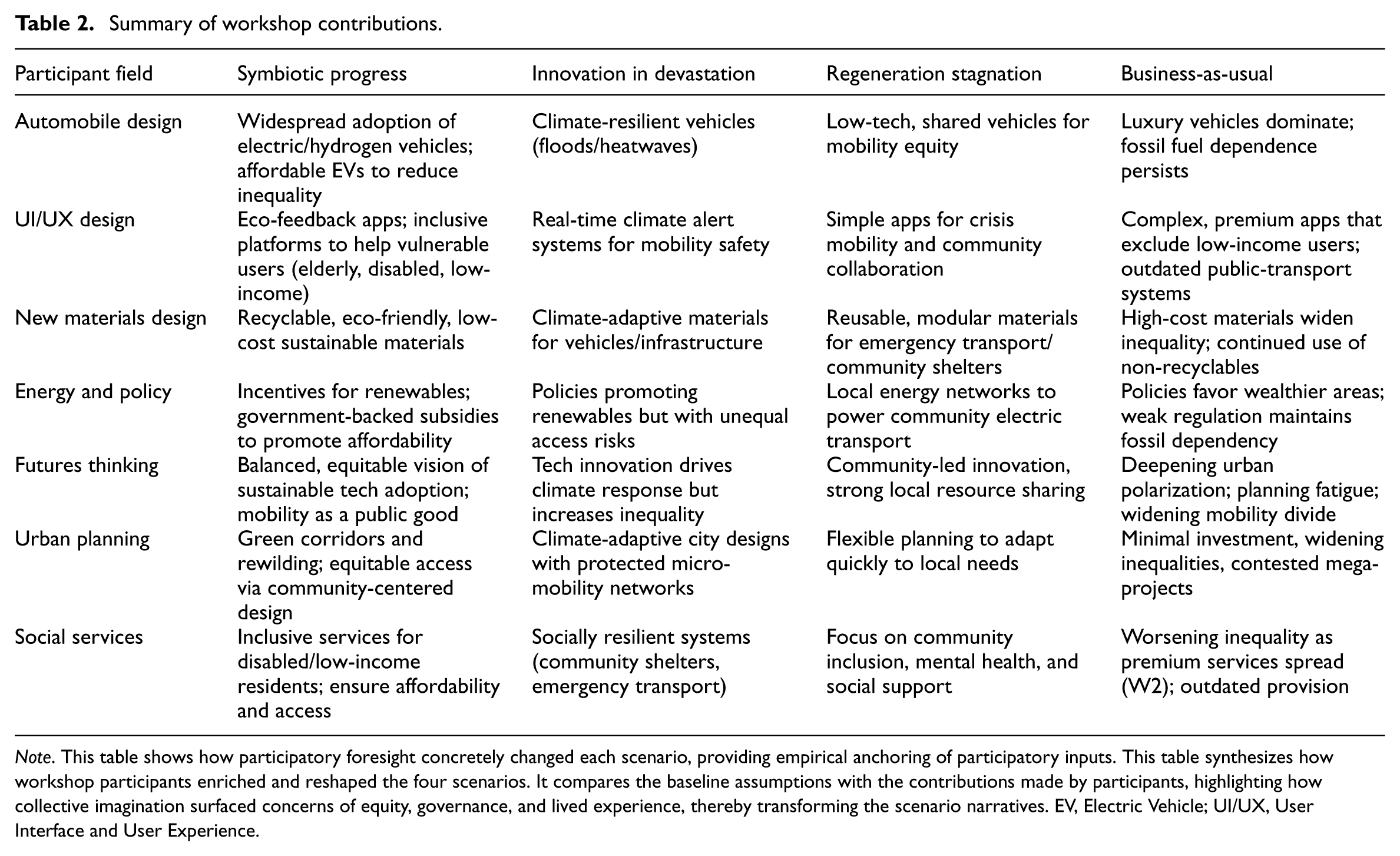
Note. This table shows how participatory foresight concretely changed each scenario, providing empirical anchoring of participatory inputs. This table synthesizes how workshop participants enriched and reshaped the four scenarios. It compares the baseline assumptions with the contributions made by participants, highlighting how collective imagination surfaced concerns of equity, governance, and lived experience, thereby transforming the scenario narratives. EV, Electric Vehicle; UI/UX, User Interface and User Experience.
In Symbiotic Progress, the workshops highlighted that technological and ecological alignment cannot be assumed to deliver equity without deliberate governance mechanisms. This addition shifted the scenario from a technocratic vision of green growth toward one that foregrounds accountability and inclusion (Dixon and Tewdwr-Jones, 2021; Healey, 1997).
In Innovation in Devastation, participants revealed how the decoupling of technological adoption from ecological resilience produced not only environmental vulnerability but also deepened social inequities. Whereas a planner-led account might have framed this trajectory primarily as ecological maladaptation, the workshops recast it as a narrative of exclusion and polarization, underscoring how innovation alone can entrench inequalities if distributive governance is absent (Basu and Bale, 2018; Greenfield, 2013).
Regeneration Stagnation was particularly enriched by local insights, as participants emphasized the uneven capacity of boroughs to deliver ecological innovation. While the baseline narrative could have been read as an optimistic vision of grassroots resilience, collective imagination introduced a sharper awareness of inequality and fragmentation, complicating the scenario with tensions around decentralization and resource disparities (Frantzeskaki and Newton, 2020; Soja, 2000).
Finally, in Business-as-Usual, the participatory process underscored the risks of governance inertia and planning fatigue, drawing attention to the lived consequences of incrementalism. Rather than a neutral projection of continuity, the scenario became a cautionary tale of missed opportunities and cumulative decline, directly informed by participant frustrations with slow or contested policy implementation (Harvey, 2012; Transport for London, 2021).
Taken together, these comparative insights illustrate how participatory foresight operates not only as a method for generating plausible futures but also as a mechanism for reconfiguring their meaning. The scenarios demonstrate that collective imagination enriches foresight outputs by embedding equity, governance, and lived experience into narratives that might otherwise remain narrowly technocratic or descriptive (Bell and Paskins, 2013; Goodspeed, 2020).
Discussion
Futures methods and urban studies
The findings from this study underscore the analytical potential of futures methods for urban studies, particularly when applied to empirical cases such as London’s mobility system. While foresight tools like horizon scanning, forecasting, and scenario planning are well established in corporate strategy and national policy domains (Curry and Hodgson, 2008; Schwartz, 1996; Van der Heijden, 2010), their integration into urban scholarship has been comparatively limited. Urban studies has historically prioritized critical engagement with governance, inequality, and spatial transformation (Harvey, 2012; Healey, 1997; Soja, 2000), often framing the future as a contested political terrain rather than as an explicit methodological object of study. This gap has meant that futures methods are rarely mobilized to interrogate the complex uncertainties of urban transformation, even though such uncertainties lie at the heart of contemporary urban challenges.
This paper contributes to filling that gap by demonstrating how scenario planning, when grounded in a specific case and informed by collective imagination, can enrich urban analysis. Rather than treating futures methods as technocratic exercises, the London 2050 scenarios reveal how foresight can function as an interpretive tool, exposing trade-offs, blind spots, and contradictions in planning assumptions. In this sense, the study aligns with Goodspeed’s (2020) argument that participatory foresight can democratize urban planning by embedding plural perspectives into the construction of future pathways. It also resonates with Dixon and Tewdwr-Jones (2021), who argue that futures work in cities must be understood as socially constructed and politically contested, rather than as neutral or objective projections.
Moreover, the methodological integration of futures techniques with participatory workshops demonstrates that foresight can extend beyond descriptive modelling into conceptual engagement with urban theory. The process of articulating critical uncertainties, elaborating scenarios, and reflecting on their implications foregrounds dynamics—such as governance inertia, uneven local capacity, and contested imaginaries—that are central concerns in urban studies. This suggests that foresight methods should not be confined to applied planning practice but recognized as part of the analytical repertoire of urban scholarship, capable of bridging empirical cases with conceptual debates.
Collective imagination and urban imaginaries
The London 2050 scenarios also demonstrate how collective imagination, the product of participatory foresight workshops, reshapes urban futures, both in substance and in framing. In foresight exercises led exclusively by experts, scenario narratives often default to either technocratic optimism or deterministic pessimism. The workshops conducted in this study revealed alternative pathways, surfacing equity concerns, governance dynamics, and lived experiences that transformed the meaning of each scenario. For instance, in Symbiotic Progress, disabled participants’ insistence on universal accessibility shifted the narrative from a technologically utopian future to one centered on inclusive design and affordability. In Innovation in Devastation, low-income participants highlighted how ecological decline would exacerbate existing vulnerabilities, reframing the scenario as one of exclusion and polarization rather than simply technological maladaptation.
These contributions affirm Basu and Bale’s (2018) claim that urban imaginaries are not neutral visions of the future but contested narratives reflecting power and exclusion. Without participatory processes, the scenarios would have risked reproducing what Dixon and Tewdwr-Jones (2021) describe as “aspirational imaginaries”: glossy, optimistic futures that marginalize social complexity. Instead, collective imagination grounded the narratives in everyday realities, making visible the voices and values of groups often excluded from long-term planning. This supports Bell and Paskins’ (2013) argument that urban imaginaries matter because they structure how policy and governance decisions are legitimized.
By bringing diverse publics into the process, participatory foresight shifted the epistemic foundation of the scenarios. Imaginaries were no longer projections authored by planners alone but co-constructed visions that exposed trade-offs, tensions, and alternative priorities. In Regeneration Stagnation, for example, participants’ reflections on uneven borough capacities reframed localism as both opportunity and risk, showing how grassroots innovation could reproduce inequality without redistributive governance. In Business-as-Usual, participants’ language of fatigue and resignation transformed a neutral baseline into a cautionary tale of political inertia.
Collective imagination thus enriched the scenarios in two key ways. Substantively, it added detail that planners and experts alone may have overlooked, such as accessibility concerns or the emotional toll of stagnation. Conceptually, it reframed the function of the scenarios themselves, from speculative models of change to diagnostic tools that interrogate who benefits, who is excluded, and how power is exercised in the shaping of urban futures. In this way, participatory foresight operationalizes imaginaries not only as objects of study but as co-produced frameworks for understanding urban transformation.
Governance and policy implications for London
The scenarios also generate insights into the governance of London’s mobility transition, highlighting tensions between long-term planning ambitions and the lived realities of urban inequality. The Mayor of London’s Transport Strategy (Mayor of London, 2018) and Infrastructure Plan 2050 (Greater London Authority, 2014) articulate ambitious goals for reducing car dependency, achieving modal shift, and preparing for net-zero mobility futures. Similarly, the UK Government Office for Science’s Future of Cities program has underscored the importance of long-term scenario planning for national urban resilience (Government Office for Science, 2016). Yet, the participatory scenarios suggest that such frameworks often privilege infrastructural and technological delivery while neglecting questions of governance, equity, and lived experience.
The Symbiotic Progress scenario demonstrates how ecological and technological ambitions resonate with London’s official strategies, yet highlights the need for governance models that ensure inclusivity and accountability. Without such mechanisms, the benefits of clean, efficient mobility risk being distributed unevenly. By contrast, Innovation in Devastation illustrates how ecological decline coupled with rapid technological roll-out exacerbates inequities, echoing critiques of current debates around the ULEZ and congestion charging. These policies, while environmentally motivated, have provoked concerns about fairness, particularly for low-income groups unable to access cleaner vehicles. The scenario projects these tensions into the future, showing how failure to integrate equity into governance can produce deeply polarized urban mobility landscapes.
Regeneration Stagnation offers another important governance lesson. By emphasizing grassroots innovation and local resilience, it highlights the potential of decentralized governance to advance ecological goals. However, workshop participants underscored that not all boroughs possess equal resources or institutional capacities, raising the risk of uneven provision. This aligns with critiques of London’s fragmented governance structure, where capacity disparities across boroughs can translate into spatially uneven outcomes. Without redistributive policies, localism risks reproducing inequalities rather than mitigating them.
Finally, the Business-as-Usual scenario illustrates the risks of incrementalism and governance inertia. Despite incremental improvements, the long-term consequences of delayed investment, contested policies, and planning fatigue result in ecological decline and persistent inequality. This cautionary framing echoes Soja’s (2000) critique of incremental urban change and Harvey’s (2012) warnings about the erosion of the right to the city through governance systems that fail to address structural inequities.
Taken together, the scenarios suggest that London’s mobility futures will be determined less by technological or ecological drivers alone than by the governance frameworks mediating their implementation. Futures methods thus provide diagnostic value, revealing not only possible trajectories but also the governance mechanisms required to make those trajectories equitable and resilient. For policymakers, this highlights the importance of embedding participatory foresight into planning processes, ensuring that strategic visions are stress-tested against the concerns and aspirations of diverse publics.
Participatory foresight as a conceptual intervention
While foresight is often framed as a methodological toolkit for planning under uncertainty, this study positions participatory scenario planning as a conceptual intervention within urban studies. In doing so, it contributes to rethinking how futures are theorized and practiced in urban contexts.
First, participatory foresight challenges the dominance of expert-driven imaginaries. As Goodspeed (2020) and Chambers (2012) argue, scenarios produced solely by planners or technical experts risk reproducing narrow, technocratic logics. The participatory workshops in this study revealed how collective imagination introduces new epistemic resources—lived experience, local knowledge, and values often absent from policy discourses. This reconfigures scenario planning from a predictive exercise to a dialogic process that surfaces contestation and plurality, aligning with Healey’s (1997) conception of collaborative planning.
Second, participatory foresight reframes the role of the planner. Rather than acting as an authoritative forecaster, the planner becomes a facilitator of collective imagination, creating spaces where multiple publics co-envision alternative futures. This represents an epistemic shift in line with Dixon and Tewdwr-Jones’ (2021) call to situate urban futures as socially constructed, contested, and embedded in power relations. The workshops demonstrated that without such facilitation, scenarios risk falling into what Dixon and Tewdwr-Jones describe as “aspirational imaginaries”—optimistic yet socially thin.
Third, this approach extends the urban studies literature on imaginaries (Basu and Bale, 2018; Bell and Paskins, 2013) by showing not only that imaginaries matter, but that their co-production materially alters the content of urban futures. In the case of London mobility, participatory foresight shifted scenarios from being primarily about technology and infrastructure to also being about governance, equity, and lived experience. In this sense, participatory foresight is not just a method of inclusion but a conceptual framework for interrogating whose visions of the future are legitimized, how they are constructed, and with what consequences.
Finally, positioning foresight as a conceptual intervention highlights its potential to bridge theory and practice. It provides urban studies with a tool for advancing scholarly debates on power, equity, and governance, while simultaneously generating outputs—scenarios, narratives, and policy dialogues—that are directly relevant to practitioners and policymakers. This dual role strengthens the case for embedding participatory foresight within the core analytical repertoire of urban studies, not as a peripheral method but as a lens through which to critically engage with the politics of urban futures.
Limitations and future research
While this study contributes to the dialogue between foresight and urban studies, several limitations must be acknowledged. First, the scenarios were constructed around a 2050 horizon, chosen to align with the Greater London Authority’s Infrastructure Plan 2050 (Greater London Authority, 2014) and the Mayor’s Transport Strategy (Mayor of London, 2018). This provided coherence with policy frameworks but may have constrained the exploration of alternative temporalities. Shorter-term horizons might have captured disruptive shocks such as pandemic-induced travel shifts, energy price volatility, or AI-driven demand management, while longer horizons could have revealed more radical transformations, including post-automobility imaginaries or climate migration impacts on London’s urban fabric.
Second, while the participatory workshops broadened the range of perspectives, they cannot claim to have been fully representative of London’s diverse populations. Recruitment constraints meant some groups—particularly disabled residents, recent migrants, and low-income communities—were underrepresented. This points to the need for further participatory foresight research that is more inclusive, accessible, and multi-lingual, ensuring that marginalized voices are substantively embedded in scenario design.
Third, the empirical material is necessarily limited by the study’s scope. The scenarios drew on trend scanning, weak signal identification, and facilitated workshops, but further triangulation with systematic transport modelling, demographic projections, and economic analysis could enhance robustness. Combining qualitative participatory foresight with quantitative modelling offers a promising avenue for future research.
Finally, the study is situated in London and reflects its institutional and socio-political contexts. While insights may be transferable to other metropolitan regions, comparative research across different governance and mobility systems would provide a stronger basis for generalization. Cross-city foresight studies could also illuminate how collective imagination manifests differently in cities with contrasting resource levels, governance capacities, or cultural imaginaries.
In light of these limitations, future research should pursue multi-scalar, comparative, and mixed-method foresight approaches that deepen the empirical grounding of urban futures while advancing conceptual debates in urban studies.
Conclusion
This study demonstrates how participatory foresight produces collective imagination that can reframe urban futures. The four scenarios, namely Symbiotic Progress, Innovation in Devastation, Regeneration Stagnation, and Business-as-Usual, demonstrated not only the uncertainties inherent in ecological and technological change but also the transformative role of collective imagination. Workshop participants reframed scenarios in ways that highlighted equity, governance, and lived experience, shifting them from technocratic projections to socially grounded imaginaries.
The analysis contributes to urban studies in two key ways. Empirically, it provides evidence that participatory foresight generates scenarios that are more inclusive, realistic, and diagnostically useful than those produced solely by experts. Conceptually, it positions participatory scenario planning as a tool for interrogating whose visions of the future are legitimized and how imaginaries are constructed in urban contexts. In this way, it bridges foresight methods with critical urban theory, advancing debates on governance, equity, and sustainability.
At the policy level, the findings highlight the need for London’s long-term mobility strategies to embed participatory foresight into their design and evaluation, ensuring that diverse publics are co-creators of the city’s future. At the scholarly level, the paper opens pathways for comparative, cross-city studies and for integrating foresight with quantitative modelling. Together, these contributions point to a broader research agenda where futures methods and urban studies are not separate traditions but mutually reinforcing approaches to understanding and shaping urban transformation.
Supplemental Material
sj-pdf-1-usj-10.1177_00420980251409128 – Supplemental material for Imagining urban futures: Participatory scenario planning London’s mobility to 2050
Supplemental material, sj-pdf-1-usj-10.1177_00420980251409128 for Imagining urban futures: Participatory scenario planning London’s mobility to 2050 by Trisha Mehta in Urban Studies
Supplemental Material
sj-pdf-2-usj-10.1177_00420980251409128 – Supplemental material for Imagining urban futures: Participatory scenario planning London’s mobility to 2050
Supplemental material, sj-pdf-2-usj-10.1177_00420980251409128 for Imagining urban futures: Participatory scenario planning London’s mobility to 2050 by Trisha Mehta in Urban Studies
Footnotes
Acknowledgements
Acknowledging the mentorship of Dr Andrew Muir Wood, Dr Carla Amaral, Dr Savitri Bartlett, and Dr Elise Hodson. Semi-structured interviews were conducted with Mobility Experts: Barak Sas, Charles Sprang, David Lang, Frederic John, and Anonymous. Co-Design Sessions with participants: Alex Meehan, Cheng Fan, Francesca Piling, Sha Ma, Mehek Khanna, Murphy La, Ruben Vazquez, Samia Dumbuya, Taline Frantz, Tingjun Hu, Trisha Mehta, and Vaishnavi Chitrapu. A Special Thanks to Dr Artur Mausbach and Markus Iofeca for enriching this study’s insights.

Funding
The author received no financial support for the research, authorship, and/or publication of this article.
Declaration of conflicting interests
The author declared no potential conflicts of interest with respect to the research, authorship, and/or publication of this article.
Supplemental material
Supplemental material for this article is available online.
References
Supplementary Material
Please find the following supplemental material available below.
For Open Access articles published under a Creative Commons License, all supplemental material carries the same license as the article it is associated with.
For non-Open Access articles published, all supplemental material carries a non-exclusive license, and permission requests for re-use of supplemental material or any part of supplemental material shall be sent directly to the copyright owner as specified in the copyright notice associated with the article.
