




Abstract
Negative perceptions of anti-social behaviour have been shown by previous research to have harmful repercussions to both an individual’s mental and physical health as well as the neighbourhood’s long-term prospects. Studies in the USA have previously found that the location of alcohol supply points is associated with these negative perceptions, whereas recent, more qualitative and ethnographic research from the UK emphasises the heterogenous and contingent nature of attitudes and perceptions towards alcohol consumption patterns and behaviour. Using multilevel models applied to data from a national crime survey and geocoded data on pubs, bars and nightclubs, this paper focuses on the complex relationship between perceptions of alcohol-related anti-social behaviour and the density of such establishments across England. The findings support the general link between unfavourable perceptions and density of outlets but also highlight the complexity of this association by showing that these relationships are dependent on other characteristics of the neighbourhood, namely deprivation and the proportion of young people in the neighbourhood.
Keywords
Introduction
Robert Sampson recently stated that ‘perceptions of disorder constitute a fundamental dimension of inequality at the neighbourhood level and perhaps beyond’ (Sampson, 2009: 6) and stressed that it is perceptions of disorder (not observed disorder per se) that have a crucial influence in social differentiation of urban neighbourhoods. Where residents (and potential future residents) perceive disorder as an issue there is greater risk that the neighbourhood will suffer from a downward trajectory (Wikström, 2009). Perceptions of disorder are also associated with harmful repercussions for an individual’s health (both physical and mental) and personal wellbeing (see for example Aneshensel and Sucoff, 1996; Bowling et al., 2006; Ellaway et al., 2009; Ewart and Suchday, 2002; Steptoe and Feldman, 2001). Understanding the drivers of such perceptions is therefore important to address neighbourhood inequalities.
In the USA, research on neighbourhood perceptions has been led by the Project on Human Development in Chicago Neighbourhoods (see e.g. Sampson and Raudenbush, 2004). In the UK, studies have predominantly been based on the Crime Survey for England and Wales (CSEW), formerly known as the British Crime Survey. This is a large annual household survey of c. 46,000 individuals (Chaplin et al., 2011) and asks respondents about how much of a problem they perceive a range of different types of anti-social behaviour (ASB) to be in their local area. 1
Unlike the US research, where disorder is often divided into social and physical disorder (see e.g. Sampson and Raudenbush, 2004: 324; Skogan, 1990: 51–52; Taylor, 2001: 56), perceptions of different types of ASB have been combined for analysis purposes into one overall indicator (e.g. Flatley et al., 2008; Kershaw and Tseloni, 2005; Taylor et al., 2010; Tseloni, 2007). However, more recently this approach has been challenged, warning against a ‘reductionist’ and ‘oversimplified’ representation of ASB (Case et al., 2011: 168). In acknowledgement of this criticism, we focus on one specific dimension of ASB covered by the CSEW, namely ‘people being drunk or rowdy in public places’, referred to throughout this paper as ‘alcohol-related anti-social behaviour’. However, a second more important substantive reason for focusing attention on this specific dimension of ASB is its importance in the growing debate and discussion concerning the social implications of the diverse set of alcohol-related night-time entertainment and activities that are characteristic of recently regenerated and gentrified urban areas (Chatterton, 2002; Jayne et al., 2006, 2008). Such spaces of ‘drinkatainment’ are often linked with anti-social behaviour (Jayne et al., 2006) and a burgeoning sense of moral panic (Crawford and Flint, 2009). Debate often stresses the complexity of this night-time economy, highlighting the rivalry between ‘law and order’ and ‘economic profit and growth’ (Chatterton, 2002). The work also emphasises the growth of flexible and multi-agency governance (Crawford and Flint, 2009) striving to achieve social control via manipulation of consumption and behaviour patterns. Within all of this fast-paced, night-time activity centred on alcohol, Hubbard (2013) argues that the ‘practices and aesthetics of excess’ are an integral part of the ‘urban spectacle’ but may perpetuate divisions based on race, class and gender. Moreover, others have challenged the widely held assumption that drunkenness is a transgressive practice both historically (Kneale, 2001) and in the contemporary city (Latham, 2003).
Much of this established and emerging literature on the urban nightscape is heavily theoretical and often based on ethnographic and case study research. In contrast, the work presented here is heavily quantitative but attempts to supplement this rich literature by summarising the underpinning complexity of perceptions of ASB relating to alcohol across the whole of England.
Background: Perceptions of alcohol-related anti-social behaviour and alcohol supply points
Evidence for England suggests that there are strong geographical variations in unfavourable perceptions of alcohol-related ASB, ranging from 17% in North Yorkshire to 35% in Greater Manchester (Walker et al., 2009). However, the mechanisms by which alcohol use affects perceptions of local neighbourhood are multifaceted and complex, and arguably, reflect the diversity and heterogeneity of drinking cultures, practices, behavioural norms, urban design and nightscape activities outlined in the literature above (but see Jayne et al., 2008 and Moon and Kearns, 2014: 235 for reviews with a geographical focus). The research which explicitly centres on explaining disparities has tended to be piecemeal, usually focused in one region or place, although some work is based on national studies. Flint et al. (2007), working with Glasgow Housing Association, for example, found that tenants made reference to the perceived environmental degradation of the local area, both in terms of groups of people consuming alcohol in public places and through broken bottles and associated litter around buildings. In Cardiff and Swansea (Bromley et al., 2000), people’s perceived insecurity was found to be highly localised and related to crime and ASB associated with the night-time economy. Focusing on the London Boroughs, Brunton-Smith et al. (2010) showed that area level deprivation was significantly associated with individual negative perceptions of alcohol-related ASB, independent of the type of person interviewed. In an extensive study working with the 2007/2008 sweep of the CSEW, Flatley et al. (2008) found that the frequency with which survey respondents visited the pub was found to be related to negative perceptions of alcohol-related ASB.
Some studies have focused specifically on alcohol outlet density. Outside of the UK framework, evidence from New South Wales in Australia has shown that such density is associated with perceptions of neighbourhood problems relating to drunkenness (Donnelly et al., 2006). This research also indicated that those living in more deprived areas as well as younger residents were also more likely to report adverse perceptions. Sampson and Raudenbush’s (2004) study of Chicago used systematic social observation of land use which measured incidents of commercial building security (such as iron security gates or pull down metal shutters), alcohol and tobacco advertising and bar and liquor stores which, in combination, they treated as a measure of alcohol density. Although the measure has been criticised for not focusing solely on alcohol-related land use (see McCord et al., 2007), it was found to be statistically significantly related to perceptions of both physical and social disorder.
In summary, the evidence from localised studies in the UK and the seminal US study of Chicago suggest that availability (i.e. density) of alcohol outlets is, in some way, associated with unfavourable perceptions of generic or alcohol-related ASB. Findings also suggest however, that the relationship is contingent on individual characteristics as well as features of neighbourhood. Up until recently it was not possible to explore these relationships across the small areas of England because of data limitations. Whilst the CSEW was able to supply information on alcohol-related ASB, it did not contain neighbourhood counts of alcohol outlets. However, as we outline below, changes in the way that these data are now made available allow us to link the individual level survey findings to external sources on alcohol outlets for neighbourhoods. This data structure facilitates a multilevel analysis whereby we can investigate the extent to which spatial disparities in alcohol-related ASB are associated with individual characteristics (e.g. age, gender and socio-economic background) and area characteristics (including density of alcohol outlets) simultaneously. In this way we can explore some of the more nuanced debates regarding the influence of high density alcohol-related activities in urban space on perceptions of alcohol-related ASB.
At this stage it is useful to specify the research questions that the paper will explore by means of a series of multilevel models (referred to throughout this paper as Models A to D). In the first model (A) we are interested in the individual characteristics associated with negative perceptions of alcohol-related ASB. We then extend this model to test which area characteristics influence such perceptions after controlling for individual compositional effects (Model B). By adding the density of pubs, bars and nightclubs to the model we quantitatively test the intuitive hypothesis that higher densities will be related to more negative perceptions above and beyond other features of the respondent’s local area (Model C). In Model D, we test the possible mediating effects of the density of pubs, bars and nightclubs in the relationship between neighbourhood depriva-tion, levels of young people and perceptions of alcohol-related ASB (Model D).
Data sources
Our main data source was the 2008/2009 sweep of the CSEW (Home Office and BMRB Social Research, 2012). Although the CSEW covers England and Wales, one of our key independent variables – the 2010 Index of Multiple Deprivation – was not available for Wales and therefore our analysis and results are restricted to England only. Full technical details of the survey can be found in Bolling et al. (2009). The analysis presented here takes advantage of a recent innovation whereby the Lower Layer Super Output area identification code for each observation has been attached to the data set. This areal unit relates to UK Census Geography and has a mean population of 1500. For a fuller description see Office for National Statistics (2012). Importantly, the inclusion of this spatial identifier allows us to link the CSEW survey results to external area level data sources such as the 2001 UK Census (Office for National Statistics, 2004a) and Ordnance Survey’s MasterMap Address Layer 2 data set (Ordnance Survey, 2011a). For the purposes of this study we worked at the spatial level of Middle Super Output Area (MSOA) which are derived from aggregations of Lower Super Output Areas and have a mean population of 7200. Arguably, MSOAs approximate to the definition of local area given to CSEW interviewees (a 15 min walk from the respondent’s home) and have been used elsewhere with CSEW data to define local neighbourhoods (see for example Brunton-Smith and Sturgis, 2011).
Dependent variable
Our main dependent variable is the CSEW question ‘how much of a problem are people being drunk or rowdy in public places in your local area?’, with the possible answers being ‘a very big problem’, ‘a fairly big problem’, ‘not a very big problem’ or ‘not a problem at all’. Respondents are not prompted to think about a particular day of the week or time of day when formulating their answers, although it is highly feasible that actual levels of alcohol-related ASB could differ. Those answering either of the first two responses were categorised as perceiving problematic levels of alcohol-related ASB.
Independent variables
We were interested in identifying the covariates of perceptions of alcohol-related ASB at the individual, household and area level. Because of the limited sources of research into the different dimensions of ASB (Brunton-Smith et al., 2010; Flatley et al., 2008), our variable selection was also guided on overall perceptions of ASB (Franzini et al., 2008; Millie et al., 2005; Sampson and Raudenbush, 2004; Taylor et al., 2010). Although the main focus of this paper is on area context (i.e. density of outlets), it is important to acknowledge the potential impact of an individual’s socio-economic and demographic make-up in forming individual perceptions. For this reason, and guided by the literature, individual factors, namely gender, age, ethnicity, marital status, educational qualifications and whether the person had been a recent victim of crime were all included in the models. Important household level characteristics were also included (i.e. income, tenure, accommodation type and length of time living in the neighbourhood). Measuring place effects was also informed by the wider body of literature on perceptions towards an overall or combined measure of ASB. Shaw and McKay’s (1942) classic study of Chicago found that neighbourhoods with high levels of disorder were more likely to experience low socio-economic status, high population turnover and high levels of ethnic heterogeneity. To capture low socio-economic status neighbourhoods we employed the 2010 Index of Multiple Deprivation (Department for Communities and Local Government (DCLG) 2011). 2 This index combines seven domains, chosen to cover a range of economic, social and housing issues. The living environment domain consists of two subdomains which attempt to identify deprivation in the quality of the local environment both within and external to the home (McLennan et al., 2011). Because of the circular relationship between our dependent variable and this external assessment of environment we decided to exclude this subdomain from the overall deprivation score. The crime domain was also removed as level of reported crime is included in our models as a separate independent variable. The remaining domains (including the ‘indoor’ living environment, quantified in the IMD as houses in poor condition and/or without central heating), were then merged into a composite score which we have labelled ‘deprivation’ in our models.
Population turnover was derived from MSOA inflow and outflow rates per 1000 population for the period July 2008 to June 2009 (Office for National Statistics, 2010a). Because these two variables were highly correlated (0.94) they were combined using Principal Component Analysis into one variable to represent turnover between MSOAs. To measure ethnic diversity, we employed the Gibbs and Martin (1962) index defined as:

where p is proportion of individuals in a category (from the 2001 Census) and N is number of categories. The range of the index of diversity is from 0 (where all residents are of the same ethnic background) to
Following Sampson and Raudenbush’s (2004) discussion of other important area influences we also include four other area level variables. First is the level of young people (defined here as those aged 15 to 24 years old) in the population (Office for National Statistics, 2010b) and second is a cross-government rural and urban area classification which divides neighbourhoods into three types: ‘urban’ (defined as urban settlements with a population greater than 10,000), ‘small town and fringe’ and ‘village, hamlet and isolated dwellings’ (The Countryside Agency et al., 2004). The third variable is the reported incidents of anti-social behaviour and in the absence of systematic social observation data (as used in the Chicago studies), police data on levels of actual anti-social behaviour have been used. Since December 2010 street level information on crimes reported to the police has been available at www.police.uk. 3 These point level reported crime data were imported into a Geographical Information Software package, ArcGIS v10 (Environmental Systems Research Institute (ESRI), 2011) along with digital boundary data for MSOAs (Office for National Statistics, 2004b). The software was then used to calculate a count of incidents of ASB reported to the police per 1000 population for each neighbourhood. It is important at this juncture to highlight the fact that these data will only capture a proportion of actual incidents of ASB. Indeed the 2007/2008 sweep of the CSEW found that 72% of individuals who witnessed any type of ASB did not report it to the police or any other authority (Innes and Weston, 2010).
Most crucially to the research objectives of this study, the fourth item measures the density of pubs, bars and nightclubs in the respondent’s local area. The decision to focus this research on pubs, bars and nightclubs was two-fold. First, other alcohol supply points such as off-licences are not separately identified in the Ordnance Survey’s MasterMap Address Layer 2 data base. Second, previous research has shown that it is this category of alcohol supply points which are the strongest predictor of variations in crime (Newton et al., 2010). However, as Newton and Hirschfield (2009) reported there is no single source of consistent data on these supply points in England and Wales. We therefore used the Ordnance Survey’s MasterMap Address Layer 2 data base which contains co-ordinates for more than 27 million residential and commercial properties in Great Britain. The data base employs three different classification schemes to denote the nature of buildings – the Ordnance Survey Base Function, the National Land Use Database Group and the Valuation Office Agency non-domestic rates primary description code (Ordnance Survey, 2011b), however only the first of these three coding schemes offers complete coverage. Further, there is a substantial proportion of commercial premises that are simply coded as ‘general commercial’. Consequently we are unable to ascertain whether these buildings are pubs, bars or nightclubs. This is not an unsubstantial problem when using the data. For example Smith and Crooks (2010) reported that in London 51% of non-residential addresses had the ‘general commercial classification’, leading them to conclude that MasterMap Address Layer 2 building functionality should not be used in detailed analysis without being aware of the errors in the commercial classifications. However, as there is no obvious reason to suggest that the use of the general commercial ‘catch-all’ category is unevenly employed between business types and in absence of an alternative data set of alcohol supply points covering the whole of England we have used Address Layer 2 here while fully acknowledging the data set’s shortcomings. By using the combination of land use classifications we were able to calculate the density of pubs, bars and nightclubs across the MSOAs. 4
Analytical approach
To investigate the research questions set out in the background section above, we employed multilevel logistic modelling (Goldstein, 2003; Snijders and Bosker, 2012). Such models adjust standard errors for the clustered sample design used in the CSEW, whereby individuals (n = 41,892) are nested within MSOAs (n = 3611), which in turn are nested within Police Force Areas (n = 38). 5 These models are also appropriate for distinguishing between the variance associated with individuals and the variance relating to the different geographical levels within the data structure and thus avoid incorrect conclusions based on ecological or individualistic fallacies.
Each of the models has a single binary response variable (see section on the dependent variable above) and were initially estimated using iterative generalised least squares based on a first order marginal quasi-likelihood approximation using the software package MLwiN (Rasbash et al., 2009). The model coefficients were checked for stability using Markov Chain Monte Carlo simulation (Browne, 2009). The models were each run through 50,000 iterations (with a burn-in period of 5000 iterations). The first model (A) explored whether individuals in similar environments perceived different levels of alcohol-related ASB. To do this, the first model contained our pertinent individual level variables, but to estimate how these variables are associated with perceptions of alcohol-related ASB within MSOAs, each variable was centred around its MSOA mean (see Kawachi and Subramanian, 2006; Sampson and Raudenbush, 2004). The subsequent models (B to D) involve the assessment of area level covariates on individual perceptions of alcohol-related ASB. Here all individual level variables are centred around their grand mean which ensures that area level associations will be adjusted for individual level characteristics. In all models we allowed random intercepts but not random slopes.
Results
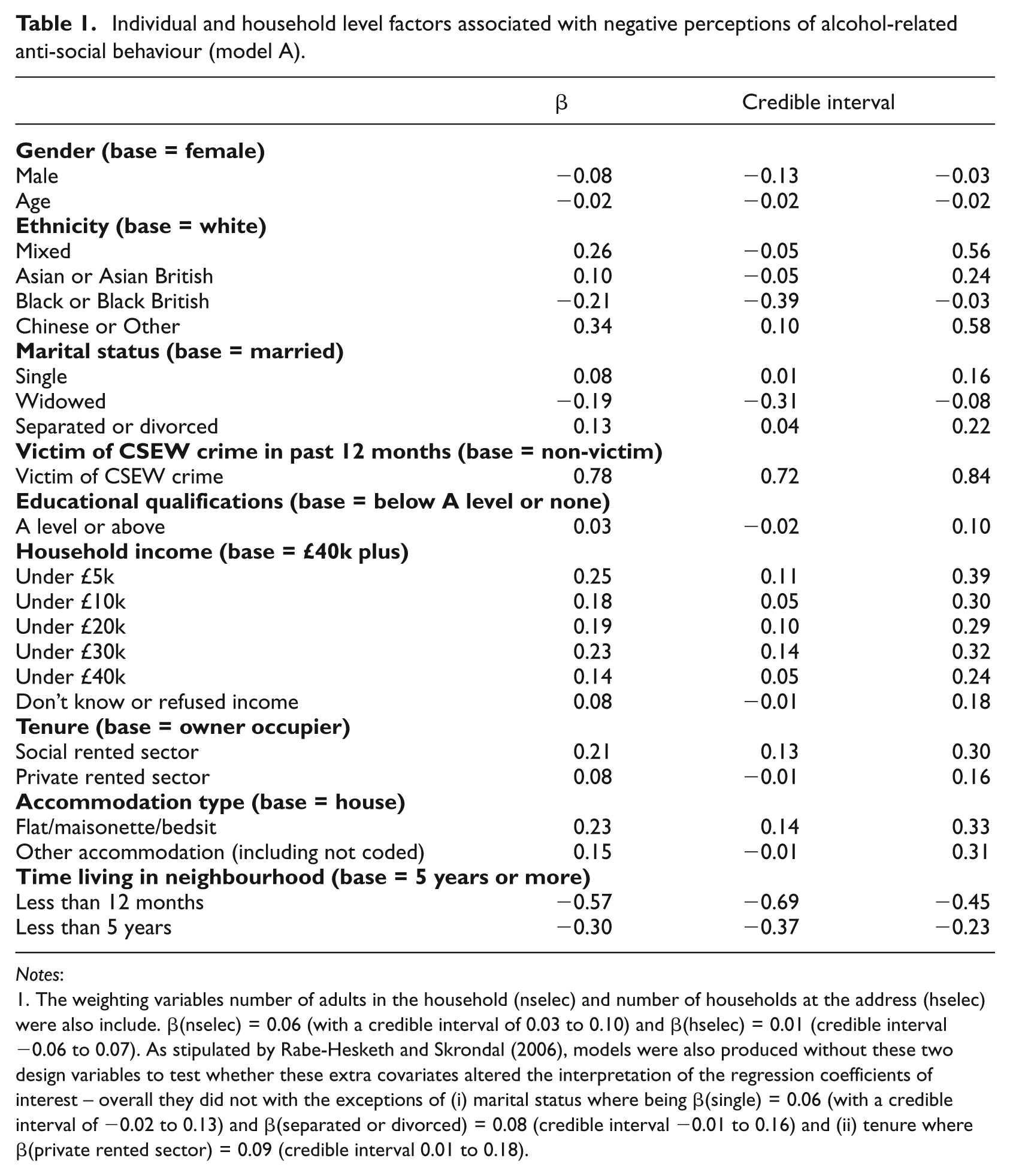
Table 1 shows the results for Model A which focuses on the association between individual level characteristics and perceptions of alcohol-related ASB. Results are expressed as logits. Credible intervals, derived via the Bayesian estimation process, which can be interpreted in much the same way as confidence intervals, are also included. The results illustrate that in line with previous research on perceptions of alcohol-related ASB (Brunton-Smith et al., 2010; Donnelly et al., 2006), as a person gets older they are less likely to perceive alcohol-related ASB to be a problem. As Egan et al. (2012) noted these findings run contrary to the direction one would expect to see if negative perceptions of ASB were driven by the UK’s intergenerational intolerance and characterisation of younger people as anti-social (as argued by the United Nations Committee on the Rights of the Child, 2008) – a stereotype which young people themselves identify with (Neary et al., 2013). Possible explanations could be that older people, on average, live further away from any night-time economy within their neighbourhood and/or interact less with those areas where alcohol activities are concentrated. In university towns and cities, the ‘town’ versus ‘gown’ conflict (Hall, 1997; Munro and Livingston, 2012), for example, may lead urban planners and pub landlords to create entertainment and accommodation areas that are deliberately exclusionary to non-students.
Individual and household level factors associated with negative perceptions of alcohol-related anti-social behaviour (model A).
Notes:
The weighting variables number of adults in the household (nselec) and number of households at the address (hselec) were also include. β(nselec) = 0.06 (with a credible interval of 0.03 to 0.10) and β(hselec) = 0.01 (credible interval −0.06 to 0.07). As stipulated by Rabe-Hesketh and Skrondal (2006), models were also produced without these two design variables to test whether these extra covariates altered the interpretation of the regression coefficients of interest – overall they did not with the exceptions of (i) marital status where being β(single) = 0.06 (with a credible interval of −0.02 to 0.13) and β(separated or divorced) = 0.08 (credible interval −0.01 to 0.16) and (ii) tenure where β(private rented sector) = 0.09 (credible interval 0.01 to 0.18).
Being male, widowed or living in the area for a short period of time all reduce the chances of perceiving drunk or rowdy behaviour to be a problem in the local area. Conversely respondents who described themselves to the survey as being either Asian or Asian British or Chinese (or from another minority ethnic background) were more likely to perceive a problem. Those in the lower income brackets (household incomes of less than £30k per annum) as well as those living in flats or in social rented housing were also more likely to perceive a problem. There are many number of reasons why poorer economic status may lead to more adverse perceptions. It may be that such people live in less gentrified areas of the city where the night-time economy is characterised by fewer numbers of security personnel, compared with more up-market areas (see, for example, Chatterton, 2002).
The impact of previous crime victimisation was particularly strong; if a respondent had been a recent victim of crime, the odds of them describing alcohol-related ASB to be a problem more than doubled. No association was found between educational achievement and perceptions of alcohol-related ASB.
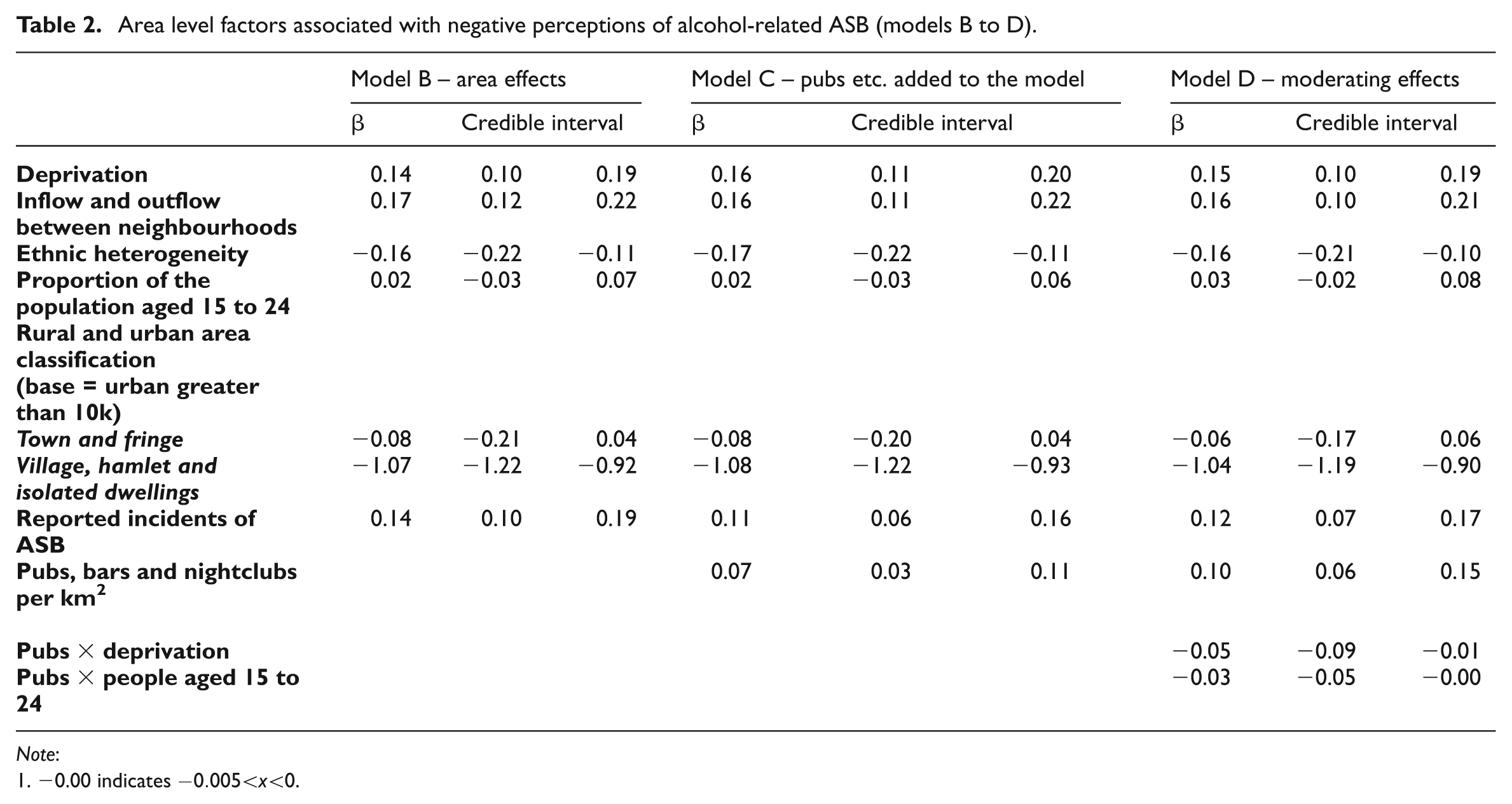
The second stage of the modelling focuses on the area level variables. In these models (Table 2), estimates of the coefficients of the area factors have been adjusted for the characteristics of individuals and households as detailed in Table 1. 6 Unfailingly researchers have found a link between neighbourhood deprivation and negative perceptions of disorder on both sides of the Atlantic – the results presented here being no exception (Model B). The proposition that there is a link between ethnic density and/or levels of ethnic diversity and perceptions of ASB has been controversial (for a full discussion see Taylor et al., 2010). The results here suggest that residents who live in an ethnically mixed area were less likely to report alcohol-related ASB to be a problem in their neighbourhood. Perceptions of drink-associated ASB were worse in neighbourhoods with high levels of population turnover and more urban areas. As would be expected, Model B indicates that actual reported levels of ASB increased an individual’s propensity to report high levels of alcohol-related ASB (regardless of whether they themselves have been a recent victim of crime). The proportion of young people living in the neighbourhood did not have an independent effect on perceptions.
Area level factors associated with negative perceptions of alcohol-related ASB (models B to D).
Note:
−0.00 indicates
Model C shows the effects of the density of pubs, bars and nightclubs on perceptions of alcohol-related ASB. The results indicate that individuals who live in areas with the highest density of pubs, bars and nightclubs do perceive more problematic levels of drunk and rowdy behaviour. Moreover, this relationship holds after adjusting for personal, household and other area characteristics.
The final stage of the analysis examines whether the effect of alcohol outlet density on perceptions of ASB is moderated by other factors. Does the contextual influence of pubs and clubs vary across different types of people and/or different types of places? This is highly plausible given the complexity of attitudes towards ‘drinkatainment’, the varied nature of the urban night-time economy and the diversity of consumers and providers involved with alcohol-related activities (Chatterton, 2002; Jayne et al., 2008; Latham, 2003). Are residents expectations around what is acceptable behaviour, as Millie (2008: 379) contends ‘determined by social and cultural norms of aesthetic acceptability’? Model D shows two interaction terms between the density of pubs and other area level variables, namely deprivation and the level of young people in the local area.7,8 The attenuating effects of both a younger community and deprivation on the density of pubs and clubs are illustrated in Figure 1. As the neighbourhood either becomes more youthful or more deprived the probability of negative perceptions of alcohol-related ASB becomes the same regardless of the density of pubs and clubs.
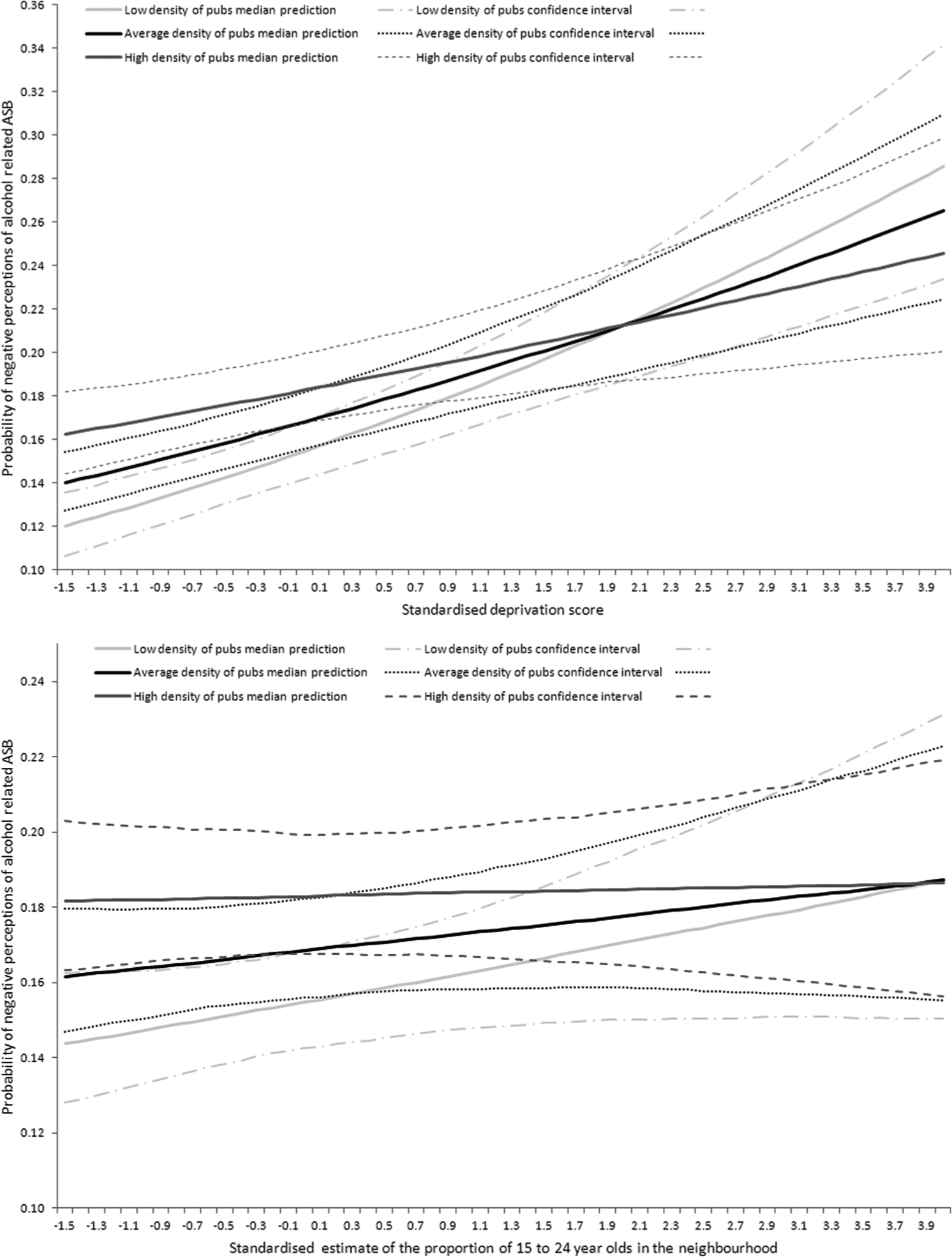
Area level interactions with the density of pubs, bars and nightclubs.
It is difficult to hypothesise on the mechanisms behind these findings in a cross-sectional survey although it is arguable that in high deprivation areas or those where many young people live, pubs are not necessarily seen as a ‘red-flag’ in terms of troublesome behaviour, they are instead, using Millie’s phraseology, tolerated or even celebrated in some instances as a positive part of community life. Young people may even influence cultural norms of acceptance in areas of high youth concentration. They are often the dominant group who consume the 24 hour city and nearly half of young people in the UK now attend higher education (Department for Business Innovation and Skills, 2013). They are probably familiar with extreme alcohol occasions such as Fresher’s week and Carnage drinking events (Hubbard, 2013) and therefore may be more accepting of behaviour that others find disdainful.
Again, it is difficult to explain why deprivation attenuates the association with density outlet. It may be that areas defined as deprived by the Index of Multiple Deprivation may also be those same parts of inner cities and urban areas that have a thriving, well-managed, night-time economy. In such areas, there may be a high density of outlets but levels of acceptance are more tolerant and flexible management curtails levels of alcohol-related ASB.
It is worth noting that although the final model (Model D) explains 53% of the area level variation in the model 9 this means a significant proportion of the area level variation remains unexplained by the area factors described above. A potential explanation of this is apparent by analysis of additional CSEW questions. Although the majority (86%) of individuals living in England reported forming their negative perceptions, at least in part, from their personal experiences, a significant proportion of adults who perceived drunk and rowdy behaviour to be a problem in their local area recounted forming their opinion based on factors which are not necessarily specific to their immediate neighbourhood – local newspaper stories, TV or radio (20%), friends and family (29%) or simply being just something that is well known (25%). Indeed, of those who reported alcohol-related ASB to be a problem in their local area, when asked specifically whether they had witnessed drunk or rowdy behaviour close to where they lived, over one-third (37%) said they had not.
Conclusions
A substantive finding of this work is that it provides evidence, for England, that the location of pubs, bars and nightclubs is associated with negative perceptions of alcohol-specific ASB even after controlling for actual levels of ASB reported to the police. Moreover this contextual relationship varies depending on both the level of deprivation and the proportion of young people in the neighbourhood. It should be noted that obviously not all neighbourhoods with a high density of pubs and clubs are necessarily associated with worsening perceptions; some implement conscientious place management or strong anti-crime policies (McCord et al., 2007). Furthermore, it is important at this juncture to acknowledge that pubs, bars and nightclubs also vary considerably in terms of their size, pricing policies, turnover and trading hours (Livingston, 2011) none of which are taken into account in the analyses presented here.
The results presented here also suggest that previous research which has amalgamated different types of ASB into one overall measure may have masked differing associations between types of ASB. For example a high proportion of young people in the neighbourhood has been found to be related to negative perceptions of combined measures of neighbourhood ASB (Ames et al., 2007; Kershaw and Tseloni, 2005; Taylor et al., 2010; Tseloni, 2007). However, there was no statistically significant main effect when looking at the more focused question of perceptions of drunk and rowdy behaviour examined here but there was a significant interaction between levels of young people and density of outlets. Accordingly, future research plans include investigating differing associations between perceptions of diverse types of ASB in more detail.
Although these results add to previous work by examining the relationship between perceptions of alcohol-related ASB and the location of pubs, bars and nightclubs in an English context, there are several ways in which our analysis might be refined. First, we cannot be certain that our chosen definition of neighbourhoods, MSOAs, correspond to the area in which respondents live their lives or indeed the area which they were thinking about when interviewed. Moreover a respondent may live near an MSOA boundary and be recalling their perceptions of the adjoining MSOA – a problem which Sampson and Raudenbush (2004: 333) referred to as ‘spatial mismatch’. Nor can we create bespoke neighbourhoods 10 (or indeed know whether respondents live close to a boundary) as confidentiality restraints (with respect to not disclosing the exact location of individual respondents) prevented this. Furthermore, even this more complex and resource-intensive approach would not have addressed the flexible notion of neighbourhoods that any one individual may possess and which are likely to be contingent on life stage or routine activity (e.g. employment and family status along with leisure pursuits, etc.). A second problem with our choice of MSOAs is the modifiable areal unit problem (Openshaw, 1984). Detail is inevitably lost when contextual data are aggregated to a larger geographical level and there is no guarantee that adopting an alternative geography would not have resulted in a different set of findings. Finally a more sophisticated analysis of the distribution of pubs, clubs and nightclubs such as the network analysis employed by Ellaway et al., (2010) was not undertaken because of the large geographical area covered by this study.
This research has demonstrated how the development of geocoded social survey data sets will enable further work using ‘proper’ place-specific factors (such as localised crime rates and building usage) rather than simply relying on aggregates of individual statistics. Newton et al. (2010: 1) previously made the argument that the lack of data on alcohol supply points ‘impairs attempts to gain a strategic overview of the timing and location of the availability of alcohol, the proximity of the various outlets to each other, and their relationship to crime and disorder’ and the results presented here echo their sentiment. In order to fully utilise these enhanced social survey data sets it is imperative that administrative data sets, such as any data base of licensed premises, include localised geographical information.
Here, the localised information on alcohol outlets and reported incidents of ASB have allowed the work to move beyond the ‘black box’ nature of area effects. We have attempted to detail the ways in which place characteristics may influence perceptions of alcohol-related ASB. Here we can draw parallels with the approaches and debates in the public health and social epidemiology literature concerning the influence of area contexts on health-related behaviours such as smoking, diet, exercise and alcohol consumption. Traditional approaches looked at the correlates of these risky behaviours adopting a broad-brush approach usually encompassing area deprivation scores. Now more nuanced debate argues for a deeper understanding of the links between context and behaviour, stressing that any identified protective or harming contextual effects are contingent; that is contextual influences vary across different types of people and different types of places. Furthermore, contextual processes are not static; place or context is characterised by dynamic, multiscalar, socio-relational complexity (Cummins et al., 2007; Pearce et al., 2012).
Footnotes
Acknowledgements
We would like to thank the anonymous reviewers for their constructive comments on an earlier version of this paper.
Funding
This work was supported by the Economic and Social Research Council (grant number ES/H019235/1).