




Abstract
Teachers’ professional identities are the foundation of their practice. Previous scholarship has largely overlooked the extent to which the broader institutional environment shapes teachers’ professional identities. In this study, I bridge institutional logics with theory on teacher professional identity to empirically examine the deeply institutionalized, taken-for-granted ways U.S. society has come to think of teaching (e.g., as a moral calling, as a profession, as labor), which are internalized by PK–12 teachers. I draw on survey data from 950 teachers across four U.S. states (California, New York, Florida, and Texas) and develop an original survey measure to capture what I term teachers’“institutionalized conceptions of teaching.” Across diverse state policy contexts, I find that teachers’ conceptions of teaching are guided by three underlying logics: (1) an accountability logic, (2) a democratic logic, and (3) a moral calling logic. I then examine the relationship between institutional logics and teachers’ professional identities. I find that the taken-for-granted ways society frames teaching may be associated with dimensions of teachers’ professional identity, such as self-efficacy and professional commitment. The findings suggest that supporting the professional well-being of PK–12 teachers may require shifting the deeply institutionalized norms of the profession to be more aligned with teachers’ democratic aims—rather than maintaining our system’s deep norms around external accountability and view of teaching as a moral calling. The study offers methodological contributions to the study of logics and practical implications for the field of teaching.
Keywords
A central challenge of education reform is that the beliefs, practices, and norms that underlie our education system are deeply ingrained and can be challenging to shift (Cuban 1984; Tyack and Tobin 1994). Educational reforms frequently fall short because they focus on transforming structures without effectively supporting shifts in the “shared norms, knowledge, and skills of teachers” that underlie those structures (Elmore 1995:26). These shifts are especially difficult because they require altering teachers’ professional identities, which can be as deeply ingrained and intransigent as the beliefs, practices, and norms that underlie the education system because they are informed by the same institutional environments. A robust body of scholarship explores how the institutional environment shapes the education system (e.g., Bridwell-Mitchell and Sherer 2017; Coburn 2004; Diehl 2019). However, less is known about how the micro-level dynamics through which institutional environments shape teachers’ work also have implications for shaping teachers’ professional identities. Given the centrality of teacher professional identity to teacher practice (Beauchamp and Thomas 2009; Garner and Kaplan 2019; Hong 2010) and evidence that institutional environments shape practitioners’ professional identities in other educational fields (e.g., Blake 2023), understanding how the institutional environment shapes teachers’ images of themselves as professionals may be critical to understanding the possibilities of transforming the teaching profession.
One way macro-level institutional environments have influence at the micro level is through institutional logics, meaning “the unstated norms of reference,” patterned on broader societal institutions, such as family and democracy, that shape “the way actors within a field or organization choose to behave” (Marsh et al. 2020:607). In this article, I argue that institutional logics shape not only actors’ behaviors but also their self-conceptions, namely, their professional identities. Professions, such as teaching, are an institution (Thornton and Ocasio 1999), and teachers’ experiences with their profession imprint particular sets of practices, values, and beliefs (i.e., logics) that define what it means to be a teacher. As teachers see themselves through their enactment of these professionally imprinted practices, values, and beliefs (i.e., “I am a person who does A, who values B, who believes C . . . ”), their conceptions of self, or professional identities, come to reflect the logics of the profession. Hence, professional identity embodies the institution (and logics) with which it is associated (Ashforth and Mael 1989).
Understanding the relationship between institutional environments and professional identity is especially pressing in light of recent upheavals in the institutional environment of teaching, which have implications for teachers’ professional identity. A growing number of states, for example, have banned “critical race theory” in schools (Alexander et al. 2023), yet other states have adopted curriculum standards promoting culturally responsive teaching. This tension in the policy environment about what teachers should teach implies different underlying sets of professional practices, values, and beliefs—that is, different logics. This results in multiple conceptions of teaching (Comstock et al. 2025a; Kaul 2024) and potentially in teachers’ contested understandings of their own professional identities. To the extent professional identity plays a key role in organizational commitment (Ashforth and Mael 1989), the dissonance of a contested professional identity may help explain why upheaval in the policy environment and political attacks on the teaching profession are a leading factor driving teachers out of the profession (Hart Research Associates and Mathews 2022).
Given the implications of the interplay between institutional environments and teachers’ professional identities, this article has two related aims. First, I aim to develop a more robust empirical approach for studying the dynamic nature of teacher professional identity. This is in service of the second aim, which is to explore the relationship between teachers’ professional identities and the institutional environments within which they work. I ask three research questions:
Research Question 1: How do teachers’ conceptions of their roles reveal underlying institutional logics?
Research Question 2: How do teachers conceptualize their professional identities?
Research Question 3: To what extent do teachers’ professional identities reflect underlying institutional logics?
I address these questions through a survey study of 950 in-service teachers across four states. I find that teachers’ professional identities are grounded in three institutional logics: (1) an accountability logic, (2) a democratic logic, and (3) a moral service logic. This study makes four significant contributions to the field. First, by broadening conceptions of teacher socialization and identity formation, I document how teachers’ institutional environment relates to their conceptions of themselves as “change agents” in their schools. Second, I offer greater theoretical and empirical clarity about how the institutional environment shapes what happens at the individual level—shaping not just teachers’ behaviors but also their conceptions of their roles. Third, I advance methodologies for studying institutional environments and professional identity—in the latter case, introducing a new measure that elucidates key dimensions of professional identity. Fourth, from a policy perspective, I document how the professional status of teaching is related to teachers’ own professional identities, which are rooted in the logics that policymakers propagate in the institutional environment. My findings suggest that for policies to be effective in shifting teachers’ identities and practices, they must shift the broader taken-for-granted norms of the profession. Supporting the professional well-being of teachers—and addressing the historically low status of the teaching profession (Kraft and Lyon 2024)—demands shifting the deeply institutionalized norms of the profession to be more aligned with teachers’ democratic aims for their work.
Theoretical Framework
I bridge together theoretical scholarship on teacher professional identity and institutional logics. The link between institutional logics and teacher professional identity has not been directly examined in scholarship to date, but there is precedent for studying this relationship in other professions—for example, school counseling (Blake 2023), medicine (Kyratsis et al. 2017), accounting (Bévort and Suddaby 2016), and information technology (Zikic and Richardson 2016). Bridging institutional logics with teacher professional identity offers greater theoretical clarity in how the institutional environment shapes what happens at the individual level (Lounsbury et al. 2021).
Teacher Professional Identity
Scholarship on teacher professional identity emerged nearly three decades ago (Beijaard, Meijer, and Verloop 2004) and is situated in a broader tradition of scholarship on teacher professional socialization (e.g., Lortie 1975; Zeichner and Gore 1990). Beijaard et al. (2004:113) define teacher professional identity as “an ongoing process of integration of the ‘personal’ and ‘professional’ sides of becoming and being a teacher.” Although research on teacher professional identity has gained traction, the construct of teacher professional identity is not consistently conceptualized or operationalized in existing scholarship (Beijaard et al. 2004; Rus et al. 2013), which has created methodological challenges for studying it in practice (Garner and Kaplan 2019). In this article, I seek to address the call in prior work for the development of more innovative methods for studying teachers’ professional identity (Hong, Cross Francis, and Shultz 2024).
To that end, I build on a previous qualitative study of teacher professional identity (Kaul 2024) that documents four central domains to teacher professional identity: (1) self-efficacy, (2) professional commitment, (3) professional integrity, and (4) beliefs about the teaching profession. Self-efficacy and professional commitment have been widely integrated into other frameworks of teacher professional integrity. These frameworks posit that teachers’ professional identities are shaped by how effective they feel in their practice and how committed they are to their roles (Canrinus et al. 2011; Hong 2010; Perera and John 2020). Professional integrity and beliefs about the teaching profession, however, are particularly important to consider in the current policy environment. As political attacks and public scrutiny over teachers’ work mount, teachers have been leaving the profession (Hart Research and Mathews 2022). Traditional accounts for teacher turnover often point to teachers’ working conditions as the key driver of teacher attrition (e.g., Ingersoll 2001; Simon and Johnson 2015). Current political attacks on the teaching profession have targeted how teachers engage with questions of race and ethnicity and other dimensions of identity in the classroom. Many teachers enter the profession with moral commitments to their work, and even the most committed veteran teachers may leave the profession if they believe they cannot work ethically in the current system (Santoro 2021). Teachers’ professional integrity—that is, teachers’ sense they can teach in ways that align with their ethical commitments in the profession—is foundational to their broader professional identity (Kaul 2024). For teachers who enter the profession seeking to be change agents, their professional integrity may be threatened if they are unable to find a path toward working ethically in their roles.
Finally, teachers’ beliefs—both their ontological and epistemological beliefs and their more general beliefs about their roles and the nature of their work (Garner and Kaplan 2019; Vizek Vidović and Domović 2019)—are a key domain of their professional identity. In this study, I focus on one particular domain of teachers’ beliefs: teachers’ culturally responsive (CR) beliefs (Comstock et al. 2023), or teachers’ beliefs about the role of CR teaching. I chose this focus for several reasons. First, given the salience of political debates over the role of race in schooling, I was interested in investigating the extent to which teachers’ CR beliefs may be associated with the institutional logics of teaching. Second, previous scholarship has found this dimension of teachers’ beliefs is deeply related to their professional integrity (Kaul 2024). Teachers’ CR beliefs reflect the extent to which teachers see themselves as change agents, and their professional integrity captures the extent to which they believe the current system allows them to retain their moral visions of their work.
Institutional Logics
An institutional logic perspective provides the ideal framework to consider how what happens within the institutional environment at the macro level shapes teachers’ conceptions of their roles at the micro level. As Bridwell-Mitchell (2013:176) posits, the institutional logics framework “create[s] a conversation between macro and micro research.” Institutional logics are the “socially constructed, historical patterns of cultural symbols and material practices, including assumptions, values, and beliefs, by which individuals and organizations provide meaning to their daily activity, organize time and space, and reproduce their lives and experiences” (Thornton, Ocasio, and Lounsbury 2012:2). Put another way, logics are the “unstated norms of reference” that shape “the ways actors within a field or organization choose to behave” (Marsh et al. 2020:607). They are institutional insofar as they are “patterned on broader cultural and societal institutions” (Bridwell-Mitchell and Yurkofsky 2023:309), including “(a) the family, (b) markets, (c) democracy, (d) bureaucracy, (e) the professions, and (f) religion” (Bridwell-Mitchell 2013:174). In this view, cultural institutions are “constellations of established practices guided by enduring, formalized, rational beliefs that transcend particular organizations and situations” (Lammers and Barbour 2006:357).
Education scholars have leveraged the framework of institutional logics to study how the institutional environment informs a wide range of educational settings, such as charter schools (Glazer, Massell, and Malone 2018), research practice partnerships (Shirrell et al. 2023), portfolio district reforms (Marsh et al. 2020), reading instruction (Woulfin 2016), teacher licensure reform (Comstock et al. 2025a), and school-based equity teams (Ishimaru and Galloway 2020). A central thread of educational scholarship focuses on how educators’ work is embedded in such institutional contexts (e.g., Bridwell-Mitchell and Sherer 2017; Diehl 2019). For example, in her study of the institutional logics of instructional reform, Bridwell-Mitchell (2013) examines the extent to which public school teachers’ resistance to implementing K–12 instructional reform is rooted in broader cultural institutions. She finds that teachers draw on the underlying logics of bureaucracy, democracy, and markets to “rationalize” their instructional practice—establishing a link between the macro-level cultural contexts of instructional reform and teacher’s micro-level beliefs and practices. In another piece, Kaul (2024) maps out the logics of teacher education programs, finding that the prevailing market logic at the field level undercuts programs’ efforts to professionalize or democratize teaching. Prior education scholarship has mapped out the logics that govern entire fields, such as school leadership (Rigby 2014) and kindergarten (Russell 2011), but the field of teaching has not been systematically studied in this way, and the link between the field-level logics of teaching and teacher professional identity has not been directly examined.
Bridging Teacher Professional Identity and Institutional Logics
Together, theory on teacher professional identity and institutional logics provides the ideal framework to examine how teachers’ conceptions of their roles may be rooted in the institutionalized contexts of their work. Logics matter insofar as they shape the professional identities of those on the frontlines of the system, such as teachers (Woulfin, Lamb, and Cyr 2022). And logics structure “how professionals adopt (or reject) identities . . . amid reform efforts” (Woulfin et al. 2022:30). Professional identity acts as the bridge between institutional logics and organizational and individual behavior (Lok 2010) because cultural institutions can only persist as long as organizations and individuals “adopt a unified set of beliefs and routinely behave in accordance with those beliefs” (Bévort and Suddaby 2016:19). Teachers may face multiple, competing demands from the institutional environment, which may be a source of internal conflict in their professional identities (Blake 2023).
Within this context, professional identity becomes the mechanism through which teachers internalize, negotiate, or reject the beliefs and norms of the broader institutional environment. When teachers embrace a professional identity aligned with a particular logic, they enact behaviors that sustain the underlying cultural institutions. Conversely, when individuals adopt identities that challenge a dominant logic, they may challenge the logics through their practice. Understanding the extent to which teachers inhabit the broader logics of teaching within their own professional identities thus provides critical insight into the durability of cultural institutions and the way institutional environments can be sustained and transformed through teachers’ everyday practice.
Methodology and Design
In this study, I surveyed 950 PK–12 teachers across four U.S. states. The survey includes one set of items related to institutional logics (i.e., teachers’ institutionalized conceptions of their roles) and another related to teacher professional identity. I begin by conducting exploratory and confirmatory factor analyses to refine the measures. I then conduct a latent profile analysis to surface a typology of teacher professional identity, and I examine the extent to which institutional logics are associated with these teacher professional identity types using ordinary least squares (OLS) regression models.
Survey Recruitment Platform and Sample
I contracted with Centiment, a third-party survey platform, to administer an internet-based survey to a sample of PK–12 teachers across four states: California, Florida, New York, and Texas. Similar to other commercial survey platforms, Centiment facilitates the recruitment of respondents from their broader panels based on selection criteria provided by the researcher (in this case, PK–12 teachers in the selected four states) and compensates participants for their participation in each survey (Centiment n.d.). Survey research through such commercial platforms (e.g., MTurk, CloudResearch, Centiment) has grown more common in social science research as a cost-effective approach for reaching a large sample while maintaining the integrity of responses and sampling quality (Haderlein 2022; Henderson, Peterson, and West 2016; Valant and Newark 2016; Zhang and Gearhart 2020). To ensure the quality of the sample, Centiment implements a number of security checks on each panel (Centiment n.d.). I additionally screened the IP addresses of survey responses in Qualtrics to ensure teachers were from the states they reported, and I included an attention question to ensure the quality of responses.
I limit my sample to particular states because teaching policies vary considerably by state (Boyd et al. 2008:320). Given that institutional logics are shaped by societal structures such as policy (Russell 2011), I used a purposive sampling strategy designed to capture a range of institutional logics of teaching. I sought to sample states that varied in policy domains, including regulatory environments related to teaching and teacher education and instructional policies, that may be associated with differing logics. New York and California have highly regulated environments and state-level policies supporting CR teaching, whereas Texas and Florida have a highly deregulated policy environment and bans on diversity, equity, and inclusion policies.
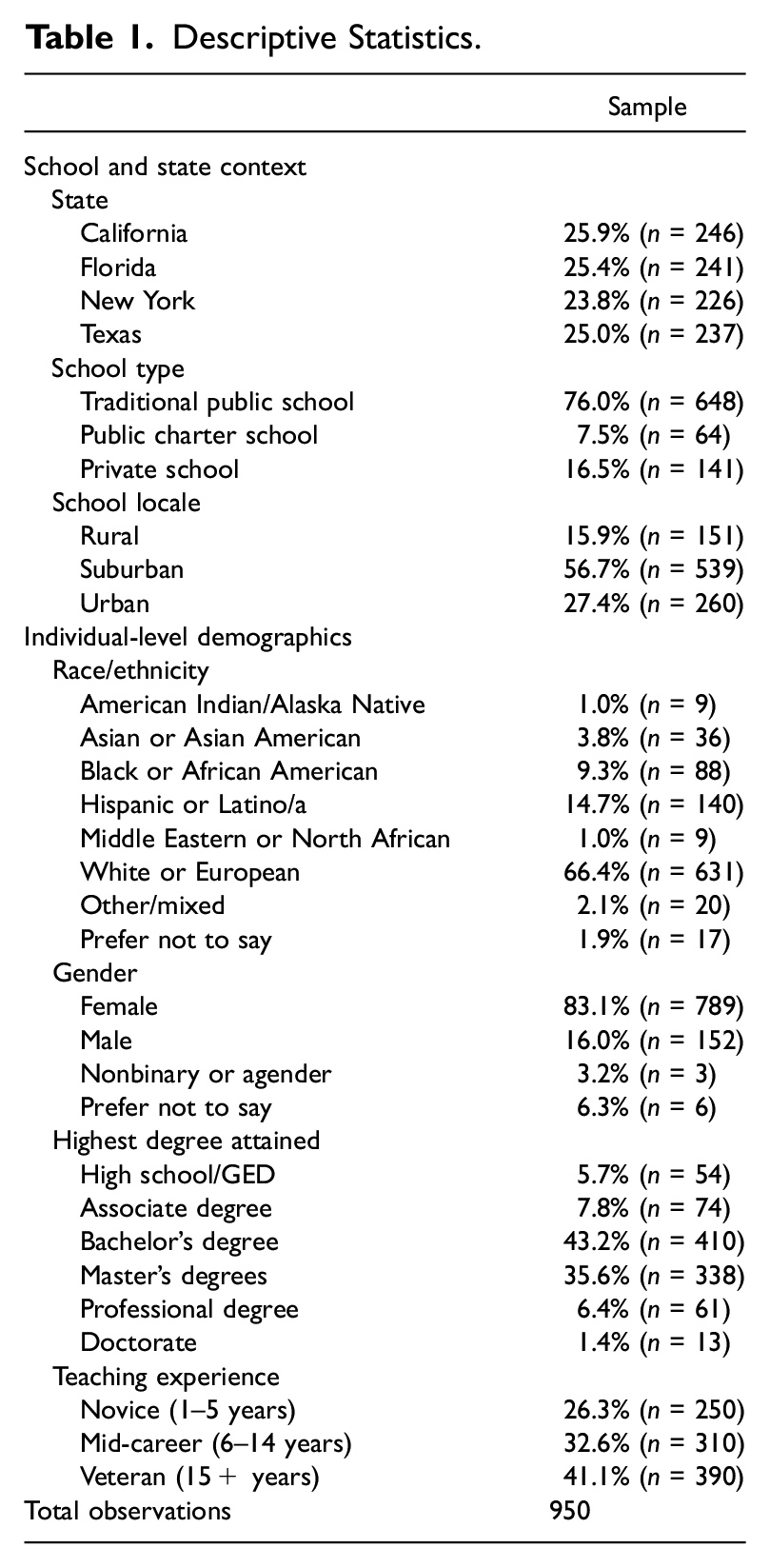
In total, 1,136 teachers took the survey. I dropped respondents from the final sample who failed an attention question (n = 53) or did not fully complete the survey (n = 133), resulting in a final sample of 950 teachers (Table 1). The demographics of the final sample are largely consistent with national trends in the U.S. teacher workforce, although the sample is relatively more racially/ethnically diverse, and respondents have slightly lower levels of educational attainment than the national average (National Center for Education Statistics 2023).
Descriptive Statistics.
Procedures
Before survey administration, I conducted cognitive interviews with five in-service teachers to refine the clarity of my survey items (Desimone and Le Floch 2004). I conducted expert interviews with education scholars to refine my items related to institutional logics to ensure the content of these items accurately reflected the theoretical constructs they were designed to represent (Gehlbach and Brinkworth 2011). The final survey was administered online to teachers in September and October 2023 and took respondents approximately 10 to 15 minutes to complete. At the beginning of the survey, respondents were notified that the purpose of the study was to examine how they conceptualize their professional identities as teachers.
Measures
This analysis leverages data from a survey in which teachers reported various dimensions of their professional identities and conceptions of their roles as teachers. To capture how teachers’ conceptions of their roles may be rooted in institutional logics, I developed a 24-item original measure, which I term “teachers’ institutionalized conceptions of teaching.” I use this measure to determine the logics that may underlie these conceptions. I additionally included three existing measures related to the key domains of teacher professional identity—professional commitment, self-efficacy, and culturally responsive (CR) beliefs—and developed an original six-item measure of professional integrity. I use this set of measures to identify teachers’ professional identity profiles. Tables A1 and A2 in the online supplement document the associated survey items.
Institutionalized conceptions of teaching
I developed a set of measures focused on teachers’ institutionalized conceptions of teaching—that is, teachers’ conceptions of teaching that are rooted in the institutional logics of their work. These items were informed by Thornton and Ocasio’s (1999:806) argument that “institutional logics comprise a set of implicit rules of the game that regulate which issues, strategic contingencies, or problems become important in the political struggle among actors in organizations.” For each cultural institution, I developed items based on “ideal types” of institutional logics (Thornton et al. 2012). Ideal types are a schema used to empirically examine how each cultural institution manifests in practice within particular organizational fields (Thornton and Ocasio 2008). Grounded in previous scholarship (Thornton and Ocasio 2008), I developed a set of survey items associated with each core cultural institution, focused on how logics may inform teachers’ conceptions of their roles. Table A1 in the online supplement presents the full set of measures I developed and tested.
Professional commitment
I adapted a section of Meyer, Allen, and Smith’s (1993) scale of professional commitment, originally developed to focus on nurses, to focus on teachers’ professional commitment. The original item included three separate domains—affective commitment, continuance commitment, and normative commitment (Meyer et al. 1993); I only use the items related to continuance commitment (see Table A2 in the online supplement) because those items were most strongly aligned with theories of teacher professional identity. The five-item scale (α = .87) includes items such as “It would be too costly for me to change my profession now” and “There are no pressures to keep me from changing professions” and uses a 7-point agreement response scale ranging from strongly disagree (1) to strongly agree (7).
Culturally responsive teaching beliefs
I adapted this seven-item scale (α = .80) from previous scales focused on teachers’ perceptions and expectations of CR teaching (Comstock et al. 2023; Phuntsog 2001; Siwatu 2007) to capture teachers’ beliefs about the role of CR teaching in their work. This scale captures the degree to which teachers find it appropriate to adopt CR teaching practices. The scale includes items such as “It is not appropriate to talk about race in the classroom” and “Questioning one’s beliefs about teaching and learning is a critical part of culturally responsive teaching” (see Table A2 in the online supplement) and is a 5-point agreement response scale, ranging from completely disagree (1) to completely agree (5).
Self-efficacy
To measure teachers’ sense of self-efficacy, I used Tschannen-Moran and Hoy’s (2001) validated Teachers’ Sense of Efficacy Scale (α = .90). This scale builds on Bandura’s (1977) construct of self-efficacy and Rotter’s (1966) social learning theory and focuses on teachers’ self-efficacy around a range of teaching practices (e.g., classroom management, student engagement, and instructional strategies; see Table A2 in the online supplement). The scale includes items such as “How much can you do to control disruptive behavior in the classroom?” and “To what extent can you provide an alternative explanation or example when students are confused?” I use the short-form 12-item version of the scale, which is a 5-point confidence scale ranging from nothing (1) to a great deal (5).
Professional integrity
Previous scholarship suggests teacher professional integrity must be included in frameworks of teacher professional identity (Kaul 2024); however, no existing scale, to my knowledge, captures this construct. I developed an original scale (α = .84) to measure teacher professional integrity, grounded in Santoro’s (2011, 2013, 2021) philosophical framework for teacher professional integrity. Aligned with Santoro’s framework, the scale includes items such as “I am able to act in the best interest of my students in my current role as a teacher” and “My personal beliefs and my daily actions as a teacher are aligned in my current role as a teacher” (see Table A2 in the online supplement). The six-item scale has a 5-point agreement response scale ranging from strongly disagree (1) to strongly agree (5). I report findings on the validity of the construct in the results.
Teacher background
To describe the overall sample and the typologies that emerge from the latent profile analysis, I included a set of questions about teachers’ contexts and individual-level demographics (see Table 1). I collected data on teachers’ state- and school-level contexts and their individual demographics: teachers’ racial/ethnic identities, gender, highest degree attained, and years of teaching experience. I constructed two dichotomous dummy variables to classify the teacher profiles: (1) White teacher and (2) male teacher. Grounded in previous scholarship (Ingersoll and Merrill 2017), I constructed a categorical variable to classify teachers based on their years of teaching experience into three groups: novice teachers (1–5 years of experience), mid-career teachers (6–14 years of experience), and veteran teachers (15 or more years of experience). I focused on these dimensions of teachers’ backgrounds because previous scholarship suggests teachers’ experience and race/ethnicity may shape their approach to instruction—especially their use of CR teaching practice (Comstock et al. 2025b).
Analytic Approach
My goals in this article were to (1) develop a measure to capture the institutional logics of teaching (i.e., teachers’ institutionalized conceptions of their roles), (2) identify a typology of teacher professional identity, and (3) examine the extent to which logics are associated with teachers’ professional identities. To that end, I engage in the following four-stage analytic process.
Variable construction: institutional logics
To answer the first research question, I developed a set of survey items to capture the logics of teaching, that is, institutionalized conceptions of teaching (see Table 1A in the online supplement). Following previous empirical work operationalizing logics, I conducted an exploratory factor analysis (EFA) to examine the extent to which teachers’ conceptions of their roles reflect underlying logics (Bridwell-Mitchell 2013). I developed the original items based on the “ideal types” of each institutional logic (Thornton et al. 2012), and I included items related to each of the six primary cultural institutions: family, markets, democracy, bureaucracy, professions, and religion. Given that multiple logics can coalesce to shape teachers’ work (see Bridwell-Mitchell 2013; Bridwell-Mitchell and Sherer 2017), I hypothesized that multiple cultural institutions might coalesce in the same factors, and I used a model with oblique promax rotation to account for correlated factors (Hendrickson and White 1964). To test for multicollinearity, I assessed the determinant of the correlation matrix. The determinant was .122, which exceeds the commonly used threshold of .00001 (Field 2017), indicating there is no multicollinearity between the variables. I then iteratively tested models, dropping factors with low factor loadings (i.e., below .40; Stevens 2012). In the final model, none of the 16 factors loaded onto more than one factor. Table 1A in the online supplement reports the full set of tested factors with their factor loadings and the reliability of the items on the subscale related to each factor. I also report the items I developed and dropped from the final model due to low factor loadings.
Variable construction: professional integrity
Prior work provides a validated measure of teacher demoralization (Carlson-Jaquez 2016), which is also rooted in Santoro’s (2011, 2013, 2021) work, but to my knowledge, there is no existing measure of teacher professional integrity. Accordingly, I constructed an original measure for teacher professional integrity, grounded in Santoro’s theoretical work. Because Santoro’s conceptualization suggests a single domain of professional integrity, I anticipated that all items would load onto only a single factor. To test this assumption, I first conducted an EFA on the initial pool of items, using a model with oblique promax rotation to account for correlated factors; I found that all items loaded onto a single factor (with factor loadings ranging from .60 to .81). Then, I conducted a confirmatory factor analysis (CFA) of these items. I identified appropriate fit statistics to consider from Bridwell-Mitchell (2013), who use a similar methodological approach; this analysis confirmed that a single-factor model fits the data (root mean square error of approximation = .029; p of close fit = .935; parsimony-adjusted comparative fit index = .994; Tucker-Lewis index or nonnormed fit index = .990).
Latent profile analysis
To address the second research question, regarding how teachers conceptualize their professional identities, I conducted a latent profile analysis (LPA), drawing on the survey measures of domains of teacher professional identity (i.e., professional commitment, self-efficacy, CR beliefs, and professional integrity). LPA is a type of mixture modeling that examines the extent to which individuals vary across a set of continuous survey items and tests the fit and significance of latent subgroups (“profiles”) across those individuals (Snodgrass Rangel, Vaval, and Bowers 2020; Urick and Bowers 2014). Unlike factor analysis, which is a “variable-centered” approach and focuses on how individual survey items group together at the construct level, LPA is a “person-centered” approach that focuses on how constructs vary at the individual level (Jung and Wickrama 2008:303). Thus, whereas factor analysis helps establish the underlying dimensions of teacher professional identity, LPA provides insight into how these dimensions coalesce within individuals. Because teacher professional identity is dynamic, collapsing the construct into a single scale would obscure important individual-level variations. Instead, LPA identifies a typology that captures how the subdomains of teacher professional identity operate alongside one another. Such a typology is needed because teacher professional identity is not just about the presence of discrete factors but also about how these factors interact differently within teachers. By surfacing distinct profiles of teachers who share similar patterns across these dimensions, LPA offers a more nuanced understanding of the dynamic nature of teacher professional identity. Each of the professional identity measures used different scales, so I standardized all items before conducting the LPA.
I used the tidyLPA package in R to conduct the LPA (Rosenberg 2021). This process first tests a series of models that vary in their covariance matrix and number of profiles to test the fit of each model (Pastor et al. 2007). Among these models, I selected the model that holds covariance and variance equal across profiles to better understand the characteristics of each profile (Rosenberg 2021). To determine the best model, the tidyLPA package uses a systematic decision-making approach (i.e., an analytic hierarchy process) to compare models using multiple fit indices, including the Akaike information criterion (AIC) and Bayesian information criterion (BIC) values (Akogul and Erisoglu 2017). The analytic hierarchy process suggested that a three-class model (i.e., a model with three teacher profiles) fit the data well (p = .01, AIC = 69,752.52, BIC = 72,457.57). Table A3 in the online supplement presents the full LPA fit statistics.
OLS regression analysis
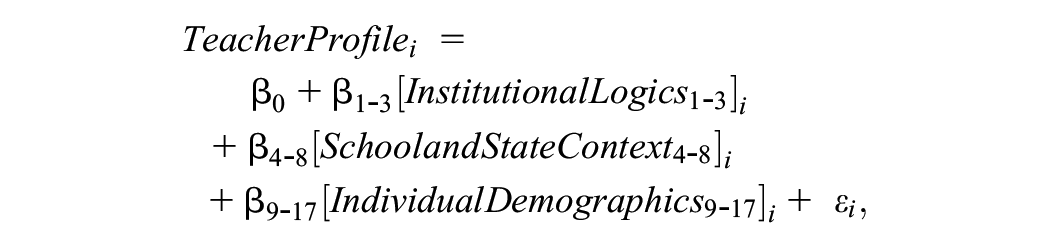
Finally, I am interested in examining the relationship between the institutional logics that teachers call on (i.e., their institutionalized conceptions of their roles) and their professional identity types. I leveraged OLS regression models to examine the association between these logics and teachers’ identity types, running three separate models (one for each teacher identity profile). The dependent variable in each model is the classification probability for each respective teacher professional identity profile surfaced through the LPA. To operationalize institutional logics, I followed Bridwell-Mitchell (2013) and Bridwell-Mitchell and Sherer (2017) and took teachers’ standardized factor loading scores on each factor. Given the moderate correlation between factors (see Figure 1), this approach accounts for teachers drawing on multiple logics in their work. The conceptual model is specified as
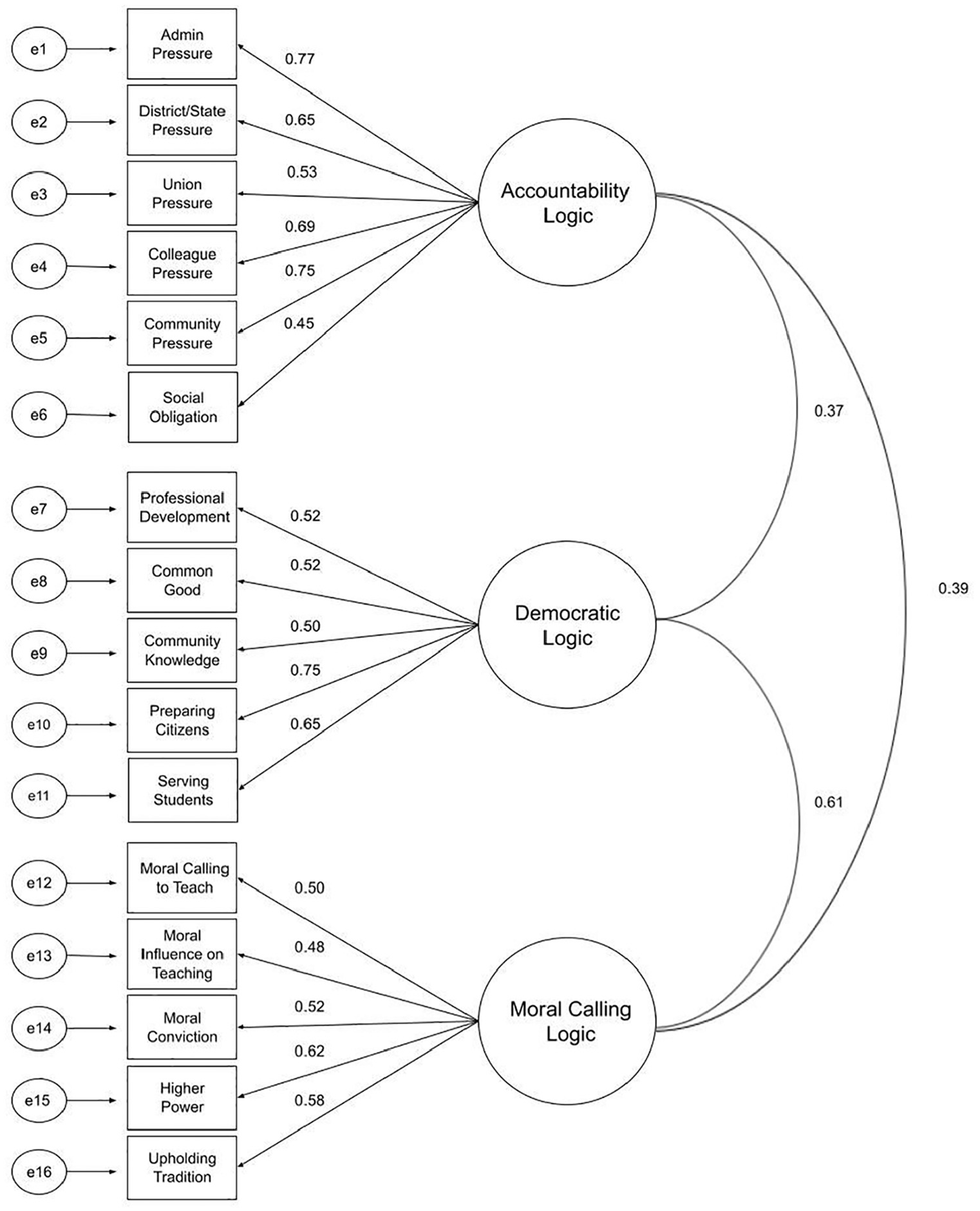
Factor structure for institutionalized conceptions of teaching.
where Teacher Profilei represents the likelihood an individual belongs to teacher profile i; β1, β2, and β3 represent the factor loading scores for each institutional logic factor; β4-8 represent state- and school-level covariates; β9-17 represent individual-level covariates; and
Findings
Institutionalized Conceptions of Teaching
The first research question seeks to identify whether institutional logics guide teachers’ underlying conceptions of their roles. To answer this question, I conducted an EFA on the items related to teachers’ self-reported institutionalized conceptions of their roles. Based on previous scholarship, I hypothesized that multiple institutional logics may coalesce (see Bridwell-Mitchell 2013; Bridwell-Mitchell and Sherer 2017). Consistent with that hypothesis, the results of the EFA suggest that teachers’ conceptions of their roles are guided by three institutional logics: (1) an accountability logic, (2) a democratic logic, and (3) a moral calling logic (see Figure 1).
Accountability logic
The first factor that emerged focused on the various external bureaucratic pressures that teachers felt were shaping or constraining their work. Notably, the items that load onto this factor draw from the cultural institutions of the bureaucracy, professions, and democracy. For example, the accountability logic emphasizes the pressures teachers experience from the union (i.e., a professional body), the district or state (i.e., a bureaucratic body), and the community (i.e., a democratic body) in shaping their work. Conceptually, these items are aligned insofar as they all focus on the external forces of accountability that teachers may experience shaping or constraining their work. These findings build on previous scholarship on how accountability pressures shape teachers’ work (e.g., Cochran-Smith 2021; Mehta 2013) by documenting how teachers internalize broader accountability pressures.
Democratic logic
The second factor focused on learning from and serving the local community toward democratic aims. The items that load onto this factor draw from the cultural institutions of democracy, family, and professions. For example, the democratic logic emphasizes the role of preparing students as citizens and situating teaching in knowledge from the community. This logic is resonant with calls in the field to democratize teaching by situating expertise in the community (e.g., Zeichner, Payne, and Brayko 2015). In contrast to the items associated with an accountability logic, the items related to a democratic logic focus on teachers’ internal sense of accountability to society rather than external pressure (e.g., from their union, colleagues, or community). Notably, the item related to developing one’s knowledge through professional development, which aligns with the cultural institution of professions, also loads onto this factor. This suggests that teachers’ views about community expertise coalesce with their views about professional knowledge, in line with the field’s calls for democratic professionalism (Zeichner 2020). Teachers who saw the need to develop their content and pedagogy through professional development also saw the need to learn from the funds of knowledge in their community, suggesting a potential alignment between teachers’ views of professional and democratic knowledge.
Moral calling logic
Finally, the third factor that emerged focused on teachers’ moral calling to teach. The items that loaded onto this factor draw from the cultural institutions of religion and family. For example, this logic includes items focused on teachers’ desire to uphold tradition and live according to their personal moral or religious convictions. This conception of teaching as a moral calling resonates with previous scholarship that positions teaching as moral work or a moral vocation (e.g., Hansen 1993; Santoro 2011). This logic is also resonant with the public narrative of teaching as a moral calling (Goldstein 2014). Whereas the moral calling and democratic logic are moderately correlated, the accountability logic is less strongly correlated with both moral calling and democratic logics (Figure 1). It is unsurprising that moral calling and democratic logics are moderately correlated because they both call on teachers’ internal sense of service or obligation to society or their community. On the other hand, the accountability logic is guided more by external policy pressures shaping teachers’ work.
Teacher Identity Types
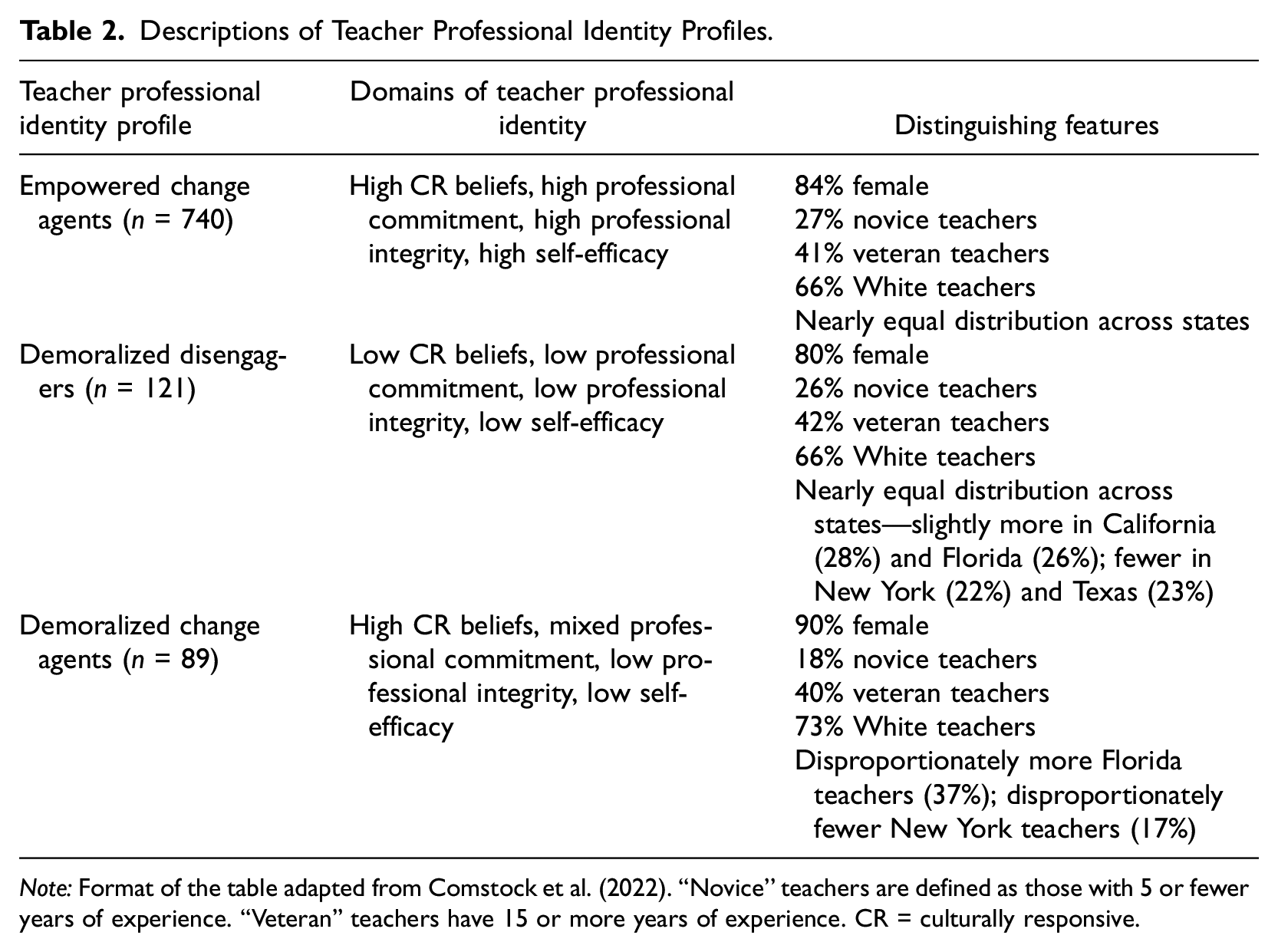
The goal of the second research question was to identify a typology of teacher professional identity based on the domains of teacher professional identity in my conceptual framework (i.e., CR beliefs, professional commitment, professional integrity, self-efficacy). The results of the LPA suggest a three-class model fits the data well (p = .01, AIC = 6,567.40, BIC = 6,659.67). I describe the three teacher profiles as (1) empowered change agents, (2) demoralized disengagers, and (3) demoralized change agents. The majority of the sample (78 percent) identified as empowered change agents, 12 percent identified as demoralized disengagers, and only 9 percent identified as demoralized change agents. Figure 2 synthesizes the standardized item-level averages in teacher responses within and across each domain of professional identity, and Table 2 synthesizes the distinguishing features of each profile.
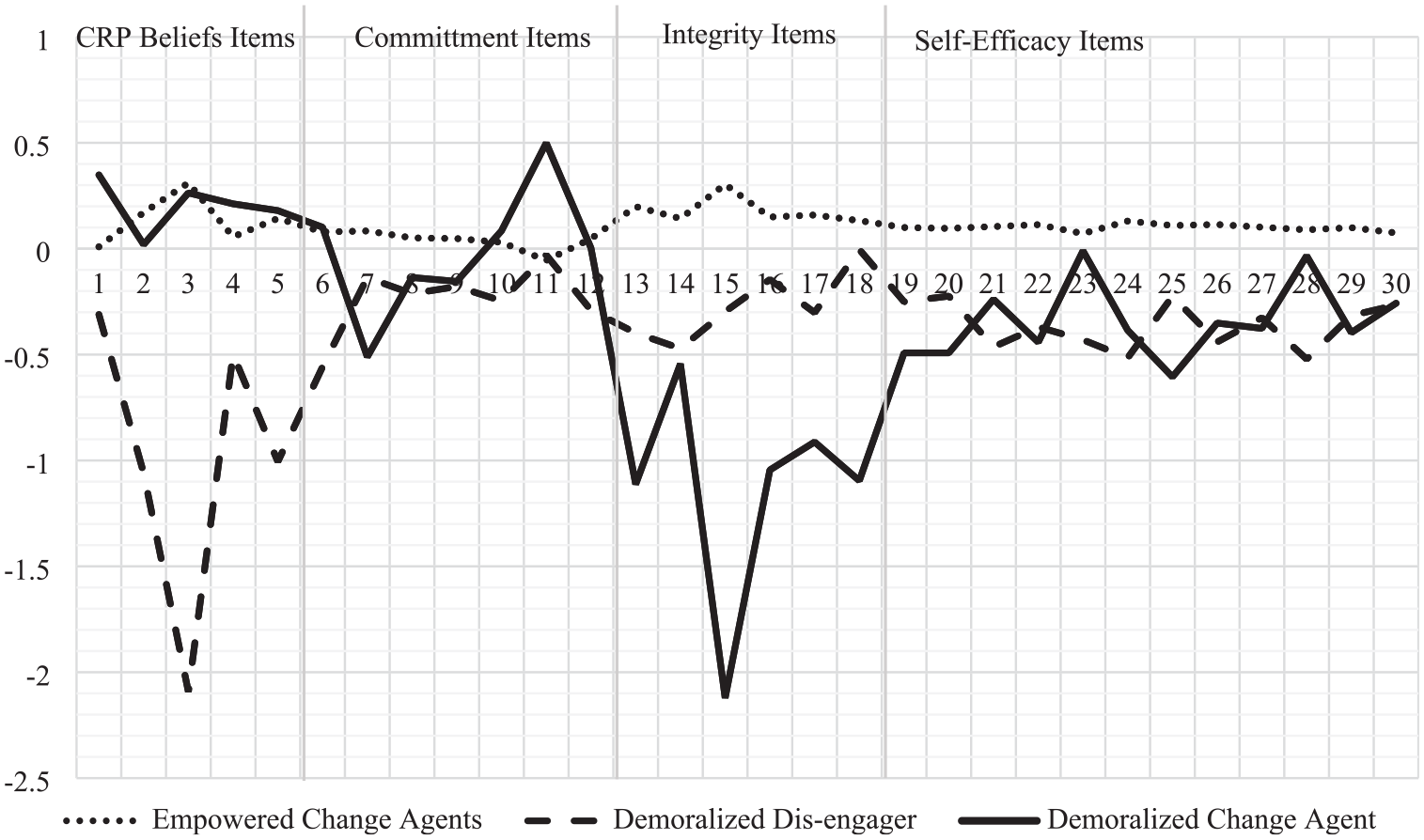
Item-level plots.
Descriptions of Teacher Professional Identity Profiles.
Note: Format of the table adapted from Comstock et al. (2022). “Novice” teachers are defined as those with 5 or fewer years of experience. “Veteran” teachers have 15 or more years of experience. CR = culturally responsive.
The first profile of teachers, empowered change agents, report high CR beliefs, high professional commitment, high professional integrity, and high efficacy (see Figure 2). These teachers were highly committed to their work, felt empowered and effective in their roles, and held strong beliefs about their roles as CR teachers. These teachers saw themselves as change agents in the education system and reported a sense of efficacy in that role. Notably, there was an equal proportion of teachers in this group in each state. Perhaps unsurprisingly, this profile of teachers included the highest proportion of novice teachers. This finding supports the commonsense understanding that teachers become demoralized over time—particularly as they experience barriers to implementing their moral visions of their work (Kaul 2024).
The second profile of teachers, demoralized disengagers, report very low CR beliefs, low professional commitment, low professional integrity, and low self-efficacy (see Figure 2). This profile is nearly the opposite of the first profile: They are highly demoralized and do not see themselves as change agents (in terms of CR practices). Disproportionately more teachers in California (28 percent) and Florida (26 percent) identify as demoralized disengagers relative to teachers in New York (22 percent) and Texas (23 percent; see Table 2). Although these descriptive findings do not provide a causal story of how state policy context relates to teachers’ professional identity profiles, they are surprising. I sampled New York and California because they report highly regulated environments and state-level policies supporting CR teaching, and I sampled Texas and Florida because they have highly deregulated policy environments and bans on diversity, equity, and inclusion. It is therefore notable that I find a greater proportion of demoralized disengagers in both California and Florida—two states that fall on opposite ends of the spectrum of regulatory environments and instructional policies. This suggests the relationship between policy environment and teacher demoralization is more complex than initially hypothesized and may be moderated by other conditions (e.g., at the district and school levels).
Finally, the third profile of teachers, demoralized change agents, display high CR, mixed levels of professional commitment, low professional integrity, and low self-efficacy (see Figure 2). The item-level plots reveal that whereas these teachers feel highly committed along some domains (e.g., they feel pressure is keeping them from changing their professions), they feel less committed along other domains (e.g., they feel they have put too much into the teaching profession to consider changing roles; see Figure 2). This discrepancy suggests that internally, these teachers do not feel committed to staying in the teaching profession, but externally, some pressures are inhibiting them from leaving. These teachers are similar to empowered change agents insofar as they hold high CR beliefs; however, they report feeling less effective and more demoralized in their roles. Unsurprisingly, this profile includes the smallest proportion of novice teachers (18 percent), in line with the view that teachers become more demoralized the longer they stay in the profession. Notably, there are disproportionately more demoralized change agents in Florida (37 percent) and disproportionately fewer in New York (17 percent). Again, these findings raise the question of the extent to which these professional identity types may be shaped by state policy environments. Future work should investigate teachers’ reasons for demoralization and the extent to which state-level teaching policy may drive demoralization relative to other conditions, such as school working conditions.
How Logics Relate to Teacher Professional Identity
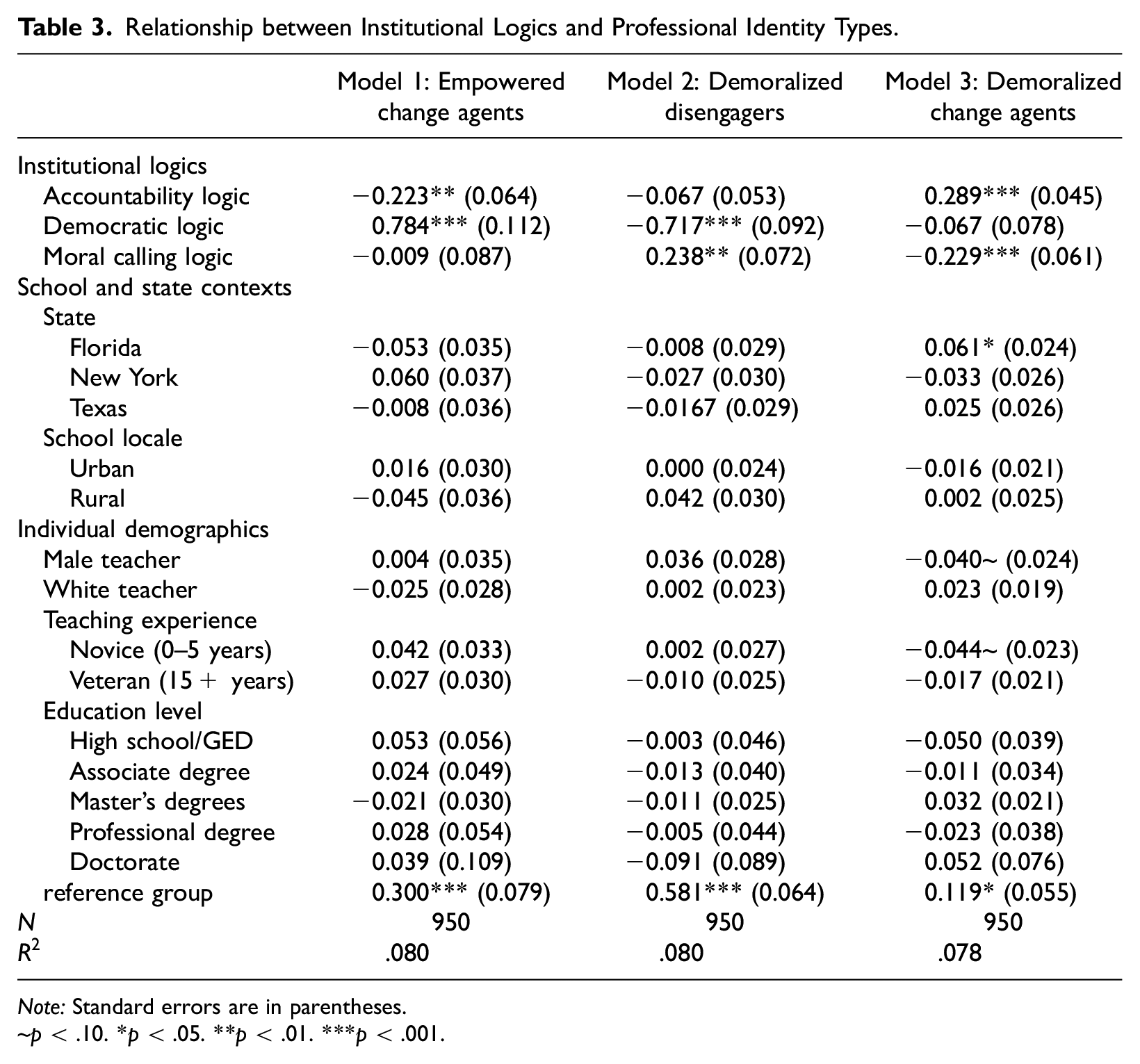
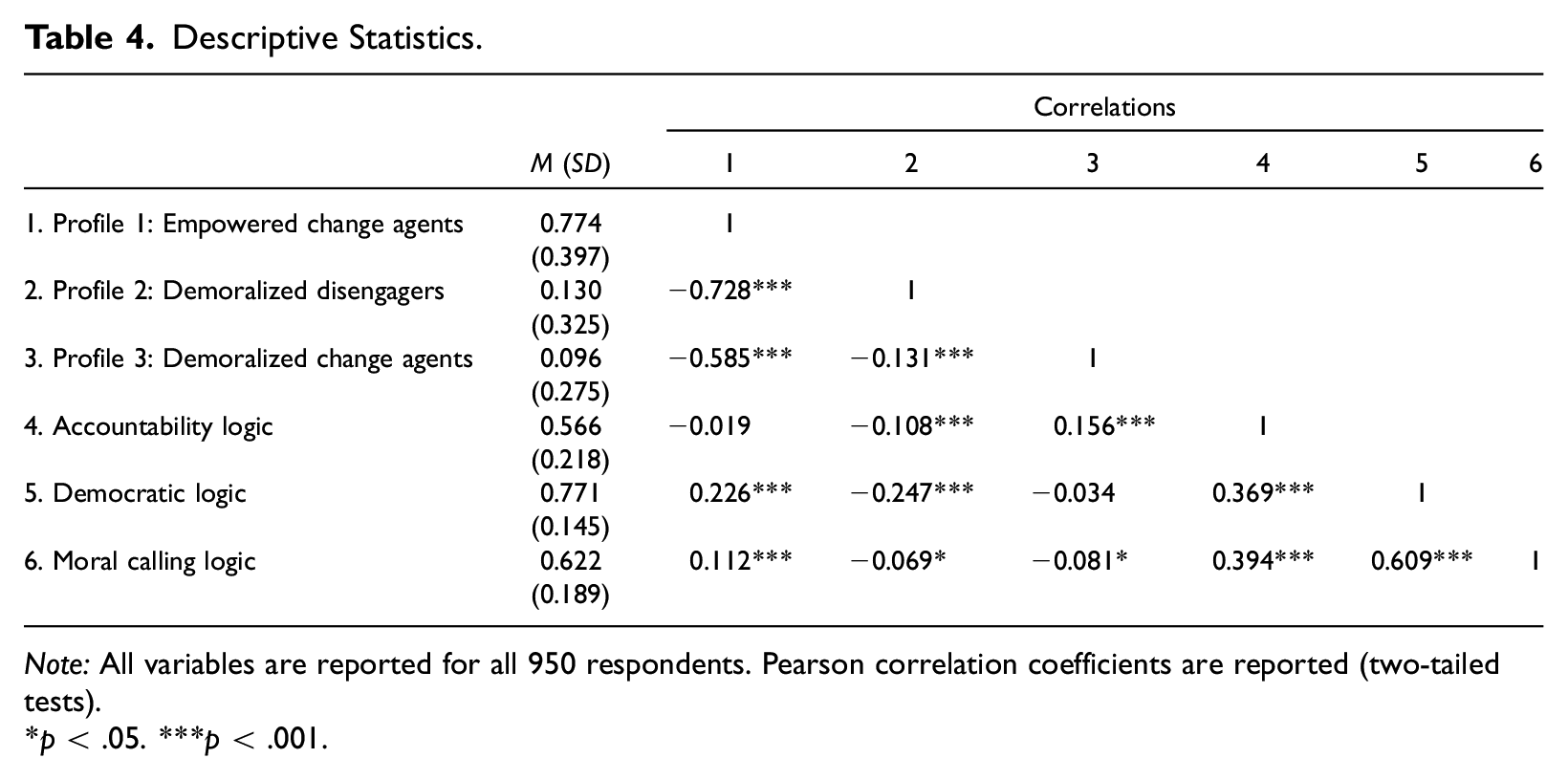
Building on the previous sets of findings, I examined the extent to which institutional logics predict teachers’ professional identity profiles. This stage of analysis considered the extent to which teachers’ professional identity types are associated with institutionalized conceptions of their roles. I found evidence that teachers’ professional identity types are associated with the underlying logics guiding their work (Table 3). Table 4 provides descriptive statistics for the variables of interest in these models.
Relationship between Institutional Logics and Professional Identity Types.
Note: Standard errors are in parentheses.
~p < .10. *p < .05. **p < .01. ***p < .001.
Descriptive Statistics.
Note: All variables are reported for all 950 respondents. Pearson correlation coefficients are reported (two-tailed tests).
p < .05. ***p < .001.
First, I found that the accountability logic is negatively associated with teachers’ likelihood of being empowered change agents and positively associated with teachers’ likelihood of being demoralized change agents. This suggests that accountability pressures shaping teachers’ work are associated with teachers who see themselves as change agents feeling demoralized in their roles. This finding empirically confirms prior work that positions high-stakes accountability pressures as the source of teachers’ demoralization (Santoro 2011; Wronowski 2021). This finding provides more granular evidence that the logics of accountability in the policy environment can shape teachers’ professional identities in addition to the policies themselves.
Second, I found that democratic logic is positively associated with teachers’ likelihood of being empowered change agents and negatively associated with teachers’ likelihood of being demoralized disengagers. In other words, conceptualizing teaching as democratic work is associated with teachers holding stronger views of themselves as change agents (as reflected by their CR belief) and being more empowered in their roles (as reflected by their professional integrity). This finding suggests that teachers’ CR beliefs and sense of professional integrity are rooted in a desire to serve their community rather than in a sense of external accountability.
Finally, I found that having a professional identity grounded in the moral calling logic is positively associated with teachers’ likelihood of being demoralized disengagers and negatively associated with teachers’ likelihood of being demoralized change agents. In other words, among demoralized teachers, seeing teaching as a moral service is associated with feeling less empowered (i.e., they reported lower self-efficacy and professional commitment). These findings suggest that positioning teaching as a moral calling actually undermines teachers’ sense of well-being in their roles. One explanation for this is that teachers who primarily view their work as a moral calling may have an overly idealistic view of their role and may be particularly vulnerable to demoralization and losing their sense of efficacy (Kaul 2024).
Demographic and contextual factors exhibited mostly insignificant or very weak associations (p < .10). The one exception is the finding that teachers in Florida are more likely than teachers in California to be demoralized change agents. This study did not investigate teachers’ reasons for demoralization; future scholarship should investigate the sociopolitical environment, state-level accountability systems, and resource disparities in potentially shaping teachers’ professional identities—particularly their levels of morale. Given the wide variation in regulatory environments related to teaching and the instructional policies related to race and equity between Florida and California, these findings suggest the need to investigate how state-level policy environments shape teachers’ professional identities at the micro level.
Limitations
This study is not without limitations. First, this study is not intended to be an exhaustive account of teacher professional identity representative of all U.S. PK–12 teachers. I sample states with varied regulatory environments and instructional policies to capture a range of logics shaping teachers’ professional identities across the country. Given the local nature of the teaching profession (Boyd et al. 2008), many other policy domains likely shape the logics of PK–12 teaching in the United States. Future work should explore the institutional logics of teaching in additional contexts.
Second, conducting a CFA of the institutionalized conceptions of teaching measure with another sample of teachers would help externally validate the measure (Hurley et al. 1997). Given the sample size, I was unable to split the sample to conduct both EFA and CFA while being able to detect the identified effects with sufficient power. The CFA findings are an important step toward establishing the measure’s construct validity, but additional studies with independent samples are needed to strengthen the measure’s external validity.
Third, a limitation of latent class and profile analysis is that the method may be unable to detect low-prevalence groups (Nylund-Gibson et al. 2023). This problem is mitigated by the relatively large sample size; however, given that the study population of interest is PK–12 teachers nationally, this sample is likely insufficient to detect all profiles across the full population. Finally, a limitation of contracting with a survey company is that the typical worker on such platforms may differ from the general population given their willingness to complete a survey for a small financial incentive (Follmer, Sperling, and Suen 2017).
Discussion
Understanding the possibilities of instructional reforms requires grappling with the deeply institutionalized beliefs, practices, and norms that underlie the education system and shape teachers’ work. Extensive scholarship examines how the broader educational reform context shapes teachers’ work (e.g., Coburn 2004; Cohen and Ball 1990; Little 2003), but fewer studies examine how the reform environment reaches teachers’ professional identities. In this study, I explore how teachers’ conceptions of their roles are institutionalized within the profession. This work advances conceptual and methodological understandings of both teacher professional identity and the institutional logics of teaching. The findings suggest that instructional reforms that seek to shift teacher practice must move beneath the surface to the deeper professional norms of the field. This finding aligns with Bridwell-Mitchell’s (2015) conceptualization of teachers as “institutional agents” and contributes to the sociology of professions scholarship by expanding evidence that structural efforts to transform fields (e.g., professionalization) require shifting practitioners’ professional identities (Pratt, Rockmann, and Kaufmann 2006).
By exploring how teachers’ professional identities are rooted in the deeper norms of the field, this study offers implications for policy and practice. For example, a strong logic of external accountability or a moral calling may harm teachers’ sense of professionalism, whereas viewing their role as democratic service fosters professionalism. These findings add to scholarship documenting how accountability policies can demoralize teachers and drive them out of the profession (Santoro 2011; Wronowski 2021). This study highlights that teachers’ professional integrity is shaped not just by their working contexts but also by the deeper norms of the profession.
Building on these findings, the question becomes: What role can policy play in shifting the taken-for-granted professional norms of teaching? As the status of the teaching profession hits its lowest levels in 50 years (Kraft and Lyon 2024), exploring ways to uplift the profession is crucial to the well-being of the broader education system. Institutional change scholarship suggests that short-term policy change alone is insufficient; transforming the deeper beliefs at the core of our education system must be driven by policy implemented in a sustained way (Payne 2008; Stein and Coburn 2023). Thus, policies emphasizing external demands (e.g., high-stakes accountability policies) may be less supportive of teachers’ professionalism than policies that build on teachers’ democratic commitments. School-level structures that support teacher agency can create the conditions for teachers to transform even deeply institutionalized professional norms (Bridwell-Mitchell 2015). Policymakers might invest more deeply in community-based partnerships or professional career leaders that position veteran teachers as experts. Expanding pathways that support teachers’ professionalism and allow teachers to challenge or resist norms that are driving them out of the profession could prove critical in addressing teachers’ historically low professional well-being.
Additionally, institutional logics of teaching persist across states with diverse policy landscapes, suggesting deep field-level institutionalization. Although this analysis does not provide a causal story of how state policy contexts may shape teachers’ professional identities, my findings suggest some potential differences at the state level regarding teacher types that are worth exploring in future work. For instance, demoralized change agents had a disproportionate presence in Florida, a state that recently enacted broad restrictions on permissible teaching topics. Future scholarship should explore how different state policies might drive these dynamics.
Methodologically, this analysis contributes to institutional theory by offering a rigorous empirical approach to studying the dynamics of institutional logics. In response to the long-standing challenge of understanding how various logics “cohere” together (Lounsbury et al. 2021), the institutionalized conceptions of teaching measure and the associated EFA offer a methodological approach for understanding how logics rooted in distinct cultural institutions coalesce. The measure may be applied to a range of other study contexts to explore how external phenomena shape teachers’ institutionalized conceptions of their roles. For example, future work might track shifts over time in response to conditions or policy changes, providing empirical insights into how policy can trigger institutional change in teachers’ taken-for-granted conceptions of their roles.
In addition, this work advances methodological approaches for studying teacher professional identity. The use of LPA addresses long-standing conceptual and empirical challenges (Beijaard et al. 2004; Rus et al. 2013) by capturing domain-specific variation within individuals. This allows for large-scale, quantitative studies of teacher professional identity while retaining its dynamic nature. This study also introduces a new measure: teacher professional integrity. Given the connection between teacher professional integrity and teacher retention (Santoro 2021), this measure offers an important construct for researchers to leverage in future scholarship. Centering demoralization in studies of teacher attrition could help us better understand how moral attacks on the profession degrade teachers’ own sense of professionalism.
These findings offer insights into the possibilities of educational reform—and the role of teachers in mediating reform. Teachers’ professional identities have long been understood to be foundational to their practice. This work extends this understanding to examine how teachers’ professional identities are not only shaped by their personal backgrounds and organizational contexts but are also deeply shaped by the institutional environment. This study provides clear evidence that the conceptions of teachers’ work institutionalized at the macro level also become inhabited within teachers’ identities. The macro-level institutional pressures act through teachers as they shape how teachers conceptualize their roles. As future reforms seek to transform the teaching profession and schools more broadly, reformers must attend to the role of teacher professional identity in potentially mediating the influence of those reforms on teacher practice.
Footnotes
Acknowledgements
The author gratefully acknowledges Ebony Bridwell-Mitchell, Meghan Comstock, Pam Grossman, Sarah Schneider Kavanagh, Rand Quinn, and Sharon Wolf for their helpful feedback on this study. The author also thanks the editor and the three anonymous reviewers for their feedback on this article, which has significantly strengthened this article.
Funding
The author(s) disclosed receipt of the following financial support for the research, authorship, and/or publication of this article: This research was supported by the National Academy of Education/Spencer Foundation Dissertation Fellowship, the University of Pennsylvania GAPSA-Provost Fellowship for Interdisciplinary Innovation, and the Institute of Education Sciences, U.S. Department of Education, through Grant R305B200035 to the University of Pennsylvania.
Research Ethics
This study design and protocols were reviewed and approved by the Institutional Review Board at the University of Pennsylvania.

Supplemental Material
Supplemental material for this article is available online.
Author Biography
References
Supplementary Material
Please find the following supplemental material available below.
For Open Access articles published under a Creative Commons License, all supplemental material carries the same license as the article it is associated with.
For non-Open Access articles published, all supplemental material carries a non-exclusive license, and permission requests for re-use of supplemental material or any part of supplemental material shall be sent directly to the copyright owner as specified in the copyright notice associated with the article.
