




Abstract
Through three years of training, school counselors build a professional identity based on providing social-emotional, academic, and postsecondary guidance to students. But school counselors face conflict in meeting these expectations in a bureaucratic environment that asks them to prioritize efficiency when meeting with students rather than building one-on-one relationships. I draw from interviews with high school counselors and school personnel and a year of observations to study the institutional logics that govern their work and use inhabited institutional theory to study how time scarcity shaped how counselors interpreted these conflicting macro-level logics in their micro-level interactions. The counselors in this study developed patterns of practice that helped them manage this conflict, negotiating but eventually settling with nonideal strategies in the best way they could with the resources made available to them. Efforts to reject the efficiency model were met with pushback from school leaders and unintended consequences for counselors and students alike. The conflict inherent in their work left little room for the mental health or postsecondary counseling they expect and are trained to provide.
So many times, a student comes into your office for one thing and it turns into something totally different. They came in to change their schedule, and five minutes into the conversation, you find out they’re cutting themselves.
School counselors are the first line of response for mental health issues in K–12 schools. Through three years of graduate training, they build a professional identity based on providing social-emotional, academic, and postsecondary guidance to students. However, embedded in schools, they are often utilized as administrative staff coordinating noncounseling tasks, such as high-stakes testing and master class schedules. School counselors find it difficult to act as a bridge between academic success and mental health due to resource constraints (especially in public schools), role ambiguity, and role conflict inherent in working with and for principals, teachers, and other noncounselors (Blake 2020; Monaghan, Hawkins, and Hernandez 2020).
Beyond these obstacles, part of the conflict school counselors face in doing their jobs well is doing so in a highly bureaucratic environment that often needs to prioritize efficiency rather than the one-on-one relationships in which counselors were trained to engage. The effort school counselors expend in their jobs is framed by the rules and guidelines of the organizations where they train and work. These guidelines are manifestations of and legitimized by the logics of the institutions in which they are embedded (Thornton, Ocasio, and Lounsbury 2012), such as the graduate counseling programs and professional organizations that oversee their training, and the public schools that structure their actual work. These institutions frame school counselors’ attention and behavior by defining the problems and issues on which they spend their time.
To better understand the conflict school counselors face, I draw from interviews with high school counselors, counselor educators, and others, and a year of observations of two high school counseling offices to study these logics as “phenomena” that are in their own right worthy of study (Lounsbury et al. 2021). I extend the literature in this area by studying how counselors interpret and adapt these macro-level logics in the organizational meso-level of schools when enacting their micro-level roles, with the understanding that institutions are “inhabited” by people who understand, create, and communicate new and existing rules and norms through everyday behavior and interactions with others (Everitt 2012, 2018; Hallett 2010; Scott 2014). Counselors must make day-to-day, “fairly mundane” interpretations of the environment and make decisions to “muddle” through (Powell and Colyvas 2008:277). Inhabited institutionalism provides the tools to understand how social interactions contribute to how institutions operate and how these interactions influence outcomes of counselors and students (Hallett and Hawbaker 2019).
I document how counselors transform conflicting logics into decisions and interactions by observing those interactions and discussing the meaning of those interactions in interviews. I find that school counselors’ identity and goals are tied to their (macro-level) professional logic, and this professional logic conflicts with the bureaucratic structure of their jobs in public high schools, where they are asked to focus on efficiency and constrained by a lack of resources and time scarcity. I contribute to inhabited institutional theory by exploring how counselors (at the micro-level) utilize their professional logic when facing the bureaucratic logic of their jobs and the negative consequences for students and counselors’ identities. Counselors try to find solutions for how to structure their time in a way that makes sense within public schools and the local cultures of their schools and counseling offices (Haedicke 2012). Ultimately, when performing the pure form of the professional logic or changing the bureaucratic logic is unfeasible, I find counselors reluctantly compromise between the two logics, concede to the bureaucratic logic, or do their best to survive the tension between the two.
Literature Review
High School Counseling
Since its origins, the counseling profession has focused on the growth and development of people through attention given one-on-one or in small group settings. 1 Professional authority over school counseling in the United States comes from two sources: the American School Counselor Association (ASCA) and the American Counseling Association. These organizations value counselors who excel in social-emotional, academic, and postsecondary guidance (Bridgeland and Bruce 2011). Like in teaching (Everitt 2018), these organizations have increasingly contributed to the professionalization of counseling.
In addition, the organizations that oversee the training of counselors—the Council for Accreditation of Counseling and Related Educational Programs (CACREP) and the graduate programs they accredit—also influence the profession through principles, guidelines, and standards (Scott 2008). Programs wishing to be accredited must meet the latest standards for counseling overall and each subspecialty, such as school counseling (CACREP 2015). CACREP does not mandate certain classes, but they do require the curriculum for all counselors cover eight areas: professional counseling orientation and ethical practice, social and cultural diversity, human growth and development, career development, counseling and helping relationships, group counseling and group work, assessment and testing, and research and program evaluation.
Yet high school counselors work in schools that have a different mandate than the clinical counseling centers in which their classmates are employed. Like teachers, public high school counselors are embedded within bureaucratic organizations managed by the federal government, the state, the district, and the principal (Bridgeland and Bruce 2011; Everitt 2018). School counselors work under rules and laws structured by these entities, which have implicit and explicit goals and expectations for their work (Lipsky 2010; Sattin-Bajaj et al. 2018). Counselors are often asked to prioritize efficiency and bureaucratic compliance through school management to support the school’s overall functioning.
Organizations can do different things to control the amount of time and attention workers can dedicate to certain tasks (Ocasio 1997). However, school administrators cannot directly oversee counselors’ day-to-day decisions or their individual interactions with students. Administrators can only set expectations, deadlines, and resources to complete these responsibilities, based in the logic of the environment. This leaves high school counselors to use their judgment when deciding how to accomplish their tasks and how to interact with students (Lipsky 2010; Sattin-Bajaj et al. 2018; Scott 2008).
Translating Institutional Logics into Interactions
The institutional logics approach frames high school counselors within multiple social institutions at multiple levels: interactions between people (at the micro-level) embedded within schools as organizations (at the meso-level) and embedded within institutions at the macro-level (professional and bureaucratic logics; Everitt 2018). Each frame, or “institutional logic,” shapes the attention and behavior of people and organizations through rules and guidelines that prioritize certain issues or tasks (Goodrick and Reay 2011). These frames provide goals, expectations, and a blueprint for action, and they can constrain actors or provide valuable supports and shortcuts that guide their work (McPherson and Sauder 2013; Scott 2014; Thornton et al. 2012). For example, Dunn and Jones (2010) highlight how two logics, care and science, developed together over time in medical schools, as these schools balanced the scientific exploration of medical issues with an increasing imperative toward patient care.
Logics based in the profession receive legitimacy through personal expertise, with oversight by professional associations and in interaction with other professionals (Thornton et al. 2012). Each individual instantiation of an ideal-type logic (like the profession) is unique to the position, time, and location (Lounsbury et al. 2021). Multiple logics may exist within a profession, but professions typically have one dominant logic through which workers learn appropriate actions, identities, and answers to issues (Dunn and Jones 2010; Thornton 2004).
But viewing actors as influenced by these institutional logics does not mean they are without choice or agency in their social structure (Coburn 2004; Everitt 2018; Thornton et al. 2012). Institutions are “inhabited” by people who understand, create, and communicate new and existing rules and norms through everyday behavior and interactions with others in their organization (Everitt 2012; Hallett 2010; Scott 2014; Thornton et al. 2012). People can choose whether or not to follow the implicit rules and, thus, may influence and change the rules themselves through embedded agency (Brown 2021; Thornton 2004). For example, teachers may not adopt institutionally based practices that go against their professional logics (Bridwell-Mitchell 2013), or they may adapt the logics based on their prior education and teaching praxis (Coburn 2004).
School counselors, like other actors, interpret the logics in the context of the local setting (Binder 2018; Nunn 2014). The local setting could mean the geographic region, the type of school, or the student clientele; interactions are thus dependent on how individual counselors interpret larger institutional logics in a localized manner (Binder 2018). This local-level interpretation of macro-level logics is the premise of inhabited institutionalism, which brings the micro-level approach of symbolic interactionism to understand how macro-level logics actually play out (Binder 2007; Fine and Hallett 2014), particularly in a meso-level organizational setting (Everitt 2018). Inhabited institutionalism privileges interactions: It is through interactions that people make meaning of and negotiate logics (Everitt 2018).
In this article, I outline two main logics that govern the work of public high school counselors: the logic of their profession and the bureaucratic logic inherent in the way their jobs are structured in public high schools. I then use the inhabited institutionalist approach to prioritize observing interactions between counselors, students, and others to see how counselors navigate and discuss conflicting logics in action and the meaning they assign to their interactions, bringing “more attention to everyday processes” in institutional analyses (Powell and Colyvas 2008:277). When used to determine the antecedents of decision-making, inhabited institutionalism gives me the opportunity to view how counselors’ decisions within particular interactions are constrained, how they navigate these constraints, and how their subsequent actions can have larger organizational consequences.
Data and Methods
Sample Network
This study is based on 53 interviews with and observations of school counselors and those they interact with on a regular basis, such as principals and counselor educators (a full list can be found in the online Supplemental; a short list of the participants by type and location is shown in Table 1). 2 I focused on counselors in a school district in a midsized urban city in the U.S. Midwest. Ashview School District 3 is largely low income and racially diverse, with 70 percent of students taking part in the free and reduced lunch (FRL) program and over 50 percent identifying as Black or Latinx. I chose this district because of its racial and income diversity and because of the diversity across its high schools.
Number of Participants by Type and Location.
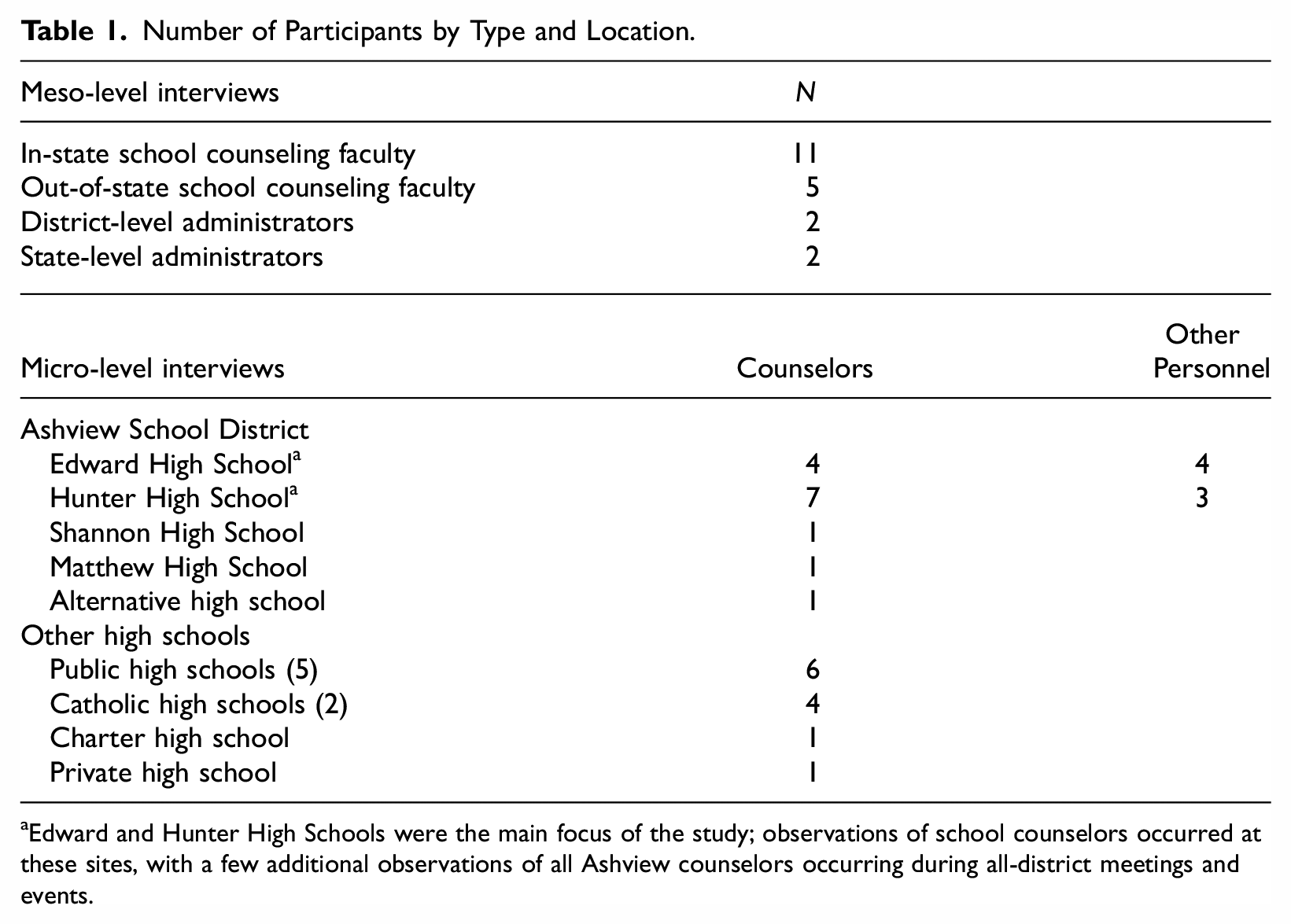
Edward and Hunter High Schools were the main focus of the study; observations of school counselors occurred at these sites, with a few additional observations of all Ashview counselors occurring during all-district meetings and events.
I conducted interviews with the guidance directors of each high school in the district and guidance directors and counselors of other public and private high schools in the area. I interviewed an additional four counselors throughout the country to gather nonlocal perspectives. The formal, semistructured interviews with counselors were conducted between June 2015 and October 2016 and lasted 45 to 180 minutes. Questions for the counselors focused on how the district structured their time and resources, how they managed their time, and how their graduate training prepared them for the challenges they experienced in the job.
I then narrowed my focus to interviews with and observations of the school counselors in two high schools in Ashview. These two high schools represent the highest and lowest performing high schools in the district according to state metrics. The first school, Hunter High School (HHS), had approximately 1,700 students, with 50 percent of students on FRL, 40 percent of students identifying as White, and a student-to-counselor ratio of 340 to 1. The second high school, Edward High School (EHS), had a 75 percent FRL population, 80 percent of its 900 students identifying as Black or Latinx, and a student-to-counselor ratio of 225 to 1.
My observation period of HHS and EHS spanned from October 2015 to August 2016. I observed counselors in the main counseling office, during their meetings with students (student permitting), during school- and district-level meetings with school personnel and administrators, and during events organized by the counselors, recording field notes along the way. In addition, during my observations, I often engaged in informal interviews with the counselors, allowing me to develop rapport, gain insight into their thoughts on current issues to reduce recall bias, and clarify my field notes regarding observations.
To gather information on the supervision of school counselors, I also interviewed Ashview school-, district-, and state-level administrators and personnel, including the principals of both schools and those whose work brought them in contact with or supervision of the counselors. Finally, to gather information regarding school counselor training and expectations, I interviewed counselor educators in colleges in the state and around the country in semistructured, recorded, and transcribed interviews (in person or by phone). Because the majority of counselors in Ashview obtained their master’s degree in school counseling in their state, these interviews supplied information regarding their training process and the logic of the profession.
Data Analysis
Field notes and interview transcripts with all participants were coded using MaxQDA using an iteratively based coding scheme. After using prior research on school counselors to create an interview questionnaire focused on how their jobs were structured within schools (particularly Holland 2013), during my field work and prior to coding (Brown 2021), I found that these interviews and observations suggested the use of institutional theory to explain the conflicts counselors encountered. When all data were collected, I constructed “parent” codes using holistic and provisional coding to label conversations and interactions that were used to describe the logic of their professional training and identity and the logic of their work in public high schools (Saldana 2009). In a second round of coding, I looked for frequent themes within these logics and how counselors enacted them. For instance, in coding how counselors and counselor educators discussed and inhabited their profession, words such as “care,” “personal,” and “social-emotional” emerged frequently and were subcodes used to describe the field of school counseling. In coding how their work was structured in schools, words such as “meetings,” “managing,” “efficiency,” and “master schedule” emerged frequently as counselors described their roles, fitting the ideal-type bureaucratic logic. Discerning a conflict between these two logics, I looked for words, phrases, and actions that explained how counselors inhabited these logics, with discussions of “balance” and “choices about time spent” coming up most frequently. I then reread these data and revised codes by further refining examples and counterexamples of the logics and strategies counselors used. In this article, I use a small subset of my conversations and observations with participants to explain how the two logics operated in the schools and counselors’ strategies for navigating them (Saldana 2009).
Results
Logics of High School Counseling
School counselors exist within overlapping “institutional spheres,” including school counseling graduate programs, professional organizations, and K–12 schools. Each sphere is influenced by different logics. Here, I discern between the rules, guidelines, and practices that oversee school counselors within public high schools to determine which logics framed their utilization, attention, and behavior. Evidence from interviews and observations of interactions and prior research suggest two main logics govern the work of high school counselors: a professional student-centered logic focused on the social-emotional and academic success of students and the bureaucratic logic that structures their work in public high schools. I gathered data regarding the profession logic from counseling professional organizations, counselors, and counseling faculty (to situate the training of counselors at the meso-level); data regarding the bureaucratic logic come from counselors and school administrators (to place their work at the micro-level in their school setting).
The Profession Logic of School Counseling
According to the counselors and counselor educators in this study, through professional membership and graduate education, counselors are exposed to social-emotional counseling to identify obstacles to a safe and productive learning environment and to respond to physical and emotional abuse or social problems that prevent learning. School counselors are also trained and expected to guide students through the academic, college, and career discernment process. Their continued professional socialization is ongoing (Everitt and Tefft 2019) and shaped by their personal identities, their schools, and other counselors around them.
According to CACREP, graduate programs may meet their standards in many ways. However, when I asked faculty members what made their programs similar or different from others, they all said CACREP-accredited programs followed the same blueprint, showing how professional training can be a key source of “normative isomorphism” in organizations (DiMaggio and Powell 1983). Dr. Ware, an assistant professor at the regional public university responsible for educating the majority of Ashview counselors, indicated that school counseling graduate programs emphasized counseling through roughly 10 general courses, with 1 to 2 courses specific to school counseling (introduction to school counseling and career counseling). She believed school counseling programs are indistinguishable from each other, except for different ways of obtaining internship and practicum hours (in a clinic vs. school) or the influence of the school’s mission on the content of courses (e.g., a religious institution). The largely standardized curriculum across programs ensures counselors across the country are obtaining a similar education with a student-centered logic of the profession.
Multiple faculty members highlighted how important it was that school counselors be “counselors first,” with school counseling as their specialty, and that they have a “therapeutic relationship” with students. The ability to counsel and care for students was typically indicated as a “vital skill” for graduates of school counseling programs. Mr. Coughlin, a program director at a state university, explained why counseling skills were vital to the position in the quote opening this article, a quote that represents the importance of counselors as mental health professionals, even if within the context of a fairly routine class scheduling meeting. For faculty, completing the job of school counselor involved considering “the whole person” and tackling students’ social-emotional issues to understand how to fix the academic issues. As Dr. O’Brien, a faculty member at a mid-Atlantic school counseling program, noted, counselors must “identify as counselors [who] straddle the world of mental health and education” while excelling in clinical skills.
The counseling student-centered logic was also evident in my conversations with school counselors and in observations of when they would activate this logic. When asked about their responsibilities, each counselor I interviewed referenced activities such as helping students choose their courses, handling course conflicts, counseling students with poor grades, attending to students’ social-emotional needs, and supporting teachers on these issues. These goals were laid out in HHS’s counseling office mission: The mission of the Hunter School Counseling Program is to help all students succeed through a comprehensive developmental counseling program addressing academic, career, and personal/social development. School counselors are professional advocates who provide support to maximize student potential and academic achievement and assist students in overcoming barriers that inhibit their success.
In activating the profession logic, the HHS counselors applied for the highest recognition ASCA offers school counseling programs, the Recognized ASCA Model Program (RAMP). For this process, they made a list of situations that interfered with learning and for which they would provide counseling, such as abuse, anxiety, depression, divorce, drug/alcohol use, eating disorders, homelessness, suicide, and teen parenting. School counselors enacted the profession logic through individual meetings with students, group presentations in classrooms or after school, and other counseling tasks. Counselors spent their time talking with students about their courses, talking about how they could stay on track toward graduation, discussing students’ individualized education programs or academic progress, or just establishing a rapport with students to engender trust.
Activating this logic was not always easy for Ashview counselors. Whereas their clinical counseling counterparts, who received the same training, operated in a clinic with other counselors, school counselors worked alongside and were supervised by noncounselors. The student-centered logic was available to all school counselors, regardless of school sector or age group with which they worked, but activation of this logic was contingent on how the schools they worked in structured their time.
The Bureaucratic Logic of the Structure of School Counselors’ Jobs
Not every high school used school counselors in the same way, nor did they operate under the same rules or logics, but through interviews and observations, it was evident that Ashview counselors often grappled with a bureaucratic logic at the micro-level that focused their attention on “noncounseling tasks” such as data entry, creating the master schedule, and coordinating high-stakes testing to support school management. Explicit and implicit expectations of this logic of bureaucracy were that the counselors be as efficient as possible with their time, even if that meant sacrificing time with students.
Evidence of this logic is apparent symbolically in the words the Ashview administrators used to describe counselors’ work. For instance, the HHS principal talked about the counselors as the “glue” of the school, referring to the role they played in the school’s smooth operation rather than their role as mental health professionals. The EHS principal described the school counselors as the “artillery” (opposed to the teachers as the “frontline”) due to the “sheer background work” done by the counselors. Both “glue” and “artillery” imply a job description dedicated to school management and the proper functioning of the school rather than an identity as professional counselors.
This logic could also be seen materially in the ways principals and school-district leaders utilized the counselors, like tasking them with the master schedule of courses. This entailed not only inputting students into classes in the school management software but also determining how many sections of classes were needed, when teachers had planning periods, and who taught the courses. Julia, the guidance director at HHS, noted that the administration saw the counselors as “the cog of the building, we kind of keep everything with students and schedules that runs the high school.” This comment seems positive, referring to the counselors as indispensable to the school. But their indispensability was not due to their roles removing obstacles to academic success or serving students’ emotional needs, but in ensuring the school ran smoothly.
Competing Logics
The profession and bureaucratic institutional logics embedded within the work of Ashview school counselors dictated how they did their jobs. School counselors are trained to provide student-centered support, but the Ashview high schools constrained the amount of time counselors could spend counseling students, focusing instead on school management tasks. A few faculty members I spoke with discussed this conflict, such as Dr. Mario, a faculty member at a Southern university: They’ve got a foot in [the] world of education and they’ve got a foot in . . . the area of mental health and counseling. . . . The school counselor has to figure out how to live in both of those fields where [they] can do the small group for 6 to 8 weeks on divorce issues but not 6 to 8 months, and how [do they] keep [themselves] from being the person that always gets called when a teacher is sick or when the librarian is out? So that’s tricky, but it’s something that a school counselor has to figure out and they don’t learn that in graduate school.
The profession’s logic encouraged one-on-one and small group meetings with students to discuss social-emotional, academic, and postsecondary topics; yet the administration’s logic pushed them toward efficiency in school management tasks in a resource-scarce environment. For example, for their RAMP application, HHS counselors had to calculate where they spent their time over two weeks. They estimated that only 45 percent of their time went to guidance, counseling, and advocacy—with the last two only garnering 5 percent of their time (in contrast to the ASCA-recommended 80 percent of time). Management activities like emails, granting hall passes, setting up student meetings, and planning events took 16 percent of their time (vs. the recommended 10 percent). The nonprogrammatic duties they completed included state testing, state reports, book rental, substitute teaching, attendance, report cards, transcripts, master scheduling, balancing class loads, and planning events. These activities took upward of 38 percent of their time over the two weeks (vs. the recommended 10 percent).
Ashview counselors questioned whether it was appropriate for them to be doing school management tasks. Rose, the guidance director at EHS, struggled with this. She noted she was trained to do developmental counseling, where “you have 8 to 10 students, you work with them for 6, 8, 9 weeks and then you can see the before and after.” She loved this part of her training and looked forward to it in her job. But she was disappointed to find this form of developmental counseling was never possible in her school. This affected her professional identity: “I can say that I’m a real counselor because I’m certified in the state, because you wouldn’t want anyone saying ‘oh, you’re not a counselor, you’re not a real counselor.’ Well, I got my certification, so I’m a real counselor.” But she rarely practiced those skills.
In the next sections, I outline how counselors used their discretion to navigate these constraints and the conflicting logics utilizing data collected at the micro-level. I utilize inhabited institutionalism to understand how these logics were negotiated in micro-level interactions. I find that both logics were available to counselors and that counselors attempted to meet the expectations of both by engaging in three strategies: (1) accede to the constraints of the bureaucratic logic, (2) push against the bureaucratic logic to emphasize the profession logic, or (3) balance the two logics.
The Constraints and Consequences of the Bureaucratic Logic
The two most consequential strategies counselors engaged in to manage their workloads were to structure efficiency into their student assignments and “mass processing.” In terms of structured efficiency, students are assigned to counselors in one of two ways. One is to assign based on the alphabet: Counselor 1 counsels students whose last names start with A through M, and Counselor 2 works with N through Z students. Another way is to assign part of or a whole class of students and follow them to graduation: Counselor 1 has all first-year students, Counselor 2 has all sophomores, and so on. Three Ashview schools (including EHS and HHS) followed the alphabet model, and one Ashview school followed the class model. Both models have pros and cons, but both are attempts at structured efficiency—ensuring each student has a counselor dedicated to them. However, the other duties counselors were assigned took more of their time, and so when they met with students, they needed to do so efficiently.
The second bureaucratic strategy Ashview counselors would engage in was “mass processing,” conveying information to all students in their high caseloads but not with in-depth individualized meetings. This mass processing was apparent in the summer leading into the first week of school. During the summer, about 215 students and their parents came through the HHS counseling office looking to solidify fall schedules. At any time, up to 35 students and their parents were waiting to be seen by the five counselors in a nearby classroom. Because each counselor wanted to see students in their assigned caseloads, each counselor had a separate waiting list. This meant a student who arrived at 9:30 a.m. to see one counselor might actually be seen after someone who arrived at 10:00 a.m. who came to see another. This created a fair amount of grumbling from students and parents because there was little explanation for the different wait times.
The strategy of mass processing was more apparent at HHS than EHS because HHS caseloads were larger (EHS counselors would meet for up to an hour a year with each of their juniors and seniors but not the first-year or sophomore students), and their guidance director, Julia, felt the strategy was necessary to manage their caseloads. During the busy scheduling season in January and February, the five HHS counselors needed to schedule over 1,200 rising sophomores, juniors, and seniors and upward of 450 incoming first-years, all within a four-week span. During a 45-minute English class, counselors met the 15 to 30 students in that class in the library to schedule them for next year’s classes. On average, each of the five counselors had 6 students in a class of 30, so they could meet with each student for 7.5 minutes. That is not a lot of time, and I rarely saw any conversation about social-emotional issues or vocational discernment. Even 7.5 minutes per student might be generous because one counselor may have upward of 10 students in an English class they need to meet with. In this case, each student received maybe 5 minutes of attention, or the student would have to meet with a different counselor they did not know. In an informal conversation, Susan, a guidance director at an Ashview school that utilized a similar approach to HHS, noted the difficulty of “trying to compact four years of high school in 10 to 15 minutes” during those scheduling meetings. Because they had such an enormous caseload to work through in four weeks, the counselors did not start longer conversations regarding what the student wanted to achieve beyond “What do you want to be when you grow up?” These were the only meetings most first-year students would have with their counselors that year, and they focused more on the task of filling out a schedule than integrating the high school experience into students’ future goals.
While allowing counselors to meet with each student at least once a year, this structured efficiency meant students received little meaningful contact with counselors. Without one-on-one attention from a counselor, any additional support beyond this 10-minute meeting required that students reach out to the counselor. Joe, a guidance director at a nearby school, highlighted the unequal nature of this arrangement: There are sometimes when people don’t know what to ask, and those are the people I worry about the most. . . . There are all kinds of people with all kinds of needs that don’t verbalize those needs and it’s like . . . how do you know? I mean, if the wheel doesn’t squeak, how do you know it needs grease?
Jane, a counselor at HHS, shared, “You know the old saying, ‘the squeaky wheel gets the oil’? My whole thing is that we deal with 20 percent of the clients 80 percent of the time.” The consequence is that the students less likely to ask for help are not receiving the attention they might need.
More than once, Ashview counselors noted that the middle students—those not at the top or bottom of their class—received the least attention. Laura, a counselor at EHS, explained how the middle students were overlooked: They have kind of middle-child syndrome. They’re smart enough, they’re kind of doing well enough that they’re going to make it if they want to go on to college or do some kind of technical training. It’s usually the really gifted ones that I spend a lot of time trying to get them into the school that they’re looking to, or spending time talking about “What do you want to do, and how do you plan to get there?” Or the really challenged ones that take up a lot of the time.
Students in the middle did not create situations where immediate attention was needed, and thus Laura and others reluctantly acknowledged they were underserved. There was a sense among school counselors that these middle students were falling through the cracks because they did not ask for help and they as counselors were too busy to identify and help these students (as Julia put it, counselors were more “reactive than proactive”).
Because of this tendency to serve only the loudest students or those at the extremes, some counselors recognized they were sacrificing relationships with students. For instance, I asked Leonard, an EHS counselor, if he got a chance to meet with all the students in his caseload: “Juniors, yes. And seniors, yes. Generally not freshmen. The only time I meet with freshmen is if I have to change their schedule or they have an issue. Ideally, we should be able to meet with all of our students but it is really difficult.”
Rose noted that students who were not motivated enough to do class work their first year and earned poor grades were haunted by this behavior four years later when they were trying to graduate. Students tried to make up for these mistakes their senior year, but often, it was too late. Counselors could have focused on this group of first-years—promising students who were not putting forth the effort—but their issues were not treated as time-sensitive.
The Promises and Pitfalls of Prioritizing the Profession Logic
Ashview counselors were not just passive recipients of mandates, blindly accepting the prevailing logic of the school environment. They could and did utilize their own agency in choosing how to do their jobs, reproducing or adapting the rules of the institutions they inhabited. Sometimes, they pushed back on the expectation that they manage the school or be as efficient as possible with their time, activating the profession logic.
When counselors felt they had the power to do so, they set boundaries that protected the time they spent on student-centered tasks. At EHS, Rose had a favorite saying: “They would like for me to do something administrative, but I keep saying that I need to stay in my lane. That’s my favorite last words, ‘stay in my lane.’” Rose’s definition of her “lane” included what she had learned in her graduate training, such as group, academic, and postsecondary counseling. It did not include administrative responsibilities. If she did not protect her time, this could affect her self-identification as a trained counselor. Rose suggested this “stay in your lane” approach to Susan after Susan complained how stressed she was around scheduling. But Susan responded, “Our lane is a little crowded.”
Despite working in a system built for efficiency, another strategy was to take extra time to meet with students. In their attempts to provide students with individualized meetings, I observed the EHS counselors meeting with upper-class students for 5 to 60 minutes. During these meetings, the counselors provided detailed information on the scheduling process and tried to build knowledge and trust with students. Of the meetings I observed, these EHS meetings with upper-class students were the most thorough regarding academic and postsecondary counseling, a strategy championed by their director, Rose, but also an opportunity partially born out of the fact they had, on average, 115 fewer students per counselor than HHS. However, one hour a year with a counselor likely only scratches the surface of student academic and postsecondary needs, and social-emotional needs were not discussed.
At HHS, Jane often worked at odds with the system of meeting students, having much longer meetings with students than the other HHS counselors and spending more time getting to know them. When students arrived during the summer add-drop period, Jane tended to host longer meetings with students and parents, with a few upward of two to three hours; another counselor had all her students in and out in 20 minutes each. During winter scheduling, Jane made sure never to rush a student out of her office. She was warm and inviting and seemed to enjoy chatting with students about school- and non-school-related things, just to get to know them.
Students and counselors alike felt the consequences of working at odds with the system. Despite their efforts to more fully meet student needs, the district instructed EHS counselors not to take so long to meet with students, wanting them to be more efficient (and thus cutting down on relationship building the one time of year counselors met with all the students). This caused particular stress for Laura and Leonard as they dealt with stern warnings and constant reminders of deadlines. But they advocated to keep meeting with students longer than just to schedule classes.
Jane, too, sacrificed efficiency to hold thorough meetings with students. But longer meetings meant other students were left waiting, especially during the important summer add-drop time. Jane explained her approach: I’d like to think that I’m a person that’s approachable, so a lot of times kids will come in, not particularly because they need something, but they just want to connect, which is good. And I never stop them from doing that when they want to do that. . . . We’re really here for them, and we really should be rolling out the carpet for them. But not all the time that can happen because of all the other things that can encroach upon that.
Jane received pushback for this approach. After a conversation with Jane, I wrote in my field notes: “She says (now in hushed tones) that when she started here, she was told to get the students in and out, in and out as fast as she could.” Julia, the guidance director, perceived Jane as slow and inefficient, even trying to enlist me to help Jane with data entry of class schedules. The HHS principal also complained about Jane to me during our interview (although not by name; context told me who he was speaking of). He said she was “extremely slow” and worried about her completing deadlines.
This example shows how there is very little room for inefficiency or relationship building with students, especially in high-caseload environments. There was not time for Jane to be both student-centered and efficient, nor any room for error or slowness (even working extra hours, which many did, was not enough). If Jane tried to rewrite the rules of the efficiency approach by focusing on students, she might cause unintended negative consequences elsewhere, especially for students waiting for her. As an individual, she could not change the way counselors worked with students because the institutional structure of the work pushed against her.
Surviving the Tension
Facing pressure to be efficient while maintaining their identities as student-centered counselors, Ashview counselors requested the administration provide more resources, such as an additional counselor (which HHS received just prior to my observations, although they still had the highest student-to-counselor ratio in the district) or a test coordinator (which an area Catholic school had received). Some counselors hoped I would advocate on their behalf with my research. However, most of the counselors’ efforts to advocate for their profession went unheeded. When attempts at surviving the tension between the logics were not enough or went unanswered, Ashview counselors attempted to make sense of the compromises they made in their work through several strategies.
In the majority of scheduling meetings I observed at both high schools, counselors merely recorded students’ class preferences. Little actual college guidance occurred during these meetings. After one day of observing two HHS counselors schedule first-year students, I noted that one counselor mentioned college once when trying to convince a student to take a language class even though it was not a requirement, but neither counselor asked their students if they wanted to go to college. The students were first-years, so more pointed questions might be premature, but having that initial conversation as early as ninth grade could set the standard for a relationship built toward that goal.
Time seemed to be the biggest hindrance to providing college counseling, not lack of college knowledge. EHS counselor Leonard used to work for a college preparation program and had more extensive knowledge of college-going than most counselors (as did Laura). Yet on multiple occasions, Leonard suggested students “Google” information on colleges that had their intended majors or talk to teachers regarding career discernment instead of engaging in those discussions with them himself. He later admitted he was discouraged and surprised how little time he had to engage students in college counseling. Rose at EHS noted her utilization of resources provided by college preparation programs found in the community, such as SAT preparation courses or a college preparation program dedicated to low-income students. She utilized these when she could not ensure those services were being provided by her and her office. HHS counselors left much of the college counseling to business teachers who taught the college and careers courses for first-year students. But not all high schools have access to a college preparation program or college counselors/teachers.
When EHS counselors did provide information on academic and postsecondary issues during meetings with upper-class students, they faced the challenge of imparting everything students needed to know about their remaining high school career and postsecondary plans in a short amount of time. This meant students were overloaded with so much information that even I could not keep up. In Rose’s meetings with juniors, her strategy was to go through a mental checklist of topics, such as grades, taking the SAT or ACT, and career aspirations. Despite the information being mostly uniform across students, she had no written mechanism to relay the information, relying on her memory to inform them and relying on their memory to remember and act on what she said. Often, she would tell a student to come back to her office another day with some piece of information, but the students never wrote these instructions down, and I am not even sure they brought pens to write with, so it was unlikely they would follow up. The students in these meetings rarely talked, shared their thoughts, or asked questions.
Leonard approached his upper-class student meetings in a similar way. I noted in one meeting the student’s response to all this information: Throughout all of this, the student looks bored, and has a glazed over look in his eyes. Sometimes he’ll bite his fingernails, and he’s not writing anything down. None of the students Leonard met with today are writing any of the information down. And the only information he physically gives them is their progress report and the SAT and ACT dates.
Laura and I discussed the struggles she had regarding this method of informing students. From my field notes after a meeting between her and a junior: She says she has an internal battle regarding how much information she should share with the students. Sometimes she’s worried that she gives too much. But then she’s worried that if she doesn’t cover this information, they won’t be prepared. She’s worried that she saw the student’s eyes glaze over, and realizes that at a certain point, she needs to stop telling them everything. But she also wants to make sure they are prepared and can start on a lot of this before senior year.
This technique of information overload was common at EHS because the counselors insisted on meeting with each of their juniors to discuss classes and postsecondary plans. HHS counselors, on the other hand, gave presentations to juniors through their English classes. This mass processing was more efficient, but it meant less time talking to individual students about individual needs.
Regardless of method at EHS or HHS and despite all the information provided to students in these meetings, meaningful conversation regarding students’ futures was missing. These meetings were typically one-sided, with the counselors unloading a lot of complicated information about scheduling and the college application process but little to no information about college or career options or discernment or preparation. Thus, it was unclear what the students retained from these meetings or if the counselors had any effect on their college and career plans.
Because of these challenges meeting students’ needs, the high school counselors in this study were skeptical of their ability to reach all students in their caseloads, regardless of which school they worked at, so they downgraded expectations of what they could accomplish. This downgrading of expectations bridged the gap between the few resources they had and the goals of their position. For instance, Jane from HHS talked about balancing the desire to help all students with the reality of the job: I really want these kids to have what they so richly deserve. All of them. Not just the 20 percent. And I know that there’s probably not enough of us to go around and make that happen, but each one reaches one. Sometimes I’ll have kids who will come in and bring another kid. And so I could get them that way.
Rose echoed this sentiment: “I just feel that if I can help one more to get their diploma, I’ll do my best and do that.” Her sentiment suggests the technique of serving a small portion of the student body in an ideal manner, reducing her expectations that she could help all students (or at least a lot of students) in a meaningful way.
Amy, the guidance director at a Catholic high school near Ashview, recognized how she was downgrading her expectations regarding how many students she could help: Are you going to be able to help every student? No, but when you’ve helped one or two and you know you’ve made an impact . . . I mean that’s one or two. And that doesn’t sound like a lot in the scheme of things, but if everybody’s truly making an impact on one or two. . . . When you’ve got a student that comes back to you . . . and thanks you, it kind of makes up for all the many that aren’t happy with you.
Amy’s approach is likely an effort to maintain optimism and a sense of a good job done, essential to positive feelings about one’s job. But this approach lowers the bar of expected outcomes.
One counselor noted that teachers engaged in counseling more than counselors. When I asked him how much actual counseling he was able to do, Dave, a substitute HHS counselor and former teacher, juxtaposed the difference between counselors and teachers and how teachers often became de facto counselors because of their greater access to students: As a teacher I probably did more counseling because I had kids every day and I had the same kids every day. . . . That’s not saying that counseling is bad or teaching is good. It’s just that you meet with that kid every day [as a teacher]. You get to say “you’re smiling today,” next day “you’re not smiling, you got some kind of scratch on your face here.” Or you can say “your clothes are torn today” or something like that. Whereas you can’t do that here [in the counseling office] because you don’t really know if the kid, what kind of attitude the kid has, unless you get to know the kid.
Teachers are poised to provide counseling-like services to students because of their daily interactions. But teachers are not trained counselors, and they might not see that student again after the semester is over, whereas a high school counselor is typically assigned to a student all four years and is trained but does not have time to interact with students on such a regular basis.
Discussion and Conclusions
School counselors join the profession to help students succeed academically, social-emotionally, and after high school (Armor 1969; Blake 2020; Bridgeland and Bruce 2011; McDonough 2004; Rosenbaum 2001). However, their work conditions constrain their ability to counsel students (Lipsky 2010; Ocasio 1997). In this study, I drew from interviews with and observations of high school counselors, administrators, and counselor educators to determine the macro-level logics of their profession and their work in public schools. Utilizing inhabited institutionalism, I investigated how high school counselors translated these macro-level logics and structural constraints into micro-level decisions regarding their time and attention, affecting their professional identities. Because institutions are “inhabited” by people who make, understand, create, and communicate new and existing rules and norms through everyday behavior and interactions with others in their organization (Everitt 2012; Hallett 2010; Scott 2014; Thornton et al. 2012), it was important to observe how these logics were translated through the experiences of the counselors themselves.
Not every high school’s use of school counselors is the same or operates under the same rules or logics (Binder 2007; Nunn 2014). Every counselor has their own agency and interprets local logics in their own ways (Binder 2018; Nunn 2014). In addition, different schools may be influenced by different logics, such as Catholic schools (religious logic) or charter schools (market logic). But in this study, I found that high school counselors’ work is guided by two often conflicting logics: a student-centered logic of the profession and an efficiency- and management-centered bureaucratic logic of their jobs in public high schools. By observing interactions between counselors, students, and other school personnel and engaging in interviews to talk about and make meaning of those interactions, I examined how these logics affect how counselors approach their jobs and the conflict regarding their time and attention, extending knowledge of the structural conditions of school counselors’ work. Counselors, like teachers, have to adapt to changing rules and expectations of their work (Everitt 2018). However, although their training and actual work may differ, teachers still get to teach, whereas counselors must adapt to an ever-increasing (and professionally norm-diverging) list of things to do while still attempting to do the purest form of their profession (i.e., counsel). Ashview school counselors wanted to and were trained to provide student-centered counseling for social-emotional, academic, and postsecondary needs, but they were often tasked with school-centered management work or were expected to interact with students in short but efficient ways that made it difficult to build relationships.
Although a lack of resources constrains high school counselors, counselors retain discretion within those constraints in how they accomplish their work (Lipsky 2010). I extend inhabited institutionalism by showing how time scarcity can shape how social actors translate norms. Ashview counselors developed patterns of practice that helped them manage the conflict, utilizing their own agency in choosing how to do their jobs (Binder 2018; Thornton et al. 2012). Their combination of strategies made the most sense to them based on how they interpreted the logics and their mandates, often in ways they recognized are not ideal. Some counselors pushed against expectations of efficiency to spend more time with students one-on-one, but they often received pushback. Some counselors would attempt to manage the two logics by meeting with students but overloading them with information. Some utilized strategies common among other “street-level bureaucrats,” such as downgrading their expectations of how many students they could serve (and how well; Everitt 2018; Lipsky 2010). Counselors outsourced college counseling to others because they did not have time to do this on their own. Many students fell through the cracks, especially first-year students and students in the academic middle. Ultimately, this struggle to inhabit two conflicting logics made counselors question their identities as “real counselors.”
There were some differences in how Ashview counselors navigated conflicts, whether it was one counselor adapting differently from other counselors in her school or differences between the two schools due to local cultures and leadership. For instance, HHS counselors were more likely to engage in mass processing than EHS counselors, partially due to the lower student-to-counselor ratio at EHS, which gave them more time to meet with students. However, in highlighting these different strategies, it is important not to reduce the struggle counselors face to solely one of student-to-counselor ratios, as if an influx of resources will completely solve the conflicting logics of their work (although it would not hurt). Counselors at all the schools I studied struggled with these conflicting logics, even if those at schools with smaller ratios had more freedom. That freedom meant meeting for 60 minutes rather than 10 minutes with a student each year. Although obviously more time, this is not the level of involvement counselors were trained to provide, and no counselor at any school felt they were meeting students’ social-emotional needs. This is extremely important to highlight in the face of increasing mental health issues among adolescents. The overall conflict between how counselors are trained and how they are utilized in schools will remain unless concerted efforts are made to change this dynamic (Blake 2020).
I extend inhabited institutionalism by discussing how people who feel they lack substantial power adapt two conflicting logics in their work. Believing they lack the power for change, the counselors almost reluctantly engaged in the bureaucratic logic, and they adapted their profession-informed behaviors and meanings in the face of this conflict (perhaps exerting their agency where they could—in how they interpreted the conflict; Everitt 2018). Haedicke (2012) highlights a similar process in how co-op managers made sense of the seemingly inevitable market-like changes to their more democratic and participatory business model. But unlike Haedicke’s (2012) respondents, the counselors compromised between the two logics rather than changing the environment. Some counselor educators did discuss pushing their counseling students to make changes at the school level, but most counselors felt they were not adequately trained to or had the power to do so. Counselors were reluctant compromisers, negotiating but eventually settling with strategies in the best way they could with the resources available to them. The counselors’ adaptations were not ideal. When they utilized the efficiency model, they compromised relationships with students. When they protested the efficiency model to prioritize these relationships, they received pushback from other counselors and principals for being “slow,” butting up against school-level practices.
The study was not designed to make causal claims regarding how counselor-to-student ratios, school type, or geography influence the activation of logic-balancing strategies. However, much of the narrative of counselor educators and professional organizations was how counselors could maintain their professional identity in the face of increasingly school-management-centered instructions from principals. The individual narratives I presented are in no way evidence of all high school counselors’ approaches to work, but they do represent a larger trend regarding school counseling as existing within conflicting logics, how counselors must manage their time, and the resulting gap left in mental health and postsecondary services.
Supplemental Material
sj-docx-1-soe-10.1177_00380407231204596 – Supplemental material for School-Level Bureaucrats: How High School Counselors Inhabit the Conflicting Logics of Their Work
Supplemental material, sj-docx-1-soe-10.1177_00380407231204596 for School-Level Bureaucrats: How High School Counselors Inhabit the Conflicting Logics of Their Work by Mary Kate Blake in Sociology of Education
Footnotes
Acknowledgements
Thank you to Bill Carbonaro, Omar Lizardo, Jennifer Jones, and Mark Berends for their guidance and feedback in my overall study of organizational theory and school counselors. Thank you to Megan Austin, Kevin Estep, and Joshua T. Brown and his Inequality in Higher Education graduate class at the University of Virginia for their extensive feedback. I am thankful for Toby Blake and Barbara O’Brien for their editing and moral support. Thank you to the school counselors, leaders, and students who gave their time and taught me everything I learned in this project. I am especially indebted to the SOE editors John B. Diamond and Odis D. Johnson Jr., the three anonymous reviewers, and the copyeditor for their suggestions. Their feedback led to a vastly improved article. Despite all this support, there may still be errors in this article. If so, they are my own.
Funding
The author(s) disclosed receipt of the following financial support for the research, authorship, and/or publication of this article: I am thankful for the generous support of this research by the William T. Grant Foundation through an officers’ research grant (No. 186448) and the Center for Research on Educational Opportunity and the Institute for Scholarship in the Liberal Arts at the University of Notre Dame.
Research Ethics
Research protocol was approved by the University of Notre Dame Institutional Review Board. All human subjects gave their informed consent prior to their participation in the research, and adequate steps were taken to protect participants’ confidentiality.

Supplemental Material
Supplemental material for this article is available online.
Notes
Author Biography
References
Supplementary Material
Please find the following supplemental material available below.
For Open Access articles published under a Creative Commons License, all supplemental material carries the same license as the article it is associated with.
For non-Open Access articles published, all supplemental material carries a non-exclusive license, and permission requests for re-use of supplemental material or any part of supplemental material shall be sent directly to the copyright owner as specified in the copyright notice associated with the article.
