




Abstract
This article examines the characteristics of traditionally academic vis-a-vis practice-based pedagogies in sociology; questions the former’s widely assumed superiority and the UK’s current state of pedagogical exceptionalism; and considers arguments and challenges associated with a more substantially practice-based approach. It combines pedagogic, sociological and other literatures, and includes a scoping review of practice-based provision in UK undergraduate sociology, along with a case study based on focus groups at one ‘post-1992’ university. Our analysis suggests that traditionally academic teaching and learning may inadequately prepare many students for their future civic and working lives; and that greater pedagogic plurality could enhance graduate outcomes without loss of criticality. Indeed, we conclude by articulating a ‘critical practice-based’ pedagogic model, and by considering its implications for both sociology students and the wider discipline – elaborating these in relation to social class and Burawoy’s conception of ‘public sociology’.
Keywords
Introduction
This article suggests that widening participation and other recent developments in UK higher education (HE), including frequent demands to better prepare students for employment, call into question the continuing pre-eminence of traditionally academic pedagogies – not least in arts, humanities and social science (AHSS) disciplines such as sociology. Indeed, generally modest AHSS graduate outcomes are sometimes used to advance arguments hostile to mass HE participation and liberal education in general, and sociology in particular. However, the transition to technology-driven and knowledge-based economies and societies arguably places a renewed premium on capabilities that both traditionally academic pedagogies and practice-based education (PBE) are able to cultivate. Our article therefore aims to explore the characteristics of, and relationships between, PBE and traditionally academic pedagogies; and to consider the possibilities for, and implications of, a more substantially practice-based approach in UK sociology teaching and learning.
PBE is mainly associated with vocational subjects such as architecture, engineering and healthcare. In contrast, traditionally academic pedagogies that prioritise critical engagement with the disciplinary canon, via lectures, seminars, essays and so on, remain dominant in sociology, at least in the UK. It is notable, however, that US sociology more commonly incorporates practice-based elements such as work- and community-based learning, portfolios and reflective journals, albeit with limited recognition of potential incompatibilities between these contrasting approaches. We begin by examining both generic and (mainly US) sociology-specific literatures relating to PBE, and by outlining the UK context of our study. This is followed by a scoping review of practice-based provision in UK undergraduate sociology, and a case study at one post-1992 university that uses focus groups with students, teaching and support staff, alumni and employer representatives to explore pedagogic practices and associated attitudes, particularly in relation to whether and how sociology programmes prepare students for their lives after university. We then combine these strands to re-examine the case for – and to consider some possible means of operationalising – a more substantially practice-based pedagogic approach, while recognising that further research would be required to fully test these suggestions.
Practice-Based Education: Pedagogic Debates and the UK Context
Characterising Practice-Based Education
Generic characterisations of PBE have emerged via numerous landmark publications (including Billett, 2015; Higgs et al., 2012; Wenger, 1998; Wenger-Trayner et al., 2014) – often focusing on what Higgs (2012: 3) refers to as ‘occupational practice’, and grounded in ‘goals, content and strategies that direct students’ learning towards preparation for practice roles post graduation’ (Higgs, 2019: 187). Accordingly, PBE is commonly understood to mirror ‘real-world’ tasks that students might be expected to undertake in their working and civic lives. For example, among predominantly US-based sociological literature, PBE pedagogies include ‘project-based learning’ (De Lima, 2021), ‘problem-based learning’ (Bartholomay, 2018) and ‘community-based learning’ (Garoutte, 2018). Learning via PBE is characteristically active and reflective; knowledge is progressively ‘constructed’ by learners; and teachers are primarily facilitators, rather than repositories of wisdom (Moon, 2004).
Undeniably, ‘constructivist’ views of knowledge and learning are widely accepted in sociology, as in other AHSS disciplines – albeit more commonly with traditionally academic pedagogies and outcomes in mind. And whether culminating in traditional outputs such as a project report (De Lima, 2021) or more novel outputs such as a ‘community profile’ and ‘action plan’ (Garoutte, 2018), practice-based sociologists have tended to emphasise the conventional academic benefits of their pedagogy: for example, ‘mak[ing] abstract concepts . . . tangible’ (Bartholomay, 2018: 249). Others, however, also identify employability and civil society-related outcomes. Mooney and Edwards (2001: 189), for example, see ‘civic literacy’ as an outcome of ‘service-learning advocacy’; and Ciabattari et al. (2018: 193) propose community-based learning as a way for students to develop ‘the skills employers want’ – including communication, collaboration, quantitative analysis and problem-solving. Some caveats aside, they find ‘no dichotomy between liberal education and practical education for careers’ (Ciabattari et al., 2018: 203). This view largely mirrors that of the generic literatures on PBE: for example, Jackson (2015: 351) advocates ‘work-integrated learning’ as ‘the practice of combining traditional academic study . . . with student exposure to the world-of-work in their chosen profession’; and associates it with ‘skills including team working, problem-solving, communication, information literacy and professionalism’ (2015: 351) – and more recently with ‘enhanced work readiness, connections for career purposes, and professional socialisation’ (Jackson, 2024: 15).
PBE and the UK Context
Possible arguments for according greater value and attention to PBE in UK sociology start from the massive growth and transformation of HE itself that has occurred in recent decades, including the number and characteristics of both institutions and students, along with their respective funding arrangements (for overviews see Bolton, 2025; Higher Education Statistics Agency (HESA), 2025a; NatCen Social Research and Institute for Employment Studies, 2023). Student participation has both ‘deepened’ among traditional (mainly white, middle- and upper-class) entry groups and ‘widened’ to include many from previously under-represented (broadly working-class and ethnic minority) backgrounds. Deepening and widening of participation have, however, been accompanied by continuing institutional differentiation, especially between ‘selective’ and ‘mass participation’ universities – the former mainly older research-intensive institutions, the latter mostly former polytechnics and colleges with stronger vocational traditions that adopted university status ‘post-1992’ (Boliver, 2015).
Their respective intake profiles suggest that while UK students overall may divide approximately equally between mass participation and selective universities, those from non-traditional backgrounds divide nearer two to one. Significantly, however, these aggregate differences are declining, albeit slowly and unevenly, as selective universities expand and widen their own recruitment; for example in London, the Black and Asian student ‘participation gap’ between older and post-1992 universities has almost disappeared (HESA, 2025b). Widening participation not only means greater diversity of class and ethnicity: it also brings more students who are living at home, doing paid term-time work and are deeply conscious of HE-related debts that will remain after graduation – and who are more likely to seek an education that will directly benefit their career prospects (see, for example, Moreau and Leathwood, 2006; Pokorny et al., 2017).
Further, globalisation and the transition to technology-driven, knowledge-based economies have combined to destroy or ‘precaritise’ manual and routine service employment (see, for example, Standing, 2011), while arguably (artificial intelligence and automation notwithstanding) increasing opportunities for those with higher-level capabilities of a kind actually or potentially cultivated by HE. According to the British Academy (2020) these include generic skills such as communication, collaboration, research and analysis; attitudes and behaviours characterised by independence and adaptability; and subject-specific skills, including data analysis in sociology.
Finally, the current era of the ‘neo-liberal university’ is associated with tuition fees and institutional ‘performance metrics’, as well as increasingly instrumental views of HE and its likely benefits (see, for example, Holmwood, 2014; Maisuria and Cole, 2017; Vernon, 2018). Graduate outcome statistics generally favour vocational over non-vocational subjects – not least sociology, which scores rather poorly even compared with some other AHSS disciplines. However, greater distinctions exist between institutions than disciplines (Belfield et al., 2018), with selective universities often (though not always) out-performing mass participation institutions.
Not surprisingly, the case for growing HE participation in general, and AHSS (including sociology) in particular, is not universally accepted. Indeed an influential strain of current popular and political discourse (see, for example, Duncan Smith, 2019; O’Brien, 2020; O’Brien et al., 2019; Walsh, 2021) variously maintains that graduate ‘supply’ exceeds employer ‘demand’; that many participants experience net lifetime financial losses from their HE ‘investments’; that training for non-cognitive (especially manual and emotional) work is being neglected; and that public funding should therefore be redistributed in favour of lower-level education. In terms of wider implications, Goodhart (2020) and Goodwin (2023) are among those who decry the new social divide associated with HE expansion and alleged stigmatisation of those who are excluded.
In contrast, Coulter et al. (2022: 32) claim that ‘demand for high-level skills will only grow as technology transforms the economy [and that] . . . [b]y splicing complex analytical skills with non-cognitive ones, HE harnesses the aptitudes that meet those demands’. From a student – and social class – perspective, however, Savage et al. (2015) caution that while HE participation (versus non-participation) is now a key social divide, the steep gradient that differentiates universities in terms of prestige and recruitment profile itself reinforces inequalities of graduate outcomes and inhibits social mobility. Indeed, Morley (2001: 133) argues that selective universities are, precisely, already ‘selecting the most “employable” sections of the community’; and Stoten (2018: 15) claims that, for some students, ‘employability is largely implied through attendance at a prestigious university’. However, the picture is complex, as we have noted, with no simple divide between selective and other universities (see, for example, Boliver, 2015). Furthermore, Savage et al. (2015) and others (including Bathmaker et al., 2016) say little about individual subject differences, which would inevitably add further complexity. Nor do they systematically examine pedagogic aspects of the HE experience that might have implications for economic, social and cultural capital formation – and hence for graduate outcomes. They do, however, note significant contrasts – including economic as well as cultural capital endowments – between graduates of different universities.
Traditionally Academic versus Practice-Based Sociology
Traditionally academic pedagogies privilege acquisition of disciplinary knowledge, precision of thought and expression, critique and argumentation, and of course the essay as a vehicle for their achievement. However, in UK sociology, Williams et al. (2017: 145) note a preference for ‘sociology already done, rather than . . . doing sociology’; while Johnson et al. (2013: 317) similarly claim that, in the absence of a commitment to active learning, ‘[s]tudents may learn sociology but not act like sociologists’. And in other AHSS disciplines, essay writing has been variously portrayed as an ‘exercise in nostalgia, as if one should teach young people the . . . table manners of Edwardian Belgravia’ (Womack, 1993: 47) and ‘a metalanguage unknown and unusable in the professions’ (Calder and Williams, 2021: 932).
It would of course be inaccurate to claim that UK sociology is monopolised by traditional and relatively passive forms of learning. Rather, the evidence suggests an unequal and uneasy co-existence between two broadly defined pedagogic models: a dominant one in which traditional practices prevail; and a secondary one, which allows for other possibilities. For example, examination of the UK’s national Subject Benchmark Statement for undergraduate sociology suggests that these two models co-exist in a clearly, if implicitly, hierarchical relationship: for example, ‘[t]eaching and learning activities can take the form of lectures, seminars, workshops, computing laboratory classes, tutorials, discussions, collaborative uses of diverse digital media, visits to external sites, and group and individual activities and projects’ (Quality Assurance Agency for UK Higher Education (QAA), 2019: 9); and ‘essays and exams remain an important mode of . . . assessment . . . but other modes of presenting work orally, visually and in writing are also used’ (QAA, 2019: 10). Practice-based possibilities, including ‘experience of volunteering, work placements or activism’ (QAA, 2019: 14), are undeniably acknowledged in the Subject Benchmark Statement. But the pre-eminent pedagogy is traditionally academic, and other possibilities constitute mere additives – with little consideration given to how these diverse forms of engagement might, or might not, cohere.
Williams et al. (2017) identify a further sociological divide, between qualitative/critical and quantitative/analytical paradigms; and note several issues associated with the former’s dominance in UK teaching. First, it contributes to a ‘quantitative deficit’ in terms of graduate outcomes, which is of particular concern since many career opportunities in applied sociology rely on quantitative insights – in contrast with the qualitative ‘emphasis on micro-sociological issues, for example, relationships and personal identities’ (Williams et al., 2017: 146) or ‘a preference for theoretical reasoning alone’ (Williams et al., 2017: 146). Second, they worry that ‘most quantitative research methods are taught within “methods modules” . . . rather than integrating methods into substantive content’ (Williams et al., 2017: 144–145). And third, they argue that to be ‘a successful learner of quantitative methods, one has to know why one is doing it’ (Williams et al., 2017: 148) – the implication being that many learners do not. Indeed Ralston (2020) affirms that quantitative sociology lacks ‘epistemological legitimacy’ in the eyes of many students and staff.
Consideration of these diverse ways of ‘doing’ sociology brings to mind Burawoy’s (2005) analysis of ‘professional’, ‘critical’, ‘policy’ and ‘public’ sociologies – and his advocacy of the latter. In terms of the pedagogies of public sociology, Burawoy (2005: 9) argues that ‘as they learn students become ambassadors of sociology to the wider world just as they bring back to the classroom their engagement with diverse publics’; and that ‘we must think of them as carriers of a rich lived experience that we elaborate into a deeper self-understanding of the historical and social contexts that have made them who they are’ (2005: 9). These important points notwithstanding, however, neither his ‘public sociology’ formulation nor his subsequent (Burawoy, 2011) analysis of the ‘public university’ carry significant pedagogic emphasis – for example, the former being more concerned with ways in which professional sociologists ‘comment on matters of public importance’ (Burawoy, 2005: 7) or work ‘in close connection with a visible, thick, active, local and often counter public’ (Burawoy, 2005: 7).
Finally, it is notable here that UK universities have recently invested heavily in non-academic ‘professional services’, including academic skills and employability support, partly in response to pressures for enhancing the student experience and improving performance statistics. Macfarlane (2011), and Wolf and Jenkins (2021), are among those who have examined these developments. However, two specific issues of relevance here, namely the extent to which non-vocational disciplines such as sociology are effectively supported in terms of employability services, and the degree of coherence between multiple professional services and academic sources of support, seemingly remain unaddressed.
Methodology
This section reports on a small qualitative research project, including a scoping review of existing practice-based provision in UK undergraduate sociology and four semi-structured focus groups conducted at one post-1992 university. Our research adopted a case-study approach (Yin, 2018), designed to investigate:
what constitutes PBE in sociology and how far it is practised in the UK;
if/how PBE can support sociology students in developing their capabilities and employability;
how far the idea of PBE is supported by sociology students, alumni, teaching and professional services staff, and prospective employers; and
how professional services can support development and delivery of PBE.
While recognising that some sociology teaching takes place beyond the discipline (e.g. in business and education programmes), our inquiries focused on the learning experiences of sociology students themselves. Prior to commencement, we received approval from the University’s ethics committee.
The scoping review, conducted from May to October 2023, sought to establish the nature and extent of PBE in UK undergraduate sociology. The review was limited to sources available online. This resulted in some universities being excluded due to insufficient information; it was also unable to capture the richness of teaching within modules that did not qualify as ‘practice-based’ according to our criteria – but which may nonetheless incorporate elements such as guest speakers, project- or problem-based assignments or experiential exercises within a predominantly traditional pedagogic framework. More in-depth research with a representative sample of UK sociology teaching staff would be necessary to overcome these limitations.
To address the remaining research questions, online focus groups were conducted at one post-1992 university. We used purposive sampling to recruit participants from three groups, namely: (1) current sociology students and alumni; (2) professional services (employability and careers, academic skills and library services) and academic staff who teach and support sociology students; and (3) employer representatives, including some who themselves graduated in sociology or another AHSS subject. In total 10 students/alumni, eight academic/professional services staff and seven employer representatives took part in four focus groups in July 2023.
Seeking to create an environment conducive to open discussion, we conducted separate focus groups, respectively with current/former students and with staff/employer representatives (see Smithson, 2000). Discussion guides reflected these different perspectives: the student guide focused on how the sociology curriculum prepared them for life beyond university; and the staff/employer guide explored teaching and support, student capabilities and career pathways, and if/how to make the curriculum more practice-based. For employer representatives, we tailored questions depending on their previous engagement with students. The focus groups were moderated by a current PhD student and a recent graduate, both in sociology (see Clark et al., 2021): we hoped that because neither moderator was directly involved in teaching on the programme, participants would speak freely about their views and experiences, and that a graduate’s presence would also facilitate ‘peer-to-peer’ conversation. All names and identifiable details of participants were changed after the recordings were transcribed, and pseudonyms are used throughout this article.
We used NVivo 14 to thematically analyse the focus group transcripts, initially coding student/graduate transcripts separately from staff/employer transcripts, but then combining their responses in the category ‘Journeys from education into employment’. Further categories derived from the research questions were ‘What students learned in and took away from the sociology programme’ and ‘Supporting students into employment’. After coding the data across these deductively derived themes, we developed three more interpretive themes inductively from the data (see Terry et al., 2017). Findings from all these themes are presented below, following an outline of current practice-based UK sociology provision based on the scoping review.
Key Findings from the Scoping Review and Focus Groups
The Current State of PBE in UK Sociology
Using Times Higher Education and Guardian HE rankings, we identified 90 UK institutions with an undergraduate degree in sociology. Six were excluded from the analysis due to insufficient information available online. Modules primarily offering research methods, work placements or volunteering, and those with titles such as ‘research in the community’, were all categorised as practice-based.
According to our categorisation, only six programmes were ‘extensively’ practice-based, defined by combining at least three different aspects of PBE. Such a curriculum typically incorporates PBE throughout the degree programme, for example including a ‘Sociology in Action’ module in year one, a work placement in year two and a third-year module integrating theoretical knowledge and placement practice. Table 1 shows that, overall, only around 7% of UK sociology degree programmes are extensively practice-based – including no pre-1992 institutions and around 13% of post-1992 providers. The proportions offering a limited practice-based curriculum are 51% overall, including 39% and 62% among pre- and post-1992 institutions respectively.
Percentage of undergraduate sociology programmes in the UK with extensive, limited and no practice-based learning provision.
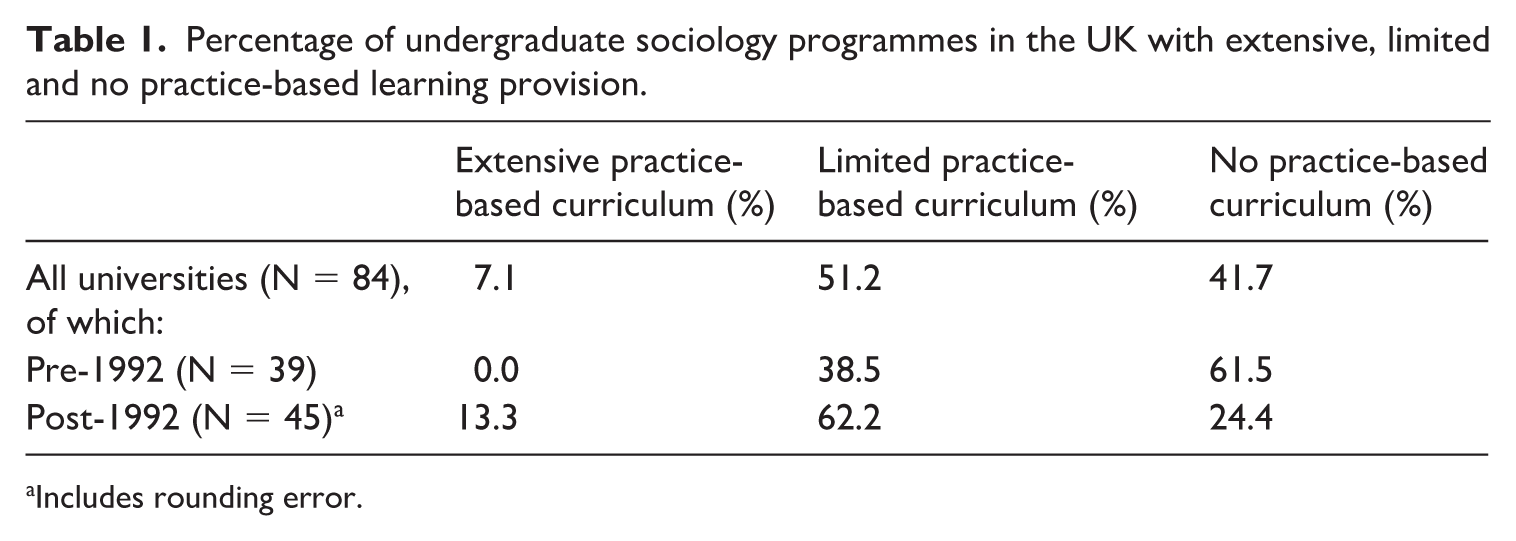
Includes rounding error.
The Purposes of HE: Employability or Intellectual Pursuit?
In the focus groups, students, alumni, university staff and employer representatives discussed the purposes of HE and the extent to which sociology prepared graduates for life after university. For example, Ajla shared her surprise after hearing that another recent graduate’s primary motivation was to study the subject area, rather than seeing university as a pathway to employment:
But to me, uni was [to] get that degree and go get a job and get that income because no one in this world is gonna give you money . . . And so when I see like other people have that different opinion, it is quite interesting . . . Yes, you go to uni to learn about the subject and it’s interesting. But then at the same time, I need an income. (Ajla, recent graduate)
As well as Ajla, several students and alumni stated that they had gone to university mainly for employability reasons. Some employer representatives and most careers and employability services staff shared similar views about the purpose of university: primarily to prepare students for their working lives. Conversely, some students and alumni favoured a more traditionally academic view of HE. Perhaps unsurprisingly, this latter view was also endorsed by the academics, but by almost no professional services staff and few potential employers.
As previously outlined, sociology has come under criticism for poor graduate outcomes. Many students at our university are from ‘non-traditional’ backgrounds, and therefore already face obstacles and possibly discrimination in the labour market (Laurison and Friedman, 2016). For many students from less privileged backgrounds, going to university is a stepping stone to social mobility and a degree is expected to increase their employment prospects. Against this background, it is important to reflect on how the sociology curriculum can support students in identifying careers that not only ‘pay the bills’ in an unequal labour market, but that they also find fulfilling – while ideally also empowering them to use their sociological knowledge and skills to critique the structural conditions that produce labour market inequalities, as we argue further below.
Sociology Graduates’ Awareness of their Skills and Knowledge
Sociology graduates’ career paths are varied and their journeys non-linear – an experience all participants who had studied sociology shared, whether alumni or employer representatives. Compared with more vocational subjects, the diversity of careers that sociology graduates pursue seemingly makes it difficult for university employability teams to provide support – for example:
Even though you know, I think as well with kind of, jobs and sociology, we’re always told that sociology, such a broad topic, and you can apply it to so many different industries and all of that. But I think just saying that kind of isn’t really enough. And I think just knowing about what kind of jobs you could do with a sociology degree isn’t also enough. (Lina, recent graduate)
As the quote illustrates, students are eager to explore careers during their studies, but current employability support is more focused on informing them about possible careers, rather than supporting them to understand how the knowledge and skills they have gained could be applied to various career paths. This is despite students acknowledging that they are equipped with a breadth of employability-relevant capabilities, including practical skills such as time management, writing skills and professional communication, as well as critical thinking. For example, Zoe noted that sociology had equipped her with an understanding of the importance of fact-checking and the tools to evaluate the reliability of sources:
I feel like now . . . I look at things [and] I think ‘oh like, where’s that come from? Like [has] that come from something you could trust?’ . . . I think maybe that’s a good thing because I think you’re not taking things at face value and you’re kind of looking up deeper into things. (Zoe, recent graduate)
Her comment points to the importance of traditional sociological emphases on the development of critical thinking skills.
Further, as an institution that mainly teaches students from non-traditional backgrounds, the social capital gained suggests that sociology has the potential to be a lever for social mobility (Bathmaker et al., 2016; Savage et al., 2015). For instance, students suggested that university had opened their minds to possible careers, especially having built connections to professionals able to write references for them. However, as provision currently tends to focus on either employability or transmission of sociological knowledge, students struggle to match the skills and knowledge gained during their studies to possible careers. Lina, for instance, expressed frustration that, during an employability module, the roles presented all required additional qualifications beyond her sociology degree: ‘none of the jobs were actually jobs that you could get with just a sociology degree, you always had to get extra qualifications’ (Lina, recent graduate).
Lina’s comment points towards the difficulties for professional service teams of effectively supporting students in non-vocational subjects. It also highlights how a separation of traditional academic teaching and employability support is failing to identify and articulate sociology students’ transferable skills and match them to attainable career paths. It is notable in this respect that Burke et al. (2020: 1717) found a ‘significant class disparity between how students understand and prepare for the graduate labour market’. Similarly, Carroll (2011: 93) notes that ‘non-traditional graduates can face challenges in obtaining employment that is commensurate with their educational skill sets, as well as with that which they find meaningful’, but further that this may be because they struggle more to make connections between their degree programmes and the world of work, and ‘may not present to recruiters with the right “set” of skills’ (2011: 97).
Accessing Career Opportunities
Despite the various skills that participants mentioned gaining, the research also revealed areas where students and other participants identified gaps in knowledge and skills, affecting their confidence following graduation. For example, Nasima found work in the criminal justice sector after graduating but said that she would like to have gained more quantitative skills that she could apply in her job:
Now my manager goes to me, ‘can you please create an Excel spreadsheet to show this data’, which is like I don’t know how to do it. I still don’t know how to do it . . . I wish kind of I just had that in me from the get-go. (Nasima, recent graduate)
Nasima’s comment highlights a sense of disappointment that the degree did not give her a head start with data handling and analysis skills. She goes on to note:
We do a lot of research in sociology, but where do they take the time to say, ‘OK, this is why we use Excel. [That’s] actually important because it’s where we . . . put together [the] majority of our data. It’s why it works so well.’ We’re not explained any of this. (Nasima, recent graduate)
Despite traditional sociological teaching emphasising research skills, including some quantitative methods, Nasima laments not having learned applied data skills that would become useful in her future career. This evidence is further supported by our scoping review, which found that while research methods are commonly taught in sociology degrees, extensively practice-based curricula remain rare. As a result, students lack opportunities to practise these skills during their degrees and are unlikely to gain the awareness and confidence to put these skills into practice outside of university.
Work placements and volunteering may offer such opportunities but are often inaccessible to students who cannot commit to additional hours outside the core curriculum due to caring responsibilities or paid employment. One of the careers advisor participants explained how many students rely on income from part-time jobs not necessarily in the fields they want to pursue after graduation:
So many of our students work part-time on top of studying, so they literally do not have time to volunteer which is a real shame because . . . if they’re volunteering in a sector they actually want to work and that’s more valuable for their career in a lot of ways than doing part-time retail or hospitality work. (Josephine, careers advisor)
Opportunities outside of the curriculum are not accessible for all students, therefore inhibiting social mobility, as students who do not need to pursue paid employment are more likely to gain work experience in their desired field.
Discrepancies between students’ career aspirations and labour market demands become further visible in the careers that students feel they are encouraged to pursue by employability teams. Participants frequently mentioned being encouraged to explore careers in social work and teaching, which are in high demand, despite being more interested in careers in the charity sector or academia, for example – as well as generally being aware of the pressures faced by universities to improve their employability statistics. This is perhaps not a surprising finding, given the increasing marketisation of universities and the pressures of performance targets around graduate outcomes. And while traditional academic teaching may be well suited to preparing students for an academic career, the reality is that few sociology graduates go on to become academic sociologists.
The UK’s (admittedly mixed) graduate employability record has been criticised from both within sociology and elsewhere as evidence of pressure on the ‘public university’ system to surrender to ‘marketisation’ (see, for example, Holmwood, 2011). More specifically, university employability support has been critiqued for ‘its tendency to place the responsibility for success in the labour market solely with the graduates themselves’ (Carroll, 2011: 89) and thereby treating employability as a ‘decontextualised signifier’ (Morley, 2001: 132). By individualising employability, this approach overlooks how structural inequalities ‘interact with labour market opportunities’ (Morley, 2001: 132) and ignores the role played by economic, social and cultural capitals in taking advantage of such opportunities (Tenorio-Rodríguez et al., 2021). Indeed, some of our focus group participants critiqued universities’ employability provision from a similar perspective. Both professional services staff and students and alumni pointed to the difficulties that many students from non-traditional backgrounds have in accessing opportunities to enhance their CVs, including shortage of time and absence of ‘connections’ (Carroll, 2011; Wladis et al., 2023).
Discussion
We now combine insights from previous sections of the article in order to develop and discuss our ideas for a more substantially practice-based approach in UK sociology learning and teaching and its implications for students in the era of mass HE participation. Our findings have pointed to the continuing pre-eminence of traditionally academic pedagogies in UK sociology, whereby the discipline is primarily a ‘body of knowledge to be learned’ (Morley, 2001: 135) and often separate from ‘real-world’ concerns. In contrast, PBE, as conventionally practised in vocational fields, prioritises employability-oriented skills acquisition. However, this latter approach is seemingly in conflict with sociology’s primary – and critical – intellectual raison d’etre. We therefore suggest an alternative pedagogic model – referred to here as ‘critical PBE’ – which prioritises (1) active ‘doing’ over passive ‘learning’ of sociology; (2) explicit recognition and integration of sociological practices, including research methods, data and communication skills, with disciplinary content; and (3) systematic critical reflection on those sociological practices, traditionally academic and otherwise, and the knowledges thereby generated.
For example, Williams et al. (2016: 449) report on their embedding of quantitative skills in a ‘content-based’ sociology module – that is, outside their usual enclave within ‘research methods’ modules – and recommend:
using a wide range of embedding strategies and materials to differing extent across many modules, not just quantitative but also qualitative, and/or tailoring generic methods modules toward practical tasks and reinforcing methods learning through repetition across the three years of an undergraduate course.
This approach facilitates questions such as: ‘[w]hat kind of claims about the social world can be made from quantitative data and does the learner believe, or even know, what the epistemological basis for such claims is?’ (Williams et al., 2017: 148).
Similarly, in our own teaching of data visualisation skills, students critically reflect on questions such as: does your visualisation promote understanding of a complex social problem, or over-simplify it? Is it accessible to the groups represented in/by the data? Is the visualisation stereotypical, or does it help to challenge stereotypes? Whose voice or viewpoint is being prioritised in how the data are visualised? How is power enacted in the visualisation of data? Digital and quantitative skills in data visualisation are thereby integrated with sociological insights and theories in a critical framework.
A further example of critical PBE is provided by classroom debate on controversial topics such as migration, race, gender and sexuality (see, for example, Crone, 1997; Healey, 2012; Kennedy, 2009). For example, in a role play scenario, each student may be assigned two contrasting roles, for both of which they research and develop arguments; and in the debate be asked to enact one (of the tutor’s choice). This may be followed by documenting their arguments in a range of academic and other genres and explaining why they developed and expressed them as they did, and whether and why they personally agreed or disagreed with the views expressed. Importantly, this model also responds to concerns that AHSS (including sociology) students are sometimes insulated from views that are widely held in the ‘real’ world but less commonly heard in academia – including concerns expressed in terms of ‘freedom of speech’ (on which, see Adams, 2025).
Critical PBE is also suited to exploring the social structures framing students’ own educational, workplace and wider experiences – for example via sociologically framed autobiographical writing tasks. As Tenorio-Rodríguez et al. (2021: 138) note:
progressive and innovative methodologies, based on reflection, involved writing, and group narrative methodologies, can improve the skills to analyse, interpret and evaluate the structural and personal factors that operate in the development of university careers and in the transitions from training to the labour market.
Reflection is indeed a core aspect of PBE, as it enables students to realise, acknowledge and articulate the skills that have been gained, as well as highlighting areas for further development (Hamilton and Margot, 2023; Jackson, 2015). This type of reflection is particularly suited to work placement modules, where students put their skills – sociological and generic – into practice in a workplace setting. Thus, critical PBE enables students to also benefit from a more holistic approach to employability via three core processes: ‘first the pedagogic process that encourages development, second, self-reflection by the student and, third, articulation of experiences and abilities’ (Harvey, 2006: 5) – in contrast with approaches that treat employability as separate from core, disciplinary teaching.
It should be acknowledged that while our scoping review of UK undergraduate sociology suggested a dearth of PBE, it was mainly based on the identification of modules with titles such as ‘Sociology in Action’ and ‘Research in the Community’. Hence this is likely to be an under-estimate, particularly to the extent that teaching may combine traditionally academic with practice-based elements – for example, using outside speakers or diversifying assessments – in modules that superficially appear quite conventional. Indeed, such a pluralistic approach affords opportunities for critical engagement with a variety of more and less traditional sociological practices, of precisely the kind proposed by our pedagogic model of critical PBE.
Returning finally to the questions of HE participation, graduate outcomes and social class, our findings broadly align with Savage et al.’s (2015) claim that university differences in prestige and student recruitment are inhibiting social mobility – widening HE participation notwithstanding. They acknowledge some convergence between ‘new’ and ‘old’ universities, and subject-related differences would doubtless add further complexity to this picture. But we nonetheless agree that HE is fundamentally characterised by continuing inequality; and therefore suggest that while traditionally academic sociology undoubtedly has the potential to enrich some students’ social and cultural capitals, a more substantially practice-based education is needed to confer benefits of relevance to the world of work and civic life, especially for less privileged students.
There is of course a risk of reinforcement of inequalities, if some sociology programmes offer a substantially practice-based education while others continue to provide a mainly traditional academic experience, especially to more privileged students and at more prestigious universities. But if introduced widely across UK HE, we suggest that critical PBE affords advantages to all or most students – and could therefore assist in reducing inequalities. As Savage et al. (2015) point out, the sharpest UK class divide now separates a small elite from the much less clearly differentiated group of ‘middle classes’, and as such, a higher education grounded in critical PBE may, indeed, best support the needs of the vast majority of students. For some the benefits may derive principally from enhanced opportunities for critical reflection, while for others they may particularly reside in preparing for a professional career and thereby escaping the world of less well-paid, more precarious and/or less fulfilling work.
Taking this point further, recent research shows that, for those from less privileged backgrounds, upward mobility into more rarified working, social and cultural milieux can be an alienating experience, which leaves them ‘[c]aught between two worlds’ (The 93% Club, 2025: 5). In a similar vein, Savage et al. (2015) suggest that the rise of ‘emerging’ cultural practices among younger educated generations is simultaneously marginalising ‘highbrow’ cultural forms traditionally associated with elite educational experiences. These conflicts are typified in their analysis of ‘Gita’, a graphic designer of modest Ugandan Indian background who reported ‘a profoundly conflicted sense of self, oscillating between the loyalties of family and the opportunities of mobility’ (Savage et al., 2015: 214). Clearly ‘Gita’ is a unique case, and not a sociology graduate; but she nonetheless typifies those many university participants for whom an elite education paired with a complete break with their past social and cultural lives is not necessarily the desired outcome. Our point here is, thus, not to suggest a two-tier sociological curriculum, but rather to note that pedagogic approaches centred around critical PBE offer further benefits to those of traditionally academic pedagogies, including academic knowledge, criticality and employability relevant skills. Thus, rather than suggesting that whether students benefit from PBE is contingent on their (class) background, we argue that PBE can confer benefits of various kinds on all students – and further, if rolled out across universities, it could even act as a ‘leveller’ across what is undeniably a highly unequal HE world.
Conclusion
Our intention in this article is not to suggest that the current learning experiences of UK sociology students are exclusively grounded in traditionally academic practices; but rather that there is a hierarchy of pedagogic prestige, and an imbalance of approaches, which may not reflect the needs of many students – especially, though by no means exclusively, those from non-traditional backgrounds. We therefore propose a more substantially practice-based pedagogic model, referred to here as ‘critical PBE’, which calls for a questioning approach towards all pedagogic practices, traditionally academic and otherwise, with the intention of bringing consistent intellectual rigour to learning experiences that might otherwise appear incoherent, and sometimes shallow. However, we acknowledge the provisionality of our analysis, and suggest that a more comprehensive and representative study across several universities could usefully extend and deepen the research presented here.
We also recognise that affording greater attention to currently unpopular ways of doing sociology (not least, quantitative methods), to issues that are important in the public realm and to younger generations but perhaps neglected in academic sociology (e.g. inter-generational inequalities), and to points of view (such as on migration, race, gender and sexuality) that are more widely held without than within the academy, all present challenges and may raise uncomfortable questions for many HE teachers. Pedagogic changes of these kinds similarly call for sensitivity and consistency of understanding across the student–academic–professional services (including careers) divides.
Finally, having associated PBE with Burawoy’s (2005) conception of public sociology, it seems to us that engaged scholarship of this kind on the part of those who teach is a further prerequisite for its success. This may also represent a significant challenge, in that currently favoured sociological paradigms (qualitative rather than quantitative) and interests (e.g. focusing on relationships and identities more than on material, especially inequality-related, concerns that presently animate the public realm) suggest a likely dearth of the knowledge and skills that this kind of scholarship and related teaching necessitate. Creating opportunities for students to make connections between their sociological skillsets and the worlds of work and civic participation also requires teachers to possess the necessary connections to, and understandings of, those worlds.
But developing such relationships and understandings stands to afford significant benefits to UK students, whatever their institutional affiliations and levels of privilege. The vast majority of sociology graduates do not become professional sociologists, though many go on to deploy their sociologies in a range of (paid and unpaid) fields and forms, including social research, social and youth work, teaching, human resources, public relations and, indeed, civic and everyday life. As scholars and educators, we should surely be interested not only in imparting sociological knowledge to our students, but also in better understanding – and contributing to – what the doing of sociology in these various fields might look like. To this end we have proposed a pedagogic model, referred to here as ‘critical PBE’, that integrates employability and related skills in a critical framework with traditional academic practices and sociological insights.
Footnotes
Acknowledgements
We would like to thank the anonymous reviewers for their comments on the earlier versions of this article. A special thanks to Professor Gayle Letherby for her useful comments on this manuscript and to Lauren Lockhart for completing the scoping review and assisting with the focus groups.
Funding
The authors disclosed receipt of the following financial support for the research, authorship and/or publication of this article: this work was supported by the University of Greenwich Institute for Inclusive Communities (ICE) Pedagogic Research Development Fund 2022–23.
Ethics Statement
The research was approved by the University of Greenwich Research Ethics Board, reference: UREB/22.4.5.19.
