




Abstract
In political and social scientific discourses, the link between right-wing political orientation and anti-immigrant sentiment is often presented as a universal social fact. Based on a systematic examination of the association between left–right political orientation and attitudes towards migrants, the article demonstrates a clear inconsistency in the strength and direction of this presumed association in postsocialist European countries. We provide two analytical explanations for this inconsistency. The first challenges the western-centric idea that people leaning towards the political right tend to hold conservative views that shape their tendency to express anti-immigrant sentiment. The second explanation pertains to the limited relevance of the left–right political orientation scale for postsocialist subjects, making it difficult to attribute anti-immigrant sentiment to specific political orientations. In conclusion, we discuss specific social identities of the holders of hostile attitudes towards outsiders in postsocialist Central and Eastern Europe, which western-centric analytical models do not capture.
Keywords
Introduction
Despite its origins in the specific historical realities of western liberal democracies, the association between left–right political orientation and attitudes towards migrants is often presented as a universal social fact in political and social scientific discourses. These discourses commonly frame intolerant views towards ‘the other’ as a constitutive element of right-wing political orientation. The political right is characterized by the concern for national homogeneity and the desire to protect the borders of national collectives – both considered fertile ground for hostile attitudes towards others. In contrast to this, the political left is associated with the values of universalism, diversity and cultural openness, which underpin a commitment to tolerant and inclusive attitudes towards others.
In this article, we examine the association, frequently analysed in cross-national comparative attitudinal research, between self-reported left–right political orientation and attitudes towards migrants, in the context of the postsocialist countries of Central and Eastern Europe. We challenge the taken-for-granted universality of this association by demonstrating clear inconsistencies across 20 postsocialist countries in its presence, strength and direction. The study of the association between left–right political orientation and attitudes towards migrants in postsocialist European contexts allows us to reassess the implicit assumption in social scientific research that what applies to Western Europe also applies to Eastern Europe. We highlight the historical and political particularities of this association, and show that when it is deployed uncritically it may conceal more than it reveals about the social world it purports to analyse and describe.
The inspiration for our critique derives from the scholarly literature problematizing the Euro- and western-centric nature of social scientific knowledge (e.g. Chakrabarty, 2007; Gorodzeisky and Leykin, 2022; Krause, 2016). Postcolonial scholarship has highlighted the inadequacy of accepted scholarly concepts in describing the realities of the Global South, calling for the integration of indigenous social theory, generated outside of the western core, into a sociological canon (Bhambra and de Sousa Santos, 2017; Chakrabarty, 2007; Connell, 1997, 2007; Onwuzuruigbo, 2018; Patel, 2018). Postsocialist scholarship, in turn, has criticized western-centric modes of interpretation by arguing against an evolutionary understanding of political change in Central and Eastern Europe and demonstrating diverse experiences and trajectories of democratization processes in postsocialist societies (Berdahl, 2000; Dunn, 2004; Hann, 2002; Rogers, 2010; Stark and Bruszt, 2001; Verdery, 1996).
Scholars of postsocialism have also integrated insights from the two traditions of thought, using both ‘posts’ as a critical standpoint from which to reflect on the continuing effects of the Cold War on power relations in and between the western and eastern regions of Europe (Chari and Verdery, 2009; Koobak and Marling, 2014; Krivonos, 2020; Krivonos and Näre, 2019; Tlostanova, 2012, 2017). Cold War representations, this research shows, continue to shape knowledge about the ‘East’ and the ‘West’, preventing engagement with postsocialist regions as a legitimate source of social scientific knowledge. Building upon this scholarship, we critically examine western-centric scholarly ideas about political orientation in relation to attitudes towards migrants.
‘Eastern’ Europe is an especially illuminating case for developing a broader critique of western-centric knowledge production. On the one hand, inherent hierarchies in the European region have led to Central and Eastern European countries being perceived as perpetually lagging behind their Western European counterparts (Koobak and Marling, 2014; Tlostanova, 2012). On the other hand, and despite their distinct political and historical trajectories of socialism, the geographic proximity of Central and Eastern European countries, and their perceived cultural similarities, make it easier to conceptualize them as part of a larger cultural and political space called Europe. Within this shared yet hierarchical conceptual space, the transfer of analytical models and tools from Western European realities to postsocialist European countries seems as though reasonable (Gorodzeisky and Leykin, 2020, 2022).
This article contributes to critical analysis of the assumed universality of western-centric analytical models in two ways. First, based on a systematic examination of the association between self-reported left–right political orientation 1 and different types of attitudes towards migrants, we demonstrate the inconsistent pattern of this association across 20 postsocialist European countries, as compared with 14 Western European ones. Second, our research goes beyond the descriptive dimension of exposing the limitations of the analytical model – the association between left–right political orientation and attitudes towards migrants – when applied beyond Western Europe.
Specifically, we provide two analytical explanations for this inconsistency in relation to postsocialist Europe. Our first explanation challenges the western-centric understanding that people leaning towards right-wing political orientation tend to hold political conservative views that influence their anti-immigrant sentiment. As we will demonstrate, in the majority of postsocialist European countries political conservative views – whether expressed in social, economic or cultural terms – do not characterize supporters of the political right to any greater extent than they do supporters of the political left. Thus, we contend that, unlike in Western European contexts, in the majority of Central and Eastern European countries, political conservative views cannot explain the presumed link between right-wing political orientation and anti-immigrant sentiment. Our second explanation pertains to the problematic nature of the left–right political orientation scale in Central and Eastern Europe, and its low relevance for postsocialist subjects, making it difficult to link any political orientation on the left-right scale to anti-immigrant sentiment.
In what follows, we review cross-national comparative research that incorporates the association between self-reported left–right political orientation and attitudes towards migrants into their models. This is followed by an empirical analysis of the association, based on data obtained from the 2017/2018 European Values Study (EVS) and the 2018 European Social Survey (ESS) (the detailed information on the data, variables and samples used in our empirical analysis is provided in online Appendix A). We then elaborate on the explanations for the inconsistency of the link between right-wing political orientation and anti-immigrant sentiment across Central and Eastern European countries. We conclude with a discussion of the social identities of the holders of hostile attitudes towards others in postsocialist Central and Eastern Europe, which the uncritical use of western-centric analytical models prevents us from capturing.
Is There a Stable Association between Left–Right Political Orientation and Attitudes towards Migrants in Postsocialist Contexts?
What Do We Know about the Association from the Existing Scholarship?
Social scientists have long demonstrated a growing polarization in anti-immigrant sentiment, along political-ideological lines, in western liberal democracies. They have identified a consistent association between right-wing political ideology and anti-immigrant sentiment across North American and Western European states. Scholars often explain the high level of anti-immigrant sentiment among supporters of right-wing political ideologies by their tendency to hold relatively conservative views regarding national identity. Right-wing political ideologies are associated with a lack of tolerance and openness towards cultural diversity. Following this line of reasoning, holders of right-wing political ideologies are more likely than their left-wing counterparts to be threatened by the perceived detrimental impact of migrants on the majority’s collective interests and national culture (Haas et al., 2020; Raijman and Semyonov, 2004; Schnapper, 1994; Wimmer, 1997). The inclination of proponents of right-wing ideologies to harbour higher levels of anti-immigrant sentiment is also explained by their political conservatism, reflected in their resistance to change and acceptance of social inequality (Pardos-Prado, 2011; Rowatt, 2019).
Recently, as high-quality cross-national data have become more available, comparative studies examining, among other things, the association between self-reported left–right political orientation and attitudes towards migrants, have begun to include in their samples postsocialist Central and Eastern European countries along with the Western European ones (Bohman, 2011; Bohman and Hjerm, 2016; Callens and Meuleman, 2017; Gorodzeisky, 2011; Gorodzeisky and Semyonov, 2009; Heizmann and Huth, 2021; Hoxhaj and Zuccotti, 2021; Nagayoshi and Hjerm, 2015; Pardos-Prado, 2011; Pichler, 2010; Ponce, 2017; Rustenbach, 2010). Some of these studies focused on the link between right-wing political views and anti-immigrant sentiment (e.g. Pardos-Prado, 2011), or cited left–right political orientation as one of the central explanatory factors for attitudes towards migrants (Bohman, 2011; Gorodzeisky, 2011). Others only controlled for the left–right political orientation scale in order to accurately test other explanations for anti-immigrant sentiment (e.g. Callens and Meuleman, 2017; Ponce, 2017). The share of postsocialist Central and Eastern European countries in the overall samples of the studies mentioned above ranges from just a few countries in a sample of mostly Western European countries (e.g. three out of 16 in Bohman and Hjerm, 2016) to half the sample (e.g. six out of 12 in Hoxhaj and Zuccotti, 2021). Empirical analysis of the association between left–right political orientation and attitudes towards migrants in these studies is usually based on an aggregated cross-national comparison, which often conceals the specificities of postsocialist contexts. 2
However, a handful of attitudinal studies have critically examined the association between political orientation and attitudes towards migrants within the national context of a specific postsocialist country. These studies have questioned the universality of the presumed tendency of supporters of right-wing political ideologies to express anti-immigrant sentiment (for Russia see Gorodzeisky et al., 2015; for Czechia and Slovakia see Kapranova, 2019). Indeed, with regard to post-Soviet Russia, in 2006 no stable pattern of the association between political party preferences and attitudes towards migrants could be identified (Gorodzeisky et al., 2015). Several years later, supporters of the Communist and nationalist parties in Russia – which, in the West, would be perceived as representatives of the left and right – expressed higher levels of anti-immigrant sentiment than the supporters of the state-sanctioned United Russia party, which positioned itself as centrist during that period (Gorodzeisky and Glikman, 2018). In Czechia, it was found that citizens who self-reported as leaning towards the left on the left–right political orientation scale (used in the cross-national attitudinal survey) tended to express higher levels of anti-immigrant sentiment than their right-wing compatriots; in Slovakia, the association between left–right political orientation and attitudes towards migrants was negligible (Kapranova, 2019). However rare, the relevant studies we identified clearly contradict the universality of the link between right-wing political orientation and anti-immigrant sentiment.
What Does a Systematic Test of the Association between Self-Placement on the Left–Right Political Orientation Scale and Attitudes towards Migrants Reveal?
In what follows, we systematically test the association between self-placement on the left–right political orientation scale and attitudes towards migrants across 20 Central and Eastern European postsocialist countries. As a benchmark for evaluating the pattern and the strength of the correlation, we also present this association across 14 Western European countries.
Table 1 presents our findings on the association between left–right political orientation and a range of attitudes towards migrants, drawing on data obtained from the 2017/2018 EVS. While the findings in Western European countries fully support claims about a consistent and stable link between right-wing political orientation and anti-immigrant sentiment (with Portugal a notable exception), the picture is remarkably different in postsocialist countries. In only four out of the 20 postsocialist European countries under study (Croatia, Hungary, Poland and Slovenia) did people who placed themselves towards the right end of the political continuum consistently express more negative attitudes towards migrants; even with these four, the correlation was weaker than in most of the Western European countries. In five postsocialist countries, the direction of the correlation ran counter to what was expected. In Armenia, Bulgaria, Czechia, Estonia and Lithuania, holders of right-wing political ideologies tended to express more positive attitudes towards migrants than people holding left-wing ideologies. In the other 11 postsocialist countries under study, no consistent association was found between left–right political orientation and attitudes towards migrants. 3
Spearman correlations between the left–right political orientation scale (where 1 means left and 10 means right) and negative perceptions of migrants’ impact. a
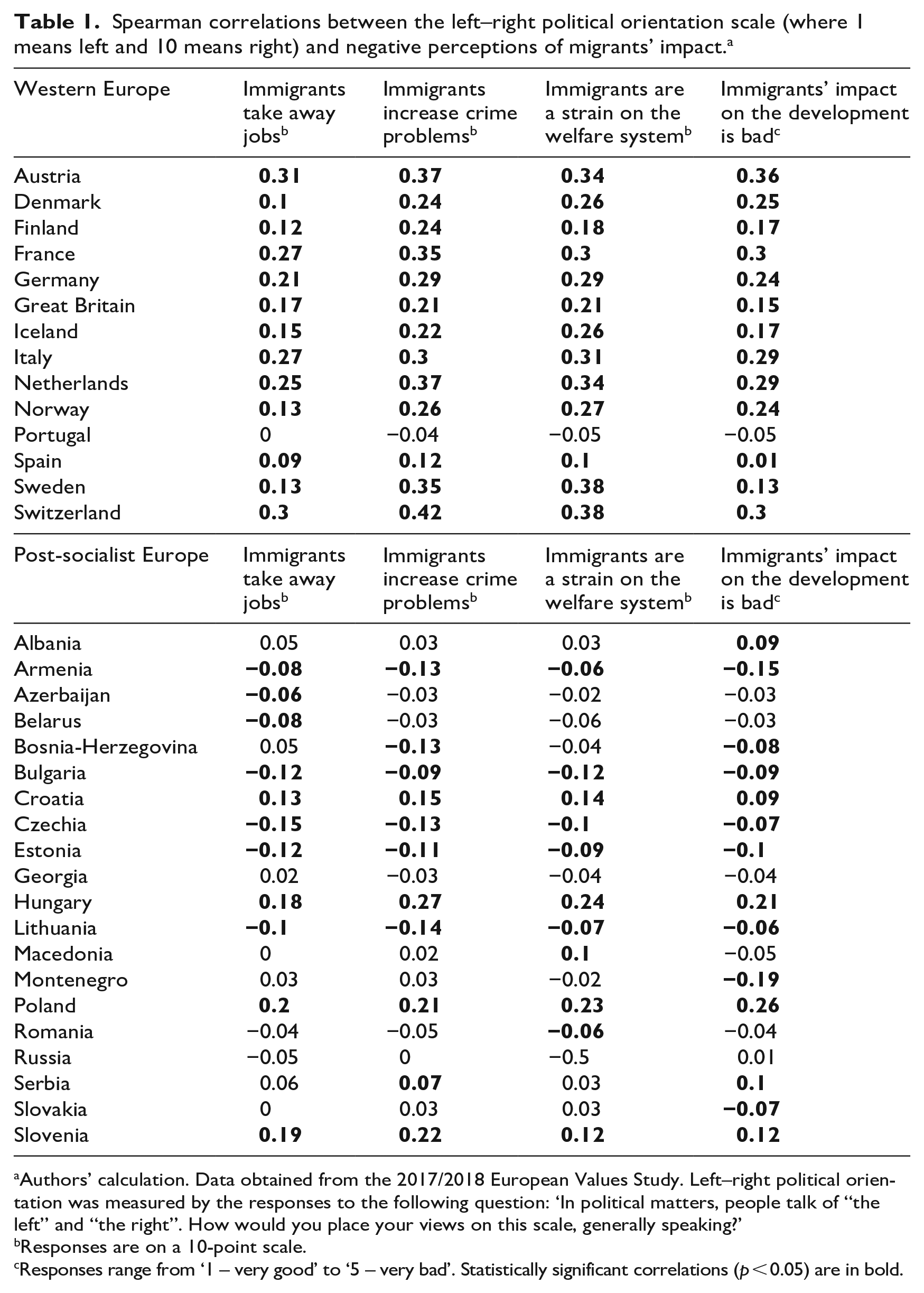
Authors’ calculation. Data obtained from the 2017/2018 European Values Study. Left–right political orientation was measured by the responses to the following question: ‘In political matters, people talk of “the left” and “the right”. How would you place your views on this scale, generally speaking?’
Responses are on a 10-point scale.
Responses range from ‘1 – very good’ to ‘5 – very bad’. Statistically significant correlations (p < 0.05) are in bold.
The findings in Table 1 are based on information gathered from a set of different questions about attitudes towards migrants. However, these questions all relate to just one type of anti-immigrant attitude – the perceived threat posed by migrants to the collective interests of the local population. To further investigate the association between left–right political orientation and attitudes towards migrants, we analysed data pertaining to another type of anti-immigrant attitude – the desire to maintain social distance (as expressed by an unwillingness to have a migrant as a neighbour). For this analysis, we grouped respondents into three categories representing their self-reported political orientation: left, centre and right. Figure 1 presents the percentage of those who desired to maintain social distance from migrants across the three categories. Not surprisingly, our analysis demonstrates that in Western European countries, the percentage of respondents who desired social distance from migrants is consistently the highest for holders of right-wing political ideologies and the lowest for holders of left-wing political ideologies. Those self-placed at the centre of the left–right political orientation scale fell in between (data from Portugal deviate slightly from this linear pattern).
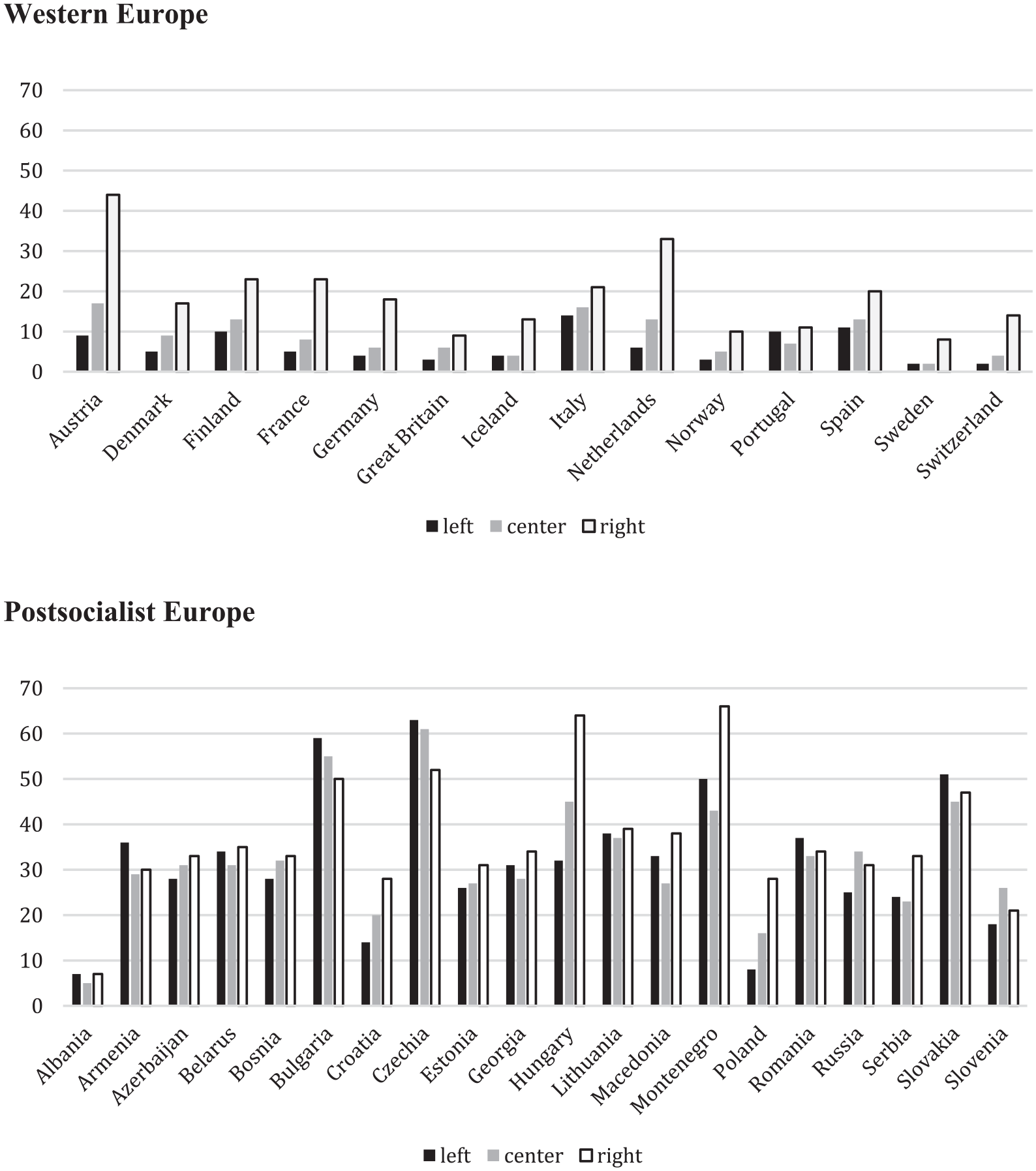
Percentage of respondents who do not want an immigrant as a neighbour, by political orientation.
Once again, the picture is remarkably different for postsocialist European countries. In a few, such as Croatia, Hungary and Poland, the pattern of association between left–right political orientation and the desire to maintain social distance from migrants resembles the linear pattern of the association in Western Europe. In other postsocialist countries, such as Armenia, Bulgaria and Czechia, the percentage of respondents who desire social distance from migrants is higher for those leaning towards the political left than for those leaning towards the right. However, in a majority of the postsocialist countries sampled, there are no clear linear patterns of association or/and no substantial differences in the desire to maintain social distance across social groups holding either left, centre or right political ideologies. 4
So far, our findings clearly demonstrate that the link between self-reported right-wing political orientation and anti-immigrant sentiment does not exist in the majority of postsocialist countries. In the next section, we will discuss two possible explanations for this absence.
What Explains the Lack of an Association between Right-Wing Political Orientation and Anti-Immigrant Attitudes in Postsocialist Countries?
What accounts for the fact that the link between right-wing political orientation and hostility towards migrants, so obviously apparent in western liberal democracies, does not exist in postsocialist contexts, or at least is not characterized by any similar consistent pattern? We suggest two possible explanations. The first questions the role of political conservative ideologies in driving this association in postsocialist European societies; the second focuses on the relatively low social relevance of the left–right political orientation scale for postsocialist subjects.
Political Conservative Ideologies 5 and the Association between Left–Right Political Orientation and Attitudes towards Migrants
As previously mentioned, in attitudinal research the association between right-wing political orientation and anti-immigrant sentiment is usually explained by the tendency of supporters of right-wing ideologies to hold beliefs justifying social inequality, resistance to change and conservative views regarding national identity (Haas et al., 2020; Pardos-Prado, 2011; Rowatt, 2019; Wimmer, 1997). However, this wide range of conservative views, commonly attributed to the political right in western liberal democracies, is far from unequivocally affiliated to the political right in a majority of postsocialist countries. Previous research demonstrates that in postsocialist European countries, unlike in their western counterparts, there is no consistent pattern linking right-wing political orientation to conservative values like conformity, security and tradition (Piurko et al., 2011; Thorisdottir et al., 2007). Likewise, in the former Communist countries, and in contrast to the countries of Western Europe, the relationship between right-wing political orientation and resistance to change, or between right-wing political orientation and acceptance of inequality, does not have a consistent pattern (Aspelund et al., 2013; Thorisdottir et al., 2007). Examining 13 former Communist countries, Aspelund et al. (2013), for example, demonstrated that while in some countries holders of right-wing political orientation expressed higher levels of political conservatism (measured by resistance to change and acceptance of inequality), in other countries it was holders of left-wing political ideologies who reported higher levels of political conservatism. This aside, in some other countries no link could be found between political conservatism and either left or right political orientation.
We now present an empirical analysis of the association between left–right political orientation and conservative views regarding national identity, using data from the 2017/2018 EVS. Table 2 presents the correlation in 20 postsocialist countries and 14 Western European countries between the left–right political orientation scale and two indicators of national identity – a sense of pride in being a citizen of a certain nation, and a sense of closeness to this nation. As expected, in most of the Western European countries, those self-placed towards the right end of the political continuum tended to express greater pride in being citizens of their respective nations and to feel closer to their countries than their left-wing compatriots. However, this held true for only eight out of the 20 postsocialist countries studied. Thus, while in some postsocialist European countries patterns of correlation between left–right political orientation and national identity resembled those in Western European countries, in others no consistent or/and meaningful association between left–right political orientation and conservative views regarding national identity was found.
Spearman correlations between left–right political orientation scale (where 1 means left and 10 means right) and dimensions of national identity. a
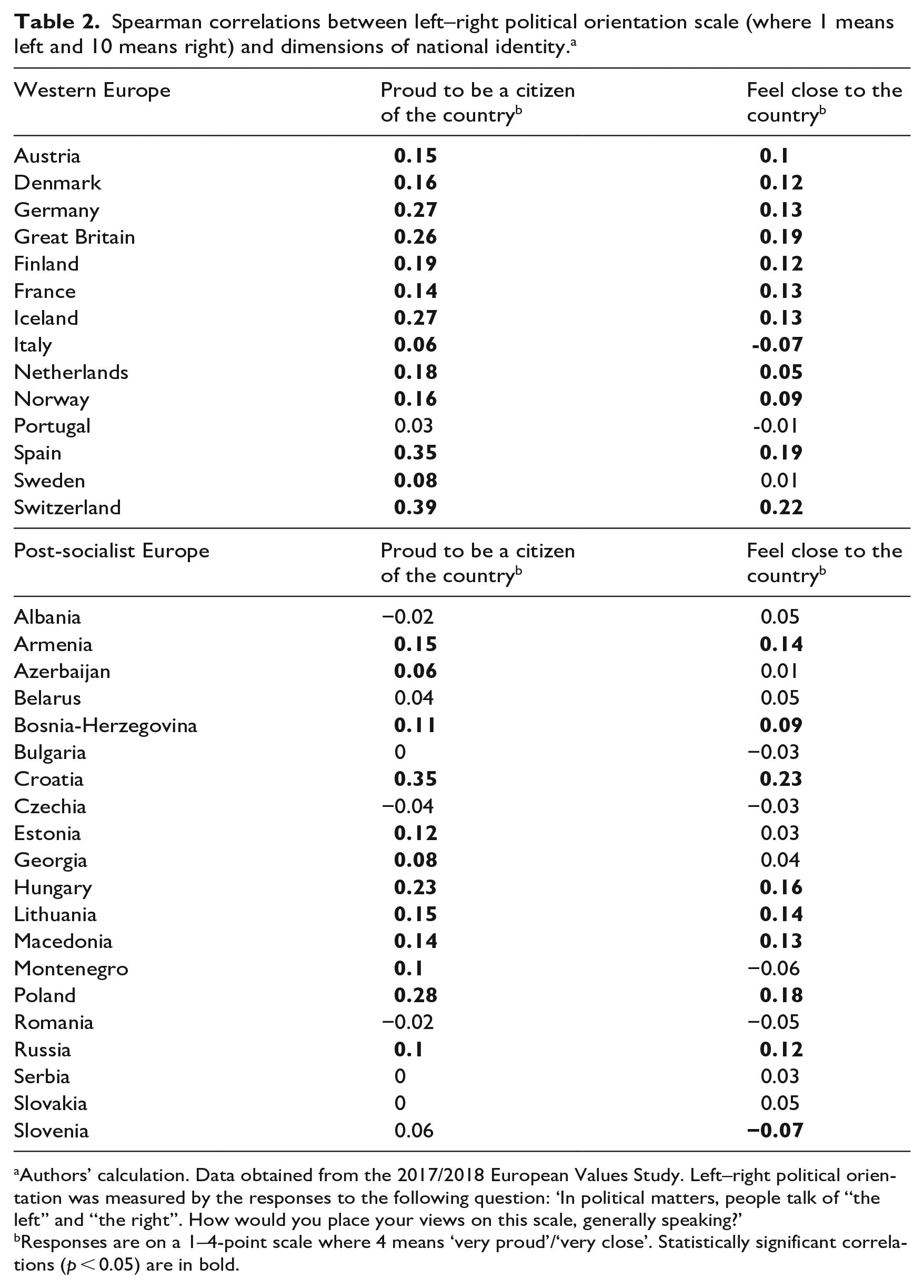
Authors’ calculation. Data obtained from the 2017/2018 European Values Study. Left–right political orientation was measured by the responses to the following question: ‘In political matters, people talk of “the left” and “the right”. How would you place your views on this scale, generally speaking?’
Responses are on a 1–4-point scale where 4 means ‘very proud’/‘very close’. Statistically significant correlations (p < 0.05) are in bold.
Both previous research (Aspelund et al., 2013; Piurko et al., 2011; Thorisdottir et al., 2007) and our own empirical analysis show that in the majority of postsocialist European countries, political conservative ideologies, expressed in either social, economic or cultural terms, do not characterize supporters of the political right to any greater extent than they do supporters of the political left, as is the case in western liberal democracies. In addition, in a supplementary analysis of 20 postsocialist countries we did not find any clear pattern characterizing the association between conservative ideologies regarding national identity and anti-immigrant sentiment (see online Appendix B, Table B3). Therefore, in postsocialist Central and Eastern Europe, political conservative ideologies cannot underwrite the association between right-wing political orientations and anti-immigrant sentiment.
Relevance of the Left–Right Political Orientation Scale for Postsocialist Subjects
The second and more radical explanation for the absence of a consistent association between left–right political orientation and attitudes towards migrants in postsocialist countries questions the relevance of the left–right political orientation scale itself. Scholars who have drawn attention to the particularities of local political meanings in postsocialist countries have noted that – for example in Hungary at the turn of the 21st century – the left–right political continuum had no coherent relevance for the country’s population. About a third of the respondents did not answer the question concerning their left–right political orientation. Of the rest, no correlation could be found between left–right political self-identification and views concerning a range of social issues, including taxes, privatization, environment, freedom of religion and abortion (Gunther and Hsin-chi, 2007).
Scholars have also suggested that in post-Soviet Russia, the traditional division between the ‘left’ and the ‘right’ has been rendered meaningless (Gorodzeisky et al., 2015; Pain, 2007). In analysing the 2006 ESS data, Gorodzeisky et al. (2015) found that almost half of the Russian respondents did not answer the question: ‘How would you place your views on the left–right political orientation scale?’ Of those who did respond, more than half placed themselves in the middle of the scale and for the other half no obvious trends related to voting behaviour were found. Recently, Wojcik et al. (2021) found that certain political beliefs regarding abortion, divorce, euthanasia, state regulation of the market and so on – all traditionally associated with right-wing political ideologies in Western Europe – do not characterize people who self-identified with the political right in Central and Eastern Europe. They further questioned the usefulness of the left–right political continuum in interpreting the shared meanings of existing political ideologies.
To further pursue the explanation challenging the relevance of the left–right political orientation scale in postsocialist contexts, Figure 2 presents the percentage of respondents in 20 postsocialist countries that did not reply to a question in the 2017/2018 EVS regarding their political left–right self-identification. The data demonstrate that a substantial proportion of citizens in most postsocialist countries avoided placing themselves on the left–right political orientation scale. In seven countries, at least 30% of respondents did not answer the question regarding their left–right political self-identification. For example, 30% of Estonians, 36% of Romanians and Russians, and more than half of the respondents from Montenegro did not answer this question. In 10 other countries, between 19 and 29% of respondents did not answer the question on left–right political self-identification.
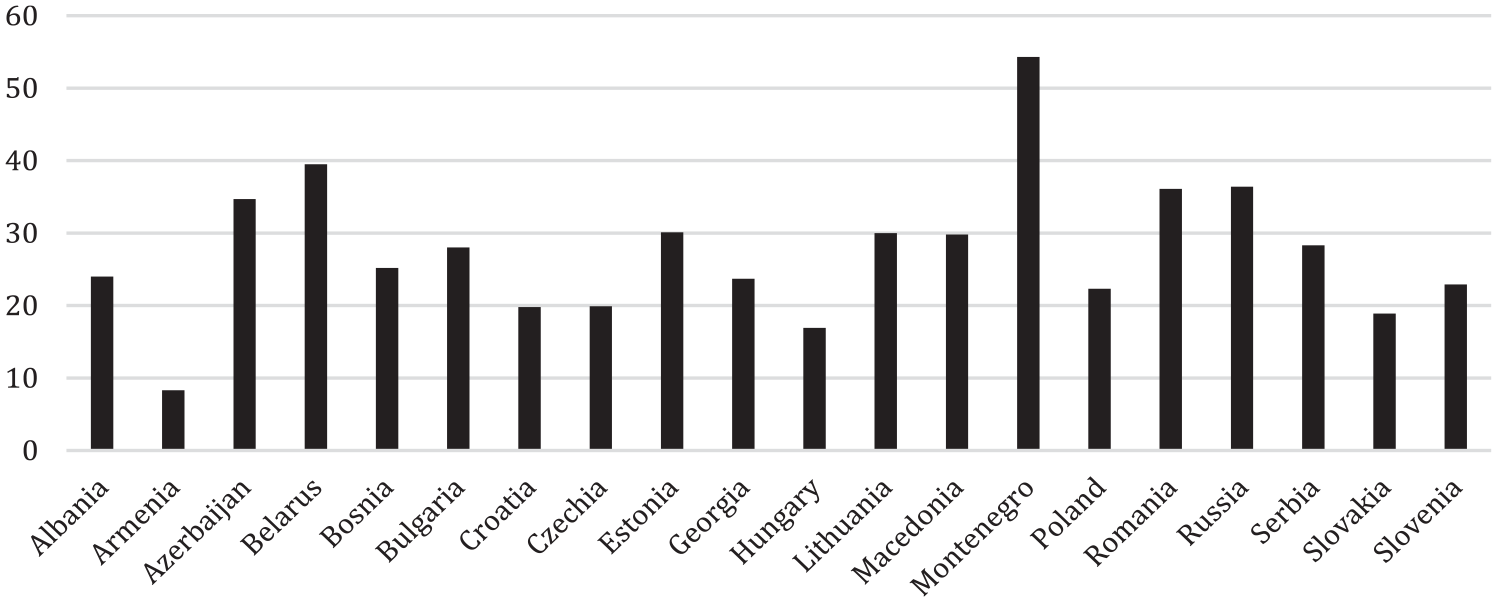
Self-placement on the left–right political orientation scale: Percentage of nonresponse, by country, postsocialist European countries.
Of course, the objection could be raised that the high non-response rate might be a feature of a specific survey and thus does not necessarily reflect uncertainty regarding left–right political self-placement in postsocialist countries. To eliminate this doubt, we compared the non-response rate in postsocialist European countries with that in Western European countries, using two different surveys – the 2017/2018 EVS and the 2018 ESS.
Figure 3 displays box plots illustrating the distributions of the percentage of respondents who gave no answer regarding their left–right political self-identification by country in postsocialist Central and Eastern Europe, and in Western Europe.
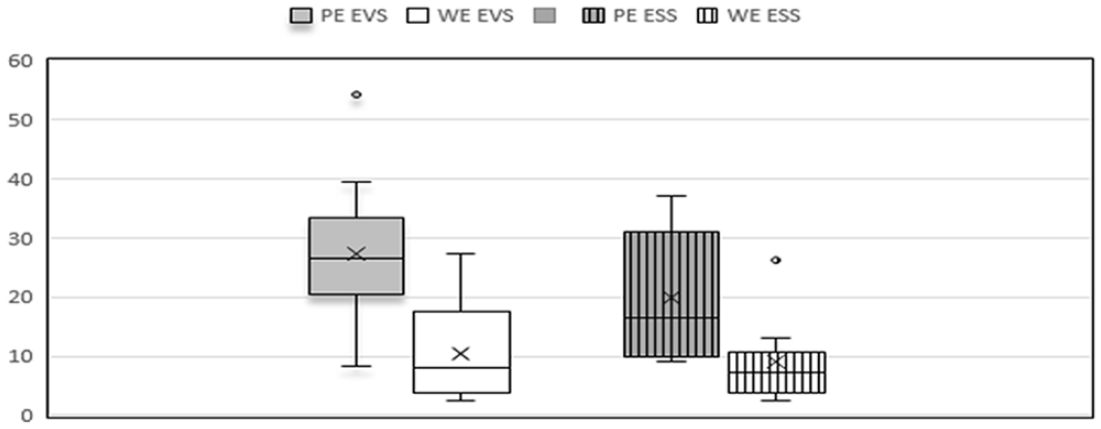
Box-plot: Distribution of non-response rate in self-placement on the left–right political orientation scale: postsocialist European countries (PE) versus Western Europe countries (WE).
The findings demonstrate that while the specific percentage varies across countries within postsocialist Europe, the general trend is clear: the non-response rate to the question about left–right political orientation is much higher in postsocialist countries than in Western Europe. In other words, the very high non-response rate in postsocialist countries is not driven by a particular survey, but rather confirms doubts regarding the meaningfulness of the left–right political scale for postsocialist subjects. Consequently, the low relevance of the left–right political orientation scale for postsocialist subjects makes it difficult to attribute a specific political orientation, as measured by the left–right scale, to anti-immigrant sentiment.
Political Conservatism and the Left–Right Political Orientation Continuum in Postsocialist Contexts
We have questioned the role of political conservative ideologies in shaping the tendency of people leaning towards right-wing political orientation to hold anti-immigrant attitudes, and have challenged the relevance of the left–right political continuum itself in the postsocialist region. A particular thread of scholarship suggests that the lack of consistency in the link between political conservative ideologies and right-wing political orientations is a temporary outcome of the so-called ‘transition from communism to democracy’ in postsocialist societies (Evans, 2006; Whitefield, 2002). More than 30 years since the fall of the Berlin Wall, this claim, grounded in the transitional paradigm inspired by Fukuyama’s (1992) notion of ‘The End of History’, still looms large over political analysis of postsocialist countries. The transitional paradigm situates postsocialist societies on a transitory path, by the end of which they would have successfully realized their democratic potential. Implicit in this line of reasoning is the presumption that it is only a matter of time and concerted effort before these societies reach an advanced stage of development, at which point the ‘proper’ link between right-wing political orientation and conservative ideologies will be realized.
Scholars of postsocialism have argued against this understanding of transition and its linear images of progress, noting that democratization processes in postsocialist societies present diverse experiences and configurations. The transformations that emerged from socialism produced a variety of social and political forms, some resembling western liberal democracies and others not (Hann, 2006; Humphrey, 2002; Makovicky, 2014; Matza, 2012; Rogers, 2010; Stark and Bruszt, 2001; Verdery, 1996). This literature also stresses the role played by the legacy of communist and socialist regimes in the tendency of postsocialist subjects to attribute different meanings to the left–right political continuum, as compared with western liberal democracies. In postsocialist political contexts, the political left, for example, could be associated with the ideas that resemble social and cultural liberalism in its Western European sense; alternatively, the political left could also be associated with communism, which has quite different connotations for postsocialist subjects (Whitefield, 2002). As Wojcik et al. (2021) demonstrated, the concept of left–right political self-identification cannot be seamlessly translated from Western to Eastern European countries, because there are no consistent and shared beliefs characterizing either side of the political continuum in postsocialist Europe, as it is the case in Western Europe.
Building on these insights, we conclude with a consideration of the social and political identities that the uncritical transfer of analytical tools and models from western to postsocialist Central and Eastern Europe have prevented us from capturing.
Concluding Remarks
Scholars have repeatedly shown that knowledge, concepts and instruments produced in North America and Western Europe benefit from the dominant position in the social sciences (Beigel, 2014; Jacobs and Mizrachi, 2020; Krause, 2016). In the case of postsocialist societies in Central and Eastern Europe, this dominance is reinforced by both the legacy of the Cold War and the internal hierarchies of Europe, which have consistently construed Eastern Europe as subordinate and inferior to Western Europe (Koobak and Marling, 2014; Krivonos and Näre, 2019). For instance, analytical concepts, tools and models forged in Western European political and social contexts continue to be uncritically applied in social research depicting social realities in Central and Eastern Europe (Gorodzeisky and Leykin, 2022).
The focus of this article, the association between left–right political orientation and attitudes towards migrants, is a case in point. As clearly demonstrated here, when approached critically, the stable pattern of the association between left–right political orientation and attitudes towards migrants, well established in Western Europe, does not manifest in postsocialist contexts. This article provides two analytical reasons for this. First, we have demonstrated that unlike in Western European societies, where people leaning towards the political right tend to hold conservative views that inform their tendency to express anti-immigrant sentiment, in postsocialist Central and Eastern Europe, political conservative views can hardly be responsible for the association between left–right political orientation and attitudes towards migrants. This is because in the majority of postsocialist European countries, self-identified supporters of the political right are not more likely to hold political conservative views than supporters of the political left. Second, we have shown that the left–right political orientation scale, as applied in attitudinal research, is much less useful and meaningful for the political identification of the citizens in postsocialist societies than in Western European countries. It seems that this scale fails to comprehend the categories through which postsocialist subjects imagine their social and political worlds, making its use problematic when trying to affiliate anti-immigrant sentiment with a certain political orientation in this region.
While beyond the scope of this research, another important question worth asking about the association of anti-immigrant sentiment with the left–right political orientation, relates to the figure of the migrant in the collective imaginary of postsocialist European societies. The notion of who, in postsocialist regions, is considered a migrant is grounded in specific historical and political developments. Such developments tend to disrupt popular social distinctions between migrants and locals, forged in Western European political contexts. For example, after the establishment of new independent postsocialist states in Central and Eastern Europe, people who migrated within the borders of a single socialist or communist federation before the fall of the Berlin Wall (e.g. USSR, Czechoslovakia and Yugoslavia), were retrospectively defined by transnational data-producing institutions as international migrants – even though they had not crossed international borders at the time of their migration (Gorodzeisky and Leykin, 2020). In some countries, such as postsocialist Latvia and Estonia, popular imaginations of migrants and national minorities were affected by representing Russian speakers who had arrived in the country during the Soviet period as international migrants (Dzenovska, 2018; Smith et al., 2002). Another example is the unified Germany, in which the particular migratory histories of the former East and West Germanies continued to produce substantial differences in popular representations of migrants as much as 20 years after the unification (Asbrock et al., 2014).
The critical examination of the western-centric analytical models in postsocialist Central and Eastern European contexts have clearly demonstrated the internal heterogeneity of the postsocialist European region. Expanding our discussion of the link between right-wing political orientation and anti-immigrant sentiment, we would like to propose an intellectual exercise. Leaning heavily on the social realities in western liberal democracies and ignoring the particularities of postsocialist contexts only allows consideration of a specific set of social attributes – such as right-wing political leanings, low levels of education and the lack of certain cultural capital – as affiliated with intolerant attitudes towards others. We suggest closer consideration of other social identities relevant for understanding the distribution of hostile attitudes towards ‘the other’ (e.g. migrants, racialized and ethnic minorities, asylum seekers, etc.) in postsocialist societies, without applying the analytical models developed in Western European realities. For instance, blatant racial prejudice is quite common among the contemporary self-identified liberal Russian intelligentsia – possessors of high levels of education and socially valued types of cultural capital. The responses of Russian liberal public figures to the 2020 Black Lives Matter protests are a striking example of the racist views openly expressed by liberal subjects (Djagalov, 2021). In post-Soviet Latvia, even those who propose inclusion and diversity as quintessential liberal virtues necessary for the country’s democratization and European integration have insisted on policing the boundaries of Latvia’s citizenry and on practising exclusionary attitudes towards others, as a way of redressing the legacy of the Soviet occupation (Dzenovska, 2018, 2021). Further, in the second decade of the 21st century, both left- and right-wing political parties in Czechia seemed to support anti-refugee discourse; several left-leaning political parties stressed the importance of the country’s cultural homogeneity, voicing opposition to the idea of multiculturalism (Jurečková, 2020). In the same vein, there is no empirical evidence that voters supporting centre–left and left-wing political parties in Hungary and in Poland are less likely to express racist views than voters supporting the most populist and radical right-wing political parties (Bell et al., 2022).
Another configuration that contradicts the social patterns institutionalized in western liberal democracies refers to the rural–urban divide in attitudes towards others. While residents of western metropolitan areas tend, in general, to be more tolerant towards migrants and minorities, in Hungary racist views towards these groups are more prevalent among urban residents than among their rural compatriots (Bell et al., 2022). In Russia, contrary to common-sensical patterns, anti-immigrant sentiment in Moscow – Russia’s capital and most cosmopolitan city – is among the highest in the country (Bessudnov, 2016). These are just a few examples of how engaging with postsocialist contexts as an independent source of social knowledge creates opportunities to identify unexpected associations between intolerant attitudes towards others and a range of social identities.
Finally, challenging taken-for-granted ideas about the distribution of anti-immigrant sentiment across different social groups can also be beneficial for social research in western liberal democracies. After all, as recently as the 1990s there were no significant differences between self-identified Democrats and Republicans in attitudes towards immigration in the United States. The polarization concerning such attitudes – nowadays perceived as almost universal – only began to appear at the beginning of the 2000s (Sanderson et al., 2021). Going back even further in time, it was the Socialist Party of America that vocally opposed the arrival of labour migrants from Japan (Bonacich, 1972: 555). In other words, challenging western-centric social knowledge can be beneficial in understanding postsocialist realities and in avoiding overgeneralizations in studying ‘familiar’ social worlds in western liberal democracies.
Supplemental Material
sj-pdf-1-soc-10.1177_00380385231161206 – Supplemental material for Is Anti-Immigrant Sentiment Owned by the Political Right?
Supplemental material, sj-pdf-1-soc-10.1177_00380385231161206 for Is Anti-Immigrant Sentiment Owned by the Political Right? by Inna Leykin and Anastasia Gorodzeisky in Sociology
Supplemental Material
sj-pdf-2-soc-10.1177_00380385231161206 – Supplemental material for Is Anti-Immigrant Sentiment Owned by the Political Right?
Supplemental material, sj-pdf-2-soc-10.1177_00380385231161206 for Is Anti-Immigrant Sentiment Owned by the Political Right? by Inna Leykin and Anastasia Gorodzeisky in Sociology
Footnotes
Acknowledgements
We would like to thank Nissim Mizrachi for encouraging us to pursue this line of inquiry and Michal Kravel-Tovi for her insightful and helpful comments on the earlier drafts of the article. We are also grateful to Yifat Gutman, Tom Pessach and Erica Weiss for a thoughtful engagement with the earlier drafts of the article. Finally, we would like to thank Professor Rob Meadows and two anonymous reviewers. Their suggestions and guidance helped us sharpen our argument.
Authorship Note
The authors contributed equally to this work.
Funding
The authors disclosed receipt of the following financial support for the research, authorship and/or publication of this article: this work was supported by Israel Science Foundation [Grant Number 948/20].

Supplemental material
Supplemental material for this article is available online.
Notes
Author biographies
References
Supplementary Material
Please find the following supplemental material available below.
For Open Access articles published under a Creative Commons License, all supplemental material carries the same license as the article it is associated with.
For non-Open Access articles published, all supplemental material carries a non-exclusive license, and permission requests for re-use of supplemental material or any part of supplemental material shall be sent directly to the copyright owner as specified in the copyright notice associated with the article.
