




Abstract
Family financial support of young adults has occupied growing scholarly attention over recent years yet remains disconnected from literature addressing the intensification of parenting, which focuses primarily on children. In this article we seek to connect these bodies of literature in order to consider how providing financial and practical support to young adult children affects their parents’ lives and future plans. We present the findings of an interview-based study with 30 parents of young adult children living in Australia. Firstly, we consider patterns of support that our participants provided to their children, finding that financial and practical support was extensive across our sample. Secondly, we consider how supporting young adult children affects parents’ lives, finding that our participants were reluctant to discuss the negative effects that supporting their children may have on them in the present. In relation to the future, the majority of our participants anticipated providing financial support to their children and had factored doing so into their retirement planning. Drawing together these findings, we argue that the parenting of young adult children represents a continuation of aspects of intensive parenting commonly associated with childhood and adolescence and conclude by highlighting some areas for future research.
Introduction
A growing number of scholars have become concerned with the issue of intergenerational financial support in recent years. This interest is connected to the reemergence of significant intergenerational wealth disparities in many countries. In Australia, those aged 18–34 are in a weaker financial position than any other living generation were at a comparable age (Productivity Commission, 2020), reflecting patterns that are also evident in other national contexts (Chetty et al., 2017). Intergenerational financial assistance with housing and home ownership has attracted particular scholarly attention in the years following the Global Financial Crisis, which have witnessed significant growth in property prices in Anglo-American countries that have historically had high rates of home ownership (see Ronald & Arundel, 2022). However, while assistance with home ownership generally represents a particularly large financial commitment, recent research has shown that it is often preceded and accompanied by assistance with other expenses (Cook, 2020; Woodman et al., 2024). Existing research has primarily mapped out patterns of family support (Albertini et al., 2018), and sought to understand the relationship between receiving financial or in-kind support and achieving outcomes such as home ownership and other markers of socioeconomic standing (Suh, 2020). As a result, studies of the impact of intergenerational support have predominantly focused on the adult children who are receiving it, and the question of how providing support to adult children impacts upon parents remains under-addressed.
Concurrently, research on parenting cultures has drawn attention to the intensification of parenting, leading to the rise of a parenting style that is characterised by its resource intensiveness (Faircloth, 2023). Again, however, this research has focused primarily on the parenting of children and adolescents, leaving the issue of parenting adult children largely unexplored. In this article we draw together literature on intergenerational support and parenting cultures to highlight some of the patterns in parents’ experiences of providing financial and practical support to their young adult children, and to consider how providing this support affects parents’ present-day lives and plans for the future. Drawing on an interview-based study conducted with 30 parents who had at least one child aged between 18 and 25, we find that, for our participants, parenting young adult children demands investments and commitments that fit with the concept of intensive parenting, suggesting it is extending beyond the parenting of children and adolescents. In relation to the present-day effects of supporting young adult children, we find that our participants are reluctant to engage in explicit discussion of the challenges associated with parenthood, reflecting the strong social expectations stemming from the rise of ‘positive parenting’ as a primary model of good parenting (Reece, 2013). Finally, we find that the anticipated impact of supporting young adult children on parents’ plans for the future is primarily financial, with the majority of our participants planning to provide some degree of financial support to their children in the future.
The impact of providing intergenerational support
As outlined above, there has been a recent boom in research on intergenerational financial assistance, with a particular focus on housing (see, for instance, Cook & Overton, 2024; Druta & Ronald, 2017; Suh, 2020). However, this research has focused primarily on the impact of this support on those receiving it rather than those providing it, given the empirical focus has been around the role of these transfers in shaping intergenerational transmission of opportunity and inequality for younger generations (Konings et al., 2022). While there have been some important studies that have included the perspective of those providing support, this is only included alongside recipients: a methodological choice that opens up insights into the intergenerational dynamics shaping these transfers but may also render it difficult for those providing support to feel comfortable giving voice to the effect that doing so has on them (see, for instance, Cook & Overton, 2024; Druta & Ronald, 2017).
Research that has focused on parents’ provision of support to adult children has often sought to identify patterns in practices and attitudes towards support related to socioeconomic status (SES) or social class and family composition. For instance, Kalmijn (2024) has considered how parents’ SES mediates their provision of support to adult children across the life course, finding a positive relationship between parental SES and informational and financial support, but no relationship between parental SES and practical support (see also Rauscher, 2016). The latter finding is echoed to a degree in the work of Fingerman et al. (2015), which found that although higher SES parents provided more financial support, lower SES parents provided more practical support to their children. Although this work has limited utility for understanding how providing support shapes parents’ lives beyond indicating who is likely to be providing which types of support, it does highlight the significance of non-financial support. The focus of this work on practical and informational support especially echoes Bourdieu’s (1979) famous conclusion that, through the mid-20th century in France, social and cultural transfers grew in importance relative to direct financial inheritance in explaining the reproduction of social positions. Indeed, while financial support has risen significantly in prominence in recent decades in both Australia and other similar countries, it is nevertheless important not to lose sight of the significance of other forms of support.
Of the few studies that address the effects of providing support on parents, the focus has been on how it does or does not shape transitions to retirement (Miller et al., 2018; although see also Walsemann et al., 2020 on the effect of borrowing money to pay for a child’s tertiary education on parents’ mental health). Despite these important examples, overall, there is a paucity of research addressing how providing support to adult children impacts upon parents. This is in spite of the growing normalisation of financially supporting children well into adulthood (see Drake et al., 2018 on the Australian context). This gap is significant given research suggesting that the impact of parenthood on physical and mental health is highly dependent on the parenting stage that one is in (see Simon & Caputo, 2019). This article addresses an important part of this gap, considering the subjective experience of providing this support as it extends into young adulthood, including how it is rationalised, negotiated with other parents, and planned for.
Parenting adult children
There is a significant body of literature addressing the impact of parenthood on individuals’ identity, present-day life and future plans. This literature is situated within parenting culture studies, a sub-field that Lee (2023, p. 13) characterises as follows:
The transformation of the noun ‘parent’ into the verb ‘parenting’ has taken place through a sociocultural process centering on the belief that ‘parenting’ is a highly important and problematic sphere of social life; indeed, ‘parenting’ is almost always discussed as a social problem, and in some way blamed for social ills. In turn, ‘parenting culture’ can be summarized to mean the more or less formalized rules and codes of conduct that have emerged over recent years which reflect this deterministic view of parents and define expectations about how a parent should raise their child.
Drawing on this approach to studying parenting, in this article we seek to understand the rules and codes of conduct that are evident in the experience of parenting young adult children in the Australian context, and to consider how conforming with them or pushing back against them impacts upon the present-day lives and future plans of parents.
So far there has been little dialogue between parenting culture studies on the one hand, and research on intergenerational support on the other. This is surprising as, despite the use of differing terminology, each body of research adopts a similar broad focal point: the expansion of parenting expectations over recent decades. This might be attributable to parenting cultures research focusing primarily on children and adolescents, while studies of intergenerational support focus primarily on young adult children who have aged beyond the point at which ‘full’ support can be assumed.
Hays (1996) argues that expectations on parents began to transform during the 1980s, with a growing emphasis on the importance of near constant parental involvement. She defines this approach (which she termed at the time ‘intensive mothering’ and later evolved into intensive parenting) as ‘child-centered, expert-guided, emotionally absorbing, labor-intensive, and financially expensive’ (Hays, 1996, p. 8). Intensive parenting is characterised by the dual assumptions of parental determinism and childhood innocence and vulnerability (Furedi, 2002). As a result, parents’ actions take on heightened significance as they are assumed to take a leading role in cultivating their children’s skills and abilities and disproportionately shape their developmental outcomes while at the same time protecting their children from any potential harms that may compromise their outcomes (Faircloth, 2023). In a recent review article Nomaguchi and Milkie (2020) argue that intensive parenting has itself intensified since the 1990s. For instance, growing income inequality and competition in the labour market have led parents to feel insecure about their children’s futures (see Cooper, 2014). In this context child-related spending has increased overall but most rapidly amongst higher income households (Schneider et al., 2018). Importantly, this claim points to a so-far unexplored link between the literatures on intergenerational support and intensive parenting, with parents presented in each as ‘stepping in’ to ensure that their children are on track to achieve milestones.
Discourses of parenting such as those stemming from Hays’ (1996) work have been critiqued for normalising middle-class parenting practices and, as a result, pathologizing working-class practices (Gillies, 2005; Skeggs, 2004). However, as Perrier (2013) argues, this dichotomous focus may risk reifying working-class and middle-class parenting approaches and may paper over the work that parents do to resist and negotiate parenting discourses. In her study of how mothers negotiate dominant discourses of ‘good’ mothering, Perrier (2013) found that although the middle-class mothers in her sample emphasised the importance of education, they also expressed ambivalence which manifested as reluctance to forcefully intervene in their children’s learning. Drawing on Perrier’s work, we seek to develop an account of the intensive parenting of young adult children that is attuned to potential ambivalences and is alive to parents’ potential to resist and negotiate parenting discourses.
Recent studies have also identified intensive parenting and similar discourses as universalising the experiences of white, middle-class mothers and using these experiences as a norm against which to judge all mothers (see Dow, 2019; Verduzco-Baker, 2017). In the context of Australia – a settler colonial country with an increasingly multicultural population following the end of White Australia policies in the 1960s and 1970s – the challenges of parenting in a different cultural context are particularly pertinent. In their study of parenting practices post-migration Renzaho et al. (2011) found that migrants from collectivist cultural backgrounds often became more authoritarian in their parenting practices over time rather than assimilating to the parenting norms in the Australian context. Importantly, authoritarian parenting styles share notable similarities with intensive parenting. While this style of parenting places a lower emphasis on emotional intimacy, it nevertheless involves a large degree of attention and investment from parents (Du & Li, 2023). Similarly, research on Asian families in the Australian context has shown that intergenerational financial support and resource sharing is relatively normalised well into adulthood (Ma et al., 2022; Robertson & Rogers, 2017). Importantly, these findings highlight the fact that ongoing intergenerational support and practices of parenting young adult children are already present in many migrant and multicultural communities.
Much of the literature on intensive parenting has sought to highlight how such practices are focused on the cultivation of cultural and educational capital. For instance, Skeggs (2004) has shown that many of the practices that middle-class parents engage in, such as enrolling their children in extra-curricular activities, are not simply enriching their child’s development; they are also imbuing them with the cultural capital that is necessary to succeed in education and employment. In this article we argue that the extension of intensive parenting into young adulthood takes a somewhat different form. Specifically, while the parenting of children and adolescents focuses on the transmission and enhancement of cultural and educational capital, the intensive parenting of young adults appears to focus increasingly on the transmission of economic capital and attendant skills and dispositions.
Methods
The data presented in this article are drawn from a 2024 interview-based study that sought to understand how providing financial, practical and emotional support to young adult children impacted upon their parents’ present-day lives and future plans. The participants were recruited from the Life Patterns study, an ongoing longitudinal research programme that has followed a sample of participants who completed secondary school in the state of Victoria, Australia, in 1991 throughout their adult lives via surveys every two to three years and periodic interviews with a sub-set of the sample. The participants were aged 51–52 at the time of data collection.
It is important to note that the dynamics of the wider longitudinal research programme shaped the demographic composition of the recruitment pool for the present study. Specifically, the recruitment of the participants from those who finished secondary school in 1991 meant that the participants were disproportionately likely to be white when compared to the wider cohort of present-day 51- to 52-year-olds living in Victoria. This is because non-white migration to Australia, and the proportion of the population who do not identify as white, have each increased significantly since the participants were born in the early 1970s and entered secondary school in the 1980s. Additionally, it is well documented that longitudinal studies tend to be more successful at retaining participants with higher levels of educational attainment and middle- or upper-class backgrounds than they are at retaining working-class participants and those with lower levels of educational attainment (Young et al., 2006). The wider longitudinal sample that the present study recruited from is no exception to this trend, and for this reason the participants were disproportionately likely to be employed in professional and managerial occupations, despite efforts to recruit the small number of participants employed in manual occupations. Despite these challenges, the choice to recruit from an existing longitudinal study was informed by the capacity that it afforded us to identify potential participants who aligned with the inclusion criteria for the study, as well as the strong rapport between the research team and the participants.
The recruitment pool for the present study was established using responses to questions in the 2023 survey that was completed by the full sample (N = 251). Specifically, the survey data were used to identify which participants were in ‘a parenting role’ (a formulation chosen to include step-children) and the age(s) of their child(ren). Using these data, the recruitment pool was narrowed down to participants who had at least one child aged over 18. The recruitment process then sought to ensure a gender-balanced sample, as well as diversity in relation to the participants’ location, family size and expectations (or not) of providing financial support to their adult children (each of which were determined using potential interviewees’ 2023 survey responses).
The final sample included 30 participants (see Table 1 for an overview of key demographic characteristics). Fifteen identified as men, and 15 as women, and they lived across a range of location types including capital cities, regional areas, country towns and rural areas. The inclusion of a diversity of geographic locations was prioritised in this study due to the normalisation of post-secondary education in the Australian context, and the disproportionate financial burden that this places on those who do not live in the urban areas in which higher education providers are concentrated. As outlined above, although efforts were made to recruit a diverse sample is relation to occupation, the majority of the participants were nevertheless in professional or managerial roles. Similarly, the participants all identified as white.
Participants’ demographic and family information.
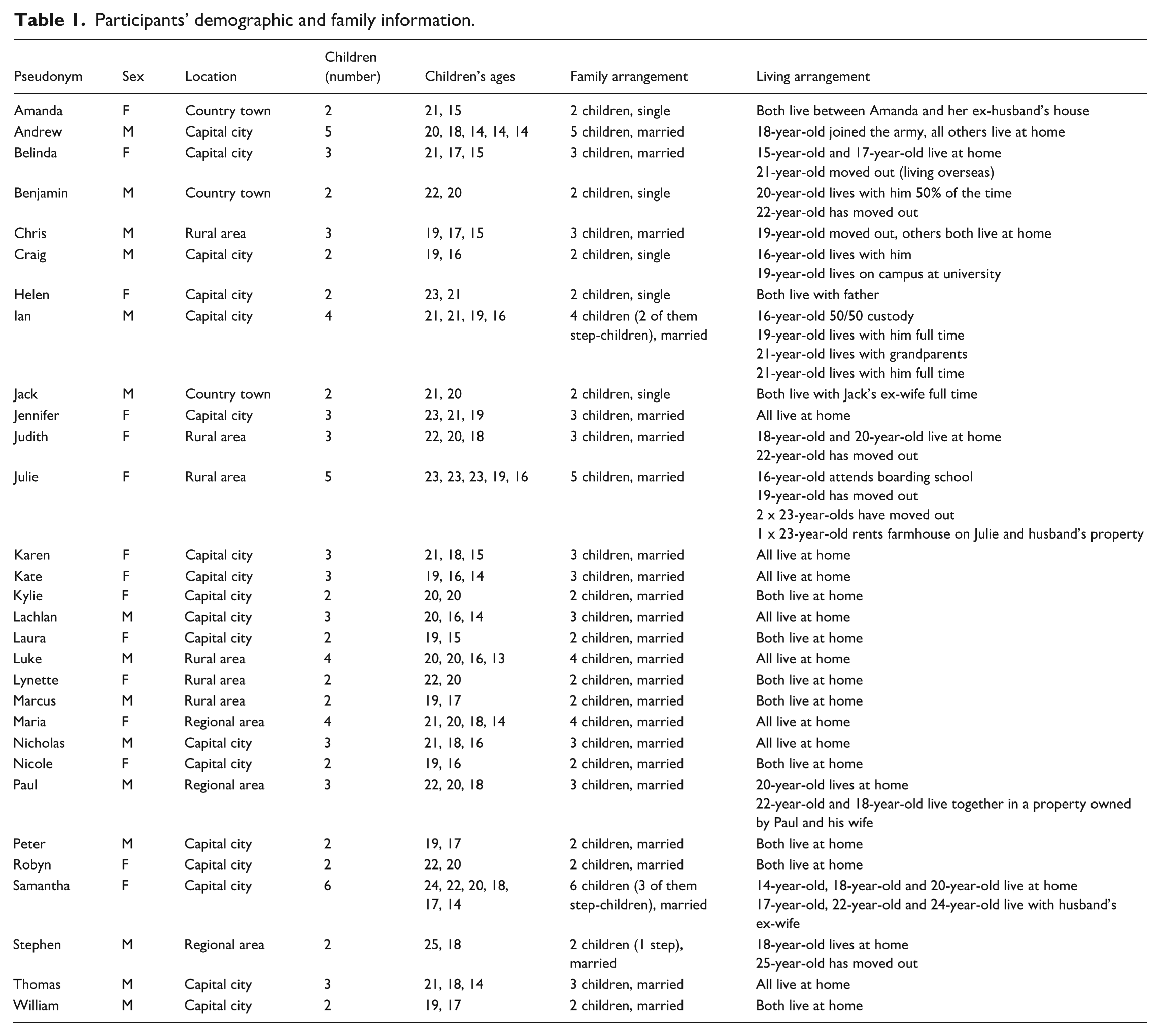
The majority of the participants (22/30) were in what could be considered traditional nuclear families. Of the remaining participants, three were step-parents and five were single and in co-parenting arrangements with their former spouse. Aside from one participant who identified that his step-daughter’s biological father was not part of her life, the participants in co-parenting and step-parenting relationships generally characterised these arrangements as low-conflict, stating that they were typically ‘on the same page’ as their ex-spouse or their step-child’s other parent.
The interviews began with an overview of the participants’ children, focusing on their education, employment, housing and relationship status. The participants were then asked about their relationship with each of their children, as well as their parenting arrangement (i.e. whether they were co-parenting, single parents, step-parents, etc.). We then asked the participants about the forms of financial, practical and emotional support that they were providing to each of their children, and how doing so impacted upon their own lives. We followed up these questions by asking at what age the participants anticipated ending their direct support for their children, and whether they anticipated that providing support would affect their own future plans, for example the timing of their transition to retirement. Next, we asked relational questions about how the level and types of support that they provided and planned to provide to their children compared to that which they had received from their own parents, and that which they thought was being provided by their peers.
The interviews took approximately an hour, and were conducted via either telephone or Zoom, depending on the participants’ preference. Participants received a $50 giftcard after the interview concluded in recognition of their time and contribution to knowledge. Audio recordings of the interviews were transcribed and entered into NVivo for analysis. Data analysis followed a method adapted from Deterding and Waters’ (2021) ‘flexible coding’; the transcripts were initially coded by interview question to allow the dataset to be navigated more easily by the team of researchers, and thematic coding then took place on the basis of both themes drawn from both the dataset and existing literature.
Findings and discussion
The findings and discussion are divided into two sections: (1) types of support, and (2) the effects of supporting young adult children. The quotations presented below were chosen to exemplify tendencies that emerged across the interviews.
Types of support
The participants typically provided extensive financial and practical support to their young adult children. The practices through which these forms of support were provided, as well as assumptions and attitudes underpinning them, were surprisingly consistent across the sample. Support with financing a vehicle was very common throughout the sample, with most participants paying for all or part of their young adult child’s first vehicle once they had obtained their driver’s licence. Support with covering university fees was much less common. This is likely due to Australia’s relatively benign student loan system in which study fees can be borrowed from the government and then repaid incrementally once the borrower reaches a specific income threshold (which for most people corresponds with commencing a full time job). In contrast, the provision of support with accommodation for adult children who were studying was ubiquitous. Collectively our sample of parents had 58 children aged over 18 (out of 86 total children), with 44 living in the family home and 14 living outside the family home. Of those who lived outside the family home, seven were undertaking some form of post-secondary education or training and received support with their accommodation costs, ranging from living in a property owned by their parents to parental assistance with rent (private rental or on-campus accommodation). All adult children who were living in the family home and studying, and most who were not studying, were not charged rent or board, and most received assistance with additional expenses such as transport and car and medical insurance. A common rationale for this decision was articulated by Lynette, who, when asked if her sons (aged 20 and 22) were paying board, responded:
No, we don’t [expect them to], but we’ve always said if they weren’t saving money then they would have to be paying rent. But we can see that they’re saving money so I think that if they’re doing that, that’s kind of the purpose of being here is to help them to save some money.
This aligns with a wealth of recent research on the notion of deservingness in parents’ decisions about whether to financially support their adult children (see, for instance, Drake et al., 2018). Specifically, like Lynette, many of the participants identified their support of their young adult children as contingent on them doing the ‘right thing’ by saving money, or by undertaking further study or paid employment. There was also strong normative consensus across the sample about the expenses that parents should and should not cover, with expenses that were deemed non-essential – entertainment, clothing and takeaway food – typically regarded as the responsibility of the young person themselves. For instance, Helen, whose children were aged 21 and 23 and were both studying full time, stated:
So there’s financial supports now that they’re both not working, they’re both studying, so just giving them an allowance sort of every fortnight, you know, offering to pay for things if they need it, just essential things, so like anything to do with their studies, transport, health care as well, so those sorts of things.
By providing financial support that was contingent on their young adult children doing the ‘right thing’ many of the participants seemingly used this support as a way of ensuring that their children would engage in practices that they associated with progress towards the normative milestones denoting full, independent adulthood (i.e. completion of studies and accrual of savings to eventually support financial independence and, potentially, independent housing).
The financial support that the participants provided to their children was also matched by a significant amount of practical support. Many of the participants identified that they were essentially on stand-by to support their young adult children as needed. For instance, William stated:
I don’t know how to classify it, to be honest. If they need me, I’m here and almost every day [I ask them] how can I help and what can I do?
However, while the financial support that the participants provided to their children appeared to remain stable, or even to increase, as they completed secondary school and reached the age of 18, many of the participants sought to reduce their children’s reliance on their practical forms of support during this time. For instance, despite his previous statement about being on stand-by to support his adult children William went on to say:
Well, you slowly loosen the support so that they can stand on their own two feet. That’s something that I’ve planned to do because they’ve got to learn to do things themselves. I suppose another analogy is that I used to tell them the time and now I give them a clock to tell the time. So, I used to drive the eldest around and now I’ve given her a car to drive around in.
Several of the participants identified that providing their children with a car, or in some cases assisting them with the purchase of one, was intended to augment their independence and decrease their reliance on their parents. It thus appeared that financial support was used by some of the participants to reduce their children’s reliance on practical support such as transportation.
Taken together, these findings demonstrate that across the sample the participants were providing a significant amount of support to their young adult children. This suggests that intensive parenting practices are extending into children’s young adulthood, with many of the forms of support reflected in this study echoing those discussed in research on parenting younger children. Notably, this appears to represent a social change, with many of the participants reflecting on the fact that they received comparatively less financial and practical support from their own parents, and that they stopped receiving this support earlier in their young adulthood than their own children did or will. However, these findings can be contextualised with references to the positionality of this study’s sample. Specifically, the participants were exclusively white and middle class, and their experience of a comparatively lower level of family support during their own young adulthood, as well as the premium that they placed on independence for their children, is reflective of this positionality. Their experience of supporting their children financially and practically into their young adulthood as a new phenomenon thus stands in contrast to the experiences of Asian families discussed earlier in this article, for whom these forms of extended support are comparatively normalised.
The impact of supporting young adult children
Despite the extensive forms of support that the participants provided to their children (as outlined above), across the sample they struggled to answer questions about how providing this support affected their present-day lives. When the participants were asked questions about this, they tended to continue speaking about the specific supports they provided their children, rather than reflect on what doing so meant for their own lives. This may reflect a lack of social acceptability in admitting to the negatives of having children. However, the five participants who did reflect in this way generally focused on the limitations that supporting their children placed on their own lives. For instance, Craig, who had sole custody of his children and did not have a partner, stated:
Well, it doesn’t really affect my mental health as much because you know you’re doing it for the right reasons. So, you know there’s a deadline to it like I’m happy with in a year’s time, in one and a half years’ time when Claire finishes that [school] she’ll be on her own. So, there’s a deadline and as long as you’re focused on that it’s crap for your romantic life because you just can’t have any. So, that’s the hard one.
Craig made this statement in response to probing about whether supporting his children impacted on his physical or mental health. Although he insisted that ‘it doesn’t really affect my mental health’ he went on to state that his parenting commitments were ‘crap’ for his romantic life, which was sidelined until his youngest daughter had finished secondary school. This statement suggests that although his parenting commitments may not negatively affect his health, they nevertheless reduced the time he could dedicate to other areas of his life. Lachlan made a similar statement, reflecting on the fact that his children ‘take up your time’, but going on to say ‘that’s what we signed up for’.
Of course they absorb you, they take up your time, they’re your children, that’s part of parenting in life. But I guess that’s – I think that’s what we signed up for, I hate to say it, we signed up for having three kids so we knew it was all ahead of us.
Another participant, Julie, reflected on how supporting her children, and her parenting role more generally, had affected her career, which she characterised as having taken a ‘back seat’:
I’m a nurse and I do – I work part time. But the hours I have worked have always been – when I say dictated; it was by choice; [husband] and my choice as we had children and whatever. Initially I stayed at home full time and then slowly went back to work or whatever. But, yeah, my career’s always, well, I don’t – I don’t mean taking a back seat because it was a mutual decision.
Julie’s experience was shared by other female participants who also took time out of paid work to undertake childcare, worked part time, or in other ways did not pursue career interests or progression due to their support and caring commitments. Notably they took pains to frame their support of their children as a choice and as an integral part of parenting, suggesting that reflecting on the effects of parenting on their own lives was somewhat difficult and required a display of their awareness that this was what they had ‘signed up for’. Nevertheless, these reflections highlight the fact that, as Perrier (2013) argues, intensive parenting is not absent of ambivalence.
While the participants’ discussions of the present-day impact that supporting their children had on their lives were limited and focused primarily on their lack of time, discussions of the anticipated future impacts of supporting their adult children took place across the sample and focused on money. These discussions were most explicit in aspects of the interviews that touched upon the participants’ retirement plans. A minority of participants felt that their retirement plans would not be affected by their commitments to their children due to their assumption that they would no longer provide them with any major financial or practical support. However, most were actively planning to provide their children with some level of financial assistance into adulthood, especially for milestones such as purchasing cars and homes, and reflected upon how they would accommodate this in their own finances and future plans. Specifically, just over half of the participants’ retirement planning actively accounted for the financial needs of their children, whether this was renovating their home to facilitate prolonged cohabitation or setting aside funds to assist with entry into home ownership. For instance, while discussing the role of her children in her retirement planning Helen stated:
You don’t want them to struggle and be stressed out financially, and I understand that, you know, potentially down the track it will be really hard for them to buy a house or a property because everything’s so expensive and they wouldn’t even be able to save for a loan, so they’re going to be reliant on their parents for some support around that too.
Similarly, Lachlan stated:
Look, I do suspect we’ll be helping them somewhat, I don’t know how, whether it’s money, deposits, all that stuff. It would have to be for a big lifestyle or big life decision like a house.
The finding that many of the participants had incorporated their anticipated support for their young adult children into their retirement planning provides a potential explanation for why these forms of support have not been associated with a large impact on the timing of retirement in previous research (Miller et al., 2018; Seiter et al., 2025). Specifically, it is possible that support for adult children can be absorbed by (at least some) households because it is planned for long before retirement (from the age of 52 in the case of the present study), allowing parents to make financial decisions that allow them to provide this support without delaying retirement. However, planning to provide financial support to young adult children without delaying retirement is reflective of a significant degree of financial security and was not possible for all of the participants in the sample. For instance, while reflecting on the expenses that she anticipated covering for her daughters in the future Kate stated:
[Daughter]’s got a boyfriend at the moment and down the track if she ever wanted to have a wedding, we’d have to really struggle to financially cover her for the wedding and we’ve got three girls so we’d have to do the same for each of them. And yeah, we will be working ’til we were very old, I think, to cover all those costs.
It is notable that Kate anticipated that her and her partner would continue working rather than declining to cover costs associated with her daughters’ weddings.
The ongoing support that many of the participants in this study planned to provide to their children well beyond age 18 may initially appear to be at odds with the desire to cultivate greater independence that many of them also articulated (see Brooks et al., 2025). Indeed, while discussing their plans for the future many of the participants emphasised the importance of equipping their children with financial skills and a work ethic which they felt would augment their independence. However, rather than providing an alternative to financial assistance, this emphasis on financial skills often appeared alongside plans to provide direct support. For instance, Nicholas stated:
What I want to be doing and I am doing is instilling some financial competence in them so that they understand that it is more expensive and it’s so important that they are saving money on their own. They need to be putting money away and have an understanding as to how to build that financial stability themselves. Also since they’ve been born we’ve had trust accounts established for them so that when it comes time for them to be able to go out and look to purchase property or get into the market, we are going to be able to provide them with a bit of a starting point. . . Hopefully we’ve given them the tools and we will be able to provide them with some support so they will be comfortable in that next stage of their lives.
An explanation for the provision of support alongside the cultivation of independence and ‘financial competence’ was provided by Andrew, who reflected upon his experience of providing financial support to his adult children, stating:
It seems to be the – I was going to say not the new norm but it’s certainly parents wanting to be able to do that on the basis that it’s really hard.
Andrew’s statement about financially supporting his children well into their young adulthood because navigating young adulthood is now ‘really hard’ highlights a sentiment that was echoed throughout the sample. Specifically, that even when their children had internalised responsible financial practices they would still likely need additional support to align with key aspects of the normative life course (most notably home ownership). This echoes the finding that although child-related spending is increasing across the board, this growth is most concentrated in higher-income households (Schneider et al., 2018). Such findings suggest that parents who can afford to do so are investing heavily in safeguarding their children against life course risks (including downward social mobility) and point towards the connection between research on intergenerational support and intensive parenting. This development again represents a potential area of social change for our white, middle-class sample, with participants such as Andrew highlighting the challenging social context facing contemporary young adults. Such comparisons created an implicit comparison with the participants’ own experiences of requiring (and receiving) less financial support during their young adulthood and growing up in families in which extended support was not normalised. The significance of this finding lies in the fact that it highlights a potential motivation that parents may have for engaging in intensive regimes of support for their young adult children that stems from beyond a general desire to see their children succeed. Specifically, it appears that the parents in this study were, for the most part, aware of the structural challenges facing contemporary young adults and viewed their support as a necessary means of ensuring that their children would be buffered from the impact of these challenges. Through such practices the parents were able to ensure that their children maintained their class positions in a context in which downward class mobility is a very real possibility for many contemporary young adults. Ultimately this reading provides a potential explanation for why our white, middle-class participants have adopted practices of extended financial and practical support for their young adult children despite not experiencing these forms of support themselves.
Conclusion
In this article we have shown that, for our white, middle-class participants, supporting their children continued well into their children’s young adulthood. We have also shown that many of the participants plan to provide financial support to their children well into the future, and by demonstrating that many participants have incorporated this expectation into their retirement planning we provide a potential explanation for why previous research has found that providing intergenerational support does not have a large impact on the timing of retirement (Miller et al., 2018). We have also found that, beyond a general desire to support their children, this intensive regime of support appeared to be motivated by a desire to safeguard them against the possibility of downward class mobility in the context of intersecting housing affordability and cost-of-living crises. This finding provides an explanation for why our participants have taken on such support practices, despite not experiencing them during their own young adulthood.
Our findings also reflect the difficulties associated with studying the present-day impact of supporting adult children on parents. The participants’ clear reluctance to acknowledge that supporting their children negatively affected their lives and haste to emphasise that any impact was simply part of what they had ‘signed up for’ seemingly dovetails with the norms of ‘positive parenting’. This parenting style is encompassed in the general intensification of parenting, and is framed as an ideal parenting style for creating happy parents and well-developed children by many experts (see Reece, 2013). ‘Positive parenting’ is characterised by a lack of punishment, the expansion of positive reinforcement, and leading by example. Although it has typically been associated with the parenting of younger children, our finding about the difficulty that our participants typically had discussing any negative impacts of supporting their children suggests that the norms of this parenting style shape the narratives of these parents of young adult children. Indeed, Lin et al. (2021) consider how positive parenting (which they termed ‘parenting with a smile’) affects parents of younger children. In so doing they considered positive parenting as a form of emotional labour and found that regulating negative emotions in order to conform to the emotional display rules associated with positive parenting was associated with higher vulnerability to parental burnout. This suggests that the inability to acknowledge the negative impacts of parenting may, in of itself, have a negative impact upon parents’ wellbeing.
Our finding that many of the participants anticipated providing some form of financial support to their young adult children well into the future, and that just over half of them had actively incorporated doing so into their retirement planning, also has significant implications for both parents and adult children. As already discussed, existing research has found that child-related spending has increased most rapidly amongst higher income households (Schneider et al., 2018). The potential continuation of inequalities in child-related spending across the income and wealth strata well into young adulthood highlights the significant scope of these dynamics to further embed inequalities into the life course. However, the growing necessity of family financial support for ensuring successful transitions during young adulthood also has obvious implications for parents. As already identified, our participants are primarily in managerial and professional occupations, and this is likely to have shaped the findings of our study. Previous research has shown that intensive parenting is evident among working-class families (Lavee & Benjamin, 2015). However, the type of intensive parenting that we have identified, particularly in relation to future plans to provide support, is heavily related to financial forms of support. One of our participants, who was in a less financially secure position than most others, expressed that she and her partner may continue working longer than otherwise anticipated in order to pay for their daughters’ weddings. When combined with existing research identifying that adult children returning to the family home corresponds with increased hours of paid work for parents in the lowest wealth decile (Seiter et al., 2025), this finding suggests the need for future research to consider the strategies that less wealthy parents adopt to support their adult children. Moreover, it suggests the need for policymakers to be aware of the way that family support is extending well into young adulthood for some, and that this support (or its absence) has effects on the life courses of both parents and their adult children.
Similarly, as discussed earlier in the article, our participants all identified as white. As Lareau (2003) has famously shown, race and ethnicity – and particularly their intersections with social class – play a significant role in shaping young people’s unequal experiences of school and family. There is thus significant scope for future research to consider the role of race, ethnicity and related considerations such as migration in shaping the norms and practices associated with parenting young adult children. Additionally, it is crucial to highlight that while extensive support for young adult children may be experienced as a new phenomenon by our white, middle-class sample, such practices have long been normalised in many Asian cultures. Our findings must therefore be qualified by the fact that extensive support for young adult children is not new across Australian society – it is, rather, new for our white, middle-class participants.
The findings of our study help connect the booming body of research addressing intergenerational support – which focuses on adults – and the literature on parenting cultures and the intensification of parenting – which focuses primarily on children and adolescents. In so doing we have found that, for our participants, intensive parenting practices tend to continue into their children’s young adulthood. 1 On the basis of this finding we suggest that intergenerational support of adult children be considered through the lens of not just an extension of support, but also an intensification. Indeed, we find support for this reading in studies that have found that financial support is accompanied by information and advice, and is often used to shape young adults’ practices (see Cook & Overton, 2024). Our findings also highlight that many middle-class parents are aware of the structural challenges facing their young adult children and are motivated to provide them with financial support not just to meet their immediate needs or requests, but to buffer them against these challenges and the real possibility of downward class mobility. Ultimately, we seek to highlight the scope for a future research agenda addressing the parenting of adult children in the midst of the (re)turn to the family as a key site of resource provision across many contexts.
Footnotes
Acknowledgements
We are grateful to Nadishka Weerasuriya, Natalie Calleja and Maddison Sideris for conducting some of the interviews, and to Nadishka Weerasuriya for her work on coding the interview data. We also acknowledge and are grateful for the contribution of the participants in the project over the years.

Ethics considerations
The project informing this article received approval from the University of Melbourne HASS 1 Ethics Committee under the protocol 2024-20882-49808-9.
Funding
This article is part of the Life Patterns research programme titled ‘Young People Shaping Livelihoods across Three Generations’, funded by the Australian Research Council (DP210100445).
Declaration of conflicting interests
The authors declared no potential conflicts of interest with respect to the research, authorship, and/or publication of this article.