




Abstract
While there is now a large literature on ‘intensive parenting’ practices, the majority of studies have focused on young children, rather than those in their early adulthood. This article draws on interviews with 30 Australian parents to explore parenting practices as they pertain to higher education. It argues that although parents tended to stress the importance of children achieving independence during their degree programmes, in other ways, their parenting practices were notably ‘intensive’ in nature. The research is significant in documenting both the extension of intensive parenting beyond the years of childhood and the associated dependencies that appear to continue to characterise family relationships in early adulthood. It also suggests that, politically, it may be harder to demonstrate the degree that responsibilities (particularly those that are financial in nature) have shifted from the state to families if parental contributions are masked by the discourse of ‘independence’.
Introduction
Intensive parenting is the foregrounding of a child’s needs and the devotion of significant time, money and energy to their care (Hays, 1998). It is linked to ideas about ‘parental determinism’ – that is, the belief that parents are central determinants of their child’s current and future success (Jezierski and Wall, 2019). Although originating in the USA, there is now compelling evidence that this approach has gained cultural ascendance in many countries of the Global North and in some parts of the Global South (Faircloth et al., 2013). To date, however, discussion of intensive parenting has focused almost exclusively on how young children are being brought up. There is evidence that parental financial support is increasingly being extended to young people beyond the childhood and teenage years (Woodman et al., 2024) but we have little knowledge about whether this is associated with change to wider norms about parenting, particularly as they relate to higher education students.
In this article, we draw on interviews with 30 Australian parents of children in their late teens and early 20s to explore parenting practices as they pertain to higher education. We consider the type of support parents provide to their children while they are at university, and – through the use of vignettes – normative views about parental engagement at this time in children’s lives. We argue that although parents tended to stress the importance of children achieving independence during their degree programmes, and of parents not intervening directly in their children’s relationships with teaching staff, in other ways, their parenting practices were notably ‘intensive’ in nature. This evidence is significant in documenting both the extension of intensive parenting beyond the years of childhood and the associated dependencies that appear to continue to characterise family relationships in early adulthood. It also suggests that, politically, it may be harder to demonstrate the degree that responsibilities (particularly those that are financial in nature) have shifted from the state to families if parental contributions are masked by the discourse of ‘independence’.
The article proceeds as follows: we first introduce the conceptual underpinnings of the study, before outlining our methods. We then provide evidence to show how the concept of ‘independence’ was a dominant theme in many of our interviewees’ narratives. This is then contrasted with the quite significant ways in which, in practice, parents provided support to their student-children, or believed parents should offer support. We conclude by exploring the reasons for this apparent paradox and its implications.
Conceptual Underpinnings
The Rise of Intensive Parenting Worldwide
Intensive parenting was originally documented among middle-class families and in high-income Anglophone countries (Faircloth et al., 2013; Hays, 1998). However, over recent years, a growing body of scholarship has indicated that the pressure to parent intensively is now felt across the socio-economic spectrum, including within working-class families (e.g. Lavee and Benjamin, 2015) and in non-Anglophone and low- or middle-income nations (e.g. Kaur, 2022). In many analyses, the role of education has been emphasised. Indeed, scholars in numerous countries have documented how the positioning of parents as central determinants of their children’s educational outcomes has encouraged intensive parenting practices – particularly the monitoring of schoolwork, providing direct assistance, and creating the right conditions for children to take on self-responsibility (Jezierski and Wall, 2019; Lavee and Benjamin, 2015). Neo-liberal social policy has typically transferred responsibility for successful educational outcomes from the state to individuals, with parents in particular held accountable for their child’s intellectual achievements and expected to monitor closely their progress, intervening with teachers where necessary (Gewirtz, 2001).
Furthermore, children have increasingly been positioned as vulnerable and potentially at-risk, and, as a consequence, in need of parental supervision and intervention (Jezierski and Wall, 2019). Such trends have been exacerbated by wider economic changes: as a result of increasing bureaucratisation and professionalisation in many companies worldwide, greater emphasis has come to be placed on certification as a means of reproducing social advantage. The acquisition of educational qualifications has thus become even more important to families keen to sustain or improve their social position – and a critical means of avoiding the risk of downward social mobility. This has led to what Brown (1990) has termed a ‘parentocracy’. In his analysis, educational success is no longer assumed to be intimately related to a child’s ability and effort (meritocracy), understood instead as more closely aligned with parents’ wealth and wishes (parentocracy). In general, intensive parenting has been problematised for placing too great a demand on parents (particularly mothers), giving children little space to develop their own interests, and contributing to competitive individualism, whereby parents seek to maximise the positional advantage of their own children (see Faircloth, 2013).
Intensive Parenting and Higher Education
There has been much less research on the extent to which intensive parenting practices have been played out with respect to higher education. Nevertheless, some studies of the financing of higher education provide important insights. For example, Antonucci (2016) has contended that European nation-states have witnessed a process of ‘southern Europeanisation’. By this, she means that, as a result of a shift in welfare provision from the state to the family, students have been placed in a position of ‘semi-dependence’, at least economically, in relation to their families (which, until recently, had been seen only in southern European nations). Similarly, Zaloom (2019: 95), writing about the US context, asserts that the premise of family responsibility for funding higher education, which she argues is engrained in US political morality, has led to ‘enmeshed autonomy’ whereby young people’s independence is cultivated ‘under conditions not only of intimate connection but also of extended financial assistance’.
Other scholars have argued that this shift in funding – from the state to individual students and/or their families – has changed the way in which universities interact with parents. For example, research has shown how parents, rather than prospective students, are increasingly seen by universities as key decision-makers (e.g. van Zanten and Legavre, 2014), with some institutions tending to address parents rather than students in their marketing activities (Lainio and Brooks, 2021). Indeed, Levine and Dean (2012) have suggested that, because parents (in the USA) have come to see themselves as consumers, they treat universities more as businesses, which, in turn, results in them visiting their student children more frequently, intervening more in their academic and social lives, and instigating direct contact with university staff if considered necessary. Moreover, Hamilton (2016: 4) contends that the challenging financial circumstances in which many US universities find themselves encourage them ‘to recruit, rather than evade, parents to whom they can outsource a wide array of tasks and responsibilities’. Drawing on her ethnographic study of a mid-tier, public university, she maintains that such institutions value highly affluent, engaged parents, because they ‘often engage in university promotion; conduct admissions interviews; interface with donating alumni; assist with their students’ emotional, cognitive, and physical needs; and help them place graduates in valuable internships and jobs’ (2016: 8–9). Thus, ‘competition to attract them is stiff’ (2016: 9).
Hamilton (2016) is also one of a small number of scholars to provide detailed evidence about the day-to-day actions of parents with respect to their children in higher education. Developing the points above, she explains that:
Affluent, well-educated parents – typically mothers – often dive headlong into the roles of academic adviser, career counsellor, therapist, and life coach. They have flexible careers that allow for emergency visits, ties to professionals in industries where their children show interest, a savvy understanding of higher education, and money to smooth over every hurdle. (2016: 194)
Nevertheless, she notes that such parenting practices are not available to all families, identifying a group in her study that she calls the ‘bystanders’ – parents whose influence on their children’s higher education is constrained by their limited economic resources. A rather more polemic argument is advanced by Lukianoff and Haidt (2018) who suggest that recent cohorts of US higher education students have tended to be ‘over-scheduled and over-protected’ by their parents (including while they are at university), which has had a direct impact on their approach to learning – encouraging them to avoid ideas that they might find challenging, for example. Writing with respect to the UK context, West and Lewis (2018) found little evidence of the parents in their sample engaging in controlling or directive behaviour. They did, however, provide relatively high levels of support, and were in frequent contact with their children throughout their time in higher education. West and Lewis (2018: 52) write:
parents varied considerably in how far they were prepared to help their children with day-to-day activities and to provide emotional support (substantial academic support was rare), but all acknowledged the importance of the student showing signs of developing greater independence and most tried consciously to provide the kind of support that would enable autonomy and independence.
Cross-National Variation in Intensive Parenting
While the studies cited above tend to suggest that similar trends are evident worldwide with respect to the parenting of higher education students, other work has pointed to some significant cross-national variation in the extent to which intensive parenting has been embraced. In France, for example, the nationally dominant form of feminism, which emphasises female autonomy and maternal–infant separation, led mothers in Faircloth’s (2013) study to resist imperatives to parent intensively. Moreover, Collins (2019) has shown how ideas about what constitutes an appropriate time to spend with one’s children differs to some degree across Europe and the USA, influenced by national cultures, policies and histories. Cultural factors that pertain to higher education more specifically are also evident. For example, across Europe, there are very different societal expectations about whether students should live in the parental home, move into student accommodation or set up more permanent living arrangements with friends or a partner (Brooks et al., 2022). Such evidence raises questions about whether we can automatically assume that the more involved parenting practices documented in the USA and the UK (e.g. Hamilton, 2016; West and Lewis, 2018) are necessarily played out in all national contexts and, where they are, whether they are underpinned by the same normative understandings. Our research speaks directly to this agenda. By analysing responses to vignettes, as well as accounts of actual practices, we are able to generate new knowledge about normative understandings of the parenting of higher education students and identify any tensions within these norms and practices.
Research Methods
The data presented in this article are drawn from a 2024 interview-based study that sought to understand how providing financial, practical and emotional support to young adult children impacted upon their parents’ present-day lives and future plans. The participants were recruited from the Life Patterns study, an ongoing longitudinal research programme that has followed (via surveys and interviews every two to three years) a sample of participants who completed secondary school in the state of Victoria, Australia, in 1991, throughout their adult lives. The participants were aged 51–52 at the time of data collection.
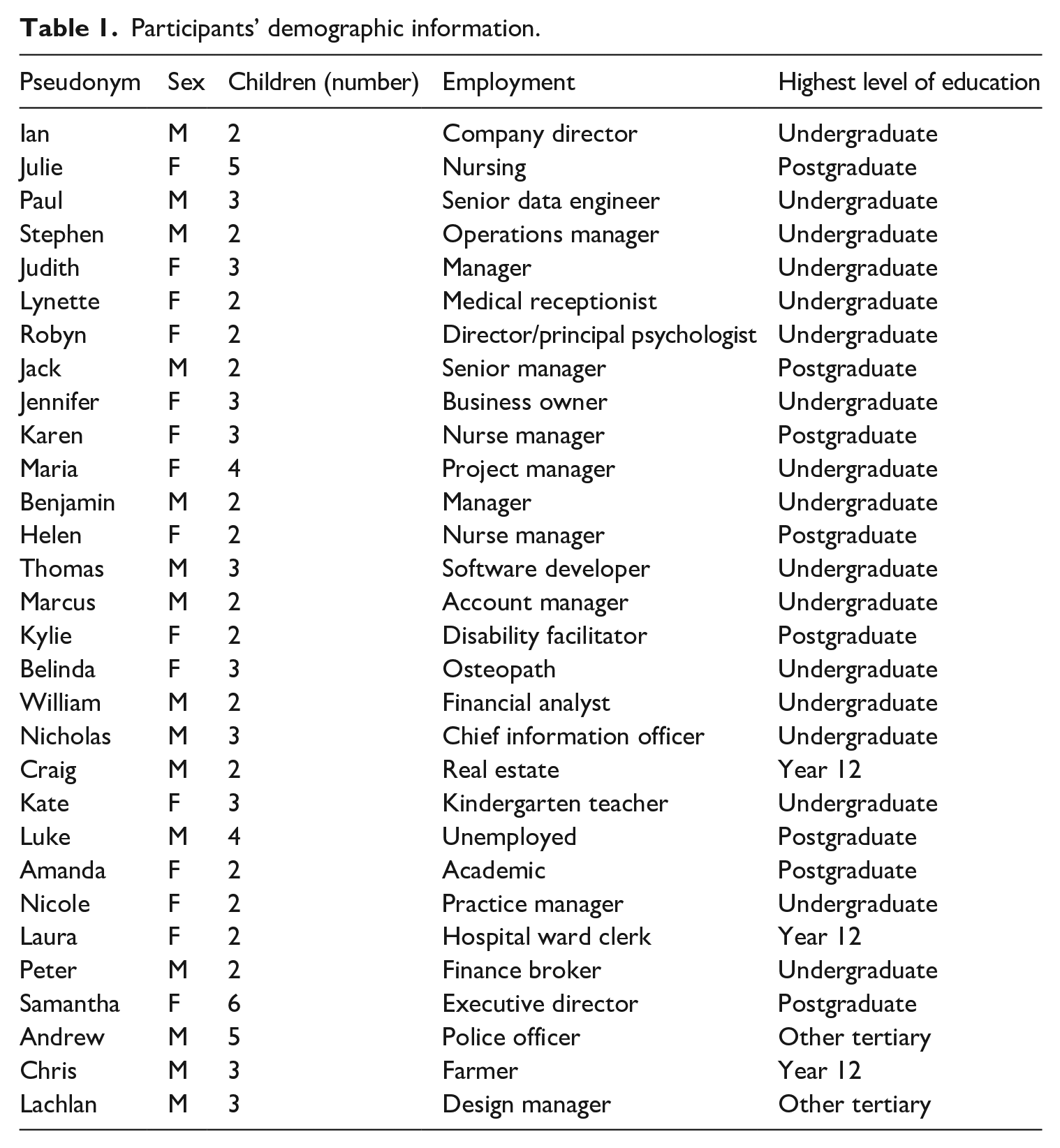
The recruitment pool for the present study was established using responses to questions in the 2023 survey that were completed by the full sample (n = 251). Specifically, the survey data were used to identify which participants were in a ‘parenting role’ (a formulation chosen to include step-children) and the age(s) of their child(ren). Using these data, the recruitment pool was narrowed to participants who had at least one child aged over 18. The recruitment process then sought to ensure a gender balanced sample, as well as diversity in relation to the participants’ location, family size and expectations (or not) of providing financial support to their adult children (each of which were determined using potential interviewees’ 2023 survey responses). The final sample included 30 participants (see Table 1 for an overview of demographic characteristics). Fifteen identified as men and 15 as women, ensuring a gender balance (something that was deemed important in this study due to the highly gendered nature of parenting roles and expectations), and participants lived across a range of location types, including capital cities, regional areas, country towns and rural areas. There was less diversity, however, with respect to social background due to uneven attrition by socio-economic status over time in the larger study from which we sampled. The participants had an above-average level of educational attainment for their age cohort and most were employed in managerial or professional jobs.
Participants’ demographic information.
The interviews included questions about: participants’ relationships with each of their children; their parenting arrangements; the forms of support that they were providing to their children; until what age the participants anticipated supporting their children; and how such support compared with that which they had received from their own parents, and that which was provided by their peers. The interviews concluded with three vignettes (following Finch and Mason, 1991) that the interviewer read to the participant and then asked them to respond to. The interviews took approximately an hour, were conducted via either telephone or Zoom, and participants received an AUD$50 giftcard as thanks. Audio recordings of the interviews were then transcribed and entered into NVivo14 for analysis. Data analysis followed a method adapted from Deterding and Waters’ (2021) ‘flexible coding’: the transcripts were initially coded by question and subsequently by theme, with themes drawn from both the dataset and existing literature (most relevant to this article is the theme ‘intensive parenting’ that was applied to the dataset). We then analysed further the data coded against each question and theme. It was at this point that we identified the salience of narratives about ‘independence’ (across a number of different themes and questions), and how these appeared to contrast with the quite significant types of support that were also discussed.
This article draws primarily on the interviewees’ responses to interview questions about the support they were providing to their children and/or planned to provide in the future and to the vignette that asked specifically about support to students studying in higher education (see Figure 1). Responses in both these areas were analysed using the approach outlined above.

Vignette.
The Paradoxical Foregrounding of ‘Independence’
Across the sample as a whole, when parents talked about their relationships with their children, instilling independence in them was a prominent theme. A small number, such as Maria, claimed that this was something that had always characterised their approach to parenting:
I think it’s my parenting style, I just like to raise independent kids. I know some of my friends will go in and fight the case for their kids and do all that, but that’s not my style. I prefer the kids to work through the problem and deal with that problem and of course I’ll support if I need to. But I’m the really the last one to jump in and do anything.
More common, however, was a reported shift to giving children more independence as they got older and, in particular, as they moved from school to university. For example, in response to the vignette, both Karen and Helen described how they would not intervene:
I don’t think it’s my role at all. They’re at university. They can fend for themselves. (Karen) I wouldn’t get too involved because, you know, they’re an adult and if they’re at university, you know, it’s adult learning, but maybe just push them in the right direction to get the support they need. (Helen)
Indeed, a particularly strong theme among the interviewees was the inappropriateness of a parent contacting a university lecturer on behalf of their child, and how this differed significantly from what might be expected during a child’s compulsory schooling. The following excerpts are illustrative:
I would not get involved. I would have possibly got involved at high school level, but they’ve chosen to go to uni[versity] and study that. They need to own that. (Robyn) I would say it would be different whether they were at university or high school or primary school . . .. I certainly wouldn’t suggest the parent storming down to the university and standing in front of a lecturer and saying ‘What’s going on?’ (Jack)
Thus, in contrast to Finch and Mason’s (1991: 352) claim that it is rare that ‘normative obligations are easily recognisable and commonly agreed upon’, our data reveal a relatively high degree of normative consensus with respect to both the importance of inculcating a sense of independence among university-age children, and the unacceptability of a parent making direct contact with university staff.
Nevertheless, despite this rhetorical embrace of the importance of ‘independence’, the interviewees went on to give more complex and, in some ways, paradoxical responses – in relation to both the vignette and questions that asked about the support they had offered, or planned to offer, their own children. None of the interviewees, when discussing the vignette, said that the student in question should be left to deal with the situation completely by themselves. All believed that the student’s parent should offer some kind of support. Moreover, all but one interviewee assumed that the child would listen to and accept the advice and/or support offered by the parent. Only Helen noted that ‘they’re probably unlikely to listen to you anyway’.
Most significantly, many seemed to think that the independence discussed above was entirely consistent with a more active ‘behind the scenes’ role on the part of parents. For example, Robyn, who talked – as reported above – about ‘not getting involved’, also described how she would ‘be in the background, pushing’, encouraging the child to contact their lecturer, and providing support with respect to ‘writing the email or “this is how the conversation may look” or how do you pick the right time to make an appointment’. Similarly, Luke, while believing that parents should not be contacting teaching staff, thought that they could take substantial steps to support their child in doing so:
At the point when a student’s at university, I think that they should be going and speaking to the lecturer. Parents have no place to be out there talking to the lecturer, but the student needs maybe guidance to go and talk to the lecturer and ask the right questions, because really that’s what it’s about, isn’t it? You need to be asking the right questions to get to the point.
Maria, while adamant that ‘I’m the really the last one to jump in and do anything’ (see above), went on to say that ‘I would hope that the child would come to me as the mum and we’d talk through the problem and I’d offer some advice or some suggestions on how to approach that with the teacher.’
Prior research has argued that there are often differences between normative statements about family obligations and how such obligations play out in practice (Finch and Mason, 1991). In our research, however, such differences were played out even in the normative statements provided by interviewees, in which a strong emphasis on the importance of the independence of the child sat alongside evidence of a seemingly deep desire to offer a high level of support and advice. In the following section, we provide more detail about the nature of this support and advice, before considering the likely explanations of this apparent paradox in the discussion.
Nature of Support and Intervention
The interviewees outlined a wide range of support for higher education students – in their response to the vignette and to various other questions. As a majority of them (22 out of the 30) had already had at least one child study in higher education, they typically reflected on actions they had taken, or were in the process of taking, as well as what they would hypothetically do in certain situations. (Many interviewees responded to the vignette by relating it to their own prior experiences of having a child in higher education.) Four main types of parental support can be identified in the participants’ narratives: financial support; the adoption of a ‘coaching approach’; encouragement to use university services; and direct academic interventions. We outline each of these in turn.
Financial Support
First, the majority of the parents in the sample with children who had enrolled in higher education, or planned to do so in the near future, had provided substantial financial support to them or were anticipating doing so.
1
The following excerpt is typical: ‘While he’s still at university we’re not getting them to pay any board or anything like that. We’re happy for them to live at our expense’ (Thomas). Indeed, despite the widespread rhetorical emphasis on the importance of independence outlined above, and the view that university was a key space in which to become independent, most interviewees identified the point at which financial support should stop or at least greatly reduce was at the end of university, when their child had secured their first full-time job, not on entry to university:
2
we’re hoping to be able to pay all her . . . fees so she hasn’t got the debt after that and then hopefully after that point she’ll be able to get a job and be reasonably self-sufficient. (Kylie) So once they’re working they become financially responsible and not dependent on us. (Maria)
In a few cases, however, parents qualified their comments about financial support during higher education, to emphasise that it was conditional on their child showing commitment to and a genuine interest in their course. For example, Ian commented: ‘If one of them is still doing third year uni[versity] after six years and still playing computer games at two o’clock in the morning and then wants to buy a new car, well, probably not [provide financial support].’
For most of these parents, providing significant financial support during university appeared to be an important point of principle, and was not a topic on which they reported any disagreement between them and their partner. Chris had not yet had a child who had gone on to university. However, he was sure that he and his partner were going to provide financial support, even though he acknowledged that he had little idea of the likely scale of the outlay: ‘I mean we’ve got a lot of learning to do because we don’t know what it’ll cost with universities and all of that sort of stuff; that’s going to be a whole new world for us.’
While, for obvious reasons, financial factors were not discussed by interviewees in relation to the vignette, they were brought up at numerous points in the wider interview, and often related to higher education in particular. This form of support is not surprising given the wider situation in Australia where intergenerational financial transfers have become common. Most Australians now receive direct financial support from parents at some point during their 20s and 30s (Woodman et al., 2024) – as a means not just of avoiding precarity but of establishing successful career trajectories, too (Woodman et al., 2024). It is also likely influenced by higher education policies, specifically, whereby the shift from state to individual funding has meant largely a shift to families (Antonucci, 2016; West and Lewis, 2018). While Australia does provide a deferred loan scheme for undergraduate study, very few students receive living stipends from the government or other sources. Indeed, the apparent widespread acceptance of the need for some financial support on the part of most parents in this study (there was a notable absence of any complaints at having to continue to fund children during higher education) suggests that Zaloom’s (2019) claim that the premise of family responsibility for supporting higher education costs being so entrenched in the USA that it is largely unquestioned may be, at least in part, applicable to Australia.
Coaching Approach
A second, and commonly discussed, form of support is what can be described broadly as a ‘coaching approach’. This was a frequent response to the vignette question but, in their answer, the parents often gave examples of how they had used such an approach already, to support a child at university. It typically involved ‘unpacking’ the problem, and trying to help them identify root causes: ‘just sort of unpack it a bit further, whether it is drugs and alcohol or depression or mental health issues that’s happening outside, maybe what could be the triggers’ (Helen). Many parents also stressed the importance of trying to understand the problem from the child’s perspective, and helping them come to their own solutions, rather than imposing them oneself, for example: ‘So more just, I would think, guiding – or asking the student what they think should happen or – and helping them navigate what they should be doing about it, not what you should be doing about it for them’ (Julie).
It is interesting to note that two interviewees – Maria and Karen – made explicit reference to ‘coaching’ in their responses:
we had a similar issue last year in Year 12 and my preference is that my child, or the student in your scenario, work through and problem solve themselves first. So . . . we’d talk through the problem and I’d offer some advice or some suggestions on how to approach that with the teacher. My kids are calling that life coaching for me: ‘Mum’s just being a life coach, she’s not telling me what to do.’ (Maria) I would hope that that student has brought that to my attention and we would sit down and have a conversation and a coaching style conversation about what they think they can do. . . . So usually, you know, in a coaching style conversation people know the answers, it’s just soliciting that out of them and then also getting a commitment to action. (Karen)
In these narratives, parents take care not to impose solutions on their children. In some ways, this can be seen as broadly consonant with what West and Lewis (2018) found in their research on the parenting of UK higher education students in relation to the importance of the student gaining autonomy and parents providing support to facilitate this. Nevertheless, in other ways, the ‘coaching’ approaches described above can be seen as broadly in line with some of the tenets of intensive parenting – not least with respect to the time required on the part of the parent to explore the problem with the child, ask appropriate questions and, together, devise a possible course of action. Moreover, the narratives underline firmly that these parents believed it was their role to support their child to solve the problems they were facing; higher education was thus not positioned as a sphere where close parental involvement was deemed inappropriate or unnecessary. It is also interesting to note what seem to be the relatively porous boundaries between work and personal life for some of these parents, with several (primarily the mothers rather than the fathers) seemingly importing techniques – notably to do with coaching – that they had presumably learnt in the workplace. This suggests that, for older children, maternal employment is not necessarily an impediment to intensive mothering, as has been suggested in some research (e.g. Forbes et al., 2020), as relational and coaching skills are also increasingly valorised in the workplace. Employment experiences might be providing useful resources for enacting these parenting approaches.
Encouragement to Use University Services
Perhaps the most common response to the vignette on the part of our interviewees was to suggest that they would encourage their child to take advantage of the various services offered by the university. Some, such as Nicholas, outlined this in quite general terms:
I would say support them to understand or to work through what supports are available, you know . . .. so helping them understand what the options are and then helping them prepare for that, I suppose that conversation, if that’s what’s needed.
Other interviewees were more specific, and explained that they would encourage their child to speak to the relevant lecturer or student support services, depending on what the problem was. The following quotations are illustrative:
I would encourage [daughter] to speak directly with the teacher and get clarification. (Jennifer) one of the parents [participant referring to himself in third person] is far more adept at that particular scenario . . .. So he will involve himself to the point where he actually assists our child in approaching the lecturer, like writing back to the lecturer or contact lecturer saying, look, I’m having trouble with X, Y, Z. Is there an alternative resource or something else? What else can I do to understand that process? (Ian)
The evidence presented in this section can be interpreted as coming close to the type of intensive parenting approaches widely documented across the Global North with respect to compulsory schooling (Gewirtz, 2001; Ule et al., 2015) – with parents deeming it appropriate to provide strong encouragement to a child to seek help from lecturers, counsellors or relevant others. Here, parents outline a more directive approach than evident in the ‘coaching’ section above. Indeed, Ian implies that he would offer detailed advice to his child in how to approach a lecturer, suggesting (through his comment that he is ‘adept’ at this) that it is something he has done before. It is notable that none of the (significant number of) parents who talked about seeking support from the university expressed any concerns about doing so, or thought that a child may lack the confidence to act in this way. Here, there are clear contrasts with research that has documented the fear some students (typically from non-traditional backgrounds) feel in asking for help from university staff (e.g. Wong and Chiu, 2019). These are likely to relate to the class composition of the sample: as outlined above, almost all participants were well educated and employed in professional or managerial jobs. There are strong parallels between the narratives of these parents and those of the middle-class parents of school-aged children in Calarco’s (2018) study – in the ease with which both groups spoke of encouraging children to ask for help, and the expectation that this would be offered to them. This is a key aspect of the ‘negotiated advantage’ that Calarco believes drives social reproduction within education.
It is perhaps also the case that parents are encouraged in this behaviour by the reframing of higher education as a private good as a result of the relatively high fees payable by Australian students (OECD, 2021), even if the cost can be deferred until they are earning a full-time wage. Two parents made explicit reference to this in their comments:
[I would say] ‘You’re an adult now, you’re paying that university a bit of money, I’m sure they can help you if you ask the right people.’ (Lachlan) If I can’t help them understand it, I’d tell them speak to your lecturer, that’s what they’re there for. It’s this – and we’ve done this through high school, I said ‘We’re paying them to educate you.’ (Peter)
In Peter’s excerpt, he draws parallels with secondary schooling, emphasising the likely continuity of approaches. This, along with other evidence we present in this article, raises questions about whether university and school should be considered as distinct as some parents suggested in the data about ‘independence’ discussed previously.
Direct Academic Intervention
A fourth way in which the parents in our study reported supporting their children during higher education – or thought that the parent in the vignette should support their child – was through directly intervening in their academic studies. This is obviously in tension with the emphasis on ‘independence’ discussed previously and also with the coaching approach outlined above, in which parents stressed the need for the child to arrive at the specific solution to any problem themselves. Direct intervention typically came from three sources: the parents themselves; their wider networks; and private tutors.
Some parents claimed that, if their child were struggling at university, they would be able to offer support with skills such as time management, studying effectively and writing clearly. The following quotations are typical:
Yeah, we would help [daughter] through that and . . . make a timetable for her for the week on how she could help with the study. . . . So she’s not thinking it’s all got to be done in a short amount of time. (Kate) I would probably look at what the assignment is asking for and try and help make sense of it. (Paul)
Nicholas and Peter also noted that, if their child happened to be studying a subject they knew about, they would be happy to provide more specific support and guidance. Laura, uniquely among the parents in the study, said that she would approach teaching staff herself, if necessary: ‘I would probably get in contact quietly with the uni without telling the child and just saying “What assistance in that is there?” because . . . there’s no need to struggle.’
In other cases, interviewees explained that they would draw on their wider social networks to help support their child, with several, such as Peter, giving examples of how they had already done this for children who were currently at university: ‘I’m lucky my sister is a teacher so I’ve sent my daughter and my son there a couple of times.’
Four parents, in addition to other forms of support, explained that they would pay for their child to have private tutoring alongside their university studies. Typically, this was framed as a last resort, if other approaches had not worked:
The other thing we could do is investigate some tutoring if that’s required. (Stephen) I would also be looking to get them to come back to me and if they need some sort of tutoring; I can provide some financial help to give them the ability to have some tutoring as an option. (Nicholas) if that [asking lecturer for help] still didn’t work then I would ask them if they wanted a tutor in that subject just so that they could get through it. (Nicole) Possibly as a parent and we did this last year, setting up a tutor to come in and support. So again that’s a financial thing that the parents chose to do. (Maria)
It is striking that Maria had already used a private tutor for her child, and yet was one of the most vocal participants in emphasising the need for children to be independent (see above).
It is here, in these types of direct intervention with academic studies, that the contrast with the parents’ professed commitment to children’s ‘independence’ is most stark. Indeed, many of the activities discussed in this section seem to be well aligned with notions of intensive parenting documented previously in relation to compulsory schooling – where parents are intimately involved in their child’s intellectual development and step in to provide extra support when school teachers are perceived to not be doing enough (e.g. Gewirtz, 2001; Ule et al., 2015). The willingness to use private tutoring for higher education students is also significant, and a further manifestation of ‘intensive’ approaches to parenting. Although there is now a sizable literature showing how such tutoring has become commonplace in many nations of the world (e.g. Bray, 2017), this has typically focused almost exclusively on that used within lower levels of education (e.g. Holloway et al., 2023) or with respect to accessing higher education (e.g. Kosunen et al., 2020), rather than on use by students enrolled on higher education programmes.
Discussion and Conclusion
In the sections above, we have drawn on interviews with 30 Australian parents to explore their attitudes to parenting higher education students. As a majority (22) already had a child who had enrolled in higher education, we were also able to examine parenting practices with respect to such students. These data have provided strong evidence about the significant forms of support that are given by parents to their children as they engage in degree-level study. All of those we interviewed were either already providing financial support to their offspring at university, or they had clear plans to do so when they reached the relevant age. As we have previously noted, this is in line with other studies of Australian youth that have documented the prevalence of financial transfers between parents and young adult children (e.g. Woodman et al., 2024).
Our data also indicate that the practices of these parents and/or their views about appropriate parental behaviour (in response to the vignette) have much in common with ‘intensive parenting’ norms; that is, the assumption that parents should foreground their child’s needs and devote significant time, money and energy to their care (Hays, 1998). Parents either had already spent, or thought it was desirable to spend, considerable time with their children if they encountered problems during their studies to help them to resolve difficulties. This differed somewhat from individual to individual but included, as we have outlined above, ‘coaching’ approaches, to help the child identify the root cause of problems; strong encouragement to take advantage of the various academic and social support services available on campus – sometimes with detailed advice about how best to access these; and, in a significant number of cases, direct involvement in academic matters, including paying for private tutors.
While some of these practices seem very similar to those documented in the literature on the ‘intensive parenting’ of school-aged children (e.g. the purchase of private tutoring) (Ule et al., 2015), others show how the form of intensive parenting can evolve as children get older – for example, in the transfer of practices from the workplace to the personal sphere evident in the frequent discussion of ‘coaching’ techniques. Taken together, however, these practices have the effect, we suggest, of replicating the ‘semi-dependence’ or ‘enmeshed autonomy’ of higher education students that has been documented in other parts of the world (Antonucci, 2016; Zaloom, 2019).
Nevertheless, we have also shown how this sits alongside a strong rhetorical commitment, on the part of parents, to independence – to ensuring that their children grow up to be fully independent young adults. For some interviewees, this was something that, they claimed, had always underpinned their parenting practices. Others associated it specifically with higher education. Indeed, university was typically positioned as a space where their children would ‘fend for themselves’, engage in ‘adult learning’ and be accountable for their own actions. In such discourses, we can see played out traditional views – particularly from the Anglophone Global North – about higher education constituting a ‘transitional space’ in which adult behaviours are learnt and independence is achieved (Brooks et al., 2022).
None of our interviewees remarked on this apparent paradox – that is, the contrast between the rhetorical foregrounding of notions of ‘independence’, on the one hand, and the numerous examples of parental intervention and ‘semi-dependencies’, on the other. This is perhaps unsurprising. It does, however, raise an important question about why these parents continued to see university as a space of ‘independence’ given the various forms of support they were giving their child (or thought should be given). In answering this question, we can first point to the dominance of discourses about independence. Despite the well-documented changes to young people’s lives over recent decades and the associated significantly later age at which the traditional markers of adulthood are now reached (Furlong and Cartmel, 2006), ‘independence’ as an achievement of early adulthood retains considerable discursive power. Admitting that one’s child is ‘semi-dependent’ or similar, while at university, may thus be viewed as admitting one has ‘failed’ as a parent. There may also be social opprobrium associated with acknowledging that one intervenes in the life of one’s student son or daughter. This is alluded to in the following comment from Lachlan:
Kids get older, they’re more mature than you think. You don’t want to be seen as mothering your children, I don’t want to be that umbrella parent that’s hanging over them all the time saying ‘Do go do this’ or ‘You should do that’.
Such opprobrium perhaps also explains why the parents in this study did not think it was acceptable to intervene too obviously, through making direct contact with a lecturer, and yet were quite happy to become involved quite substantially ‘behind the scenes’ through, for example, helping with assignments and even paying for private tutors. This approach is encapsulated well in the quotation from Robyn – ‘I would be in the background, pushing’ – cited earlier. Data such as these suggest that the discourse of intensive parenting is played out differently with respect to older children. While the extant literature would suggest that admitting to engaging in intensive practices may be viewed as a mark of ‘good parenting’ for those with younger children, this appears to be less the case for those with older children, because of the enduring discursive power of norms associated with ‘independence’ and ‘self-reliance’. Thus, while both structural factors (such as having to pay tuition fees, and the high cost of university housing) and cultural influences (such as the expectation that parents take responsibility for monitoring their child’s educational progress) may encourage parents to continue to intervene quite significantly in the lives of their student-children, it appears that they are nevertheless keen to discursively distance themselves from intensive parenting norms.
To conclude, this article has made several contributions to our understanding of the parenting of higher education students and intensive parenting more broadly. First, it has shown that, in some contexts at least, intensive approaches to parenting extend beyond the school years, to young adults in their late teens and early 20s. However, such approaches differ from those documented with respect to younger children in that parents typically adopt a more ‘behind the scenes’ role, and may use different techniques (e.g. importing some that have been learnt in the workplace).
Second, the study has highlighted a paradox whereby parents appear comfortable adopting a range of relatively interventionist approaches with respect to their child’s higher education, and yet remain wedded to the idea of university being a space for securing independence. This indicates the enduring strength of cultural norms – about young people’s independence and the place of higher education in facilitating this – both of which now may be in tension with lived experiences. This may have broader political and policy implications: indeed, it may be harder to demonstrate the degree that responsibilities (particularly those that are financial in nature) have shifted from the state to families if parental contributions are masked by the discourse of ‘independence’.
Finally, it has contributed to the emerging international literature on the parenting of higher education students by showing that while the ‘semi-dependencies’ documented in US and UK research (e.g. Antonucci, 2016; Zaloom, 2019) are played out in in this particular Australian context, they are sometimes not recognised by Australian parents, because of their overriding commitment to the ‘independent student’ ideal. However, as outlined above, the sample for this study were disproportionately likely to hold at least one university degree and were primarily in managerial or professional employment. This has likely shaped the findings of our study. As already discussed, previous research has found that intensive parenting is evident within working-class families along with their middle-class counterparts (see Lavee and Benjamin, 2015). There is thus scope for future research to consider how the paradox that we have identified may (or may not) play out among working-class parents of higher education students. Moreover, such research could also consider whether some of the practices that appear socially reproductive in nature (e.g. buying private tutoring, encouraging one’s child to make full use of the available educational services) are played out among a more diverse range of families.
Footnotes
Acknowledgements
We are grateful to Nadishka Weerasuriya, Natalie Calleja and Maddison Sideris for conducting some of the interviews, and to Nadishka Weerasuriya for her work on coding the interview data. We also acknowledge and are grateful for the contribution of the participants in the project over the years.
Funding
The authors disclosed receipt of the following financial support for the research, authorship and/or publication of this article: the article is part of the Life Patterns research programme titled ‘Young People Shaping Livelihoods across Three Generations’, funded by the Australian Research Council (DP210100445).
Ethics
The project informing this article received approval from the University of Melbourne HASS 1 Ethics Committee under the protocol 2024-20882-49808-9.
