




Abstract
This article traces the trajectories of psilocybin and ayahuasca in the context of the psychedelic renaissance. The bibliometric analysis reveals that academic publications on psilocybin fall primarily into the medical and scientific areas, whereas those devoted to ayahuasca derive mainly from humanities and social sciences. Second, the article argues that psilocybin and ayahuasca use is undergoing a process of secularization, leading to psychedelic use that is increasingly removed from its traditional cultural roots. This secularization manifests itself differently in the two cases: Psilocybin exhibits a higher degree of secularization than ayahuasca. Ayahuasca maintains strong ties to religious institutions and indigenous organizations deeply involved in its global spread, and it has undergone less medicalization than psilocybin. While the careful attention to setting in psilocybin clinical trials is noteworthy, this doesn’t necessarily imply an emphasis on traditional mushroom use settings. On the other hand, a form of ‘ayahuasca guardianship’ persists, manifested in individuals and groups actively maintaining and asserting their cultural authority over the plant’s significance and associated practices.
Introduction
A key debate within the social sciences of religion centers on the heuristic efficacy of categories like ‘religion’ and ‘spirituality’. The primary objective of this discussion is to understand the dynamics of religious life within the context of modern secularized societies. A long-standing concern has been to refine the methods of observation and analysis to comprehend the transformations and dynamics within the religious field, expanding its boundaries beyond Bourdieu’s limitations (Camurça, 2016). Traditional understandings of religion confined to religious institutions in a modern secularized world are challenged by a religious/spiritual economy that transcends those boundaries. At a minimum, New Age spiritualities and indigenous cosmopolitics require a reevaluation of concepts, considering religion and spirituality both beyond and within institutions. The prevalence of transcendent spirituality has given way to the emergence of immanent forms of spirituality. Mystical experiences, the phenomenology of religious/spiritual life, and sensitive self-awareness gain significant importance for the social sciences of religion (De la Torre, 2016; Frigerio, 2016). The convergence of spirituality and the health field is also noteworthy, both as an emic discourse/experience and in the effort to quantify and evaluate spirituality’s role in health through scientific means (Giumbelli and Toniol, 2017; Toniol, 2014, 2023).
The field of psychedelics exemplifies the multifaceted nature of contemporary religiosity. Psychedelics are closely linked to mystical experience and the phenomenology of religious experience. The neologism ‘entheogen’ (Ruck et al., 1979), proposed to describe these substances, emphasizes the immanence of the psychedelic experience. As its creators intended, the term ‘entheogen’ highlights the capacity of certain plants, fungi, or preparations to induce an experience of ‘God within’ upon consumption. Knowledge surrounding the preparation and use of psychedelics/teacher plants predates modern processes of institutionalization and secularization. The medico-religious uses of psychedelics are deeply interwoven with the traditions and mythologies of a significant portion of humanity across different times and places. Extensive literature from various disciplines highlights the millennia-long association of psychedelic substances with diverse medical and religious systems.
These substances, understood as inducers of internal mystical experiences, interact with modern secularized societies in the form of religion, through what Jonathan Ott (1998: 144) termed the ‘entheogenic Reformation’ – a process of creating religious institutions to defend cultural practices surrounding psychedelic use, where entheogens assume the role of a ‘true sacrament’, providing access to religious experience. In North America, the Native American Church emerged as cultural resistance to prohibitionist efforts concerning peyote. In Brazil, ayahuasca religions originated as medico-religious responses to the encroaching modernity of the state on Amazonian territories. Psychedelics and religion became intertwined not only within traditional indigenous contexts but also through modern state management of these institutionalized entheogenic religions beginning in the early twentieth century. More recently, alongside the development of a broad range of therapeutic/religious/spiritual practices centered on psychedelics (such as neoshamanism), their incorporation into medico-scientific research agendas has become definitive.
This article aims to explore the trajectories of psilocybin and ayahuasca to illustrate the tension within the field between a medico-scientific and a traditional religious pole. The empirical correlation supporting the positioning of psilocybin predominantly within the medico-scientific pole and ayahuasca primarily within the traditional religious pole is based on a bibliometric analysis. This analysis shows strong medical field participation in psilocybin research and significant social science involvement in ayahuasca research. The study also indicates that clinical research on psilocybin significantly surpasses that of ayahuasca.
The therapeutic aspect exists across the entire spectrum, ranging between the aforementioned poles. The field of psychedelics fosters a fertile ground for discussion and reflection on onto-epistemological negotiations between dimensions encompassing religion, health, and spirituality. The ‘psychedelic renaissance’ (George et al., 2022; Sessa, 2012) fosters novel intersections between religion and science, and health and spirituality. This is evident in psilocybin clinical trials, where the incorporation of a ‘ritual model’ (Oña, 2023) or set and setting approach increasingly emphasizes and quantifies extra-pharmacological factors in scientific research focused on developing new pharmaceuticals. Variables related to ‘spirituality’ and scales for measuring it are used in various psychedelic studies.
Examining the psychedelic field through the lens of the social sciences of religion offers reciprocal benefits. It introduces a methodology that enriches and complicates the psychedelic field by problematizing the uses and links between religion, spirituality, and health from a perspective that isn’t necessarily dominant within that field of study. Conversely, the psychedelic field and the social sciences of religion enjoy a mutually beneficial relationship. The former provides rich empirical material requiring the latter to expand its analytical frameworks to accommodate the complex and novel interweaving of religion, indigenous cosmologies, spirituality, and science. Viewed through the lens of the social sciences of religion, the psychedelic field reveals a rich and heterogeneous interplay of practices for producing, negotiating, experiencing, and measuring phenomena situated at the intersection of religion, indigenous cosmologies, spirituality, and science.
Expansion pathways of the psychedelic field
The term ‘psychedelic’ was introduced to the academic world in 1957 by psychiatrist Humphrey Osmond. Osmond (1957) defined ‘psychedelic’ as ‘mind-manifesting’ (p. 429). This neologism, derived from the Greek words ψυχή (psyche, soul) and δηλόω (dēloō, to manifest), suggests that psychedelic substances are those capable of manifesting the mind or soul upon consumption. The term’s inherent ambiguity stems from varied interpretations of the Greek root ‘psyche’ and the concept of mind or soul.
The term encompasses a group of substances including lysergic acid diethylamide (LSD), psilocybin, N,N-Dimethyltryptamine (DMT), ibogaine, 3,4Methylenedioxymethamphetamine (MDMA), and ayahuasca. Psychedelic substances include both synthetic or semi-synthetic compounds, such as MDMA and LSD, and active principles present in fungi and plants. These plants, fungi, or their preparations have been traditionally used in various cultural contexts (Schultes and Hofmann, 2012). For instance, anthropologist Luis Eduardo Luna demonstrated that Peruvian ‘vegetalistas’ (healers or shamans he studied in the 1980s) attribute agency to these plants, considering them intelligent beings with whom a learning relationship can be established. These plants possess the power to teach and empower those who use them, hence the term ‘plant teachers’ (Luna, 1984, 1986).
Scientific interest in these substances is not new, emerging in the late nineteenth century and consolidating in the mid-twentieth century. Until the late 1960s and early 1970s, significant research was conducted across various disciplines, many seeking to understand traditional uses and explore potential therapeutic applications for specific pathologies (Apud, 2016).
After decades of prohibition, starting in the 1970s (which, besides deeply stigmatizing psychoactive substance users, halted research), new investigations and widespread interest in psychedelics emerged in the twenty-first century. This renewed and profound interest in the various dimensions and themes surrounding psychedelics has been characterized as a ‘psychedelic renaissance’ (George et al., 2022; Sessa, 2012).
The global expansion of teacher plants/entheogens/psychedelics use beyond traditional cultural contexts occurs through: (1) religious institutions; (2) the development of a therapeutic-spiritual field encompassing neoshamanism, microdosing, and recreational use; (3) scientific and academic research; and (4) commercial and regulatory expectations. The global landscape of psychedelic use is characterized by onto-epistemological tensions, as previously noted (Dev, 2018; Fotiou, 2020; Tupper and Labate, 2015).
Regarding religious institutions, a significant transnationalization of Brazilian ayahuasca religions, such as Santo Daime, is evident, spreading from Brazil to Europe, the United States, Canada, Australia, Japan, and Latin America (Labate and Jungaberle, 2011). Given Brazil’s strong history as an exporter of religion (Oro, 1993), Santo Daime represents the third religious movement or flow originating from the country. If we accept the idea that Brazil exports religion, and that Pentecostal and Afro-Brazilian segments exemplify well-established processes of practice re-territorialization, then Santo Daime and Brazilian ayahuasca religions represent another possible form of circulating religious narratives originating in Brazil. The distinctive symbolic system conveyed by Brazilian ayahuasca religions is associated with a semantic field related to Amazonian shamanism. The central role of ritual ayahuasca use within those religions doesn’t negate the presence of symbolic elements and practices from Christian and Afro-Brazilian traditions. In this sense, Santo Daime is a uniquely powerful expression of synthesis, combining a wide range of symbols that clearly demonstrate elements from the major cultural traditions that shaped intercultural Brazil (Scuro, 2012, 2024).
Simultaneously, a significant international spread of Amazonian shamanism linked to substances like ayahuasca is observable. Places like Iquitos and Pucallpa in Peru become major hubs for international tourism seeking ayahuasca experiences, retreats, dietas, and other related activities (Fotiou, 2016). Healers, vegetalistas, and indigenous shamans from this region increasingly move to major cities, creating a neoshamanistic landscape. Neoshamanistic settings vary across different national contexts. More recently, a hybrid space between neoshamanism and the health and clinical fields has emerged, centered on the use of ‘microdoses’. This method of using small quantities of psychedelics like psilocybin is widely prevalent. The Global Psychedelic Survey indicates that psilocybin is the most widely used psychedelic in Anglophone countries. In this survey, 90.8% of respondents reported its use, with 72.8% using it regularly or in microdoses. ‘Personal growth’ (85.2%) is the most commonly cited reason for use, followed by ‘general wellbeing’ (68.9%) and ‘recreation’ (61.1%; Lake and Lucas, 2024). Microdosing avoids the perceptual alterations triggered by macrodoses, allowing individuals to maintain daily activities. In Latin America, the emergence of societies comprising therapists who promote and support therapeutic processes using microdoses is notable. Psychedelic-Assisted Psychotherapies appear to be gaining ground in the therapeutic market. In Uruguay, more people are turning to this modality to alleviate everyday problems like depression or anxiety. The recent establishment of the Uruguayan Society of Psychedelic-Assisted Psychotherapy and its strong media and social media presence demonstrate its influence. As promoted by these organizations, individuals using these therapies seek to focus on their daily activities and find greater harmony and calmness in their lives. This is how this modality of psychedelic use, encompassing meditation groups, therapeutic consultations, and so on, is presented. Several Latin American countries already have organizations of this type. Online courses and seminars on this topic are constantly increasing. In Uruguay, sustained ethnographic and interdisciplinary research on this topic has been conducted (Apud, 2015; Scuro, 2016).
Meanwhile, the research agenda within the medico-scientific realm is increasingly important, with significant progress in studying the therapeutic potential of various psychedelics. MDMA is the furthest along, in phase III trials for post-traumatic stress disorder (PTSD), while psilocybin is in phase II trials for treatment-resistant depression (Carhart-Harris et al., 2021; Mitchell et al., 2021).
In the case of MDMA, it was legally prescribed by a psychiatrist in Australia in January 2024 (Wheeler, 2024). Research involving MDMA is highly advanced, with an application for medical approval submitted to the Food and Drug Administration (FDA) years ago. However, in August 2024, the FDA rejected approval, arguing that research demonstrates the crucial role of extra-pharmacological factors, and that regulating such factors falls outside the agency’s purview. This is extremely significant, as it shows that clinical research on psychedelics includes the ‘ritual’ dimension of set and setting.
Ayahuasca also has promising therapeutic research (Breeksema et al., 2020; Dos Santos et al., 2016), although progress lags behind psilocybin. The psychedelic renaissance heavily relies on clinical research, aiming to develop safe pharmaceuticals for various conditions.
Finally, it is crucial to consider the ‘hype’ surrounding psychedelics. This stems from high expectations based on research progress, regulatory changes, experiences of altered states of consciousness induced by psychedelics, the fascination they generate, and commercial interests. These high expectations surrounding psychedelics are even becoming a factor considered in clinical trials (Aday et al., 2022). The topic’s immense popularity is evident not only in extensive media coverage but also in the proliferation of educational materials like books and streaming content, with Michael Pollan’s ‘How to Change Your Mind’ being a prime example.
The preceding discussion aims to outline some of the main trends and forms of diversity within the global psychedelic field. It doesn’t attempt to provide an exhaustive overview of such a vast and heterogeneous field. A detailed analysis of national realities would necessitate a different approach. The intention here is to provide a map that helps locate the specifics of psilocybin and ayahuasca.
Academic publications on ayahuasca and psilocybin
Below are some data on academic publications related to ayahuasca and psilocybin. The search was conducted across the following databases: Scopus, PubMed, JSTOR, and ScienceDirect. Searches were performed separately for ‘ayahuasca’ and ‘psilocybin’ in publication titles (see Figure 1).
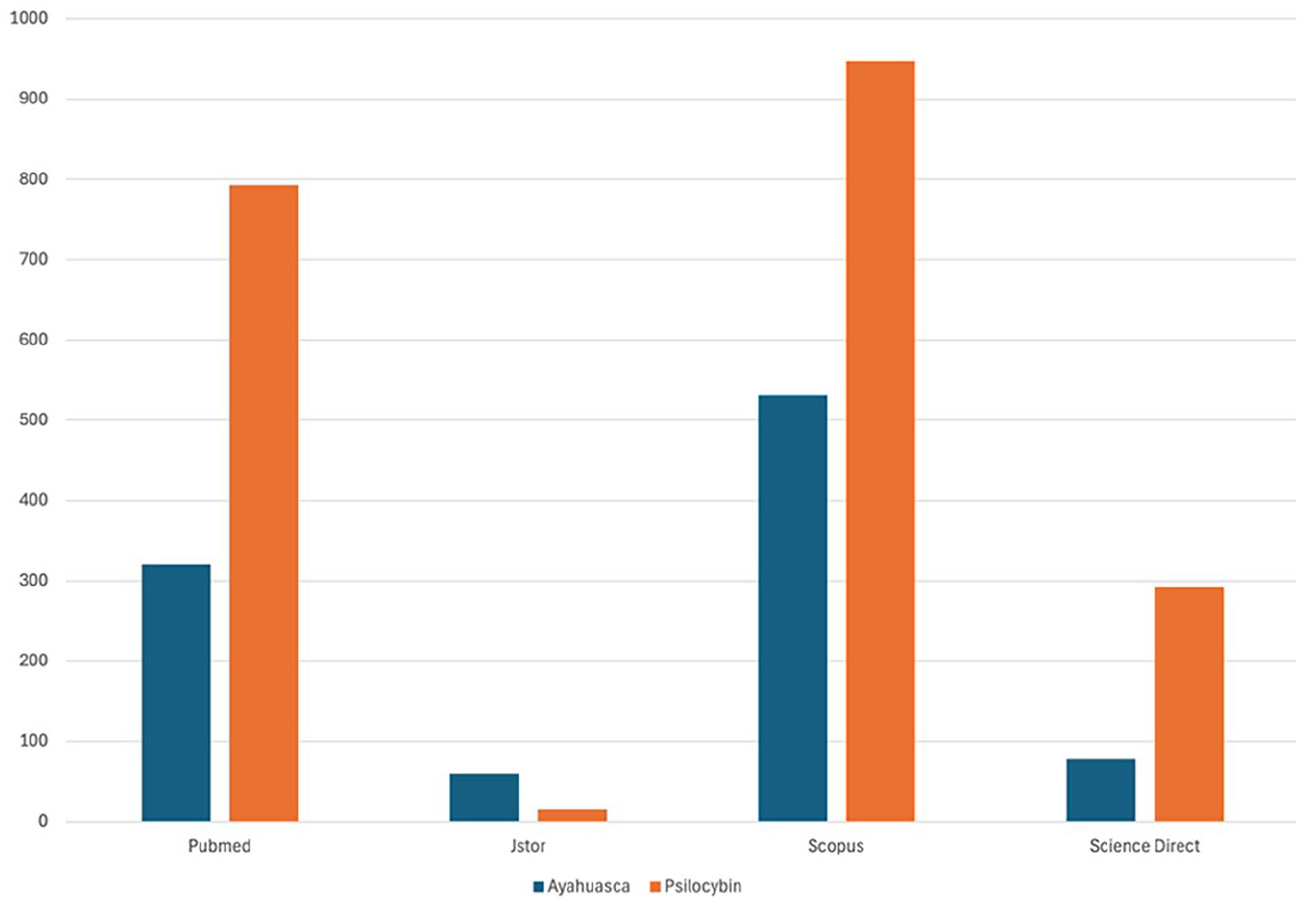
Number of publications on ayahuasca and psilocybin.
PubMed yielded 320 publications on ayahuasca and 793 on psilocybin. Applying the ‘clinical trial’ filter, 28 ayahuasca publications (8.75%) and 104 psilocybin publications (13.11%) remained. Psilocybin clinical trial publications tripled those of ayahuasca.
JSTOR yielded 60 publications on ayahuasca and 15 on psilocybin. Of the ayahuasca publications, 33 were categorized under ‘anthropology’, 17 under ‘religion’, and 2 under ‘biological sciences’. In contrast, among the psilocybin publications, only 1 fell under ‘anthropology’, 3 under ‘religion’, 5 under ‘biological sciences’, 4 under ‘general science’, and 2 under ‘health science’. ScienceDirect showed 78 publications on ayahuasca and 292 on psilocybin. Scopus results showed 531 publications on ayahuasca and 947 on psilocybin. A detailed breakdown by subject area is presented in Figure 2.
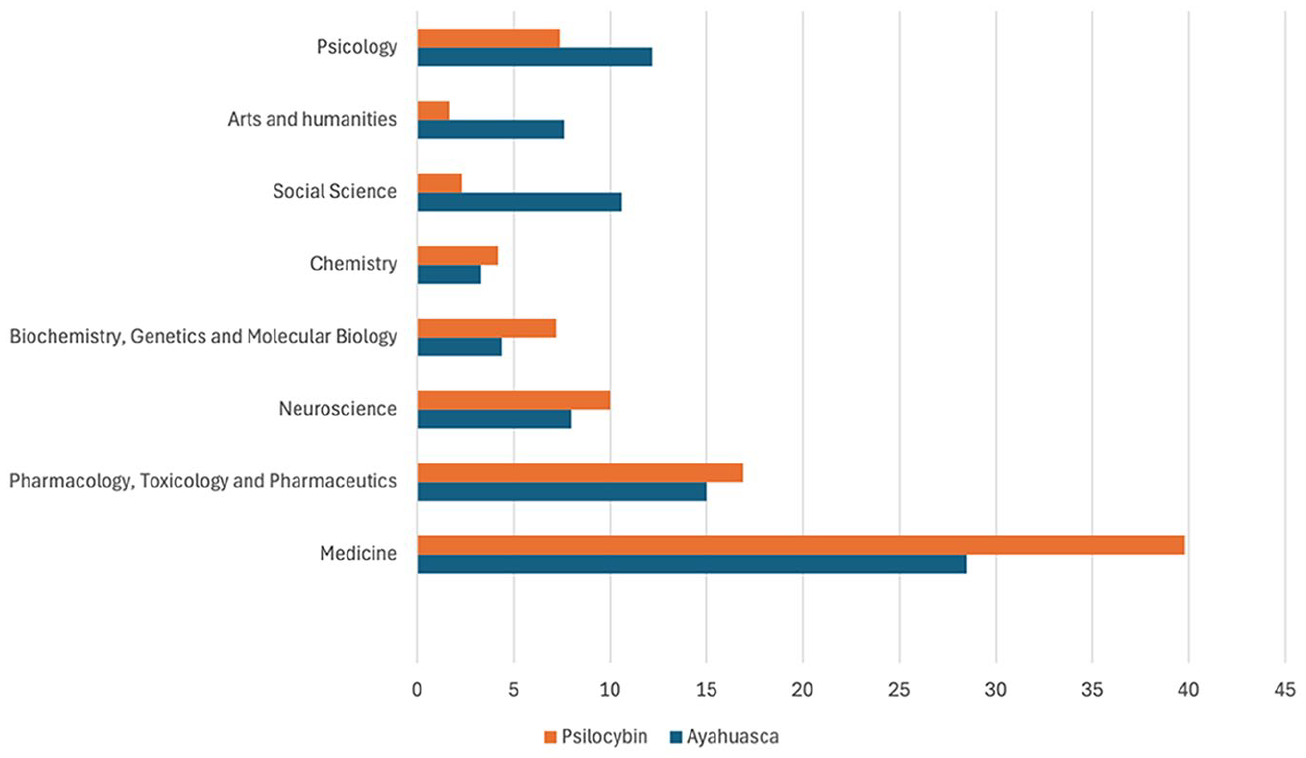
Subject area distribution of publications on psilocybin and ayahuasca in Scopus.
Figure 2 shows the relative relevance of each subject area on publications about ayahuasca and psilocybin. Of the 531 publications with ‘ayahuasca’ in the title, 28.5% were in ‘medicine’, while of the 947 psilocybin publications, 39.8% were in ‘medicine’, representing the largest difference between the two, exceeding 10 percentage points. In pharmacology, neuroscience, biochemistry, and chemistry, the percentage differences between ayahuasca and psilocybin were smaller, but psilocybin consistently had higher publication percentages across these areas. Ayahuasca showed higher publication percentages in social sciences, arts and humanities, and psychology. Significantly, social sciences and arts and humanities ayahuasca publications were four times higher than those for psilocybin. In psychology, the ratio was 1.6 times higher for ayahuasca.
These searches have many limitations. The results only show a trend: a greater number of publications with ‘psilocybin’ in the title than with ‘ayahuasca’. Furthermore, for psilocybin, medico-pharmacological publications significantly outnumbered those in the social sciences and humanities. While ayahuasca also showed a greater impact from medical fields, the difference between these and the social sciences and humanities was significantly smaller. For ayahuasca, the combined weight of social sciences and arts and humanities was 18.2%, compared to only 4% for psilocybin. JSTOR, a database with a stronger focus on social sciences and humanities, was the only one where ayahuasca publications exceeded those of psilocybin, with anthropology showing significant impact.
These searches results reflect anticipated findings, which highlight the methodology’s limitations. They illustrate the proposed starting point for analysis: a relatively greater emphasis on the social sciences and humanities regarding ayahuasca and increased ‘medicalization’ of psilocybin research. These findings are entirely consistent with a more detailed understanding of what is being compared, as discussed below.
Ayahuasca and psilocybin: two slightly different paths
Ayahuasca, originating in the Amazon basin, is known by many different names. These names may refer to the Banisteriopsis caapi plant or the brew resulting from boiling this plant with others, such as Psychotria viridis. Names like jagé, natem, hoasca, daime, and nixi pae derive from various languages and cultures where ayahuasca is used. Luis Eduardo Luna (1986) identified over 70 different linguistic contexts for ayahuasca. Its use is strongly associated with healing and religious practices (Beyer, 2009).
In the early twentieth century, a new, non-traditional indigenous use of ayahuasca emerged: Santo Daime, a Brazilian religion founded by Raimundo Irineu Serra. Known as Mestre Irineu within the Daime community, he arrived in Rio Branco (Acre) from northeastern Brazil. In this border region between Brazil, Peru, and Bolivia, he encountered ayahuasca, gradually giving rise to what would become Brazilian ayahuasca religions.
From the 1970s onward, significant interest in ayahuasca arose, primarily fueled by ethnographic approaches. Researchers from diverse fields increasingly ventured into Amazonian regions where ayahuasca was used (Dobkin de Rios, 1984; Harner, 1973; Langdon, 2016; Luna, 1986). Simultaneously, the dissemination of Brazilian ayahuasca religions proceeded gradually, first establishing a presence in major Brazilian cities before becoming transnational during the 1990s. This resulted in a global presence in numerous countries (Assis and Labate, 2017).
The remarkable international expansion of ayahuasca use beyond Amazonia involves a large influx of individuals seeking out specific experiences, dietas, retreats, village visits, and various other possibilities, including partnerships for commercializing ayahuasca and associated practices.
While acknowledging potential negative consequences for indigenous groups, ayahuasca’s transnationalization has expanded access to Amazonian therapeutic and spiritual traditions globally. Notwithstanding inequalities and the potential for illegitimate appropriation and reproduction of colonial power structures, a form of ‘ayahuasca guardianship’ persists, manifested in individuals and groups actively maintaining and asserting their cultural authority over the plant’s significance and associated practices. This characteristic of the global ayahuasca landscape likely explains its strong anthropological focus in research, as indicated by the figures presented. Furthermore, ayahuasca’s complex pharmacology is likely a significant factor in its slower progression toward a clinical-medical research agenda compared to psilocybin. While pharmacological, pre-clinical, and clinical research on ayahuasca does exist, this field demonstrates a significant presence of research from the social sciences and humanities, emphasizing uses in ceremonial and ritual contexts, with varying degrees of connection to traditional indigenous elements.
While sharing some similarities, the trajectory of psilocybin mushrooms differs significantly from ayahuasca. The rise in popularity of ‘magic mushrooms’ in the West was spearheaded by mycologist Robert Gordon Wasson, a New York banker from J.P. Morgan married to Russian mycologist Valentina Pavlovna. His renowned 1957 Life magazine article marked a turning point, altering both the trajectory of psilocybin mushrooms and the research agenda and the life of María Sabina and her community in Huautla de Jiménez. María Sabina and her mushrooms generated considerable enthusiasm within hippie, countercultural, scientific, and political circles, albeit with detrimental effects on this Mazatec shaman and her people. The interval between Wasson’s article and Albert Hofmann’s obtaining psilocybin mushroom samples for psilocybin synthesis was very short. With synthetic psilocybin available, its entry into clinical research was swift and decisive. While other research streams did continue, the clinical interest undeniably dominated.
In 1943, Albert Hofmann discovered the psychoactive properties of LSD. This discovery significantly impacted not only hippie culture but also the scientific community. LSD immediately sparked intense interest in psychology and psychiatry, and early research highlighted its therapeutic potential. This coincided with Hofmann’s synthesis of psilocybin from certain mushroom species. During the first wave of psychedelic research in the 1950s and 1960s, psilocybin was already in laboratories and clinical settings, whereas ayahuasca remained confined to its Amazonian origin. Although early research pointed to the therapeutic potential of the newly identified psychedelics, prohibitionist efforts prevailed, leading to their inclusion in international conventions alongside substances deemed addictive and medically ineffective, such as cocaine and heroin.
Currently, psilocybin is experiencing a surge in research driven by the exponential growth in scientific investigations exploring its therapeutic benefits, generating widespread interest. Research on psilocybin for treatment-resistant depression is in phase II. The U.S. FDA has designated psilocybin-based therapy as a ‘breakthrough therapy’, a designation for treatments showing significant improvement over existing options (Apud et al., 2021). Frank Lozano and colleagues have highlighted both the progress and limitations of psilocybin-assisted psychotherapy research, presenting different usage scenarios and administration models depending on dosage (Lozano et al., 2023).
Although research exists on traditional psilocybin mushroom use in Mexico (Spiers et al., 2024), most scientific research on these fungi and psilocybin originates from basic and health sciences. While the careful attention to setting in psilocybin clinical trials is noteworthy, this doesn’t necessarily imply an emphasis on traditional mushroom use settings. Although some Mexican ceremonial mushroom uses provide points of reference, the global spread of these fungi doesn’t directly reflect these traditional practices. Unlike ayahuasca, mushrooms are easily cultivated anywhere, including urban settings. María Sabina’s legacy primarily serves as a backdrop in the global mushroom narrative rather than a significant source of traditional knowledge transmission or cultural resistance. While Mexico demonstrates a capacity for cultural and academic engagement with mushrooms, ayahuasca’s cultural global influence is far greater, evidenced by international conferences attracting thousands of participants from diverse political, religious, scientific, and indigenous backgrounds.
Discussion
Medico-religious practices originating from indigenous populations of the Americas are challenging biomedical paradigms. The expectations surrounding psychedelics and the scientific research into them are currently very high, as evidenced by calls to temper the ‘hype’ (Langlitz, 2023; Yaden et al., 2020). An onto-epistemological tension is evident regarding psychedelics, highlighted by the differing ways these substances are conceptualized: as ‘psychedelics’, ‘entheogens’, or ‘teacher plants’. The emphasis is on mind/consciousness in the first case, on the ineffable religious-spiritual dimension in the second, and on the attribution of agency and knowledge acquisition mechanisms in the last.
Conceptualizing psilocybin necessitates a specific, materialist, scientific perspective, as psilocybin is a molecule. Psilocybin is a modern scientific term identifying the psychoactive principle in Psilocybe genus fungi. Ayahuasca, on the other hand, originates from the Quechua language and is one of many names for the brew made with plants like Banisteriopsis caapi and others. Here, ayahuasca does not refer to a single molecule but rather a complex array of plants and preparations, with varying compositions and ‘active principles’. The word ‘ayahuasca’ itself carries a range of meanings, suggesting a certain ‘immateriality’ and spiritual dimension. In Quechua, it means ‘vine of the spirits’, a vehicle for communication with the spiritual realm. While many indigenous names exist for this plant or brew, during internationalization and within the psychedelic renaissance, ‘ayahuasca’ has become the dominant term. Similarly, psilocybin-containing fungi, despite their multiple names in indigenous contexts, are primarily identified by the term ‘psilocybin’ within the psychedelic renaissance. While ‘magic mushroom’ is sometimes used, the focus remains on their psilocybin content. The very term itself, in its usage, reveals an inherent ‘despiritualization’, a more pronounced secularizing mechanism than that found in the ayahuasca context. Unlike ayahuasca, there’s no specific reference to an indigenous language or direct spiritual connection; a specifically scientific perspective prevails. Given the previously stated psilocybin and ayahuasca represent a ‘partial connection’, using Marisol de la Cadena’s application of Marilyn Strathern’s concept to consider indigenous cosmopolitics (De la Cadena, 2020). These terms denote not only different geographical, cultural, and material dimensions, but also different epistemological perspectives or semantic fields, all subsumed under the umbrella term ‘psychedelics’.
Psilocybin’s trajectory, therefore, begins in a somewhat secularized state. This point may be illustrated by a statement of Albert Hofmann, who, following experimentation with psilocybin mushrooms of Mexican origin, successfully isolated and synthesized psilocybin, its active component. He then declared, ‘the enigma of the sacred mushrooms was thus solved. These compounds, whose magical psychic effects led the Indians to believe for thousands of years that a god resided in them, could now be synthesized in a test tube’ (Hofmann, 2009: 51). The characteristic of entheogens as inducing a ‘God within’ – an immanent religious experience – is not limited to their natural use in traditional, religious, or neoshamanistic settings, but rather, through science, this ‘god within’ is now contained in a capsule, potentially usable in new contexts like clinical trials or hospitals. God hasn’t died; it has merely been encapsulated.
What intersections are evident in the psychedelic’s field? What epistemological-methodological dialogues are at play here?
Several analyses have explored the unique emergence and development of Santo Daime and ayahuasca religions in Brazil, highlighting the incorporation of alterity into the national narrative (Scuro, 2018). Understanding Brazil’s specific role as a producer and exporter of religion helps clarify the regulatory process for ayahuasca within the country, where religious uses have been prioritized (Labate, 2011; Labate and Feeney, 2012). Despite this apparent oversight of scientific research in regulatory proposals, Brazil continues to conduct scientific research on ayahuasca.
Genís Oña highlights the differences between research employing a ‘clinical ritual’ approach and those using a more ‘pharmacological model’ (Oña, 2023). Oña’s analysis, focusing on clinical ayahuasca research in Brazil, provides significant nuances to the arguments presented, raising further questions.
Genís Oña observes three clinical studies evaluating ayahuasca’s efficacy and safety in treating depression, PTSD, and alcohol abuse (Oña, 2023). Oña notes that these studies were conducted within an experimental context lacking any psychotherapeutic or spiritual elements (Oña, 2023: 207), expressing surprise that the ritual framework accompanying ayahuasca’s transoceanic journey remained largely unchanged within the borders of its country of origin (Oña, 2023: 209). He posits that economic, practical, and socio-ideological factors explain the suppression of ritual in clinical ayahuasca use in Brazil (Oña, 2023: 211). He also suggests that clinical ayahuasca use in Brazil should be separated from indigenous or religious use to present this brew and the surrounding science, as legitimate and rigorous. Otherwise, he argues, neither professionals and regulators nor patients would likely accept its use (Oña, 2023: 212).
Ayahuasca’s global spread leads many to believe they are experiencing shamanic practices akin to traditional contexts. Brazil gives rise to ayahuasca religions and develops protective regulatory mechanisms, yet this explicit protection is not extended to psychedelic science. Paradoxically, they produce research more closely aligned with the ‘gold standard’ than that often found in North America or Europe (Oña, 2023: 208).
Oña’s distinction between a ‘pharmacological model’ for clinical ayahuasca research in Brazil and a ‘ritual model’ for psilocybin research is insightful. Consistent with Oña’s perspective, the importance of considering set and setting in psilocybin clinical trials is notable. Incorporating extra-pharmacological factors into clinical psychedelic research – that is, what Oña refers to as the ‘ritual model’ – presents significant challenges and changes in research design (Pronovost-Morgan et al., 2023). Many clinical researchers emphasize subjective experiences as significant aspects in psychedelic therapies (Yaden and Griffiths, 2021). These subjective experiences, it should be remembered, often entail a significant spiritual component, describing ineffable, mystical experiences of ego dissolution and contact with entities.
Psychedelic research opens up spaces for dialogue, connection, and epistemological-methodological intersections. A ‘translation’ zone, similar to that identified by Peter van der Veer (2009) for the emergence of spirituality as a modern concept, is implicit in the world of psychedelics. Rodrigo Toniol has highlighted how spirituality functions as a strategic element within both religious and scientific fields, reviving long-standing debates on secularization mechanisms. Toniol has demonstrated how the concept of spirituality is incorporated into the health field. Toniol observes that the category of spirituality has become so broad and multifaceted that, while it may present an analytical weakness, it also indicates its relevance in those very terms (Giumbelli and Toniol, 2017; Toniol, 2014, 2023). These approaches to spirituality focus on its operationality, not its definition; spirituality is seen as acting rather than being. In this sense, spirituality becomes a space for translation, as Van der Veer demonstrates. It allows for the negotiation of meanings from different symbolic networks, not just interreligiously, but also between religious and secular realms. Ismael Apud, using different analytical frameworks, explored this symbolic frontier, investigating ayahuasca’s uses within the medico-religious field and how ‘spiritual ontologies’ are shared across religious and scientific realms (Apud, 2016, 2017, 2020; Apud and Romaní, 2017). Apud highlights, among other points, the strong spiritual influence on many researchers, including leading figures in the field.
The growing scientific interest in psychedelics and spirituality is demonstrated by the substantial increase in publications on these topics. For both spirituality and psychedelics, publication numbers have risen exponentially, with an upward trend starting in the 1990s for spirituality and the 2010s for psychedelics, according to Scopus bibliometric data. A cross-search of ‘psychedelic + spirituality’ yields 133 results in Scopus, with exponential growth over the last 4 years. Over this period, a search for ‘psychedelic + spirituality + health’ produced 38 articles, averaging almost one per month, exploring the links between psychedelics, spirituality, and health. Elizabeth Roberts’ proposal for a non-secular medical anthropology (Roberts, 2016) offers insight into how to understand these intersections within clinical psychedelic research. This presents a compelling area of study for the social sciences of religion, highlighting the importance of spirituality within scientific research.
What shifts do psychedelics create in regulatory mechanisms? A key discussion point in the social sciences of religion focuses on how religions are regulated within secular and lay contexts. The Native American Church’s origins lie within the context of U.S. Prohibition, which banned alcohol sales except for medicinal or religious purposes. Anthropologist James Mooney helped peyote groups gain legal protection for their practices, using the framework of Prohibition, which, while primarily prohibitionist, did allow for medical and religious exemptions. Psychedelics exist in a fascinating duality, straddling the medical and religious worlds, while still being classified as ‘drugs’ subject to prevailing prohibitionist laws. At the same time, psychedelics are at the forefront of shaping new regulatory frameworks, a domain receiving growing political and economic interest.
Brazilian ayahuasca religions have played a pivotal role in this development since the 1990s. The spread of ayahuasca-using religious groups to Europe and North America has generated various challenges, including legal and regulatory aspects. The exceptional legality of ayahuasca for religious use in different countries has served as a regulatory mechanism in some cases, while prohibition has prevailed in others.
Significant advances in research on the therapeutic potential of psychedelics provide strong arguments for new legal frameworks. These have primarily focused on defending religious freedoms, particularly for ayahuasca and peyote (Feeney, 2014; Labate and Cavnar, 2018), while psilocybin and MDMA regulations are gradually shifting toward enabling therapeutic approaches with these substances (Burns et al., 2023; Siegel et al., 2023). Examples of the latter include Oregon’s legalization and Australia’s recent approval of psilocybin and MDMA for therapeutic use. The specifics of evolving regulatory frameworks reveal two major trends. First, there’s a focus on strategies and discussions surrounding the regulation and legitimacy of indigenous movements and religions. Key issues include cultural rights, access to lands, religious freedoms, and ethnic-cultural autonomy. Second, for psilocybin and MDMA, regulatory discussions are more closely linked to medical-therapeutic applications, focusing on building scientific evidence, training professionals, and developing safe and effective protocols to ensure successful integration of psychedelic therapies into biomedical systems.
The global psychedelic landscape provides a space to examine epistemological relationships, offering clues on how to create a more ethical and just psychedelic science (Dev, 2018; Fotiou, 2020), one where ontological disagreement can be negotiated politically (De la Cadena, 2020).
Psychedelic plants, the traditional knowledge surrounding their use, the experiences they generate, and their demonstrated health benefits offer opportunities to foster new dialogues and alliances between medical-scientific perspectives and the onto-epistemologies of indigenous groups from which these psychedelic plants and fungi originate. Are psychedelics merely molecules to be understood and investigated using standard methods of modern science, or, differently, as understood in their indigenous contexts of origin, should we consider psychedelic plants and fungi as agents capable of transmitting knowledge to humans?
Conclusion
This article explored the trajectories of psilocybin and ayahuasca within the context of the psychedelic renaissance. Bibliometric analysis reveals that publications from medical and scientific fields significantly outweigh those from social and humanistic fields for psilocybin, while the opposite is true for ayahuasca. This does not imply that either substance is limited to one type of scientific-academic production. Nor does it mean that psilocybin use is solely scientific and ayahuasca use solely religious. As presented, recreational psilocybin use is prevalent, and psilocybin is the most commonly used psychedelic according to the Global Psychedelic Survey. A defining characteristic of the psychedelic field, and the specific case studies presented here, is the demonstrably transformative influence of both psilocybin and ayahuasca upon their respective contexts of use. For example, the considerable progress in psilocybin clinical research mirrors that of MDMA, both incorporating set and setting considerations – that is, extra-pharmacological aspects such as patient preparation, ritualized ingestion, and post-experience psychotherapeutic integration. This creates unprecedented methodological and regulatory challenges. The FDA’s recent rejection of MDMA for PTSD treatment (despite being in phase III clinical trials) exemplifies these challenges. The agency’s argument centered on its mandate to regulate pharmaceuticals, not psychotherapies, and highlighted the crucial role of psychotherapy and extra-pharmacological factors in achieving positive results in MDMA (and similarly psilocybin) research.
The trajectories of psilocybin and ayahuasca suggest differing processes of secularization. Secularization, in this context, is defined as a gradual distancing from traditional cultural contexts of psychedelic use and a progressive shift toward scientific rationality and medicalization. Recreational uses, even when ‘spiritual’, also indicate a secularizing trend, in the sense that they distance themselves from traditional symbolic contexts. It involves distancing from indigenous cosmologies while simultaneously engaging with therapeutic-spiritual practices, such as neoshamanism, thus integrating into contemporary forms of religiosity.
Psilocybin exhibits a higher degree of secularization than ayahuasca. Ayahuasca maintains strong ties to religious institutions and indigenous organizations deeply involved in its global spread, and as the bibliometric data show, it has undergone less medicalization than psilocybin. Access to ayahuasca experiences remains largely confined to (neo)shamanic ritual settings. Individual access to psilocybin mushrooms for self-administered use is considerably easier. Psilocybin’s secularization is thus driven by its integration into the medical-scientific field and individual use. Microdosing with therapeutic support represents another pathway for psilocybin dissemination. Ayahuasca, however, remains predominantly institutionalized within religious or neoshamanistic frameworks, less secularized in that it stays closer to its original symbolic contexts.
This leads to the question of whether a unidirectional hypothesis of secularization is appropriate and whether ayahuasca will follow a similar path to psilocybin. The answer isn’t straightforward. The findings from psilocybin clinical trials, which explicitly incorporate the ritual model and extra-pharmacological factors (set and setting), underscore the need to consider the inherent spiritual dimension as a significant factor influencing health and positive clinical outcomes. In contrast, while Brazil conducts clinical ayahuasca research following a pharmacological model, ayahuasca religions and (neo)shamanic networks continue to represent a significant node within the local and international religious landscape.
The psychedelic renaissance offers a richly complex field for the social sciences of religion, enabling a reevaluation of the intersections between religion, indigenous cosmologies, spirituality, and science. Seemingly disparate and distant fields are ‘partially connected’ by these substances that bring ‘God within’.
Footnotes
Acknowledgements
The author would like to thank the editors of this issue and especially the reviewers of this article. Their comments were a great contribution to the improvement of this article.
Funding
The author(s) received no financial support for the research, authorship, and/or publication of this article.

Author biography
Address: Universidad de la República, Av. Uruguay 1695, Montevideo, Uruguay.
Email: