




Abstract
Although Mexico is one of the countries with the most number of Catholics, it is experiencing a rapid and intense religious diversification. The religious field in Mexico now comprises a myriad of denominations that are transforming the supposed socioreligious homogeneity of Mexicans. Among the Catholics, novel practices often associated with new spiritualities, including neopagan and indigenous rituals, are another feature of this diversity, along with a trend toward religious deinstitutionalization. Findings from the ENCREER, a national survey on religious practices and beliefs, allow for a comparative analysis of the main religious identifications (Catholics, Protestants and Evangelicals, Seventh Day Adventists/Jehovah’s Witnesses/Latter Day Saints, and unaffiliated). With an eye to facilitating international comparisons, this article describes the survey design and the principal findings of the analysis of the contemporary religious diversity in Mexico.
Introduction
Conducted in 2016, the Mexican Survey on Religious Beliefs and Practices (ENCREER) aims to identify the main trends in religious composition by comparing a range of dimensions of the population’s religious behavior (shifts in religious identification, commitment to religious institutions, religious practices, transcendental beliefs, and opinions on religion-related topics). This article explores the reconfiguration of religious identities in relation to religious identification. The sample is broad enough for a reliable comparison of the most representative religious groups in Mexico: Catholics, Evangelicals, Seventh Day Adventists/Jehovah’s Witnesses/Latter Day Saints (SDA/JW/LDS), and the unaffiliated. Besides establishing the mean religious profiles for the general population, we also conducted a multivariate analysis of ethnic belonging, age groups, gender, educational attainment, and socioeconomic status, with the intention of further examining how these aspects relate to religion in upcoming studies. 1
This article presents a comparative analysis of the quantitative data of religious groups, sketching the specific profiles of each religious affiliation. It also explores the reconfigurations of religious belonging and affiliation, and new ways of believing and practicing religion in a historically Catholic country.
Methodological challenges for the study of religious reconfiguration in Mexico
In recent years, Mexico has experienced a reconfiguration of its religious field: from a Catholic monopoly to an emerging religious diversity, albeit among a minority. To examine this reconfiguration, we will consider the following trends: (1) religious diversity, as manifested in the drop in Catholicism and the rise of other religions (principally Christian Evangelicals); (2) heterodoxy within Catholicism; and (3) the rise in the religiously unaffiliated.
Mexico’s population census provides data on religious affiliation and this information represents an important tool for considering sociodemographic trends nationwide (Gutiérrez Zúñiga and De la Torre, 2017). However, due to the dispersion and minority status of religions other than Catholicism, there is not enough data to grasp the changes taking place within denominations. The trends within religious diversification are critical to understanding current processes of socialization and patterns of multiculturalism. The change is not limited to religious affiliations but also to beliefs, values, and practices that are increasingly transversal, fluid, and dynamic.
Studies of individualizing religion and religious deinstitutionalization draw on a paradigm that appeared in the European sociology of religion in the 1990s (Cipriani, 2004). Hervieu-Léger (1993, 1996), for example, argues that researchers should pay less attention to ruptures within religion and instead focus on changes within the continuities and continuities within the changes. By emphasizing ‘the growing dissociation between an “intensive” sociology of religious groups and an “extensive” sociology of phenomenon of belief’ (Hervieu-Léger, 2008: 250), her contribution has important repercussions for the designs of surveys on religious identifications. Some that served as models for our design include the Swiss study directed by Campiche, who emphasized the processes of individualization in religion, 2 though within a limited framework of certain social and cultural offerings (Campiche, 1993); the Quebec survey that introduces hermeneutic analysis to distinguish the signifiers from the meanings in order to understand the complex reconfiguration of the imagined and religious imaginaries (Lemieux et al., 1983); the British survey that introduced the concept of ‘believing without belonging’ (Davie, 1990); 3 and the comparative studies based on the European Values Study (EVS), which noted how reconfiguration played out in each national context (Hervieu-Léger, 2004: 29–30).
Beyond the question of new affiliations and disaffiliations, religious diversification should be accompanied by a culture of religious pluralism. Due to the Catholic majority in Mexico, the growth in other denominations has not necessarily brought greater tolerance of the rights of these religious others. Recent data from the National Council for Discrimination Prevention (CONAPRED) reveals that nearly half of Mexicans (45%) believe that religious diversity entails social conflict (see results at http://sindis.conapred.org.mx/estadisticas/enadis/). This fear of diversity can be attributed to the persisting cultural hegemony of Catholicism: apprehension in the face of religious diversity is akin to a fear of the unknown.
A close examination of religious reconfiguration provides insight into the traditions that continue among Catholics as well as the changes they are experiencing. Catholicism is heterogeneous and syncretic by nature, incorporating indigenous worldviews and elements of African American religion. Increasingly, these alternative elements are acquiring greater autonomy and demanding attention, as can be seen in the nationalist spiritual movement known as Mexicanidad, which is based on a return to pre-Hispanic forms of worship (De la Peña, 2002; De la Torre and Gutiérrez Zúñiga, 2018).
In addition, a series of trends distinguish religious subidentities. A tendency toward heterodoxy affirms individual autonomy among the ‘believers in their own way’, distancing them from the official positions of their respective churches. This can be seen in a search for beliefs and practices stemming from other traditions or a position on topics like sexual liberation and sex education that differs from that of their church (De la Torre, 2014).
The ‘nones’ is a group that continues to grow, with 4.68% of Mexicans stating they identified with no religion in 2010 (Gutiérrez Zúñiga and De la Torre, 2017). Although for many years the ‘nones’ have been grouped alongside atheists (i.e. those who deny the existence of God), different studies have shown that not identifying with religion is most commonly a form of self-identification at odds with religious belonging. For this reason, this category has also been referred to as ‘without religious belonging’ (Rabbia, 2017), ‘religiously unaffiliated,’ or ‘none’ (Baker and Smith, 2009; Pew Research Center, 2012).
In sum, it is necessary to draw attention to religious minorities, who are often overlooked due to the low statistical relevance of their census answers, while simultaneously acknowledging the diversity that exists among Catholics. In addition, the assumption that the ‘nones’ are analogous to atheists must be overridden, given that this category actually represents former religious affiliates whose spiritual practices now take place outside the scope of religious institutions.
From secularization to reconfiguration: previous studies in Latin America
Religious reconfiguration is not limited to experiencing a religious conversion, like being ‘born again’ or joining a certain denomination, because religiosity is increasingly practiced along the margins of institutional religion or outside its scope entirely. In fact, the evident shift toward religious deinstitutionalization and individualizing religion is more attributable to globalization in late modernity (Casanova, 2001) than to secularization (Campiche, 1993).
According to both Martin (1990) and Casanova (2018), the process of secularization in Latin America stands out from that of Europe. The authors show that during colonization, the Catholic Evangelization promoted by the Spanish colonists was unable to eradicate the indigenous or African American components of religiosity. In terms of other regional differences, globalization and the convergence of multiple cultures preceded modernization in Latin America, where religious diversity is much more recent (the 1960s) and coincides with urbanization and democratization. Finally, the right to religious freedom and pluralism cannot be attributed to Protestantism or Pentecostalism in Latin America: they come from the Catholic Church itself, which has gone from an institution where affiliation is mandatory to a civil society organization. In Mexico, the rise in disaffiliation has not led to radical secularization but to an emerging diversity that is most visible in the internal reconfiguration of different denominations. First and foremost, Catholicism is now characterized by a number of different orientations and by believers who see themselves as ‘Catholic in my own way’ (Parker, 2008). This trend, however, can also be seen in religious beliefs and practices outside of religious institutions among the disaffiliated.
In order to approach the reconfiguration of religious compositions, it is necessary to move beyond processes of conversion and disaffiliation to consider the transversal dynamics of religious identification present in and among different denominations. According to Bastian, the field of Catholicism became progressively deregulated in late modernity, oscillating between ‘[. . .] the three main pillars of the religious field (magic-religious, bureaucratic and charismatic)’, (Bastian, 2011: 29). The tenets of the theory of secularization, which is understood as a reduction in religion’s importance, are thus unable to account for the current state of affairs in Mexico.
Latin America is generally defined as a Catholic region in atlases of world religions. While the decline of religion in Europe led some to begin speaking of a ‘Postchristian’ world, Latin America – the home to 42% of all Catholics worldwide – had become the bulwark of Catholicism at the end of the twentieth century (Stefanini, 1993). Yet, this region is also experiencing a gradual shift from Catholicism to religious diversity (Berryman, 1995), specifically toward Protestantism (Stoll, 1990) and its third wave, Pentecostalism (Martin, 1990).
The intensity of this regional change varies from country to country. While the prevalence of Catholics in Latin America dropped from 90% in 1960 to 69% in 2014 (Pew Research Center, 2014a), the decrease has not been as large in Mexico, where the percentage of Catholics went from 96.5% in 1960 to 82.6% in 2010 (Gutiérrez Zúñiga and De la Torre, 2017). This trend can also be seen in the Latino population residing in the United States, where Catholicism is also most prevalent among Mexicans at 61% compared to Salvadorans (42%), Puerto Ricans (45%), Cubans (49%), and Dominicans (59%) (Pew Research Center, 2014b: 36).
In Mexico, the population remains overwhelmingly Catholic but is nonetheless experiencing gradual, sustained religious change, as is the rest of Latin America. Religious change in Mexico, however, occurs within a framework of Catholic hegemony, and new religious minorities coexist with a Catholic majority: according to Pew Research Center (2014a), Mexico is second only to Paraguay in terms of the number of Catholics. While Catholicism used to be an element of cultural unity and a feature of Mexico’s historic identity, changes in its religious composition are challenging Catholicism’s hegemony (Bastian, 2011). For this reason, it is important to focus on what is hidden behind this hegemony in order to capture the transformations in the field of religion and understand the new protagonism of religious minorities (like Evangelists) in politics (Machado and Burity, 2014).
The question these changes entail is how to overcome the methodological and theoretical challenges associated with Mexico’s new religious diversity. These include the following:
Categorizing congregations often involving transversal, transdenominational, and non-exclusive categories such as Christian, Evangelical, Pentecostal, charismatic, and spiritual;
Detecting multi-religiosity (Negrao, 2008) that is, taking into account the identity reconfigurations at work between affiliation, on the one hand, and practices, beliefs, and value hierarchies on the other (examples include folk religions such as Santa Muerte, Santeria, and Spiritualism that may be practiced by Catholics or the unaffiliated). Multi-religiosity challenges the assumption that a person’s beliefs necessarily reflect his or her religious belonging;
Capturing the dynamic shifts of religious identifications in constant movement (Mafra, 2013); for example, interdenominational and post-denominational tendencies (Marti and Ganiel, 2014; Miller, 1998). The non-denominational Christian population is generally classified in the ‘Other Evangelicals’ group, which represents 5% of all religious affiliations (Instituto Nacional de Estadística y Geografía (INEGI), 2011). The non-denominational Evangelical/Pentecostal groups also represent the fastest growing segment of Latino religions in the United States (Espinosa, 2014);
Confirming that nomadic forms of belief are increasingly removed from organized religion such as the Catholic Church (De la Torre, 2012; Mallimaci, 2011, 2014);
Distinguishing between diversity (a greater assortment of denominations) and religious pluralism (a positive assessment of diversity) (Beckford, 2003; Frigerio and Wynarczyk, 2008); 4
Recognizing the tendency toward individualizing religion and religious deinstitutionalization, which can be seen in the distance between beliefs and practices and religious affiliations/religious membership (Hervieu-Léger, 1996; Campiche, 1991; Cruz Esquivel, 2017).
Survey design
The Religious Research Network of Mexico (RIFREM) 5 designed and conducted the Mexican Survey on Religious Beliefs and Practices in 2016. Our survey and methodological design aimed to identify and provide information on the folllowing:
Patterns of religious mobility between affiliations and multi-religiosity;
Degrees of religious commitment;
The reconfigurations of beliefs and affiliations;
The reconfigurations of practices and affiliations;
The new and significant social spaces of religion: opinions and positions on secularity, secular freedoms, human rights and a culture of religious plurality.
The sample was designed to ensure comparability between the following:
(a) The principal religious groups according to the INEGI 2010 census that is, Catholics, Protestants and Evangelicals, Biblical non-Evangelicals 6 and the unaffiliated. Non-Christians (Muslims, Jews, etc.) were excluded due to their low statistical relevance (Figure 1);
(b) Mexican regions, which are mapped according to their degree of religious change (Hernández and Rivera, 2009);
(c) The country’s urban/rural proportions.
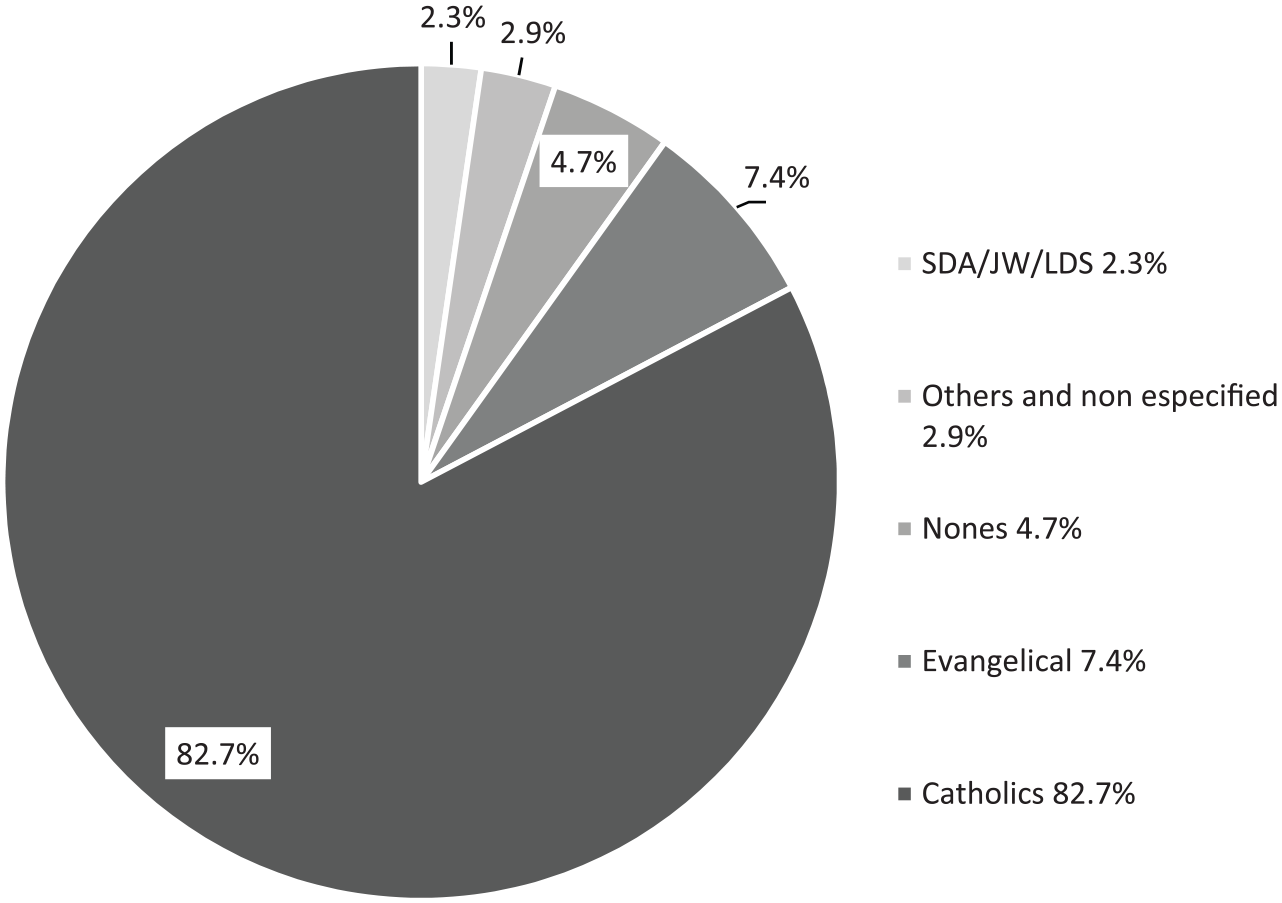
Percentages of religious membership, INEGI 2010.
The universe of the study consisted of four population groups defined by their religious affiliations. The sample considered 3000 cases, with a reliability rate of 95% and a standard error of ±2.5%. The sample covered 155 towns in the country’s 32 districts (31 states and Mexico City) (Figure 2). Stratified random sampling with probability proportional to size was used for the sample. The information was obtained through a face-to-face questionnaire conducted at households with anonymity assurance.
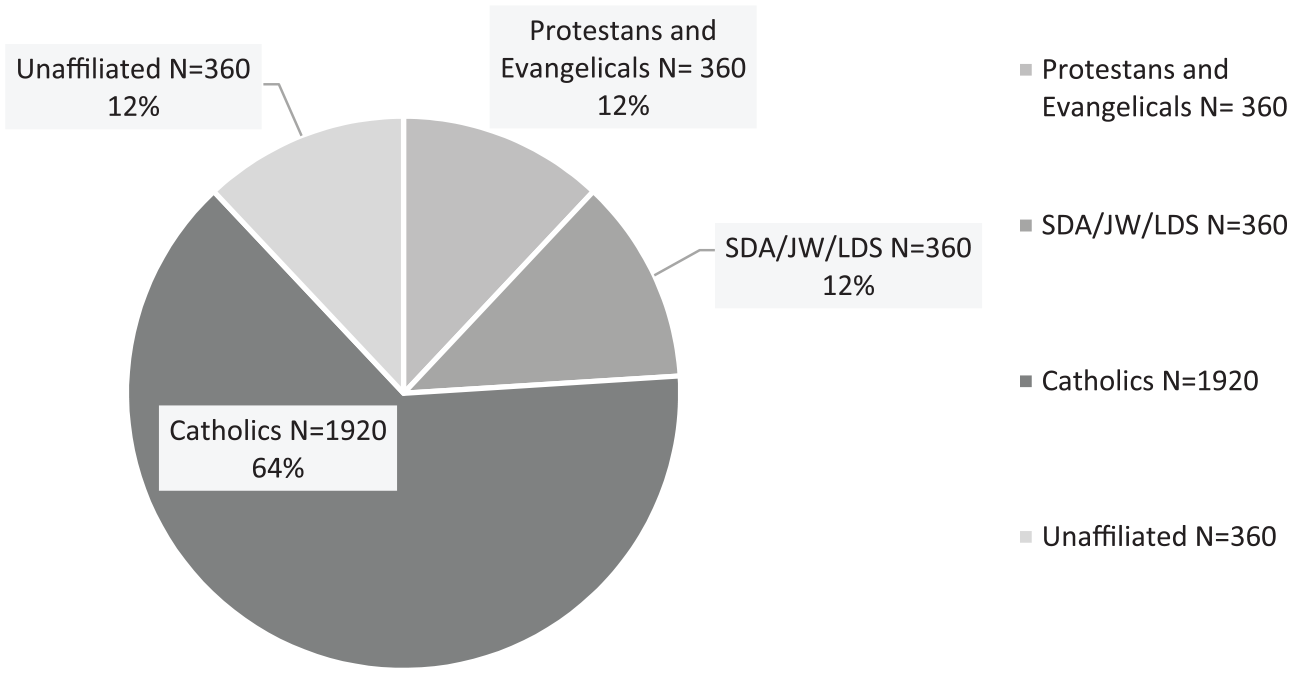
Distribution of the sample by religious group.
Oversampling was used to ensure the representativeness of non-Catholic groups and generate statistically dependable subsamples for the comparisons. The report contemplated the percentages of religious belonging from the most recent National Census (2010).
Overview of the results
Switching religion: mobile religious trajectories and multi-religiosity
In general terms, switching religions is not particularly common, as just 10.4% of the population stated they have switched religions or abandoned religion altogether. More than half of those people who acknowledged a change in religion used to be Catholic (57.1%), confirming that in Mexico, religious change principally involves abandoning Catholicism during adulthood.
Among the non-Catholics, conversion is an important source of new members: 40.2% of the SDA/JW/LDS group (JW, 46.2%; for SDA, 31%; for LDS, 22.4%) and 38.5% of Evangelicals once professed another religion. In addition, half of the unaffiliated (50.2%) abandoned or switched religion for one of the causes cited below (Figure 3).
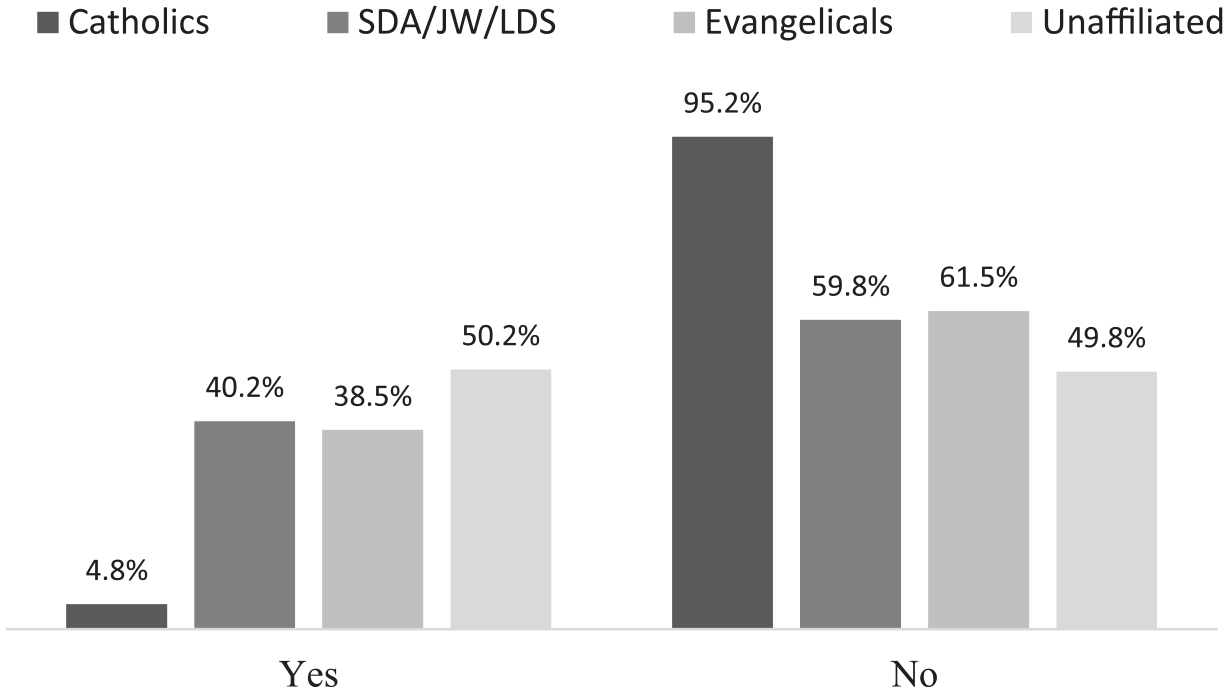
Have you switched religions or abandoned religion?
There are myriad reasons for converting to a new religion but more than half of all converts gave one of the following four answers for the change: dissatisfaction with their previous religion (17%), the new religion’s faithful interpretation of the Bible (16.8%), the search for truth (13.2%), and the conviction that their new religion is the true religion (10.5%).
The scarce mention of the reasons cited in the literature as important motives for religious conversion is worth noting. These include the economic assistance and solidarity that the convert encounters in the new religious community, the crisis that gave origin to the change, and the struggle against addictions, which total just 6.4% altogether.
An interesting result that should be explored in upcoming research is that the reason given by people who convert to new religions generally aligns with the new religious group they choose. Finding meaning in life (19.2%) and dissatisfaction with their previous religion (19.1%) are the main motives for religious conversions among those who become Evangelicals; among converts to other Christian denominations, the conviction that the new religion is the true religion (23.9%) prevails. For those who abandon religion, religious dissatisfaction is the main reason for converting, with 18.5% saying they weren’t satisfied by their previous religion and 33.3% saying no religion satisfied them.
Independently of their affiliation or experience with religious conversion, the survey respondents believe that people change religions mainly based on a personal decision (21.7%). This seems indicative of a growing awareness of religious conversion as a way to exercise the right to religious freedom. When Catholics were asked about why people change religion, they often cast doubt on the reasons for conversion, with answers like, ‘they’ve been brainwashed’ (19.4%) or ‘economic incentives’ (13.5%) (Figure 4).
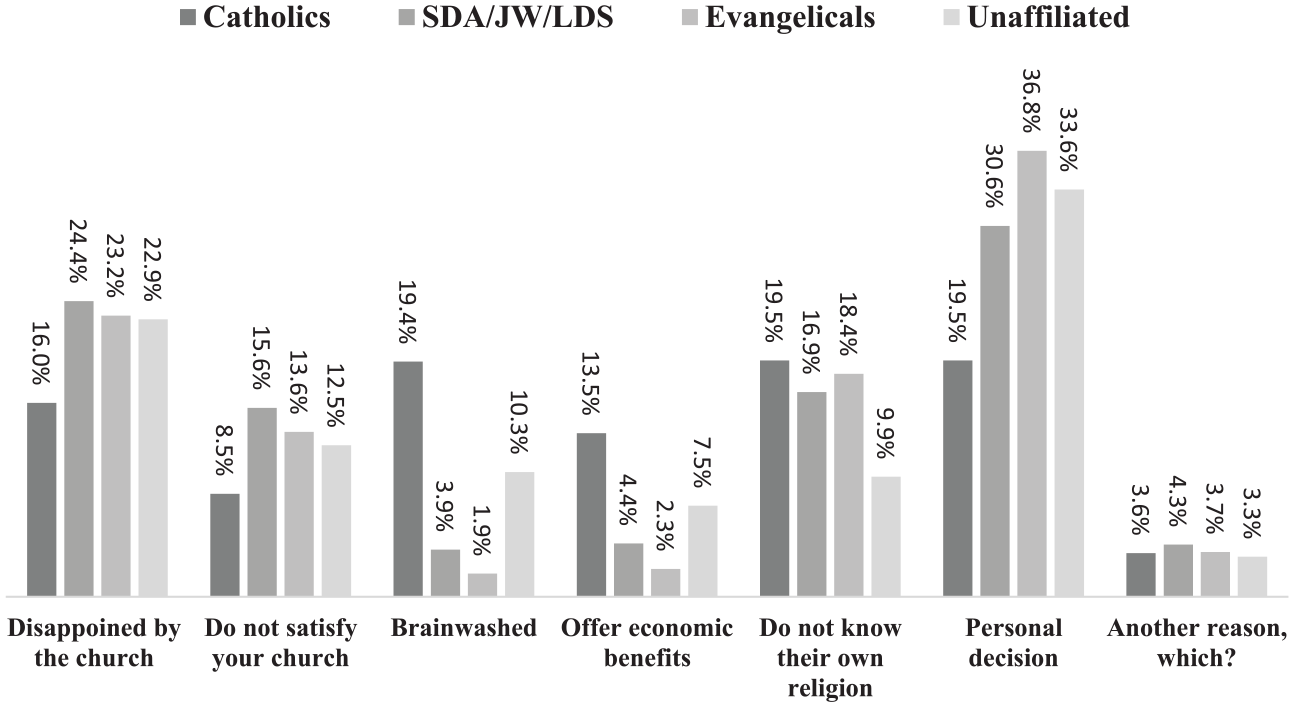
Why do you think people convert to a new religion?
Identity and religious commitment
Religious identity and commitment vary according to religious group. The majority of Catholics attribute their beliefs to tradition (47.3%) but Christians of other denominations and Evangelicals mainly attribute their beliefs to conviction (61.5% and 49.8%, respectively). These differences can be related to the long-standing nature of Catholic affiliation, the fact that Catholics are still a religious majority and the intensity of religiosity among first generations of converts. However, the category of ‘believer in my own way’ is present in all denominations, revealing a trend toward religious autonomy previously only seen among Catholics. As for the unaffiliated, many in fact believe in something, though their identity is not quite as defined as the other groups. The fact that a significant number of the unaffiliated identify as ‘believers in my own way’ (17%) and as ‘spiritual without a church’ (18%) confirms the deinstitutionalized spiritual practices among those not affiliated with any church (Figure 5). In other words, unaffiliated is not only a category for atheists (11.9%) or for those who do not practice any religion (15.5%). This category encompasses many individualized, out-of-the-box ways of practicing different types of deinstitutionalized spiritualities.
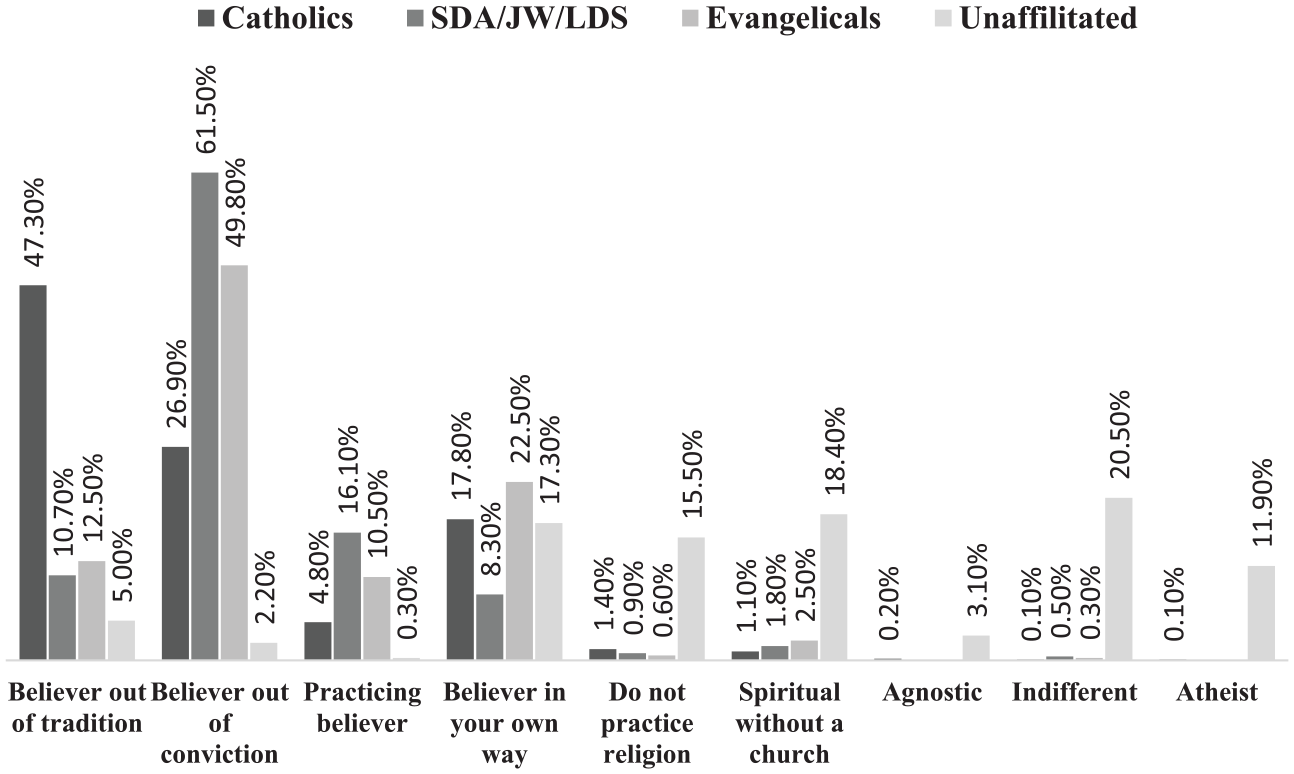
How do you identify yourself in religious terms?
The frequency with which believers attend services or practice their religion is one of the indicators of religious commitment. Another sign of this commitment is whether or not they believe that fundamental life events (like birth and marriage) should be done in accordance with their church’s norms and rites. Generally, Mexican society continues to consider religious rites important. The most common ritual is baptism or initiation, which 94% of the sample had done; however, over the course of individual lives, rites of passage are not viewed as quite so important. Only a little over half of those interviewed (52.3%) had opted for a church marriage and less than half (46.1%) had participated in other rituals. In a comparison of all the religious groups, a higher proportion of Catholics get baptized and married in the church. In the case of baptism, this difference could be attributed to the fact that while Catholics baptize new members a few months after birth, baptism among Evangelicals and SDA/JW/LDS is usually done during adulthood and after a person has been a member of the church for some time. The high percentage of baptisms among the unaffiliated confirms that this group mainly comprises people who professed a religion at some point in their lives or were born into a Catholic family. The same occurs with church marriage, done by more than half of Catholics but by only 9.8% of the unaffiliated (Figure 6).
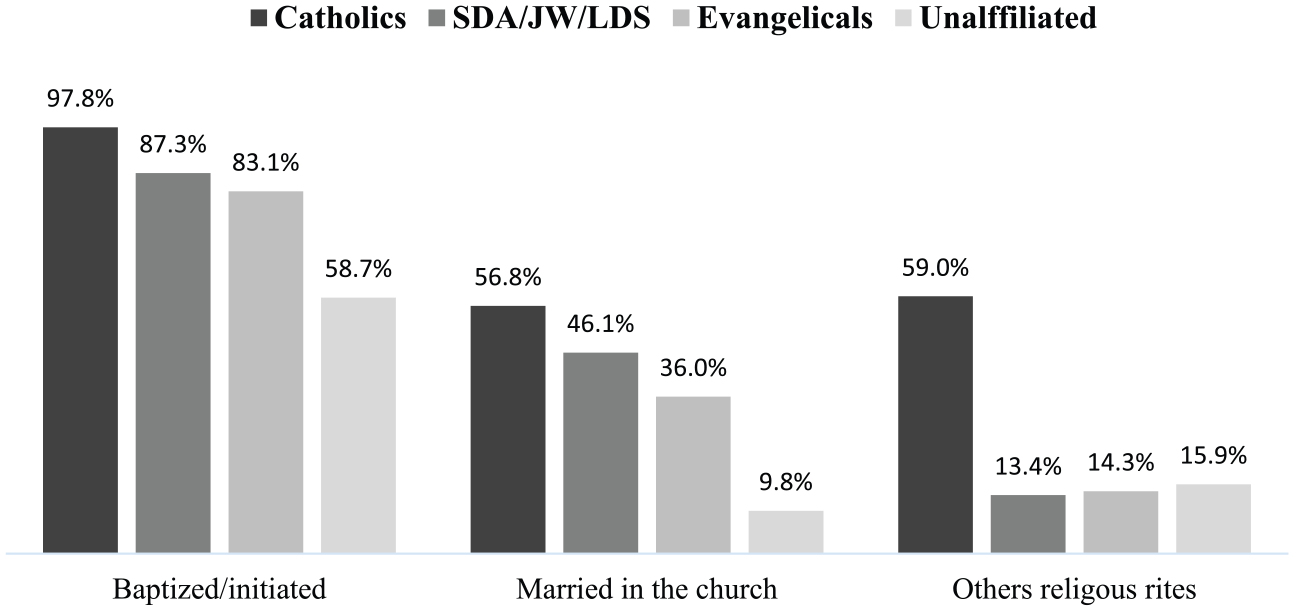
Were you baptized/initiated and/or married in the church? (Percentage that responded YES).
In addition to rites of passage, Saturday or Sunday attendance to religious services is another sociological indicator of religious commitment. Unlike the inhabitants of most of the Western European countries, Mexicans continue to regularly attend religious services. Almost half (44.3%) responded that they attend church services weekly; one-fourth (25.3%) occasionally, especially for important family celebrations; 13.1%, once a month; and 10.8%, daily, with only 6.6% saying they do no not attend religious services. This information confirms Mexico’s top ranking in world comparison surveys gauging religious service attendance like the ISSP (data from 2008 and 2009), which found that church attendance stood at 58.5% in Mexico, 20% higher than the average for all countries surveyed (Silva Medina, 2014: 323). If those who attend daily and those who attend weekly are totaled, more than half of all Mexicans (54.3%) are frequent churchgoers, a percentage analogous with the findings of this survey.
In terms of most frequent church attendance, 86.7% of the SDA/JW/LDS group and 85.1% of Evangelicals attend church either daily or weekly, 30% more than Catholics. Surprisingly, a small percentage of the unaffiliated attend church services with a certain regularity. The tendency toward higher church attendance among Evangelicals in comparison to Catholics can also be seen among Latinos in the United States, where 40% of Catholics and 71% of Evangelicals attend church weekly. (Pew Research Center, 2014b)
In the comparison among groups, half of Catholics (47.8%) attend weekly mass, while 53.5% of the Evangelicals and 44.7% of the SDA/JW/LDS group report daily attendance. Among the unaffiliated, weekly religious practice is rare and 75% never attend services (Figure 7). In addition, low church attendance is highest among the two youngest cohorts (ages 18 to 34), while the two oldest cohorts (ages 45 and over) report the highest church attendance. Those with the highest educational attainment (master’s or doctoral studies) report the lowest levels of participation in church rites compared to the other groups, with 22% reporting such participation ‘occasionally’ and 27% ‘never’. In contrast, those with low educational attainment (elementary-level education) are the most engaged with church rites.
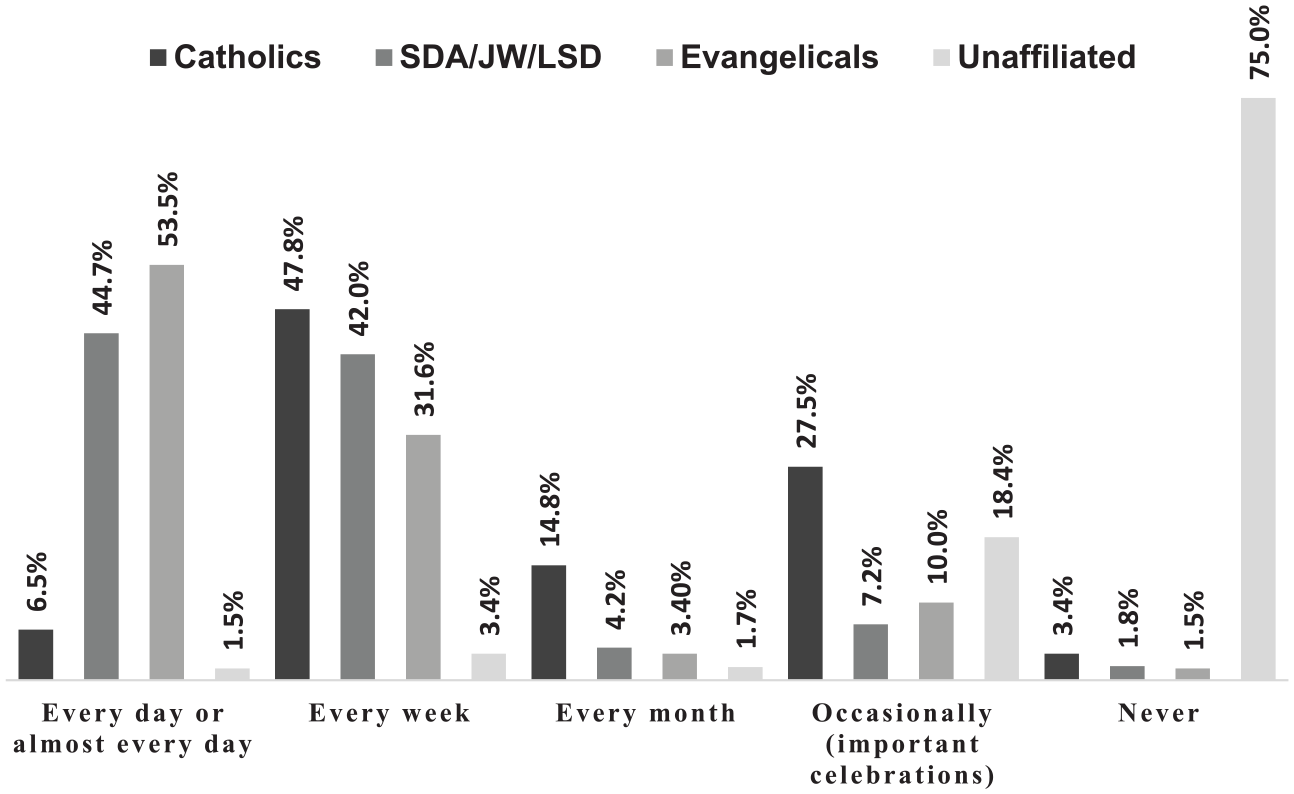
How often do you currently attend religious services (i.e. mass or prayer sessions)?
The reconfigurations of practices and affiliations
The survey explored practices among Mexicans that are independent from their church’s mandatory activities and which often take place within the household. For example, a strong devotion to cult images has always characterized Mexican Catholicism, particularly the Virgen de Guadalupe, a syncretic icon combining Catholicism with indigenous worldviews. This tradition of worshiping cult images is generally practiced outside the church at altars located at homes, workplaces, or on neighborhood streets. While 93.4% of Catholics profess their belief in the Virgen de Guadalupe, her worship is part of the lives of approximately two-thirds of all Mexicans (59.4%), followed by altars dedicated to Christ (18.2%) and other Marian devotions. A handful of Mexicans worships patron saints (1.3%) followed by, in even smaller percentages, other popular traditions like the Orishas of Cuban Santeria, altars to the dead (a folk tradition among indigenous people that culminates on 2 November, the Day of the Dead, which UNESCO has recognized as an Intangible Cultural Heritage of Humanity) and the worship of folk saints not officially recognized by the Catholic Church like Santa Muerte and Jesus Malverde. Latino Catholics living in the United States continue with the tradition of praying to the saints. These ‘portable’ traditions accompany migrants, building symbolic bridges between their new home and their land of origin (Odgers, 2008). According to Pew Research Center (2014b), 70% of Catholics pray to saints, compared to 13% of Protestants, 9% of Evangelicals, and 21% of the unaffiliated. Although the tradition persists among Catholics born in the United States, it is not as prevalent, standing at 74% for those born outside the country and 63% for those born on American soil.
In sum, the survey reaffirms the Virgen de Guadalupe tradition among Mexican Catholics, even among the affiliated, with one-fourth saying that they believe in her. However, it clearly establishes that not all Mexicans profess such devotion, as around 90% of the SDA/JW/LDS group and Evangelicals stated they do not. According to the theology of these non-Catholic groups, this practice is idolatrous and/or pagan, and in the public setting (i.e. schools), it has become a source of tension between the Catholic majority and the non-Catholic religious minorities (Figure 8).
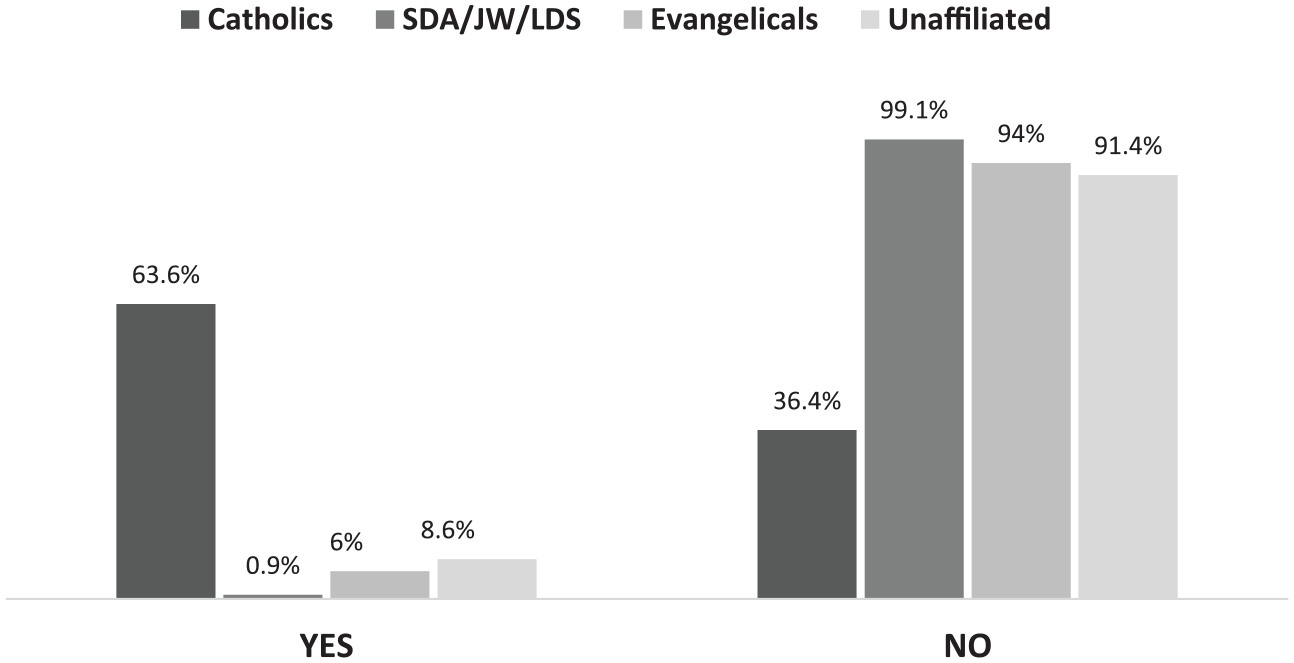
Do you have a religious altar in your home?
Mexican religious practice is not limited to attending mass. Bible reading is the most common practice among half of Catholics and around 88% of Evangelical Christians and the SDA/JW/LDS group, both of whom report high levels of Bible reading (Figure 9).
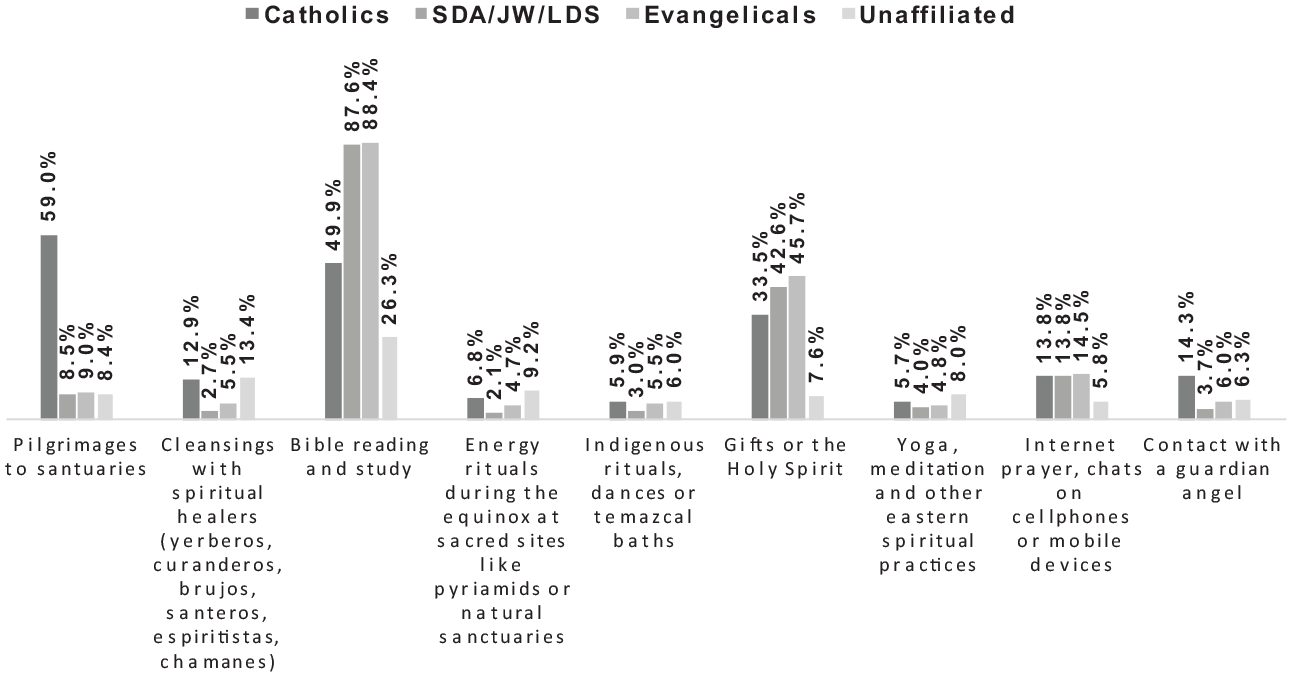
Which of the following activities do you practice?
Mexican Catholics are highly ritualistic and, as Rodríguez Shadow and Ávila (2010) have noted, Catholicism in Mexico is synonymous with pilgrimage. Nearly two-thirds of Catholics reported making regular pilgrimages to altars or temples of virgins, Christs, or the saints viewed as miracle workers within Catholicism. Another that has recently taken root in Mexico’s Christian tradition is the receiving of gifts of the Holy Spirit, a practice particularly common among Pentecostals (45.7%) and the SDA/JW/LDS group (42.6%) but also among one-third of Catholics (33.5%), since Catholicism has promoted this ritual as a part of Charismatic Renewal. One striking finding from the survey is that information and communication technology (ICT) has not only become an important medium for the dissemination of religion, but also a novel space for prayer chains. This new practice is common among Catholics, Evangelicals, and the SDA/JW/LDS group – but not among the unaffiliated – and was reported by one-sixth of the population. Second is a practice introduced by esoteric movements but later adopted by Catholics (14.3%) of summoning a guardian angel (Eufracio, 2006) and present though not as common among the other religious groups; and old syncretic practices viewed as magical like the spiritual cleansings attended by nearly one-sixth of Catholics and some of the unaffiliated as well.
In terms of practices associated with novel New Age spiritualities and those promoted by neoindigenous movements that revindicate indigenous traditions, like Mexicanidad (De la Peña, 2002), the most common are absorbing solar energy during the spring equinox at archeological sites and the Temascal baths organized by traditional healers. It is interesting to note that more than a quarter of the unaffiliated (26.3%) participates in this neopagan practices and a smaller group (13.4%) does cleansings, rituals more closely tied to indigenous traditions. The unaffiliated thus cannot be assimilated to non-practicing atheists: a good number could be defined as worshippers of new spiritualities.
While Catholics and Evangelicals also report engaging in such activities, these practices are rare among the SDA/JW/LDS group. Yoga and meditation are especially popular among the unaffiliated and, though to a much lesser extent, Catholics (5.7%), Evangelicals (4.8%), and the SDA/JW/LDS group (4%). Altogether 15% of Mexicans are involved in practices and rituals that comprise emerging spiritualities, either because they are spiritual seekers without a church (Davie, 1990) or because they are Christians practicing ‘in their own way’ (Parker, 2008).
The reconfigurations of transcendental beliefs and affiliations
The way in which different religious and non-religious groups responded to the set of questions on mystical beliefs confirmed that the majority of the unaffiliated are in fact believers, with nearly three-quarters (71.4%) reporting they do believe in God but do not identify with any institution. When asked about other beliefs associated with religion, affirmative answers ranged from 24 to 46%, as shown below.
Some of the survey questions unveiled subtle differences between the different Christian religious groups in Mexico. Among the SDA/JW/LDS group and Evangelicals, for example, 84% expressed their conviction in eternal life, with Catholics trailing 10% behind them in this particular belief. More than 90% of Catholics believe in the power of the Holy Spirit, but so do 83% of Evangelicals and 78% of the SDA/JW/LDS group, revealing the importance that this divine figure has acquired among Pentecostal groups and among followers of Catholic Charismatic Renewal. The Bible as a source of absolute truth is strongest among the SDA/JW/LDS group (88.8%) – particularly JW, who position this belief at the core of their doctrine. For this reason, this particular belief has often been associated with Christian fundamentalism. However, it is worth noting that the Bible’s absolute authority is a common belief among all Mexicans, one even more widespread than conviction in eternal life: 80% of Catholics and 84% of Evangelicals affirmed the Bible’s absolute authority, along with 33.7% of the unaffiliated. Belief in the devil is common among more than half of the believers of all religious groups, but especially among the SDA/JW/LDS group (63.3%, over 10% more than the national average).
The questions included in the survey about beliefs considered heterodox from the Christian point of view revealed that the unaffiliated are most likely to hold paranormal beliefs in extraterrestrials (24.7%, double the national average) and ‘ghosts, apparitions and prankster spirits’ (28.2% vs the national average of 25.3%). Catholics are the second most likely to subscribe to these heterodoxies, showing that the Christian minorities tend to adopt a harder line in response to these divine folk figures and/or figures taken from cultural industries (Figure 10).
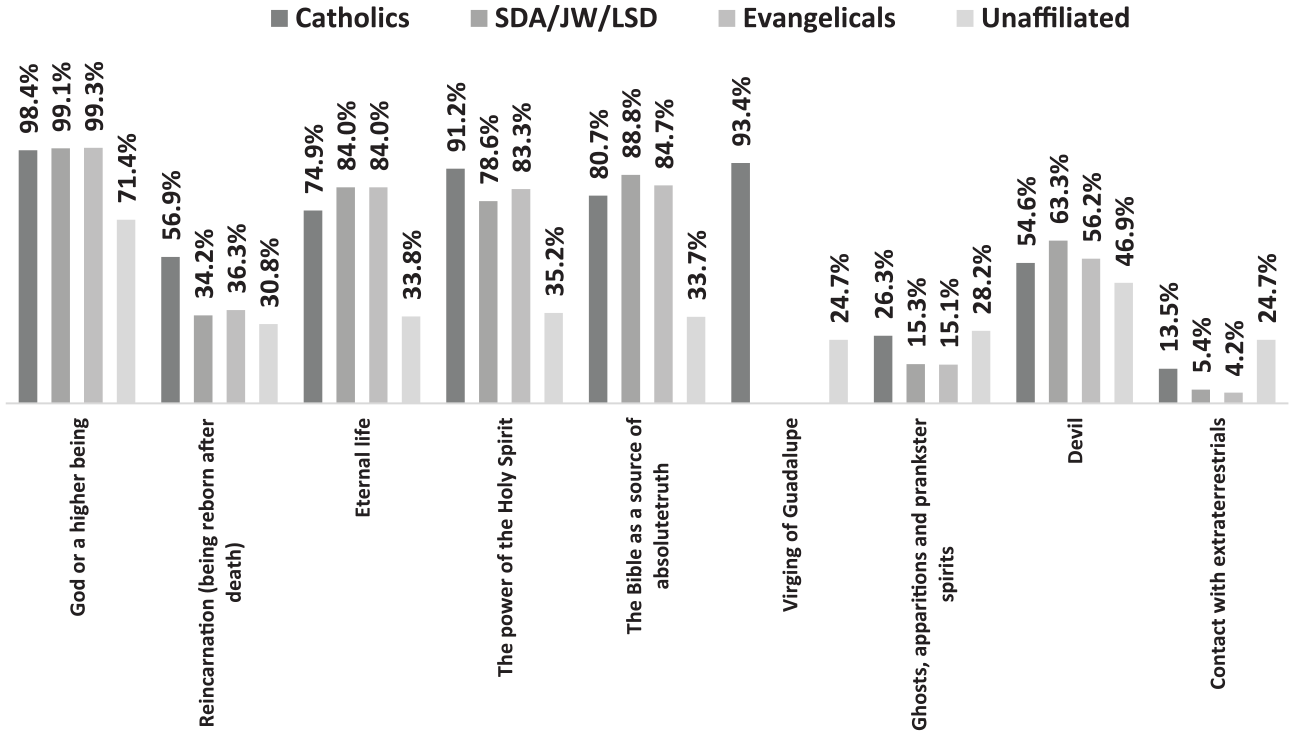
Do you think the following exist . . .?
According to Max Weber, religion provides explanations for one’s success and suffering during life, with varying degrees of magical/rational elements. Religion can reflect a belief in the ability to control one’s destiny, on the one hand, or entire dependence on higher forces. The responses to the question, ‘To what do you attribute your stability, success or failure in life?’ reveal that unlike Evangelicals, the SDA/JW/LDS group views life events as more fortuitous, with 52.3% (compared to a national average of 35.9%) attributing their success/failure in life to God’s will and 14.4% (vs a national average of 5.7%) to living according to God’s laws (Figure 11). An individualistic, meritocratic approach is most common among the unaffiliated, with 58.9% saying that success/failure depends on personal effort. Catholics were the second most likely (43.4%) to give this answer. It could be said, then, that those without religion are the most secularized but also the most permeable to magical conceptions like luck or destiny, though these believers still represent a minority among the unaffiliated as a group.
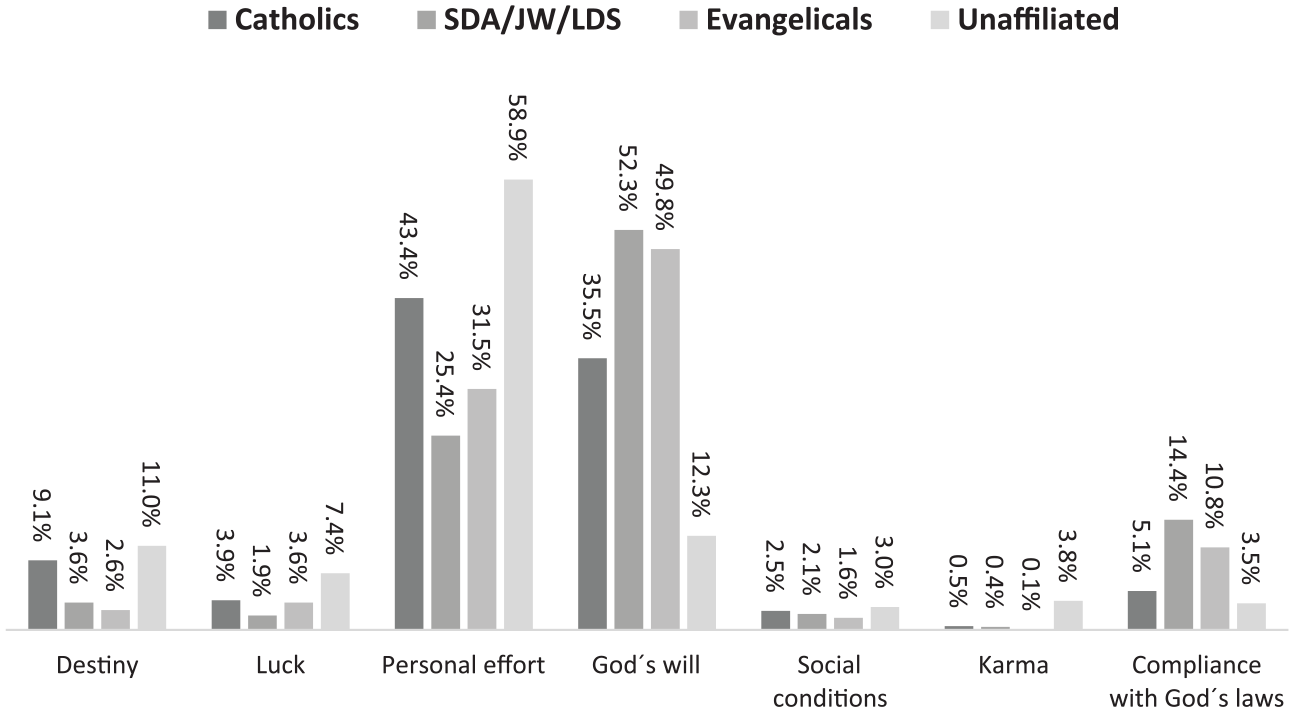
To what do you attribute your stability, success, or failure in life?
Perceptions on religion and the public sphere: secularity, secular freedoms, human rights, and a culture of religious plurality
Although religious diversity is a recent phenomenon in Mexico, the majority of the survey respondents – regardless of their creed – believe that the member of any religious group should have the same rights as all other citizens. This is indicative of the country’s pluralistic values (Beckford, 2003).
Mexico is characterized by contrasts since, despite Catholicism’s influence on local culture, it has remained a secular country with strict laws on the separation of church and state since the mid-nineteenth century. One of the historic topics of dispute among conservative Catholics and liberals has been public schools. Catholics regularly launch campaigns to incorporate religious values in the national education system. When asked about whether religious values or content should be taught at schools, 64.3% of Catholics agreed, followed by 51.9% of the SDA/JW/LDS group, 48% of Evangelicals, and 35.7% of the unaffiliated. On the other hand, when it comes to sex education, although bishops and other conservative movements have expressed their opposition, the majority of Mexicans (80.8%) say they are in favor of it. Paradoxically, Catholics are the group most likely to agree with sex education (83.5%), followed by the unaffiliated (73.7%), the SDA/JW/LDS group (63.6%), and a majority, though in lower numbers, of Evangelicals (60.8%) (Figure 12).
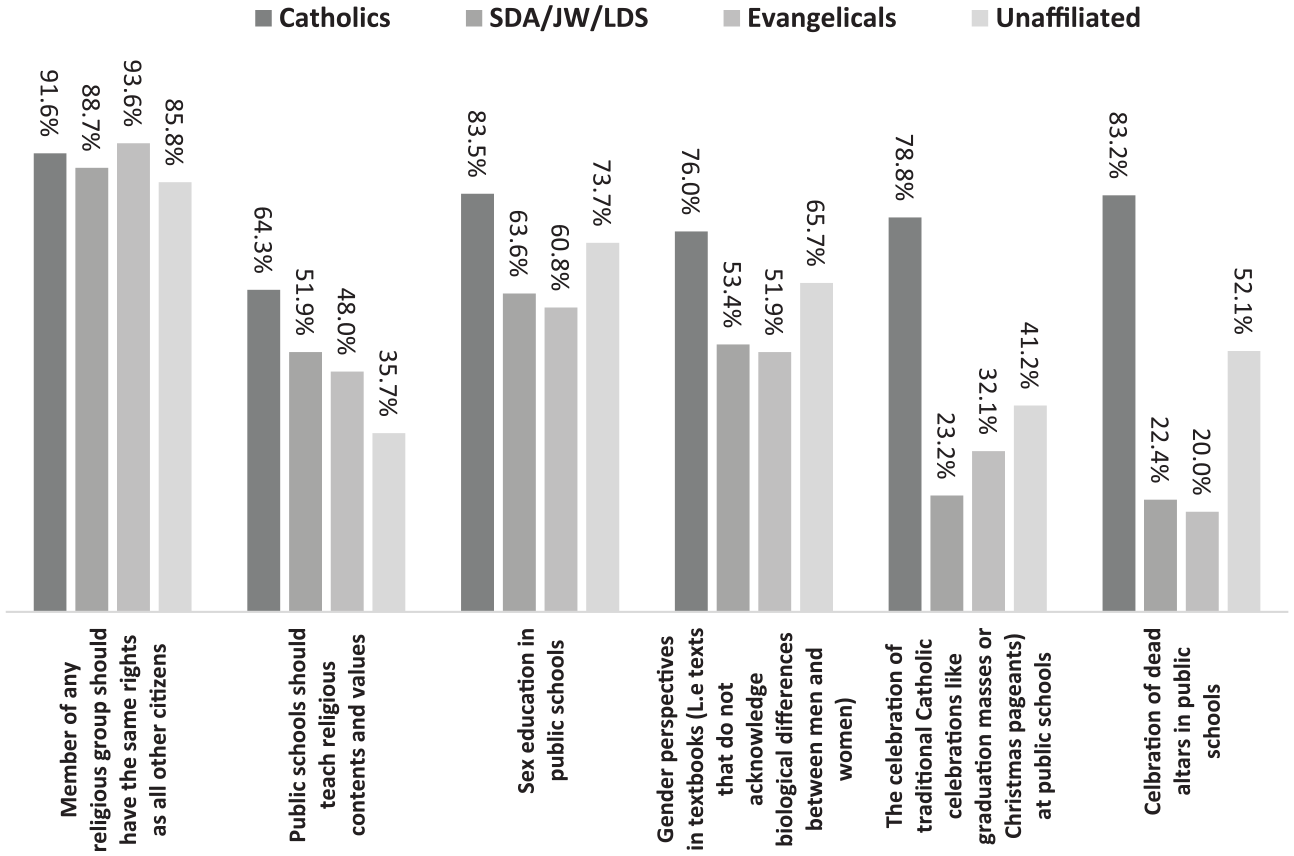
Do you agree or disagree with the following statements or situations? (% agree)
Similarly, Mexicans in general do not frown upon teaching gender perspectives at schools (73.2% agree with it). Once again, Catholics are the group most in favor of it (76%), though the same year the survey was conducted, this same group launched nationwide crusades against what they referred to as ‘gender ideology’. In contrast, the SDA/JW/LDS group (53%) and Evangelicals (51.9%) are more reactionary on this topic.
Most Mexicans (75.4%) are not bothered by the tradition of having altars to the dead (though 41.2% of the unaffiliated, 32.1% of Evangelicals, and 23.2% of the SDA/JW/LDS group do take issue with this practice). A similar number of Mexicans (72.2%) is not opposed to the traditional Catholic celebrations (like graduation masses or Christmas pageants) that are frequently organized at schools, although some SDA/JW/LDS groups (23.2%), Evangelicals (32.1%), and the unaffiliated (41.2%) are in favour of them. The data reveal that although secularism is established in the Mexican Constitution, it needs to be applied to values and practices at public schools, where traditional Catholic celebrations do little to contribute to a pluralistic culture. This is a task that remains for Mexican secularism.
With regard to the regulation of religion in the public sphere, more than half of Mexicans agree with laws requiring that churches render accounts to the tax authority. Only one-third (33.1%) said they were in favor of legalizing abortion, with a similar number in favor of legalizing same-sex marriages (30.1%). When asked about whether churches should be able to own media outlets – Mexican law currently prohibits this – 28.4% said they approve; 21.4% are not against religions openly participating in electoral politics (also prohibited). A minority (8.8%) would be in favor of political candidates using religious symbols in their political campaigns. In short, this analysis shows that the majority of Mexicans are against the new laws proposed by both politicians and conservative religious sectors, with the exception of requiring churches to file tax statements. However, it also reveals that a significant number approves of new trends in sexual liberation and pluralism (around one-third) while most oppose religions getting involved in politics. However, interesting differences appear in the comparison of religious groups: the unaffiliated are more liberal and favor secular culture, followed by the Catholics, while the Evangelicals and the SDA/JW/LDS group are more conservative and less sympathetic to a political culture that monitors the actions of religions in the public sphere (Figure 13).
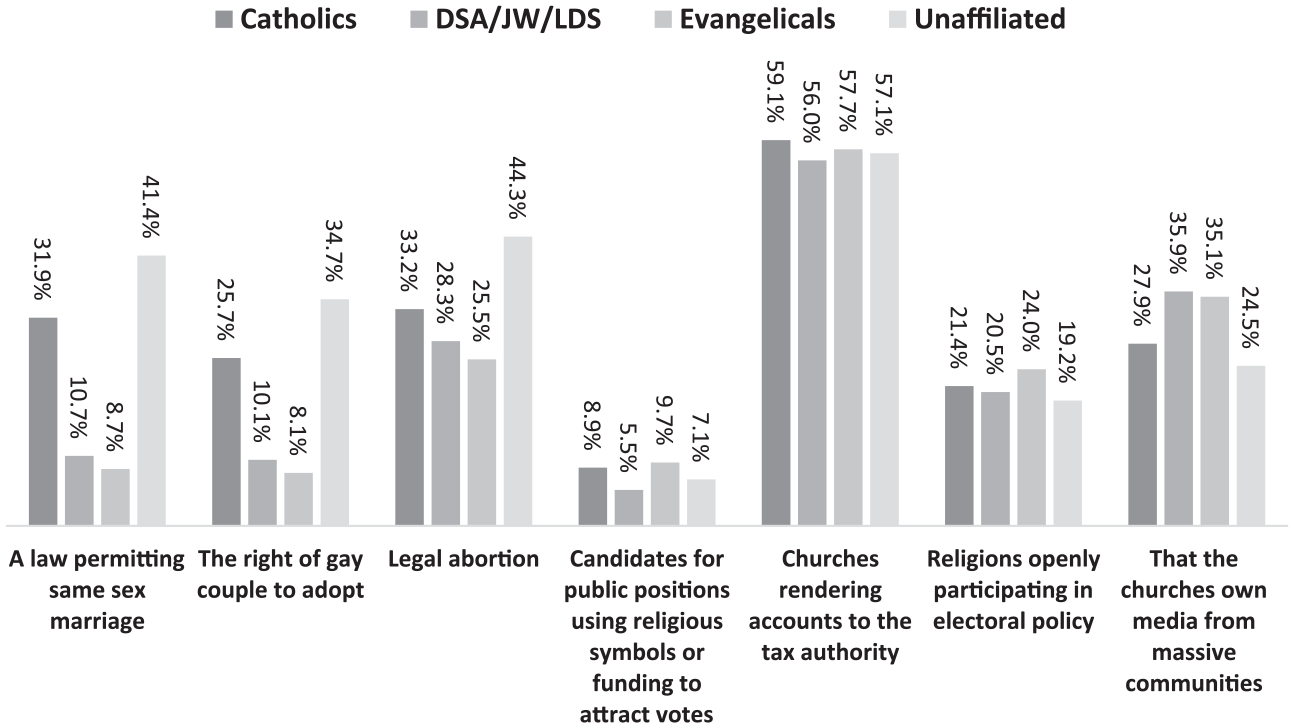
Do you agree or disagree with the following statements or situations? (% agree)
Conclusion
Religious reconfiguration in Mexico is characterized by an overall weakening of Catholicism, not only due to disaffiliation and the rising numbers of the unaffiliated, but also because the remaining Catholics are increasingly drifting away from their church’s norms, opting to be Catholics in their own way. Catholics are becoming more ritualistic, receptive to other religious matrixes and more likely to take autonomous positions on the church’s precepts. An important number of Catholics fitting a profile could be described as ‘belonging but not believing’ in which Catholicism is an inherited tradition, a religious belonging bound by an identification with a social majority or a cultural inheritance. The belongers but not believers are ‘Catholics in their own way’, a phrase that suggests their receptiveness to heterodox beliefs and practices. Although they do not necessarily feel as connected to the church as an institution, these believers in their own way remain engaged with the collective rituals of Catholic affiliation, that is, the worship of saints and virgins and pilgrimages to their altars or temples. Catholics identify these rituals as a part of Mexican folk culture, which is why they are the least concerned with the public observance of such celebrations (i.e. in schools). This feature of deinstitutionalized religiosity is also evidenced in varying degrees of Catholic opposition to conservative church positions on topics like sex and gender diversity education at schools, abortion, and same-sex marriage.
We can say that religiosity is increasingly practiced along the margins or directly beyond the reach of institutions or religions. In the late modern age of globalization, beliefs, values, and practices are becoming more transversal, fluid, and dynamic, though this trend does not equally apply to Evangelicals and the SDA/JW/LDS group, the religious minorities that have attracted the most converts in Mexico. As a first generation of believers, this group expresses greater commitment to religious institutions, high participation in rituals, less receptiveness to heterodox beliefs or practices, and a solid self-identification as believers ‘by conviction’.
We have seen how the group identified as unaffiliated cannot be assimilated to ‘non-believers’ – only a handful are actually atheists – but instead corresponds to a profile of ‘believing but not belonging’ (Davie, 1990). Within this category, there are many individualized, out-of-the-box ways of practicing different types of deinstitutionalized spiritualities, though these are also sporadic. The unaffiliated are undoubtedly the most receptive to practices identified with Eastern philosophies, New Age spiritualities, and especially indigenous ceremonial practices resignified by a cosmopolitan spirituality movement that yields new hybrids like the so-called neo-Indian spiritualities. This phenomenon, however, affects members of all religious denominations. The traditions that establish ancestral bonds or lineage are currently very popular, part of what Hervieu-Léger (2009) has characterized as the emergence of new ethnic-religious identifications.
Although religious affiliation and self-identification are being reconfigured by way of expressing and practicing religiosity outside of church institutions, it is important to avoid minimizing religion’s social significance or jumping to conclusions on religion disappearing. Collective rituals, strongly tied to Catholic tenets, remain strong in the sphere of the Mexican household and social realm. Practices associated with this folk Catholicism include the worship of virgins and saints, with syncretic rituals like celebrating the days of particular saints, altar worship, and pilgrimages, and the devotional relationship within a cosmology whose components are drawn from different religious matrixes. Both are very common among Mexican Catholics. Given the growing religious diversification, transcendental beliefs are not the main feature of the array of identities among affiliates of the different religions. Instead, these daily folk practices reveal Catholicism’s continued hegemony, where ‘Catholic’ is still seen as synonymous with ‘Mexican’ and thus a source of tension between Catholics and the Evangelist and Biblical minorities.
However, when it comes to reproductive rights and alternative family models that challenge church ethics, Evangelicals and conservative Catholics are finding common ground and forging alliances with the support of the ecclesiastical authorities. Ideological affinities are forming along with a shared perception of common enemies (feminists, the LGBT movement, etc.). We are witnessing what could be the rekindling of a ‘political’ alliance between Catholic and non-Catholic churches, though the different denominations continue to compete for believers on the salvation market.
Based on the survey data, we can say that religious diversity in Mexico faces the challenge of transitioning to a culture of religious plurality. In a scenario characterized by religious reconfiguration and greater diversity, we identified three tendencies: a subjective secularization that leads most Mexicans to reject the interference of religion in politics (though Christians and the SDA/JW/LDS group are less likely to do so); new and unexpected alliances between the conservative fringes of Catholics and Evangelicals to form a united front on issues related to gender ideology; and folk religious practices in the public sphere (i.e. schools) as a new source of tension among Christian minorities. This survey has allowed us to statistically compare religious groups, revealing the increasing diversity in Mexico’s religious field despite Catholic hegemony. It also evidences the reconfigurations of religious affiliation and self-identification through forms of believing and practicing religion outside of religious institutions. At the same time, the survey contributes to a better understanding of the religious change in Mexico and a consideration of the shifts between religious diversity and pluralism.
Footnotes
Acknowledgements
The authors would like to acknowledge the invaluable support of Yasodhara Silva Medina, and Demoskópica México for overseeing the sampling and application of the survey.
Funding
The author(s) disclosed receipt of the following financial support for the research, authorship, and/or publication of this article: The National Science and Technology Council of Mexico (CONACYT Grant No. 271695) provided funding for this work.

Notes
Author biographies
Address: Av. España 1359 Col. Moderna, Guadalajara, Jalisco, c.p. 44190, Mexico.
Email:
Address: Av. Aurelio Ortega 575 Col. De los Maestros, Zapopan, Jalisco, c.p. 45150, Mexico.
Email:
Address: Carretera escénica Tijuana-Ensenada, km. 18.5, San Antonio del Mar, Tijuana, Baja California, c.p. 22560, Mexico.
Email: