



Abstract
The argument for adopting more comprehensive measures of religiosity, put forward by Yang and McPhail, underscores the centrality of the concept of ‘multiple’ as an entry point for analyzing contemporary religious belonging and practice. This article offers the findings from a 2023 study conducted among adherents of the Italian Buddhist Union (UBI, n = 515), testing the multiple religiosity hypothesis within the context of a predominantly Catholic society. After outlining the sociodemographic and cultural backgrounds of the participants, we explore the patterns of multiple religious belonging (MRB) and multiple religious practice (MRP) among Italian Buddhists, considering their prior and newly declared affiliations. Consistent with the research hypothesis–originally tested on a sample of young East Asians respondents by Yang and McPhail–UBI members in our study exhibit distinct patterns of MRB and MRP, with the latter being more prominent. In the Italian Catholic cultural context, characterized by societal conditions that foster pluralism, we found that both MRB and MRP demonstrate elevated levels, while newly acquired religious belonging plays a crucial role in the religious practices of UBI members.
Introduction: Advancing measures of religiosity in pluralist societies
Recent studies have delved into the phenomenon of multiple religious belonging (MRB) within secularized Western societies (Berghuijs, 2017; Bruce, 2017; Cornille, 2003, 2010; Drew, 2011; Holmes, 2014; Yang and McPhail, 2023). While the prevalence of MRB may not be as widespread in Europe and the United States as it is in East Asia, there is indeed evidence of inclusive and hybrid self-identification within these regions, particularly in societies characterized by pluralism and a notable interest in New Religious Movements and Oriental traditions. Berghuijs (2017) provides insights into the existing phenomena of MRB in a highly secularized Dutch society by illustrating how two contexts in these fields – cultural Catholicism and cultural multi-religiosity – should be considered.
In line with these studies, Yang and McPhail (2023) contend that multiple religious belonging, believing, and practicing – traditionally observed in most of East Asia – goes beyond the religious and cultural boundaries of the East Asian region. This argument implies the centrality of the category of ‘multiple’ in analyzing present-day religiosity and the necessity of devising more culturally contextualized measures for the empirical study of its dimensions. Yang and McPhail discuss the varying intensity of engagement in multi-religiosity in the sample of international East Asian students in the United States. The authors conclude by arguing that while developed measures of multiple religious belonging, believing, and practicing are ‘particularly sensitive to several East Asian cultures’ (Yang and McPhail, 2023: 226), they are also ‘effective in capturing the religious lives of the globalizing world today’ (p. 239).
Moreover, Yang and McPhail (2023) suggest that elements of MRB are becoming ‘increasingly prevalent in Western societies as well’ (p. 239), particularly when considering the growing category of ‘nones’ – individuals who are religiously disaffiliated but still tend to believe and practice. They argue that this inclusive worldview of religious nones somewhat reproduces the absence of a ‘sacred-secular distinction’ (Yang and McPhail, 2023: 222) that characterizes East Asian traditions.
These observations underscore the intertwined processes of increasing secularization and growing religious pluralism in Western societies (Berger, 2014; Berzano, 2019; Giordan and Pace, 2014), including the phenomena of ‘Asianization’ or ‘Easternization’ (Campbell, 2007), which to some extent enhance the phenomenon of MRB and multiple religious practicing (MRP). Consequently, there is a theoretical imperative to develop more sensitive definitions and analytical constructs for comprehending the complexities of multi-religiosity.
Following the hypothesis put forth by Yang and McPhail (2023), we focus on MRB and MRP among Italian Buddhists, considering the cultural context of Catholicism and the pluralization of the Italian religious landscape. We argue that the Italian peninsula offers a unique case for the study of MRB and MRP, given the dominant presence of the Catholic tradition, alongside conditions of religious freedom that foster growing religious diversity.
Specifically, we hypothesize that, compared to the empirical findings of Yang and McPhail (2023), the proportion of Italian Buddhists exhibiting MRB will be more pronounced. This is because the concepts of ‘belonging’ and ‘identity’ are deeply ingrained in the Italian Catholic context, while historically ‘East Asians are known to be reluctant to identify with a particular religion’ (Yang and McPhail, 2023: 224). An important factor explaining this difference is the presence or absence of religious repression, which can compel individuals to either openly express or conceal their religious affiliations. Regarding multiple religious practicing (MRP), we expect to observe their hybrid expressions among Italian Buddhists. However, we anticipate that these hybrid forms will be less prevalent than those identified in Yang and McPhail’s (2023) study, which involved participants from East Asian cultures raised in environments more receptive to polytheistic traditions.
The case of Italian Buddhists is particularly intriguing for sociologists of religion as it allows for the examination of MRB and MRP among those actively engaged in the activities of centers of the Italian Buddhist Union (UBI) across the country. In our research, all the participants are engaged members of the Buddhist centers. Moreover, most Italian Buddhists were raised in a Catholic environment, having been baptized and participated in Catholic rituals during childhood, amalgamating their experiences of Christian and Buddhist rituals and shaping the dynamics of MRP.
In examining the consistency of the argument of multi-religiosity among Italian Buddhists, we start with a brief overview of existing definitions of MRB and MRP and then provide a panorama of the Italian religious landscape, emphasizing the influential role of the Roman Catholic Church and the dynamics of pluralism. Next, we specify the methodology of our study and overview the key sociodemographic and cultural contexts of our participants, Italians attending UBI centers. Subsequently, we present the primary findings, specifying the patterns of MRB and MRP among Italian Buddhists: We consider their prior and newly declared religious belonging alongside their perceptions of conversion. Finally, we discuss the findings of our study, illustrating their consistency with the hypothesis regarding the presence of MRB and MRP patterns among Italian Buddhists.
Sociological discussions on multiple religiosities and the context of Italian Catholicism
Defining multiple religious belonging (MRB) and multiple religious practice (MRP)
The importance of revising measures of religiosity linked to a single religious tradition has been debated (Yang and McPhail, 2023), prompting the need to adopt alternative methods for analyzing nonexclusive and hybrid forms of individual religious commitment, particularly for international comparison. These alternative measures propose adapting the classical dimensions of religiosity (Glock and Stark, 1965) while allowing participants to select more than one choice for each dimension. Yang and McPhail (2023: 226) argue that for measuring MRB, one option could be to formulate the question: ‘Regardless of what you believe or practice, would you say you are (may choose more than one) (…)?’ followed by a list of options representing various religious traditions and non-religious beliefs.
Similarly, to measure MRP, Yang and McPhail (2023: 231) formulated the question: ‘How often do you participate in any of these religious rituals or worship services?’ Participants are provided with multiple options and are asked to indicate the frequency of their engagement, ranging from ‘daily or almost daily’ to ‘never’. At first glance, these formulations are likely to provoke theoretical debates regarding the definitions of MRB and MRP, transcending sociological discourse to encompass theological perspectives, and defining the challenges of ‘translating’ these questions from one cultural context to another. However, when considered together with a critical understanding of these concepts, empirically studied MRB and MRP shed light on patterns of contemporary religiosity and spiritual and non-religious practices.
Theoretical challenges in defining MRB and MRP for empirical research, central to our study, can be addressed through several critical points. What are the core elements of MRB and MRP? Does MRP entail simultaneous adherence to two or more traditions or can individuals engage in MRP without being multiple religious belongers (MRBers)? Moreover, there is an issue of contextualization of the meaning of MRB and MRP that requires sensibility when we translate these concepts from one cultural and religious context to another and analyze combinations of MRB and MRP. For instance, when we consider MRP through Christian/Buddhist or through Catholic/Protestant combination, do we face the same phenomena?
Trying to define the concept of MRB, Berghuijs (2017: 22) describes a person as an MRBer ‘if he or she combines elements of different religious traditions in his or her life’. In addition, Berghuijs explains:
I see MRB as ranging from people who are intensely involved in two religions, and who are also members of two religious communities, to ‘unaffiliated spirituals’, who combine elements from different religious traditions, without joining a religious community, and everything in between, for instance, Christians who practice Zen meditation. (Berghuijs, 2017: 22)
Drawing on the multidimensional concept of religiosity developed by Glock and Stark (1965), as well as Smart (1998), Berghuijs (2017: 22) suggests modalities of religious belonging that encompass various ‘ways in which people can be related to a particular religion, and therefore include more than forms of expression’. Accordingly, nine modalities of religious belonging (affinity, practice and material culture, ideology, narrative, origin, experience, ethics, social participation, and identification) are developed to provide more flexible and inclusive choices of religious sources of belonging to the participants. Berghuijs concludes:
What does ‘belonging’ mean when membership is no longer the sole answer? This study shows that the Dutch are quite flexible in choosing their religious sources. Many of them draw from more than one religious tradition. We have to reflect further and investigate deeper into the meaning of their ‘belonging’, and their relatedness with their religious or spiritual sources. (Berghuijs, 2017: 35)
According to Bruce (2017), criticism can be raised if MRB is defined either as a combination of various modalities of religiosity or as a membership in two religious communities. Belonging ‘implies a strong bond. It is also generally not a matter solely of personal preference’ (Bruce, 2017: 606). Religious organizations and communities have different criteria for membership. Bruce emphasizes that even if ‘you might like the theology and worship styles’, it is not possible to ‘sensibly claim to ‘belong’ to a particular religious community unless it ‘accepts your claim’ (Bruce, 2017: 606). The existence of nonporous boundaries has to be taken into account when the concept of MRB is defined. Bruce notes:
The three Abrahamic religions have statements of faith and requirements that distinguish themselves from each other and even the supposedly tolerant religions of Hinduism and Buddhism have beliefs and practices that allow little confusion as to whether one is a Hindu or a Buddhist. That is, we should not confuse considerable internal variegation with a lack of boundaries. (…)There needs to be a reciprocal acceptance from those empowered to approve or reject personal preferences. (Bruce, 2017: 606)
Against this backdrop, Bruce proposes his own definition of an MRBer: ‘an observant ‘member’ of more than one religion’ (Bruce, 2017: 611). However, even this stricter approach to defining MRB has to be scrutinized, since belonging, for instance, to the Roman Catholic Church ‘has been slow to accept a category of ‘member’ and wishes to regard as members, all whom it has baptized’ (Bruce, 2017: 606). This implies that the definition of belonging is not solely an issue for individuals but also for religious institutions establishing criteria for membership and belonging.
Theoretical discussions on MRB and MRP demonstrate that the classical measures of religiosity fail to capture the complexity of changing religious phenomena related to individual situations and states of engagement with more than one religious tradition. The intersection of these two concepts assists in building up new typologies. Holmes (2014) delineates two types of relationship between these concepts: when the MRBer partially or fully participates in two or more religions; and an individual who belongs to a single religion but engages in MRP, a process akin to ‘religious borrowing’ (p. 426). The latter is grounded in ‘the recognition that truth may reside in religious traditions outside of one’s own’ (Holmes, 2014: 426).
Various combinations of MRB and MRP patterns illustrate the trajectories of individual choices and degrees of openness of religious traditions including the MRBers and MRPers. Bruce notes that: ‘The key to MRB then is a novel attitude to our traditional faiths. We have to radically re-write those faiths so they are no longer exclusive’ (Bruce, 2017: 610). It is interesting to note that various studies highlight Buddhism and Christianity as one of the most common combinations of multi-religiosity in Europe (Berghuijs, 2017; Cornille, 2003).
The context of Italian Catholicism. Traditional religiosity and its alternatives
In the Italian context, the interplay between Catholicism, the predominant religion, and Buddhism, a minority faith, introduces a dynamic religious landscape warranting consideration. Catholicism, deeply ingrained in the Italian cultural and historical context, exerts a significant influence on societal norms, values, and traditions (Cipriani, 2017). Its prevalence shapes the moral compass of the majority and has implications for various aspects of public life, including education and social ethics. At the same time, the crisis of traditional religiosity, which has led many people to seek spiritual alternatives, represents a noteworthy phenomenon in the current social context (Garelli, 2020). In particular, this process characterizing Italian society has resulted in a marked decrease in the influence of the Catholic Church (Biolcati et al., 2020; Diotallevi, 2022), and the diminished relevance of the Church has paved the way for an increasing search for new forms of spirituality and meaning (Giordan, 2009; Palmisano and Pannofino, 2021).
The quest for new forms of spirituality can be seen as an attempt to fill the void left by traditional religiosity, with individuals seeking a more personalized meaning adapted to current life contexts in which they have turned to diverse sources of meaning and inspiration beyond the boundaries of conventional religiosity (Berzano and Zoccatelli, 2006). This phenomenon reflects the complexity and plurality of modern society, highlighting the need for an inclusive and open approach to the diversity of spiritual paths and the pursuit of meaning (Giordan and Pace, 2014). The increasing quest for spiritual alternatives amid the crisis of traditional religiosity opens up space for the exploration of different practices.
Buddhism, with its emphasis on meditation and the search for inner peace, emerges as an option resonating with those seeking a more personal and contemplative connection with the divine. Furthermore, Buddhism’s non-theistic approach, which does not necessarily imply the worship of a deity, can be attractive to those seeking a spiritual path without dogmatic constraints. On the other hand, the presence of Buddhism as a minority religion adds diversity to the religious tapestry of Italy, introducing alternative perspectives on spirituality and philosophy. 1
In recent decades, the study of Buddhism in Italy (Bianchi, 2018; Bielli, 2023; Mahté, 2010; Molle, 2013) has gained increasing significance in line with the diffusion of Buddhism in the West (Baumann, 2001; Payne, 2019) which has led to a transformation of the Buddhist tradition to adapt it to Western culture (Coleman, 2021), concurrent with the process of ‘Easternization’ (Campbell, 2007). The growing Western interest in spirituality (Heelas and Woodhead, 2005) has contributed to the dissemination of Buddhism and other spiritual traditions. Moreover, the appeal of Buddhism in Italy has been enhanced by its philosophy centered on tolerance and non-violence, providing a model of peace and peaceful coexistence at a time when Western societies face conflicts and tensions. Thus, it is essential to consider the specificity of the context in which this presence and dissemination occur, namely, the process of pluralization, both religious and spiritual, which has been a stable characteristic of Italy for several decades.
Although there are limited data and research addressing the spread and practice of Buddhism in Italy (Zoccatelli, 2002), it is interesting to observe how some studies (Comolli, 1995) indicate its specificity within the Italian context (Introvigne and Zoccatelli, 2013). In terms of numbers, within the 4.3% of Italian citizens belonging to religious minorities, 218,000 are Buddhist, representing 9.5% of Italian citizens adhering to religious minorities (CESNUR, 2023).
Given that affiliation with Buddhism may yield different numbers considering individuals who practice without identifying, by combining Buddhists among Italian citizens and foreigners residing in Italy, there are currently approximately 358,000 practitioners of the Buddhist tradition in Italy, 0.6% of the resident population (CESNUR, 2023). The coexistence of religious traditions raises questions about religious freedom, tolerance, and the potential for dialogue between different belief systems. Italy faces the challenge of balancing the rights and expressions of its majority religion with the inclusion and recognition of minority faiths. Being a complex, multidimensional phenomenon, Buddhism in Italy should be analyzed in relation to the processes of cultural and social change that are shaping society.
Exploring the interactions and intersections between Catholicism and Buddhism in Italy offers insights into the evolving nature of religious pluralism and its impact on broader social dynamics. It prompts reflection on how individuals navigate their religious identities, fostering an environment where mutual respect, understanding, and cooperation can flourish among diverse religious communities. This is one of the main focuses of our contribution: albeit at an exploratory level and anchored in UBI Buddhism (Falà, 1995), the main aim is to analyze Buddhism in Italy and examine how multiple belonging and practices can coexist.
Method and data: Preliminary notes on studying Italian Buddhist Union
The empirical data presented and discussed in this article are part of the research project promoted by the Universities of Padua and Turin in collaboration with the Italian Buddhist Union (UBI), entitled ‘Buddhism in Italy: A Study on the Italian Buddhist Union’. The research design was tailored to address the core research objective of examining the identities of participants in UBI centers in Italy and providing a detailed description of those who attend these centers. In exploring sociodemographic variables, attention was focused on the participants’ educational background, marital status, and employment, while the core issues linked to Buddhist contexts covered the system of beliefs, values, and practices underlying participation in activities and UBI centers.
From a methodological perspective (Creswell and Clark, 2011), this article is based on data collected through structured questionnaires administered to a sample of individuals attending UBI centers in Italy. As for UBI-affiliated centers – referring to a non-probabilistic sampling with exploratory research objectives, and considering that the total number of UBI centers in Italy provides only a snapshot of a phenomenon characterized by numerical changes – we selected some of the 64 UBI centers. The selection criteria were the number of centers in Italy by geographic area (north, center, south), their number of members, and their traditions (including Zen, Vajrayana, Mahayana, Diamond Way, Theravada, and Nichiren). Nine UBI centers in the north, four in the center, and two in the south were selected.
The use of Computer Assisted Web Interviews (CAWI) enabled us to engage a broader population within the UBI centers in Italy, aiming to capture a more diverse range of experiences and testimonies. We gathered 261 questionnaires through in-person interviews and an additional 254 questionnaires were collected online, amounting to a total of N = 515 valid cases. All the participants attended Buddhist activities in UBI centers. By employing both in-person and online approaches, we believe we have enhanced the robustness and comprehensiveness of the empirical evidence produced. 2
The main sociodemographic characteristics of the respondents indicate a substantial gender parity among participants in the centers’ activities: 49.5% identify as male, and 50.1% identify as female. Regarding the respondents’ year of birth, 34.7% report an age between 61 and 87 years, 49.9% fall within the 41 to 60 years range, and the remaining 15.4% are between 20 and 40 years old. Overall, nearly 8 out of 10 participants are over 40 years old. As the average age is 54, younger participants are a minority. Combining the categories of married, divorced, and cohabiting individuals, almost half (49.3%) have stable family relationships; the other half (47.9%) are not cohabiting (single, widowed, separated, or divorced).
As for the educational background, more than half (51.2%) of the participants hold a university degree, while 39.4% have completed high school. There are no participants with only an elementary school diploma or without any qualifications, and only 3.7% have a middle-school diploma. This is a distinctive feature because the percentage of graduates among Buddhists is higher than that of the general population. From the perspective of employment status and monthly family income, 62.4% are employed, and 37.4% are not permanently employed (looking for new employment 4.2%; seeking first employment 0.4%; military service 0.2%; homemaker 2.2%; student 2.2%; retired and pensioners 18.9%; other 9.3%). When considered in conjunction with the average age, 54, we conclude that 6 out of 10 are actively engaged in the workforce. The declared net monthly income indicates that more than a third have an average income (1,000 to 2,000 Euros), and more than half earn more.
Regarding sociodemographic characteristics such as education and income, we see that participants are characterized by balanced gender distribution, higher education, and favorable economic conditions. These data are useful to understand what will be discussed later regarding the hypothesis of this paper. The high percentage of Italian Catholic rituals in which the majority of respondents participated (baptism, first communion, and confirmation), along with the high frequency of participation in Buddhist centers, highlights the role played by cultural and religious contexts of belonging in the developing ‘multiple’ practices.
Results. Without conversion: Patterns of MRB and MRP among Italian Buddhists
Multiple religious belonging (MRB) among Italian Buddhists
Yang and McPhail’ (2023) study suggests that only 4% of participants had MRB, concluding that the ‘proportion of people who selected multiple religious identities is very low’ (p. 226). This 4% also indicates that MRB mainly occurs within the combination of Buddhist identity with other religions, the most prevalent combinations being Buddhist and Daoist, followed by Protestant, Confucian, and folk religions.
In this study, we designed two questions to navigate between the primary and current identity of Italian Buddhists: ‘When you started practicing Buddhism, what religion did you belong to?’ and ‘Currently, which religion do you feel you belong to?’ Both questions offer a single-choice option. Therefore, we rely on empirical evidence obtained by comparing and contrasting individuals’ belonging in terms of their sequence and integrity.
Around half of the participants (52.3%) come from a Catholic background (Figure 1), while another significant proportion identify as having no religious affiliation at the time they began practicing Buddhism (39.9%). We refer throughout to this latter group as ‘religious nones’. These are two predominant backgrounds that characterize the profiles of Buddhists in our research, indicating that in the Italian peninsula, Catholic and secular sociocultural contexts prevail and have to be considered together.
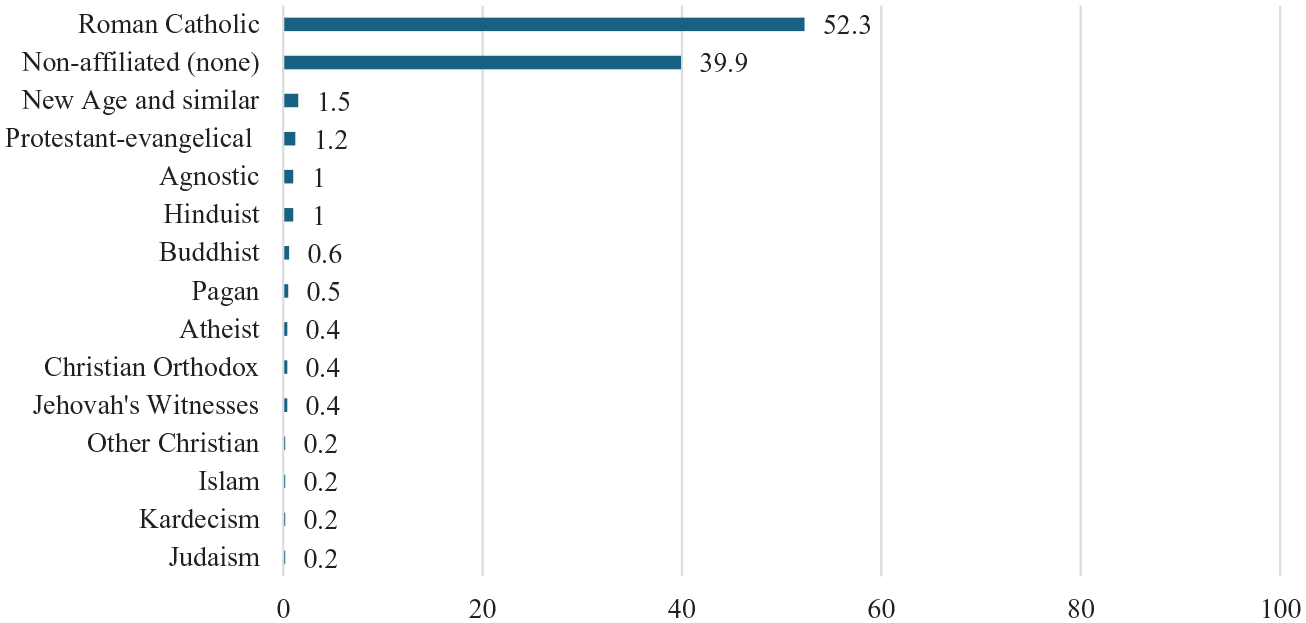
When you started practicing Buddhism, what religion did you belong to? (single-choice, valid cases n = 509, %).
Apart from these two main groups, Italian Buddhists indicate their adherence to various religious and spiritual minorities or declare their atheist views before being engaged in their new practice. For research purposes, we allocate participants other than the two mainstream primary identities (‘Catholic as primary belonging’ and ‘Religious none as primary belonging’) into a third group named ‘Other as primary belonging’. These three groups are considered in the context of new religious belonging of Italian Buddhists and their system of beliefs and practices, allowing us to designate patterns of MRB and MRP.
The process of acquiring a new affiliation with Buddhism has been examined through the lens of conversion, allowing us to interpret the former in terms of both fluent adaptation and a switch between prior and present belonging. Seven out of 10 participants note that their affiliation to Buddhism is not a conversion (Table 1); and 23.1% explicitly define their new affiliation in terms of conversion, showcasing a diversity of perspectives within the Buddhist community. A minority of 10.4% remain undecided, introducing an intriguing layer to the analysis by highlighting some ambiguity or lack of clarity about whether their adherence to Buddhism should be considered in terms of conversion.
Would you define your affiliation with Buddhism as a conversion? (valid cases n = 498, frequency, %).
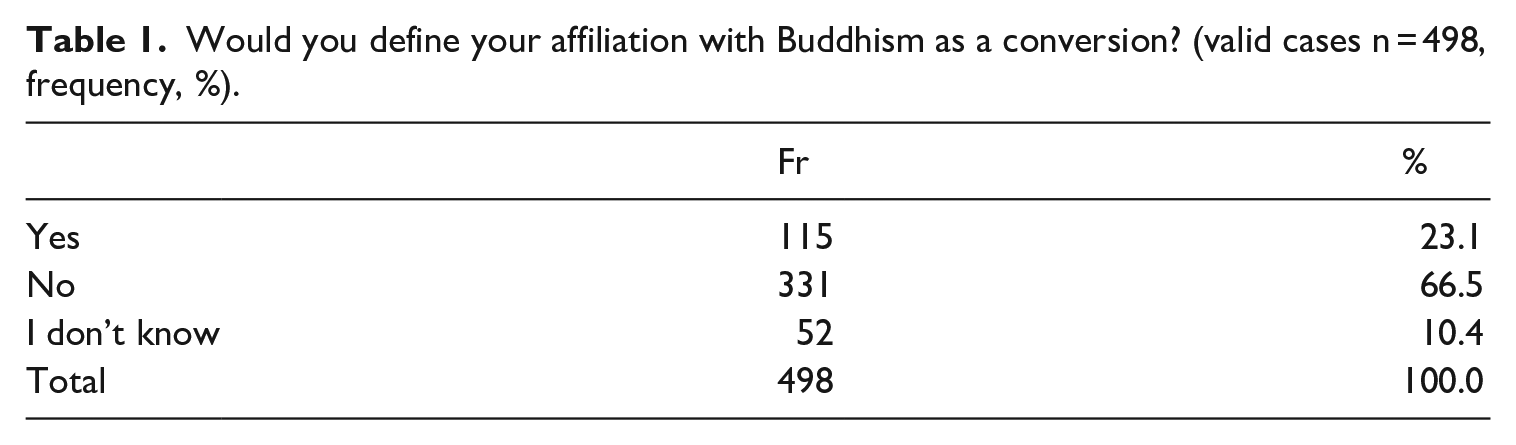
These findings highlight the non-exclusive nature of belonging to Buddhism, as participants perceive a sense of connection without the necessity of conversion. They emphasize that, in the Italian context, individuals – especially those with prior religious or secular affiliations raised in a Christian tradition – are actively exploring and cultivating a new sense of belonging within Buddhism. This majority of UBI members do not perceive their transition to Buddhism as an episode of rupture, in which the formation of a new self, distinct from, if not opposed to, the old self and the identity that existed before, are in conflict. However, it is important to consider more specific aspects that our article clearly highlights: for instance, those who approach Buddhism but retain their previous faith (NRBers), or those who practice certain Buddhist practices (such as meditation) to gain psychophysical benefits without genuine knowledge of or interest in the doctrine do not consider themselves converted, because they do not see themselves as belonging to a religion but rather to a philosophy of life or spirituality.
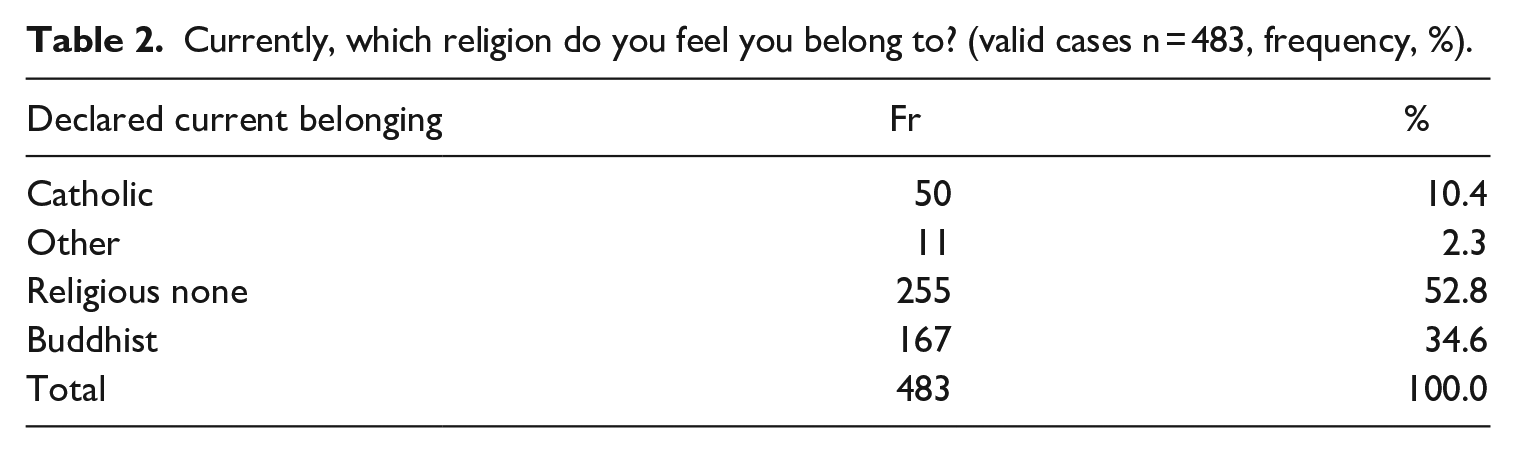
This indicates the possibility of the presence of the MRB phenomenon and its analysis among those who declare their primary identity as Catholics, religious nones, and others. They also emphasize the necessity for a nuanced understanding of the concept of conversion within the Buddhist context in Italy, underscoring the diversity of viewpoints within the UBI community and the multiple ways in which individuals navigate and integrate primary and new belonging and practices. This finding must also be interpreted within the context of the cognitive openness exhibited by the majority of participants toward different religions, a trait that is explored in more detail later in the analysis. Against this backdrop, our article explores new Buddhist belonging (Table 2) alongside participants’ primary religious belonging (Figure 1). Among those who attend UBI-centered activities, 34.6% declare current religious belonging as Buddhists, 10.4% as Catholics, 52.8% as religious nones, and 2.3% as others.
Currently, which religion do you feel you belong to? (valid cases n = 483, frequency, %).
Among those who previously declared that they belong to Catholicism, almost four out of ten confirm their Buddhist identity (Table 3), and two out of ten of the participants confirm the link with the first identity: They currently identify themselves as Catholics. Among those who had no previous religious belonging, almost seven out of ten continue to identify themselves as religious nones, while for three out of ten declare their belonging to Buddhism. As regards those who primarily identified with other religions, most of them (almost five out of ten) continue to declare no religious belonging, while four out of ten adhere to Buddhism.
Currently, which religion do you feel you belong to? (disaggregated data for the three groups, valid cases n = 483, frequency, column %).
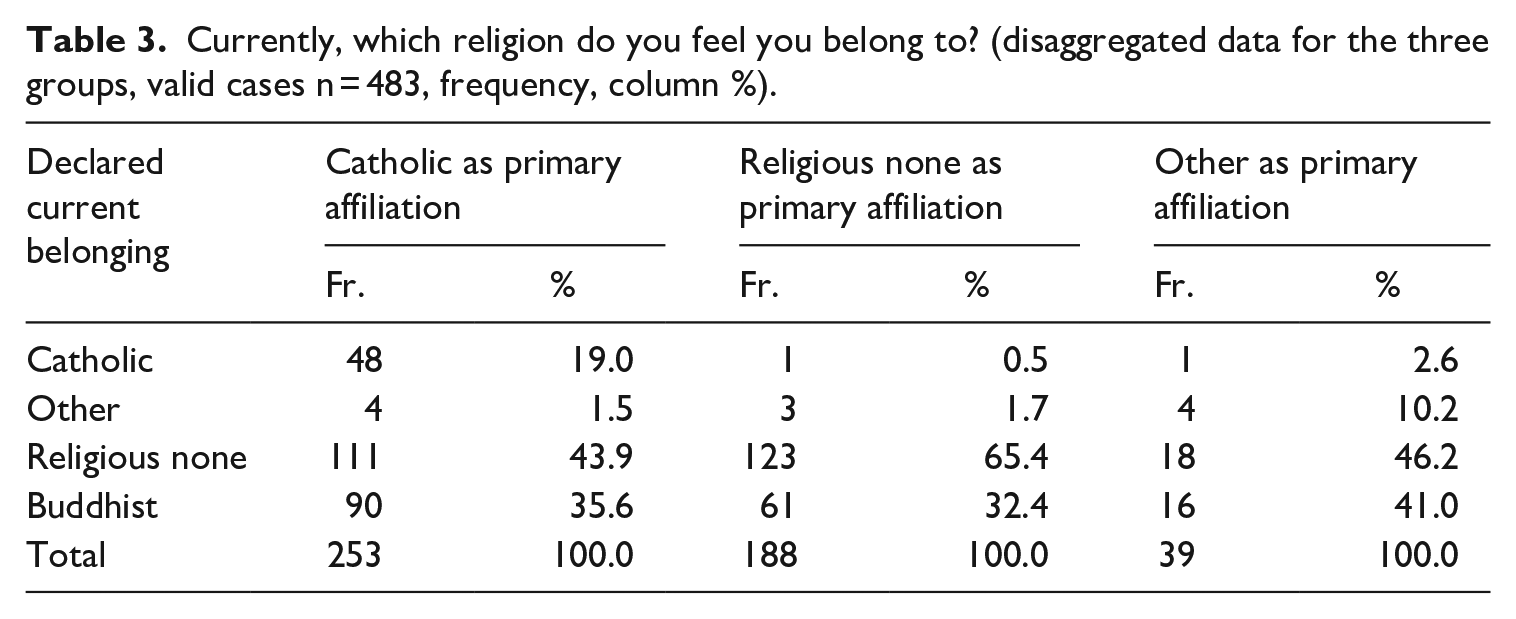
Again, all participants are engaged to a varying degree in activities of Buddhist centers. Nonetheless, the data presented in Table 3 illustrate the degree of association among multiple aspects of religious belongings, encompassing individuals’ values, intragroup relations, and practices.
To verify what has been said, Table 4 offers an analysis of participants’ Catholic socio-cultural background by showing how it can be associated with declared current identity. This is useful in understanding the MRB profiles of participants with respect to their Catholic background, taking into consideration that they have an average age of 54. Of those who declare Buddhist belonging, 94.6% were baptized, 90.9% had their first communion, 80.6% received confirmation, and 24.4% followed a marriage preparation course.
Could you please tell us about yourself: (‘YES’ answer, %).
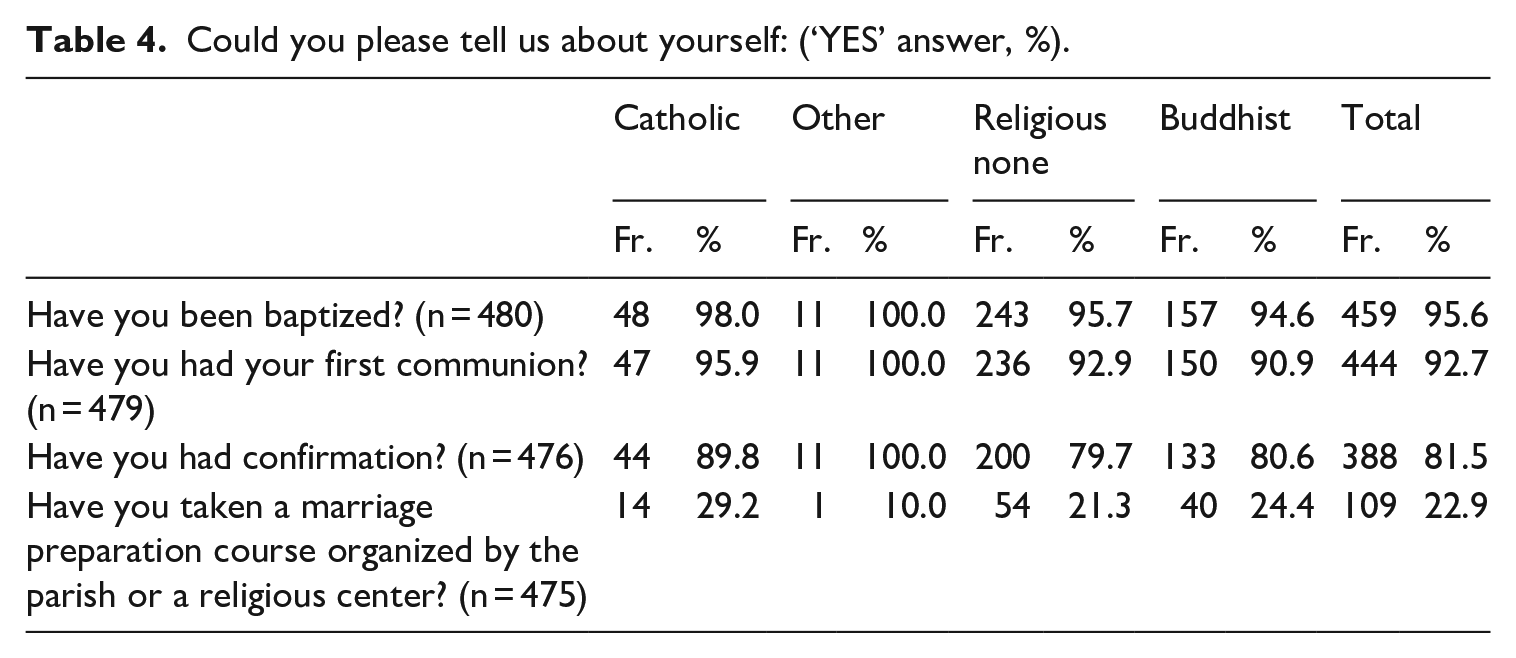
Similar percentages are found among religious nones: 95.7% were baptized, 92.9% had their first communion, 79.7% received confirmation, and 21.3% followed a marriage preparation course. As regards those who declared they previously belonged to other groups, 100.0% were baptized, had their first communion, and received confirmation, while only 10.0% followed a marriage preparation course (Table 4). The main Catholic rituals are, with some non-significant differences, transversal to the various previous affiliations. If this is plausible for those who have declared a previous Catholic affiliation, it may seem less intuitive for those who have declared not having belonged to any religion. Even for this group, the main Catholic rituals, such as baptism, first communion, and confirmation are present. These rituals are placed within a more cultural than active belonging (Garelli, 2020), a hypothesis confirmed by the fact that only two in ten, having reached adulthood, with greater independence, followed marriage preparation courses organized by Catholic parishes.
Multiple religious practice (MRP) among Italian Buddhists
In this section, we discuss the pattern of MRP of Italian Buddhists examining their engagement in Buddhist practices, participation in UBI centers, and attendance at Catholic mass, taking into account their currently declared and primary religious belonging. Two out of ten participants engage in Buddhist practices many times a day (Table 5), and together with those who practice it every day (52.9%), the daily practice is regular for seven out of ten Italian Buddhists. Practicing Buddhism on a weekly basis is important for two out of ten participants.
How often do you engage in Buddhist practice? (one answer only) (valid cases n = 505, frequency, %).
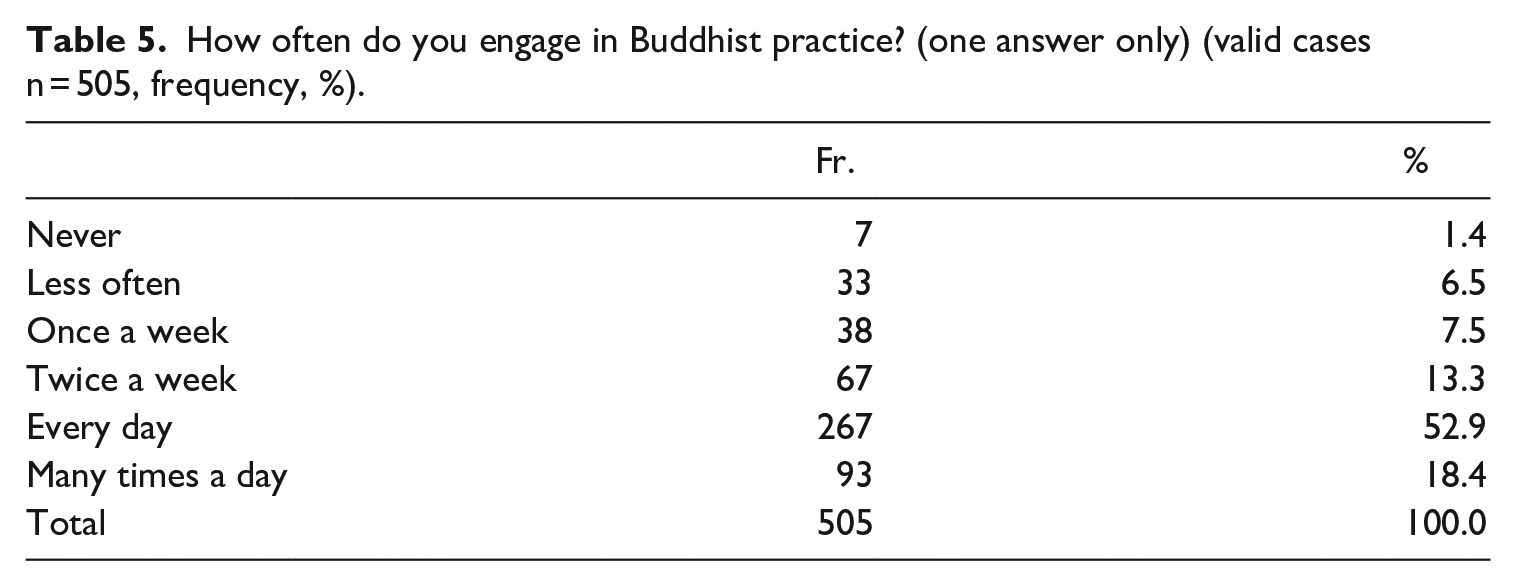
Buddhist practices, when examined alongside the MRB, yield some interesting results.
Among participants who declare current Buddhist belonging, eight out of ten engage in daily Buddhist practices (including 55.8% doing so every day and 28.5% many times a day). Similarly, seven out of ten self-declared religious nones, six out of ten from other religious affiliations, and five out of ten self-declared Catholics engage in daily Buddhist practices (Table 6).
How often do you engage in Buddhist practice? ( ‘YES’ answer) by declared current belonging (valid cases n = 477, frequency, column %).
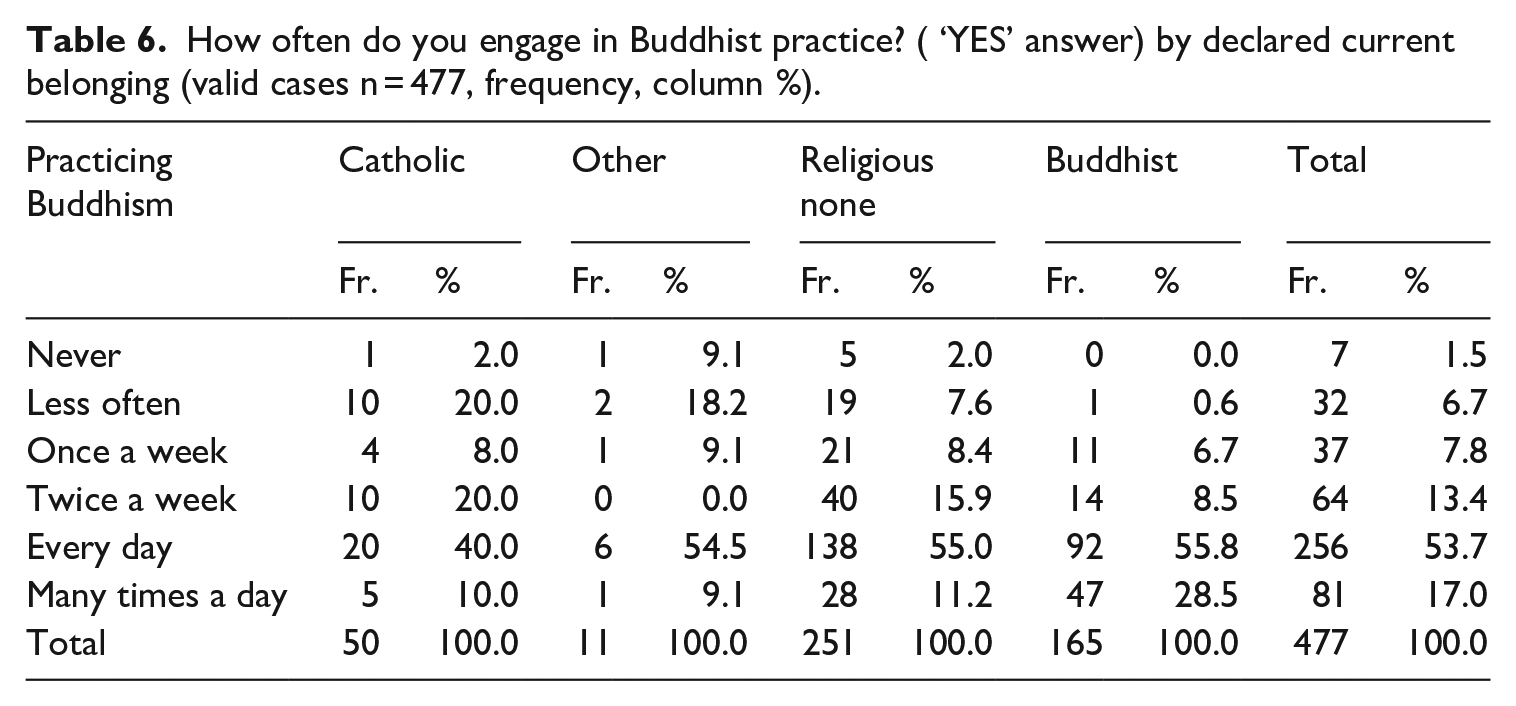
These findings provide valuable insights into the way individuals practice Buddhism relative to their primary religious belonging. Table 7 suggests that engagement in Buddhist practices is more coherent across three groups of participants while primary belonging is taken into account: seven out of ten are engaged daily and two out of ten weekly, except for the group of ‘Other as primary belonging’ who are more active in weekly participation (three out of ten). This comparison allows us to conclude that the new Buddhist identity produces more diversification in terms of religious practice between those who currently declare themselves as Buddhists and Christians.
How often do you engage in Buddhist practice? ( ‘YES’ answer) by primary religious belonging, valid cases n = 501, frequency, column %).
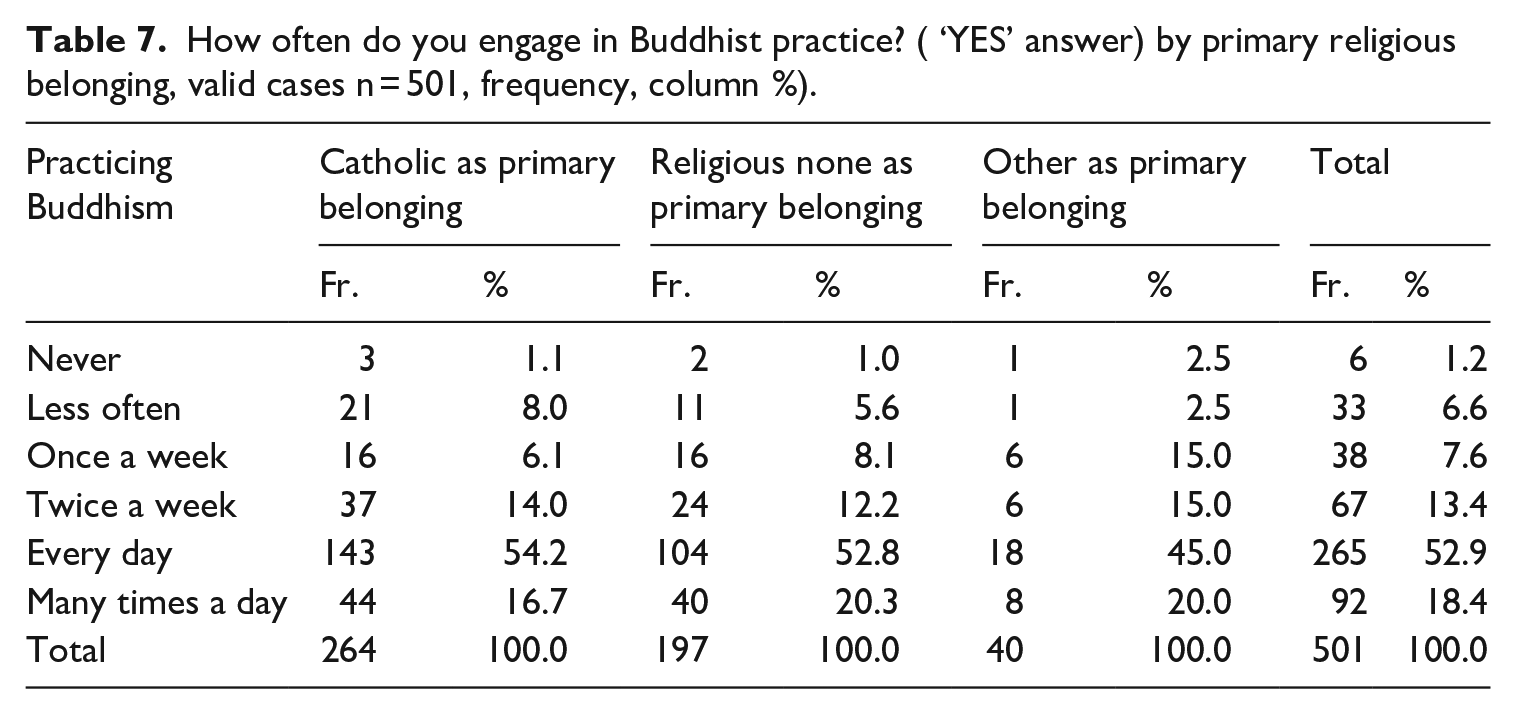
Moreover, we conducted a statistical test controlling for the association between previous religious affiliation and Buddhist practices (χ² and Cramer’s V have statistical significance at the level of p < .001). These findings suggest that current religious identity has an influential role in shaping Buddhist practice frequency, underscoring the importance of multiple religious belonging in the religious practices of UBI members.
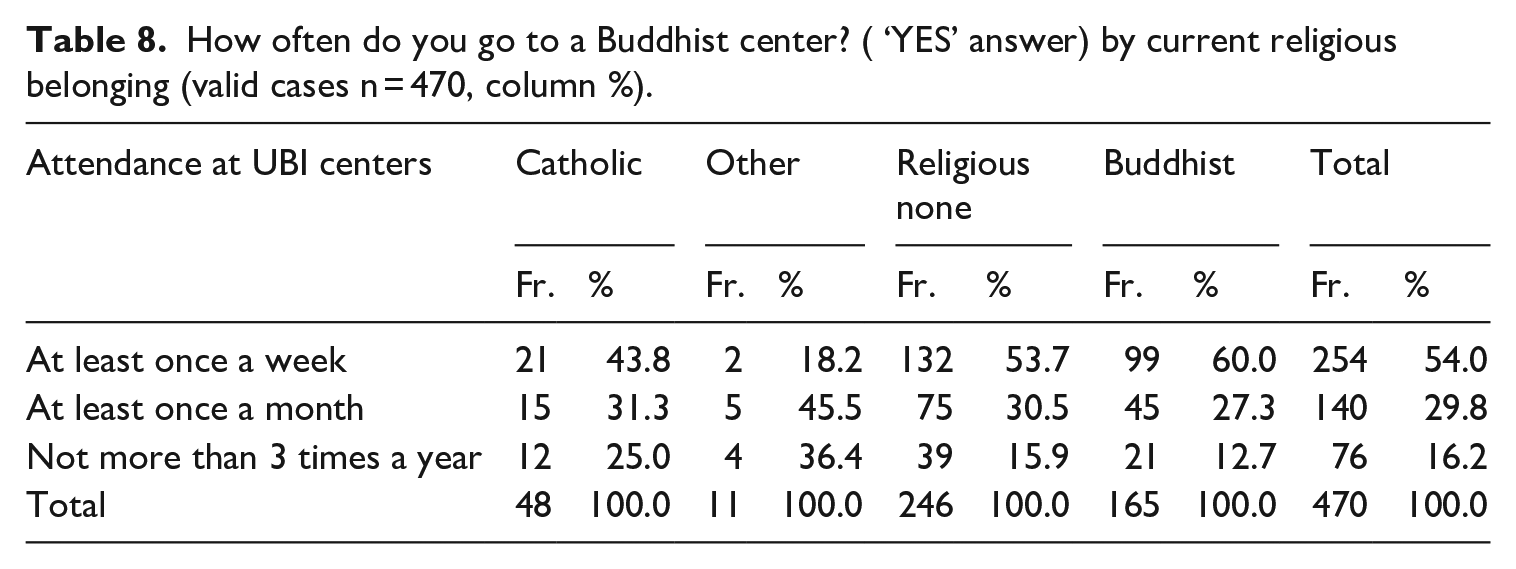
Data about participants’ attendance at UBI centers (Table 8) illustrate particular dynamics: six out of ten of those who declared themselves as Buddhists are engaged in weekly UBI centers’ activities, as do four out of ten of those who currently consider themselves Catholics. Almost 54% of those who declared themselves to be ‘religious nones’ go to UBI centers weekly.
How often do you go to a Buddhist center? ( ‘YES’ answer) by current religious belonging (valid cases n = 470, column %).
As with Buddhist practices, Table 9 shows that data about the compared groups are more coherent if we associate attendance at UBI centers with primarily religious belonging. Fewer differences can be observed across the three groups of participants with primary belonging as Catholic, religious none, and other in their answers.
How often do you go to a Buddhist center? ( ‘YES’ answer) by primary religious belonging (valid cases n = 497, column %).
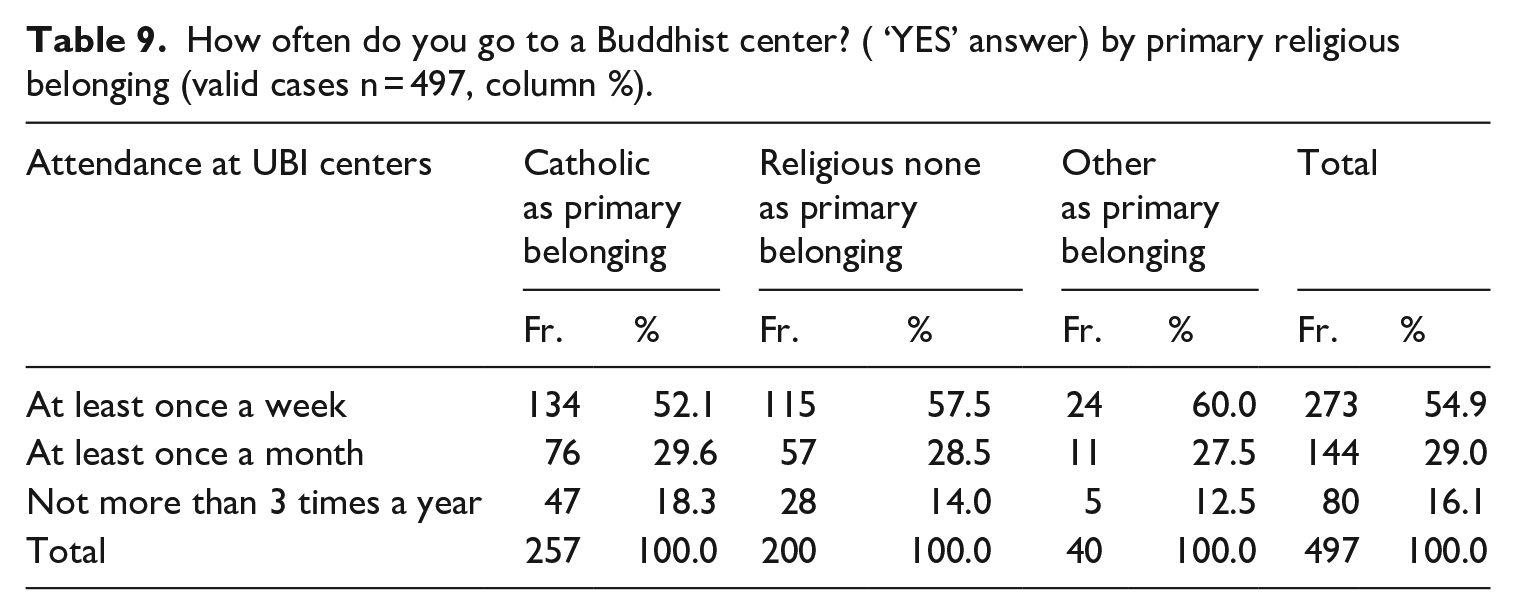
These two tables show that ‘multiple’ characterizes a relationship within at least two identitarian aspects of the same dimension of religiosity (for instance, declaration of belonging to Buddhism and Christianity); however, it illustrates some contrast between these two aspects when the other dimension is added (for instance, attendance at a Buddhist center or Buddhist practice). In both cases (Tables 6 to 9) MRB has to be seen not in terms of opposition to prior belonging to that currently declared (being Buddhist but not Christian or being Christian but not Buddhist). This suggests that Italian Buddhists do not feel compelled to compartmentalize various spheres of their religious belonging and practice.
Then, we compared the frequency of Buddhist practices with attendance of Catholic mass of Italian Buddhists (Table 10). It is useful to observe that during the last 12 months 15.6% of participants attended a Catholic mass once or twice a year and 13.6% more regularly. This excludes baptisms, first communions, confirmations, weddings, and funerals. That is to say that three out of ten Buddhists attend Christian services.
In the last 12 months, have you attended a Catholic mass, excluding baptisms, first communions, confirmations, weddings, and funerals? ( ‘YES’ answer) by primary religious belonging (valid cases n = 494, column %).
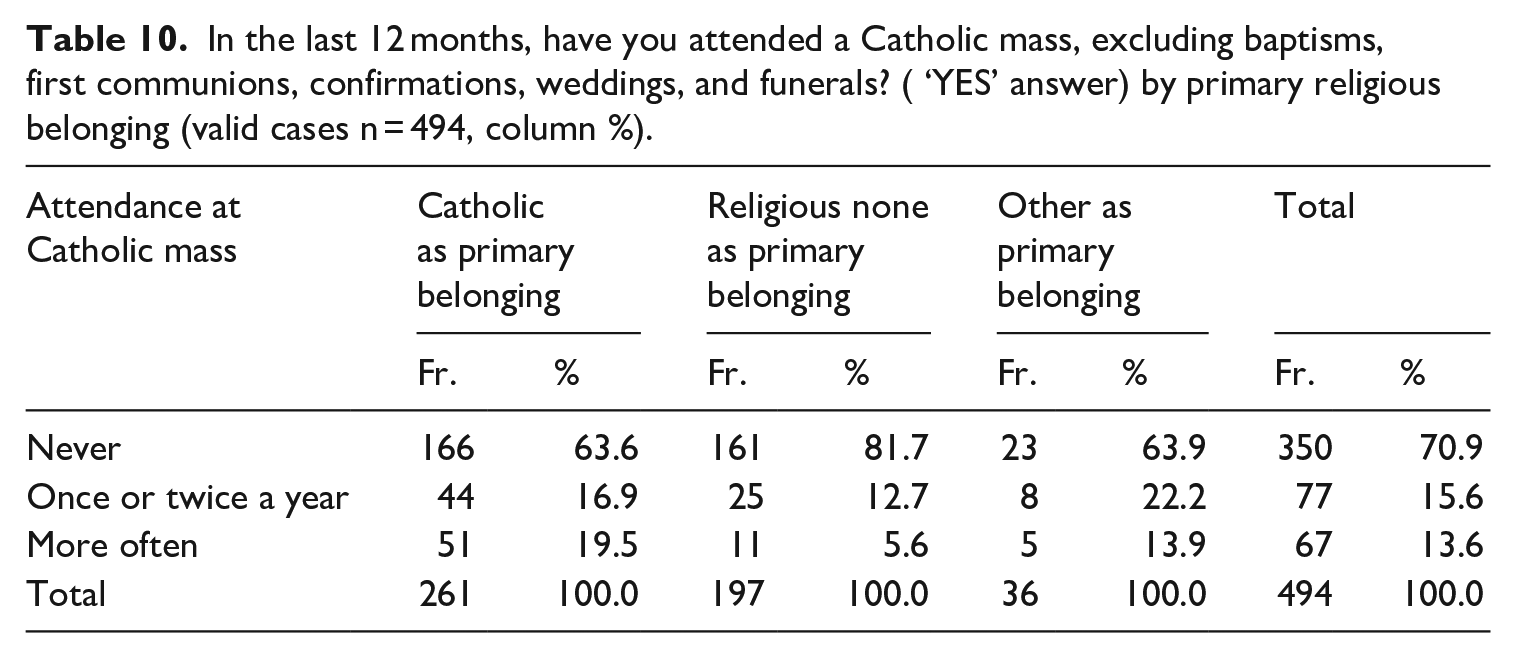
More specifically, we take into consideration attendance at Catholic mass by comparing affiliation as a primary identity and currently declared affiliation (Table 10). For those who attend UBI centers and who identify as Catholic, approximately one-third currently attend both Buddhist activities in the centers and Catholic mass once or twice a year or more frequently. But if we cross the current religious affiliation (Table 11) we discover that the new identity as Catholic/Buddhist also produces more active engagement in Catholic practice.
In the last 12 months, have you attended a Catholic mass, excluding baptisms, first communions, confirmations, weddings, and funerals? ( ‘YES’ answer) by current religious belonging (valid cases n = 473, column %).
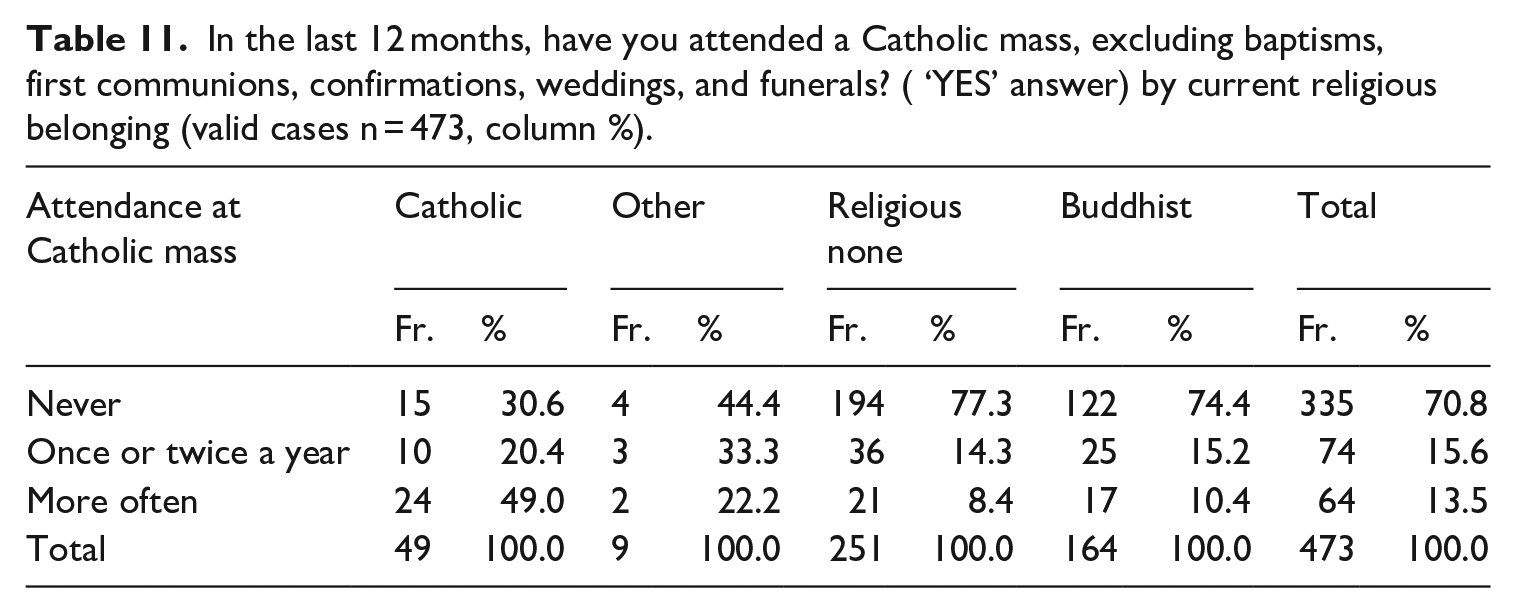
When examining the current religious affiliation of participants in Buddhist centers, it is noteworthy that among those who presently declare themselves as Buddhists, nearly 26% attended Catholic mass once or twice a year or more frequently in the past 12 months (Table 11). As regards those who identify themselves as currently non-affiliated, almost eight out of ten never attended Catholic services: almost 23% participated in religious services of the Catholic Church during the last year.
Among those who still identify as Catholic, only three out of ten did not attend Catholic mass, whereas five out of ten continue to practice more often than twice a year and two out of ten attend mass once or twice a year. Once again there is no clear compartmentalization of religious practices. Individuals who engage in Buddhist activities simultaneously participate in the main Catholic rites, blurring the lines of their affiliation.
The intersection of participants’ engagement in Buddhist practices and attendance at Catholic mass suggests findings about multiple practices of Italian Buddhists (Table 12). Among those who are engaged in daily Buddhist practices, almost 27% attend Catholic mass once or twice a year, more often during the previous year (14.7% and 11.9%). Among those who practice Buddhism weekly, almost 37% attend Catholic mass annually or more often (19.8% and 16.8%). Among those who engage in Buddhist practices less often than weekly, four out of ten participants attended Catholic mass once or twice a year during the last 12 months.
Question: In the last 12 months, have you attended a Catholic mass (excluding baptisms, first communions, confirmations, weddings, funerals)? by question: How often do you engage in Buddhist practice? a (valid cases n = 486, column %).
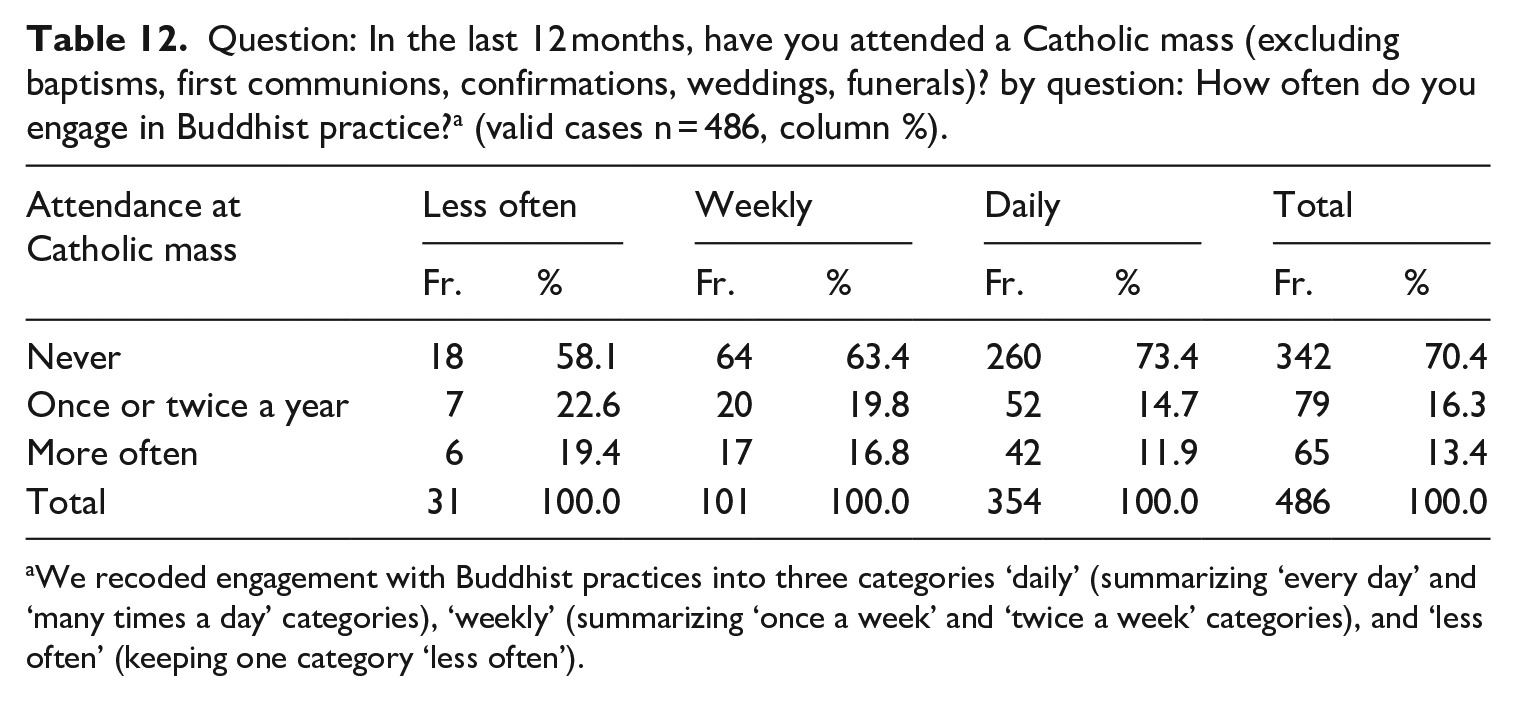
We recoded engagement with Buddhist practices into three categories ‘daily’ (summarizing ‘every day’ and ‘many times a day’ categories), ‘weekly’ (summarizing ‘once a week’ and ‘twice a week’ categories), and ‘less often’ (keeping one category ‘less often’).
Even if the majority did not attend Catholic rites, three out of ten Italian Buddhists attending Catholic rites and engaging with Buddhist practices are not mutually exclusive.
The dynamic of MRB and MRP can be better understood if we consider the perceptions of religious pluralism by UBI members. The pluralistic perspective of Italian Buddhists was examined (Table 13) by considering five distinct views on pluralism (Astley and Francis, 2016). These viewpoints range from atheism (denying the existence of significant truths in any religion) to pluralism (acknowledging that truth can be found across various religious traditions).
To which of the following statements do you feel closer? (single response, valid cases n = 501, %).
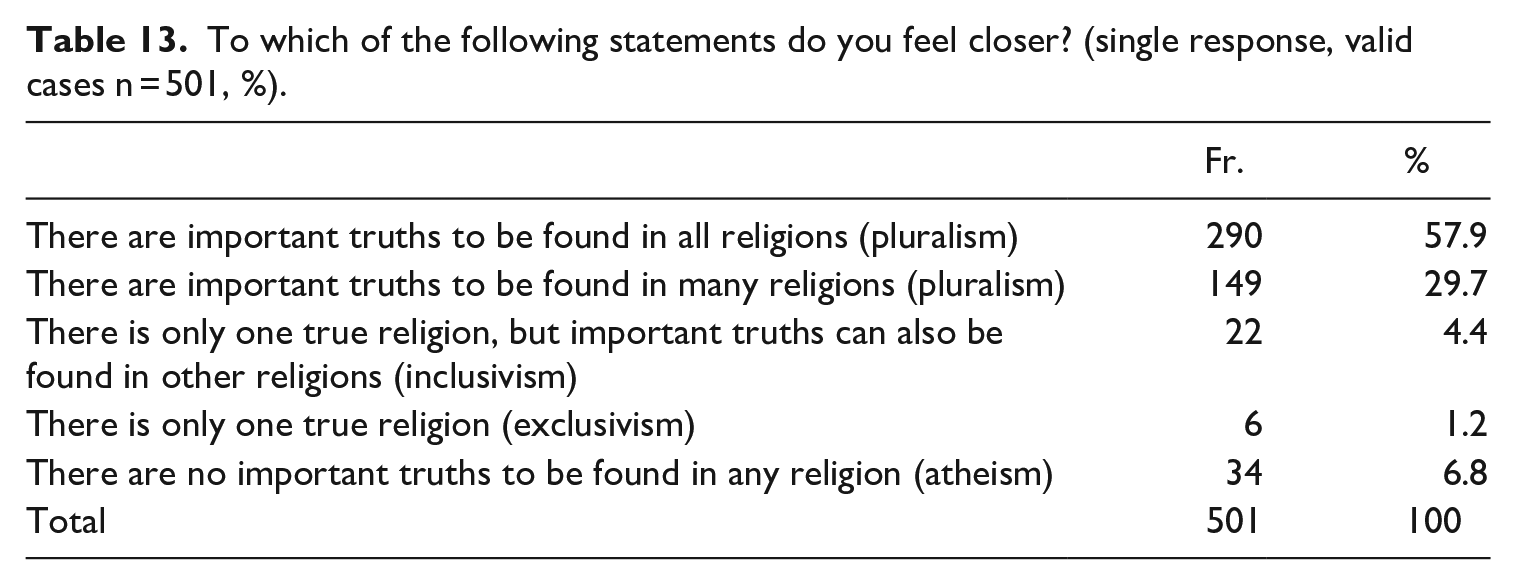
The data (Table 13) highlights cognitive openness toward different religions, with 9 out of 10 participants demonstrating a pluralistic attitude. This is particularly notable, given that embracing Buddhism is generally not perceived as a conversion by the participants, underscoring how Buddhist identity in Italy aligns with pluralistic values and perspectives.
Discussion and conclusion. Toward non-binary religious belonging and practice?
This article is envisaged as an explorative study of MRB and MRP among individuals who are actively engaged in the activities of UBI centers throughout the Italian peninsula. Through empirical analysis of this specifically targeted group, which maintains strong connections and relationships with both Buddhist communities and a Christian background (95.6% being baptized, 92.7% having made their first communion, and 81.5% having received confirmation), we intended to test the hypothesis of Yang and McPhail (2023) regarding the presence of the phenomenon of multi-religiosity among Italian Buddhists, being focused on patterns of MRB and MRP within the cultural context of a predominantly Christian tradition.
Our findings suggest that the phenomenon of MRP for UBI members is discernible in the Italian Catholic context. Nearly 30% of those who are engaged in Buddhist practices attended Catholic mass during the last year (Table 12), 16.3% participated in Catholic mass once or twice a year, and 13.4% even more often.
Among UBI members, the MRB phenomenon exists, albeit less prominently. Before engaging with Buddhism, 52.3% belonged to the Catholic Church, while 39.9% were non-affiliated (Figure 1). After engaging with Buddhism, the percentage of those who declared their belonging to Catholicism declined to 10.4% and religious nones increased to 52.8%, while those who declared belonging to Buddhism increased from 0.6% to 34.6% (Table 2). The data on MRB become more informative when we compare participants’ prior belonging (before engaging with Buddhism) to their current identities (after engaging with Buddhism). Among those who previously identified as Catholics before practicing Buddhism, 35.6% confirmed their belonging to Buddhism (Table 3), while 19.0% continued to identify as Catholics. Among those who had no religious belonging before, almost seven out of ten continue to identify as religious nones, while three out of ten declare their belonging to Buddhism.
More specifically, the data about MRB offers several insights relevant to our study. First, the results have to be considered against the background that almost 36% of participants view Buddhism as a philosophy of life. This can explain the high percentage of those who identify themselves as being ‘religious none’ while practicing Buddhism. In the general sample, the proportion of ‘nones’ shifted among participants upon entering UBI centers: they made up nearly 40% before practicing Buddhism and increased to almost 53% after joining UBI. This trend warrants further investigation, as it reflects both the ongoing secularization of Italian society and a growing search for alternative spiritualities.
Second, it is important to recognize the significance of the finding that individuals previously identified as ‘other’ are more likely to declare their current affiliation as either Buddhist or ‘religious nones’. The data reveal that after beginning Buddhist practices, nearly 46% of this group identify as religious nones, while 41% identify as Buddhists. Many in this group come from religious minorities, where the process of developing new religious and social identities is particularly important. This is due to the fact that religious minorities often have less porous boundaries and experience greater social marginalization in their interactions with other religious groups.
This study suggests that in the Catholic cultural context, MRB reinforces the motivation of individuals to follow multiple religious practices. This is valid for Buddhists who declare their current identity as Catholic, and who attend Catholic mass nearly twice as often as before engaging with Buddhism. Indeed, participation in Buddhist practices can lead to an affinity with Catholic rituals, resulting in an unambiguous fusion of engagement in two religious traditions. We recognize that our instrument does not include direct measures of religious practices prior to participants’ engagement with Buddhism. However, the comparison we present is based on current participation in both Christian and Buddhist practices. While we cannot directly infer changes in religious activity over time, the present patterns of dual participation reveal valuable insights into how individuals navigate multiple religious identities. This observation underscores the coexistence of religious practices, rather than assuming a decline in Christian engagement following Buddhist involvement.
The finding can be explained by the combination of various factors referring to the Italian pluralistic condition. On the one hand, it is guaranteed by a particular regime of religious freedom (Breskaya et al., 2022; Ferrari, 2023; Giorgi et al., 2022) and internal pluralism of the Catholic Church in Italy (Diotallevi, 1999). On the other hand, similar to the Dutch case (Berghuijs, 2017) combination of Christian-Buddhist identities indicates the openness toward pluralistic worldviews among those who keep and develop this multiple identity. As some studies show, it can be due to the ‘appealing values’ considered through ‘respect, honesty, sobriety, and simplicity’ (Berghuijs, 2017: 27) that attract individuals to identify themselves as Buddhists. Moreover, the data about pluralistic worldviews of UBI members shed light about how varying current belonging is associated with openness to the pluralistic worldviews.
More specifically, a detailed analysis of perceptions of religious pluralism within our sample indicates that the largest proportion of pluralists is found among those who identify as Catholic (almost 96%). This is followed by the group categorized as ‘other’, with nearly 91% identifying as pluralists, and 88% of those who identify as Buddhists also expressing pluralistic views. Moreover, we can ascribe this difference to the sociodemographic characteristics of the Italian sample, where a majority of participants are aged older than 40, with most having attained higher education.
These particular dynamics between MRB and MRP in the context of cultural Catholicism and secularity (with a considerable number of religious nones), suggest that the argument of Yang and McPhail (2023: 239) about the presence of ‘inclusive or hybrid religiosity’ finds support within our sample of Italian Buddhists. However, our data show a higher proportion of those who declare multiple belongings compared to the findings presented by Yang and McPhail. Although we used different measures for MRB compared to those applied by Yang and McPhail (2023) in their study, we can contrast the 10.4% of Italian Buddhists who simultaneously identify themselves as Catholics in our study with the average of 4.3% of MRBers from various East Asian countries, as reported by Yang and McPhail (2023: 227).
We can attribute this difference to the Catholic upbringing and socialization of the participants. Within this Catholic context, the patterns of religious affiliation and community involvement reflect aspects of ‘church religion’ serving as ‘a basic cultural model of reference’ (Palmisano and Pannofino, 2017: 143) for individuals navigating multi-religious choices. Thus, the hypothesis about the larger share of Italian Buddhists exhibiting MRB compared to the data gathered by Yang and McPhail in their study is proved.
The MRP data are also higher in our study of UBI members, with 29.7% among them participating annually or more often in Catholic mass, compared to 17.2% reporting annual participation in MRP in the sample of East Asian students (Yang and McPhail, 2023: 231). Although Yang and McPhail (2023) confirmed that ‘multiple religious affiliations is less common among monotheists than polytheists’, they also observed that ‘it might be surprising to see the high proportions of monotheists who either believe in or practice more than one religion’ (p. 237). Further research is needed to explore the differences shaped by participants’ sociodemographic characteristics, especially as the studies examined various age cohorts. Notably, in both studies, multiple religious practice (MRP) was found to be more prominent than multiple religious belonging (MRB), a key finding that merits attention.
Our observations about MRB and MRP within the Italian Catholic context highlight the importance of further research into multi-religiosity within a sociocultural environment that is culturally monotheistic and at the same time conducive to pluralistic perspectives and values (Berger, 2014; Breskaya et al., 2024; Giordan and Pace, 2014). This calls for revisiting previous studies in the sociology of religion to better understand the dynamics of MRB and MRP among individuals, particularly by engaging with concepts such as ‘bricolage’ (Altglas, 2014) and the notions of the ‘pilgrim’ and ‘convert’ (Hervieu-Léger, 1999).
We observe that the possibility of multiple identities becomes a reality if membership ‘in a particular tradition do not include an exclusive commitment to this tradition’ (Cornille, 2010; Oostveen, 2017: 41), thus indicating the existence of experiential realms beyond a single tradition (Hick, 1990). They emphasize the importance of developing criteria for measuring MRB and MRP considering their interrelationship (Berghuijs, 2017) as well as the sociocultural context in which individuals experience them. Furthermore, the prominence of MRP in our study underscores that the concept of double or multiple belonging must be analyzed alongside other criteria and modalities of contemporary religiosity and secular worldviews (Finke and Bader, 2017).
The concept of MRB and MRP could be more accurately described as co-joined belonging, emphasizing that practitioners do not draw rigid boundaries between religious traditions. Instead, they view these practices and identities as integral to their personal spiritual journey. Among UBI members in the Catholic context, MRB and MRP highlight the importance of having non-binary options–where individuals can make choices and fluidly navigate across different traditions. This flexibility allows for a more inclusive and personalized spiritual experience.
Footnotes
Acknowledgements
PierLuigi Zoccatelli passed away suddenly during the final drafting of the article. We dedicate this work to him, cherishing his memory with affection and gratitude. The authors are very grateful to the anonymous reviewers for their careful reading, detailed comments, and suggested improvements for this manuscript.
Funding
The authors disclosed receipt of the following financial support for the research, authorship, and/or publication of this article: This article is based on a study carried out by both the University of Padua and the University of Turin, funded by Italian Buddhist Union (UBI), and entitled ‘Buddhism in Italy. A Study on the Italian Buddhist Union’.

Notes
Authors biographies
Address: Department of Philosophy, Sociology, Education and Applied Psychology, University of Padova, via Cesarotti 10/12, Padova 35123, Italy.
Email:
Address: Department of Culture, Politics and Society, University of Turin, CLE–Campus Luigi Einaudi, Lungo Dora Siena 100, Turin 10153, Italy.
Email:
Address: Department of Philosophy, Sociology, Education and Applied Psychology, University of Padova, via Cesarotti 10/12, Padova 35123, Italy.
Email:
Address: Department of Philosophy, Sociology, Education and Applied Psychology, University of Padova, via Cesarotti 10/12, Padova 35123, Italy.
Email: