



Abstract
This article is centred on the diverse modes of articulation between Tambor de Mina – the African-Brazilian religion prevalent among the Black population of São Luís (the state capital of Maranhão, Brazil) – and Holy Ghost feasts – a Catholic feast that is the most important public celebration in Tambor de Mina cult houses. My focus is on the creative processes associated with these diverse modes of articulation. I argue that these processes are connected, on one hand, to the wider politics of boundary management between religious genres that each cult house adopts and, on the other hand, to different politics of display and containment centred on the visibility of Tambor de Mina in the public space. The article is both a contribution to recent anthropological debates on creativity and to discussions on processes of interface between different religious genres in African-Brazilian religions.
Tambor de Mina is the prevalent African-Brazilian religion among the Black population of São Luís, the state capital of Maranhão (NE Brazil). Despite occupying a rather marginal position in studies of African-Brazilian religions (Endler and Brito, 2016), Tambor de Mina has been the object of a number of anthropological studies, ranging from the pioneering monographs of Nunes Pereira (1979 [1947]) and Otávio Eduardo (1948) to the recent approaches proposed by Sérgio Ferretti (1995; 2001; 2009 [1985]) and Mundicarmo Ferretti (2000).
Like other African-Brazilian religions, Tambor de Mina is organized around independent cult houses directed by pais or mães de santo (‘fathers or mothers of saint’), who assemble a variable number of devotees, called fihas and filhos de santo (‘daughters and sons of saint’). A major distinguishing trait of Tambor de Mina is the importance of voduns – African deities of Jeje origin – in its spiritual pantheon. 1 Besides voduns, most cult houses also worship other spiritual entities, such as orishas (African deities of Yoruba origin) and encantados (‘the enchanted ones’). The encantados, in particular, play a major role in Tambor de Mina. They correspond to spirits of individuals who, after an earthly existence, were enchanted and now live in worlds parallel to that occupied by humans, in rivers, in the sea, or under the earth. In most cult houses, the encantados include several categories of spiritual entities: caboclos, princesses, European kings and noblemen, turcos (‘Turkish’), and surrupiras. 2 While caboclos can also be found in other African-Brazilian religions, European kings and noblemen, as well as turcos, are spiritual entities who only exist in Tambor de Mina cult houses. Some of these spiritual entities have originated in the Tambor de Mina, while others derive from other religious genres such as pajelança (the local designation given to shamanistic beliefs and practices of Indigenous origin) and Terecô (the African-Brazilian religion prevalent in Southeast Maranhão). 3 These different entities are organized in families, and the underlying principle of Tambor de Mina is its ‘spiritual productivity’ – to quote a concept proposed by Maurizio Bettini (2016: 122–23) in another context.
As in other African-Brazilian religions, spirit possessions, along with animal sacrifices and other offerings, are the main forms of cult practice in Tambor de Mina cult houses. Spirit possession takes place during sessions of singing and drumming – called toques de tambor – that can last for hours, during which the devotees incorporate a plurality of encantados. The script of Tambor de Mina also includes other drumming and singing sessions dedicated to specific categories of spiritual entities, such as the tambor da mata – dedicated to the spiritual entities of the mata (‘bush’) – the tambor de índio – dedicated to the spirits of ‘wild Indians’ – and the toque de cura – curing sessions where encantados related to pajejelança are invoked. Some of these rituals have allegedly originated outside Tambor de Mina but were eventually incorporated in its ritual script. The same applies to several other celebrations that are part of the annual calendar of Tambor de Mina. Besides its spiritual productivity, Tambor de Mina is thus characterized – as other African-Brazilian religions – by its ritual productivity. In both cases, expansion and aggregation (Parés, 2011: 271) seem to be the basic tenets of Tambor de Mina.
Spiritual and ritual productivity, based on expansion and aggregation, are also important to understand another important aspect of Tambor de Mina: the role played by Catholic beliefs and practices in its ritual script. This point was already stressed by Otávio Eduardo (1948), who, as a student of Herskovits, viewed Tambor de Mina as an example of ‘religious acculturation’. But it was more strongly emphasized by Sérgio Ferretti, whose second monograph on the Casa das Minas (Ferretti, 1995) was dedicated to the study of syncretism. Other authors have also stressed this aspect of the cult (e.g. Barretto, 1987: 180; Halperin, 1995: 70–96).
Syncretism has been a concept widely used to characterize other African-Brazilian religions (notably Candomblé; see Bastide, 1960). However, the available literature has documented a much stronger relationship between Tambor de Mina and Catholicism than between other African-Brazilian religions and Catholicism. Also, contrary to what has happened since the 1980s in other African-Brazilian religions such as Candomblé (Sansi, 2007; Serra, 1995), de-syncretization is a largely irrelevant trend in contemporary Tambor de Mina.
This openness of Tambor de Mina towards Catholicism has many expressions. Besides the more usual analogies between African spiritual entities and Catholic saints (or Virgin Mary invocations), drumming and singing sessions are generally preceded by Catholic litanies and prayers, and most cult houses celebrate Catholic feasts such as Christmas, Saint Barbara – who is viewed as the patron saint of Tambor de Mina – or Saint Lazarus – honoured with the so-called banquete dos cachorros (‘dog’s banquet’). 4
Among the Catholic feasts celebrated by Tambor de Mina, Holy Ghost feasts stand as the most important. Holy Ghost feasts originated in the early fourteenth century in continental Portugal. In the fifteenth century, they travelled to the Atlantic archipelagos of Madeira and the Azores. Beginning in the seventeenth century, the feasts migrated from both the Azores and continental Portugal to Brazil, where they can be found in several states. In Maranhão, the feasts were allegedly introduced in the early seventeenth century by Azorean colonists, and they are currently the most important Catholic feast throughout the state (Gonçalves and Leal, 2016). They also provide the model for other Catholic feasts in the state (Pacheco, 2004).
In São Luís, the co-option of Holy Ghost by Tambor de Mina cult houses dates back to the late nineteenth century. In the 1940s, Eduardo (1948) found that the majority of the 20 cult houses then active in São Luís celebrated the feast. Current data show that, out of around 120 Tambor de Mina cult houses, 70 celebrate it (Leal, 2014).
The objective of this article is to analyse the modes of articulation between Tambor de Mina and Holy Ghost feasts. It could be that the feasts were organized by Tambor de Mina cult houses according to principles of autonomy between African-Brazilian and Catholic beliefs and ritual practices that can be found in other African-Brazilian religions. Actually, at the beginning of my research, the autonomy of the feasts vis-à-vis the Tambor de Mina was stressed by many fathers and mothers of saint: as one of them told me, ‘Mina é Mina, Divino é Divino (‘Mina is Mina, the Holy Ghost is the Holy Ghost’). However, as I soon came to realize, in most cult houses, the organization of Holy Ghost feasts leads to the establishment of diverse articulations with Tambor de Mina spiritual entities and rituals. The feast remains admittedly a Catholic feast, but its appropriation by Tambor de Mina cult houses is often based on the exploration of ontological compatibilities and ritual interactions between both religious genres.
This article emphasizes the diversity of these modes of articulation. Although the feast itself has a rather fixed script, the connections that are established between Holy Ghost feasts and Tambor de Mina are characterized by flexibility. I argue that this flexibility has two main reasons: on one hand, it is connected to the wider politics of boundary management between religious genres that each cult house adopts; while on the other hand, it is associated with distinct politics of display and containment (Castillo, 2010; Johnson, 2002) centred on issues related to the visibility of Tambor de Mina in the public space. In any case, what is at stake is the creative management of the connections and boundaries that govern the interaction between Tambor de Mina and Holy Ghost feasts.
The article should thus be read as a contribution to anthropological debates on creativity (e.g. Hallam and Ingold, 2007; Liep, 2001). By stressing how creativity is intrinsically linked to the making of the feast, it argues that creativity does not pertain to the ‘extraordinary’, but it is part of the very process of cultural reproduction of the feasts by Tambor de Mina cult houses. It also emphasizes how creativity rests not only in the adoption of innovations but also in their creative management, based both on mimesis and on the reframing of inherited worldviews and rituals. Finally, it also emphasizes that creativity is both dependent upon and enabling of the political conditions in which Tambor de Mina cult houses operate, characterized by the centrality of issues related to their visibility in the public sphere.
By focusing on the relationships between an African-Brazilian religion and a Catholic ritual, the article is also a contribution to recent discussions on processes of interface between different religious genres in African-Brazilian religions (e.g. Capone, 2005, 2014; Goldman, 2015; Oro and Anjos, 2008). By emphasizing the variable articulations between Tambor de Mina and Holy Ghost feasts, the article locates them not in the distant past of ‘syncretism’ but in the present day predicaments that characterize an African-Brazilian religion in the making. It also addresses them not so much as final products but as processes that constantly reshape the relationships between the two religious genres.
The article is based on 9 months of fieldwork carried out in seven cult houses between 2011 and 2014. My initial focus was on the more prestigious Tambor de Mina cult houses, such as Casa das Minas, Casa Fanti-Ashanti, Casa de Iemanjá, and Dona Elzita cult house. As most of these cult houses had been the subject of previous studies, my idea was to draw on the more general information available on them and concentrate on the study of Holy Ghost feasts. Later, I decided to extend my fieldwork, in order to include feasts that took place in less known cult houses. Two of them – Ilê Ashé Obá Izô and Jardim da Encantaria cult houses – had the additional advantage of being led by young fathers of saint and the third one – Pai Edmilson cult house – was chosen because of its particular blend of Tambor de Mina and Umbanda.
Holy Ghost feasts: modes of articulation
Holy Ghost feasts in São Luís are religious celebrations in honour of the Holy Ghost centred on a crown, topped by a dove that represents the Holy Ghost. Besides the crown, the Holy Ghost is represented by a wooden dove and a mastro (‘flagpole’), which also signals the place where the feast takes place. While some feasts honour exclusively the Holy Ghost and take place on Pentecost Sunday, most of them honour both the Holy Ghost and a Catholic saint (or a Virgin Mary invocation) and take place throughout the year. The so-called impérios (‘empires’) – six children of both sexes – are the central protagonists of the feasts. They wear royal costumes, and two of them – the emperor and the empress – also wear a small crown. The feasts can last up to 3 weeks and include several ritual segments, such as the buscamento and levantamento (‘lifting up’) and derrubamento (‘bringing down’) of the flagpole, the coronation of the emperor and the empress, a Mass, several meals, including a large meal open to the public, and sessions of prayer and songs dedicated to the Holy Ghost and other Catholic spiritual entities. The feasts have a musical repertoire of their own, which is performed by groups of six to eight women, mostly Black, who play drums and sing – the so-called caixeiras (‘drummers’). 5
Holy Ghost feasts are usually viewed in São Luís as the festa maior dos terreiros, that is, ‘the most important feast that takes place in Tambor de Mina cult houses’ (Leal, 2014). They are the most expensive feasts and the one that requires a larger amount of work. They are also the public celebration that opens up Tambor de Mina cult houses to larger audiences and to the public sphere. As Dona Bidoca – who is in charge of the feast at Casa de Iemanjá – told me, it is ‘the most attended feast, the one that brings more people together’. Or, in the words of Pai Clemente Filho, the father of saint of Jardim da Encantaria cult house, ‘it is the most important feast of the house, the one that attracts more people’. 6
Holy Ghost feasts in Tambor de Mina cult houses are firmly located in the realm of Catholic devotion. Most mothers and fathers of saint stress that the organization of the feast results from their personal devotion. As Pai Wender, the father of saint of Casa Ilê Ashé Obá Izô, told me, ‘most [fathers or mothers of saint] organize the feast because they are devotees of the Holy Ghost or because they made a vow: “my Divine Holy Ghost if you grant me this grace I will organize the feast in your honour”. Everybody has his own [religious] reasons for celebrating the feast’. The children of the impérios also participate in the feast as a result of vows made to the Holy Ghost by their parents (or other close relatives), or, in some cases, as a result of a lifelong devotion of their parents. The majority of the dozens of individuals who help with the feast – particularly the caixeiras – are also either devotees of the Holy Ghost or individuals that made a vow to the Holy Ghost.
Besides being connected to the realm of Catholic devotion, the feasts are also connected to the realm of Afro-Brazilian obrigação. Obrigação (‘obligation’, ‘duty’) is the generic name given to the religious duties that daughters and sons of saint have towards their enchanted ones. Holy Ghost feasts, besides being a Catholic devotion in most cult houses, are also an obligation to a specific encantado (Table 1).
Encantados and Holy Ghost feasts.
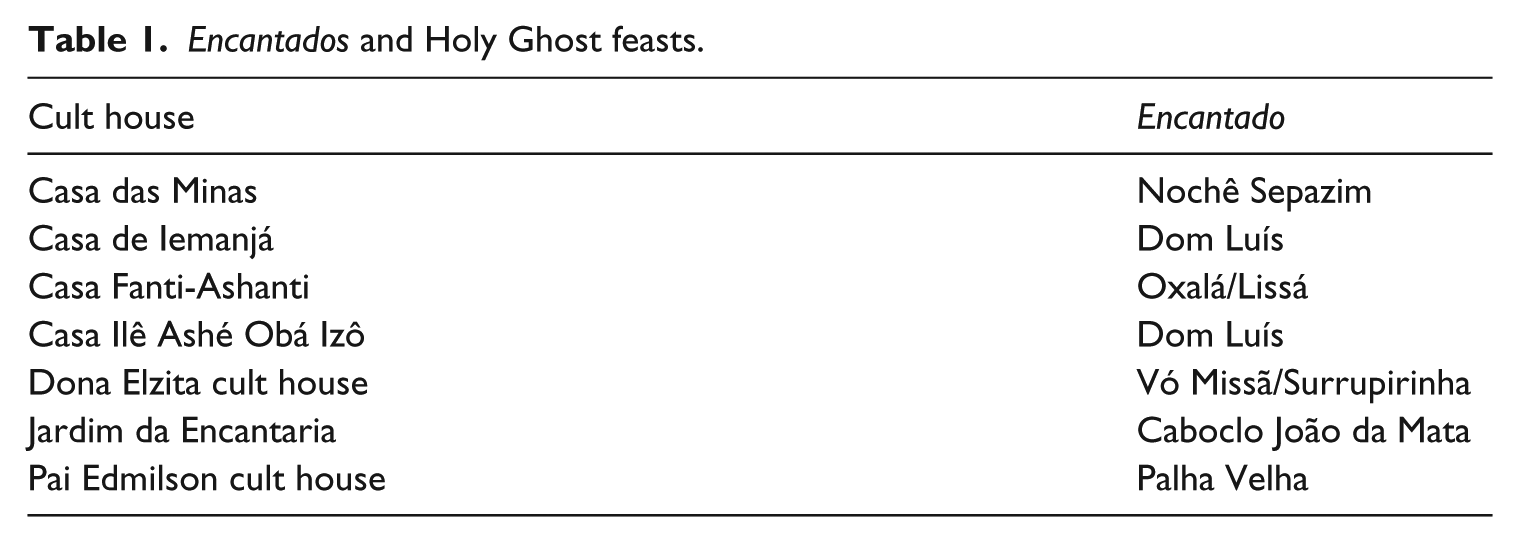
The reasons given for this obligation are manifold. In Tambor de Mina, most encantados are viewed as devotees of Catholic saints (or invocations of the Virgin Mary) or of other Catholic entities – such as the Holy Ghost – and the feasts are a ritual occasion for the encantados to honour the Holy Ghost. Thus, in most cult houses, it is an encantado who ‘has asked for’ the feast, which then becomes an obligation of the father or mother of saint towards him (or her). Some fathers and mothers of saint, though, instead of devotion, prefer to use the category of ‘sympathy’: the encantados ‘sympathize’ with the feasts, that is, they enjoy both the effervescence associated with them and their baroque aesthetics.
The same blend of Catholic devotion and African-Brazilian obligation applies to several other performances associated with the feasts. While in some cases the sponsoring of the impérios is the result of a vow made to the Holy Ghost, in other cases, it derives from a demand of an encantado. Being a caixeira is also often associated with a request of an encantado, sometimes based on an agreement that replaces her obligations towards him (or her) with the duty of playing music for the Holy Ghost.
As a result of their role in the co-option of the feasts, the encantados are often associated with decisions regarding the celebration, such as the choice of the colour of the decorations of the feast. They can also play an important role in some ritual segments of the feast. In some cases, it is the encantado who welcomes and receives the impérios and the symbols of the Holy Ghost after the Mass. Encantados can also be present at other ritual segments, such as the inauguration of the Catholic altar, where the symbols of the Holy Ghost are placed during the feast, or the ritual closing of the feast, when the impérios are crowned by the caixeiras. In some cult houses, the impérios are also supposed to represent some encantados. But the ritual segments of the feasts where the participation of the encantados is more salient are the ones related to the flagpole. These segments are mostly connected to play, transgressive behaviour and anti-structure (Turner, 1969), and they involve, in most cult houses, the participation of a special category of encantados: the so-called caboclos farristas (‘carousers’), whose transgressive behaviour has been famously described by Seth Leacock (1964).
To sum up, not only do the encantados play a major role in the co-option of the feasts by Tambor de Mina cult houses, but in most feasts, they also are actively involved in them.
Articulations between Holy Ghost feasts and Tambor de Mina are also evident in some Tambor de Mina rituals that take place during the period dedicated to the feasts. Indeed, in most cult houses, the feasts are part of a broader celebration that involves the organization of five to seven drumming and singing sessions. This is especially the case in feasts that honour both the Holy Ghost and a Catholic saint (or a Virgin Mary invocation). The Catholic saint who is honoured at the feast is usually ‘synchretized’ with an encantado and drumming and singing sessions are organized in his (or her) honour and in honour of other African-Brazilian religious entities.
The majority of the fathers and mothers of saint insist that there is a pragmatic reason for organizing these drumming and singing sessions during the period of the feast: the objective is to benefit from the concentration of people and resources associated with them in order to involve a large number of people with the Tambor de Mina rituals. In these cases, the separation between Tambor de Mina drumming and singing sessions and Holy Ghost feasts is emphasized.
Despite this emphasis, in some cult houses, these drumming and singing sessions are articulated to the Holy Ghost. The altar of the feast is only removed 7 days after the formal closing of the feast, and it is in front of the altar that most drumming and singing sessions take place. While in some cult houses this is only a matter of spatial coincidence, in other cult houses, this spatial coincidence is ritually worked out. At the end of the closing drumming and singing session, the Holy Ghost crown is ritually returned to the Catholic altar of the house through an elaborated ceremony that involves the circulation of the crown between all daughters and sons of saint, accompanied by the singing of a Tambor de Mina doutrina (‘chant’). In some cult houses too, the impérios participate in a drumming and singing session dedicated to the princesses – Tambor de Mina spiritual entities who behave like children. Although these modes of articulation between Tambor de Mina and the Holy Ghost are more subtle than the ones that take place during the feast, they nonetheless indicate that separation between Tambor de Mina drumming and singing sessions and Holy Ghost feasts coexist with ritual arrangements that explore the interface between Tambor de Mina and Holy Ghost feasts.
Multiplicity and diversity
What I have been presenting until now is not a closed pattern of the connections between Tambor de Mina and Holy Ghost feasts, applicable to all cult houses, but a list of the possible modes of articulation between the two religious genres. Indeed, diversity and multiplicity are central to the modes of articulation between Holy Ghost feasts and Tambor de Mina. While most of these connections are present in most cult houses, in other cases, only some of them can be found. And still, in other cases, more radical modes of articulation have been adopted.
This pattern of multiplicity applies first of all to the role of the encantados in the co-option of the feasts. While in some cases, as I have previously noted, the devotion of the encantado is regarded as central, in other cases, ‘sympathy’ is the word chosen to define the relationship between the encantados and the feasts. That is the case of the Casa Fanti-Ashanti. As (the late) Pai Euclides told me, ‘the voduns are not devotees of saints, because they [the voduns] are African and the saints are Catholic. They may have an affinity, a sympathy. [Thus] the vodun may sympathize with the feast [of the Holy Ghost] and ask for [its organization]’. However, in other cases, a more emphatic relationship between the encantados and the feast may be established. For instance, at Pai Edmilson cult house, the feast is both a devotion of his main encantado (Palha Velha) to the Holy Ghost, as well as a reproduction of Palha Velha’s royal court at the encantaria (‘the land of the enchanted ones’).
The same applies to the participation of the encantados in the organization of the feasts. While in some cases the choice of the dominant colour of the feast is the decision of the encantado, in other cult houses, it is a decision taken jointly by the father or mother of saint and the individuals who sponsor the impérios. Specific ritual innovations in the feasts are also regarded either as resulting from a demand of the encantado or, more prosaically, from a decision of the father or mother of saint.
The participation of the encantados in the feasts is also characterized by diversity. For instance, the correspondence between encantados and the impérios is particularly pronounced in Dona Elzita and Iemanjá cult houses. In Pai Edmilson cult house, the impérios are replaced by an ‘imperial court’. This imperial court includes up to 60 children, and each child represents an encantado. But in other cult houses where I carried out research, no connection between the impérios and the encantados was necessarily made.
The participation of the encantados in the feasts also takes multiple forms. In some houses, it is the father or mother of saint who welcomes and receives the impérios after the Mass, and the participation of the encantados in the opening and closing ceremonies of the feast is rather negligible. The same applies to the participation of the caboclos farristas in the ritual segments related to the flagpole. At Dona Elzita cult house, for instance, only the visiting caboclos participate. But at Fanti-Ashanti and at Jardim da Encantaria cult houses, the caboclos are not welcomed. As Pai Clemente Filho told me, ‘I don’t like these groups of caboclos talking pornography’.
Connections between the Tambor de Mina drumming and singing sessions and the Holy Ghost also do not follow – as I have mentioned before – a fixed pattern. Both the ceremony that returns the crown to the Catholic altar of the house at the end of the closing drumming and singing session and the participation of the impérios in the drumming and singing session for princesses are specific to some cult houses.
The connections between Holy Ghost feasts and Tambor de Mina may also take more idiosyncratic and radical forms. That is the case of the Ilê Ashé Obá Izó cult house, where a passagem de cura takes place during the feast. The passagem de cura is a drumming and singing session in which several Tambor de Mina spiritual entities are successively incorporated by the father of saint: its objective is to prevent conflicts between the encantados who attend the ritual segments related to the flagpole. Pai Edmilson is even more radical. As we have seen, in his cult house, the impérios are replaced by a royal court comprising up to 60 children, each one representing a specific encantado.
Holy Ghost feasts there are also strongly connected to the celebrations of Preto Velho (a widely known African-Brazilian spiritual entity, mostly associated with Umbanda). Those celebrations comprise processions and ritual meals that include the participation of the children of the royal court and the daughters and sons of saint. In the closing ceremony of the feast, Pai Edmilson also successively incorporates the spiritual entities whom the children of the royal court have represented throughout the feast.
Finally, connections between Holy Ghost feasts and Tambor de Mina are also related to different ways of addressing the autonomy of the two religious genres. Although most fathers and mothers of saint stress the Catholic characteristics of the Holy Ghost feasts – which, in their view, are not put into question by the connections between the feasts and Tambor de Mina – some of them adopt a more robust ‘anti-syncretic’ discourse (Shaw and Stewart, 1994). That is the case of Dona Elzita. Despite some relevant connections between her feast and Tambor de Mina (Dona Elzita cult house is one of the houses where the impérios represent encantados), she constantly emphasizes the strictly Catholic characteristics of her feast. For example, contrary to what most other cult houses do, the leaflet distributed with schedules of feast events elides mention of the singing and drumming sessions that take place.
To sum up, multiplicity is the main characteristic of the interface between Tambor de Mina and Holy Ghost feasts. The modes of articulation between the two religious genres are not a property – that is, are not an essential and immutable attribute of Holy Ghost feasts in Tambor de Mina cult houses – but are rather a set of possibilities that each cult house may activate, cancel, or elaborate in its own way.
It is tempting to view these differences in the modes of articulation between Holy Ghost feasts and Tambor de Mina as a continuum. This is a perspective often used in the anthropological literature on African-Brazilian religions (Bastide, 1960; Capone, 2005; Herskovits, 1966) to describe the irregular distribution of some of their characteristics. According to this perspective, we could locate the cult houses where these modes of articulation are more relevant at one end of the continuum, and at the other end, the cult houses where they are less significant. But the image of a continuum has its limits: not only are the majority of the cult houses in this study mostly located in the medium zone of the continuum, but it is often difficult to apply strict quantitative criteria to the analysis of the modes of articulation between Holy Ghost feasts and Tambor de Mina. For example, at Dona Elzita cult house, the encantados of the house do not participate in the segments related to the flagpole, and she has a robust anti-syncretic discourse. At the same time, it is in this cult house that the idea that the children of the impérios represent encantados is more important.
Pai Euclides also has a strong anti-syncretic discourse. As he told me, ‘the Holy Ghost here has nothing to do with the encantaria. Here the encantados don’t ask anything, I am the only one who makes the decisions, together with the community, without any encantado’. His animosity towards the participation of the caboclos in the ritual segments related to the flagpole was also strong. Nonetheless, it was his cult house that first adopted the ceremony that returns the Holy Ghost crown to the Catholic altar of the cult house at the end of the closing drumming and singing session. It is thus difficult to analyse the multiplicity of modes of articulation between Holy Ghost feasts and Tambor de Mina in the strict quantitative terms that are implied in the continuum image.
Multiplicity not only applies to differences between cult houses but also applies to individual cult houses as well. Options regarding the modes of articulation between Holy Ghost feasts and Tambor de Mina can indeed change through time. Information collected by the anthropologist Amália Barretto (1977; 1987) suggests that the connections between Holy Ghost feasts and Tambor de Mina at Casa Fanti-Ashanti were more important in the 1980s than they are today. Back then, the participation of the caboclos in the segments related to the flagpole was common, and Pai Euclides was more explicit in relation to the connection between the Holy Ghost feast and the orisha Oxalá. In some cult houses, changes can occur on an annual basis. From 2013 to 2104, at the Ilê Ashé Obà Izó cult house, the reception of the crown after the Mass by the encantados evolved from a rather short ceremony to a complex ceremony lasting for more than 1 hour. In 2013, at the same cult house, the impérios participated in the drumming and singing session for princesses, but in 2014 that session did not take place. That is, flexibility is not only a matter of differences between cult houses but also a matter of how the same cult house manages diversity through time.
Diversity and creativity
The diversity of the modes of articulation between Tambor de Mina and Holy Ghost feasts are actively built upon creativity. This is most evident in relation to some ritual innovations that were introduced in particular cult houses. This is the case of the ceremony that returns the Holy Ghost crown to the altar of the house at the end of the closing drumming and dancing session. It is also the case of the participation of the encantados in the ceremony that welcomes the impérios after the Mass and in the opening and closing ceremonies of the feast. All these ritual options are rather recent and were first adopted by specific cult houses. From there, they travelled to other cult houses. In the process, some new details were added.
Other ritual options are usually viewed as more traditional. That is the case of the role played by the encantados in the co-option of Holy Ghost feasts. This pattern seems to have been established at the very beginning of the process of appropriation of Holy Ghost feasts by Tambor de Mina cult houses in the late nineteenth century. Indeed, according to a widespread narrative of origin, the first Holy Ghost feast in a Tambor de Mina cult house took place at Casa das Minas and resulted from a request of a vodun (Ferretti, 1995: 168). This is also the case of the encantados participation in the ritual segments related to the flagpole. As long as people remember, the encantados – particularly the caboclos farristas – have always participated in these ritual segments.
Despite being viewed as more ‘traditional’, these ritual options are implemented in different ways. In the first case, the devotion of the encantado to the Holy Ghost is sometimes viewed as a matter of his (or her) sympathy towards the feast. In the second case, even if a majority of cult houses welcome encantados in the ritual segments related to the flagpole, there are also cult houses in which their presence is viewed with suspicion.
Multiplicity is thus the outcome of processes that involve both the adoption of innovations and their creative management. These processes share some general characteristics. First, they result from variable combinations of human and spiritual agency: while some innovations are authored by the encantados, others are attributed to the fathers and mothers of saint. In addition, their success is related to the prestige and influence of the cult houses that first adopted them. Most of the innovations listed above were first introduced (around the 1960s and the 1980s) in two cult houses that occupied a central position in the African-Brazilian religious scene of São Luís – the Fanti-Ashanti and Iemanjá cult houses. These ‘senior’ cult houses have a connection to several ‘junior’ cult houses that spun-off from them, such as the Ilê Ashé Obá Izô and Jardim da Encantaria cult houses. It is through these lines of religious descent that these innovations have circulated. Conversely, some more idiosyncratic innovations do not circulate because of the marginal position occupied by the cult houses where they were adopted. That is the case of Pai Edmilson, whose cult house is not only located outside the city of São Luís but also combines Tambor de Mina with Umbanda. Some of the more orthodox Tambor de Mina fathers and mothers of saint even consider that it is not a Tambor de Mina cult house but an Umbanda cult house with some ‘Mina traits’.
In order to understand the diversity that governs the interface of Tambor de Mina and Holy Ghost feasts, one has to take into account that Tambor de Mina – like other African-Brazilian religions – is characterized by ritual autonomy and flexibility. As most fathers or mother of saint told me, cada terreiro é um terreiro (‘each cult house is different’). This means that each cult is free to adopt, within certain limits, innovative ritual solutions. It is against this background that the different modes of articulation between Holy Ghost feasts and Tambor de Mina can be understood, as a result of autonomous and creative exercises that explore different ontological and ritual possibilities related to the co-option of Holy Ghost feasts.
In some cases, these modes of articulation are linked to the more general politics that each cult house adopts in relation to the management of the boundaries between religious genres. For instance, Pai Edmilson is one of the cult houses where these modes of articulation are more important. It is also the cult house where the boundaries between Tambor de Mina and Umbanda are weaker. In both cases, his approach multiplies the connections between religious genres.
At Iemanjá cult house and at Ilê Ashé Obá Izô cult house – whose father of saint was initiated at Iemanjá cult house – connections between Tambor de Mina and Holy Ghost feasts are also important. This seems to derive from a more eclectic approach towards the management of boundaries between religious genres that was adopted in the 1960s by the late Pai Jorge, the former father of saint of Casa de Iemanjá. As Lindoso has written, Pai Jorge developed some contacts with ‘Candomblé and Umbanda and other Afro-Brazilian religions [and these contacts] were very relevant to his religious journey’ (Lindoso, 2014: 98). Accordingly, his policy regarding Holy Ghost feasts was directed towards the establishment of more effective links with Tambor de Mina.
In the opposite end, Tambor de Mina cult houses where connections between Holy Ghost feasts and Tambor de Mina are less important are also characterized by a more rigid approach towards other religious genres. That is the case of the Casa Fanti-Ashanti. Being one of the more innovative São Luís’s fathers of saint, Pai Euclides was initiated in the Candomblé in the 1980s and his cult house had both Tambor de Mina rituals and Candomblé rituals. But his adoption of Candomblé was based upon principles of strict spatial and temporal separation between the two religious genres. The same principles were applied to the Holy Ghost feasts. As one of the fathers of saint who was initiated by Pai Euclides told me, ‘many caboclos used to participate in the feast, but that has declined after the adoption of Candomblé. I don’t know whether it is because Candomblé gods don’t feel at ease [with the feast] but it might have to do with this’.
The diversity of the modes of articulations between Tambor de Mina and Holy Ghost feasts is also related to the politics of management of display and containment that, as in other African-Brazilian religions (Castillo, 2010; Johnson, 2002), characterize Tambor de Mina. As mentioned before, Holy Ghost feasts are the most important feast of Tambor de Mina cult houses and the one that opens them up to larger audiences and to the public sphere (Leal, 2014). They are thus part of the strategies of visibility through which Tambor de Mina cult houses try to engage with the religious and political public spheres in São Luís. These strategies stem not only from the need to counteract widespread prejudices about Tambor de Mina but also, in more recent years, from the need to oppose the neo-pentecostal offensive against African-Brazilian religions. Being viewed as the most important Catholic feast throughout Maranhão, Holy Ghost feasts powerfully contribute to reinforcing the public perception of Tambor de Mina as a respectable religion. At the same time, Holy Ghost feasts have also been the object of processes of cultural objectification that have turned them into a symbol of the state’s cultural heritage (Leal, 2018). This co-option by Tambor de Mina cult houses thus contributes to enhancing the cultural capital of Tambor de Mina. That is why the feasts are viewed not only as a source of religious energy and spiritual power for the Tambor de Mina cult houses but also as a source of political and cultural empowerment. 7
In some cases, this means that fathers or mothers of saint take a more careful approach towards the connections between Holy Ghost feasts and Tambor de Mina. They want the feast to be viewed as a Catholic feast that takes place in Tambor de Mina cult houses rather than a feast where Catholicism is uncomfortably associated with a religion that is the object of widespread negative stereotypes. As one Holy Ghost devotee put it to me, ‘I don’t agree with mixtures. The Holy Ghost is the Holy Ghost, Mina is Mina. [Unlike Mina] the Holy Ghost is pure’. (Catholic) visibility is thus, in the mind of some fathers and mothers of saint, closely associated with (African-Brazilian) invisibility.
For instance, the famous Casa das Minas follows a politics of containment in relation to Holy Ghost feasts. The presence of voduns in the feast is discrete and goes almost unnoticed. Sérgio Ferretti has written that this can be viewed as part of the ‘puritan’ style adopted in Casa das Minas. However, it is also the consequence of the politics of respectability adopted in relation to the feast which caters to a Black middle class audience (Ferretti, 1995: 171). The case of Casa Fanti-Ashanti is also revealing. Pai Euclides was particularly attentive to the cultural dimension of Holy Ghost feasts. His feast has its own group of caixeiras, who regularly gives shows and has recorded two CDs; relatives of Pai Euclides, in collaboration with the Caburé cultural association, were also instrumental in the creation of a Holy Ghost feast in São Paulo. This might also be one of the reasons why the feast has developed a more effective autonomy vis-à-vis Tambor de Mina.
In some cases, the politics of containment followed by some cult houses rest on more surgical approaches. That is the case of Pai Clemente Filho’s opposition to the participation of caboclos farristas in the ritual segments related to the flagpole. One of the reasons he gave for not having these ‘groups of caboclos talking pornography’ was that his feast is attended by several friends and neighbours who are católicos ranzinzas (‘stubborn Catholics’). This is similar to Dona Elzita’s anti-syncretic approach to the Holy Ghost feasts. The adoption of such an approach is a way of ensuring that the feast remains committed to a broader audience.
The modes of articulation between Tambor de Mina and Holy Ghost feasts can thus be seen as a response to a wider ideological and political environment that makes visibility a major issue in the relationships between Tambor de Mina cult houses and the public sphere. Located at the crossroads of Catholic devotion and African-Brazilian obligation, the feasts may involve different ways of rendering (more or less) explicit their dual religious background.
Conclusion
As stated at the beginning of this article, the diversity of modes of articulation between Tambor de Mina and Holy Ghost feasts is the result of the creative management of the connections and boundaries that govern the relationship between Tambor de Mina and Holy Ghost feasts. This article can thus be seen as a contribution to current anthropological debates on creativity. As in other cases, creativity is not only related to the ‘extraordinary’ but is an intrinsic characteristic of the social and cultural processes that I have analysed. As Borofsky (2001) has written ‘creativity is more gerund than noun – more a creating, a process, than a thing to be located. It is always in motion’ (p. 69). As in other cases too, creativity not only applies to innovations added to a pre-existent script but also to forms of management of tradition that include reiteration and downsizing or even suppression of established ritual options. As Ingold and Hallam (2007) have argued, creativity is not only about ‘novelty’ but also about the handling of ‘convention’ and ‘continuity’ (pp. 2, 5). The analysis that I have proposed is also important because it provides a corrective to the tendency to view creativity as separated from the wider political contexts that enable or weaken it. Indeed, articulations between Tambor de Mina and Holy Ghost feasts can be viewed as ‘constrained combinatorics’ (Friedman, 2001: 48), strongly dependent on the politics of display and containment adopted by different cult houses. This means both that creativity is constrained by a wider ideological and political environment that makes visibility a major issue in the interface between Tambor de Mina cult houses and the public sphere and that it is instrumental in negotiating this interface.
This article is also a contribution to recent reappraisals of issues related to the modes of articulation between religious genres in African-Brazilian religions. From the 1940s to the 1970s, this topic was mainly addressed through the concept of syncretism (Bastide, 1955; 1960; 2000 [1963]; 2002 [1946]; Ramos, 2007 [1935]). After a long quarantine that lasted until the late 1990s, when Sérgio Ferretti (1995) and Ordep Serra (1995) published their monographs on the topic, a more widespread interest in the study of connections between religious genres has seemed to develop. This interest is not limited to African-Brazilian religions (e.g. Greenfield and Droogers, 2001; Leopold and Jensen, 2004; Mary, 1999; Stewart, 2011) but has gained a particular traction in several recent researches in this particular field of research. Most of this research adopts a critical position towards the classical Bastidian approach to the topic. In more radical cases, this has led to the rejection of the very designation of syncretism, replaced by alternative expressions, such as ‘(contra)mestiçagem’ (‘(counter)mixing’; Goldman, 2015). Other authors continue using the concept of syncretism (Capone, 2005; 2014; Oro and Anjos, 2008; Sansi, 2007) but have offered alternative theorizations. In any case, more attention is now paid to the modes of articulation between religious genres.
By emphasizing processes that take place in contemporary São Luís, this article questions the excessive importance given to the past in some theorizations of syncretism. Indeed, in most cases, African-Catholic syncretism is mainly viewed as a heritage dating back to the period of slavery. This historical argumentation of the connections between African-Brazilian religions and Catholicism is particularly relevant, as some authors have stressed (e.g. Sansi, 2007; Serra, 1995), in processes of de-syncretization associated with contemporary Candomblé. Of course historical factors are important in the explanation of this and other aspects of African-Brazilian religions. In the case of Maranhão, these factors include, as Assunção (1995; 2005) has shown, not only vertical processes of forced circulation of religious beliefs and practices between dominant and dominated groups but also more horizontal and democratic processes among dominated groups, some of them closely associated with what Goldman has termed ‘(contra)mestiçagem’ (‘(conter)mixing’). Notwithstanding their historical roots, this article has shown that modes of articulation between Tambor de Mina and Holy Ghost feasts are firmly located in the present. They are an historical heritage, but an historical heritage that is continually produced and worked out in the present.
Classical thematizations of syncretism have also put more emphasis on its final results rather than on the processes associated with it. This is most evident in the taxonomical approaches proposed by Bastide, aimed at establishing distinct types of syncretism (e.g. magical vs religious and material vs formal; Bastide, 2000 [1963]; 2002 [1946]). Results are of course important. But what this article has shown is also the importance of the processes through which these results come into being. Results are always provisional, can be revised, or elaborated in novel ways. Processes entail the constant monitoring of old forms and the experimenting with new possibilities. As Ingold and Hallam (2007) would have it, what is important in the modes of articulation between Tambor de Mina and Holy Ghost feasts is ‘to keep going, rather than coming up to a dead end or becoming caught in a loop of ever repeating cycles’ (2007: 7).
Footnotes
Acknowledgements
The author thanks the fathers and mothers of saint of the different cult houses where he did fieldwork for their hospitality and patience. Special thanks are due to Pai Wender. He also thanks Miguel Moniz for his careful revision of the paper and the two referees for their comments and suggestions.
Funding
The research was funded by the Fundação para a Ciência e Tecnologia (through the project ‘Ritual, ethnicity and transnationalism’, PTDC/CS-ANT/100037/2008) and by FAPEMA (through a Visiting Professor grant that funded the author’s fieldwork in São Luís between May and September 2014).
Notes
Author biography
Address: Centro em Rede de Investigação em Antropologia (CRIA), Universidade Nova de Lisboa, Lisboa, Portugal.
Email: