




Abstract
Since the 1930s, the frequency of mass attendance has been the most widely used indicator of involvement in Catholicism in France. Yet its validity is sometimes debated: to what extent can subjective religiosity constitute an alternative measure? Both indicators seem closely related. However, the social distributions they perform diverge at the margin. And the large sample on which this research is based reveals changes in contemporary Catholicism – particularly with regard to the urban rather than rural character of today’s practitioners. Electoral behaviour is also used in this article as a touchstone for the comparison of the two indicators. Previous research has established the strong link between Catholic religious practice and right-wing – but not far-right – voting. Despite the singularity of the 2017 election, the analysis establishes that this still holds true – and that the combination of these two indicators allows for subtler insight into this link.
France, long considered to be the eldest daughter of the (Catholic) Church, has become one of the Western European countries with the highest proportion of people with ‘no religion’ (Bréchon and Gonthier, 2015). This shift has produced a duopoly: in the French Electoral Survey (Enquête électorale française - ENEF), 1 the two groups, Catholics and ‘no religion’, together make up 95% of the whole sample. 2
The decline of the religion which had long been predominant has made it necessary to develop indicators of religious involvement capable of capturing the varying degrees of engagement with Catholicism. In the 1930s, Gabriel Le Bras suggested a scale based on the frequency of mass attendance (1933). Although the level of commitment required for regular practice has become less demanding, the distribution of religious involvement is still often apprehended through variants of this indicator.
Studies have systematically shown the strong link between Catholic practice defined in this way and a right-wing vote under the Fifth Republic (Michelat and Simon, 1977; Boy and Mayer, 1997; Michelat, 2000; Dargent, 2004; 2016; Michelat and Dargent, 2015). This result has also been verified at the European level (Bréchon 1996, 2002, 2006; Dargent, 2010b). But does this indicator not have biases?
What we observe in relation to other religions raises questions. Muslims in France, for example, predominantly vote for the left (Brouard and Tiberj, 2005). But narrowing the focus down to Muslims who go to mosques or prayer rooms on Fridays does not seem to accentuate the trend of a left-wing vote (Dargent, 2003). If attendance was a ‘neutral’ indicator of religious involvement, the greater frequency for Muslims ought to correspond to an even greater vote for the left, which they already favour.
The case of Protestantism confirms this: whereas Protestants have long voted for the left in France (Siegfried, 1995 [1913]; Encrevé, 1985: 285), practicing ones are drawn further to the right (Baubérot, 1983). By the end of the 20th century, the political leaning of Protestants matched that of the average French population: they were no longer on the left, but not really on the right either. Yet regular temple attendance still has a conservative effect on Protestants in France (Dargent, 2005), as it does in Europe (Bréchon, 2002). 3
These two examples show that religious practice is not ‘purely’ an indicator of religious involvement. It has also been criticized for other reasons. For proponents of the theory of religious dualism (Bréchon and Campiche, 2011), for example, this indicator addresses the ‘institutional’ side of religion and ignores the ‘universal’ one. It is therefore incapable of measuring the endurance of religious belief (Lambert, 2000; Dargent, 2010a; 2017). Conversely, the work of Hadaway et al., in the United States (1993; 1998) has shown that religious practice measured through surveys of representative samples can also overstate the role of religion. 4
Moreover, this approach views all those who state that they have ‘no religion’ as having no religious involvement whatsoever. But this point of view on this category is discussed today. Its size appears to be highly dependent on the questions asked (Day and Lee, 2014; Bréchon, 2009). Most notably, the reasons for such self-classification appear to be varied. This choice seems to be totally compatible with the persistence of religious belief (Davie, 1994). And far from reflecting a ‘disaffiliation’, it can also express a determined kind of religious positioning and, at any rate, does not constitute the indicator of secularization to which it is often reduced (Lee, 2014).
It is therefore important to use other measures, to better understand the level of religious involvement. This operation can also help to assess the effect of service attendance, alongside its role as an indicator of religious involvement. The French Electoral Survey (EEF) is an interesting source for this project: apart from the measure of religious affiliation and service attendance, it contains a question that tries to grasp what might be called subjective religiosity, defined as the self-assessment by the interviewees of their own religious dispositions. So what is the added value of this indicator?
Practice and subjective religiosity: Congruent but distinct
Two unequally used indicators
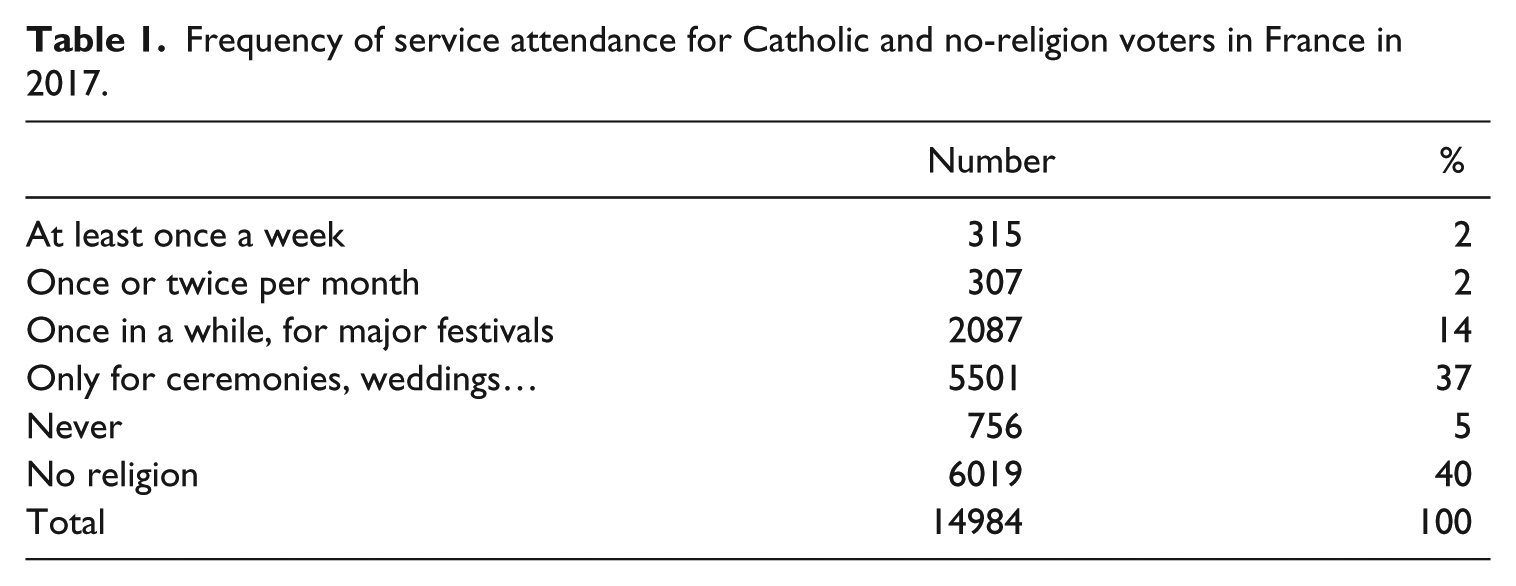
The impressive size of the sample group gathered by the French Electoral Survey makes it possible to give a detailed picture of Catholic practice in France (Table 1). 5 Practicing Catholics (whether occasional or regular) make up a little under one fifth of the voting population, and those who practice regularly (weekly or monthly) account for one twentieth. As we shall see, the influence of Catholicism does not stop there, but its effect – especially on the many French people who attend mass only for social rites (marriages, baptisms, funerals) – must be grasped through other measurements.
Frequency of service attendance for Catholic and no-religion voters in France in 2017.
Subjective religiosity is much less common in studies. It has, nevertheless, been introduced in several international surveys. It was first used in the European Values Survey (EVS), soon followed by the World Values Survey, which asks: ‘Independently of whether you go to church or not, would you say you are a religious person, not a religious person or a convinced atheist?’
In the same perspective, the International Social Survey Programme (ISSP) then asked the question: ‘Would you describe yourself as extremely religious, very religious, somewhat religious, neither religious nor non-religious, somewhat non-religious, non-religious or extremely non-religious?’ The Religion Monitor has adopted a similar scale, but with five degrees: very religious, rather religious, somewhat religious, little religious, non-religious. As for the European Social Survey, since 2002, it has measured the level of religiosity on a scale of 1 to 10, by asking the following question: ‘Regardless of whether you belong to a particular religion, how religious would you say you are?’
The French Electoral Survey uses the same phrasing as the EVS. This indicator has one major advantage: it allows for a more balanced distribution of Catholics and ‘no-religion’ than the criterion of service attendance alone. When offered three possible answers, a little over one quarter (28%) of French voters define themselves as ‘religious’. A little under one half (44%) consider themselves to be ‘non-religious’. And, symmetrically, 29% say they are ‘convinced atheists’. 6
The analysis of data from this study indicates that service attendance and subjective religiosity are strongly correlated amongst Catholics and those with ‘no religion’: between these two indicators, Cramer’s V is 0.52 – a high level in the social sciences (p <0.001). Since the variables are ordered, we can calculate the b Kendall rank correlation coefficient: it confirms this strong relationship since it is as high as 0.618 (p <0.001).
When combined with service attendance, the categories become more precisely defined (Table 2). Among Catholics, there is almost no difference between those who practice weekly or monthly: 95% of the former and 92% of the latter say they are religious. 70% of those who practice occasionally say the same. This is also the case for one third of those who only attend mass for ceremonies, and for 16% of those who are non-practicing.
Service attendance according to the subjective religiosity (%).
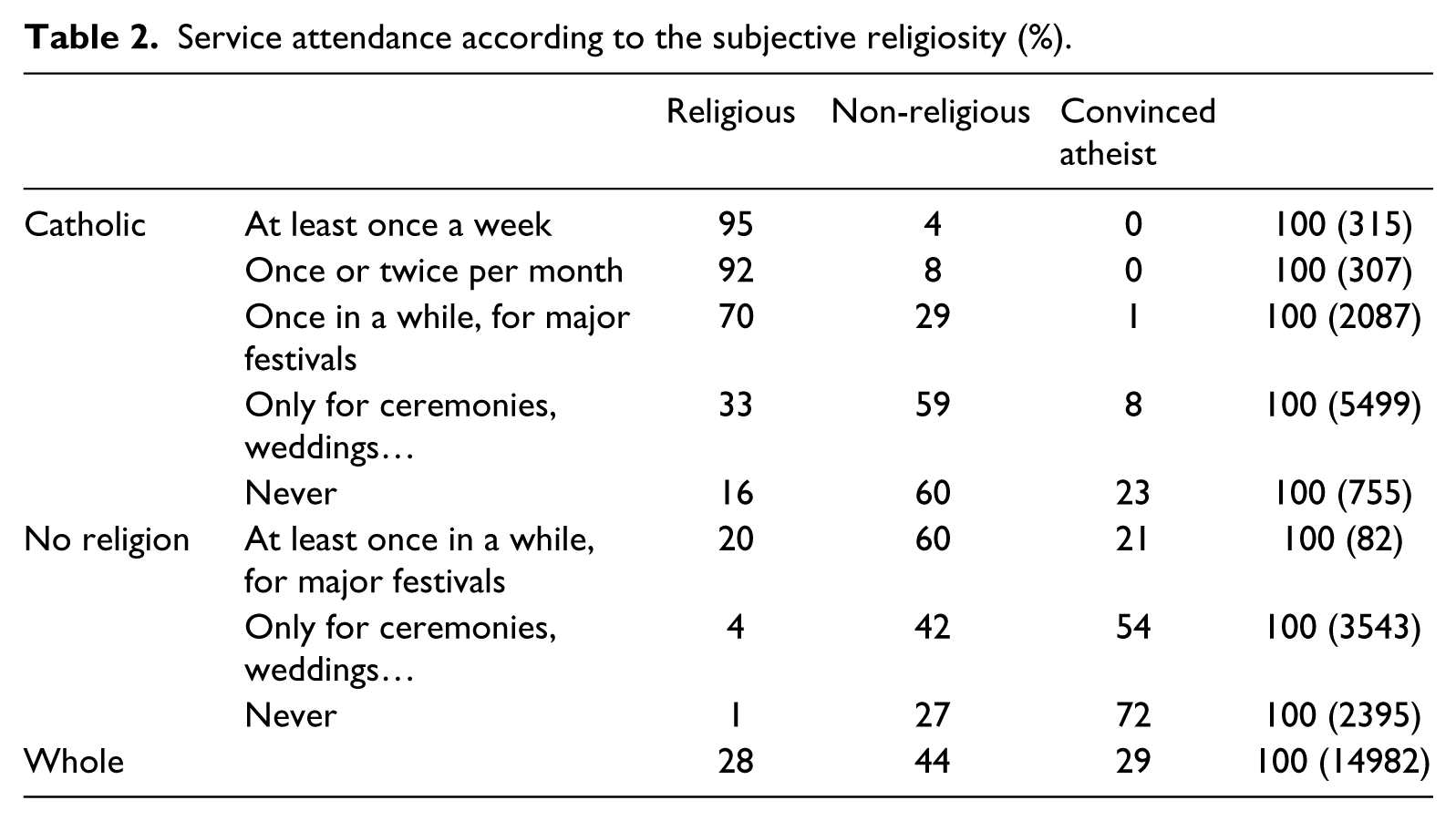
Conversely, almost three quarters (72%) of those who declare no religion and say they never attend mass defined themselves as convinced atheists. This is also the case for a majority (54%) of those who only attend mass for ceremonies. On the other hand, 20% of the no-religion group who go to mass at least occasionally say that they are religious. 7
There is, therefore, a real connection between Catholic practice and stated religiosity. It is a meaningful result. Admittedly, Guy Michelat had already shown the correlation between religious practice – including mass attendance – and belief (1990; 1997). With regard to belief, he factored in the adhesion to Catholic doctrine but also an indicator of something closer to subjective religiosity, by means of the question: ‘do you define yourself as a believer, a sceptic or a non-believer?’ However, it is not insignificant to note that thirty years after the original survey which led to these conclusions, and in spite of the major social and religious transformations which have occurred in the meantime, the conclusion still holds.
The demonstrated correlation between a practice – service attendance – and a representation – the level of religiosity – confirms both of these indicators of religious involvement. Yet beyond the differences in distribution that they effect, are they redundant, or does religiosity exhibit different characteristics from religious practice?
Religion and socio-democratic structures: The transformations at play
The social composition of the categories identified by the two indicators leads in part to results which are already known, but it also reveals social evolutions which accentuate the real divergences between them over the past few years.
Repeatedly, involvement in Catholicism has been characterised by the over-religiosity of women, even though the gender gap seems to be shrinking (Campiche, 1996). In the survey, 59% of regularly practicing Catholics were women, while both genders were almost equally represented amongst those without religion. 8 The gaps are even greater for subjective religiosity: 60% of people who call themselves religious are women, whereas women only make up 48% of convinced atheists. 9 Propensity towards religion therefore varies according to gender, in spite of the near balance of genders amongst ‘convinced atheists’. This near balance no doubt owes a lot to the weight 10 of this category in France. It is one of the highest in Western Europe, and has moreover shown substantial progression over the last few years: 20% of the population in the 2008 Values survey (Bréchon, 2017); 27% in the 2017 electoral survey. This trend towards the normalisation of atheism probably contributes to its spread amongst sections of the population where it was formerly rare, and therefore especially amongst women.
However, there is still a gender dimorphism which is a recurring feature of contemporary Catholicism: since the 1950s, academic monographs (Pin, 1956) and Sunday censuses provided by the canon Boulard have outlined the same trend. As an aside, it is worth noting the strong impact of age on religious practice, which has been confirmed by the analysis of the data from the French Electoral Survey. 13% of 18-35-year-olds attend mass regularly or occasionally, while one in two declares no religion. For the over 65s, the rates are respectively 29% and one out of four. 11 The weak religious involvement of young French people, as captured through mass attendance (Michelat and Lambert, 1992), is proven once again. 12
The same trend can be noted for subjective religiosity: one fifth of 18-24-year-olds define themselves as religious, almost a third say they are convinced atheists, while the rates are respectively 41% and 19% for the over 65s (Table 3). From a sociodemographic perspective, the two indicators examined in this article converge.
Age groups according to their religious subjectivity (%).
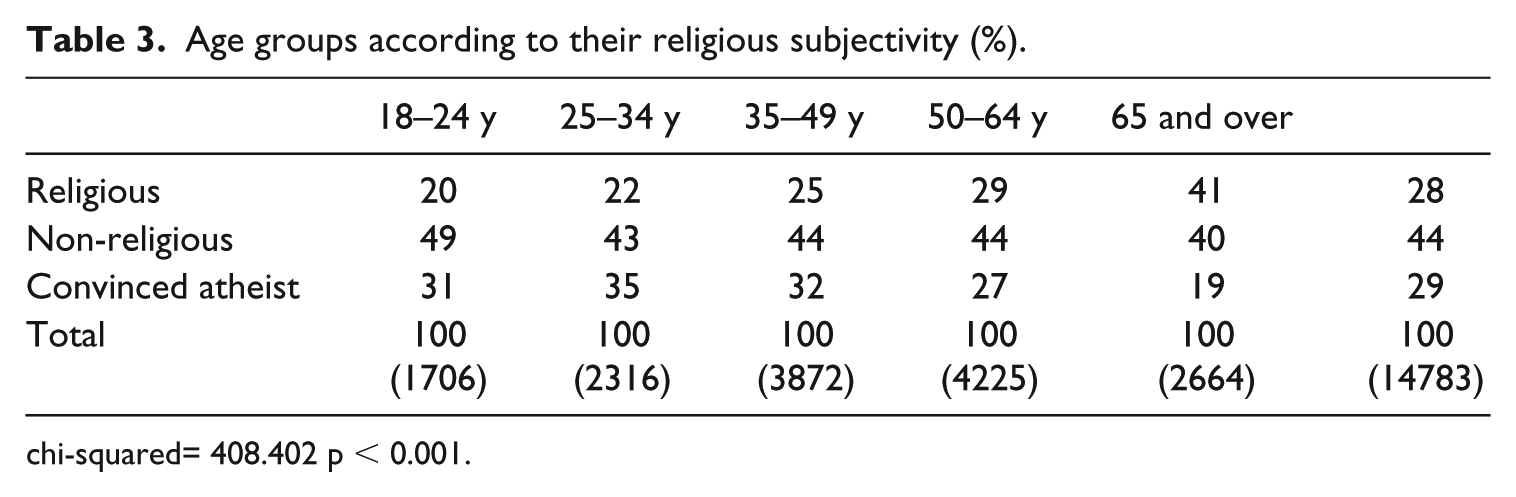
chi-squared= 408.402 p < 0.001.
Other variables have a more surprising impact on religious practice and subjective religiosity, and bear witness to the evolving relationship to religion in contemporary societies. Traditionally, the de-Christianisation witnessed since the 19th century has been thought to primarily affect urban centers, whilst rural areas – apart from the ‘mission territories’ – were thought to be refuges for practicing Catholicism (Le Bras, 1955). Whilst religious groups were not totally missing from new towns in the second half of the 20th century, their establishment was not straightforward, and moreover Catholicism was only one of several religions in these places (Grémion, 2012). 13
Yet the data from the French Electoral Survey shows that the situation in France has become the complete opposite (Table 4). We already know that in developed countries cities are a space where many religious dynamics are at play (Garbin, 2012; Endelstein et al., 2010). But this is the product of new cults, while older ones are generally in decline. In France, Catholicism nowadays is over-represented in towns with a population of more than 200 000: these towns house only 37% of voters, but 45% of people practicing their religion regularly. And Catholicism is now under-represented in rural France, in towns with fewer than 2000 inhabitants, which house 21% of those who practice regularly, but 26% of voters. The contraction of the Catholic faith can therefore be seen to be leading to a concentration of practitioners in big cities.
Service attendance according to the size of the place of residence (%).
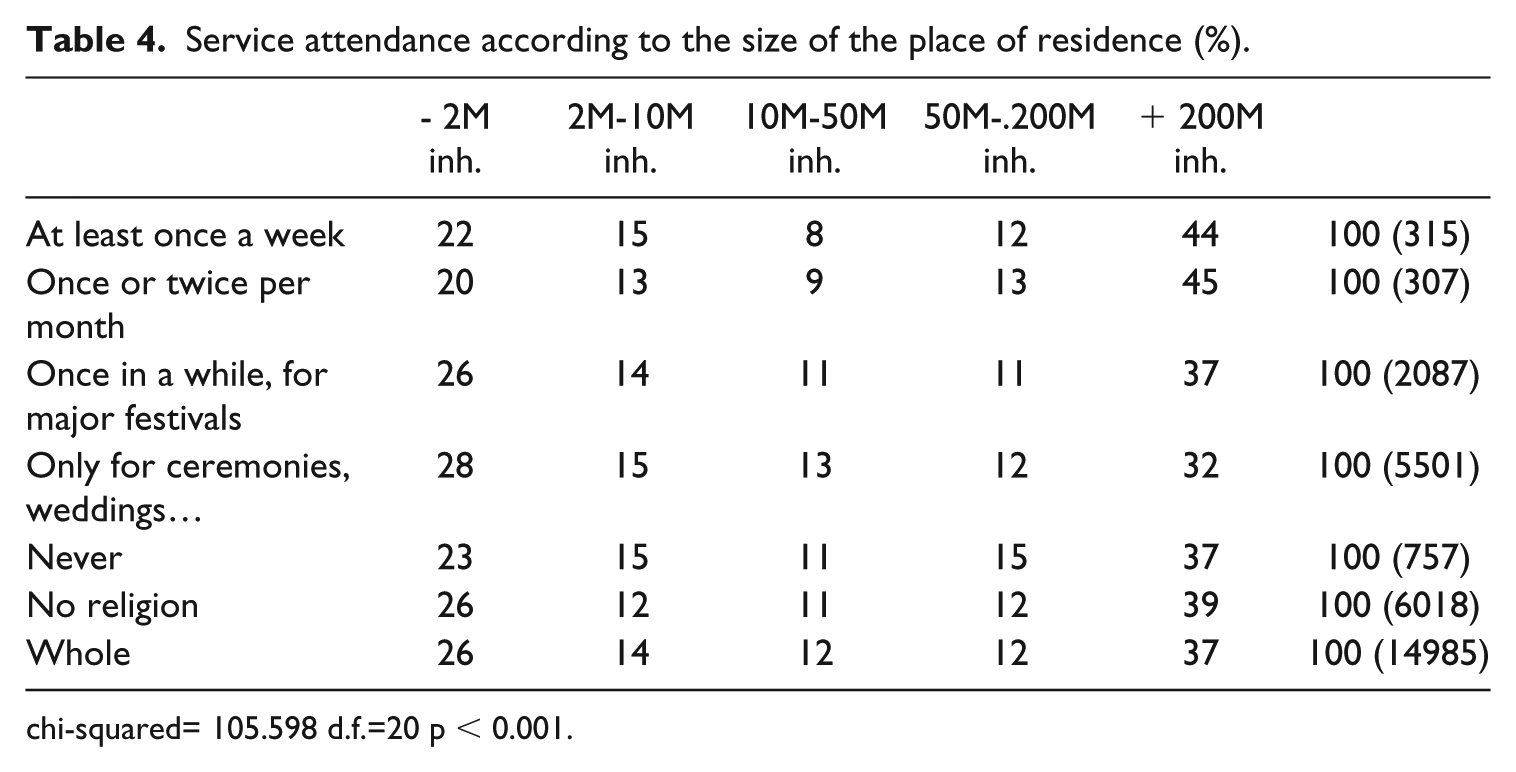
chi-squared= 105.598 d.f.=20 p < 0.001.
This situation is all the more significant given that it is not matched for subjective religiosity: 39% of convinced atheists live in towns with more than 200 000 inhabitants, but only 36% of people who state that they are religious. The categories outlined by the two indicators cannot therefore be exactly assimilated when it comes to their social characteristics. How can this discrepancy be accounted for?
A clear differentiation between forms of social affiliation
To better understand this paradox, we must consider another variable: the profession of the respondents. It appears that the more regular the religious practice, the higher the rate of managers and professionals, and the lower the proportion of manual workers (Table 5). This had been noted from the very first studies on the de-Christianisation of the working class (Isambert, 1961).
Levels of Catholic practice according to the professional category of the interviewee (%).
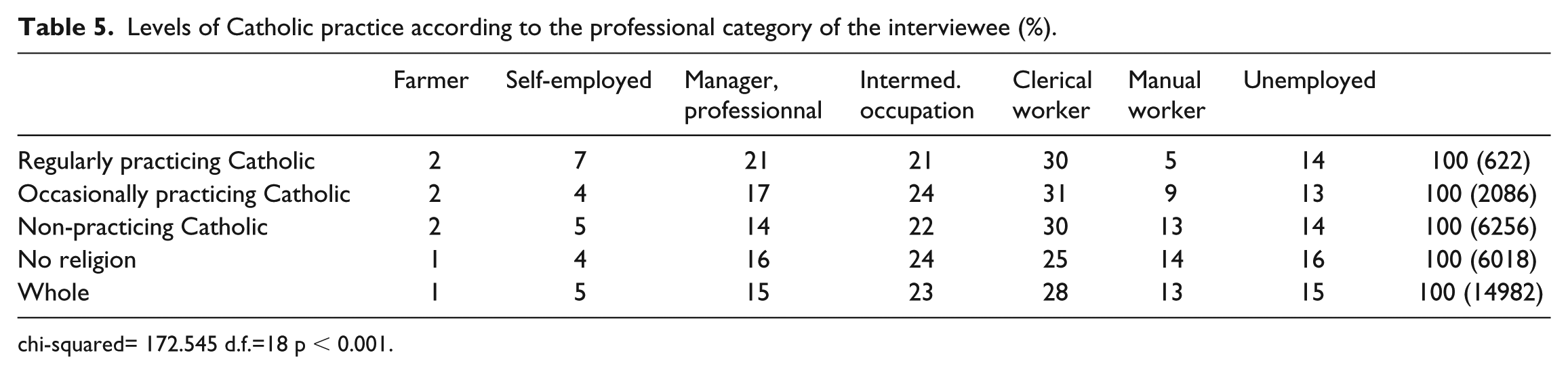
chi-squared= 172.545 d.f.=18 p < 0.001.
But this social continuity has caused a shift when it comes to the place of residence. Today, more than half (54%) of professionals live in urban centers with more than 200 000 inhabitants, which house only 37% of voters. Conversely, workers are over-represented in smaller communities with a population of fewer than 50 000 inhabitants, especially in villages: 32% of workers live in villages, but only 26% of all voters do. The over-representation of practicing Catholics in large towns therefore has specifically social causes.
This morphological explanation must be completed with two others. The first one is linked to the shortage of priests. Given the vocational crisis, it is increasingly difficult for the Catholic Church to celebrate the Sunday service. To remedy this, the Church has created interparish gatherings (Béraud, 2007; Mercator, 1997). Mass is therefore often celebrated in different churches in an area in turn. This inevitably creates a distance between the place of worship and the place where people live, and it also makes regular religious practice more haphazard. The break-up of the parish community often goes hand in hand with the expansion of the geographical remit of the priest, which impacts on the regularity of Sunday practice.
Finally, a third perspective must be added to these observations: graduates are over-represented amongst those who practice regularly (57%, compared to 48% as a national average), as well as, to a lesser extent, amongst those who declare no religion (53%). 14 This creates an asymmetrical U curve. With regard to those in France who attend mass most regularly, the data matches the over-representation of professionals amongst the most involved Catholics.
The situation seems to be the opposite for subjective religiosity: indeed, religious feeling is overrepresented amongst those who did not complete the baccalaureate, whereas graduates are much more numerous amongst convinced atheists. 15
It becomes easier to understand what distinguishes these two indicators. Catholic practice seems to be more typical of the bourgeoisie (salaried or self-employed). This explains why the religious population is overrepresented in larger towns. Religiosity, on the other hand, is more typical of the lower middle class, and especially of clerical workers (Table 6).
Subjective religiosity according to the socio-professional category of the interviewee (%).
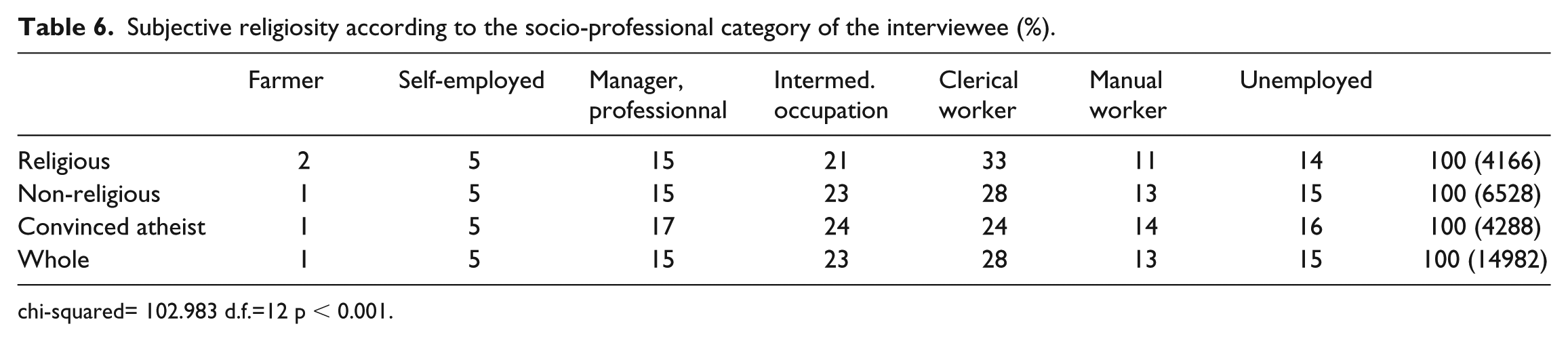
chi-squared= 102.983 d.f.=12 p < 0.001.
But do these discrepancies between the two indicators of religious involvement translate into discrepancies in electoral behaviour?
Religious involvement and the vote in 2017
The political impact of religious practice
In France, the influence of involvement in Catholicism on political attitudes and behaviours has often been established on the basis of the results of the second round of the presidential election. But the configuration of the second round in 2017 was very particular since it didn’t oppose a right-wing and a left-wing candidate: the first round had qualified Marine Le Pen, from a far-right-wing party, and Emmanuel Macron, who claimed that he was from neither the right nor the left. To study whether the left-right split remains linked to the level of Catholic commitment in 2017, it is therefore better to focus on the first round of the election.
Although the ballot effectively represented a four-fold split in the electorate, the results show very significant differences depending on Catholic religious practice (Table 7). 16 Most notably, without being strong, the associative relationship between these two variables was shown to be consistent, with a Cramer’s V statistic of 0.18 (p < 0.001). 17 This consistency is worth noting, given that nearly half of the electorate voted for candidates who did not fit into the traditional categories of left and right.
Vote of Catholics and ‘no religion’ depending on the frequency of service attendance (%).
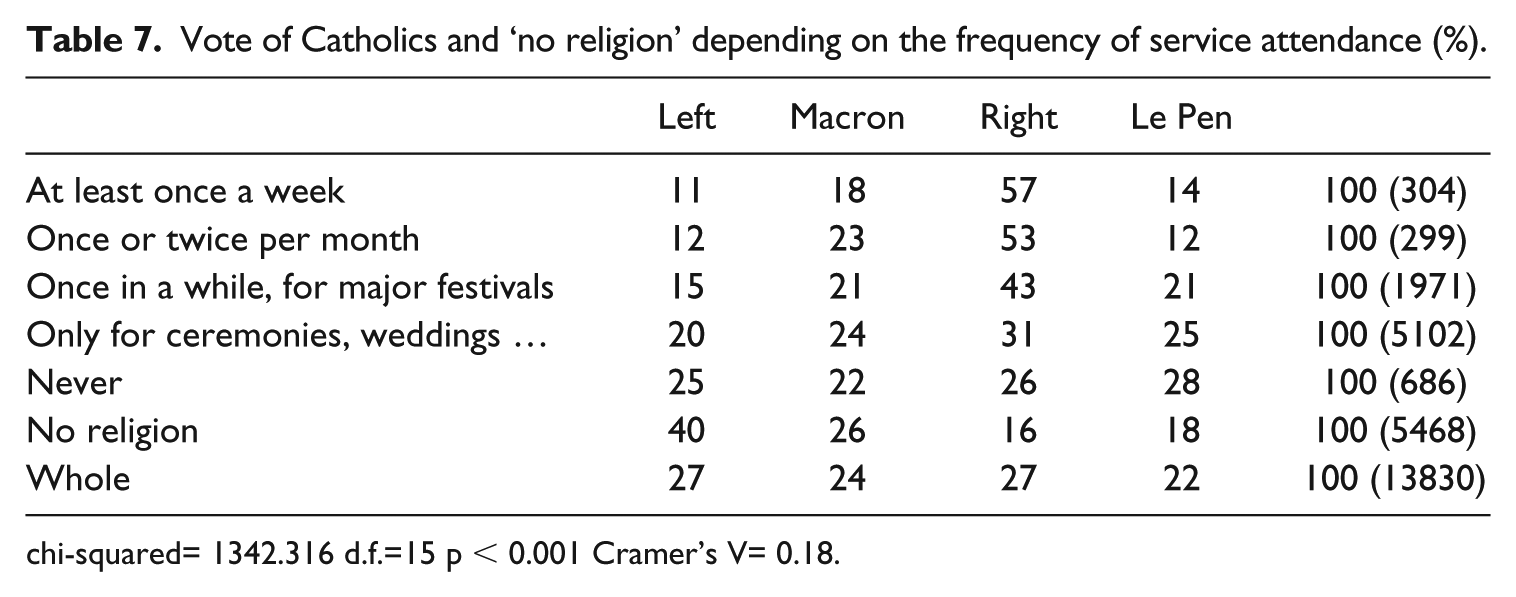
chi-squared= 1342.316 d.f.=15 p < 0.001 Cramer’s V= 0.18.
As regards the vote for Marine Le Pen, the data collected counters the analysis put forward since 2015 18 which argues that, in a break with the past, Catholics had become supportive of the Front national. Since the rise of this party, at the end of the 20th century, one of the counterintuitive results highlighted by electoral sociology is the reticence of practicing Catholics to vote for candidates from this party (Mayer, 2007: 434). Considered from the religious perspective, as well as from an ideological point of view, the Front national cannot be assimilated to the extreme right. Contrary to what has sometimes been argued since, and according to what has been shown in the last regional elections (Dargent, 2016: 28), involvement in Catholicism continues to keep people away from the far right in France, as it has done for many years. 19
Thirdly, there does not seem to be a clear link between Catholic integration and voting for Emmanuel Macron. Since this integration has traditionally been a marker of the right-left divide, it understandably might not be relevant for a candidate who claims to eschew this divide. We also know that the centrist François Bayrou gave his support to the founder of the En Marche! movement. And it had already been noted during previous presidential elections that the vote for the president of the Modem was not strongly correlated to religious involvement either (Michelat and Dargent, 2015).
This result can be interpreted: the choice of the former Economy Minister is the product of a combination of votes originating from opposite segments of the political spectrum: 46% of François Hollande’s voters of 2012 voted for Macron, but also 40% of François Bayrou’s and 17% of Nicolas Sarkozy’s. The former enjoyed far greater support from those with no religion than from practicing Catholics, unlike the latter. Given that Macron was supported by people with such opposite religious attitudes, it is not very surprising that the very diverse voters of the future President do not reveal any significant trend.
Nonetheless, it remains obvious in 2017 that the left and the right have radically opposite religious perspectives. The Electoral Survey shows that a person who claims to have no religion is almost four times more likely to vote for a left-wing candidate, and almost four times less likely to vote for a right-wing one. It is on this last choice that Catholic religious practice has the greatest impact, with every extra level of the scale leading to a rise of 4 to 10 points for a right-wing vote.
We can therefore see how mass attendance in 2017 remains a very good indicator of political positions, on the right and on the left. Better still, it is also significant for voters who do not belong to any church (Table 8). Although the global link is weaker in this instance, there is a clear difference between the right-wing vote of those who attend services at least from time to time – more regular practitioners are predictably very rare in this population – and those who attend only for rites of passage, and especially those who never do.
Vote of the ‘no religion’ depending on the frequency of service attendance (%).
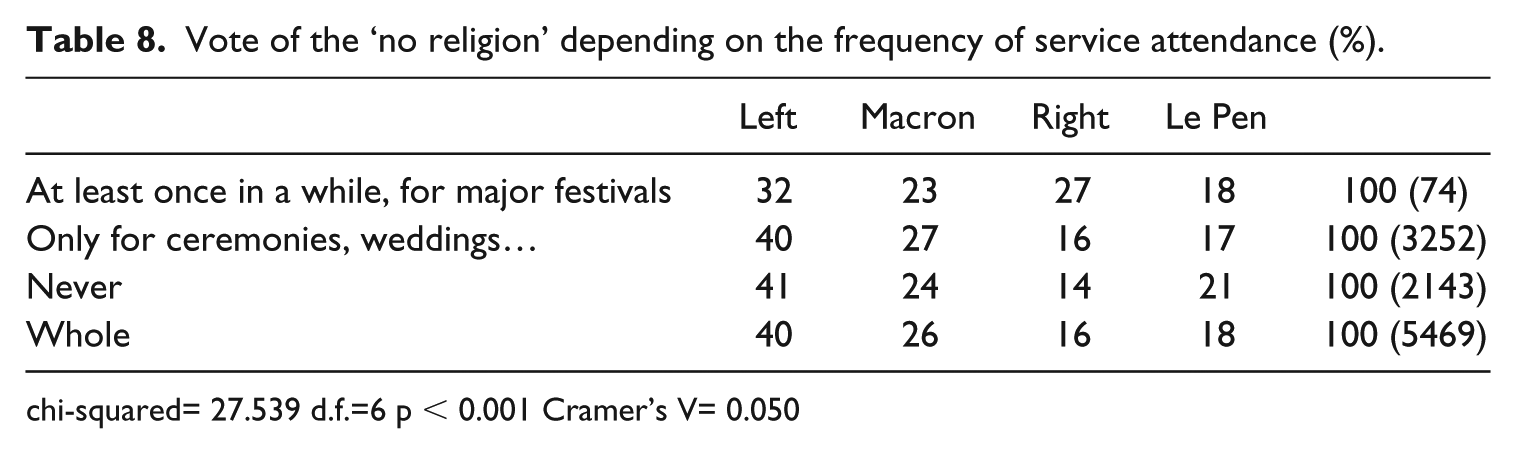
chi-squared= 27.539 d.f.=6 p < 0.001 Cramer’s V= 0.050
Why is mass attendance conducive to a specific electoral behaviour for people who state that they have no religion? Maybe because it is usually a trace of past religious socialisation: we can see that Catholic culture has long-term political effects, even for those who have abandoned any claim of religious affiliation. And mass attendance, rare as it may be, is a good indicator of political behaviour.
The political effects of religiosity
Subjective religiosity confirms what mass attendance reveals of the political leaning of Catholics. But it also points to other insights (Table 9).
Vote according to subjective religiosity (%).
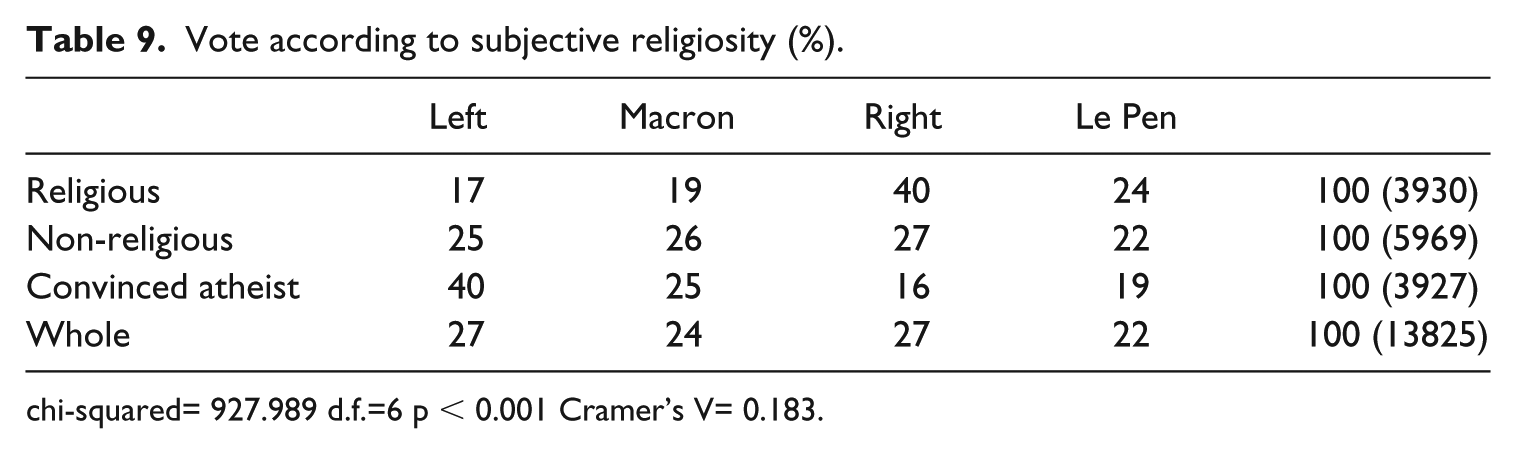
chi-squared= 927.989 d.f.=6 p < 0.001 Cramer’s V= 0.183.
Firstly, we can see that strong religiosity is conducive to a right-wing vote and distances the population of Catholics and those with ‘no religion’ from a left-wing vote, whereas the claim of atheism has the opposite effect. Overall, without being very significant, the link between subjective religiosity and voting behaviour remains substantial: Cramer’s V is of 0.183 (p< 0.001). Above all, the right-wing vote is multiplied by 2.5 when we shift from convinced atheists to assertive Catholics, and the left-wing vote is divided by the same coefficient.
But are these truly the effects of subjective religiosity? As we have seen, some social categories have moved away from religion (workers, young people…). Is what we are seeing here not a distinctive trait of their voting behaviour rather than of their religious disengagement? A turn to logistic regression disproves this possibility. In respect of the right-wing vote in the first round of the 2017 election, this method helps us to assess the impact of various types of social belonging on the vote (Table 10). If gender had no effect in 2017, age did, and the under 35 voted almost three times less for the right than the over 65; graduates half as much more as those without a degree; the self-employed twice as much as workers; and those whose assets are made up of 6 or 7 items more than three times as much as those who own no assets. In spite of this, even when these variables have been factored in, so all things being equal, the voters who self-identify as religious voted 3.2 times as much for the right as atheists, while those who declare no religion occupy a middle ground.
Logistic regression for the right-wing vote (2017 1st R).
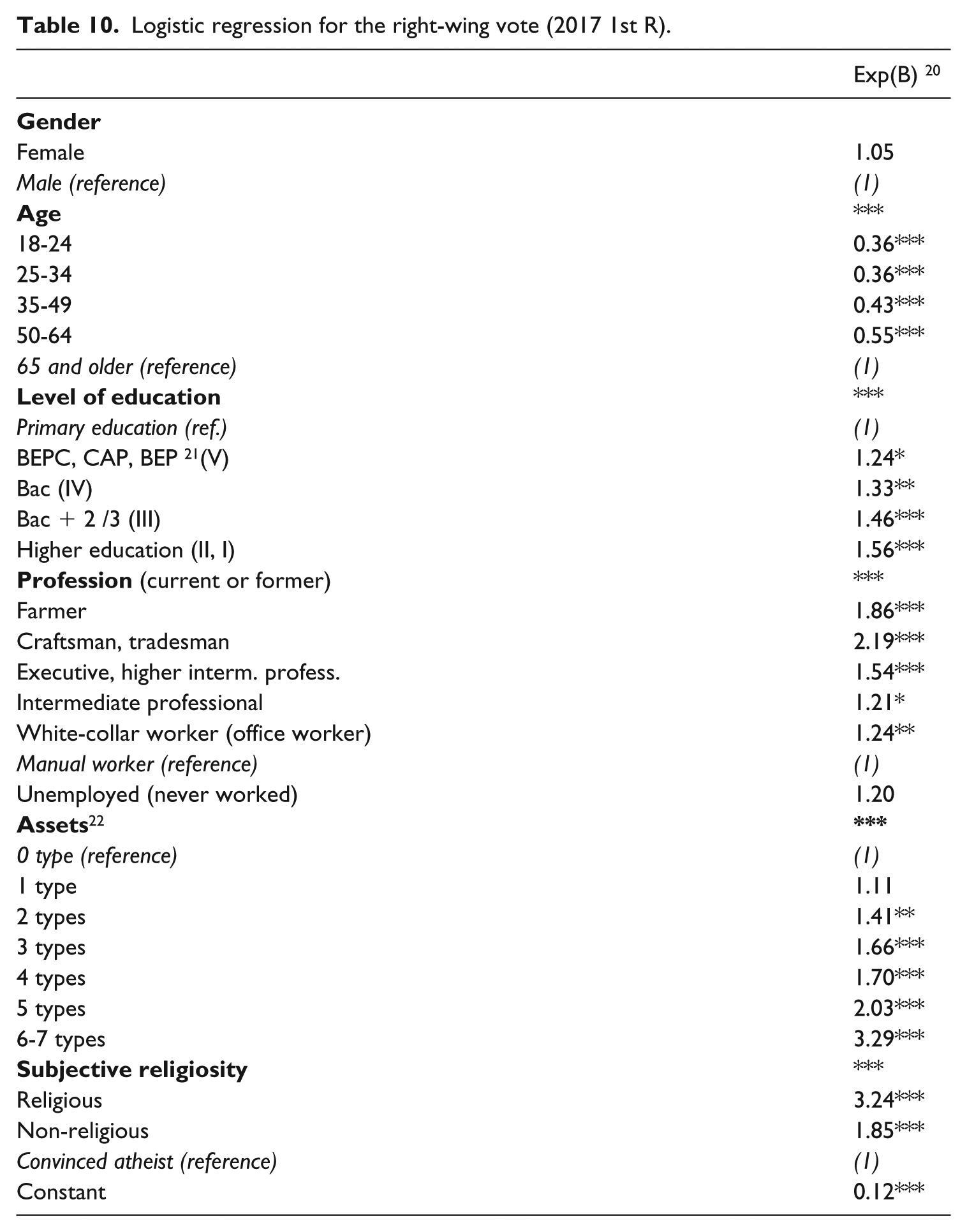
These results match those of previous studies. The French sample of the 2004 European Social Survey already showed that the higher the level on the religiosity scale, the more likely a self-positioning on the right of the political spectrum (Dargent, 2010b). This was also the case throughout Europe, for all religions, but to a lesser extent than in France. This discrepancy can probably be put down to the fact that Catholicism is by far the dominant religion in France, unlike in Northern Europe, for example. In spite of all the changes that have happened since, with regard to the place of religion in society, the relation between religiosity and politics still therefore exists, 13 years on.
The two indicators of religious practice and subjective religiosity, which are correlated, show convergent results, while belonging to different registers and resulting in different social distributions. Combining these two scales can therefore be insightful, not only by distinguishing atheists from other people who state that they have no religion, as has been done before (Bréchon, 2006), but by introducing the distinction between religious and non-religious at every level of practice, every time it proves relevant.
Whilst confirming the hypothesis of a structural connection between Catholicism and conservatism, the combination of these two indicators refines the relation: it shows a perfectly regular progression of the right-wing vote proportional to involvement in Catholicism, and a symmetrical decline of the left-wing vote (Table 11). Admittedly, this indicator does not produce a much stronger association with the vote than those it complements (Cramer’s V is at 0.187). Yet it allows for a more balanced distribution of the population amongst categories than Catholic practice alone, given the increasing weight of non-practicing Catholics, and those with no religion.
Vote according to Catholic practice and subjective religiosity (%).
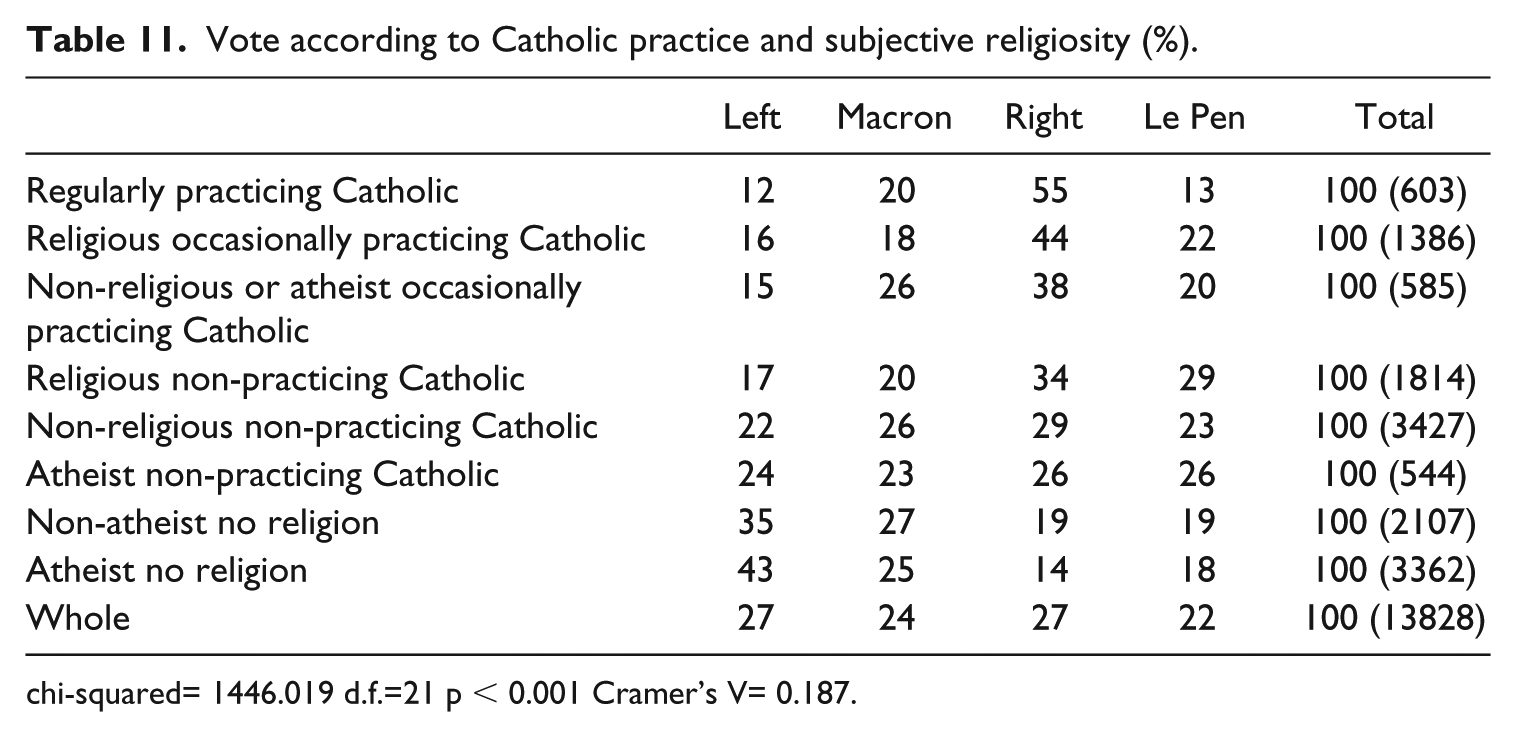
chi-squared= 1446.019 d.f.=21 p < 0.001 Cramer’s V= 0.187.
Despite the singularity of the 2017 French presidential election, the results clearly show the enduring relationship between Catholic integration and a right-wing vote.
This continuity must be highlighted, since it contrasts with the changes that have happened in recent years, especially with regard to the directions set for the Catholic Church by successive popes – John Paul II, followed by Benedict XVI in 2005, whose resignation in 2013 allowed Cardinal Bergoglio to ascend to the papacy. With regard to issues of social morality, as well as questions of ecclesiastical organisation, the differences between the two last popes have been substantial. Yet, these changes have not been reflected in any significant way in voters’ choices.
It is interesting to observe that this is also true when subjective religiosity is considered, as opposed to practice. One could argue that, independently from its status as an indicator of involvement in Catholicism, the regularity of a behaviour like mass attendance is the expression of a lifestyle associated with conservatism. This could explain why even in religious cultures historically drawn to the left, such as Protestantism, service attendance is correlated with a more right-wing orientation, and why practicing Muslims do not seem to vote more on the left than non-practicing ones, according to the available data. Because subjective religiosity only deals with representations, it incurs no such objection. In spite of the renewal of the electoral configuration in 2017, it is therefore significant that the data from the French electoral survey also points towards links between the level of subjective religiosity and a conservative vote.
More generally, the mobility which characterises contemporary societies undermines binary models such as the opposition between those who follow a religion and those who don’t. This development tends to multiply the incidence of intermediary situations. Hence the need to diversify the indicators of (non-)religious affiliation. The analysis presented in this article demonstrates the significance of subjective religiosity from this perspective, both for the sociology of religions and for political sociology, much like subjective social class in another field. The strong correlation between this indicator and practice shows that they belong to the same level of reality. Nonetheless, this is a distinct register, concerning representations rather than behaviour. The differences show that this indicator is indeed another angle from which to understand the social world, necessary for the comprehension of religious and political phenomena.
Footnotes
Acknowledgements
I thank Cevipof and its director, Martial Foucault, for allowing me to access the data from the French election survey.
Funding
This research received no specific grant from any funding agency in the public, commercial, or not-for-profit sectors.
Notes
Author’s biography
Address: Claude Dargent, Cresppa, UPL, Univ. Paris 8, CNRS, Cevipof-Sciences Po, 59-61 rue Pouchet, Paris, 75849, France. Email: