




Abstract
Campus master plans are released every few years for developing and implementing its physical infrastructure. Open spaces, compactness, connectivity, greenness, and environmental impact have often been the focus on its framework. In particular, the effect of new building development on existing buildings’ occupant comfort and design intent is mostly ignored. Providing guidelines to retain existing users’ comfort for stakeholders involved in design decision making will result in improved design decisions. Hence, this research aims to provide a work methodology to mitigate the adverse effects of new buildings on existing buildings’ user comfort through a case study at Carleton University. The case study shows a methodology to retain the existing users’ comfort by analyzing Carleton University’s master plan on massing studies, occupant survey to understand their comfort needs, performance analysis of the impact of the new building on the existing building user comfort. The analysis reveals the key parameters to consider in design for occupants’ comfort. Finally, the research reinforces the generative design and the need for dynamic modeling in campus master plans to mitigate the negative implications of new development on occupants’ comfort.
1. Introduction
People become accustomed to their habitat and adapt to their surroundings for comfort. Any changes to their building or surrounding buildings may affect their comfort factors (like daylighting or views) and adaptive behavior. Sometimes, in new building developments, designers mostly tend to focus on the occupants’ comfort for the building they are currently designing, without considering the effect of new buildings on the occupants’ comfort of existing adjacent buildings. The goal is to avoid such pitfalls to retain the occupants’ comfort in existing buildings. This research focuses on campus planning and development to understand how new development impacts existing building users’ comfort, as it mimics some aspects of urban issues at a lesser scale. The approaches to the campus planning problems are applicable for a broader framework like the neighborhood, city, or urban design. 1 A master plan drives campus designs and understanding how it is developed will help evaluate the design process and implementation.
A master plan consists of long-term goals combining the site and institutional strategy in its policy while giving flexibility for future development. 2 Implementing these goals depends on various stakeholders, such as building occupants, master planners, engineers, architects, landscape designers, and campus administrators. Master planners and architects are the key stakeholders, and their goals vary in perspective and expectations, dominating their design approach and decisions. 3 Nevertheless, one of the main stakeholders is the occupants and they have little to no influence on the decision-making of building development, 4 nor are they a part of a collective decision made by campus administration and designers. 3 Other factors like cost, population density, and spatial requirements during building development play a crucial role in a successful implementation.
In general, before master plans were introduced, campus design focused on individual buildings, producing “drive-through, sprawling, fragmented and isolated campus.” 5 The master plan resolves these issues by bringing coherence to the building design with its policy and goals. A comprehensive analysis of randomly selected 50 US master plans identified seven critical dimensions of campus designs: land-use organization, compactness, connectivity, configuration, campus living, greenness, and context.6–8 Concisely, these concepts or methods are apt for campus goals and learning experiences at a large scale but approaching the design through the lens of the occupants’ comfort and well-being is not addressed. Also, there is little information on how the campus considers occupants’ mental health and well-being in design for existing and new buildings. 9
During new building developments, the factors that affect occupants’ comfort in existing buildings are visual comfort (daylight and views), noise, and thermal comfort. Currently, campus master plans generally do not provide any guidelines to retain or minimize the impacts of new buildings on existing buildings’ user comfort, mental health, and well-being. However, a few studies consider students’ health and well-being on campus. For example, a study of healing gardens at the University of Hong Kong highlights the importance of mental health and natural space in sustainable campus planning. 10 Students working for long hours need a break from their work from time to time. Hence, the researchers suggest enhancing the visual connection between the outdoor green space and buildings’ indoor spaces to provide visual and physical contact with the green space for occupants’ well-being. When a new building is constructed, these factors are often neglected or compromised for the existing buildings due to the requirements and spatial constraints. A review on occupants’ comfort and well-being in buildings emphasizes that building performance often prioritizes occupants’ well-being. 11
Many studies improve occupants’ health and well-being in the workplace. For instance, studies on nature and the workplace reveal that views to nature, plants give physiological and psychological benefits,12,13 helps with stress management, 14 cognitive restoration, and recovering from mental fatigue. 15 An empirical finding on different view opportunities consolidates windows as a design element causes more psychophysiological influence than indoor plants. The findings also state that natural landscapes have a better impact than city views. 12 Similarly, daylight affects productivity, well-being, comfort, and sleep quality.11,16 Hence, designing artificial lighting, glare, window geometry, glazing ratio plays a vital role in occupant well-being, health, and comfort.11,17,18 New building massing affects the existing buildings’ daylight quality, and its building materials may cause glare issues. Recent studies cover the importance of occupant comfort from all aspects for performance analysis, but to reduce the scope of work, we focus on visual comfort for this research.
The influence of new buildings on their surrounding buildings should be analyzed in any given environmental context. New buildings affect the existing buildings’ original design to meet occupants’ comfort, energy usage, interactive behavior, and well-being. Hence, the research question is: how can we mitigate the negative impact of new buildings on existing buildings occupants’ comfort? In general, with the current state of the art, a simulation analysis of occupants’ comfort in the existing building with the massing of new buildings will enable the designers to understand the negative implications. Furthermore, a occupants’ survey on existing buildings near new constructions will illustrate new buildings’ imposition on their comfort.
In this case study, we are using an ongoing construction at Carleton University (Ottawa, Canada) to analyze the impact of a new business building on an existing Architecture Building. The Architecture Building is historic and impacted by the presence of the new building. The scope of the case study is limited to massing and its influence on its surroundings. To approach the problem, we analyze the Carleton university master plan, survey occupants, and use simulation to understand the implications of the new buildings. Finally, we use generative design for massing analysis of the new buildings that consider various design parameters like visual comfort of the existing building and floor area to minimize the negative implications.
2. Case study approach
This section briefly discusses on the need for contextual design parameters and the work methodology. Building design and occupants’ comfort preferences vary depending on the building context, and culture. For example, the building’s design varies for a cold and warm-humid climate. Likewise, the occupants’ behavior varies based on the building type, available technology, culture, and religious practices. Hence, design consideration for building performance and occupants’ health and well-being should consider contextual design parameters. Many computational and simulation tools also allow designers to perform design and simulation analysis for building performance and occupants’ comfort evaluation—these methods, when combined with contextual parameters, create a more robust method.
Hence, our case study proposes the following work methodology: contextual design analysis by evaluating the campus master plan and development through time, occupants’ comfort analysis through survey, building performance analysis (like visual comfort, thermal comfort) of the proposed new building with the existing building occupants’ comfort, and a computational design (generative method) analysis that considers various design and comfort parameters for massing design that maximizes occupant comfort in buildings.
We applied this methodology to Carleton University’s campus development, captured the occupants’ feedback while the construction was in progress, and proposed how this approach, if followed, can affect design decisions. The analysis of the campus master plan will reveal how the goals have been improved and implemented over the years. It will help in understanding the institution’s goals and designers’ goals, knowledge on new developments, and the drawbacks of the design goals with implementation. Likewise, an occupant survey will reveal the design issues, site attractions, and preferences. The campus master plan analysis and occupant survey will guide the design requirements to retain occupants’ comfort in existing buildings. The building performance and comfort analysis of the new building with the existing building will reveal its negative implication and influence design decisions. The occupant survey and the building performance analysis will help analyze occupants’ perception with simulation prediction to make a robust comparison. Generative design analysis will allow the designers to input various parameters and evolve a design that maximizes occupants’ comfort.
3. Carleton University master plan
This section analyzes Carleton University’s campus plan in the context of buildings’ mutual impact on each other and the corresponding impact on occupant comfort. We analyze the massing guidelines and compare what was proposed with the actual impact that it can have on new developments. There are discrepancies between the master plan’s key principles and the intentions of the design decision-making stakeholders (master planners, architects, and campus building program committee) for various reasons. We use the case study to evaluate the effect of the master plan over the decision-making of new developers on campus. Besides the use of BIM models of campus buildings for simulations, different stakeholders were taken into consideration using various survey methods.
Every 5 to 10 years, Carleton University releases a new master plan that represents the roadmap of the university planning at the campus scale. The introduction of 2016’s version of the master plan states, “The purpose of this plan is to set the parameters, policies, and directions for the physical development of the campus—its buildings, landscapes, movement systems, and general infrastructure.” 19 Its idea is to provide guidance and constraints to the developers of new buildings and infrastructure. However, the plan also promotes flexibility and variation over time. The set principles function as a framework to plan further campus development. Carleton University identifies the key principles through a consultation process, including interviews and surveys to students, faculty, and administrative staff.
In the 2010 version, 19 the plan set some fundamental principles related to (1) design, programming, and maintenance; (2) height and massing of new buildings; (3) character of pedestrian and cyclist routes; and (4) new design for the North Campus (Figure 1). These principles were still relevant when they began to plan 2016’s master plan. 20
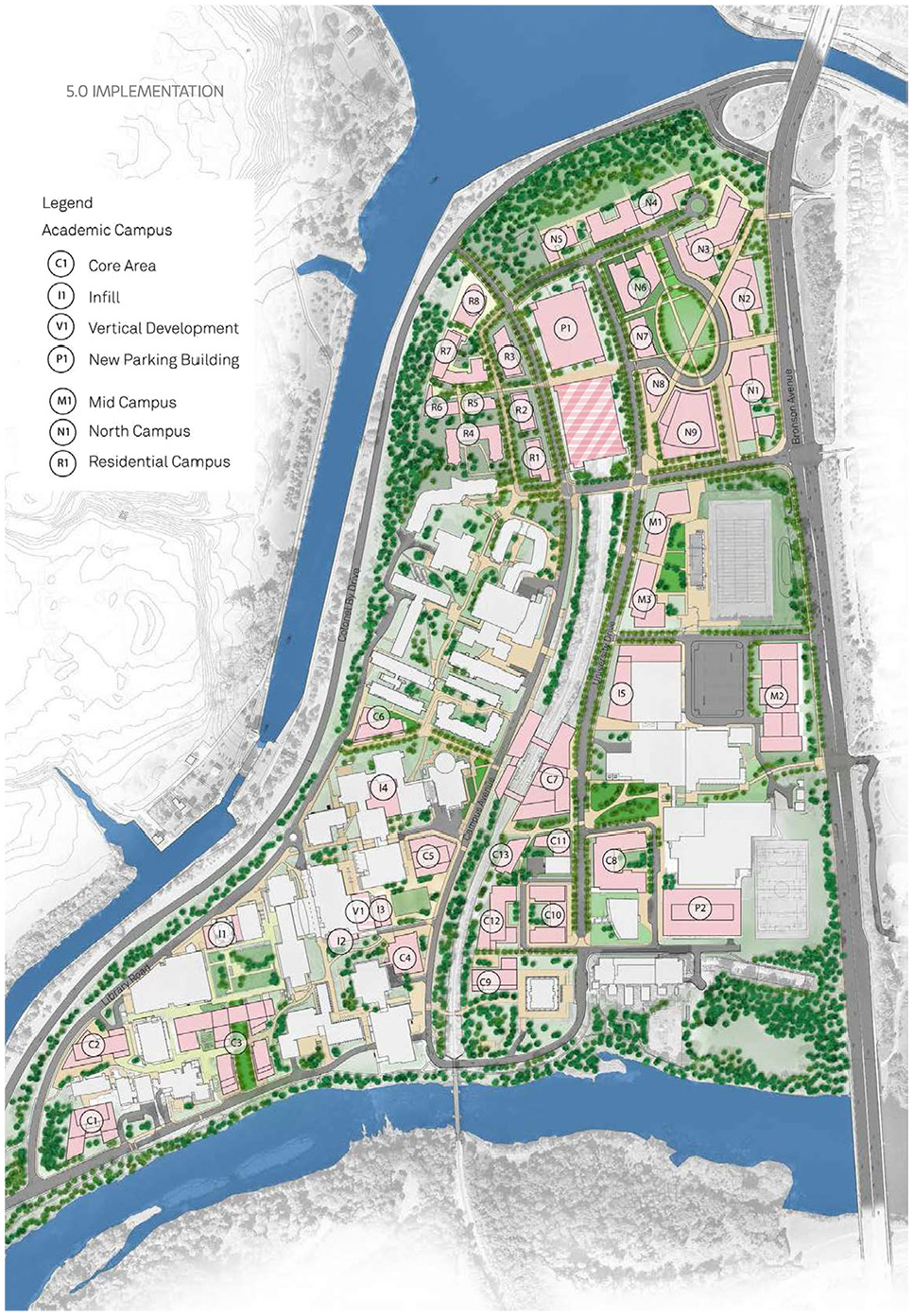
From the 2016 Campus Master Plan. The red blocks indicate proposed buildings. The whole north of the campus (top green part of the image) it is a proposed area that it is currently undeveloped. 19
The design team reconfirmed the principles through a consultation process, providing additional direction for some of them. This project focuses on the second key area; the height and massing of new buildings relative to their location on campus and proximity to streets, open spaces, and existing buildings, regarding that concept the master plan states that
“The appropriate height and massing of new buildings will be determined by evaluating impacts on the surrounding areas” (page 15).
“Positive indoor-outdoor relationships should be an objective of all new development. Buildings should frame open spaces and relate physically and visually to the outdoor environment” (page 20).
“New buildings should aim to maintain a 20 meters separation distance from existing buildings. If 20 m is not achievable, the minimum dimension for facing primary facades is 15 meters. Secondary facades (those that do not house active building uses or are less than 25 m in length) should have a minimum facing dimension of no less than 12 meters” (page 39).
In many cases, these ideas were graphically represented with diagrams, renderings, and schematic massing analysis to provide a visual testimony of the concept that the master plan was trying to highlight. The focus was on avoiding or minimizing the negative impacts of new development to maintain the quality of spatial, environmental, and user experience.
The proposed design of the Nicol Building (new building for the Business school) in the 2016 Master plan (Figure 2) tries to consider the principles of indoor–outdoor relationships, views, and natural light. However, it does not consider the principles in their entirety. For example, it does not propose how to relate this new development with its neighboring building, the Architecture Building. The Architecture Building, also known as Building 22, is considered an important heritage piece of the campus, and it is one of Carleton’s earliest buildings (Figure 3). The east façade has had a direct relationship with one of Carleton’s main roads—Campus Avenue—for the last 45 years (Figures 3 and 4). Moreover, users of the classrooms that face east have enjoyed a wide view of the campus public space from the interior. Studios on the fourth floor had plenty of sunlight and a generous view over the Parking lot 2A (Figure 6).
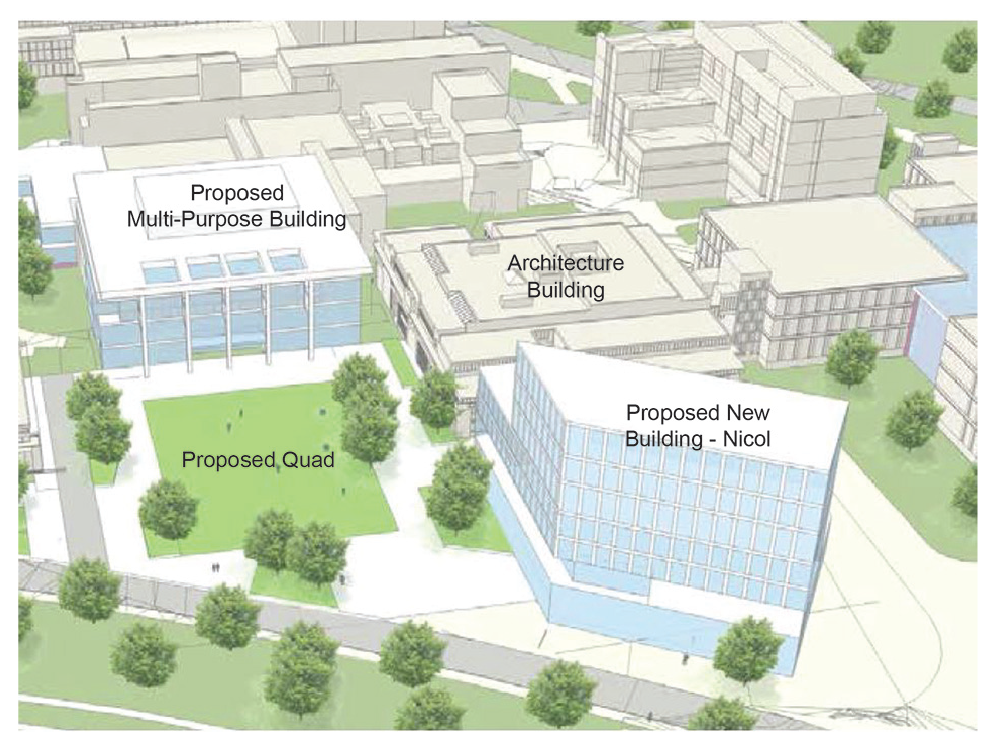
Campus Master Plan (2016) illustrating the proposed massing for the new Business School building(foreground) and the existing Architecture Building (background). 19
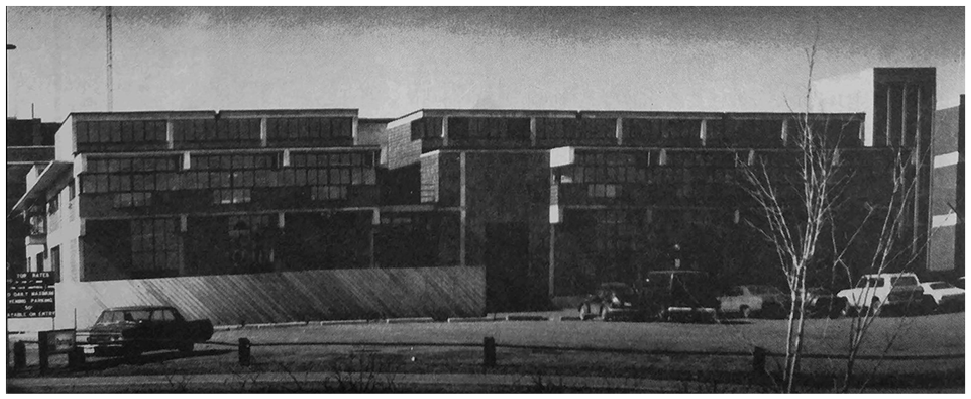
Architecture Building east façade, 1972 (Stinson 1973).
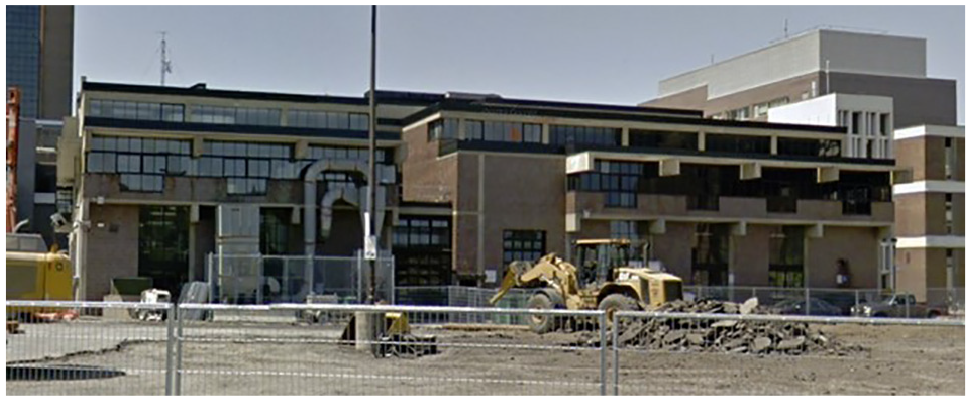
Architecture Building east façade, 2018—Starting of construction phase.
For this study, it is necessary to evaluate how the master plan’s principles are translated into concrete building regulations. The chosen case study is the relationship between the new Nicol Building for the Sprott School of Business on the campus and the Building 22 of the faculty of Architecture and Urbanism. The Nicol Building is one of the first buildings to be designed and constructed after 2016’s master plan. The building’s construction began in 2018, and the university took possession of the building in July of 2021 in time for classes in September 2021.
The Architecture Building did not undergo any significant modifications since 1985, when a fifth floor was added, impacting the building’s sunlight conditions. Architecture students were not pleased about losing natural light, so they protested to stop the project from proceeding but failed in their attempt. The fifth floor’s new addition blocked most sunlight coming through a central clerestory that provided natural lighting to the studios on the fourth floor and main central spaces. The Charlatan, Carleton’s University newspaper,
21
dedicated a whole article to that case. The article says that “The importance of natural light is something the architects find difficult to explain but feel very passionately about. The Director of the School of Architecture, Alberto Perez-Gomez says the loss of natural light would have a negative psychological effect on the students.”
22
For the studio spaces behind the east facade of the Architecture Building, the remaining source of natural light and visual indoor–outdoor relationship with the exterior was the window that used to look directly at the parking lot 2A (Figures 5 and 6).
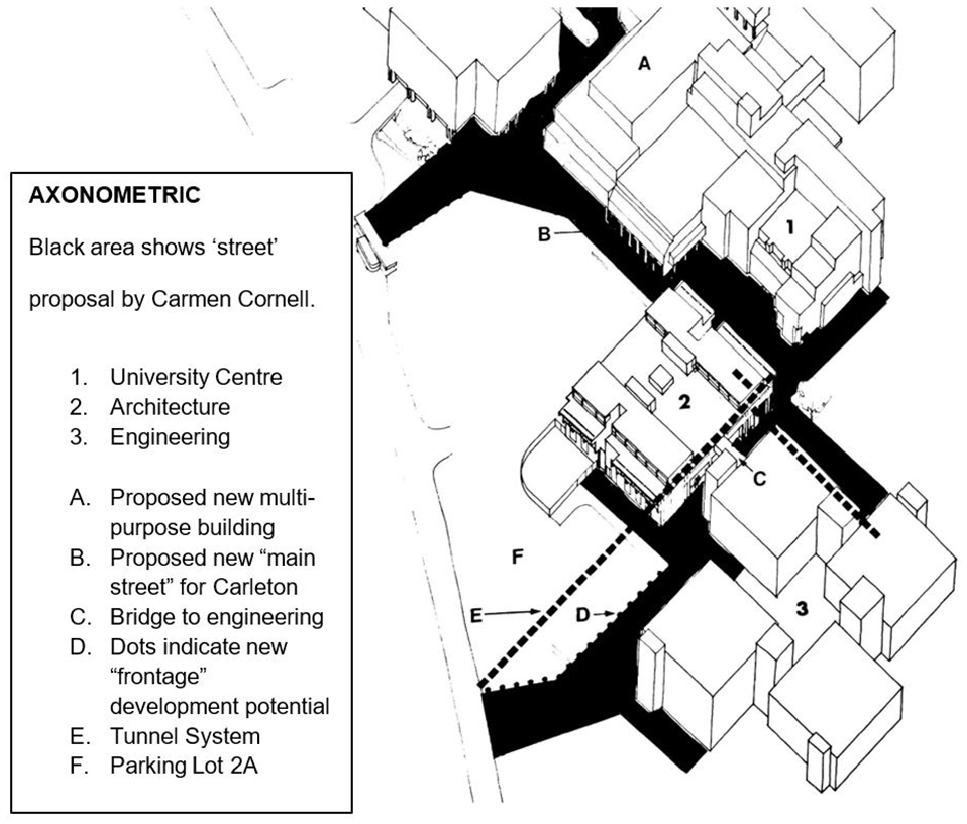
Axonometry shows the relationship of the Architecture Building with the surrounding buildings. 21
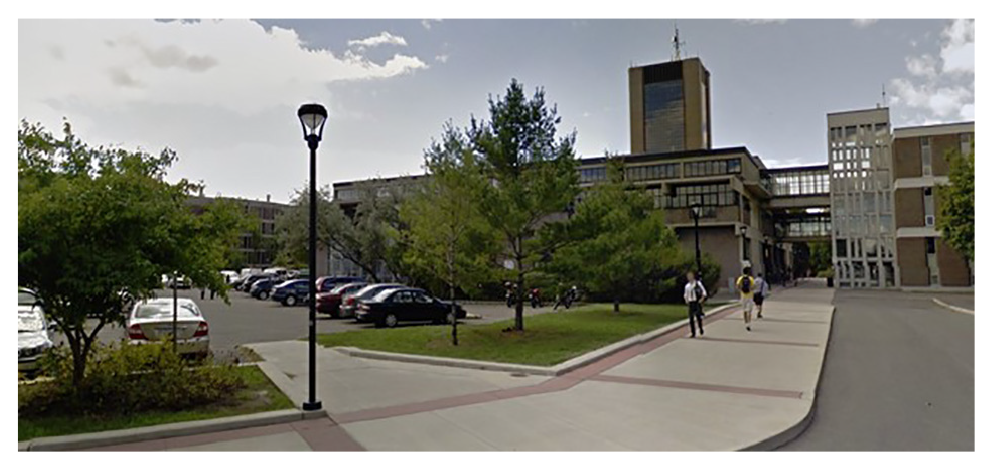
Architecture Building east façade, 2018.
The population density in the university is continually increasing; therefore, the necessity of new infrastructure and buildings is imminent. Multiple times in the history of Carleton, new buildings have affected the environmental condition of their surroundings, and the campus land is not expanding in the foreseeable future. These necessities are solved by densifying the current available space. Often, the occupants’ experiences are not a definitive parameter for new development decision-making. The expansion of the fifth floor in the Architecture Building in 1985 clearly articulates the lack of attention toward occupants’ experiences. 21 Moreover, the design teams assigned to new developments are not necessarily concerned about all the aspects of the new building’s surroundings.
The campus master plan explicitly points out that the university’s goal is to reduce the negative impact among neighboring buildings, but this is not successful in recent development. Hence, the study’s goal is to provide a workflow to mitigate the negative impact of new development on occupants’ experience.
4. Occupants’ survey
A survey was conducted for the Architecture Building’s occupants to understand how the new building impacted their daily spatial experience. At the time of the survey, the building was 70% completed, and the scaffoldings were removed. The study was conducted for studio III and IV (see Figure 7) of Carleton University’s Architecture Building. The hour of occupancy and accessibility to space are crucial factors in choosing the studio rooms. The rooms are used 24/7, as they are studio spaces. The research originated from an occupant’s experience. The occupants reported that the lighting conditions were impacted drastically with the presence of the new building. This experience led us to understand if other occupants felt the same.
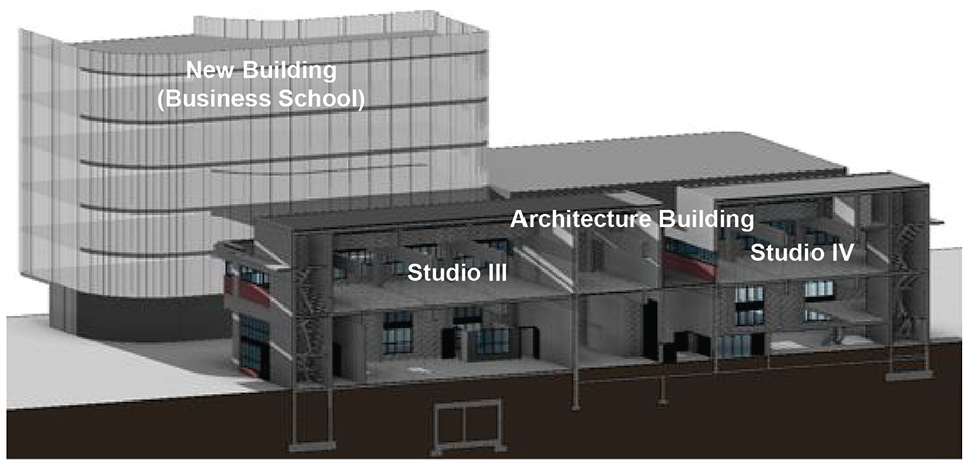
Sectional view of studio III and studio IV of architectural building in relation to new business school building.
4.1. Data collection and analysis
The user study consists of a qualitative survey of 5 topics attributed to spatial behavior: studio space, lighting conditions, indoor–outdoor relationships, impact on creativity, and design solutions. Each topic has a quantitative question to rate their experiences and a qualitative inquiry to explain the rating. The questions are described in Section 4.2 results. The participants were students and faculty of studios III and IV who had used the lab before the new building construction. They were recruited in the labs with the permission of the professors and lab instructors. We announced the study in the lab, and whoever was willing to participate in the study completed the survey. The survey was paper-based, and 53 students volunteered to take part. Prior to March 2020, the total capacity of the 2 studios was approximately 146 students. The survey considers the population of the Architecture Building rooms that face the new Nicol building. The floor beneath the studios is a workshop space and is not occupied for long hours.
At the time of the study, the sky was clear, which may have influenced the participants’ responses. The two studios’ spatial conditions were slightly different; studio III faces the new building tower as opposed to studio IV (see Figures 7 and 8). The lighting for studio IV was comparatively better than studio III. We did not separate the survey based on studios as we conducted it simultaneously. Hence, we could not segregate the data based on spatial location. The survey was quantified using an Excel sheet and NVivo 12 for qualitative analysis. Two different reviewers identified similar themes for each topic and consolidated the key attributes.
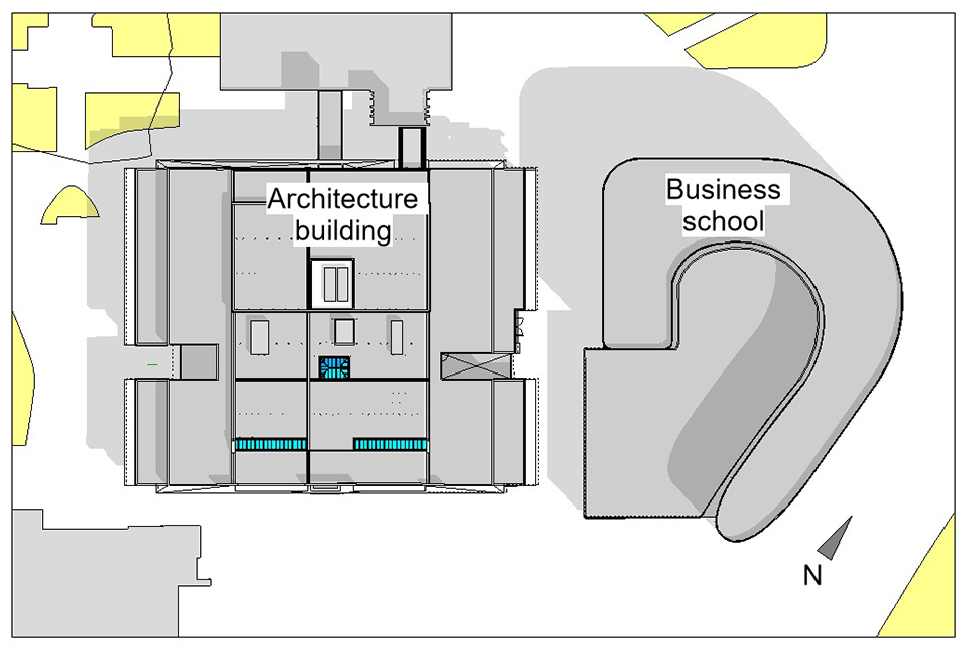
Location and orientation of the Architecture Building and the business school building.
4.2. Results
This section summarizes the results for the following topics: physical or studio space, lighting conditions, indoor–outdoor relationships, the impact on creativity, and design solutions. Each topic addresses two questions to the users. The first question asks the occupants to rate their feelings about the environmental conditions considering comfort (daylight, temperature, and views). Figure 9 shows the occupant survey for the studio space, lighting conditions, and indoor–outdoor relationship. Second, to provide a qualitative explanation of their rating. The following sections explain the reasons for the rating and summarize the survey issues quantitatively for each topic.
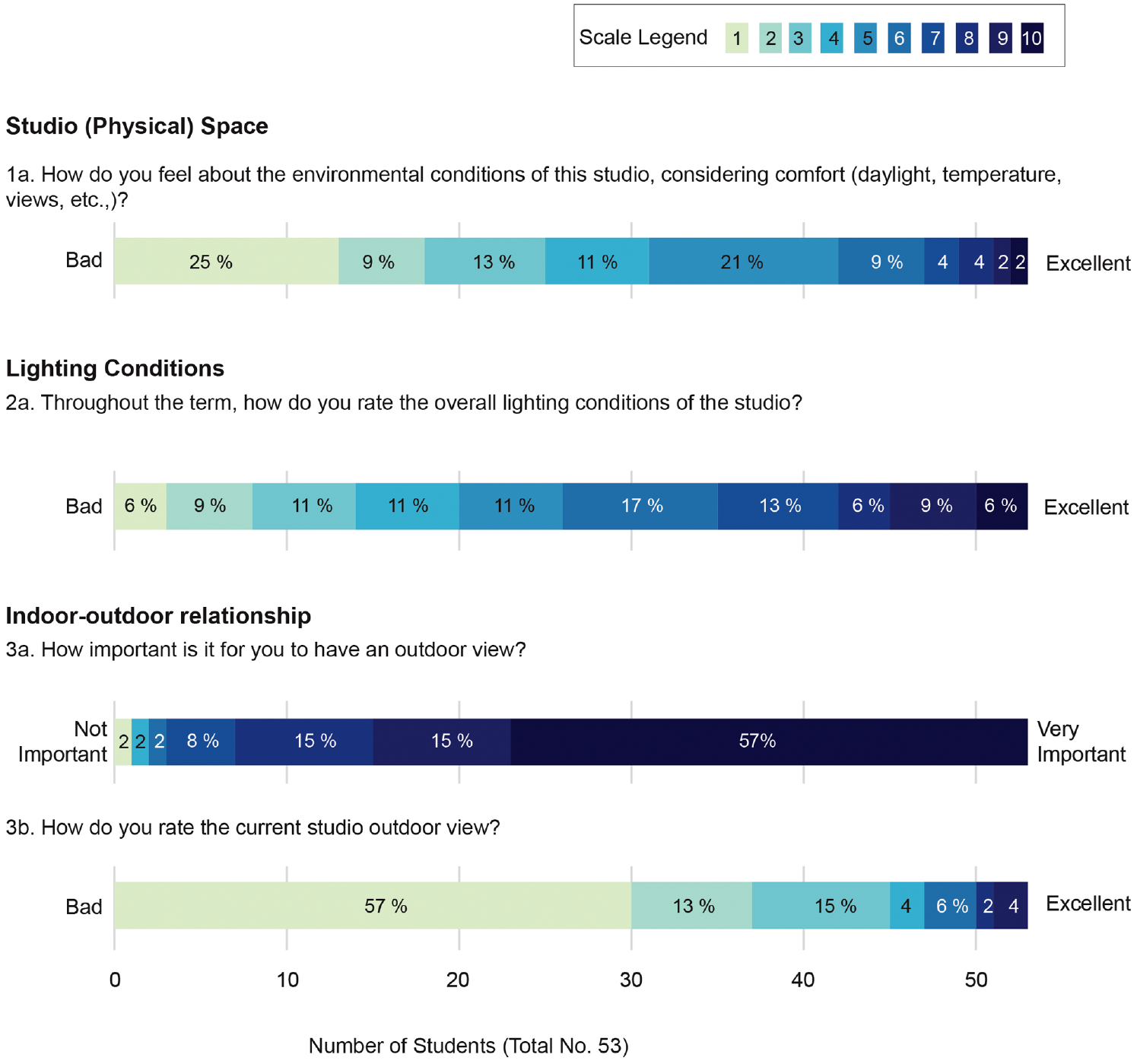
Occupant survey on Studio III and Studio IV in the Architecture Building at Carleton University.
4.2.1. Studio space comfort reasoning
The overall rating of the environmental conditions revealed that 25% of the students found it bad and only 2% excellent. The result summarizes the features related to new buildings, the building’s design, and issues related to both existing and new buildings. There were two main reasons for dissatisfaction with the current studio space: major temperature fluctuation and new buildings blocking the views (see Figure 10). The next main reason also relates to the new building as it affects daylight. But the quantitative rating for lighting conditions gives a mixed rating (see Figure 9, question 2a). The analysis also revealed noise as one of the major issues. The noise was mainly from the HVAC (heating, ventilation, and air conditioning) system and not from new building construction. The other issues related to environmental conditions were mostly associated with the existing buildings (see Figure 10). The nine participants who gave positive feedback mentioned that the lighting is adequate, good, or great, and one participant said the view was fine as well.
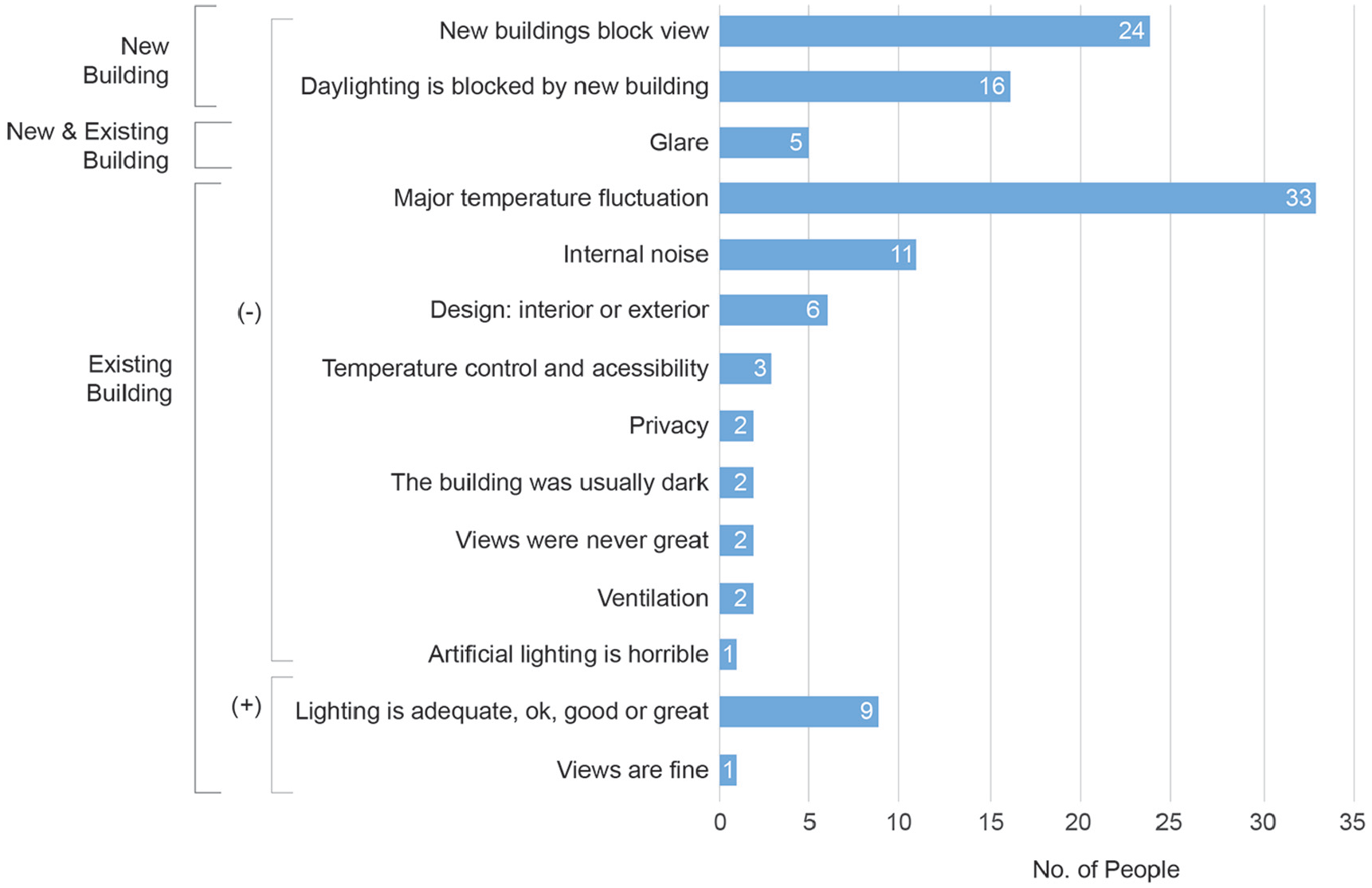
Reasons on why the participants find the environment conditions bad.
4.2.2. Lighting conditions
Most participants gave a positive response to the lighting conditions of the studio space. The reason for lighting discomfort was harsh fluorescent light, and it was not visually pleasing. The construction of new buildings and minimal daylight was also another reason. A few participants mentioned that lack of daylighting causes depression, unpleasantness, and lack of focus in their work. Participants also complained about the placement of the controls, the windows’ orientation, and control opportunities as a problem (see Figure 11). Occupants found the new building blocks or reduced daylighting, and it also casts shadows. A few students were concerned about the influence of the new building once completed with cladding materials as it would cause glare or visual discomfort to the occupants.
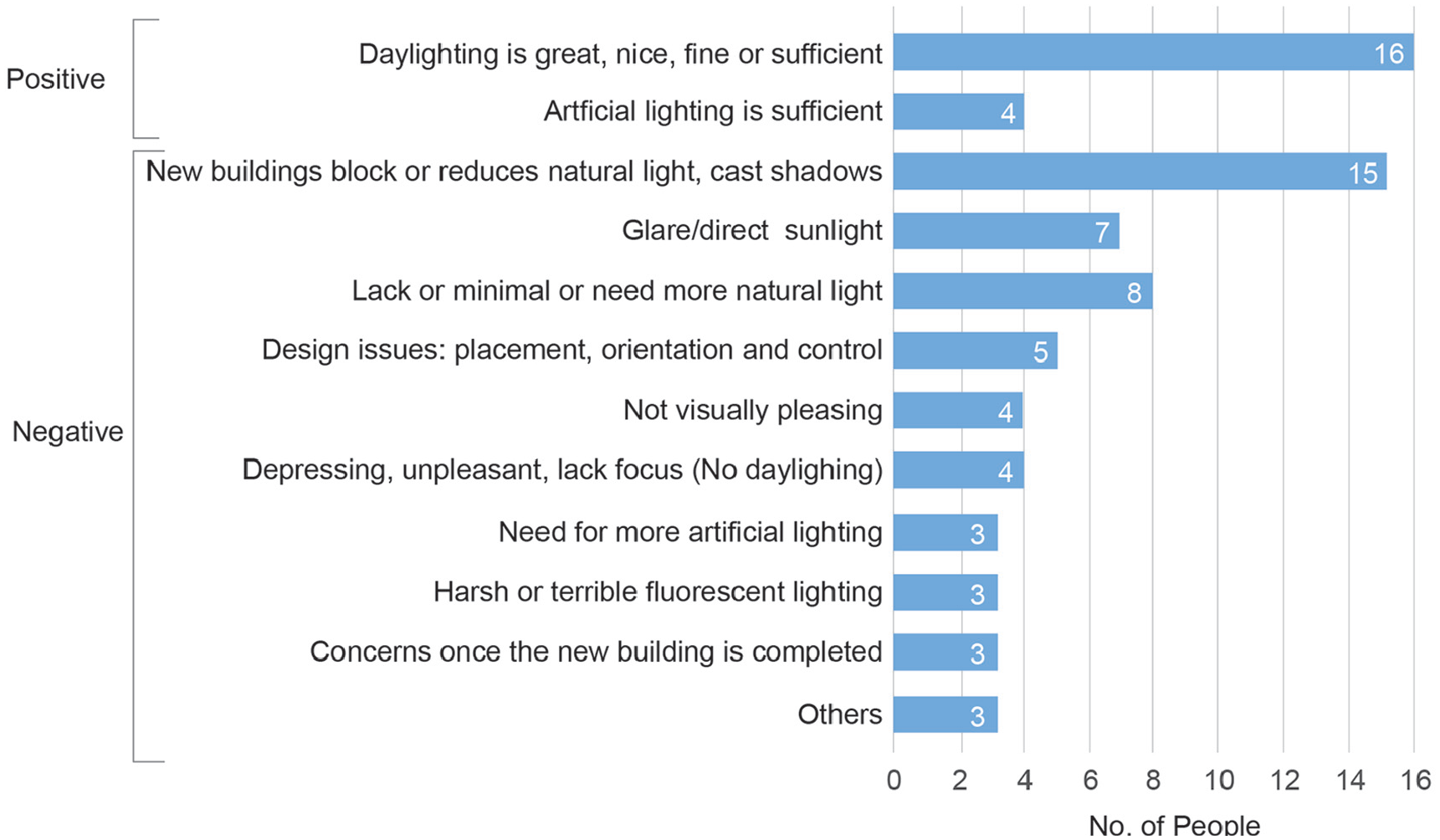
Reasons on the rating for lighting conditions.
Occupants prefer natural light (66%) over artificial light Occupants’ wellness (physical and mental) was one of the critical factors for preferring natural light. The factors are better mood, less strain on eyes, connects them to the outside world, break from work, and keeps them awake, pleasant, and comfortable. Since the participants were architectural students, they felt natural light helps study physical models and accentuates natural colors to their drawings or models.
4.2.3. Indoor–outdoor relationship
A qualitative inquiry of their rating on views reveals a new building as one of the critical issues for their discomfort (see Figure 12). The indoor–outdoor relationship was crucial for its visual connection to the rest of the campus and participants’ well-being. One of the participants said it helps their “mind to focus and be productive,” and a few said it give a visual break from the screen. Connecting to nature, campus streetscape, and vegetation is a relief from stress and work. One participant mentioned, “I enjoy having a visual connection with the rest of the campus,” like having a visual connection with the campus’s main arrival point. Currently, the new building blocks that view, and a few of them expressed it as “Now there is a wall.” Connecting with nature helps the occupants to focus, be productive, and provide relief, escape, and inspiration. The students were interested in seeing the sunrise, and one participant says, “I had been looking forward to watching the sunrise as a reward for working long and hard, but I can no longer do that.”
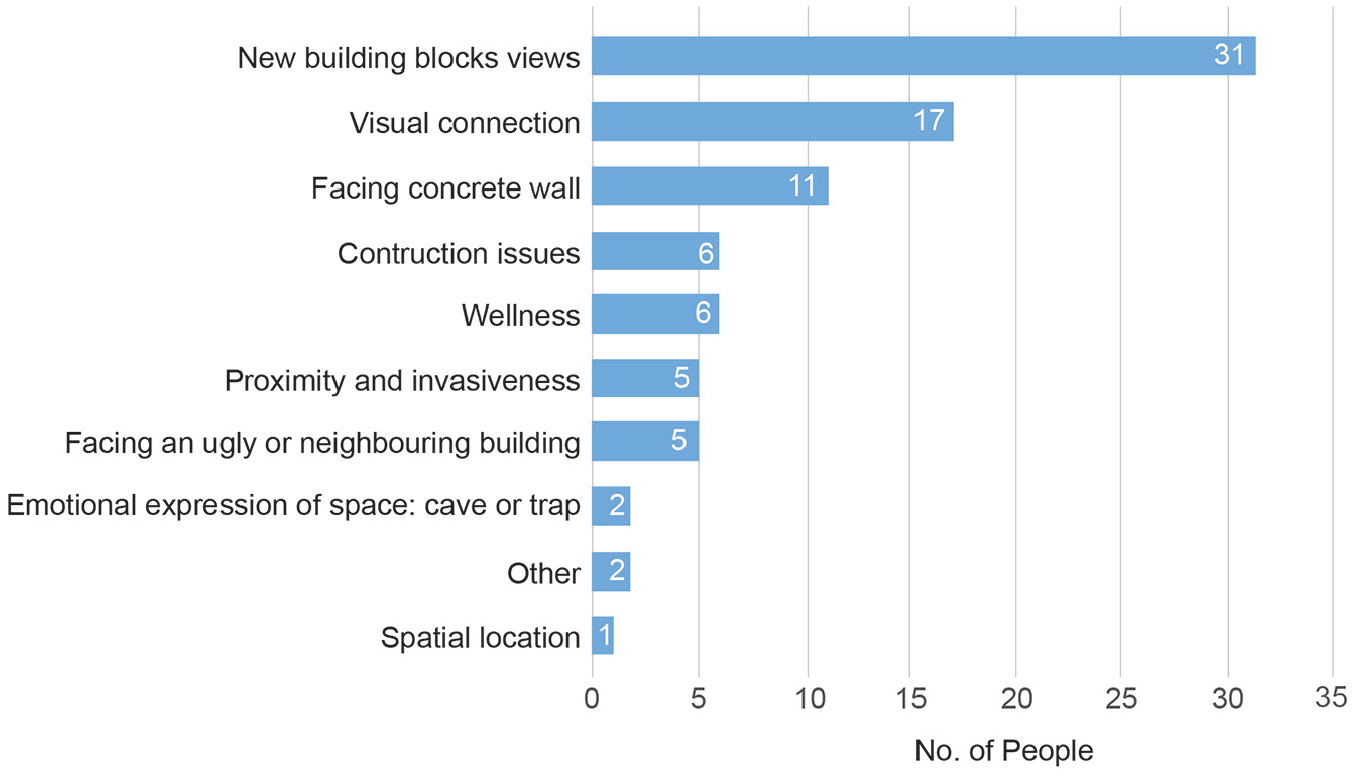
Characteristics and features to consider indoor–outdoor relationship.
Participants narrated the spatial experience as a cave or trap. They kept highlighting the problem that they are facing a concrete wall. Participants found the building too close and invasive. It was also a concern for the future as occupants found their space invasive. One of the participants mentioned that the indoor–outdoor did not matter because they never got to sit by the window. The topic on construction issues surfaced while a few found it interesting, others found it annoying. Since this will not be an issue after the building is complete, we will ignore it for the study evaluation.
4.2.4. Impact on creativity
We evaluated the impact of the new building on creativity as architectural students are engaged in creative activities in their studios. Figure 13 shows the occupants’ ratings. The main design parameters negatively impacting creativity is daylight, views, and proximity (see Figure 14). Daylight and views affect inspiration, mood, productivity, and relief. Lack of daylight and views gives them a spatial experience of confinement. The participants were willing to compromise with a beautiful building as a view. They do not like the current building design and find it ugly. The proximity of the building causes privacy issues and gives them a feeling of invasiveness. Participants feel that in the future, occupants of the new building will be looking at them.
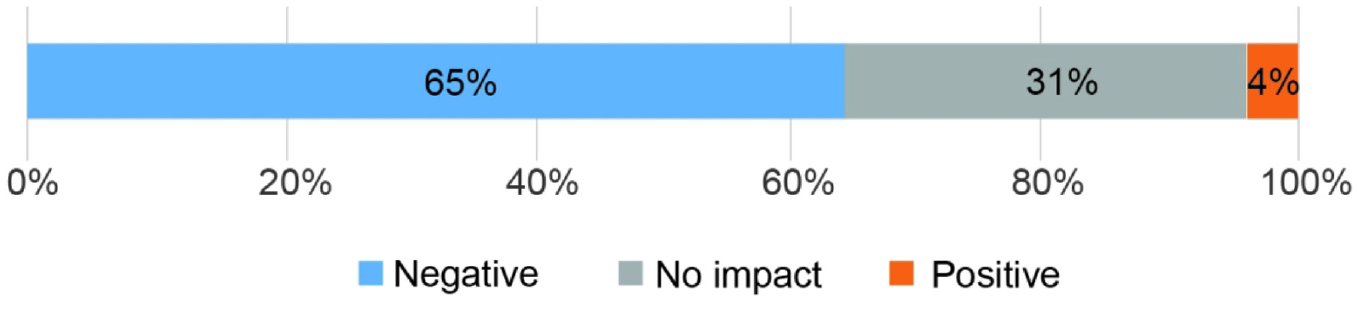
Impact of the new building on creativity.
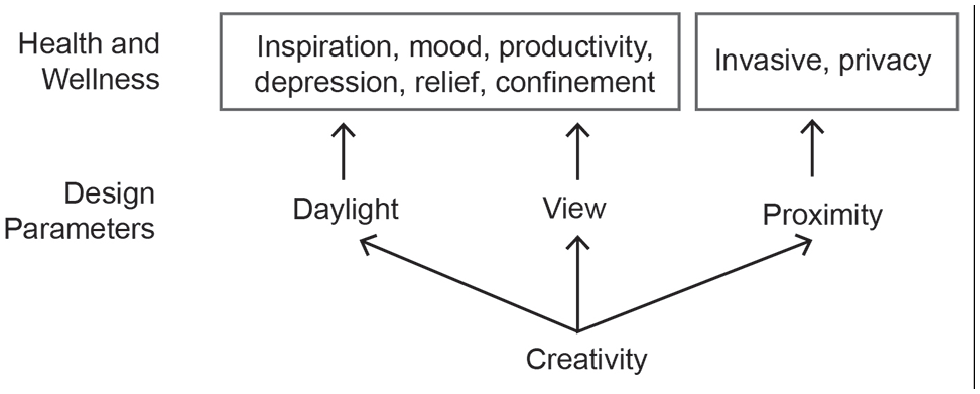
The negative influence on creativity.
4.2.5. Design solutions
The participants proposed various design solutions, although the two prominent ideas were integrating green space and connecting the existing building to the new building and nature. Figure 15 identifies the major design concepts suggested by architectural students. Participants preferred the existing building to have a direct or open connection with the new building through a patio or roof garden, bridge, or shared space. Different students suggested the notion of connecting the studio to open space. The idea for green space was to have a green street between the two buildings, a green wall, a roof garden, and an outdoor patio.
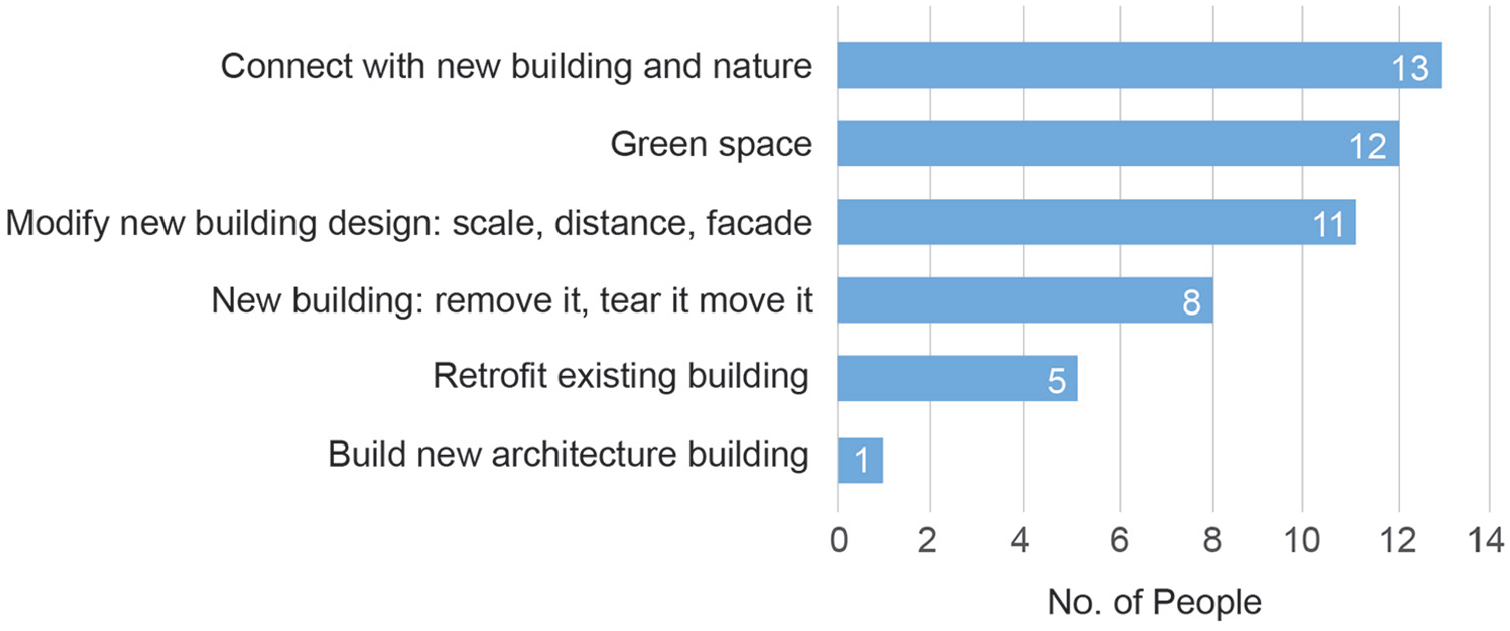
Design solutions proposed by the participants (architecture students).
Figure 16 shows selected sketches of design solutions obtained during the survey. Figure 16(a) shows the distance between the buildings on the fourth floor to the new building is much closer. A majority of the students found the current design very invasive. Figure 16(b) suggests increasing the height of the building and moving the studio to that floor. Figure 16(c) indicates a bridge to connect the Architecture Building to the new building. Their preference for the existing building is to connect to nature or an open space or roof garden.
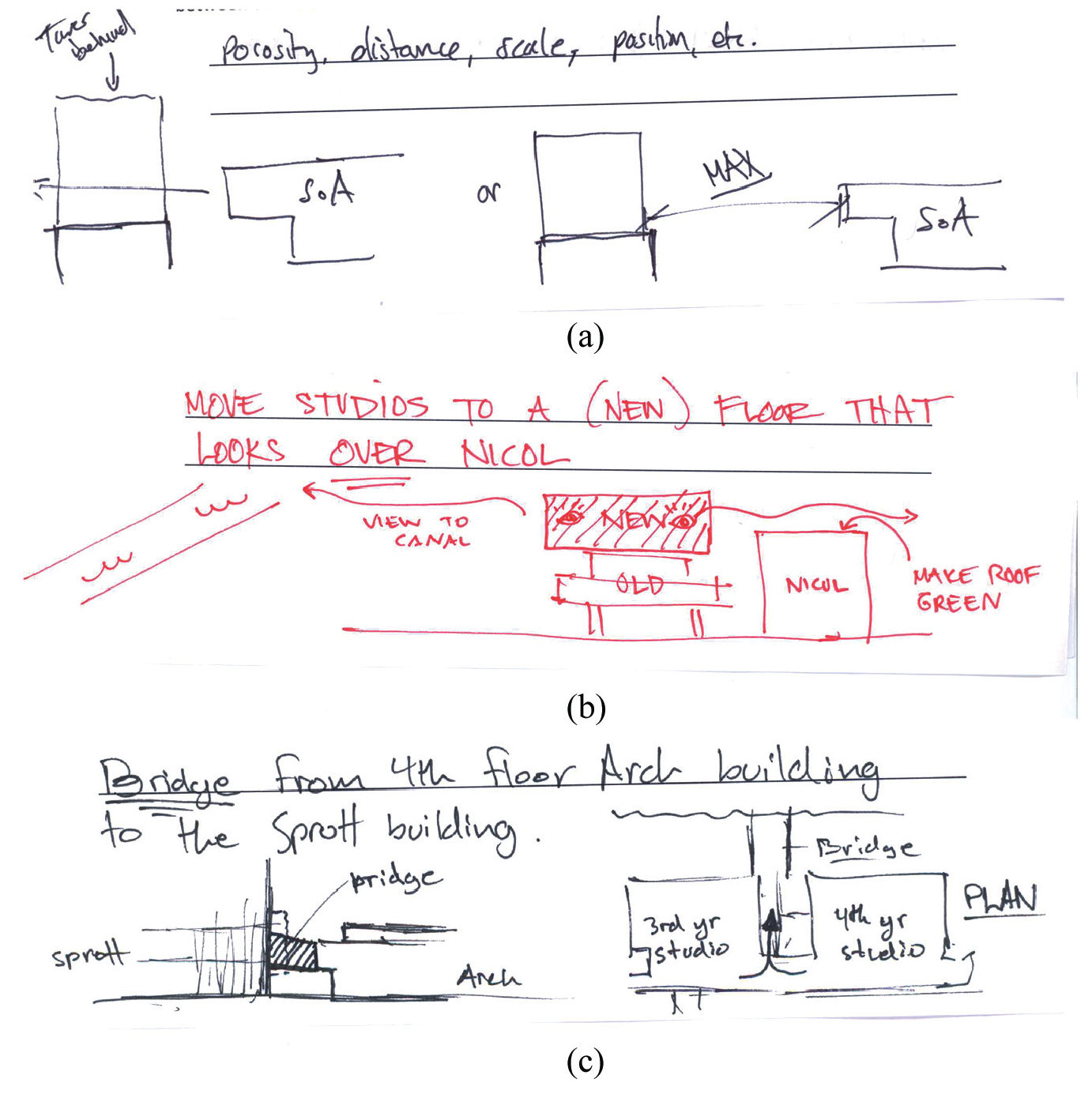
Sketches of few participants on new design solutions. (a) shows the distance between the buildings on the fourth floor to the new the building is much closer and provides a solution to maximize the distance, (b) suggests to increase the height of the building and move the studio to that floor to maximize the view, and (c) provides a solution to connect a bridge from the Architecture Building to the new building to a roof garden.
The results from the occupant survey show that they were dissatisfied with the lack of view opportunities because of the new building. The daylight was not significantly affected as there were mixed responses from the people, mostly related to the harsh fluorescent lights in the building. The next stage is to perform a simulation analysis on the new building design with the Architecture Building on visual comfort. This will help in correlating the occupants’ experience with predicted performances.
5. Simulation methodology and performance analysis
As mentioned previously, to reduce the scope of the study, we only focus on visual comfort analysis (daylight and views). The campus buildings are modeled using Autodesk Revit, 23 a widely used Building Information Modeling (BIM) software by Architects and engineers. The visual comfort analysis was performed using two open-source environmental plugins, Ladybug and Honeybee, 24 for Rhino/Grasshopper. Ladybug provides access to EnergyPlus weather files, and Honeybee connects the 3D models to EnergyPlus, Radiance, Daysim, and OpenStudio for energy and daylight simulation of buildings. A series of simulation studies using these tools summarize the impact of the new building (Nicol) on the Architectural Building for daylight and views. The study evaluates annual and per-semester impacts for daylighting, as seasonal changes and occupancy vary for a campus environment. For example, in summer, many of the students are away, or they can take early summer or late summer classes. The occupancy pattern influences energy use and comfort in the building. This section presents an analysis of the existing architectural building with/without the new building for daylight and view analysis. Since the research focuses on massing, the building form for daylighting and view simulation is simple. It considers the necessary parameters like obstruction for views, shading, and type of window glass (double or single pane). Figure 17(a) shows the model of the Architecture Building. The Architecture Building is unique in its design as it considers clerestory for solving daylighting issues. The clerestory is a window high up on a wall and has the primary purpose of daylighting and/or natural ventilation rather than views.
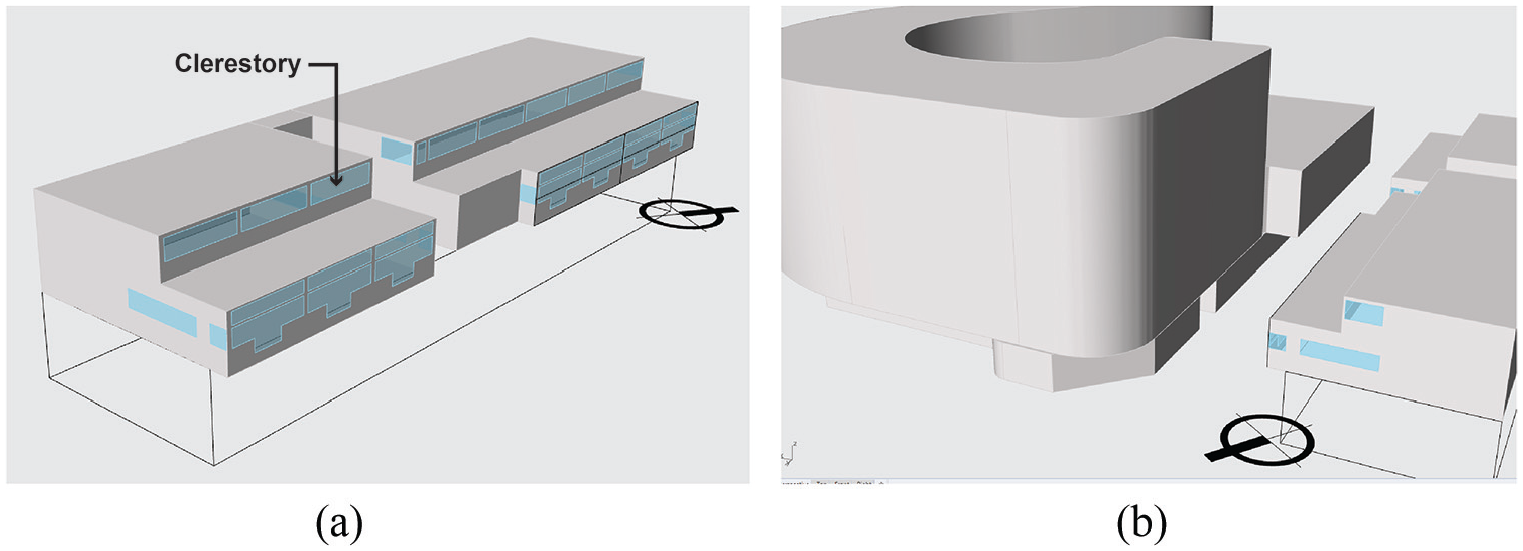
(a) Simplified model of the Architecture Building (b) Architecture Building with the new building.
5.1. Daylight analysis
Carleton University’s Architecture Building is well designed for natural daylighting. Figure 18 shows the annual daylight autonomy for the Architecture Building with/without the clerestory. Spatial Daylight Autonomy (sDA) is the percentage of floor area that receives daylight for at least 300 lux for at least 50% of the annual occupied hours. The analysis mesh height is 0.85 meters above the floor. For this analysis, the occupancy hours for the model were from 9 am to 5 pm. sDA analysis for the Architecture Building with and without the new building reveals that the difference is not significant.
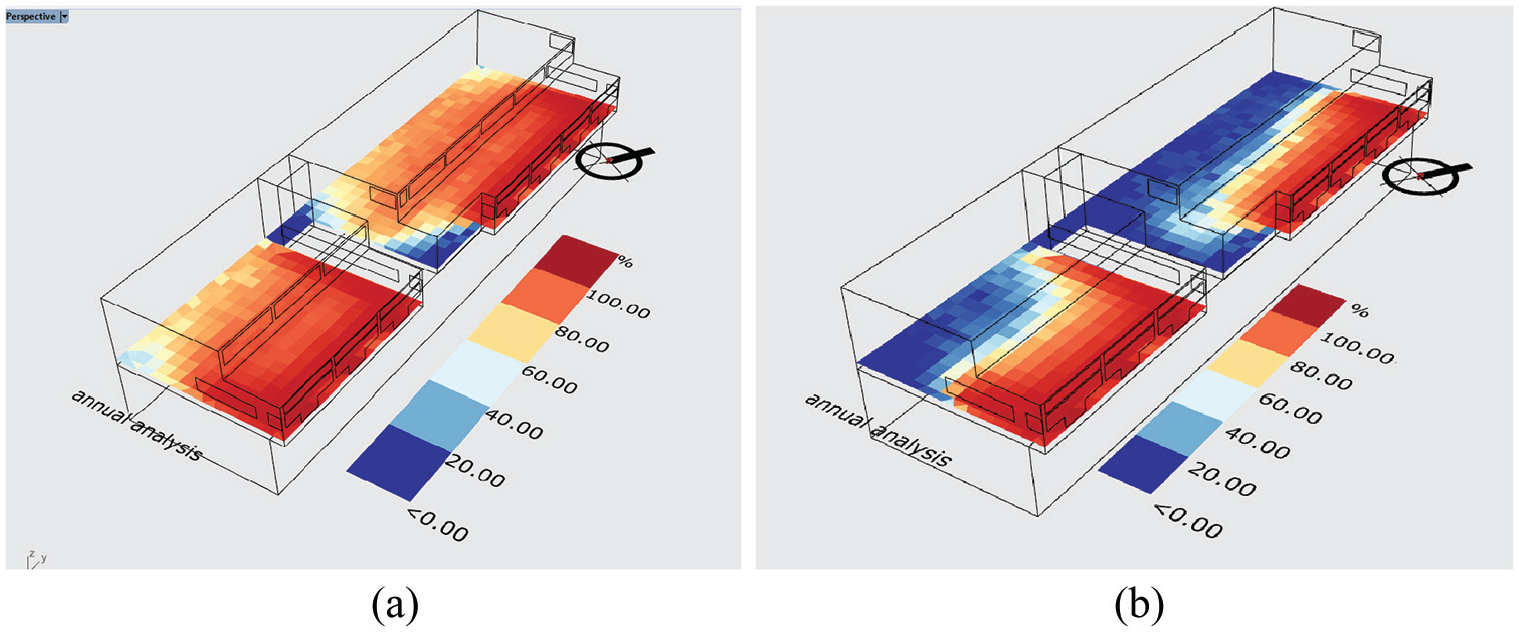
Daylight Autonomy for Architecture Building (a) with the clerestory and (b) without the clerestory.
Figure 19 shows the spatial daylight autonomy values for the analysis. The sDA for Architecture Building with the new building is 76.27%, and without the new building is 82.04%. sDA with the new building is less by 5.77%. The new building does not affect the daylight for the Architecture Building because of the clerestory, and the output would have been different if the building did not have a clerestory. Since the occupancy patterns vary for different seasons/semesters, we conducted the performance analysis for each semester.
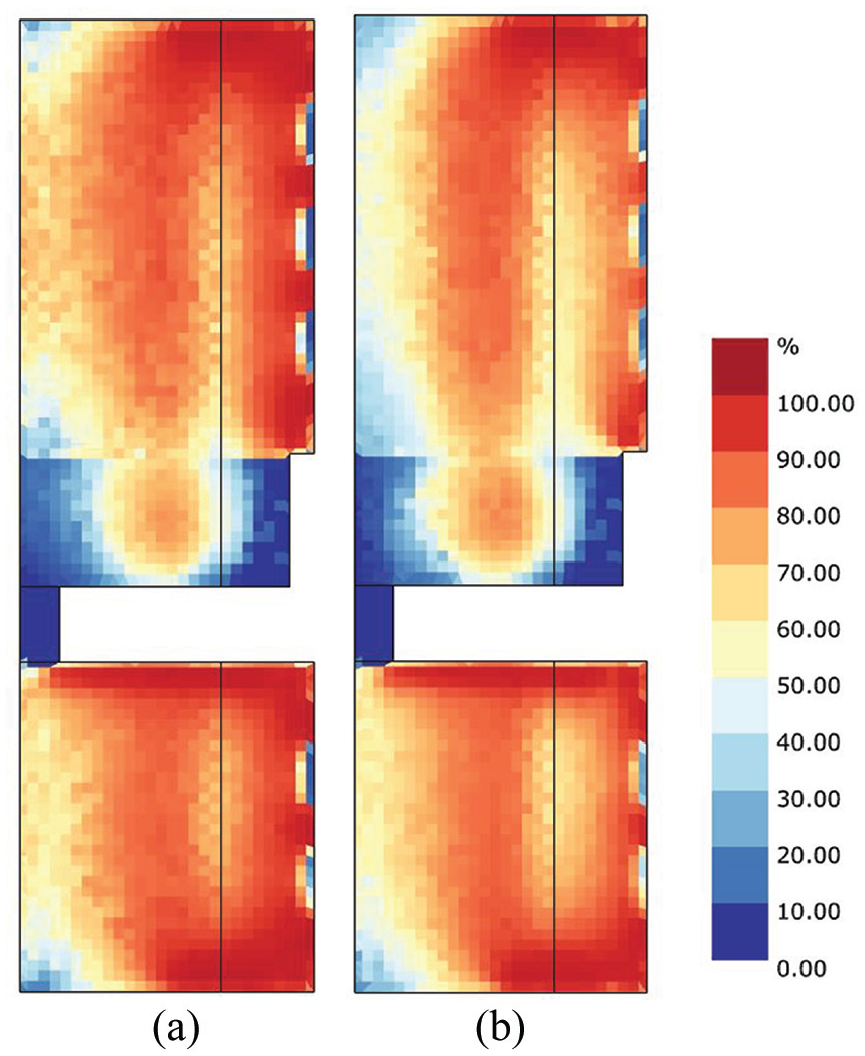
Annual Spatial Daylight Autonomy for Architecture Building. (a) Without the new building and (b) with the new building. sDA for 300 lux luminance thresholds.
Figure 20 summarizes an in-depth analysis for different semesters: winter (January—April), summer (May—August), and fall (September—December). The study shows an interesting difference between the semesters. As the research focused on massing studies, frame details, and wall depth were not considered. These parameters influence the daylight, for example, in fall, the sDA is 51.26% with the new building, and depending on the facade and interior details, it may affect the daylighting by 20%–30%. Hence, a semester analysis may enable the university planners to manage building automation and minimize energy use.
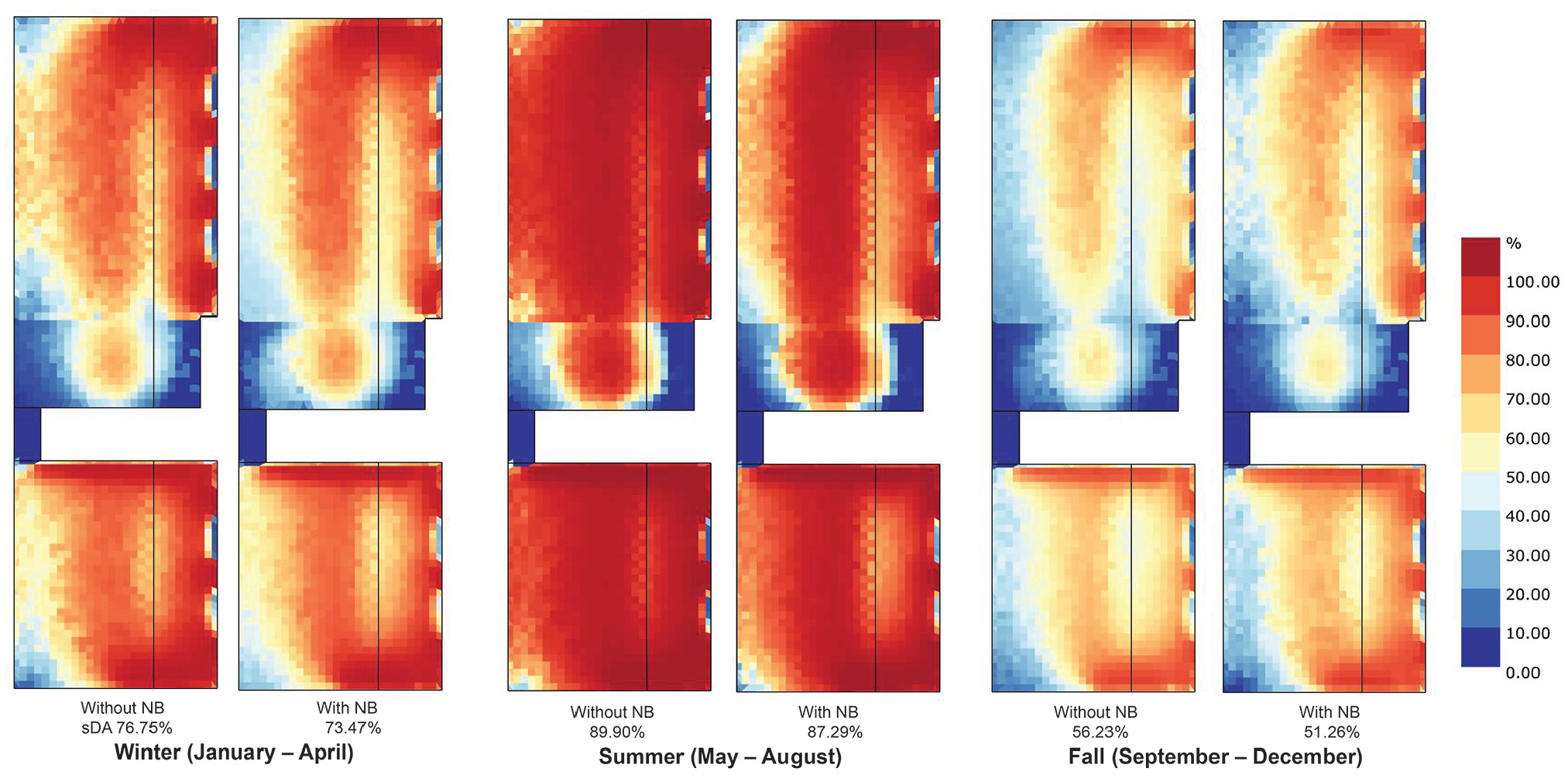
Spatial daylight autonomy (sDA) for different semesters (NB is new building).
Analysis of annual sunlight exposure (ASE) for both conditions reveals that it does not have a significant difference as well. The area that receives at least 1000 lux for 250 hours is less than 1% for both cases with and without a new building (see Figure 21). ASE does not make any difference for semester analysis as well. The Architecture Building has resolved many daylighting issues, and the new buildings do not significantly affect the existing building’s daylight.
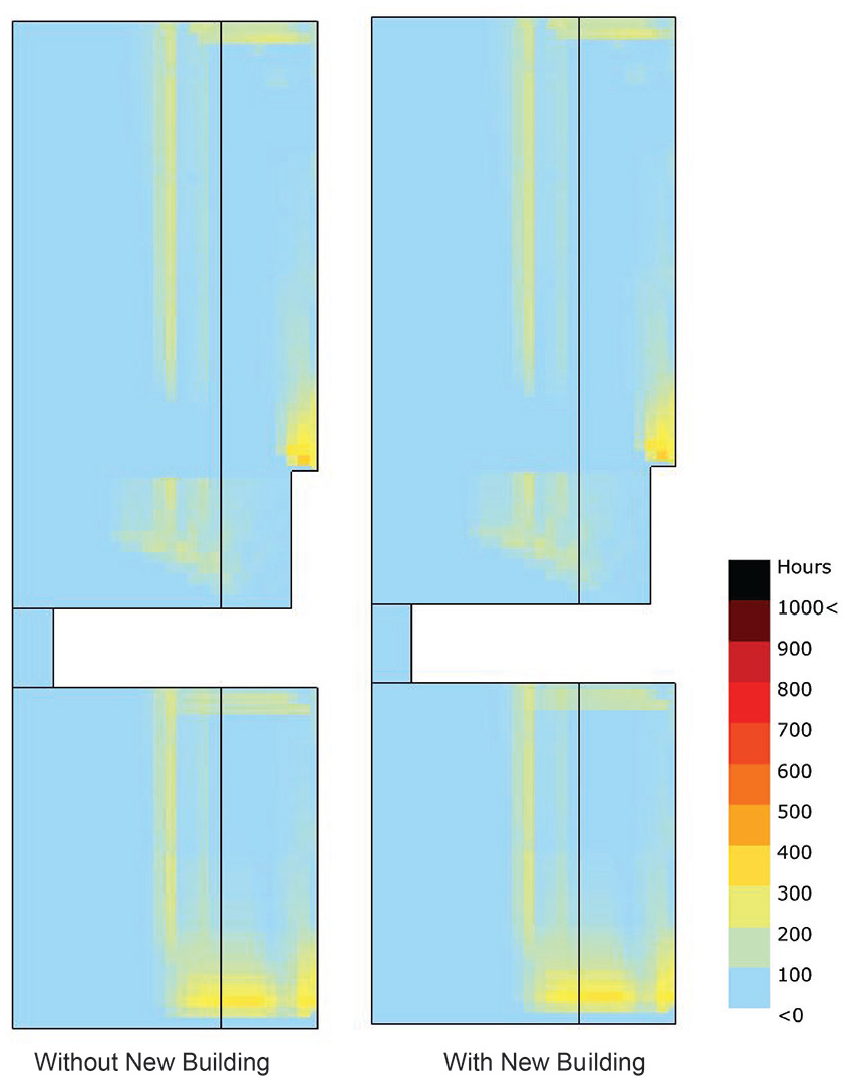
Annual sunlight exposure without and with new building.
5.2. View analysis
A noticeable impact of the new building design is the view. The user study reveals that the lack of view causes depression and affects their self-reported work performance. We identified the following visual point of interest from the survey: landscape, urban life, street life (bus stop), and a future quad (see Figure 22). We perform a view analysis considering these visual points of interest. View analysis can be done by analyzing the percentile of view from windows or interior spatial view analysis. The former uses a ray analysis, and the latter uses the Ladybug/Honeybee view analysis component. We primarily used Ladybug/Honeybee for this study to understand the spatial view quality. The interior view analysis shows the quality of view is 15% with the new building and 79% without the new building (see Figure 23). The interior view analysis gives a clear understanding of the spatial impact to understand the occupants’ visual comfort.
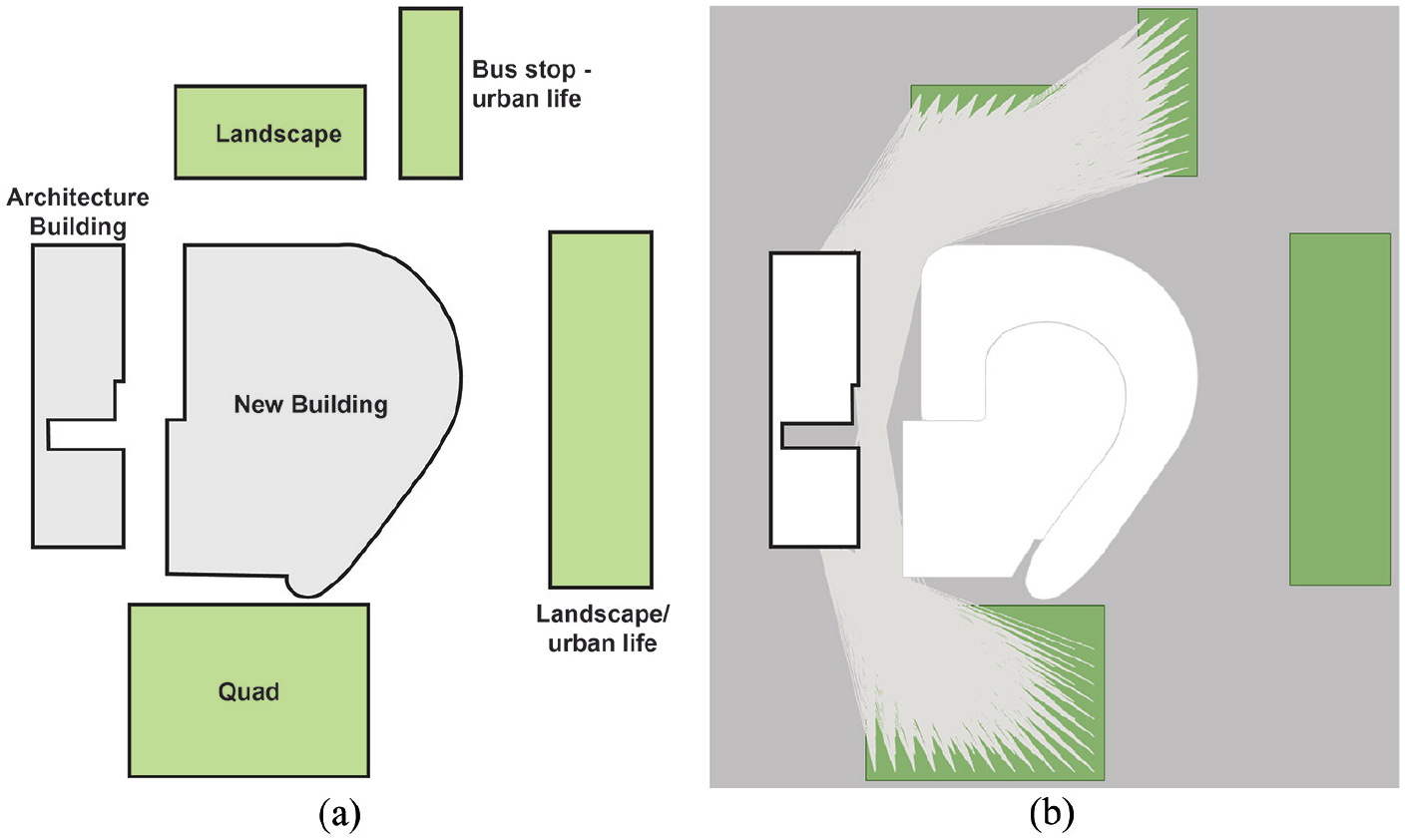
(a) Target area for viewpoints and (b) view analysis from window.
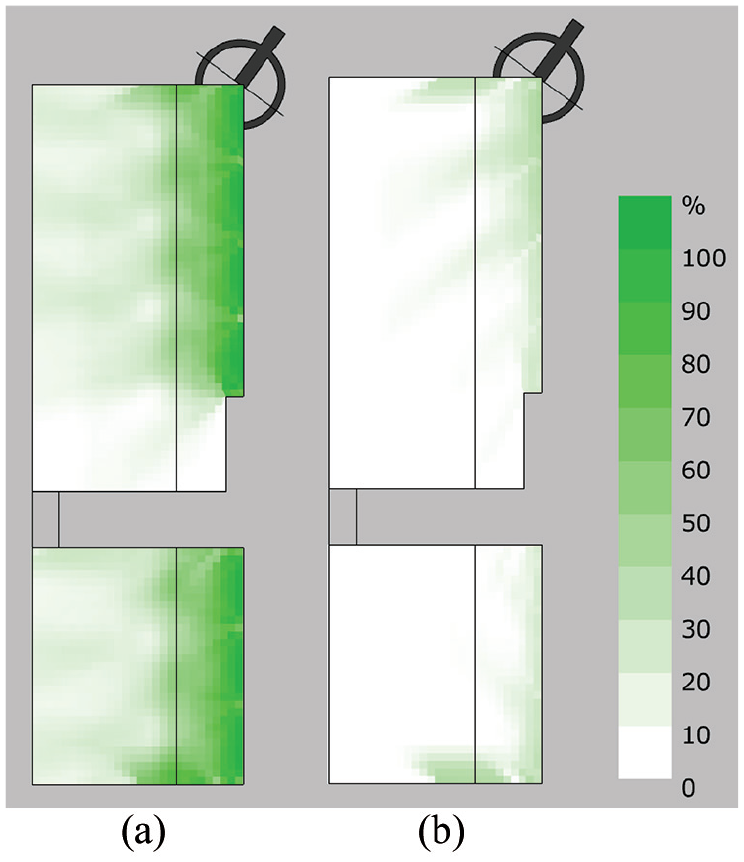
Interior view analysis (a) without new building and (b) with new building.
The visual comfort analysis shows that studio III and IV of the Architecture Building is significantly affected by the new building. The primary issue was the loss of view. It is an essential criterion for occupants’ wellbeing and health, as mentioned in the literature.
6. Design assumptions, process and evaluation
The design parameters for exploration were inferred from the master plan analyses, occupant survey, and visual comfort analyses. The goals set by the master plan for new developments are the height and massing influence on its surrounding areas, positive indoor–outdoor relationship, and a distance of 15 to 20 meters from existing buildings (see section 3). The occupant survey identified various issues, but two critical parameters were major temperature fluctuations and indoor–outdoor relationships. The key inference from the participants was that they wanted to connect the nature and not feel trapped. Participants seemed happy with daylighting except for a few who were not satisfied. The simulation process supports the occupants’ experience. The analyses show that the new building does not significantly affect the daylighting significantly but the indoor–outdoor relationship. So, this design focuses on the master plan goals for massing and new development with an emphasis on maximizing indoor–outdoor relationships.
There are various urban modeling tools like UMI, 25 UrbanOpt, 26 or advanced modeling techniques to analyze urban or campus development. These tools enable designers to evaluate the plan at a large scale for building performance. The campus consultant may use this for massing analysis at conceptual stages, but development stages require a more detailed analysis. One of the reasons is the developments may happen after 10 years, and the requirements for space or climatic conditions would have changed. Hence, at the development stage, a more detail analysis is required. We use Ladybug/Honeybee 24 for building performance analysis as it widely used and allows different simulation analysis such as view quality, daylight, and thermal comfort analyses. The generative method helps the designers base the design on multi-objective goals. The generative analysis is performed using Discover API 27 as it gives flexibility in customizing the algorithm. Other generative tools, such as Autodesk/Refinery, could perform a similar analysis, or the designer can create their algorithm. This section discusses generative analysis to mitigate the negative impact of the new building on exiting buildings’ visual comfort.
6.1. Generative method for retaining occupants’ comfort
Figure 24 shows the generative design workflow and design parameters for the new development at Carleton university campus. We divided the site into seven blocks so the computation can generate different floor levels, length and width depending on the design objectives. The Discover API runs through a script, and it uploads the input parameters and design objectives set for the project.
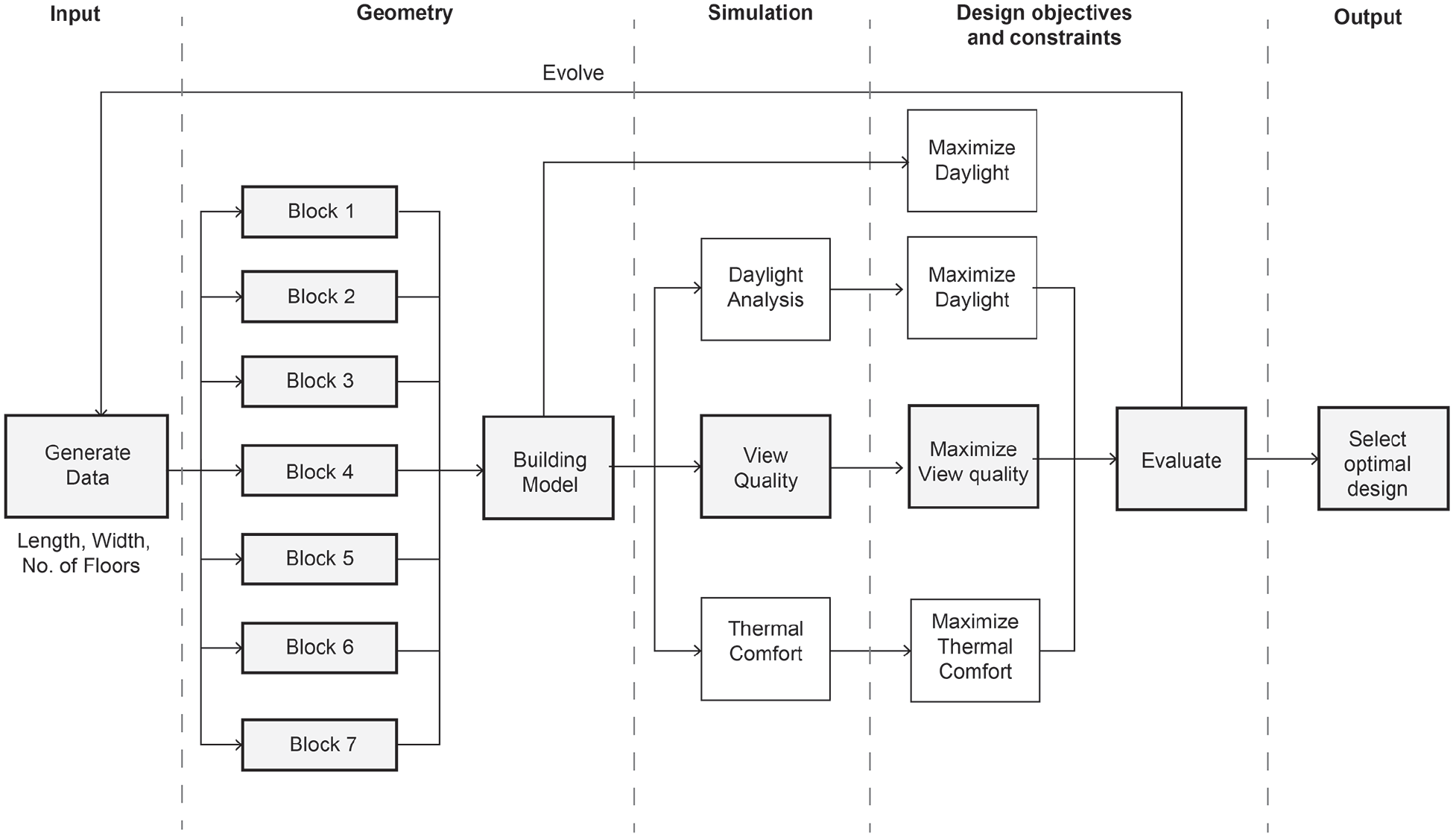
Generative workflow and design parameters. The parameters considered for this case study are highlighted using gray shaded boxes.
The designers can choose how many generations the system can run to arrive at an optimal design. The system first generates data for each block and randomly chooses the value based on the range of value provided for evaluation. Once we update the blocks, we combine all the geometry and prepare it for simulation. The model can be connected to various simulation analyses, but for this case study view quality was the main issue and hence and we conducted analysis using Ladybug/Honeybee and ray casting method. The output from the simulation analyses is set as objective for generative analyses. In this case, the objective for design was to maximize view quality (see Figure 25) and maximize floor area. Once the system receives the value and evaluates the design and evolves by updating the input parameters until an optimal design is arrived.
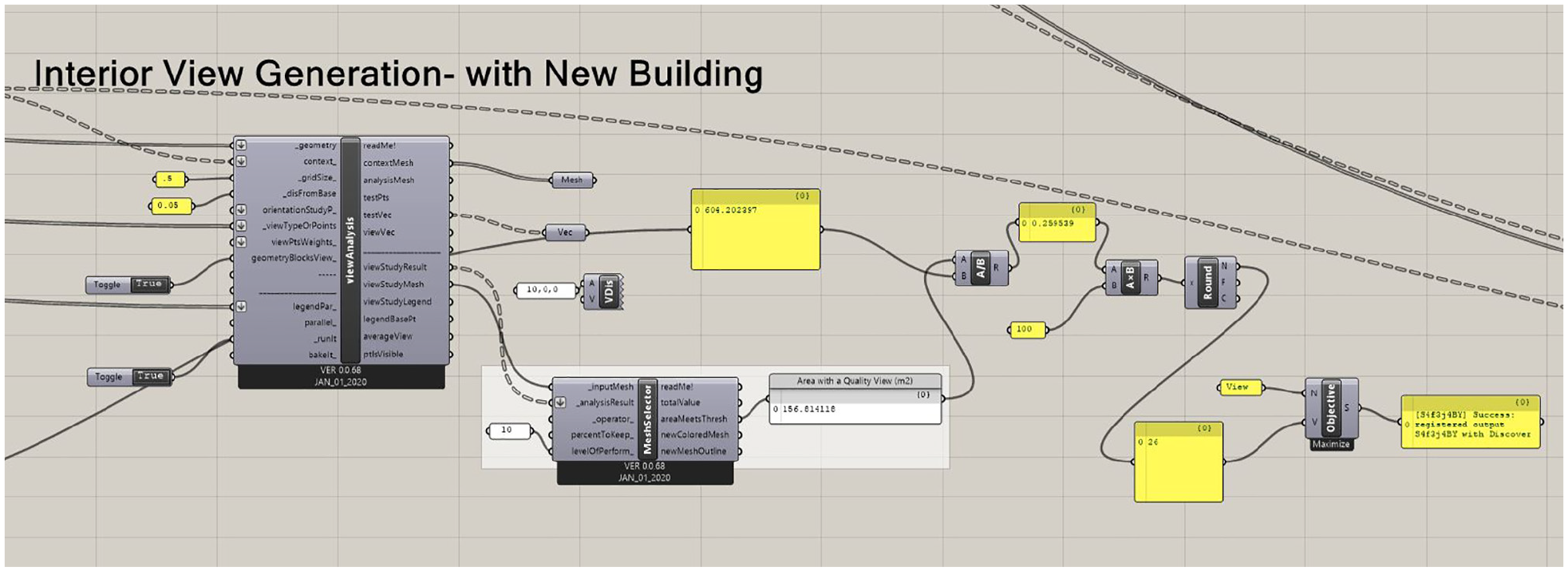
Screenshot of Grasshopper interface showing Ladybug/Honeybee components for view quality and Discover API for Generative design analysis.
Figure 26(a) shows the two methods to analysis visual comfort: spatial view quality and ray method to viewpoint of attractions from the windows. Figure 26(b) shows that the site was divided into parts and each part’s width, length, and number of floors can be modified. But some parts length and width were parametrically connected to other parts to retain proportion. Figure 26(c) shows the scale options applied in the generative design. P1 and P2 are fixed points, and they scale horizontally. The design was intuitive because of the cone of vision. P3, P4, and P5 are interdependent parameters. P3 (No.5 building) changes position in the x-direction, and its width affects the position of P4 (part 6) and P5 (part 3). The simulation had 200 generations, and each generation had 10 designs.
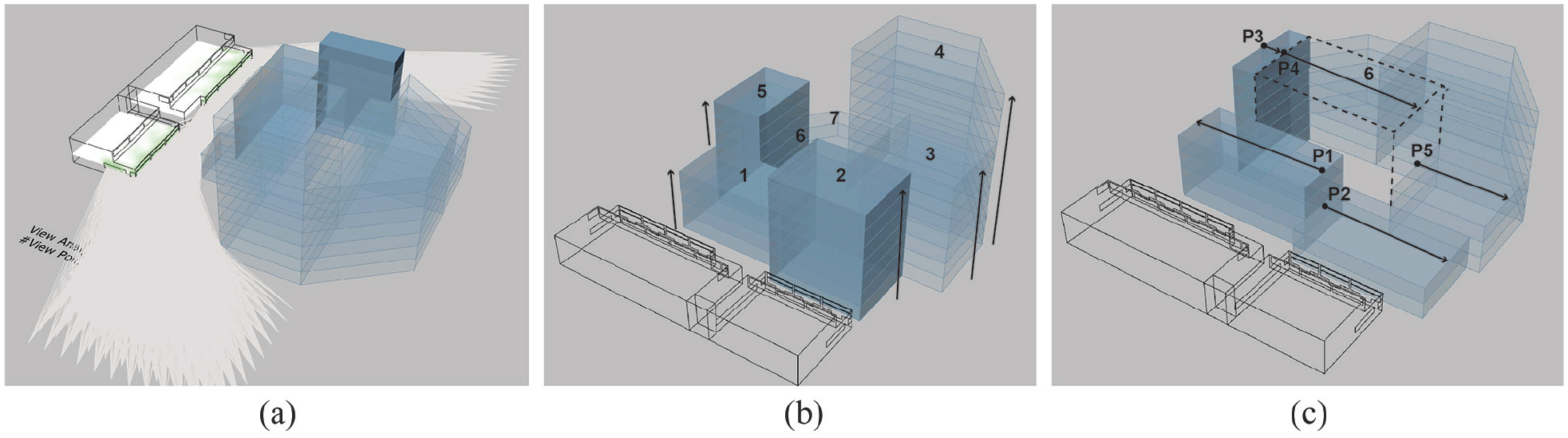
Generative design parameters for the new building. (a) View analysis using Rhinoceros/Ladybug/Honeybee modeling tool. (b) The model was broken into seven blocks and each block has height as a parameter. (c) P1 & P2 are fixed points and scales horizontal.
Figure 27 shows a graph weighing views with a floor area for the proposed new design. The first 200 iterations of designs are at the low end of the graph, and the quality view percentile is between 14% and 24% (see Figure 27(c)). Since the goal of the design was to maximize the view, the design iteration of Figure 27(b) is more suitable. The designers could weigh decisions based on the floor area or even nonquantifiable design criteria, such as aesthetics decisions. The maximum view percentile the generative analysis solves is 28%; once it reaches its limitation, the next consecutive iteration solves the other objective maximizing floor area. The graph allows the designers to find an optimal design and select designs by considering the quality of the view, preferred floor area, and form (see Figure 28). The only issue with the optimal design is that the solutions may be purely objective and ignore faulty design solutions.
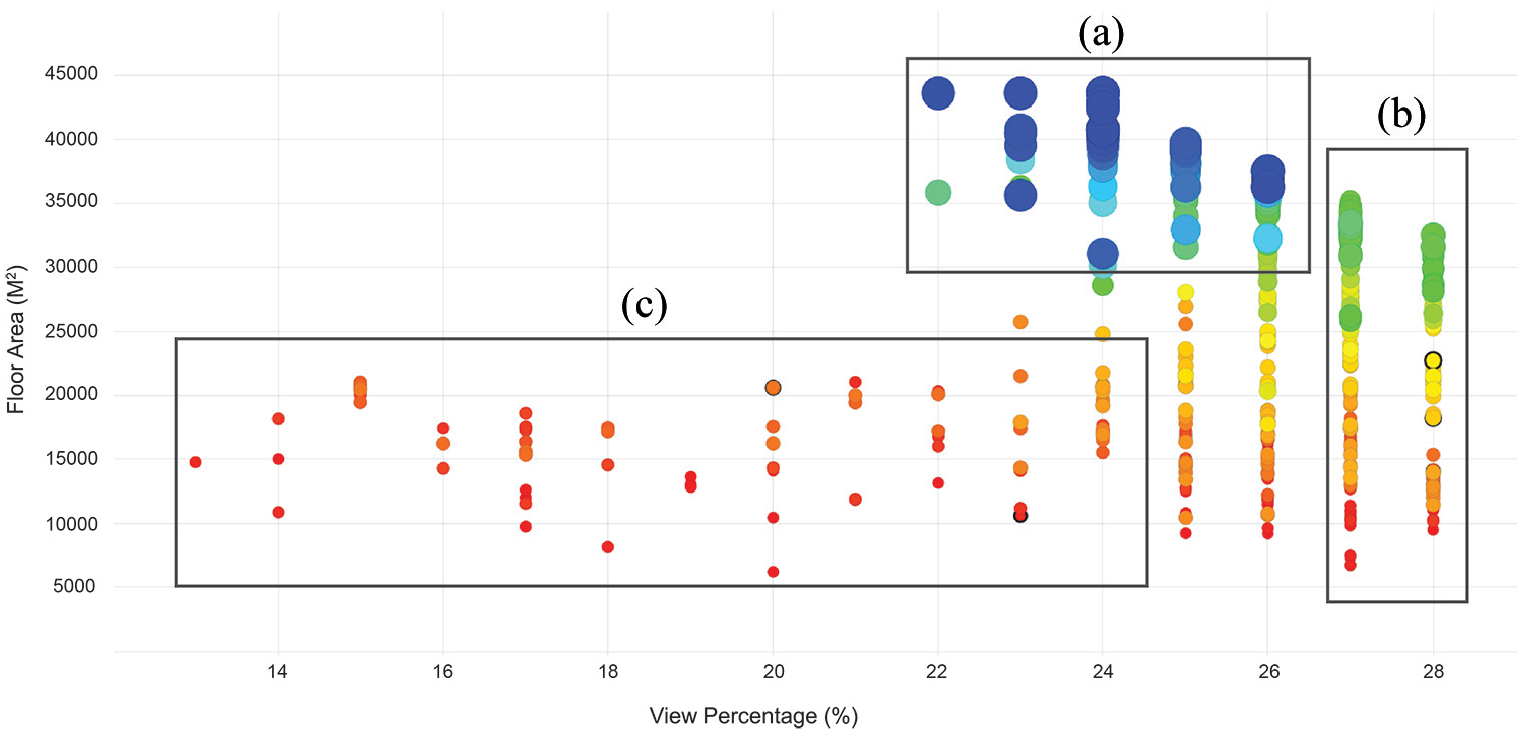
Generative analysis graph comparing view percentile and massing floor area. The color of the circle represents the generation, and the size of the circle represents the design ID. (a) shows the design options with higher floor areas, (b) shows the design iterations with the maximum view quality. As this was the study’s goal, these options are more suitable for design consideration, and (c) shows the first 200 iterations of designs at the low end of the graph for floor area and view percentile.
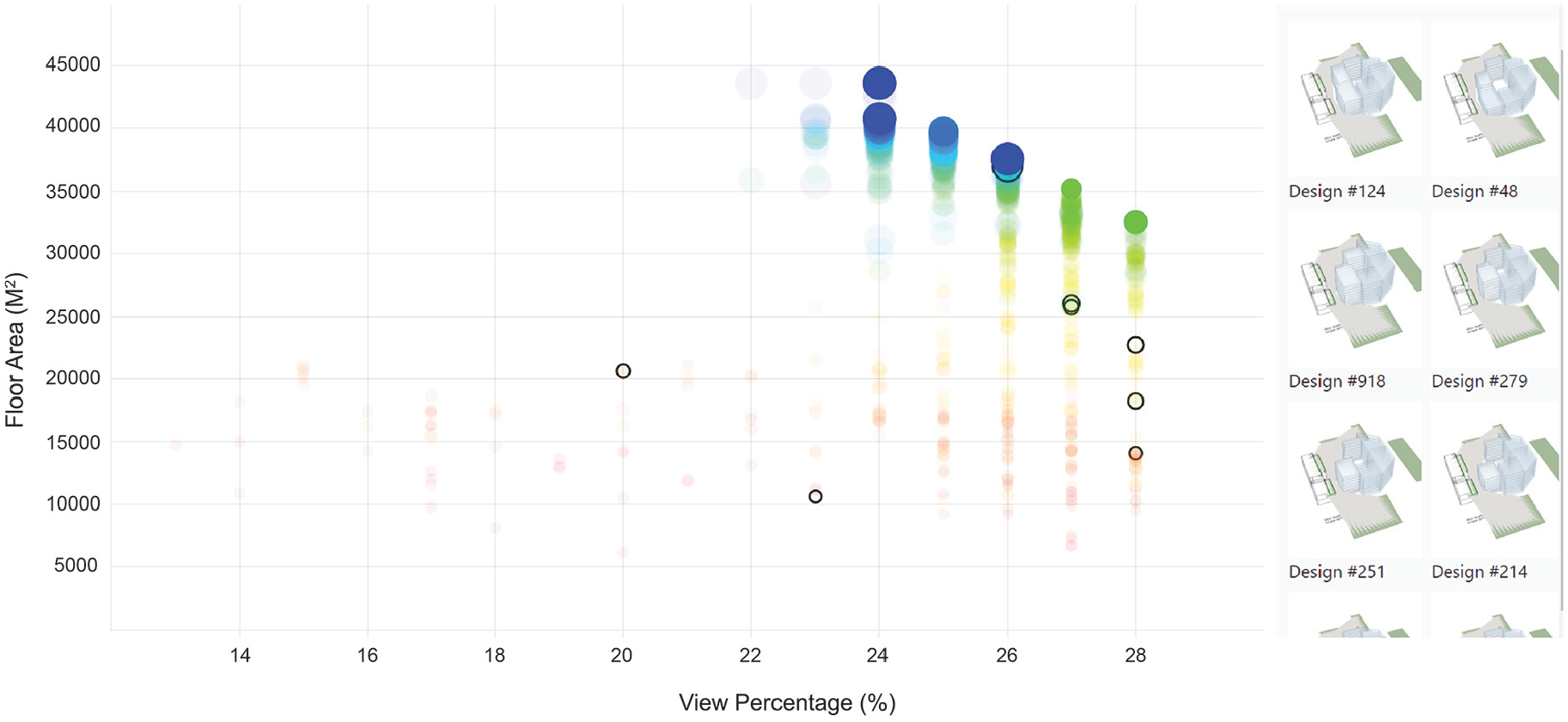
The graph shows the optimal design and the performance of selected design.
Finally, design #1096 (Figure 29) is preferable as it gives more floor area and 26% quality view. The design decision is dependent on the current requirement and future requirement, considering the university needs. As a designer, these massing could be used as a base framework to develop more detail studies such as daylighting for the proposed new building. Since impact on daylighting from the new building over the existing building was not a significant issue for this study, it was not considered in generative design. On a future study, the impact on daylighting may be worth considering as a design parameter. Consequently, generative design is helpful in evaluating different criteria to meet the user expectations.
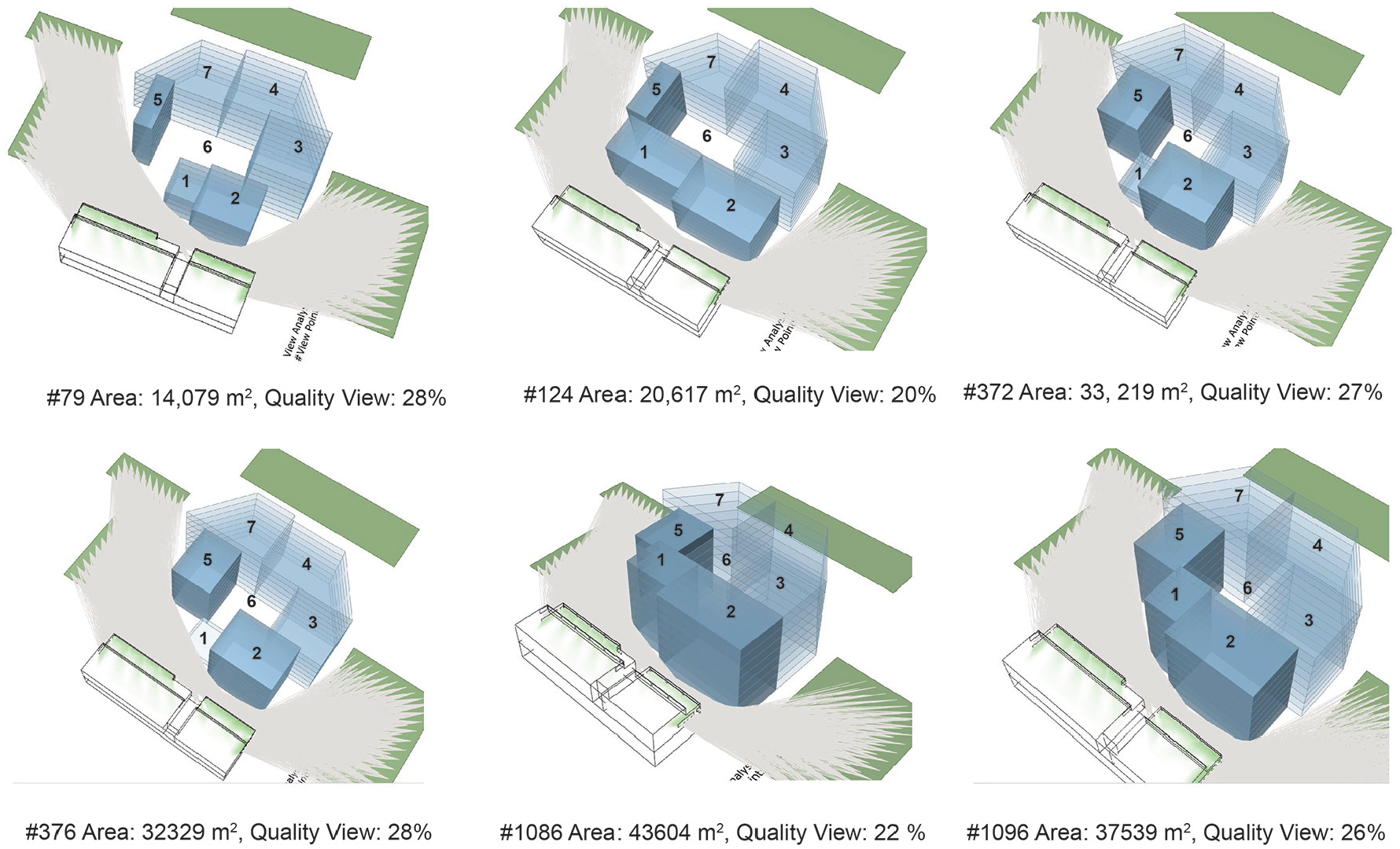
Design iterations with view quality and floor area.
Some participants suggested to the addition of a roof or wall garden to the new building. Based on this, we lowered the floor level for a part of the new building to accommodate a roof garden. We also added a wall garden to the left side of the building (see Figure 30). We performed three analyses: wall garden, roof garden, and a combination of both. The simulation analysis shows the quality view for wall garden is 33%, 67% for a roof garden, and with both criteria, it is 58%. The wall garden will be beneficial for all floors while the roof garden may meet the needs only for few floors or the floors above it. In this case, the designer could provide the feasible options to improve the wellness of the students by presenting the design options with cost so the management can decide.
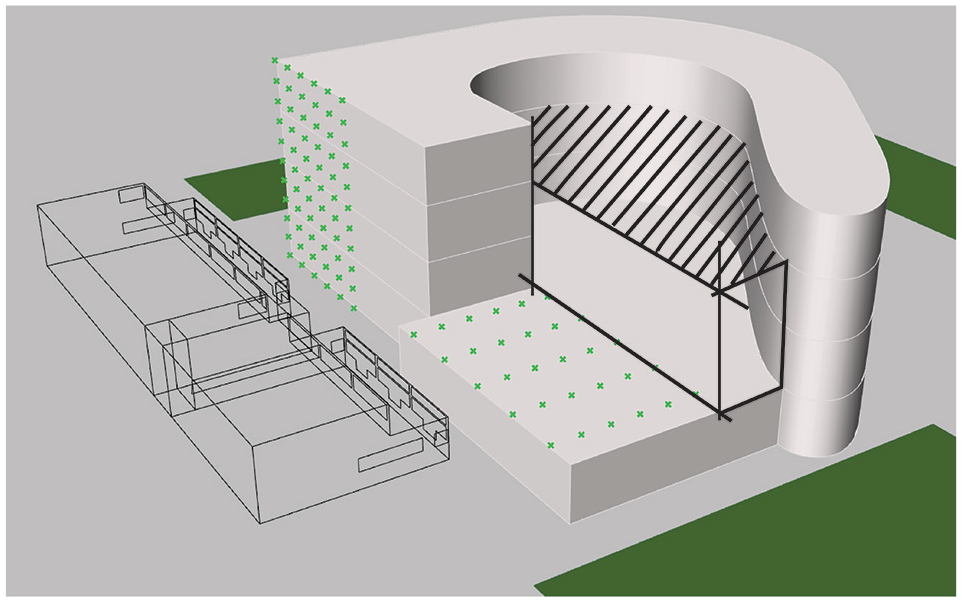
Considering roof or wall garden for view analysis to increase visual comfort.
7. Discussion
In design, various parameters take priority: aesthetics, program, floor area, available space, context, sustainability aspects, such as natural daylight, thermal comfort, cost, and so on. Master planners focus more on on-site planning and massing while architects or contractors for the development make focus on individual buildings. Hence, meeting every requirement might be demanding over time and cost. User comfort could be a trade-off between cost, available land space, or requirements. This study identifies four elements to consider in the master plan. The suggestions are contextual to campus planning but may also apply to other performance analysis.
7.1. Occupant’s health and wellbeing in the master plan
Current master plans in Carleton University consider massing, development strategies, energy, and sustainability initiatives, but there are no metrics or guidelines to consider building or campus expansion. A guideline or metrics will help various stakeholders to increase the user experience and wellbeing in buildings. Students are more stressed and are less aware of coping strategies for mental health issues. Carleton University has a health service and counseling for such issues, but providing a healthy indoor environment is essential. The WELL Building Standard was built explicitly for occupant wellbeing and health. 28 A framework can be derived for campus goals to retain occupants’ comfort in existing buildings from the WELL Building Standard to the master plan. The occupant survey highlights the need for such metrics as students mention that continuously staring at a computer screen hurts their eyes and looking at nature gives restoration. The case study shows that the new building takes away that relief. Figure 31 shows the picture taken after completion from within the studios and the occupants will be facing a concrete wall with glazing.
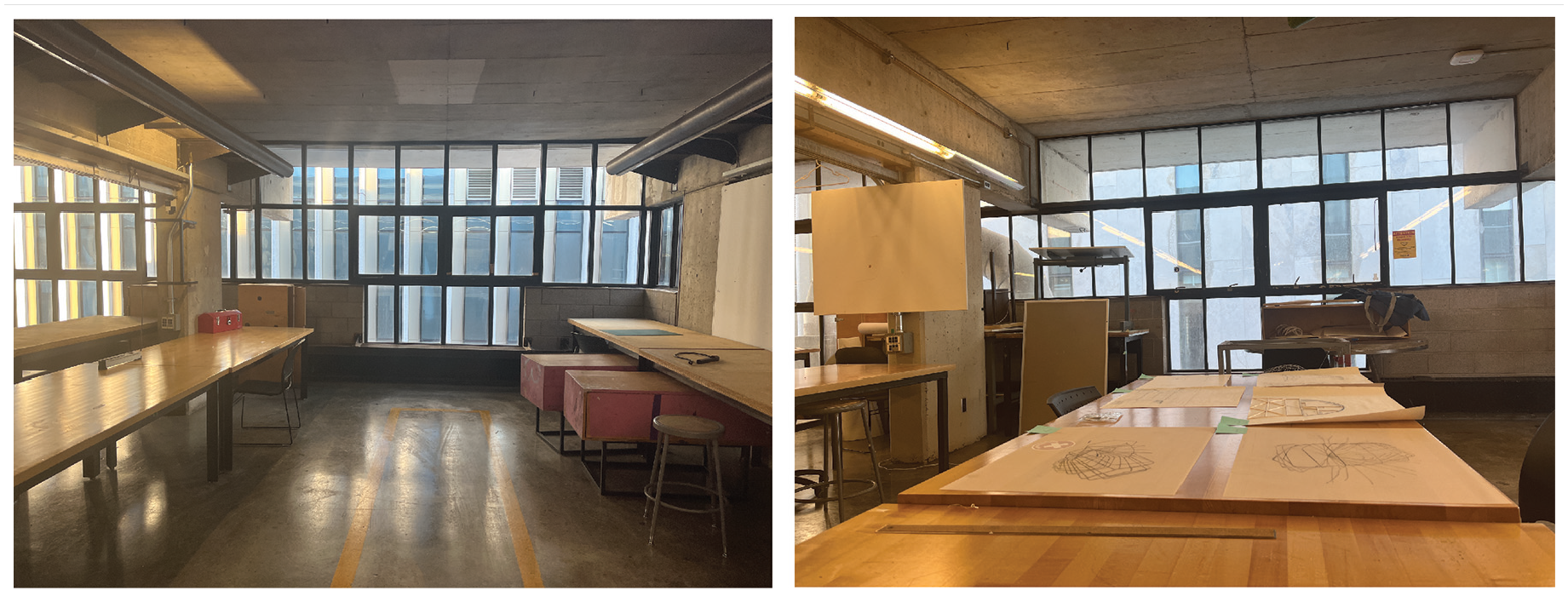
Photos taken after the completion of new building (Nicol) from within the studios.
Massing in Carleton’s master plan considers the physical aspect of design and planning and barely considers user experience. A guideline to evaluate the massing against user experience would benefit sustainable design and occupant wellbeing. Integrating an initial evaluation of user comfort could be analyzed with existing urban modeling tools like UMI. An adequate design starts with the master plan as it is a guideline for future development. The master plan could provide a checklist to be evaluated during construction and give flexibility for various needs like an increase in requirements. It will also help non-expertise in building design like campus administration to make appropriate design decisions.
7.2. Semester or seasonal analysis
Our research originated due to the experiences of a researcher in the studio space and how the new building takes away the good daylighting. The researcher has used the studio space for several years and felt the impact was significant, but the performance analysis and the user analysis give a varied response. The annual performance analysis of daylighting using Ladybug/Honeybee shows the spatial daylighting was reduced by 5% only. Clerestory in the studio spaces solves the major daylighting; hence, there is no significant change in the spatial daylight autonomy. Not all buildings come with a clerestory, and it depends on the context and requirements. Therefore, the impact of new buildings on the existing building’s daylighting may differ. Since university occupancy varies based on semester, a semester performance analysis reveals intriguing spatial daylight autonomy. Spatial daylight autonomy is 51% with the new building and 56% without the new building in the Fall semester. Here, the new building does not significantly the daylight availability. But, if a detailed analysis considers the columns, HVAC (heating, ventilation, and air-conditioning) ducts, and interior design, it will not meet the LEED (Leadership in Energy and Environment) minimum requirement of 50% for spatial daylight autonomy during fall semester. Designing the space for seasonal changes may affect user comfort and energy usage differently as the occupancy hours vary. As universities have particularly high occupancy in the fall and spring, there could be design trade-offs. Future research on a semester or seasonal evaluation may highlight the needs or demands on energy usage.
7.3. Generative analysis and massing
Section 6.1 shows that generative design tools can help to mitigate the impact of the new building on the existing building’s user comfort. A significant issue the designer faces is the time it takes to run the simulation. Currently, the design only considers view analysis, and it took around 24 to 30 hours to complete the generative process. The simulation performance depends on system capabilities. If the design incorporates annual daylighting as one of its objectives, it will require more simulation time. Hence, designers need to carefully plan the order of evaluation and make sequential design decisions. Another issue a designer will face is going through many design iterations. The optimal design is purely quantitative parameters and does not consider qualitative parameters like human experience and preferences on designs.
Furthermore, generative design does not identify faulty designs early, making the whole process time-consuming. These tools need to consider the human experience and design preferences in the loop. These generative tools can provide an option for the designers to select among the optimized solutions based on human experience and subjective appreciation. The selective iteration will reduce redundant design, time, and resources. As in this case study, one should not wait for 2000 iterations to see an inappropriate design solution. These issues could be resolved if human design decisions participate in generative design tools. Since generative analysis is a developing concept, there is a possibility to integrate human in the loop in the future. Still, at its current state of the art, it provides better performance-based design solutions.
Designers and practitioners should take advantage of available urban modeling tools for site-level analysis and generative tools to consider multi-objective criteria at an individual building analysis. Advancement in modeling and simulation tools allow various design explorations. Dynamic analysis can be a solution for small-scale building evaluations like two neighboring buildings. A design that responds to each other building needs at the conceptual stage may eliminate fundamental design issues like visibility during the development stage. The idea needs to evaluate design feasibility and evaluate the amount of time it takes.
7.4. Limitations
The research considers the top floor levels of the building for user evaluation and does not consider lower floor levels. The hour of occupancy and accessibility to space was a crucial factor in choosing the top floor levels. The rooms are used 24/7 as it is a studio space. The lower floor levels contextual parameters vary as the space is a workshop. Considering all the floor levels and their impact on user experience would have added depth to the investigation.
Furthermore, considering the daylight for other floor levels may affect the new building massing significantly. Daylight analysis only focused on the massing and did not consider the interior geometries like ducts and columns of the existing building. Also, a detailed interview with all the stakeholders like master planners, architects, and campus administration would have given more insightful data. One of the critical features of user feedback was on thermal comfort on how it was either hot or cold and never comfortable. The scope of the paper excluded thermal analysis.
8. Conclusion
The case study articulates the need for incorporating occupants’ spatial experience and wellbeing in the master plan. The idea of this study is to provide additional tools to the master plan designers to include such experiences into future plans. Carleton University’s current master plan does not have regulations or criteria for the influence of new buildings on the existing building’s occupants’ comfort. Hence, we highlight the need for generative analysis during new developments; the analysis will help various stakeholders like campus administrators, master planners, architects, and occupants on design decisions and trade-offs. The occupants’ survey revealed that daylighting conditions were widespread. Occupants prefer natural lighting and find the current fluorescent lighting harsh. Most of the occupants feel depressed and stressed with the lack of a natural view. The study and literature show that natural daylighting and quality views affect occupants’ wellbeing. Simulation analysis of spatial daylight autonomy and annual sun exposure reveals that the new building did not significantly influence the studios’ natural daylight. But it affected the view quality significantly.
The generative analysis demonstrates the analysis of massing that considers occupants’ view quality. Subsequently evaluates the impact of the new building on the existing building’s occupant comfort. The occupants of the campus buildings are not influential in design decisions; hence, incorporating a design guideline for considering their comfort will play a critical role. It will also help the university decision-makers in checking how it affects the occupant’s wellness in the buildings. This paper highlights the need to consider occupant’s wellbeing in the master plan and semester-based performance analysis.
The next steps of the research will involve the building design’s stakeholders and campus building program’s committee to understand their goals and create a design guideline for future developments. The generative analysis can be used to understand the impact of the new building on the lower floors of the Architecture Building or a whole building performance analysis.
Footnotes
Funding
This projected is funded by NSERC under grant STPGP-521555-18 and Autodesk Research.
