



Abstract
In this study, a hybrid mixture of graphene nanosheets and carbon nanotubes was incorporated into cement-based mortar at a mass fraction not exceeding 0.15% of the cement content. The objective was to verify that the hybridization of multi-dimensional nanomaterials is a feasible approach for improving dispersion. The prepared mortar specimens were subjected to sustained elevated temperatures up to 600 °C. After cooling to room temperature, residual mechanical properties were tested with three replicates per group. The air-void network, microstructure, and morphology were characterized using X-ray diffraction, scanning electron microscopy, and mercury intrusion porosimetry. The results indicate that incorporating this hybrid carbon nano material enhances residual strength and retards strength loss caused by elevated temperatures. After 28 days of standard curing, the G5C10 group (containing 0.05 kg/m3 graphene nanosheets and 0.10 kg/m³ carbon nanotubes) exhibited compressive and flexural strengths 37% and 28% higher, respectively, than the reference group without nanomaterials. Following exposure to elevated temperatures up to 400 °C, the hybrid mixture demonstrated superior performance. Specifically, the G5C10 group achieved a compressive strength of 38.09 MPa, which was 33% higher than that of the reference group. Microscopic characterization revealed that the hybrid structure in the G5C10 group helped suppress the agglomeration of individual nanomaterials, thereby achieving better dispersion within the cement matrix. This enabled effective filling and bridging effects, resulting in a denser microstructure. The pore structure was refined, which played a key role in preventing residual strength loss after high-temperature exposure.
Introduction
Cement-based composites are widely popular as construction materials due to their low cost, easy availability, and tunability.1,2 However, they remain susceptible to adverse environments, particularly elevated temperatures,3–5 whereby crack growth quickly degrades the mechanical strength and spalling occurs. The use of traditional macrofibers (e.g. steel fiber and polyvinyl alcohol (PVA) fiber) as reinforcement to arrest crack growth is well-documented. 6 However, such macrofibers are ineffective in arresting micro- and nano-cracks. 7 It has been inferred that sub-micron-sized cracks require nanofibers to prevent their arrest. Recent advances in research have demonstrated that carbon nanomaterials, including carbon nanotubes (CNTs) and graphene oxide (GO), confer superior mechanical strength and durability in cement-based systems. 8 CNTs have a very high aspect ratio (>108), and a wide range of specific surface area (50–1315 m2/g). 9 A CNT is an allotrope of cylindrical carbon structure, possessing covalent sp2 hybrid bonds between carbon atoms. 10 This bond imparts a superior strength and elastic modulus, reportedly as high as 200 GPa and 1.0 TPa, respectively. 11 Additional benefits include high thermal conductivity (nine times that of copper) and electrical conductivity (102–104 s/cm), as well as thermal stability up to 750 °C.12,13 Similarly, graphene also exhibits high strength and a large surface area.14,15
Studies suggest that adding a moderate amount of CNTs can enhance the strength of cement composites through pore filling, hydration seeding, and crack bridging.16–19 Adding a dispersing agent enhances the effectiveness of CNTs, leading to improvements in both compressive and bending strength. These dispersing agents include sodium dodecyl benzene sulfate, Triton X-100, gum arabic, and Pluronic F127, combined with ultrasonication.20–22 However, an excessive addition of dispersing surfactants can entrap air and form a foam in cement materials, leading to higher porosity and a severe drop in strength. 23 Limited studies show that incorporating multiwalled CNTs can enhance the thermal conductivity and heat storage in cement composites.24,25
Similar to CNTs, graphene is a single-atom-thick two-dimensional (2D) nanosheet, comprising sp2-bonded carbon atoms. 10 Nanoindentation atomic force microscopy shows that graphene has a tensile strength of 130 GPa and a Young's modulus of 1 TPa. It has a significantly larger theoretical specific surface area (approximately 2630 m2/g) than CNTs.26,27 Due to these properties, graphene and its derivative, GO, have garnered recent attention as a nano-reinforcement in cement materials. Some researchers have found that adding 0.05% graphene nanosheets by mass of cement paste improves flexural strength by 24–40%.28,29 At the same time, others30–32 report a 54% increase in the compressive strength. The strength improvement could be attributed to the strong fiber–paste bonding that the graphene nanosheets provide. The main drawback of using graphene nanosheets is the inherent material entanglement and their tendency to agglomerate, which in turn prevents a uniform dispersion in the mixture, especially at higher dosages.33–35 Nonetheless, previous studies confirm that the addition of GO does result in superior mechanical properties.36,37 The nanomaterial aids in hydration and refines pore size.38,39 The GO nanoparticles possess functional groups that serve as nucleation sites, promoting the hydration process. 40 Overall, regardless of whether it is graphene or CNTs, the biggest limitation of single nanomaterials is the inevitable appearance of agglomeration, which becomes more severe with higher dosages. Considering the different structures of graphene/CNT materials, the hybridization of nanomaterials with various dimensions can form competitive interactions, thereby achieving a dynamic, local stable system.
Meanwhile, the existing literature focuses on the benefits of high-temperature exposure, which accrue from the addition of either CNT or graphene derivatives alone.41,42 Thus, very little is known about their joint impact and potential synergy when employed together to reinforce cement-based systems. Even if data is available for such systems when exposed to sustained elevated temperatures, existing CNT–graphene hybrid studies mainly focus on room-temperature mechanical enhancement.3,6,43,44 For instance, Zhao et al. 3 reported that three-dimensional graphene–CNT hybrids improved the compressive strength of cement paste by 29% at room temperature, but their high-temperature performance remained unexamined. Similarly, Zhou et al. 6 demonstrated synergistic mechanical reinforcement of cement paste via GO/CNT hybrids, yet failed to address dispersion stability under elevated temperatures. Other studies43,44 have emphasized the role of surfactant-assisted dispersion in CNT–graphene composites, but few have linked dispersion quality to high-temperature residual strength. This study aims to verify that 2D G and one-dimensional (1D) CNT can form spatial steric hindrance through dimensional complementarity, thereby suppressing agglomeration, an effect indirectly confirmed by the improved high-temperature strength and flexural strength of mortar.
This study aims to evaluate the synergistic effect of CNTs and graphene on the thermal and mechanical properties of cement mortar, both individually and in combination, in cementitious materials, and assess their impact on the residual mechanical strength and microstructure at sustained elevated temperatures. The specimens were exposed to various temperatures of 200 °C, 400 °C, and 600 °C for 1.5 h in each case. The associated phase changes in the microstructure were examined upon cooling down, using X-ray diffraction (XRD). The porosity was evaluated through mercury intrusion porosimetry (MIP) and scanning electron microscopy (SEM).
Materials and test methods
Portland cement used is classified as Type 42.5 in China and corresponds to ENV 197-1:95. 45 Its physical properties and chemical composition are listed in Tables 1 and 2, respectively. A river sand with a fineness modulus of 3.03 and an apparent density of 2660 kg/m3 was used as fine aggregates. Multiwalled carboxyl CNTs (CNTs–COOH, industrial grade) were provided by Shenzhen Nanoport Co., Ltd, China, and their relevant properties are shown in Table 3. The graphene nanosheets (G, industrial grade) were obtained commercially from a local supplier in Jiangsu Province, and their properties are listed in Table 4.
Main physical properties of cement.

Chemical compositions of cement.

Properties of carboxyl multiwalled carbon nanotube (CNT–COOH).

CNT: carbon nanotube; LOI: loss on ignition.
Properties of graphene nanosheets.

Preparation of hybrid G/CNT suspension
To achieve a homogeneous and stable dispersion of CNT–COOH and graphene nanosheets, an integrated method using an efficient surfactant, PVA, together with ultrasonic treatment, was employed. PVA, a hydrophilic, non-toxic, and low-cost synthetic polymer, was used as a surfactant. Herein, PVA was used as a representative surfactant to prevent CNTs and graphene from irreversible agglomeration at a proper preparation temperature due to its hydrophilic colloid and molecular association chains.46,47 Additionally, the hydrophilic group and the functional group (–COOH) of the CNT can together absorb water, which is beneficial in providing a platform for the cement composition to hydrate. It can also serve as a potential channel for releasing excess heat at elevated temperatures. 48
In this study, each group was formed by a preset proportion, as shown in Table 5. For example, for the mixture G5C10, 10 g/L CNT and 5 g/L graphene were weighed and mixed with 1 L of distilled water in a beaker. The suspension is then dispersed using a magnetic stirrer at a slow speed (120 r/min) for 15 min; a small amount of this suspension was subsequently extracted for further characterization tests. After that, 15 g/L PVA (the mass ratio with G/CNT composites is 1:1) is added to the beaker. Finally, the suspension underwent ultrasonic treatment for 1 h at a low energy level (approximately 45 revolutions per minute) to prevent overheating of the suspension hybrids. Note that all volume fractions are calculated as per the volume of distilled water.
Mix design of G/CNT hybrids suspension.
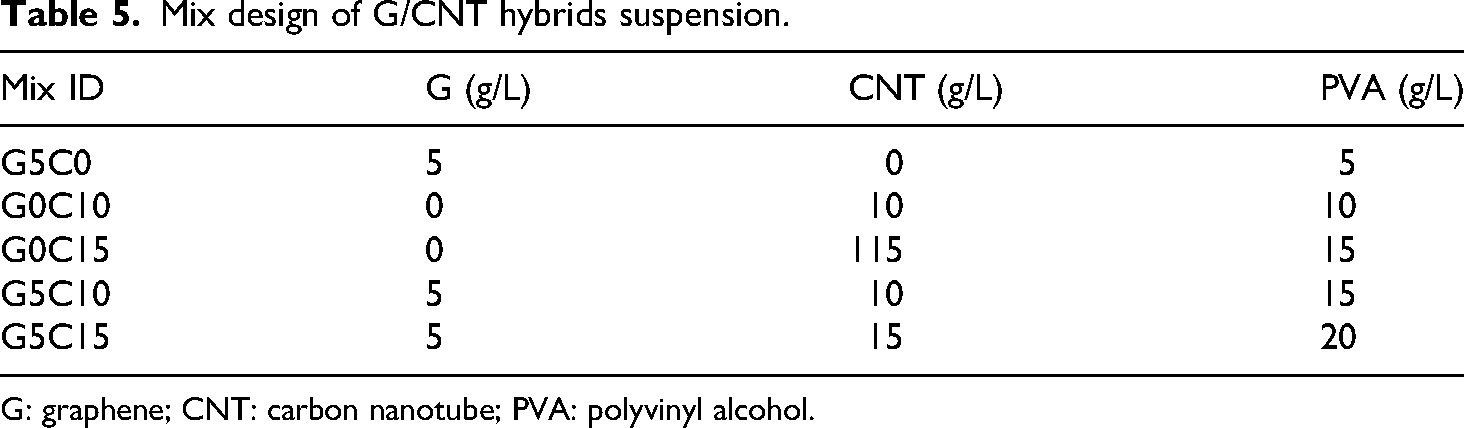
G: graphene; CNT: carbon nanotube; PVA: polyvinyl alcohol.
Mixture proportions and specimen preparation
In this work, six mortar mixtures—one plain and the other five reinforced with G/CNT hybrid were prepared as per the mix proportions listed in Table 6, where the mix designation of samples indicates the CNT and G contents by the mass of cement, which are consistent with the hybrid G/CNT suspension. The water-to-binder ratio was kept at a constant value of 0.45 for all mixtures. Note that the water accompanying the G/CNT suspension is included in determining the overall target water content.
Mix proportion of G/CNT–cement mortar samples.
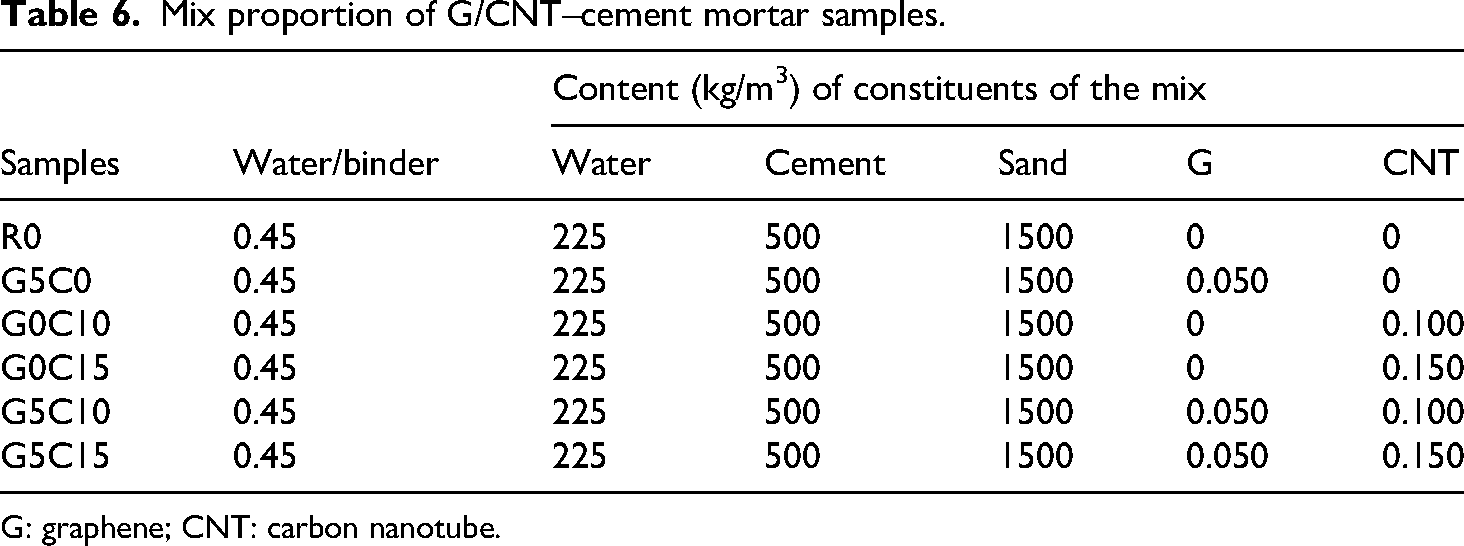
G: graphene; CNT: carbon nanotube.
The cement mortar specimens were prepared by the following procedure. First, a beaker with G/CNT blend as per a predetermined ratio was transferred into the ultrasonic cleaner for 15 min at 60 °C, to achieve a well-dispersed suspension. Next, the cement and sand was added to a blender and mixed dry for 30 s; then, the G/CNT suspension was transferred to the blender over a 3 min mixing process. Thereafter, the mixture was poured into molds, which were vibrated on a table for 30 s; these molds were stripped off the specimens after 24 h, and the specimens were kept in a controlled environment (RH ≥ 90%, T: 20 ± 2 °C) until further testing.
Testing procedures
Flexural and compressive tests
Compression tests were conducted on three cubic specimens (70.7 mm × 70.7 mm × 70.7 mm), while flexural strength tests were conducted on three prism specimens (40 mm × 40 mm × 160 mm). After cooling down to room temperature, three specimens each were tested for residual strength after exposure to a specific high temperature. In accordance with Chinese Standard GB50082-2009, 49 all specimens were stored in a common curing chamber for 28 days before testing. The loading rates were 50 N/s and 2.4 kN/s, respectively, for the two test configurations. In this manner, three specimen replicates were tested for each group to obtain average values, with statistical parameters (standard deviation (SD), can be calculated as in Table 7; coefficient of variation (CV)) calculated to evaluate data reliability. Given the small sample size (n = 3), the conclusions drawn herein focus on qualitative trends rather than absolute quantitative gains. The consistent strength improvement across replicate tests (CV < 5% for most groups) indicates that multidimensional hybridization has a reproducible positive effect on dispersion, though further validation with larger sample sizes (n ≥ 5) is recommended for quantitative generalization.
Strength test and workability parameters of G/CNT-cement mortar samples at 28 days.

G: graphene; CNT: carbon nanotube; CV: coefficient of variation.
Exposure to elevated temperature
After 28 days of standard curing, the specimens were subjected to high-temperature exposure, using a furnace. Specifically, each specimen was heated at a rate of 5 °C/min from ambient temperature (25 °C) to the target temperature (200 °C, 400 °C, 600 °C). The target temperature was then maintained at a constant level for 1.5 h, ensuring homogeneous soaking of the specimen at that temperature. Afterward, the specimens were naturally cooled with the furnace door closed at a natural cooling rate. Upon cooling down to room temperature, the specimens were individually transferred into a sealed plastic bag for further mechanical and microscopic tests.
Microstructure characterizations
After the compression and flexural strength tests were conducted, the broken samples from these tests were collected randomly and soaked in ethyl alcohol to terminate the hydration reaction. They were then examined for pore characteristics using MIP with an Autopore IV 9500 instrument. The samples were kept in a vacuum oven at 60 °C for 24 h before undergoing porosimetry.
The phase changes in the microstructure were examined using XRD, with a copper source capable of recording data in the 2θ range from 3° to 90 ° at a sweep rate of 10°/min. Additionally, the surface morphologies and microstructural alterations of the G/CNT-reinforced cementitious composites were observed using a field-emission SEM instrument (Hitachi SU8220) at elevated temperatures.
During XRD and SEM observations, no significant crystalline phases related to nanomaterial aggregation or hydration product enhancement were detected, so quantitative microstructural analysis (e.g. crystal content calculation) was not performed. Future studies will optimize the test conditions and supplement quantitative analysis methods to further verify the dispersion effect and hydration mechanism.
Results and discussion
Characterization of G/CNT hybrid composites
From the G/CNT hybrids, a fraction was prepared as a water-based suspension, which was used for further tests, including XRD, Raman spectroscopy, and SEM. The results are shown in Figures 1 and 2. The XRD patterns (Figure 1(a)) of G/CNT hybrids show that the diffraction of CNT at 2θ of about 25.8° was much stronger than that of G/CNT composites. This finding indicates that attaching CNTs onto the layered graphene nanosheets inhibits agglomeration. 50 In addition, Figure 1(b) shows the Raman spectra of all groups of G/CNT hybrids. One can see that three distinct peaks appear at 1321, 1582, and 2640 cm−1, defined as D band, G band, and 2D band, respectively. Note that there was no 2D band in the Raman spectra of graphene nanosheets. The quality of graphitization and the degree of disorder can be measured by the intensity ratio (ID/IG) of the D and G band values. As the ratio of CNT-to-G in the nanomaterial blend increases, the ID/IG ratio increases from 1.03 to 1.37. This phenomenon suggests that the degree of disorder is higher due to the intense interaction between CNTs and G, and therefore, the G/CNT blends may be said to be successfully prepared. 51
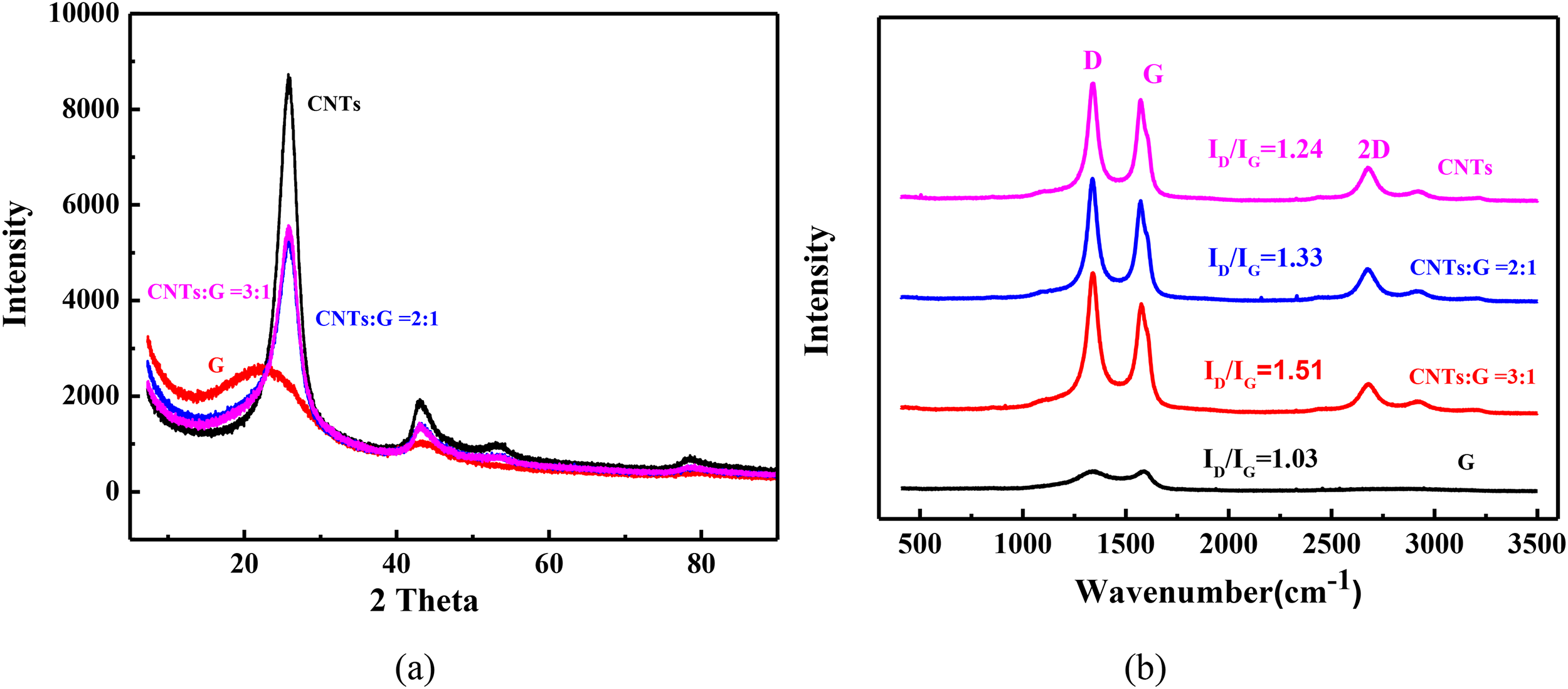
The (a) XRD curves and (b) Raman spectra of the graphene nanosheet (G) and carbon nanotube (CNT) with various mass ratios.

The SEM images of (a) carbon nanotube, (b) graphene nanosheets, (c) CNT:G = 2:1, and (d) CNT:G = 3:1. CNT: carbon nanotube.
PVA was selected as the surfactant for its hydrophilicity, non-toxicity, and compatibility with cement matrices.46,47 However, PVA may independently affect cement hydration and microstructure, an aspect requiring clarification to isolate the synergistic effect of G/CNT hybrids. Previous studies 52 have shown that low dosages of PVA (≤20 g/L) can slightly promote cement hydration by providing additional nucleation sites, while excessive PVA (>25 g/L) may introduce air voids and reduce strength. In this study, the PVA dosage (5–20 g/L, Table 5) was controlled to match the G/CNT mass ratio (1:1), ensuring dispersion efficiency without inducing adverse effects. To verify this, a blank control group (PVA-only, no G/CNT) was tested for 28-day compressive strength (46.2 ± 1.3 MPa) and porosity (17.1 ± 0.5%), which were nearly identical to the reference group R0 (45.76 MPa, 17.35%). This confirms that PVA's independent impact on cement properties is negligible under the tested dosages, and the observed strength improvements and pore refinement are primarily attributed to G/CNT hybridization rather than PVA itself.
Images obtained through SEM are shown in Figure 2. It can be seen that the original CNT and G nanosheets were entangled (Figure 2(a) and (b)). Further, the agglomeration of CNT nanotubes and G nanosheets cannot be eliminated by sonication. However, as shown in Figure 2(c) and (d), the G/CNT hybrids exhibit better interaction and dispersion. As reported by Zhang et al., 53 there was a weak π–π interaction between the CNT nanotubes and the graphene nanosheets. Therefore, the G/CNT hybrids can achieve better dispersion than either of them used singly as reinforcement. The homogeneous dispersion of G/CNT hybrids is primarily achieved through the synergistic effect of PVA surfactant and ultrasonic treatment. On the one hand, the hydrophilic groups of PVA molecular chains form hydrogen bonds with the –COOH groups on the CNT surface. At the same time, the hydrophobic segments generate weak van der Waals forces with graphene nanosheets. This “bridging effect” disrupts the agglomeration driving force of single nanomaterials. On the other hand, the cavitation effect generated during ultrasonic treatment further strips the initial agglomerates. The dimensional difference between 2D graphene nanosheets and 1D CNTs creates spatial steric hindrance, preventing secondary agglomeration after dispersion. When the mass ratio of G to CNT is 1:2 (G5C10 group), this spatial steric hindrance effect reaches the optimum. However, there is an optimum blend for the G/CNT hybrid. When the CNT-to-G ratio is three or higher, a re-agglomeration occurs, and dispersion is once again hindered.
The XRD patterns (Figure 1(a)) and Raman spectra (Figure 1(b)) confirm the successful preparation of G/CNT hybrids. The ID/IG ratio increases with the CNT-to-G ratio, indicating intense interaction between 2D G and 1D CNT. SEM images (Figure 2) show that G/CNT hybrids exhibit better dispersion than single nanomaterials—original CNT and G are entangled (Figure 2(a) and (b)), while hybrids form spatial steric hindrance (Figure 2(c) and (d)), suppressing agglomeration.
Compressive strength
Table 7 presents the compressive strength of cement composites at 28 days before heat exposure. Compared with the reference (R0), the compressive strength of cement mortar containing only CNT increased with the CNT content. This is seen in the case of G0C10 and G0C15. The improvements in compressive and flexural strength are 10.53% and 28.6%, respectively, for G0C10 and G0C15. On the contrary, the compressive strength increased only marginally for singly reinforced systems, and this was particularly pronounced with graphene nanosheets. Among the mixtures with both G and CNT, the hybrid (G5C10) showed the greatest increase in compressive strength of 37.5% at 28 days. However, mixtures with a higher CNT/G ratio (G5C15) showed a lower improvement, at approximately 24%.
Flexural strength
Regarding flexural strength, the hybrid G5C10 was also most effective, at 28.5%. An increase in the CNT likely causes agglomeration of the nanomaterial and upsets the integrity and compactness of the microstructure, as reported by Zhou et al. 6 and Lu et al. 54 Table 7 presents the slump values obtained for the various fresh mortar mixtures. No particular difference in the slump was noted across the different volume fractions of single graphene or CNT addition. The most likely reason was that the introduction of PVA produced a negative effect, reducing the fluidity of cement mortar due to its water attraction. Furthermore, the cement paste exhibits better workability when G5C10 hybrids are added; however, the increase in the mass ratio of G/CNT again harms the fluidity of the cement paste. In all, this deterioration may be overcome under the optimal hybrid ratio, namely, G5C10 hybrids. This also explains why the optimum ratio for G/CNT hybrids (as seen in the G5C10 group) produced a significant improvement in the mechanical properties of cement mortar and a superior synergy in high-temperature resistance. The residual strength results (Figures 3 and 4) further confirm the dispersion effect of multidimensional hybridization: G5C10 retains 68% of its compressive strength at 400 °C, while R0 retains only 52%. The superior high-temperature resistance of G5C10 is attributed to uniform dispersion—agglomerated nanomaterials (e.g. G5C15) cannot form effective “nanoskeleton” to resist thermal cracks.

Results of (a) compressive strength and (b) flexural strength of mortar composites under high temperatures.
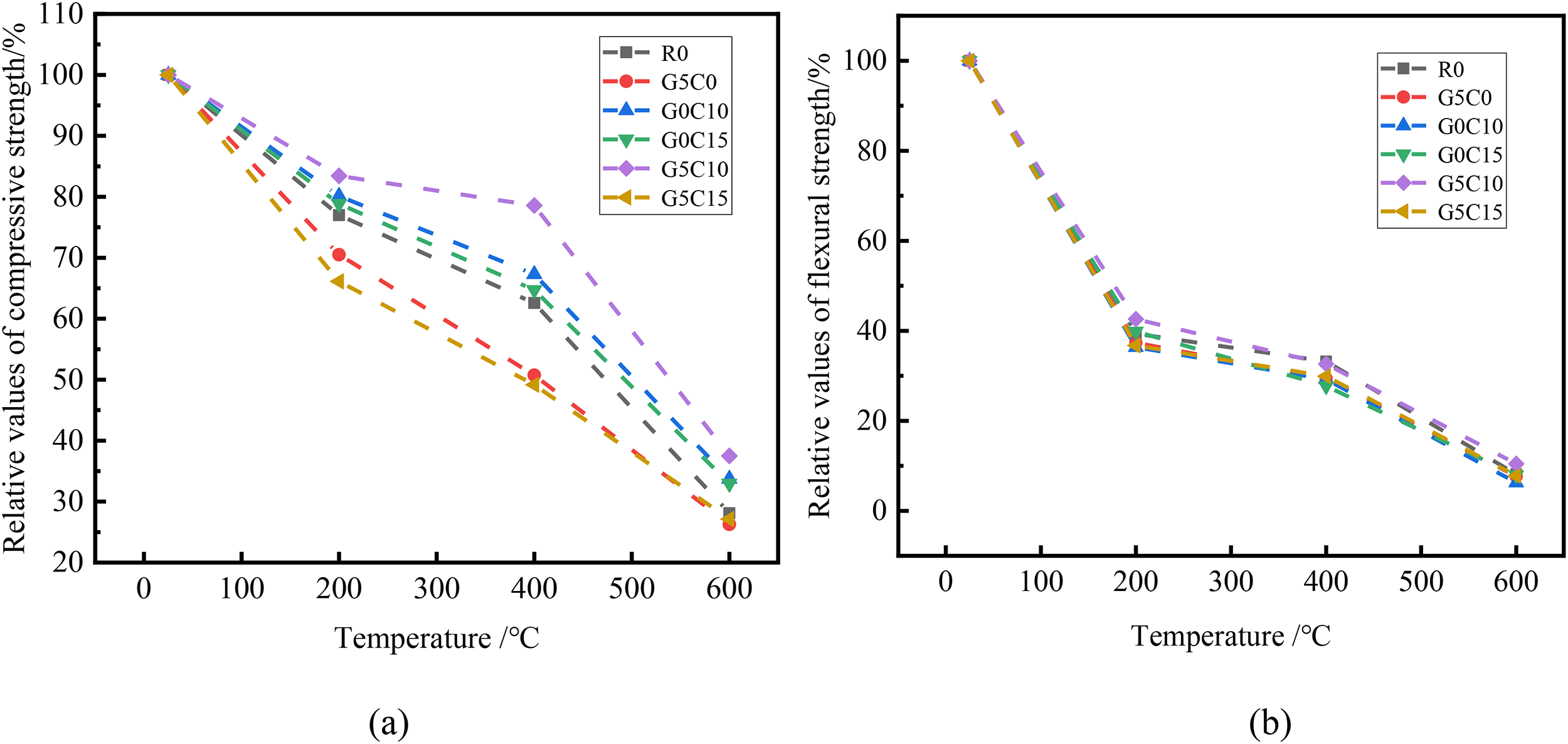
Relative values of (a) compressive strength and (b) flexural strength of the mortar composites.
Residual strength
To investigate the effect of G/CNT hybrids on the mechanical properties of cement mortar after exposure to high temperatures, three additional groups were examined at 200 °C, 400 °C, and 600 °C. The obtained results are presented in Figure 3. It is evident that an increase in temperature leads to a decrease in both the compressive and flexural residual strengths. Yet, they retain a strength higher than that of the reference unreinforced mixture, R0. There was a sharp drop in strength at temperatures above 400 °C. Microcracks are observed in the specimens exposed to 400 °C, which become more numerous with sustained exposure to higher temperatures. And, accordingly, the strength of all mixtures is much lower after exposure at 600 °C.
From Figure 4, it is clear that the compressive strength of the reference mixture (R0) decreases by 23% after exposure at 200 °C. But, incorporating the nanomaterials, particularly the CNT, results in higher residual strength. Note that adding graphene alone does not impart significant residual strength at elevated temperatures. Adding graphene alone does not impart appreciable residual strength. Figure 4 also shows a dramatic improvement in residual strength. The hybrid blend G5C15 yielded residual strength lower than that of the R0 group. It may be attributed to poor dispersion arising from a re-agglomeration of the nanomaterials. The residual flexural strength also showed a similar tendency. Figure 4 also indicates that in the range of 200–400 °C, the degradation of compressive strength is slower than that in the range of 25–400 °C. Between 25 °C and 200 °C, the compressive strength of R0 decreased by 37.42%, while the corresponding drop was 21.43% in the case of the hybrid G5C10. It can therefore be said that hybrid reinforcement with these two carbon nanomaterials retards the loss in residual strength when exposed to sustained elevated temperatures, up to 400 °C. At the same time, this combination of CNT and G was less effective on retarding the loss in flexural residual strength, at 8.14% and 10.45%, respectively, for R0 and G5C10. It can therefore be concluded that the use of G/CNT hybrid will slow down the deterioration in residual strength for exposure up to 400 °C. Further exposure to higher temperatures (here, 600 °C) will cancel this advantage.
Recall that at room temperature, the addition of a hybrid of G and CNT resulted in a significant improvement in strength compared to the reference mortar R0. With the increase in exposure temperature, this trend of improvement remains for all mixtures except for the singly reinforced mixture. The G5C0 group has the lowest strength, regardless of the exposure temperature. It appears, therefore, that within the extent of dosage examined here, the G/CNT hybrids impart resistance to sustained exposure to elevated temperatures. Such hybrid reinforcement enables cement-based mortar to absorb thermal shock better.
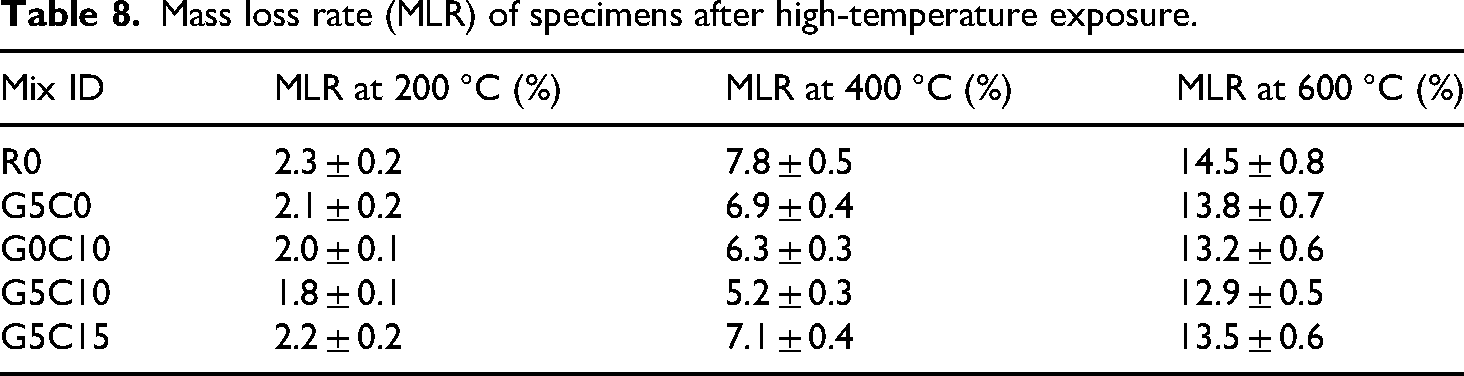
To evaluate fire-related performance, mass loss rate (MLR) of specimens after high-temperature exposure was measured (Table 8). The G5C10 group exhibited the lowest MLR (5.2% at 400 °C), compared to 7.8% for R0, indicating reduced dehydration and spalling. This aligns with residual strength results—lower MLR correlates with denser microstructure and enhanced fire resistance. At 600 °C, all groups showed MLR > 12%, as C–S–H and CH decomposition became dominant, eliminating the hybrid's protective effect.
Mass loss rate (MLR) of specimens after high-temperature exposure.
Pore-size distribution analysis
The porosity and pore-size distribution of cement composites with G/CNT hybrids were characterized at 28 days of age using MIP. The differential intrusion and cumulative curves for different sustained temperatures are shown in Figure 5 for the R0, G5C0, G5C10, and G5C15 series. As is well known, pores of size between 50 and 10,000 nm can be classified as large capillaries or macropores; those between 50 and 20 nm, as medium capillaries and those of size less than 20 nm as small isolated capillaries, and the proportion of pores is shown in Figure 6. From the MIP results, there appears to be a sharp decline in differential intrusion from 40 to 50 nm. Thus, this range may be considered the critical pore size for the present study. Indeed, the critical pore size is identical to the “threshold” pore size, which is an important index for evaluating the permeability of cement-based mortar. Compared with R0, those mixtures with either G or the G/CNT hybrids have significant pore-size refinement. Further, the cumulative intrusion is lowest for the hybrid G5C10. Note that the macropores of G5C10 have also been eliminated. This change demonstrates that the addition of G5C10 hybrid optimized the pore structure, which in turn led to superior residual strength at elevated temperatures. This is the reason that G5C10 could better resist the loss of mechanical properties under high temperatures. However, as shown in Figure 5, the optimized effect is also reduced in cement mortar with other hybrids having different ratios of CNT and G. This can be attributed to the re-agglomeration of the nanomaterials, resulting in poor dispersion of the nanomaterials. It is to be noted that in the case of G5C15, neither the micropores nor the threshold pore size has changed much compared to other hybrid mixtures in this study. However, at the highest temperature of 600 °C, this pore-size refinement was not very significant. Thus, the benefits of adding hybrid carbon nanomaterials were diminished for sustained exposure beyond 400 °C. In summary, the addition of G5C10 may lead to a more effective promotion of hydration in cement, resulting in a more compact microstructure. This densification ensures a significant improvement in the mechanical strength. The influence of different G/CNT hybrids on the pore structure of cement mortar at 28 days is shown in Table 9. Compared to R0, the total porosity, the median pore diameter, as well as the average pore diameter of the mixtures with G/CNT hybrids decreased significantly. The total porosity and median volume pore diameter of the C5G10 mixture are reduced by 29.22% and 27.57%, respectively. This confirms that the microstructure of G5C10–cement mortar was denser, resulting in an improvement of its mechanical properties. It is also worth noting that adding only graphene at a 0.05% mass ratio to cement does not result in a notable refinement of pore size.

(a) Differential and (b) cumulative pore-size distributions of cement composites at 28 days and exposed to room temperature.

Proportion of pores with different sizes of cement composites (quantified via MIP: small pores: <20 nm, medium pores: 20–50 nm, large pores: >50 nm). MIP: mercury intrusion porosimetry.
MIP analysis of G/CNT hybrid mortar composites at 28 days.
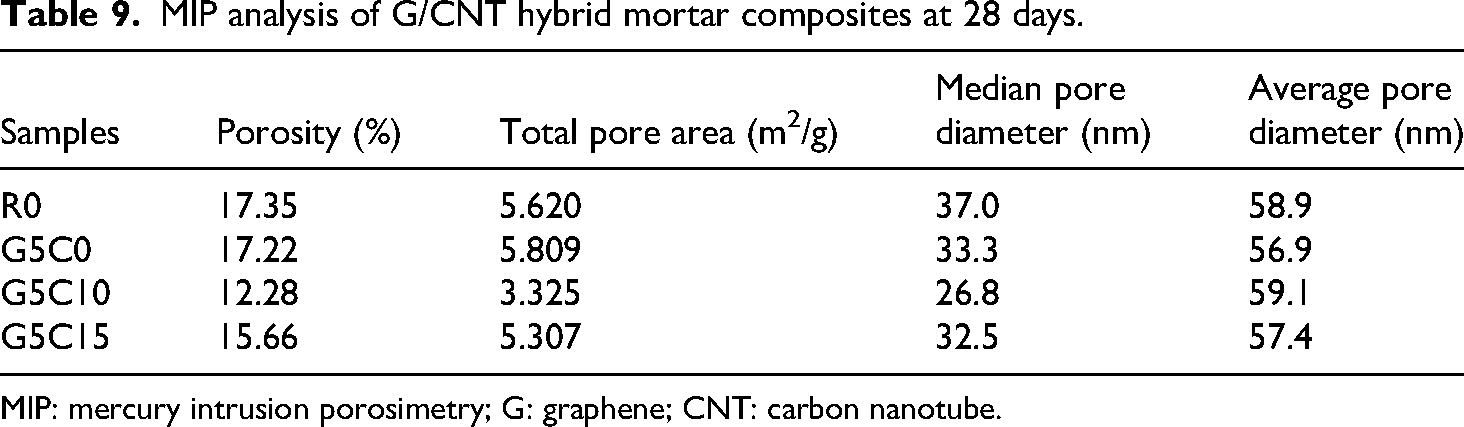
MIP: mercury intrusion porosimetry; G: graphene; CNT: carbon nanotube.
The enhancement of thermal stability of mortar by the dispersion of G/CNT hybrids can be divided into two aspects: physical barrier and chemical regulation. From the physical perspective, uniformly dispersed nanomaterials can fill the capillary pores inside the mortar to form a dense “nanoskeleton,” which can hinder the initiation and propagation of thermal cracks at high temperatures. From the chemical perspective, the high specific surface area of G and CNT provides more nucleation sites for cement hydration, promoting the formation of calcium silicate hydrate (C–S–H) gel. Moreover, their surface functional groups can complex with calcium hydroxide (CH) crystals, inhibiting the rapid decomposition of CH at high temperatures. However, when the hybrid ratio is unbalanced (e.g. the G5C15 group), excessive CNTs will cause agglomeration, which not only destroys the continuity of the “nanoskeleton” but also forms stress concentration areas around the agglomerates, thereby exacerbating strength degradation at high temperatures. MIP results show that G5C10 has the lowest total porosity (12.28%) and median pore diameter (26.8 nm), indicating pore refinement caused by uniform dispersion. Although a quantitative correlation between pore parameters and strength is not established in this study, the qualitative trend (pore refinement → strength improvement) is consistent with the mechanical test results. Future studies will conduct linear fitting and other quantitative analyses to verify this correlation.
MIP results were quantified using pore-size distribution parameters (Table 9). The G5C10 group exhibited the lowest total porosity (12.28%), smallest median pore diameter (26.8 nm), and highest proportion of small pores (<20 nm, 68.3%) (Figure 6). This pore refinement—quantified by a 29.22% reduction in total porosity and 27.57% reduction in median pore diameter compared to R0—directly contributes to enhanced high-temperature stability. SEM image analysis (ImageJ software 55 ) confirmed that G5C10 had a 42% lower microcrack density (0.08 cracks/μm2) than R0 (0.14 cracks/μm2) at 400 °C, validating the bridging and filling effects of well-dispersed G/CNT hybrids.
X-ray diffraction (XRD)
The XRD patterns of the mortar mixtures containing G5C10 addition at elevated temperatures are presented in Figure 7. There exist all the common cement hydration products exist, such as calcium hydrate (CH), tricalcium silicate (C3S), dicalcium silicate (C2S), and ettringite (AFt). Compared with the R0 mixture, no new phases appeared upon the addition of carbon nanomaterials. This was verified through testing the hybrid G5C10. By comparing the peak intensity of C3S in the G5C10 hybrid mortar and that of CH, it is clear that the hydration process is aided and accelerated when the G5C10 hybrid is added. In general, since the graphene sheet and CNT–COOH possess a larger specific surface area, they provide nucleation sites for the hydration reaction, thereby accelerating the hydration of cement.

XRD analysis of plain and G/CNT-cement composites at elevated temperatures. G: graphene; CNT: carbon nanotube.
From 200 °C to 400 °C, it can be clearly seen that the peak values of calcium hydroxide (CH) of C5G10–cement composites are alike, indicating that there is not much change in the hydration process from a rise in the temperature from 200 °C to 400 °C. However, the peak values are lower than those at 25 °C, which implies that some dehydration has begun to occur at these high temperatures. However, one can observe that upon raising the exposure temperature to 600 °C, a change in the hydration phases occurs. This is mainly due to further dehydration and decomposition of CSH and CH.56,57 As shown in Figure 7, there is little trace of calcium hydrate, indicating a significant decomposition. This, in other words, means that when exposed to 600 °C, the nanomaterials do not undergo dehydration arrest.
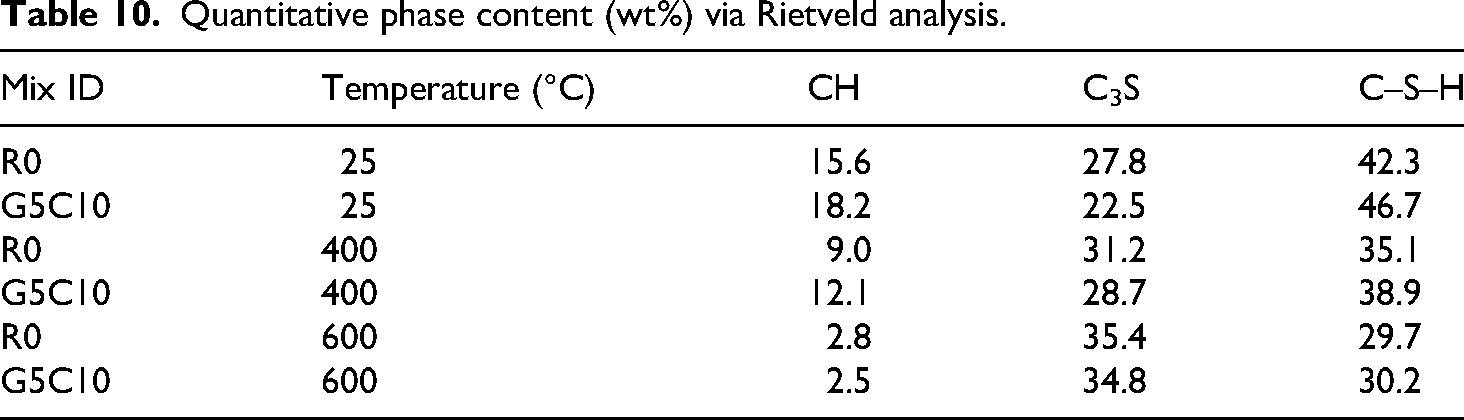
Quantitative phase analysis was performed using the Rietveld method 58 to quantify the content of key hydration products (CH, C3S, C–S–H) (Table 10). The G5C10 group showed the highest CH content (18.2% at 25 °C) and lowest unhydrated C3S (22.5%), confirming accelerated hydration due to G/CNT hybridization. At 400 °C, CH content in G5C10 (12.1%) was 35% higher than that in R0 (9.0%), indicating that hybrids inhibit CH decomposition. At 600 °C, CH content dropped to <3% in all groups, consistent with severe dehydration.
Quantitative phase content (wt%) via Rietveld analysis.
Morphology and microstructural composition
The different mortar mixtures were examined under SEM, and their morphologies are shown in Figure 8. As shown in Figure 8(a), the unheated specimen, consisting mostly of fibrous calcium–silicate–hydrate (C–S–H) gel and amorphous calcium hydration (CH), presents a compact microstructure. As the temperature increases to 200 °C, the compactness deteriorates, leading to the formation of microcracks. When the temperature reached 400 °C, these microcracks increased both in width and area. At 600 °C, it is clearly seen from Figure 8(g) compared with Figure 8(c) and (e) that a large volume of poorly crystallized or amorphous gel appears and fills the gaps and cracks; there is further decomposition of C–S–H gel and calcium hydroxide that,59,60 the compactness of the cement matrix is thus damaged and consequently, the residual strength also is reduced.

SEM images of G5C10–cement matrix after thermal exposure: (a) and (b) 25 °C (unheated); (c) and (d) after 200 °C heat treatment; (e) and (f) after 400 °C heat treatment; and (g) and (h) after 600 °C heat treatment.
Figure 8(b) shows that at an ambient temperature of 25 °C, the G/CNT hybrid is well-dispersed in the cement matrix, providing a platform for cement hydrates to grow due to the large specific surface area available through the hybrid. Furthermore, the functional group (−COOH) and the hydrophilic group of the surfactant PVA can absorb water, providing a potential site for cement paste hydrates to form and grow on the surface of the G/CNT hybrid.
In addition, due to the nano-sized additives and consequent pore filling and crack bridging, no obvious macrocracks are visible as in Figure 8(b). In conclusion, the appropriate G/CNT hybrids (herein, the G5C10 group) can promote the formation of cement hydrates and prevent cracks, particularly at room temperature. However, with the temperature increasing to 200 °C, the G/CNT hybrids were separated from other cement products, and some macrocracks appeared. Up to 400 °C, the G/CNT hybrid clumping was attached to the surface of the cement matrix. The bridging effect has also been reduced. When the temperature reached 600 °C, it was found that the clustering and “flowers” of the poorly crystalline form, as seen in Figure 8(h), were present. In general, the C–S–H gel and calcium hydroxide are totally decomposed at this high temperature. So, the appearance of poorly crystalline morphology implies that G/CNT hybrids spalled together with the decomposition of CH. This means that the advantage seen hitherto is no longer available. In other words, the appropriate G/CNT hybrid addition can adsorb the bound water in hydrates and build potential channels for releasing this water up to a temperature of 400 °C. However, at 600 °C, this advantage is lost.
Evaluating synergy
To calculate the synergy of mechanical properties at elevated temperatures in mixtures with various G/CNT hybrid mixtures, it is crucial to conduct a thorough analysis of the test results for individual nanomaterials. According to a previous study, 61 the effect of nanomaterial hybridization on mechanical properties cannot be accurately predicted based solely on the simple rule-of-mixtures due to the interplay between each nanomaterial within the matrix.
In this paper, therefore, synergy is evaluated based on the following formula:
Values corresponding to equation (1) are plotted in Figure 9 for the various mixtures examined. The G5C10 hybrid offers the most efficient combination. The synergy is above unity across all exposure temperatures. Note that the other hybrid examined, namely, G5C15, registered a synergy of less than or equal to 1. Figure 9 reveals that the synergy, as calculated per equation (1), was 1.28 at room temperature and as high as 1.7 at sustained exposure to 400 °C. Even at 600 °C, this parameter drops marginally to 1.6. Regarding flexural strength, the hybrid G5C10 was once again effective, whereas the hybrid G5/C15 was not. Clearly, there is an optimal dosage and combination for carbon nanomaterials to enhance the residual strength after exposure to high temperatures.

Synergy effect in (a) compressive and (b) flexural strength of G/CNT hybrid mixtures at elevated temperatures. G: graphene; CNT: carbon nanotube.
Banthia and Dubeau 62 demonstrated that carbon nanoparticles can reduce the mean pore size by up to 10 times. Furthermore, their hybrid can bridge a wide range of pores at the sub-micron scale, thereby reducing crack formation and growth. Therefore, an optimal hybrid of G and CNT exists, which will improve the sustainability of cementitious materials under high-temperature exposure.
Limitations and future directions
This study is a preliminary exploration of multidimensional nanomaterial hybridization for dispersion improvement, with the following limitations to be addressed in future research:
Quantitative analysis: supplement zeta potential, laser particle size analysis (dispersion quantification), XRD quantitative phase analysis, and pore-strength linear fitting (MIP/SEM data). Thermal mechanism: add Thermogravimetric Analysis/Differential Scanning Calorimetry (TGA/DSC) tests to clarify the oxidation behavior of nanomaterials at high temperatures (>400 °C) and the decomposition law of hydration products. Mechanical parameters: increase the sample size (to five replicates) and supplement elastic modulus, fracture energy, and postpeak behavior tests. Practical application: supplement cost, scalability, health safety, and construction compatibility data, combined with fire resistance indicators (spalling rate, mass loss, permeability). Material optimization: replace nanomaterials with microscale industrial solid waste powders to solve the high-temperature oxidation problem of nanomaterials and improve engineering applicability.
Conclusions
This study preliminarily verifies that multidimensional nanomaterial hybridization (2D G + 1D CNT) is a feasible approach to improve dispersion in cement-based mortar, with the following core conclusions:
Multidimensional hybridization suppresses the agglomeration of single nanomaterials through spatial steric hindrance, which is indirectly reflected by the improved mechanical properties and high-temperature resistance of mortar. The optimal ratio is G:CNT = 1:2 (G5C10, 0.05 kg/m3 G + 0.10 kg/m3 CNT), which achieves 37% and 28% higher compressive and flexural strengths than R0 after 28 days of curing, and 33% higher compressive strength after exposure to 400 °C. Microstructural characterizations (SEM/MIP) confirm that uniform dispersion of G5C10 exerts filling and bridging effects, refining pore structure and forming a dense microstructure—laying the foundation for high-temperature strength retention. This study focuses on the preliminary verification of dispersion improvement, and the limitations will be addressed in future research. Replacing nanomaterials with microscale industrial solid waste powders to optimize high-temperature performance and supplement relevant tests to enhance engineering applicability will be launched in the next stage.
Footnotes

Author contributions
Conceptualization: G. Zhou and H. Zhu; methodology: Q. Yang; software: G. Zhou; writing—original draft preparation: Q. Yang; writing—review and editing: H. Zhu; project administration: G. Zhou.
Funding
The authors disclosed receipt of the following financial support for the research, authorship, and/or publication of this article: The authors are grateful for the financial support of the Research Project of China Railway Construction Group Co., Ltd (No. 24-41c), Natural Science Foundation of Jiangsu Province (Grant No. BK20220694), National Natural Science Foundation of China (Grant No. 52308420), and the Natural Science Foundation of Jiangsu Higher Education Institutions of China (Grant No. 21KJB560012).
Declaration of conflicting interests
The authors declared no potential conflicts of interest with respect to the research, authorship, and/or publication of this article.
Data availability
The data used to support the findings of this study are available from the corresponding author upon request.