



Abstract
Wellbore instability in deep hard-brittle shale formations, primarily induced by hydration-driven strength degradation upon interaction with water-based fluids, poses a critical challenge to hydrocarbon extraction. Conventional triaxial testing for assessing shale hydration behavior is often constrained by substantial sample requirements, extended duration, and high operational costs. In response, this study develops an efficient alternative approach centered on the indentation hardness method. While standard indentation tests are typically limited to hardness and plasticity coefficients, this work establishes theoretical models—based on contact mechanics, elasticity theory, and the Mohr–Coulomb criterion—to derive elastic modulus, Poisson's ratio, and uniaxial compressive strength from indentation data. Experimental analysis of homogenized Longmaxi shale revealed a dense, low-porosity microstructure dominated by non-expansive clay minerals and quartz. Freshwater immersion tests displayed a three-stage absorption trend—rapid, slow, and stable—reaching near-saturation after 72 hours. Pronounced mechanical degradation was observed within the initial 300 hours of immersion, characterized by marked reductions in compressive strength, elastic modulus, and indentation hardness, alongside a stepwise increase in Poisson's ratio; this degradation trend decelerated thereafter. Validation experiments confirmed that single-point indentation hardness measurements provide mechanical equivalence to uniaxial compression responses. As a result, indentation testing on shale chips following fluid immersion offers an efficient and reliable means of evaluating time-dependent fluid–rock interactions. The proposed methodology minimizes core material requirements, enhances operational efficiency, and mitigates the influence of heterogeneity, thereby offering considerable practical value for shale hydration assessment and wellbore stability forecasting.
Introduction
As the drilling depth continues to increase, hard and brittle shale formations have gradually become the main geological body for well drilling operations.1–3 During the drilling process, about 90% of the wellbore instability occurs in the mud shale sections, and the wellbore instability in hard and brittle shale formations accounts for 60% of the total wellbore instability in the mud shale formations. During the drilling process, the shale in the wellbore will inevitably come into prolonged contact with the water medium, which causes the clay minerals to undergo hydration, altering the mechanical properties of the hard and brittle shale in the formation and affecting the collapse pressure in the near-wellbore area, leading to the occurrence of wellbore instability.4–7 Due to the different physical and chemical properties of hard and brittle shale compared to other mud rocks and the certain concealment of the hydration characteristics, it is necessary to conduct experimental evaluation studies on the hydration mechanical properties of hard and brittle shale to ensure safe and efficient drilling in hard and brittle shale formations.8–10
Yan et al.11–14 conducted triaxial mechanical experiments on shale before and after soaking, and obtained consistent research results: as the hydration time of shale increases, the internal structure of the rock is damaged, thereby weakening the strength of the rock and causing a decrease in the mechanical parameters of the rock. Especially for shale with bedding structure, the bedding plane becomes a high-permeability channel, and external fluids preferentially penetrate the rock body through the bedding plane, making the rock more prone to failure along the bedding plane.
Xiong et al. 15 conducted hardness and compressive mechanical experiments on shale before and after immersion, and studied the mechanical strength change characteristics of Dongying Formation shale before and after immersion. The strength of shale under the action of drilling fluid decreased with the extension of immersion time. Yuan and Chen 16 conducted direct shear experiments on shale immersed in water-based and oil-based drilling fluids, and linked them with the single-group weak plane strength theory, studying the influence of cohesion and internal friction angle on the strength of clay mechanics. Due to the influence of hydration on the bedding plane, the strength of shale decreased with the extension of immersion time, and with the expansion of micro-cracks, shale was prone to failure. Fang et al. 17 studied the influence of water content on rock mechanical properties through water absorption experiments and uniaxial compression experiments. The experimental results showed that with the increase of water content, the elastic modulus and strength of hard brittle mud shale gradually decreased. Zhang et al. 18 studied the mechanical properties of plate-like shale after immersion in clear water through triaxial compression experiments, and combined with CT scanning experimental results, discussed its mechanical mechanism from a microscopic perspective. The anisotropy of plate-like shale is stronger than that of bedding shale. With the extension of hydration time, the compressive strength and elastic modulus of plate-like shale gradually decreased, and the hydration effect led to the expansion of micro-cracks at the interface between the bedding layer and the rock matrix, resulting in fracture along the shale bedding layer.
Currently, the study of dynamic changes in hydration-induced mechanical parameters of hard brittle shale under different water-based drilling fluid environments primarily relies on laboratory triaxial mechanical tests. These experiments utilize small cylindrical shale samples to obtain constitutive relationships and mechanical parameters. However, according to rock mechanics testing standards, determining the mechanical strength of shale under varying hydration durations requires a substantial number of downhole cores. With increasing drilling depths, core acquisition has become significantly more challenging and costly, rendering conventional coring methods inadequate. Under conditions of limited standard core availability, which precludes uniaxial compression testing, researchers have explored simpler alternative methods such as the scratch method or the indentation method. The scratch method inverts the rock strength by measuring the lateral cutting force generated when a diamond tool scrapes the rock sample surface, and combining the depth and width of the scratch. However, its test target is large-sized long core columns, and it is difficult to meet the hydration test requirements of the entire core in terms of the number of samples and device modification. The indentation method encompasses a variety of specific techniques: The indentation hardness method indirectly calculates hardness and strength based on the load–displacement curve and tiny indentations, but due to its too shallow range of action, it cannot fully characterize the changes in mechanical properties within the thickness of the hydration layer. The point loading method estimates the strength by fracturing irregular rock blocks. Its calculation is based on the failure load and the cone head spacing, but the results are easily disturbed by the sample size and internal heterogeneity. In contrast, the indentation hardness method continuously loads until the surface of the rock sample breaks. By recording the peak load and the load–displacement curve throughout the process, parameters such as rock hardness, yield strength, and plasticity coefficient can be directly calculated. In conclusion, on the basis of the combination of experimental operation and theory, the indentation hardness method may be operational and meet the requirements of mechanical property evaluation.
It should be noted that while standard rock hardness tests provide only hardness and plasticity coefficients, uniaxial compression tests yield elastic modulus, Poisson's ratio, and compressive strength. Therefore, single-point indentation hardness measurements on rock core end faces cannot be equated with complete uniaxial compression tests on cylindrical cores. Suppose multi-point indentation hardness tests are conducted on the end face of a 5-cm-diameter rock sample. If elastic modulus, Poisson's ratio, and uniaxial compressive strength could be directly obtained from single-point indentation experiments, then indentation measurements at any point on the end face could effectively replace uniaxial compression tests of the entire cylindrical core. Consequently, indentation hardness tests performed on both ends of rock core discs after immersion in working fluids (Figure 1) could enable evaluation of rock mechanical properties under single working fluid immersion conditions.

Multi-point hardness indentation test on the end face of the core sample.
To overcome the above technical bottlenecks, uniaxial compression fracture mechanics experiments and hardness indentation tests were carried out. Then, based on the conventional rock indentation hardness method, a theoretical model for solving the elastic modulus, Poisson's ratio and compressive strength of rock samples by Schmidt hardness (the cylindrical flat-bottomed indenter is Schmidt indenter) indentation method was constructed. Finally, a method for evaluating the mechanical parameters of hard brittle shale hydration based on indentation hardness was established. The core of this method lies in that the result of single-point indentation hardness test on the end face of the core can be equivalent to the result of uniaxial compression fracture test of a piece of shale.
Materials and methods
Materials
This study focuses on the outcrops of hard brittle shale from the Longmaxi Formation in a specific region of southern Sichuan. To eliminate the influence of bedding plane weaknesses on subsequent hydration mechanical experimental tests, the coring angle was selected perpendicular to the bedding planes during core sample preparation. Due to the unique physicochemical properties of hard brittle shale, the outcrop was processed into experimental plunger samples using dry ice freezing, liquid nitrogen drilling, and blade cutting techniques, ensuring no contact with water throughout the sample preparation process. The small plunger samples (Figure 2(a)) have a diameter of 25 mm and a length of approximately 50 mm, while the large plunger samples (Figure 2(b)) have a diameter of 50 mm and a height of approximately 50 mm. Both types of samples feature parallel ends with a maximum non-parallelism error of 0.05 mm and a diameter error not exceeding 0.3 mm. Across their entire height, the end faces are perpendicular to the sample axis with a maximum deviation of no more than 0.25°. The small samples are utilized for conventional uniaxial compression fracture tests, whereas the large samples are employed for Schmidt hardness indentation tests.
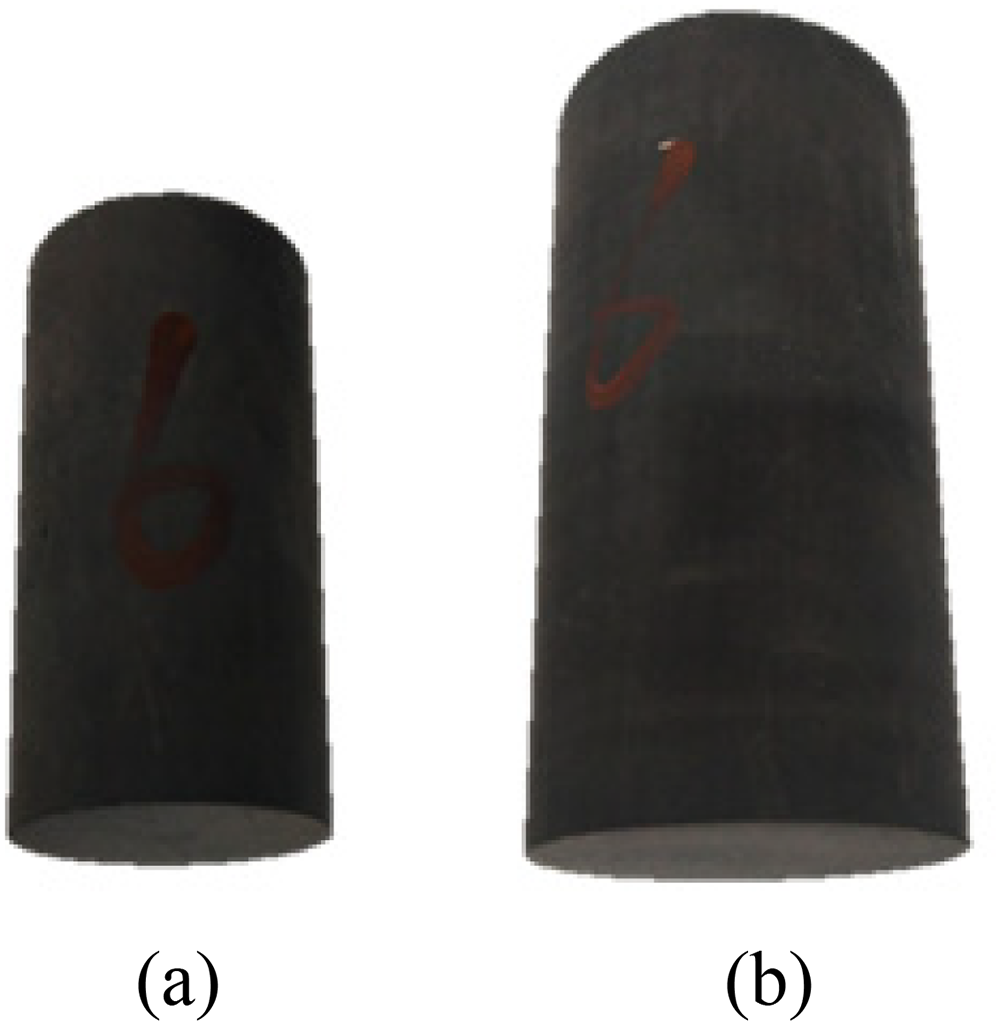
The prepared hard brittle shale specimens.
Due to the strong heterogeneity among shale samples and the development of fractures, the experimental results of different shale samples vary greatly, making it difficult to obtain accurate conclusions. To eliminate the influence of factors such as the development of micro-fractures in hard and brittle shale on the test results of uniaxial compressive strength and indentation hardness, various methods are needed to remove the heterogeneity of the collected hard and brittle shale outcrops, ensuring that the selected cores all belong to hard and brittle shale with relatively similar homogeneity. Thus, subsequent series of experimental tests can be carried out. Firstly, observation and screening are conducted using a stereomicroscope, and rock samples with obvious defects are eliminated. Then, the homogeneity of the rock samples is evaluated and analyzed through density, longitudinal and transverse wave velocities, porosity, permeability, and micro-CT scanning tests (Figure 3), and rock samples with similar homogeneity and meeting the experimental test standards are selected. 19

CT scan results of the rock core column without crack development.
The characteristic parameters of the selected rock samples were tested. The hard and brittle shale is mainly composed of clay and quartz (Figure 4(a)). The clay minerals are mainly non-expansive illite, chlorite, and kaolinite, with a 10% content of the interlayer of illite/montmorillonite. There is no strongly expansive montmorillonite (Figure 4(b)). Porosity and permeability were obtained as results from laboratory tests on hard brittle shale using a nitrogen porosity–permeability testing instrument. The overall structure of the hard and brittle shale is dense, and the porosity and permeability parameters are low. The porosity mainly ranges from 2.1% to 2.8%, and the permeability mainly ranges from 0.0012 to 0.00175 mD.

Testing of mineral components of hard brittle shale.
Methods
The rock samples selected for the uniaxial compression fracture mechanics experiment and hardness indentation experiment conducted this time are the homogeneous hard and brittle shale that were filtered out in the previous step. The water-based liquid given is plain water, and the soaking times are 0, 6, 12, 16, 24, 36, 48, 60, and 72 hours. To ensure the overall uniform hydration of the rock samples, the small rock samples are fully immersed in the solution for self-suction tests of the core. The experimental steps are as follows:
Before the experiment, the rock samples are dried in a 100-°C oven for 24 hours, and the original mass of the rock samples is recorded; The rock cores are fully immersed in plain water to allow for complete self-suction; After soaking for different periods of time, the rock cores are taken out, the water film on the surface of the rock cores is removed with absorbent paper, and the mass of the hard and brittle shale after soaking is weighed using a balance to obtain the water absorption mass of the hard and brittle shale after soaking for different periods of time.
After the rock samples have been soaked for different periods of time, the rock cores are sealed and placed for 48 hours to allow the water inside the pore spaces of the rock cores to diffuse evenly. Then, a uniaxial compression fracture test is conducted on the rock samples. The experimental equipment used for the uniaxial compression fracture mechanics test is the triaxial confining pressure rock mechanics testing machine developed in laboratory. This equipment can test the uniaxial compressive strength, elastic modulus, Poisson's ratio of rock samples at room temperature, as well as the longitudinal and transverse wave velocities during the loading process. The maximum axial load of this equipment can reach 1000 kN, and the size of the rock samples is: Φ25–100 mm × 100 mm. The mechanical loading of this experiment adopts the displacement control mode, with a loading rate of 0.2 mm/min. The axial load, stress and strain data are collected using a numerical control system, and are recorded every 0.4 seconds. The experimental equipment and the rock samples are shown in Figure 5. The specific experimental steps are as follows.
The shale specimen was placed inside a heat-shrink tube and securely positioned between two loading platens. A heat gun was applied uniformly from the center to both ends of the tube to ensure a tight seal around the specimen. A circumferential strain sensor was then mounted at the mid-height of the core. The encapsulated sample, along with the platens, was transferred into the pressure chamber. The control software was activated, and the upper platen was lowered to apply a 0.2-kN preload, ensuring full contact with the specimen. Stress–strain sensors were zeroed before commencing axial loading at a displacement-controlled rate until specimen failure, at which point the test was terminated. The procedure was repeated for subsequent specimens to complete the suite of uniaxial compression tests. Acquired test data were exported, and stress–strain curves were plotted to determine uniaxial compressive strength and deformation characteristics.

Three-axis mechanical experiment test.
The indentation hardness experimental testing was conducted using an axial mechanical loading press with a capacity of 50 kN, specifically designed as a uniaxial rock mechanics testing machine developed in our laboratory. The indenter employed was a 2 mm diameter Schmidt indenter. Schmidt hardness testing utilizes a cylindrical flat-ended indenter. To ensure the quality of the indentation mold, hard alloy material was selected, and the precisely machined cylindrical indenter was welded onto the base structure. A schematic diagram of the overall indenter mold structure is presented as follows in Figure 6.

Schematic diagram of the structure and dimensions of the hard alloy punch head.
Prior to immersion, the processed large cylindrical rock core specimens were sealed along their lateral surfaces using epoxy resin to prevent water seepage into the lateral sides of the specimens during end-face immersion. The end faces of the laterally sealed rock cores were then fully submerged in freshwater to allow comprehensive self-absorption. After varying immersion durations, the rock cores were removed and any surface water film was carefully wiped off using absorbent paper. The mass of the hard brittle shale specimens was measured using a balance to determine the water absorption quantity at different immersion times. Subsequently, indentation hardness tests were conducted corresponding to each immersion duration.
Prior to initiating the experiment, the indenter was mounted onto the load–displacement sensor of the mechanical loading press. Placing the soaked large rock core specimen with a diameter of 5 cm onto the specimen stage positioned beneath the indenter, and proceed with the indentation hardness testing. The experimental testing system is shown in Figure 7.

Experimental testing system.
The detailed experimental procedures are as follows:
Activate the computer software and controller for the 50-kN uniaxial rock mechanics testing machine. Install the carbide indenter onto the load–displacement sensor of the testing press, and adjust the loading platform of the mechanical testing machine to an appropriate height for placing the large rock core cylinder. Launch the mechanical software for hardness testing on the computer, and zero the load and displacement data. Control the load–displacement sensor of the mechanical testing machine to move the indenter downward as a whole until the computer software displays a load of 0.01 kN (ensuring full contact between the carbide indenter and the end face of the rock core). Clear the parameters of the load–displacement sensor again, open the data acquisition software, and commence the experiment by recording the load–displacement curve parameters. Upon completion of the hardness test for the original rock sample, stop recording the experimental parameters. Raise the indenter of the load–displacement sensor on the mechanical testing machine to a certain height, remove the rock core for end-face immersion, and conduct indentation hardness tests at different positions after varying immersion times by rotating the rock core end face. Sequentially complete the indentation hardness tests after immersion in fresh water for different durations. Copy the experimental test data and plot the load–displacement diagrams.
Results and discussion
Experimental results of uniaxial compressive strength
According to the above experimental method, single-axis compression fracture mechanical experiments on core samples under different soaking times were carried out. The experimental results and data analysis are shown in Figure 8.

Relationship between the amount of water absorbed by the core sample and the soaking time after different soaking durations in clear water.
The water absorption characteristics of hard brittle shale after freshwater immersion can be categorized into three distinct stages: rapid water absorption, slow water absorption, and stabilization. During the initial 6-hour immersion period, the water uptake capacity increased rapidly with a water absorption rate of 0.282%. Between 6 and 30 hours of immersion, the rate of water absorption slowed down, reaching a cumulative water content of 0.588%. After 30 hours of immersion, the moisture content stabilized with minimal incremental changes. Following 72 hours of immersion, the rock specimen exhibited a final water content of 0.697%, representing only a 0.109% increase from the 30-hour measurement. This observation indicates that during the early immersion stage, the shale's relatively high porosity enables rapid water absorption. However, as immersion time increases, water gradually fills the pore spaces, leading to a reduction in effective porosity. Consequently, the water absorption rate diminishes until the pores reach saturation after approximately 30 hours. The Longmaxi formation homogeneous hard brittle shale, characterized by low permeability and porosity parameters, demonstrates inherently low water absorption capacity throughout the immersion process.
After immersion in fresh water, the hard brittle shale exhibits a decline in core compressive strength and elastic modulus, accompanied by a stepped increase in Poisson's ratio, as immersion duration increases (Table 1). The mechanical parameters undergo significant changes primarily during the first 30 hours of immersion (Figures 9 and 10). Within this initial period, the rock demonstrates high water absorption rate and substantial immersion-induced weakening, resulting in marked reductions in compressive strength and elastic modulus. As immersion extends beyond 30 to 72 hours, the rock approaches a certain saturation state where water absorption rate diminishes. The later-stage degradation extent weakens compared to the initial phase, leading to relatively smaller reductions in peak stress intensity and corresponding elastic modulus. Due to the gradual penetration of water into the core interior, the rock undergoes staged weakening, which causes the Poisson's ratio to exhibit a stepwise growth pattern.

Trend of compressive strength and elastic modulus after water immersion.

The trend of Poisson’s ratio after water immersion.
Parameters of uniaxial mechanical tests on core samples after immersion in water for different durations.
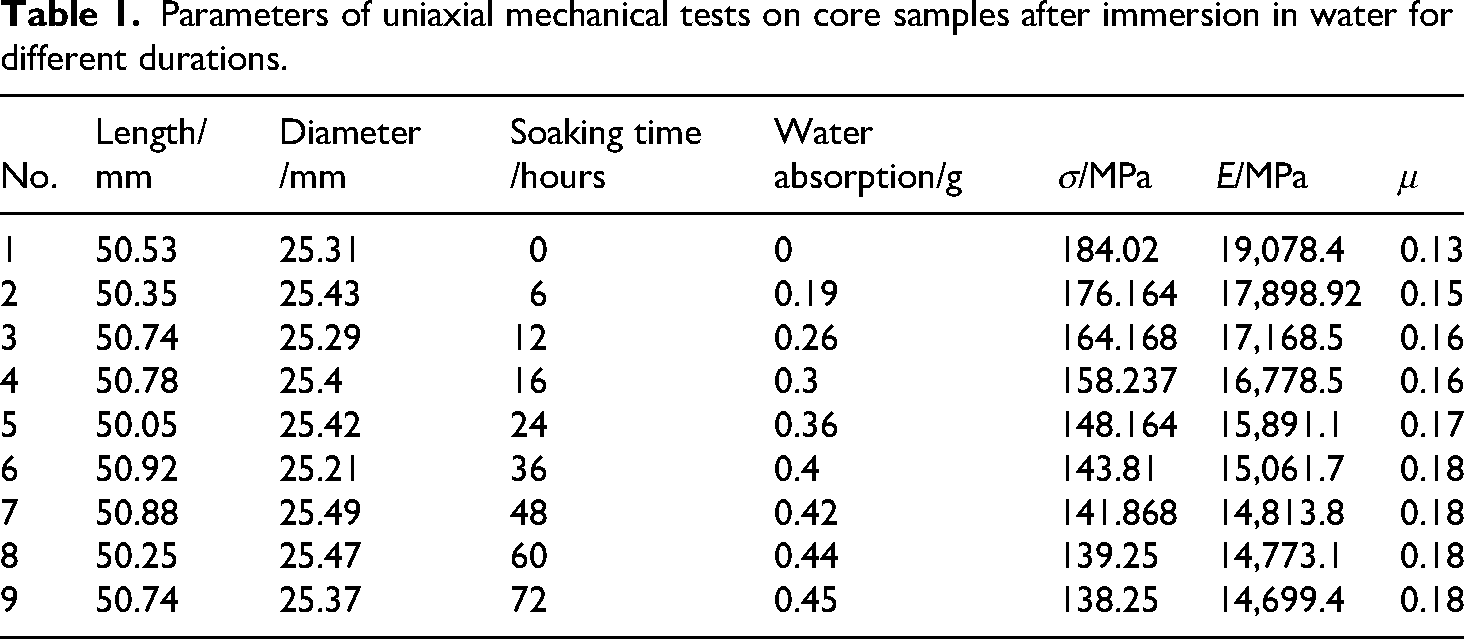
From the above, it can be seen that after the rock samples were soaked in water for 72 hours, the water absorption rate gradually stabilized. Although the increase in water absorption was very small, it still did not reach a stable state. Therefore, the rock cores were continued to be soaked in water, and the water absorption situation of the rock cores was tested and analyzed as in Figure 11.

The relationship between the water absorption of the core after soaking in clean water for 72 hours and the soaking time.
After soaking in water for 96 hours, it was found that the water absorption of the shale changed very little. It was not until 120 hours of soaking that the water absorption curve stabilized and became relatively flat. Compared with 72 hours of soaking, the water absorption of the shale was increased by 0.05%. Thus, it can be seen that the increase in water absorption of hard and brittle shale mainly occurs in the first 72 hours. At this time, the shale is almost at the saturation state of water absorption. Later, as the soaking time increases, the water absorption of the shale reaches the saturation state and no longer changes. Therefore, the analysis of the mechanical properties of hard and brittle shale after soaking in different water-based liquids can mainly focus on the first 72 hours of soaking as the main research stage.
Experimental results of indentation hardness
According to the above-mentioned experimental method, the core hardness indentation tests were carried out under different soaking times. The experimental results and data analysis are presented in Table 2 and Figures 12 and 13.

Relationship between indentation hardness load and immersion time and water absorption rate under clear water immersion conditions.

Photos of the two end surfaces of the core after the indentation hardness test was completed.
Test results of indentation hardness after soaking in clear water for different times.

The spontaneous imbibition volume of hard and brittle shale in the indentation hardness test is predominantly concentrated within the first 30 hours, reaching 0.054%. There is minimal increase in the shale's spontaneous imbibition volume during the later stages, particularly between 48 and 72 hours, where the increment in the core's spontaneous imbibition volume is very slight, almost reaching a plateau. As the soaking time extends, the rock sample's hardness also exhibits the most significant reduction primarily within the initial 30 hours. Water comes into contact with the internal particles of the hard and brittle shale, triggering a weakening reaction in the rock and reducing the cohesion between particles. Macroscopically, this results in a decrease in the rock sample's hardness. However, after 30 hours, although the hardness of the rock sample continues to decline with the prolonged soaking time, the magnitude of this reduction becomes relatively small.
The plasticity of rock mass reflects its ability to absorb residual deformation or its capacity to absorb mechanical energy associated with irreversible deformation. Compared with the rock indentation hardness, the rock plasticity coefficient exerts a more significant influence on drilling efficiency. By conducting indentation hardness experiments on rocks, the load–displacement curve of the rock can be obtained, from which the rock plasticity coefficient can be determined (Table 2). By calculating the plasticity coefficients under different immersion times, it can be observed that the original rock of the hard and brittle shale in the Longmaxi formation is brittle. As the immersion time in the solution increases, the rock end face is affected by the hydration effect, leading to an increase in rock plasticity and, consequently, an increase in the plasticity coefficient. However, the maximum plasticity coefficient calculated after 72 hours of immersion is 1.25, which still falls within the low-plasticity range. This further demonstrates that the hard and brittle shale in the Longmaxi formation is relatively dense, with low porosity and permeability parameters, and that hydration has a relatively minor impact on rock hardness.
The elastic parameters in rock mechanics can also be obtained through rock hardness tests. By analyzing the load–displacement curves from shale hardness tests, it can be found that these rocks are essentially elastoplastic in nature, thereby enabling the determination of the slope of the elastic deformation stage on the load–displacement curves obtained from rock hardness tests. 20 After the immersion of hard and brittle shale, the slope K of the elastic segment of the load–displacement curve decreases. As the immersion time prolongs and the water absorption rate increases, the slope K gradually decreases, with the most significant reduction occurring within the first 36 hours and only a slight decrease thereafter. The reduction in rock hardness mainly occurred within the first 30 hours. However, due to the continuous weakening effect of hydration on the rock, the slope K of the elastic segment of the load–displacement curve did not stabilize until after 36 hours. This demonstrates that the slope K of the elastic segment can indirectly reflect the weakening effect of aqueous solution immersion on the rock.
In this study, the rock samples were soaked in clean water and compared with the actual formation water, it also involved complex effects such as ion exchange and chemical crystallization. In the subsequent part, conducting research on the response and correction of pressure penetration hardness under different formation water and drilling fluid systems will be included as a key future direction in the conclusion.
Theory
Solving the elastic modulus and Poisson's ratio of hard brittle shale based on the Schmidt hardness indentation method
The conventional rock mechanics indentation hardness method cannot yield the elastic modulus, Poisson's ratio, and uniaxial compressive strength of rocks. Therefore, to achieve the determination of the elastic modulus, Poisson's ratio, and uniaxial compressive strength of rock cores from indentation hardness experiments conducted at a single point, it is necessary to carry out research on the parameter inversion theory of the Schmidt hardness indentation method. The first step involves research on the inversion theory for the elastic modulus and Poisson's ratio of shale. Based on the common laws governing the indentation of an elastic semi-infinite body by a rigid indenter (including three typical types: spherical, conical, and flat-bottomed cylindrical), a quantitative relationship model between the indentation hardness experiment and the rock's elastic parameters is established by analyzing the mathematical characteristics of the indentation load–depth curve (P–H curve),21–23 as follows:
When rigid indenters with different geometric configurations indent into a semi-infinite elastic body, the aforementioned relationship can be expressed as followed:
Based on the test data from uniaxial compression experiments, the mathematical expressions for rock mechanical strength parameters can be represented as follows:
By combining the aforementioned equations (2) and (3), we can obtain:

Based on the above analysis, the slope of the initial linear stage of the stress–strain curve in the uniaxial compression failure test is denoted as
The slope of the linear section of the load–displacement curve obtained when conducting the indentation hardness test using a cylindrical flat-bottomed indenter (Schmidt hardness indenter) is denoted as 
From equation (6), it can be known that:
In summary, the slope k2 of the linear segment of the P–H curve of the Schmidt hardness indentation can be characterized by the following mathematical relationship:
Among them, the f of the Schmidt hardness indenter is 2d. In this experiment, a 2-mm indenter was used. To verify the calculation accuracy of the theoretical formula for f value, the results of the uniaxial compression mechanical test and the indentation hardness test after soaking in clean water were utilized. The theoretical calculated value and the measured value of f were compared and analyzed as in Table 3.
Comparison of the theoretical and experimental f values of the indentation hardness of hard brittle shale.
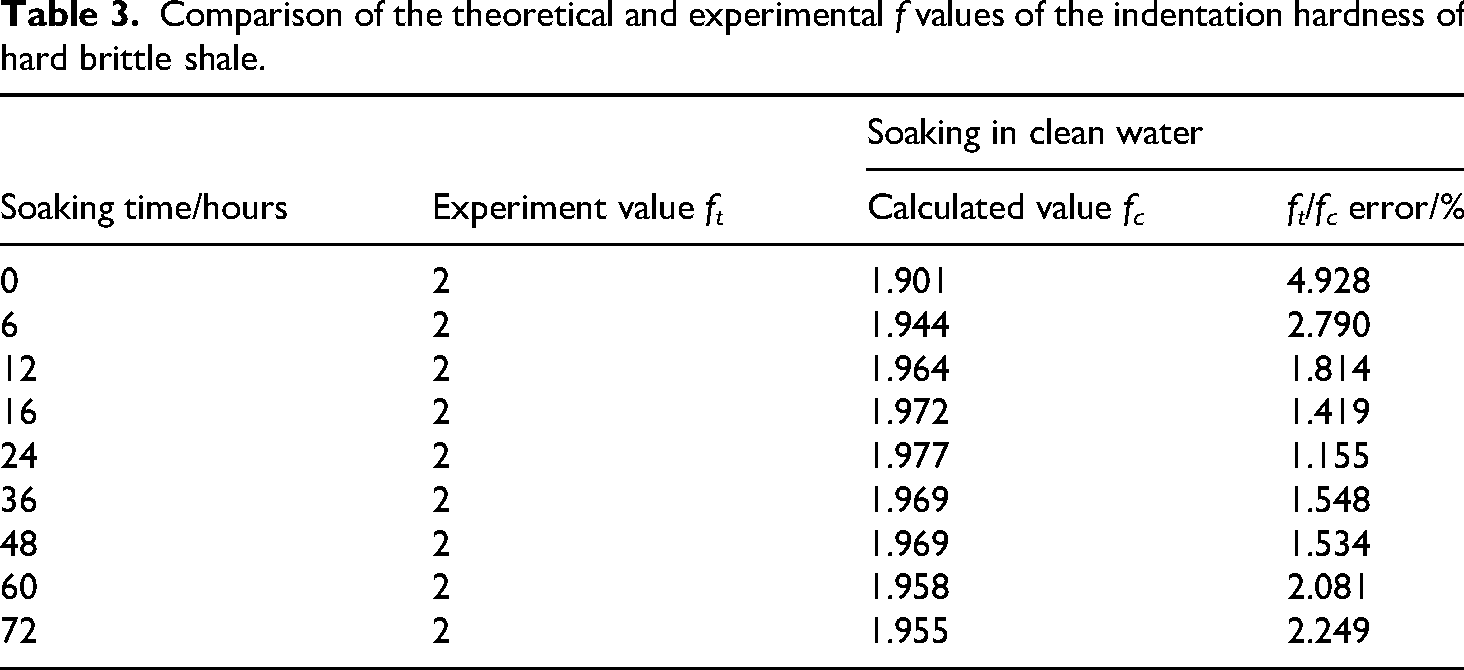
Analysis shows that the relative errors between the theoretical values calculated based on the Schmidt hardness indenter formula and the measured values are all controlled within the range of 5%, fully verifying the accuracy and engineering applicability of this calculation model. However, it should be noted that although the rock material parameter f value is known and the parameter k2 can be obtained through indentation hardness testing, the independent values of the elastic modulus E and Poisson's ratio μ cannot be directly calculated through equation (8).When either of these two elastic parameters is known, the other unknown parameter can be inversely calculated using equation (8). The specific idea is as follows: select the homogeneous shale core mentioned earlier and divide it into two groups of comparison samples. The first group of dry rock samples underwent longitudinal and transverse wave velocity tests and uniaxial compression failure experiments in sequence to obtain the reference parameters. After the second group of rock samples were completely saturated with clean water, wave velocity tests and mechanical property tests were carried out simultaneously. The specific experimental results are as shown in Table 4.
Test results of uniaxial compression mechanics of dry rock samples and saturated water rock samples.

Based on the results of uniaxial compression mechanics experiments obtained from dry rock samples and fully saturated water rock samples, a quantitative relationship model for the evolution of Poisson's ratio with water absorption rate during the hydration process of hard and brittle shale was fitted. The specific expression is as follows: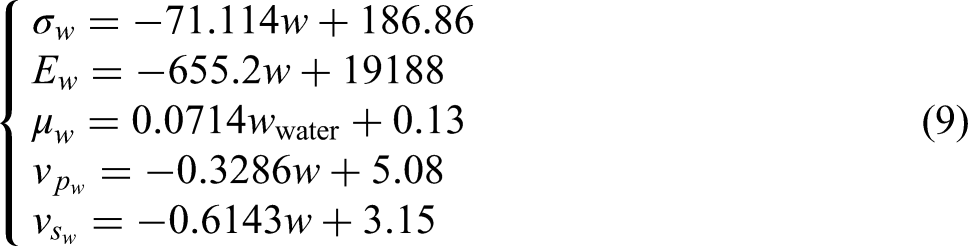
Based on the above analysis, it can be known that the Poisson's ratio μ of the rock sample shows a significant linear correlation with the water absorption at different hydration cycles. To verify the accuracy of the above formula (9), based on the water absorption of shale at different times of soaking in clean water mentioned above, the Poisson's ratios of shale at different times of soaking in clean water were calculated respectively using formula (9), and compared with the test results of the uniaxial compression fracture mechanics experiment conducted in the previous text. The specific calculation results are as shown in Table 5.
Comparison of the calculated uniaxial mechanical parameter Poisson's ratio with the experimental values.

As can be seen from the above table, the selected homogeneous hard and brittle shale has a good linear relationship with the water content. After being soaked in clean water, the Poisson's ratio μ value of the homogeneous hard and brittle shale changes slightly. Therefore, the Poisson's ratio calculated by formula (9) has a good fit with the corresponding Poisson's ratios tested under different hydration times, and the calculation errors are all within 4%. It also proved the feasibility and accuracy of using formula (9) to solve the Poisson's ratio of hard brittle shale soaked in clear water with different water saturation.
After obtaining the Poisson's ratio values under each water saturation condition through formula (9), they are substituted into formula (8) to solve the elastic modulus E. The theoretical calculated values were compared and analyzed with the measured values of the uniaxial compression experiment. The specific results are detailed in Table 6.
Comparative analysis of calculated and measured values of uniaxial mechanical parameters.

From the calculation results in the above table, it can be seen that the calculation error between the E value obtained by the formula and the E value obtained from the uniaxial compression test is relatively small, both within 5.5%, which proves the accuracy and feasibility of using the above formula to solve the elastic modulus of hard and brittle shale under different hydration times.
Solving the uniaxial compressive strength of hard brittle shale based on the maximum load of Schmidt hardness indentation
Although traditional statistical methods can establish a correlation model between indentation hardness and uniaxial compressive strength, their application requires obtaining uniaxial compressive strength experimental data in advance. In the absence of uniaxial compression experimental support, the application of this method is significantly restricted. For this purpose, theoretical research on the inversion of rock sample compressive strength based on the Schmidt hardness indentation method is carried out.
Under the mechanism of the Schmidt hardness indenter, the internal stress field of the rock can be regarded as a mechanical problem of the elastic half-space body subjected to concentrated surface loads. In a cylindrical coordinate system, the mathematical expressions of the axial stress component σz, the circumferential stress component σθ, and the radial stress component σr along the Z-axis are, respectively:

When the Schmidt hammer penetrates the rock mass, the rock material exhibits a markedly lower shear strength compared to its compressive strength. As the external load P′ continues to increase, shear failure initiates once the stress along a critical shear plane within the parent rock reaches its threshold, resulting in the disintegration of the surrounding rock mass. Ultimately, the failure mode observed during the rock indentation hardness test is characterized by a typical shear failure mechanism, manifesting as a conical fracture pit on the specimen surface (Figure 14). Based on this failure characteristic, the Mohr–Coulomb (M–C) strength criterion is employed to describe the indentation failure process, and its mathematical expression is given by:

Schematic diagram of the fracture pit formed after the indenter presses into the core.
The location of rock mass failure on the central axis (Z-axis) of the fracture pit can be determined through the load function P′. The critical conditions for failure to occur in the compaction zone can be expressed as:

For the flat-bottom cylindrical in-press condition, when the load P′ reaches its peak, the volume breaks. After substituting σz = σ1, σr = σ2 = σ3 into equation (13), we can obtain:
Let 
According to the above derivation, the mathematical model of the depth of the fracture pit is mainly affected by the Poisson's ratio μ and the internal friction angle φ after the hydration of the shale. In the analysis of the formation mechanism of the fracture pit, a conical compaction core structure is first formed (Figure 11A′OB′). As the external load is continuously applied, the flat-bottomed pressure head transmits pressure to the parent rock through this compaction core, and eventually the fracture pit is formed through shear failure (Figure 11AOB). The critical load P′ for failure in the compaction zone has the following relationship with the shear stress τ′, normal stress σ′ of the parent rock at the slope of the pit body and the inclination angle γ of the fracture surface:
Let 
When the external load P′ reaches the critical value of the rock indentation hardness (i.e. the maximum load HD), the material undergoes crushing failure under the action of shear stress, as expressed by:
According to the Mohr–Coulomb failure criterion of the uniaxial compression test, the mathematical expression of the uniaxial compressive strength σc is:
By combining the above relationship, the equivalent expression of hardness parameters and uniaxial compressive strength can be established:
After the maximum load HD is measured through the indentation test, the uniaxial compressive strength of the rock under different water saturation conditions can be calculated:
To verify the reliability of equation (21), the Poisson's ratio corresponding to different water saturation levels was first calculated using equation (9) established in the previous text. Combined with the maximum load HD, indentation depth h and the internal friction angle φ of the shale measured in the indentation experiment at different hydration times, they were substituted into equation (21) for theoretical calculation. The calculation results were compared and analyzed with the measured compressive strength in the uniaxial compression experiment to verify the accuracy of the theoretical model. The specific calculation results are detailed in Table 7.
Comparison of measured and theoretical values of uniaxial compressive strength of rock cores soaked in clear water.

Analysis shows that the relative error range between the predicted values and the measured values of the axial mechanical strength calculated based on the theoretical formula for different water saturation levels is 5.27% to 7.97%. This quantification result fully verifies the reliability of the theoretical formula (21).
Based on the analysis framework of the Schmidt hardness indentation theoretical model, by obtaining the indentation hardness experimental data of rocks at different hydration times and supplementing the uniaxial compression experiments of dry rock samples and saturated water rock samples, the quantitative mapping relationship between the indentation hardness parameter and the elastic modulus E, Son's ratio μ, and uniaxial compressive strength σc can be established. Furthermore, the dynamic evaluation of the mechanical properties of shale during the entire period of clear water immersion is achieved. This provides significant practical value for the evaluation of the hydration of hard and brittle shale under the gas drilling water discharge conditions in an approximately constant-pressure wellbore environment, as well as for the prediction of wellbore stability.
The experimental evaluation method for the hydration mechanical properties of hard and brittle shale based on Schmidt hardness indentation method established is only a preliminary study, but it can be fully applied to the evaluation of wellbore stability after gas drilling fluid discharge. For conventional mud drilling, the rock samples absorb water under the wellbore pressure difference. A high-pressure device needs to be designed. It is recommended to conduct subsequent high-pressure equipment tests when the research funds are available.
Conclusion
This study focuses on the hard and brittle shale of the Longmaxi formation. By selecting homogeneous hard-brittle shale samples, spontaneous imbibition and hydro-mechanical property tests under varying freshwater soaking durations were conducted. A theoretical model was established to derive rock mechanical parameters based on the Schmidt hardness indentation method. The main conclusions are as follows:
Through core preparation and heterogeneity screening, the discreteness of experimental results was effectively controlled, enabling relatively stable outcomes with a limited number of core samples. The Schmidt hardness indentation method proposed in this study allows for point-specific hardness measurements that are equivalent to uniaxial compressive tests on standard core plugs. A full-size core slice can thus serve as multiple mini core plugs, facilitating the evaluation of hydration effects on shale mechanical properties based on available cores. The testing protocol for the hydro-mechanical parameters of hard-brittle shale has been optimized, significantly reducing core consumption and experimental duration, thereby improving research efficiency and considerably lowering overall costs. In this study, homogeneous and hard brittle shale without micro-cracks or bedding fractures was selected. Subsequently, core samples with more developed weak surfaces such as micro-cracks can be used for a series of self-pumping and hydration mechanical experiments to test the hydration mechanical properties of hard brittle shale. Based on the Schmidt hardness indentation method, an experimental evaluation method for the hydration mechanical properties of hard brittle shale can be established, forming a complete and simple, rapid and scientific experimental method for evaluating the rock mechanical properties of hard brittle shale formation.
Footnotes

Funding
The authors disclosed receipt of the following financial support for the research, authorship, and/or publication of this article: This research was funded by the China Postdoctoral Foundation Funding Program (project number: 2025M772951) and the postdoctoral research station scientific research project (project number: 2024D102-01-17).
Declaration of conflicting interests
The authors declared no potential conflicts of interest with respect to the research, authorship, and/or publication of this article.