




Abstract
Objective
This study examined the composition, diversity, and assemblage of zooplankton in relation to environmental factors in the coastal Dakatia River, Bangladesh, across wet and dry seasons.
Methods
Zooplankton samples were collected seasonally (monsoon and winter) from each station, alongside measurements of environmental parameters. Population density, diversity indices, assemblage patterns, and environmental drivers of the zooplankton community were analyzed.
Results
A total of 25 zooplankton genera were recorded, dominated by Rotifera (36%), followed by Copepoda (26.49%), Cladocera (21.25%), and crustacean nauplii (16.26%). Zooplankton density varied significantly (p < 0.05) between the seasons, with the highest mean (144.88 ± 22.94 ind./L) during the winter (dry) and the lowest (120.25 ± 14.04 ind./L) in the monsoon (wet) season. Diversity indices indicated moderate diversity, ecological stability, habitat suitability, and generally low dominance of taxa. Cluster analysis delineated five and four major assemblage clusters during monsoon and winter, respectively, at 70% similarity. Analysis of similarity confirmed significant (p < 0.05) spatial and temporal variation among the stations and between the seasons, while similarity percentage analysis identified Keratella sp., Brachionus sp., Bosminopsis sp., crustacean nauplii, Cyclops sp., and Lecane sp. as the most influential contributors to community dissimilarity. Environmental parameters varied significantly across seasons (p < 0.05). Among them, pH exerted the greatest effect during the monsoon, while canonical correspondence analysis further revealed that pH in the monsoon and nitrate in the winter were the primary drivers structuring zooplankton assemblages.
Conclusion
These findings reveal moderate zooplankton diversity and community stability, providing key indicators of ecological integrity and productivity in tropical river ecosystems.
Introduction
Zooplankton play a pivotal role in aquatic food chains and form a fundamental component of food webs, substantially enhancing the biological productivity of aquatic habitats.1,2 Functioning as an intermediate nexus for energy fluxes, they facilitate the transfer of energy between lower and higher trophic levels.3–5 By serving as prey for a wide range of aquatic organisms, particularly fish,6,7 zooplankton contribute directly to successful fish production and provide valuable insights into fisheries potential and sustainability.8,9 They also contribute to nutrient recycling by transferring materials from the water column to sediments,10,11 thereby supporting benthic vegetation and invertebrate growth that further promote fish production. Moreover, zooplankton are widely recognized as bioindicators of aquatic ecosystems, responding rapidly to environmental variation due to their high densities, short life cycles, pelagic distribution, and extensive species diversity.3,9,12,13
Rivers are among the most diversified, dynamic, and productive aquatic ecosystems on the Earth, supporting a wide range of flora and fauna due to their favorable conditions. The Dakatia River, a major tributary of the Meghna, exemplifies this diversity as it originates in the Comilla district and flows through the Chittagong Hill Tracts before merging with the Meghna in the Chandpur district. This geographical span allows the river to sustain a rich aquatic ecosystem, harboring a diverse fish community that largely relies on abundant natural food resources, such as plankton. 14 Furthermore, the Dakatia River provides critical habitats that serve as breeding, feeding, and sheltering grounds for keystone species, including the ecologically and economically important Hilsa.
The interaction of physical and chemical attributes of water plays a decisive role in shaping the abundance, composition, distribution, diversity, growth, and reproduction of aquatic species. Environmental parameters such as temperature, salinity, pH, dissolved oxygen, light availability, and nutrient levels are widely recognized as key drivers of the physiological performance of zooplankton and other aquatic organisms, including fish.13,15,16 Zooplankton, in particular, are typically adapted to specific ranges of these parameters, and their abundance is strongly regulated by the physicochemical characteristics of aquatic systems.12,15,17,18
For effective conservation and sustainable management of fish diversity, as well as for enhancing aquatic productivity, a comprehensive understanding of zooplankton diversity is essential. Zooplankton communities exhibit pronounced variation across spatial and ecological gradients, even within the same geographic region. Although zooplankton are widely recognized as key bioindicators of aquatic ecosystem health, most studies in Bangladesh have concentrated on large river systems,19–21 often relying on taxonomically coarse, short-term, or season-specific assessments.3,15,17,1920–23 Consequently, ecologically important but smaller tropical rivers such as the Dakatia remain poorly studied, particularly with respect to seasonal zooplankton dynamics and their linkages with environmental variables. This is the first comprehensive account of seasonal zooplankton diversity in the Dakatia River, linking community dynamics to key environmental gradients through multivariate analyses. The novelty of this work lies in its integrative assessment of physicochemical drivers—such as pH, transparency, nutrients, and conductivity—within a monsoon-regulated coastal river, a setting rarely explored in prior research. We hypothesize that seasonal variability in key environmental parameters significantly influences zooplankton community composition and diversity. Specifically, the objectives of this study are: (i) to characterize the seasonal diversity patterns and taxonomic composition of zooplankton; (ii) to evaluate spatiotemporal variations in community structure using multivariate analyses; and (iii) to identify the major environmental drivers shaping zooplankton assemblages in this dynamic tropical river ecosystem. The findings contribute to biodiversity conservation efforts and support the livelihoods of local communities reliant on the river for fisheries and other economic activities. Furthermore, this work supports sustainable development goal (SDG) 6 (Clean Water and Sanitation) by clarifying environmental elements that govern water quality and ecosystem resilience, and SDG 14 (Life Below Water) by assessing zooplankton diversity as a critical indication of aquatic ecosystem health.
Materials and methods
Study area and sampling
The present study was carried out at eight distinct stations along the Dakatia River in Chandpur, Bangladesh, located between 23°12′8″ and 23°13′44″ N latitude and 90°38′23″ and 90°40′28″ E longitude (Figure 1). Zooplankton samples were collected seasonally during the monsoon (July 2022) and winter (December 2022) from each station. At each site (three replicate), 100 L of surface water samples were filtered through a net with a mesh size of 90 µm. Because of the high turbidity of some stations, where clogging could have decreased filtration effectiveness and sample reliability, a finer mesh (e.g. 20 µm) was not utilized, even though it would have increased retention of these groups. Furthermore, the use of 90 µm guaranteed methodological consistency with earlier research conducted in the area, allowing for insightful comparisons. The abundance and diversity of smaller taxa, especially rotifers and early juvenile stages, may have been understated by this mesh size, which is frequently used in regional surveys and was suitable for catching mesozooplankton groups like copepods and cladocerans. However, findings pertaining to smaller zooplankton should be regarded as conservative.

Map showing the location of the sampling stations of the Dakatia River, Chandpur, Bangladesh (S1—Puran Bazar Ghat, S2—Puran Bazar Bridge, S3—Notun Ghat, S4—Coast Guard Ghat, S5—Raghunathpur Guccho Gram, S6—Dhali Ghat, S7—Ichuli Ghat, and S8—Balur Math Power House).
The concentrated samples (10 mL) retained at the lower end of the net were carefully transferred into labeled plastic vials and preserved immediately with a 5% formalin solution. The preserved samples were then transported to a laboratory of the Department of Fisheries and Marine Science, Noakhali Science and Technology University, for further taxonomic identification and quantitative analysis.
Measurement of environmental parameters
Environmental parameters of the river water, including temperature, pH, dissolved oxygen, total dissolved solids, salinity (ppt), and electrical conductivity, were measured in situ using a portable multiparameter meter (HACH, model HQ30D) after collecting water samples in a bucket. For nutrient analysis, river water was filtered through a 20 µm mesh plankton net, collected, and transported in a cooled icebox before being refrigerated for ex situ determination of nitrate, phosphate, and ammonia concentrations using a spectrophotometer (HACH, model: DR2700). Water transparency was assessed in situ with a Secchi disk.
Identification and counting
For efficient sorting, a small amount of Rose Bengal stain was added to the preserved samples and left overnight, which resulted in all zooplankton acquiring a pink coloration that facilitated easier identification. Subsequently, a 1 mL aliquot of the stained sample was transferred into a Sedgewick-Rafter (S-R) counting cell using a micropipette, and a glass cover slip was carefully placed over the cell to avoid air bubble formation. After allowing the sample to settle for 10 min, zooplankton were identified under a luminous stereoscopic microscope (XSZ21-05DN, China) using relevant monographs, textbooks, and journal articles to the genus level.24–28 For quantitative analysis, zooplankton were identified and counted in 10 randomly selected fields within the S-R cell, and cell density was subsequently calculated using the following formula
29
:

Diversity indices
Zooplankton diversity was measured by the Shannon–Wiener diversity index (H′),
30
species evenness (J′),
31
species richness (d),
32
and dominance index (D),
33
and calculated as follows:


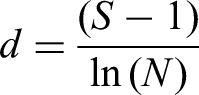

Statistical analyses
Prior to data analysis, tests for normality and homogeneity were conducted. For datasets meeting normal distribution assumptions, one-way analysis of variance (ANOVA) was applied, whereas the non-parametric Kruskal–Wallis ANOVA was used for non-normal data. Pearson's correlation coefficient was employed to assess relationships among environmental parameters, zooplankton groups, and diversity indices. One-way analysis of similarity (ANOSIM) was used to evaluate the significance of differences in zooplankton assemblages, while similarity percentage (SIMPER) analysis was conducted to determine the contribution of individual genera to the average dissimilarity among the stations and between seasons, based on the Bray–Curtis similarity matrix. Canonical correspondence analyses (CCAs) were performed using dominant zooplankton genera, defined as those with densities exceeding 3 ind./mL and contributing more than 2% to total abundance. All statistical analyses were conducted using PAST software (version 3.0; Paleontological Statistics). 34
Results
Zooplankton community
A total of 25 zooplankton genera were recorded during the monsoon and 20 genera during the winter across different stations of the Dakatia River, comprising Rotifera (9 genera), Copepoda (10 genera), Cladocera (5 genera), and crustacean nauplii (1 genus) (Table 1). Among these, Rotifera was the dominant group (Figure 2(a) and (b)), with a mean abundance of 36%, followed by Copepoda (26.49%), Cladocera (21.25%), and crustacean nauplii (16.26%). The composition of Rotifera ranged from 8.98% at S1 in the monsoon to 56.68% at S4 in the winter. Copepoda varied between 11.11% at S2 in the winter and 38.84% at S1 in the monsoon, while Cladocera ranged from 5.32% at S8 to 41.99% at S1 in the monsoon. Crustacean nauplii contributed between 5% at S8 in the winter and 40.49% at S7 in the monsoon (Figure 2(c)). Out of 25 genera, 5 were dominant in both seasons, 5 were dominant during the monsoon, and 4 were dominant in the winter (Table 1). The five dominant genera that occurred in both seasons were crustacean nauplii (15.27%), Cyclops sp. (14.45%), Bosminopsis sp. (11.64%), Ceriodaphnia sp. (3.58%), and Moina sp. (3.18%).
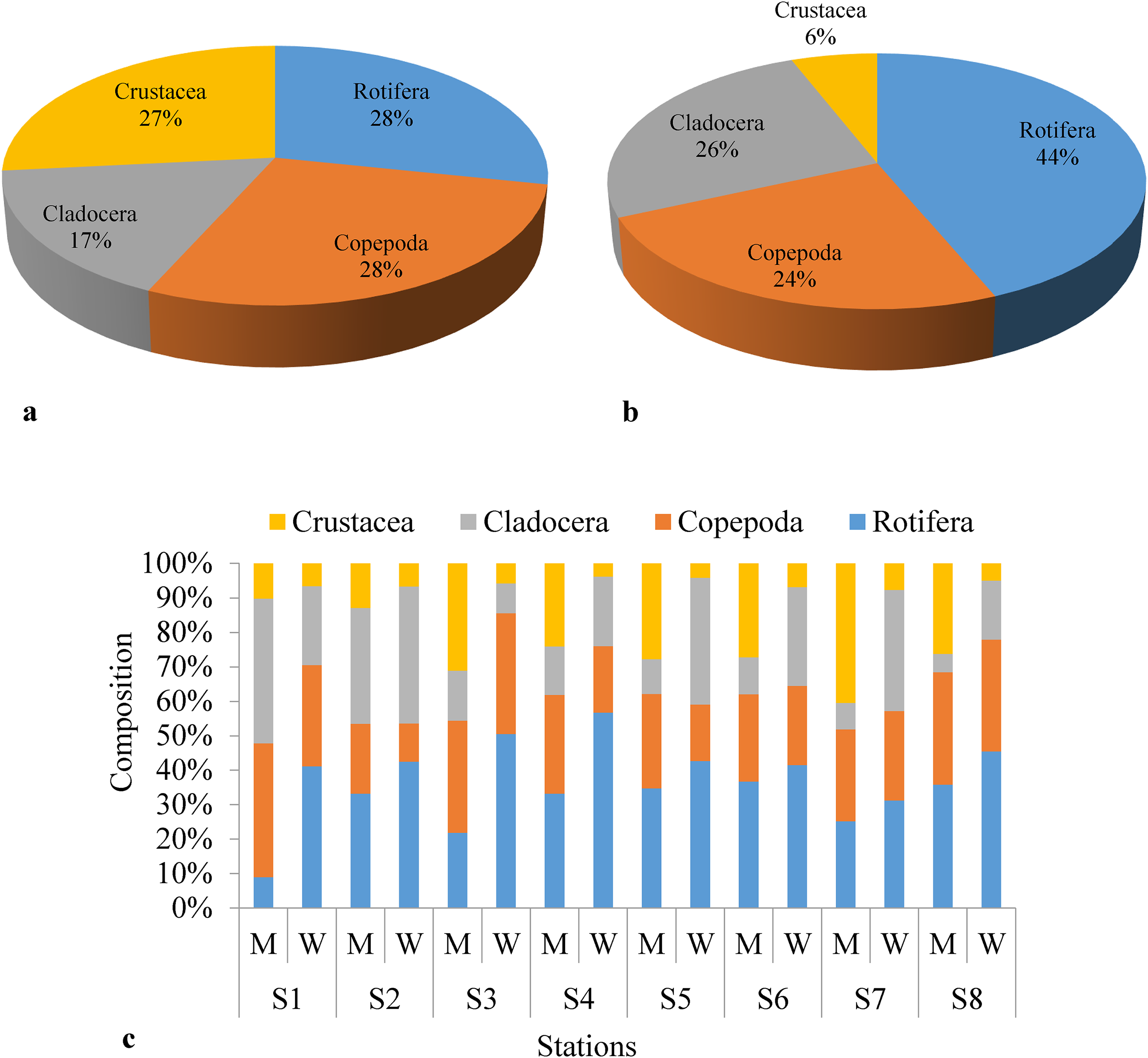
Composition of zooplankton groups in (a) monsoon, (b) winter, and (c) different stations of the Dakatia River, Chandpur, Bangladesh (M = monsoon, W = winter).
A checklist of zooplankton genera found at the Dakatia River, Chandpur, Bangladesh.

Note: +: present; −: absent.
Dominant only in monsoon.
Dominant only in winter.
Dominant in both seasons.
Zooplankton density and diversity
Zooplankton density in the Dakatia River was highest at S8 (194.33 ± 20.53 ind./L) and lowest at S3 (68.67 ± 12.35 ind./L), with a mean of 120.25 ± 14.04 ind./L during the monsoon. In the winter, the highest density was recorded at S1 (290.67 ± 53.65 ind./L) and the lowest at S8 (80.00 ± 7.02 ind./L), with a mean of 144.88 ± 22.94 ind./L. A significant difference in zooplankton population density was observed among the stations during both the monsoon (F = 3.18, p = 0.03) and winter (F = 6.38, p = 0.001); however, no significant difference was detected between seasons (F = 1.89, p = 0.18). The density of Rotifera varied from 12.33 ± 1.67 ind./L at S1 to 69.67 ± 4.67 ind./L at S8 during the monsoon (mean = 35.21 ± 6.88 ind./L) and from 34.00 ± 4.62 ind./L at S7 to 119.67 ± 23.54 ind./L at S1 in the winter (mean = 63.33 ± 9.86 ind./L). Copepoda ranged from 20.33 ± 6.69 ind./L at S2 to 63.33 ± 12.60 ind./L at S8 in the monsoon (mean = 35.38 ± 5.47 ind./L) and from 15.00 ± 3.79 ind./L at S2 to 85.33 ± 16.76 ind./L at S1 during the winter (mean = 35.58 ± 8.31 ind./L). Cladocera varied from 8.33 ± 3.33 ind./L at S7 to 57.67 ± 6.12 ind./L at S1 in the monsoon (mean = 20.08 ± 6.10 ind./L) and from 14.00 ± 2.52 ind./L at S3 to 66.33 ± 10.68 ind./L at S1 during winter (mean = 37.38 ± 7.19 ind./L). Crustacean nauplii ranged from 13.00 ± 1.00 ind./L at S2 to 51.00 ± 3.60 ind./L at S8 during the monsoon (mean = 29.58 ± 5.07 ind./L) and from 4.00 ± 0.58 ind./L at S8 to 19.33 ± 5.36 ind./L at S1 in the winter (mean = 8.58 ± 1.69 ind./L) (Figure 3). Cyclops sp. was the most dominant zooplankton genus in both seasons, with a mean density of 19.33 ± 3.75 ind./L, followed by crustacean nauplii (19.08 ± 10.50 ind./L), Bosminopsis sp. (16.17 ± 9.34 ind./L), Ceriodaphnia sp. (4.67 ± 0.42 ind./L), and Moina sp. (4.11 ± 0.78 ind./L), respectively.

The population density of zooplankton at different stations of the Dakatia River, Chandpur, Bangladesh (M = monsoon, W = winter).
The mean values of the Shannon–Wiener diversity index, species evenness, species richness, and dominance index during the monsoon and winter seasons were 2.16 ± 0.04 and 1.79 ± 0.04, 0.66 ± 0.03 and 0.57 ± 0.02, 2.68 ± 0.04 and 1.99 ± 0.08, and 0.16 ± 0.01 and 0.24 ± 0.01, respectively. The Shannon–Wiener diversity index ranged from 1.99 ± 0.19 at station S7 to 2.34 ± 0.17 at S2 during the monsoon, and from 1.95 ± 0.01 at S2 to 1.62 ± 0.15 at S4 in the winter (Figure 4). A significant difference in the Shannon–Wiener index was observed between seasons (F = 42.76, p = 0.0001), whereas no significant variation was found among the stations during monsoon (F = 0.81, p = 0.592) or winter (F = 2.27, p = 0.083). Species evenness varied from 0.55 ± 0.07 at S7 to 0.84 ± 0.05 at S2 in monsoon, and from 0.51 ± 0.02 at S1 to 0.65 ± 0.05 at S2 in winter (Figure 4). Significant seasonal variation was observed in evenness (F = 9.76, p = 0.003), along with significant differences among the stations during the monsoon (F = 4.33, p = 0.01), whereas no significant difference was detected among the stations in winter (F = 1.19, p = 0.364). Species richness ranged from 2.49 ± 0.20 at S5 to 2.84 ± 0.44 at S8 in the monsoon, and from 1.70 ± 0.08 at S6 to 2.36 ± 0.18 at S3 in the winter (Figure 4). A significant difference was found between seasons (F = 26.53, p = 0.0001), though no significant variation occurred among the stations in either monsoon (F = 0.09, p = 0.998) or winter (F = 1.60, p = 0.205). The dominance index ranged from 0.11 ± 0.01 at S2 to 0.21 ± 0.05 at S7 in monsoon, and from 0.20 ± 0.01 at S2 to 0.25 ± 0.02 at S5 in winter (Figure 4). A significant seasonal difference in dominance was observed (F = 36.60, p = 0.0001) while no significant difference was noted among the stations during monsoon (F = 2.40, p = 0.070) or winter (H = 8.68, p = 0.276).

Diversity indices of zooplankton at different stations of the Dakatia River, Chandpur, Bangladesh (M = monsoon, W = winter).
Zooplankton assemblage
Cluster analysis, based on the Bray–Curtis similarity matrix, was performed to assess the similarities among the stations in terms of zooplankton population density. The results revealed clear differentiation among the studied stations, forming five and four major clusters at a 70% similarity threshold during the monsoon and winter seasons, respectively (Figure 5). In the monsoon, stations S1, S2, and S4 appeared as isolated groups, while two stations (S6 and S8) formed one cluster, and the remaining three stations (S3, S5, and S7) comprised another cluster (Figure 5(a)). During the winter, two stations (S1 and S3) were isolated, a cluster was formed by S2 and S4, and the largest cluster included the remaining four stations (Figure 5(b)). The ANOSIM showed significant dissimilarity in zooplankton assemblages among the stations in both monsoon (global R = 0.6541, p = 0.0001) and winter (global R = 0.6734, p = 0.0001), as well as between seasons (global R = 0.8616, p = 0.0001). SIMPER analysis identified several zooplankton genera—Keratella sp., Brachionus sp., Bosminopsis sp., crustacean nauplii, Cyclops sp., and Lecane sp.—as the most influential contributors (>10%) to the observed dissimilarity in community structure across stations and seasons (Table S1 in the Supplemental materials).

Dendrogram showing clusters based on the Bray–Curtis similarity matrix of eight studied stations during (a) monsoon and (b) winter.
Environmental parameters
Environmental variables in the Dakatia River varied across the stations and between seasons (Figure 6). Water temperature ranged from 28.38 ± 0.13 to 29.30 ± 0.05 °C during the monsoon (mean = 28.86 ± 0.13 °C) and from 21.85 ± 0.02 to 22.66 ± 0.05 °C in the winter (mean = 22.13 ± 0.10 °C), with significant differences observed both among the stations and between seasons (p < 0.05). Transparency varied from 28.33 ± 0.33 to 32.67 ± 0.33 cm in the monsoon (mean = 31.13 ± 0.57 cm) and from 37.00 ± 0.58 to 46.67 ± 0.33 cm in the winter (mean = 42.63 ± 1.31 cm), also showing significant differences both seasonally and between seasons (p < 0.05). Salinity ranged from 0.63 ± 0.03 to 1.10 ± 0.06 ppt in the monsoon (mean = 0.91 ± 0.07 ppt) and from 0.73 ± 0.03 to 1.17 ± 0.03 ppt in the winter (mean = 0.99 ± 0.05 ppt), with significant differences among the stations within seasons but no significant variation between seasons (p < 0.05). Dissolved oxygen ranged from 5.72 ± 0.01 to 6.91 ± 0.02 mg/L in the monsoon (mean = 6.24 ± 0.15 mg/L) and from 6.19 ± 0.02 to 9.33 ± 0.04 mg/L in the winter (mean = 7.62 ± 0.42 mg/L), with significant variation observed both among the stations and between seasons (p < 0.05). The pH ranged from 6.70 ± 0.04 to 7.79 ± 0.01 in the monsoon (mean = 7.15 ± 0.13) and from 7.86 ± 0.02 to 8.32 ± 0.17 in the winter (mean = 8.10 ± 0.07), with significant differences observed both seasonally and between seasons (p < 0.05). Total dissolved solids ranged from 61.67 ± 0.88 to 116.0 ± 1.0 mg/L in the monsoon (mean = 94.75 ± 0.75 mg/L) and from 127.33 ± 0.88 to 130.5 ± 0.76 mg/L in the winter (mean = 128.92 ± 0.42 mg/L), with significant differences during monsoon and between seasons (p < 0.05). Electrical conductivity ranged from 141.0 ± 1.15 to 225.67 ± 0.67 µS/cm in the monsoon (mean = 175.46 ± 12.84 µS/cm) and from 252.6 ± 0.67 to 259.17 ± 1.30 µS/cm in the winter (mean = 255.45 ± 0.65 µS/cm), with significant differences within seasons and between seasons (p < 0.05). Nitrate concentration ranged from 0.06 ± 0.003 to 0.08 ± 0.003 mg/L in the monsoon (mean = 0.07 ± 0.003 mg/L) and from 0.02 ± 0.003 to 0.05 ± 0.01 mg/L in the winter (mean = 0.04 ± 0.005 mg/L), with significant differences observed within and between seasons (p < 0.05). Phosphate concentration ranged from 0.8 ± 0.06 to 2.63 ± 0.09 mg/L in the monsoon (mean = 1.51 ± 0.24 mg/L) and from 0.38 ± 0.02 to 1.27 ± 0.07 mg/L in the winter (mean = 0.88 ± 0.13 mg/L), with significant differences both seasonally and between seasons (p < 0.05). Ammonia concentration ranged from 1.10 ± 0.06 to 1.53 ± 0.03 mg/L in the monsoon (mean = 1.25 ± 0.05 mg/L) and from 0.60 ± 0.06 to 1.27 ± 0.01 mg/L in the winter (mean = 1.01 ± 0.13 mg/L), with significant differences within seasons but not between them (p < 0.05).

Mean environmental parameters: (a) temperature, (b) transparency, (c) salinity, (d) dissolved oxygen, (e) pH, (f) total dissolved solids, (g) electrical conductivity, (h) nitrates, (i) phosphates, and (j) ammonia at different stations of the Dakatia River, Chandpur, Bangladesh.
Relationship between biological and environmental variables
Rotifera showed negative relationships with salinity (r = −0.75, p < 0.05), dissolved oxygen (r = −0.81, p < 0.05), pH (r = −0.74, p < 0.05), total dissolved solids (r = −0.78, p < 0.05), electrical conductivity (r = −0.77, p < 0.05), and phosphate (r = −0.79, p < 0.05) (Table S2 in the Supplemental materials). Cladocera has a positive and negative correlation with pH (r = 0.86, p < 0.05) and transparency (r = −0.74, p < 0.05), respectively (Table S2 in the Supplemental materials). Crustacean nauplii exhibited positive relationships with temperature (r = 0.74, p < 0.05) and transparency (r = 0.80, p < 0.05), while negative relationships with salinity (r = −0.93, p < 0.01), dissolved oxygen (r = −0.86, p < 0.05), pH (r = −0.92, p < 0.01), total dissolved solids (r = −0.98, p < 0.01), electrical conductivity (r = −0.79, p < 0.05), nitrate (r = −0.76, p < 0.05), and phosphate (r = −0.90, p < 0.01) (Table S2 in the Supplemental materials). The Shannon–Wiener diversity index showed positive relationships with salinity (r = 0.86, p < 0.05), pH (r = 0.75, p < 0.05), and total dissolved solids (r = 0.78, p < 0.05), but a negative relationship was found with temperature (r = −0.88, p < 0.01), and dominance index showed a positive relation with temperature (r = 0.85, p < 0.05) (Table S2 in the Supplemental materials). The density of total zooplankton has positive correlations with Copepoda (r = 0.90, p < 0.01) and Rotifera (r = 0.76, p < 0.05) (Table S2 in the Supplemental materials). Besides, Rotifera exhibited a positive relation with salinity (r = 0.79, p < 0.05), while crustacean nauplii has a negative relationship with ammonia (r = −0.73, p < 0.05), and species richness exhibited a negative relation with phosphate (r = −0.79, p < 0.05) (Table S2 in the Supplemental materials). The density of total zooplankton has positive correlations with Copepoda (r = 0.95, p < 0.01), Rotifera (r = 0.87, p < 0.01), and crustacean nauplii (r = 0.93, p < 0.01) (Table S2 in the Supplemental materials).
CCA was conducted to evaluate the relationships between environmental parameters and dominant zooplankton genera in both seasons (Figure 7). During the monsoon, axis 1 exhibited an eigenvalue of 0.367, explaining 80.37% of the total variance, while axis 2 showed an eigenvalue of 0.038, accounting for 8.32% of the variance, indicating strong correlations between biological and environmental variables. Among the measured parameters, pH, temperature, ammonia, and salinity had a significant influence on the distribution and density of zooplankton genera, whereas total dissolved solids, nitrate, and electrical conductivity exhibited a moderate effect (Figure 7(a)). The density of Cyclops sp., crustacean nauplii, and Moina sp. was highly correlated, and that of Brachionus sp., Lecane sp., and Filinia sp. was moderately correlated with the studied environmental variables (Figure 7(a)). Filinia sp., Ceriodaphnia sp., and Bosminopsis sp. were positively correlated with both axes and showed close affinity to most of the environmental variables, while Cyclops sp., crustacean nauplii, and Brachionus sp. were negatively correlated with both axes and showed close affinity to temperature and transparency (Figure 7(a)). Eigenvalue of axis 1 (0.069) demonstrated 44.49% correlation, and axis 2 (0.045) demonstrated 30.15% correlation between biological and environmental variables in the winter. The nitrate, pH, and transparency have a significant impact, and the temperature, electrical conductivity, and ammonia have a moderate impact on the density of zooplankton genera (Figure 7(b)). The density of crustacean nauplii, Moina sp., Keratella sp., Polyarthra sp., Cyclops sp., and Heliodiaptomus sp. was highly correlated with the studied environmental variables, negatively correlated with both axes, and showed close affinity to electrical conductivity and salinity (Figure 7(b)).

CCA biplot between environmental variables and dominant zooplankton genera in (a) monsoon and (b) winter (CN: crustacean nauplii, BN: Brachionus sp., C: Cyclops sp., L: Lecane sp., TC: Thermocyclops sp., BS: Bosminopsis sp., CD: Ceriodaphnia sp., M: Moina sp., FN: Filinia sp., ND: Neodiaptomus sp., KT: Keratella sp., PA: Polyarthra sp., MS: Macrosetella sp., HD: Heliodiaptomus sp.). CCA: canonical correspondence analysis.
Discussion
During the present study, 25 genera of zooplankton in monsoon and 20 genera of zooplankton in winter, comprised of four groups, were found at different stations of the Dakatia River. This comparatively low level of richness suggests that the Dakatia River's ecological condition is moderate and perhaps unbalanced. 15 The number of zooplankton was higher at S6 (21 genera) and lower at S1 (17 genera) in monsoon, and maximum at S3 (18 genera) and minimum at S6 (12 genera) during winter. Among the recorded zooplankton groups, Copepoda (28.42%) and crustacean nauplii (26.60%) were dominant in monsoon, while Rotifera (43.72%) and Cladocera (25.80%) were dominant during winter. The zooplankton community composition across different stations and seasons exhibited distinct trends, likely influenced by the dynamic nature of river systems and fluctuations in environmental parameters.4,35 Variations in environmental conditions may play a critical role in shaping the structure and distribution patterns of zooplankton communities.3,17 Several previous studies have reported the presence of similar zooplankton groups and comparable numbers of genera in freshwater and coastal ecosystems of Bangladesh.3,15,18,19,2436–38 However, there are notable variations in the number of zooplankton groups and genera among systems, though some ecosystems support higher richness, which is frequently linked to habitats that are nutrient-rich or relatively undisturbed,39–41 while others show lower richness, which is usually linked to environments that are stressed or degraded.21,42
The zooplankton in the Dakatia River were primarily characterized by the predominance of Rotifera (36%), followed by Copepoda (26.49%), Cladocera (21.25%), and crustacean nauplii (16.26%), respectively. The maximum density of Rotifera has been previously reported by other studies.1,18,1922–24,41 Additionally, Rotifera was found as the second dominant group (27.78%) along with Copepoda (35.58%) and Cladocera (27.37%) in the coastal homestead ponds, 15 and Rotifera (45.28%) was the second dominant group together with Cladocera (46.60%) in Kaptai Lake. 21 Among 9 genera of Rotifera, Brachionus sp., Filinia sp., Lecane sp., Keratella sp., and Polyarthra sp.; 10 genera of Copepoda, Cyclops sp., Heliodiaptomus sp., Macrosetella sp., Neodiaptomus sp., and Thermocyclops sp.; 5 genera of Cladocera, Bosminopsis sp., Ceriodaphnia sp., and Moina sp.; and crustacean nauplii were found dominant in the Dakatia River. Several previous authors reported abovementioned zooplankton genera as dominant during their studies.1,15,19,21,36,41 Rotifers are known to be hardy and opportunistic taxa that frequently predominate in environments with moderate enrichment, while a decrease in copepod and sensitive cladoceran taxa may be a sign of ecological stress.21,36 The dominance of a few tolerant taxa and the comparatively moderate diversity indices seen here may be caused by a combination of human activities along the Dakatia River's course, including organic loading, nitrogen enrichment from agricultural runoff, and other human activities. Disrupting trophic links, changing the way energy is transferred to higher consumers like fish, and ultimately affecting fisheries production are all consequences of such community alterations.
Zooplankton population density of the Dakatia River recorded during this study (68.67 ± 12.35 to 290.67 ± 53.65 ind./L) was close to the zooplankton density of Yangtze River estuary of China, 5 tropical Meghna River of Bangladesh, 19 and tropical urban water bodies of Malaysia. 41 As zooplankton is a major food source for many fish species, hence this abundance level indicates that the river has strong potential to support fisheries output. There were obvious seasonal variations, with winter densities being larger than monsoon numbers. This could be related to increased water stability and transparency during the winter, which encourages phytoplankton development and, consequently, supplies zooplankton with an abundance of food. On the other hand, during the monsoon, zooplankton abundance is limited due to excessive rainfall and runoff that disturbs the water column, decreases light penetration, and lowers primary productivity.
This phenomenon is also explained by the seasonal succession of zooplankton, which appears to be correlated with the availability of sufficient natural food in aquatic ecosystems.3,39 On the contrary, maximum density of zooplankton in summer and the minimum in winter were found by others,3,15,21,41 and this variation could be attributed to the difference in habitats and ecosystems. The mean density of Rotifera, Copepoda, Cladocera, and crustacean nauplii ranged from 35.21 to 63.33 ind./L, 35.38 to 35.58 ind./L, 20.08 to 37.38 ind./L, and 8.58 to 29.58 ind./L, respectively, in the Dakatia River during our study. Zhang et al. 1 reported the density of Rotifera, Copepoda, and Cladocera varied from 89.36 to 113.92 ind./L, 8.71 to 32.04 ind./L, and 39.85 to 57.70 ind./L, respectively, in floodplain lakes of the Yangtze River.
The Shannon–Wiener diversity index (H′) ranged from 1.62 to 2.34, indicating a moderate level of zooplankton diversity in the Dakatia River. 33 Although these values imply that the system can support communities that are fairly balanced, some stations may also encounter ecological stress. Habitats with longer food chains and more complex trophic interactions are indicated by higher species richness and evenness values, whereas less stable conditions are indicated by lower values. 32 Species evenness (J′) varied from 0.51 to 0.84, pointing to a moderately stable zooplankton community. 43 The species richness index (d) ranged from 1.70 to 2.84, further supporting the ecological suitability and stability of the system. 32 However, localized stressors such nutrient enrichment, organic loading, or physical disruptions may be the cause of reduced evenness and richness at specific locations.
The dominance index (D), which varied between 0.11 and 0.25, indicates low dominance and relatively balanced species distribution within the community. 33 However, decreasing dominance values may also reflect ecological stress due to the predominance of a few species in high densities, potentially caused by anthropogenic pressures in the study area. 39 Overall, the diversity indices recorded in this study are consistent with findings from similar aquatic ecosystems in Bangladesh.12,15,16,40
Cluster analysis revealed distinct differentiation among the stations in the Dakatia River, with five clusters in the monsoon and four in the winter at 70% similarity, likely due to variations in zooplankton density and irregular plankton patterns. 16 Stations within the same cluster had similar zooplankton compositions, while isolated stations differed. 40 ANOSIM showed significant differences in zooplankton density among the stations and seasons, attributed to station distance and seasonal environmental changes. 16 Key genera, including Keratella sp., Brachionus sp., Bosminopsis sp., crustacean nauplii, Cyclops sp., and Lecane sp., significantly contributed to these differences, consistent with previous research.15,19,21 Environmental parameters significantly affect aquatic organisms’ growth, community structure, abundance, and diversity.
Zooplankton are influenced by factors like temperature, pH, dissolved oxygen, and nutrients.3,15,17,18 Significant differences in these parameters were observed in the Dakatia River across monsoon, winter, and between seasons. Variations are likely due to natural and anthropogenic changes and seasonal shifts. Water temperature ranged from 22.13 °C in monsoon to 28.86 °C in winter, with pH levels between 7.15 and 8.10, indicating suitability for zooplankton growth.12,15,16,18 Dissolved oxygen ranged from 6.24 to 7.62 mg/L, consistent with other studies.3,12,16,18 Transparency (31.13 to 42.63 cm) and total dissolved solids (94.75 to 128.92 mg/L) were similar to previous findings.12,16 Lower concentrations of nitrate (0.04 to 0.07 mg/L), phosphate (0.88 to 1.51 mg/L), and ammonia (1.01 to 1.25 mg/L) were noted, aligned with other research.12,15,16 The observed pH, dissolved oxygen, and nutrient levels are generally within the acceptable norms, indicating that the river can sustain planktonic life. However, anthropogenic inputs and seasonal nutrient surges from runoff may cause temporary stress. Increased nitrate, phosphate, and ammonia concentrations during the rainy season are probably caused by organic enrichment and agricultural runoff, which might upset zooplankton communities by giving preference to opportunistic species over sensitive ones.12,13,44 These patterns demonstrate how human activity and natural monsoon dynamics work together to structure the river's biological equilibrium.
Correlation analyses showed selective responses to particular parameters: nauplii were more prevalent in warmer, clearer waters but suppressed under high nutrient loads, rotifers decreased with increasing salinity and pH, and cladocerans were preferred under neutral to slightly alkaline conditions. These group-specific answers highlight how changes in water quality have a direct impact on the compositional balance of communities. In addition to these trends, the inhibition of nauplii in nutrient-rich environments raises the possibility that eutrophication brought on by wastewater or agricultural runoff may disturb their early life stages, which would lower their recruitment and weaken the integrity of the food web. Similar to this, the decrease in rotifers at higher pH and salinity levels might be a result of freshwater taxa's growing susceptibility to salinization, which is a major concern in regions with intense irrigation and saltwater intrusion. The fact that cladocerans prefer near-neutral to slightly alkaline waters emphasizes how crucial it is to keep pH regimes steady because variations in pH caused by untreated effluents or industrial discharges could destabilize their populations and lessen the pressure that grazing puts on phytoplankton, which would increase algal blooms.
The Shannon–Wiener diversity index related positively with salinity, pH, and total dissolved solids, and negatively with temperature. CCA highlighted significant impacts of pH, nitrate, transparency, and electrical conductivity on zooplankton density, with moderate impacts from other parameters. The relationships observed align with previous studies on environmental influences on zooplankton.1,3,12,15,18,20,39
Conclusion
This study has provided a comprehensive assessment of the zooplankton community structure, diversity, and assemblage dynamics in relation to environmental parameters in the Dakatia River, Chandpur, Bangladesh. The findings indicated a low ecological status, characterized by an imbalanced community structure with the dominance of a few tolerant species rather than a diverse assemblage. Of the 25 identified genera, only five exhibited dominances across both seasons. Zooplankton density varied seasonally, with a peak in the winter and a decline during the monsoon, highlighting its potential suitability for fisheries. Species diversity indices indicate moderate diversity, stability, suitability, and low dominance of the zooplankton community. Significant variation among the studied stations was found and at a similarity of 70%, five and four major clusters were generated in monsoon and winter. According to ANOSIM, significant differences among different stations during monsoon, winter, and between seasons were observed, and five zooplankton genera were found to be significant contributors to dissimilation. The measured environmental factors were suitable for plankton, fish, and other aquatic organisms. CCA states the significant impact of pH, nitrate, transparency, and electrical conductivity on the density of zooplankton genera. Even if our analysis was restricted to taxonomic composition, future research should incorporate functional features such feeding modes (filter feeding, predation, raptorial feeding, and omnivore) to better capture ecological processes. Interpretations of how environmental gradients impact trophic interactions, energy transfer, and community resilience to human stressors would be strengthened by such an approach.
Supplemental Material
sj-docx-1-sci-10.1177_00368504251403063 - Supplemental material for Zooplankton diversity patterns, assemblage, and environmental determinants in a seasonally dynamic tropical river
Supplemental material, sj-docx-1-sci-10.1177_00368504251403063 for Zooplankton diversity patterns, assemblage, and environmental determinants in a seasonally dynamic tropical river by Md Mofizur Rahman, Md Robiul Hasan, Md Milon Sarker, Md Saeduzzaman Faraji, Mehedi Mahmudul Hasan, Asma Jaman, Takaomi Arai, Norhayati Ngah and Mohammad Belal Hossain in Science Progress
Footnotes

Author contributions
Conceptualization: MMR and MBH. Design and investigation: MRH, MSF, and AJ. Data analysis and writing—original draft: MMS. Writing—review and editing: MMR, MMS, MMH, TA, NN, and MBH. All authors have read and approved the final manuscript.
Funding
The authors received no financial support for the research, authorship, and/or publication of this article.
Declaration of conflicting interests
The authors declared no potential conflicts of interest with respect to the research, authorship, and/or publication of this article.
Data availability
The supporting data for this study can be obtained from the corresponding author upon reasonable request.
Supplemental material
Supplemental material for this article is available online.
References
Supplementary Material
Please find the following supplemental material available below.
For Open Access articles published under a Creative Commons License, all supplemental material carries the same license as the article it is associated with.
For non-Open Access articles published, all supplemental material carries a non-exclusive license, and permission requests for re-use of supplemental material or any part of supplemental material shall be sent directly to the copyright owner as specified in the copyright notice associated with the article.
