




Abstract
Environmental quality is a sustainability issue influenced by economic realities. To understand their relationships and influence, a comparative study of economic factors that affect pollution in Iwo and Ibadan metropolia was carried out. Data for the study was generated by administering 1067 structured questionnaires at both locations out of which 215 and 658 were, respectively, retrieved from Iwo and Ibadan. Demographic features of the respondents assessed as female gender, married status, tertiary education, a Christian sect, and household size of two to five, were 52%, 67%,79%, 67%, and 55% in that order for Iwo; while for Ibadan, the figures were 67%, 61%, 86%, 69%, and 58% in the same order. The six economic factors evaluated were; (1) income, (2) accommodation & living standards, (3) waste & noise management regimen, (4) energy utilization (5), inclination toward a green economy, and (6) waste sorting technology and adoption. KMO (74.8%) and Bartlett's Test of Sphericity showed that the data were factorable at p < 0.005. Results considered three of the economic variables as significant enough to explain 59.3% of the pollution state in Iwo and 60.2% in Ibadan. Of major importance for Iwo were waste & noise management regime (22.5%), accommodation & living standards (18.7%), and inclination towards a green economy (18.3%). In Ibadan, the three extracted factors also explained 60.2% of all economic variables affecting pollution. These were accommodation and living standards (24.4%), inclination towards a green economy (18.8%), and waste & noise management regime (17.0%). That means the strong economic influencers of pollution were common to both cities, even though, their order of importance varied. In other words, their degree of influence on pollution may be location dependent. Conclusively, the people's standard of living and inclination towards a green economy are compelling determinants of environmental pollution and so should be considered by stakeholders in formulating associated policies.
Introduction
Environmental quality is vital to achieving sustainable living because it enhances good health, unhindered human mobility, sound minds, viable and profitable businesses, etc.1–3 It further describes the quality of the total environment and it encompasses shelter provision in terms of its adequacy and quality; public health and safety in terms of prevention of disease, accidents, and environmental resources pollution; efficiency of the factor of the environment which enhances human mobility and peoples’ comfort and happy living, among others.1,4 United Nations 5 considered the value of environmental quality for sustainable livelihood and listed it among the 17 Sustainable Development Goals (SDGs) as Goal Number 11. According to United Nations 5 “Sustainable Cities and Communities” is aimed at making cities and human settlements inclusive, safe, resilient and sustainable. The goal has among its targets “that by 2030, there should be reduction in the adverse per capita environmental impact of cities, including by paying attention to air quality and municipal and other waste management. Similarly, Goal number 7 tagged “Affordable and clean energy” of the SDGs having as one of its targets the enhancement of global cooperation to facilitate access to clean energy including renewable energy, and its efficiency. Thus, the global community considered human sustainability as partly reliant on the quality of the environment. In another instance, UN Conference on the Human Environment held in Stockholm held between 5 to 16 June 1992 considered the magnitude of harm done to the environment by humans with varying levels of pollution introduced into water, air, and living beings and other major and undesirable disturbances to the ecological balance of the biosphere declared and resolved in Principle 6 “that the discharge of toxic disturbances or of other disturbances and the release of heat in such qualities or concentration as to exceed the capacity of the environment to render them harmless must be halted in order to ensure that serious or irreversible damage is not inflicted upon ecosystems—the just struggles of the peoples of ill countries against pollution should be supported.”
It is clearly evident that human actions have inflicted different degrees of harm to the natural environment through various actions such as industrial, agricultural, and domestic activities.6–9 These, all together, are principal contributors to the contamination of water, air, and soil; introduction of toxic wastes, smoke, effluents and sewage, and solid wastes, among others. Thus, environmental quality varies over space globally and also within a neighborhood scale7,10,11 depending on the volume of the contaminants emitted or introduced into the environment. These challenges, in a human environment, are still on the rise in view of the unabated growth in population and urbanization, and the increase in food insecurity, among others, especially in the underdeveloped countries of the world.12–14 Agbonifo 15 and Unigwe and Egbueri 9 noted the grievous impact of environmental resources on pollution, especially on the socioeconomic status of the society which was associated with the poverty level, poor health status, unemployment, population displacement and migration, and insecurity, among others in the Niger Delta region of Nigeria.
It is rather unfortunate that governments in many developing countries do not put up the right attitude towards implementing policies that will improve the quality of the environment of their nations. For example, Ibikunle 16 and Nwaichi and Osuoha 17 had lamented the lackadaisical attitudes of the government in Nigeria to execute relevant policies already put in place to regulate and control environmental pollution, especially in the Niger Delta region of the country. They, therefore, recommended harmonization of various policies under one bye-law to ensure uniformity in tackling the menace. In addition, it was recommended that public education and keeping to international treaties should be prioritized for improved livelihood. Similarly, Nwani 18 evaluated the consequences of air pollution on human health and its sustainability and submitted that, in order to enhance life expectancy in Nigeria, the government should adopt stringent strategies and education to subdue air pollution in the country. Also, Okumagba 19 discovered the poor attitude of the Nigerian government in complying with the court orders and ruling in matters relating to climate litigation (which has been majorly attributed to anthropogenic activities) and, even the weakness of the legal institutions to give such rulings, may jeopardize sustainable environment in the country. He posited that Nigeria stands to benefit from climate litigation if adhered to as being practiced in advanced nations. The poor attitude of the government to implement policies that will promote a quality environment is at times due to conflicts with other pressing needs, also the consequences and cost of taking such a critical decision. Coccia20–22 noted that critical decisions on related matters are desirable to achieve lasting solutions to challenges of environmental pollution which could be life-threatening. The decisions could be responsive, proactive, and/or lead to recovery, according to Coccia 20 and Coccia and Benati, 23 and are desirable in the face of market variations, and uncertain and volatile environmental situations to ensure a sustainable livelihood.
Several works have reported on pollution-related issues such as its causes, types, consequences, and remediation methods.6,24–28 Nevertheless, scanty publications are available on the relationships and weighted contributions of economic variables, especially in Africa. Ogunbode et al. 3 had demonstrated concern for the diminishing quality of environmental resources and recommended intensified public enlightenment and better education to improve awareness of environmental protection and its management. Sachdeva 29 observed that regions with higher income disparity often experience improvements in smog and pollution control with an increased proportion of clean energy use. The impact of religious and micro-business activities on the environment, especially on air quality and noise pollution has also been documented.3,30–32 Albeit, investigations on the impacts of economics on pollution, especially in Nigeria have not been well documented. Such documentation is a major purpose of this study aimed at pollution control and management. The work assessed the impacts of economic variables on pollution perception in Iwo and Ibadan for comparative purposes. The objectives are (i) to identify the economic variables that influence environmental pollution in Iwo and Ibadan cities; (ii) to determine which of the economic variables are critical to pollution management at the location through a ranking of the variables in order of their importance to pollution. These are to provide privileged information that would assist relevant agencies/authorities understand how economic variables influence pollution and to help management strategize appropriately for a sustainable environment.
Theoretical framework
Various conditions and associated explanatory variables are capable of explaining the dynamics of the human environment. From an ecological perspective of development and change, 33 believed that as the population of a given society rises, members of that society would continue to exert pressure on the finite scarce natural resources. This trend, according to theorists, induces environmental pollution and degradation, borne out of their routine engagements. This theory further informed that development is inevitable when an environment exhausts its resources, thereby forcing the members of the environment/society to shift in the methods of doing things. For instance, some are forced to sell their labor for economic empowerment while others may engage in commerce and some in agricultural-related activities such as animal husbandry, and livestock keeping, and some in technical activities, all in order to enhance their livelihood and survival. The environment bears the impact which could ultimately manifest in pollution and resource degradation. The nature of human activities in different locations determines the extent of environmental damage. Zeliger, 34 Coccia, 35 Nwaichi and Osuoha, 17 and Peng et al. 36 corroborated this theory while explaining that development has the potential for economic growth viz-a-viz environmental pollution and its negative consequences on the environment, health, and food safety.
Dietz and Rosa
37
also postulated that as the population grows, technology and affluence could tamper with environmental quality. A model was developed by Dietz and Rosa
37
to describe a relationship occurring between three variables that were believed to affect the environment as follows:


Generally, the Xie et al. 38 model added carbon emissions (green economy), transportation infrastructure, population (household size), affluence (economic power), technical progress (including waste management and waste sorting), energy utilization, level of urbanization (including living standard), trading and industry as the major contributors to the quality of urban (cities) environment quality. Alper and Alper 39 had revealed the power and validity of the Environmental Kuznets Curve (EKC) in three countries, including Nigeria. As the per capita income of a country rises at the initial phase of economic development, the level of pollution was also believed to rise to a threshold value, after which the growth of per capita income reduces economic pollution. Within this context, Coccia 35 found that green ecology and its composition have significant characteristics to strengthen technological innovation for efficient resource utilization and pollution reduction.
Method of study
Study area
Iwo and Ibadan (Figures 1 and 2) are both located in the southwestern part of Nigeria but in different states. Iwo is one of the towns in Osun State and the headquarters of Iwo Local Government Area (LGA) located at the coordinates of 7°63′N and 4°18′E. On the other hand, Ibadan is the capital city of Oyo State, Nigeria, located on 7°22′N and 3°56′E. Both cities share boundaries towards the eastern part of Ibadan. Demographia 40 puts the population of the Ibadan metropolis at 1,887,100 for 2016. It is the zonal headquarters of the Ibadan/Ibarapa zone of Oyo State with eleven LGAs out of which five are located within the municipality of the city. The five LGAs are Ibadan North, Ibadan North East, Ibadan North West, Ibadan South West, and Ibadan South East covering an area of 3080 km2, making the city 12 times the area of Iwo. The growth of Ibadan can be traced to the early times when Ibadan became the seat of the old Western Region in Nigeria, which comprised the five (5) states in the southwest namely Ondo, Ekiti, Ogun, Osun, and Oyo State. In view of its status as the capital city of Oyo State, the city has attracted a lot of tertiary institutions and research institutes. Ibadan harbors Bola Ige International Market (popularly called Gbagi Market), one of the biggest markets in Nigeria apart from other ones located within the nooks and cranes of the metropolis making the town a commercial city. Apart from being the location of educational institutions, Ibadan is also the location of many industries and many other historical infrastructures. For instance, the famous Cocoa House, Airport, University of Ibadan, and so on are located in the heart of the city. These features of the metropolis have influenced the settlement of diverse people of various professions in the city. Ibadan has formed a nucleus for many other places, thus, making it a nodal city for northward, eastward, westward, and southward travelers. However, Ibadan has been noted for its problem with solid waste management which has been a serious challenge to the authorities in charge. The flood disaster of 1982, 1996, and 2003 which led to the destruction of life and properties worth millions of Naira have been attributed to the indiscriminate waste disposal in the metropolis.

Map of Nigeria showing the location of Ibadan in Oyo State.

Map showing Iwo LGA in Osun State (inset: map of Nigeria showing Osun State).
On the other hand, Iwo, covering an area of 245 km2, is the headquarters of Iwo LGA. The population of the city, according to Igbru and Ifurueze 14 2022, has been put at 263,500. Iwo is a typical agrarian economy depending on agriculture as its mainstay for livelihood. Iwo is well noted for its market popularly called Odo-Ori Market which often receives the patronage of people from far and near including buyers and sellers from Ibadan, Osogbo, and Gbongan, among others. In terms of industrial activities, Iwo is not endowed. Most of the small and medium-scale industries include Gaari processing factories, oil palm mills, and slaughter slabs. It is the site of Bowen University, a privately-owned university owned by the Nigeria Baptist Convention, Westland University, and the College of Arabic and Islamic Studies, among others.
Sample and data collection
The data used for this study were generated through the administration of a questionnaire. In some instances, some other relevant information was obtained through field observations to complement those contained in the questionnaire. Two hundred and fifteen (215) (83.65%) copies of the questionnaire were completed and retrieved out of the 257 administered in Iwo town. Three LGAs were investigated in Ibadan namely: Ibadan North East, Ibadan North West, and Ibadan North out of the 5 LGAs in the municipality for the purpose of generating data for the Ibadan metropolis. A total of 810 copies of the questionnaire were administered in the three local government areas investigated out of which 678 (84.75%) copies were completed and retrieved. The survey was conducted when the season was dry and favorable for unhindered movement between late October 2021 and late January 2022. The head of the household was the target as the respondent, but where not available, any other adult within the household who could provide the required information on the questionnaire was made use of.
Measures of variables
The respondents were randomly selected in each study location for the purpose of completing the structured questionnaire. Household heads were selected for the survey where they were available, otherwise, any available elder in each of the households was selected for the survey. The questionnaire covered the following sections namely: (1) personal information, (2) household income level, (3) accommodation type and living standard, (4) waste/noise management strategies, (5) energy utilization, (6) orthodox or green economy, and (7) adoption of waste sorting technologies. The details of the variables are as follows:
Household income level: Income level has a strong influence on household livelihood and standard of living, including mode of transportation, housing structures, safety, comfort, among others. Accommodation/living standard: This factor indicates the structure of the living apartments whether it is one-bedroom, two-bedroom, or three-bedroom types, the availability of functional plumbing and sewage system, and the willingness to relocate to other communities. Waste/noise management strategies: This parameter focused on recycling/reuse of wastes, use of alternative packaging materials, detoxification (a practice of avoiding the use of harmful chemicals in living areas), use of protective equipment, such as boots, face-mask, gloves and so on, cleanliness/sanitation culture and use of low noise turbo machines such as silencers and stereo de-amplifiers. Energy utilization: This factor explains major sources of household energy in use in homes, type, or mode of transportation. Inclination towards green economy: This parameter is about the availability of landscaping with trees and flowers, free availability of seedlings, frequency of waste removal on weekly basis (i.e. rural-based job opportunities), and the ability to pay for refuse collections (a measure of equity and welfare) outside the orthodox demand/supply curve; and Waste sorting: Household reasons for sorting wastes whether to make additional income or reduce the quantity and/or convert degradable to composts.
Data analysis procedure
Both descriptive and inferential statistical techniques were used in the analysis of the data generated. The general characteristics of the respondents in each of the locations were presented in tabular form in percentages and averages. Factor analysis (FA) was used to determine and order the economic variables influencing pollution in the study areas using SPSS (version 16.0) software. FA is a tool used in extracting complex and diverse relationship existing among a set of observed variables that link together the apparently unrelated variables and provides a significant structure of data, which could be interpreted into meaningful scientific conclusion. 41 Some of the scholars that successfully adopted this statistic include.3,8,41,42 Factorability was determined by KMO and Bartlett test while the eigenvalue was set at 1 maximum. Thus, any variable with a value not up to 1 is observed as insignificant in its contribution to environmental pollution issues in the study area.
Results and discussion
The general characteristics of the respondents in Iwo and Ibadan are presented in Table 1.
Some characteristics of the respondents involved in the survey.

Table 1 shows that female respondents were more than their male counterparts. While 48% and 52% of male and female respondents were, respectively, involved in the survey in Iwo, the respondents in Ibadan were 33% and 67% males and females in that order. This scenario could be attributed to the availability pattern in homes in this part of the country. The study areas are parts of Yorubaland in the southwestern part of Nigeria, the tribe that holds the belief that women and children are meant to be at home to engage in home chores when compared with their male counterparts. This observation supported the findings of Princewill et al., 43 which asserted that the keeping of women is a necessity in order to protect them. Other similar works that corroborated this observation, especially from religious beliefs include.44–46
The table further revealed that more of the respondents in both study areas were of married status. The proportion was 67% and 61%, respectively, for Iwo and Ibadan while single men and women were, respectively, 31% and 37% in favor of the Ibadan metropolis. The dominance of married respondents in the survey was based on the premise that full details on the subject matter can be obtained from married than in singles’ homes. In fact, the single respondents’ homes were extremely accommodated when married were not available in any of the houses sampled. The preference of married respondents was to support the views of.47–51
Table 1 also indicates that the respondents belonged to different religious groups in both study areas. The respondents in Iwo and Ibadan were, respectively, made up 61% and 69% of Christians. In Iwo, 31% of the respondents claimed to practice Islam while it was 30% in Ibadan. Also, the table showed that 1% claimed not to have any religion while 1% of Iwo respondents practiced traditional religion. The distribution of the religious groups in favor of Christianity and Islam in both study areas is in support of the findings.48,52,53 The 1% of traditionalist respondents in Iwo is a reflection of the ancient practice of traditional religion while the 1.4% could probably be those who are religiously carefree individuals and/or free thinkers. 47
Respondents with tertiary education levels formed the bulk of the people surveyed as shown in Table 1. While 79% were involved in Iwo, 86% were surveyed in the Ibadan metropolis. This composition was deliberately for relative ease of interpretation and answering the questions made in view of the technicality involved in attending to the questions raised in the questionnaire. It was only when people with tertiary education were not available that the researcher engaged the respondents with fewer qualifications. Thus, 18% and 10% of secondary level from Iwo and Ibadan, respectively, were surveyed. However, 2% and 3% of respondents with primary education in Iwo and Ibadan in that order were either assisted by the research assistants or by their elder-educated children. In the same vein, 1% of the respondents in both locations were also assisted in completing their respective questionnaires. This distribution was similar to the work of.54–56
On the income level distribution of the respondents, Table 1 indicates that 53% and 56% of the respondents in favor of Ibadan earned between N30000.00 and N99000.00 while 32% and 33% earned less than N30000.00, all on monthly basis. However, the data showed that 15% and 11% of the respondents earn N100000.00 and above monthly in both Iwo and Ibadan stations, respectively. The monthly income level is a reflection of the level of poverty in developing nations of the world and Nigeria, importantly as recorded by Wusu and Isiugo-Abanihe 55 and Nmom. 57
The household size of the respondents as presented in Table 1 showed that 55% and 58% have a maximum of five members in them while 36% and 34% have between six and 10 members, in that order for Iwo and Ibadan. Apart from this, 4% and 6% have 11–20 members in them in Iwo and Ibadan, respectively, while 5% and 2% have not less than 20 members in Iwo and Ibadan, respectively. The distribution of household sizes was a reflection of the current trend in family procreation. Studies have shown that many homes, especially the elites and others that believe in small family sizes, in contemporary times engage in monogamy rather than the old practice of polygamy that encourages large family sizes. In another instance, many respondents with a large family size probably are those that have extended relations living under the same roof as a family. This fact was in support of the views of.57–59
Identified economic attributes influencing pollution in Iwo and Ibadan Metropolis
Six economic factors that have impacted pollution in both Iwo and Ibadan metropolia were identified from the survey. The factors were (1) household income level; (2) accommodation type and living standard; (3) waste/noise management strategies; (4) energy utilization; (5) orthodox or green economy; and (6) waste sorting needs.
Economic factors influencing pollution in Iwo and Ibadan stations using factor analysis
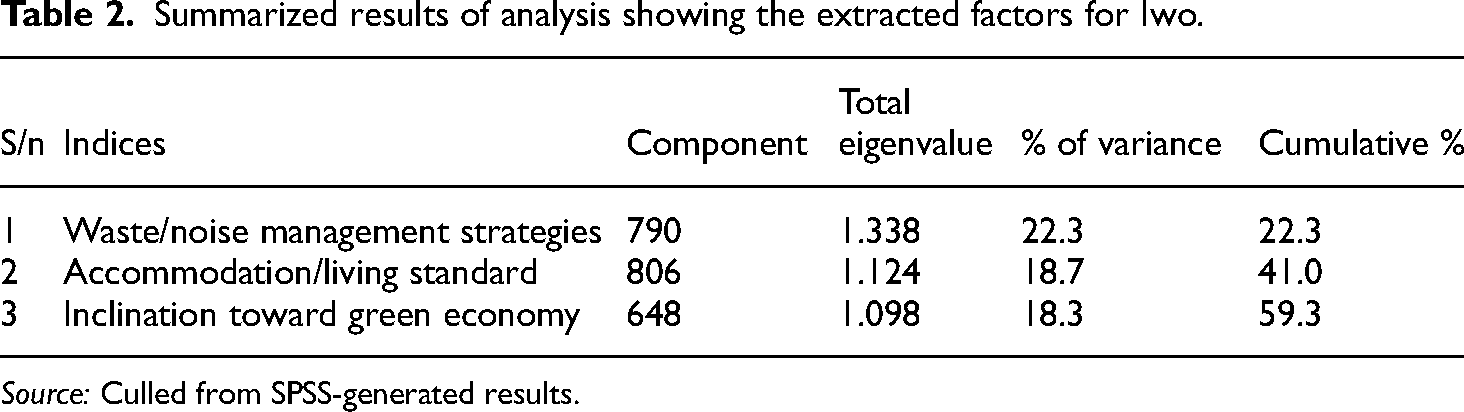
Factor analysis statistic was used to extract factors that strongly influence pollution out of the identified variables in either ascending or descending order. The factorability of the data was determined by KMO and Barttlets tests. The results of the tests revealed that the data was significant (p < 0.05) with a KMO of 74.8%. The summarized results of factor analyses for both study areas are presented in Tables 2 and 3, respectively.
Summarized results of analysis showing the extracted factors for Iwo.
Source: Culled from SPSS-generated results.
Summarized results of analysis showing the extracted factors for Ibadan.

Source: Culled from SPSS-generated results.
The results of the analysis revealed that three economic indices were extracted as having a strong influence on the pollution in the study area as presented in Table 2. The three extracted factors for Iwo had a total explanation of 59.3% for the entire factors which exert influence on the pollution in Iwo. The factors were in this order: (1) waste/noise management strategies which had the highest explanation for pollution level (22.3%) which implies that waste recycling, and avoidance of harmful chemicals, among others, are prominent in the town. The next important variable is the housing structure followed by an orthodox or green economy with the least explanation for the pollution level of 18.3%. The results corroborated the findings.2,4,60
Similarly, three variables were extracted by the factor analysis for the Ibadan metropolis as shown in Table 3. The three factors, in order of the magnitude of explanation given for the pollution level in the metropolis, were (1) accommodation/living standard; (2) orthodox or green economy; and (3) waste/noise management strategies. All three variables gave a total of 60.2% explanation for the pollution in the metropolis. Accommodation and living standards which formed the most significant factor gave a proportion of 24.4%. This implies that the type of accommodation and/or structure whether one-bedroom or two-bedroom apartments and so on, the availability of functioning plumbing and sewage system, and the household's willingness to relocate has a great influence on the level of pollution in the metropolis. The importance of green technology was also mentioned by the authors29–31 in ensuring environmental quality in their respective areas of study.
From the ongoing, it is evident that the pollution matters in Iwo and Ibadan were both influenced by three different variables. Even though two of the three factors were similar, their respective levels of significance in the order were not similar. While waste and noise management strategies were foremost in Iwo, they had the least explanation in the Ibadan metropolis. Similarly, the orthodox or green economy was least important in Iwo while it was a strong factor in Ibadan being the second on the order for the city. Thus, this implies that Iwo and Ibadan should be treated separately from each other when seeking solutions to pollution-related matters. Coccia, 20 Rizam et al., 61 Coccia, 62 Peijun et al. 63 had similar results when it was discovered that each local government area should be treated individually when solving water-related challenges.
Conclusion and policy recommendation
Comparative analysis of the economic factors which influence pollution in the Iwo and Ibadan metropolis was carried out. The survey showed that most of the respondents were females and of married status, while the largest proportion of the household size was between one and five. Six economic factors were identified and subjected to factor analysis to determine the factors prominent in influencing pollution in the two communities. The results of the analyses showed that three different variables are the greatest influencers of pollution in the surveyed areas. The significant variables extracted for Iwo gave 59.3% of the explanation given in the order: waste/noise management strategies (22.5%), accommodation and living standard (18.7%), and orthodox or green economy (18.3%). The three economic influencers of pollution extracted from Ibadan explained 60.2% of the pollution. These were given in the order of accommodation and living standard (24.4%), orthodox or green economy (18.8%), and waste/noise management strategies (17.0%). Though two of the variables namely accommodation and living standard, and orthodox or green economy were common to both study areas, their respective importance and ordering position varied. While waste and noise management were most significant in Iwo, they were not so in Ibadan. Similarly, the inclination towards a green economy had the least explanation for Iwo but was better rated for Ibadan. This suggested that the level of impact of any economic influencer on pollution may be location dependent. However, the people's standard of living and inclination towards a green economy are compelling determinants of environmental pollution in the study areas. Stakeholders in pollution management should consider these economic variables in formulating related policies for sustainable results. It is recommended that future research on this subject would consider other localities to affirm the general influence and applicability of the identified economic influencers to environmental pollution studies.
Supplemental Material
sj-docx-1-sci-10.1177_00368504231153489 - Supplemental material for Economic factors affecting environmental pollution in two Nigerian cities: A comparative study
Supplemental material, sj-docx-1-sci-10.1177_00368504231153489 for Economic factors affecting environmental pollution in two Nigerian cities: A comparative study by Timothy O Ogunbode, Joseph P Jazat and John A Akande in Science Progress
Footnotes
Declaration of conflicting interests
The author(s) declared no potential conflicts of interest with respect to the research, authorship, and/or publication of this article.
Funding
The author(s) received no financial support for the research, authorship, and/or publication of this article.
Data availability and accessibility
The datasets generated and/or analyzed during the current study are not publicly available the data used here were from a pull of data on which further investigations are still ongoing as at the time of submission but are available from the corresponding author on reasonable request.

Supplemental material
Supplemental material for this article is available online.
Author biographies
Timothy O Ogunbode is currently an assistant professor of Environmental Management, College of Agriculture, Engineering and Science, Bowen University, Iwo, Nigeria. He received his doctoral degree in Geography from the University of Ilorin, Ilorin, Nigeria His research focus includes environmental management, water resources management, and climate change and pollution studies. His has over 40 publications in both local and international reputable journals. He is currently a faculty member in Agriculture Programme in the aforementioned College and University.
Joseph P Jazat received his MSc from Coventry University, United Kingdom. He is currently pursuing his PhD degree in Environmental Management in Environmental Management Programme, College of Agriculture, Engineering and Science, Bowen University, Iwo. His research interests are: socioeconomic factors affecting environmental pollution, climate change and environmental justice.
John A Akande is a consultant environmentalist and forest industry expert. He is a professor of Environmental Management in the College of Agriculture, Engineering and Science, Bowen University, Iwo Nigeria. He holds a PhD in Environmental & Resource Engineering (1988) from the State University of New York, Syracuse, USA. He was deputy vice-chancellor at Bowen University (2014–2019). His research areas are in forest industry environment, pollution studies and resource sustainability. He has taught in the University system for over 35 years and supervised many postgraduate level studies. He has over 130 publications to his credit, listed in Google Scholar.
References
Supplementary Material
Please find the following supplemental material available below.
For Open Access articles published under a Creative Commons License, all supplemental material carries the same license as the article it is associated with.
For non-Open Access articles published, all supplemental material carries a non-exclusive license, and permission requests for re-use of supplemental material or any part of supplemental material shall be sent directly to the copyright owner as specified in the copyright notice associated with the article.
