



Abstract
Global sustainable development relies heavily on stable and efficient grain production, where reliable and durable harvesting machinery plays a crucial role. However, the harsh operating conditions experienced by these machines in the field often lead to premature failure. These failures not only cause crop losses and economic burdens but also undermine sustainability goals by increasing the lifecycle environmental footprint through the consumption of materials and energy for repairs and replacements. Furthermore, unexpected downtime can lead to harvest delays, resulting in food waste and inefficient fuel use. This review focuses on research aimed at enhancing the operational fatigue reliability and durability of harvesting machinery. It specifically reviews the latest advancements in the application of sensor technology, signal processing methods, computer simulation techniques, and data analysis methods to advance harvesting machinery durability research. Furthermore, it identifies the challenges in current research, including obtaining accurate load data, handling uncertainties, and validating models. Looking ahead, this review highlights a necessary shift towards integrated, intelligent systems that can transform harvester design and maintenance from a reactive process into a proactive strategy for ensuring lifecycle sustainability.
Keywords
Introduction
In the current context of intensifying global climate change and increasing resource scarcity, sustainable agriculture has emerged as an inevitable trend. Its goal is to balance production demands with environmental carrying capacity and achieve responsible production and consumption. Staple crops such as cereals (e.g. rice, wheat, maize, soybeans) constitute fundamental global food sources and critical industrial raw materials, and their stable and efficient production is paramount to ensuring global food security.1–4 Efficient and timely harvesting of these crops is a core process for maximizing yield and minimizing post-harvest losses. It directly affects the efficiency of agricultural production, the effective utilization of food resources, and the sustainability of crop rotation systems. As key equipment in modern agriculture, the performance and reliability of grain harvesting machinery directly influence the achievement of these sustainability objectives. As global agricultural modernization, scaling, and precision farming accelerate,5,6 efficient and reliable harvesting machinery has become a crucial pillar. This is particularly true in China (where, as shown in Figure 1, the ownership of combine harvesters and total agricultural machinery power have shown continuous growth) and other major grain-producing countries. Here, the strategic importance of harvesting machinery in ensuring food security and advancing the transition to sustainable agriculture is increasingly evident (Data source: Ministry of Agriculture and Rural Affairs of China; National Bureau of Statistics of China). The upward trend depicted in Figure 1 underscores the escalating role of mechanization in modern farming and highlights the growing fleet of machinery for which reliability is paramount.

Inventory of combine harvesters and total power of agricultural machinery in China, 2020–2023.
As global agriculture transforms towards large-scale, intelligent, and precision farming,7–12 the operating intensity and complexity of harvesting machinery have significantly increased.13–15 However, grain harvesters that operate continuously at high intensity for extended periods in complex and variable field environments are subjected to multiple challenges including random impact, cyclic loads, vibration, and harsh environmental erosion.16–21 These harsh operating conditions lead to structural components being prone to fatigue damage and premature failure, becoming a prominent issue affecting machine reliability.22–26 Furthermore, these challenges are compounded by agricultural innovations; for instance, new high-yield crop varieties may introduce unforeseen mechanical demands, such as thicker stalks or higher moisture content, that are not fully accounted for in conventional fatigue models and machine designs. 27
Fatigue failure of grain harvesters during the harvest window does not merely cause downtime; it has cascading effects on the entire value chain. These effects range from threatening the stability of stored grains due to delayed and improper harvesting to disrupting the logistics of large-scale, climate-smart supply chains.28–31 Furthermore, frequent machine failures and premature obsolescence have a profound environmental impact. The manufacturing of new components and machines consumes significant natural resources and energy, generating industrial waste and substantial carbon emissions throughout the supply chain. This cycle of premature failure and replacement runs counter to the principles of a circular economy and sustainable resource management. It is important to note, as true sustainability requires a holistic view, that enhancing durability must be achieved through intelligent design and material selection, not simply by over-engineering with excess material. Critically, while much research focuses on high-tech solutions, the practical challenges of deploying and maintaining reliable machinery in diverse agro-ecological contexts, particularly in developing regions facing acute food security challenges, remain a significant hurdle. Beyond these direct consequences, the socio-economic impacts are profound. For individual farmers, especially smallholders, unexpected machinery failure during the critical harvest window can decimate annual profits and threaten their livelihoods. On a larger scale, systemic unreliability can impact regional food security, increase post-harvest losses, and affect commodity prices. Therefore, enhancing harvester reliability is a prerequisite for the success of broader agricultural innovations, linking advanced engineering to the fundamental goals of global food security and sustainability. 32
It is important to acknowledge that the term “grain harvester” encompasses a variety of machines designed for specific crops, most commonly wheat, rice, and maize. While these harvesters share fundamental structural components and systems (e.g. chassis, threshing units, power transmission) and thus face similar overarching reliability challenges, the specific nature of fatigue failure can differ. These differences arise from variations in crop characteristics (stalk toughness, moisture content), field conditions (soil type, terrain), and harvesting methods (e.g. crawler- vs. wheeled-chassis). This review synthesizes the key research on reliability enhancement that is broadly applicable across these types. It also provides specific examples from wheat, rice, and maize harvester studies to ground the discussion in practical realities.
In-depth research into the fatigue characteristics, failure mechanisms, life prediction, and reliability assessment techniques of grain harvesters is crucial for extending their service life, reducing total lifecycle costs, and minimizing crop losses and resource waste caused by failures. This not only contributes to advancing the technical level of individual agricultural equipment but also serves as a strategic support for ensuring food security, promoting agricultural technological innovation, and building a more sustainable agricultural framework.33,34
This review aims to systematically summarize the current state of research in the field of fatigue reliability analysis of grain harvesters. It specifically reviews the latest advancements in the application of sensor technology, signal processing methods, computer simulation techniques, and data analysis methods to advance harvesting machinery fatigue reliability research. Furthermore, it discusses the challenges currently faced and outlines future development directions, with the goal of improving the fatigue-related durability and overall reliability of grain harvesting equipment, thereby providing theoretical reference and technical support for promoting sustainable agricultural practices.
Review methodology
To ensure a systematic and comprehensive review of the field, this study is based on a structured search of the academic literature. We conducted searches in the Web of Science databases, focusing on publications from the last decade to capture the most current research advancements.
Our search strategy combined two groups of keywords using the “AND” operator. The first group targeted machinery types, including terms such as “grain harvester,” “combine harvester,” “Rice combine harvester,” “Wheat combine harvester,” “corn picker,” and “Soybean harvester.” The second group focused on engineering analysis methods, with keywords like “fatigue,” “reliability,” “durability,” “life prediction,” “load spectrum,” “FEA,” “Finite Element Analysis,” “structural optimum,” “fatigue analysis,” “fatigue life,” and “vibration analysis.”
The retrieved articles were then carefully screened according to a set of predefined criteria. To be included, a study had to be a peer-reviewed journal article or conference paper written in either English or Chinese. Thematically, the research was required to have a primary focus on the mechanical fatigue, structural reliability, durability, or life prediction of grain harvesters or directly analogous agricultural equipment. Furthermore, a critical requirement was that each article detailed the application of relevant analytical methods—such as sensor technology, signal processing, computer simulation (e.g. finite-element analysis (FEA), multi-body dynamics (MBD)), or data analysis—for durability assessment and enhancement. Studies that were themselves reviews, editorials, or primarily focused on agronomy or economics without a substantial engineering component were excluded.
The study selection process is illustrated in the PRISMA flow diagram (Figure 2). The initial search in the Web of Science database yielded 833 records. Before the main screening, 121 records were removed because they were non-compliant document types (e.g. reviews, editorials, conference abstracts), leaving 712 records for screening. After screening the titles and abstracts, a further 221 records were excluded as they were clearly not relevant to the review's scope. The full texts of the remaining 491 articles were retrieved and assessed for eligibility. Following a detailed full-text review, 340 articles were excluded for the following reasons: the focus of the study was irrelevant (n = 157), the article lacked a specific or detailed methodology (n = 70), or the study was out of the defined scope (n = 113). Ultimately, 151 studies that fully met the inclusion criteria were included in this systematic review.

PRISMA flow diagram of the study selection process.
Structural characteristics and fatigue failure modes of grain harvesters
Typical structure and load characteristics of grain harvesters
Grain harvesters are large agricultural machines characterized by their complex structure. This review focuses on the most common types used for cereals like wheat, rice, and maize, which primarily consist of the header, conveying channel, threshing unit, cleaning device, grain tank, chassis frame and traveling undercarriage, transmission system, and engine.35–40 The structure of a typical grain harvester is illustrated in Figure 3.

Structure of a typical grain harvester.
During cooperative operation, the various components of the grain harvester inevitably experience complex loads originating from multiple sources and possessing diverse characteristics.
41
Specifically, these can be categorized as follows:
Traveling undercarriage and chassis frame: Serving as the load-bearing foundation and mobile platform for the entire machine, they directly sustain random impact and vibration loads induced by field ground unevenness. This constitutes one of the key load sources affecting the overall structural fatigue life of the machine.42,43 Header and conveying channel: These components, which are in direct contact with the crop, endure dynamic interaction forces during the cutting, collection, and conveying processes. These forces arise from the material properties of the crop (such as density, humidity, toughness) and its uneven distribution.
44
Threshing unit: High-speed rotating components within this unit, such as the threshing cylinder, generate centrifugal forces during operation. Furthermore, unbalanced forces resulting from material entanglement or manufacturing/installation deviations serve as significant sources of periodic excitation.45–51 Transmission system: Components responsible for power transmission, such as axle shafts, gears, and belts, are subjected to torque fluctuations and alternating stresses caused by factors like engine output variations and load changes.52,53
Relevant studies further corroborate the complexity of the loading environment experienced by grain harvesters. For instance, the vibration analysis of a corn harvester frame by Fu et al. 54 indicated that the unevenness and variations of the field terrain are the primary sources of vibration excitation. Li et al., 55 through analysis based on field measurements of a combine harvester chassis frame, identified the threshing cylinder, vibrating sieve, and engine as the main internal vibration sources. They also observed that vibration intensity increased with rotational speed, revealing the complex response characteristics of the chassis structure under multi-source excitation. The research by Que et al. 56 focused on the rice threshing process and found that unbalanced excitation, caused by factors such as material entanglement, significantly affects the operational stability of the threshing cylinder, thereby inducing complex dynamic loads. Furthermore, other components such as front-end loading devices, 57 agricultural implement fasteners, 58 the cutting blades of the header, 59 and cleaning sieves60,61 are also subjected to unique operating loads and random impacts during their specific operational processes. Regardless of the operation type—be it tillage, seeding, or harvesting—agricultural machinery is commonly subjected to significant vibration loads, which are recognized as one of the key factors leading to structural fatigue damage.62,63
This multi-source, complex, and random load environment presents a severe challenge to the fatigue resistance performance of grain harvester components. This directly affects the machine's ability to operate continuously and efficiently under harsh conditions, making unexpected downtime a significant factor affecting the long-term viability and environmental performance of agricultural production.
Fatigue failure modes of grain harvesters
Under the long-term action of complex alternating loads, structural components of grain harvesters are prone to fatigue failure. Common fatigue failure components and modes include:
Key load-bearing components: such as fatigue fracture of the chassis frame
64
and axles65,66; Welded joints: such as fatigue cracking at the weld toe or weld root in plate-shell structures
67
; Bolted connections: loosening or fatigue fracture at these locations
58
; Shaft components: such as torsional fatigue or bending fatigue of the Power Take-Off (PTO) shaft
68
; Standard parts like bearings: fatigue spalling or failure69,70; Gears: fatigue fracture or pitting, such as in spiral bevel gears,
71
PTO gears,
72
and gearbox gears.73–75
Noh et al. 59 conducted fatigue analysis on the cutter knives of a combine harvester, indicating that the cutter knives are also key components subjected to high-frequency fatigue loads. Cleaning sieves may also experience fatigue damage under long-term vibration.61,76 Research by Li et al. 77 showed that header vibration not only leads to harvest losses but also implies that the header itself endures vibration loads that can induce fatigue. Cecchini et al., 78 through a survey, found that bearing failure is a common issue in agricultural machinery (including equipment like rotary tillers that operate in environments similar to harvesters), which indirectly highlights the importance of fatigue in rotating components. Therefore, researching and addressing these fatigue failure issues is crucial for enhancing the durability of grain harvesters, reducing resource waste and ensuring food security.
Theoretical basis for fatigue reliability evaluation of grain harvesters
Fatigue damage theory reveals the performance degradation mechanisms of materials and structures under cyclic loading, providing a scientific method for predicting the fatigue life of grain harvester components. Accurately predicting life and implementing more optimized design and maintenance strategies. These strategies extend machine service life, reduce premature obsolescence, and conserve manufacturing resources, providing crucial theoretical support for enhancing the economic and environmental sustainability of machinery.
Fatigue refers to the phenomenon where, under the action of cyclic stress or strain, a material or structure experiences crack initiation or propagation after a certain number of cycles, ultimately leading to fracture, even when the applied stress is far below the material's static tensile strength. The fatigue process in metallic materials typically includes three stages: crack initiation, crack propagation, and final instantaneous fracture. Common methods for fatigue analysis are shown in Table 1.
Common methods for fatigue analysis.
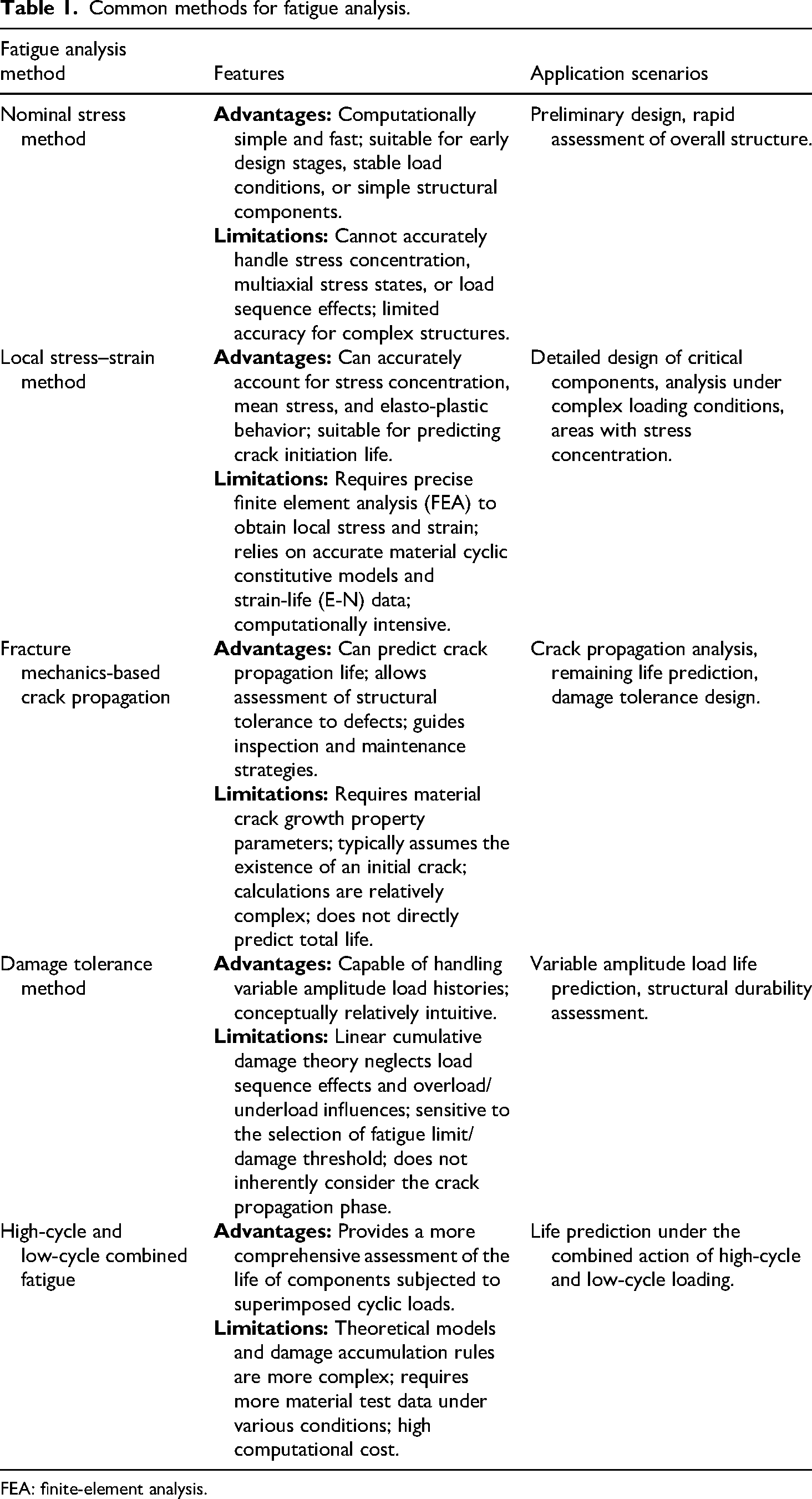
FEA: finite-element analysis.
Under variable amplitude loading, it is necessary to consider the cumulative effect of damage. The Miner linear cumulative damage rule79,80 is the most commonly used damage accumulation model. It assumes that the damage caused by each cycle can be linearly superimposed, and fatigue failure occurs when the total damage reaches a critical value (typically 1). For example, Islam et al. 81 applied the Palmgren–Miner rule to assess the damage level when analyzing the fatigue of transplanter gears. However, Miner's rule does not account for load sequence effects and load interactions, thus having certain limitations. Consequently, various modified models have been developed. For instance, Yan et al. 82 proposed a non-linear damage model based on the Lemaitre model and compared it with the Miner and Corten-Dolan theories. The results demonstrated that the fatigue life predicted by the Lemaitre-based non-linear damage model was closer to the actual life. Other commonly used fatigue life prediction models include methods based on specific fatigue parameters. For example, the Smith–Watson–Topper (SWT) parameter has been used to evaluate the fatigue life of tractor spiral bevel gears, 70 cultivator PTO gears, 71 and components of radish harvesters. 83 For fatigue problems under multiaxial stress states, multiaxial fatigue theories are required. Noh et al., 58 for instance, employed modified models based on the critical plane approach, such as Morrow, SWT, and Brown-Miller parameters, when evaluating the fatigue life of harvester cutter knives.
Research status of key technologies for grain harvester reliability
Ensuring that grain harvesters maintain high efficiency and reliability during extended, complex field operations, while minimizing failures and downtime, is crucial for enhancing the overall sustainability of modern farming. However, achieving this goal is complicated by numerous uncertainties inherent in real-world operations, such as variability in field loads, material properties, and manufacturing processes. These factors make it insufficient to rely solely on predicting a single, fixed service life. A more robust, probabilistic approach is therefore essential. This is the core purpose of fatigue reliability assessment, which quantifies the likelihood of failure-free operation and provides a more realistic basis for guiding optimized design and maintenance strategies.
In recent years, with the development of sensor technology, computer simulation techniques (such as FEA and MBD), signal processing techniques, and data analysis methods,84–89 significant progress has been made in these key technological areas. This chapter provides a systematic review of the current state of research and advancements in key technological areas for grain harvesters, including fatigue load spectrum acquisition and processing, structural stress and strain analysis, fatigue life prediction and evaluation, and fatigue reliability evaluation models and methods. Figure 4 illustrates the synergistic relationship between the key technologies discussed. The process begins with acquiring load data from the field or virtual simulations (Data Acquisition). This raw data is then refined through signal processing to create an accurate load spectrum (Data Processing). The processed spectrum serves as the input for computational models (FEA/MBD) that determine the stress–strain response of critical components (Stress/Strain Analysis). This response, combined with material properties, is used to predict component life (Fatigue Life Prediction). Finally, by incorporating uncertainties, a probabilistic reliability assessment is performed (Reliability Assessment). Modern, disruptive technologies like Digital Twins and artificial intelligence/machine learning (AI/ML) are now emerging to integrate this entire workflow, enabling real-time monitoring, predictive maintenance, and true sustainable lifecycle management.

The workflow of harvesting machinery from data acquisition to sustainable lifecycle management.
Sensor-based technologies for fatigue load spectrum acquisition and processing
The fatigue load spectrum is a statistical representation describing the load history experienced by a grain harvester throughout its entire life cycle, and it forms the basis for fatigue design, analysis, and testing. Accurately obtaining and appropriately processing a load spectrum that truly reflects actual operating conditions is crucial for ensuring the reliability of subsequent fatigue analysis. Load spectra are primarily obtained through two main approaches: field measurement and virtual simulation. However, the raw data acquired often require a series of processing steps, such as denoising, cycle counting, editing, extrapolation, and acceleration, before they can be effectively applied to fatigue assessment.
Acquisition of fatigue load spectrum
(1) Field measurement method: This involves deploying sensors at key locations on the grain harvester to collect actual load or response signals under typical operating conditions. A load data acquisition system typically includes sensors, data acquisition modules, and data acquisition software, where the data acquisition software is installed on a laptop computer.
Han et al. 90 determined the working load of a chisel by reconstructing loads from strain gauge data collected during field tests; this data was then used for fatigue testing of the chisel assembly. The results demonstrated that the proposed fatigue testing method could be successfully used for the durability assessment of the chisel. Koyuncu et al. 79 conducted strain tests on a tractor front axle and its support on both a test track and farmland. Kim et al. 91 measured the actual operating loads of a corn harvester to construct a load spectrum. Zhao et al. 92 performed fatigue life analysis using field-measured load data. Niu et al. 93 utilized measured load data from the chassis frame of a corn harvester. While this method provides the most realistic data, reflecting actual operational stressors, it is often constrained by high costs, long durations, and the difficulty of instrumenting complex geometries, particularly on rotating components.
(2) Virtual prototyping and simulation method: This involves using software such as MBD to establish models of the entire machine or key systems and simulate their dynamic responses under different operating conditions to predict loads. For example, Kim et al. 56 utilized MBD simulation to determine stress measurement points for a front-end loader. Liu et al. 94 performed MBD simulation of the chassis of a triangular-crawler ratoon rice harvester using RecurDyn, analyzing its performance under straight-line and turning conditions. Zhao et al. 95 conducted a dynamic simulation of the scraper conveyor device of a sugarcane harvester. This approach offers high efficiency and low cost, making it ideal for early-stage design iterations and comparative studies. However, its prediction accuracy is critically dependent on the model's fidelity (e.g. accuracy of joint definitions, material properties, and contact parameters) and the adequacy of its experimental validation, which remains a key challenge.
Load spectrum data processing
Raw load data obtained from acquisition or simulation typically contain noise and a large amount of information, requiring processing before use for fatigue analysis. This processing involves several key techniques:
(1) Denoising / signal processing: This step focuses on filtering out noise interference. For example, Dai et al. 96 proposed the CEEMDAN-Wavelet threshold method for denoising. Qian et al. 97 used Fast Fourier Transform to process acceleration signals. Fu et al. 53 employed an improved empirical mode decomposition algorithm for noise reduction processing of the high-noise, non-stationary vibration signals from a corn harvester frame. Wang et al. 98 proposed decomposing and reconstructing PTO torque and suspension loads based on the Daubechies wavelet transform to identify and retain segments causing significant damage.
(2) Rainflow counting method: This method converts an irregular load history into load cycles, serving as a standard method for fatigue damage calculation. Paraforos et al. 80 employed the rainflow cycle counting method to extract load cycles from stress data and used the Palmgren–Miner method to determine the fatigue damage of each cycle and the total accumulated fatigue damage. Niu et al. 93 performed rainflow counting statistics on pre-processed, measured raw load data to obtain a load cycle mean-amplitude matrix.
(3) Load spectrum compilation and extrapolation: This involves organizing the counting results and potentially requiring extrapolation or combination based on the target service life or different operating conditions. For example, Song et al. 99 proposed a load spectrum extrapolation framework based on probability weighted moments and peaks-over-threshold (POT). Yang et al. 100 proposed a load spectrum extrapolation method based on using a genetic algorithm to optimize the POT model threshold, aimed at generating a load spectrum reproducible on a test rig. Su et al., 101 on the other hand, utilized a Gaussian mixture model based on the expectation-maximization algorithm to fit the probability density distribution of load cycles, intended for related fatigue life analysis and load spectrum extrapolation.
(4) Accelerated spectrum generation / editing: This process aims to compress a long-term load spectrum into a damage-equivalent short-term accelerated spectrum to shorten testing time. For example, Wen et al. 102 proposed a fatigue load spectrum editing method for accelerated durability testing based on Power Density (PD-LSD). This method utilizes the short-time Fourier transform (STFT) and the S-N curve to calculate cumulative power density, identifying and extracting regions with severe damage from the original load signal. The principle of this test is illustrated in Figure 5. Figure 5 outlines the theoretical workflow of the PD-LSD method. It demonstrates a systematic process that begins with acquiring field data and progresses through signal processing (using STFT), damage calculation (based on the S-N curve), and finally, the extraction of high-damage segments to create a compressed, damage-equivalent test spectrum. This approach intelligently shortens test durations while preserving the most damaging load characteristics.
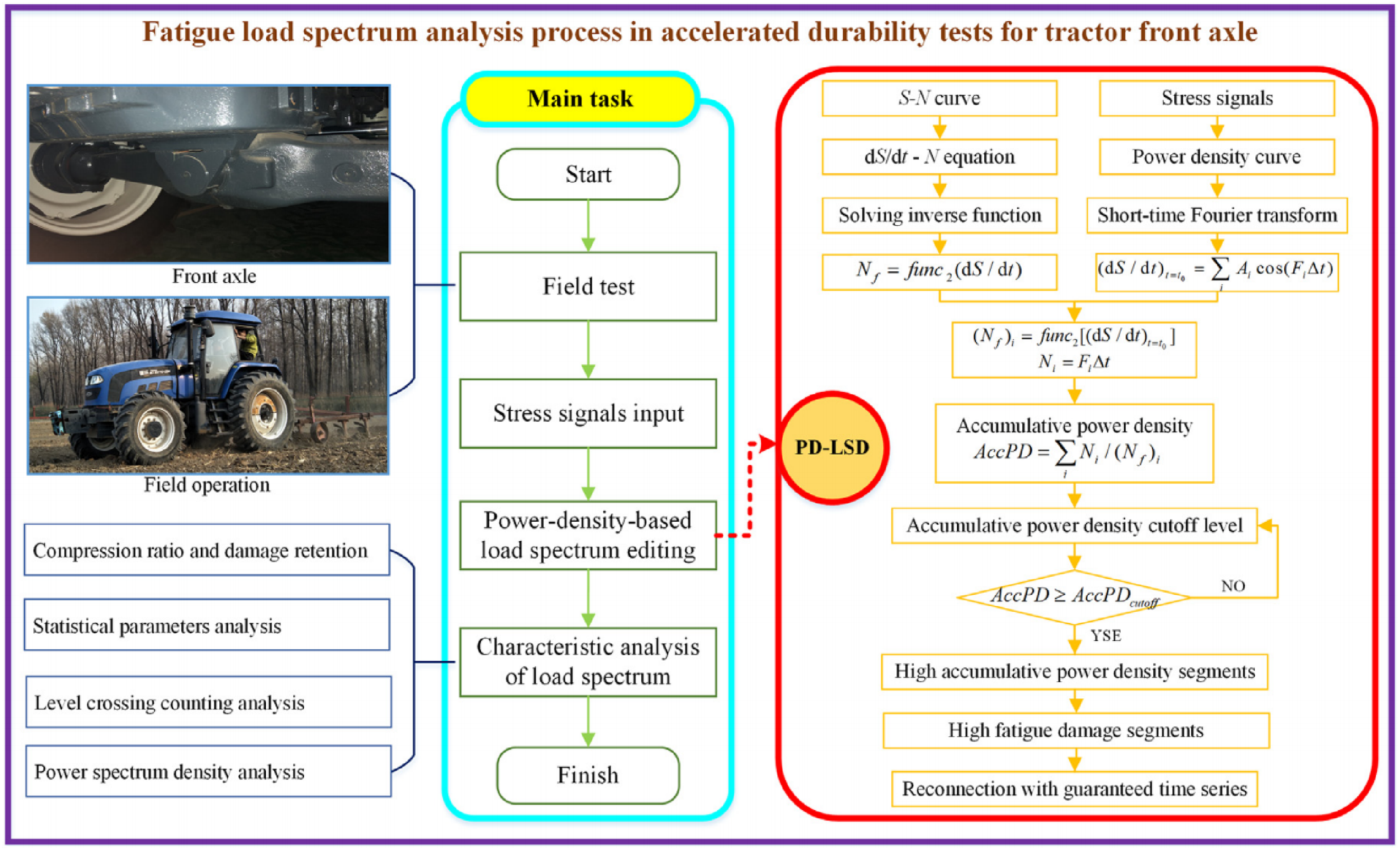
Theoretical flowchart of the PD-LSD method. Reprinted from reference, 102 with permission from the copyright holder.
Wen et al. 103 designed an accelerated structural test scheme for a tractor by integrating POT extrapolation, the Augmented Lagrangian Method, and Monte Carlo sensitivity analysis. Yan et al. 82 proposed a method for compiling the torque load spectrum for a tractor PTO shaft based on the Lemaitre non-linear damage accumulation model, intended for fatigue life prediction and bench testing.
(5) Other Processing Methods: Researchers have also explored more advanced and specific signal processing techniques. Mattetti et al. 104 employed time-varying correlation coefficient and time-varying pseudo damage to identify and quantify the influence of driving events on tractor axle housing damage. Paraforos et al. 105 used Markov chain models to model the turning point sequences of load signals from a hay rake to predict cumulative fatigue damage, and also modeled and classified road profiles, providing input for vehicle dynamics simulation and fatigue analysis. 106 Wen et al. 107 proposed a deep learning model based on a multi-head attention convolutional long short-term memory network for identifying high-intensity operating load segments within tractor load spectra.
The emergence of intelligent technologies represents a fundamental shift in the philosophy of load spectrum analysis. While field measurement provides realism and simulation offers efficiency, both are essentially reactive or predictive based on limited scenarios. The integration of the Internet of Things and AI-powered analytics is enabling a transition towards proactive, real-time condition monitoring.108,109 Instead of relying on a static, historical load spectrum, engineers can now use continuous data streams from onboard sensors to build a dynamic “digital twin” of the harvester. 110 A critical challenge moving forward is no longer just the acquisition of accurate load data, but the development of intelligent algorithms that can analyze this continuous stream in real-time. These algorithms are needed to predict imminent failures and optimize operational parameters, which will transform load spectrum analysis from a design tool into a dynamic maintenance and operational guidance system.
Structural stress–strain analysis techniques
Structural stress or strain analysis serves as the crucial link connecting external loads to internal damage, and its results are directly used for subsequent fatigue life prediction. FEA is currently the most widely used tool for structural stress analysis, capable of handling complex geometries and load conditions. Additionally, MBD simulation and experimental stress analysis are also commonly used to obtain structural responses under dynamic loads or to validate the accuracy of simulation models.
Finite-element analysis
FEA software is utilized to model key components of the grain harvester, such as the chassis frame, axles, header, threshing cylinder, plate-shell structures, 111 gears, PTO, and clutch. 112 Boundary conditions and loads are applied to calculate their stress/strain distributions, identify stress concentration areas, and pinpoint maximum stress locations. For example, Irsel 113 conducted detailed FEA (static, modal, transient) on the chassis of a fertilizer spreader. McCoy et al. 66 performed FEA on welded rectangular frame joints to compare stress levels in different designs. Tang et al. 114 modeled the loading and constraints and analyzed the load-bearing capacity of the crawler chassis frame of a rice combine harvester.
Co-simulation of multi-body dynamics and finite-element analysis
For systems where the coupling effect between component flexibility and rigid body motion needs to be considered, such as the interaction between the chassis and working units, 115 MBD-FEA co-simulation can provide more accurate dynamic stress–strain on flexible components. By importing flexible body models generated by FEA into the MBD environment, or by performing iterative calculations between MBD and FEA, the effects of inertial forces and kinematic coupling on structural stress can be considered. For example, Liu et al. 94 conducted a co-simulation of the chassis and hydraulic system of a triangular-crawler ratoon rice harvester using AMESim and RecurDyn.
Experimental stress analysis
This involves measuring structural stress directly, typically by attaching strain gauges, primarily for validating the accuracy of simulation models. Han et al. 116 utilized strain data in the load analysis of a disc harrow. Khanali et al. 64 validated the FEA calculation results for the front axle of a combine harvester using strain gauge measurement results.
Experimental modal analysis
This involves applying a known excitation to the structure and measuring the response to identify its modal parameters (natural frequencies, damping ratios, mode shapes). Tang et al. 117 validated the accuracy of the header FEA model by comparing the results of free modal analysis based on the Eigensystem Realization Algorithm with experimental results. Wang et al. 118 utilized multi-input multi-output modal testing to obtain or verify the natural vibration characteristics of a threshing cylinder and a seeder frame. Zhang et al. 119 performed modal testing on a threshing frame to validate modal analysis results. Wang et al. 120 conducted modal testing to verify the theoretical analysis of the frame of a residual film recovery machine.
Fatigue life prediction and assessment
Accurate prediction of the fatigue life of critical grain harvester components is central to formulating predictive maintenance plans, avoiding unplanned downtime, reducing repair costs and resource waste, and ensuring the continuity of agricultural production. Fatigue life prediction estimates the number of cycles or duration of use a structure or component can withstand within its expected service period, based on acquired load spectra, stress–strain analysis results, and material fatigue properties data. Depending on the characteristics of the object under analysis and the available data, different life prediction theories and models can be selected. Modern fatigue analysis is often completed using professional commercial software to handle complex calculation and evaluation processes.
The general procedure for fatigue life prediction of grain harvesters is shown in Figure 6. The process integrates virtual modeling (FEA) with empirical data (material S-N curves and field-test load spectra) and established theoretical frameworks (Cumulative Fatigue Damage Theory) to derive a life prediction for critical component locations. This visual representation highlights the interdisciplinary nature of modern durability assessment, combining simulation with real-world data to achieve accurate results. A key advantage of this structured approach is its ability to integrate diverse data sources—from field measurements to simulation results—into a quantitative life estimate. However, the accuracy of these predictions is highly sensitive to the quality of input load spectra and material S-N curve data, which often contain significant uncertainties, particularly for complex welded structures or novel materials operating in corrosive environments.

Flowchart for fatigue life prediction of grain harvesters.
Zhao et al. 92 adopted a fatigue life analysis method based on stress field intensity and optimized the traditional approach by considering factors such as stress concentration, size effect, surface quality, and load characteristics. This resulted in a modified S-N curve used to predict the fatigue life of a tractor steering drive axle housing. Kim et al. 71 used KISSsoft software to analyze the strength and fatigue life of a gear train. Fu et al. 121 compared time-domain and various frequency-domain fatigue analysis methods for the half-shaft of a combine harvester, finding that improved frequency-domain methods (considering mean stress and non-Gaussian correction) offered higher accuracy. Ebrahimi et al. 122 estimated the fatigue life of a chisel plow arm in the frequency domain using the Wirsching-Light and Dirlik methods.
Despite the increasing sophistication of life prediction theories, the accurate and efficient application of these methods to harvester components under complex operating conditions, while considering the impact of multi-source uncertainties, remains a significant challenge in engineering practice.
Fatigue reliability assessment models and methods
Uncertainties are inherent in factors such as loads, material properties, geometric dimensions, manufacturing processes, and the analysis models themselves. Consequently, deterministic fatigue life predictions often fail to fully reflect the real-world situation. Fatigue reliability assessment aims to quantify the impact of these uncertainties on fatigue life, providing the likelihood that a structure will not experience fatigue failure within its specified service life. By treating variables like load magnitude, material strength, and geometric dimensions as random variables, these methods can quantify the probability of failure, offering a more realistic assessment than deterministic approaches. The primary challenge for these probabilistic methods, however, is the acquisition of accurate probability distribution information for all input variables, which can be data-intensive and costly.
Sejkorova et al. 123 proposed a method for assessing engine reliability based on the impurity content in engine oil. This method enables failure prediction and offers new insights for predictive maintenance strategies for machinery.
Miodragovic et al., 124 addressing the issue of insufficient accuracy in agricultural machinery reliability assessment, improved the reliability assessment model based on fuzzy theory. They evaluated the overall machine system from the dimensions of usability, maintainability, and reliability, with results showing that the improved model possesses both higher accuracy and strong applicability.
Mygdakos et al. 125 proposed a reliability calculation method based on the exponential distribution to predict header reliability, machine downtime due to failures, and their impact. The results indicated that this method offers high prediction accuracy.
Abo et al., 126 targeting the problems of low operational capacity and safety issues caused by insufficient reliability in agricultural tillage machinery, combined reliability theory with Monte Carlo simulation methods. They proposed machine improvement concepts and conducted reliability assessment and design, effectively ameliorating the instability of tillage force.
Tokida et al., 127 tackling the challenge of lacking effective reliability assessment methods for certain agricultural machinery systems, proposed an assessment scheme based on operational state data. This method has found wide application in the fields of agricultural machinery performance monitoring and management.
Petrovic et al., 128 by surveying the off-season maintenance and storage conditions of 382 harvesters in the Slavonia and Baranja regions, analyzed the failure modes and hazards of the harvesters. While outlining maintenance diagnostic methods, they emphasized the necessity of pre-operational checks and systematic organization, but also noted the potential challenge of uncontrollable costs.
Introducing probabilistic and statistical methods into fatigue analysis is an inevitable trend for achieving reliability assessment, as it allows for a more realistic reflection of the impact of various uncertainties on life. However, the effectiveness of these methods largely depends on the accuracy and completeness of the probability distribution information for input parameters. Acquiring such information is often difficult and costly. Therefore, how to perform effective uncertainty quantification and propagation analysis with limited data, and how to develop efficient and robust fatigue reliability assessment methods suitable for complex engineering structures, such that the assessment results can genuinely guide design improvements and maintenance decisions, represent the key challenges in transitioning this field from theory to widespread engineering application.
This chapter provides a systematic review of the current state of research and advancements in key technological areas for grain harvesters, including fatigue load spectrum acquisition and processing, structural stress and strain analysis, fatigue life prediction and evaluation, and fatigue reliability evaluation models and methods. As a capstone to this technological review, Table 2 offers a systematic synthesis of these approaches, critically evaluating each method's strengths and limitations. This synthesis highlights that while a powerful suite of tools exists for acquiring data, analyzing stress, and predicting life, their ultimate value lies in their application. The successful integration of these technologies is essential for informing the next logical step: the development of proactive design and enhancement strategies aimed at building more durable and sustainable machinery.
Synthesis of key technologies for harvester fatigue reliability analysis.
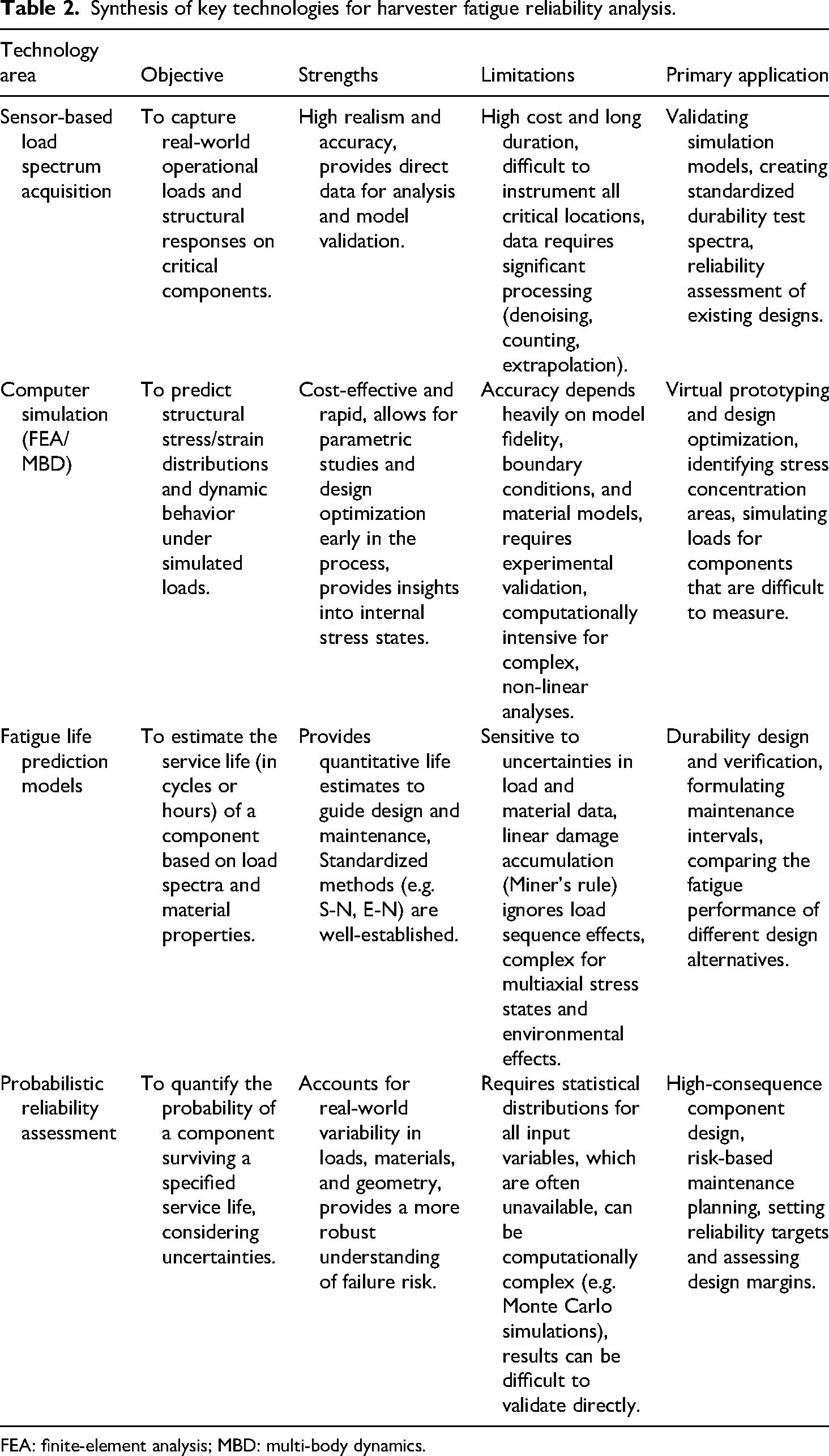
FEA: finite-element analysis; MBD: multi-body dynamics.
Sustainable structural optimization design and enhancement strategies for harvesting machinery
The optimization design and enhancement strategies for the structural integrity of harvesting machinery aim to improve the machine's durability, reliability, and efficiency. These technical means help reduce failures, extend service life, lower resource consumption, reduce environmental impact, and directly support the goals of sustainable agriculture. However, a critical analysis suggests that the very concept of “optimization” in this context requires re-evaluation. Historically, optimization has focused on component-level metrics like weight, stress, and vibration. In the modern framework of sustainable agriculture, this view is insufficient. True sustainable design must now consider the harvester's adaptability and performance within a dynamic, integrated system. Furthermore, as intelligent technologies enable harvesters to become nodes in a larger, digitally managed supply chain, their design must be optimized for data integration and system-level efficiency, not just mechanical performance.110,129 Therefore, a critical shift is needed from isolated structural optimization to holistic, adaptive design that prioritizes resilience and integration within the entire agricultural value chain.
Structural optimization design methods
Structural optimization design utilizes mathematical programming methods and computer simulation techniques to seek a design scheme that achieves optimal structural performance (such as minimum weight or minimum stress) while satisfying specific constraints. In the fatigue reliability design of grain harvesters, structural optimization methods can effectively identify load paths, reduce weight in non-load-bearing areas, mitigate stress concentration, and adjust natural frequencies to avoid resonance, thereby achieving light weighting while ensuring or improving fatigue life. 130
Tang et al. 111 optimized the plate-shell structure of a combine harvester using surrogate models and the multi-objective genetic algorithm (MOGA) for parameter optimization. They significantly increased the first-order natural frequency and reduced the dynamic response while maintaining the same mass. Yuan et al. 131 conducted a multi-objective lightweight design for the chassis frame of a crawler-type corn combine harvester using surrogate models and the MOGA, significantly reducing the frame weight while satisfying strength and stiffness constraints. Zhao et al. 95 performed size optimization on the scraper conveyor device of a chopper-type sugarcane combine harvester, aiming to minimize weighted eigenvalues as the objective, and successfully reduced weight while meeting strength requirements.
Material selection and manufacturing process improvement
The choice of materials and the quality of manufacturing processes directly impact the initial fatigue strength and damage resistance of components. Utilizing new materials with superior fatigue properties, or improving forming processes, joining techniques, and implementing surface strengthening treatments, are all important avenues for enhancing the structural integrity and reliability of grain harvesters. 132
Tan et al. 133 investigated the potential application of a novel Mg-Zn-Ce-Cu lightweight alloy as a material for agricultural machinery, analyzing its mechanical properties and corrosion resistance in soil environments. Wang et al. 134 employed laser cladding technology to deposit a Ni60A alloy coating on the surface of a 40Cr journal for repairing worn main shafts. The study indicated that the clad layer exhibited good bonding, high hardness, and excellent wear resistance. Wang et al. 135 studied the effect of low-amplitude preload strengthening on the fatigue life of the rear axle housing of an agricultural transport vehicle. Experiments demonstrated that appropriate preloading could enhance fatigue life. Cheng et al. 136 modified the surface of a rice harvester cleaning sieve using a polytetrafluoroethylene coating, significantly reducing adhesion with wet and sticky materials and improving anti-adhesion and drag reduction performance. Li et al. 137 prepared composite peg-teeth for corn threshing using nitrile rubber, natural rubber, and ethylene propylene diene monomer rubber. Tests showed that the EPDM rubber composite peg-teeth offered the best overall performance in terms of reducing breakage rates and enhancing their own wear resistance.
Vibration reduction technology
Vibration is one of the primary sources causing structural fatigue damage in grain harvesters and operator discomfort.138–140 Therefore, implementing effective vibration reduction measures can not only significantly improve operator ride comfort and operational safety but also reduce the amplitude and number of cycles of dynamic loads experienced by key components, thereby extending the fatigue life of the structure.141,142 Vibration reduction techniques include optimizing structural design to avoid resonance, increasing damping, using vibration isolation devices, and optimizing component kinematic parameters.143,144
Numerous studies have demonstrated the effectiveness of these strategies in practical applications. Guo et al. 145 analyzed and optimized the vibration characteristics of an integrated machine for straw returning and residual film recovery. By optimizing the structural parameters of the frame, they effectively avoided resonance and significantly reduced the vibration intensity at various measurement points. Hostens et al. 146 compared the vibration reduction effects of mechanical suspension and air suspension seats, finding that air suspension seats could better attenuate high-frequency vibrations and provide greater comfort.
Further research has focused on optimizing mechanical systems. Lin et al., 147 by optimizing the phase angle arrangement of 10 sets of crank-rocker mechanisms in a shovel-type seedbed preparation machine, achieved basic balancing of the machine's overall inertial forces, significantly reducing the unit's vibration. Tang et al. 148 designed four types of prestressed support beam structures, investigating their dynamic suppression effect on the threshing unit of a thresher, and found that the triangular beam structure was the most effective. Wang et al. 149 conducted vibration transmission path analysis on the chassis frame of a rice combine harvester and performed damping optimization on it to reduce the vibration response. Hu et al. 150 designed a vibration reduction structure for a sensor bracket based on the acoustic black hole principle and verified its vibration reduction effect through FEA.
Current research challenges and deficiencies
Despite significant progress in the fatigue reliability research of grain harvesters, numerous challenges and limitations still exist in translating theoretical research into practical application. These issues constrain the enhancement of machine sustainability performance across economic, environmental, and social dimensions. This section consolidates the primary obstacles identified throughout the literature.
(1) Accurate load spectrum acquisition and characterization: A persistent and fundamental challenge is the acquisition of load spectra that accurately represent the full range of complex and variable operating conditions. 151 Field measurements are costly and time-consuming, while virtual simulations struggle with model validation and accurately representing soil-tool and crop-machine interactions. This uncertainty in the primary load input propagates through the entire analysis chain. It directly impacts the accuracy of life prediction and the effectiveness of preventive maintenance, leading to potential resource waste and reduced machine availability. This trade-off is evident throughout the reviewed literature. For instance, while field measurement studies like those by Kim et al. 91 on corn harvesters provide high-fidelity data, they are often resource-intensive and limited in scope. Conversely, virtual simulation approaches, such as the MBD used by Liu et al., 94 offer efficiency for design iterations but face significant hurdles in experimental validation, a limitation that undermines the predictive accuracy of subsequent analyses.
(2) Quantification and propagation of multi-source uncertainties: Harvester reliability is influenced by numerous uncertainties, including variability in material properties, manufacturing tolerances, environmental conditions, and operator behavior. Quantifying these diverse uncertainties and modeling their propagation through complex engineering systems remains a significant hurdle. This leads to wide confidence intervals in reliability predictions, increasing design and maintenance risks and affecting the continuity of agricultural production. This is implicitly highlighted in many deterministic fatigue life prediction studies reviewed, such as those by Fu et al. 121 and Ebrahimi et al. 122 These studies, while valuable, often rely on nominal material properties and specific load cases, thereby not fully capturing the probabilistic nature of failure that is critical for a comprehensive reliability assessment.
(3) Deficiencies in material and joint fatigue databases: There is a notable lack of comprehensive fatigue property databases, particularly for new, advanced materials (e.g. high-strength steels, composites) and complex joint structures (e.g. welds, bolted connections) under conditions specific to agricultural field environments. This data scarcity restricts the application of fatigue-resistant materials and advanced designs, hindering efforts to extend machine life, reduce weight, and achieve more sustainable resource utilization. This gap becomes apparent when considering the analysis of welded structures, as seen in the work of McCoy et al., 66 or the introduction of novel lightweight alloys, as explored by Tan et al. 133 Without fatigue data specific to the corrosive and abrasive agricultural environment, engineers must often rely on generalized S-N curves, introducing significant uncertainty into life predictions.
(4) Modeling of multi-factor coupling effects: Grain harvesters operate in environments where components are subjected to coupled, multi-physical effects, including mechanical loads, thermal cycling, chemical corrosion, and abrasive wear. Current fatigue research often considers these factors in isolation. Limited understanding and inadequate models for these multi-factor coupling effects fail to capture the true failure mechanisms, restricting the accuracy of life prediction and the design of robust machines for harsh conditions. The vast majority of simulation and analysis methods reviewed in Theoretical basis for fatigue reliability evaluation of grain harvesters Section, such as FEA and MBD, focus almost exclusively on mechanical loads. For example, the life prediction methodologies applied to components like axles64,65 and frames 63 typically do not integrate the synergistic effects of chemical corrosion from fertilizers or the abrasive wear from soil contact, which can significantly accelerate crack initiation and propagation.
(5) High cost and accessibility of advanced technologies: A significant practical barrier is the high initial investment required for advanced sensor systems, data acquisition hardware, simulation software, and digital twin platforms. These costs can be prohibitive for many small and medium-sized equipment manufacturers and, ultimately, for the farmers who are the end-users. This economic hurdle limits the widespread adoption of cutting-edge reliability analysis and predictive maintenance, particularly in developing economies and among small-scale farming operations.
(6) Skill gaps and infrastructure deficiencies: The effective implementation of these technologies requires a specialized skill set. There is a notable shortage of trained technicians in rural areas capable of installing, calibrating, maintaining, and interpreting data from sophisticated monitoring systems. Furthermore, practical implementation is often hampered by inadequate rural infrastructure, such as unreliable power or limited high-speed internet connectivity, which is essential for the real-time data transfer and analysis that powers modern reliability management.
Future research directions for promoting sustainable operation of harvesting machinery
To address the challenges outlined and to translate research into practice, future work must move beyond general concepts toward specific, actionable pathways. This section proposes a concrete roadmap for advancing the field.
From static models to dynamic digital twins: A methodological pathway
Researchers should focus on creating a hybrid framework that integrates high-fidelity FEA/MBD models with real-time sensor data (e.g. strain, vibration, GPS). A crucial step is to employ data assimilation techniques, such as Bayesian inference or extended Kalman filtering, to continuously update the parameters of the physics-based model (e.g. material degradation, joint stiffness) based on incoming sensor data. This would create a “living” model that reflects the actual health of the machine, rather than a static simulation. The immediate research goal would be to demonstrate this on a critical subsystem, like the chassis frame, to enable real-time stress monitoring and predict remaining useful life (RUL) under dynamically changing field conditions.
Developing task-specific AI/ML models for predictive reliability
Synthetic load spectrum generation: A major bottleneck is the cost of field data acquisition. A concrete research task is to develop and train recurrent neural network models, specifically LSTMs, to generate realistic, high-resolution load spectra. The model inputs would be easily accessible operational data (e.g. engine RPM, ground speed, header height), and the output would be the predicted load history for critical components, providing a low-cost alternative for simulation input.
Incipient fault diagnosis: To move towards predictive maintenance, research should focus on using deep learning for early damage detection. An experimental setup could involve seeding fatigue cracks in key components (e.g. axles, welded joints) and collecting vibration or acoustic emission data. This data could then be used to train convolutional neural networks to identify the unique signal signatures of incipient damage long before failure.
Sustainability impact modeling: To directly link reliability to sustainability, researchers could develop multi-output regression models that predict not only RUL but also associated sustainability metrics. For example, an AI model could predict the increased fuel consumption and potential crop loss risk associated with a component's degrading health state, providing a quantifiable basis for maintenance decisions.
Beyond material properties: An experimental framework for durability validation
A critical need is to establish a standardized accelerated corrosion-fatigue testing protocol for agricultural machinery components. This protocol should simulate the synergistic effects of cyclic mechanical loading, exposure to agrochemicals (e.g. fertilizers, pesticides), and abrasive wear from soil contact. This would allow for a direct, comparative evaluation of advanced materials (e.g. high-strength steels, aluminum alloys) and joining techniques (e.g. laser welding, adhesive bonding). Furthermore, this experimental data should be coupled with a comparative lifecycle assessment to rigorously quantify the true environmental benefits—from manufacturing to in-field fuel efficiency and end-of-life recycling—of using lightweight materials.
Integrated multi-physics simulation of critical systems
Future modeling efforts should focus on developing tightly-coupled multi-physics simulations for high-risk systems like gearboxes and threshing units. For example, a study could create a thermo-mechanical-tribological model of a planetary gearbox. This model would simultaneously solve for gear contact stress (mechanical), frictional heat generation and dissipation (thermal), and lubricant film breakdown (tribological). Such a model could predict failure modes like pitting and scuffing, which are beyond the scope of purely mechanical fatigue analysis, providing designers with a powerful tool to enhance the durability of these core systems.
Conclusions
The reliability and durability of harvesting machinery are not merely isolated technical metrics; rather, they are crucial factors directly linked to ensuring global food security, promoting efficient utilization of agricultural resources, reducing the environmental footprint, and enhancing farmer welfare. They profoundly impact the economic, environmental, and social benefits of agricultural production and are consequently one of the core elements for achieving sustainable agriculture. This review systematically summarized and discussed the latest advancements in the application of sensor technology, signal processing methods, computer simulation techniques, and data analysis methods for advancing harvesting machinery durability research. These technological advancements provide significant support for enhancing the durability and reliability of harvesting machinery. They facilitate extending machine service life and reducing failure rates, consequently minimizing maintenance resource consumption and crop losses. Future research should be closely aligned with sustainable development goals. This includes applying cutting-edge technologies such as digital twin, artificial intelligence, advanced materials, multi-physical field coupling analysis, and probabilistic optimization to the fatigue reliability research of harvesting machinery. Critically, while the principles discussed are broadly applicable, future work must also address the unique fatigue failure mechanisms specific to different machine types, such as the distinct vibrational loads in rice harvesters versus the high-impact loads common in maize harvesting. Such targeted research will be essential for developing truly robust and sustainable solutions. This is anticipated to significantly enhance the overall sustainability performance of grain harvesters by reducing failures, extending lifespan, and conserving resources. Continued exploration and technological breakthroughs in this domain are expected to make significant contributions towards building a more efficient, reliable, and environmentally friendly agricultural production system.
Footnotes

Author contributions
HW conceived the project, consulted the literature and collected the data, wrote the manuscript, and prepared the figures. ZT, LT, LL, and HS revised the manuscript. All authors have read and agreed to the published version of the manuscript.
Funding
The author(s) disclosed receipt of the following financial support for the research, authorship, and/or publication of this article: This research work was supported by the National Natural Science Foundation of China (Grant No. 52175235; 32272002), Inner Mongolia Autonomous Region Science and Technology Plan Project (2025YFDZ0033), and Taizhou Science and Technology Support Programme (Agriculture) Project: Key Technology and Equipment for Efficient Harvesting of Pea Seedlings Growing in Disorder in the Field (TN202315).
Declaration of conflicting interests
The authors declared no potential conflicts of interest with respect to the research, authorship, and/or publication of this article.
Data availability statement
Not applicable. This article is a review of existing literature. The data supporting this review are from previously reported studies and datasets, which have been cited accordingly. These primary sources are available from their respective publishers as indicated in the references.