




Abstract
The shotcrete lining in the underground water sumps of the Shen Dong coal mine in western China has been subjected to long-term exposure to harsh environmental conditions, including repeated dry-wet cycles and high salinity. The elevated chloride ion concentration in the mine water exerts a pronounced corrosive effect on the shotcrete. The performance degradation of shotcrete in highly erosive environments has become a technical bottleneck restricting the long-term safety and reliability of shaft and tunnel engineering. This paper takes the shotcrete in the underground water sump of Shigetai Coal Mine in Shendong Mining Area as the research object. Combined with the surrounding environmental conditions, theoretical analysis is carried out, and a diffusion model of moisture and chloride ions is established. The erosion rate of chloride ions is regarded as the evaluation index in coal gangue shotcrete and ordinary shotcrete. Firstly, the COMSOL simulation software is employed to simulate the erosion rate of 40% coal gangue shotcrete under various water–cement ratios. It is concluded that the coal gangue shotcrete has the strongest resistance to chloride ion erosion when the water–cement ratio is 0.4. Secondly, the erosion rates of chloride ions in coal gangue shotcrete and ordinary shotcrete are, respectively, compared under the optimal water–cement ratio. It is ascertained that coal gangue shotcrete has a stronger ability to resist chloride ion erosion under the same water–cement ratio. Finally, the erosion depth of chloride ions in coal gangue shotcrete and ordinary shotcrete is studied through experiments, and the chloride ion concentration on the surface of specimens at different erosion ages. The research finds that the experimental results are basically consistent with the numerical simulation results. The results indicate that coal gangue shotcrete with a 40% replacement rate of coal gangue and a water–cement ratio of 0.4 exhibits the highest resistance to chloride ion penetration. Furthermore, a novel approach is proposed for investigating chloride ion erosion in concrete, which involves establishing a moisture-chloride ion diffusion model and performing numerical simulations. The approach aims to reduce the loss caused by multiple experiments, save experimental costs, and time. It is also proposed to prepare shotcrete with coal gangue to consume a large amount of coal gangue and reduce the discharge of coal gangue, and a new method is provided for the comprehensive utilization of coal-based solid waste.
Introduction
In the field of mining engineering, critical support structures such as underground water sumps are continuously subjected to the dual degradation effects of high-salt environments and dry-wet cycling conditions.1–3 The hydrogeological conditions of Shigetai Coal Mine in Inner Mongolia exhibit distinctive characteristics. The annual evaporation rate exceeds six times the annual precipitation, resulting in a high concentration of chloride ions in the groundwater. The shotcrete structures within the water sump are frequently exposed to dry-wet cycles induced by fluctuating water levels, which further accelerate material deterioration. As a fundamental component in underground mine support systems, the durability of shotcrete directly influences the stability of surrounding rock control in mine drainage systems and the overall safety of mining operations. Consequently, the degradation of concrete performance under highly aggressive environmental conditions has emerged as a crucial technical challenge limiting the long-term reliability of underground mine engineering.4–8 Coal gangue can alleviate environmental pressure and reduce production costs through resource utilization as a solid waste generated during coal mining. However, the inherent porous structure and complex chemical composition of coal gangue make the applicability of coal gangue in a dry-wet cycle environment with chloride salts still require in-depth research.
Previous studies have primarily focused on concrete degradation mechanisms under individual exposure conditions, such as chloride salt corrosion or dry-wet cycling. Lv et al. 9 investigated the mechanical properties, chloride resistance, pore structure, physical phase composition, and microstructure evolution of ultra-high performance concrete under early wet-dry cycles. Yang et al. 10 researched the corrosion inhibition performance and mechanism of nicotinamide intercalated LDH inhibitors under dry-wet cycling and in different concentrations of NaCl solution. The results indicated that nicotinamide intercalated LDH inhibitors possess excellent corrosion inhibition and chloride-ion fixation capabilities, which improve the pore structure of cement mortar. Li et al. 11 selected ordinary concrete, iron ore tailings concrete, and steel fiber-reinforced tailings concrete as the research objects to study the properties such as compressive strength, chloride permeability, and air porosity under dry-wet cycles of chloride. Chen et al. 12 studied the influence of steel fiber content, 1.5 vol% polyvinyl alcohol fiber, hybrid fibre-reinforced cementitious composite layer depth, and simulated seawater dry-wet cycles on the flexural performance of repaired beams in order to improve the durability of marine concrete structures. Yang et al. 13 activated three types of coal gangue-slag geopolymers with diverse activators and compared the compressive and flexural strengths of water and sulfate solution in dry-wet cycles. Liu et al. 14 examined the evolution of bond-slip behavior between steel bars and steel fiber-reinforced concrete under chloride ion erosion. Additionally, the mapping relationship among water–cement ratio, steel fiber content, and bond strength was established. Rohit et al. 15 studied the influence of the replacement ratio of fly ash and different water–cement ratios on the compressive strength of concrete. Wang et al. 16 established a mortar filling model to analyze the influence of water consumption variation on the mortar components in fresh concrete. The research shows that the volume of fine aggregate increases linearly with the increase in the total volume of cement paste under a certain water–cement ratio. Wang et al. 17 regarded fresh concrete as a four-level particle size filler composed of coarse aggregate, fine aggregate, cement, and water, established the relationship between mix proportion design parameters and fluidity, and functionally predicted the optimal sand-aggregate ratio. Zheng et al. 18 employed a rapid determination method for the chloride ion diffusion coefficient to investigate the effects of varying curing ages and water–cement ratios on the diffusion behavior of chloride ions in both concrete and cement paste. Li et al. 19 utilized the RCM method to accelerate chloride ion diffusion in cracked concrete, investigated the effects of water–cement ratio variations and crack presence on chloride ion permeability, and predicted the spatial distribution of chloride ion concentration around cracks using finite element analysis.
Based on the aforementioned research, this study investigates the damage and deterioration mechanisms of coal gangue-based shotcrete under the combined environmental conditions of high salinity and dry-wet cycles, as well as explores the optimization of coal gangue concrete mix proportions to enhance resistance against chloride ion penetration. First, a moisture-chloride ion diffusion model was established to determine the diffusion mechanism of moisture and chloride ions in shotcrete. Then, numerical simulation was utilized to verify the erosion rate of chloride ions on shotcrete under the action of different water–cement ratios and dry-wet cycles, and the optimal coal gangue concrete ratio for resisting chloride ion erosion was determined. Finally, laboratory research was conducted to verify the accuracy of the diffusion model and the feasibility of the numerical simulation study.
Project overview
This study centers on the Shigetai Coal Mine located within the Shendong Mining Area of Inner Mongolia. The mine is situated in the northern part of Shenmu County, Yulin City, Shaanxi Province, on the eastern bank of the Wulanmulun River at the Shaanxi–Inner Mongolia border. The mining field spans an area of 65.27 square kilometers, with geological reserves amounting to 835 million metric tons, recoverable reserves of 462 million metric tons, and an estimated service life of 30.4 years. The coal produced at Shigetai Coal Mine is super high-quality, characterized by exceptionally low ash, sulfur, and phosphorus content. It is a premium-grade coal suitable for power generation, chemical industry, and metallurgy. The Shigetai mining area is positioned in a semiarid continental climate zone, characterized by an average annual precipitation of less than 300 mm and an evaporation rate exceeding 2000 mm. The prevailing arid conditions with limited rainfall lead to elevated concentrations of sulfate and chloride ions in the water resources.
The underground water sump is exposed to repeated wetting and drying cycles due to the operational drainage regime of the mining area. During peak drainage periods, the water level in the sump and associated reservoirs rises rapidly and remains at full capacity. Conversely, during the low water period of drainage, the water level drops rapidly, and the surface of the shotcrete is exposed to the humid underground air, with continuous evaporation of moisture. The shotcrete in the mining area is susceptible to multiple dry-wet cycles on a monthly basis, while the groundwater exhibits acidic pH conditions and elevated chloride ion concentration. Concrete that is constantly prone to dry-wet cycles will accelerate the deterioration process of structural materials, diminish the durability of the materials, and easily cause the degradation of shotcrete, thereby affecting the overall stability and safety of the mine.
Theoretical study on the deterioration mechanism of shotcrete under chloride ion erosion
In a high-salt environment, chloride ions are a primary factor contributing to the degradation of shotcrete structural durability. It is extremely crucial to determine the transmission speed of chloride ions in shotcrete made of coal gangue. The ways that chloride ions invade shotcrete are generally four types: diffusion, permeation, convection, and electrochemical migration. Diffusion is the predominant mechanism for chloride ion to penetrate shotcrete. The chloride ion diffusion coefficient is influenced by parameters including the water–cement ratio and stress level.
As the water–cement ratio increases, the chloride ion diffusion coefficient rises accordingly, thereby increasing the rate of chloride ion diffusion. Due to the characteristics of low density and high water absorption of coal gangue, when coal gangue is used to replace coarse aggregate in coal gangue shotcrete, which will also change the transmission speed of chloride ions.
Coal gangue shotcrete structures in nonsaturated states are proven to exhibit heightened susceptibility to deterioration. The phenomenon is attributed to the concurrent operation of diffusion and convection mechanisms during dry-wet cycles, which are found to amplify the internal chloride transmission rate. Consequently, the transmission velocity of coal gangue shotcrete with specific replacement ratios under varying water–cement ratios is systematically investigated in this study, utilizing nonsaturated specimens as the experimental basis.
The governing equation for water transport in shotcrete is formulated as:

The moisture diffusion coefficient differs between the drying and wetting processes. The behavior of moisture in coal gangue shotcrete under the influence of the water–cement ratio can be expressed as
20
:

In the equation,
The moisture diffusion coefficient during the drying process

In the equation,
The moisture diffusion coefficient

In the equation,
For unsaturated shotcrete, the total flux of chloride ion transport

The diffusion flux of chloride ions under unsaturated conditions
24
is expressed as:

The convective flux of chloride ions is expressed as:

where v indicates the convective velocity.
By substituting equations (6) and (7) into equation (5), the following expression is obtained:

Based on the principle of chloride ion mass conservation,
25
the following relationship holds:

By substituting equation (8) into equation (9), the following expression is obtained:

The time-dependent model for the chloride ion diffusion coefficient influenced by

where k represents the ratio of the chloride ion diffusion coefficient of shotcrete at varying

where
By combining equations (1) and (11), a coupled transport model describing the migration of chloride ions and moisture in unsaturated shotcrete is established:

Among these terms,
Numerical simulation of the deterioration behavior of shotcrete under chloride ion attack
Software introduction
COMSOL Multiphysics is multiphysics modeling and simulation software developed by COMSOL, a company from Sweden. COMSOL integrates the finite element method with multiphysics coupling technology in an innovative manner. The finite element method discretizes complex solution domains into high-resolution meshes, which enables accurate analysis of various physical fields, including electromagnetism, structural mechanics, and fluid dynamics phenomena. The multiphysics coupling capability accurately captures the interactions between different physical domains, such as electromechanical coupling and thermo–fluid–structure interaction. COMSOL software features an intuitive graphical modeling interface and powerful equation customization capabilities. It is widely employed in scientific research, industry, and other fields, providing efficient solutions for the analysis of complex physical problems and engineering optimization.
Model development
For the ion transport model, distinct boundary conditions must be established for the wetting and drying processes due to their differing moisture dynamics. The boundary conditions can be defined as:

In the equation,
The computational conditions and parameter values employed in the model are summarized as follows:
Initial Conditions: Boundary Conditions: Moisture Absorption Phase: Drying Phase: Simulation Parameters: dry-wet cycling period is defined as 4 h, consisting of a 0.5-h wet phase during which chloride ion ingress occurs, and a 3.5-h dry phase. Simulation results are recorded after 30, 60, 120, and 240 cycles.
Model simulation results
The model simulation results are presented in Figures 1–4. It can be observed that the penetration depth and erosion extent during the wetting stage are greater than those during the drying stage. However, the chloride ion concentration is more elevated in the drying stage compared to the wetting stage at the same depth. Under the same water–cement ratio, ordinary shotcrete exhibits a greater erosion depth than coal gangue-modified shotcrete.

Erosion cloud map of coal gangue shotcrete with water–cement ratio of 0.4.

Erosion cloud map of coal gangue shotcrete with water–cement ratio of 0.5.

Erosion cloud map of coal gangue shotcrete with water–cement ratio of 0.6.

Erosion cloud map of ordinary shotcrete with water–cement ratio of 0.4.
Results analysis
As demonstrated in Figure 5, with the progression of dry-wet cycles, the depth of chloride ion penetration increases in shotcrete with various mix proportions. However, due to increasing internal resistance, the chloride ion concentration decreases rapidly, leading to a characteristic distribution pattern of surface enrichment and internal decay. Furthermore, the specimens are more significantly affected by the intrusion during the wetting stage compared with the drying stage. This increased vulnerability is attributed to the combined effects of moisture and chloride ion diffusion and convective transport, which enhance the rate of ion penetration.
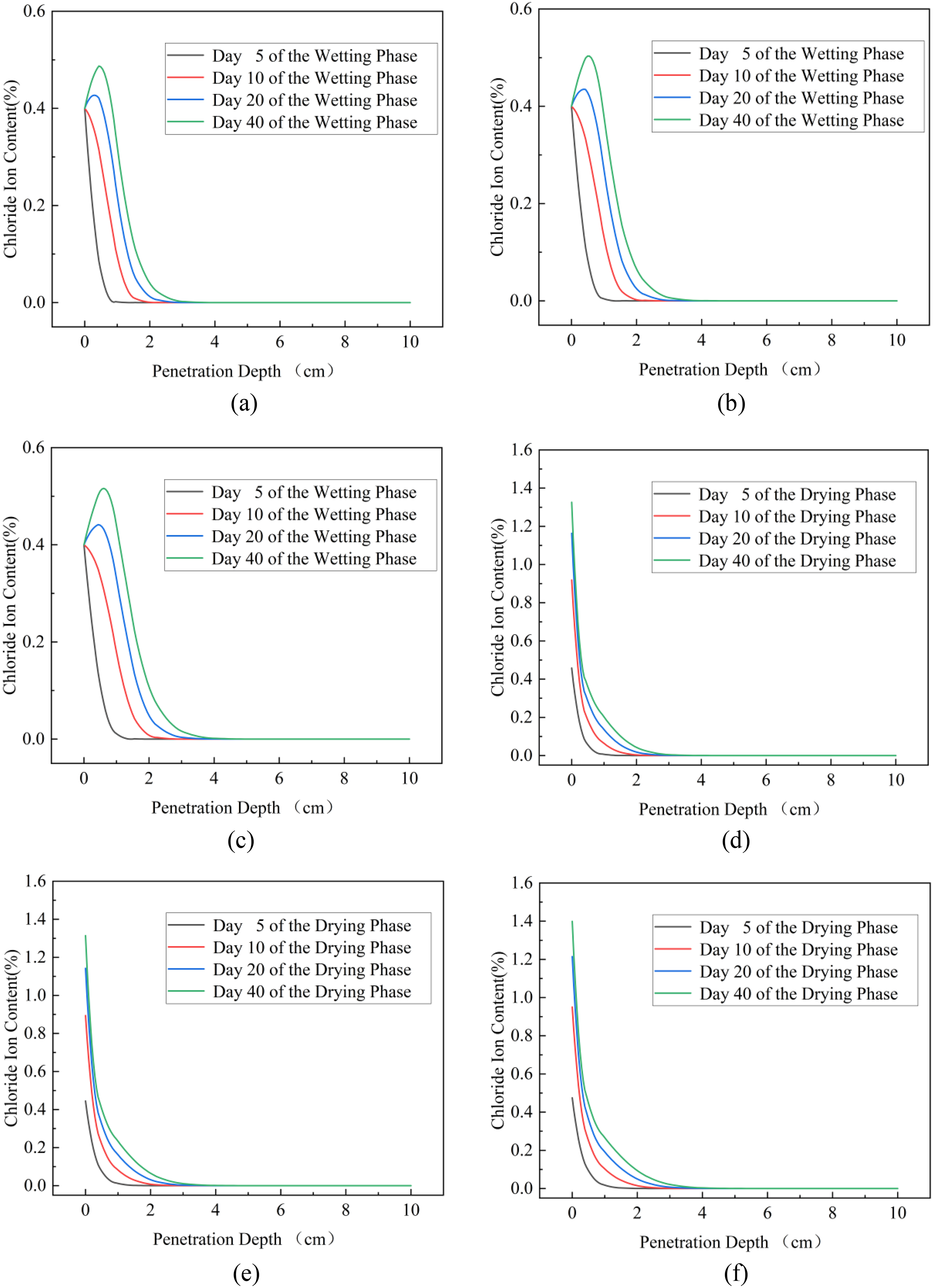
Chloride ion concentration of coal gangue shotcrete with different water–cement ratios under wet-dry cycle conditions. (a) W/C ratio 0.4, wetting phase, (b) W/C ratio 0.5, wetting phase, (c) W/C ratio 0.6, wetting phase, (d) W/C ratio 0.4, drying phase, (e) W/C ratio 0.5, drying phase, and (f) W/C ratio 0.6, drying phase.
The moisture profiles at 5 days and 10 days indicate that chloride ion penetration remains at relatively shallow levels during the period. This phenomenon is principally attributed to the dominance of diffusion mechanisms, where lower water content is associated with weaker migration driving forces. Therefore, chloride ion migration is confined to diffusive transport through the shotcrete matrix. However, the drying curves at 5 days and 10 days indicate a decrease in boundary saturation of the shotcrete, with moisture continuously migrating toward the surface and evaporating. At this stage, chloride transport mechanisms are complicated by superimposed processes. While diffusive movement persists, convective transport activated by water flux is identified as an additional contributor to boundary-ward ion displacement. Nevertheless, due to confinement at the physical boundary, the ions are unable to escape, resulting in relatively shallow penetration.
During the 20-day wet phase, the convection and diffusion fluxes of chloride ions act in the same direction, thereby boosting transport into the interior of the shotcrete. As clearly demonstrated in the figure, the chloride ion distribution profile is observed to advance significantly into the material. During the subsequent 20-day drying phase, moisture continues to migrate toward the boundary, where it evaporates and leads to surface accumulation. Consequently, the surface concentrations of chloride ions are significantly higher compared to the wet phases.
During the 40-day wetting phase, the chloride ion concentration distribution exhibits a pronounced peak, attributable to the extremely short duration of moisture replenishment. This pattern is characteristic of chloride ion behavior in unsaturated shotcrete. Chloride-bearing moisture is reintroduced into pore structures, initially diluting surface concentrations before transporting additional ions into internal pores. As the moisture progressively penetrates into the interior, it transports additional chloride ions into the internal pores. Given the inherently low internal chloride concentration within the shotcrete matrix, the influx leads to the formation of a zone with a sharp increase in concentration at a certain depth below the surface. Through successive dry-wet cycles, surface chloride accumulation is intensified during drying phases, while subsequent wetting phases are shown to propagate ions deeper into the matrix. This cyclic mechanism is recognized to produce progressive chloride accumulation at subsurface depths, generating pronounced concentration peaks.
The various mineral components in coal gangue can undergo physical adsorption or chemical reactions with chloride ions, and the interactions between these minerals and chloride ions are constantly changing. During the drying phases, adsorbed chloride ions may accumulate in localized regions as a result of water loss. In the subsequent wetting phase, newly introduced chloride ions engage in additional adsorption or chemical reactions with mineral components, thereby further influencing the migration and distribution of chloride ions within the shotcrete and promoting the development of a distinct peak in the chloride concentration profile. With increasing cycle numbers, peak magnitude is observed to amplify while peak location is progressively shifted inward.
During the 40-day drying phases, the repeated wet-dry cycles enhance the convective and diffusive transport of chloride ions within the shotcrete. Each evaporation event promotes further chloride ion accumulation, leading to a substantial increase in chloride concentration during the later stages of drying.
As quantified in Figure 5, an increase in the water–cement ratio leads to accelerated chloride ion ingress, greater penetration depth, and higher chloride concentrations at equivalent depths. The behavior is attributed to elevated porosity and reduced matrix density associated with higher water–cement ratios, which enhance the diffusivity of chloride ions. The coal gangue shotcrete exhibits optimal resistance to chloride ion penetration at a water–cement ratio of 0.4.
As illustrated in Figures 5 and 6, the coal gangue shotcrete with a water–cement ratio of 0.4 exhibits a slower chloride ion erosion rate and a shallower penetration depth compared to ordinary shotcrete with the same water–cement ratio. This indicates that coal gangue improves the pore structure by decreasing pore connectivity, thereby enhancing resistance to chloride ion ingress.

Chloride ion concentration of ordinary shotcrete with a water–cement ratio of 0.4 under wet-dry cycle conditions. (a) Wetting phase, (b) drying phase.
Based on the above analysis, it is concluded that the higher the water–cement ratio, the faster the chloride ion erosion rate. A water–cement ratio of 0.4 provides the optimal resistance to chloride ion erosion. Coal gangue shotcrete exhibits superior resistance to chloride ion erosion compared to ordinary shotcrete. With an increasing number of dry-wet cycles, chloride ions penetrate more deeply into the concrete matrix, leading to progressively severe erosion damage. The wetting phase constitutes the primary period for rapid chloride ion ingress, whereas the erosion rate decreases during the drying phase, although the deterioration process continues to advance.
Laboratory investigation on chloride salt erosion under dry-wet cycles
Experimental materials
This paper employs P.O42.5 ordinary Portland cement and grade II fly ash as cementitious materials, river sand as fine aggregate, and natural crushed stone along with crushed coal gangue as coarse aggregate, with a maximum particle size of 15 mm for all crushed materials. Figure 7 presents the jaw crusher used in the experiment, while Figure 8 displays the coal gangue samples sourced from Shigetai Coal Mine. Polycarboxylate water reducer and alumina cement accelerator are incorporated as chemical admixtures. The coal gangue is subjected to prewetted after crushing and screening, and its chemical composition is summarized in Table 1.
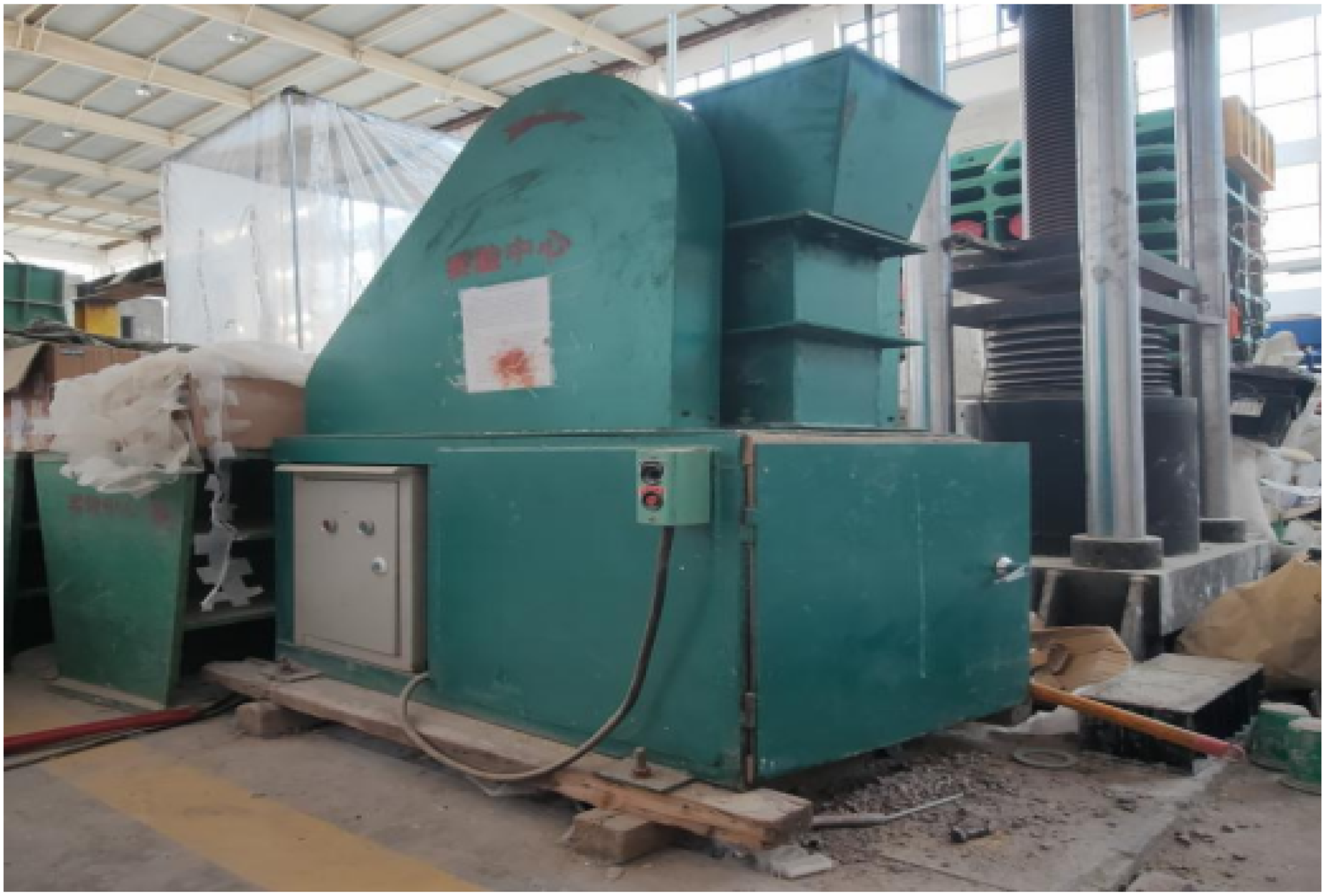
Jaw crusher.

Coal gangue from Shigetai Coal Mine.
Chemical composition of coal gangue (%).

Characteristics of coarse aggregate
Physical Performance Indicators
The physical property indices are tabulated in Table 2. The moisture content and water absorption rate can influence the rate and depth of chloride ion penetration, as well as moisture ingress. Additionally, the apparent density of the material affects the porosity of the specimens, which in turn influences the diffusion behavior of chloride ions.
Microstructural Analysis of Coal Gangue via Electron Microscopy
Physical property indices.

Scanning electron microscope analysis of coal gangue from Shigetai Coal Mine reveals a rough surface morphology and weak interparticle bonding, which facilitates the formation of microcracks that serve as pathways for ion erosion (as shown in Figure 9). Additionally, the presence of small pores enhances the adsorption of moisture and ions, thereby exacerbating material deterioration during dry-wet cycles. Distinct interfacial gaps and structurally disordered regions are detected, revealing inherent instability and elevated susceptibility to ionic corrosion. The formation of interconnected channel networks is observed, facilitating inward penetration of aqueous solutions and ionic species. The coal gangue exhibits significant variation in particle size and contains abundant pores and microporous structures between particles, indicating high porosity and a large specific surface area, which enhance the adhesion of water molecules and ions. Based on the above analysis, it can be inferred that these inherent characteristics of coal gangue may exacerbate solution-induced erosion in coal gangue shotcrete under dry-wet cycling conditions.

Scanning electron microscope (SEM) microstructure of coal gangue from Shigetai Coal Mine. (a) 5000×, (b) 5000×, (c) 10000×, (d) 20000×.
Preparation of shotcrete
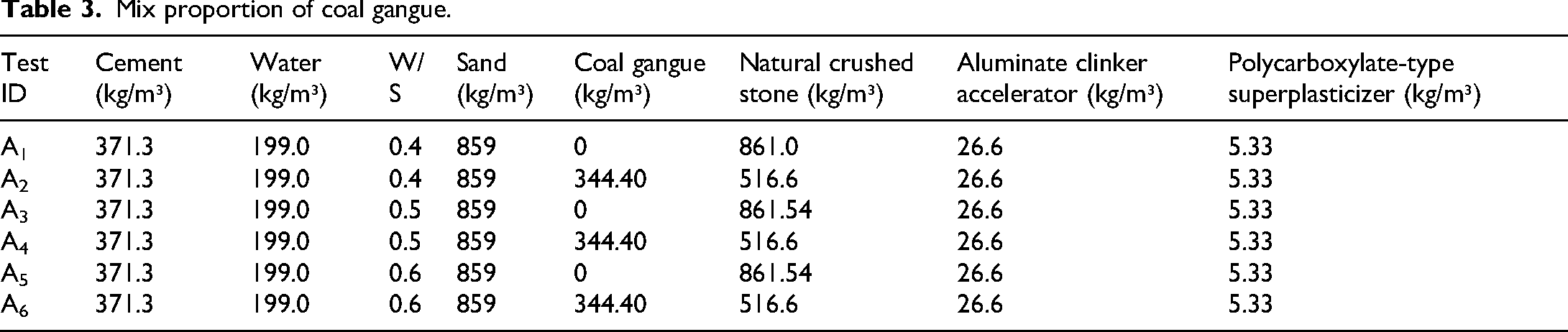
Ordinary shotcrete and coal gangue shotcrete are prepared. Coal gangue is applied to replace crushed stone at a mass fraction of 40% to prepare coal gangue shotcrete. According to the “Technical Code for Rock and Soil Anchoring and Shotcrete Support Engineering” (GB50086—2015), where 500 mm × 500 mm × 120 mm slabs are initially cast and cured for 7 days. These slabs are subsequently sectioned into 100 mm × 100 mm × 100 mm cubic specimens, followed by standard curing until 28-day maturity. The specimen preparation sequence is detailed in Figure 10. For specimens used to investigate the depth of erosion, five surfaces are coated with epoxy resin, and the remaining surface perpendicular to the direction of the jet is used as the erosion surface to ensure unidirectional erosion. The shotcrete mixtures are designated A1 to A6, with complete mix formulations provided in Table 3.
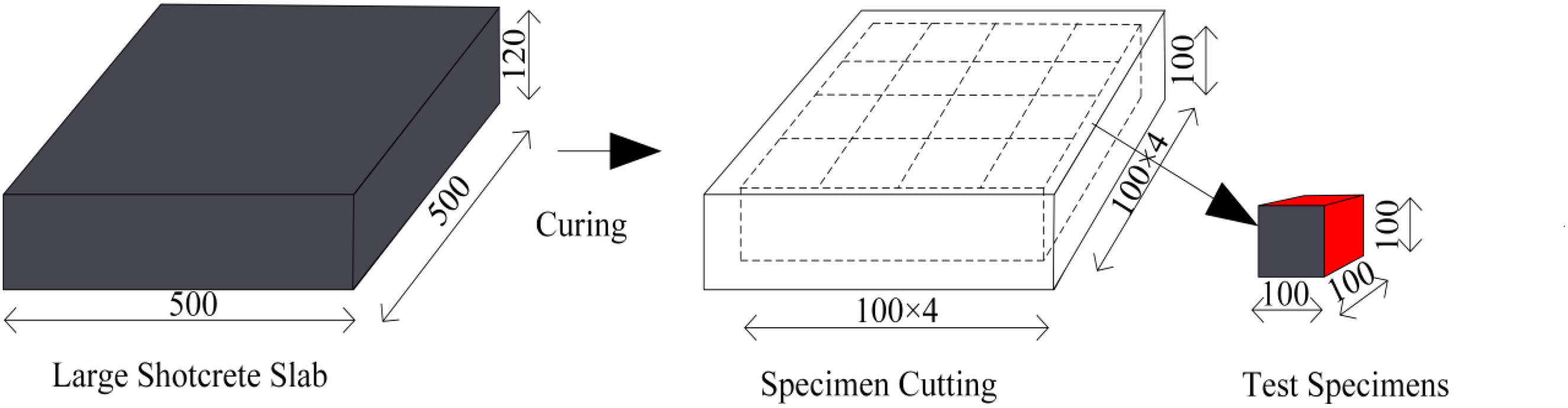
Schematic diagram of experimental specimen preparation.
Mix proportion of coal gangue.
Experimental method
The relative humidity in the simulation test chamber is controlled at 40%. The mass fraction of the chlorinated salt (NaCl) solution utilized to erode the shotcrete specimens is set at 10%. Each wetting and drying cycle lasts for 4.0 h, with a 0.5-h spray and a 3.5-h drying period. The chloride salt solution is replaced every 5 days. The erosion ages are selected as 5, 10, 20, and 40 days. At these times, the powder of shotcrete within the depth range of 0–5 mm is drilled out to measure the change in the chloride ion content on the surface of the shotcrete specimens. At each age, the powder of shotcrete at 5, 10, 15, 20, and 25 mm is drilled out, respectively, and the chloride ion content in each powder sample is determined by the silver nitrate titration method, expressed as a percentage of the shotcrete mass.
Analysis of experimental results
Chloride ion erosion behavior under varying water–cement ratios
The distribution of chloride ion concentration with age under different water–cement ratios is shown in Figures 11–13. As depicted in the following figure, coal gangue shotcrete with a 40% replacement ratio exhibits superior chloride ion resistance compared to ordinary shotcrete. The porosity of coal gangue aggregates leads to a local low water–cement ratio in the interfacial transition zone, resulting in higher density. The water-releasing characteristic of coal gangue aggregate in the later hydration stages promotes sustained hydration of the cement paste at the aggregate interface and surrounding regions, thereby further improving the microstructural densification. It is evident that an appropriate substitution rate of coal gangue aggregate can modify the pore structure by reducing the proportion of harmful pores, thereby enhancing the compactness of shotcrete. As the erosion age increases, the chloride ion concentration at the same depth becomes larger and larger, a result of long-term accumulation of chloride ions. With the increase of erosion time, the chloride ion erosion becomes more and more obvious, and the depth becomes deeper. Along with the increase in the water–cement ratio, the erosion of chloride ions speeds up. The larger the water–cement ratio, the greater the porosity of the shotcrete, the poorer the density, and the faster the diffusion speed of chloride ions. With the advancement of the depth, the rate of decrease in chloride ion concentration gradually diminishes, indicating a progressive reduction in chloride ion diffusion. At a constant water–cement ratio of 0.4, the chloride ion concentrations in coal gangue shotcrete at 40 days of age across the depth range of 0–25 mm are measured as 0.7%, 0.4%, 0.24%, 0.11%, 0.04%, and 0.01%, respectively, compared to 0.8%, 0.47%, 0.28%, 0.13%, 0.05%, and 0.01% for ordinary shotcrete under the same conditions. These results demonstrate that an appropriate substitution rate of coal gangue aggregate can effectively reduce the rate of chloride ion transport.

Variation of chloride ion concentration distribution with age under 0.4 water–cement ratio.

Evolution of chloride ion distribution with curing time at water–cement ratio of 0.5.

Temporal evolution of chloride ion distribution at water-to-cement ratio of 0.6.
Surface chloride ion concentration analysis
The data of the chloride ion content on the surface of the shotcrete specimens varying with the erosion age are depicted in Figure 14. The chloride ion content on the surface of the shotcrete specimens increases with the extension of the erosion age during the initial stage of erosion. The growth rate is relatively high in the initial stage and subsequently decreases gradually. The chloride ion concentration in coal gangue shotcrete remains consistently lower than that in ordinary shotcrete, indicating the superior resistance to chloride ion penetration of shotcrete with a 40% replacement level of coal gangue. As the water–cement ratio increases, the surface chloride ion concentration of the specimens also continuously increases. At 49 days, when the water–cement ratios are 0.4, 0.5, and 0.6, the chloride ion concentrations of the ordinary shotcrete are 1.25%, 1.44%, and 1.73% respectively. Therefore, both the water–cement ratio and the incorporation of a certain amount of coal gangue aggregate can influence the rate of chloride ion transport.

Surface chloride accumulation kinetics in shotcrete specimens.
The experimental analysis presented above demonstrates that the experimental results are in good agreement with the numerical simulation results, confirming the accuracy of the moisture-chloride ion transport model and the feasibility of applying numerical simulation for predicting chloride ion erosion in shotcrete.
Conclusions
A coupled moisture-chloride transport model has been developed to elucidate the interrelationships between moisture transport, chloride migration, and water–cement ratio in coal gangue-modified shotcrete.
Numerical simulations conducted using COMSOL Multiphysics were performed to analyze chloride diffusion behavior at a 40% gangue substitution rate, demonstrating that a water–cement ratio of 0.4 offers superior chloride resistance and enhanced performance compared to conventional shotcrete.
Experimental results under dry-wet cyclic conditions demonstrate spatiotemporal variations in surface chloride concentration, confirming that chloride accumulation intensifies with prolonged exposure time and elevated water–cement ratios.
The transport model is validated through experimental comparisons, offering a scientifically robust approach for investigating chloride ingress while promoting sustainable gangue utilization to minimize solid waste and safeguard fragile ecological systems.
Footnotes
Acknowledgements
National Key R&D Program of China (2018YFC0604700), National Natural Science Foundation of China (Grant No. 51474134), Funding for basic scientific research business of central universities (Grant No. 3142022002).

Declaration of conflicting interests
The author(s) declared no potential conflicts of interest with respect to the research, authorship, and/or publication of this article.
Funding
The author(s) received no financial support for the research, authorship, and/or publication of this article.