



Abstract
This paper presents a mathematical model for studying heat transfer in a spacecraft multi-layered thermal protection system, focusing on material properties and thickness optimization. The heat equation is solved using the immersed finite element method, which efficiently handles material discontinuities at layer interfaces. Simulations are conducted for a three-layer thermal protection system with materials such as carbon composites, ceramics, and insulating foams. Results show the impact of material selection and layer thickness on thermal performance, providing valuable insights for spacecraft design. The study demonstrates the effectiveness of the immersed finite element method for multi-material heat transfer problems in aerospace applications.
Keywords
Introduction
Thermal protection systems (TPS) are vital for ensuring the safety and functionality of structures and devices exposed to extreme thermal environments. These systems play a critical role in regulating heat transfer, preserving structural integrity, and maintaining operational reliability under high thermal loads. 1 TPS applications span various industries, including aerospace, automotive, and energy, where materials and designs must withstand severe temperature fluctuations and intense heat fluxes. 2 For instance, in the context of spacecraft design and operation, TPS play an indispensable role in enabling missions that involve atmospheric entry, planetary exploration, and high-speed maneuvers. They protect the spacecraft and its payload from the extreme thermal environments encountered during these missions, ensuring both structural integrity and operational safety. 3 As space exploration pushes the boundaries of speed, the development of efficient, reliable, and innovative TPSs has become increasingly significant.
Mathematical modeling of heat transfer in TPS provides a powerful tool for understanding and predicting thermal behavior under various scenarios. Among these models is the heat equation which describes the distribution of temperature over time and space and serves as a fundamental tool for studying thermal dynamics in complex systems.4, 5 However, solving this equation for multi-layered systems with complex geometries and varying material properties presents computational challenges. In this context, many recent studies have addressed advanced modeling techniques in fluid-based heat transfer, such as fractional rheology in oscillatory ducts, 6 shear-induced heating in nanoliquids under magnetic fields, and thermophoretic effects in MHD stagnation-point flows,7, 8 in addition to non-Fourier approaches like the Cattaneo–Christov theory for capturing nonlocal heat conduction behaviors. 9 On the other hand, other models tackled solid-state heat conduction in stratified media facing challenges posed by sharp interfacial discontinuities and heterogeneous thermal properties. Other recent studies have addressed thermoelastic and thermal responses in multi-layer materials, emphasizing accurate modeling at interfaces. For instance, Tokovyy et al. 10 and Perkowski et al. 11 explored homogenized and multi-layer models for thermal stress and surface deflection, while Huang et al. 12 proposed a macro–micro finite element approach for identifying elastic parameters in ceramic composites. Analytical solutions for multi-layer stress evaluation 13 and investigations into the impact of porosity on high-temperature behavior 14 further highlight the complexity of these systems.
Numerical modeling of heat transfer in multi-layer materials has been extensively studied using a variety of computational techniques. Traditional finite element methods (FEMs) are widely used due to their flexibility in handling complex geometries; however, they require body-fitted meshes that conform to material interfaces, which can complicate mesh generation for multi-layer domains.15, 16 As an alternative, finite volume methods offer good conservation properties and are frequently used in engineering applications, but they may struggle with interface resolution in heterogeneous materials. 17 Furthermore, the extended finite element method was later introduced to address interface discontinuities without mesh conformity by enriching the solution space, but its implementation can become complex and computationally intensive.18, 19 More recently, interface-fitted and unfitted approaches have been developed to improve interface handling. 20
In this study, immersed finite element (IFE) method is proposed to address challenges faced by the classical numerical techniques. The IFE method is a numerical approach used for solving boundary and interface problems in complex domains, and known for its flexibility in handling complex geometries and discontinuous material properties.21, 22 The IFE method eliminates the need for conforming meshes, allowing efficient computation in multi-layered configurations without sacrificing accuracy. 23 By integrating IFE method with advanced computational techniques, this paper explores the heat transfer dynamics in multi-layered TPS, providing insights into the influence of material properties and thicknesses on thermal performance.
In fact, the original concept of immersed methods in general was introduced by Peskin 24 in the context of fluid–structure interaction problems, where the immersed boundary method was developed to model the interaction of flexible boundaries with fluid flow. However, the immersed boundary method lacked the rigorous numerical framework for problems with sharp discontinuities. Hence, Li et al.25–27 extended the idea by introducing the IFE method, which incorporated interface conditions directly into the weak formulation of the FEM. In the IFE method, the computational mesh is independent of the geometry of the interfaces, and the method uses special basis functions to capture discontinuities in the solution and its derivatives. This approach avoids the need for the generation of meshes that are fitted to the interface, making it suitable for problems involving complex and/or multiple interfaces. For more details about the IFE method and its advantages, we refer the reader to the following references.28–36 Moreover, significant efforts have been made to enhance the accuracy and stability of the IFE method. For instance, Adjerid et al. 37 introduced enriched high-degree IFE basis functions, which effectively capture high-order discontinuities at material interfaces, improving the method's precision and reliability. Theoretical studies, including error analysis and convergence investigations have further validated the reliability of the method for practical applications. 38 Additionally, adaptive mesh refinement strategies have been also investigated, ensuring accurate solutions with optimized resources. 39
The first objective of this study is to develop a mathematical model for multi-layered TPSs using the heat equation as the governing framework. Furthermore, we intend to implement and validate the IFE method for solving the considered model problem, enabling a detailed investigation of the thermal behavior of a spacecraft TPS under various configurations. This includes analyzing the effects of material selection and layer thickness on thermal performance and providing insights into the design and optimization of TPS configurations for enhanced efficiency and reliability. By combining mathematical modeling, advanced numerical techniques, and computational analysis, this work aims to contribute to the ongoing efforts in improving the design and performance of TPSs for various applications, particularly, the spacecraft applications.
This paper is structured as follows. In The mathematical model section, we introduce the mathematical model and governing equations for the TPS. In Solving the model using immersed finite element method section, we detail the implementation of the IFE method. In Implementation of the immersed finite element method section, we discuss the theoretical analysis and computational advantages of IFE method. In Numerical results section, we present the numerical simulations and their results, along with an interpretation of key findings. Finally, in Conclusion section, we conclude the study and outline directions for future research.
The mathematical model
The considered TPS is modeled as a one-dimensional multi-layered structure, composed of M layers and exposed to heat flux on its surface. The heat transfer process within the TPS is governed by the heat equation with diffusion term. Each layer is characterized by unique material properties such as thermal conductivity, density, and specific heat capacity. The model problem, boundary conditions, and initial conditions are as follows.
Governing equation/model
The heat conduction in each layer of the TPS is locally described by the heat equation with diffusion. Hence, at each layer k (with: 1 ≤ k ≤ M), the model is written as follows: Tk(x, t) is the temperature in layer k as a function of position x and time t; ρk is the density of material in layer k; ck is the specific heat capacity of material in layer k; βk is the thermal conductivity of material in layer k; xk−1 and xk are the boundaries of layer k.

Also, the top boundary of the first layer is x0 = 0, while the bottom part of the bottom layer is denoted as xM = L.
Boundary conditions and interface jump conditions
It is essential to define appropriate boundary conditions and interface jump conditions to accurately model the thermal behavior. At the exposed surface (x = 0), a convective heat flux is applied, leading to the following boundary condition: qconv is the applied heat flux; h is the convective heat transfer coefficient; T∞ is the ambient temperature.

Furthermore, at the back surface (x = L, the end of the last layer), we have the following additional boundary condition:

On the other hand, interface jump conditions need to be set up at the interface between the two-layer guaranteeing the continuity of the solution and the flux. Hence, at the interface between two adjacent layers (x = xk), continuity of temperature and heat flux are enforced, respectively, as follows:


Moreover, the initial temperature distribution in the system is assumed to be uniform and equal to the ambient temperature, providing the following initial condition:

The mathematical model described above is then discretized and solved numerically using the immersed FEM. The multi-layered structure is represented as a single computational domain with discontinuities in material properties handled implicitly. Details of the numerical implementation are presented in Solving the model using immersed finite element method section.
Solving the model using immersed finite element method
To solve the model problem (2.1) for the multi-layered TPS, we opt to use the IFE method. In fact, the IFE method is conveniently suitable for problems involving complex geometries and/or discontinuities in the material properties, since it allows for the representation of multi-material domains on a non-conforming mesh. Hence, in this section, we provide an overview of the IFE method framework, its implementation for the considered model problem, and its advantages for this particular problem.
Overview of the immersed finite element method
The IFE method is useful for solving several engineering and scientific problems, such as problems in material sciences, electromagnetism, and fluid dynamics. In particular, it can be applied to solve the multi-layer TPS model (2.1). In fact, in the standard FEM, the computational mesh is required to conform to the geometric boundaries and material interfaces. In contrast, the IFE method allows the mesh to be independent of the material interfaces, which are embedded within the computational domain. This flexibility simplifies the mesh generation and enables efficient modeling of multi-material systems. Indeed, it makes the IFE method efficient compared to other standard methods, since higher accuracy can be easily obtained using the IFE method with simply coarse mesh. Therefore, the key idea of the IFE method is to modify the standard finite element shape functions to incorporate discontinuities in material properties. These modified shape functions, called IFE shape functions, are constructed to satisfy the interface conditions of continuity in temperature and heat flux.
The immersed finite element space
Let Eh be a regular mesh of size h formed over the domain [0, L], where h is the maximum size of the elements (Figure 1 illustrates the case of two layers—one interface point). Any element containing an interface point αk is referred to as an interface element, the other elements are referred to as non-interface elements. As illustrated in Figure 2, the interface element E = [hi, hi+1] can be split as E = E+ ∪ E− where E+ = [hi, α] while E− = [α, hi+1].

A sample mesh on a layer [a, b] with an immersed interface point α.

A sample interface element.
For the non-interface elements, standard finite element spaces and Lagrange shape functions are used. For the interface element, we develop special shape functions which satisfy the Lagrange nodal value conditions in addition to the interface jump conditions (2.4).
The weak formulation of the proposed IFE method for the heat equation (2.1), applied to the multi-layered TPS, is obtained by multiplying the governing equation by a test function

This approach ensures that the solution satisfies the heat equation in an integral sense, accommodating the complexities introduced by the multi-layered structure. The interface conditions are implicitly satisfied by constructing IFE shape functions which incorporate the material discontinuities.
Equation (3.1) can be written also as the sum of integrals over each layer L k as follows:

Applying integration by parts on each layer L
k
of Ω then combining the terms, we obtain

Construction of immersed finite element shape functions
As mentioned earlier, the computational domain Ω = [0, L] is discretized using a uniform grid. To construct the IFE shape functions, the standard finite element shape functions are modified to satisfy the interface jump conditions. For a given element that intersects a material interface, the shape functions are split into subdomains corresponding to the materials. The following properties are enforced:
Continuity of temperature across the interface (2.4a); Continuity of heat flux across the interface (2.4b).
The resulting shape functions are piecewise-defined within the intersecting elements and retain standard finite element properties elsewhere.
Temporal discretization
We also perform a uniform discretization in time into τ intervals with time step size denoted as Δt while the discrete time points are denoted as tn, n = 1, · · ·, τ . The time derivative is discretized using the implicit backward Euler scheme for stability:

Advantages of immersed finite element method
The use of the IFE method for the multi-layered TPS problem has several advantages:
Implementation of the immersed finite element method
The implementation of the IFE method for solving the multi-layered TPS model involves discretizing the computational domain, constructing the IFE shape functions, assembling the system of equations, and solving for the temperature distribution over time.
Construction of the immersed finite element shape functions
The computational domain Ω is discretized into N elements, each defined by a uniform grid spacing Δx. The nodes of the grid are denoted as
Furthermore, the IFE shape functions are constructed to satisfy the interface conditions. For elements intersecting material interfaces, the shape functions are split into subdomains corresponding to the materials. These functions are defined piece-wisely ensuring both: (i) the continuity of temperature across the interface, and (ii) the continuity of heat flux across the interface, scaled by the thermal conductivity. The resulting shape functions are computed locally for each element and stored for assembly into the global system matrix.
Assembly of the global system
For each element


The global system matrix

Hence, the resulting linear system of equations at each time step will be:

Furthermore, the temperature is updated iteratively for each time step using the implicit backward Euler scheme:

This approach ensures numerical stability, particularly for the large thermal gradients expected in TPS applications.
Numerical implementation
In sum, the numerical implementation can be summarized according to the following steps:
Define the computational domain, material properties, and initial conditions. Construct the IFE shape functions. Assemble the global system matrix and load vector. Apply boundary conditions. Solve the linear system iteratively for each time step. Store and visualize the temperature distribution.
Furthermore, to clarify the implementation procedure, a detailed flowchart outlining the computational steps is presented in Figure 3. This diagram illustrates the overall workflow from mesh generation to numerical solution, highlighting how interface conditions are incorporated into the IFE framework.

Flowchart of the IFE method key implementation steps, for the multi-layer heat conduction problem. IFE: immersed finite element.
Numerical results
In this section, we present numerical simulation results including the temperature distribution and the effects of the material properties and thickness variations on the thermal performance. First, in Figure 4, we present the sample configuration of the considered three-layered TPS, while in Table 1 and Table 2 we display the boundary conditions and the mesh parameters used in the simulation. Additionally, in Table 3 and Table 4, we present the different material properties and the geometry parameters, respectively, which are used in the simulation process under different material configurations.

A sample configuration of a three-layered TPS. TPS: thermal protection system.
Boundary conditions and initial conditions used in the simulation.

Simulation parameters for the multi-layered TPS model.

TPS: thermal protection system.
Material properties of the considered three-layered TPS for the different cases.

TPS: thermal protection system.
Geometry parameters of the multi-layered TPS model for the different cases.
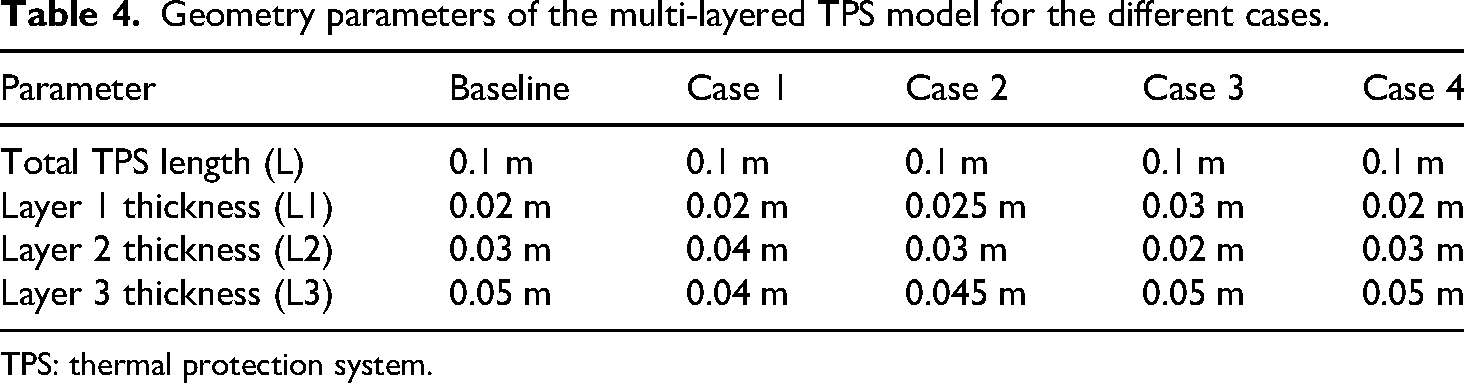
TPS: thermal protection system.
To assess the final temperature profile across the TPS, we first display in Figure 5 the final temperature profile across the TPS. The plot shows the steady-state temperature distribution in the TPS at the end of the simulation for each case, illustrating the effects of material property changes on the thermal performance. We observe that for the baseline case as well as for the cases of materials 2, 3, and 4 (respectively characterized by lower β2, lower β3, and higher ρ3/c3), the temperature gradient is smooth, with a steady decrease from the high-temperature boundary to the insulated side. The temperature drop across each layer reflects the thermal conductivities of the materials. Specifically, the middle layer, with the highest thermal conductivity, allows for more rapid heat transfer, resulting in a smaller temperature drop compared to the outer layers. Conversely, in the first case of material where β1 is higher, increasing the thermal conductivity of the first layer reduces the temperature drop across it, enabling heat to penetrate more efficiently into the subsequent layers and raising their temperatures.
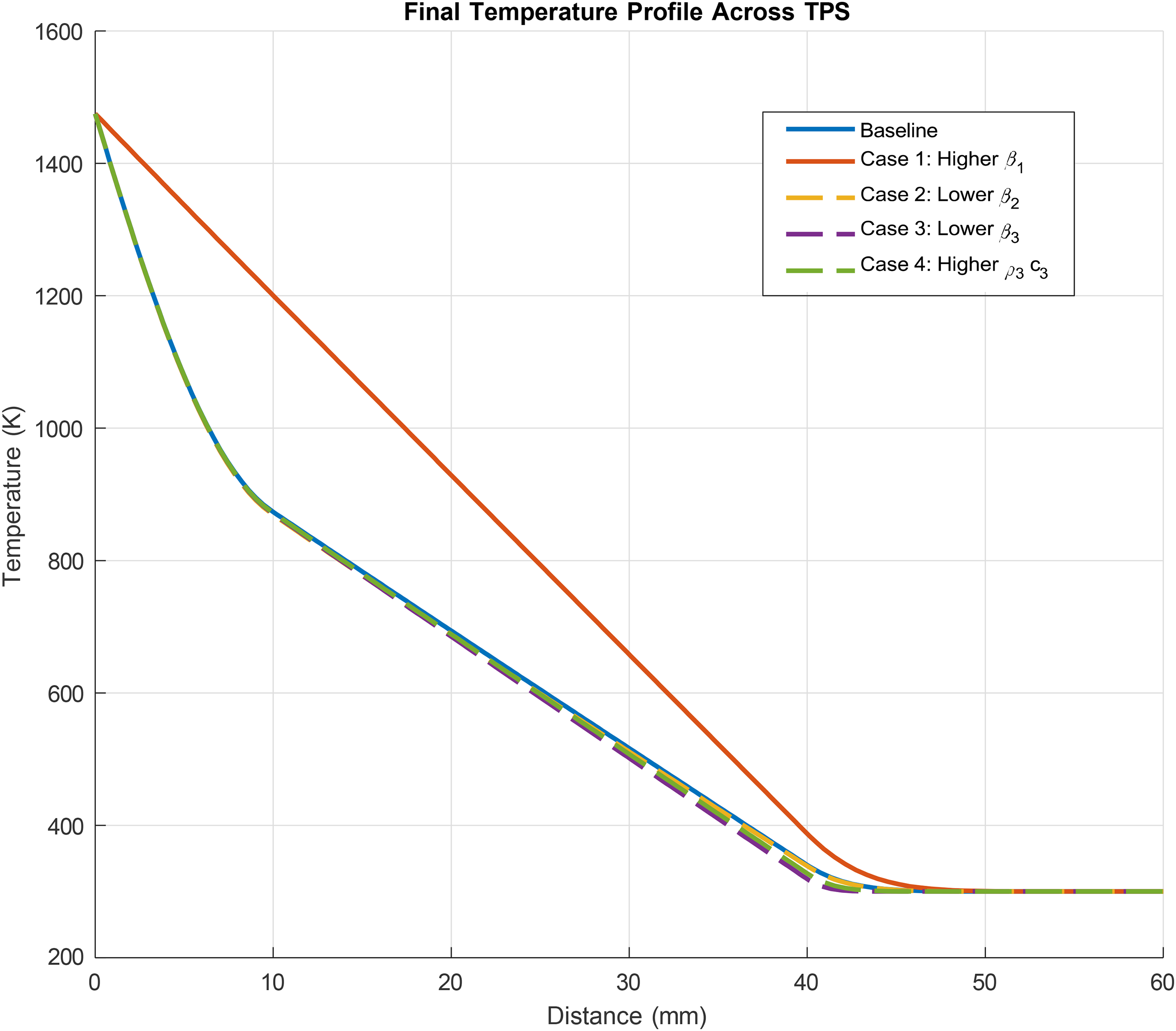
Final temperature profile across the TPS for the different cases. TPS: thermal protection system.
Figure 6 displays the temperature vs. time graphs for specific locations, such as the boundaries of the surface and layers. The graphs provide detailed information on the dynamics of heat penetration in the various test cases, revealing the significant influence of the material properties and configurations on the performance of the TPS. For the baseline case, the temperature gradient is smooth, with a steady decrease from the high-temperature boundary to the insulated side. The temperature drop across each layer reflects the thermal conductivities of the materials, where the middle layer, with the highest thermal conductivity, allows for more rapid heat transfer, resulting in a smaller temperature drop compared to the outer layers. In Case 1, where the first layer has a higher thermal conductivity (β1), the temperature drop across this layer is reduced, allowing the heat to penetrate more efficiently into the subsequent layers and increasing their temperatures. In Case 2, reducing the thermal conductivity of the middle layer (β2) creates a significant temperature drop across it (due to heat transfer resistance) which enhances thermal insulation but raises the temperature of the first layer. In Case 3, the lower thermal conductivity of the third layer (β3) increases its insulating properties, causing the temperature to remain higher in the inner layers, while the final temperature on the insulated side is lower than in other cases. Finally, in Case 4, with a higher density and specific heat capacity (ρ3 and c3) for the third layer, the heat transfer process is delayed, resulting in a slightly flatter temperature gradient as the material absorbs and stores more heat without significantly increasing its temperature.

Temperature variation with time at different levels of the three-layered TPS. TPS: thermal protection system.
Besides, the surface plots shown in Figure 7 show the dynamic interaction between thermal conductivity, density, and heat capacity. These plots provide a dynamic view of how the temperature evolves over time across the TPS. The following main observations are identified from the analysis of the cases. For the baseline case, the temperature rises rapidly near the high-temperature boundary and propagates through the layers over time. The surface clearly reflects the impact of thermal diffusivity, with the middle layer allowing faster temperature changes. In Case 1 (Higher β1), the heat propagates faster through the first layer due to the higher thermal conductivity, leading to a more significant rise in temperature in the subsequent layers early in the simulation. For Case 2 (Lower β2), the temperature gradient across the middle layer is steeper compared to the baseline, significantly slowing heat transfer and delaying the temperature rise in the third layer. In Case 3 (Lower β3), the third layer acts as a more effective insulator, reducing the heat reaching the insulated side and showing a slower temperature increase near the insulated boundary. Finally, for Case 4 (Higher ρ3 and c3), the higher heat capacity of the third layer delays heat propagation through it, with the surface plot illustrating the third-layer acting as a thermal buffer, absorbing heat while maintaining a flatter gradient.

Surface plots of the temperature variation with time and position in the TPS. TPS: thermal protection system.
In conclusion, we can synthesize our observations in the following main points:
- High thermal conductivity accelerates heat propagation; - Low conductivity increases the temperature gradient, enhancing insulation; - High density and heat capacity slow down heat transfer, acting as thermal buffers.
Comparative study
Compared to other methods, the IFE method shows efficiency in handling the discontinuity. For instance, a comparison with the results reported in40, 41 demonstrates comparable or improved accuracy in key metrics. For example, in the multi-layer benchmark case, our IFE method yielded an error with L2−norm of 2.1 × 10 − 3 that closely matched the accuracy reported by SCTBEM while achieving smooth temperature and flux profiles across discontinuous interfaces. Additionally, the IFE method supports non-conforming meshes, making it more adaptable to complex geometries and interface evolutions that are less tractable for boundary-only methods.
Finally, in Figure 8, an additional test case is provided, which combines both a higher number of layers (five-layer configuration) and a comparative study of the proposed IFE method versus the classical FEM (using body-fit mesh). This comparison highlights the IFE method's ability to maintain accuracy while offering greater flexibility in handling complex multi-layer geometries without requiring mesh conformity.

Temperatures profiles obtained using classical FE vs. IFE methods in a five-layer medium. IFE: immersed finite element.
Practical considerations on layer thickness and material gradients
While the multi-layer configurations and thicknesses employed in the numerical experiments were primarily chosen to demonstrate the accuracy and robustness of the IFE method, the selected dimensions may exceed those typically encountered in practical TPS. For instance, in aerospace applications, TPS coatings are often limited to a few millimeters in thickness to satisfy weight and space constraints. A promising direction in this context is the use of functionally graded materials (FGMs), which feature a gradual variation in thermal properties across their thickness. Such materials, like ZrO2−NiCr alloy-based FGMs, are already being developed and tested for aerospace and hypersonic vehicle applications due to their ability to withstand steep thermal gradients while maintaining mechanical stability. The IFE framework is particularly well-suited for modeling FGMs, as it accommodates spatially varying material properties without requiring interface-fitted meshes. One possible extension of this work is to incorporate FGMs with realistic geometries and gradation profiles into simulations to further enhance the engineering relevance of the methodology.
Implications for thermal protection system design
The generated figures collectively illustrate the effectiveness of different material configurations in mitigating thermal loads. This approach enables engineers to design tailored TPS solutions based on mission-specific requirements. The surface plots and steady-state profiles provide complementary insights into the dynamic and equilibrium thermal behavior, offering a comprehensive understanding of the system's performance. As a result, we can extract the following conclusions and interpretations of the current study on TPS design. The choice of materials with specific thermal properties significantly impacts the performance of the TPS. A high β material is suitable for rapid heat dissipation in regions where overheating is critical, while low k materials provide insulation. Balancing layer thicknesses can optimize the TPS's thermal performance; for instance, increasing the thickness of an insulating layer can improve thermal protection but at the cost of weight and bulk. The transient analysis highlights how materials’ heat capacity and density affect temperature evolution, which is crucial for applications where the TPS must withstand short-term, high-intensity thermal loads, such as during reentry phases.
Conclusion
In conclusion, this study demonstrates the potential of the IFE method as an effective tool for analyzing and designing multi-layered TPSs. By incorporating realistic material properties and solving the heat equation in a computationally efficient manner, the proposed approach provides valuable insights into the thermal performance of different TPS configurations. The findings highlight the importance of carefully selecting material properties and optimizing layer thicknesses to achieve the desired balance between insulation, weight, and thermal dissipation. Additionally, the dynamic thermal behavior observed with the transient conditions highlights the importance of considering time-dependent factors in the TPS design. Future work may consist in extending the current one-dimensional IFE framework to higher dimensions, addressing challenges such as interface basis construction, accurate integration over cut elements, and maintaining stability in complex geometries. It may also consist in generalizing this computational methodology by incorporating more complex boundary conditions and taking into account nonlinear material behaviors, which would enhance its applicability to advanced aerospace applications. Additionally, exploring the use of the discontinuous Galerkin method42, 43 could provide further flexibility and accuracy in handling the interface conditions and capturing localized phenomena within the TPSs.
Footnotes

Author contribution
The author solely carried out the conceptualization, methodology development, software implementation, analysis, writing, and revision of the manuscript.
Funding
The author received no financial support for the research in this article.
Declaration of conflicting interests
The author declared no potential conflicts of interest with respect to the research, authorship, and/or publication of this article.
Data availability statement
No external data was used for the research described in the article.