This study addresses the critical analysis of heat and mass transfer within a time-dependent, viscous fluid flow over an oscillatory stretched curved surface, incorporating variable thermal conductivity and both homogeneous and heterogeneous chemical reactions. The research highlights the influence of heat generation and magnetic fields on energy and momentum equations, employing a curvilinear coordinate system to transform a complex physical problem into a tractable mathematical model. A homotopy analysis method is utilized to derive a convergent series solution for the resulting partial differential equations, enabling a comprehensive parametric investigation of temperature, velocity, concentration, and pressure fields. Extensive graphical and tabular analyses reveal how specific parameters, such as reaction strengths, radius of curvature, and Schmidt number, influence the surface concentration, heat and mass transfer rates, and skin friction coefficient. The insights provided are essential for applications in engineering and industrial processes involving curved surfaces under dynamic thermal and magnetic conditions, such as in chemical reactors, biomedical devices, and materials processing, where precise control of heat and mass transfer is critical for system efficiency and performance optimization.
Heat transmission analysis as well as heat production phenomena by incorporating constant and temperature-dependent thermal conductivity has apprehended the attention of scholars and scientists in the last few years due to its widespread employment in the disciplines of mechanical manufacturing and certain physical procedures such as cooling towers, refrigeration, heat exchangers, equipment power collectors, electric motors, gas turbines, and solar power machinery. Abbas et al.1 evaluated heat production effects along with constant thermal conductivity in nanofluid flow across a stretched curved wall. Saba et al.2 have conducted heat transport analysis for the motion of viscous nanofluid toward a stretchable curved surface and computed the effects of heat generation. Hydromagnetic flow and heat transfer analysis with temperature-dependent thermal conductivity over a curvy surface was considered by Murtaza et al.3 Afridi et al.4 analyzed entropy production in dissipative liquid motion toward a curved sheet by considering the impacts of varying thermal conductivity. Kempannagari et al.5 have considered the influence of temperature-dependent thermal conductivity and Joule heating on non-Newtonian liquid flow across a curved exponential sheet. Kumar et al.6 have detected the significance of Soret–Dufour's effects on radiative flow across a porous plate in the presence of a chemical reaction.
Catalysis, biological procedures, and combustion are examples of chemically reactive structures that include heterogeneous and homogeneous (HH) chemical reactions. The correlation between these chemical reactions is extremely complicated. Dispersal and fog deposition, ceramics manufacture, food production, polymers, and hydrometallurgical procedures are examples of physical systems involving HH chemical reactions. Hayat et al.7 have considered HH reactions in the flow of a micropolar liquid in a curvy channel. Imtiaz et al.8 have scrutinized the consequences of HH chemical reactions in magnetohydrodynamics convective movement of ferro liquid over a stretched curved sheet. Inspection of HH chemical reactions in boundary layer motion toward a nonlinear convectively heated curvy stretchable surface was conducted by Saif et al.9 Hamid10 detected the consequences of HH reactions and variable thermal conductivity on the flow of Williamson fluid. Waini et al.11 have studied equally diffusive chemically reactive hybrid nanoliquid motion over a stretched wall. Abbas et al.12 have scrutinized the impacts of equally diffusive reactions on the oscillatory and radiative motion of Casson nanoliquid toward a curved stretched sheet.
The research of boundary layer liquid motion accompanied by curved stretched surfaces has aroused the concentration of scientists and researchers in recent years because of its broad applications in the sectors of manufacturing, engineering, and industries. Such industrial and manufacturing sectors are the expulsion of polymer sheets from a dye, elongation of plastic films, production of paper, flow generated in hot rolling, and blowing of glass. In all of these procedures, the superiority of the resulting product is greatly affected by the stretching rate of the surface. First, Sajid et al.13 evaluated the numerical results of viscous fluid across a stretching curved surface. After the revolutionary work of Sajid et al.,13 many researchers have performed different research studies on curved surfaces by considering different stretching velocities. Naveed et al.14 have studied hydromagnetic flow toward an unsteady curvy stretchable surface. The examination of viscous liquid motion due to a nonlinear curved stretched sheet was conducted by Sanni et al.15 Okechi et al.16 analyzed the flow of Newtonian fluid over an exponentially curved stretchable wall. Analysis of heat transmission for viscous fluid motion across a generalized stretchable or shrinkable curved sheet was conducted by Naveed et al.17 Narla et al.18 have evaluated the impacts of entropy creation in magnetohydrodynamic flow caused by the stretching of a curved surface. Yasmin et al.19 have detected the consequences of velocity and thermal slips on the radiative motion of hybrid nanoliquid toward a stretched curved sheet. Recently, Imran and Naveed20 conducted a numerical inspection to scrutinize the effects of activation energy and heat production in the curvilinear flow of Carreau nanofluid over a curved wall.
All of the research cited above addresses the flow problems due to either linear or nonlinear and exponential curved stretching surfaces. However, another attractive area of research is in which a surface performs a stretching response across its designated plane with consistent cyclic velocity and is titled as an oscillatory stretchable sheet. In such a situation, the flow mechanism is due to the periodic motion of the surface. The first examination of the motion of Newtonian fluid toward a flat oscillatory stretched sheet was performed by Wang.21 Abbas et al.22 have extended Wang's21 work on a curvy oscillatory stretched sheet and evaluated the stimulus of thermal radiation in the magnetized flow of viscous liquid above on a convectively heated stretched oscillatory curved sheet. Imran et al.23 conducted analytical research for the flow of nanomaterials over a curved oscillating stretching wall and detected the effects of Joule heating and melting heat transport. Naveed et al.24 have considered the impacts of the Cattaneo–Christov heat flux model on the oscillatory motion of micropolar fluid over a curvy stretchable sheet. A detailed and comprehensive literature about various flow problems over curved oscillatory geometries is referenced in the reference section.25–28
Building on previous research, the present study emphasizes the critical importance of investigating flow and heat transfer in viscous fluids with temperature-dependent thermal conductivity, specifically under the influence of HH chemical reactions across a curved oscillating stretched sheet. Such transport phenomena are crucial in various chemical and mechanical engineering applications, including thermal management systems, chemical reactors, polymer processing, and energy conversion technologies. Despite the encouraging relevance of such phenomena, a comprehensive literature review exposes a notable research gap: although some researchers have examined the individual effects of temperature-dependent thermal conductivity, chemical reactions, or their combined influence over flat or curved stretched surfaces, the simultaneous impact of heat and mass transfer in viscous fluids with variable thermal conductivity over a curved oscillating stretchable surface remains largely unexplored. To address this gap, the present study examines the coupled heat and mass transport features in a magnetized flow of a viscous fluid with temperature-dependent thermal conductivity subjected to an oscillating stretchable curved surface. The energy equation incorporates internal heat generation, while the concentration equation accounts for both HH chemical reactions, thereby capturing the complex interplay between thermal and chemical transport mechanisms. An analytical approach namely the homotopy analysis method (HAM) is employed to solve the resulting nonlinear partial differential equations. The findings, presented through comprehensive graphical and tabular analysis, provide valuable insights into the influence of key flow parameters and establish a theoretical foundation for the design and optimization of practical systems such as catalytic reactors, electronic cooling units, and dynamically operated heat exchangers.
Problem description
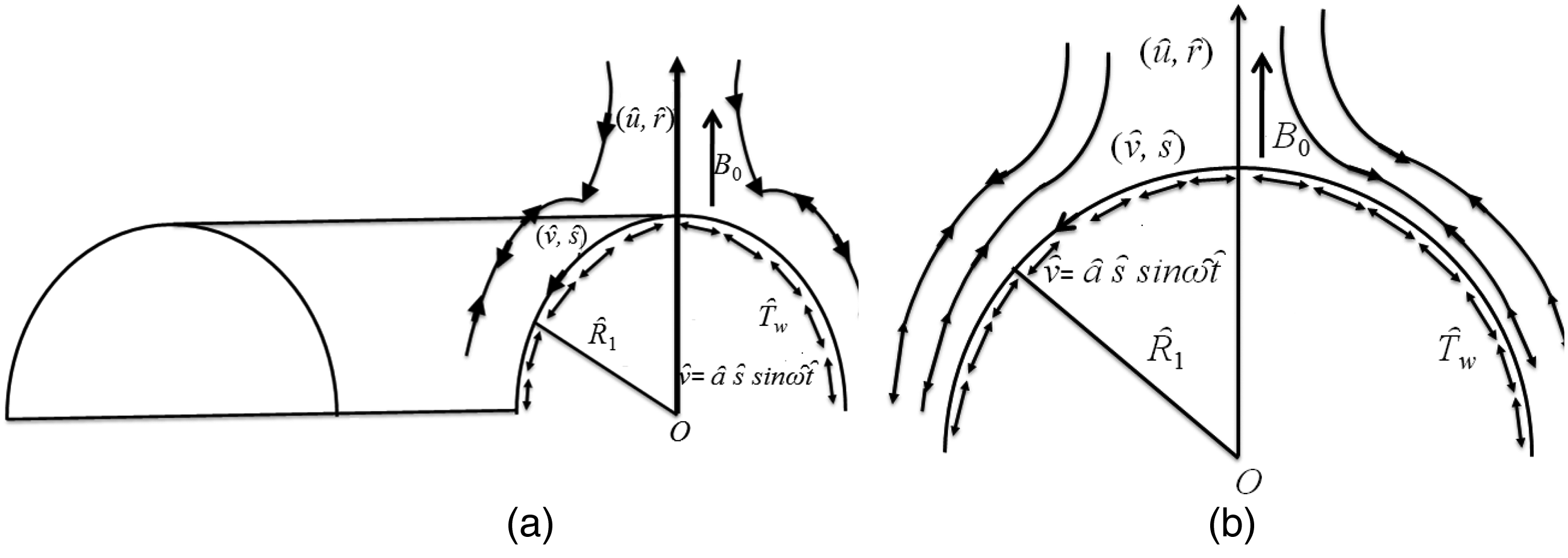
Consider a laminar boundary layer and incompressible electrically conducting unsteady motion of viscous fluid across a stretched curved oscillatory sheet of radius (see Figure 1). The oscillatory velocity of the sheet which is regarded to be the cause of flow mechanism is specified as with and be the stretched rate and the frequency of the oscillatory sheet, respectively. An unvarying magnetic field of amount is forced along the radial direction . The significances of the induced magnetic field are unnoticed due to the very low Reynolds number. Let and represent the oscillatory sheet and the ambient fluid temperatures, respectively, with . Moreover, the characteristics of HH chemical reactions are also explored for two species and . The homogeneous chemical process for the cubic auto catalyst is specified as
Schematic flow geometry.
The heterogeneous chemical reaction on the outer surface is
In the above equations , indicate the strengths of the chemical species and , and , are the rate constants, respectively. Governing equations for the present boundary layer time-dependent viscous liquid motion problem with an applied magnetic field can be written as7,23
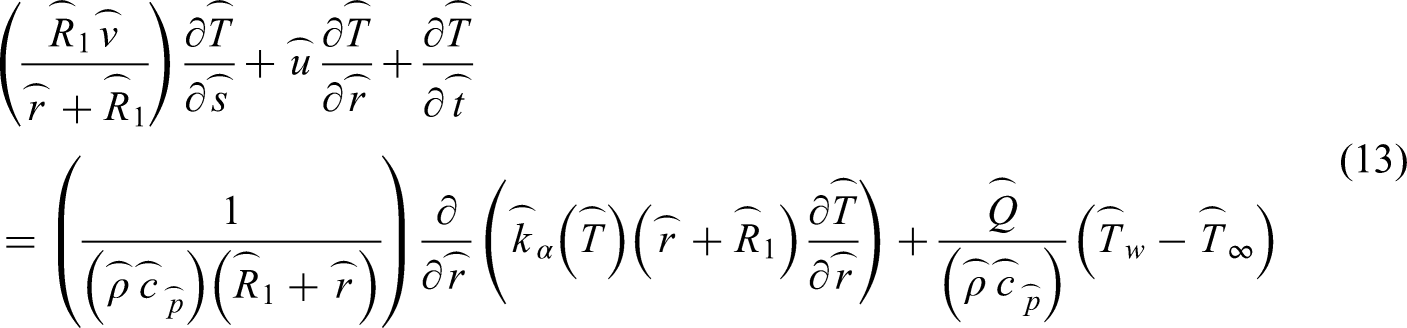
Here, and are the pressure and temperature, is the velocity vector, and are the diffusion coefficients, is the Laplacian operator, and are the volumetric rate of heat production parameter and density, and are the current density and kinematic viscosity, and are the magnetic flux vector and time, is the specific heat capacity, and represent the thermal conductivity of the liquid which is stated as10
in which is a small parameter and is the ambient thermal conductivity of the liquid, respectively.
For the current flow problem, consider the velocity field in the following form:
In the above equation and are the parts of velocity toward the and directions, respectively. By incorporating equation (9) along with boundary layer approximations, equations (3), (4), (5), (6), and (7) can be rewritten as7,12
and equation (8), the continuity equation (10) is identically verified, and the rest of equations (11)–(16) takes the following non-dimensional form:
In the above equations is the magnetic parameter, is the radius of curvature, and are the Prandtl number and the fraction of sheet oscillating frequency to stretched rate of the sheet, is the proportion of diffusion coefficient, is the homogeneous reaction strength, is the Schmidt number, is the heat production parameter, and is the strength rate of heterogeneous reaction parameter, respectively.
After omission of the pressure term between equations (18) and (19), we attain the fluid velocity equation as
The drag wall force and the rate of heat transportation along the curvy surface is defined as
where represents the shear stress and denotes the heat flux and are depicted as
By employing equation (17) in equations (28) and (29), we attain
here, characterizes the Reynolds number.
HAM solution
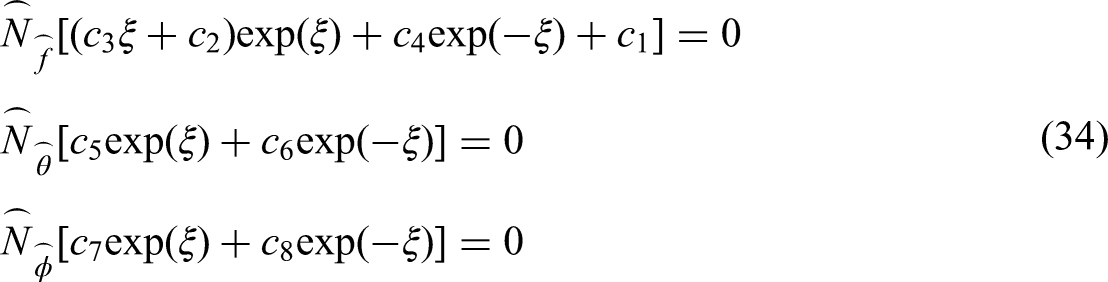
In this section, we proposed HAM to solve the governing equations (20), (24), (26), and (27) by incorporating the auxiliary linear operators and initial guesses indicated below:
with
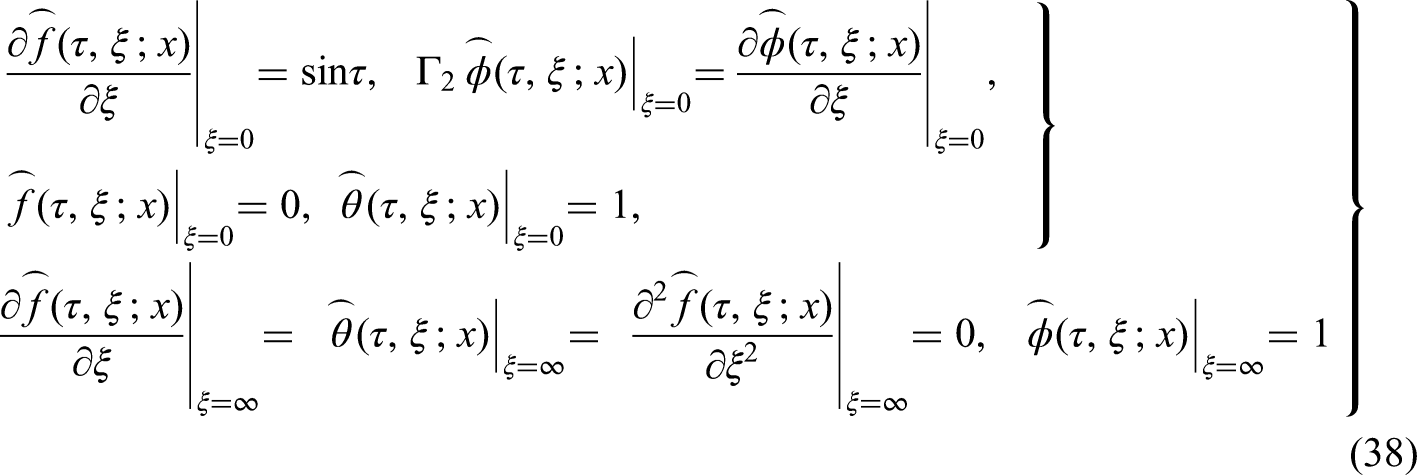
Here, are the arbitrary constants. Let characterizes an embedding variable with , and are non-zero auxiliary variables. One can construct the zeroth-order deformation expressions as
subject to boundary conditions:
The associated non-linear operators are designated as
put and in equations (35), (36), and (37), the following results are accomplished:
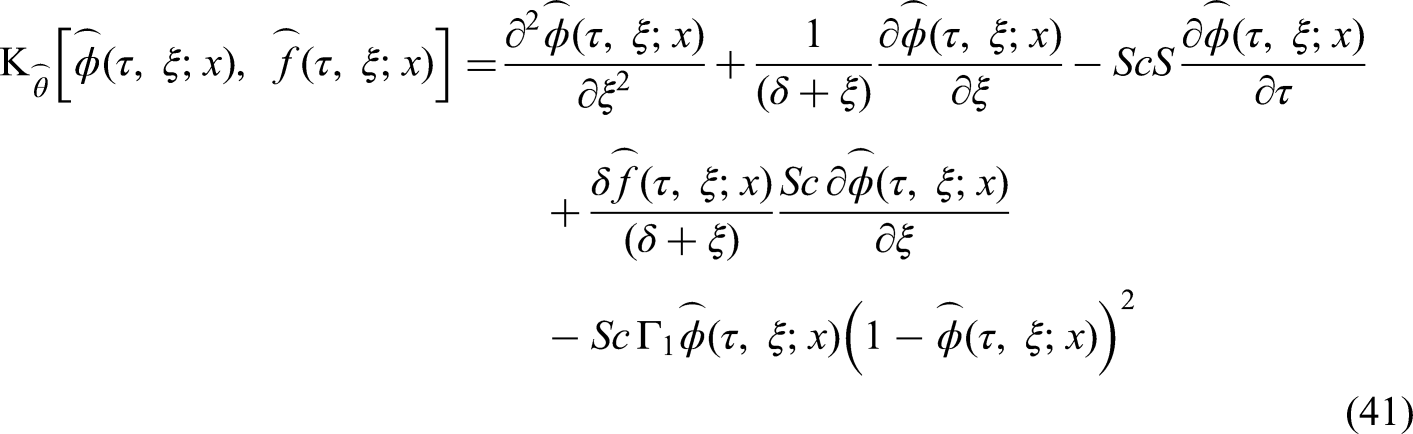
Making use of the Taylor series expansion in equations (42), (43), and (44), the following results are accomplished:
To ensure the convergence of equations (45), (46), and (47) at , the variables , and must be carefully adjusted. At , equations (45), (46), and (47) are transmuted as
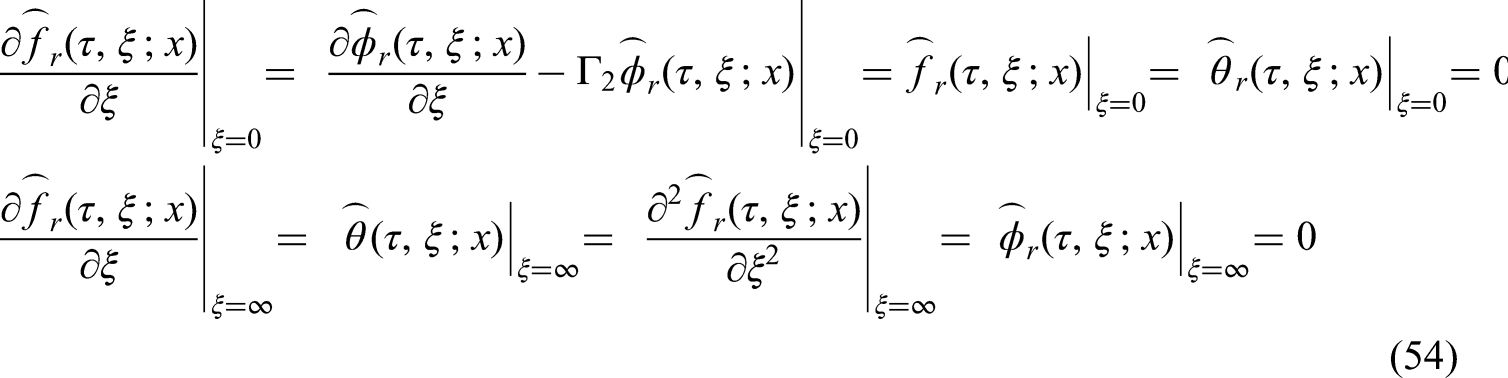
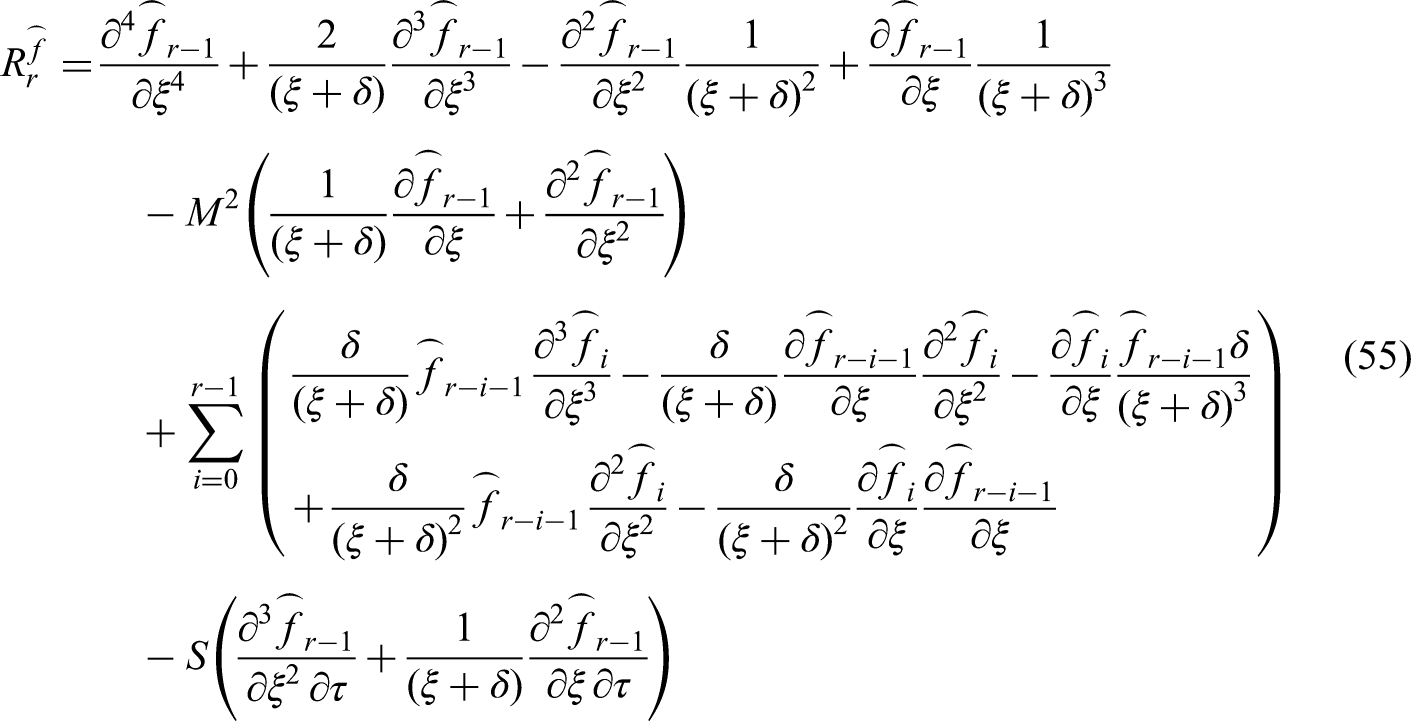
Differentiate equations (35), (36), (37), and (38) by r times to embed parameter x, then put and finally divided by , the following results are obtained:
where
and
The following expressions designate the general form of the solution:
here , and denote the particular solution. By incorporating boundary conditions equation (54), the arbitrary constants , are calculated as
Validation of results
Table 1 is organized to justify the validity of the accomplished results by comparing them with the existing published results26,29 by considering , , and as a limiting case. The table displays that the current findings show remarkable agreement with the published solutions.
Comparison of arithmetical outcomes of with existing data for dissimilar values of variable when , and
The outcomes of distinct concerned parameters such as homogeneous reaction strength parameter , the ratio of oscillatory frequency to the stretched rate of the sheet heterogeneous reaction strength parameter , Schmidt number magnetic parameter , thermal conductivity parameter , Prandtl number , and radius of curvature on the interested profiles are illustrated in detail in this section.
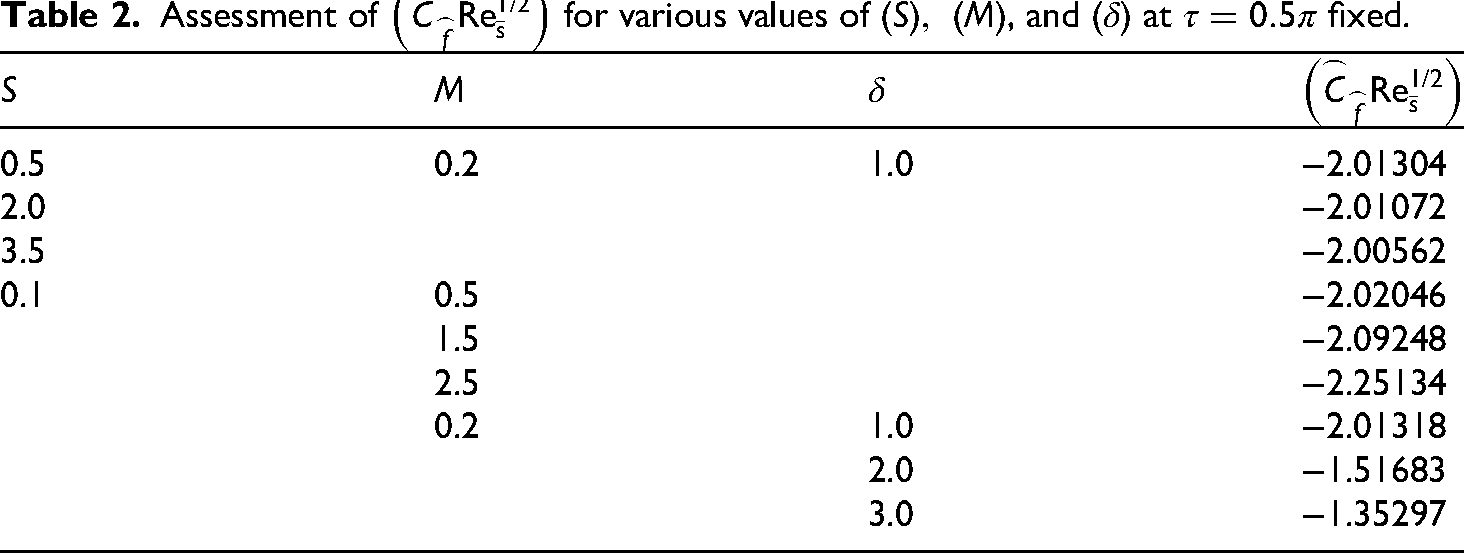
Table 2 demonstrates the impacts of , and on skin friction coefficient when is fixed. It is observed that the magnitude of shows the diminishing response with improving , , and it grows with an enhancement of . Table 3 shows the change in the magnitude of for unalike values of , , , and at . It is detected that the arithmetic magnitude of the Nusselt number rises for advanced values of , whereas it is reduced with growing , , and .
Assessment of for various values of , and at fixed.
0.5
0.2
1.0
−2.01304
2.0
−2.01072
3.5
−2.00562
0.1
0.5
−2.02046
1.5
−2.09248
2.5
−2.25134
0.2
1.0
−2.01318
2.0
−1.51683
3.0
−1.35297
Assessment of for some values of , , , and at when and fixed.
0.1
1.0
1.0
0.2
0.994010
0.2
0.991370
0.6
0.988738
1.0
1.5
0.994835
3.0
0.995329
4.5
0.995829
1.0
3.0
0.994672
5.0
0.977576
1.0
0.960775
0.1
0.5
0.990171
1.0
0.982648
1.5
0.975098
Figure 2(a) and (b) shows the effects of and parameter on velocity profile for time interval . The amplitude of gradually declines with both parameters and . The mounting values of the parameter originate a significant amount of Lorentz force in the boundary layer section of the liquid flow. The Lorentz force, being a resistive force in nature, plays a key role in opposing the motion of the fluid particles. Consequently, the amplitude of the velocity profile decreases gradually as values of parameter enlarges. Figure 3(a) and (b) characterizes the consequences of and on at fixed time respectively. The velocity profile increases by increasing and it shows the opposite trend for advanced values of . The mounting trend in the velocity profile due to the radius of curvature constant indicates that as the radius of curvature increases, the boundary layer effects reduce, resulting to a more stable flow within the boundary layer region. Consequently, the surface resistance decreases which allows the fluid velocity to increase.
Alteration in for the period : (a) effects of and (b) effects of magnetic parameter M.
Alteration of dissimilar fluid parameters on at : (a) effects of and (b) effects of M.
The change in pressure distribution in interval is illustrated in Figure 4(a) and (b). Figure 4(a) depicts that the amplitude is diminished with increasing values of . While it is perceived from Figure 4(b) that amplitude is developed with Figure 5(a) and (b) shows the alteration in for and at . It is witnessed that is a decaying function of and it is upward by growing the parametric values of .
Variation in profile: (a) impacts of and (b) impacts of M.
Change in at : (a) influences of the radius of curvature variable and (b) impacts of M.
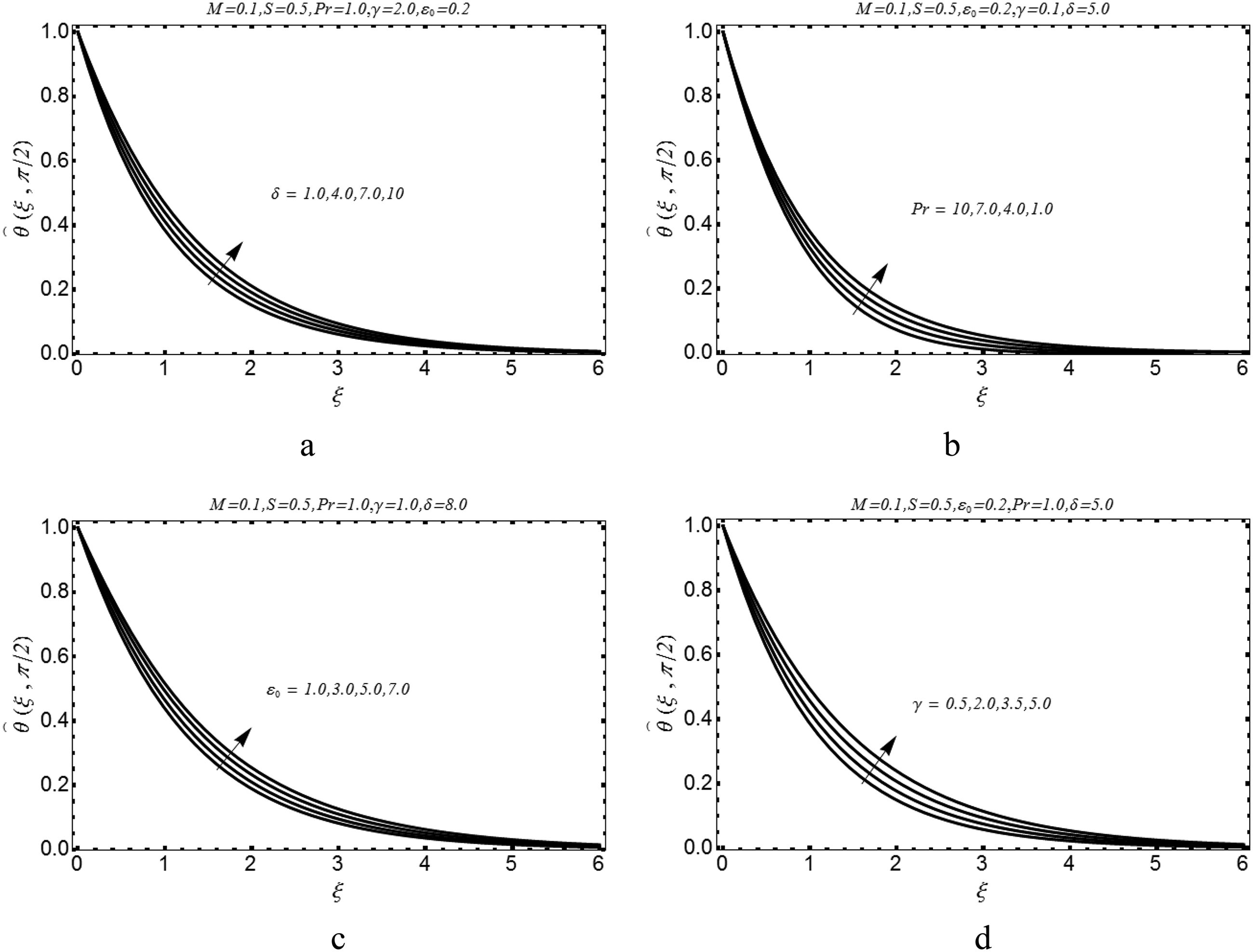
Figure 6(a) to (d) confirms that the magnitude of temperature profile and thermal boundary layer thickness is improved with increment of , , and . However, both the thermal boundary layer width and temperature distribution profile decline with the Prandtl number , this is because the Prandtl number is inversely related to thermal diffusivity. As the Prandtl number grows, thermal diffusivity drops. The reduction in thermal diffusivity leads to a decrease in the rate of heat transfer. Consequently, both the temperature profile and the thermal boundary layer thickness decrease as the Prandtl number increases.
Variation in temperature outline : (a) effects of , (b) effects of Prandtl number , (c) impacts of , and (d) effects of .
Figure 7(a) to (d) shows the alteration in the concentration field under the influences of different parameters likely , , , and at . This figure clearly depicts that shows a decaying response with and it increases with the improving values of , , and
Influences of dissimilar variables on the profile when : (a) effects of , (b) effects of , (c) influences of , and (d) impacts of .
Figure 8(a) to (d) exemplifies the consequences of dissimilar variables likely , , , and on the surface concentration profile at time instants It is observed from this figure that the amplitude of is reduced with , , and and is amplified with
Deviation in at : (a) influences of , (b) effects of , (c) effects of , and (d) influences of .
Figure 9(a) and (b) presents the consequences of varying values of homogeneous reaction parameter versus radius of curvature and heterogeneous reaction parameter versus Schmidt number respectively on the profile of for . It is evident from Figure 9(a) and (b) that gradually declines with uplifting values of , , and and it enhances with an enhancement in the values of .
Effects of diverse flow variables on surface concentration distribution : (a) effects of versus and (b) effects of versus when
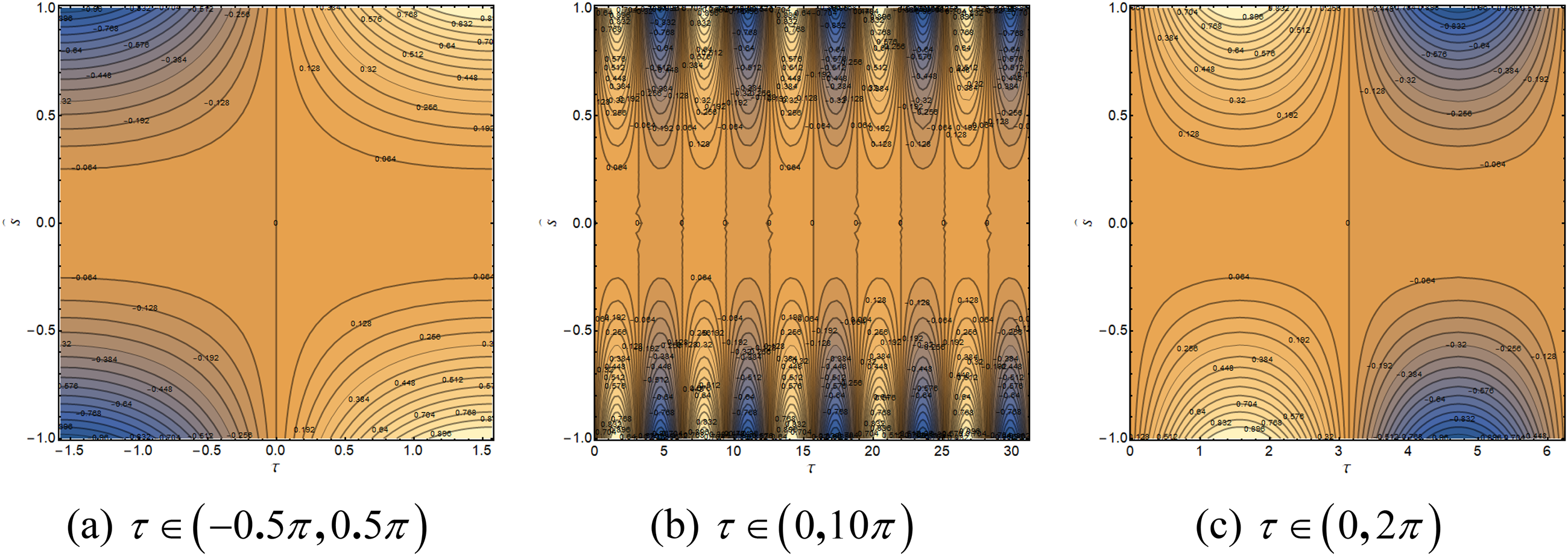
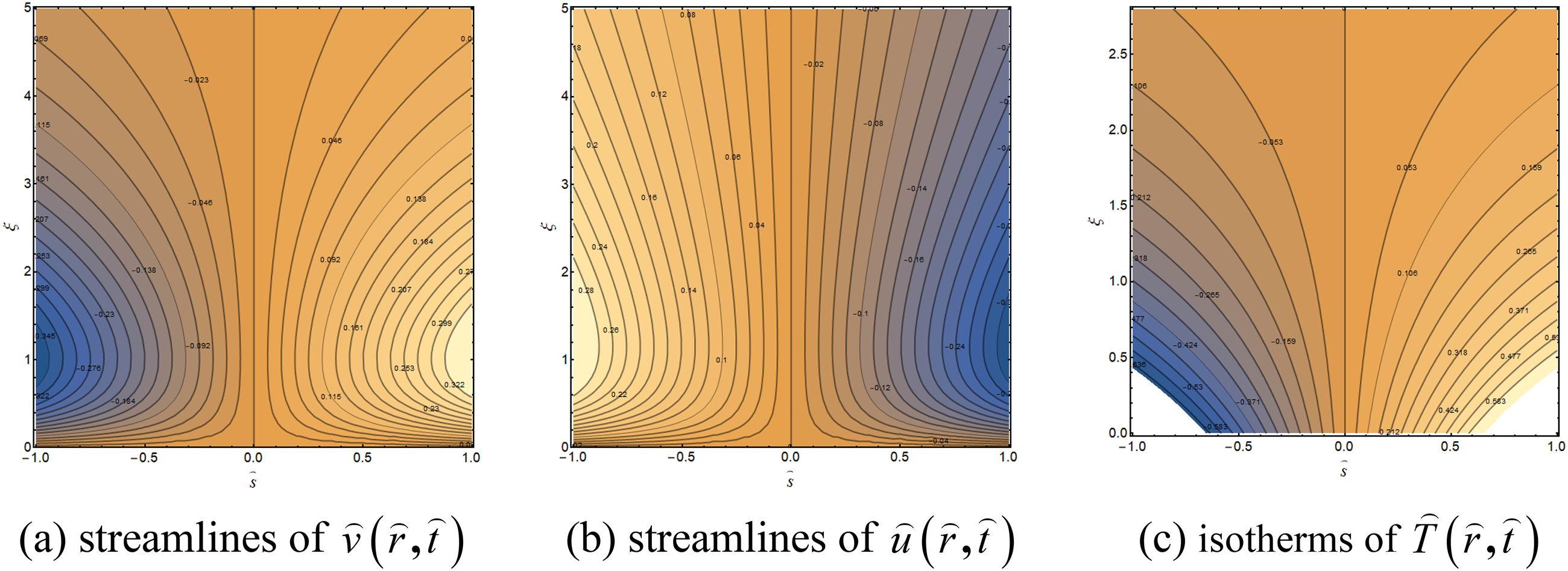
Figures 10(a) to (c) and 11(a) to (c) illustrate the behavior of the streamlines corresponding to the axial and the radial velocity components at various time points respectively. Figures 10(a) and 11(a) elucidate the symmetric distribution of streamlines radiating outward from the origin. In contrast, Figures 10(b), (c) and 11(b), (c) exhibit the oscillating response of the streamlines. Figure 12(a) to (c) demonstrates the behavior of streamlines and isotherms when fixed. It is evident from these figures that the streamlines and isotherms show a symmetrical pattern.
Alterations in streamlines by letting with and .
Alterations in streamlines of by letting with and .
Expressions of streamlines and isotherms by keeping , and .
Concluding remarks
This study explored the transport phenomena of heat by considering the impacts of heat production along with temperature-dependent thermal conductivity and HH chemical reactions in the time-dependent viscous fluid motion on a stretchable curved oscillatory sheet. The analytical solution of the developed nonlinear partial differential equations in the convergent series form has been attained by employing the HAM. The significant results have been recognized on the evidence of the recent study, with significant implications for engineering and industrial applications involving heat and mass transfer over curved surfaces.
The liquid velocity amplitude is a diminishing function of and . This reduction in liquid velocity amplitude highlights its potential role in augmenting flow dynamics in biomedical devices such as controlling blood flow in artificial organs and in industrial coating applications where precise fluid control is vital.
The fluid velocity declines with improving values of the magnetic parameter at . This declining response in fluid velocity due to mounting values of the magnetic parameter is significant for electromagnetic casting and plasma-assisted material processing where precise flow control plays a crucial role in ensuring uniform material properties.
For upward values of , the pressure profile amplitude is enhanced, while for it is reduced. These alterations in pressure amplitude offer valuable insights for precisely modulating pressure in the design of both microfluidic and macrofluidic systems including drug delivery systems and lab-on-a-chip technologies.
The temperature profile is increases with uplifting values of , , and , while it reduces gradually with Understanding the temperature trend due to the above-defined parameters is fundamental for thermal management systems, such as advanced cooling systems for electronic devices and heat exchangers in industrial procedures.
The profile of concentration distribution depicts a decreasing manner with , , and . However, it shows upward behavior for . This diminishing trend against the upward values of homogeneous reaction parameter, radius of curvature variable, and heterogeneous reaction parameter highlights the significance of optimizing concentration distribution for chemical reactors, catalytic converters, and pollution control systems.
The amplitude of is enhanced with and it displays the opposite trend for , , and The increase in surface concentration amplitude with Schmidt number emphasizes its importance in filtration and separation technologies.
The numerical magnitude of the skin friction coefficient increases by improving , and it declines against and The alteration in the magnitude of the skin friction coefficient due to the above-defined variables has widespread practical implications for aerodynamic and hydrodynamic areas, particularly in reducing drag in transportation and marine engineering.
The magnitude of the Nusselt number is a rising function of , while it reduces for growing parametric values of , , and The growing response of the Nusselt number with the Prandtl number and declining trend with , , and highlights strategies for exploiting heat transference efficiency in industrial heating and cooling systems ensuring optimal thermal regulation in energy-intensive processes.
The present findings offer valuable insights into real-world implications across manufacturing and engineering disciplines, including liquid transport, thermal energy management, and chemical reaction engineering. The study provides a foundation for optimizing system performance in industries where precise control over heat and mass transfer is essential, such as chemical processing, biomedical engineering, and energy production.
Footnotes
Nomenclature
Greek letters
Acknowledgments
We are grateful to the respectable reviewers for their constructive suggestions and encouraging comments for improving the manuscript quality.
ORCID iDs
Muhammad Naveed
Muhammad Imran
Author contributions
Muhammad Naveed conceptualized the study, developed the mathematical model, supervised the research, and ensured the accuracy of the findings. He also reviewed and edited the manuscript, providing critical insights. Muhammad Imran conducted the formal analysis, developed the methodology, performed analytical simulations using the homotopy analysis method, and interpreted the results. He also contributed to manuscript revision, ensuring accuracy and clarity. Faizan Khadim contributed to the methodology, data visualization, and manuscript drafting. All authors discussed the results, contributed to manuscript preparation, and approved the final version.
Funding
The author(s) received no financial support for the research, authorship, and/or publication of this article.
Declaration of conflicting interests
The author(s) declared no potential conflicts of interest with respect to the research, authorship, and/or publication of this article.
Data availability statement
The datasets used and/or analyzed during the current study are available from the corresponding author on reasonable request.
References
1.
AbbasZNaveedMSajidM. Hydromagnetic slip flow of nanofluid over a curved stretching surface with heat generation and thermal radiation. J Mol Liq2015; 18: 244–255.
2.
SabaFAhmedNHussainS, et al.Thermal analysis of nanofluid flow over a curved stretching surface suspended by carbon nanotubes with internal heat generation. Appl Sci2018; 8: 395.
3.
MurtazaMGTzirtzilakisEEFerdowsM. A note on MHD flow and heat transfer over a curved stretching sheet by considering variable thermal conductivity. Int J Math Comput Sci2018; 12: 38–42.
4.
AfridiMIWakifAQasimM,et al.Irreversibility analysis of dissipative fluid flow over a curved surface stimulated by variable thermal conductivity and uniform magnetic field: utilization of generalized differential quadrature method. Entropy2018; 20: 943.
5.
KempannagariAKBurujuRRNaramgariS,et al.Effect of Joule heating on MHD non-Newtonian fluid flow past an exponentially stretching curved surface. Heat Transf2020; 49: 3575–3592.
6.
KumarMAMebarek-OudinaFMangathaiP, et al.The impact of Soret Dufour and radiation on the laminar flow of a rotating liquid past a porous plate via chemical reaction. Mod Phys Lett B2025; 39: 2450458.
7.
HayatTFarooqSAhmadB,et al.Homogeneous–heterogeneous reactions and heat source/sink effects in MHD peristaltic flow of micropolar fluid with Newtonian heating in a curved channel. J Mol Liq2016; 223: 469–488.
8.
ImtiazMHayatTAlsaediA. Convective flow of ferrofluid due to a curved stretching surface with homogeneous–heterogeneous reactions. Powder Technol2017; 310: 154–162.
9.
SaifRSMuhammadTSadiaH,et al.Boundary layer flow due to a nonlinear stretching curved surface with convective boundary condition and homogeneous–heterogeneous reactions. Phys A2020; 551: 123996.
10.
HamidA. Numerical study of temperature dependent thermal conductivity and homogeneous–heterogeneous reactions on Williamson fluid flow. J Phys Commun2020; 4: 085009.
11.
WainiIIshakAPopI. Hybrid nanofluid flow with homogeneous–heterogeneous reactions. CMC-Comput Mater Con2021; 68: 3255–3269.
12.
AbbasZImranMNaveedM. Impact of equally diffusive chemical reaction on time-dependent flow of Casson nanofluid due to oscillatory curved stretching surface with thermal radiation. Arab J Sci Eng2022; 47: 1–20.
13.
SajidMAliNJavedT,et al.Stretching a curved surface in a viscous fluid. Chin Phys Lett2010; 27: 024703.
14.
NaveedMAbbasZSajidM. Hydromagnetic flow over an unsteady curved stretching surface. Eng Sci Technol Int J2016; 19: 841–845.
15.
SanniKMAsgharSJalilM,et al.Flow of viscous fluid along a nonlinearly stretching curved surface. Results Phys2017; 7: 2851–2854.
16.
OkechiNFJalilMAsgharS. Flow of viscous fluid along an exponentially stretching curved surface. Results Phys2017; 7: 1–4.
17.
NaveedMAbbasZZiaQMZ,et al.Analysis of heat transfer of hydromagnetic flow over a curved generalized stretching or shrinking surface with convective boundary condition. Therm Sci2018; 23: 200–200.
18.
NarlaVKBiswasCRaoGA. Entropy analysis of MHD fluid flow over a curved stretching sheet. AIP Conf Proc2020; 2246: 020099.
19.
YasminHLoneSATassaddiqA, et al.Numerical analysis of slip-enhanced flow over a curved surface with magnetized water-based hybrid nanofluid containing gyrotactic microorganisms. Sci Rep2023; 13: 18816.
20.
ImranMNaveedM. Analysis of thermophoretic and Brownian diffusions in hydromagnetic curvilinear flow of Carreau nanofluid with activation energy and heat generation. Results Eng2024; 24: 103114.
21.
WangCY. Nonlinear streaming due to the oscillatory stretching of a sheet in a viscous fluid. Acta Mech1988; 72: 261–268.
22.
AbbasZImranMNaveedM. Time-dependent flow of thermally developed viscous fluid over an oscillatory stretchable curved surface. Alexandria Eng J2020; 59: 4377–4390.
23.
ImranMAbbasZNaveedM,et al.Impact of Joule heating and melting on time-dependent flow of nanoparticles due to an oscillatory stretchable curved wall. Alexandria Eng J2021; 60: 4097–4113.
24.
NaveedMImranMAbbasZ. Curvilinear flow of micropolar fluid with Cattaneo–Christov heat flux model due to oscillation of curved stretchable sheet. Z Naturforsch A2021; 76: 799–821.
25.
ImranMNaveedMAbbasZ. Dynamics of Soret and Dufour effects on oscillatory flow of couple stress fluid due to stretchable curved surface. Adv Mech Eng2023; 15: 16878132231156742.
26.
ImranMNaveedMIftikharB,et al.Heat transfer analysis in a curvilinear flow of hybrid nanoliquid across a curved oscillatory stretched surface with nonlinear thermal radiation. ZAMM-J Appl Math Mech/Z Angew Math Mech2023; 103: e202200600.
27.
ImranMNaveedMRasheedMW. Analysis of heat transfer in magnetized Williamson fluid over a porous curved oscillating surface: Entropy generation. Int J Geomet Methods Mod Phys2024. https://doi.org/10.1142/S0219887825500872
28.
NaveedMImranMAsgharT,et al.Transport mechanism in chemically reactive hybrid nanofluid flow containing gyrotactic micro-organisms over a curved oscillatory surface. Appl Math Mech2025; 46: 177–192.
29.
AbdelmalekZKhanSUAwaisM, et al.Analysis of generalized micropolar nanofluid with swimming of microorganisms over an accelerated surface with activation energy. J Therm Anal Calorim2021; 144: 1051–1063.