



Abstract
Fully analyzing the impact and role of digital inclusive finance on the improvement of renewable energy efficiency plays an important role in realizing the long-term sustainable development of regional economy. This research undertakes a comprehensive empirical examination to investigate the influence of digital inclusive financial growth on renewable energy efficiency across 30 Chinese provinces and cities, spanning from 2011 to 2021. The results demonstrate that the advancement of digital inclusive finance significantly improves the efficiency of renewable energy. The examination of regional variations indicates that while digital financial inclusion markedly enhances the efficiency of renewable energy in both eastern and western areas, its impact remains negligible in the central region. In addition, our influencing mechanism results show that the progress in regional science and technology, alongside the effectiveness of financial services, markedly boosts the beneficial effects of digital inclusive finance on the enhancement of renewable energy efficiency. Furthermore, the degrees of innovation in science and technology and the efficiency of financial services act as a singular threshold in the development of digital inclusive finance for the improvement of renewable energy efficiency. Our study provides new evidence and implications for fully realizing the combination between digital inclusive finance and renewable energy efficiency, thereby promoting long-term sustainable regional development.
Keywords
Introduction
Humanity faces unparalleled energy and environmental issues as global temperatures rise and extreme weather events become more common.1,2 During the industrial revolution, fossil energy is a significant force driving development and change, playing a vital role in the overall economic and social development.3,4 After entering the carbon neutral era, the over-exploitation and use of fossil energy and the serious damage it causes to the environment have made the search for clean and sustainable energy solutions particularly imperative.5,6 Renewable energy, with its zero-emission and sustainable development characteristics, is viewed as the key to addressing the energy crisis and mitigating climate change.7,8 In September 2020, China made a commitment to the international community to achieve a peak in carbon emissions by 2030 and strive for carbon neutrality by 2060. This pledge underscores China's dedication to combating worldwide climate change and marks a crucial aspect of its strategic plan for development in the medium to long term.9,10 Carbon dioxide and other greenhouse gas emissions primarily originate from fossil energy sources, such as coal and oil, and China must realize the goal of “dual-carbon” by adjusting the energy structure dominated by fossil energy sources and vigorously developing the renewable energy industry.11,12 Improving the efficiency of renewable energy utilization can ensure the efficient use of clean energy, which is particularly important for the realization of regional sustainable development goals.13,14
However, renewable energy projects frequently encounter difficulties in implementation and development due to insufficient funds and limited financing channels. First, the initial investment costs of renewable energy projects are high.15,16 In particular, solar and wind energy projects typically require high upfront investments. This necessity arises from the procurement of equipment, construction of infrastructure, and installment of operational systems. Although the technological cost of renewable energy has been gradually decreasing in recent years, continuous R&D investment is needed to improve existing technologies or develop new ones to increase energy efficiency and reduce costs. 17 Secondly, the sporadic and unpredictable output of renewable energy sources creates a significant challenge for maintaining the stability of the power grid. This situation requires solving the grid access and scheduling problems. Furthermore, storage technologies for renewable energy can be limited, and efficient storage solutions to balance supply and demand are lacking, particularly in intermittent energy sources, such as wind and solar. 18 In addition, the comparative difficulty of financing is an important constraint to renewable energy development and efficiency improvement. 19 Conventional financial institutions will be cautious about renewable energy projects due to the uncertainty of risk assessment and return cycle.
Finance is the lifeblood of economic development. An effective financial backing system will enable China to develop a sustainable framework for energy efficiency, carbon emission reduction, and green transformation. However, the traditional financial system is characterized by inefficient financing modes, imbalance between financial supply and demand, and other prominent problems, which seriously constrain China's energy green transition and renewable energy development.20,21 China suggests speeding up digital transformation and actively advancing digital inclusive finance to address the challenges mentioned. This new financial model leverages emerging technologies like artificial intelligence, big data, and blockchain to provide more inclusive financial services; this model integrates and develops digital technologies with the traditional financial industry and provides a comparable solution to effectively solve information asymmetry, alleviate project financing challenges, and reduce the high cost of financial transactions. 22 Moreover, digital inclusive finance can accurately assess and manage credit risks, reduce the threshold of financial services, and expand the coverage of financial services by utilizing a new generation of information technology tools. 23 This model not only helps in improving the efficiency of capital utilization but also in promoting the flow of capital to green industries, such as renewable energy. Digital inclusive finance, an important means to promote financial inclusion, is gradually becoming an important force in supporting renewable energy projects. 24 The following research questions merit thorough analysis and discussion: What is the impact of digital financial inclusion on the efficiency of renewable energy systems? Which factors facilitate this influence? Additionally, how do the consequences of integrating digital finance vary in their influence on renewable energy efficiency across various geographical areas?
This study examines provincial panel data across China from 2011 to 2021, investigating how digital financial inclusion enhances renewable energy efficiency and the mechanisms driving this influence. The main contributions of this research are detailed below: Initially, it provides an empirical analysis on the role of digital financial inclusion in fostering improvements in renewable energy efficiency, thus broadening the spectrum of variables analyzed in this field of study. Our study highlights two main mechanisms by which the growth of digital inclusive finance can boost renewable energy efficiency: by enhancing regional science and technology innovation and boosting the efficiency of financial services, we set the stage for our analysis. In our detailed nonlinear empirical study, we consider this element as a pivotal threshold variable to delve deeper into how the growth of digital inclusive finance correlates with the enhancement of renewable energy efficiency. Additionally, this study seeks to offer strategic insights into how digital inclusive finance can further the progress and efficiency of renewable energy. Our findings underscore the considerable promise that digital inclusive finance holds in promoting renewable energy advancements. This approach successfully merges conventional finance with new green finance, providing innovative theoretical insights and practical lessons to achieve carbon neutrality on both national and regional levels.
The organization of the remaining parts of the article is arranged as follows: the second part contains the content of the literature review; the third part contains the theoretical analysis and research hypotheses; the fourth part contains the modeling, variable descriptions, and data sources; the fifth part contains the content of the analysis of the empirical results; the sixth part contains the content of the discussion; and lastly, the part of the conclusions and policy recommendations.
Literature review
Financial markets and renewable energy development
An examination of current research shows that numerous scholars have explored how finance impacts renewable energy growth. The role of financial markets is pivotal in advancing renewable energy initiatives. First, the diversified instruments of financial markets provide a variety of financing options for renewable energy projects, including stocks, bonds, trusts, and insurance.25,26 Some scholars have analyzed the influence of stock market changes on renewable energy project financing and found that numerous renewable energy companies have attracted a large number of investors by listing in the capital market. 27 Meanwhile, green bonds have become an important tool to support renewable energy projects. Scholars have found through project studies on renewable energy that renewable energy investment funds provide investors with opportunities to participate in renewable energy projects while diversifying investment risks.28,29 For example, infrastructure investment trusts (IITs) and private equity funds have provided substantial capital support for renewable energy projects. 30 Regarding government policies and financial incentives, several scholars have verified that the enforcement of these policies has significantly contributed to advancing the financial growth of renewable energy. 31 Local governments can effectively minimize investor risks and increase the return on investment by adopting relevant policies and incentives, thus attracting additional capital into the renewable energy sector. 32 In terms of subsidies and tax incentives, numerous countries have implemented renewable energy subsidies and tax incentives to encourage corporate and individual investment. 33 China provides feed-in tariff subsidies for photovoltaic projects, while the United States supports wind and solar projects through specific policies, such as production tax credits and investment tax credits. The government reduces the financing costs and risks of renewable energy projects by providing financing guarantees and low-interest loans.34,35
Digital financial inclusion and renewable energy development
Finally, in terms of carbon market and carbon pricing mechanism, scholars have used empirical data to confirm that carrying out carbon trading market construction can provide an additional source of income for renewable energy projects.36,37 Banks and other financial institutions have supported numerous renewable energy projects by providing loans, credit guarantees, and asset management services. The above-mentioned studies mainly analyze the influence on renewable energy development from the perspectives of financial system, 38 financial market, 39 and green credit. 40 Existing studies concur that finance positively contributes to renewable energy development. 41
Overall, the positive influence of finance on renewable energy development is reflected in a number of aspects, ranging from financial support, risk management to market incentives, all of which provide important guarantees for the promotion of renewable energy projects. Nevertheless, there remains a noticeable lack of comprehensive studies that merge traditional and modern financial methods to evaluate the influence of digital inclusive finance, which leverages advanced technologies such as big data and artificial intelligence, on renewable energy efficiency. Consequently, few research efforts have been made to investigate how digital inclusive finance can promote renewable energy development and enhance its operational efficiency. Promoting renewable energy vigorously and improving its efficiency are essential tactics for China to conserve energy, decrease carbon emissions, and stimulate superior regional economic development. This research is dedicated to enhancing the efficiency of renewable energy and delves deeply into the effects of digital inclusive finance on the renewable energy sector, analyzing its underlying mechanisms. Additionally, the findings of this research can offer valuable insights for promoting regional renewable energy development and crafting effective policy measures.
Theoretical analysis and research hypotheses
The beginning of renewable energy project infrastructure construction necessitates significant fixed asset investment, and the later operating capital accounts for a large proportion of the total cost; consequently, the financing needs are relatively substantial. 42 Moreover, renewable energy infrastructure construction has a large time span and a relatively long investment cycle, which urgently requires medium- and long-term loan funding support from the financial sector. The growth of digital inclusive finance will strengthen the financial characteristics and bolster the pioneering nature of the finance sector, 43 which has a direct influence on renewable energy efficiency. Digital inclusive finance utilizes digital technology to establish an environmental information sharing platform for investment projects, and it can help microeconomic agents identify investment opportunities for environmentally friendly projects through public disclosure of information on renewable energy projects. 44 The renewable energy industry can obtain a large amount of R&D investment funds by introducing social capital into renewable energy projects, thus enhancing renewable energy efficiency. 45 In addition, the level of digital financial inclusion, the coverage and popularization of digital finance, and the depth of application of financial instruments contribute to the improvement of the financial development environment; a well-established financial environment lowers debt costs for renewable energy companies, facilitating the innovation and implementation of cutting-edge renewable energy technologies. This enhancement is expected to significantly boost the efficiency of renewable energy. 46 Based on this, the following hypotheses are proposed.
The special attributes of renewable energy technological innovation pose challenges in securing financial support. Renewable energy technology is characterized by long research and development cycles, substantial financing needs, and high entry barrier; these factors pose risks to scaling production and widespread application in the short term. 47 Furthermore, renewable energy enterprises encounter challenges in green technological innovation activities due to information asymmetry, adverse selection, and moral hazard; these factors result in greater credit risk, making it more difficult for renewable energy enterprises to obtain financial support for their technological research and development. Moreover, slow development of green technology can result in stagnation in renewable energy development and a decline in utilization efficiency. 18 Digital inclusive finance uses digital technology to improve and optimize traditional financial technology, searching and mining online users’ investment business, financial status, and relevant data with the support of big data technology, artificial intelligence, blockchain, and other digital tools to conduct comprehensive credit assessment. 48 This mechanism can minimize the cost of risk control for RET investors. Digital inclusive finance persistently enhances its algorithms to tackle the challenges of information asymmetry and excessive transaction costs in the financial market. This advancement alleviates the financing restrictions faced by renewable energy companies and expands their funding opportunities for developing green technologies. 49 This initiative also encourages renewable energy companies to boost their green, low-carbon technological innovations, leading to enhanced renewable energy efficiency. Consequently, this study puts forward the following pertinent hypotheses.
Digital inclusive finance has lowered the barriers to accessing financial services for renewable energy initiatives, enhanced the efficiency of these services, and facilitated the seamless execution of renewable energy projects. This advancement broadens the scope of conventional financial services. By leveraging Internet technology, digital inclusive finance creates platforms and provides users with electronic accounts, removing the constraints associated with traditional finance reliant on physical branches. This expansion increases the reach of financial services and extends financial support to a larger number of renewable energy companies. 50 Convenient digital payment systems can help minimize the operating and financing costs of renewable energy projects, save costs for renewable energy enterprises to carry out research and development activities, and improve renewable energy efficiency. 51 Conversely, the advancement of digital financial inclusion enhances the scope of conventional financial applications. By leveraging modern digital technology, digital inclusive finance offers a wide array of financial services to renewable energy companies, surpassing the capabilities of traditional financial intermediaries. This, in turn, improves access to critical information. This mechanism can also match the supply and demand of funds for renewable energy projects and provide financial services directly. 52 Increasing the reach of digital inclusive finance can enable precise financial support for technology R&D in renewable energy companies, which in turn can boost renewable energy efficiency. Therefore, this study introduces the following pertinent hypotheses.
The impact of financial factors on the efficiency of renewable energy is significantly moderated by the advancement in science, technology, and innovation (STI). Vibrant STI activities will help financial intermediaries exert a highly efficient resource allocation effect, thus promoting renewable energy efficiency. 53 Digital inclusive finance emerges from the integration of digital technology with traditional financial systems, driven by advanced technological innovations and comprehensive financial services. As technological innovation and financial services advance, digital inclusive finance enhances renewable energy efficiency by innovating financial service technologies and creating diverse financial products. 54 Greater regional capacity for scientific and technological innovation, along with more efficient financial services, significantly boosts advancements in renewable energy technology and accelerates the growth of the renewable energy sector. Based on these insights, this study puts forward the following pertinent hypotheses.
Modeling and data description
Fixed effects model
This study develops a fundamental regression model to analyze how digital financial inclusion influences the efficiency enhancement of renewable energy, thereby testing the validity and dependability of previous assumptions. The detailed model construction is as follows:

This work uses instrumental variables method for two-stage least squares regression to further examine how the development of digital financial inclusion affects renewable energy efficiency and overcome the endogeneity bias problem:




The meaning of the variable representation in the formula is consistent with that in the above.
Variable selection and explanation
Explained variable
Renewable energy efficiency (REG). Existing studies have no uniform standard for measuring renewable energy efficiency. In this work, the ratio of real GDP (with the value of 2011 as the base period) and renewable energy generation is used to express the renewable energy efficiency of each administrative region. A higher value signifies a rise in the output per unit of renewable energy consumed, indicating improved efficiency in renewable energy development. On the one hand, this calculation method is simple and suitable for inter-regional comparisons. On the other hand, this method can take into account social and economic aspects to measure the degree of effective utilization of renewable energy.
Core explanatory variable
This study builds on prior research and utilizes the Digital Financial Inclusion Index, a unitless measure developed by the Digital Finance Research Center at Peking University. 44 Our findings offer a comprehensive, objective, and scientifically grounded depiction of the current state and characteristics of digital financial inclusion in China. Furthermore, the research evaluates the regional levels of digital financial inclusion by examining three key dimensions: depth (DFD), breadth (DFC), and digitization level (DFS). This study divided each index by 100 for reduction for ease of statistical analysis.
Control variables
This research builds upon earlier studies and incorporates five control variables to scrutinize the benchmark regression outcomes. 45 This approach helps to mitigate the potential impact of omitted variables on the regression results, thereby enhancing their robustness. The selected control variables are as follows. (a) Regional economic development (lngdp), quantified by the logarithm of real GDP, with 2011 as the base year. (b) Industrial structure (is), represented by the ratio of the added value of regional industrial output to GDP. (c) Science and technology investment level (rd), determined by the ratio of R&D expenditure to GDP for each region. (d) Human capital level (hum), measured by the average years of schooling per region, based on previous methodologies. (e) Foreign direct investment level (fdi), indicated by the ratio of total foreign direct investment to GDP for each region.
Mediating variables
This study examines two key factors: regional science and technological innovation, and the efficiency level of financial services. 57 These elements are analyzed to effectively demonstrate how digital financial inclusion impacts the efficiency of renewable energy. (a) The metric for regional science and technological innovation (te) is represented by the average number of patents per 10,000 inhabitants in the area. (b) Level of financial service efficiency (fs), which refers to the output efficiency brought about by investing financial services as resources into the real economy. Building on previous research methods, 54 the financial service efficiency across 30 Chinese provinces, municipalities, and autonomous regions from 2011 to 2021 has been assessed using an enhanced DEA-Malmquist index method. This evaluation employs input indicators such as the workforce size in financial institutions, the volume of loan balances, the overall stock market financing, and the aggregate premium income. The amount of regional GDP minus the value-added of the output of the financial and real estate industries is used as an output indicator.
Data sources and explanations
Considering the availability and accuracy of data, the current data on installed renewable energy power generation is only available at the provincial level, and data at the prefectural and municipal levels are seriously missing. At the same time, there are still differences in the statistical caliber of some provinces. Therefore. this research employs a panel dataset encompassing 30 provincial entities across China, with the exception of Hong Kong, Macao, Taiwan, and the Tibet Autonomous Region, covering the years 2011 to 2021 for the analysis. The main sources for the required data variables and metrics include the China Statistical Yearbook, the Digital Inclusive Finance Index by Peking University (spanning 2011–2021), the China Science and Technology Statistical Yearbook, the China Financial Yearbook, various regional statistical yearbooks, and several other reputable official websites. To compensate for any gaps in the data, linear interpolation methods are utilized, and data pertaining to prices are normalized to a common base period.
Analysis of the empirical results
Benchmark regression analysis
This study employs a panel fixed effects model to explore the plausibility of the initial hypothesis and assess the effect of digital financial inclusion on renewable energy efficiency. The benchmark regression results for equation (1) are displayed in Table 1. The first two models scrutinize the impact of advancements in digital financial inclusion on the efficiency of renewable energy. Models 3 through 5 examine how three specific sub-indicators—depth (DFD), breadth (DFC), and overall digitization level (DFS) of digital financial inclusion—affect renewable energy efficiency. The estimation of Models 1 and 2 indicated that introducing control variables does not change the conclusion that digital financial inclusion development positively and significantly influences renewable energy efficiency at the 1% level, even after controlling for individual and time effects. The findings indicate that the growth of digital financial inclusion plays a crucial role in enhancing the efficiency of renewable energy, thereby supporting Hypothesis 1. Analyzing the three sub-indicators of digital financial inclusion, it becomes clear that both the extent of utilization and the degree of digital empowerment notably contribute to the advancement of renewable energy efficiency. The influence of the depth indicator is greater than the level of digitization, while the breadth indicator does not significantly affect the improvement of renewable energy efficiency. The statement suggests that the key catalyst enhancing the efficiency of renewable energy is the comprehensive application and integration of digital financial inclusion, along with the empowerment provided by digitization. 58 By leveraging its extensive application, digital inclusive finance offers a variety of financial services to the renewable energy sector, thereby mitigating the credit risks associated with renewable energy companies. It builds a platform between renewable energy enterprises and financial institutions through blockchain, internet technology, and other digital means. This effectively solves problems of asymmetric information and non-transparent credit systems, improving the efficiency of renewable energy development. The review also indicates a need for wider application of digital inclusive finance. 59 Although this form of finance provides channels for funding the growth of the renewable energy sector, these channels are still largely blocked. Moreover, the widespread availability of such financial services has not significantly improved the efficiency of renewable energy development. 60
Benchmark regression estimation results.

Note: Robust standard errors in parentheses; *, **, and *** indicate significance at the 10%, 5%, and 1% levels, respectively.
Robustness and endogeneity discussion
Robustness tests
This research will also perform rigorous checks to confirm the dependability of the results. Initially, alternative explanatory variables are introduced. For the robustness assessments, the ratio of real GDP to renewable energy consumption is employed as an alternative indicator of renewable energy efficiency. The outcomes of the regression are displayed in column (1) of Table 2. The regression coefficient indicating the development level of digital financial inclusion is positive and significantly at the 5% level. The findings from this study align with earlier research and confirm the first hypothesis. Furthermore, the sample excludes municipalities that report directly to the central government. Given the disparate economic conditions and resource allocations among Chinese provinces, which might distort the influence of digital financial inclusion on renewable energy efficiency, the cities of Beijing, Shanghai, Tianjin, and Chongqing are omitted from the robustness analysis. The regression results, shown in the second column of Table 2, reinforce the credibility of Hypothesis 1. Additionally, the sample size is adjusted: since 2013, digital inclusive finance in China has experienced rapid growth, with 2013 recognized by scholars as a pivotal year in its development. Therefore, we narrowed down the sample size and selected the period from 2013 to 2021 for our testing and analysis. The results of the regression analysis, shown in column (3) of Table 2, demonstrate a considerably positive coefficient for digital inclusive finance development. This evidence strongly supports the accuracy and reliability of the first hypothesis.
Robustness test results.

Note: Robust standard errors in parentheses; *, **, and *** indicate significance at the 10%, 5%, and 1% levels, respectively.
Endogeneity discussion
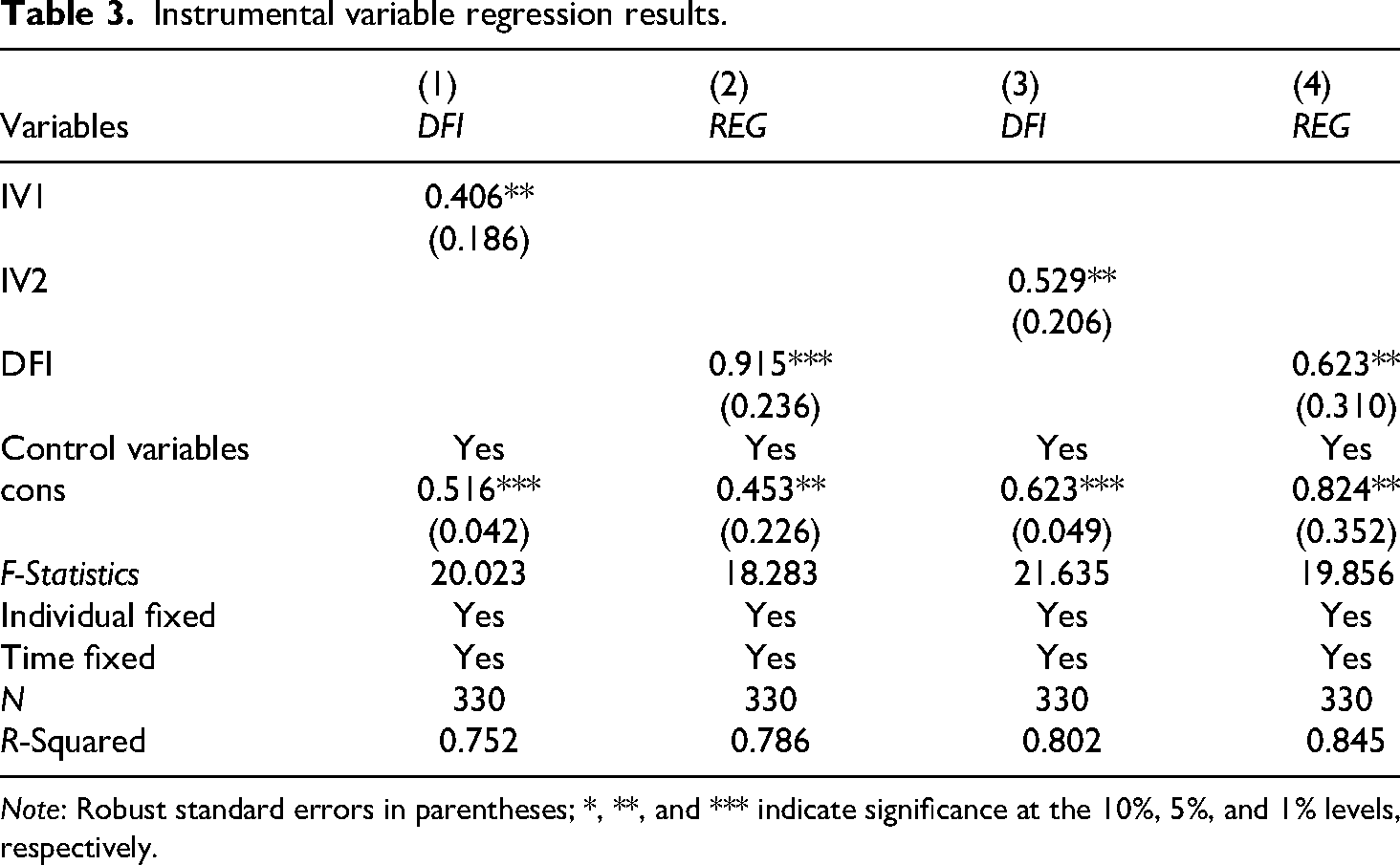
Considering that the benchmark regression estimation results above may generate endogeneity problems, the instrumental variable method will be adopted to further obtain robust estimation results. The possible reverse causality between digital financial inclusion and renewable energy efficiency can be effectively addressed by using two-stage least squares for regression analysis.20,29 Therefore, this paper uses the number of landline telephones per 100 people (IV1) and the number of post offices per million people (IV2) in each province in 1984 as instrumental variables reflecting digital financial inclusion. Meanwhile, considering the effect of balanced panel data, we further multiply IV1 with the number of national Internet broadband access subscribers lagged by one period and multiply IV2 with the number of national Internet broadband access subscribers lagged by one period, which in turn form two balanced panels of data for analysis. Regression results, which are detailed in Table 3, show that the coefficients associated with the instrumental variables display a notably positive significance. Additionally, the results demonstrate that tackling the endogeneity issue within the model notably enhances the efficiency of renewable energy, attributing this improvement to the progress in digital financial inclusion. Such results strongly support the accuracy of the first hypothesis.
Instrumental variable regression results.
Note: Robust standard errors in parentheses; *, **, and *** indicate significance at the 10%, 5%, and 1% levels, respectively.
Heterogeneity analysis
The impact of developing renewable energy efficiency can vary significantly across regions, influenced by unique economic progressions, substantial variations in resource availability, and diverse levels of advancement in digital financial inclusion infrastructure across China's eastern, central, and western regions. Table 4 presents Models 1, 2, and 3, which analyze how the development of digitally inclusive finance affects the efficiency of renewable energy in these respective regions. Evidence suggests that digital financial inclusion plays a substantial role in enhancing renewable energy efficiency in both the eastern and western regions. However, its impact is minimal in the central region. This disparity likely stems from the higher economic prosperity and more developed digital economy infrastructure in the eastern region. Additionally, factors such as advanced scientific and technological contributions, a robust pool of skilled talent, favorable geographical conditions, and other pioneering advantages contribute to a more mature digital inclusive finance sector. This, in turn, significantly boosts the efficiency of renewable energy development in these regions. The western area boasts abundant renewable energy resources and a robust foundational infrastructure for development. Despite this, it faces challenges such as a sluggish economic growth rate, limited financial assets, and a lack of strong innovation capabilities. Promoting digital inclusive finance in this region could support green technological advancements. By adopting cutting-edge technologies for renewable energy development, substantial financial backing is ensured. Such initiatives greatly improve the efficiency of renewable energy utilization, underscoring the widespread applicability of digital inclusive finance. Much of the central area is classified as a region abundant in traditional energy resources. Yet, it lacks significant progress in developing renewable energy. This region faces challenges due to a limited supply of funds and inequitable distribution of financial assets. Moreover, its capacity for innovation lags behind, and the infrastructure for digital inclusive finance is notably underdeveloped compared to the eastern region. Consequently, digital inclusive finance has not been effectively utilized to enhance the efficiency of renewable energy development in this area.
Results of estimation of regional heterogeneity.

Note: Robust standard errors in parentheses; *, **, and *** indicate significance at the 10%, 5%, and 1% levels, respectively.
Further discussion
Analysis of the influencing mechanism
Research suggests that improvements in renewable energy efficiency within the realm of digital inclusive finance are predominantly influenced by advancements in science and technology, as well as by the efficiency of financial services. This study applies the mediation effect method to examine this dynamic further. The specific findings are detailed in Table 5. Both the baseline regression data presented earlier and the empirical findings from Model 1 in Table 5 affirm that the growth of digital inclusive finance markedly enhances renewable energy efficiency, thus meeting the initial requirement for a mediation effect. In Models 2 and 4, the positive and significant coefficients associated with intermediary variables suggest that the advancement of digital inclusive finance plays a crucial role in enhancing regional innovation in science and technology, as well as the efficiency of financial services, thereby meeting the second criterion for intermediary effects. Digital inclusive finance fosters the growth of diverse financing avenues essential for the innovation of renewable energy technologies, green tech research, and other creative efforts. Furthermore, this initiative aids in lowering the costs of financing and mitigates the challenges posed by information asymmetry. Digital inclusive finance expands traditional financial offerings and increases the range of business activities for renewable energy projects. It also enhances the depth and efficiency of conventional financial services. The findings from Models 3 and 5 reveal that introducing the intermediary variables—scientific and technological innovation and financial service efficiency—yields positive and significant effects, with coefficients of 0.011 and 0.0916, respectively. However, the development coefficients for digital inclusive finance stand at 0.663 and 0.689, which are notably less than the total effect coefficient of 0.901 from Model 1. The implications indicate that the influence of the expansion of digital inclusive finance is somewhat smaller than what was first suggested by Model 1. The results show that at a regional level, the growth of digital finance that includes a broader range of the population acts as a partial intermediary in improving the efficiency of renewable energy, affected by advancements in science and technology as well as innovations in financial services. In particular, this mediating role contributes 26.42% to the overall impact, which amounts to 23.53%. This supports the assertions made in Hypotheses 2 and 3. Essentially, the efficiency of renewable energy improvement is driven by the degrees of innovation in science and technology and financial services, which are key factors influenced by the levels of digital financial inclusion.
Results of mediation effect estimation.

Note: Robust standard errors in parentheses; *, **, and *** indicate significance at the 10%, 5%, and 1% levels, respectively.
Analysis of threshold effects
In the realm of renewable energy efficiency enhancement through digital inclusive finance, regional advancements in science and technology innovation, alongside financial service efficacy, might exert a nuanced regulatory impact. This research incorporates these dimensions of innovation and service efficiency as threshold variables within a panel threshold effect model, examining their potential influence. The methodology employed involves a multiple threshold self-sampling test. Findings indicate that science and technology innovation and financial service efficiency manifest a singular threshold effect that facilitates the improvement of renewable energy efficiency via the progression of digital inclusive finance. Table 6 presents the test outcomes, while Table 7 displays the empirical testing of the threshold model. The analysis reveals that when the threshold of 17.891 in scientific and technological innovation is exceeded, the impact coefficient of the digital inclusive finance development measure increases significantly from 0.609 to 0.662 at a 1% significance level. In a similar vein, this coefficient escalates from 0.534 to 0.605 when the efficiency threshold of 1.029 in financial services is surpassed. It is evident that the contribution of digital inclusive finance to the enhancement of renewable energy efficiency is determined not just by its own levels, but also by the regional progress in science and technology and the operational efficiency of financial services. The impact of progress in digital inclusive finance on boosting the efficiency of renewable energy intensifies as innovations in science and technology, along with improvements in financial services, expand. Furthermore, results from testing the threshold effect model indicate a nonlinear link between digital inclusive finance and renewable energy efficiency. The confirmation of Hypothesis 4 validates the choice of levels of scientific and technological innovation and financial service efficiency as intermediary variables in this study.
Results of the threshold effect tests.

Threshold model regression results.

Note: Robust standard errors in parentheses; *, **, and *** indicate significance at the 10%, 5%, and 1% levels, respectively.
Discussion
This article provides an in-depth discussion of the impact of digital financial inclusion development on renewable energy efficiency improvement in China and its mechanism of action, which has important theoretical and practical contributions.
First, at the level of theoretical contribution, our study enriches the literature in the field of digital financial inclusion and renewable energy efficiency. Existing studies have mostly focused on the impact of financial development on renewable energy, while the emerging field of digital financial inclusion and its role on renewable energy efficiency have been under-explored. This study empirically analyzes the impact of digital inclusive finance on renewable energy efficiency from the perspective of digital inclusive finance, expanding the perspective and depth of related studies. 61
Second, we also reveal the mediating role of regional STI and financial service efficiency in the relationship between digital financial inclusion and renewable energy efficiency, which provides a new theoretical explanation for understanding how digital financial inclusion promotes renewable energy efficiency by enhancing regional STI and financial service efficiency. This finding not only deepens the understanding of the mechanism of the role of digital inclusive finance, but also provides new ideas for subsequent research. 62
At the level of practical significance, our study provides policy makers with empirical evidence that digital inclusive finance has a positive role in promoting renewable energy efficiency. In the context of the current global climate change and energy crisis, this finding is an important reference value for guiding policymaking. Policymakers can accordingly increase their support for digital inclusive finance and promote its application in the field of renewable energy to achieve the goals of energy structure optimization and environmental protection. 63
The findings of our study are also instructive for the business community. Enterprises should respond positively to the development of digital inclusive finance, take advantage of the financing convenience and cost advantages it brings, and increase their investment in renewable energy projects to improve energy efficiency and realize green transformation.
In addition, our study has certain shortcomings and limitations, which include the in-depth acquisition of research data for further expanding the research scale of renewable energy. And in the future, the logical relationship between digital financial inclusion and renewable energy development can be further analyzed in depth from the theoretical level.
Conclusions and recommendations
Research conclusion
This study establishes a connection between the growth of digital inclusive finance and the efficiency of renewable energy, developing several research hypotheses from a theoretical analysis of how digital financial inclusivity can enhance renewable energy efficiency. Additionally, the paper performs thorough empirical testing of these hypotheses, employing a panel dataset from thirty administrative regions in China over the period from 2011 to 2021. Findings indicate that advancements in digital inclusive finance substantially boost renewable energy efficiency. The study also resolves issues of endogeneity and validates the results through rigorous robustness checks. In a revised form, the passage could be presented as follows: It is established that the progress in digital inclusive finance markedly boosts the efficiency of renewable energy in the eastern and western areas. Yet, its impact seems minimal in the central region. Additionally, the growth in renewable energy efficiency is supported through digital inclusive finance, which utilizes regional strengths in science and technology innovation alongside financial service efficiency. Furthermore, areas characterized by advanced scientific and technological innovation along with efficient financial services significantly benefit from the positive effects of developments in digital inclusive finance on the improvement of renewable energy efficiency.
Policy implications
The document presents a series of strategic recommendations derived from an analysis of existing research. It advocates for a rapid advancement of digital inclusive finance within the application area to boost renewable energy efficiency. It suggests enhancing top-level designs, reinforcing the infrastructure supporting digital inclusive finance, and introducing policies that guide its development to foster growth in the renewable energy sector. Additionally, it calls for the expanded integration of digital technology with traditional financial services across various domains. The scope of digital inclusive finance in supporting renewable energy development should be widened, and a more diverse array of digital financial products tailored for renewable energy enterprises should be developed.
Secondly, it's essential to tailor the development of digital finance for boosting renewable energy efficiency to the specific needs of each region. Factors such as the economic status, level of financial inclusion, and existing infrastructure should guide the formulation and execution of local digital finance policies. For instance, the eastern regions could concentrate on creating diverse application settings for digital finance and consider developing platforms dedicated to supporting renewable energy companies. Meanwhile, central and western areas should enhance their financial systems to better support the renewable energy sector, increase the availability of financial services, and foster a systematic setting that accelerates the growth of digital financial inclusion.
Thirdly, efforts should be amplified to enhance regional scientific and technological innovation, alongside ongoing advancement in the efficiency of financial services. Priority should be given to the support of research, development, and the dissemination of internet technologies within the realm of digital inclusive finance. This includes expediting the digital overhaul of conventional financial sectors, advancing reforms within financial service systems, and deepening the scope and penetration of digital inclusive financial services. Such initiatives should leverage the pivotal role of scientific innovation and efficiency transmission in digital finance, thereby boosting the operational efficiency of renewable energy sectors. Ultimately, this approach aims to fully tap into the potential of digital finance to drive growth within the renewable energy industry.
Footnotes
Funding
The authors disclosed receipt of the following financial support for the research, authorship, and/or publication of this article: This is a part research accomplishment of the National Natural Science Foundation of China Key Project “Research on the Construction of China's Economic Transformation Model for Carbon Neutrality” (72140001).
Conflicting interests
The authors declared no potential conflicts of interest with respect to the research, authorship, and/or publication of this article.
Data availability
The datasets used and/or analyzed during the current study are available from the sources informed in the article or from the corresponding author on reasonable request.
