



Abstract
The global increase in solid waste pollution due to economic growth and population growth has led to severe ecological deterioration. This situation is exacerbated by the ongoing coronavirus disease (COVID-19) pandemic, which has significantly impacted consumer behavior and consumption habits. Proper management of solid waste has thus become critical in mitigating environmental degradation. In this study, we aim to examine the relationship between the outbreak of COVID-19, environmental attitudes (EATT), social norms (SN), environmental knowledge (EK), technological innovation (TI), and solid waste management (SWM) in Ecuadorian households during the pandemic. We collected data from 426 households in Ecuador using an online questionnaire and analyzed it using the Partial Least Squares Structural Equation Model method to test the hypotheses. Likewise, we validated the measurement and structural model. The results are novel about SWM, considering a developing country severely affected during the pandemic. Our findings suggest that COVID-19 has a negative impact on SWM, while EATT, SN, and TI have a positive influence on SWM. However, we found that EK does not significantly affect SWM.
This is a visual representation of the abstract.
Keywords
Introduction
Waste generation is increasing rapidly due to economic and social development and the growing consumption habits of the global population. 1 Solid waste (SW) generates harmful emissions of gases and pollutes water, air, and soil, endangering the health of citizens.2,3 According to the World Bank, 4 an average of 2010 million tons of municipal SW are generated annually, and global waste is projected to grow by 70% by 2050 unless urgent action is taken. In Latin America and the Caribbean, 541,000 tons of SW are generated per day, which is expected to increase to 671,000 t/day by 2050. 5 INEC 6 reports that the average urban inhabitant in Ecuador produces 0.86 kg of SW. In Latin America and the Caribbean, 541,000 tons of SW are generated per day, which is expected to increase to 671,000 t/day by 2050. 5 INEC 6 reports that the average urban inhabitant in Ecuador produces 0.86 kg of SW.
Most waste in the future is expected to come from developing countries due to the growth of their economy and population and, at the same time, rapid urbanization. 7 This problem is exacerbated in these types of economies, mainly because they cannot effectively implement policies related to SW due to the scarcity of infrastructure and capital, in addition to clear laws and a lack of sanctions for citizens. 8 One of the solutions to mitigate and avoid the adverse effects of SW is the implementation of a circular economy within the home.9,10 This new alternative emerged in the 1970s focused on the industry but is potentially applicable to any resource. 11 In this way, previous findings have indicated that solid waste management (SWM), especially recycling, positively influences the practice of circular economy in society, both in consumption and production flows.12,13
Around the circular economy, this new strategy can be implemented by reducing, recycling, reusing, recovering, and repairing SW. 14 This concept has gained relevance in several countries, especially in developed economies, which have implemented it as an environmental development strategy. 15 In November 2019, the discovery of the COVID-19 outbreak in Wuhan, China, diverted the world's attention from the growing interest in the circular economy. 16 The disease, caused by acute coronavirus respiratory syndrome (SARS-CoV-2), spread rapidly across several countries, prompting the World Health Organization to declare it a public health emergency on January 30, 2020. 17 The uncontrollable growth of COVID-19 cases in various countries led to the implementation of several preventive measures by governments worldwide. 18 These measures included home isolation, remote work, social distancing, banning mass gatherings, closing schools and universities, shutting down borders, and limiting travel by public transportation. 19 The fear of contact with surfaces led to an increased use of single-use products such as plastics, cartons, and personal biosecurity equipment, resulting in a surge in the generation of SW. 20 This propensity to use more plastics and cardboard is due to the fear of contact with surfaces; consequently, shopping and delivery services have increased. 21
In this context, this research seeks to respond to the behavior of individuals in the SWM during the pandemic, especially in developed economies where the generation of SW is an environmental problem. 7 Therefore, the research aims to examine the relationship between SWG and COVID-19, environmental attitudes (EATT), social norms (SN), environmental knowledge (EK), and technological innovation (TI) in Ecuador during the pandemic. In addition, it is taken as a reference to Ajzen's theory of planned behavior. 22 The rest of the covariants have been selected because the EATT demonstrates human actions toward nature. 23 In the same way, the EK means the knowledge acquired concerning the environment and its care. 24 It also includes the SN, reflected in the rules or duties a citizen must fulfill. 25 Finally, it is added to the TI reflected in the use of technological devices and the internet to properly manage the SW. 26 The observations of these variables are collected employing a questionnaire and processed later through the Partial Least Square Structural Equation Model (PLS-SEM). This method is widely used today because it combines multiple regression and factor analysis, allowing a more comprehensive range of information and relationships between variables. 7
The academic significance of this study lies in the fact that no research has been conducted on this subject in Ecuador, particularly because developing countries were heavily impacted by the pandemic. Previous studies, such as those by Adzawla et al. 24 and Meng et al., 27 focused on domestic SWM without accounting for the influence of COVID-19. This research, however, takes into account this variable to provide a more comprehensive analysis in light of current circumstances. Moreover, it contributes to the literature on SWM in developed economies and provides insights into the effects of the pandemic on this area.
The remainder of this document is organized as follows. Section “Review of the literature” presents a review of previous literature and the development of hypotheses. Section “Data and methodological approach” outlines the methodology used in this study, and Section “Results and discussion” provides a discussion of the results. Finally, Section “Conclusions” offers conclusions and policy implications based on the findings.
Review of the literature
COVID-19 and SWM
The outbreak of COVID-19 caused a global health crisis that significantly altered the daily activities of households and supply chains of companies. 16 Governments worldwide implemented several measures to mitigate the spread of COVID-19, such as home isolation, restricted mobility, and remote work for a large percentage of the population. 18 These measures had a profound impact on the consumption behavior of the population, leading to a drastic increase in the generation of SW due to the widespread use of single-use products and personal biosecurity equipment. 28
The COVID-19 pandemic has not only had consequences in the economic, labor, and health fields but also preliminary evidence reveals negative consequences for the environment due to an increase in the amount of domestic SW. 29 This situation has been driven by fear of contagion, leading to a significant increase in online purchases, which in turn generates a larger volume of waste in homes, particularly plastic and cardboard. 21 At the same time, microenterprises have regressed in their pro-environmental progress by returning to single-use containers, further exacerbating plastic waste in homes (Rioja, 2020). Recent studies have shown that fear of virus infection generated by surface contact has had an adverse impact on reuse and SW reduction practices in households.21,30
COVID-19 has led to a reduction in SWM.
Environmental attitudes and SWM
The EATT of the population is vital to examine their behavior in the SWM. Empirical studies show that people with EATT have a correct and efficient SWM. 23 Environmental attitudes not only promotes a correct SWM but at the same time, the EATT has a positive effect on the willingness to pay citizens to purchase better services by the SWM. 31 A study conducted by Czajkowski et al. 32 in Poland determined that residents with pro-EATT are willing to correctly classify SW without receiving any gratuity just for helping the environment. Thus, these activities become a relevant component in which citizens participate in waste recycling. 33 Moreover, Zhang et al. 34 and Wan et al. 35 found in their respective studies that a positive attitude toward waste classification leads residents to be willing to perform the correct management of waste in their homes.
EATTs lead to a correct SWG.
Social norms and SWM
Social norms are considered external or situational factors of the individual generating waste that are directed to regulate the positive behavior of the individual in the environment. 36 Social norms are government regulations that align with people's values, positively changing their behavior to support the environment. 25 To regulate society on SW classification, some of the primary political instruments used are taxes, subsidies, and reimbursements, 37 which are becoming critical determinants for people's willingness to recycle. 38 The relationship between SNs and SWM in households is influenced by the cultural context of the territory in which they live. Social norms have a more significant influence on collectivist cultures than individualistic cultures. 39 The study conducted by Zhang et al. 33 has shown that government stimuli directly promote environmental activities. In some cases, strong sanctions against citizens are essential tools to control or improve the SWM of households. 40
The implementation of SN promotes citizens to perform a correct SWM.
Environmental knowledge and SWM
According to various studies, one external factor that can positively influence an individual's behavior toward SWM is their EK.37,41 When individuals possess a greater understanding of the environment, their perception of it tends to improve, leading to a more favorable attitude toward SWM within the household.37,41 Moreover, EK can help to discourage anti-environmental behavior, such as incorrect classification of SW, by encouraging individuals to reject such practices. 24
Wang et al. 42 argue that the implementation of EK in areas where proper SW elimination practices are not currently being followed can have a positive impact on the environment. On the other hand, research conducted at the Asian continent level suggests that inadequate or no EK among citizens is one of the most significant barriers to effective SWM. 33 This may be due to a lack of awareness among individuals regarding the environment's degradation and the long-term implications of environmental sustainability. 43
The acquisition of EK induces better SWM within the home.
Technology innovation and SWM
The TI action is particularly significant in production activities and among families. 44 In contemporary life, the use of modern technologies such as the “Internet of Things” (IoT) is becoming increasingly popular. This technology can be used to aid the sorting and classification of SW, making it easier to transition toward a circular economy. 45 These authors suggest that the IoT contributes to environmental sustainability by improving SWM. Similarly, Dubey et al. 26 conducted a study in India and found that the use of TI leads to better SWM practices and significantly improves SW identification. Additionally, Meng et al. 27 found that social media, digital media, and the internet in general provide residents with increased exposure to advertising and EK, which has the potential to promote an ecological lifestyle and increase participation in SWM.
Several prior studies, such as those by Luo et al. 46 and Zheng et al., 47 have found that social networks play a crucial role in promoting environmental practices in SWM. These social platforms provide a means of dissemination and interaction that can lead to a significant increase in individuals’ EATT. Similarly, Khan et al. 48 in their study, showed that technology improves circular economy practices, including SWM.
Greater TI allows people to have better SWM within the home.
Data and methodological approach
Currently, there are various approaches to managing solid waste (SWM) that aim to protect the environment. Thus, this study concentrates on SW recycling49–53 as a key SWM measure.27,54–56 To gather primary data, a survey was conducted using Google Forms between July and November 2020 in Ecuadorian households, and the sociodemographic characteristics of the 426 participating household heads are listed in Table 1. The questionnaire was administered online (see Annex 1).
Sociodemographic characteristics of the sample.
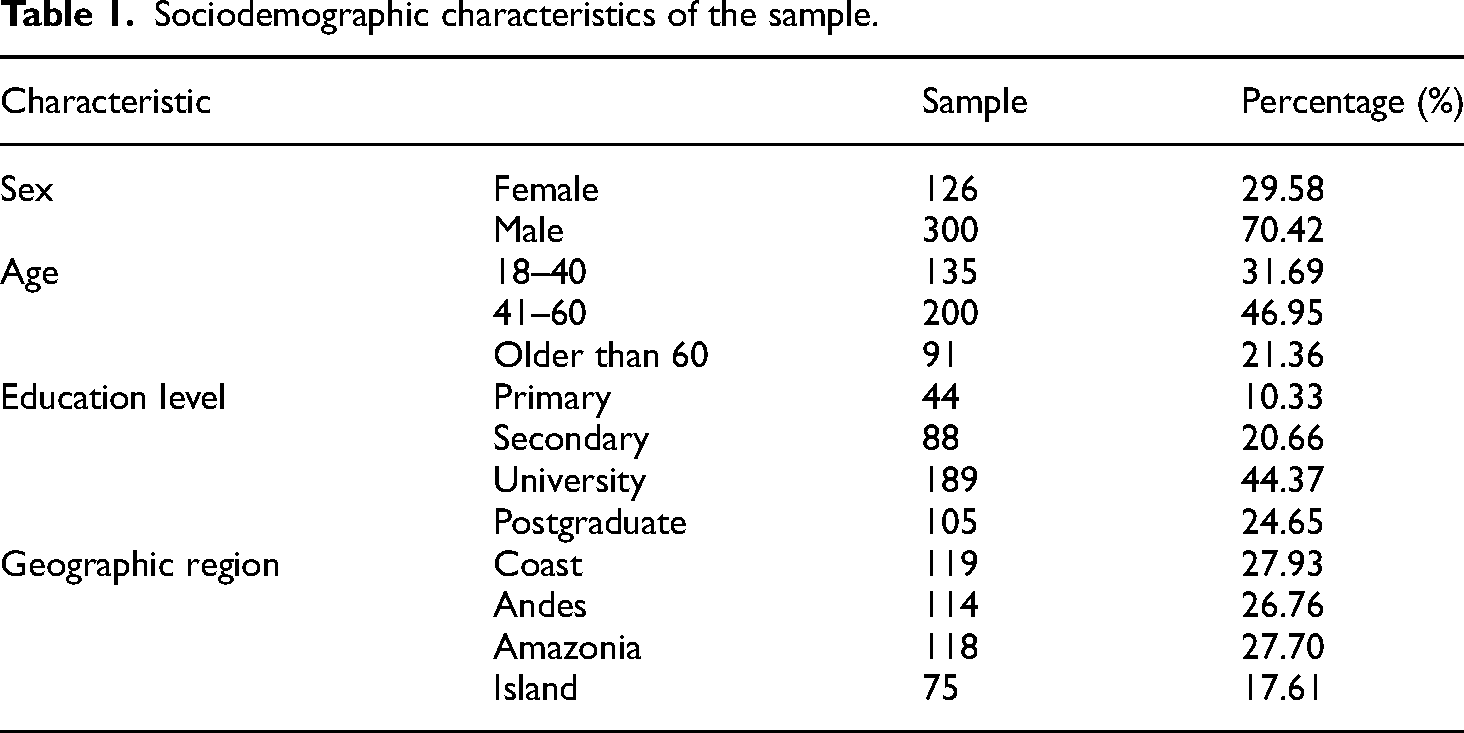
The questionnaire link was sent to people from various regions of the country through different virtual communication channels. Subsequently, the surveys were refined, and the database was compiled. Respondents were selected randomly, according to the availability of time to answer the questionnaire. Equation (1) describes the calculation of the sample (n) of the population:
Subsequently, the information was analyzed through the Smart PLS program, using the PLS-SEM technique. Partial Least Square Structural Equation Model is a statistical method that establishes relationships between constructs by maximizing the explained variance of endogenous latent variables. 57 In addition, according to the analysis phenomenon, a reflective model was used in which the indicators represent the effect of the latent variable. 58 Hence, this approach enables empirical results to be confirmed based on theoretical grounds, and hypotheses to be verified. 59
One of the main advantages of PLS-SEM is its ability to handle intrinsic models, deal with multiple indicator variables, and the problem of abnormal data distribution producing efficient results. 60 In addition, the SEM is not restricted, thus having a more sophisticated and advanced procedure than simple linear regression. 61
Finally, Table 2 presents the correlation matrix of the study variables.
Correlation matrix.

Results and discussion
Measurement validity
Chin 62 emphasized that convergent validity measures the degree of convergence between the blocks of elements to determine if their measures form a homogeneous set that captures the phenomenon of interest. Table 3 shows the reliability and convergent validity of the measure in which Cronbach's alpha scores, composite reliability (CR), and average variance extracted (AVE) are evaluated. Between Cronbach's alpha and CR, the CR of Jöreskog 63 is most frequently used. These values are more significant than 0.7, and the internal consistency is acceptable and reliable according to the established parameters. 64
Instrument reliability and validity.

Next, the AVE value indicates the average variance the construct indicators explain. 65 According to Hair et al., 66 it must be greater than 0.5 to support the existence of convergent validity, as it appears in this study, given that the values range between 0.632 and 0.823.
Likewise, the discriminant validity is evaluated through the Fornell and Lacker 67 Criterion, which aims to confirm that a reflective construct has strong relationships with its constructs. 61 The results can be seen reflected in Table 4, where the highest value in the diagonal line establishes the discriminant validity. 58 In this case, there is discriminant validity because the value on the diagonal is more significant than its values below and, on the left, respectively. 68
Discriminant validity.

Note: Diagonal values represent discriminant validity.
Regarding the discriminant validity test of Fornell–Larcker, 67 complementary tests are required.69–71 Consequently, it was decided to use a second test called Heterotrait–Monotrait (HTMT), which according to Cepeda et al. 69 and Henseler et al., 70 more precisely detects the lack of discriminant validity. The HTMT value must be below 0.90, as can be seen in the results in Table 5, a fact that makes it possible to verify the discriminant validity of the model constructs. 72
Heterotrait–Monotrait ratio (HTMT).
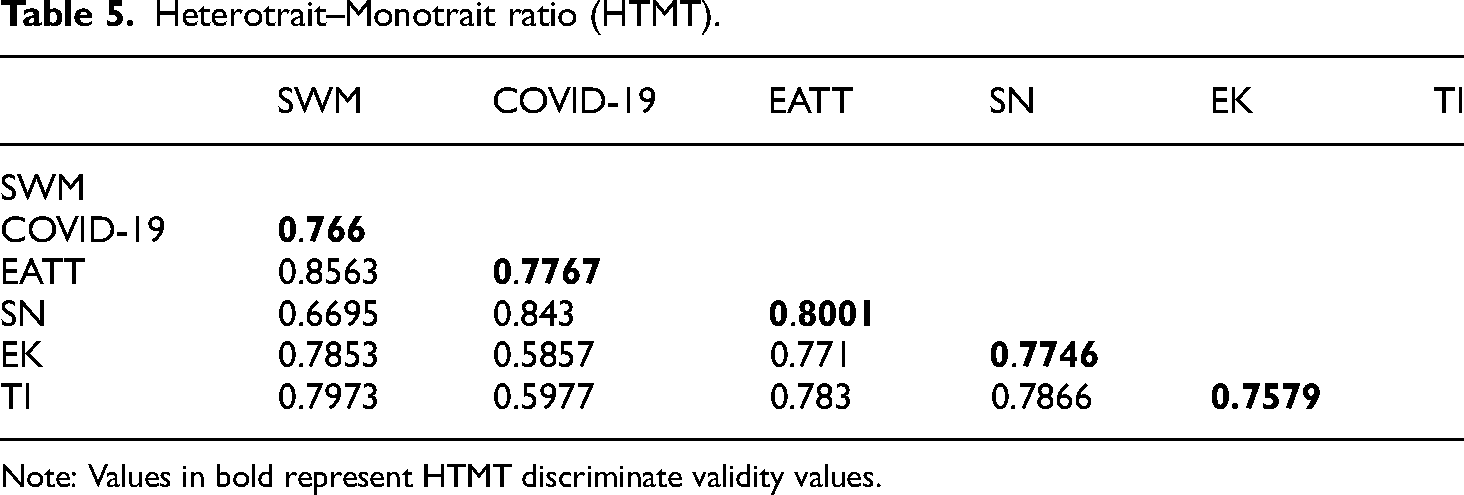
Note: Values in bold represent HTMT discriminate validity values.
The structural model
After carrying out the tests corresponding to the measure's validity, it is time to validate the hypotheses proposed in Section “Review of the literature” and illustrated in Figure 1. Figure 2 graphically presents the relationships between constructs. The findings are presented in Table 6, together with the value of its coefficient and p-value. The findings show that COVID-19 and SN have a pivotal role in SWM. Likewise, the results also revealed that EATT and TI play a statistically significant role in SWM, thus improving the environmental performance of households in the long term.
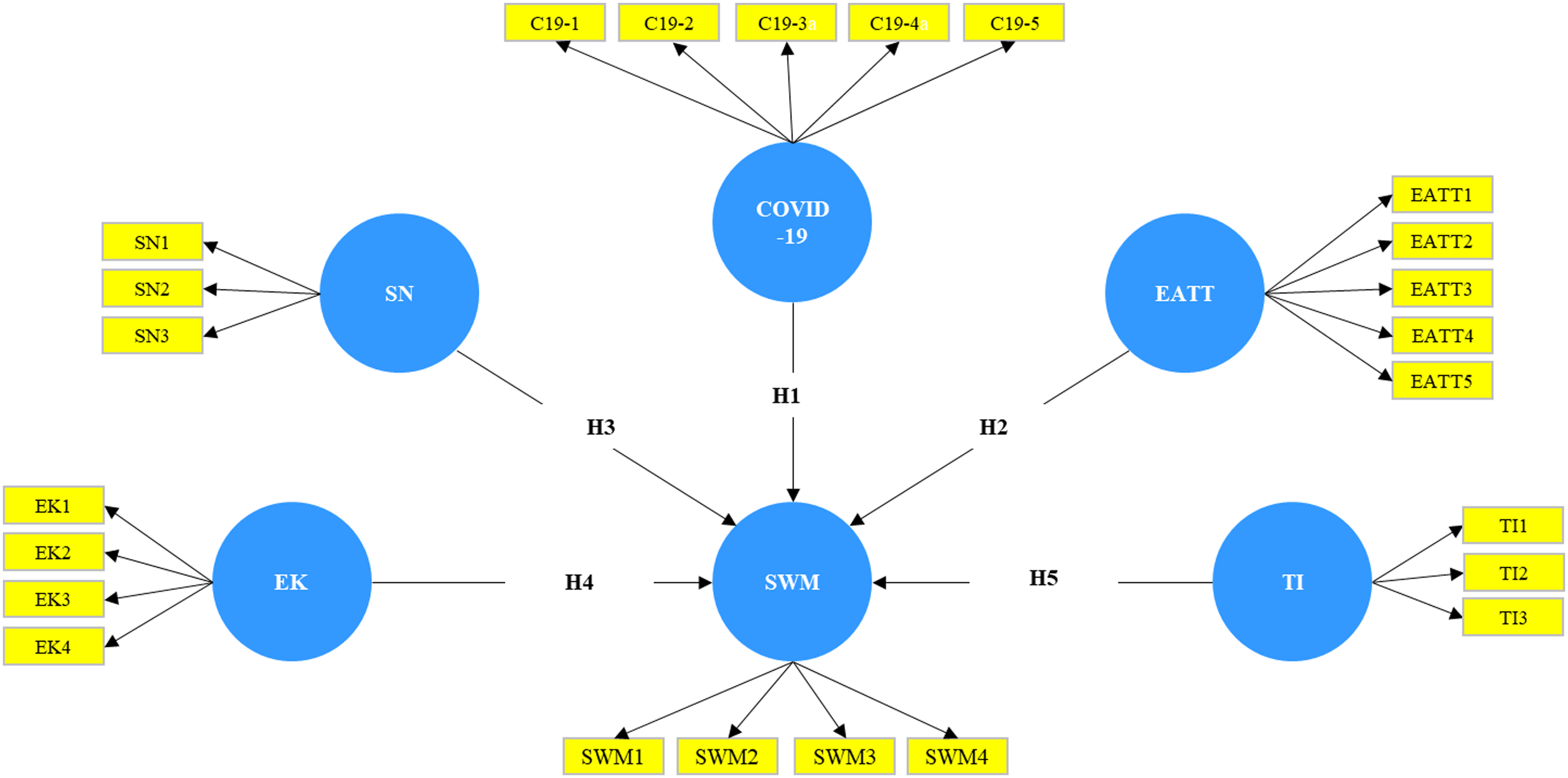
Model constructs.

The results of the structural model.
Standardized parameter estimates for structural model.

Note: ***p < 0.001; **p < 0.05; *p < 0.10.
The study findings indicate that the COVID-19 pandemic has had an adverse impact on household SWM, which is consistent with the research of Sharma et al. 30 According to Klemeš et al., 73 the COVID-19 crisis has not only affected the health system but it has also caused disruptions in SW generation, resulting in a significant change in waste composition and volume. 74 Therefore, Parra 29 suggests that there has been a rise in domestic SW. Similarly, Tripathi et al. 28 assert that the use of single-use plastics and protective equipment has surged since the pandemic was declared. This increase in SW generation is due to uncertainty, fear of infection, and the measures imposed by governments. 21
The COVID-19 pandemic caused significant changes in people's lives due to the uncertainty and concern generated by the virus. Different public policies were implemented in several countries to control the rapid spread of COVID-19, including isolation, social distancing, quarantine, community containment, curfew, and border closures. 75 As a result, people's routines and concerns were significantly altered, leading to feelings of uncertainty, fear, anguish, and worry. Alongside these emotions, people also started to take responsibility and care in the face of COVID-19, leaving aside the proper management of SW. 76
Regarding EATT, the study's findings show a positive and significant impact on the SWM of households. These results align with a study by Czajkowski et al., 32 which found that citizens in Poland with good EATTs were more likely to properly classify their waste. Similarly, Alhassan et al., 23 Vassanadumrongdee and Kittipongvises, 31 and Zhang et al. 33 found that EATTs positively promote and affect SWM. This behavior arises because most interviewees consider recycling as a strategy to mitigate the problems of contamination caused by post-consumer waste, thus contributing to the solution of environmental problems. 41 Furthermore, different types of SW, such as metal, plastic, and paper, are recycled to manufacture new products. 52 This scenario occurs because some resources may soon become scarce, motivating several people to adopt behaviors that increase SW recycling. 77
The study found that SN has a positive and significant impact on the SWM practices of households in Ecuador. These findings align with Sorkun's 38 assertions that SN is a critical determinant of SWM. Moreover, SN and SWM are largely influenced by cultural values in each region, which can influence environmental degradation. 39 Social norm is associated with people's intrinsic values and can prompt them to adopt pro-environmental behaviors, which brings them a sense of joy. 25 Furthermore, it is generally accepted that recycling is the responsibility of all economic agents, including households, citizens, companies, and governments. 78 Therefore, citizens must adhere to SN guidelines and implement proper SW classification and recycling practices. 38
Conversely, the study found that the effect of EK on SWM is not significant. This finding could be related to the shift in people's concerns and priorities due to the emergence of the COVID-19 virus. 75 The findings of this research demonstrate that the use of new technologies positively and significantly affects SWM in Ecuadorian households. These results are consistent with the study conducted by Dubey et al. 26 in India, where they found that the use of new technologies facilitated proper waste classification. Specifically, the use of mobile applications and internet access at home provides people with information related to the classification and recycling of SW, which in turn influences their actions to carry out proper SWM. 50 Moreover, with the improvement of information technology, smart devices that allow for proper waste classification and recycling are becoming more prevalent in homes, and these new tools contribute to SWM. 45 These findings corroborate Ajzen's theory of planned behavior, 22 which suggests that people's behavior can be modified, resulting in changes in SWM practices during the pandemic.
One of the persistent problems in regression analysis is multicollinearity. This problem usually indicates a high degree of association between the variables independent of the study. With this problem present, the results would be spurious. Table 7 presents the variance inflation factors (VIF) values, which allow for the assessment of collinearity in the reflective indicators. 64 Variance inflation factor values less than 5 indicate no collinearity in the estimation model. However, Becker et al. 79 suggest that collinearity may exist with values of 3, thus recommending VIF values less than 3. The results of this study show that VIF values range between 1.6 and 2.4, 80 indicating no significant collinearity among the reflective indicators. Additionally, the Common Method Bias (CMB) problem was insignificant in this study, as verified through the VIF values. Furthermore, following Bagozzi et al., 81 the correlation matrix allows ruling out the problems associated with the CMB since the value of the correlations is less than 0.9, as presented in Table 2.
Collinearity assessment.

According to Cohen 82 and Gefen et al., 83 values of f-square greater than 0.02 and less than 0.15 have a negligible effect, values between 0.15 and 0.35 have a medium effect, and values of 0.35 and more have a negligible effect significant effect on the latent dependent variable. In this model, the f-square values of COVID-19 and EATT are more remarkable than 0.35, which shows that these variables significantly affect the constructs (SWM). Meanwhile, the SN variable is between 0.15 and 0.35, which denotes that this generates a medium effect on the endogenous variable. On the other hand, the f-square values of EK and TI are in the first range of 0.02 to 0.15, so they generate a minimal effect on the explained variable (Table 8).
The f-square values.

A goodness-of-fit test called residual root mean square (SRMR) has been added (Table 8); when the standardized value of SRMR is in a range (<0.08–0.1), there is an acceptable fit.84,85 In this case, the SRMR value is 0.085, which confirms that the proposed model has an acceptable predictive quality and that the empirical results are consistent with the theory. 65 At the same time, the root mean square error correlation (RMStheta) was used, which is based on the residuals of the external model, which are the differences between the values of the forecast indicators. 57 Henseler et al. 57 indicate that the RMStheta values should be close to zero and less than 0.12. The RMStheta value of this model is 0.127, which is close to the established parameters, thus indicating that the planted model has a correct fit and is aligned with the theory.
The ongoing COVID-19 pandemic has brought about significant changes in people's behavior, particularly in their approach toward SWM. Several factors have influenced this change in behavior, and it is essential to identify them to design appropriate policy measures.
Conclusions
This article provides a comprehensive analysis of the impact of COVID-19 on SWM in Ecuadorian households during the pandemic. It also investigates the influence of EATT, SN, EK, and TI on SWM. The data were collected from households located in Ecuador, and the PLS-SEM was used to test the hypotheses. The findings revealed that NS is the main criterion for SWM, as state bodies exert pressure on citizens. In addition, EATT is an essential factor for SWM since its commitment to the environment reflects good pro-environmental practices. While IT slightly but positively affects SWM, this is because, in Ecuador, the implementation of new technologies has not yet become dynamic; since its high acquisition cost is a limitation, mainly due to import tariffs, Ecuador is not a country that manufactures new technologies in large quantities. In addition, due to the COVID-19 pandemic, households have been affected, both economically and psychologically, which has impacted the SWM since citizens seek to satisfy basic needs first to worry about managing the environment.
Implications for theory
The theoretical implications of this study are appreciated in various ways:
This research is one of the first studies to integrate and combine the role of COVID-19, EATT, SN, EK, and TI on SWN performance in a developing country. According to the special issue of the journal, this study provides critical quantitative contributions, which contribute to covering the literature gap in the field of study. The PLS-SEM approach allows for capturing data from primary sources of information, which is difficult to obtain from secondary sources. Likewise, through a set of (explanatory) variables, it can be understood how specific characteristics of individuals affect the SWM during a pandemic period. This situation provides essential information for the academic community to conceptualize the SWM after the pandemic.
Implications for policy
This research offers valuable information for policymakers and academics. The study emphasizes the role of each factor in SWM, encouraging households to adopt SWM practices that align with socioenvironmental needs to achieve a circular economy. It also calls for government agencies and regulatory authorities to develop a clear legal framework that promotes environmental protection, regulates citizens’ actions, and generates greater awareness of the items consumed and their resulting SW. These policies must take into account the uncertainties and risks caused by the pandemic and aim to ensure environmental sustainability. This study proposes the following policy implications:
Municipalities should develop SW programs for households, preparing people for potential social upheavals and helping them adopt pro-environmental behaviors toward SWM. In addition, it is recommended to generate municipal ordinances that encourage SWM through a table of economic incentives for households. Increased publicity on the classification of SW and EATT in both urban and rural areas can motivate the general public. Campaigns can be generated to promote the social and economic benefits of proper SWM. Laws addressing each population segment according to geographical peculiarities can strengthen SN on SWM, and regulations on such practices should be improved. Additionally, incentives can be given to households to improve SWM. Import taxes on technology, mainly targeting SWM, should be reduced to make it more affordable to people, which can lead to better SWM practices.
Limitations and future research
In the development of the research, some limitations were presented, time availability of the people surveyed and the length of the questionnaire. The study's scope is also expanded to examine the variation of other home services due to the current COVID-19 pandemic.
Footnotes
Declaration of conflicting interests
The author(s) declared no potential conflicts of interest with respect to the research, authorship, and/or publication of this article.
Ethical
The authors are fully responsible and there is no ethical issue in this manuscript.
Funding
The author(s) received no financial support for the research, authorship, and/or publication of this article.

Author biographies
Pablo Ponce obtained the title of Economist at the Universidad Técnica Particular de Loja (Ecuador) and a Master in Economics, Regulation and Competition at the University of Barcelona (Spain). In addition, he is studying his Doctorate program in Economic Analysis and Business Strategy at the University of Vigo (Spain). He works as a teacher - researcher in the Economics Program at the National University of Loja. Likewise, he is director of the Master's Degree in Public Policy at the same institution. His research is carried out in the field of renewable energy, energy economics, economic and social policies, among others. He has published more than 30 scientific articles in high-impact journals indexed in Web of Science and Scopus.
Nathalie Aguirre-Padilla, Economist from Universidad Técnica Particular de Loja, Engineer in Accounting and Auditing from Universidad Nacional de Loja. Master's Degree in Economics and Agricultural Administration from the Escuela Superior Politécnica de Chimborazo. Experience as a Research Fellow at the UTPL, Project Technician at the Municipality of Loja. Teaching at UNL in the career of Economics from 2017 to 2019. During the year 2019 Teaching in the degree of Economics at the Universidad Técnica Particular de Loja. From 2020 Teaching in the Degrees of Agribusiness, Environmental Management, Agricultural and Livestock, and Environmental Engineering, at the Universidad Técnica Particular de Loja. Currently Director of the Agribusiness career at the Universidad Técnica Particular de Loja. Author and co-author of several regional and worldwide publications. Her field of research is oriented to the environmental economic valuation of natural resources and agribusiness.
María Orellana-Jimbo research is related to the field of social sciences and behavioral economics.
Jhohana Larrea-Silva academic preparation is related to the formulation and evaluation of public and private investment projects. She is currently studying her doctoral program in Mexico.
Verónica Cabrera-Gonzalez, Graduate in Accounting and Auditing at the National University of Loja. Master in Finance at the National University of Loja. Professor of the Accounting and Auditing Course at the National University of Loja. Member of the Advisory Council of the Master's Program in Accounting and Finance at the National University of Loja