




Abstract
Cross-border e-commerce (CBEC) represents a digitized form of international business that provides enterprises with an opportunity to enhance their innovation of green technologies. This paper explores the impact of CBEC on the green technological innovations (GTIs) among enterprises by examining China's CBEC Pilot Zone as a quasi-natural experiment. We employ panel data from China's A-share listed companies covering the period from 2011 to 2022 and implement a staggered difference-in-differences model for our analysis. The results of the study indicate that CBEC fosters the GTI and enhances both the quantity and percentage of green patents held by enterprises. These results remain robust after robustness tests and account for the effects of heterogeneity treatment. Heterogeneity analysis shows that this positive effect is particularly pronounced among large firms, non-state-owned firms, highly polluting industries, and firms in inland areas. Mechanism studies demonstrate that alleviating financial constraints and enhancing absorptive capacity are two crucial channels through which CBEC fosters GTI in firms. Notably, absorptive capacity significantly moderates the firm's information advantage, amplifying the effectiveness of this process.
Keywords
Introduction
Environmental degradation is an inevitable consequence of the industrialization process in developing countries,1,2 leading to significant health risks and hindering sustainable economic development. Trade serves as a primary driver of global resource allocation, influencing both regional economies and environmental systems. 3 Since joining the World Trade Organization, China has exported vast quantities of inexpensive industrial goods to various countries, resulting in rapid economic development. In 2022, China contributed 30% of global manufacturing value added, while accounting for 28.87% of worldwide CO₂ emissions despite occupying only 6.44% of Earth's land area.4,5 This environmental-economic paradox highlights the nation's dual role as both an industrial powerhouse and a major carbon emitter. The incongruity between China's rapid export trade growth and its substantial carbon dioxide emissions is particularly striking. Despite decades of initiatives aimed at addressing this issue, China continues to grapple with the complex balancing act between fostering economic development and achieving environmental sustainability.
In the green technology market, developing countries face significant challenges, such as a lack of cutting-edge technologies, inadequate government policies, and a considerable technological gap in comparison to developed nations. These factors hinder their ability to achieve efficient green technology innovation on their own. In this context, promoting smooth international trade, enhancing international cooperation, and harnessing the potential spillover effects of technology are crucial for their advancement. As a new model of international trade, cross-border e-commerce (CBEC) has progressively becoming a crucial conduit for advancing international economic development and collaboration, and offers new opportunities for technology development. The CBEC reduces transaction linkages, improves trade efficiency, and lowers trade costs, thus providing more market space for green products and stimulating corporate green innovation behavior. Furthermore, paperless offices, online delivery, intelligent logistics, and warehousing promote trade openness while conserving energy and reducing pollution. 6 Additionally, CBEC fosters trade liberalization, efficiently facilitates the circulation of goods in the international market, promotes the dissemination of advanced knowledge and technology, and enhances the efficiency of green innovation. Green technological innovation (GTI) activities exhibit dual externalities and are essential for driving green economic growth.7,8 Consequently, exploring the relationship between CBEC and GTI offers a novel solution to the conflict between economic growth and environmental pollution.
Given the above, this paper explores two questions: Can CBEC stimulate environmental benefits and enhance enterprise GTI? Additionally, what accounts for the improvement in an enterprise's GTI when positive impacts are observed? To investigate these questions, this study employs a “quasi-natural” experiment derived from the phased establishment of CBEC Pilot Zones in China between 2015 and 2020. It utilizes panel data from Chinese A-share listed companies spanning the years 2011 to 2022. In addition, we refer to existing studies to empirically analyze the effect of CBEC on firms’ GTI using staggered difference-in-differences method using STATA 18 software.9,10
This paper's research topic helps to understand how institutional innovation in new trade openness affects green development and achieves sustainable economic development. Marginal contributions of this paper are as follows: (1) It breaks through the traditional scope of discussions between trade and GTI, expands the literature on the impact of new cross-border trade on green development, and fills the research gap regarding the intrinsic relationship between CBEC and GTI. (2) Based on the characteristics of CBEC platforms and China's CBEC policy system, it examines the influence of digital trade on GTI through the lenses of enterprise financing and absorptive capacity at the micro level. (3) Utilizing empirical evidence from China's CBEC pilot zone provides insights for countries to formulate relevant trade-opening policies to achieve economically sustainable development.
The rest of the paper is structured as follows: Literature review presents the literature on trade and GTI. Policy background and research hypotheses presents the policy background of the CBEC pilot zone and the theory and hypotheses of this paper. Research design and data sources presents the research methods, variables, and data. Empirical analysis presents empirical results. Further analysis presents the mechanism by which CBEC influences GTI. Discussion presents the discussions. Conclusions and recommendations provides the conclusion.
Literature review
The academic community has conducted exhaustive research on the impact of corporate GTI from the perspectives of both internal and external. At the internal perspectives, factors such as internal governance mechanisms,11,12 social responsibility,13,14 ownership structure, 15 and management gender are all found to influenced GTIE. 16 Regarding external environmental factors, since Porter's hypothesis was proposed, numerous studies have concentrated on environmental regulation.17,18 In addition, some studies have examined the influence of green finance on GTI in enterprises,19,20 public pressure, 21 and urban information infrastructure.22,23 Multinational investment facilitates the diffusion of green technology, 24 resulting in a green spillover effect. 25 Trade openness exerts a similar effect, accelerating the diffusion of green technology. 26
China's network of manufacturing companies is expanding rapidly overseas, 27 but the iceberg costs of trade still cannot be ignored. 28 We divide trade into export and import trade to summarize the impact of trade openness on GTI. Firstly, export trade has scale, learning, and competition effects, overcoming barriers to innovation and promoting GTI in enterprises. 29 Secondly, import trade helps spread international technology to the domestic market, promoting GTI in domestic enterprises. However, the extent of technology spillover depends on the host country's ability to absorb it. 30 Thirdly, the impact of trade openness on the GTI of the host country is uncertain. 31 Owing to cost and other factors, studies examining the association between trade openness and GTI have yielded varying conclusions.
CBEC, with its integration of digital and trade technologies, reduces trade costs, overcomes the constraints of distance and culture. 32 Consequently, CBEC has been demonstrated to curtail the iceberg costs ordinarily associated with conventional trade, expedite the dissemination of advanced information technology, 33 and promote technology innovation. 34 However, existing research on CBEC primarily concentrates on aspects such as costs, 35 entrepreneurship, 36 and exports,37,38 while relatively little attention has been directed toward GTI.
Policy background and research hypotheses
The global e-commerce market has proliferated significantly due to economic globalization and digitalization. In response to new trends in international trade, the Chinese government has been focusing on CBEC since 2012, issuing a series of policy documents to promote its development. However, obstacles remain in CBEC transactions, payments, logistics, customs clearance, and tax rebates. In 2015, Hangzhou established China's first CBEC pilot zone to address these issues. This policy represents an institutional innovation in foreign trade, aiming to resolve systemic problems in CBEC and create a trading environment with a robust system and efficient services. Since then, 104 CBEC pilot zones have been established in five batches across 2016, 2018, 2019, and 2020. As of 2024, the number of pilot cities for China's CBEC pilot zone has reached 165, covering all 31 provinces in China. The establishment of these pilot regions is built on a framework that encompasses mature e-commerce regions, transportation hub cities, provincial capitals, and less developed regions. This point-to-point liberalization model aims to create an integrated pattern of sea-land connectivity and promote mutual benefits between the East and the West. Figure 1 illustrates the geographic distribution of CBEC pilot zones announced by the State Council of China in 2015, 2016, 2018, 2019, and 2020, with data from https://www.gov.cn/.

Overview of the pilot region.
With the support of the Chinese government, China's CBEC has undergone rapid growth. In 2023, China's CBEC import and export is expected to total 2.38 trillion yuan, representing a growth of 15.6% compared to 2022. Exports will account for approximately 1.83 trillion yuan, indicating a notable increase of 19.6%. Establishing the CBEC pilot zone has addressed low efficiency, high costs, and slow market response in traditional trade. Specifically, innovative tax policies reduce operating costs and enhance international competitiveness; streamlined import and export processes simplify customs clearance and improve trade facilitation; and innovative international business models encourage enterprises to explore diversified strategies to meet the varied needs of global consumers. Additionally, the CBEC pilot zone strengthens regional coordinated development, enhances connectivity with international markets, achieves resource sharing and complementary advantages, and promotes forming a system of open economies.
Innovation activities are dynamic processes centered around the “demand-solution” approach. 39 From the demand side, green demand incentivizes enterprises to develop innovative and sustainable services and products. CBEC leverages multiple digital technologies to overcome the iceberg costs of traditional trade, reduce trade barriers, and enable numerous enterprises to enter the international market, 40 connecting them with global consumers in real-time. By using e-commerce platforms, the reduction in consumer search costs and enhanced search capabilities increase the “long tail” demand in the international market. 41 To address the diverse global demand for green products, GTI emerges as the core competitiveness of enterprises. Enterprises will pursue the “long tail” 42 and offer more competitive green products through GTI. Moreover, as environmental issues become increasingly important to governments and consumers, governments have issued various environmental regulations, and consumers are more concerned about the sustainability and eco-friendliness of products. 43 This makes it essential for enterprises operating in the international market to produce green products that comply with environmental regulations and meet consumer needs. Additionally, ecological responsibility influences corporate GTI. Consumers can quickly access product and brand information through platforms, prompting enterprises to increase investment in GTI, produce environmentally friendly products, establish a positive green corporate image, and gain a brand advantage in the international marketplace. 44
From the solution side, disseminating information and technology is conducive to GTI in enterprises. CBEC significantly weakens the constraints of geographical distance on trade and promotes the dissemination of information between consumers, enterprises, and economies. The success of GTI largely depends on the interaction between new products and services and consumer purchasing behavior. Due to differences in geographical, policy, and cultural environments between economies and the “long tail” effect of e-commerce,
42
enterprises operating in international markets may face unpredictable consumer habits and individualized needs.
45
This information is transmitted to enterprises in real-time through cross-border platforms, helping them stay updated with the latest consumer preferences and dynamically adjust their GTI strategies. This helps enterprises produce green innovative products that meet consumer demand, reduce the uncertainty of GTI, and achieve value co-creation between consumers and enterprises.
46
Moreover, the accelerated flow of green information internationally helps enterprises learn about advanced international green technologies and improve GTI. Enterprises can exchange information with international trading partners through CBEC platforms, expand global resource exchange channels, import technology-intensive and environmentally friendly intermediate products more efficiently, and enhance their stock of green technology knowledge. The green technology standards of developed countries provide mature references for enterprises’ GTI. As the technological content of export products increases, enterprises are more likely to encounter advanced international green quality standards and emission reduction technologies, gain more reverse green knowledge spillovers, strengthen the learning effect, and promote GTI. We therefore propose the following hypothesis:
This paper will analyze how CBEC can overcome obstacles during GTI from corporate financing and absorptive capacity perspectives. GTI has a long payback period and high risk. 47 Under financial constraints, enterprises tend to allocate limited resources to short-term projects that yield immediate returns, 48 which is not conducive to GTI. CBEC can alleviate corporate financing constraints by leveraging digital technology and policy advantages. In the cities of the CBEC pilot zone, enterprises that import and export through CBEC benefit from import tax reductions and export tax rebates, which reduce the institutional costs of participating in international trade. Additionally, reducing trade costs through CBEC platforms promotes the export of products, increases profits, and alleviates the high investment constraints of GTI. This enhances the risk-taking ability of enterprises in GTI and promotes increased investment in research and development. 49 In addition, the pilot zone has established “six systems and two platforms,” which have reduced the information asymmetry between enterprises and financial institutions, improved the transparency and accuracy of financing approvals, reduced the difficulty of enterprises in obtaining credit loans, and eased external financing constraints.
The concept of absorptive capacity, first proposed in 1990, encompasses the search, absorption, transformation, and application of external information and knowledge. 50 It is a critical influence of GTI in enterprises. 51 Specifically, during the information search and absorption process, CBEC reduces enterprises’ difficulty in obtaining information on technology and consumer preferences. It facilitates the efficient global flow of goods, services, and information, enabling enterprises to enhance their knowledge reserves. In the knowledge transformation stage, consumer preference information and knowledge reserves can be fully utilized to develop green innovative products that meet consumer needs, thereby reducing the uncertainty of GTI. During the utilization stage, CBEC enables the transformation of knowledge into the international market. Real-time market feedback allows for the reabsorption, transformation, and reuse of information, achieving value co-creation and circular development of GTI.
However, employees’ abilities influence the efficiency of utilizing technical information. Human capital is closely related to an enterprise's absorptive capacity
52
and directly affects GTI. First, pilot cities with higher trade openness stimulate enterprises to cultivate high-tech innovative talents, enhancing efficiency in searching, absorbing, transforming, and applying information, thus boosting innovation capacity. Second, policies in the CEBC pilot zone concerning trade and taxation reduce barriers for enterprises entering the international market, create numerous jobs, and invigorate the urban economy, attracting highly skilled personnel. CBEC pilot zone policies include talent cultivation and introduction, directly enhancing human capital in pilot cities, and improving absorptive capacity. Finally, the CBEC pilot zone grants cities a branding advantage. The higher trade liberalization associated with the CBEC brand attracts international capital and technical personnel,
53
promoting the introduction of technology and the improvement of human capital in pilot cities. The influx of highly skilled personnel bolsters enterprises’ capacity to assimilate and leverage external knowledge, thereby enhancing the efficiency of technological innovation. We therefore propose the following hypotheses:
Research design and data sources
Staggered difference-in-differences
We used data from Chinese A-share listed companies from 2011 to 2022 to study the impact of CBEC on enterprise GTI. Given that the pilot zone for CBEC was established in batches and that GTI has a lagged effect, we designated listed companies from the five batches of 105 CBEC pilot cities between 2015 and 2020 as the experimental group, while listed companies from other cities were designated as the control group. The policy effects of the pilot zone were evaluated using a staggered difference-in-differences model,9,10 as follows:

Variable selection
Dependent variable: lnGI
Green patents are divided into green utility model patents and green invention patents. Green invention patents signify significant technological progress and better reflect the level of GTI in the enterprise. In this paper, we use the number of green invention patent applications submitted by enterprises as a proxy for green technology innovation. To analyze the data, we first add 1 to the entire dataset and then apply a logarithmic transformation. In comparison with the number of patents granted, the number of applications is less susceptible to bias, to some extent, due to issues such as time lag.
Independent variable: Treat × Post
The independent variable indicates whether the CBEC pilot zone policy affects the enterprise. If the enterprise is affected, the value is 1; otherwise, the value is 0. Specifically, the Treat indicates whether the enterprise is in a pilot city for the CBEC pilot zone policy. If it is, the value is 1; otherwise, the value is 0. The Post indicates whether the enterprise is in the policy implementation year and beyond. If it is, the value is 1; otherwise, the value is 0.
Control variables
The size of the enterprise (ln(size)) is the logarithm of the enterprise's total assets. The debt ratio (Dera) is the ratio of total liabilities to total assets. The current ratio (Cura) is the ratio of current assets to current liabilities. The inventory turnover rate (Intu) is the ratio of operating costs to the closing balance of net inventory. The age of the enterprise (ln(age)) is the logarithm of the actual number of years in existence. The growth rate of operating income (GroI) is calculated as the ratio of the difference between the current period's operating income and that of the previous period to the operating income of the previous period.
Mechanism variables
Financial constraints use corporate financing capacity and corporate tax rates as proxy variables. The SA index represents financing capacity (FC), with a higher SA indicating more robust corporate financing capability; corporate tax rates (Tax) are represented by the ratio of taxes and surcharges and income tax to operating income; absorption capacity (Ab) is represented by the ratio of employees with a master's degree or above to the total number of employees; employee size (LnE) is represented by the logarithm of the number of employees; undergraduate ratio (Ug) is represented by the ratio of the number of employees with a bachelor's degree to the total number of employees. We show in Table 1 the variables used in this paper.
Data sources
The green patent data comes from the China Research Data Service Platform (https://www.cnrds.com/), and the company characteristic data comes from the China Economic and Financial Research Database (https://data.csmar.com) and WIND databases (https://www.wind.com.cn/). The data is processed as follows: (1) Excluding listed companies in the financial sectors. Accounting standards for financial industries differ significantly from those for other industries, and indicators are not comparable between financial and non-financial industries. (2) Excluding listed companies with ST and ST*. ST(Special Treatment) and ST*(Risk Warning) listed companies are often excluded from empirical research samples to avoid the skewing of results due to their financial instability and unique market behaviors, which may not reflect the broader trends of stable companies. (3) Excluding listed companies with significant missing data; (4) some missing values are completed using linear interpolation; (5) Enterprises that change their office locations during the sample period are excluded; (6) Triming the extreme values of continuous variables at the 1st and 99th percentiles. After some of the above processes, finally, we retained a sample of 1159 listed companies from 2011 to 2022 and excluded a sample of 1056 listed companies.
Empirical analysis
Benchmark regression
Table 2 reports the regression results for Model (1). Columns (1) and (2) show the results of the OLS regression. The estimated coefficients of the core variables are significantly positive at the 1% level, indicating that CBEC significantly promotes GTI in enterprises. Columns (3) and (4) show the regression results with fixed effects for the enterprise and year. The estimated coefficients show that the GTI of enterprises in the reform area increased by 6.2% to 7.4%. Considering that some enterprises changed industries during the sample period, unobserved factors at the industry level were present. As shown in column (5), we controlled for industry fixed effects. The coefficient remains significant, and the above conclusion is unchanged. Hypothesis 1 is confirmed.
Descriptive statistics of variables.

Benchmark regression.

Note: *, **, and *** indicate significance at the 10%, 5%, and 1% levels, respectively. Standard errors in parentheses.
Parallel trend test
Figure 2 illustrates the event study graph. The estimated coefficients in Figure 2 are all based on the year before the policy was implemented. In order to mitigate collinearity, data from the year preceding the policy's implementation is excluded from the analysis. The joint test of the overall trend found that the F-value of the pre-test of joint significance was 0.55 with a p-value of 0.82, while the F-value of the post-test of joint significance was 2.67 with a p-value of 0.01, indicating that the pre-trend was not significant but the post-trend was significant.

Parallel trend test.
Compared to the pre-policy period, the treatment group experienced a significantly higher increase in GTI levels relative to the control group during the post-policy period, indicating that the CBEC positively impacted GTI. Notably, the estimated coefficient for the first period is not significant, which may be because it takes time for enterprises to invest in GTI. Therefore, the impact of CBEC on GTI exhibits a lag. The results materialize, aligning with the typical innovation cycle of enterprises.
However, the ex-ante trend test alone does not support the parallel trend assumption sufficiently.54,55 Based on existing research, we set the maximum deviation from the parallel trend to 1 standard deviation and constructed the corresponding confidence interval for the post-treatment point estimate. 56 The results are shown in Figure 3. The treatment effect of the policy during the treatment period is very robust under the relative deviation limit, and the treatment effect is robust within a 20% deviation under the relative smoothing limit, indicating that the results of Figure 3 are credible to some extent.

(a) Relative deviation limit. (b) Relative smoothing limit.
Robustness tests
Heterogeneity treatment effect
The heterogeneous treatment effect of the experimental group will lead to bias in the estimation. 57 The estimated coefficient of the overlapping DID is the weighted average of all 2 × 2 DID estimates. These DIDs can be divided into three categories: treatment vs. never treated, first treatment vs. later treatment, and later treatment vs. first treatment. The third category will contaminate the estimation results when a temporal trend exists in the treatment effect. The baseline regression is analyzed using Bacon decomposition in this paper. 58 The decomposition results indicate that most estimates come from comparing the treatment and control groups, accounting for 79.5%. However, the results of this paper are still contaminated to a certain extent, and event studies may produce bias. The results of the parallel trend test may not be reliable. Therefore, model (1) is re-estimated using the interpolation-based “heterogeneity-robust” estimator. 59 The results are indicated in Figure 4. The estimated coefficient was around 0 and was not significant before the policy. After the policy, the estimated coefficient was significantly positive, and the event study results were still robust.
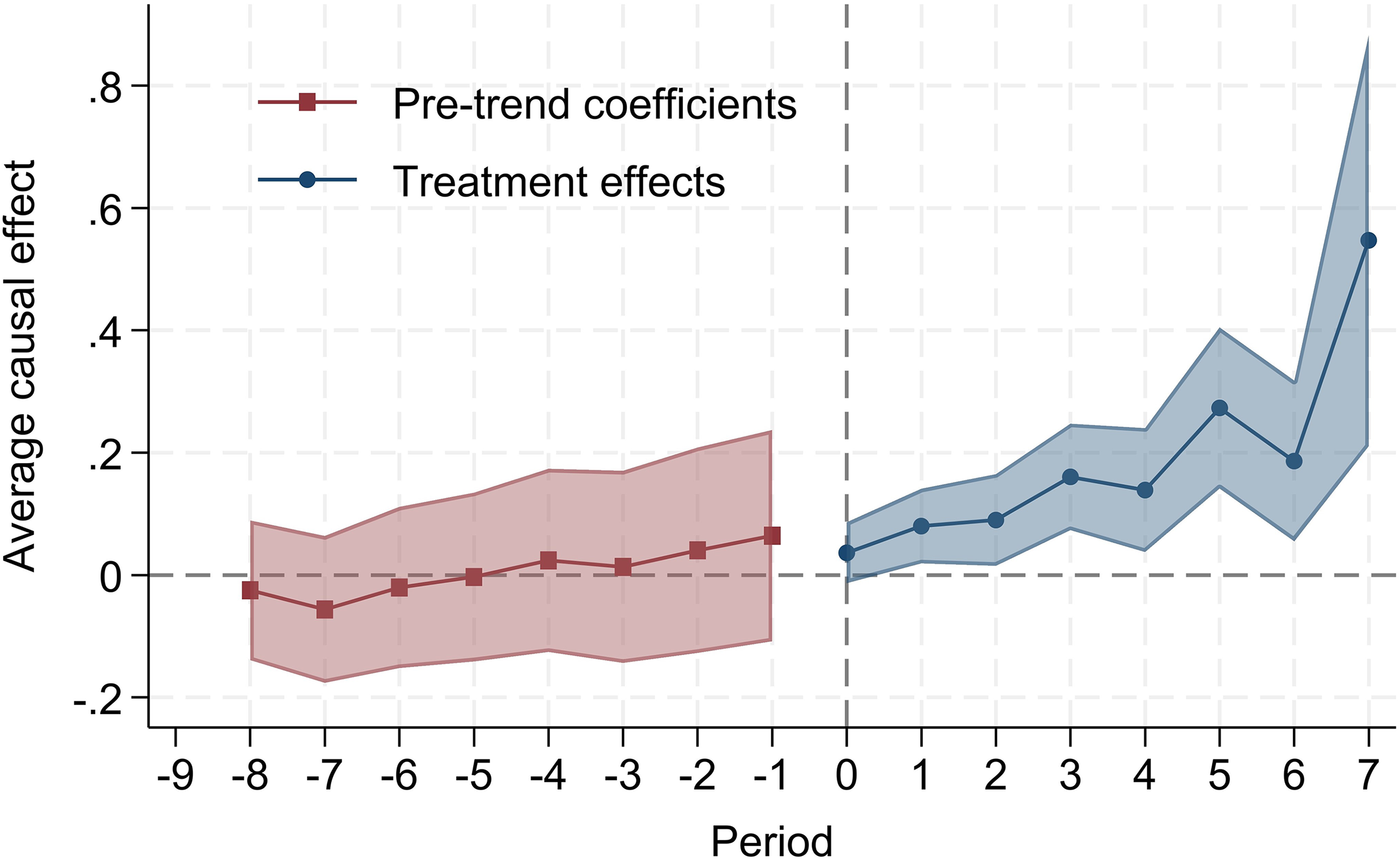
Parallel trend test.
Bacon's decomposition shows that 20.5% of the DID estimates come from the inappropriate group. Including the treatment effect in the control group resulted in biased two-way fixed effect estimates. Therefore, the simplest way to get a clean estimate is to exclude the control group that contains the treatment effect. In this paper, only the group that has never participated in the treatment and has not been treated is used as the control group (CSDID). The regression results in columns (1) and (2) of Table 3 indicate that the estimated coefficients are positive, suggesting that CBEC significantly affects enterprises’ GTI.
Heterogeneity treatment effect.
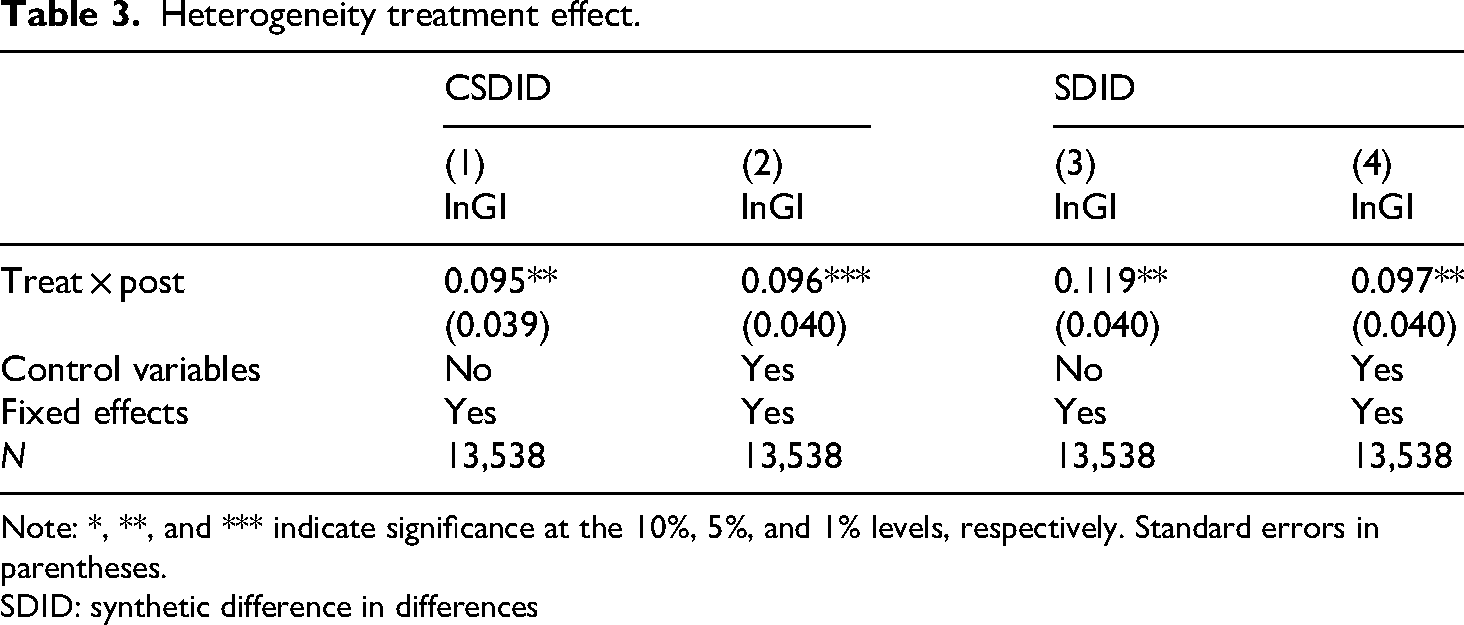
Note: *, **, and *** indicate significance at the 10%, 5%, and 1% levels, respectively. Standard errors in parentheses.
SDID: synthetic difference in differences
Synthetic difference in differences
The parallel trend assumption is a critical prerequisite for the application of DID. The current mainstream practice is to infer that the ex-post trend is consistent through the ex-ante trend consistency of event studies. However, even if ex-ante trends are found to be the same for the treatment and control groups through event studies, it is still difficult to ensure that their ex-post trends will align when the policy has not yet taken effect, as the ex-post period has not yet occurred. Additionally, the selection of pilot cities may have issues with selection bias, and the heterogeneity of different cities makes it challenging to find a completely matching control group. The synthetic control method combined with double difference forms the Synthetic difference in differences (SDID). SDID applies individual and time weights to identify a control group that closely resembles the treatment group, mitigating these issues to some extent. 60 The results are shown in Table 3, columns (3) and (4). The results obtained by SDID are similar to those obtained using CSDID, further verifying Hypothesis 1 of this paper.
Placebo tests
This paper conducts two placebo tests to demonstrate that the effect of CBEC in promoting GTI is not a coincidental outcome. Specifically: (1) keeping the processing time unchanged, we randomly replace the individuals in the treatment group and repeat the simulation 1000 times; (2) we randomly replace the individuals in the treatment group and randomly advance their processing time by 1 to 5 years, repeating the simulation 1000 times. Figure 5 shows that the estimated coefficients of the two methods are both in the right tail of the placebo effect distribution, with bilateral p-values of 0.023 and 0.017. It is rare for the pseudo-experimental group to have the same effect as the experimental group. Thus, the null hypothesis of a 0 policy treatment effect can be rejected, confirming the robustness of the baseline regression results.
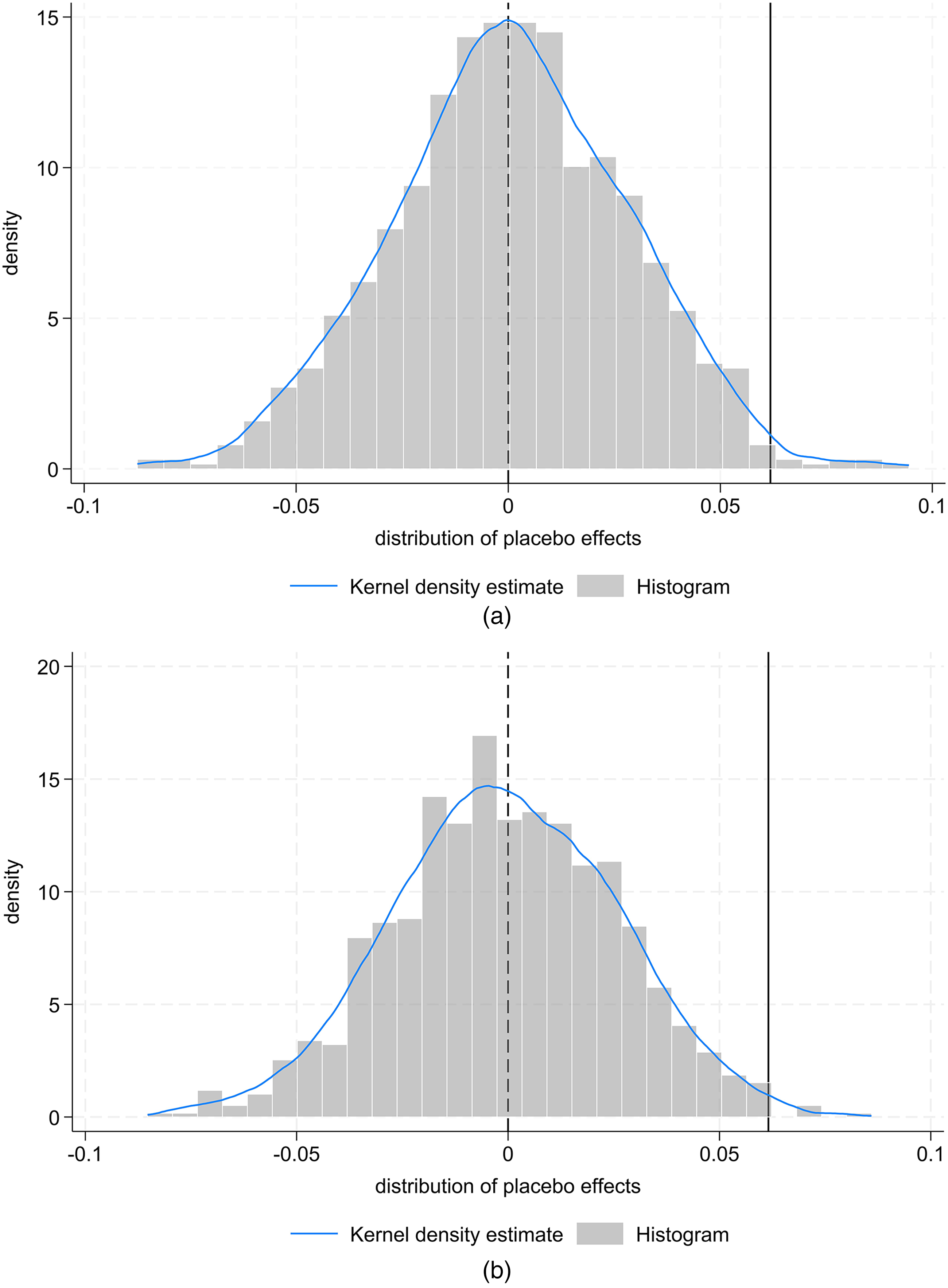
(a) Spatial placebo test. (b) Mixed placebo test.
Excluding the interference of concurrent policies
A range of other policies may have interfered with CBEC's estimates of GTI impacts during the sample period. In this paper, we searched for pilot policies that may have impacted GTI in enterprises from 2011 to 2022. For example, the low-carbon city pilot policy emphasizes the low-carbon economy. The free trade zone agreement reduces trade costs between member states and alleviates financial constraints for enterprises. The Broadband China pilot promotes Internet construction in pilot areas, improves the digital capabilities of enterprises, and fosters GTI. Therefore, this paper constructs dummy variables for low-carbon pilot cities (LC), free trade zones (FTZ), and Broadband China (BC) and introduces them into the regression. Table 4 indicates that after introducing other policy variables, the estimated coefficient of the Treat × post remains significant.
Estimated results of concurrent policies.

Note: *, **, and *** indicate significance at the 10%, 5%, and 1% levels, respectively. Standard errors in parentheses.
Expected effects
The DID method requires excluding expected effects to ensure the exogeneity of policy implementation. Therefore, a dummy policy shock variable
Other robustness test results.

Note: *, **, and *** indicate significance at the 10%, 5%, and 1% levels, respectively. Standard errors in parentheses.
Substitution of explanatory variables
The dependent variable in this paper reflects only the absolute level of GTI in enterprises, not its proportional quantity relative to overall enterprise innovation. We replace the dependent variable in the benchmark regression with the ratio of green invention patents to green patents (LnGI_1) and the ratio of green invention patents to total patents (LnGI_2). This substitution reflects the relative level of GTI in enterprises. Columns (2) and (3) of Table 5 show that the main explanatory variables are positive and significant, indicating that CBEC significantly increases the proportion of GTI in the total output of enterprise innovation and promotes high-quality green development in enterprises.
Endogenous treatment
Changes in the macro-environment across provinces over time may affect the estimated results. To mitigate estimation bias caused by province-specific time-varying factors, province-by-time fixed effects are introduced into the regression model. The results in column (4) of Table 5 show that, after incorporating these fixed effects, the coefficients remain consistent with the baseline regression estimates, indicating that the baseline results are robust.
Additionally, selecting the pilot cities for the pilot zone is not a completely exogenous policy shock. For instance, the first batch of pilot cities for the pilot zone was selected in Hangzhou, suggesting that a series of observable and unobservable factors, such as e-commerce development, digitalization level, and government emphasis on foreign trade, may have influenced the selection. Although the synthetic double difference method was used to avoid the impact of non-exogenous shocks, this paper still attempts to use instrumental variables to alleviate endogeneity.
We consider using the number of local post offices in 1984 as the core element of the instrumental variable. CBEC is based on e-commerce and the Internet. From the perspective of Internet development, China's early development relied mainly on fixed-line telephones to transmit information and access the Internet. From the perspective of e-commerce, logistics are critical for its development. In the early days, express delivery enterprises often relied on the distribution routes of post offices due to construction costs. Thus, the number of post offices in 1984 was selected as a proxy variable for CBEC due to its established relevance. However, compared with the rapid development of enterprises and the progress of science and technology and information technology, the number of post offices in 1984 is unlikely to reflect enterprises’ GTI level during the sample period, making it a suitable instrumental variable.
Considering that this paper uses panel data. This paper uses the interaction between the number of post offices in the area in 1984 and Internet penetration lagged by 1 year as an instrumental variable and the interaction between the number of landline telephones per 100 people in the area in 1984 and Internet penetration lagged by 1 year as a test variable for parameter estimation. The results are reported in columns (5) and (6) of Table 5. The estimated coefficients of the two instrumental variables are in the same direction, indicating that CBEC positively impacts GTI in enterprises. Compared to the benchmark regression, the coefficients of the instrumental variables are larger, suggesting that the benchmark regression may have underestimated the impact of CBEC on GTI in enterprises; however, this does not affect our conclusions. The relevant tests ruled out the possibility of weak instrumental variables.
Further analysis
Reconstruct the independent variable
The independent variable, based on whether the city where firm i is located was included in the pilot list of the pilot zone in year t, may lead to an underestimation of the estimated coefficient, as the policy implementation date is not always January 1 of the given year. For example, the fourth batch of CBEC pilot zone policies was implemented on 24 December 2019, giving only 8 days of policy effect in 2019. Treating the policy impact period as the whole year extends the policy processing time, resulting in underestimating the average treatment effect. Therefore, the policy impact time is processed monthly according to the actual implementation date within the current year. For instance, if the fourth batch of the pilot zone was implemented in December 2019, it would be recorded as 1/12, and if the first batch was implemented in March, it would be recorded as 10/12. A new difference variable (Ndv) is generated and substituted into equation (1) to re-estimate the baseline regression.
Column (1) of Table 6 shows that the re-estimated coefficient is slightly larger than the initial baseline coefficient of 0.060. Although the estimates from the baseline regression are underestimated, Hypothesis 1 remains valid. Columns (2) and (3) present the estimated results for the ratio of green invention patents to green patents and the ratio of green invention patents to total patents, respectively, showing positive and significant coefficients. This further verifies Hypothesis 1, demonstrating that CBEC can promote GTI in enterprises.
Reconstructing the estimates of the independent variables.

Note: *, **, and *** indicate significance at the 10%, 5%, and 1% levels, respectively. Standard errors in parentheses.
Heterogeneity analysis
Scale differences
Enterprise size is categorized according to total assets. The top one-third of the sample is designated as large-scale enterprises, the middle one-third as medium-sized enterprises, and the bottom one-third as small-scale enterprises. Columns (1) to (3) of Table 7 report the regression results by size group. The coefficients for small- and medium-sized enterprises are not significant, whereas those for large enterprises are significant, indicating that the improvement in GTI driven by CBEC is primarily concentrated in large enterprises. GTI differs from general innovation in that it includes environmental benefits. Larger enterprises have more innovation resources, including talent and capital, and are more likely to leverage the advantages of CBEC to transform resources into GTI.
Heterogeneity analysis (1).

Note: *, **, and *** indicate significance at the 10%, 5%, and 1% levels, respectively. Standard errors in parentheses.
Ownership differences
The sample is divided into two groups according to the type of ownership: state-owned enterprises and non-state-owned enterprises. The results of the regression by enterprise ownership are reported in columns (4) and (5) of Table 7. The coefficient for state-owned enterprises is positive but insignificant, while that for non-state-owned enterprises is significantly positive. This indicates that CBEC has significantly improved the GTI capabilities of non-state-owned enterprises. This is because state-owned enterprises generally face less pressure from financing constraints, and their ownership advantages bring more local government policy and bank funding support. In contrast, non-state-owned enterprises lack these ownership advantages, making the effect of CBEC on their GTI more significant.
Regional differences
The sample is divided into eastern, central, and western regions according to the listed enterprises’ locations. Columns (6) to (8) of Table 7 report the regression results of regional heterogeneity. The coefficient in the central region is significant and positive, while the coefficients in the eastern and western regions are insignificant. This indicates that CBEC significantly promotes GTI among enterprises in the central region. The eastern region is coastal and more economically developed, with more opportunities for enterprises to operate across borders. In contrast, the Western region is constrained by economic, talent, and other factors. These regions are not as sensitive to the incentive effect of GTI brought by the CBEC.
Industry differences
Based on the “List of Industry Categories for Environmental Protection Verification of Listed Companies,” the sample data were matched, classifying samples from 14 industries, including thermal power, steel, and cement, as heavily polluting industries, while all other industries were classified as non-heavily polluting. The regression results for industry characteristics are reported in columns (1) and (2) of Table 8. The coefficients for non-heavily polluting industries are not significant, while the coefficients for heavily polluting industries are significant and greater than those for non-heavily polluting industries, indicating that CBEC has a more significant effect on the improvement of GTI in enterprises in heavily polluting industries.
Heterogeneity analysis (2).

Note: *, **, and *** indicate significance at the 10%, 5%, and 1% levels, respectively. Standard errors in parentheses.
Trade borders differences
Distinguishing whether enterprises have overseas operations by the presence or absence of overseas revenues, the article excludes enterprises that added or exited overseas operations and retains only enterprises that consistently had overseas operations or none during the sample period. Columns (3) and (4) of Table 8 report the regression results for having overseas business or not, and the coefficients of both are positive and significant, indicating that CBEC reform enhances enterprises’ GTI regardless of whether they have overseas business. However, the promotional effect of CBEC reform is greater for enterprises without overseas operations, possibly due to differences in access to international technological information. The pilot zone strengthens the ability to transmit international technological information, breaking this information constraint and easing the information gap between the two types of enterprises. Thus, enterprises without overseas operations are more sensitive to the GTI incentives of CBEC reform.
Mechanism analysis
In the previous section of this article, we verified that CBEC has a significant positive influence on enterprises’ GTI and passed the robustness test. Next, we use a mediation effect model to examine whether this influence mechanism is related to financial constraints and enterprises’ absorptive capacity.
Financial constraints
Financial constraints limit enterprises’ GTI capability, while China's CBEC development offers institutional advantages that help reduce the tax burden on enterprises, enhance their financing capability, and alleviate financial constraints. Table 9 reports the impact of financial constraints on enterprises’ GTI from tax burden and financing ability perspectives. The estimated coefficient in column (1) is significantly negative, suggesting that the tax burden hinders GTI in enterprises. The coefficient in column (2) is significantly negative, indicating that CBEC reduces the tax burden on enterprises. The estimated coefficient in column (3) is significantly positive, indicating that CBEC positively impacts enterprises’ GTI. The tax burden of enterprises has a partial mediating effect: On one hand, CBEC directly promotes GTI, and on the other hand, it indirectly promotes GTI by reducing the tax burden and alleviating financial constraints. Column (4) shows that financing ability significantly positively affects GTI. Column (5) shows that CBEC enhances financing ability, and column (6) shows that CBEC positively affects GTI, with financing ability having a partial mediating effect. Therefore, Hypothesis 2 is supported: CBEC promotes GTI by alleviating financial constraints.
Mechanism analysis: financial constraints.

Note: *, **, and *** indicate significance at the 10%, 5%, and 1% levels, respectively. Standard errors in parentheses.
Absorption capacity
The development of CBEC can create jobs, attract many employees, especially high-level talents, enhance the absorptive capacity of enterprises, and promote GTI. Columns (1) and (2) of Table 10 indicate that CBEC creates jobs, attracts many employees, and increases the size of enterprise personnel. However, it does not significantly enhance the ratio of employees with bachelor's degrees to total employees. The coefficient in column (3) is significantly positive, indicating that absorptive capacity promotes GTI in enterprises. Additionally, when replacing undergraduate ratio (Ug) with absorption capacity (Ab) in the model in column (3), the regression result is positive and significant, with a coefficient of 0.005, lower than the 0.018 in column (3); however, this result is not reported in the table due to the insignificance in column (2). This shows that high-level talents significantly enhance GTI, justifying the proportion of employees with master's degrees or above as a proxy for absorptive capacity. Columns (4) and (5) report the mediation effect model's estimation results. The significantly positive coefficient in column (4) indicates that CBEC reform significantly enhances enterprises’ absorptive capacity, and both coefficients in column (5) are significantly positive, suggesting that enterprises’ absorptive capacity has a partial mediation effect.
Mechanism analysis: absorption capacity.

Note: *, **, and *** indicate significance at the 10%, 5%, and 1% levels, respectively. Standard errors in parentheses.
Let us further explore whether a firm's absorptive capacity enhances this informational advantage and, in turn, stimulates its innovation in green technologies. The information advantage (IA) is assessed based on the firm's engagement in overseas operations. Generally, having overseas operations signifies a closer proximity to international markets, leading to improved access to global market and technological information. I indicates whether the enterprise has an overseas business, taking the value of 1 if it does and 0 if it does not. A indicates whether the enterprise has overseas business in the current year, taking the value of 1 if it does and 0 if it does not. The estimation results of the introduction of overseas business are reported in column (6) of Table 10, with all three coefficients being significantly positive, suggesting that the information advantage enhances the enterprise's GTI. Further introducing the cross-multiplier term (IA × Ab) between overseas business (IA) and the enterprise's absorptive capacity (Ab), column (7) of Table 10 reports the estimation results, showing that the cross-multiplier term is significantly positive. This suggests that an enterprise's absorptive capacity significantly enhances the informational advantage, promoting GTI. Thus, Hypothesis 3 is supported: CBEC can enhance the absorptive capacity of enterprises and promote GTI, with this absorptive capacity moderating the improvement of information transformation efficiency.
In previous analyses, the emphasis was placed on addressing the two primary discussion questions posed by this paper: the potential for CBEC to enhance GTI and the underlying mechanisms that facilitate such an enhancement. The results are then ensured to be credible by extensive robustness checks. In the subsequent discussion section, the primary focus will be on the comparison of extant literature and the discussion of cases to ensure the robustness of the conclusions.
Discussion
CBEC's policy effects demonstrate the dual mechanism of GTI through learning effects: alleviating firms financing constraints and facilitating talent pooling. Contemporary scholarship consistently affirms the environmental benefits arising from digital economy expansion, particularly through the mediating channels of financial accessibility and human capital optimization.61–63 While this study corroborates the pivotal intermediary role of these financial and talent factors in GTI advancement, it reveals an important nuance: despite comparable mediating mechanisms, strategic orientation disparities in trade policies can generate divergent impacts on green innovation outcomes.
Although both policies enhance regional openness, they diverge fundamentally in operational focus: Free trade zones (FTZ) primarily facilitate traditional trade flows whereas CBEC drives digital trade transformation. Previous research has shown that FTZ is conducive to GTI, 64 particularly demonstrating stronger effects in coastal regions compared to inland areas. 65 It has been shown that China's CBEC is indeed conducive to green development and lower carbon emissions, and that green technology innovation is one of the key mechanisms of influence. 66 Counterintuitively, our findings present a contrasting spatial dynamic for CBEC implementation, revealing more pronounced GTI enhancement effects in interior regions.
This paper has certain limitations. First, while the CBEC pilot zone policy has enhanced China's trade openness, this study does not address the broader impact of this policy on overall trade liberalization, and the relationship between trade openness and GTI remains uncertain. 67 Future research could evaluate the policy's effect on regional trade liberalization and examine the interaction between integrated trade zones and GTI in greater detail. Second, although this paper demonstrates that China's CBEC pilot zone policy significantly promotes GTI, economic levels, infrastructure development, and cultural and geographic characteristics vary across different economies. Future studies could adopt a global perspective to compare the development environments of CBEC in various countries and explore the differences and mutual influences between economies. Lastly, the identification of CBEC enterprises in this study is somewhat coarse, as some enterprises within pilot cities are not involved in CBEC, which may reduce the average treatment effect and lead to an underestimation of the results. In the future, AI technologies and text analysis could be used to analyze company reports and more accurately identify CBEC enterprises at the enterprise level, thereby improving the precision of the analysis.
Conclusions and recommendations
This paper empirically examines the impact of CBEC on GTI among Chinese enterprises, using China's CBEC pilot zone policy as a quasi-natural experiment. The main conclusions are as follows: First, CBEC promotes GTI and enhances the share of green patents in companies’ patent portfolios. Second, the GTI effects of CBEC are particularly significant for large enterprises, non-state-owned enterprises, heavily polluting industries, and enterprises located in central regions. Third, CBEC reform stimulates GTI by alleviating financing constraints and enhancing enterprises’ absorptive capacity. Fourth, enterprises without overseas operations are more sensitive to the incentives provided by CBEC reforms. Fifth, the advantage of access to international information moderates the effect of enterprises’ absorptive capacity on GTI.
Based on these findings, several policy recommendations can be drawn. At the government level, it is essential to establish a “monitoring and early warning” mechanism for green barriers in international trade. This mechanism would dynamically collect, organize, analyze, and evaluate key standards and technical information related to green barriers, providing timely warnings to enterprises. Second, the government should continue to expand the CBEC pilot zone by summarizing successful experiences, easing enterprises’ financing constraints, capitalizing on the talent dividend, and stimulating GTI in the private sector. At the enterprise level, enterprises should fully leverage the advantages of CBEC digital platforms, utilizing real-time international market information to guide technological research and development, thereby enhancing innovation efficiency and output. Furthermore, enterprises should take advantage of policy innovations in the pilot zone to optimize their capital and talent structures, increase investment in R&D, advance their positions in the global value chain, and acquire core competitive advantages in the international market, fostering green and high-quality development.
Footnotes

Ethical considerations
This study conforms to the ethical and moral requirements.
Consent to participate
All the authors of this article were consented to participate.
Consent for publication
This study was consented to be published.
Author contributions/CRediT
CT was responsible for writing—review and editing, methodology, funding acquisition, supervision, conceptualization. CZ was responsible for writing—original draft, data curation, visualization, software, methodology, formal analysis, and conceptualization.
Funding
The author(s) disclosed receipt of the following financial support for the research, authorship, and/or publication of this article: The authors would like to thank the Major Project of the National Social Science Foundation of China under Grant (number 21&ZD150) for funding support.
Conflicting interests
The author(s) declared no potential conflicts of interest with respect to the research, authorship, and/or publication of this article.
Data availability
Data will be made available on request.