




Abstract
Due to the discrete and non-homogeneous of similar materials and the inability to realize large-size and original scale modeling, it is difficult to restore the structure and stress state of underground coal and rock mass in similar simulation tests. To solve this problem, a lightweight and suitable for large-scale modeling similar material, rock-like porous material has been developed. The quasi-static uniaxial compression experiment was carried out by using the large tonnage multi-module electronic control test system. And the influencing factors of controllable mechanical behavior of rock-like porous materials were studied. The results showed that, under uniaxial compression conditions, the material stress–strain curve exhibits three phases: elastic stage, failure stage, and platform stage. The uniaxial compressive strength, elasticity modulus, stress drop, and softening modulus of rock-like porous materials basically increase with the increase of density. The stress after peak strength changes from a slow decrease to a “stepped” or even “cliff like” downward trend. Polypropylene fibers have the effect of enhancing the uniaxial compressive strength, elasticity modulus, stress drop, softening modulus, shear deformation, and residual strength stability of rock-like porous materials. The rock-like porous material has a critical loading velocity, and it increases with density. At the critical loading velocity, the material shows obvious shear failure, and the shear inclination angle is the largest, and so is the uniaxial compressive strength. Through the experimental research, the influence laws of density, polypropylene fiber, and loading velocity on the failure mode, mechanical parameters, and mechanical behavior of the material are clarified, and the quantitative relationship between density and each mechanical parameter is obtained. The research is helpful to realize the accurate control of mechanical behavior of rock-like porous materials and further inverts the deformation and failure mechanism of underground coal and rock structures through indoor similar simulation tests.
Keywords
Introduction
Accurate and reliable analysis of migration process monitoring and structure deformation and failure of coal and rock is the prerequisite for the occurrence mechanism, refined prediction, prevention, and control of mine dynamic disasters.1–4 However, due to the complex geological structure and limited mining environment, it is difficult to carry out in-situ rock mass test. Therefore, it is a necessary research method to invert the deformation and failure mechanism of underground coal and rock structures through indoor similar simulation tests. However, at present, similar materials themselves have the shortcomings of discreteness, heterogeneity, and the inability to realize large size/original scale modeling. This make it difficult for similar models to restore the structure and stress state of underground coal and rock mass, resulting in a far difference between the test results and the actual situation. Therefore, in order to achieve high fidelity and large-scale reduction of deep coal and rock structures, it is urgent to have a rock-like material with lightweight and controllable mechanical behavior. In order to ensure lightweight and large-scale reduction, rock-like porous materials (Abbreviated as RLPM) have been developed.
At present, some experts have carried out a series of studies on porous materials. Guo et al. 5 studied the effects of lime, glass fiber, and triethanolamine on increasing the strength of foam concrete through experiments and found that triethanolamine has a greater effect on the strength increasing of foam concrete. Fang et al. 6 studied the relationship between compressive strength and pore structure of foamed concrete with reading microscope and image analysis software. Liu et al. 7 studied lightweight foam concrete with high compressive strength, low thermal conductivity, and low water absorption. Zhao et al.8–11 and Ma et al. 12 studied the effects of foamed concrete density and the applied normal stress on the peak stress, residual stress, shear stiffness and residual friction coefficient of the foamed concrete layer-lining interface. Sun et al. 13 studied the effects of different foaming agents on compressive strength and dry shrinkage of foamed concrete. Tan et al. 14 found through experimental research that the failure mode of foamed concrete is related to its density and is more influenced by its height-diameter ratio. Zhou et al. 15 studied the effect of impact velocity on failure modes. Sun 16 studied the relationship between the strength and residual strength of foamed concrete and the concentration of foaming agent and curing time. Huang et al. 17 used the impact load test to find that the dynamic stress–strain curve presents an obvious strain rate-dependent effect. Zhou et al. systematically studied the effects of aluminum honeycomb filled with foamed concrete on the compressive strength and energy absorption capacity of aluminum honeycomb, 15 and the effects of CFRP and ceramite on compressive strength and energy absorption capacity of foamed concrete.18–21 Zhang et al. 22 developed a foaming material with better crystallinity, initial gel time and compressive strength than ordinary Portland cement. Liu et al. 23 studied the shear modes of foamed concrete-shotcrete and foamed concrete-secondary lined concrete composites.
In summary, at present, great progress has been made in the study of RLPFs, but the main focus has been on strength and basic failure modes in areas such as insulated building walls, roof slopes, harbor rock walls, and poor concrete fills (as shown in Table 1). The study on mechanical parameters and mechanical behavior of materials is not deep and comprehensive enough. And the materials cannot be used in laboratory to reduce coal and rock mass structure and invert the dynamic phenomena of mine. Therefore, in this paper, quasi-static uniaxial compression experiments of RLPFs with different density levels, different polypropylene fiber content, and different loading velocities are carried out through a large tonnage multi-module electronic control test system independently developed and designed. The effects of density, polypropylene fiber, and loading velocity on the deformation failure and failure forms, uniaxial compressive strength, elasticity modulus, stress drop and softening modulus of RLPFs are studied. And how to control the mechanical behavior of RLPFs is further proposed.
Main advances in existing research.

Experiment of mechanical parameters and behaviors of RLPFs
Specimen preparation
The specimens used in the experiment are prepared by physical preparation technology. Firstly, the foaming agent and water are mixed in a certain proportion, and the foaming agent aqueous solution is made into uniform and stable foam by a high-speed mixer. Secondly, the main materials such as cement and fly ash are mixed evenly, and water is added proportionally to form a uniform cement mortar. Thirdly, add the foam according to a certain volume ratio, continue to stir until the cement mortar and foam mixture is evenly stirred, pour it into the mold, and remove the mold after 24–48 h. Finally, the experiment can be carried out when the specimens are cured for 28 days in a curing room with a temperature of 25° and a humidity of 95%. The specimen preparation process is shown in Figure 1. The precise preparation of RLPFs is realized by precisely controlling the ratio, addition quality, addition time, addition speed of each material, and the time and environmental parameters of each step. Then the accuracy and stability of the mechanical parameters of materials were further guaranteed.

Physical preparation process of RLPFs.
Testing system
As shown in Figure 2, a large tonnage multi-module electronic control test system independently developed and designed is used in the test. The system consists of test bench, loading system, temperature control system, and seepage system. The system adopts pure electric control, the maximum loading force is 1000 kN, including quasi-static force control (0.01–20 kN/s), displacement control (0.001–300 mm/min), deformation control (0.001–1 mm/s), program control, and other four control methods. In addition, the testing system can also carry out high and low temperature tests at −70 to 300°C, as well as seepage tests at the maximum system pressure of 50 MPa.
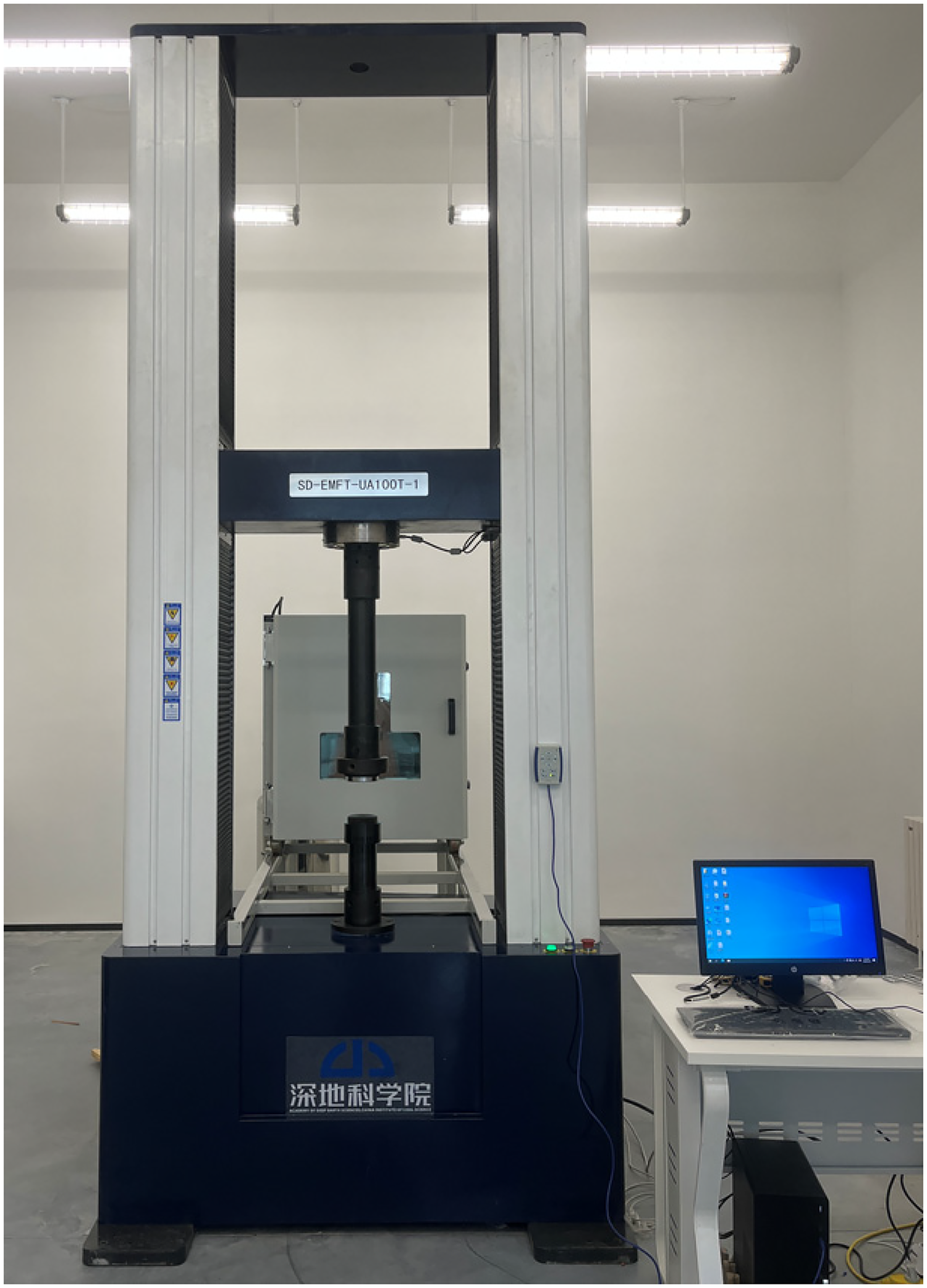
Large tonnage multi-module electronic control test system.
Experimental program
The experiment is divided into three groups, and the effects of density, polypropylene fiber, and loading velocity on the mechanical parameters and behaviors of materials are tested, respectively. The density influence test includes 11 density grades within the range of 300–1500 kg/m3 (material parameters with different densities are shown in Table 2). And on this basis, experiments without polypropylene fiber of 5 density grades are conducted to analyze the influence of polypropylene fiber. In addition, specimens of 5 density grades are selected. Uniaxial compression experiments at four loading velocities of 2 mm/min, 5 mm/min, 15 mm/min, and 25 mm/min are carried out to further analyze the influence of loading velocity on materials.
Test results and analysis
Effects of density on mechanical behaviors of RLPFs
Figure 3 to Figure 5, respectively, show the relationship between stress–strain curves, deformation and failure, mechanical parameters (including uniaxial compressive strength, elasticity modulus, stress drop, softening modulus), and density of specimens (group A) with different density grades containing polypropylene fiber under uniaxial compression with loading velocity of 5 mm/min. Table 3 shows the mechanical parameters obtained by the experiment, and the results retain 2 decimal places. Among them, the softening modulus refers to the absolute value of the curve slope after the peak of the stress–strain curve, which indicates the ability of the material to resist deformation during the failure stage.

Stress–strain curves of group A specimens with different density grades (a) All specimens in group A, (b) A3–A6, (c) A7–A10, and (d) A12–A13.

Deformation and rupture of group A specimens with different density grades (a) A3, (b) A4, (c) A5, (d) A6, (e) A7, (f) A8, (g) A9, (h) A10, (i) A12, (j) A13, and (k) A15.
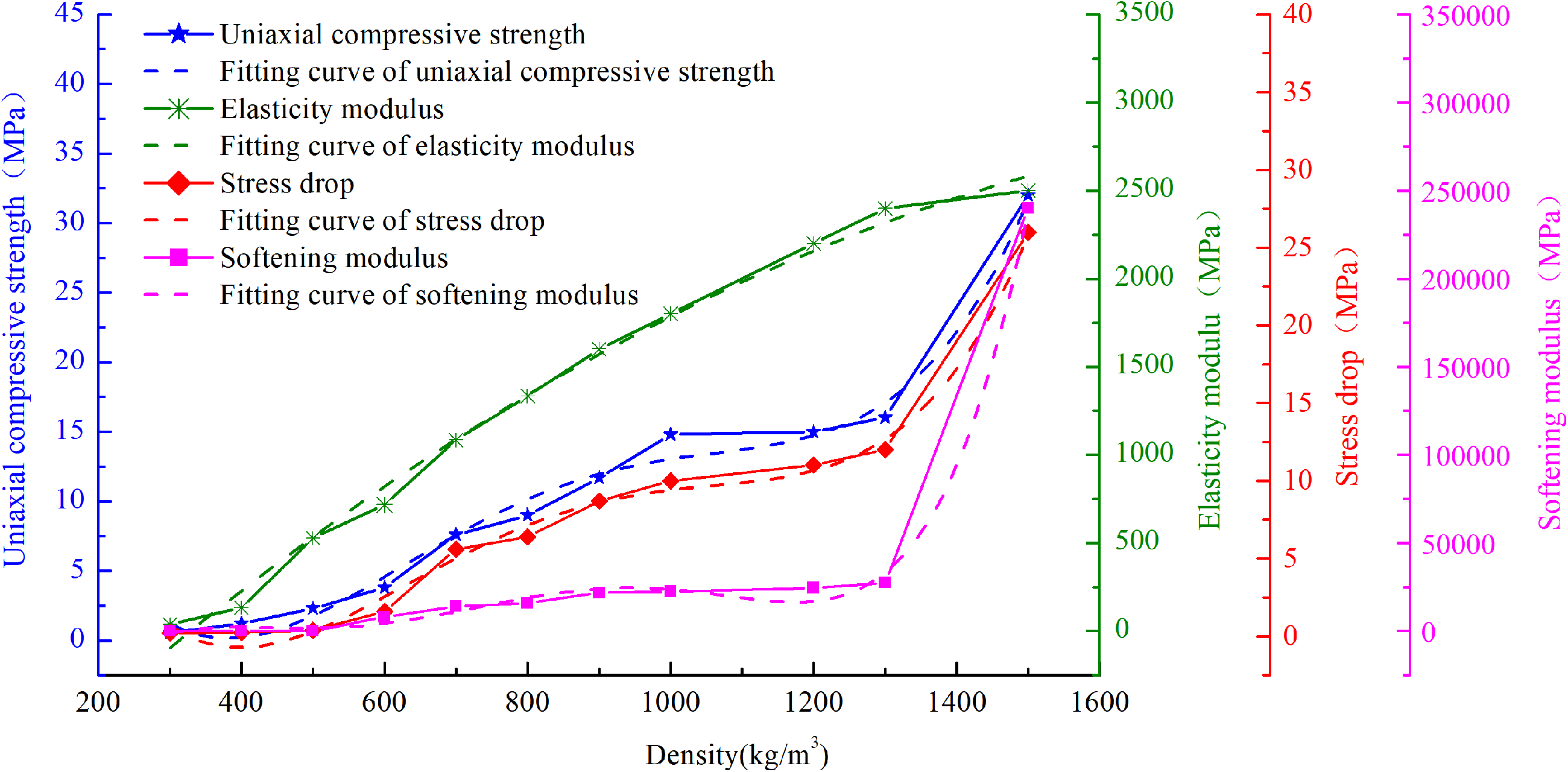
Relation between mechanical parameters and density of group A specimens.
Parameters of group A RLPF specimens.

As can be seen from Figure 3 and Figure 4, RLPM specimens with different densities show three different stages: elastic stage, failure stage, and platform stage. In the elastic stage, the specimens with small compression displacement mainly exhibit elastic mechanical properties. With the increase of compression displacement, the axial load of specimen decreases rapidly due to penetrating cracks on the surface, when the specimen reaches the peak load. With the further increase of compression displacement, the specimen gradually crumbled and failed, showing a stable stage of platform stress.
After the peak strength, the deformation of specimens A3-A6 is relatively gentle, and there is no obvious stress reduction. The creep property is obvious, the stress changes are little, and the strain changes are obvious. Especially, the curves of A3 and A4 with relatively small density grades are close to ideal elastoplasticity. The deformation and rupture process from intermediate splitting to overall collapse occurs in all four groups of specimens. After the peak strength, the stress of specimens A7–A10 show an obvious stepped decreasing trend, the stress drop and softening modulus increased with the increase of density, and the four groups of specimens basically showed X-type shear fracture. The stress of specimens A12–A15 shows a cliff-like decline, and the three groups of specimens are broken with multiple bands, after reaching the peak strength.
It can be seen from Table 2 and Figure 5 that, the uniaxial compressive strength, elasticity modulus, stress drop, and softening modulus of the specimen basically show an increasing trend with the increase of density. The fitting function relations are shown as Eq. (1)–Eq. (4), respectively. And there is a stable plateau in the residual strength stage, and the stress will not drop to 0.



To sum up, for low-density RLPM, due to the existence of many uniform bubble holes and microholes in its interior, when subjected to axial pressure, the bubble holes and microholes play a leading role, and the specimen slowly stores energy and releases energy, and there is no obvious stress reduction after the peak strength. With the increase of density, the bubble hole in RLPM decreases and the concrete content increases. During the loading process of the specimen, stress concentration occurred at the weakest cell wall, and the stress there gradually increased until it is greater than the fracture strength, and then brittle fracture occurred, resulting in the collapse and stacking of the cell wall, which is manifested as local crushing and micro-cracks. At this time, the stress in the stress–strain curve shows a phenomenon of “stepped” decline. During the compression process of RLPM, brittle fracture occurs in the cell wall and micro-cracks are formed. With the increase of compression distance, micro-cracks converge and gradually extend, and finally form macro-cracks, and then enter the stage of platform loading.
However, with the further increase of density, the content of bubble hole in the specimen is less and less, and the content of concrete is more and more. In the loading process of the specimen, the role of concrete particles and its own cracks becomes more and more obvious. Due to its low porosity, that is, the number of bubbles is small, the hole wall collapse cannot occur like that of low-density RLPM, when it is actually subjected to axial pressure. Instead, the inner bubble hole will act as an internal defect, and the stress concentration area will appear around the bubble hole. When the axial pressure reaches a certain value, the specimen appears several cracks through its different surfaces with a “click” sound. The stress–strain curve shows a trend of stepped decline or even cliff decline after the stress reaches uniaxial compressive strength, and then the curve enters the plateau stage with the increase of strain. This form of deformation and failure is getting closer to the coal and rock. However, because the polypropylene fiber added to the material increases its toughness and crack resistance, there is a stable plateau period in the residual strength stage of deformation and fracture, and the stress will not drop to 0. At the same time, because the added polypropylene fiber has the same quality, when the concrete content is small, the effect of polypropylene fiber is more obvious, making the toughness of the specimen stronger. This is one of the reasons why the stress–strain curves of low-density materials are close to ideal elastoplasticity.
According to the statistical results in Table 1, a large number of experts have studied the effect of density on RLPFs, but mainly focused on the uniaxial compressive strength, residual strength, failure modes, etc., and did not get the quantitative relationship of the uniaxial compressive strength, residual strength, and density. At the same time, the root cause of a certain failure mode of the material has not been clarified. In this paper, not only the three deformation damage stages presented by the material under uniaxial compression conditions and the mechanical mechanisms generated by different failure modes of the material are found through experimental studies. At the same time, the influence law of density on uniaxial compressive strength, elasticity modulus, stress drop, and softening modulus is clarified, and a quantitative functional relationship equation is obtained.
Effects of polypropylene fiber on mechanical behaviors of RLPFs
Polypropylene fiber is a high-strength, corrosion-resistant synthetic fiber material with excellent durability and tensile strength. Preliminary analysis shows that by adding polypropylene fibers to RLPFs, the excellent properties of polypropylene fibers themselves can also play an important role in RLPFs. In order to study the effects of polypropylene fiber on the mechanical behaviors of RLPFs, group B specimens without polypropylene fiber with different ratios of foaming agent, water, and cement are prepared, and uniaxial compression experiments are carried out at a loading velocity of 5 mm/min. The test results are compared with those of group A specimens in “Effects of density on mechanical behaviors of RLPFs” section.
Figures 6, Figure 7, Figure 8, and Table 4, respectively, show the stress–strain relationship, mechanical parameters, and density relationship of Group B specimens with different density grades, the comparison of mechanical parameters of group A and group B specimens, and the material and mechanical parameters of specimens. The results retain 2 decimal places.

Stress–strain curves of group B specimens with different density grades (a) B6, (b) B7, (c) B9, (d) B10, and (e) B12.

Relation between mechanical parameters and density of group B specimens.

Comparison of mechanical parameters between group A and group B (a) uniaxial compressive strength–density relation, (b) elasticity modulus–density relation, (c) stress drop–density relation, and (d) softening modulus–density relation.
Mechanical parameters of group A specimens with different densities.

Material and mechanical parameters of group B RLPF specimens.
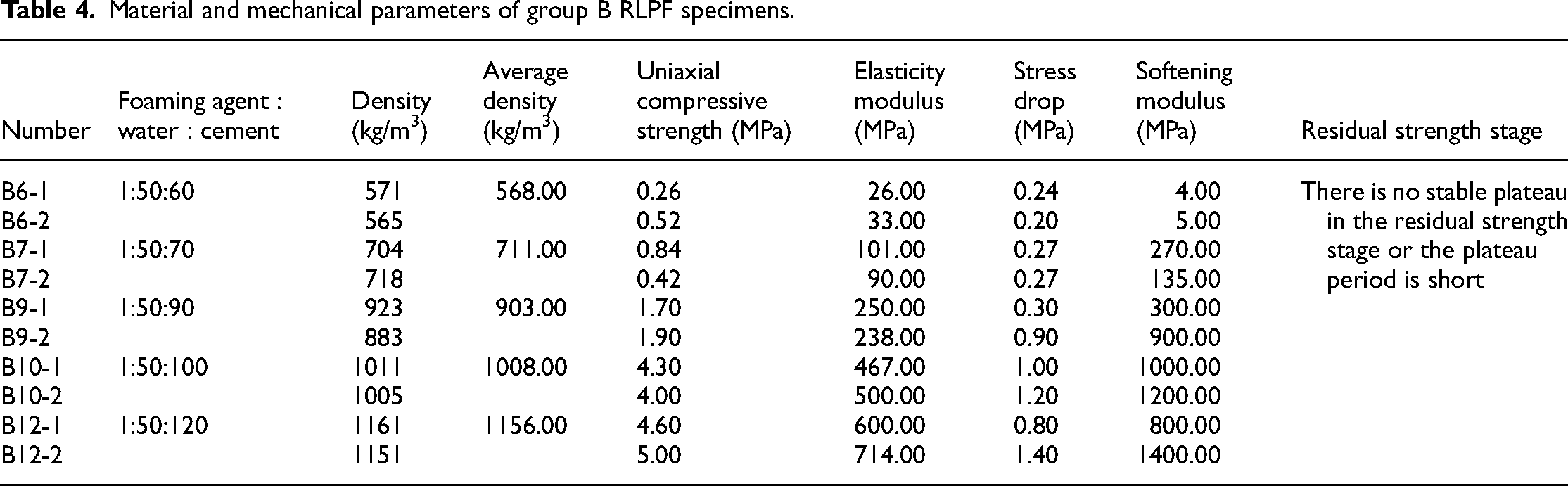
As can be seen from Figure 6, Figure 7, and Table 4, specimens B6, B7, B9, and B10 all show obvious shear failure. The inclination of shear line increased, and the angle between the two shear lines became smaller and smaller, with the increase of density. And specimen B12 (with an average density of 1156 kg/m3) shows strip fracture. Meanwhile, uniaxial compressive strength, elasticity modulus, stress drop, and softening modulus increase with the increase of density. In addition, the stress–strain curves have no stable platform segment or a short platform segment in the residual strength stage.
As can be seen from Figure 8, uniaxial compressive strength, elasticity modulus, stress drop, and softening modulus of group A specimens of each density grade are much larger than those of group B specimens. The preliminary analysis is related to the polypropylene fiber and non-uniformity of bubble. On the one hand, because the polypropylene fiber added to group A specimens has high strength, elasticity modulus, and dispersibility and has strong binding force with the cement surface, which can enhance the strength, crack resistance, and elasticity modulus of the specimens. At the same time, due to the binding force of the polypropylene fiber on the concrete inside the specimen, the specimen is difficult to be crushed but exists in the form of a larger body. When the energy inside the specimen accumulates to a certain extent, it is released instantly. Therefore, the stress drop and softening modulus are increased to a certain extent. On the other hand, the test results of the mechanical parameters of group B are relatively discrete due to the non-uniform bubble holes and more unstable endogenous cracks. Meanwhile, it makes the specimen unable to accumulate large energy. Therefore, the uniaxial compressive strength, stress drop, and softening modulus are smaller than those of group A.
According to the statistical results in Table 1, the current research on the influence of polypropylene fibers on RLPFs mainly focuses on the uniaxial compressive strength and does not comprehensively consider its influence on the elasticity modulus, stress drop, softening modulus, and the failure mode of material. This paper comprehensively analyzes the influence of polypropylene fibers on uniaxial compressive strength, elasticity modulus, stress drop, softening modulus, and failure mode of material through experimental research and elaborates the mechanical mechanism of polypropylene fibers affecting the mechanical parameters and behavior of the material.
Effects of loading velocity on mechanical behaviors of RLPFs
Figure 9, Figure 10, and Figure 11 show the deformation and failure, stress–strain curves, and the relationship between uniaxial compressive strength and loading velocity of specimens with different density grades at loading velocities of 2 mm/min, 5 mm/min, 15 mm/min, and 25 mm/min, respectively.

Deformation and failure of specimens with different density grades vary with loading velocity (a) A3, (b) A7, (c) A9, (d) A13, and (e) A15.
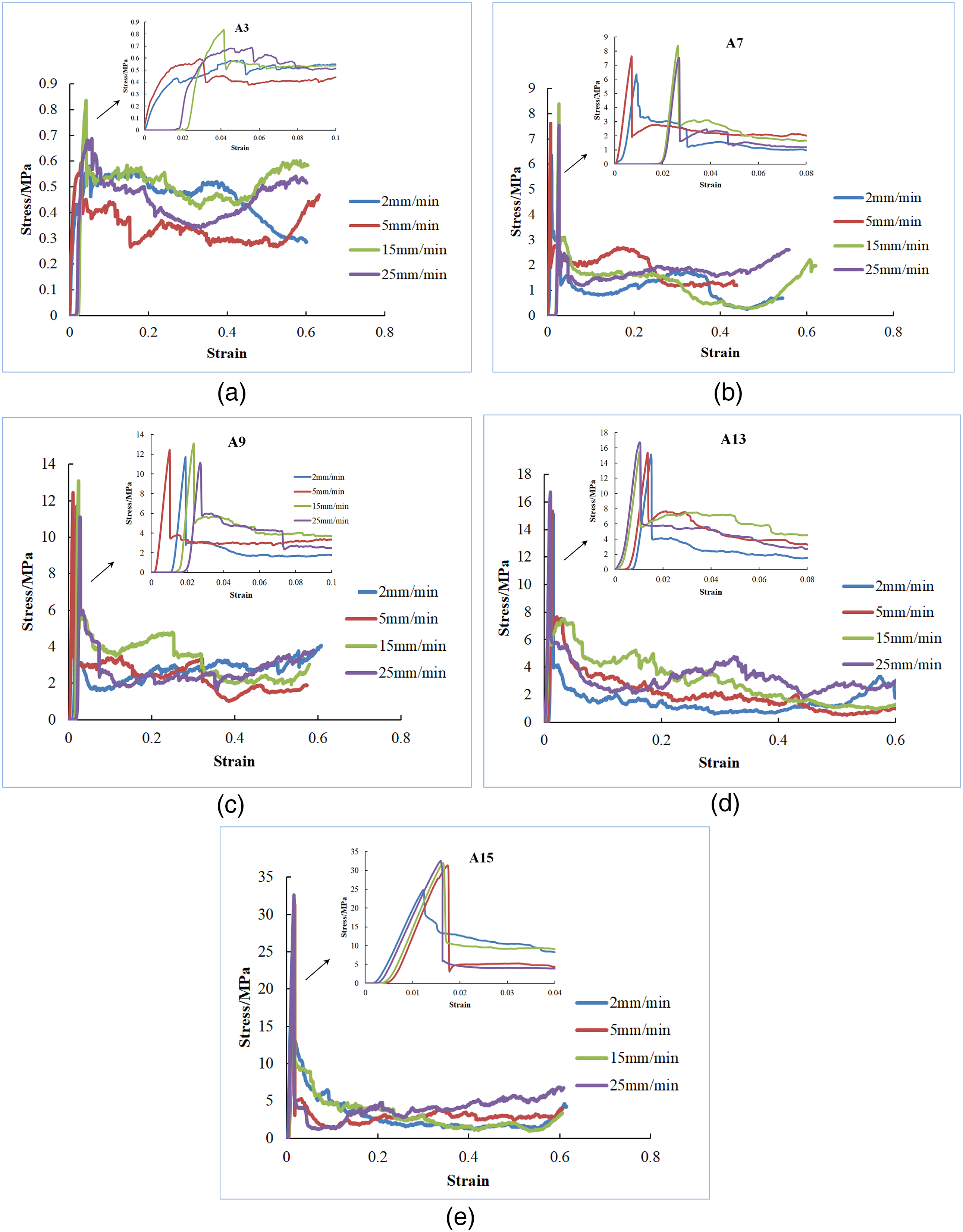
Stress–strain curves at different loading velocities (a) A3, (b) A7, (c) A9, (d) A13, and (e) A15.

Relationship between uniaxial compressive strength and loading velocity.
It can be seen from Figure 9 to Figure 11 that, the stress–strain curve of specimen A3 changes gently after the peak strength. Especially when the loading velocities are 2 mm/min and 25 mm/min, the curve is close to the ideal elastoplasticity. As the loading velocity increases, the uniaxial compressive strength and stress drop first increase and then decrease. When the loading velocity is 15 mm/min, the uniaxial compressive strength and stress drop reach the maximum, which are 0.84 MPa and 0.34 MPa, respectively. Except for the obvious shear crack under the loading velocity of 15 mm/min, the specimens gradually collapsed from the bottom under other loading velocities.
With the increase of loading velocity, the uniaxial compressive strength and residual strength of specimens A7 and A9 firstly increase and then decrease. When the loading velocity is 15 mm/min, the uniaxial compressive strength (8.4 MPa and 13.2 MPa, respectively) and residual strength (3.2 MPa and 5.9 MPa, respectively) reach the maximum. Both of specimens A7 and A9 show obvious shear failure, and the dip angles first increase and then decrease with the increase of loading velocity. The dip angle is the largest, when the loading velocity is 15 mm/min.
The uniaxial compressive strength of specimens A13 and A15 increases with the loading velocity increasing. When the loading velocity is 25 mm/min, the uniaxial compressive strength reached the maximum, which are 16.8 MPa and 33 MPa, respectively. Specimens A13 and A15 show obvious shear failure.With the increase of loading velocity, the inclination of shear line increases, and the angle between the two shear lines becomes smaller and smaller and gradually presents strip fracture.
In summary, the RLPF has a critical loading velocity, and the critical loading velocity increases with the density increasing. Under the critical loading velocity, the RLPF shows obvious shear failure, the inclination of shear line is the largest, and the uniaxial compressive strength is also the largest.
According to the statistical results in Table 1, the current research on the effects of loading velocity on RLPFs mainly focuses on the effect of impact speed on the failure mode of materials. Different from previous studies, this paper focuses on the effects of loading velocity on uniaxial compressive strength, residual strength, and failure mode of RLPFs under static loading conditions. At the same time, it determines the critical loading velocity of RLPFs with different densities and the characteristics of the uniaxial compressive strength and failure mode under the critical loading velocity.
Conclusion
The research developed a kind of rock-like porous materials and realized the precise preparation of RLPMs by precisely controlling the ratio, addition quality, addition time, addition speed of each material, and the time and environmental parameters of each step. Then the accuracy and stability of the mechanical parameters of materials were further guaranteed. Subsequently, three parameters (including density, polypropylene fibers, and loading velocity) that have a relatively large influence on the mechanical parameters and behavior of material were investigated through laboratory tests. The density influence test included 11 density grades within the range of 300–1500 kg/m3. On this basis, experiments without polypropylene fiber of 5 density grades were conducted to analyze the influence of polypropylene fiber. In addition, specimens of 5 density grades were selected. Uniaxial compression experiments at four loading velocities of 2 mm/min, 5 mm/min, 15 mm/min, and 25 mm/min were carried out to further analyze the influence of loading velocity on materials. By refining the level of each influencing parameter, an accurate analysis of the mechanical properties and behavior of the material was achieved. And the following conclusions were obtained:
Under uniaxial compression conditions, the material stress–strain curve exhibits three phases: elastic stage, failure stage, and platform stage. The stress of low-density RLPM shows a slow decreasing trend after uniaxial compressive strength. With the increase of density, the stress after peak strength first presents a “stepped” decline trend, and then enters the plateau stage. With the further increase of density, the stress–strain curve shows a trend of stepped decline or even cliff decline after the stress reaches peak strength, and then the curve enters the plateau stage with the increase of strain. The uniaxial compressive strength, elasticity modulus, stress drop, and softening modulus of RLPFs basically increase with the increase of density, and the corresponding fitting curves and functions are obtained. RLPM without polypropylene fiber shows obvious shear failure. And with the increase of density, the inclination of shear line increases, and the angle between two shear lines becomes smaller and smaller. Meanwhile, uniaxial compressive strength, elasticity modulus, stress drop, and softening modulus increase with the increase of density. In addition, the stress–strain curve has no stable platform segment or short platform segment in the residual strength stage. The uniaxial compressive strength, elasticity modulus, stress drop, and softening modulus of RLPM with polypropylene fiber are higher than that without polypropylene fiber. The RLPF has a critical loading velocity, and the critical loading velocity increases with the density increasing. Under the critical loading velocity, the RLPF shows obvious shear failure, the inclination of shear line is the largest, and the uniaxial compressive strength is also the largest.
The above conclusions are mainly based on the quasi-static loading test to study the macroscopic influencing factors on the mechanical properties and behaviors of RLPFs. In order to comprehensively study the mechanism of controllable mechanical behavior of RLPFs, various loading conditions, such as dynamic and impact loading, as well as macroscopic (e.g., density, material composition, curing time, curing temperature, etc.) and microscopic (e.g. porosity, shape factor, and fractal dimension, etc.) influencing factors on the mechanical properties and behaviors of materials will be investigated in the subsequent study. At the same time, in addition to the applied research in similar simulation tests, we will also take advantage of the characteristics of RLPF, such as lightweight, high strength, thermal insulation, and heat insulation, to expand the research on its application in the field of coal mine underground filling and mining, firewall, support, and so on.
Footnotes
Acknowledgments
The authors gratefully acknowledge the support for this study granted by the Ministry of Science and Technology of the People's Republic of China, and National Key Laboratory of Intelligent Coal Mining and Rock Formation Control, and Collaborative Innovation Center for Coal Mine Major Dynamic Disaster Prevention and Control. The technical assistance provided by the workshop staff at Chinese Institute of Coal Science and Liaoning University is also gratefully acknowledged.
Additional information
Correspondence and requests for materials should be addressed to Xiaojing Zhu.
Author contributions
All authors contributed to the study conception and design. Xiaojing Zhu Carried out all the material preparation, data collection, and analysis, advised by Qingxin Qi, Yonghui Xiao, and Haitao Li. The first draft of the manuscript was written by Xiaojing Zhu. All authors read and approved the final manuscript.
Declaration of conflicting interests
The author(s) declared no potential conflicts of interest with respect to the research, authorship, and/or publication of this article.
Funding
The author(s) disclosed receipt of the following financial support for the research, authorship, and/or publication of this article: This work was supported by the National Natural Science Foundation of China, Special project of science and technology innovation venture capital of Tiandi Technology Co., LTD (grant number 52404217, 2024-TD-MS019).
