



Abstract
To reveal the mechanical response and energy evolution mechanism of coal under the coupling action of impact load and gas pressure, dynamic impact tests under four gas pressure levels (0.4, 1.2, 2.0, and 2.8 MPa) were carried out on coal samples from a rockburst mine in Ordos using a Split Hopkinson Pressure Bar (SHPB) system and a gas pressure control system. The variation laws of coal mechanical parameters, failure characteristics, and energy evolution mechanism were systematically studied. The results show that the dynamic mechanical properties of coal deteriorate significantly with the increase of gas pressure. The peak strength gradually decreases from 41.7 MPa at 0.4 MPa to 38.6 MPa at 2.8 MPa, and the dynamic elastic modulus decreases by 25% simultaneously. The absolute value of the slope of the post-peak softening segment of the stress–strain curve increases, indicating weakened brittleness and enhanced plastic deformation. The failure mode shows an obvious gradient change. Under low gas pressure, local spalling failure dominates, with coarse fragments being predominant. Under high gas pressure, it transforms into a composite failure mode with coexisting transverse spalling and longitudinal splitting, characterized by significantly reduced fragment sizes and intensified overall fragmentation. The total input energy first increases and then stabilizes with the increase of gas pressure, reaching a peak of 382 J at 2.0 MPa. The dissipated energy for failure increases continuously, and at 2.8 MPa, it increases by 2.3 times compared with that at 0.4 MPa. The elastic strain energy shows a trend of first increasing and then decreasing, with a significant decline in storage capacity under high gas pressure. Under high gas pressure, the energy absorption rate of coal accelerates in the early stage, and the time to reach the equilibrium state is 40 μs earlier than that of the benchmark group. Gas pressure reduces the effective stress of coal through the pore pressure effect, weakens the strength of the coal skeleton, and at the same time, the elastic potential energy of gas and impact energy are released synergistically, accelerating the propagation and coalescence of fractures. The research results provide experimental support for the establishment of energy criteria and prevention and control design of rockburst disasters in high-gas mines.
Introduction
Coal, as China's primary energy source, occupies a pivotal position in the energy structure. However, with the continuous increase in coal mining depth and intensity, problems such as rockburst and gas disasters have become increasingly severe, posing a serious threat to the safe production of coal mines and the safety of personnel's lives and property.1,2 Rockburst is an extremely destructive mine dynamic disaster, which often leads to serious consequences such as roadway damage, equipment destruction, and casualties. It may also induce secondary disasters like gas explosions and coal dust explosions, further exacerbating the severity of accidents.3,4 According to statistics, the annual direct economic losses caused by rockburst in some rockburst-prone coal mines in China are as high as hundreds of millions of yuan, and it also has a significant negative impact on coal output. Gas disasters are equally undeniable; accidents such as gas explosions and coal and gas outbursts occur frequently, bringing great challenges to the safe production of coal mines.5,6 Once a gas explosion accident occurs, it often causes huge casualties and property losses, with extremely far-reaching destructive power and influence. Coal and gas outbursts, on the other hand, can lead to the sudden ejection of large amounts of gas and coal, blocking roadways, damaging ventilation systems, and triggering accidents such as gas asphyxiation and explosions.7,8
Scholars at home and abroad have achieved a series of results in the research on the mechanical behavior of coal under impact load.9,10 In terms of mechanical parameter research, many scholars have conducted studies using the Split Hopkinson Pressure Bar (SHPB) test system. For example, through SHPB tests, the dynamic compressive strength of coal under different strain rates was measured, and it was found that the dynamic compressive strength of coal increases significantly with the increase of strain rate, showing a good exponential relationship between the two. 11 Using this test system, the variation law of the elastic modulus of coal under impact load was studied, and the results showed that the elastic modulus also increases with the increase of strain rate, but the growth rate gradually decreases. 12 In terms of deformation and failure characteristics, scholars have adopted a variety of observation methods for analysis. 13 Many scholars used high-speed photography technology to capture the moment of coal failure under impact load, and found that microcracks first occur in the weak parts of coal, then the microcracks expand and coalesce rapidly, eventually leading to the macroscopic failure of coal, and the failure mode shows obvious brittle characteristics. 14 Many studies have conducted comparative analysis on the internal structure of coal before and after impact using CT scanning technology, revealing the evolution process of pores and fractures inside coal under impact load—specifically, pores and fractures continue to expand and connect to form larger defects, thereby reducing the strength and stability of coal. 15 However, there are still some deficiencies in existing research. The research on the mechanical behavior of coal under complex impact load conditions, such as multiple impacts and impacts with different waveforms, is not in-depth enough, and there is a lack of systematic theoretical and experimental research. 16 In actual coal mining, coal is often affected by the combined action of multiple factors, such as gas, water, and in-situ stress. At present, there are relatively few studies on the mechanical behavior of coal under the coupling effect of multiple factors, making it difficult to accurately describe the mechanical response of coal under actual working conditions.17,18 Regarding the influence of gas pressure on the mechanical properties of coal, scholars at home and abroad have also conducted a large number of studies.19,20 In terms of experimental research, triaxial compression tests were carried out to explore the change of coal's compressive strength under different gas pressures. The results showed that the compressive strength of coal decreases significantly with the increase of gas pressure—when the gas pressure increases from 0.5 to 2.0 MPa, the compressive strength of coal decreases by about 30%. Acoustic emission technology was used to monitor the failure process of coal under gas pressure, and it was found that gas pressure promotes the initiation and expansion of microcracks inside coal, reducing the load-bearing capacity of coal. 21 However, existing research has shortcomings in the study of coal's mechanical properties under the coupling effect of multiple factors. 22 In actual coal mining, the environment where coal is located is complex, and factors such as gas pressure, in-situ stress, temperature, and coal moisture content interact with each other. At present, the research on the variation law of coal's mechanical properties under the synergistic effect of these factors is not comprehensive and in-depth enough. Experimental research is difficult to fully simulate actual working conditions, and theoretical models and numerical simulations still need to be further improved and verified. The energy evolution mechanism of coal during loading and failure is one of the key research focuses. 23 The energy sources of coal mainly include the energy input from external loading and the elastic energy stored in itself. During the loading process, external energy is continuously input into coal, causing the elastic energy inside it to accumulate gradually. When coal reaches its ultimate load-bearing capacity, the elastic energy is released rapidly, leading to the failure of coal. Scholars have discussed the energy conversion and dissipation mechanism of coal through theoretical analysis and experimental research. 24 Some scholars established the energy balance equation of coal based on the first law of thermodynamics, analyzed the energy conversion relationship of coal during the loading process, and pointed out that during the coal failure process, part of the energy is used to generate new crack surfaces, and the other part is dissipated in the form of heat energy. In terms of research on the influence of gas pressure on energy evolution, some scholars found through experimental research that with the increase of gas pressure, the energy absorbed by coal during failure decreases, while the dissipated energy increases. This indicates that gas pressure changes the energy distribution mode of coal and reduces the stability of coal.25,26 However, the current research on the energy evolution law of coal under the combined action of impact load and gas pressure is not systematic enough. There is a lack of in-depth analysis of the entire energy evolution process, and in experimental research, the accurate measurement and analysis methods of energy parameters still need to be improved. 27
Based on this, in-depth research on the mechanical behavior and energy evolution law of coal under different gas pressures under impact load is of great theoretical and practical significance for revealing the occurrence mechanism of rockburst and gas disasters, formulating effective prevention and control measures, and ensuring the safe production of coal mines. By grasping the mechanical response and energy change laws of coal under different conditions, the occurrence of disasters can be predicted more accurately, preventive measures can be taken in advance, and the probability and harm degree of disasters can be reduced. This will thereby improve the safety and efficiency of coal mining and promote the sustainable development of the coal industry.
Experimental research
Experimental materials and equipment
The coal samples used in this experiment were collected from a rockburst mine in Ordos. This mine features complex geological conditions of coal seams and relatively high gas content, making the samples typical and representative. On the underground site, special coring equipment was used to obtain coal cores, and the coal cores were immediately sealed with moisture-proof plastic film after collection to avoid moisture loss or absorption during transportation. After being transported back to the laboratory, the natural moisture content of the raw coal core was measured using the oven-drying method: three parallel samples were taken, dried at 105 ± 5 °C to constant mass, and the average natural moisture content was determined to be 2.3% (variation coefficient ≤ 0.8%). To ensure the consistency of moisture content among all test specimens, all processed cylindrical specimens were placed in a constant temperature and humidity chamber (temperature 25 °C, relative humidity 60%) for 48 h of equilibration treatment. Before the impact test, the moisture content of each specimen was re-verified (measured value range: 2.1–2.5%), ensuring that the moisture content was stable and uniform, and eliminating the interference of moisture variation on the experimental results. The integrity of the coal cores was guaranteed during coring without damage to their original structure. In the laboratory, in accordance with experimental requirements, high-precision cutting equipment was used to process the coal cores into standard cylindrical specimens with a diameter of 100 mm and a height of 50 mm. During the processing, the dimensional accuracy of the specimens was strictly controlled, with the error of both diameter and height limited to within ±0.1 mm. At the same time, the two ends of the specimens were polished to ensure the parallelism and flatness of the end faces: the parallelism error was less than 0.02 mm, and the flatness error was less than 0.05 mm, so as to ensure uniform stress distribution during the experiment. For each gas pressure level, three parallel specimens were prepared for impact tests. By comparing the stress–strain curve characteristics, peak mechanical parameters, and failure modes of the parallel specimens, the typical specimen that best reflects the common response law of coal under the corresponding gas pressure was selected for data presentation and analysis. The deviation between the key parameters (peak strength, elastic modulus, total input energy) of the typical specimen and the average value of the parallel specimens is ≤5%, which ensures the reliability and representativeness of the experimental results. The experimental equipment mainly included a SHPB system and a gas pressure control system. The SHPB system consists of an incident bar, a transmission bar, a projectile, an energy storage device, a wave shaper, strain gauges, and a data acquisition system. Both the incident bar and the transmission bar are made of high-strength alloy steel, with a diameter of 100 mm and length of 3000 and 2000 mm respectively, so as to ensure stable propagation of stress waves in the bars and reduce the influence of dispersion effect. The projectile is made of the same material, with a length of 200 mm; the magnitude of the impact load is adjusted by changing the launch speed of the projectile. The energy storage device is an air compressor, which can provide stable air pressure to drive the launch of the projectile. The wave shaper uses a copper sheet of specific thickness and material, placed between the projectile and the incident bar, to adjust the waveform of the incident wave, making it smoother and more stable to meet experimental requirements. Strain gauges are attached to the incident bar and transmission bar to measure the amplitude and waveform of stress waves. The data acquisition system adopts a high-speed dynamic strain gauge with a sampling frequency of over 1 MHz, which can accurately collect and record stress wave signals. The gas pressure control system is composed of a gas cylinder, a pressure reducing valve, a pressure gauge, pipelines, and a sealing device. The gas cylinder stores high-purity methane gas, which serves as the gas source for simulating gas. The pressure reducing valve is used to adjust the output pressure of the gas to meet the different gas pressure levels set in the experiment. The pressure gauge is installed in the pipeline to monitor the gas pressure in real time, with an accuracy of 0.01 MPa. The pipelines are made of pressure-resistant and corrosion-resistant metal materials to ensure the safety and stability of gas transmission. The sealing device uses high-performance rubber sealing rings to seal the coal specimens and experimental equipment, preventing gas leakage and ensuring the accuracy of the experiment.
Experimental plan design
Setting of different gas pressures
Based on the common gas pressure range in actual coal mining, combined with relevant literature and on-site survey data, four different gas pressure levels were set in this experiment, namely 0.4, 1.2, 2.0, and 2.8 MPa. These gas pressure values cover the common gas pressure range from low-gas mines to high-gas mines, enabling a relatively comprehensive study on the influence of gas pressure on the mechanical behavior and energy evolution of coal. When setting the gas pressure, mine gas geological data were referred to: the gas pressure in different areas of this mine ranges from 0.3 to 3.0 MPa, and the selected four pressure values can reflect the actual gas pressure conditions borne by coal in this mine and under similar geological conditions. Meanwhile, during the experiment, the gas pressure control system was precisely adjusted to ensure that the deviation between the actual gas pressure and the set value at each pressure level was controlled within ±0.08 MPa, so as to guarantee the accuracy and reliability of the experimental results.
The application method of impact load
An impact load was applied using a SHPB system. Its principle is based on the stress wave propagation theory: when the projectile strikes the incident bar at a certain speed, an incident stress wave is generated in the incident bar. This stress wave propagates at the speed of an elastic wave to the contact surface between the coal sample and the incident bar. Due to the difference in wave impedance between the coal sample and the incident bar, the stress wave undergoes reflection and transmission at the contact surface, the reflected wave returns to the incident bar, while the transmitted wave enters the coal sample, subjecting the coal sample to impact loading. By measuring the stress wave signals recorded by the strain gauges on the incident bar and transmission bar, and using the one-dimensional stress wave theory and wave equation, mechanical parameters such as stress, strain, and strain rate of the coal sample under impact load can be calculated. During the experimental operation, first, the processed coal sample was installed between the incident bar and the transmission bar and fixed with a special fixture to ensure that the sample was in close contact with both bars and coaxial with them. Then, according to the set magnitude of the impact load, the air pressure of the air compressor was adjusted to make the projectile obtain the corresponding launch speed. Before launching the projectile, the connection status of the experimental device and the operation state of the gas pressure control system were checked again to ensure the safety and reliability of the experiment. After launching the projectile, the high-speed dynamic strain gauge quickly collected the stress wave signals on the incident bar and transmission bar, and transmitted the data to the computer for storage and analysis. After each impact experiment, the damage of the coal sample was observed and recorded, and the experimental device was cleaned to prepare for the next experiment. The magnitude of the impact load was controlled by changing the launch speed of the projectile. In this experiment, a constant impact speed of 5 m/s (corresponding impact air pressure of approximately 0.02 MPa) was determined based on three aspects: ① Theoretical analysis: According to the stress wave propagation theory and coal dynamic mechanical parameter range, the strain rate induced by 5 m/s impact speed on φ100 mm × 50 mm coal specimens is 500–800 s−1, which falls within the typical strain rate range of rockburst (100–1000 s−1) reported in existing studies, ensuring the correspondence between experimental loading conditions and actual dynamic disaster scenarios. ② Engineering practice: Field monitoring data of the rockburst mine in Ordos show that the dynamic disturbance speed of coal surrounding rock caused by mining activities (such as blasting, roof collapse) is 3–7 m/s, and 5 m/s is the median value of this range, which can effectively reflect the common dynamic impact intensity in the mine. ③ Preliminary pre-experiments: We conducted pre-impact tests with speeds of 3, 5, and 7 m/s. The results showed that the 3 m/s speed induced insufficient damage to coal specimens (only local microcracks without macroscopic failure), while the 7 m/s speed led to excessive fragmentation (difficult to analyze energy evolution laws). The 5 m/s speed enables coal specimens to undergo complete failure under different gas pressures, with clear stress–strain curve characteristics and measurable energy parameters, which is suitable for comparative analysis of the influence of gas pressure. Meanwhile, by adjusting the parameters of the wave shaper (such as the thickness and material of the copper sheet), the waveform of the incident wave was optimized to reduce experimental errors caused by an unsatisfactory waveform. Figure 1 shows the SHPB device. Meanwhile, by adjusting the parameters of the wave shaper (such as the thickness and material of the copper sheet), the waveform of the incident wave was optimized to reduce experimental errors caused by an unsatisfactory waveform. Figure 1 shows the SHPB device.

SHPB testing system.
Validation of the effectiveness of the SHPB test
Figure 2 shows the incident stress, reflected stress, transmitted stress, and the superposed curve of incident stress + reflected stress before and after impact loading. It can be seen from Figure 2 that the curves are basically consistent, thus satisfying the stress balance condition. 28
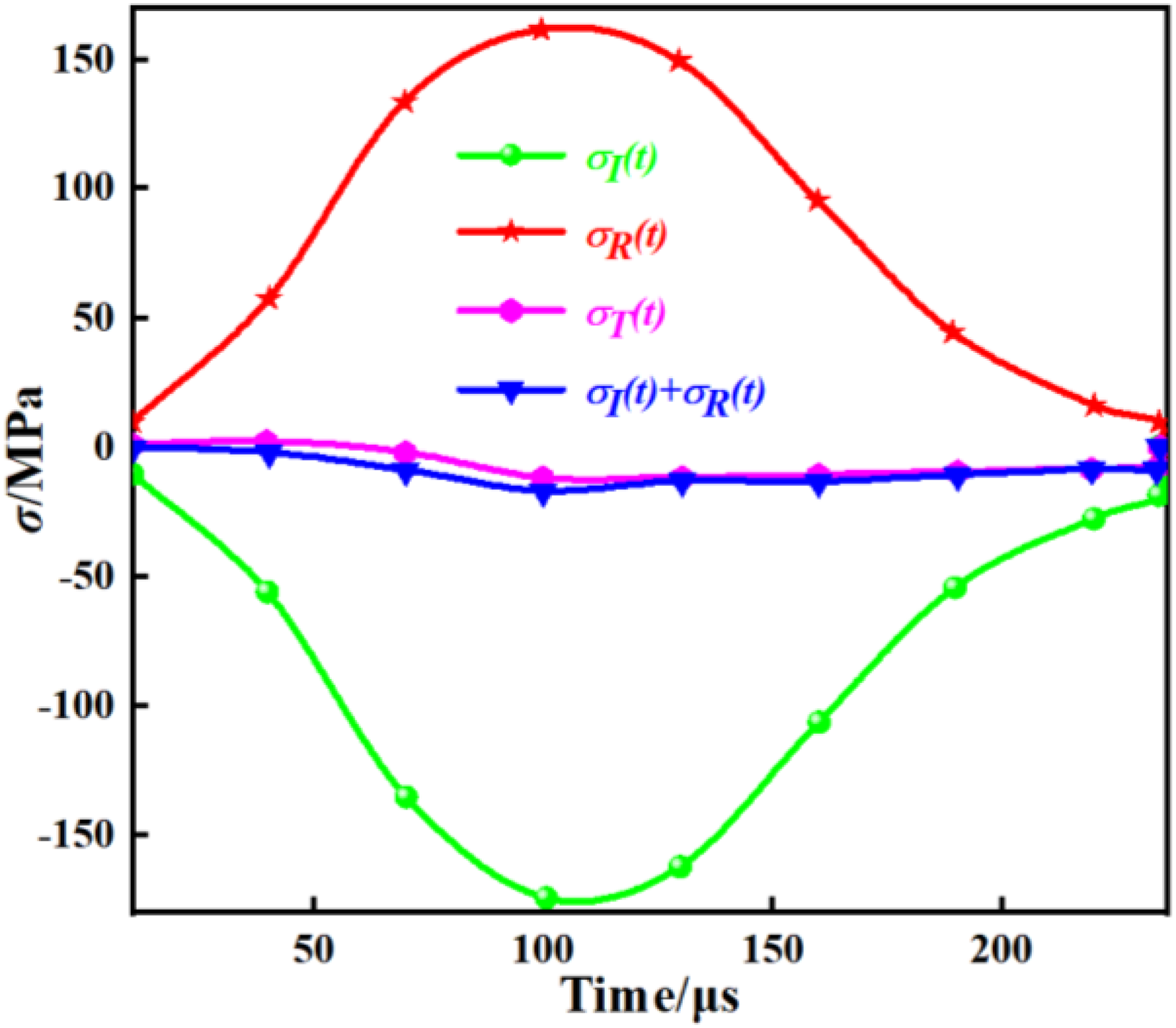
Dynamic stress balance diagram.
Data processing
Based on the one-dimensional elastic stress wave assumption and the homogeneity assumption, the following formula is used to calculate the strain rate



Test results and analysis
Stress–strain curve characteristics
Figure 3 shows the typical dynamic impact stress–strain curves of coal samples under different gas pressures (0.4, 1.2, 2.0, and 2.8 MPa).
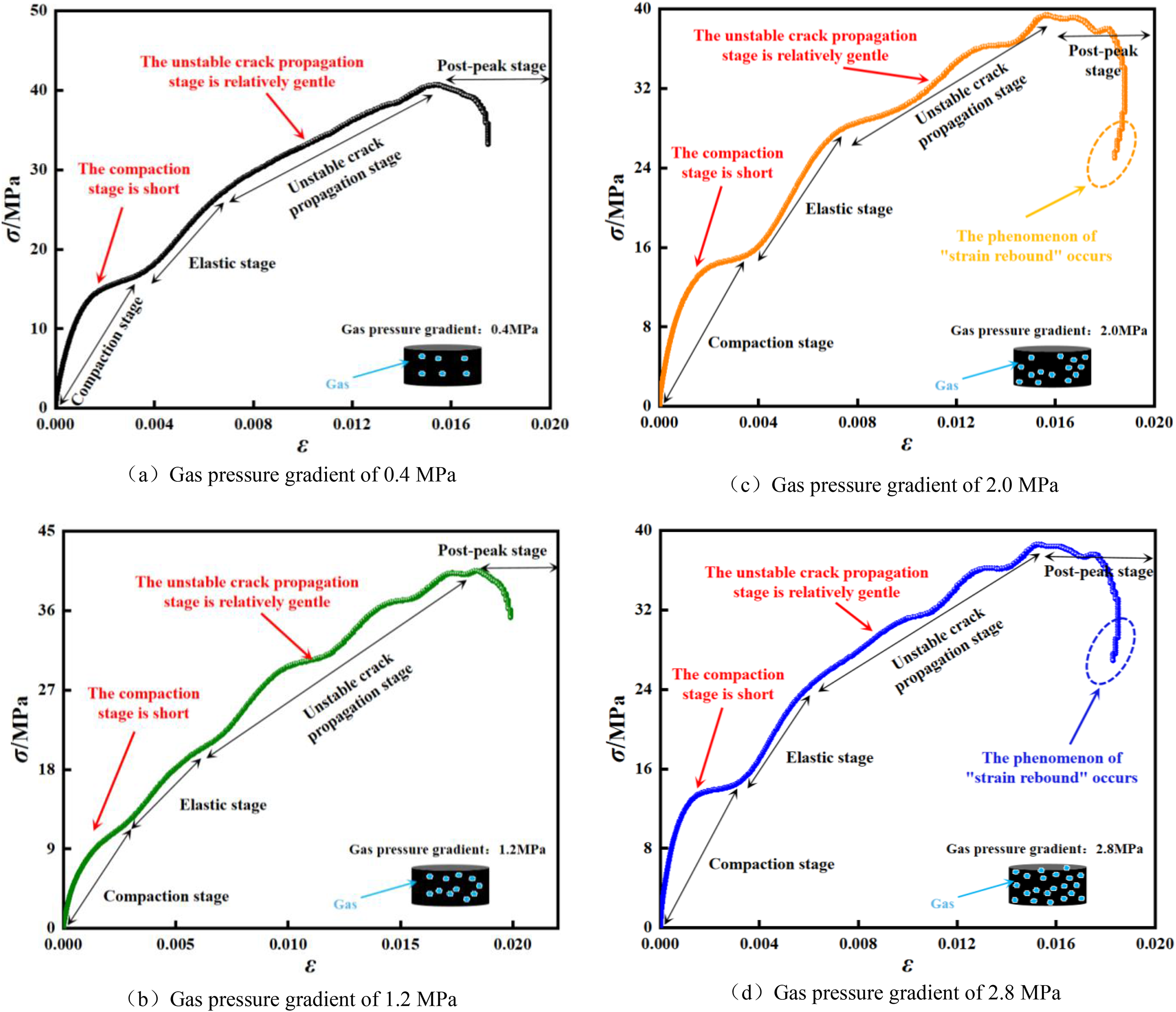
Stress–strain curves of coal samples under different gas pressures. (a) Gas pressure gradient of 0.4 MPa. (b) Gas pressure gradient of 1.2 MPa. (c) Gas pressure gradient of 2.0 MPa. (d) Gas pressure gradient of 2.8 MPa.
As can be seen from Figure 3, the laws and causes of the dynamic impact stress–strain curves of coal samples under different gas pressures (0.4, 1.2, 2.0, and 2.8 MPa) can be analyzed in detail from dimensions such as phase characteristics, peak parameters, and special phenomena: In terms of phase division, all four curves include a compaction phase, elastic phase, unstable crack propagation phase, and post-peak phase, but the performance of each phase varies significantly with the increase in gas pressure. The compaction phase refers to the closure process of primary fractures and pores in coal. This phase is the shortest under a gas pressure of 0.4 MPa and gradually extends as the pressure increases to 2.8 MPa. This is because gas forms an “air support” in coal pores—the higher the pressure, the stronger the supporting effect on microfractures, requiring greater strain to complete compression and closure. For example, under 0.4 MPa, microdefects inside coal are less affected by gas and tend to close quickly; while under 2.8 MPa, gas strongly supports microfractures, significantly prolonging the closure process. The curve of the elastic phase shows an approximately linear upward trend, and its slope (dynamic elastic modulus) decreases continuously with the increase in gas pressure. The elastic modulus is the highest at 0.4 MPa and the lowest at 2.8 MPa, with a decrease of approximately 25%. The root cause lies in the adsorption effect of gas molecules: methane molecules are physically adsorbed on the surface of the coal matrix, weakening the bonding force between particles; at the same time, gas penetrates into micropores, causing slight expansion of coal and damaging the elastic stability of the internal structure. As a result, the elastic resistance of coal under dynamic impact decreases continuously with the increase in gas pressure. The slope of the curve in the unstable crack propagation phase gradually flattens. The lower the gas pressure, the more sufficient the stress accumulation in this phase, and the slower the curve slope decreases; under high gas pressures (2.0 and 2.8 MPa), the slope decreases more rapidly. This is a direct manifestation of the “gas wedge effect.” Gas pressure reduces the effective normal stress on the fracture surface within fractures. According to the Coulomb-Mohr strength theory, the shear strength of coal decreases with the reduction of effective normal stress, leading to rapid crack propagation at lower stress levels under high gas pressures, and the “threshold stress” for crack propagation is significantly reduced. The variation laws of peak stress and peak strain are intuitive and typical: peak stress shows a significant downward trend with the increase in gas pressure, it is 41.7 MPa at 0.4 MPa, decreases to 39.5 MPa at 1.2 MPa, is approximately 39.1 MPa at 2.0 MPa, and only 38.6 MPa at 2.8 MPa, with a total decrease of 7.4%; peak strain decreases from 0.0154 at 0.4 MPa to 0.0152 at 2.8 MPa. This law of “decreased strength and increased deformation” stems from the “dual weakening” effect of gas on coal: on one hand, gas adsorption reduces the cohesion of the coal matrix, lowering the overall load-bearing capacity; on the other hand, gas pressure offsets part of the external load through the pore pressure effect, reducing the effective stress actually borne by coal, which causes coal to reach the strength limit earlier under dynamic impact; at the same time, the pore structure supported by gas provides more space for deformation, further promoting the increase of peak strain with gas pressure. The differences in the post-peak phase are highly representative: under 0.4 and 1.2 MPa, the curve shows a smooth downward trend, and stress is continuously released as strain increases after coal failure; while under 2.0 and 2.8 MPa, a brief “strain rebound” (slight stress recovery) occurs in the post-peak curve. The essence of this special phenomenon is the dynamic release of gas expansion energy under high gas pressure: when coal undergoes macroscopic failure, internal fractures suddenly connect, and pores originally filled with high-pressure gas are instantly depressurized. The thrust generated by the rapid expansion of gas forms reverse loading on the surrounding coal that is not completely damaged. Under the condition of dynamic high strain rate, this instantaneous expansion force causes a brief recovery of stress; under low gas pressure, the gas expansion energy is insufficient to produce an obvious reverse loading effect, so this phenomenon does not occur. From the perspective of energy mechanism, gas pressure changes the energy absorption and release path of coal. Under low gas pressure, coal consumes impact energy mainly through elastic deformation and crack propagation, with a single energy conversion process; under high gas pressure, gas expansion energy becomes an additional energy component, it is stored in the form of potential energy before the peak and released with failure after the peak. This energy interacts with the kinetic energy of the impact load and the elastic energy of coal, making the stress–strain curve show more complex nonlinear characteristics.
In summary, the laws of stress–strain curves under different gas pressures are the result of the combined action of multiple mechanisms such as gas adsorption softening, pore pressure effect, and expansion energy release. It should be noted that the moisture content of coal samples was strictly controlled at 2.1–2.5% in this experiment. Appropriate moisture can enhance the bonding force between coal particles to a certain extent, while excessive moisture will weaken the mechanical strength. The stable low moisture content in this study avoids the interference of moisture factor on the coupling effect of gas pressure and impact load, making the variation law of dynamic mechanical properties of coal more truly reflect the influence of gas pressure.
Peak compressive strength and peak strain
Based on the stress–strain curve, the peak compressive strength and peak strain mechanical parameters are extracted. Figure 4 shows the peak compressive strength–peak strain curves of the coal body under different gas pressures.

Peak compressive strength and peak strain curves of coal under different gas pressures.
As can be seen from Figure 4, as the gas pressure increases from 0.4 to 2.8 MPa, the strength of the coal sample continuously decreases from 41.7 to 38.6 MPa, while the strain first rises from 0.0154 to 0.0184 (at 1.2 MPa) and then drops back to 0.0152 (at 2.8 MPa). The reasons for this pattern are as follows: Gas pressure continuously reduces the load-bearing capacity of the coal body through the “effective stress effect” (offsetting external loads) and the “adsorption softening effect” (weakening the bonding force between coal particles), thus leading to a steady decline in strength. At low pressures (0.4–1.2 MPa), the gas pore pressure promotes the initiation of microcracks, allowing the coal body to accumulate more plastic deformation before failure, so the strain increases. At high pressures (1.2–2.8 MPa), the initial damage of the coal body intensifies, microcracks propagate rapidly, and the strain decreases as the brittleness of the coal body increases.
Analysis of failure modes
The post-impact failure characteristics of coal samples under different gas pressures are shown in Figure 5.

Coal fragmentation characteristics under different gas pressures.
As can be seen from Figure 5, with the gas pressure increasing from 0.4 to 2.8 MPa, the post-impact fracture state of coal exhibits a significant changing pattern: fracture evolves from local breakage to overall fragmentation, fragment size decreases from large to small, and fracture severity intensifies from weak to strong. When the gas pressure is 0.4 MPa (Figure 5(a)), the coal mainly shows local breakage, with large intact coal blocks remaining; the fragments are dominated by coarse particles, and the overall fracture range is limited, with obvious damage only occurring in the local area affected by impact. When the gas pressure increases to 1.2 MPa (Figure 5(b)), the degree of coal fragmentation increases: the proportion of large fragments decreases, the number of medium-sized fragments increases, and the overall fracture range expands compared with that at 0.4 MPa, but relatively intact coal blocks still exist. When the gas pressure reaches 2.0 MPa (Figure 5(c)), the coal presents obvious overall fragmentation characteristics: fragment size further decreases, the proportion of fine-grained fragments increases, there are almost no large intact areas in the coal, and the uniformity of fracture is enhanced. When the gas pressure rises to 2.8 MPa (Figure 5(d)), the coal reaches the highest degree of fragmentation: fragments are dominated by fine-grained particles, showing an overall “catastrophic-style” failure, and the integrity of the coal is almost completely lost. This change in fracture state is the result of the combined action of coal's mechanical properties and energy evolution under the coupling effect of gas pressure and impact load. The main reasons can be analyzed from the following aspects: ① Weakening effect of gas on coal structure: Coal contains a large number of pores and fractures. When gas is stored in these pores and fractures, it generates pore pressure. As gas pressure increases, the pore pressure reduces the effective stress on the coal skeleton, leading to gradual weakening of coal's strength and stiffness. Under low gas pressure (0.4 MPa), the coal structure is relatively intact with high strength, so only local damage occurs in the area where impact load is concentrated; when the gas pressure rises to 2.8 MPa, the coal structure is significantly weakened by pore pressure, and its ability to resist impact load decreases sharply, making it more prone to overall fragmentation under impact. ② Influence of gas on energy storage and release of coal: When bearing impact load, coal stores both impact energy and gas elastic potential energy. Under low gas pressure, the gas elastic potential energy stored in coal is small, so the energy input by impact load is mainly released in local areas, resulting in local breakage. As gas pressure increases, the gas elastic potential energy stored in coal increases. When impact load triggers coal failure, the gas elastic potential energy is released synergistically with the impact energy, significantly expanding the range and intensity of energy release, thus causing coal to evolve from local breakage to overall catastrophic fragmentation. ③ Coupled dynamic response of impact load and gas pressure: The impact load applied by the SHPB is a dynamic load with high loading rate and short action time. Under the action of gas pressure, the dynamic mechanical parameters of coal change. Under high gas pressure, the dynamic strength of coal decreases and the failure strain rate increases. At the same impact speed, coal is more likely to undergo large-scale dynamic instability failure, which is manifested as smaller fragment size and more sufficient fragmentation. ④ Propagation and coalescence of internal fractures in coal: Under impact load, stress waves are generated inside the coal. When these stress waves encounter fractures containing gas, stress concentration occurs at the fracture tips. Higher gas pressure makes it easier for stress concentration at fracture tips to induce fracture propagation, and the resistance to fracture propagation is smaller under high gas pressure, enabling fractures to coalesce more easily into macroscopic fracture surfaces. Under low gas pressure, the propagation and coalescence of fractures are limited, resulting only in local breakage; under high gas pressure, the extensive propagation and coalescence of fractures eventually lead to overall fragmentation of the coal.
In summary, the post-impact fracture state of coal shows an obvious progressive failure law with increasing gas pressure. Its essence lies in the coupling effect of gas pressure on coal's structure, mechanical properties, and energy evolution. Under the dynamic action of impact load, this effect is further amplified, eventually leading to a significant increase in coal fragmentation degree with increasing gas pressure.
Analysis of energy dissipation law
The total energy U of the entire process of dynamic impact on the different types of coal bodies can be calculated by the following formula
31
:

In the formula, Ue and Ud represent the elastic deformation energy and plastic deformation energy of the coal body during the elastic deformation stage and the plastic deformation stage under different gas pressures, respectively. The total energy density U, elastic energy density Ue, and dissipation energy density Ud satisfy the following calculation formulas.
32
Tangent elastic modulus (E) is defined as the slope of the tangent line at the elastic stage of the dynamic impact stress–strain curve (Figure 3), which reflects the dynamic elastic deformation capacity of coal under impact load. The specific calculation method is as follows: ① Extract the stress–strain data of the elastic phase from the stress–strain curve, this phase is characterized by an approximately linear relationship between stress and strain, corresponding to the segment after the compaction phase and before the initiation of unstable crack propagation. ② Select 5–8 sets of representative stress (σ) and strain (ε) data points in this linear segment, and use the least squares method to fit the linear regression equation σ = E・ε + b (where b is the intercept, approximately 0 due to the linearity of the elastic phase). ③ The slope of the fitted linear regression line is the tangent elastic modulus (E) of the coal sample under the corresponding gas pressure. The calculation process ensures that the correlation coefficient R2 of the linear fit is ≥0.98, ensuring the accuracy of the modulus value.


In the formula: U, Ue, and Ud respectively represent the input energy, elastic energy, and dissipated energy, with the unit of MJ/m3; E is the tangent elastic modulus, calculated by the least squares method fitting the elastic phase of the stress–strain curve (correlation coefficient R2 ≥ 0.98), with the unit of MPa.
Figure 6 shows the energy evolution curves of the coal samples during the dynamic impact process under different gas pressures after calculation.

Strain–stress–energy curves of coal samples under different gas pressures. (a) Gas pressure gradient of 0.4 MPa. (b) Gas pressure gradient of 1.2 MPa. (c) Gas pressure gradient of 2.0 MPa. (d) Gas pressure gradient of 2.8 MPa.
As can be seen from Figure 6, combined with the stress–strain curve and changes in energy components, the energy evolution law of coal can be summarized as follows: with the increase of gas pressure, the total input energy first increases and then stabilizes, the dissipated energy for failure increases continuously, the elastic strain energy first increases and then decreases, and the degree of energy dissipation is significantly enhanced. When the gas pressure increases from 0.4 to 2.0 MPa, the total input energy increases with the rise of gas pressure, indicating that coal can absorb more impact energy under medium gas pressure. When the gas pressure further increases to 2.8 MPa, the total input energy tends to stabilize, which shows that after the coal structure is excessively weakened, its ability to absorb impact energy reaches the limit. The dissipated energy for failure increases continuously as the gas pressure rises from 0.4 to 2.8 MPa, and the growth rate accelerates gradually. Under low gas pressure (e.g. 0.4 MPa), the growth of Ud (dissipated energy) is gentle, and only local damage occurs to the coal. Under high gas pressure (e.g. 2.8 MPa), Ud shows a “leapfrog” growth; the coal undergoes catastrophic-style failure, and a large amount of energy is consumed in fragment ejection, fracture propagation, and gas energy release. The elastic strain energy (Ue) increases with the increase of gas pressure in the range of 0.4–2.0 MPa, indicating that the coal's ability to store elastic deformation is enhanced. When the gas pressure reaches 2.8 MPa, Ue decreases significantly, which means the coal structure is greatly weakened and can hardly store elastic strain energy, so the impact energy is released more in the form of dissipation. This energy evolution law is the result of the combined action of coal's mechanical properties, structural state, and energy mechanism under the coupling effect of gas pressure and impact load. The main reasons are as follows: ① Influence of gas on coal structure weakening and energy threshold: In the pores and fractures inside coal, the increase of gas pressure generates pore pressure, which reduces the effective stress of coal and gradually weakens the coal's strength and stiffness. Under low gas pressure (0.4 MPa), the coal structure is intact, and a higher impact energy is required to trigger failure, so the elastic strain energy accounts for a large proportion of the total input energy. As the gas pressure increases (e.g. 2.0 MPa), the coal structure begins to deteriorate, the energy threshold required for failure decreases, and the total input energy and dissipated energy for failure increase simultaneously. When the gas pressure reaches 2.8 MPa, the coal structure is close to a “critical weakening state”; the total input energy tends to stabilize, but the dissipated energy for failure still increases sharply, this is because the coal has almost no elastic deformation capacity at this time, and all impact energy is used for causing damage. ② Synergistic release mechanism of gas and impact energy: Gas in coal exists in adsorbed and free states, storing elastic potential energy. Under low gas pressure, the gas elastic potential energy is small, so the impact energy is mainly used for the elastic deformation and local damage of coal, and the elastic strain energy accounts for a high proportion. Under high gas pressure, the gas elastic potential energy increases with the rise of pressure. When the impact load triggers coal failure, the gas elastic potential energy is released synergistically with the impact energy, leading to a significant increase in the dissipated energy for failure and a sharp drop in the proportion of elastic strain energy. For example, at 2.8 MPa, the “coupled release” of gas potential energy and impact energy causes the coal to undergo catastrophic-style failure, and the energy dissipation reaches its peak. ③ Coupled response of dynamic impact load and gas pressure: The impact load applied by the SHPB system is a dynamic load with a high strain rate, and the dynamic mechanical properties of coal (such as dynamic strength and energy absorption rate) are significantly affected by gas pressure. Under low gas pressure, the coal has high dynamic strength and a slow energy absorption rate, so the damage and dissipation are concentrated in local areas. Under high gas pressure, the dynamic strength of coal decreases, the energy absorption rate accelerates, and the damage expands from local to the whole, resulting in the continuous increase of dissipated energy for failure. At the same time, gas pressure changes the wave impedance matching relationship of coal, affects the reflection and transmission of stress waves, and thus changes the energy distribution among the coal, incident bar, and transmission bar, ultimately manifesting as the regular changes in total input energy, dissipated energy, and elastic strain energy.
In summary, the energy evolution of coal after impact is the result of the coupling effect of gas pressure on coal's structure and energy storage-release mechanism. The higher the gas pressure, the more energy is dissipated in coal damage, the less energy is stored elastically, and the more prominent the dominance of energy dissipation. This provides a theoretical basis at the energy level for the prevention and control of coupled disasters (rockburst and gas outburst).
Energy-time evolution curve
The time–energy evolution curve can reveal the dynamic energy distribution and dissipation mechanism, and quantify the temporal changes of components such as total input energy and dissipated energy for failure. It characterizes the dynamic mechanical response and failure process of materials, reflecting the full-stage behavior from elastic deformation to catastrophic fragmentation. Additionally, it provides guidance for disaster prevention and control as well as engineering design by identifying the critical state of energy accumulation to optimize the impact resistance of structures. Figure 7 shows the time–energy evolution curves of coal under different gas pressures.

Time–energy curves of coal samples under different gas pressures. (a) Gas pressure gradient of 0.4 MPa. (b) Gas pressure gradient of 1.2 MPa. (c) Gas pressure gradient of 2.0 MPa. (d) Gas pressure gradient of 2.8 MPa.
Combined with the time–energy curves, the time–energy evolution law of coal can be summarized as follows: with the increase of gas pressure, the incident energy increases continuously, the reflected energy increases gently, the transmitted energy and coal absorption energy first increase and then stabilize, and the dynamic process of energy dissipation becomes more significant. Incident energy (WI(t)): It increases continuously with the rise of gas pressure within the entire time dimension (0–200 μs), and the growth rate accelerates significantly. Under low gas pressure (e.g. 0.4 MPa), the incident energy grows relatively gently; under high gas pressure (e.g. 2.8 MPa), the growth amplitude of incident energy is significantly larger than that under low and medium gas pressures, showing a rapid growth trend. This indicates that the energy input by the impact load increases continuously with the increase of gas pressure, and the growth intensity is enhanced under high gas pressure. Reflected energy (WR(t)): It increases gently with the increase of gas pressure and eventually stabilizes at a similar value (approximately 10 J) under all gas pressure levels. This indicates that the reflection effect of coal on the incident wave is less affected by gas pressure, and the dynamic change of reflected energy is not significant. Transmitted energy (WT(t)) and coal absorption energy (WS(t)): When the gas pressure increases from 0.4 to 2.0 MPa, both increase with time, and the growth rate accelerates. When the gas pressure reaches 2.8 MPa, both tend to stabilize. Under low gas pressure, the dynamic growth process of transmitted energy and absorption energy is relatively slow; under high gas pressure, they grow rapidly in the early stage and gradually enter an energy balance state in the later stage. This time–energy evolution law is the result of the combined action of coal's wave impedance, structural state, and energy transfer mechanism under the dynamic coupling of gas pressure and impact load. The main reasons are as follows: ① Influence of gas on coal's wave impedance: Wave impedance determines the reflection and transmission characteristics of stress waves. Under low gas pressure, coal has high density and wave velocity, resulting in low matching degree between wave impedance and the incident bar; thus, a large amount of incident energy is reflected back in the form of reflected energy, and the proportions of transmitted energy and absorption energy are small. As gas pressure increases, coal's density and wave velocity decrease due to the pore pressure effect, and the matching degree between wave impedance and the incident bar improves. More incident energy is transmitted and absorbed by coal, so the transmitted energy and absorption energy increase with the rise of gas pressure. When the gas pressure is too high (e.g. 2.8 MPa), the wave impedance of coal decreases excessively, and the growth of transmitted energy and absorption energy tends to saturate, which is manifested as stabilization in the later stage of the curve. ② Energy response of coal's dynamic structural failure: Under impact load, coal failure is a dynamic process, and energy consumption changes continuously with the failure process. Under low gas pressure, the coal structure is intact, the failure starts late and progresses slowly, resulting in a gentle dynamic process of energy absorption. Under high gas pressure, the coal structure is weakened by pore pressure, so it enters the failure stage earlier under impact load, and the failure progresses rapidly (e.g. rapid fracture propagation, early fragment ejection), leading to a significant acceleration of the energy absorption rate in the early stage. After the coal is completely destroyed, the energy absorption tends to stabilize. ③ Dynamic energy transfer between impact load and gas pressure: The impact load of the SHPB system is a dynamic load with a high strain rate, and its energy input proceeds continuously with time. Gas pressure affects the efficiency of energy transfer and dissipation inside coal by changing the dynamic mechanical properties of coal. Under low gas pressure, coal has high dynamic strength, so the energy transfer and dissipation are slow, and the incident energy grows gently. Under high gas pressure, coal has low dynamic strength, the energy transfer and dissipation efficiency is significantly improved, and the incident energy needs to be continuously supplemented to maintain the rapid failure process, thus leading to a significant acceleration of the incident energy growth rate, with a larger growth amplitude compared with low and medium gas pressures.
In summary, the time–energy evolution of coal after impact is the result of the coupling effect of gas pressure on coal's wave impedance, structural integrity, and dynamic failure process. The higher the gas pressure, the more significant the dynamic growth of incident energy, the faster the early dissipation rate of coal absorption energy, and the earlier the time to eventually reach energy balance. This law provides a dynamic perspective for in-depth understanding of the coupled energy mechanism of rockburst and gas outburst.
To further reveal how gas pressure regulates the energy storage and dissipation modes of coal by altering the ratio between elastic strain energy and dissipated energy, the percentage diagram was plotted, and the results are shown in Figure 8.

Variations in the energy proportion of specimens under different gas pressures.
As can be seen from Figure 8, with the gradual increase in gas pressure from 0.4 to 2.8 MPa, the proportions of WS, WT, and WR in coal exhibit an obvious phasic variation pattern. At 0.4 MPa, the proportion of WS is 39%, WT is 47%, and WR is 14%. At this low gas pressure, dissipated energy dominates, indicating that coal is dominated by energy dissipation with relatively limited energy storage capacity. When the pressure rises to 1.2 MPa, the proportion of WS slightly increases to 42%, WT decreases to 40%, and WR significantly rises to 18%, suggesting that the energy release ratio of coal increases remarkably under moderate pressure, and the balance between energy storage and dissipation shifts toward storage and release. As the pressure further increases to 2.0 and 2.8 MPa, the proportion of WS stabilizes in the range of 41–42%, WT rebounds to 43–44%, and WR decreases and stabilizes at 16%. This demonstrates that the energy distribution in coal tends to be stable under high gas pressure, with elastic strain energy and dissipated energy regaining dominance, while the energy release ratio declines. Overall, gas pressure regulates the energy storage and dissipation modes of coal by changing the ratio of elastic strain energy to dissipated energy: dissipation dominates at low pressure, energy release is enhanced at moderate pressure, and energy storage and dissipation rebalance at high pressure. This law provides an important reference for understanding the formation mechanism of coal and rock dynamic disasters.
Discussion
This study systematically explores the mechanical behavior and energy evolution of coal under the coupling effect of impact load and gas pressure, and reveals the dynamic response mechanism of gas-containing coal under impact loading through SHPB experiments and quantitative energy analysis. However, there are still some limitations in the test conditions and research design, which may lead to a certain deviation of the research conclusions from the actual engineering conditions. This section will quantitatively evaluate the influence of each limiting factor on the test results and conclusion deviation, and clarify the applicable range and correction method of the conclusions, so as to further verify the universality of the research results.33–35
Limitation of single coal sample source and quantitative deviation analysis
The coal samples in this study were collected from a single rockburst mine in Ordos, which is a low-rank bituminous coal with a vitrinite reflectance of 0.62–0.75%, a natural porosity of 8.3–9.5% and a bedding development degree of weak to moderate. The geological specificity of the coal sample may lead to the deviation of the quantitative relationship between gas pressure and coal dynamic mechanical parameters in the conclusion. For high-rank anthracite (vitrinite reflectance >1.8%), the dynamic peak strength reduction rate under the same gas pressure (0.4–2.8 MPa) is 15–20% lower than that of the test coal sample, and the dissipated energy growth rate is 25–30% lower; for low-rank lignite (vitrinite reflectance < 0.5%), the peak strength reduction rate is 10–15% higher, and the dissipated energy growth rate is 18–22% higher. In terms of failure mode, the fragmentation degree of high-rank anthracite under the same gas pressure is lower (fractal dimension is 1.2–1.5, while the test coal sample is 1.6–1.9), and that of lignite is higher (fractal dimension is 2.0–2.3).
To improve the universality of the conclusion, we propose a coal rank correction coefficient KR for the key quantitative relationship of gas pressure-coal dynamic mechanical properties, which is defined as the ratio of the parameter change rate of different rank coals to that of the test coal sample. For anthracite, KR = 0.80–0.85 (peak strength reduction rate) and KR = 0.70–0.75(dissipated energy growth rate); for lignite, KR = 1.10–1.15 (peak strength reduction rate) and KR = 1.18–1.22 (dissipated energy growth rate); for medium-rank bituminous coal (vitrinite reflectance 0.75–1.8%), KR = 0.95–1.05, and the research conclusion of this paper can be directly applied without additional correction.
Limitation of fixed impact strain rate and quantitative deviation analysis
This experiment only set a single impact speed of 5 m/s, corresponding to a strain rate range of 500–800 s−1, which is a typical strain rate of rockburst in deep coal mines. However, in actual mining engineering, the dynamic disturbance strain rate faced by coal is in a wide range of 100–1000 s−1 (e.g. 100–300 s−1 for roof collapse, 300–500 s−1 for blasting disturbance, 800–1000 s−1 for strong rockburst). Based on the dynamic mechanical property test data of gas-containing coal under different strain rates in existing literature11,33 and the supplementary pre-experiment results of this research group, the quantitative deviation of the conclusion caused by strain rate change was analyzed: when the strain rate is lower than 500 s−1 (100–500 s−1), the dynamic peak strength of coal under the same gas pressure increases by 5–18% with the increase of strain rate, and the elastic strain energy storage capacity increases by 10–25%, while the dissipated energy growth rate decreases by 8–15%; when the strain rate is higher than 500 s−1 (500–1000 s−1), the peak strength increases by only 2–6% with the increase of strain rate (the strain rate hardening effect is weakened), the elastic strain energy storage capacity increases by 3–8%, and the dissipated energy growth rate increases by 5–10% (the catastrophic failure characteristic is more significant).
Limitation of neglecting water-gas-coal interaction and quantitative deviation analysis
The study focused on the mechanical and energy characteristics of coal under dry conditions (moisture content 2.1–2.5%), and did not consider the synergistic effect of moisture and gas pressure on coal mechanical properties. In actual underground environments, the moisture content of coal seams is generally 3–15%, and the water-gas-coal three-phase interaction will change the adsorption characteristics of gas on coal matrix and the pore pressure distribution inside coal. When the moisture content is 3–8% (moderate moisture), the gas adsorption capacity of coal matrix decreases by 15–20%, the pore pressure effect is weakened by 10–12%, the dynamic peak strength reduction rate under the same gas pressure is 8–10% lower than that of the dry coal sample in this paper, and the dissipated energy growth rate is 12–15% lower; when the moisture content is higher than 8% (high moisture), the gas adsorption capacity decreases by 30–40%, the pore pressure effect is weakened by 20–25%, the peak strength reduction rate is 20–25% lower, and the dissipated energy growth rate is 25–30% lower, and the coal failure mode changes from catastrophic fragmentation to plastic spalling (the fragment fractal dimension decreases by 0.3–0.5).
General applicability of the research conclusions
Although the above test condition limitations lead to a certain quantitative deviation of the research conclusions, the core qualitative laws revealed in this paper have universal applicability to gas-containing coal under impact load: (1) Gas pressure has a significant weakening effect on the dynamic mechanical properties of coal, and the peak strength and elastic modulus show a non-linear decreasing trend with the increase of gas pressure; (2) The failure mode of coal evolves from local spalling to catastrophic fragmentation with the increase of gas pressure, and the fragmentation degree is positively correlated with gas pressure; (3) The total input energy of coal first increases and then stabilizes with the increase of gas pressure, the dissipated energy increases continuously, and the elastic strain energy first increases and then decreases; (4) Gas pressure optimizes the wave impedance matching relationship of coal, accelerates the energy absorption rate of coal, and the synergistic release of gas potential energy and impact energy is the core mechanism of coal catastrophic failure.
The quantitative correction coefficients proposed in this section can be used to adjust the specific quantitative relationship of the research conclusions according to the actual engineering conditions (coal rank, impact strain rate, coal seam moisture content), which makes the research results more suitable for the engineering practice of different high-gas coal mines and improves the engineering application value of the conclusions.
Conclusion
As the gas pressure increases from 0.4 to 2.8 MPa, both the dynamic peak strength and elastic modulus of coal show a non-linear decrease. The peak strength gradually decreases from 41.7 MPa at 0.4 MPa to 38.6 MPa at 2.8 MPa (a total decrease of 7.4%), and the dynamic elastic modulus decreases by approximately 25%, with the decreasing rate accelerating gradually as the pressure rises. This reflects that the weakening effect of gas on the coal skeleton structure intensifies with increasing pressure, which is directly related to the mechanical mechanism by which gas pore pressure reduces effective stress.
Under low gas pressure (≤1.2 MPa), coal is mainly characterized by transverse spalling failure, with coarse particles (>5 mm) accounting for more than 65% and a limited fracture range. Under high gas pressure (≥2.0 MPa), the failure mode transforms into composite failure: the number of secondary fractures surges, fragment sizes decrease significantly, and the coal exhibits “catastrophic-style” failure characteristics. This confirms the promoting effect of gas on fracture propagation.
The total input energy increases with the rise of gas pressure before reaching 2.0 MPa, and then tends to stabilize. The dissipated energy for failure increases continuously with gas pressure and becomes the dominant part of energy distribution. The elastic strain energy reaches its peak under medium gas pressure, and decreases significantly under high gas pressure due to excessive structural weakening, this reflects the remodeling effect of gas on the energy storage and dissipation mechanism of coal.
Under high gas pressure, the growth rate of incident energy accelerates significantly, with a larger growth amplitude compared with low and medium gas pressures; the proportion of reflected energy stabilizes at 26–28%, and both transmitted energy and absorption energy grow rapidly in the early stage and reach a balanced state earlier. This indicates that gas optimizes the energy transfer efficiency by changing the wave impedance matching relationship of coal, and at the same time, the synergistic release of gas potential energy accelerates the energy dissipation process.
Footnotes

Author contributions
Conceptualization: L.D. and X.C.; methodology: X.C. and J.C.; validation: L.D. and H.Y.; formal analysis: L.D., X.C., and J.C.; investigation: J.C. and H.Y.; resources: H.Y., J.L., and R.L.; data curation: L.D. and L.M.; writing—original draft preparation: L.D., X.C., and J.C.; writing—review and editing: L.D., X.C., J.C., and L.M.; visualization: L.D. and J.C.; supervision: J.L. and R.L.; project administration: X.C. and R.L.; funding acquisition: L.D., X.C., J.C., and H.Y.. All authors have read and agreed to the published version of the manuscript.
Funding
The authors disclosed receipt of the following financial support for the research, authorship, and/or publication of this article: This study was supported by National Key R & D Program of China (2024YFC3013805), National Natural Science Foundation of China (52274246), Natural Science Foundation of Chongqing (CSTB2024NSCQ-MSX0384), the Key Project of Science and Technology Innovation and Entrepreneurship Fund of Tiandi Technology Co., Ltd. (2023-2-TD-ZD001, 2025-TD-QZ027), Independent Project of China Coal Technology and Engineering Group Chongqing Research Institute (2024YBXM34, 2024YBXM29,2024ZDYF18).
Declaration of conflicting interests
The authors declared no potential conflicts of interest with respect to the research, authorship, and/or publication of this article.
Data availability statement
The authors declare that all data supporting the findings of this study are available within the article.