




Abstract
At present, airspace congestion and flight delays have become widespread concerns. This study aims to optimize the sequencing of arrival flights in the terminal area of multirunway airports. Considering the constraints of multiple runways, slant intervals and moving flight positions, this article establishes an optimization model for arrival flight sequencing in a multirunway airport terminal area. Accordingly, an improved sparrow search algorithm (ISSA) is proposed based on Chebyshev chaotic mapping, the golden sine strategy, and the variable neighborhood strategy. Through six basic test functions, the ISSA is compared with particle swarm optimization, the whale optimization algorithm, the genetic algorithm, and other algorithms to verify its superiority. Finally, two sets of instance data from Kunming Changshui Airport were used for experiments. The results show that the total delay times (TDTs) of small-scale flights (number of aircraft: 29) and large-scale flights (number of aircraft: 147) are 55.3% and 20.5% lower, respectively, than those of the first-come-first-served algorithm. The superiority of the ISSA designed in this article is verified, and it can significantly reduce the TDTs of arrival flights. It is suitable for optimizing arrival flights during peak hours at most airports. This approach provides theoretical support for optimizing the sorting of flights in terminal areas.
Introduction
Considering the post-COVID-19 era, China's civil aviation transportation market experienced explosive growth in 2023. Subsequently, there were many challenges in air traffic flow, such as the low utilization rate of runways in many busy airports and the poor efficiency of air traffic control systems. Therefore, effectively and efficiently scheduling and sorting arriving flights is one of the main problems in improving airport safety, capacity, and efficiency.
Many operational studies and management-related methods have been applied to solve the modeling problem of arrival flight sequencing and scheduling. With respect to flight optimization models, Wieland et al. 1 transformed the multiairport flight scheduling problem into a single-airport problem. Then, multiple single airports were combined to form a multiairport scheduling module. Wang et al. 2 established a multiairport collaborative decision-making arrival and departure flight scheduling model for the terminal area based on a multiconstraint situation. Zhou et al. 3 established an optimal scheduling model for approach and departure flights with maximum throughput, minimum flight delay loss and robustness as the objective functions. Tian et al. 4 constructed a multiobjective terminal area resource allocation problem by using the arrival fix allocation problem, taking into account the environmental constraints related to emissions and noise. Jiang et al. 5 proposed a comprehensive mixed-integer programming model for arrival sequencing that considered multiple airports, runways, and routes.
There are many current research results on approach sequencing, but they still have shortcomings, such as the following: (1) model construction methods seldom consider the runway configuration and the current operation status, and this is mostly done for single-runway flight optimization; (2) the tail flow interval standard under RECAT-CN is rarely considered, so the needs of actual operation cannot be met; (3) most scholars adopt the first-come-first-served (FCFS) algorithm for flight scheduling, which is simple and easy to implement but is also prone to causing a large number of flight delays for a busy airport or an uneven distribution of multiple runways; and (4) most studies have not considered the fact that in the flight sequencing problem, the delays brought about by different aircraft types and different flight modes are also different.
In terms of solution algorithms, Bae and Clarke 6 introduced the delay saturation weighting factor and proposed an improved mixed integer planning algorithm. In addition, the scatter search algorithm, 7 branch and bound method, 8 genetic algorithm (GA),4.9,10,11 greedy algorithm, 12 and simulated annealing algorithm 13 have been used to solve the approach scheduling problem. Most scholars use traditional optimization algorithms, but developing a more effective and accurate solution algorithm in addition to the commonly used traditional algorithms is an urgent problem; for example, the swarm intelligence algorithm has a strong global search ability and high convergence speed, so the introduction of swarm intelligence algorithms into the study of the flight scheduling problem may be a helpful tactic. The sparrow search algorithm has the advantages of a global search and few adjustable parameters, and it has been applied by some scholars in image processing, 14 path planning 15 and other practical engineering optimization problems. However, the SSA has the problems of insufficient search accuracy and easily falling into a local optimum solution. In this regard, Lv et al. 16 used tent chaotic mapping to perturb the population to reduce local searches. Tang et al. 17 drew on the idea of GAs and introduced crossover and mutation into the SSA to protect the diversity of populations while simultaneously increasing the probability of individuals jumping out of a local optimum. In addition, other scholars have conducted research on improvement methods, including k-means clustering, 18 Cauchy's mutation, 19 and other strategies. However, there is still a lack of search ability in the late stage of the optimization search, and premature convergence easily occurs. Further research is needed to explore better improvement strategies to enhance the convergence accuracy and global optimization performance of the algorithm.
This study focuses on dual-runway airports and considers constraints such as multiple runways, flight fairness, and terminal area arrival flow. The latest RECAT technology is used for wake turbulence separation with the objective of minimizing the total delay time (TDT). A multirunway arrival flight sorting optimization model is established, and a new improved sparrow search algorithm (ISSA) is proposed. Based on the standard Sparrow Search Algorithm, the ISSA initializes the population using the Chebyshev chaotic mapping strategy 20 to ensure population diversity and avoid becoming trapped in local optima. The ISSA incorporates the golden sine strategy 21 to update the discoverers, addressing the issues of local optima and a large search space. The ISSA also incorporates the Lévy flight strategy 22 to update the followers, enhancing the algorithm's exploration capability in the solution space and increasing the likelihood of escaping local extreme values. Finally, the ISSA incorporates a variable neighborhood search strategy to escape local optima.
Arrival flight sequencing model establishment
Parameter setting
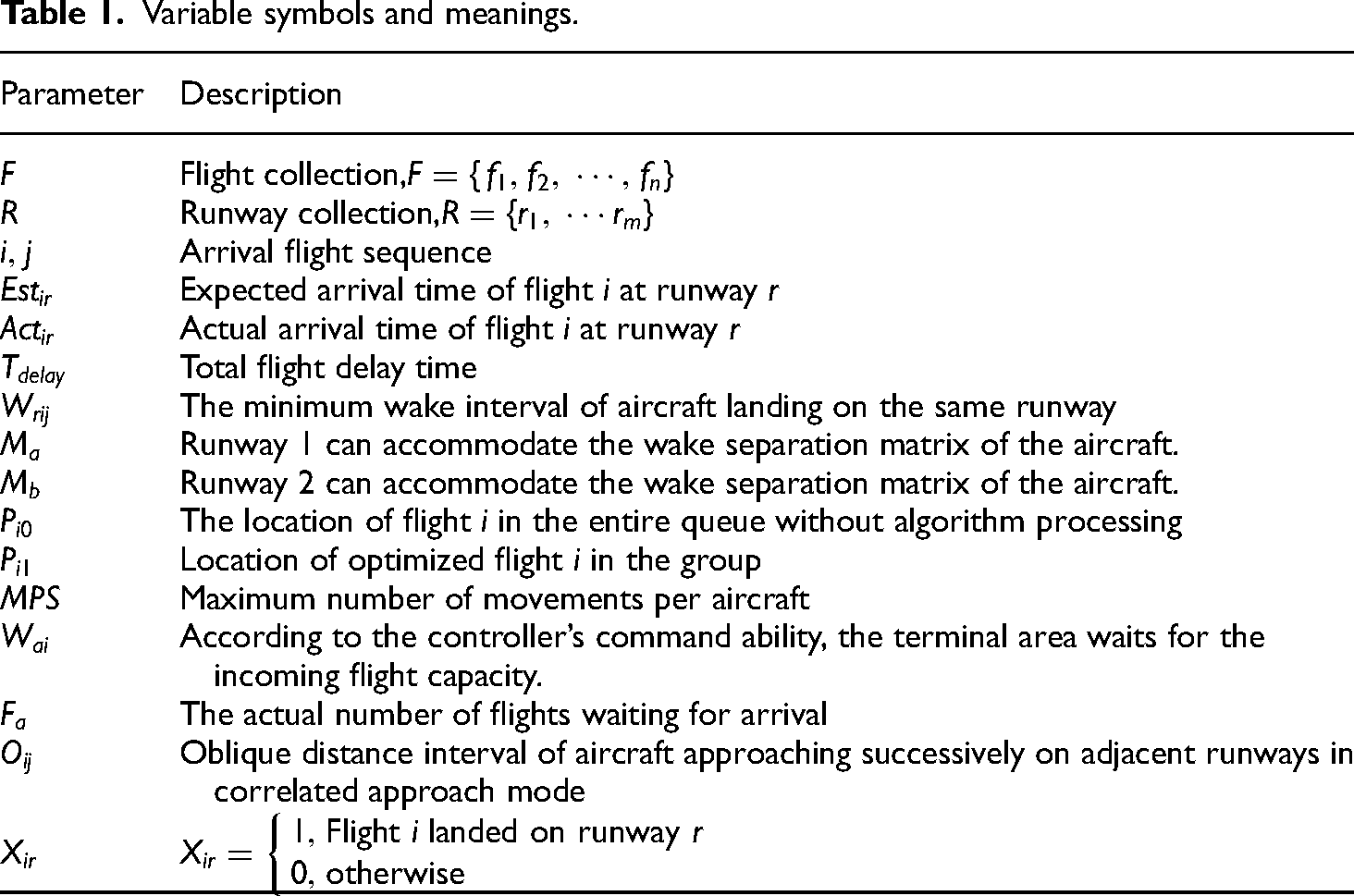
The variable symbols used and their meanings are provided in Table 1.
Variable symbols and meanings.
Model assumptions
When there is an airport in the terminal area, only the situation of arriving flights is considered.
To maintain fairness and impartiality, this paper does not consider VIP flights and does not classify flights except for the purpose of dividing the wake interval.
The scheduled arrival times and arrival routes of the flights are known.
Objective function
It is assumed that there are n flights waiting to land in the terminal area during a certain period of time and that there are m runways for flight landing. The overall optimization goal is to minimize the total flight delay time:
Constraint condition
(1) RUNWAY CONSTRAINTS:
The above formula indicates that each flight can only land on a unique runway according to its own aircraft type.
(2) FLIGHT WAKE INTERVAL CONSTRAINT:
During the approach and landing phases of a flight, the aircraft can be affected by wake turbulence. To facilitate modeling and calculations, the more refined RECAT-CN wake turbulence separation standards
23
based on categorization can improve the efficiency of flight sequencing. The required time intervals can be determined based on the aircraft's category and wake turbulence intensity, as shown in Table 2.
RECAT wake turbulence separation standards (unit: seconds).

The above formula indicates that the flight will be affected by the wake when it lands, and the difference between the actual landing times of the next flight j and the previous flight i is greater than the specified time interval standard. When r = 1, (3) OBLIQUE SPACING CONSTRAINT: (4) ARRIVAL FLOW IN THE TERMINAL AREA: (5) NUMBER OF FLIGHT MOVING POSITIONS:
The above formula is intended to ensure that the oblique distance between two adjacent flights is greater than the required oblique distance interval in the parallel double-runway configuration. Here, 

Considering the communication pressure of the controller, the arrival flow in the terminal area is controlled. The number of aircraft in the sorting area of the terminal area should not exceed the command capacity of the controller.

Considering the fairness of flights and the workload of controllers, the order of aircraft moving forward or backward during scheduling cannot exceed the maximum number of flight movement positions. This article takes 
Improved sparrow algorithm
Algorithm design
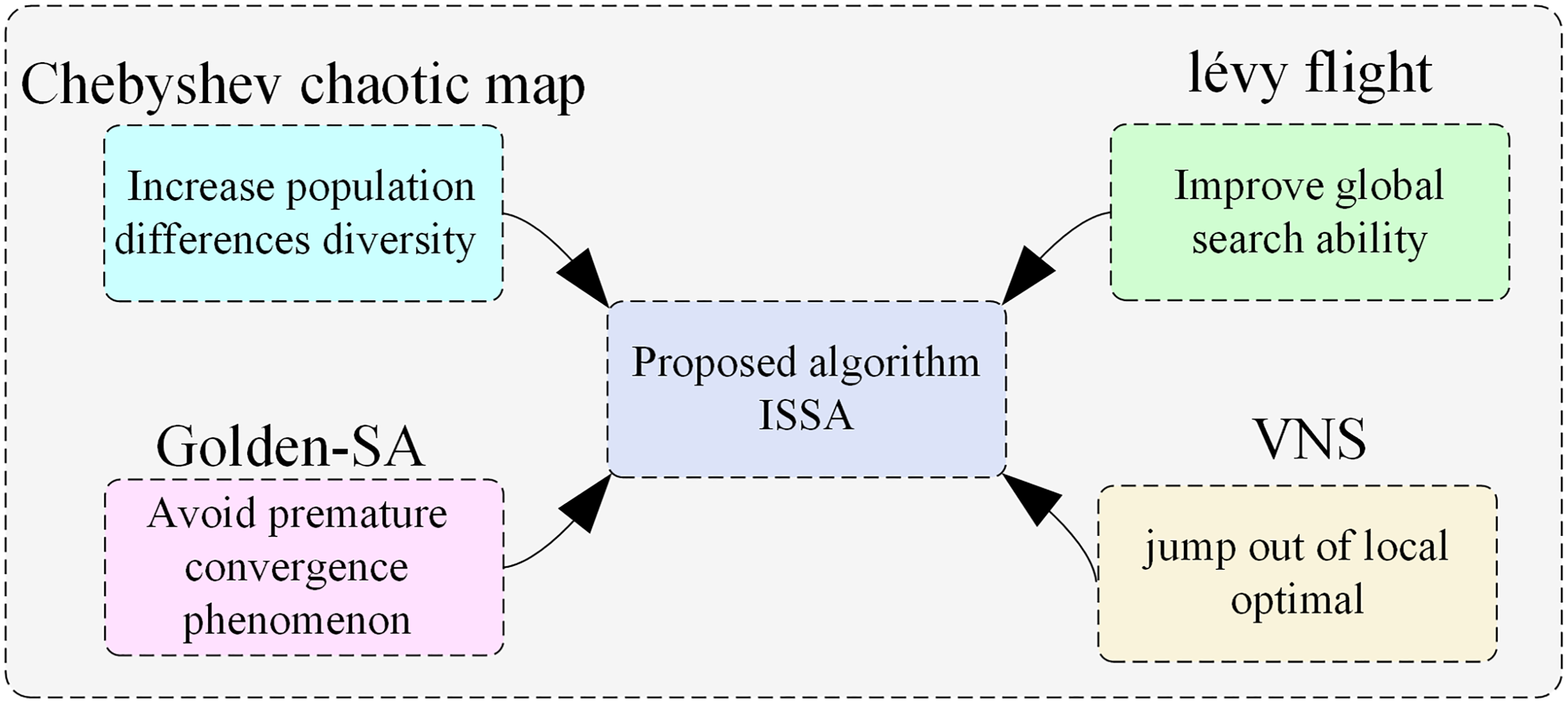
In this paper, four optimization strategies are used in the improved algorithm: (1) the Chebyshev chaotic mapping strategy, (2) the golden sine strategy, (3) the Lévy flight strategy, and (4) the variable neighborhood search strategy. A schematic of the improved algorithm strategy is shown in Figure 1.
(1) Chebyshev chaotic mapping population initialization
Schematic diagram of the code.
In the sparrow algorithm,
24
randomly generating the initial population will increase the difference in the population and make the distribution of the search space uneven. The introduction of Chebyshev chaotic mapping can increase the difference and diversity of the population and effectively prevent premature convergence of the sparrow algorithm. The definition of this mapping is as follows: (2) Golden sine strategy update discoverer (3) Lévy flight strategy update follower (4) Position update of the vigilant observer (5) Variable neighborhood search strategy
In the sparrow algorithm, the discoverer's extensive global search for food may easily fall into a local optimal solution at the beginning of the search. To avoid premature convergence, the golden sine algorithm is introduced into the process of the discoverer searching for food. The improved position update formula is as follows:
In this paper, the Lévy flight strategy is introduced to generate a random step size in each iteration of the follower's position update, which can improve the global search ability. After introducing this strategy, the follower position update formula for the sparrow population can be expressed as:
The vigilant observer is based on the discoverer and the joiner, and its position is updated as follows:
In this paper, the variable neighborhood search strategy
25
is used to make the algorithm jump out of local optima by changing the neighborhood structure. In the jitter stage, the method of moving the current solution toward the individual historical optimal solution and the population historical optimal solution is adopted. The neighborhood search is implemented with three operators, exchange, insertion and 2-opt, and the neighborhood search is nested within the jitter process.
Algorithm performance test
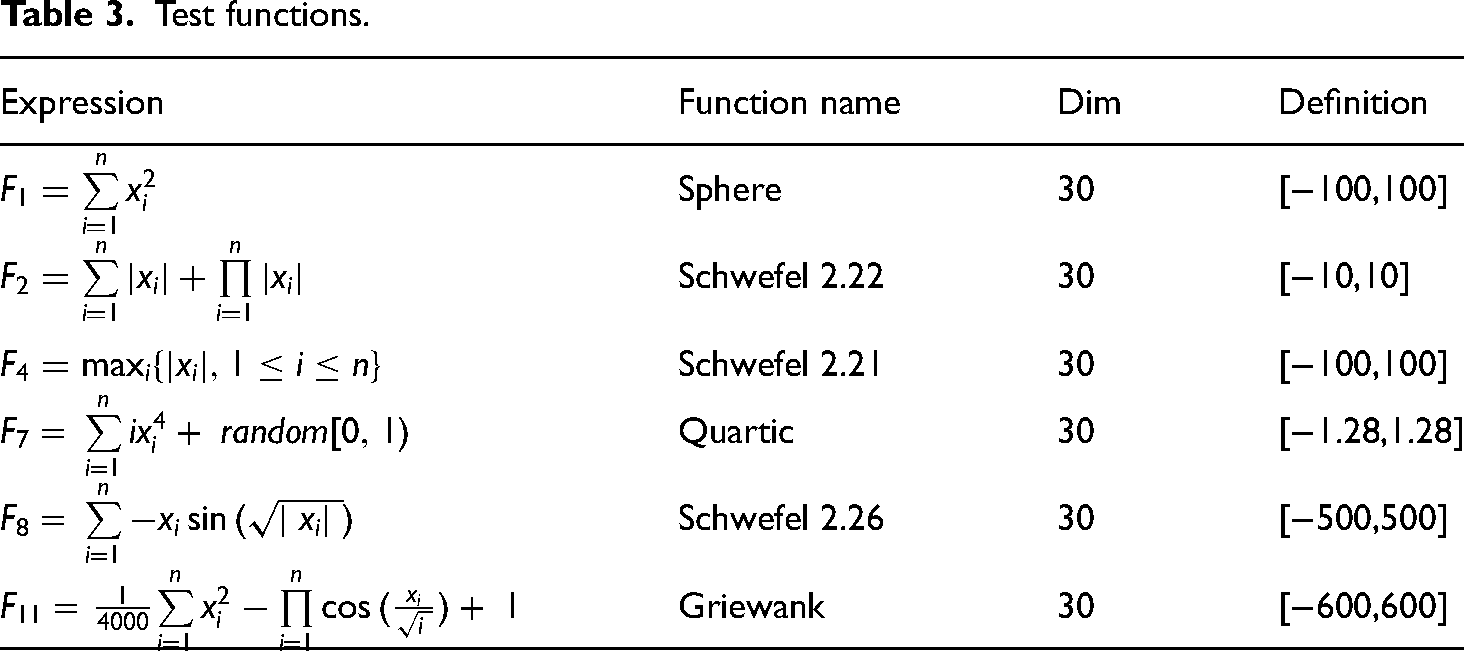
To verify the effectiveness of the ISSA, this paper selects six sets of standard functions and compares the results of the ISSA with those of the traditional GA, the widely used particle swarm optimization algorithm (PSO), the whale optimization algorithm (WOA), and the sparrow search algorithm (SSA). In the test function, F1, F2, F4, and F7 are unimodal test functions, and F8 and F11 are multimodal test functions; the specific functions are shown in Table
Test functions.
The iterative results obtained are shown in Figure 2.

Comparison of algorithm results.
The six test functions in the table from top to bottom correspond to (a)–(f) in Figure 2. The above diagram clearly demonstrates that in the case of the four unimodal test functions (a), (b), (c), and (d), the ISSA exhibits the highest accuracy and the fastest iteration speed compared to the other four algorithms. Compared with the traditional SSA, which can find the optimal solution in 600 iterations, the ISSA requires only 300 iterations. Additionally, in the multipeak test function F5 shown in Figure 2(e), although the solution result of the ISSA is comparable to those of the other algorithms, its optimal value remains lower and more stable. In conclusion, the ISSA demonstrates faster convergence speed and superior optimization ability, providing evidence for its feasibility.
Optimization of arrival flight sorting based on the ISSA
Data encoding and decoding
In this paper, the flight is encoded based on the flight number, the number of encoding layers is an integer input, and the encoding type is a one-dimensional array input. Assume that there are currently six flights sorted as follows:
Fitness function
This paper studies the sequencing of arrival flights in the terminal area. To minimize the TDT of flights, the fitness function is set as the reciprocal of the objective function of the model. The fitness function is defined as
Algorithm flow
The specific algorithm process is shown in Figure 3.
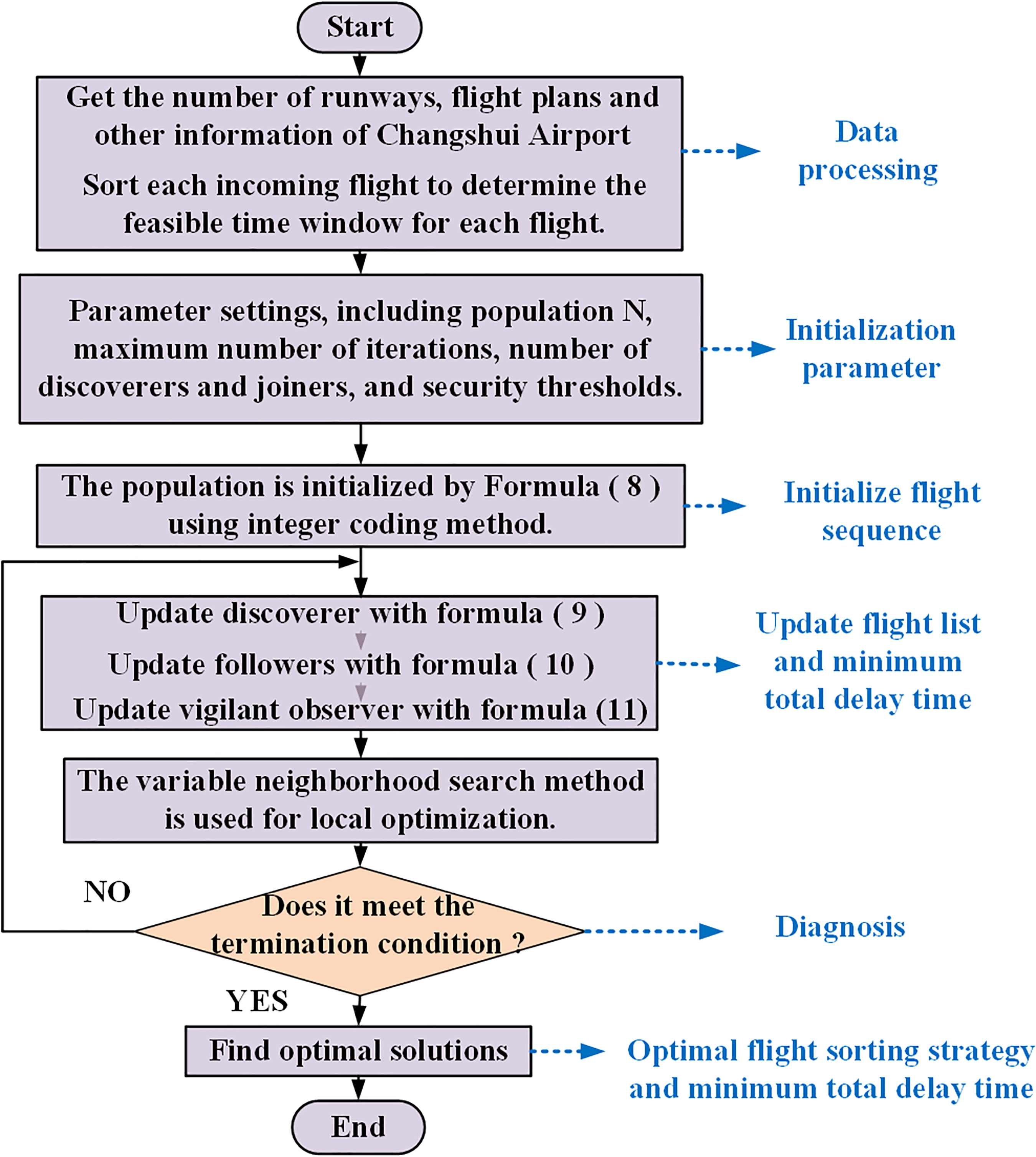
Algorithm flow chart.
Example verification
Algorithm design
To conduct accurate research on delayed flights, in this paper, we select a certain period of time on a certain day at Kunming Changshui Airport to conduct targeted research on the sequencing of arrival flights: the arrival flight data during the peak period of a typical festival are chosen, and the total number of arrival flights is 457. The specific flight data are shown in Tables 4 and 5. The data from small-scale flights (29) and large-scale flights (147) are selected for the simulation experiments, and the algorithm proposed in this paper is verified on two dimensions.
Arrival delay flight data (small-scale flight data).

Large-scale flight data.

Analysis of effectiveness
(1) Small-scale flight delays
A total of 29 delayed flights from 0:00–12:00 on a certain day were selected for simulation. The relationship between the value of the adaptive function and the number of iterations after 100 iterations using the five algorithms is shown in Figure 4(a). A comparison of the cumulative TDTs of the 29 delayed flights is shown in Figure 4(b).

(a) Convergence curves of the objective function. (b) Cumulative total delay time comparison chart.
In Figure 4(a), it is evident that the flight delay time progressively decreases with increasing number of iterations. Both PSO and the GA converge after approximately 40 iterations, while the ISSA proposed in this paper achieves the optimal value by the 10th iteration. Despite the high convergence speed of the WOA, it yields the poorest results. Therefore, the results of the ISSA presented in this paper are optimal, and it exhibits faster convergence speed than the other algorithms. Figure 4(b) shows a comparison chart of the cumulative TDT of all the delayed flights. Currently, the widely used method for sorting aircraft takeoff and landing on runways is the FCFS algorithm, which determines the order in which aircraft use the runway for landing according to the flight's estimated time of arrival (ET) on the runway. The advantage of this algorithm is that it is simple and easy to implement and is widely used in many studies.2–4,10,11 Therefore, this paper uses it as one of the comparative algorithms. Upon comparing the flight delay results obtained by the ISSA with those obtained by the FCFS algorithm, it is apparent that from a global perspective, the ISSA incurs the least total flight delay time while ensuring fairness.
(2) Large-scale flight delays
A total of 147 flights from 0:00–12:00 on a certain day were selected for simulation. The relationship between the value of the post-adaptation function and the number of iterations after 100 iterations of the five algorithms is shown in Figure 5(a). A comparison of the cumulative TDTs of the 29 delayed flights is shown in Figure 5(b). The data corresponding to each algorithm are shown in Table

(a) Convergence curves of the objective function. (b) Cumulative total delay time comparison chart.
Comparison of the results of different algorithms.

It can be clearly seen from Figure 5(a) that the ISSA operation results are optimal. Figure 5(b) shows that the total flight delay time of the optimized algorithm is lower than that of the FCFS algorithm, and from a global perspective, the total flight delay time of the ISSA is the smallest under the large number of flights. Combined with the results of Table
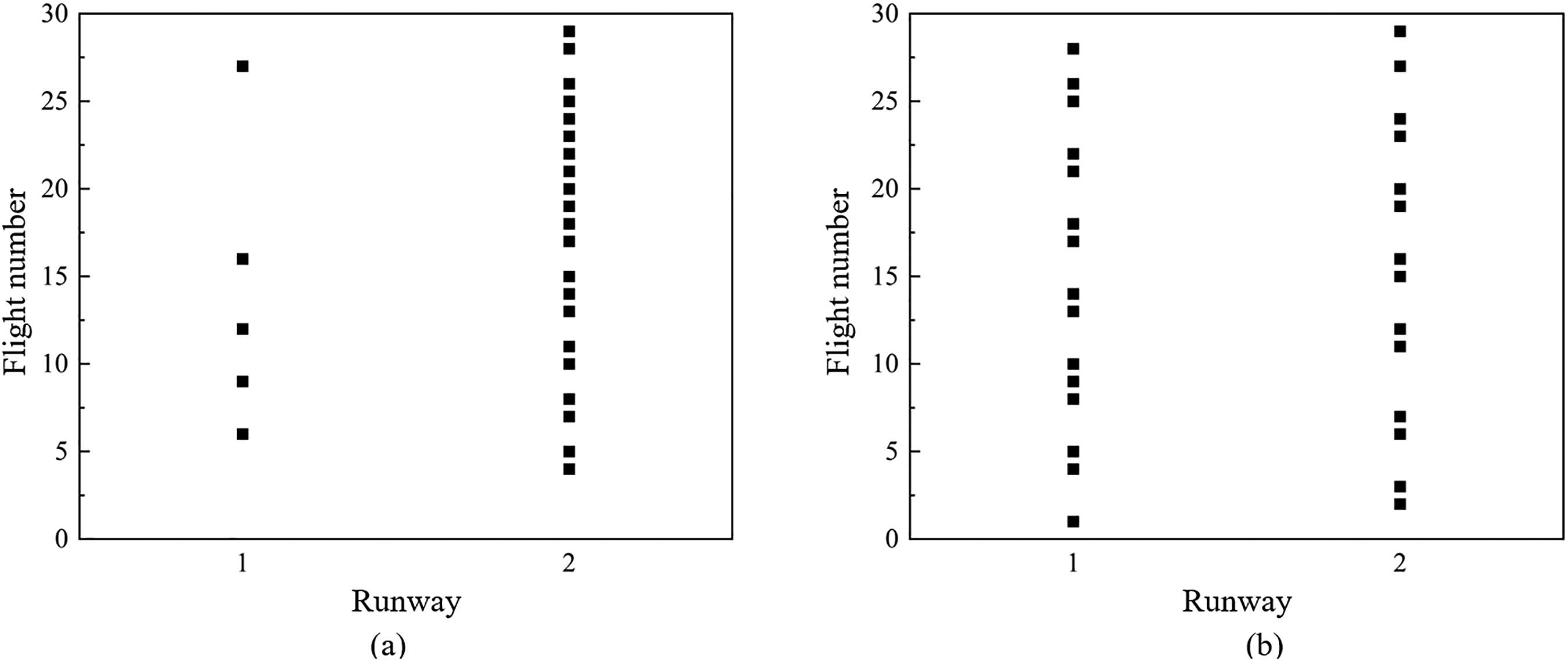
(a) Runway usage before optimization. (b) Runway usage after optimization.

Comparison before and after flight sequence optimization.
In Figure 6(a) and (b), 1 and 2, respectively, represent the east runway (R1) and the west runway (R2). The optimized runway usage is more evenly distributed, which solves the problem of local runway usage being too dense and effectively alleviates runway congestion. Figure 7 shows a comparison of the optimized flight sequences before and after optimization. For example, the first flight sequence is adjusted to the second one after improvement, and the third and twentieth flights have the largest movement, moving five positions. However, the maximum number of movements of all flights after improvement does not exceed five, which corresponds to the constraint conditions mentioned earlier and ensures fairness in flight delays and coordination of the interests of various airlines.
This paper has been compared with other studies to highlight the strengths of the research presented here. The results of the comparison are shown in Table 7.
Comparison with other studies.

When there are many congested flights at an airport during a peak flight period, the method in this paper can be used to optimize the sequencing of incoming flights and effectively alleviate airport congestion. However, this paper has several shortcomings. Weather factors are not considered in the modeling. In fact, weather will also affect the sequencing of airport flights. In addition, there will be departing flights and arriving flights participating in the sequencing of flights in the terminal area of the same airport.
Conclusion
To alleviate the pressure on terminal areas and air traffic control personnel and reduce airline operating costs, this article focuses on inbound delayed flights. The main research areas are as follows:
A multirunway airport arrival flight sorting optimization model is established to address airport arrival flight delays, reduce passenger delay times, and address various factors, such as airlines, airports, and air traffic control personnel. This model considers runway, wake, and terminal area inflow factors to achieve comprehensive optimization. Based on RECAT technology, the improved RECAT-CN wake interval standard is used to convert the interval time to its minimum value, which is convenient for model calculations. This approach makes the interval time more compact to improve the operation efficiency of the terminal area. We improved upon the traditional SSA. The improved algorithm was tested on six basic test functions and compared with other algorithms, such as PSO, the WOA, and the GA. The results showed that the designed algorithm has certain advantages over other algorithms. Using two sets of actual flight data at small and large scales for the simulation experiments, the algorithm obtained good results, verifying its practicality and effectiveness in the study of flight scheduling optimization problems. This paper provides some theoretical support for reducing flight delays in busy airports.
When constructing the model, the article did not consider the impact of weather. The proposed method can only optimize flights in a certain period, which is challenging for optimizing many real-time flights. Therefore, future research should further consider departure flight factors, weather factors, and sequencing optimization for a large number of flights to optimize the problem of arrival and departure flight delays.
Footnotes
Declaration of conflicting interests
The authors declared no potential conflicts of interest with respect to the research, authorship, and/or publication of this article.
Funding
This work is supported by Yunnan Fundamental Research Projects (grant No. 202101AU070041).

Author biographies
Weixi Zhao is a master's student. Her main research areas are transportation planning and management, swarm intelligence, and deep learning.
Te Liang is currently pursuing a PhD degree with the School of instrumentation and Optoelectronic Engineering from Beihang University, Beijing, China.