



Abstract
The security of natural gas supply is not only an important part of China's energy security, it also serves as a basic guarantee for China to achieve its dual carbon target and energy transition. Therefore, it is very important to conduct research on the security of China's natural gas supply and demand in the context of the dual carbon target. This paper develops a system dynamics (SD) model for natural gas demand forecasting and a generalized Weng's model for production forecasting to predict China's natural gas demand and production under different scenarios during 2022–2060, and then analyzes China's natural gas supply and demand situation and potential import and external dependence based on the forecast results. The simulation results show that (1) under the two demand scenarios D1 and D2, China's natural gas demand will peak at 766.02 billion m3 in 2046 and 708.07 billion m3 in 2036 and decline to 521.65 billion m3 and 278.99 billion m3 in 2060 respectively; (2) under the two production scenarios S1 and S2, China's natural gas production will peak at 344.581 billion m3 in 2042 and 366.341 billion m3 in 2043 and decrease to about 250 billion m3 in 2060; (3) before 2035, the security of natural gas supply in China will face a challenging situation, the total volume of potential gas imports will gradually increase to about 350 billion m3, and China's dependence on natural gas imports will exceed 50%; after 2035, the progress of China's energy transition will improve the security of its natural gas supply. This paper proposes four recommendations for expanding gas demand in the near to medium term, promoting conventional and unconventional gas production, diversifying import channels and building emergency reserves to ensure China's gas supply security and enable gas to play a “bridging” role in the energy transition.
Keywords
Introduction
In the context of active global efforts to address the problem of rising greenhouse gas emissions, China has proposed the “dual carbon goal” of peaking carbon dioxide emissions before 2030 and achieving carbon neutrality before 2060. 1 China's “dual carbon target” represents not only its ambition to address climate change and achieve low-carbon development, but also a serious challenge that it will face in promoting profound changes in its economic, social, and energy systems. As a stable and flexible low-carbon fossil fuel, natural gas has a solid foundation and great potential for development in China and plays an important supporting role in building a clean, low-carbon, safe, and efficient new energy system and achieving the dual carbon target. 2 Considering the large amount of carbon dioxide (CO2) emissions in China and the large share of coal in primary energy sources, natural gas will play an increasingly important role in China's energy system during the low-carbon transition to carbon neutrality. Consequently, the potential of natural gas demand will be released, and the bridging role of natural gas in reducing CO2 emissions will be further enhanced.
Energy security is an important part of economic security and the key to China's sustainable economic development. 3 Under the new situation posed by the green energy transition, energy security includes not only the security of supply, but also involves requirements for energy production and the use of low-carbon energy. Driven by favorable energy policies, China's natural gas consumption has been increasing rapidly with the development of clean energy in recent years. However, since domestic natural gas production can hardly meet the growing demand, China's natural gas imports have been increasing continuously. In 2021, China's dependence on natural gas imports reached 44.37%. 4 The outlook for future growth in natural gas demand and imports is not promising. In addition, the outbreak of the Russia-Ukraine conflict in 2022 led to a significant gas shortage in Europe, which significantly affected the global gas supply pattern and spot LNG prices, resulting in a more complex and challenging situation for international natural gas supply and demand. Against this background, accurately forecasting China's natural gas supply and demand under the trend of low-carbon energy transition is of great significance for ensuring energy security and achieving energy transition.
Literature review
Extensive research has been conducted on the security of natural gas supply and the forecasting of natural gas supply and demand in China. In this chapter, the relevant literature is reviewed from two perspectives, namely, research areas and research methods.
Research areas: Wang et al. analyzed the current situation and future prospects of China's natural gas supply and consumption and conducted research on the security of China's natural gas supply under the new situation. 5 Huang et al. analyzed the changes in global gas supply and demand patterns and the impacts of such changes on the security of China's natural gas supply and proposed countermeasures to ensure the security of China's natural gas supply. 6 Xie systematically analyzed the relationship between economic growth, energy transition, and the security of natural gas supply from the perspective of energy transition and investigated China's future gas consumption, natural gas production, and dependence on natural gas imports. 7 Ding et al. studied the situation of China's gas supply security, focusing on the pattern of natural gas supply and demand in the Asia-Pacific region and proposed countermeasures to ensure a secure natural gas supply. 8 Yuan et al. predicted the situation of China's gas supply security based on high-order Markov chains. 9 Yao established an indicator system for evaluating the security of China's natural gas resources, measured the security of China's natural gas supply using the indicator system, and analyzed the security situation of China's natural gas supply. 10 Using the data from 2006 to 2014 as samples, Tian et al. established a set of indicators, evaluated the security of China's natural gas supply using these indicators and pointed out the importance of ensuring secure natural gas supply. 11 Jia et al. forecasted China's natural gas supply and demand in the context of the dual carbon goal. 12 In another research paper, Jia et al. predicted the trend of China's natural gas development over the next 15 years with a focus on predicting the development of different types of gas sources and the total gas production. 13 Mu and Li analyzed the factors affecting China's natural gas demand, established a natural gas supply and demand model, and predicted China's natural gas demand and the specific structure of natural gas consumption under multiple scenarios. 14
Research methods: (1) Gas demand forecasting: Jia et al. forecasted China's total primary energy consumption, energy consumption structure, CO2 emissions, and natural gas consumption in the future using an improved Long-Range Energy Alternatives Planning System (LEAP) model. 12 Fu et al. predicted China's natural gas demand using an improved BP neural network. 15 Ye et al. established a forecasting model called the grey GM (1, 1) model and predicted China's natural gas demand using this model. 16 Li et al. forecasted China's energy consumption and natural gas consumption for 2030 using the elasticity coefficient of energy consumption based on the changes in economic growth and energy consumption over the last two decades. 17 Besides the above-mentioned LEAP model, BP neural network, grey forecast model and elasticity coefficient-based method, system dynamics (SD) is another method that has recently emerged as a new approach to forecasting natural gas demand in end-use sectors.14,18–20 Ding et al. predicted the medium- to long-term trend and spatial pattern of natural gas demand in Beijing using an SD-GIS-based method. 19 Fan et al. built a SD model for forecasting China's natural gas consumption and predicted the trends in China's primary energy demand, natural gas demand, and CO2 emissions under different scenarios. 20 (2) Gas production forecasting: Zhou et al. established a novel optimization model based on the generalized Weng model and Hubbert's model for forecasting oil and gas production based on the dynamic changes in oil and gas production and forecasted oil and gas production using the real production data of an oilfield. 21 Lu et al. analyzed the peaks of conventional gas (including tight gas), coalbed methane (CBM), and shale gas production in China using various methods, such as the grey-Hubbert method and the neural network-Hubbert composite model, and proposed several countermeasures and recommendations. 22 Wang and Liu used a multicycle generalized Weng model to forecast China's natural gas production and thereby determined the peak level of China's natural gas production under the existing technical conditions. 23 Jia et al. predicted China's natural gas production using the production components method. 12
In summary, in terms of research areas, more attention has been paid to forecasting and analyzing the future changes in China's natural gas supply and demand, and some scholars have evaluated the security of China's natural gas supply using a comprehensive set of indicators established based on the historical data of China's natural gas production, consumption, and imports. However, the existing studies do not fully consider and integrate China's dual carbon target into the analysis of the impact of low-carbon energy transition on China's natural gas supply security. In terms of research methods, the models commonly used for gas demand forecasting mainly include LEAP models, neural network models, grey prediction models, and SD-based models. The parameter settings of LEAP models are relatively subjective. Neural network and grey forecast models focus on analyzing the trend of change in historical statistics and do not adequately consider the factors affecting natural gas demand and dynamic cause-and-effect feedback. SD models can compensate for this shortcoming. Mainstream gas production forecasting methods include Hubbert's model, the generalized Weng model, and the production components method. The production components method is usually used in the oil and gas industry to forecast oil and gas production. This method can produce reliable forecast results, but it involves a large number of parameters, which limits its application to some extent. In contrast, a life cycle model considers a fossil energy source as an orgasm with a life cycle consisting of “emergence, growth, peak, and decline.” This type of model is widely used to forecast oil and gas production over the medium to long term.
Compared with other studies, this study is more innovative in three aspects. (1) Based on the previous studies focusing on the security of natural gas supply, the impact of the dual carbon target on the development of China's natural gas industry is fully considered. (2) The long-term trends of China's natural gas supply and demand are predicted using a SD model in combination with the generalized Weng model. (3) A variety of demand and production scenarios are set up for simulation purposes, which can provide support for policy design.
Model building
SD model for natural gas demand forecasting
SD is an approach based on feedback control theory and computer simulation technology. It is mainly used to study the relationship between the function, structure, and dynamic behavior of complex systems. China's natural gas demand system is influenced by multiple factors such as population, economy, and CO2 emissions constraints under the dual carbon target. In order to fully consider the cause-effect relationship between the components of China's natural gas demand system and external influencing factors and enable the process of low-carbon energy transition to provide feedback on the natural gas demand system, an SD model for gas demand forecasting was established to conduct simulations. All simulations were conducted using the software Vensim.
Model structure and cause-effect relationship
The SD model consists of four major systems and a natural gas demand system. The cause-effect relationship between these systems is shown in Figure 1. The natural gas demand system is a subsystem of the energy system, which is influenced by the population, economic, and CO2 emission systems. Living activities in the population system and production activities in the economic system require energy, and different sectors need to use natural gas. The CO2 emissions from fossil fuels in the energy system will limit the consumption of fossil fuels, forming feedback. The demand for natural gas consists of four parts, namely, urban gas, natural gas as an industrial fuel, natural gas for power generation, and natural gas used in the chemical industry.

Structure of the natural gas demand system.
The cause-effect diagram in Figure 2 shows that there is a causal relationship between the model variables. For example, the growth in total population will lead to an increase in household energy consumption, GDP growth will lead to an increase in productive energy consumption, and household energy consumption and productive energy consumption will determine total energy consumption. Non-fossil fuel consumption and coal consumption are calculated based on total energy consumption and the target shares set for China's energy transition and energy development. Natural gas consumption is calculated by adding the consumption of urban gas, natural gas as industrial fuel, natural gas for power generation, and natural gas used in the chemical industry. Oil consumption is calculated from total energy consumption and the consumption of other energy resources. Peak CO2 emissions and carbon neutrality constraints are built into the system by setting targets for CO2 emissions. The CO2 emission target for a given year is calculated as the reduction in CO2 emission intensity in that year relative to the CO2 emission intensity in 2005. The gas consumption adjustment factor is determined based on the difference between actual and target CO2 emissions and is used to make feedback-based adjustments to the natural gas consumption of the relevant sector. The cause-effect diagram above also shows that, in addition to the closed loops for population and GDP, there are four other causal (feedback) loops for natural gas consumption by sector. The variables and causal relationships in these loops are detailed below.
Casual loop for natural gas as an industrial fuel: natural gas as an industrial fuel → + natural gas consumption → + natural gas emissions → + CO2 emissions → + difference between actual and target CO2 emissions → + gas consumption adjustment factor → + natural gas as an industrial fuel. Casual loop for urban gas: urban gas → + natural gas consumption → + natural gas emissions → + CO2 emissions → + difference between actual and target CO2 emissions → + gas consumption adjustment factor → + urban gas. Casual loop for natural gas used for power generation: natural gas for power generation → + natural gas consumption → + natural gas emissions → + CO2 emissions → + difference between actual and target CO2 emissions → + gas consumption adjustment factor → + natural gas for power generation. Casual loop for natural gas used in the chemical industry: natural gas used in the chemical industry → + natural gas consumption → + natural gas emissions → + CO2 emissions → + difference between actual and target CO2 emissions → + gas consumption adjustment factor → + natural gas used in the chemical industry.

Cause and effect diagram for the natural gas demand system.
Model variables and equations for the natural gas demand system
A SD diagram for the natural gas demand system (Figure 3) was created based on the casual relationships in the natural gas demand system. The SD diagram contains 56 variables, including two state variables, two rate variables, 40 auxiliary variables, three fixed variables, and nine table functions. The main variables of the natural gas demand system and the dynamical equations of the SD model are listed in Table 1.

System dynamics diagram for the natural gas demand system.
Main dynamical equations of the SD model.

Model validation
The SD model was validated before it was used to forecast natural gas demand. The reliability of the model was tested by comparing the simulated values and historical data of state variables and key auxiliary variables from 2010 to 2021 (taking 2010 as the initial year for simulation). The results of the comparison between the simulated values and historical data of five key variables (population, GDP, natural gas demand, total energy consumption, and total CO2 emissions) are listed in Table 2.
Comparison between the simulation results delivered by the SD model and the actual (observed) values of key variables.

From the data listed in Table 2, it can be seen that the values of population and GDP obtained by the SD model are highly consistent with the actual values in the historical data. The errors between the simulated and actual values of natural gas demand, total energy consumption, and total CO2 emissions are within 5%, which is less than the specified error for validating SD models (10%). Therefore, the model is considered to have passed the reliability test.
Generalized Weng model for natural gas production forecasting
There are many methods for forecasting oil and gas production. Commonly used methods include Hubbert's model, the Gaussian model, and the generalized Weng model. The generalized Weng model
24
can provide a good fit for the data and is highly consistent with the actual production dynamics. For this reason, this model is used to forecast oil and gas production. The generalized Weng model is expressed as:



where Q is the annual production, t is the relative development/production time, tmax and Qmax are the peak time and peak production, NR denotes the ultimate recoverable reserves, a, b, and c are three parameters, 
Results and discussion
Scenarios and parameters
Scenarios
To fully explore the future situations of China's gas supply and demand, and to maximize the degree of consistency between the simulations and the actual conditions of China's natural gas production and energy transition towards the dual carbon target, four composite demand-production scenarios were set up for simulation purposes. The components and descriptions of these scenarios are summarized in Table 3. Depending on whether the dual carbon goal can be achieved through the energy system transition, two natural gas demand scenarios were set up. The first demand scenario (D1) represents unconstrained CO2 emissions, and the second demand scenario (D2) represents the achievement of the dual carbon target. In the first demand scenario, a business-as-usual development strategy is adopted and the growth of natural gas demand changes in the same way as before. In the second demand scenario, the energy system undergoes a deep transformation, achieved through short-term CO2 emissions control and long-term decarbonization, the transition process is faster and the uncertainty about potential natural gas demand and consumption is greater. Two gas production scenarios were set up to investigate the impact of gas production investments and R&D investment on natural gas production. The first production scenario (S1) represents normal natural gas exploration and production, and the second production scenario (S2) represents enhanced natural gas exploration and production. The above demand and production scenarios were combined into four composite scenarios, namely, D1S1, D1S2, D2S1, and D2S2.
Components and descriptions of simulation scenarios.

Parameters
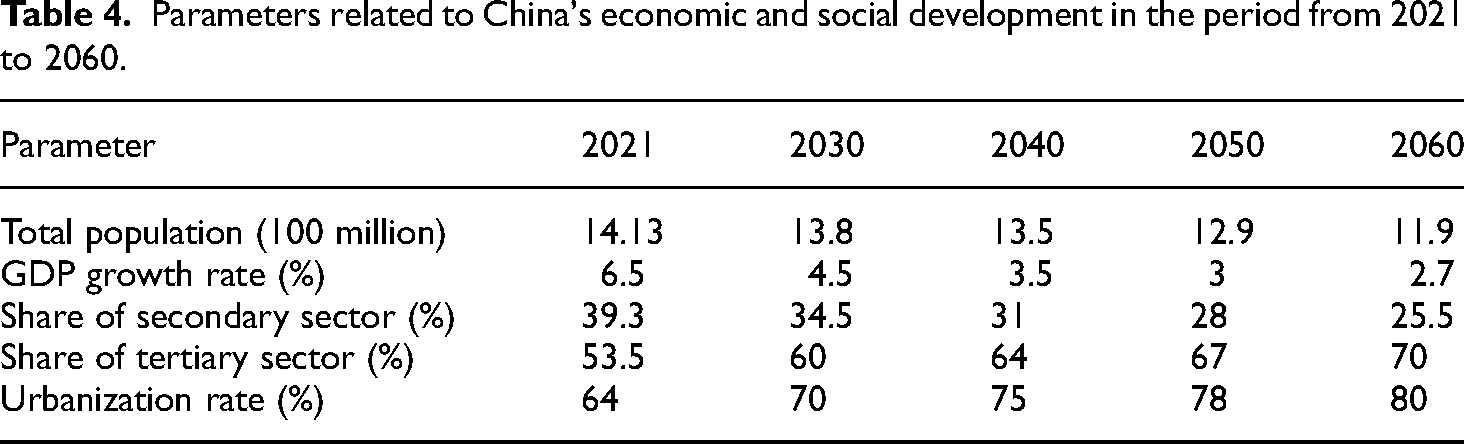
The parameters related to China's economic and social development, natural gas demand, and natural gas production from 2021 to 2060 were set according to a large number of studies and reports by scholars and institutes, as well as the development plans released by the Chinese authorities. The set parameters are listed in Tables 4–6.
Parameters related to China's economic and social development in the period from 2021 to 2060.
Parameters for gas demand simulation under different scenarios.

Parameters and basis for gas production forecasting under different scenarios 108m³.

Macro parameters of China's economic and social development: The total population was set according to the World Population Prospects 2019, 25 the National Population Development Plan (2016–2030), 26 and the China Population Forecast 2023. 27 The other parameters of the population system were set based on the high-level forecast results given in Reference 27 and taking into account the current trend of population growth in China. The forecast for China's total population in 2030, 2040, 2050, and 2060 are 1.38 billion, 1.35 billion, 1.29 billion, and 1.19 billion, respectively. The GDP growth rate was set according to World Energy Outlook 2021, 28 Research on China's Medium- to Long-Term Low-Carbon Development Strategies and Pathways, 29 and the research conducted by Zhang Xiliang et al.. 30 China's GDP growth rate will remain at 2.7–6.5% in the period from 2021 to 2060. According to the trends/rules of change in the industrial structures of developed countries and China's 14th Five-Year Plan for National Economic and Social Development, China's industrial structure will evolve toward an ultimate pattern in which the tertiary sector ranks first, the secondary sector ranks second, and the primary sector ranks third, and it will be continuously adjusted and optimized in this process. 31 As predicted by the Research Center for Macroeconomics of the Chinese Academy of Social Sciences, by 2030 the tertiary sector will account for more than 60%, and the primary, secondary, and tertiary sectors will account for 4.8%, 31.7%, and 63.5% of China's industrial structure by 2035. 32 According to the World and China Energy Outlook 2060 (2021 Edition), 33 it is estimated that the tertiary sector will account for nearly 70% of China's industrial structure by 2060. In this study, based on the above data, the proportions of China's secondary and tertiary sectors were set so that the share of the secondary sector would gradually decrease from 39.3% in 2021 to 25.5% in 2060 and the share of the tertiary sector would continuously increase from 53.5% in 2021 to 70% in 2060. China's urbanization rate was set according to Reference 33 and is expected to reach 70% by 2030 and 80% by 2060.
Among the parameters of the gas demand simulation, the share of non-fossil energy sources is directly related to the achievement of the dual carbon target. For the demand scenario representing unconstrained CO2 emissions (D1), the share of non-fossil energy sources was set at a relatively low rate of increase of around 0.7%, based on growth rates over the last decade. For the demand scenario representing the achievement of the dual carbon goal (D2), according to the expected goals for the “14th Five-Year Plan” and “15th Five-Year Plan” periods, the proportion of non-fossil energy sources is expected to increase to about 20% and 25%, respectively, in these two periods. 34 By 2060, an economic system with green, low-carbon, and circular development and a clean, low-carbon, safe, and efficient energy system will be built in China, China's energy efficiency will reach a world-leading level, and non-fossil energy sources will account for more than 80%. The proportion of coal was set according to BP Energy Outlook (2022 Edition) 35 and the forecast results for the proportion of coal in primary energy sources under different development scenarios revealed in references.29,33 In scenarios D1 and D2, the proportion of coal will drop to 30% and 6% respectively by 2060. The proportion of natural gas for thermal power generation was set according to the relevant data in references.29,33 The decrease in the target CO2 emission intensity was set on the basis of the intensity level in 2005, the relevant data in references29,36 and the preset targets.
Parameters for gas production forecasting. To forecast natural gas production, the ultimate recoverable reserves need to be determined and used as a known parameter. In most previous studies, natural gas production is predicted using published gas reserves data, but the results calculated from such data are mostly “static” theoretical values of natural gas production. To fully consider the dynamic changes in natural gas production under different scenarios with different exploration, development, and production investments, China's natural gas production was predicted based on the cumulative gas production and NR (which is calculated by summing the remaining technically recoverable reserves and potential growth in the remaining technically recoverable reserves), and calculations were made by the type of natural gas. The cumulative gas production was calculated using the historical data of natural gas production during the period from 1950 to 2021. The remaining technically recoverable reserves were calculated according to the China Mineral Resources Report (2022). 37 To calculate the potential growth of remaining technically recoverable reserves, the average annual growth in the remaining technically recoverable reserves during the period from 2017 to 2021 (five years) was calculated according to China Mineral Resources Report (2022) and China Mineral Resources Report (2018), 38 and then the potential growth of remaining technically recoverable reserves in 2060 under scenarios S1 and S2 were calculated based on two annual growth rates equal to 1.0 and 1.2 times the calculated average annual growth, respectively. A combination of current investment in exploration and production and the current rate of technological progress and another combination of higher investment in exploration and development and a higher rate of technological progress before carbon neutrality is achieved were set as constraints on NR. The parameters for forecasting gas production under the two scenarios are listed in Table 6.
Forecast results
Gas demand forecast results
Figures 4–7 show the forecast results of the SD model for China's primary energy consumption, CO2 emissions, natural gas demand, and natural gas consumption by sector under different scenarios. Figure 4 shows that under scenario D1, CO2 emissions are not constrained and the energy system is transformed at the same slow pace as before. In the future, the share of non-fossil energy sources and the share of coal will slowly decrease, while the share of natural gas in primary energy sources will increase significantly to about 15.5% around 2040. In comparison, the share of oil in primary energy sources will decrease continuously and remain at a low level after 2040. In the structure of primary energy consumption, non-fossil energy sources and natural gas will together replace coal and oil and have a larger share, leading to an increased share of clean energy in the energy system. In scenario D1, total CO2 emissions peak around 2035 at 11.23 billion tonnes and remain at a relatively high level of 5.14 billion tonnes in 2060, in which case the double carbon target will not be met.

Forecast results for the structure of primary energy consumption and CO2 emissions in China under scenario D1.

Forecast results for China's total natural gas demand and natural gas demand by sector under scenario D1.

Forecast results for the structure of primary energy consumption and CO2 emissions in China under scenario D2.

Forecast results for China's total natural gas demand and natural gas demand by sector under scenario D2.
Figure 5 shows that under scenario D1, China's natural gas demand will grow continuously, reach a peak of about 766.02 billion m³ in 2046, and then gradually decline to 521.65 billion m³ in 2060. In terms of natural gas demand, the demand for natural gas as an industrial fuel will first grow and then decline; the demand for natural gas used for power generation will grow significantly and steadily; the demand for urban gas will grow steadily, but its share will be smaller than that of natural gas used for power generation; the demand for natural gas used in the chemical industry will grow slightly and its share will remain at a low level.
As shown in Figure 6, under scenario D2, the energy system will undergo a deep transformation; the proportion of non-fossil energy sources will increase rapidly; the proportion of coal will decrease continuously, and the proportions of oil and natural gas (fossil fuels) will gradually decline in the long run. In the period from 2020 to 2040, the proportion of natural gas in primary energy consumption will increase to 13–14%. After 2040, the proportions of coal, oil, and natural gas in primary energy consumption will decrease continuously, declining to about 6%, 5.3%, and 8.4% in 2060. Under this scenario, China's total carbon emissions will peak at about 10.56 billion tons around 2029 and decrease to only 1.69 billion tons in 2060. By 2060, the CO2 emissions in the energy system will be absorbed through the implementation of negative emission technologies such as CCUS/CCS and forest-based carbon sinks, so that the dual carbon target can be achieved at the national level.39,40
Figure 7 shows that under scenario D2, China's total natural gas demand will reach about 708.066 billion m³ in 2036, start to decline significantly after 2036 and gradually decrease to 278.991 billion m³ in 2060. In terms of natural gas demand, the demand for natural gas as an industrial fuel will first increase and then decrease; the demand for natural gas for power generation will grow rapidly and the share of natural gas for power generation will increase continuously, becoming the first source of natural gas for power generation in 2060; the demand for urban gas will first increase and then decrease, with a certain share smaller than that of natural gas used for power generation; the demand for natural gas used in the chemical industry will gradually decrease after a short-term increase, and the share of natural gas used in the chemical industry will remain at a very low level without significant changes. It can be seen from Figure 7 that compared to scenario D1, the peak of natural gas demand in scenario D2 occurs earlier and the peak demand is lower. This phenomenon indicates that in the process of energy transition towards the dual carbon target, natural gas will gradually lose its role as a transitional energy source in the late stage of the energy transition and become one of the major sources of CO2 emissions, and the natural gas industry will enter a “reverse” development stage. However, for the period 2021 to 2035, natural gas demand in scenario D2 is higher than in scenario D1, indicating that natural gas will play an important role in controlling CO2 emissions in the short to medium term and that the potential growth in natural gas demand before carbon neutrality is achieved should not be underestimated.
Gas production forecast results
The forecast results for natural gas production under Scenario S1 are shown in Figure 8. Assuming that the technically recoverable reserves of natural gas will not increase after 2060, China's natural gas production will peak at 344.581 billion m³ in 2042. Among various types of gases contributing to natural gas production, conventional gas (including tight gas) is the basic guarantee for natural gas production, shale gas is the key to increasing natural gas production, and CBM is an effective supplement to natural gas production, even though CBM production is not high. Figure 9 shows the forecast results for natural gas production based on the assumption that the exploration and production investment will be greater than that in scenario S1 and the remaining recoverable reserves of natural gas will increase annually at a rate 20% higher than the current annual growth rate (i.e. scenario S2). From these results, it can be known that China's natural gas production will peak at 366.341 billion m³ in 2043. There are no significant differences in the forecast results obtained by the SD model under the two scenarios. All forecast results are generally consistent with the anticipated levels of natural gas production revealed in China's Natural Gas Development Report 2021. 41 According to the forecasts in this report, China's natural gas production will reach a level of more than 230 billion m³ in 2025, continue to increase steadily after 2025, and remain at a level of more than 300 billion m³ in 2040 and for a relatively long period thereafter. Therefore, the gas production forecast results delivered by the model are highly reliable.

Forecast results for natural gas production under scenario S1.
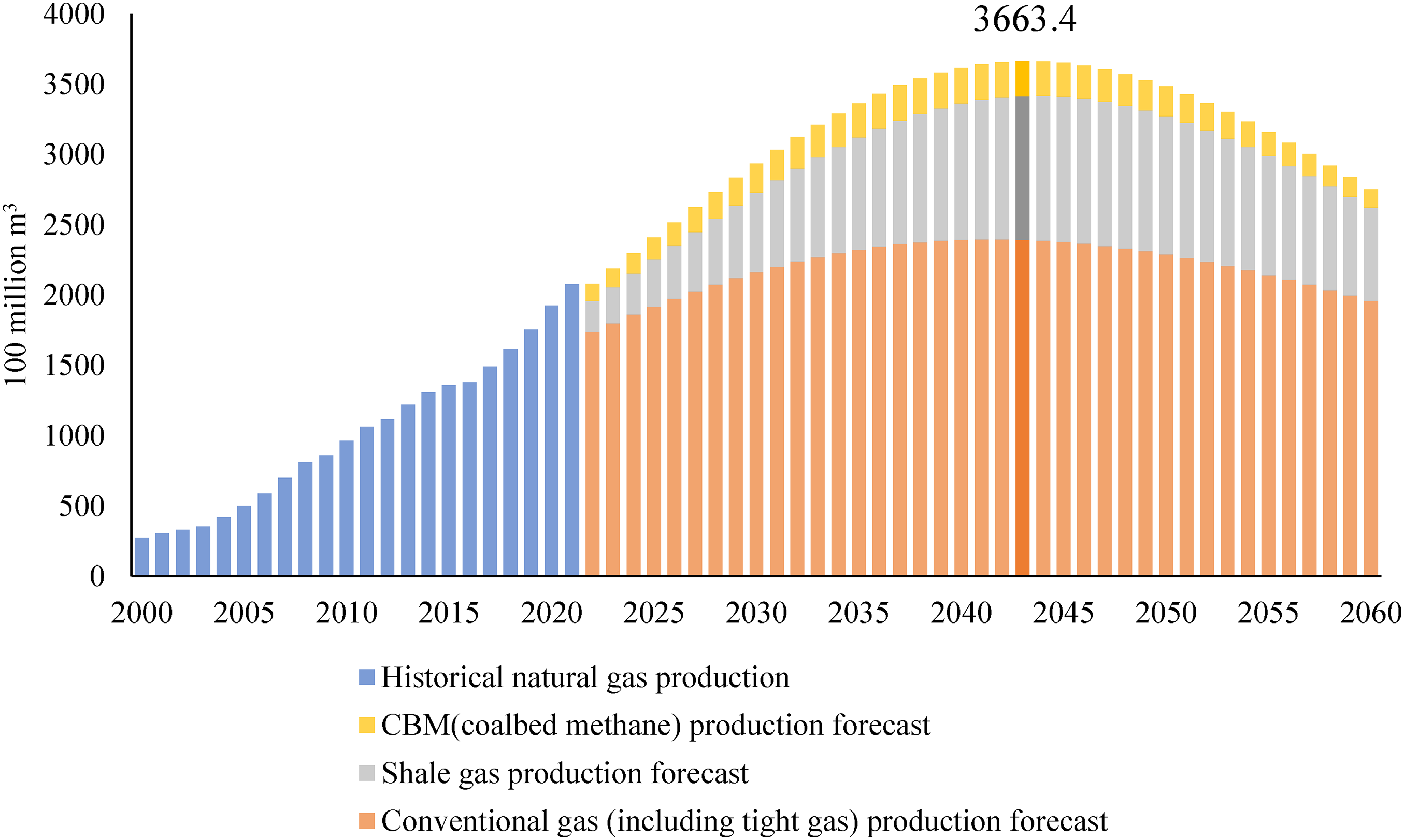
Forecast results for natural gas production under scenario S2.
The forecast results show that China's natural gas production will peak after 2040. When China's natural gas production peaks, the foundation for a new energy system dominated by non-fossil energy sources will be completed, the scale of renewable energy development will further increase, and the growth of China's natural gas demand will slow down or decline. Before 2040, China's natural gas production will increase continuously, but the delayed arrival of the peak of natural gas production will make it difficult to meet the growing demand for natural gas. Therefore, it is necessary for China to speed up its natural gas production.
In terms of the composition of China's total natural gas production at the current stage, the exploration, development, and production of unconventional gas involve great uncertainty; shale gas and CBM account for about half of conventional gas resources, but due to the restrictions posed by technical and geological conditions, the remaining technically recoverable reserves and annual production of shale gas and CBM account for only 12.6% and 16.6% of the total remaining technically recoverable reserves and total annual production of natural gas. Therefore, shale gas and CBM have great potential for growth in remaining technically recoverable reserves and annual production.
Trend of change in China's dependence on natural gas imports
The future trends in China's potential gas imports and its dependence on natural gas imports under different scenarios can be predicted based on the forecast results for China's natural gas demand and production. Under various scenarios, China's potential natural gas imports will increase continuously from 160 billion m³ in 2021 to about 350 billion m³ by around 2035, representing an increase of more than 100%, and China's dependence on natural gas imports will increase from the current level of 44.37% to a higher level and remain above 50%. In addition, China's dependence on natural gas exports will further increase in the short to medium term. With respect to the trends in China's potential gas imports and its dependence on natural gas imports after 2035, there are great differences between the forecast results obtained under different scenarios. Under scenarios D1S1 and D1S2, China's potential gas imports will increase to about 400 billion m³, and by around 2050, the potential gas imports will decrease to a certain level, and the situation with respect to natural gas imports will be eased to some extent. Under these two scenarios, China's dependence on natural gas imports will remain above 50% for a long period of time and can even increase to 57.8%. Under scenarios D2S1 and D2S2, China's potential gas imports and its dependence on natural gas imports will gradually decrease, the pressure on natural gas importation will be eased, and the security of the natural gas supply will improve continuously. Under scenario D2S2, China's potential gas imports and its dependence on natural gas imports will be close to zero in 2060, indicating that China's domestic natural gas production will be sufficient to meet its natural gas demand in 2060.
In general, China's natural gas imports and the security of its natural gas supply will face a challenging situation in the short term, and this situation will last until around 2035. The long-term security of the natural gas supply is closely related to the progress of energy transition. Scenario D1S1 can be regarded as a business-as-usual baseline scenario, under which the situation with respect to natural gas imports and the security of supply is most challenging. Under scenario D1S2, despite the increase in exploration and production investment, China's potential gas imports and its dependence on natural gas imports are lower compared to scenario D1S1, but the challenging situation in respect thereof will not be effectively alleviated before 2035. Under scenarios D2S1 and D2S2 (which consider the deep transformation of the energy system driven by the dual carbon goal), China's potential gas imports and its dependence on natural gas imports will decrease significantly after 2035, but before 2035, China will face a more challenging situation in terms of the security of natural gas supply and the pressure on natural gas imports compared with other scenarios. This indicates that the situation with respect to the security of China's natural gas supply under the dual carbon goal is not promising. Therefore, it is necessary to implement effective countermeasures and attach great importance to stabilizing gas import sources (Figure 10).

Trends in China's potential natural gas imports and its dependence on natural gas imports under different scenarios.
Discussion
The natural gas imported by China mainly includes LNG and pipeline gas. As shown in Figure 11, the total volume of natural gas imported by China in 2010 is 16.4 billion m³, including 13 billion m³ of LNG and of 3.4 billion m³ pipeline gas, and the total volume of natural gas imported in 2021 is 162.7 billion m³, including 109.5 billion m³ of LNG and 53.2 billion m³ of pipeline gas, which represents a nearly 900% increase. Compared with the source countries for pipeline gas imported by China, the source countries for imported LNG are distributed more widely, mainly including Australia, the United States of America, Qatar, and Malaysia. China's LNG imports from these four countries account for nearly 75% of the total volume of its imported LNG. China's pipeline gas imports from Turkmenistan account for nearly 60% of the total volume of its imported pipeline gas, and the remaining portion of its imported pipeline gas comes from Russia, Kazakhstan, Uzbekistan, and Myanmar.

China's natural gas imports and source countries 4 .
To ensure sufficient natural gas imports, on the one hand, it is necessary to take effective measures such as establishing close cooperative relations with source countries, deepening multilateral cooperation under the Belt and Road Initiative, and strengthening natural gas import trade. On the other hand, it is necessary to support and encourage Chinese oil companies to go global to search for overseas resource pools, cooperate with overseas oil companies, and carry out exploration and development of overseas oil and gas resources. In addition, active efforts should be made to ensure the reasonable arrangement and efficient construction of necessary infrastructure such as LNG import terminals and pipelines, construct oil and gas storage facilities, ensure sufficient import capacity, and improve emergency response capabilities.
Conclusions and recommendations
Conclusions
In this study, China's natural gas supply and demand were forecasted using the SD model and the generalized Weng model, the forecast results were analyzed, and China's potential gas imports and its dependence on natural gas imports in the future were analyzed under different scenarios based on the forecast results. The main conclusions of this study are listed below.
Under demand scenarios D1 and D2, China's natural gas demand will peak at 766.02 billion m³ in 2046 and 708.066 billion m³ in 2036 and decline to 521.65 billion m³ and 278.99 billion m³ in 2060, respectively. In terms of natural gas demand by sector, the demand for natural gas as an industrial fuel and urban gas will first grow and then decline; the demand for natural gas used for power generation will grow rapidly and remain at high levels; the demand for natural gas used in the chemical industry will not fluctuate significantly and will account for the smallest proportion. Achieving the dual carbon goal requires that natural gas play a bridging role. In other words, it is required that natural gas demand grow rapidly in the early stage and decline rapidly in the late stage. Under production scenarios S1 and S2, China's natural gas production will peak at 344.581 billion m³ in 2042 and 366.341 billion m³ in 2043 and gradually decrease to about 250 billion m³ in 2060. Through enhanced exploration and development, natural gas production can be increased to an appropriate level, and the arrival of the peak of natural gas production can be postponed. Conventional gas (including tight gas) is the basic guarantee for natural gas production, shale gas is the key to increasing natural gas production, and CBM is an effective supplement to natural gas production, even though CBM production is not high. In the short to medium term, China will face a challenging situation in terms of the pressure on natural gas imports and the security of natural gas supply, the volume of China's potential gas imports will increase to nearly 350 billion m³, and China's dependence on natural gas imports will gradually exceed 50%. The progress of the energy transition after 2035 will affect the security of the natural gas supply. China's potential gas imports and its dependence on natural gas imports will remain at high levels under scenarios D1S1 and D1S2 and will decrease significantly under scenarios D2S1 and D2S2.
Recommendations
Based on the simulation results, four recommendations are made with a view to ensuring the security of natural gas supply and enabling natural gas to play a bridging role as a transitional energy source as soon as reasonably practicable. These recommendations are detailed below.
Promote the consumption of natural gas used by various sectors, such as natural gas as an industrial fuel, natural gas for power generation, and urban gas; increase the proportion of natural gas in primary energy sources; give full play to the role of natural gas in adjusting and optimizing the fossil energy structure; and enable natural gas to play a bridging role in the energy transition process in order to lay a solid foundation for long-term decarbonization. Attach great importance to the potential of unconventional gas resources; enhance measures to maintain stable production of conventional gas and improve exploration and production of unconventional gas; and strive to make major gas discoveries and great leaps forward while ensuring the steady growth of domestic natural gas production. Secure gas import sources and channels; attach great importance to the international natural gas market; deepen cooperation with source countries in the field of natural gas trade under the Belt and Road Initiative; and improve the infrastructure for importing natural gas. Establish and improve natural gas reserves to cope with potential gas shortages that may occur in the future; properly handle the pressure produced by continuously growing natural gas demand and fluctuations in gas price in the international market; take preventative measures and make full use of natural gas reserves to prevent problems such as short-term gas shortage.
Footnotes
Declaration of conflicting interests
The authors declared no potential conflicts of interest with respect to the research, authorship, and/or publication of this article.
Funding
The authors disclosed receipt of the following financial support for the research, authorship, and/or publication of this article: This work was supported by the Research on asset evaluation and planning decision Technology of overseas oil and gas exploration project (grant number 2021DJ3106).

Author biographies
Ningning Zhang holds a PhD in Oil and Gas Exploration and Development. His research focuses on the development strategy of the oil and gas industry and the business strategy of oil companies.
Jianjun Wang is a professor in Tectonics. His area of research is overseas oil and gas business development strategy.
MengHao Xue holds a PhD in Energy Strategy. His area of research is energy transition pathways and policies.
Qing Wang holds a PhD in Oil and Gas Geochemistry. His area of research is overseas oil and gas new ventures assessment.
Yiping Wu holds a PhD doctor of Oil and Gas Exploration and Development. His research interests are natural gas and helium gas development.
Qingchao Cao holds a MD in Oil and Gas Resources Engineering. His area of research is overseas oil and gas business development strategy and new ventures assessment.
Peiling Sun is a researcher in International Political Economy. Her area of research is oil and gas country-risk rating and economic evaluation of overseas new ventures.