



Abstract
The impact of aggressive capitalist approaches on social, economic and planet sustainability is significant. Economic issues such as inflation, energy costs, taxes and interest rates persist and are further exacerbated by global events such as wars, pandemics and environmental disasters. A sustained history of financial crises exposes weaknesses in modern economies. The Great Attrition, with many quitting jobs, adds to concerns. The diversity of the workforce poses new challenges. Transformative approaches are essential to safeguard societies, economies and the planet. In this work, we use big data and machine learning methods to discover multi-perspective parameters for multi-generational labour markets. The parameters for the academic perspective are discovered using 35,000 article abstracts from the Web of Science for the period 1958–2022 and for the professionals’ perspective using 57,000 LinkedIn posts from 2022. We discover a total of 28 parameters and categorized them into five macro-parameters, Learning & Skills, Employment Sectors, Consumer Industries, Learning & Employment Issues and Generations-specific Issues. A complete machine learning software tool is developed for data-driven parameter discovery. A variety of quantitative and visualization methods are applied and multiple taxonomies are extracted to explore multi-generational labour markets. A knowledge structure and literature review of multi-generational labour markets using over 100 research articles is provided. It is expected that this work will enhance the theory and practice of artificial intelligence-based methods for knowledge discovery and system parameter discovery to develop autonomous capabilities and systems and promote novel approaches to labour economics and markets, leading to the development of sustainable societies and economies.
Keywords
Introduction
Economic issues, including inflation, energy costs, taxes and interest rates, persist in our daily lives. These challenges have been amplified by global events such as the COVID-19 pandemic, environmental crises, geopolitical conflicts and wars. 1 Global inflation, climate change's impact on economies, rising labour expenses, European gas supplies and food security are major concerns. 2 Additionally, the ‘Big Quit’ or ‘Great Resignation’, characterized by a substantial number of people leaving their jobs, further compounds these economic challenges.3–6
A history marked by financial crises, like those in the 1970s and 2008, and more recently, the FTX collapse, has exposed substantial vulnerabilities in modern economies.7,8 The financial system, regulatory structures and economic policies are all affected. 9 Furthermore, aggressive capitalist approaches have strained social and environmental sustainability. To safeguard our societies, economies and the planet, transformative economic strategies are imperative.10,11 Labour markets, integral to the economy, significantly impact individuals, businesses and society.12–14 Investigating labour markets informs us about how these elements interconnect and how different policies and conditions can influence employment, wages and overall economic outcomes.15–17 Research in this field aids our comprehension of evolving labour dynamics, employer roles and societal influence in labour markets.18–20 Moreover, it allows the alignment with national and global priorities, such as the UN Sustainable Development Goals, facilitating the development of sustainable cities and societies.21–23
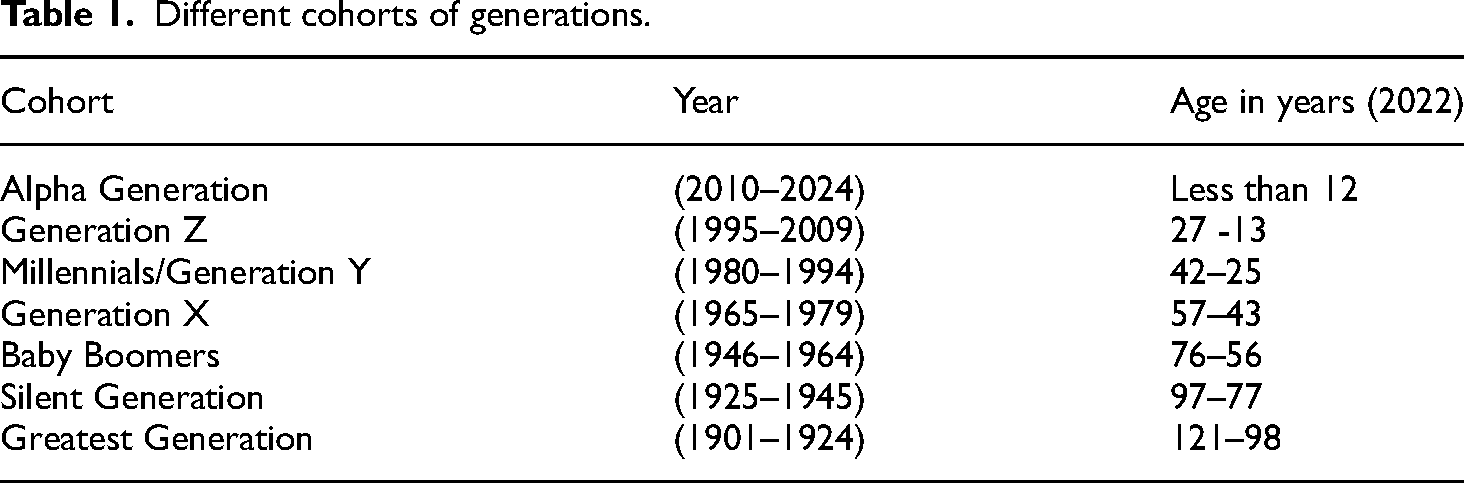
Labour markets are inherently multigenerational, encompassing individuals from various age groups24,25 (see Table 1). Generations (first, second and third generations) could also refer to generations of immigrants in the US or other countries. This diversity presents a challenge for many organizations as the generational experiences of employees influence their work tendencies. 26 Factors such as technology, economic status, gender, education and ethnicity further shape work attitudes.27,28 Recognizing these generational and contextual disparities is crucial for organizations to maintain a productive and engaged workforce. 29
Different cohorts of generations.
The study of generational dynamics in labour markets offers insights into the unique experiences and challenges faced by different age groups. 30 This knowledge facilitates informed decision-making to support the diverse needs of workers, including younger employees dealing with issues, e.g. student debt and competition, and older workers facing challenges such as ageism and technology adaptation. 26 Overall, understanding these dynamics fosters a more inclusive and supportive work environment. 29
In this study, we employ big data, machine learning and advanced techniques to uncover multi-perspective parameters for multi-generational labour markets. Two distinct perspectives, one from academic literature and the other from industry and professionals on LinkedIn, provide complementary insights. Our academic dataset, sourced from the Web of Science (1958–2022), yields 15 parameters using the Latent Dirichlet Allocation (LDA) algorithm, organized into five macro-parameters. The LinkedIn dataset, comprising 57 K posts, also yields 13 parameters through LDA. 31 We develop a comprehensive software tool for parameter discovery, incorporating quantitative analyses and visualization methods to depict datasets, clusters and parameters. The paper presents a multi-perspective labour market taxonomy (Figure 1) supported by qualitative analysis of over 100 research articles.

A multi-perspective taxonomy of multi-generational labour markets.
Previous research in the domain of this paper has employed NLP-based topic modelling for trend analysis,32–35 addressing challenges36–38 and sentiment analysis.39,40 Research in social media and LinkedIn mining has focused on revealing demographic insights, 41 employee skills42,43 and job 44 and profile classifications.45–51 Additionally, Twitter data has been harnessed for appraising transit service quality, 52 detecting traffic-related events, 53 emergency management 54 and conducting temporal trend analysis. 55 See also.56–59
This paper's significance lies in its contributions to understanding age dynamics, offering a data-driven multi-perspective approach and promoting artificial intelligence (AI)-driven knowledge discovery. Such insights are valuable for informed decision-making and could influence future labour economics research and autonomous systems development. A more detailed version of this article is available in an open-access archive. 60
Methodology & software tool design
This section explains the methodology and design of the proposed architecture for the system. In Figure 2, we illustrate the architecture of our software, which is composed of four components, each of which is analyzed in more detail below. Data collection, data sources (Web of Science and LinkedIn), preprocessing, parameter modelling, parameter discovery and quantitative analysis, validation and visualization are explained in sections 2.1 to 2.5.

The system architecture.
First, we introduce Algorithm 1, the master algorithm of our system. The algorithm has been called two times since we have two datasets. For the first dataset, we download the CSV file directly from Web of Science, which includes Article Titles, Abstracts, Keywords and publish date. On the other hand, for the second dataset, we collected LinkedIn posts using web scraping techniques (e.g. Python, Beautiful Soup, Requests and Pandas), as shown in Algorithm 2. The post objects were collected as JSON objects (JavaScript Object Notation). Afterward, we converted the JSON file to a CSV file.
Algorithm 1 takes the CSV file as input. Then, the CSV file is preprocessed in the following step using Pandas. Next, we used Gensim's Python library for parameter discovery using LDA. 61 Our quantitative analysis was implemented using domain knowledge, the clusters were classified as parameters, and then the parameters were grouped into macro-parameters. Our final step was to visualize the parameters and macro-parameters. In addition, these parameters were validated internally and externally.


Data collection
We conducted an extensive literature review to identify alternative synonyms for ‘multi-generational workforce’ and used them to collect data. We used the Web of Science database to obtain the most relevant documents with an integrated query language and data format. Moreover, it promotes access to topic indexes, citation indexes and other databases from other disciplines, which can be used to find relevant research and evaluate its conclusions. Thus, we have collected our dataset from the Web of science. The dataset was generated using a Boolean query (Q1), as shown in Table 2. We have collected around 35 K articles (1958–2022) from several Web of Science disciplines, for example, Educational Research, Business Economics, Computer Science, Social Sciences, Demography, Communication and Others. The number of articles after removing duplication is around 31 K.
Data Collection.

In our previous study, 62 we have collected our dataset from LinkedIn (posts) for four months (March 2022 – July 2022) using search query terms shown in Q2, Table 2. These posts are anonymized (aggregated) data, and we do not use personal information. Then, posts are saved in a CSV file, including around 57 K posts. The CSV file includes two columns, the query term and the post.
Data preprocessing
Preprocessing steps, as shown in algorithm 3, involve removing duplicate articles and irrelevant characters, tokenizing, removing stop words and lemmatizing with POS tags. Python's Pandas package is used to read and save the CSV file as a data frame. Redundant data is removed in the second step, leaving around 31 K articles. Third step, we eliminated all unnecessary characters, including several Unicode characters. The fourth step tokenizes the texts using a simple preprocess function from the Python package ‘Gensim’. In the fifth step, stop words are deleted from the articles. The final step involves lemmatization using Spacy. The result of preprocessing is cleaned texts, which are then used in the LDA model.

Topic modelling using unsupervised machine learning
A topic model is a machine learning technique for discovering topics in a set of documents. 63 Information filtering, retrieval and semantic search are some applications of topic modelling used in document analysis. A topic model can also be referred to as a latent topic model or a latent semantic model. This method analyzes words and their variations in various contexts to discover hidden themes in a text.
We used LDA 31 , a topic modelling method, in this study. We set the parameters for our LDA model to 15 topics, 10 passes and 100 iterations. There is no doubt that the number of topics is an important parameter when building a model. When the number of topics is large, the model must be overfitted, but when it is small, it must be underfitted. By creating multiple LDA models with different topics (k) and comparing the coherence measures with the visual representation, we could determine the optimal number of topics. Passes refer to the number of times an algorithm must traverse the whole corpus. The maximum number of iterations is required to determine the probability of each topic in the corpus.
In topic modelling, coherence scores are used to measure the human interpretability of a topic. The topic coherence scores give an extensive method for comparing various topic models. It compares by capturing the optimal number of topics and gives a ‘Coherence Score’ for those topics’ interpretability. Recent research has focused on measuring the coherence of topics to address the issue that topic models do not guarantee the interpretability of their output. The most common methods for adjusting LDA hyperparameters are based on various topic coherence measures. In this work, we used the C_v, C_uci, C_umass and C_npmi measures of coherence. C_v measure uses a sliding window-based one-set segmentation of the most popular or top words and an indirect confirmation measure. The indirect confirmation measure employs cosine similarity and normalized pointwise mutual information (NPMI). C_uci measure employs a sliding window and all word pairs’ pointwise mutual information. C_umass measure is a confirmation measure, and it utilizes co-occurrence counts for documents, a one-preceding segmentation, and a logarithmic conditional probability. C_npmi measure can be considered an enhancement of C_uci coherence, which uses the NPMI.
Parameter discovery & quantitative analysis
We identify the parameters and macro-parameters based on domain knowledge and quantitative analyses utilizing tools such as term scores, intertopic distance maps and word clouds. The keyword scores for each parameter are represented graphically in descending order. This term score visualization substantially influences parameter identification. A two-dimensional intertopic distance map depicts the parameters as parameter circles whose sizes correlate to the number of words in the dictionary that define the parameters. A word cloud is a representation of a group of words. Word Cloud highlights the famous words and phrases in the articles based on how often they appear and how important they are. It gives quick, easy-to-understand graphics that can lead to in-depth analyses.
Validation and visualization
Results can be both internally and externally validated. Internal validation of a parameter means studying and reviewing the relevant papers. In our research, documents may be academic articles or posts. We described how we interpreted the relationship between the papers and the parameters. External validation is performed by comparing the two datasets’ parameters, keywords and metric metrics. For internal and external validation, many visualization methods are utilized for the visualization. Numerous visualization techniques are utilized to describe the datasets, document clusters and the discovered parameters using histograms, taxonomies, Term scores, Intertopic Distance Map and word clouds. Several Python packages, such as LDAvis, Plotly and Matplotlib, are used to construct these visualizations.
Parameter discovery for multi-generational labour markets (web of science)
In this section, we describe the parameters for multi-generational labour markets that were detected using our LDA model based on the Web of Science dataset, including the taxonomy and quantitative analysis. The parameters are divided into five macro-parameters. The five macro-parameters are discussed in Sections 3.1 to 3.5.
Based on the LDA model, 15 parameters were found in the LinkedIn dataset. This 15-parameter set was grouped into five macro-parameters. Based on the coherence score, we determined 15 clusters (which will be discussed in more detail in the next section). Table 3 lists the LinkedIn dataset parameters and macro-parameters. According to Column 1, the parameters are categorized into five macro-parameters: Generations-specific Issues, Learning & Skills, Employment Sectors, Consumer Industries and Employment Issues. Columns two and three list parameters and cluster numbers, respectively. According to the fourth column, each parameter has a certain percentage of keywords. As indicated in the fifth column, each parameter is associated with the top keywords.
Parameters and macro-parameters of multi-generational labour markets.

In Figure 3, we show a taxonomy of the multi-generational workforce. To create the taxonomy, we used the parameters and macro-parameters from the Web of Science dataset. First level branches display macro-parameters, and second level branches display discovered parameters.
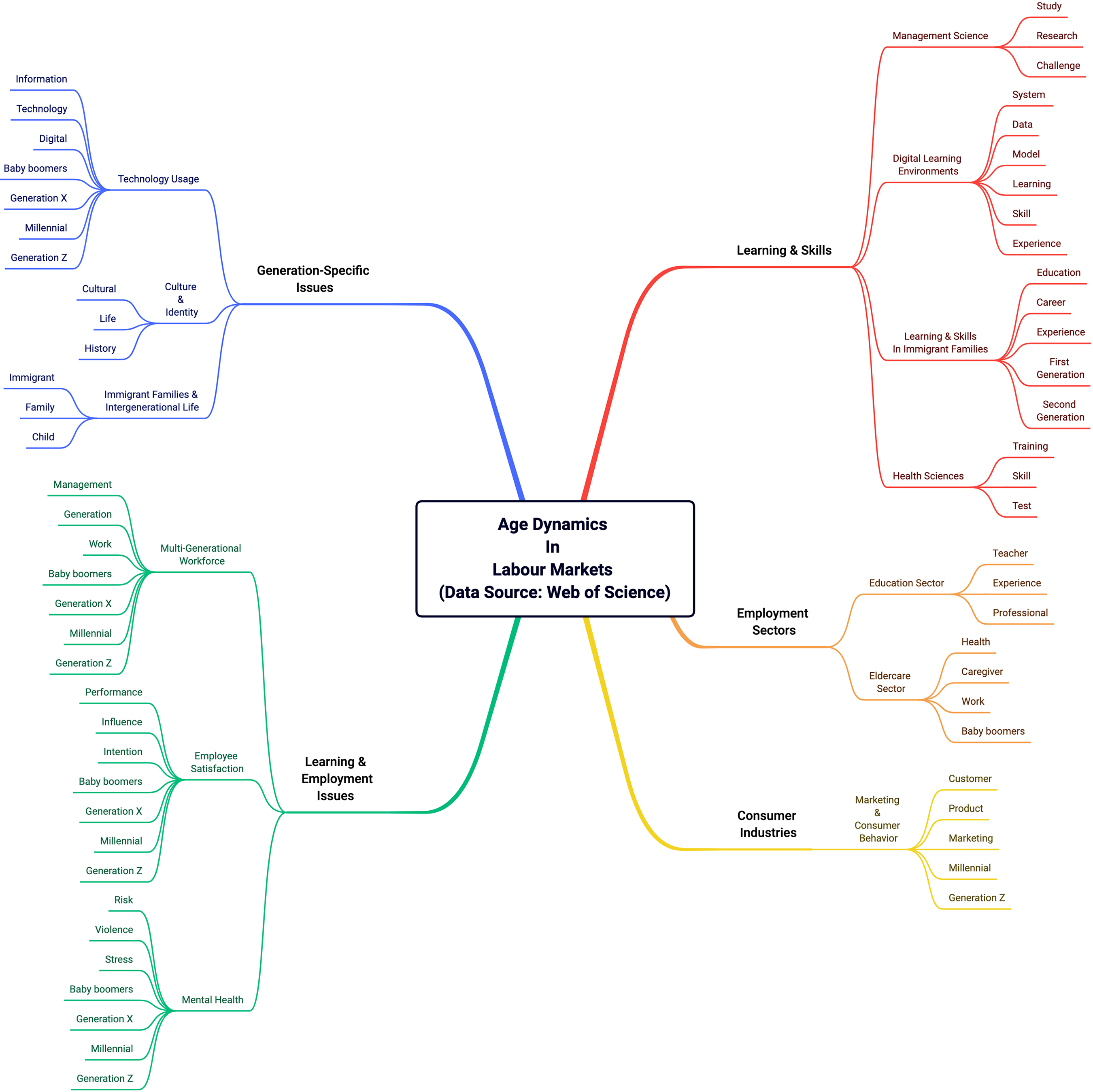
Web of science perspective taxonomy of multi-generational labour market.
Models were created with Gensim LDA package and themes were rendered with PyLDAvis. Based on the coherence measures, we selected different top models with the optimal number of topics. Figure 4 presents four different coherence measures for finding the optimal number of topics. Our choice of 15 topics was since it appeared to be an optimal number. Furthermore, the intertopic distance map has fewer overlapping circles.
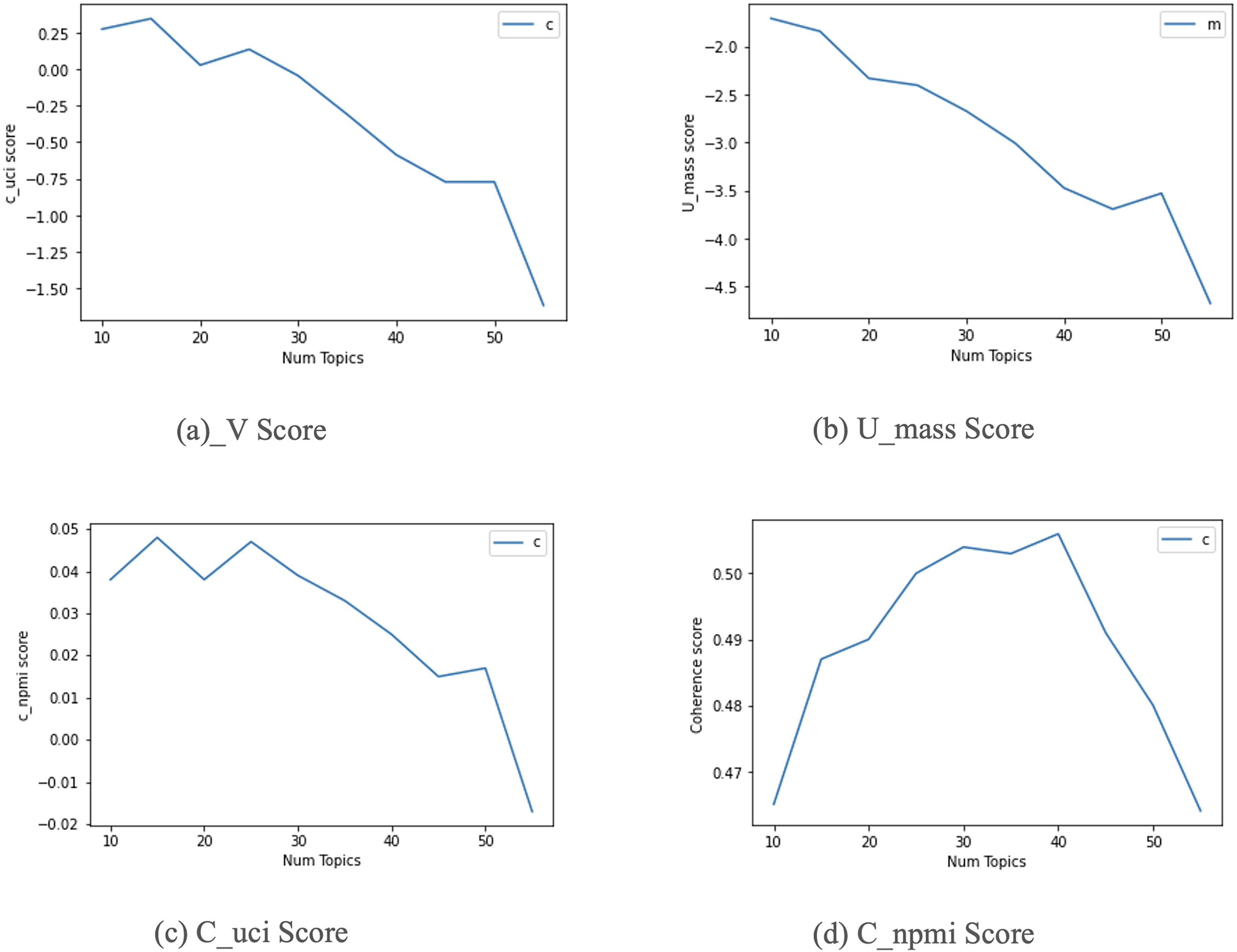
Coherence measures.
Based on the extracted 15 topics information, Figure 5 shows the intertopic distances and the most important words. Topics are represented by circles on the intertopic distance map. Depending on the topic's relevance, the circle size increases significantly. Typically, a good topic model will have fewer overlapping circles throughout the chart. A poor topic model, on the other hand, would have circles that overlap heavily clustered in one quadrant.

The intertopic distance map of the topics and the most important words.
In Figure 6, the histogram shows how many documents are in each topic. On the x-axis, the number of topics is displayed, while on the y-axis, the number of documents is displayed. As an example, Topic 12 has approximately 3500 documents. This visualization provides insights into the document distribution among the various topics, allowing us to identify the topics that have a higher or lower number of associated documents.

Number of documents in each topic.
Figure 7 shows the document word count and the number of documents. Most documents in the dataset contain fewer than 500 words. A few contain between 500 and 750 words, indicating a moderate length. Furthermore, even a fewer article abstracts contain between 875 and 1000 words, suggesting a relatively smaller proportion of longer documents in the dataset. This information helps to understand the distribution of document lengths within the dataset and provides insights into the general size and structure of the documents being analyzed.
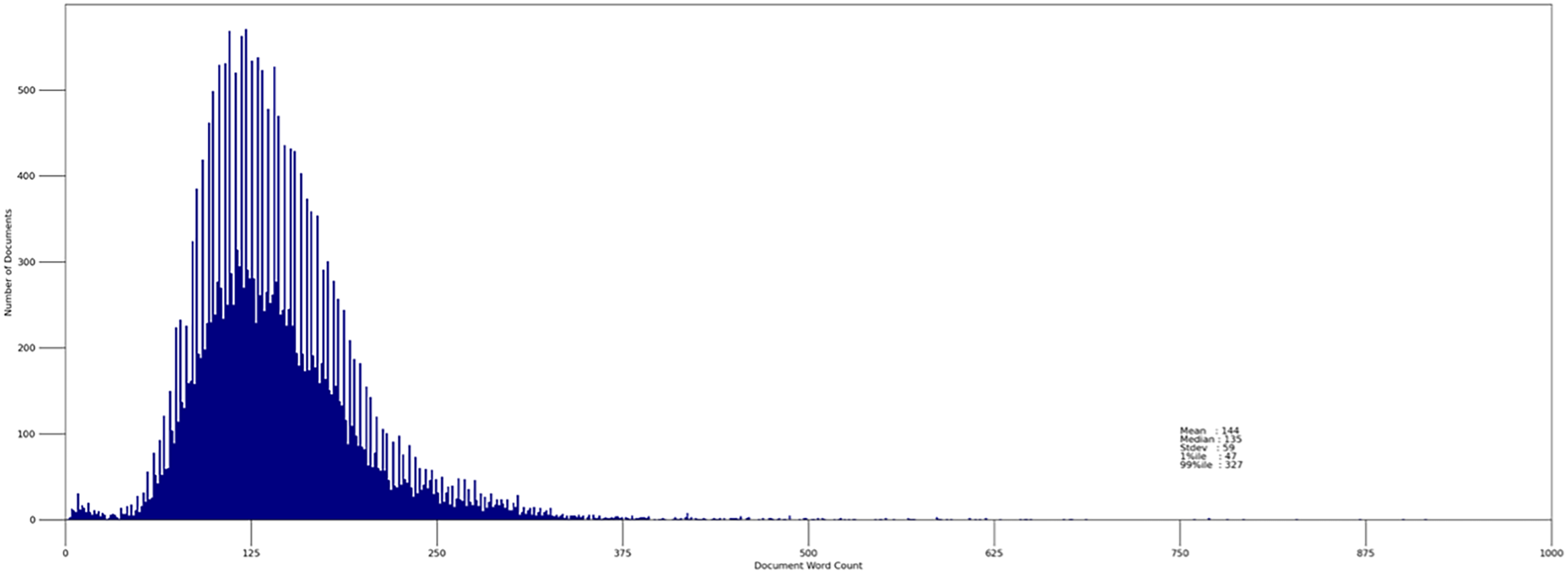
Histogram (web of science article abstracts).
Figure 8 shows the most frequently occurring and relevant words and phrases in the articles. A word cloud provides a visual representation of the most prominent terms associated with each topic. Analyzing the size and prominence of the words allows us to gain insight into the key themes and concepts discussed in the articles. In general, the larger and more prominent the word, the more likely it is to appear in the topic. We can use this technique to identify the articles’ main ideas and focus areas without having to read their entire text. Nonetheless, word clouds alone may not provide a comprehensive understanding of the articles, so they should be used in conjunction with other analytical methods.

Word cloud for each topic.
Figure 9 displays the ten most significant keywords for each parameter. The parameter keywords are represented by vertical lines, while the importance scores are depicted by horizontal lines. The colors used in the figure indicate the level of importance, with light maroon indicating the highest level of significance and dark maroon representing the least important keywords. This visualization allows for a quick assessment of the most critical keywords associated with each parameter; we can identify the key terms that contribute significantly to the analysis. By considering the importance scores and the corresponding keywords, we can gain valuable insights into the factors that drive the analysis and the specific aspects that are most relevant to the parameters being examined.

Term score.
Learning & skills
The Learning & Skills macro-parameter includes four parameters. The parameter
The parameter
The
The parameter
Employment sectors
Employment Sectors macro-parameter includes two parameters. The parameter
The parameter
Consumer industries
Consumer Industries macro-parameter includes one parameter but can be extended using modelling of additional datasets. The
Learning & employment issues
Employment Issues macro-parameter includes three parameters. The parameter
In the
The parameter
Generation-specific issues
Generations-specific Issues macro-parameter has three parameters. The
The parameter
The
Parameter discovery for multi-generational labour markets (LinkedIn)
Twitter and Facebook have been the subject of intensive research over the past few years, and datasets are readily available. LinkedIn is the largest network of professionals and hence it is an exciting source of data to explore. However, LinkedIn does not have a dataset gathering information (posts) and hence it is challenging to develop datasets from it. LinkedIn was our data source to conduct a study focusing primarily on labour markets involving professionals. A web scraping and social mining technique was used to obtain the dataset. This section presents the parameters detected using our LDA model based on the LinkedIn dataset. We briefly describe in this section the parameters and macro-parameters discovered from the LinkedIn data and use them to develop the multi-perspective taxonomy of multi-generational labour markets. A detailed description of the parameters can be found in.62,129
We detected 15 parameters. Two of them were merged into one. One of them was discarded since it was in a different language. So, we are left with 13 parameters. These parameters are divided into five macro-parameters. The parameters are categorized into five macro-parameters: Learning & Skills, Business & Employment Sectors, Consumer Industries and Learning & Employment Issues and Generations-specific Issues macro-parameter has one parameter, which is Crimes & Racism. Learning & Skills macro-parameter has two parameters: Learning & Skills and Leadership. Business & Employment Sectors macro-parameter has four parameters: Remote Work, Recruitment, Entrepreneurship and Family Business. Consumer Industries have six parameters: Brand Marketing, Retirement, Energy Sectors, Entertainment, Celebrations and Mental Health. A taxonomy of the multi-generational workforce is shown in Figure 10.

LinkedIn perspective taxonomy of multi-generational labour market.
The parameters addressed numerous issues in the labour market. The millennial generation, for instance, should understand the challenges associated with working from home and how to overcome them despite the benefits remote work offers. A significant challenge of working from home is the increased risk of burnout. Office environments give employees time to decompress and recharge after a long day at work. Employees who work from home are not afforded this luxury, so they are often under more pressure to be productive constantly. As a result, burnout can occur, and high-stress levels can negatively impact health. To overcome that, it is essential to take breaks throughout the day. This way, employees will be energized and ready to tackle another productive workday. Additionally, mental health needs to be taken care of because it can affect physical health and relationships. To feel comfortable speaking with friends and family members about their feelings, seniors and adults should feel free to express themselves.
Our results also touched on hiring and retaining employees, which is becoming more challenging for organizations. In addition to managing their workforce effectively, organizations have difficulty hiring and retaining the right employees. Depending on the organization, multi-generational employees may leave due to a lack of advancement opportunities. Additionally, creating a culture that appeals to all generations can be challenging. As a result, organizations may need to adjust their policies to be more inclusive of different generations. In addition, flexible work schedules, relevant training programs and open communication between generations can enhance employee satisfaction.
In addition, we found that the number of retirees in the United States will outnumber children by 2023. The workforce will be significantly affected by this change. There will be a decreased labour pool, resulting in higher employee demands and increased costs of hiring, training and finding new employees. Offering part-time schedules and flexible scheduling options to retirees is one solution.
In addition, we found that unemployed Generation Z and Y youth are five times more likely to have criminal records. Furthermore, if racial issues occur at work, they can severely affect both the victim and the workplace. There is a possibility that victims will feel uncomfortable or unwelcome in their jobs, and they may lose respect for colleagues and co-workers. Employees can also distrust each other in a racist environment, which hinders teamwork. Employees with racist attitudes are also more likely to be unproductive and leave the company more often.
Despite challenges in the 21st-century economy, businesses are in an excellent position to remain competitive. The reason for this is that entrepreneurs can be of any age. An entrepreneur can start a small business at any age, or an employee at an established company can start a business. Also, they can consider investing in startups or engaging in other entrepreneurial activities. Although entrepreneurs will have many challenges ahead, they must be prepared for them. Additionally, from the perspective of the brand marketing of the business, it was found that modern digital technology and media are required to meet the needs of youth customers (Gen Y and Gen Z).
Discussion
In this paper, we proposed a data-driven AI based approach to automatically discover parameters for multi-generational labour markets using academic literature and social media analysis. Specifically, we discover parameters from Web of Science and LinkedIn posts using the LDA algorithm. We developed a software tool from scratch for this work that implements a complete machine learning pipeline using two datasets.
We discovered 15 parameters within the Web of Science dataset and categorized them into five macro-parameters: Learning & Skills, Employment Sectors, Consumer Industries, Learning & Employment Issues and Generations-specific Issues. Figure 11 shows the word cloud of keywords discovered from Web of Science articles, with the size of each keyword denoting its frequency, a measure of its importance. According to the figure, the Web of Science is primarily concerned with work, education, experience, research and generation.

A word cloud generated from web of science.
Using the LinkedIn data, a total of 13 parameters were discovered and categorized into five macro-parameters. The macro-parameters are the same as for the Web of Science, however, there are differences in their constituent parameters. Figure 12 shows the word cloud of keywords discovered from LinkedIn posts, with the size of each keyword denoting its frequency, a measure of its importance. According to the figure, LinkedIn is primarily concerned with work, education, research and generation. These foci though are somewhat similar to the Web of Science the overall mix of foci is different.

A word cloud generated from LinkedIn posts.
Figure 13 shows a multi-perspective (academic and professionals) view of the generation characteristics in labour markets discovered by our tool. We depicted the importance of hiring and retaining employees. In order to hire and have the right employees, organizations may need help managing their workforces. Several generations may leave the workplace due to a lack of advancement opportunities. Creating a culture that appeals to all generations is also difficult. This issue may require organizations to make their policies more inclusive of different generations. Among the things that can be done are offering relevant training, offering flexible work schedules and establishing an open line of communication between generations.

A multi-perspective (academic and professionals) view of the generation characteristics in labour markets.
Also, we found that baby boomers in their 50s and 60s are retiring, and more retirees will live in the US in 2023 than children. As a result, the workforce will be significantly affected. With a shrinking labor pool, hiring and training new employees will become more expensive as there are fewer qualified applicants available. A possible solution is to hire more retirees and offer them part-time work.
Moreover, unemployed American youth (Gen Y and Gen Z) have five times more criminal records than employed youth. Moreover, racism at work can harm both the victim and the workplace. As a result of abuse, victims may feel unwelcome at work and lose respect for their coworkers. In addition to discouraging teamwork, racist workplaces can also foster distrust. It is also possible for racist attitudes to decrease employee productivity and turnover.
On the other hand, Today's businesses are well-positioned for success in the 21st century. It is possible to start a small business or to work for an established company at any age since entrepreneurs can start businesses at any age. Other entrepreneurial activities include investing in startups or participating in other entrepreneurial ventures.
Multi-generation workforce skills and benefits
We discuss here the skills and benefits of multi-generational workforce derived from the discovery and analysis of parameters conducted in this study (consider also the multi-perspective view depicted in Figure 1). In the past decade, technology has profoundly impacted the workplace. It has transformed how we work and interact with one another, how we manage our time and how we complete tasks. 130 This transformation is particularly evident when examining how technology has changed how employees perform their jobs. These changes are especially apparent when examining how multi-generational workplaces have evolved and continue to devolve into a new normal. 131 In today's multi-generational workforce, different attitudes and experiences among baby boomers, Gen Xers, Millennials (Generation Y) and Gen Z present greater variety in adopting and using technology. 132 With more generations working together, we see wider differences in how various age groups view technology, processes and workplace productivity. Younger generations may share technology skills, while older generations impart sectoral knowledge and general wisdom in the workplace. 25 The millennial generation is now entering the workplace in droves,130,133 bringing their distinct Millennial values with them as they take on leadership roles and manage other employees who may be from an older generation or younger generation than themselves. As it stands today, millennials are the largest generation currently in the workforce. 134
On the other hand, the shift in technology and paradigm among employers also reflects employee trends. The email and phone poll responses seemed unanimous; these trends are not going away anytime soon because technology is being used to help solve problems in the workplace and develop growth opportunities within companies from all sectors. Employees from different generations can now work collaboratively from remote locations and meet virtually without ever having met face to face throughout history, with systems like video conferencing furthering their capability to interact virtually for remote meetings.
Currently, employees no longer retire at 65 or remain with the same organization for decades. This suggests that the days when employees used to work their way up the ladder are long gone. With such a diverse talent pool, businesses can garner a competitive edge through the implementation of a multi-generational workforce. With the workforce becoming increasingly diverse, it is crucial to comprehend the advantages of an inter-generational workplace. Conceptually, an inter-generational workforce is one that has employees from various age groups, including Baby Boomers, Generation X, Millennials and Generation Z. A multi-generational workforce is defined as employees made of individuals emanating from diverse generations. This section focuses on the definition, benefits and challenges of a multi-generational workforce.
A multi-generational workforce provides an organization with a plethora of benefits. The first advantage identified in the literature is that it can result in more effective communication since employees of diverse age groups have different ways of communication. For example, Generation Z and Millennials may prefer communicating through messages or social media whereas the Generation X and Boomers may prefer face-to-face communication or emails. 133 Organizations can tap into the several styles of communication that the different age groups use to disseminate messages more effectively. Because of the diversity of the workforce, organizations can grab this as an opportunity for employees to gain insight from each other and enhance communication across the various generations. A multi-generational workforce can result in better communication due to the various communication styles of the different generations. Understanding and respecting such differences can be critical for bridging the gap and enhancing understanding between employees. 135 A cohesive working environment that such a workforce has can be beneficial in improving the overall productivity of the organization.
The second benefit of an intergenerational workforce is that it can offer various experiences and skills. Employees of various ages usually have varying experiences and skills to offer. For instance, Millennials and Gen Z may have more familiarity with new technologies, whereas Gen X may be experts in traditional methods. 136 Mixing the various age groups within the organization can enable them to benefit from various experiences and skills. The other advantage is better creativity and innovation for meeting the dynamic marketplace needs. Different age group employees bring various experiences and perspectives on things such as product development, work processes or customer service, thus resulting in innovative and exciting solutions to issues when companies tap on them. 137 An intergenerational workforce can also assist in creating an innovation culture since employees feel free to share their ideas. In this regard, businesses which adopt a multi-generational workforce have more likelihood of being successful in the current dynamic marketplace since they have better innovation and creativity that guarantees them a competitive advantage.
Better adaptability and flexibility have also been cited as a critical benefit since employees of various age groups often have varying skill sets. For instance, Millennials and Gen Z are more tech-savvy and embrace new technologies quickly, 138 whereas older generations such as Generation X can have more institutional knowledge and experience. Having a multi-generational workforce can ensure that the organization becomes more adaptable to change and flexible. Moreover, a multi-generational workforce can result in better problem-solving. With a combination of backgrounds and ages, employees can introduce various perspectives for solving workplace problems, thus resulting in more effective and innovative solutions. The more well-rounded team that emanates from a multi-generational workforce can enable an organization to tap into a wider pool of knowledge and skills. It can make the team to become more versatile and meet the workplace challenges. 139 Younger workers can gain insights from experiences of older workers, thus help in creating a more supportive and collaborative work environment. By creating a dynamic workplace, a multi-generational workforce increases the likelihood for more exchange of ideas and vibrant work culture. Increased profitability and productivity are the other benefits of a multi-generational workforce. Employees of different backgrounds and ages can introduce various viewpoints on workplace issues. 140 The more potential for exchange of ideas among the different backgrounds and ages can result in better profitability and productivity within the workplace.
Multi-generation workforce challenges
We discuss here the challenges that a multi-generational workforce poses. These are derived from the discovery and analysis of parameters conducted in this study.
Notwithstanding the numerous benefits accrued from a multi-generational workforce, it also poses certain challenges. One of the major challenges is the management of various expectations on work–life balance. For instance, Generation Z value work–life balance more than Generation X. In this regard, they are likelier to leverage on flexible work arrangements such as compressed workweeks or telecommuting. 141 As a generation that directly encountered the great recession, Generation Z are more concerned about job security, perks and salary, but at the same time tend to be vocal regarding work–life balance as well as workplace flexibility. Notably, work–life balance has been found to be quite pertinent not only for Generation Z but all other employees. 141 In fact, this generation holds the assumption that it is the mandate of the organization to offer flexibility since it only increases efficiency and productivity, 142 and that such a work arrangement needs to be open. Balancing such interests with the other demands of other generations regarding work-life balance may be quite challenging for an organization.
Communication is an important tenet for the workforce. However, different generations have different communication styles. Whereas Gen Xers often prefer emails and calls, Generation Y often prefers to send instant messages. The use of informal language, abbreviations and colloquialisms further contributes to communication breakdown, thus making communication a major challenge. To address this, organizations should encourage collaboration among the different generations to ensure they learn from each other. 143 Changing the collective mindset and influencing different generations to view themselves as partners can ensure everyone benefits from new communication forms and ideas. Motivating a multi-generational workforce is also quite daunting. Motivating employees usually implies the creation of a corporate culture that supports all persons’ goals and ideals. It can include flexible working strategies and perks that enable various generations to pursue diverse aims within their careers and work in several ways to actualize them. To address this, it is crucial for multi-generational workplaces to treat each employee as an individual. Instead of motivating all persons with similar benefits, an organization should personalize its motivational approach. 143
Every generation has certain stereotypes which may be harmful to the workplace. For example, older workers like Gen X often believe that Millennials and Gen Z are entitled and tech-obsessed, whereas the younger employees such as Gen Z believe that Baby boomers and Gen Z are stubborn and old-fashioned. 144 This illustrates that while various generations embrace different styles and preferences of work, stereotypes can negatively affect the work environment. To tackle this, it is crucial to concentrate on valuing employees for their individual strengths. 143 Employers should not assume that certain individuals in the team require special treatment and help. They should not concentrate on weaknesses of other workforce members. Rather, they need to know each employee individually, and concentrate on tapping on their strengths.
Furthermore, it is difficult to balance the weaknesses and strengths of a multi-generational workforce. Every generation has its characteristics that it delivers to the workforce. Such differences need to be embraced to enable organizations leverage on their teams. However, managers at times view the gaps that exist between members of teams as negatives. Despite this, developing a team that brims with diverse perspectives and insights can be beneficial to an organization. 132 To tackle this, cross-generational mentoring can play a pivotal role, and this can be done through the development of a reciprocal mentoring program. Such a program can ensure, for example, that Millennials teach Gen X how to utilize social media along other forms of technology, whereas Baby Boomers can guide Gen Z into communication and interpersonal skills while sharing knowledge regarding the way the business functions. The organization should allow team members to gain insights from each other and depend on other organizational members when they need assistance to balance their weaknesses and strengths. In addition, the organization should fine-tune onboarding programs to meet the needs of the various generations, especially Generation Z. 142 A well-designed program can enable new hires to minimize uncertainty and anxiety and provide knowledge and clarity to their role. Effective onboarding can also lead to better job satisfaction, loyalty and performance. Mentoring can be instrumental in ensuring the younger employees coordinate with various organizational processes.
Conclusions
Capitalist approaches have had negative impacts on social, economic and environmental sustainability. Economic issues such as inflation and energy costs have been exacerbated by global events and financial crises have revealed weaknesses in modern economies. The current trend of people quitting their jobs in large numbers, known as the Great Attrition, and the presence of multiple generations in the workforce also pose challenges. Transformative approaches are necessary to address these issues and protect society, the economy and the environment.
This study uses big data and machine learning to identify multi-perspective parameters for multi-generational labour markets. The parameters were discovered using 35,000 academic articles and 57,000 LinkedIn posts, and were organized into five macro-parameters: learning and skills, employment sectors, consumer industries, learning and employment issues and generation-specific issues. The study also includes a knowledge structure and literature review of multi-generational labour markets based on over 100 research articles. A machine learning software tool was developed for data-driven parameter discovery and various quantitative and visualization methods were applied to explore the topic.
This paper presents an approach for obtaining comprehensive, objective and multi-perspective information on a subject using machine learning and deep learning and provides tools and resources for accessing information from various datasets. The research in this paper contributes to our understanding of age dynamics in labour markets and may be used to raise awareness and drive future research on the topic using advanced technologies. The findings and knowledge gained from this work can be used to inform decisions and guide labour economics research, and the work is expected to enhance the theory and practice of AI-based methods for information and parameter discovery, extend the use of LinkedIn and scientific literature media for information discovery and promote novel approaches to labour economics and labour markets. Ultimately, this work aims to contribute to the development of sustainable societies and economies.
Artificial intelligence is enabling autonomous functionality in various systems, including self-driving cars and robots, and will be extended to larger systems such as industrial sectors and governance. By identifying and defining the key characteristics and variables that will guide the design and operations, designers and managers can ensure that they are creating a product, system or process that meets the desired specifications and requirements. The same concept is applicable, though much more complex and grander, to the design and governance of economies and societies. Internet of Things, AI, big data and high-performance computing technologies will allow increasing levels of autonomy in economic, social and other governance systems. Discovering system parameters, even in the absence of autonomous capabilities, is necessary for decision-making and problem-solving during design and operation.
The work's limitations include reliance on specific data sources, namely article abstracts and LinkedIn posts, which potentially introduces bias and limits generalizability. The timeframes of the datasets might overlook certain developments and long-term trends in the labour market. While the sample size is large, it may not fully represent the diverse nature of multi-generational labour markets. Additionally, the lack of qualitative data and overlooked variables may restrict a comprehensive understanding of labour market dynamics. Addressing these limitations will enhance the study's relevance and broader applicability in promoting sustainable societies and economies, shaping the direction of future research.
This paper is part of our broader work on the use of information and communication technology (ICT) to address challenges facing smart cities and societies. Our work on this topic has included the concept of Deep Journalism,145,146 as well as research on topics such as transportation, 146 tourism, 147 smart families and homes, 148 healthcare services for cancer, 58 mental health, 149 education during the COVID-19 pandemic, 150 energy systems 151 and AI-based event detection. 152 Future work will be directed to improving the methodological approach presented in this paper using advanced deep learning methods and their applications to investigate and improve labour economics and other problems facing our societies.
Footnotes
Acknowledgements
‘The work carried out in this paper is supported by the HPC Center at the King Abdulaziz University’.
Declaration of conflicting interests
The author(s) declared no potential conflicts of interest with respect to the research, authorship, and/or publication of this article.
Funding
The author(s) disclosed receipt of the following financial support for the research, authorship, and/or publication of this article: This work was supported by the King Abdulaziz University, (grant number RG-11-611-38).

Author biographies
Abeer Abdullah Alaql is currently a Ph.D. student in the department of Computer Science at King Abdulaziz University, Jeddah, Saudi Arabia. She received her M.Sc. degree in Computer Science from King Abdullah University of Science and Technology. She is a lecturer in the Computer Science Department at the Umm AlQura University. Her research interests include Machine Learning, Big Data, and Smart Cities and Societies.
Fahad Alqurashi received the M.Sc. degree from the Department of Computer Science, Florida Institute of Technology, Melbourne, FL, USA, in 2011, and the Ph.D. degree from the Department of Computer Engineering, Florida Institute of Technology, in 2015. He is currently an Associate Professor with the Faculty of Computing and Information Technology, King Abdulaziz University, Jeddah, Saudi Arabia.
Rashid Mehmood is a Professor of Big Data Systems at the Faculty of Computer and Information Systems and the Director of the Centre for Technology Governance at the Islamic University of Madinah, Saudi Arabia. He has obtained qualifications and work experience from universities in the UK, including Cambridge and Oxford Universities. Rashid has 28 years of experience in computational modelling, simulations, and design using artificial intelligence, big data, high-performance computing, and distributed systems. His broad research goal is to develop multi-disciplinary science and technology to enhance the quality of life and foster a smart economy, with a focus on real-time intelligence and autonomous system management. He has authored over 200 research papers, including 9 edited books, and has organised and chaired international conferences and workshops in areas including computer networks, vehicular communication, healthcare, transportation, smart cities and societies, high performance computing, distributed systems, and artificial intelligence. Rashid has led and contributed to academia-industry collaborative projects funded by EPSRC, EU, UK regional funds, Technology Strategy Board UK, and KSA, with a total value exceeding £50 million. He is a founding member of the Future Cities and Community Resilience (FCCR) Network, a member of ACM, OSA, Senior Member IEEE, and a former Vice-Chairman of the IET Wales SW Network.