Unsteady three-dimensional nodal stagnation point flow of polymer-based ternary-hybrid nanofluid past a stretching surface with suction and heat source
Open accessResearch articleFirst published online January, 2023
Unsteady three-dimensional nodal stagnation point flow of polymer-based ternary-hybrid nanofluid past a stretching surface with suction and heat source
As a result of the many real-world applications that may be derived from understanding stagnation point flow in designing, such as the coolant of nuclear reactors, there has been a great deal of interest in the topic. Consequently, the purpose of this research was to offer a numerical analysis of an unstable three-dimensional (3D) nodal stagnation point flow of polymer-based ternary nanofluid past a stretching surface with mass suction and heat source effects. In order to simplify the underlying partial differential equations, an appropriate similarity transformation is applied to them. This simplifies the ordinary differential equations. The shooting with the Runge-Kutta approach is used by the MATHEMATICA software to do the numerical calculation. Suction, stretching, unsteadiness, heat source, and nanoparticle volume fractions are other elements that play a role in regulating the flow and heat transfer as well as drag force profiles and how they affect the problem. The amount of heat transferred, and the friction coefficient increased in both directions when the suction parameter values were raised. In a ternary-hybrid nanofluid, the overall heat transfer rate decreases as the value of the heat source increases. Variations in the nanoparticles’ volume fraction parameter cause an intensification in skin friction in both directions. Expanding the unstable and nanoparticles volume fraction parameters also reduces the Nusselt number. Furthermore, the heat transfer presentation of ternary-hybrid nanofluid has superior to the hybrid nanofluid and the normal nanofluid for the suction parameter. When the results of the current research were compared to those of a study that had already been done and published, they were found to be in good agreement.
Mechanical systems rely heavily on heat transfer, making it a crucial technological and industrial phenomenon. There are several technical and industrial procedures that express the function of heat transfer. These include lamination operations and refrigeration as well as the refinement sector, mini heat pumps, and superior thermal oil.1,2 Many heavy industries rely on base fluids as their principal source of energy. In contrast, many base liquids have limited heat conductivity and so cannot be employed in industrial processes. The study of nanofluids as a potential source of alternative energy has gained a lot of attention in a fleeting period of time. In terms of potential applications, the thermal dynamics of nanoparticles are very intriguing and groundbreaking. For example, nanoparticles are being employed in exothermic reactions, resource efficiency, motorsport, ejection process, polymer coating, slender solar energy, and oil refining. They are also being used in automobile emission controls and air fresheners as well as biochemical mechanisms.
Over the course of the past several decades, polymer nanoparticles have evolved a wide variety of uses because of their low toxicity and high biocompatibility, both of which make them friendly to organisms. As a result, polymer nanoparticles have become more popular.3 The control of contamination and the cure of medical ailments are two examples of these applications. Additionally, the surface of polymer nanoparticles is amenable to easy modification, especially when a carboxyl group is present.4 Because of this, it is now possible to change the surface to increase the particle's resistance to the effects of temperature and salt. As a result of this, the polymer nanoparticles were fantastic options for the part of carriers.4
The stagnation point flow has been extensively explored by researchers, with a primary emphasis on its applications in technological fields and industries, including hot forming, processing and production, investment casting, and a variety of others. Using the stagnation point flow field and heat exchange, it is possible to determine whether or not certain commodities are consistent. For the first time, Hiemenz5 proposed the concept of stagnation point flow in 1911. The similarity variables were employed in order to cope with two-dimensional (2D) stagnation point flow, and this ultimately led to the discovery of the correct solution. Following that, Libby6 carried out an investigation into the boundary layer to determine how heat and mass were transferred in a 3D stagnation point flow. Chiam7 disclosed the stagnation point dynamic analysis against a stretched sheet and expanded his work on heat transfer modeling utilizing the regular perturbation approach in stagnation point flow. Both of these contributions were made in the context of the stagnation point flow.
It is essential to include consequences in the flow in order to determine whether or not the effect makes a positive contribution to the flow, thus providing good relevance. One phenomenon that has piqued the curiosity of academics is suction, and they want to learn more about it. Suction may be used to manage the boundary layers and bring about a reduction in potential flow or power dissipation.8 Through the use of this approach, boundary layer separation might be avoided or deferred. To deliver the suction impact, the surface has to be flawed in some way, including fissures, holes, permeability zones, or perforations. Make use of these funnels to extract air from the boundary layer, which travels at a more leisurely pace near the wall. The velocity distribution of the boundary layer is now full and reliable from the perspective of separation as a direct result of this, which occurred as a direct outcome of this. Suction or injection was highlighted as necessary by Hartnett9 as a tool for boundary layer control. In most cases, lowering the coefficient of drag and increasing the elevation values may be accomplished by rapidly inhibiting boundary layer separation. This is the case even though the suction or injection of fluid through a surface may significantly change the flow field, even in the case of mass transfer cooling. Because of the incredible potential of this idea, several researchers in the academic community have taken an active part in research on the benefits of suction.10,11
When it comes to the management of heat transmission, one of the most essential elements is the heat source/sink impact and it exerts a significant amount of its impact on heat transmission in industrial processes. Because of this, several studies have been conducted to explore the impacts of heat sources and sinks on the flow of nanofluid boundary layers and the transmission of heat from a variety of perspectives.12,13 Sharma and Gupta's research14 shows that the boundary layer flow and heat transfer of a Jeffrey nanofluid can be changed by a number of different things. These factors include heat sources and sinks, magnetic fields, and viscous dissipation. Jamaluddin et al.15 conducted research to determine the influence that heat sources and sinks had on the flow of mixed convection nanofluids over a moving surface while thermal radiation was serving as the driving force.
In recent years, hybrid nanofluid computational research has been performed to get a deeper understanding of the characteristics of heat transfer and the degree to which this innovative nanofluid category achieves its thermal efficiency. A base fluid plus two or more solid nanoparticles are the components that go into the creation of hybrid nanofluids in the field of colloids, which are combined to form a colloid. A hybrid nanofluid has proven effective in a wide range of heat transfer procedures to date. Turbine conditioning, structural ventilation and air conditioning, inverter refrigeration, cooling systems, the solvent in soldering, coolant in milling, automotive condensation, and uranium reactor evaporation are just a few of the notable uses. These fluids are more effective than nanofluids in these areas.
Because of the importance of these applications, a significant number of academics have been driven to make use of hybrid nanofluids to deliver problems with heat transmission in the real-world. It was previously shown that a single nanofluid may significantly improve the thermal conductivity of a liquid by Choi.16 The nanofluid boundary layer flow pattern has since been the subject of several experimental and basic research. It was discovered by Usman et al.17 that growth in the permeability velocity constraint enhanced the Nusselt number while lowering the drag force. Nusselt number and drag force for spinning fluids containing nanoparticles were found to be higher than those for other nanoparticles ().18 For technical applications like heat exchangers and heating, ventilation, and air conditioning systems, as well as building insulation, fluid dynamics concerns the flow of a hybrid nanofluid through a cavity. Hybrid nanofluids containing silver and magnesium oxide nanoparticles were studied numerically by Ghalambaz et al. and Mehryan et al.19,20 Considering stretching/shrinking surfaces to evaluate the hybrid nanofluid's thermal conductivity and dynamic viscosity with different conditions were also investigated by the researchers.21–23
Researchers developed nanofluids in response to the increased need for cooling agents that could transfer heat more effectively in the industry. As a direct result of this, the hybrid nanofluid was developed, and an improvement in heat transmission was discovered. Experiments on ternary nanofluids are being carried out in the hopes of increasing heat transfer rates. The ternary-hybrid nanofluid suspends nanoparticles of three distinct sorts, each with a unique set of physical and chemical connections. As an example, when sulfuric acid is used to treat , it generates a covalently bound surface sulfatase, such as . The reaction between aluminum oxide and sulfuric acid results in the formation of surface sulfatase, which is analogous to aluminum ionic ions . Because of the interaction between alumina and sulfuric acid, weaker acid sites are formed.24 The nanoparticle composition will be stable and chemically inert thanks to the acid sites generated. Copper oxide , another essential nanomaterial, is used as a reagent and combined with a range of resources to enhance mechanical properties. finds widespread use in the fields of transistors, metal catalysts, and thermal performance liquids in manufacturing equipment.25 The goal of this research is to use as a coolant. Consequently, to construct a coolant based on the use of , , and are used as supporting agents.
The properties of nanostructures and their ability to affect the pace at which heat is transmitted through a host fluid have recently been revealed by scientific innovations about the nanofluids and their possible uses and implications. Thermal stability and permittivity of the mass ratio, which creates ternary carbonate nanofluid and carbon nanotubes, are important factors to consider when designing supercritical solar power plants and have been shown to be helpful via thermal study.26 Copper oxide, magnesium oxide, and titanium oxide were all examined by Mousavi et al.27 Despite decreasing with temperature, the viscosity of the five different ternary-hybrid nanofluids studied in this work increased with concentration (the amount of nanoparticle volume). As the temperature rises, the ternary-hybrid nanofluids’ density drops linearly. The inclusion of various kinds of nanoparticles may improve the base fluid's specific heat capacity. The studies by Abbasi et al., Animasaun et al., Cao et al., Elnaqeeb et al., Saleem et al., and Xiu et al.28–33 are related publications on ternary-hybrid nanofluid. The thermal and mechanical properties of a ternary-hybrid nanofluid may be enhanced.3,34,35
The performance of ternary-hybrid nanofluids has mostly been studied using inorganic and oxide nanoparticles. The authors have not yet investigated the nanofluids that include aluminum oxide , copper oxide , and titanium dioxide nanoparticles for unsteady stagnation point flow. Research on unsteady 3D nodal stagnation point flow of polymer-based ternary-hybrid nanofluids across a stretching surface with a heat source and mass suction was the inspiration for this study. The focus of this study is purely theoretical. To find out how the ternary-hybrid nanofluid influences the performance of the polymer base fluid, we’ll utilize aluminum , copper oxide nanoparticles , and titanium dioxide . Suction with a heat source is one of the model's many creative and customizable features. After the models and simulations have been finished, the numerical computations are done using the shooting technique. The flow, thermal heat transfer, and skin frictional sketches of a fluid are strongly influenced by its flow properties. This is being investigated with the help of several different schematics. Because of this, the purpose of this investigation is to provide plausible explanations for the following research questions (Figure 1):
How does friction in both directions and heat transmission throughout the dynamics of polymer-based ternary-hybrid nanofluid of stagnation point flow change as time goes on when the volume of nanoparticles with fixed blade shapes varies?
How does the distribution of velocity and temperature alter when the unsteady stagnation points flow of polymer-based ternary-hybrid nanofluid changes depending on the volume of the blade-shaped particles?
What role does heat transfer throughout the dynamics of polymer-based ternary-hybrid nanofluids play in the increase in instability, suction, and heat source parameters, and is this effect more pronounced for a smaller or larger number of blade-like microscopic particles in a stagnation point flow?
In what way does the rising velocity that relates to the suction influence the local skin friction in both directions below the dynamics of the unsteady nodal stagnation point flow of polymer base ternary-hybrid nanofluid?
Methodology for producing ternary-hybrid nanoparticle mixes has been devised.
Mathematical modeling
The present study takes into account unstable, incompressible flow close to stagnation points in the 3D flow of () ternary-hybrid nanoparticles with polymer as the base fluid, which is dependent on mass suction and a heat source toward the stretching surface. As shown in Figure 2, the nodal stagnation point N is the origin of the coordinate system, and , and w are the velocity components along the x, y and z axes, respectively. The ambient fluid temperature is denoted by . Specifically, is thought to be the constant surface temperature of the sheet.
Physical flow coordination model and mechanism.
The outer flow is assumed to be and in x and axes, respectively. There is an unsteadiness of the issue toward t in this parameter, which is shown by the symbol . When the flow is constant and inviscid, is used to be it, while is used to increase the potential flow and corresponds to the reverse flow.
It is important to note that , where c represents the 3D stagnation points parameter or the ratio of velocity gradients at the edge of the boundary layer, a and b are the major curvatures characteristic at N or the velocity gradients at the boundary layer's edge along the x and y axes.36,37 Both a and b are positive values for the constant.
In addition, the axisymmetric situation is represented by , whereas the planar stagnation flow issue is represented by . If both a and b are positive, then the solution to the relevant equations will provide nodal points of attachment, which will be represented by the notation . On the other hand, the saddle points of adhesion are announced if both a and b are negative, or more specifically, if . In addition, it is important to notice that the issue will change into a 2D instance when but that it will return to its axisymmetric form when . and stands for the velocity of the stretching/shrinking surface. Because the surface is permeable, there is a mass flow velocity, represented by , and the plane of the body remains stationary. If is more than zero, the situation is one of the injection, and if is less than zero, the condition is one of suction. Several assumptions are also investigated for the physical model, including the following:
Flow is laminar.
It was made certain that the temperature of the conventional fluids and the nanomaterials was always maintained in a state of balance.
Since it is thought that the nanofluid is stable, it is not possible for aggregation and sedimentation of nanoparticles to influence the nanofluid.
The nanoparticles have a consistent shape that resembles a blade.
Because of these premises, the boundary layer equations that regulate it may be stated as follows: 23, 37,38
and symbolizes the velocity section along the x, y and z axes separately. Next, the boundary conditions are 23, 37,38:
The dynamic viscosity of the ternary-hybrid nanofluid is symbolized by the notation , the density of the ternary-nanofluid is symbolized by the symbol , the thermal conductivity of the ternary-nanofluid is designated by the symbol , and the heat capacity of the nanofluid is signified by the symbol . The temperature of the ternary-nanofluid is denoted by T. The symbol Q denotes the heat source/sink. In order to get the simplified version of the controlling boundary layer system (1)–(7), the terms and are interpreted as follows39: , .
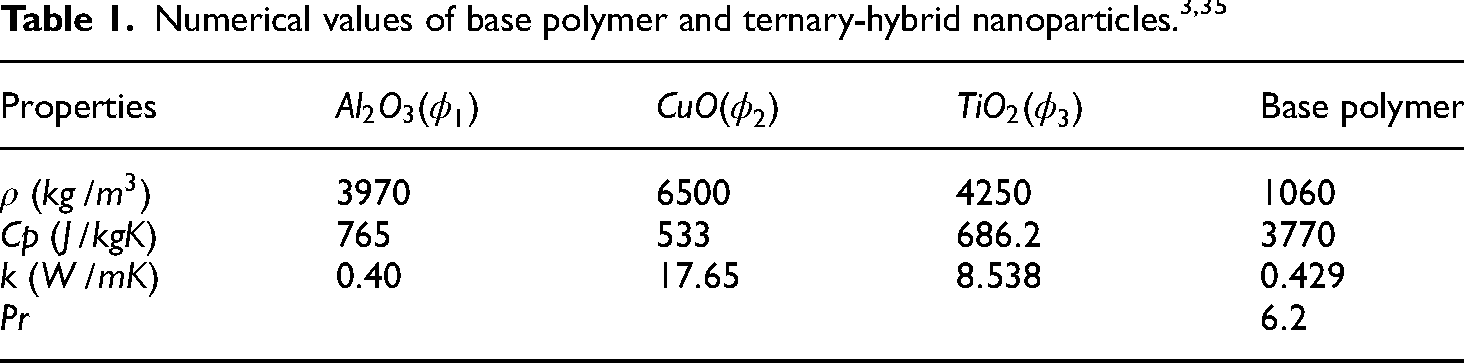
The thermophysical characteristics of aluminum oxide, copper oxide, titanium dioxide, and polymer are listed in Table 1. The thermal properties of nanofluid, hybrid nanofluid, and ternary-hybrid nanofluid are all represented mathematically in Table 2. In addition, the data points for the various form factors depending on the shape parameters m are shown in Table 3. In Table 1, the value referred to as represents the volume fraction of , ‘2' represents the volume fraction of , and represents the volume percentage of nanoparticles. Subscripts and denotes the properties of ,, and nanoparticles.
Numerical values of base polymer and ternary-hybrid nanoparticles.3,35
Similarity transformations have been proposed in response to the findings of solution38:
Here prime denotes differentiation in reference to . Equations (1)–(4) and (8) are included into the unsteady-state equations to produce the following set of ordinary differential equations.
Alteration of boundary conditions (5)–(7) to become
In the equations that came before, the parameter that signifies instability is written as shows steady-state flow when , a decelerating flow is indicated when , and an accelerating flow is indicated when and symbolizes the Prandtl number. characterizes the mass flux parameter for suction. In this context, refers to the stretch/shrink parameter, in which a sheet is stretched if while indicates that the sheet is shrinking. represents heat source/sink. To this inquiry, the friction coefficients along the x and y axes, denoted by and , respectively, and the local Nusselt number, are of utmost significance.
Here, The shear stresses along the x and y axes are denoted by the symbols and , respectively, and the heat flow is denoted by . One possible explanation for each of these phrases is as follows:
By provoking the equations (8), (14), and (15) we get the following:
where and signify the local Reynolds numbers along the x and y axes, respectively.
Numerical procedure
Equations of ordinary differentials (9–11) that are nonlinear and connected with related boundary conditions (12, 13) have a character that is both nonlinear and exceedingly difficult. It is strongly recommended that a numerical method be used to address these challenges. The use of Runge-Kutta IV (RK-IV) in conjunction with various shooting procedures makes it possible to record ternary-hybrid nanofluid flow paths for a wide range of distinct physical parameters. To get the numerical solution with a maximum accuracy of and precision to the fifth decimal place as the criterion of convergence, the step size is used. It is necessary to perform a few transformations, the specifics of which depend on the sequence in which the self-similar momentum and energy equations (9)–(11) are used, as well as the boundary domains contained in the equations (12) and (13). Figure 3 depicts the process that is followed for various shooting approaches.
Schematic diagram for shooting method.
Because of these changes, the model was able to be simplified so that it could solve a first-order initial value problem. This problem can then be solved as follows:
After rearranging the equations and making use of equations (17) and (18) in (9)–(13), we arrive at the following result:
To address the subsequent issue with the initial value, we need to include the solutions to equations (17) and (18) into equations (9) through (11), inserting them in the right places each time. To offer analytical results for the equations presented equations (9)–(11), an extremely powerful piece of computational software known as Mathematica 10 is used. It first determines the governing system and then employs the numerical method that is best suited for the system to get proper responses for the system. This is a distinctive feature.
Results and discussion
We utilize the RK-IV shooting method to solve equations (9)–(11) and present the numerical results graphically and tabulated in the computing program Mathematica. Except for the assessment, which can be seen in the figures and tables, the boundary layer thickness and (base polymer) are both fixed values. The control characteristics, on the other hand, fluctuate. The fulfillment of the conditions for the far-field boundary (12, 13) is what establishes these values. Considering that ternary nanofluid is maintained in the study that is being presented. The study of Turkyilmazoglu,40 which showed that a non-Newtonian fluid may be created if the concentration of nanoparticles is more than 5% to 6%, corresponds to a different set of volume fraction values that is confined in between and . Other parameters, such as (unsteadiness), (stretching), (suction), (source), and are fixed for nodal point are selected to ensure the accuracy of the solution.
Physically modeling the flow of a ternary-hybrid nanofluid is demonstrated in Figure 2. In the next subsections, the variation in hydrothermal profiles that is induced by associated flow factors will be discussed in more detail. Several diagrams are produced to illustrate the significant effect that flow parameters have on temperature, velocity, heat transfer, and skin frictional profiles.
Impact of pertinent parameters on velocity , and temperature
In this subsection, the profiles for ternary-hybrid nanofluid velocities in both direction and temperature for numerous estimates of , and are expounded when in Figures 4–10. The accuracy of the current solutions is supported by the fulfillment of the far-field boundary requirements. It is essential to emphasize the fact that the Prandtl number of the polymer molecule is now.
Variation in and with .
Change in in contrast to .
Variation in and with .
Change in in contract to .
Variation in and with .
Change in in contract to S.
Variation in in contract to .
Figures 4 and 5 demonstrate the upshot of volume fraction When for the dimensionless velocities and and temperature profiles of ternary-hybrid nanofluid flow for stretching case. These descriptions also demonstrate that when volume friction rises, the velocity profiles become more noticeable both inside the nanofluid and on the boundary layer thickness. This is true regardless of the location of the boundary layer. The relationship between volume fraction and velocity profiles is made abundantly evident by these graphs. Increases in resulted in an upsurge in the nanofluid density, which in turn resulted in a slowing of the flow in both directions due to the impact that their respective flow velocity profiles had. With increased , the width of the momentum barrier layer diminishes, increasing the velocity of the fluid flow. When there is a greater amount of fluid flow velocity, there is a corresponding rise in the surface shear stress. It was also possible to detect, by looking at Figure 5, that the temperature of the ternary hybrid nanofluid rose alongside a rise in the values of , and . The increases in , and are shown to have contributed to a rise in the thickness of the thermal boundary layer in addition to an improvement in the heat conductivity of ternary-hybrid nanofluids. From a purely physical point of view, the nanoparticles release heat energy into the surrounding space. As a result, an increase in the number of the nanoparticles might produce more heat, which ultimately causes a rise in the temperature. This suggests that an increase or decrease in , and might be used to modulate the temperature of the ternary-hybrid nanofluids.
Figures 6 and 7 demonstrates the impact of unsteadiness constraint , when on velocities and and temperature profiles, respectively, of polymer base ternary-hybrid nanofluid for stretching case. Clearly this figure show that decreasing the values of unsteadiness parameter decline in both the velocity profiles has been shown. This may be seen in Figure 6 which shows that unsteadiness alters the velocity profiles. A decrease in shear stress causes a fall in fluid velocity and a corresponding expansion of the momentum boundary layer along the wall, as seen in Figure 6. Figure 7 display the stimulus of unsteadiness constraint on temperature profile of ternary-hybrid nanofluid. It makes sense that a decrease in the values of would cause a rise in the temperature profile of a ternary nanofluid. This is because the spaces between molecules would spread out more in an unsteady flow if there were fewer quantities of an unstable parameter. This would cause a rise in the temperature profile and a decrease in the cooling rate of the fluid. Because of this, the feature of unsteadiness should be highlighted, and serious thought should be given to the ways in which it might be put to an advantage.
Figures 8 and 9 illustrates the consequence of suction constraint , when on velocities and and temperature profiles of the polymer base ternary-hybrid nanofluid flow for stretching case. In this picture, an increase in velocity can be seen along the profile because of increasing quantities of the suction parameter. This is a result of the increased density caused by the inclusion of additional particles. The thickness of the momentum boundary layer is decreased as a result of suction, which results in an increase in the flow of the stretched sheet. Figure 9 illustrates how responds to suction parameter S. By cumulative value of S decreasing the temperature of ternary-hybrid nanofluid. The value of S at the surface of a permeable stretching sheet is directly correlated to the level of suction experienced by a permeable stretching sheet. To improve the sluggish flow of the fluid on the expanding sheet, enhancement of the S consisted of slowing down the molecules while they were in the fluid regime. As a result, it has a dampening effect on the momentum border layer.
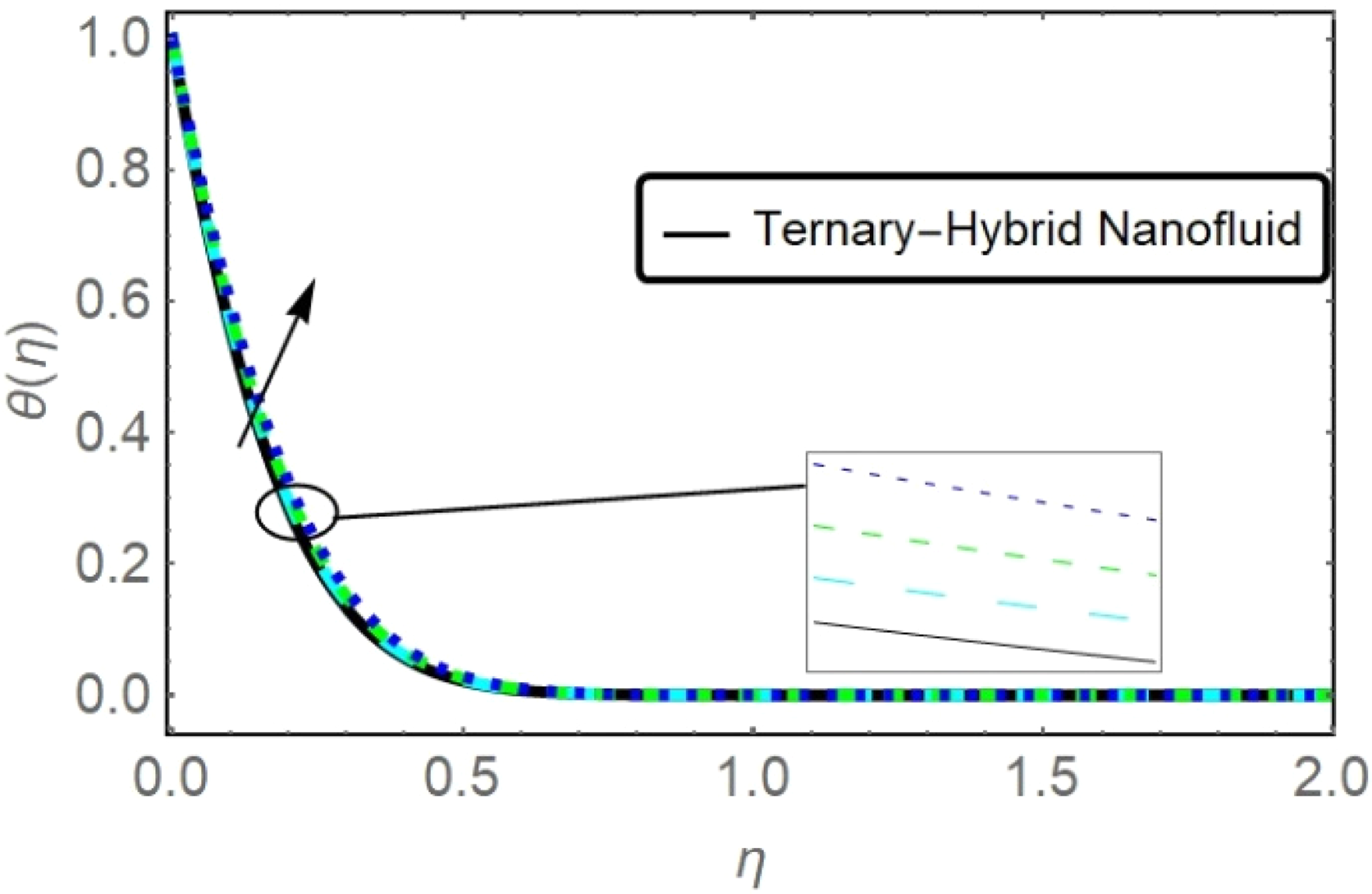
Figure 10 show the impact of source with on the temperature profile of ternary-hybrid nanofluid. Figure 10 presents the heat source parameter in question for the purpose of analyzing the temperature profile variation over a range of different values.
When the heat source parameter is raised, a rising temperature profile is seen in nanofluids used for stretching sheets.
The temperature rises as more accurate estimates of the parameter that describes the heat source are used. The source of heat in the system is reflected by the parameter's positive values, and higher values indicate that a greater quantity of heat is being produced. The inclusion of a heat source in Figure 10 substantiates the assertion that polymer base ternary-hybrid nanofluid exhibit thermal increase. The impacts are most noticeable close to the surface.
Skin friction and heat transfer
Important industrial metrics include the local Nusselt number, often known as the simple local heat transfer rate , as well as the skin friction (, ) in both directions. Because of their applications in industry, the significance of these data cannot be called into question. The skin friction coefficients (, ) and the local Nusselt number respond differently to different fluctuations in the parameters.
The volume fraction of the nanoparticles is an essential physical parameter that must be considered when determining the effect that nanoparticles have on the rate of fluid flow and heat transfer. Figures 11 and 12 show the effect that the nanoparticles’ volume fraction with , when , , respectively, has on the reduced ( and ) in both directions and the reduced local Nusselt number for ternary-hybrid nanofluid. Figure 11 demonstrates that the rate of ( and ) for () is the maximum, when assessed to (). This trend unmistakably demonstrates the presence of a colloid that is spread in the conventional fluid and contains three solid nanoparticles. As a outcome, the conventional fluid exhibits greater values of ( and ) in both directions than the colloid does. Physically, the intensification in the volume fraction of nanoparticles causes a growth in the viscosity of the polymer base ternary-hybrid nanofluid, which in turn causes an intensification in the fluid velocity as it moves through a permeable stretching sheet (see Figure 4). A closer look at Figure 4 reveals that an intensification in the brings about a decline in the thickness of the boundary layer, which in turn speeds up the fluid velocity and makes the velocity gradient more pronounced. The rise in wall shear stress is a direct result of the decrease in the thickness of the momentum boundary layer, which in turn leads to an improvement in ( and ). Higher ( and ) values indicate an upsurge in the amount of frictional drag employed on the decreasing surface, it is not appropriate for preserving the flow characteristics of a laminar boundary layer. According to the findings, the polymer base ternary-hybrid nanofluid is more difficult to maintain a laminar flow than the hybrid nanofluid and usual nanofluid. When the sheet is not moving , Figure 11 further emphasizes the value of ( and ), this suggests that there is no drag caused by frictional forces acting on the surface of the sheet. When compared with and , it is clear from Figure 12 that for has the greatest value. Based on the findings of this important experiment, it can be deduced that the base fluid had a higher than the ternary-hybrid nanofluid. In addition, this data suggests that the encouragement of raising the nanoparticles’ volume fraction might have the effect of lowering the temperature gradient. As a consequence of this, the efficiency of heat transmission drops, which in turn brings down by bringing the values of closer. Figure 12 portrays the diminishing trend of as the values of nanoparticles with when . When an ordinary nanofluid and a hybrid nanofluid combine to form a ternary-hybrid nanofluid, the rate of heat transmission slows down because of the increased number of nanoparticles. The values of have significantly decreased, which is a notable development. The temperature profiles displayed in Figure 5 lend credence to the general pattern shown in Figure 12, which provides an explanation of the rise in temperature that occurs when an ordinary nanofluid and a hybrid nanofluid combine to form a ternary-hybrid nanofluid. Since there are fewer regions toward the shrinking sheet for heat energy transmission, the fluid may be heated to a higher temperature than it would be at the extended surface, and the nanoparticle volume fraction may be able to physically spread more energy. An increase in the temperature of the ternary-hybrid nanofluid leads to a rise in the thermal conductivity of the ternary-hybrid nanofluid, which in turn causes an increase in the temperature of the ternary-hybrid nanofluid, which in turn causes a reduction in the rate of heat transfer through convection.
Variation in and in contract to with .
Variation in in contract to with .
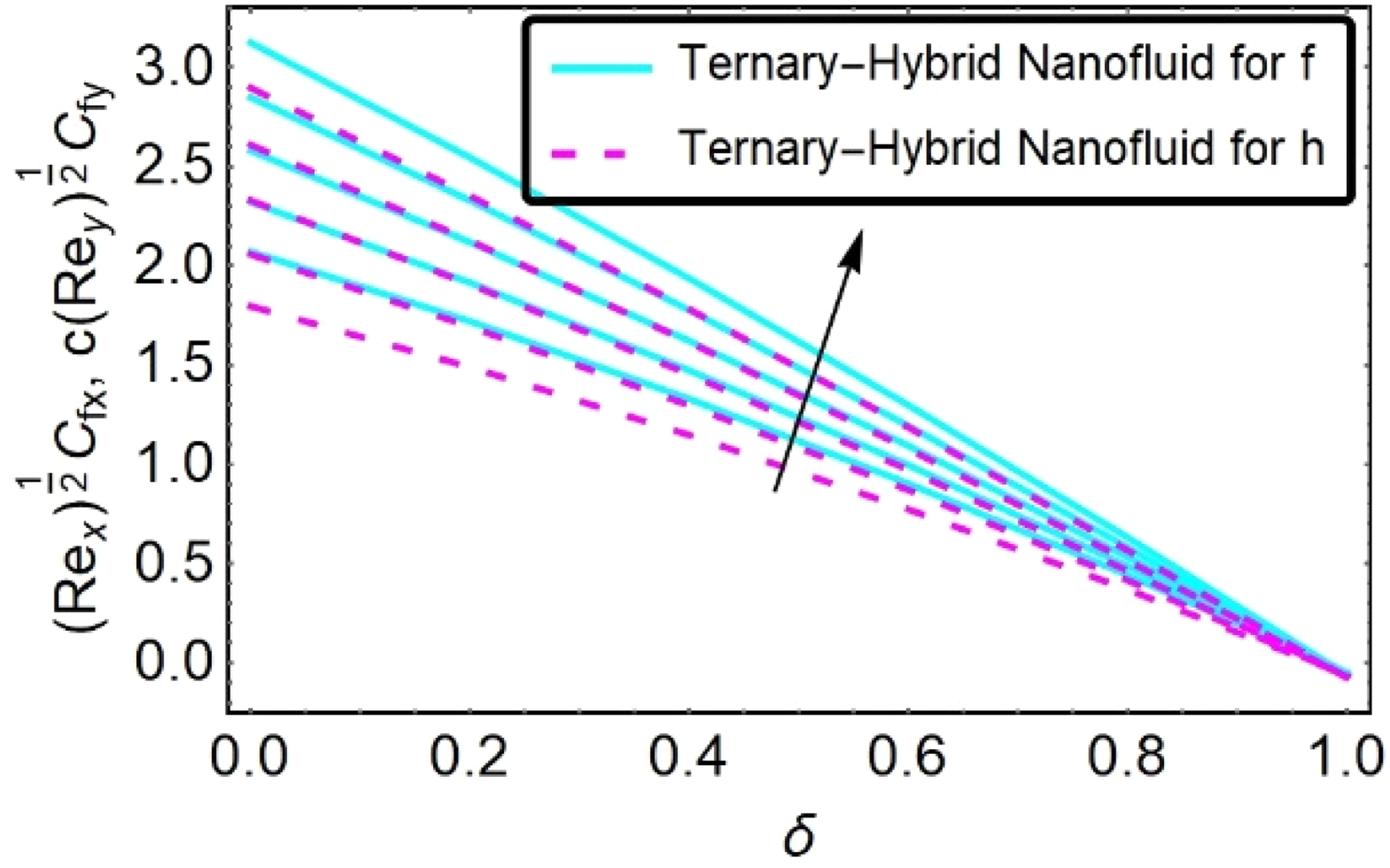
Figure 13 illustrate the impact that the unsteady parameter has when the value changes from to against , when of the skin friction coefficients (, ) of . Figure 13 illustrates that when the value of dropped, the solution exhibited a lower level of (, ). The reduction brings about an increase in the thickness of the boundary layer, which, in turn, brings about a reduction in the velocity gradient of the permeable sheet. As a result, the difference between and is reduced. Because of the increase in the viscosity of the presence of nanoparticle volume fraction may potentially cause a decrease in and . Figure 14 illustrates a situation in which various estimates of toward , when . In addition, the findings that were obtained can be shown in Figure 14 and show that in the solution decreases, which is comparable to the heat transfer rate. This happens when occurs in the permeable sheet. The authors are able to draw the conclusion that the parameter contributes greatly to the worsening of heat transfer based on the data that is now available and that which has previously been gathered. Despite this, the authors would like to assert that the impacts could be different in different situations if several control factors are considered simultaneously.
Variation in and in contract to with .
Variation in in contract to with .
Figure 15 shows the impact of against skin friction coefficient (,
) in both the directions of polymer base ternary-hybrid nanofluid. Figure 15 demonstrates that an increase in S will result in a significant increase (, ) in the solution of polymer base ternary-hybrid nanofluid for stretching sheet case. The suction event may make it easier to maintain the boundary layer's steady state. Additionally, the suction reduces the friction caused by the external flow acting on the bodies, which in turn leads to a lessening in the thickness of the boundary layer and an expansion in the velocity differential of the permeable sheet. This is accomplished by the removal of fluid across the surface with the lowest momentum. Suction is required to enhance the values of skin friction in both directions.
Variation in and in contrast to S with .
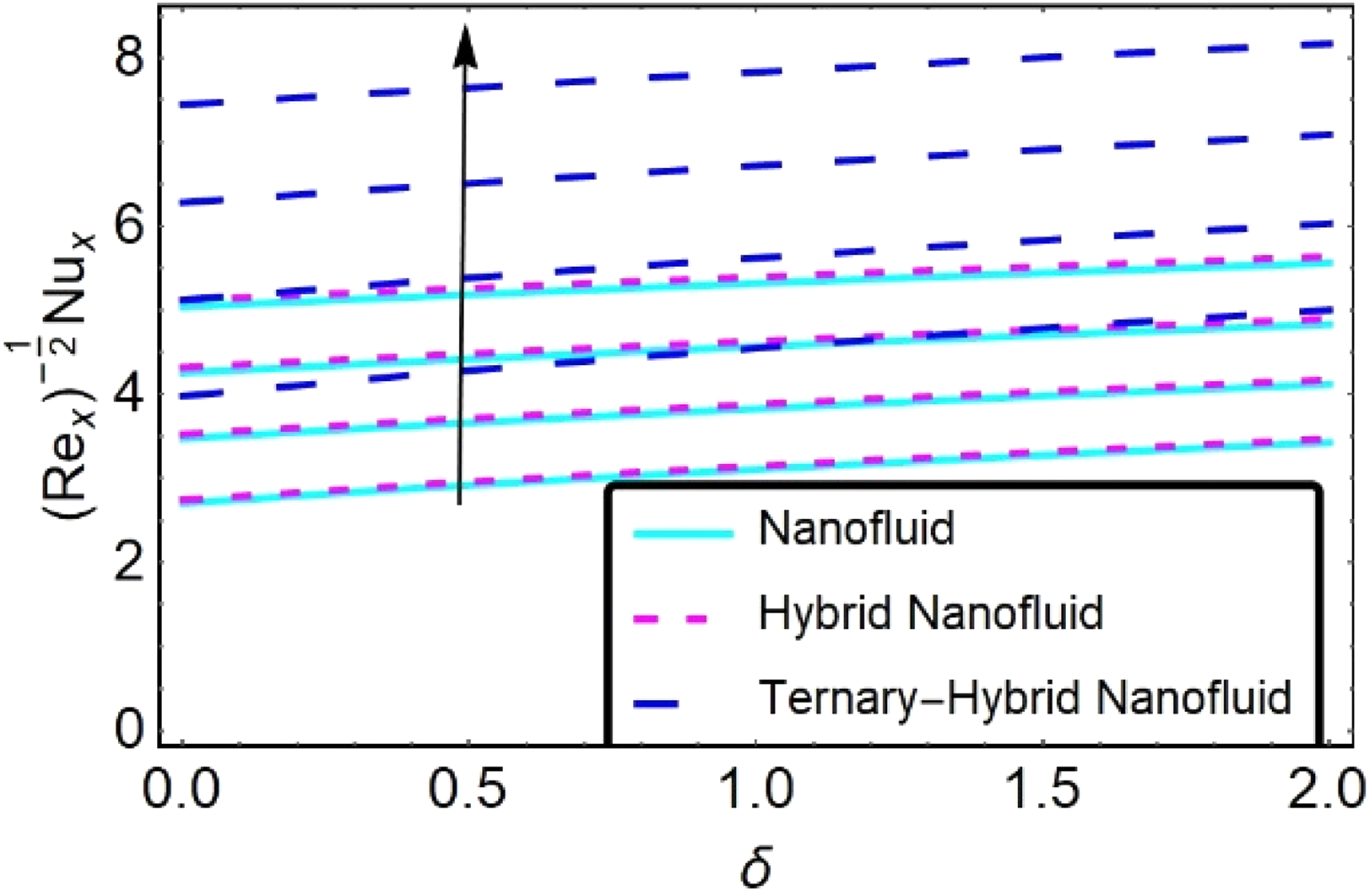
The relative performance of polymer base nanofluid, hybrid nanofluid, and ternary-hybrid nanofluid is compared in Figure 16. When . It has been revealed that the ternary-hybrid nanofluid exhibits improved capabilities in terms of heat transmission in comparison to those of the other nanofluids. This is because the use of various nanoparticles that are bound together by a variety of chemical bonds contributes to an increase in heat transfer. This is because each nanoparticle, along with the chemical bond that binds it, has its own properties that need to be taken into consideration. For instance, in this mixture, the photocatalytic property of combined with its high thermal conductivity causes it is primarily responsible for most of the heat conduction. is used to increase the catalytic nature of for it to be able to conduct more heat, while the addition of ensures that the fluid is chemically inert and stable. This is accomplished using . When seen in Figure 16, the solution carries with it an increase in as S rises over the permeable sheet. This is straightforward evidence of this phenomenon. Consider the fact that the suction impact makes it possible for the molecules of the ternary-hybrid nanofluid to occupy the surface, which in turn helps to physically enhance the heat transfer rate at the permeable sheet. It is possible to find solutions to the problem of expanding surface flows without the use of suction. Suction is required to enhance the values of the Nusselt number.
Comprasion in heat transfer performance of ternary-hybrid nanofluid, hybrid nanofluid, and nanofluid.
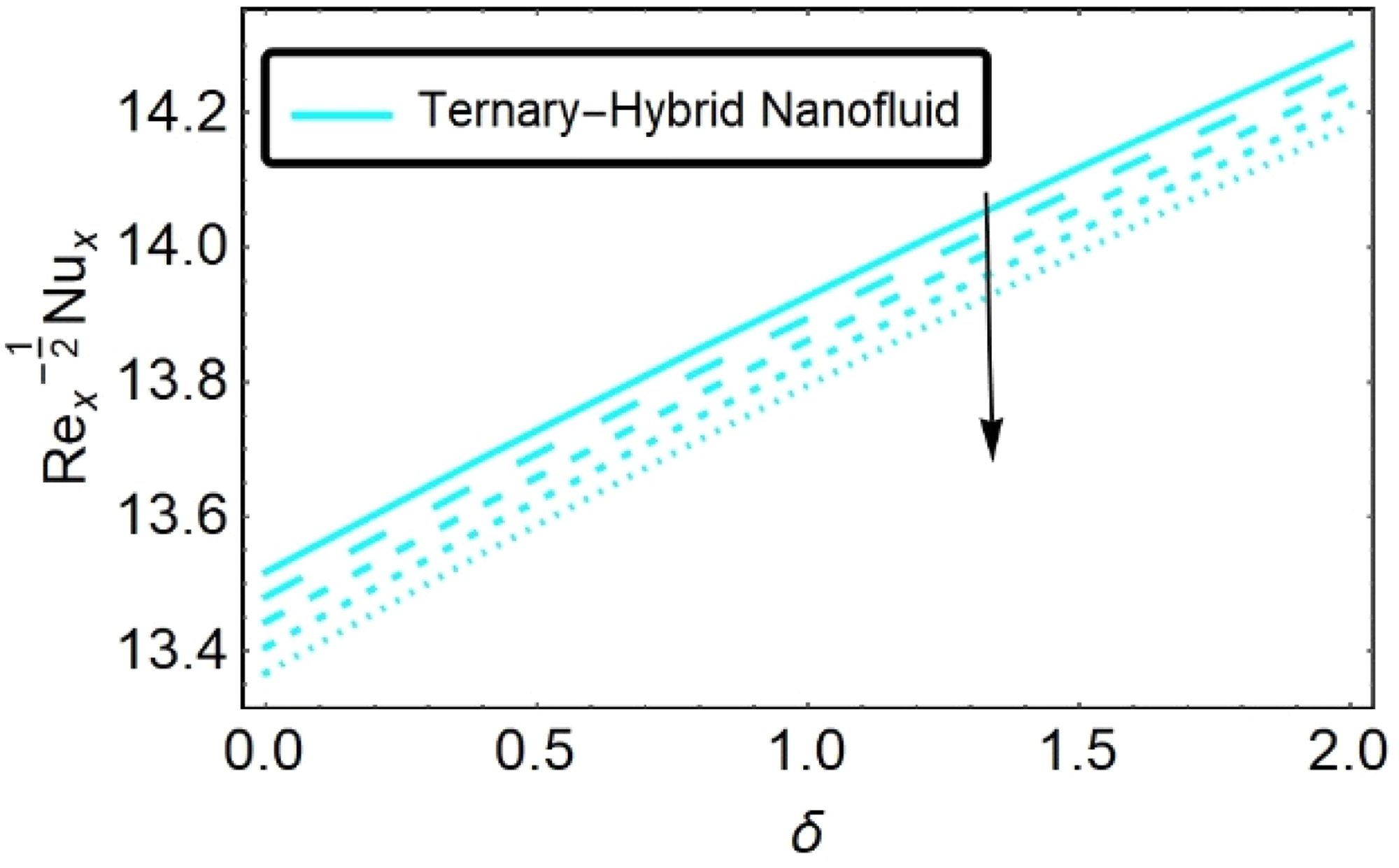
Figure 17 depicts the fluctuation of the decreased local Nusselt number with an assortment of estimates of the heat source parameter with , when S of polymer-based ternary-hybrid nanofluid of the shrinking sheet. It was discovered that the ratio of became smaller when the value of the heat source parameter increased . Based on this finding, if there is a heat source present in the boundary layer, then we can draw the conclusion that there is a possibility for there to be a rise in the thickness of the thermal boundary layer. Because of this, the heat flow is decreased, and consequently, goes down if there is an expansion in the amount of the heat source parameter .
Variation in compared to with .
Table discussion
The purpose of the comparisons of findings that are shown in Tables 4 and 5 is to verify the numerical approach that was used in the current research for the stable case () by comparing it to the numerical results that were obtained by Zainal et al.38 for a different kind of fluid. While Zainal et al.38 in their earlier works attempted to solve the issue of hybrid nanofluid fluid, the authors of the current study opted to apply ternary-hybrid nanofluid. Additionally, Zainal et al.38 utilized the bvp4c program included in MATLAB, notwithstanding this, the most recent research carried out a simulation using the Runge-Kutta procedure in Mathematica. These findings are found to be in agreement with the steady-state fluid case solutions that were previously discovered; as a result, this provides us with the confidence that the computational structure used to investigate the ternary-hybrid nanofluid flow behaviors and heat transfer in this study can be utilized with a significant amount of assurance. The most important component in determining the flow behavior of nanofluids and the amount of heat that may be transferred is the configuration of appropriate ternary nanofluids.
The primary takeaway from this line of research is that it may be possible to speed up the rate of heat transfer. This novel study explicates the unsteady 3D nodal stagnation point flow of polymer-based ternary-hybrid nanofluid contains nanoparticles past a stretching sheet with heat source and mass suction effects. The RK-IV was used with shooting techniques for the purpose of establishing the conclusions, and the MATHEMATICA program was applied. The influence that a variety of numerous factors have on velocity, temperature, skin frictions, and Nusselt number profiles may be shown graphically. The research questions that were presented in the introduction section are going to be applied to the findings in the following manner:
Due to the presence of a suction parameter, the ternary-hybrid nanofluid has a higher rate of heat transfer than the hybrid nanofluid and the ordinary nanofluid. This could improve how well heat is transferred, making the ternary-hybrid nanofluid better than both the hybrid nanofluid and the regular nanofluid.
As the volume percentage of the polymer-based ternary-hybrid nanofluid is estimated to increase, the velocity and temperature profiles of the nanofluid will also rise.
The opposite trend is exhibited in the temperature profile of the ternary-hybrid nanofluid when the suction parameter is varied. This causes an increase in the velocity profiles in both directions.
The coefficient of skin frictions (, ) and the local Nusselt number both rise as a consequence of an increase in the strength of the suction parameter from to . This, in turn, outcomes in an improvement in the heat transfer enhancement and a decline in temperature.
A decreasing significance of diminishes the velocity profiles and increases the temperature profile of polymer base ternary-hybrid nanofluid.
Subsequently, a decline in the unsteadiness parameter with volume friction diminishes the , , and over the shrinking surface of polymer base ternary-hybrid nanofluid.
Temperature profile boosts up with boosting estimates of heat source parameter of polymer base ternary-hybrid nanofluid.
For stretching sheet, the rate of heat transfer diminishes with improving values of heat source.
It is essential to keep in mind that the results of another research employing other nanoparticles and base fluids might provide conclusions that are dissimilar to those produced in the present investigation. In addition, the present work could be able to assist other researchers with the following:
Giving an original perspective on the transformation that is applicable to simplify the equations involved in the boundary layer flow. This is important for achieving the goal.
Choosing the right values for the relevant parameters to achieve optimal performance in the heat transfer process within the context of the current industry.
However, it is possible that additional researchers will be able to derive ideas from the existing study for future investigations into the heat transfer of the stretching flow with melting, mixed convection, viscous dissipation, thermal radiation, and Joule heating effects on ternary-hybrid nanofluids.
Data availability
The dataset used during the current study are available from the corresponding author on reasonable request.
Footnotes
Acknowledgments
The authors are grateful to the reviewers for providing such insightful criticism and suggestions.
Declaration of conflicting interests
The author(s) declared no potential conflicts of interest with respect to the research, authorship, and/or publication of this article.
Funding
The author(s) received no financial support for the research, authorship, and/or publication of this article.
ORCID iDs
Zafar Mahmood
Umar Khan
References
1.
TurkyilmazogluM. Exact multiple solutions for the slip flow and heat transfer in a converging channel. J Heat Transfer2015; 137: 101301.
2.
AsgharSJalilMHussanM,et al.Lie group analysis of flow and heat transfer over a stretching rotating disk. Int J Heat Mass Transf2014; 69: 140–146.
3.
MahmoodZAhammadNAAlhazmiSE,et al.Ternary hybrid nanofluid near a stretching/shrinking sheet with heat generation/absorption and velocity slip on unsteady stagnation point flow. Int J Mod Phys B2022; 36: 2250209.
4.
ZhouY, et al.Polymer nanoparticles based nano-fluid for enhanced oil recovery at harsh formation conditions. Fuel2020; 267: 117251.
5.
HiemenzK. Die Grenzschicht an einem in den gleichformigen Flussigkeitsstrom eingetauchten geraden Kreiszylinder. Dinglers Polytech J1911; 326: 321–324.
6.
LibbyPA. Heat and mass transfer at a general three-dimensional stagnation point. AIAA J1967; 5: 507–517.
7.
ChiamTC. Stagnation-point flow towards a stretching plate. J Phys Soc Japan1994; 63: 2443–2444.
8.
MahmoodZAlhazmiSEAlhowaityA,et al.MHD mixed convective stagnation point flow of nanofluid past a permeable stretching sheet with nanoparticles aggregation and thermal stratification. Sci Rep2022; 12: 1–26.
9.
RohsenowWMHartnettJPGanicEN. Handbook of heat transfer applications. 1985.
10.
MasadJANayfehAH. Effects of suction and wall shaping on the fundamental parametric resonance in boundary layers. Phys Fluids A Fluid Dyn1992; 4: 963–974.
11.
RosaliHIshakAPopI. Micropolar fluid flow towards a stretching/shrinking sheet in a porous medium with suction. Int Commun Heat Mass Transf2012; 39: 826–829.
12.
MakindeODMaboodFIbrahimMS. Chemically reacting on MHD boundary-layer flow of nanofluids over a non-linear stretching sheet with heat source/sink and thermal radiation. 2018.
13.
ZainalNANaganthranKNazarR. Unsteady MHD rear stagnation-point flow of a hybrid nanofluid with heat generation/absorption effect. J Adv Res Fluid Mech Therm Sci2021; 87: 41–51.
14.
SharmaKGuptaS. Viscous dissipation and thermal radiation effects in MHD flow of Jeffrey nanofluid through impermeable surface with heat generation/absorption. Nonlinear Eng2017; 6: 153–166.
15.
JamaludinANazarRPopI. Mixed convection stagnation-point flow of a nanofluid past a permeable stretching/shrinking sheet in the presence of thermal radiation and heat source/sink. Energies2019; 12: 788.
16.
ChoiSEastmanJ. Enhancing thermal conductivity of fluids with nanoparticles. 1995.
17.
UsmanMZubairTHamidM,et al.Novel modification in wavelets method to analyze unsteady flow of nanofluid between two infinitely parallel plates. Chinese J Phys2020; 66: 222–236.
18.
Mohyud-DinST, et al.Rotating flow of nanofluid due to exponentially stretching surface: an optimal study. J Algorithm Comput Technol2019; 13: 1748302619881365.
19.
GhalambazMDoostaniAIzadpanahiE,et al.Conjugate natural convection flow of Ag–MgO/water hybrid nanofluid in a square cavity. J Therm Anal Calorim2020; 139: 2321–2336.
20.
MehryanSAMGhalambazMChamkhaAJ,et al.Numerical study on natural convection of Ag–MgO hybrid/water nanofluid inside a porous enclosure: a local thermal non-equilibrium model. Powder Technol2020; 367: 443–455.
21.
AnuarNSBachokNArifinNM,et al.Numerical solution of stagnation point flow and heat transfer over a nonlinear stretching/shrinking sheet in hybrid nanofluid: stability analysis. J Adv Res Fluid Mech Therm Sci2020; 76: 85–98.
22.
WahidNSArifinNMPopI,et al.MHD stagnation-point flow of nanofluid due to a shrinking sheet with melting, viscous dissipation and Joule heating effects. Alexandria Eng J2022; 61: 12661–12672.
23.
ZainalNANazarRNaganthranK,et al.MHD mixed convection stagnation point flow of a hybrid nanofluid past a vertical flat plate with convective boundary condition. Chinese J Phys2020; 66: 630–644.
24.
ManjunathaSPuneethVGireeshaBJ,et al.Theoretical study of convective heat transfer in ternary nanofluid flowing past a stretching sheet. J Appl Comput Mech2021; 8: 1279–1286.
25.
AssadianEZareiMHGilaniAG,et al.Toxicity of copper oxide (CuO) nanoparticles on human blood lymphocytes. Biol Trace Elem Res2018; 184: 350–357.
26.
SangLAiWWuY,et al.Enhanced specific heat and thermal conductivity of ternary carbonate nanofluids with carbon nanotubes for solar power applications. Int J Energy Res2020; 44: 334–343.
27.
MousaviSMEsmaeilzadehFWangXP. Effects of temperature and particles volume concentration on the thermophysical properties and the rheological behavior of CuO/MgO/TiO2 aqueous ternary hybrid nanofluid. J Therm Anal Calorim2019; 137: 879–901.
28.
AbbasiA, et al.Optimized analysis and enhanced thermal efficiency of modified hybrid nanofluid (Al2O3, CuO, Cu) with nonlinear thermal radiation and shape features. Case Stud Therm Eng2021; 28: 101425.
29.
AnimasaunILYookS-JMuhammadT,et al.Dynamics of ternary-hybrid nanofluid subject to magnetic flux density and heat source or sink on a convectively heated surface. Surf Interfaces2022; 28: 101654.
30.
CaoWAnimasaunILYookS-J,et al.Simulation of the dynamics of colloidal mixture of water with various nanoparticles at different levels of partial slip: ternary-hybrid nanofluid. Int Commun Heat Mass Transf2022; 135: 106069.
31.
ElnaqeebTAnimasaunILShahNA. Ternary-hybrid nanofluids: significance of suction and dual-stretching on three-dimensional flow of water conveying nanoparticles with various shapes and densities. Z Naturforsch A2021; 76: 231–243.
32.
SaleemSAnimasaunILYookS-J,et al.Insight into the motion of water conveying three kinds of nanoparticles shapes on a horizontal surface: significance of thermo-migration and Brownian motion. Surf Interfaces2022; 30: 101854.
33.
XiuWAnimasaunILAl-MdallalQM,et al.Dynamics of ternary-hybrid nanofluids due to dual stretching on wedge surfaces when volume of nanoparticles is small and large: forced convection of water at different temperatures. Int Commun Heat Mass Transf2022; 137: 106241.
34.
MahmoodZIqbalZAlyamiMA,et al.Influence of suction and heat source on MHD stagnation point flow of ternary hybrid nanofluid over convectively heated stretching/shrinking cylinder. Adv Mech Eng2022; 14: 16878132221126278.
35.
MahmoodZAlhazmiSEKhanU,et al.Unsteady MHD stagnation point flow of ternary hybrid nanofluid over a spinning sphere with Joule heating. Int J Mod Phys B2022; 36: 2250230.
36.
KrishnaswamyRNathG. Compressible boundary-layer flow at a three-dimensional stagnation point with massive blowing. Int J Heat Mass Transf1982; 25: 1639–1649.
37.
EswaraATNathG. Effect of large injection rates on unsteady mixed convection flow at a three-dimensional stagnation point. Int J Non Linear Mech1999; 34: 85–103.
38.
ZainalNANazarRNaganthranK,et al.Unsteady MHD mixed convection flow in hybrid nanofluid at three-dimensional stagnation point. Mathematics2021; 9: 549.
39.
ZainalNANazarRNaganthranK,et al.Unsteady three-dimensional MHD non-axisymmetric Homann stagnation point flow of a hybrid nanofluid with stability analysis. Mathmetics2020; 8: 784.
40.
TurkyilmazogluM. A note on the correspondence between certain nanofluid flows and standard fluid flows. J Heat Transfer2015; 137: 024501.