



Abstract
The developments in the field of artificial intelligence (AI) and decision making systems are identified as virtuous models for banking and finance sector (BFS) applications. Even though AI provides great advantage in application changes it is essential to remodel the system using explainable artificial intelligence (XAI) design system. Also the standard sensing models provides appropriate monitoring values but huge size of sensors is considered as a major drawback. Thus two diverse problems are addressed in this research work where XAI has been integrated with micro electro-mechanical systems (MEMS) for solving the problems related to BFS applications. Further the data security has been enhanced as XAI is implemented with conviction managements and real time experiments are carried out by developing a unique application by integrating new mathematical designs. To validate the effectiveness of BFS application the developed model is tested with five scenarios which includes multiple parametric arrangements with interpretability process. The tested and compared outcomes with existing models indicates that XAI and MEMS provides inordinate improvements in terms of data impairments thus increasing the transparency of the projected system to an average 96%.
Keywords
Conventional models on XAI and MEMS
In older days many techniques such as artificial intelligence (AI) and machine learning (ML) are integrated for the process of detecting various parametric values related to different applications and they employ standard sensors for sensing and perceiving results. But standard sensors such as temperature, photoelectric, water, soil sensors, etc., can be used for sensing to a small distance and effectiveness in the abovementioned sensors are gratified. However due to rapid developments of all applications there is a need to increase the effectiveness of the sensing models using different approaches. Thus this section analyses the conventional models that are previously implemented in banking and financial sectors (BFS). In Reference, 1 the authors have restrained the AI process and delivered a brief history on the needs of explainable artificial intelligence (XAI) technique. The need of XAI grows for current implementation of automated models and in future the development of XAI will provide opportunities for many applications to be converted into automatic process. However, only the growth of XAI is provided but the effectiveness of comparison with AI information about sensing models is not provided. Thus a deep analysis has been made to understand the objectives and stake holders that are related to the process of XAI 2 where high importance is given to quality-based sectors. Since BFS is based on quality and conviction the model of AI should be rationalized to XAI thus assured privacy is conceivable. Even though privacy in BFS during several transactions is assured the stake holders always depends on a unique model that are related to transaction determination.
For determining safety during transaction modes a decision tree model has been incorporated in the intrusion detection model 3 and exploration has been made in recognition of human systems thus making a decision within short span of time. But the time taken for recognition process will be much higher as large dataset will be used in the model of BFS. Further a multidisciplinary survey has been prepared using the structure of XAI and corresponding information processing systems. 4 From the structure exploration it is illustrious that several rules can be divided for achieving the design goals in BFS and other related applications by expending numerous user groups. Conversely the design model of BFS should be persistent and changing the model consistently with result in failure of information gain in XAI technique. To avoid the failure in terms of information gain micro electro-mechanical systems (MEMS) sensor is positioned for many applications where in medical treatments the mechanical systems plays an important role 5 by detecting various infections. Due to the size of MEMS it is much easier to implement everywhere and effectiveness of MEMS in BFS is also tranquil to achieve.
In addition to the design model of XAI, a contextual behavioral with decision making approach has been described 6 where it is proved that possible solutions for solving all non-linear problems can be achieved in all domains. Yet, a multi criteria model is involved in the decision making process which is observed to be a major drawback of XAI problems. Another important exertion is made by changing the position of MEMS accelerometer 7 and in this position change all vibrations related to an individual can be measured. Then, again the same problem in the decision making process will be a difficult one if there is consistent change in the position of sensors. The performance of XAI is also investigated with different clinical supported systems 8 by solving high resource allocation problems and in this case the diagnosis can be made easier as compared with other systematic approaches. Conversely for all clinical analysis that is integrated with XAI the support from stakeholders is needed to overcome the gap between input and decision making approaches. Further the approach of XAI in BFS has been fabricated using an engineering design model where mathematical approaches indicates that perception can be controlled without any change in position of sensors. 9 In line with above concern the engineering design has been tested with autonomous cars but additional resources must be allocated thus increasing the overhead cost.
Moreover with XAI and MEMS techniques, data mining is an important problem that is addressed by many researchers. 10 It is believed that all biometric features cannot solve the delinquent threats in outdoor and indoor environments and as a result cryptographic solutions are delivered without any integration to cloud-based solutions. To increase the transparency in BFS applications black box in real time unification has been examined and a continuous progress has been achieved. 11 It is implicit that block chain is the only way to avoid data mining problems in the near future 12 where separate hashes are provided for each block to decipher the security problems. Additionally each block of data will be stored in the cloud and sensors will uninterruptedly sense and report it using secured authentication keys. Meanwhile the data that is sensed using MEMS should be designed in an appropriate manner with differential capacitive sensors. In both case studies,11,12 it is perceived that sensitivity of MEMS will increase due to dynamic characteristics in the construction phase. To reduce the sensitivity constraint geometrical parameters are designed inside the sensing elements 13 thus giving raise to input parameters to resolve in outdoor environments. All the above mentioned method has separate drawbacks and XAI provides several ways for solving all the problems. Thus, after a careful experimentation on survey the design parameters are modeled and is provided in the next section (Table 1).
Related works vs proposed.

A: monitoring critical points; B: stability of MEMS sensor; C: data protection; D: interoperability and transparency.
Design formulations of MEMS sensor in XAI
In this section, a new design model has been proposed for banking and financial applications by replacing conventional sensor technologies to solve all the existing monitoring issues. The problem of all banking industries has been entirely monitored using MEMS sensor where expensive sensor integration process has been detached from the current system. However the infrastructure is common for all applications hence the cost of installation remains the same in all conditions. In this design model any failure in the primary stages will be completely avoided thus providing effective formulated results. Also, a three axis management system is considered using four sensing capacitors that is located inside a small portion of single node system and is represented using Equation (1).
Equation (1) is also termed as a representation of critical points that are varied according to the given points where additional significance should be given to perilous points since the reference values can be rebounded at a particular time frame. To detect the vibration that is present in importance spaces of arrays inside the lending sector MEMS sensor should be free from noise thus the noise reduction formulation can be represented as follows,
Equation (2) can also be represented by distributing the noise load with adaptive filters thus satisfying the following constraint.

From Equation (4) all resultant values will be monitored at different scaling periods where the output voltage conversion will be repeated as the input signal changes the characteristic. Similarly Equation (4) can be protracted for analyzing the level of sensitivity as represented in Equation (5).
The characteristics design of MEMS changes in all corresponding axis using distinct frequency ranges. If the offset frequencies are higher then dislocations will be lesser. The abovementioned characteristics of MEMS can be determined using a term which is called as quality factor and it can be calculated as follows:
Equation (6) denotes the quality with respect to resonant frequencies and it is possible to provide extension bandwidth using a step up noise parameter. The maximum step characteristics of MEMS can be determined using Equation (7) as follows,
All the necessary equations are modeled for detecting the changes in indoor and outdoor units of heaping sectors are designed using MEMS sensor and in the next section a subsequent analysis for integration process with XAI will be delivered to observe the effectiveness of the proposed model.
Optimization model
In the design model that is represented in section “Design formulations of MEMS sensor in XAI” only vibrations will be detected using MEMS sensors but abnormal gesture activities should be detected to decide the exact status of deception in all banking sectors.14–16 Therefore all abnormal activities will be detected by integrating an optimization model which is termed as XAI where high accurate detection is possible as compared to AI procedure. Thus in the model of XAI the initial predicted values can be represented using Equation (8) as,
Equation (8) denotes that the initial score will be separated with different predicted values where in the proposed method 100 different values are predicted. The process of calculating initial values is as follows,
In the model of XAI, data segmentation and impairment are important parameters that should be monitored for every activation period. This monitoring process is usually carried out to out failure of data transmission to the receiver signal units. Thus the data impairments can be measured using Equation (10) as follows where the step-by-step implementation of MEMS with XAI is deliberated in Figure 1.

XAI with MEMS for lending division.
If the entropy of all data sets is calculated then it can be classified at further stages using predictive model of XAI thus using multiple parameters the interpretability parameter can be calculated using Equation (11).
The major reason for classification process is that the images will be located in close proximity where more fluxes will occur. To prevent the aforementioned drawback of multiple fluxes in all outdoor machines more transparent operation is necessary. This type of transparent operations can be determined using Equation (12) as follows:
From Equation (12) it can be tacit that percentage of transparency should be above 87% to attain high resolution classified image where in case of deception occurrence the individual will be identified clearly.
Results and discussions
In this section, the performance evaluation of both MEMS and XAI is analyzed after several careful experimentations and a major prototype has been created for testing the procedure in BFS applications. The process is tested on simulation test bench to indicate the percentage of values in both indoor and outdoor environments as the procedure incorporates multiple parametric values. Further, several modifications are equipped for using standard and MEMS sensors and as a result to incorporate a tiny sensor in the prototype selection MEMS has been selected as an alternate estimation. In addition to MEMS the model of XAI provides an approach to handle data impairment mechanism with low security theft. The exploration model of proposed method is divided in to five major scenarios as follows:
Scenario 1: Monitoring critical points Scenario 2: Stability of MEMS Scenario 3: Data impairments Scenario 4: Multiple parametric interpretability Scenario 5: Percentage of transparent operation
All the five scenarios that are listed above will provide importance of data transfer approach in BFS applications with high stability operation. A comprehensive discussion about five scenarios is explained in the subsequent sections.
Scenario 1
The unpretentious operation of MEMS focuses on installation of capacitors in all desired directions as any change in degree of data processing leads to severe failure in processing paths. Thus the number of critical points is measured to avoid all failures in data transmission expanses. Moreover, in this installation process respite time of capacitors is measured to placate the change in monitoring values. There are several causes of failure in the transmission stages and to avoid the conflicts the reference values are observed at stage 1. If stage 1 is completed then noise that is present in the MEMS will be removed and it is subject to lower and upper bound constraints. If the value goes beyond a particular level then number of installed capacitors needs to be reduced for at least 50% change in values. Also if the value drives below the lower bound then number of capacitors should be increased this in turn increases the cost of installation units. Therefore to avoid the abovementioned scenarios the prototype has been designed with four capacitors where all four capacitors will be compared with separate reference values. The number of simulated critical points is shown in Figure 2.

Identification of critical points.
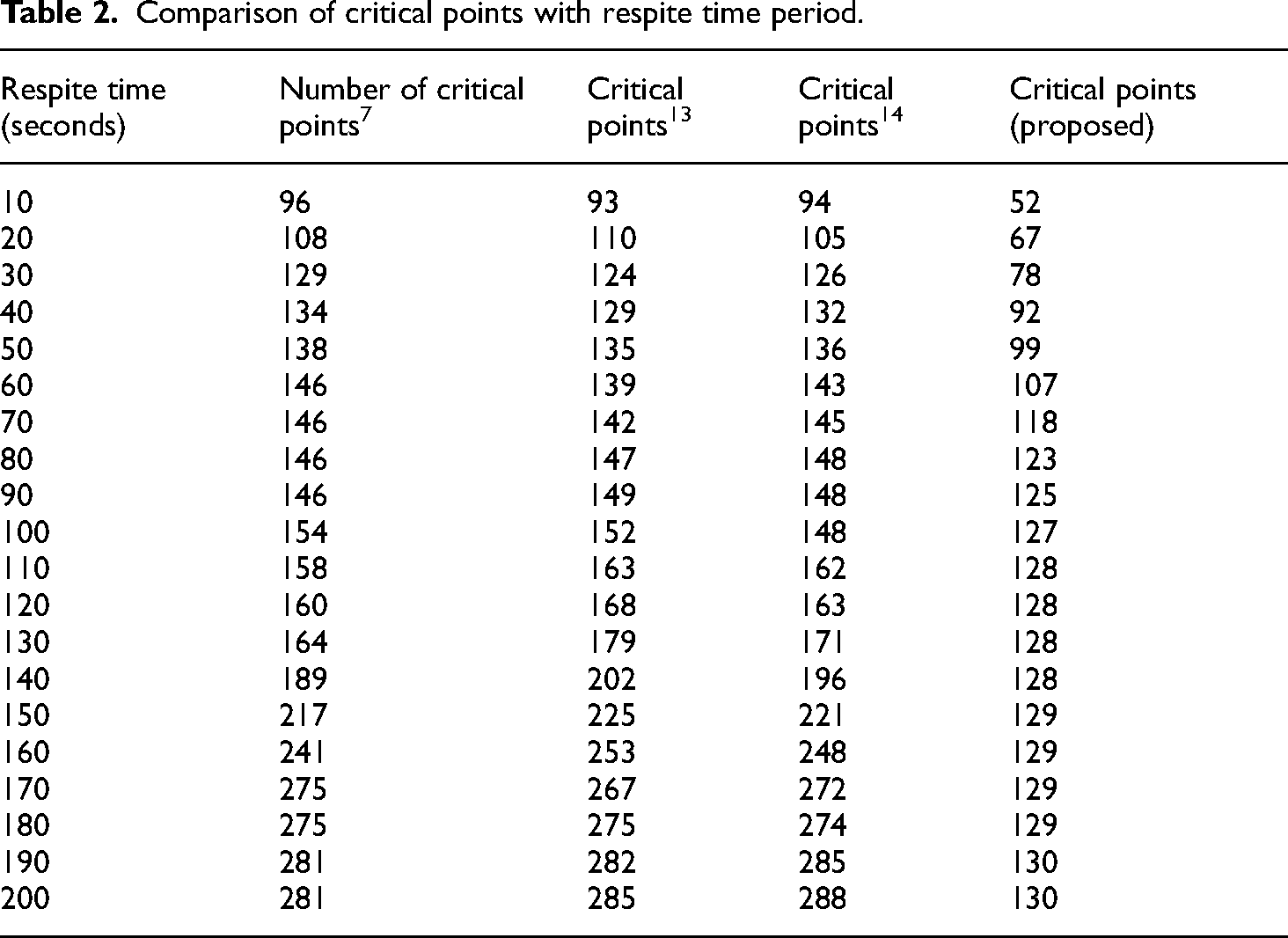
From Figure 2 and Table 2, it can be observed that the respite time is varied from 10 to 200 and corresponding critical points are measured and compared with existing methods.7,13,14 The major objective in this scenario is to reduce the number of critical points but MEMS is conniving all measured values from several directions. Thus the average value from three axes is considered as measurement point to have at least constant critical nodes. In line with above concern experimental setup has been made where all the compared method provides high critical points which are nearly equal to 290. But with same respite time even at last iteration point the proposed method using MEMS provides only 130 critical points and in further respite time the critical points residues the identical cases.
Comparison of critical points with respite time period.
Scenario 2
After evaluating the number of critical points the stability of MEMS is restrained using different offset values. In this scenario all three axis offset are started at corresponding installed degrees where at one point of view all three axes will receive one degree of notation, (i.e) if

Immovability points of MEMS.
From Figure 3 it can be detected that offset values of x starts at zero and after five iterations it returns to the initial point. The experimentation setup is placed in such a way the angle of measurement is varied from 0 to 360 degrees and for the existing method7,13,14 the voltage levels are much higher and even it crosses the threshold limit of 5 V when it attempts to reach the initial point. But for the proposed method with different measurement angles the voltage scales increases to 1.4 V, which indicates that stability is achieved before reaching the initial point. Even after reaching the initial point the voltage twitches to 1 V and this case is not attained in existing method as only standard sensors are preferred.
Scenario 3
Subsequent rotation at all angles will cause the data to flow in three axis system where data should be distributed only from the control center. Thus data impairment has been identified and it is experimented as a major concern in XAI process. In intelligence decision making process there is a high probability that data management process will result in failure due to more number of external users. Thus information should be gained at the initial phase of transmission and by using the gained data the impairment procedure will be tested. The information gain will have cross entropy function with binary values 1 or 0 which gives rise to total information gain in complete data set functions. If entropy function is set to 0 then data impairment will be much higher and in turn if entropy is equal to 1 a set of impairments are already recovered. In the proposed model five values of information gain and their corresponding data impairment modes are plotted and are shown in Figure 4.
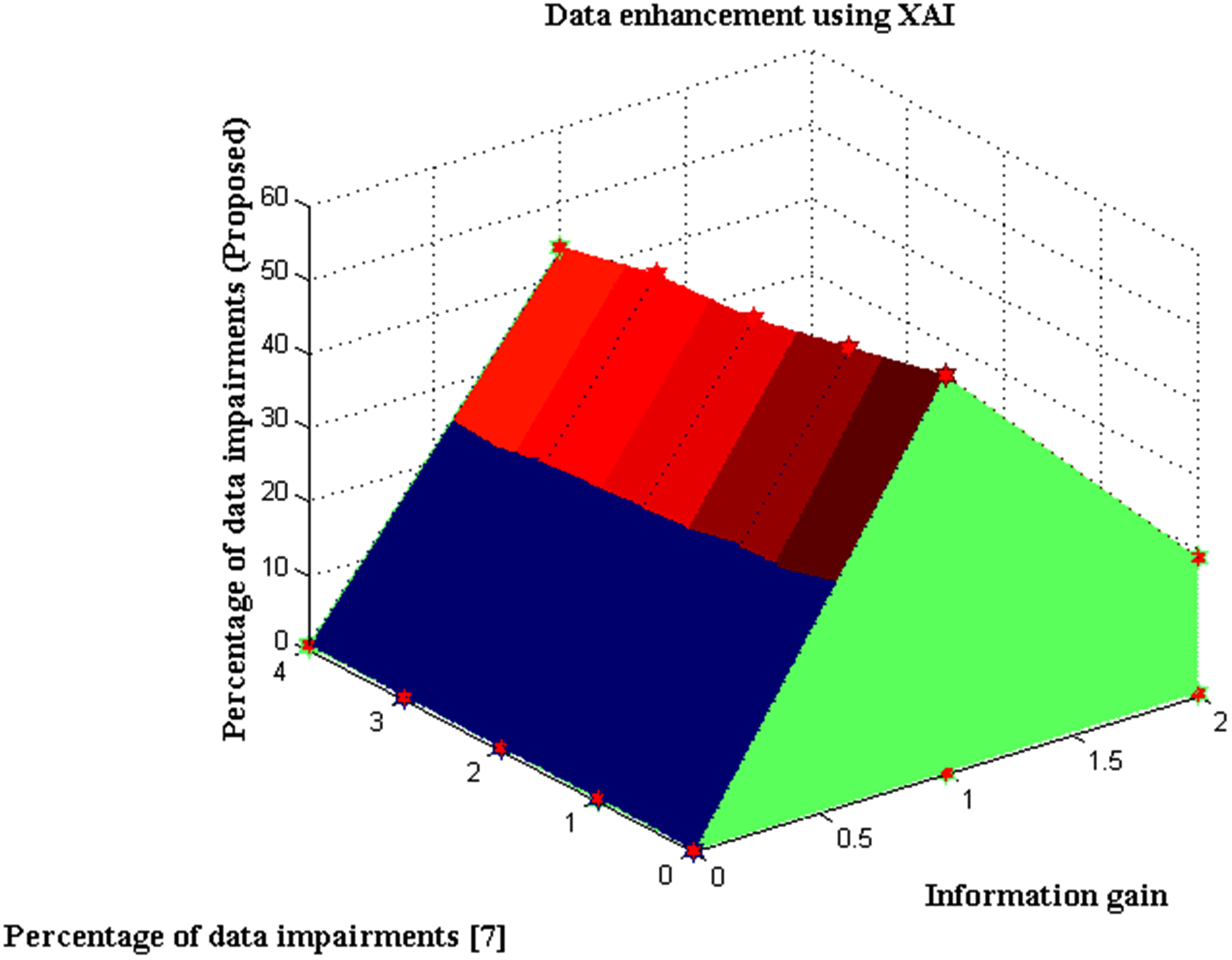
Security of data with gain.
From Figure 4, it is evident that the projected design on XAI provides low impairment percentage of 6 whereas the existing method has lost many data within a small information gain platform on an average of 44%. The most important reason for failure cases in existing method7,13,14 is that XAI is not integrated with MEMS as only standard sensors which perceives information and passes it to the receiver is utilized. This type of process can provide quick results on evaluated parametric values but again the process will fail at insignificant gain regions. Further if the obtained information gain is higher then data impairments can be further reduced to zero due to intelligent XAI decision making mechanism.
Scenario 4
The process of implementing multiple parameters is a significant impact in the design of XAI model where the number of parameters are classified based on the available data set. To compute interpretability parameter the values of classified using separate identification ranges. For example if the data is covered within 10 km of range then a group of entropy functions will be defined thus providing huge impact on all discovered set of parameters. In the proposed method 50 data set are considered in a single entropy function thus maximizing the effect of interpretability process. The maximum range that can be covered by all 50 data set in a single entropy function is equal to 5 km which is adequate for classified parameters. Also it is essential that the percentage of interpretability should not fall below 30% and if it goes beyond a particular range then dynamic movement of data will start which is unsafe in all explainable process. Thus, after careful analysis experiments are carried out to measure interpretability and are simulated in Figure 5.

Multi-parametric interpretability.
From Figure 5, it is detected that percentage of interpretability for proposed method is raised to 68% whereas the existing method7,13,14 is at risk at initial phase of implementation whereas after certain data movements it is maximized to 51%. Even though low interpretability is achieved in existing method the difference in percentage as compared with proposed method is much higher and for large data set the intended distance will again enlarge. In addition if the data set is divided within a small region then it is much difficult to attain entropy values which in turn make the interpretability percent to fall beyond 30% of threshold values.
Scenario 5
This scenario examines the importance of post interpretability process by calculating the height, length and depth of classified images. Since each image will have different resolution values the fundamental parameters are measured and percentage of transparency is calculated. Most of the AI procedures are carried out in transparent expanses but when gesture activities are performed it is important to monitor the actions within short communication period. Thus the process is made to be exceedingly transparent by following XAI procedure where the maximum classified values are varied between 2 and 23. For minor data set and classified images the transparency percentage can be minimized as the effect of post process is lesser. But for primary data set with high classified images the percentage of post process should be higher and is simulated in Figure 6.

Translucent extractor model.
Figure 5 is plotted based on the three axis extraction and classification mechanism where percentage of transparency is much higher for proposed method in case of high resolution images. But due to low interpretability the existing method7,13,14 fails to provide a transparent operation as the depth of images are not clear. In all BFS application the extraction process should be transparent to the users thus high safety transaction can be guaranteed. In XAI design model the transparency is significantly increased to 98% even in post extraction process. If XAI and MEMS is implemented in real time BFS applications then transmission technique can be made easier with enhancement in extracted images.
Outcomes
The proposed work categorizes several decision making problems in BFS applications for both outdoor and indoor environments. In BFS application the percentage of security that is provided for preventing larceny is much lesser when AI is implanted with standard sensing models. However, AI is used for prevention purpose to a large extent in current application developments where all gesture activities can be performed for identification persistence. But some extendible designs are also available where standard sensing models can be replaced with micro sensors. Thus the BFS applications are integrated with XAI and MEMS which provides high security for all individuals throughout transaction divisions. Also, data of an individual is protected and other users cannot identify the details due to incorporation of encrypted key at the input side. Further, XAI is tested for data impairment system where percentage of impairments is much lesser thus data integrity process is assured in the technologically advanced models. The key improvement of the projected models as compared with existing models is that hidden arrangements are made and pathetic indicators are controlled even if large amount of data is present. Therefore, if XAI is implemented in real time then all security problems can be solved and even solutions can be provided for deciphering complexities that are present in commercial transactions. In future the research work in XAI can be extended with a sensing model that detects the vibrations to a large distance with clear extractions.
Limitations and challenges
Even though the proposed method is applied with advanced AI algorithm, there are some minor limitation during real time implementation where exact critical points are much complex to be integrated. The above mentioned process of monitoring remains a challenging task as it affects the transparent operation on data monitoring points, whereas stability of MEMS sensor will be limited to threshold limit therefore achieving high accuracy with monitored critical points also remains a challenging task.
Footnotes
Authors contributions
HM, YT, RK and AR contributed to conceptualization, visualization, and writing-original draft, review, and editing. YT contributed to writing-review and editing. RK contributed to supervision, funding acquisition, and writing-review and editing. All authors contributed to the article and approved the submitted version.
Declaration of conflicting interests
The authors declared no potential conflicts of interest with respect to the research, authorship, and/or publication of this article.
Funding
The authors received no financial support for the research, authorship, and/or publication of this article.

Author biographies
Hariprasath Manoharan is working as an Associate Professor in the Department of Electronics and Communication Engineering, Panimalar Engineering College, Poonamallee, Chennai. He has published 75 research articles in well indexed Journals (SCOPUS, SCI, SCIE). He has also published a book entitled Computer Aided State Estimation for Electric Power Networks and published more than 15 Patents.
Teekaraman Yuvaraja received his PhD in Energy Science from Periyar University, India. He received his master’s and bachelor’s degree from Anna University, India. He has over 13 years of academic and research experience in different reputed institutions of the world. He is currently working as an Assistant Professor at the School of Engineering and Computing, American International University, Kuwait.
Ramya Kuppusamy received her PhD in Energy Science from Periyar University, India. She has over 15 years of academic and research experience in different reputed institutions of the world. She is currently working as an Associate Professor at the Department of Electrical and Electronics Engineering, Sri Sairam College of Engineering, Bangalore City, India.
Arun Radhakrishnan is currently working as an Assistant Professor at the Department of Electrical and Computer Engineering, at Jimma University, Ethiopia.