



Abstract
This paper presents a novel integrated multi-criteria decision-making model consists of the CRITIC (CRiteria Importance Through Intercriteria Correlation) technique and the EDAS (The Evaluation based on Distance from Average Solution) method to evaluate the selection of the urban rail vehicles operated in the public transport systems. In order to determine the selection criteria in a more realistic perspective, a board of experts consists of seven members, who perform as senior executives in the public transport institutions of the country, was constructed and many round tables meetings were organized with together the members of the board for determining the procedure to follow to reach meaningful and applicable results. At the beginning of the research, approximately fifty selection criteria were determined by the research team and some of them were eliminated during the preparation process of this study. Finally, 22 factors were determined as the selection criteria, which will be used in this research. These factors are the selection criteria directly or indirectly affecting the selection process and results. Also, rail tram types currently operated in the various cities of Turkey were determined as decision alternatives. These options were evaluated by using the proposed integrated MCDM approach. When the obtained results are evaluated, it can be seen that the proposed model has the potential to give very successful results for evaluating the selection process of the urban rail systems. Moreover, it can be implemented as a decision support system by decision-makers, who perform in the public transport authorities. Finally, it can also be applied for decision-making problems faced in the various fields.
Keywords
Introduction
It is accepted that increased car ownership is one of the most important indicators of economic growth in a country in a theory. On the other hand, it is a fact accepted by everybody that it is a very important factor led to various problems such as traffic congestion, environmental pollution, accidents and so on sourced from transport activities in a city. Previous studies and researches proved that there is a negative correlation between car ownership and urban welfare and according to the obtained findings of these studies if car ownership is increasing, external costs of transportation are also increasing seriously. These observations indicate that promote to use of public transportation is a crucial subject and trends related to transport activities in current should be changed urgently.
In order to use public transport systems, some criteria such as safety, security, accessibility, speed, comfort, and etc. Are very important for public transport users and a public transport system should be designed considering these factors. Unfortunately, the majority of the public transport system in the world, including turkey ones, are not well-designed and most of them are not adjusted to the need of the users. Therefore, these systems should be reviewed and should be re-designed considering the users’ needs and requirements. Trams and metro vehicles, which are the most important components of urban rail transport systems can be a very important part of this transformation process. Selection of the proper trams and metro vehicles is crucial to construct a suitable public transport system in a city and it can provide to opportunity for realizing this transformation successfully.
On the other hand, the selection of suitable trams and metro vehicles is a very complicated and time-consuming process and all factors affecting the selection process directly or indirectly should be taken into consideration to make a rational and realistic analysis.
Because these kinds of transport means are the main component of the urban transport systems, obtained results when the proposed model is applied can cause substantial changes in the public transport system thoroughly. Determining the proper vehicle types in the urban rail transit system can lead to some changes such as determining the location of facilities in accordance with the selected vehicle type, creating the new routes, defining the new vehicle operating rules, constructing the new rail system lines.
As mentioned above, the selection of the proper rail vehicle is a very complicated process and decision-making is very difficult when considering a great number of factors and variables affecting the selection process. Moreover, there are many stakeholders such as public authorities, local authorities, transport operators, users and so on in public transportation and also their interest may conflict.
In this paper, researchers have tried to find rational answers to the following research questions: can the proposed MCDM model be applied for solving the decision- making problems about urban rail vehicle selection and are the obtained results rational and applicable? Does the proposed model provide a new scientific perspective? More importantly, can it be applied easily by decision-makers in various decision-making problems in the various fields?
This paper proposes an integrated MCDM approach to determine the proper trams and metro vehicle providing the maximum benefits for all stakeholders of public transit systems. The hybrid MCDM model proposed in this paper has four potential contributions as follows:
First, this model is a novel integrated multi-criteria decision-making model that never been implemented before and can be applied for determining the proper urban rail vehicles. As a result, this model provides a methodological frame to the decision-makers, who perform in the field of public transportation.
Second, as it is the integrated approach that has the potential to provide very successful results, it can also be applied to decision-making problems faced in various fields. Third, when decision-makers, who perform in the public transportation institutes of related authorities are making a decision about transportation systems, they can use it as a decision support system.
Fourth, since it is significantly open to improvement, the proposed model can be improved by integrating with different MCDM model or models in future studies and researches. Also, some criteria will come into view in the future can be included in the scope of this model.
The obtained results were reviewed by the board of experts to evaluate the accuracy of them and all members of this board confirmed that the main findings of this research are accurate and they accepted that the proposed model gives very successful and realistic results. According to them, the obtained results are usual and consistent with the choices of the rail vehicle in real life.
This paper organized into five sections. In the first section called introduction, the matter in hand and the main problem are determined and the proposed solution way is summarized. In the second section, a literature review is realized and previous studies are reviewed. The third section introduced the proposed hybrid MCDM approach and its implementation steps were presented. In the fourth section, a numerical analysis was performed and the proper urban rail vehicle alternative has been determined by following the implementation steps of the proposed model. In the fifth section, the obtained results were reviewed and some suggestions are made to further studies by discussing the conclusions of this study.
Literature review and previous studies
In recent years, there are many studies about public transport systems and their environmental impacts. Most of them have focused on the external costs of transportation such as emissions, noise, accidents, congestions, and so on. In general, they have compared different transportation types and modes such as road, rail, maritime transportation, and etc. In aspects of environmental impacts. In addition to that, it is possible to see some studies have focused on energy sources, which used in public transport means and these studies carried out comparative evaluation among public transport systems in aspects of environmental impacts and external costs by these studies. Bai et al. investigated the spatial association network structure of china’s transportation carbon emissions and they evaluated its driving factors. 1
A methodological approach was developed with the help of an index that created to evaluate carbon dioxide emission by Labib et al. 2 In order to evaluate the environmental sustainability of transportation, using an assessment approach that can be utilized as a methodological framework was proposed by Shankar et al. 3 Keshkamat et al. evaluated environmental impacts of transportation on Mongolia’s agricultural areas. 4 A study carried out by Lv et al. proposed an environment-friendly road pricing scheme, which can be applied under uncertainty, for traffic emission control. 5 Pisoni et al. conducted a study to evaluate the impact of sustainable urban mobility plans’ on urban background air quality. They asserted that the introduction of electro-mobility options would increase the impact on air quality. 6
Jericevic et al. argued that different types of emissions such as CO2, PO, SO, and etc. may cause environmental pollution and they have different effects on the environment and each emission type should be examined separately. 7 Geng et al. examined urban residents’ responses to low-carbon travel policies by using evidence from a survey of five eastern cities in China. 8 Using a four-paradigm model for evaluating the city residents’ reactions to low-carbon public transport systems was suggested by them. In addition to that, they proposed several implementation strategies to guide urban residents’ low-carbon travel behavior. Matulevicius and Martuzevicius evaluated the life cycle of alternative fuel chains for urban buses and trolleybuses. With the help of the recipe life cycle impact assessment (LCIA) methodology, they suggested that biogas-powered buses and electric trolleybuses can be considered as the best alternatives to use when modernizing the public transport fleet in Kaunas. 9
An analytic study was conducted by Zhang et al. In order to determine optimal public transport systems in Shanghai under a carbon emission constraint, according to them, as the proportion of total travel represented by public transport increased, rail transit became the main mode of public transport. Moreover, to increase the proportion of public transport travel and achieve the goal of traffic reduction in the future further improvements are needed in the quality of public transport system services. 10
Jiang et al. examined chemical characterization of size-segregated PM from different public transport modes and when obtained results of their study are evaluated, while PM concentrations are higher depending on diesel and coal usage in public transport means, electric-based transport systems such as urban light rail systems, trams, and commuter trains can emit more reduced PM emission incomparable to petroleum-based public transport systems. 11
Ouda analyzed emissions from the road transport sector of New Zealand by taking into consideration key drivers and challenges. While they realized this research, used a vector error correction model (VECM). 12 According to them, GHG emissions have increased rapidly between 1990 and 2016 and some factors such as the gradual increase in population, car-dependent low-density development, lack of integrated public transport networks, inappropriate policy interventions are the main reasons for these increases. Wang focused on energy consumption in transport activities in India. There is a meaningful correlation among emission, energy consumption, road transportation, and urbanization. The natural results of rapid and unplanned urbanization can cause serious increases in road networks and the number of private cars. Apparently, it can be said that increases in emissions emitted from road transportation are an inevitable ending of these kinds of situations. 13
Rasool et al. evaluated determinants of carbon emissions in Pakistan’s transport sector with the help of an autoregressive distributive lag model (ARDL). 14 According to results of this study, the long-run results indicate that increases in oil prices and economic growth help to reduce the transport sector’s CO2 emissions, while rising energy intensity, population concentration, and road infrastructure increase them, with population playing a dominant role. The study recommends investment in renewable energy projects and energy-efficient transport systems (e.g. light trains, rapid transport systems, and electric busses) and environmental taxes (subsidies) on the vehicles that use fossil fuels (renewable energy).
Zhang et al. tried to identify the driving forces of CO2 emissions of China’s transport sector from temporal and spatial decomposition perspectives. They developed a temporal decomposition analysis model, for example, Logistic Mean Division Index (LMDI) to analyze the influencing factors of CO2 emissions in China’s transport sector from 2000 to 2015. 15 When the main finding of their study is considered that both in the temporal and spatial perspectives, the main factors that affect CO2 emissions in the transport sector are the same ones. Mohsin et al. realized an analysis to examine whether a meaningful correlation among energy consumption, economic development, and population growth on CO2 based environmental degradation. Findings of this research show that there is very strong correlation, which can clearly be seen among these factors. 16 Bhargava et al. pointed out that the increase in number of vehicles in metropolitan cities has resulted in increase of greenhouse gas (GHG) emissions in urban environment. They estimated the emission load of GHGS (CO, N2O, and CO2) from Chandigarh road transport sector using Vehicular Air Pollution Inventory (VAPI) model, which uses emission factors prevalent in Indian cities. 17
Aydın and Kahraman proposed to use a hybrid multi-criteria decision-making approach to solve the decision-making problem about public transport vehicle selection. The proposed model consisted of fuzzy AHP and fuzzy VIKOR techniques. It focused on the selection process of vehicles used in urban bus systems only and it left other vehicles used in other transport systems such as trams, metro, commuter trains, and BRT systems out of the scope of the study. 18 In a similar approach, Dudek et al. realized an analysis to evaluate the selection of public transport means by taking into consideration individual choices of users with the help of Electre III/IV and AHP methods. According to the main finding of his study, vehicle types both rubber-wheeled transport means and tram systems are an important factor for users. In addition to that, the location of bus and tram stops is the second important factor in the selection process of public transport means for public transport systems users. 19
When the literature is reviewed in great detail, it can be seen that there is no study, which focuses on metro and tram vehicle selection by taking into consideration environmental pollution and external costs of public rail vehicles directly. This situation proves that there is a gap in the literature about public transport vehicle selection within the perspective of environmental impacts and external costs of transport means. Therefore, this paper tries to contribute to the literature and it can help that the decision-making process about vehicles used in urban rail systems can become more simplified for decision-makers. Moreover, it also presents meaningful results and findings for other stakeholders of public transport such as investors, transport operators, and users. In addition to those, it may guide future scientific studies and researches about public transportation.
The proposed model
A multi-criteria decision-making method provides a methodological frame for solving the decision-making problems. If a decision-maker wants to realistic, rational, and applicable results, he/she should properly determine selection criteria and decision alternatives. All data and information about decision options should be collected comprehensively. Therefore, a preparation process should be planned before the implementation steps of the proposed model.
In the preparation process, a board of experts consists of seven members, who perform as senior executives in the field of public transportation was constructed. During the research, each member of this board had a function as an advisor and all selection criteria and decision alternatives were determined in the round-table meetings realized with together the board of experts.
As implementation process, the integrated MCDM model suggested in this paper consists of two multi-criteria decision-making methods such as the critic and the EDAS technique. While the critic method is applied for determining the weights of the selection criteria, the EDAS method is implemented to calculate the relative importance values of the decision options. Implemented model and its implementation steps can be seen in Figure 1.

The proposed model and implementation steps.
The CRITIC method
The CRITIC (criteria importance through inter-criteria correlation) technique was developed by Diakoulaki 20 and it is a very useful method to calculate the weights of the selection criteria. It has been implemented very complicated decision-making problems in various fields.
The main focal point of this technique is the differences among values of all objects on the same indexes. Therefore, this technique examines the correlation between two indexes and tries to detect conflicts between them.
According to this method, if there is a strong positive correlation between them, the conflict between these two indexes is low. The CRITIC method has three implementation steps21,22; as follows:
Step-1: Construct decision matrix X: in this step, a decision matrix is constructed and xij represents performance of ith alternative for jth criterion.
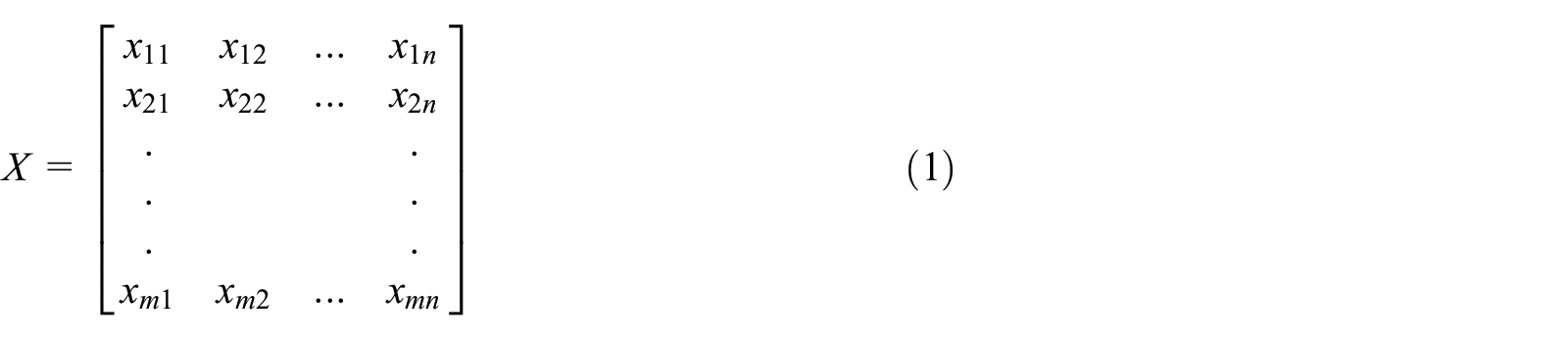
Step-2: Normalization of decision matrix X: using equations (2) and (3) the elements of the decision matrix are normalized and the normalized matrix is constructed.


While equation (2) is used for benefit criteria, equation (3) is applied for cost criteria.
Step-3: Calculation of the weight values of criteria: the weights of criteria are computed by using equations (4–6).At first, correlation coefficient of the indexes is computed as follows:

The conflict of the index Ci with other indexes can be expressed as follows:

The weight value of each criterion is calculated with the help of equation (6).

The EDAS method
As a promising method, The EDAS technique introduced by Keshavarz et al. 23 is a novel multi-criteria decision-making method. Although there are a limited number of studies using this method, when the obtained results with this method are evaluated, it can be seen that this method has the potential to give very successful results for solving the decision-making problems faced in the various fields.
According to the main argument of the method, the best solution is based on the distance from the average solution. The EDAS method has seven implementation steps and by following this algorithm it is possible to reach an optimal solution.
Step 1: Construction of the decision matrix: in the first step, a decision matrix shown as follows is constructed.

Step 2: Determination of the average solution: for each criteria, the average value is calculated by using equation (9).

Step 3: Calculation of the positive and negative distances: considering the directions of criteria, the positive (PDA) and negative distances (NDA) of each criterion from average are determined by using equations (10) and (11).


Step 4: Determination of the weighted sum of PDA and NDA: by using equations (12) and (13) values of weighted PDA and NDA are calculated.
Where Q+ represents the weighted sum of PDA and Q– symbolized the weighted sum of NDA.


wj is the non-negative weight value of the criterion j and it has been calculated with the help of the CRITIC technique.
Step 5: The normalization of the values of O+ and Q– the weighted sums of PDA and NDA are determined using equations (14) and (15).


Step: 6 Calculation of the appraisal score (AS) for all the alternatives: the appraisal scores are computed using equation (15) as follows:

Step: 7 Ranking the decision alternatives: decision alternatives are ranked according to the descending appraisal values of options. The alternative that has the highest score is determined as the best and proper decision option.
A numerical analysis
All factors and variables affecting the selection process were identified by carrying out comprehensive fieldwork in addition to that by doing interviews with the experts, who perform in the fields of public transportation. Identified selection criteria are shown in Table 1.
Selection criteria and decision options for evaluation of urban rail vehicles.

Implementation of the CRITIC method
In the first step of the CRITIC method a decision matrix was constructed. Each element of this matrix (xij) represents numerical value of ith decision alternatives for jth criterion. Constructed decision matrix X can be seen in Table 2.
The decision matrix X.
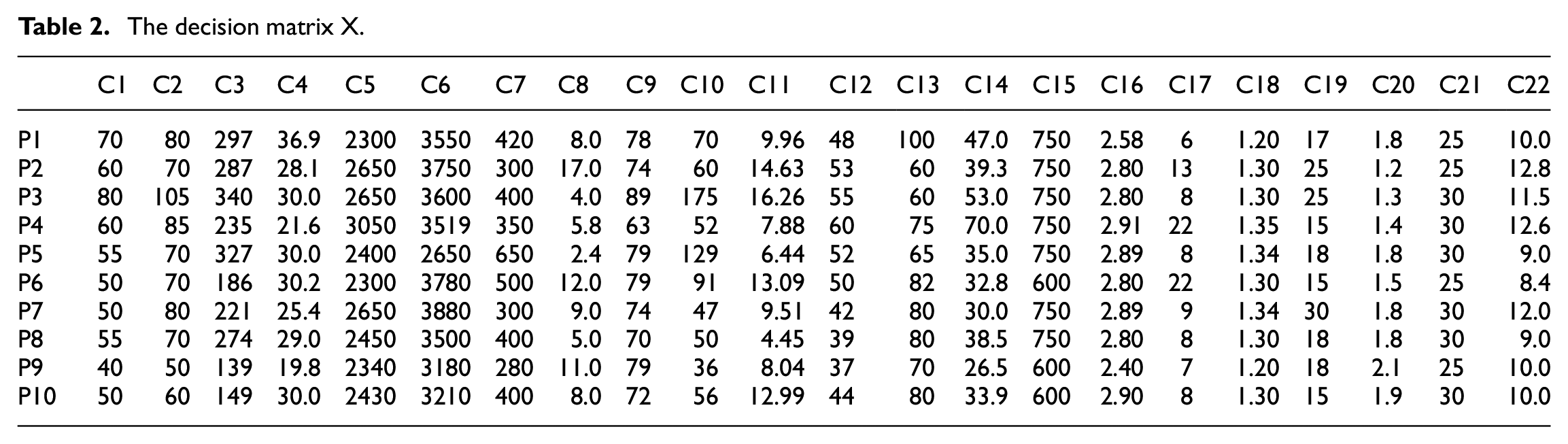
In the second step of the CRITIC method, elements of the decision matrix X were normalized by using equations (2) and (3). While equation (2) was used for the benefit criteria, equation (3) was applied for cost criteria. Afterward, normalized matrix was constructed as can be seen in Table 3.
The normalized matrix X.*

symbolizes the normalized matrix X* and it is different from decision matrix X.
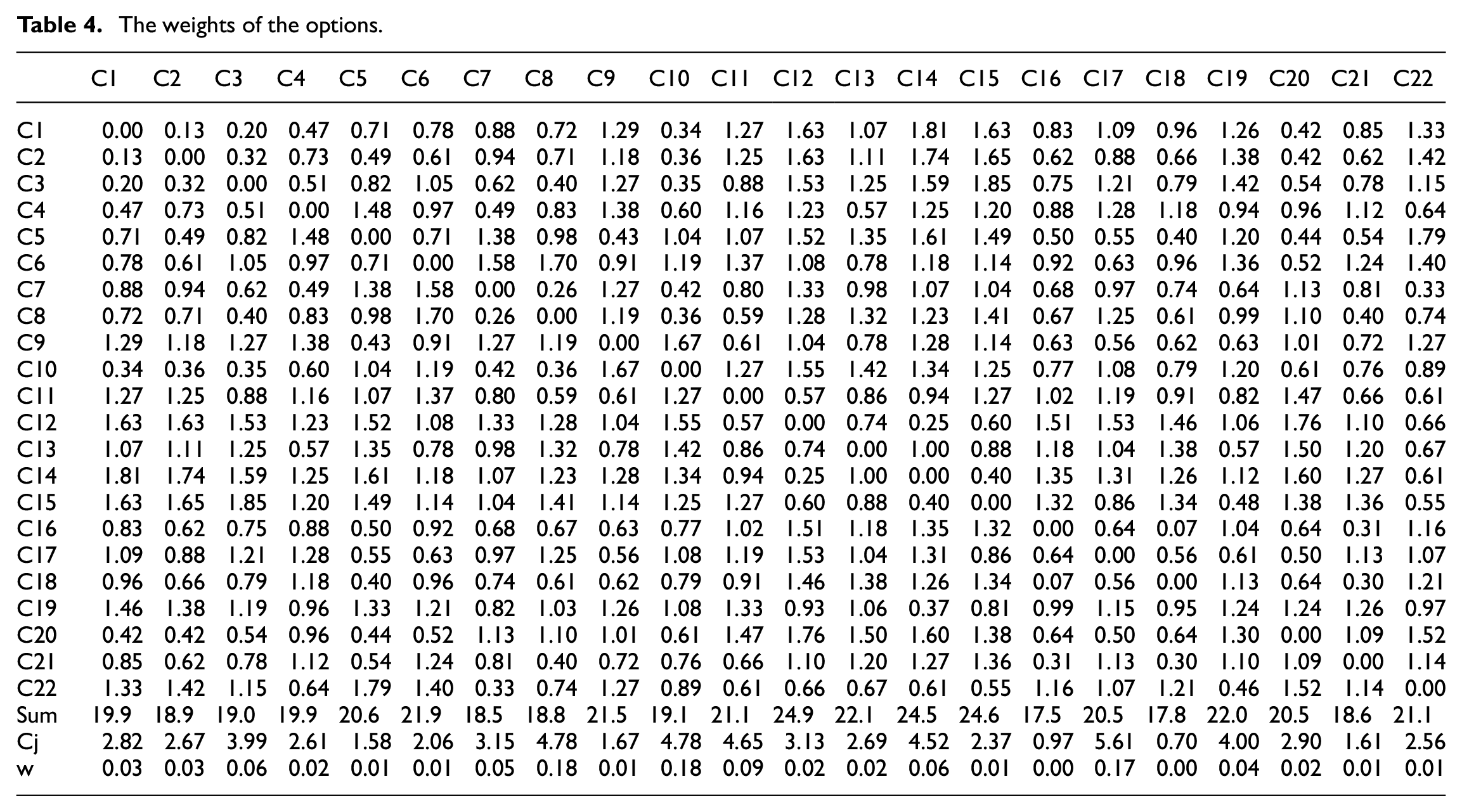
With the help of equations (4–6), weights of the selection criteria were calculated and importance scores of the factors were determined at the end of the third implementation step of the CRITIC technique.
When the obtained results using the CRITIC method are evaluated, the criteria such as the seat number, emission (CO2), and maximum grade slope have been ranked among the top three in the aspect of their relative importance values. Calculated ranking scores of the selection criteria can be seen in the last row of Table 4.
The weights of the options.
Implementation of the EDAS method
After the weights of the selection criteria were calculated by using the CRITIC method, the relative importance scores of all decision alternatives were computed and all decision alternatives were ranked considering the relative importance scores. As shown in Tables 5 and 6, positive and negative distances were computed with the help of equations (9) and (10).
The positive distance matrix (PDA).

The negative distance matrix (NDA).

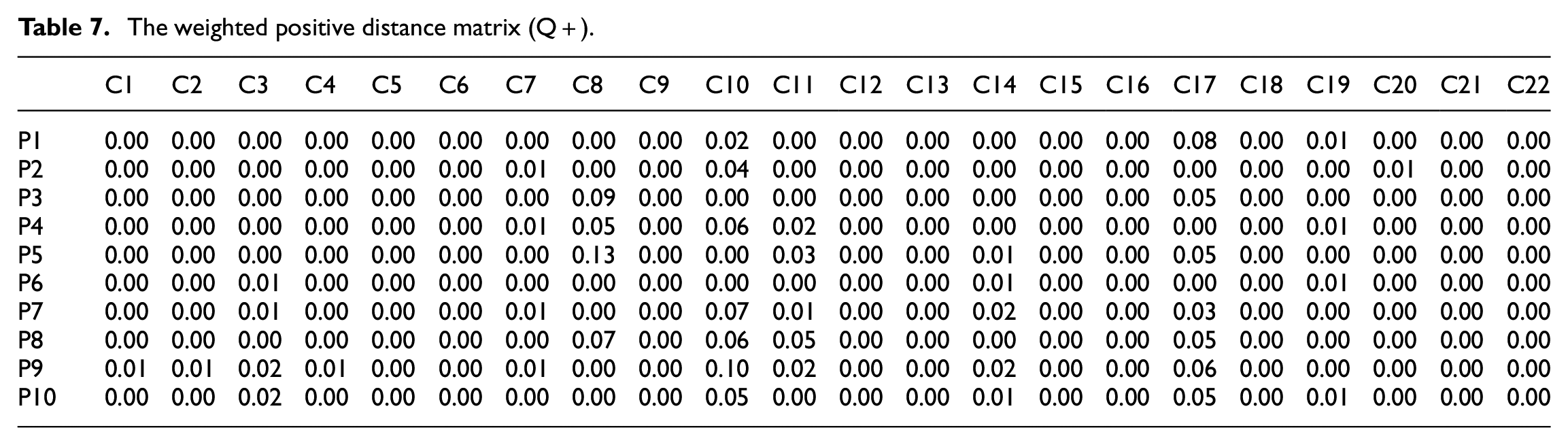
Afterward, the values of these matrices were weighted by using equations (11) and (12) and the weighted positive and the weighted negative distance matrices were constructed as can be seen in Tables 7 and 8. In the final implementation step of the EDAS technique, all decision options were ranked as following Table.
The weighted positive distance matrix (Q+).
The weighted negative distance matrix (Q−).

The following Table 9 shows the Qi+, Qi–, Si+, Si–, and Appraisal Scores. by taking into consideration the Appraisal Scores of decision options, all alternatives were ranked as shown Table 9.
Apraisal scores and ranking of the options.

Results and discussions
When it is analyzed technically, it can be seen that there are some important details, which can affect the results related to rail system vehicle selection. This study shows that the proposed MCDM model is working and also it can be applied by decision-makers in the different selection problems about urban transportation systems. More importantly, this model can shed light on scientific research and studies, which are related to the literature, will be realized in the future. More-over, this model can be utilized by decision-makers who are on the decision-making process about urban transportation systems and it may be seen as very useful instruments by investors in order to evaluate public transport investments. Consequently, there are too many parties and stakeholders such as public authorities, urban transport operators, researchers, investors and so on who can provide a benefits from outputs of this research.
While weight values of selection criteria were computed by using the CRITIC method, the quantitative utility value for each decision option was determined with the help of the EDAS technique. As a result, all factors and options related to urban rail vehicles were analyzed in this study. The results obtained using the proposed integrated MCDM approach are shown and explained in the follows:
When the calculated weight values of selection criteria are considered, it can be seen that environmental factors are remarkably important compared than other. Especially, according the findings of this research, it is recorded that CO2 emission emitted from urban rail vehicles has remark-able significance in the selection process.
On the other hand, when the relative importance values of decision options are evaluated, Brand A is determined as the best and proper rail vehicle. This option took the best score for many criteria. While the second-best rail vehicle option is Brand K, the third-best alternative is Brand C. Although these alternatives have high importance scores compared with other options, they are not in poor condition when their importance scores are considered.
Footnotes
Declaration of conflicting interests
The author declared no potential conflicts of interest with respect to the research, authorship, and/or publication of this article.
Funding
The author received no financial support for the research, authorship, and/or publication of this article.
