



Abstract
Applications:
The dynamics of superior heat transport fluids are of much interest and dominant over traditional fluids. Applications of such fluids can be found in advanced medical sciences, to maintain the building temperature, environmental sciences, chemical engineering, food engineering, and other applied research areas where enhanced heat transfer is required.
Aim and Research Methodology:
The major aim of this research is to report the thermal performance of the Glycerin-titania nanofluid using a thermal conductivity model comprising the effects of nanoparticles aggregation, and CCTF over a permeable slanted surface. The enhanced heat transport model was then analyzed numerically via RK scheme and furnished the outcomes with graphical aid under the variations of physical parameters.
Core Findings:
It is examined that the addition of CCTF (A1) in the model potentially contributes to thermal performance of aggregated nanofluid. The temperature
Keywords
Introduction
Aggregation of nanoparticles is simply defined as the mutual attraction among the particles through Vander walls attractive forces or via chemical bonding. Aggregation is the way of forming larger objects due to a cluster of nanosized particles. The unique characteristics of aggregated nanoparticles got much interest from engineers and scientists. Therefore, useful studies for engineering and industrial purposes have been reported on the effects of aggregated nanomaterial on organic or inorganic materials. For this, a more specific potential area of interest is considering the heat transport trends. In 2022, 1 analyzed the performance of nanoparticles aggregation for second-grade fluid with addition of homo-heterogeneous reactions. The model was developed for cylindrical surface with Joule heating effects and examine thermal trends at different parametric levels. Similarly, Wang et al., 2 Yu et al. 3 and Mahanthesh et al. 4 inspired by the apparatuses disk-cone gap, stretching surface, and vertically placed cylinder. They considered working fluid influenced by nanoparticles aggregation and also realistic physical constraints like fluid internal energy source, thermal radiations, magnetic field and chemical species, etc. and explore more interesting results.
The Cattaneo Christov Thermal Model (CCTM) is a fascinating physical aspect in the formation of energy equations to make it more effective. This important aspect hugely impacts the heat transmission mechanism of the fluid. Mohyud-Din et al. 5 analyzed the dynamics of (GO-MoS2)/water-EG by including CCTM in the energy model and inspected that hybrid nanoliquids by considering CCTM are useful for thermal enhancement. Mahmood et al. 6 made an attempt to examine the entropy optimization and thermal ability of Casson nanoliquid using CCTM. The analysis was carried out for two working nanoliquid TiO2-water and Cu-water and pointed out that entropy of the system enhances by enlarging the Reynolds number and better heat transmission was observed for Cu–water. Further, the more recent attractive investigations of various models with CCTM and their effectiveness under the different physical constraint's levels described in the literary works.7–12
Recently, researchers turned their idea towards hybrid types of nanofluids to achieve enhanced heat transfer for realistic applications. Thus, Animasaun et al. 13 and Bhatti et al. 14 reported the studies for ternary and hybrid nanofluids through horizontal and vertical channel flow situations. They examined thermal performance under variant physical quantities theoretically. Many other researchers (see Araina et al., 15 (Adnan, Ashraf, Khan, Shemseldin, & Mousa, Numerical Energy Storage Efficiency of MWCNTs-Propylene Glycol by Inducing Thermal Radiations and Combined Convection Effects in the Constitutive Model, 16 made attempt to analyze the nanofluids heat transport with the addition of innovative physical effects like Fourier law of thermal conduction, surface convection (Adnan & Ashraf, Numerical thermal featuring in γAl2O3-C2H6O2 nanofluid under the influence of thermal radiation and convective heat condition by inducing novel effects of effective Prandtl number model, 17 internal thermal source/sink, 18 Joule heating, chemical reaction 19 and Darcy Forchheimer flow. In 2020, Shah et al. 20 focused on the analysis of heat efficiency of various hybrid nanofluids with the physical effects of dual stretching and suction. They observed that the pressure drops each time suction operates through the wall. The significance of uniform suction and blowing under magnetic convection and revised Buongiorno's model discussed by Zaydan et al. 21 Thermal stability of nanoliquid model with magnetic field effects is the major contribution of the study and also provided a deep discussion of the results. Recently, Elnaqeeb et al. 22 reported 3D heat transmission characteristics using ternary nanoparticles with various densities and nanoparticles structures. The simulation revealed that nanoparticles with heavy densities suspended in water have outstanding thermal characteristics and the Nusselt number enhances significantly.
Summayah et al. 23 investigated the heat transport in hybrid nanofluid (see literary works24,25) by taking directed Lorentz forces. The study is conducted for two special characteristics called stretching and shrinking of the surface. Also, the stability analysis was performed and plotted the results in the view of calculated Eigen values. The authors concluded that hybrid nanoparticles potentially enhance the internal heat storage ability of the conventional fluid. Nadeem and Hussain 26 analyzed that under the effect of nanoparticles, two-dimensional flow on a stretching sheet. When solidification took place during the transformation of heat, nanoparticles play a crucial role. Because of its extensive use in glass, copper polymer, and other material among others stretching flow retains its characteristics even when it is steady flow. Polymer and glass etc. parameters have a very strongly affected on heat transferred due to its very closeness on wall and it must be neglected if they are far from the wall. The utility of nanoparticles in many other applied fields than fluid dynamics exist, for instance see the the work of Ramadan et al,, 27 (Iqubal, Characterization, surface morphology and microstructure of water-soluble colloidal MnO2 nanoflakes, 28 (Iqubal, Review on kinetic studies of α-hydroxy acids (glycolic, mandelic, citric, tartaric, and malic) and some other organic compounds with water-soluble nanoparticles of colloidal MnO2 in absence and presence of non-ionic surfactant (TX-100).29,30
Sreedevi et al.
31
revealed that when carbon nanotubes and silver nanoparticles combine and are taken as hybrid nanoparticles then water is viewed as base fluid. Mubashar et al.
32
investigated about the three—
Santhi et al. 38 reported the dynamics of two-phase nanoliquid and explored fascinating variations in the heat/mass transport mechanism. Sreekala et al. 39 On a nano-fluid of heat transfer over a stretching sheet, the interaction of chemical reaction and thermal radiation was examined. Raman et al. 40 investigated the joule heating, thermal radiation, and heat source–sink effects on the MHD (see literary works41–43) flow of hybrid nanofluid toward the stretched surface. Mjankwi et al. 44 organized the analysis of nanoliquid and noticed that heat transmission diminishes as thermal conductance rises. Vikas Poply 45 investigated the major impact of important fluid characteristics on the physical behavior of the nanoliquid.
Although, many studies relevant to the aggregation effects on the heat transport performance of nanofluids have been presented and each has their own significance. However, the heat transport analysis in nanofluids over a slanted surface with the addition of aggregation effects is not investigated so far which is of paramount interest. Further, the significant effects of CCTF and permeability effects endorsed in the governing laws to make more effects. Then, the RK technique was adopted to explore the actual variations in the heat transfer due to increasing values of the pertinent physical constraints.
Model development
This section contains the problem statement, geometry, basic governing laws, and effective characteristics of nanofluids that help to develop an enhanced Glycerin-titania nanofluid heat transport model with nanoparticles aggregation and CCTF effects. This whole procedure discusses in the subsequent sections.
Slanted surface geometry
The non-transient streamline flow of nanoliquid influenced by nanoparticles aggregation and CCTM is taken over a slanted surface. The surface is permeable and adjusted in such a way that
The governing boundary layer equations of the aggregated nano-fluid integrated by CCTF are described in the following way:


The inclined surface is subject to the below flow conditions:

The proper suitable transformations are defined as below:

where


Further,



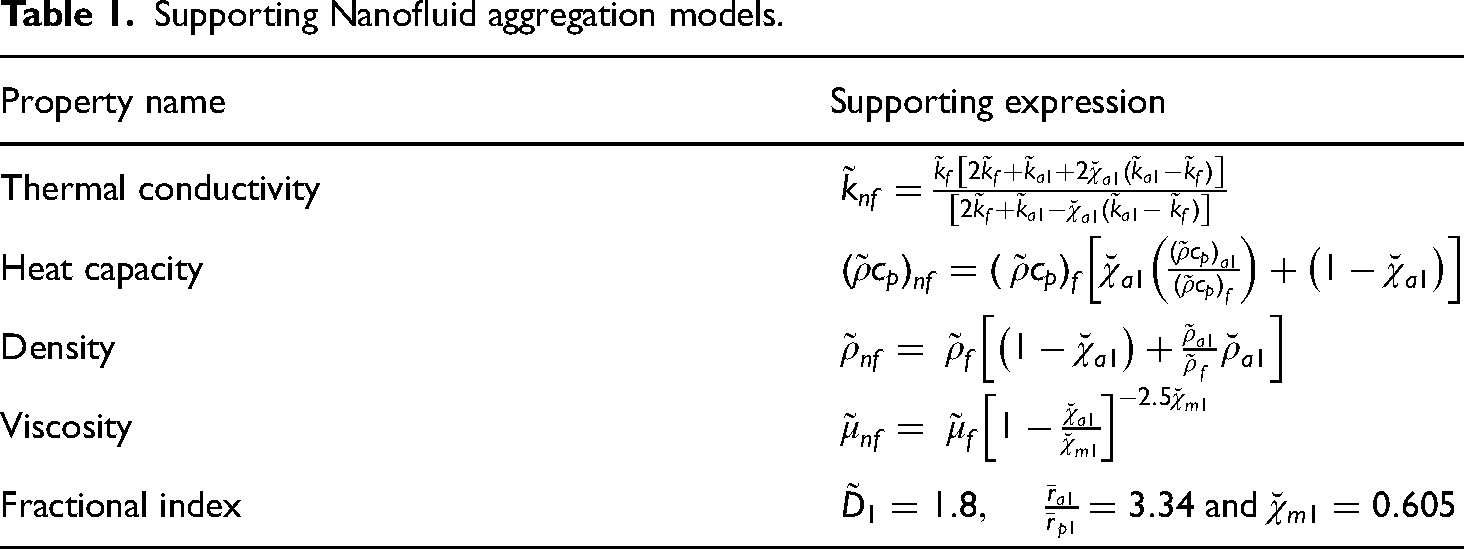
Table 1 summarizes the Nanofluid aggregation model and also briefly explains the properties of
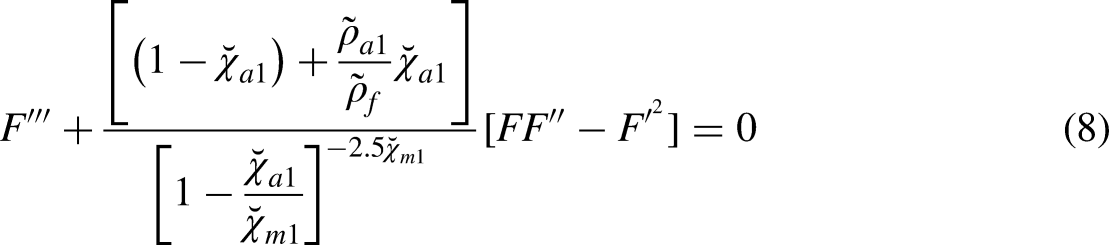

Now the boundary conditions (4) are changed to:

Supporting Nanofluid aggregation models.
Thermophysical values of nanoparticles and host fluid.
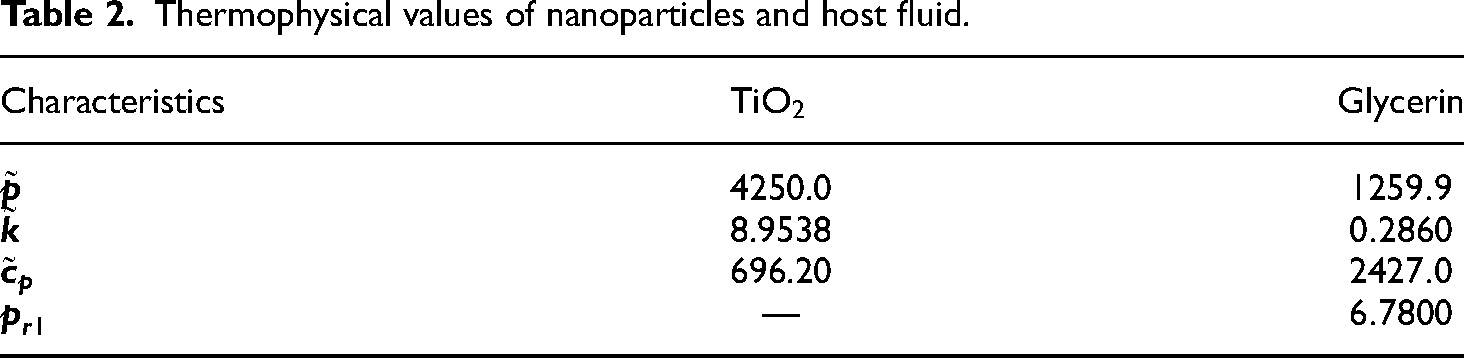
Notice that
Where the value of
Next, the parameters of physical interest are the local Nusselt number

By putting similarity variables into equation (10) we obtained:

Mathematical analysis of aggregation heat transfer model
The aggregated heat transport model is nonlinear and coupled with each other comprising the multiple effects of permeability, stretching/shrink and CCTF. Therefore, numerical treatment is obvious for such thermal transport models. For this, RK technique (see Refs. (Adnan, Ashraf, Khan, & Andualem, Thermal transport investigation and shear drag at solid–liquid interface of modified permeable radiative-SRID subject to Darcy–Forchheimer fluid flow composed by γ-nanomaterial,48,49), (Adnan and Ashraf, Thermal efficiency in hybrid (Al2O3-CuO/H2O) and ternary hybrid nanofluids (Al2O3-CuO-Cu/H2O) by considering the novel effects of imposed magnetic field and convective heat condition, 50 ), (Adnan, Heat transfer inspection in [(ZnO-MWCNTs)/water-EG(50:50)]hnf with thermal radiation ray and convective condition over a Riga surface, 51 )) is implemented and handle the problem under the flow parameters. The detailed technique implementation is given in Figure 2 over the desired domain. Further, convergence criteria are followed such the it obeys the flow conditions at the surface and at ambient freestream position.

The flow configuration of aggregated nanofluid over (a) stretching and (b) shrinking case.

Process of RK implementation scheme.
Results and discussion against the physical constraints
This section provides a detailed discussion about the physical results under the changing pertinent flow constraints with feasible ranges.
The purpose of the current research is to examine the effects of the governing parameters

Figure 4 (a) and (b) illustrates how the temperature varies with injection and suction case on two different parameter

Figures 5 and 6 displayed the temperature performance in aggregated nanofluid for various levels of


Skin friction on an inclined surface varies vertically as shown in Figures 7 and 8. It is evident from these Figures, that there are consistent solutions for skin friction that varies over an inclined surface. Whenever, the value of

Skin friction vs

Skin friction vs
The current mathematical model can be used to forecast the outcome of experiments. Additionally, Figures 9 and 10 depict the distinction of Nusselt number against

Nusselt number vs

Nusselt number vs

Nusselt number vs
Conclusions
The heat transfer performance of nanofluid including the nanoparticles aggregation, permeability, and CCTF over a slanted surface is analyzed. The numerical computation of the model done via RK technique and plot the results for different parametric ranges. It is obvious that stretching of the surface leads to an increase in the fluid movement and the particles gained high speed near the surface. The velocity of successive layers towards the ambient portion gradually drops. The fluid temperature augments in the presence of aggregated nanoparticles and fluid injection form slanted surface. Further, induction of CCTF is a good physical tool to achieve better heat transport for the presented study. The local thermal transport rate (Nusselt number) and skin friction improved by enlarging
Footnotes
Acknowledgements
The authors would like to thank the Deanship of Scientific Research at Umm Al-Qura University for supporting this work by Grant Code 23UQU4310392DSR011.
Declaration of conflicting interests
The author(s) declared no potential conflicts of interest with respect to the research, authorship, and/or publication of this article.
Funding
The authors disclosed receipt of the following financial support for the research, authorship, and/or publication of this article: The authors would like to thank the Deanship of Scientific Research at Umm Al-Qura University for supporting this work by Grant Code 23UQU4310392DSR011.

Authors biographies
Khalid Abdulkhaliq M. Alharbi is working as Assistant Professor at Department of Mechanical Engineering, Umm Al-Qura University, Saudi Arabia. His areas of interest are Mechanical properties, Mechanical behavior of materials, Mechanical testing, Microstructure, Mechanics of Materials, Failure analysis, Damage mechanics and Surface engineering.
Adnan is working at Department of Mathematics, Mohi-ud-Din Islamic University. His research interest includes Fluid Mechanics, CFD, Numerical analysis, Heat and Mass transfer analysis in Nano, hybrid nanofluids, Newtonian and non-Newtonian nanofluids, Applied Mathematics, Mathematical Modeling, Channel flows and Boundary Layer models. He has contributed more than 100 articles in different internationally reputed Journals.
Aneesa Nadeem is MPhil Scholar at Department of Mathematics, Mohi-ud-Din Islamic University. Her area of interest is Fluid Mechanics and Nanofluids.
Sayed M. Eldin is working as Professor at Center of Research, Future University in Egypt. His area of interest includes but not limited to Artificial Intelligence, Energy and Environment.