




Abstract
Experimental and numerical analysis of active and passive flow control is an important topic of practical value in the study of turbulent flows. This paper numerically analyzed the effects of an air microjet on an adverse pressure gradient turbulent boundary layer over a flat plane. Experimental data were employed to verify the numerical modeling. Vortex formation and development were then studied by changing the microjet to inflow velocity ratio (VR) and microjet angles. According to the results, the best values of the angles
Introduction
An adverse pressure gradient occurs when the static pressure increases in the direction of the flow. So, the boundary layer size and the boundary layer velocity directly above the wall increase and decrease respectively. For a large enough adverse pressure gradient, the boundary layer velocity direction changes and so the boundary layer separates. This local phenomenon is accompanied by the stall (the creation of large vortices, an increase of the drag, and a decrease of the lift). The location of this separation can be delayed by some flow control methods. Flow control methods are divided into passive (no external source of energy is required), and active (an external source of energy is required). The energy is transferred from the main flow to the boundary layer in the passive flow control method. Also, the energy is transferred from some external source of energy to the fluid in the active flow control method.1–3 One of these active control methods is the vortex generator jet (VGJ) method. This technique is resembles a well-known method of using a small vane vortex generator. 4 VGJs have some obvious advantages over vane vortex generators, for example, they do not suffer from drag penalties and they can use in the active flow control system. However, experimental or CFD modeling the flow with VGJs is more difficult and costly than that for vane vortex generators. 5 A pair of counter-rotating vortices (CVPs) are formed by VJGs. The formation mechanism of counter-rotating vortex pairs is not yet fully understood. It is often accepted that the formation of a CVP has roots in the surface of the jet. If the jet is placed closer to the surface, one of the vortices of the CVP is also forced closer to the surface, increasing in losses for this vortex. This reduces the power of the vortex so much as to bring it to the verge of annihilation. The CVP tends to blend into a single vortex as a result of the strength distributed between the two counter-rotating vortices. The weaker vortex is annihilated as it spins around the dominant vortex.6,7 The secondary vortex structure is also moved toward the outlet if the jet is slanted. As it mentioned, the VGJs can be used in some problems to delay or eliminate flow separation due to the adverse pressure gradient boundary layer. So far, a lot of research was done using CFD or experimental methods to investigate the effect of the VGJs on fluid flow.
McCurdy 8 was possibly the first researcher to investigate the effects of vortex generators (VGs) on boundary-layer flow control on an airfoil. Wallis 9 compared an inclined active VG jet (VGJ) and an inclined passive vane VG (VVG). According to his investigation, VGJ arrays would have a very similar impact on a flow as an array of VVGs. Pearcey 4 was the first researcher that investigated the results of using the VVGs and the VGJs for boundary layer separation control. Rixon and Johari, 10 Ortmanns and Kähler, 11 and some other researchers have experimentally investigated Single steady blowing VGJ setups. In this researches, the general VGJ design parameters were the pitch angle, the skew angle, the jet velocity, and the distance between the jets. Rixon and Johari 10 shown that the circulation and the peak vorticity decrease exponentially with growing stream-wise position x. Also, the circulation and peak vorticity and also the average wall-normal position of the primary vortex increase linearly with an increase in the velocity ratio. Ortmanns and Kähler 11 investigated the effects of a VGJ on the shear-layer interactions and the turbulent characteristics of the boundary layer. They reported that using a VGJ has a small effect on the turbulent kinetic energy. Also, the mixing is effected large-scale momentum transport. Von Stillfried et al. 12 reported that the actual boundary-layer conditions and many combinations are possible very important in the optimizing parameters of VGJs. According to this investigation, optimum ranges for the pitch angle and skew angle are between 15°–45° and 90°–135°, respectively. Lasagna et al. 13 investigated Stream-wise vortices originating from synthetic jet–turbulent boundary layer interaction by experimental method. According to these results, the leeward vortex intensified while the other became weaker by increasing the slot yaw angle. Also, the vortices grew in size and intensity by increasing the jet velocity ratio and the slot yaw angle. Feng et al. 14 studied a model of the trajectory of an inclined jet in incompressible crossflow. Also, the effect of jet entrainment, the horseshoe, and wake vortices may create a low-pressure region on the wall and hence alter the jet trajectory and influence the circulation in low-velocity ratios and skew angle near 90°. Beresh et al. 15 investigated the influence of the fluctuating velocity field on the surface pressures in a jet/fin interaction by experimental method. According to this result a counter-rotating vortex pair that passes above the fin is produced by a normal nozzle. Also, pressure fluctuations are principally driven by the jet wake deficit and the wall horseshoe vortex. Also, the inclined nozzle produces a vortex pair. This vortex pair impinges the fin and so yields stronger pressure fluctuations driven more directly by turbulence emanating from the jet mixing. Alimi and Wünsch 16 investigated active flow control of canonical laminar separation bubbles by steady and harmonic vortex generator jets using direct numerical simulations. According to this result disturbances caused by VGJs make the large-scale coherent structures. So the separated region is limited due to the effect of these structures at increasing the momentum exchange. Szwaba et al. 17 investigated the influence of rod vortex generators on a flow pattern downstream using experimental and numerical methods. They put out a rod instead of a jet. They wanted to show that the application of a rod can introduce the same effect as a jet and so introduced a new flow control method dedicated mainly to external flows. Liu et al. 18 used the compression corner calculation model and conducted detailed numerical investigations in the supersonic flow field. They studied the effects of different injection pressure ratios, various actuation positions, and different nozzle types. Also, they mentioned that the distance between the counter-rotating vortex pair and the wall surface is an important factor. As mentioned, with the injection of micro-jets, vortices are formed in the boundary layer through which the momentum is injected from the free stream to the boundary layer and the fluid flow remains near the wall, thus delaying the separation of the flow.
This paper used FLUENT software to analyze the effects of velocity and microjet angles on the turbulent flow over a surface. The strength and stability of the vortices were examined by varying these parameters. The location of the vortex with respect to the boundary layer and its formation and dissipation mechanisms were thoroughly discussed. The velocity and Reynolds stresses on the edges and in the center of the vortex were also explored. Finally, optimized velocity and angles were suggested based on the presented discussions.
Governing equations and numerical modeling
The geometry of the experimental wind tunnel was modeled as shown in Figure 1, where the dimensions, the origin of the coordinate system, and the boundary conditions are specified. The model dimensions in the x and z directions were 3.5 and 0.5 m, respectively. The values of y at the inlet and outlet ends of the tunnel were 0.13 and 0.231 m, respectively. The microjet was located 1.13 m from the inlet of the tunnel. It was 0.001 m in diameter and located 0.005 m from the line z = 0 m at the bottom of the channel. The following figure shows the location of the microjet and its angles from the coordinate axes. The fluid considered was air with viscosity
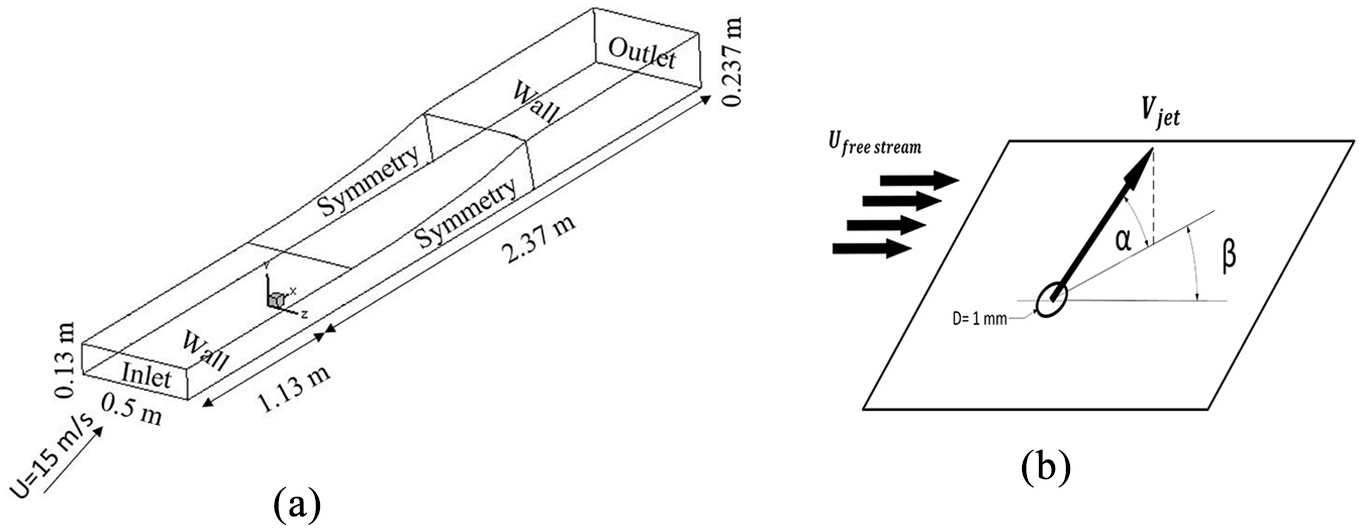
Dimensions and boundary conditions of the computational domain: (a) all the domain and (b) near the microjet.
Parameter values.

Boundary conditions
Once the computational domain is partitioned into a grid, boundary conditions can be defined on surfaces. The following boundary conditions were used in the modeled wind tunnel shown in Figure 1: Inlet boundary conditions: Inflow velocity or pressure can be defined at the inlet boundaries. An inflow velocity boundary condition is used to determine the velocity and scalar properties of the flow at the inlet boundaries. The flow enters the computational domain at a velocity equal to the values assigned to the nodes on the selected boundary surface.
Wall boundary conditions: All the nodes selected to define this boundary condition move as a rigid body. The no-slip condition is established for such problems, where the wall and its adjacent fluid layer move with the same velocity. Walls in this type of boundary conditions are usually either stationary or moving at a specific speed parallel or perpendicular to the wall surface.
Symmetry boundary conditions: When a simulation is symmetrical from a geometric or flow standpoint, symmetry boundary conditions can be employed. Using this type of boundary, one can cut the number of cells by half, and thereby reduce computational time. In symmetry boundary conditions, there is zero gradients at the boundary along any line perpendicular to it, and no flow passes through the boundary. In other words, at the boundary, normal components of the velocity and gradients of all the variables in a direction normal to the boundary are zero.
Outlet boundary conditions: This type of boundary condition is used in flow simulations where flow properties are not known at the outlet. For all flow regimes simulated using outlet boundary conditions, no flow parameter at the outlet boundaries is specified directly. In fact, such parameters in the simulation are calculated by extrapolating the values from the inside of the computational domain.
Governing equations
Navier-Stokes equations were used to solve the surface flow. However, as the inlet flow was turbulent, their direct modeling requires considerable time and computational costs. Therefore, the governing equations were expanded into RANS equations and solved numerically. The equations were discretized using the finite volume method and velocity and pressure fields were coupled through the SIMPLE algorithm. The momentum and pressure equations were discretized using the second-order upwind scheme. Turbulent flow modeling was carried out using SST-Kω and turbulence was modeled by using the first-order upwind scheme.
So, in order to solve the RANS equations, the continuity and momentum equations in incompressible flow are used as in equations (1) and (2) respectively: 19


where

where
It is worth noting that the parameter


Resulting from flow velocity fluctuation terms, Reynolds stresses were modeled by considering turbulent viscosity. For incompressible flows, Reynolds stresses were calculated as follows.

Verification of the results
As stated earlier, this paper numerically analyzed the effects of a microjet on a turbulent surface flow. For this purpose, grid-independence tests were carried out by evaluating the numerical results. The results from the numerical model and those from the experimental wind tunnel were also compared and the validity of the numerical modeling was verified.
Figure 2 depicts the present geometry, for which a HEX mesh is used for grid generation. The mesh is finer in regions with more important and intensified flow variations, such as the lower and the inlet boundaries of the domain.
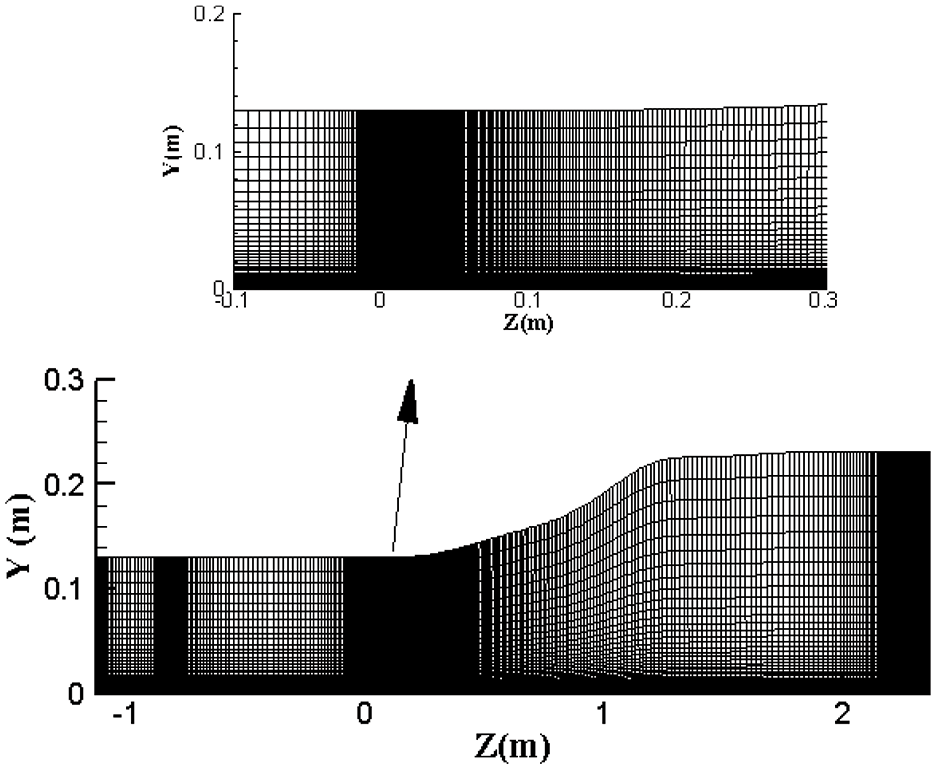
The mesh file used for the computational domain.
To perform the grid-independence test for the case without a microjet, a comparison was made between three mesh densities: coarse, normal, and fine grids having (332 × 45 × 140), (547 × 65 × 140), and (910 × 85 × 140) nodes, respectively. Figure 3 compares the pressure coefficients at the bottom surface of the wind tunnel. It is observed that the pressure decreased almost linearly with a pressure drop in the front portion of the plane. Moving toward the regions with larger distances across the walls, one observes a pressure increase according to Bernoulli’s equation due to lower velocities in the longitudinal direction. A close correlation is also observed among the results from the different mesh densities. Nevertheless, there is a slight difference between the results from the coarse grid and those from the other two mesh densities. The largest difference occurred at x = 1.3 m and was below 1%.
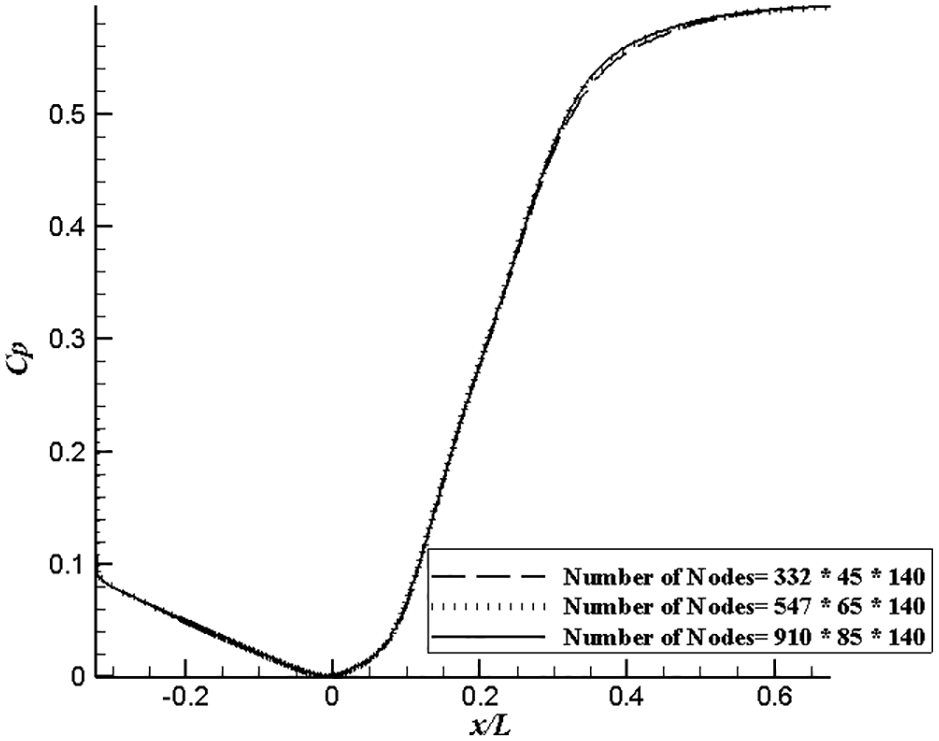
Comparison of Cp for different mesh densities at the lower wall.
Figures 4 present the x and y components of the velocity for a line parallel to the y axis at x/L = 0.1714 m. As the figure shows, the velocity was zero near the wall and gradually increased at points farther from the bottom, up to a distance of about

Comparison of velocity for different mesh densities: (a) u and (b) v.
The values for y+ over the lower walls of the tunnel are shown in Figures 5. It is observed that the value of y+ along the centerline at the lower wall was below the permissible range (about 300 20 ). This confirms the mesh was acceptable near the walls for a turbulent flow.

Values of y+ at the lower wall of the wind tunnel.
The results for the two turbulence parameters u′u′ and u′v′ at x/L = 0.1714 from the origin along the y-direction are shown in Figure 6 for comparison. The figures show that these parameters grew sharply from zero at the lower boundary, after which they take a zero value in regions closer to the middle of the tunnel, where there was almost no velocity variation. The difference in the results at points near the lower boundary was less than 1%.
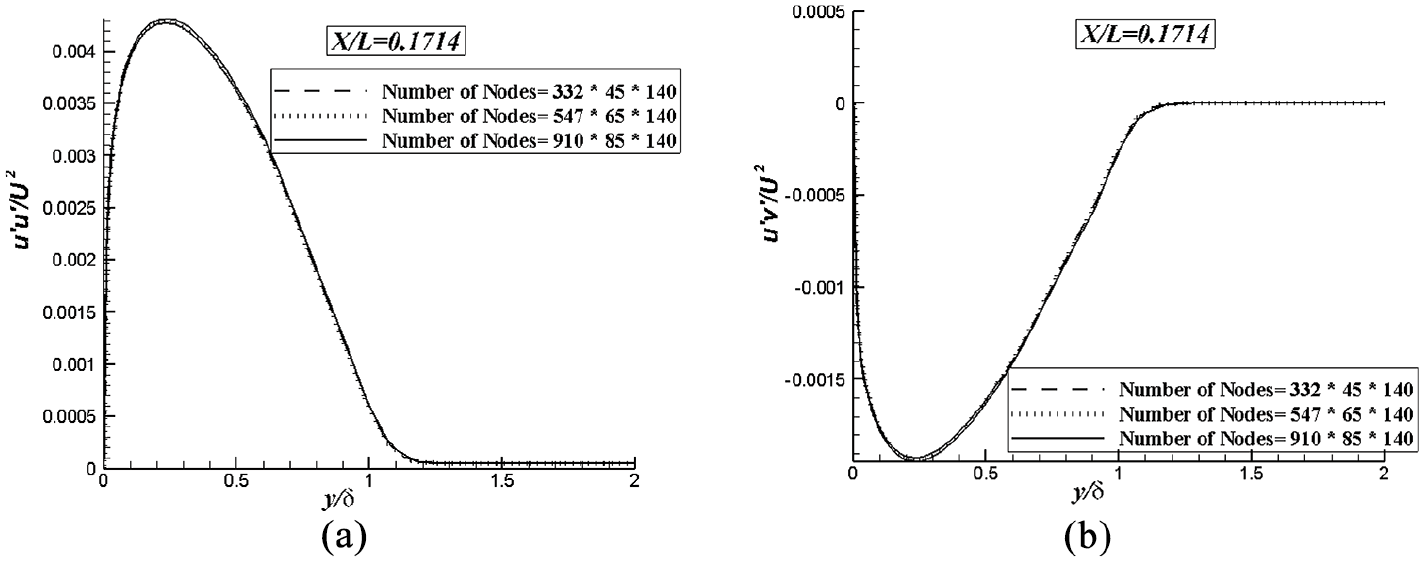
Comparison of the Reynolds stress for various mesh densities: (a) u′u′ and (b) u′v′.
The results indicate that the three mesh densities could provide reasonable accuracy for the present problem. However, adding a microjet resulted in more substantial velocity variations near the boundary and led to larger errors in the case of the coarse grid. Therefore, the normal grid density was chosen for the next stages of the analysis.
The verification experiment was completed in a low speed closed–circuit boundary layer wind tunnel. An adverse pressure gradient turbulent boundary layer with and without the microjet was measured. Hot-wire technique was applied to measure the flow velocities and Reynolds stresses. According to the uncertainty analysis of Anderson and Eaton,
22
the mean velocity had an uncertainty of 3% of the local stream-wise velocity. The normal Reynolds stress components had an uncertainty of 5% of the local value of
To verify the numerical modeling, Figures 7 and 8 present a comparison of the experimental and numerical pressure coefficients and Reynolds stresses on the lower wall of the wind tunnel, good agreement is observed between the experimental and numerical pressure coefficients as shown in Figure 7. A 3% difference is observed between the numerical and experimental results, which is due to the geometric inconsistencies (in the upper curve) of the actual tunnel and the (not completely symmetrical) wall boundary conditions.

Comparison of the numerical and experimental pressure coefficients.

Comparison of numerical and experimental Reynolds stresses u′u′ and u′v′: (a) x/L = 0.0171, (b) x/L = 0.1057 m, (c) x/L = 0.2057, and (d) x/L = 0.28 m.
Figures 8 show the numerical and experimental Reynolds stresses at different cross-sections of the turbulent boundary layer. The results indicate that there is good agreement between the numerical and experimental values. However, there is a slight difference in some cases. While many cases showed a difference lower than 2% between the experimental and numerical values, the difference grew to 9% for some other cases. This might be the result of probable experimental errors due to measurement sensitivities. However, the numerical results were concluded to be reasonably accurate.
As mentioned before, the purpose of this paper is to investigate the effects of microjet on the turbulent flow boundary layer with adverse pressure gradient. In fact, by injecting a jet, a longitudinal vortex is formed in the boundary layer. Due to its strength, this vortex forms along and affects the boundary layer until it dissipates. The main idea behind this longitudinal vortex is to form an effective rotational structure resulting from momentum transfer between a cross jet and the main flow. The fluid is injected through a small hole on the surface at a specific angle into the main flow. This creates a vortex moving down flow. Figure 9 shows the longitudinal vortex streamlines due to a microjet with VR = 1, and angles β = 60°, α = 30° at different sections along with the boundary layer. In this figure, the vortex dissipation is well seen in the turbulent boundary layer. The circular motion of the vortex also causes the mass and momentum to be transferred into the boundary layer, making it thinner on one side and thicker on the other. Reynolds stress and velocity components on the surface and consequently the pressure gradient in the boundary layer are affected by the rotational motion of the vortex in the boundary layer of the turbulent flow.

Velocity contours and vortex dissipation: (a) longitudinal vortex streamlines at different sections and (b) vortex effect on streamwise velocity contours.
Figure 10 compares the experimental and numerical results for a surface flow with a microjet. The comparison was made at 9 cm from the microjet by considering u/U for VRs = 1, 2, and 4 correspondings to percentage errors of 1%, 3%, and 5%, respectively. As the figure shows, there is good agreement between the experimental and numerical results. It was concluded that the numerical results could be used in further stages through the analysis process.

Comparison of the numerical and experimental results for u/U contours for various microjet velocities at x = 0.09 m.
Results and discussions
The grid-independence test and verification of the numerical values were carried out in the previous sections. This section analyses the effects of a fluid microjet on a surface flow. For this analysis, the inlet angles and velocity of the microjet were varied and momentum was injected into the boundary layer to assess the strength and stability of the vortex generated in the boundary layer. In what follows, the results are presented and analyzed for
Results for variable
, VR = 1, and
This section evaluates the effect of variations in

Definition of different regions around a vortex.
As shown in Figure 12, the maximum vortex velocity in the y and z directions was generally reduced in areas farther from the edge of the microjet. It is also observed that a larger

Results for variable β, VR = 1, and α = 30°: (a) v for the downwash, (b) v for the upwash, (c) w for the down side, (d) w for the up side, (e) maximum ωx, and (f) distance of up side vortex from the boundary layer.
Results for variable
, VR = 1, and
As shown in Figure 13, this section evaluates the effect of variations in

Results for variable β, VR = 1, and α = 45°: (a) v for the downwash, (b) v for the upwash, (c) w for the down side, (d) w for the up side, (e) maximum ωx, and (f) distance of up side vortex from the boundary layer.
Results for variable
, VR = 1, and
For this case, it was not possible to provide a velocity graph or vortex locations due to the reduction in velocity and [more rapid] vortex dissipation compared with previous cases. However, Figure 14 on the vortex indicates a trend similar to the previous cases with smaller

Results for variable β, VR = 1, and α = 60°: (a) maximum ωx and (b) distance of up side vortex from the boundary layer.
The results for VR = 1 and different values of
Results for variable
, VR = 2, and
Based on the previous results, this section evaluates microjet effects by varying
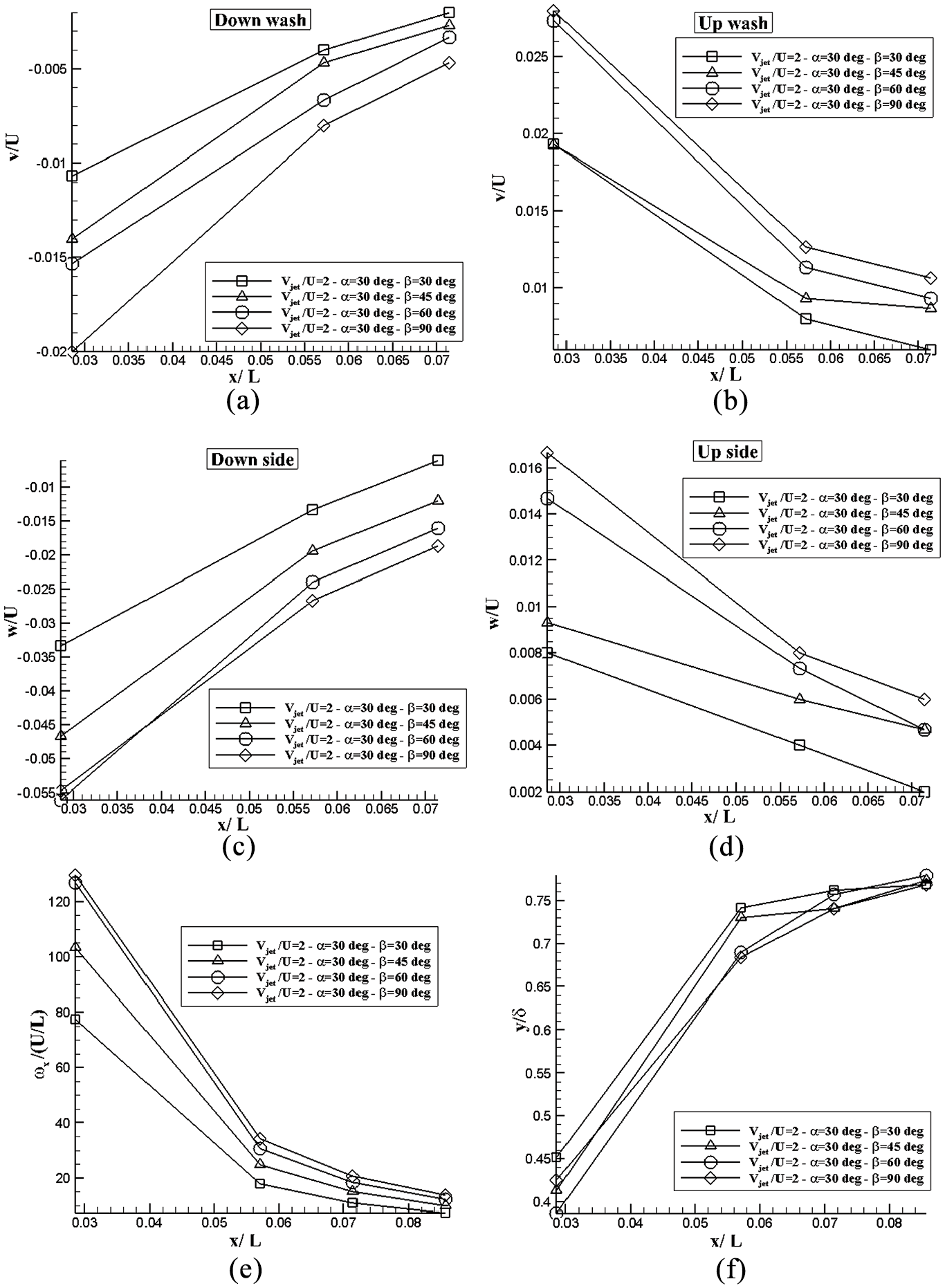
Results for variable β, VR = 2, and α = 30°: (a) v for the downwash, (b) v for the upwash, (c) w for the down side, (d) w for the up side, (e) maximum ωx, and (f) distance of up side vortex from the boundary layer.
Results for variable
, VR = 4, and
Based on the previous results, this section evaluates microjet effects by varying

Results for variable β, VR = 4, and α = 30°: (a) v for the downwash, (b) v for the upwash, (c) w for the down side, (d) w for the up side, (e) maximum ωx, and (f) distance of up side vortex from the boundary layer.
Results for variable
,
, and VR = 4
A discussion was presented in the introduction on the formation of a strong vortex from a vortex pair. This phenomenon is illustrated in Figure 17 for

Contours of the formation of a single dominant vortex from the initial vortex pair for α = 30°, β = 60°, and VR = 4.
The formation of the dominant vortex and its complete dissipation are illustrated in Figure 18 for variable

The position of altering of the main counter-rotating vortex pair into a single dominant vortex.
Figure 19 presents the results contours for

Results for variable β, VR = 4, and α = 30°: (a) ωx v for the downwash, (b) streamlines, (c) v, (d) w, (e) u, and (f) boundary layers.
Considering the position of the center, left side, and right side of the vortex, the velocity variations along the x, y, and z-directions for various distances along the x-axis are shown in Figure 20 for the center, left side, and right side of the flow. The graph shows the difference in flow velocities between the cases with and without a microjet. It is also possible to determine the position of the boundary layer from the presented graphs. The effect of the microjet gradually decreased at distances farther from its edge. Therefore, the results followed those of the case without a microjet more closely. The graph of the velocity along the x direction shows that u for the upwash and downwash flows near the bottom wall was lower and higher, respectively, than the velocity in the center. This difference in velocities is due to the fact that the vortex rotation axis was at an angle to the x axis. As the distance across the two walls became wider, the velocity in the y direction gradually increased downstream. v was observed to increase linearly in the y direction at any cross section along the x axis. Adding the microjet to the flow caused the velocity variations to occur almost equally for the upwash and downwash flows. Moreover, the distance from the lower and upper points of the vortex to the bottom can be determined by observing maximum w. The graph shows that the vortex gradually expanded. In fact, the maximum movement of the upper portion of the graph in the y direction was larger than that of the lower portion.

Variations of u, v, and w in the center, downwash, and upwash flows in the vortex for α = 30°, β = 60°, and VR = 4 (numerical data).
Reynolds stresses for variable microjet
Based on the previous results, this section provides an analysis of the Reynolds stresses using the selected microjet specifications. Reynolds stresses u′u′, u′v′, and u′w′ are presented for VR = 1, 2, and 4, and
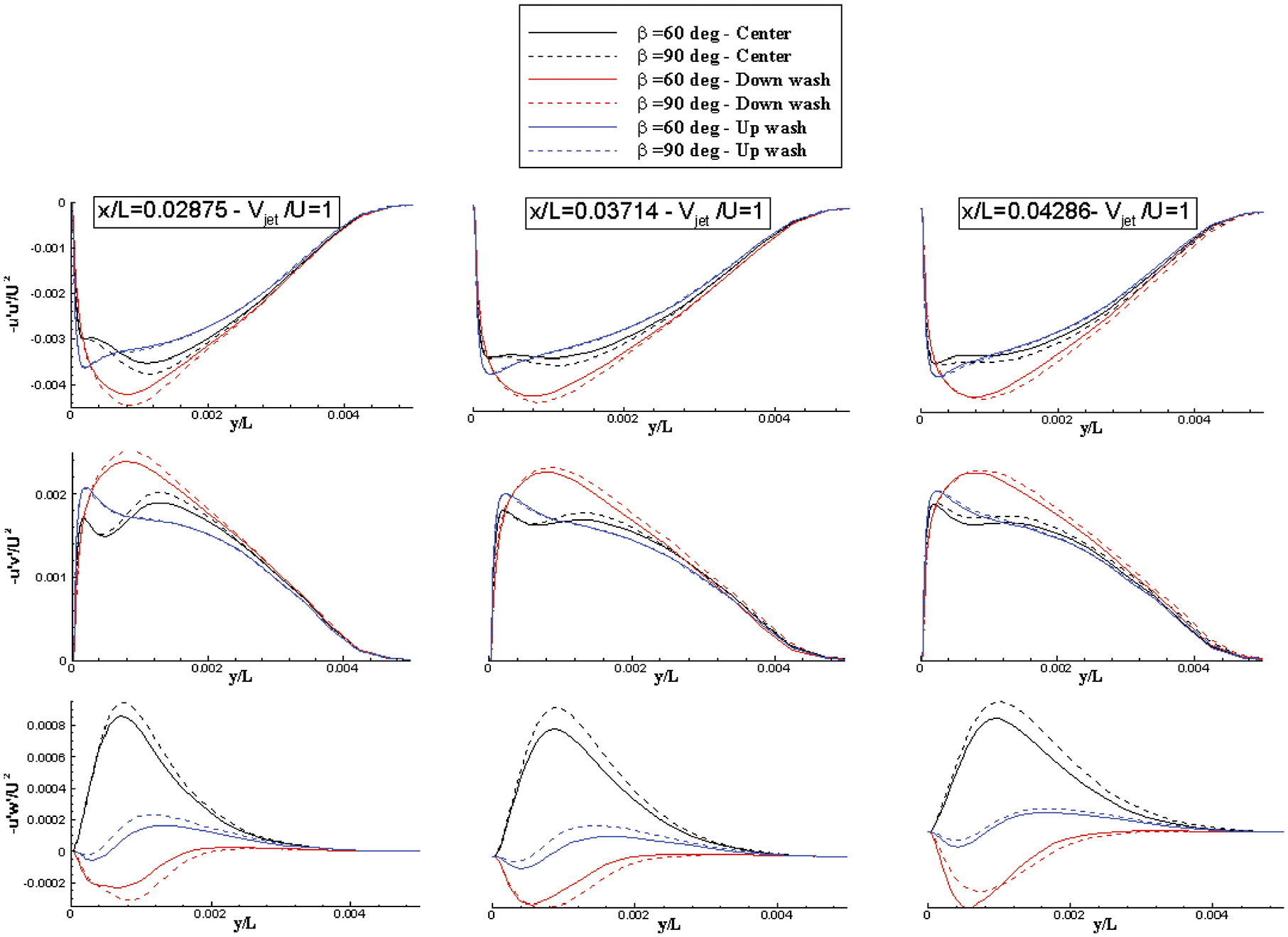
Variations of u′u′, u′v′, and u′w′ in the center, downwash, and upwash flows in the vortex for α = 30°, β = 60°and 90°, and VR = 1 (numerical data).

Variations of u′u′, u′v′, and u′w′ in the center, downwash, and upwash flows in the vortex for α = 30°, β = 60°and 90°, and VR = 2 (numerical data).

Variations of u′u′, u′v′, and u′w′ in the center, downwash, and upwash flows in the vortex for α = 30°, β = 60°and 90°, and VR = 4 (numerical data).
Conclusion
The effects of the ratio of microjet to wind tunnel inflow velocity and microjet angles
The results showed that the vortex was more stable at higher velocities. In fact, at VRs = 1, 2, and 4, the x/L (The length which the longitudinal vortex retains in the flow) values were 0.058, 0.078, and 0.18, respectively. Compared to VR = 1, the vortex strength for VRs = 2 and 4 grew by 350% and 680%, respectively.
The best microjet angles at various velocities were found to be about
While a wider
As
Due to the microjet, free flow velocity, and the bottom wall, the generated vortex were moved along the positive z, x, and y axes, respectively. However, at locations farther than a certain distance from the microjet, the effect of the microjet on the vortex became negligible. The vortex remained inside the boundary layer for all cases.
Velocity fluctuations gradually decreased downstream, which was more noticeable for larger VRs and in the graphs showing w′.
By adding the microjet to the flow, the highest variation in the Reynolds stress along the x direction from VR = 1–4 was 10%. The corresponding values along the y and z directions were 15% and 270%, respectively. Velocity fluctuations gradually decreased downstream, which was more noticeable for larger VRs and in the graphs showing w′. Moreover,
Footnotes
Appendix
Declaration of conflicting interests
The author(s) declared no potential conflicts of interest with respect to the research, authorship, and/or publication of this article.
Funding
The author(s) disclosed receipt of the following financial support for the research, authorship, and/or publication of this article: This project is funded by SXIT - Grant number: in 2019(Gfy19-01).
