



Abstract
Introduction
The applications of the modified domain decomposition method in nonlinear vibration analysis of the composite hard-coating cylindrical shells are still at a relatively superficial level, owing to the fact that its performance under different decomposition parameters has not been thoroughly investigated for achieving sufficient precision.
Methods
A parametric domain decomposition method is developed to facilitate self-performance evaluation in nonlinear vibration analysis of the shell. Correspondingly, in order to avoid a mass of redundant computation of the segment stiffness and material damping matrices during iterations, a specialized preprocessing scheme is designed by pre-establishing the parametric analytical expressions and matrix databases.
Results
The resonant response is sensitive to the circumferential segment number, but weakly affected by the axial segment number. The optimum circumferential segment number in the present study is suggested to be Nθ = 70, which can achieve good calculation accuracy and efficiency. Highly consistency is shown for the distributions of axial equivalent strain under different axial segment numbers. Smaller circumferential segment numbers would result in larger equivalent strain and bad solution accuracy.
Conclusions
The sufficient solution accuracy of nonlinear vibration of the composite hard-coating cylindrical shell can't be achieved by increasing the axial segment number with constant segment width, but only by enough circumferential segment number, which is fundamentally determined by its equivalent strain distributions and gradients, and is with close relation to the axial and circumferential wave numbers of the shell.
Keywords
Introduction
As the principal structural element in submarines and airspace crafts, cylindrical shell structures are often subjected to complex multi-field coupling loads, further leading to excessive vibration and low fatigue life.1–4 Hard-coating damping treatment is a new passive damping vibration control method developed in recent years with widespread concern.5,6 The material of the hard coating is composed mainly of the metal substrate, ceramic substrate, or their mixtures, exhibiting a high damping capacity with internal friction even in high temperature and corrosion conditions, thus has been employed in an attempt to suppress excessive vibration of the cylindrical shell structures in many studies.7–9 However, previous works showed that,10–12 the physical parameters (e.g. storage modulus and loss factor) of hard coating have a severe dependency on its equivalent strain intensity due to its internal friction, leading to strong nonlinear vibration behavior of the composite hard-coating cylindrical shell. Therefore, considering the so-called strain dependence of coating material in the modeling and solution of forced vibration of the composite hard-coating cylindrical shell is of significant practice meaning, which can provide precise control of damping vibration.
In recent years, the nonlinear vibrations of all kinds of shell structures have become one of the most important topics in the field of structural dynamics.13–15 The nonlinear vibration mechanism of the shells subjected to temperature, rotating speed, and external excitations under different boundary conditions have been deeply clarified, which provides an important basis for structural vibration control.16–19 Furthermore, many studies have been conducted on the nonlinear vibration analysis of composite hard-coating structures (e.g. beam, 20 plate,21–23 cylindrical shell,24–28 blisk29–34 and blade 35 ) considering the strain dependence of coating material. Based on the parameter identification results of hard coating,36,37 the high-order polynomial method was generally used to characterize the nonlinear characteristics of its storage modulus and loss factor with respect to the equivalent strain. Hence, the key point of introducing strain dependence into vibration modeling is to determine the equivalent strain of the layer of hard coating.
In the above studies, two types of methods were involved the finite element and analytical formulas accordingly were presented to calculate the equivalent strain of the coating layer. Compared with the finite element methods (FEMs), the introduction of material nonlinearity of hard coating with analytical approaches is considerably more challenging, but it can provide access to the equivalent strain value at any point of the layer of hard coating. The existing analytical approaches can further be summarized into two categories including the pure analytical21,27 and semi-analytical modes.26,28 However, due to the high complexity of vibration theoretical formulas of the composite hard-coating cylindrical shell, the derived expressions of the equivalent strain of the layer of hard coating are extremely complicated as well, while the computational efficiency of the nonlinear vibration with the pure analytical modes is relatively low. Then the so-called semi-analytical modes (namely the modified domain decomposition method) were proposed in our previous work 26 for easy access to the equivalent strain values, which combines the features of finite element and analytical methods by uniformly dividing the layer of hard coating into multiple segments with the assumption of constant equivalent strain. This method has also been successfully applied to include the strain dependence of coating material in equations of motion for forced vibration of the hard-coating cylindrical shell with rotating angular velocity. 28 Nevertheless, the existing applications of the domain decomposition method in solving the nonlinear vibration of the composite hard-coating cylindrical shells with material strain dependence are still in a relatively superficial level. There is lack of a detailed and comprehensive performance evaluation of this method for achieving high efficiency and sufficient precision.
In order to solve the above problems, a parametric domain decomposition method with specialized preprocessing scheme is developed to facilitate self-performance evaluation in nonlinear vibration analysis. Then, based on the semi-analytical modeling of nonlinear vibration of a clamped-free hard-coating cylindrical shell established by the Rayleigh-Ritz method, the performance evaluation for the modified domain decomposition method under different segment parameters is comprehensively carried out to obtain the optimal decomposition scheme. A series of comparison studies are performed to investigate the effects of segment parameters (including the axial and circumferential segment number) on the nonlinear vibration characteristics of the composite hard-coating cylindrical shell.
Methods
Modeling of forced vibration of the clamped-free hard coating cylindrical shell
In order to evaluate the performance of the modified domain decomposition method in nonlinear vibration of the composite hard-coating cylindrical shell, the geometry configuration with clamped-free boundary and sinusoidal acceleration load in the orthogonal curvilinear coordinate system (xθz) is considered here, as shown in Figure 1.

Geometry of the composite hard-coating cylindrical shell.
By employing the Chebyshev orthogonal polynomials of the second kind, the axial, circumferential, and radial components of the sinusoidal acceleration load for the shell can be given, respectively, by
38


Under the action of sinusoidal acceleration load, the displacements of the hard-coating cylindrical shell would change with time in a sine form. Thus, the axial, circumferential, and radial displacements at an arbitrary point of the middle surface of the shell can be given, respectively, by


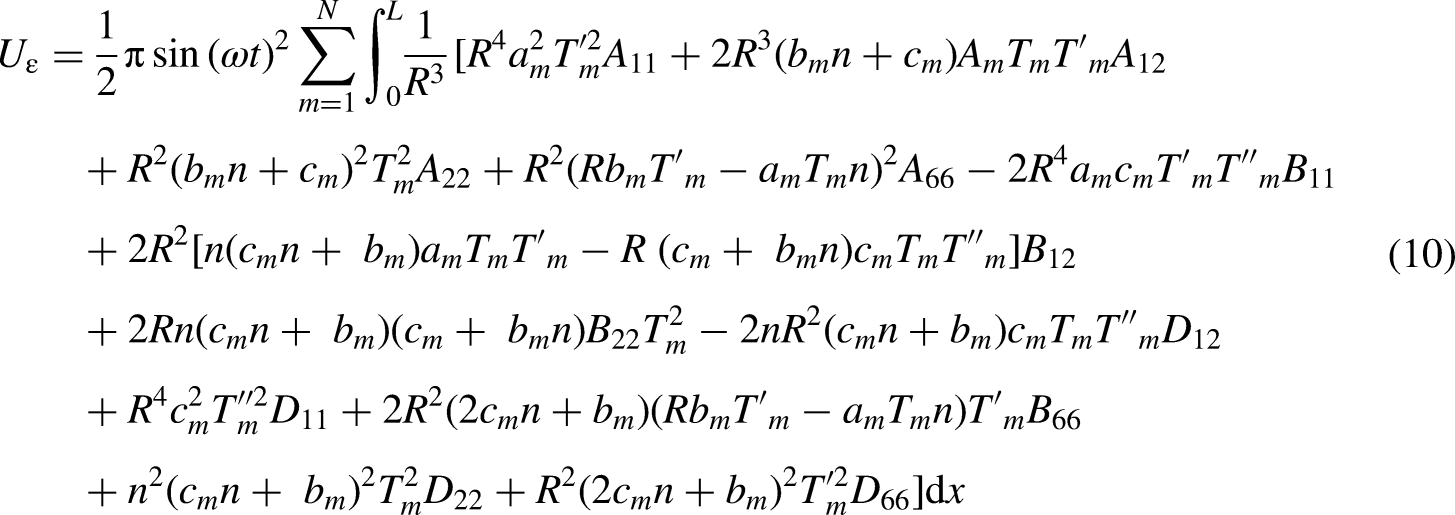
Similarly, the potential energy

And the potential energy









Parametric domain decomposition method
Due to the inner friction in the coating material, the storage modulus and loss factor of hard coating are generally strain-dependent, which would further result in a soft nonlinearity and has an important impact on the frequency response of the shell. Thus, the modified domain decomposition method
26
is employed to fully determine the equivalent strain of the coating layer for considering the strain-dependent storage modulus and loss factor of hard coating. However, due to a lack of parameterization of the coating segment number, the modified domain decomposition method with lower computational efficiency is not suitable for mass calculation during the performance evaluation. As a part of the improvement, a parametric domain decomposition method is developed to facilitate its performance evaluation in nonlinear vibration analysis of the composite hard-coating cylindrical shell. The core idea of this method is to divide the layer of the hard coating into multiple segments, the axial and circumferential coating segment numbers are defined by

Sketch of the parametric domain decomposition method.
In the present work, the axial and circumferential coordinates of the coating segment (indexed by p and q) are parameterized by the axial and circumferential coating segment numbers





Based on the construction procedure of the equations of motion of the shell in matrix form in equation (12), the maximum strain energy density


Whole iteration procedure of the unified nonlinear iterative solution method.
To speed up the calculation, some necessary strategies need to be taken to further refine the parametric domain decomposition method. It is worth noting that the challenge mainly lies in how to efficiently deal with the numerous repeated calculations of the stiffness matrix of coating segments during the nonlinear iterations, so as to facilitate the performance evaluation within the designated parameter range. Here a specialized preprocessing scheme is designed for the semi-analytical construction of the stiffness and material damping matrix of a large number of coating segments, aimed at avoiding a mass of redundant computation in the process of performance evaluation.
Firstly, by applying the indefinite integral of each item in the segment stiffness matrix
Secondly, the matrix database within the designated parameter range is recommended to pre-established, in which the pre-calculated segment stiffness matrix
In addition, it should be noted that the original domain decomposition method for dealing with the coating strain dependence in nonlinear vibration of the hard-coating cylindrical shell was firstly developed in our previous study, 26 which has been fully validated under the condition of elastic constraint by comparing with the experimental resonant frequencies and responses. Considering the present method is a parameterized version of the original domain decomposition method, focusing on the parameterization of coating segment number for facilitating self-performance evaluation, thus the repeated method verification will not be performed here. This work focuses more on the performance evaluation of the parametric domain decomposition method in the nonlinear vibration of the composite shell.
The nonlinear iterative process of the parametric domain decomposition method is given in Figure 4, to demonstrate the convergence of resonant frequency, resonant response, and 2-norm of residual vector. As indicated in Figure 4, the resonant frequency, resonant response, and 2-norm of residual vector achieve the goal of convergence after 112 iterations, possessing a good convergence and accuracy for the solution.
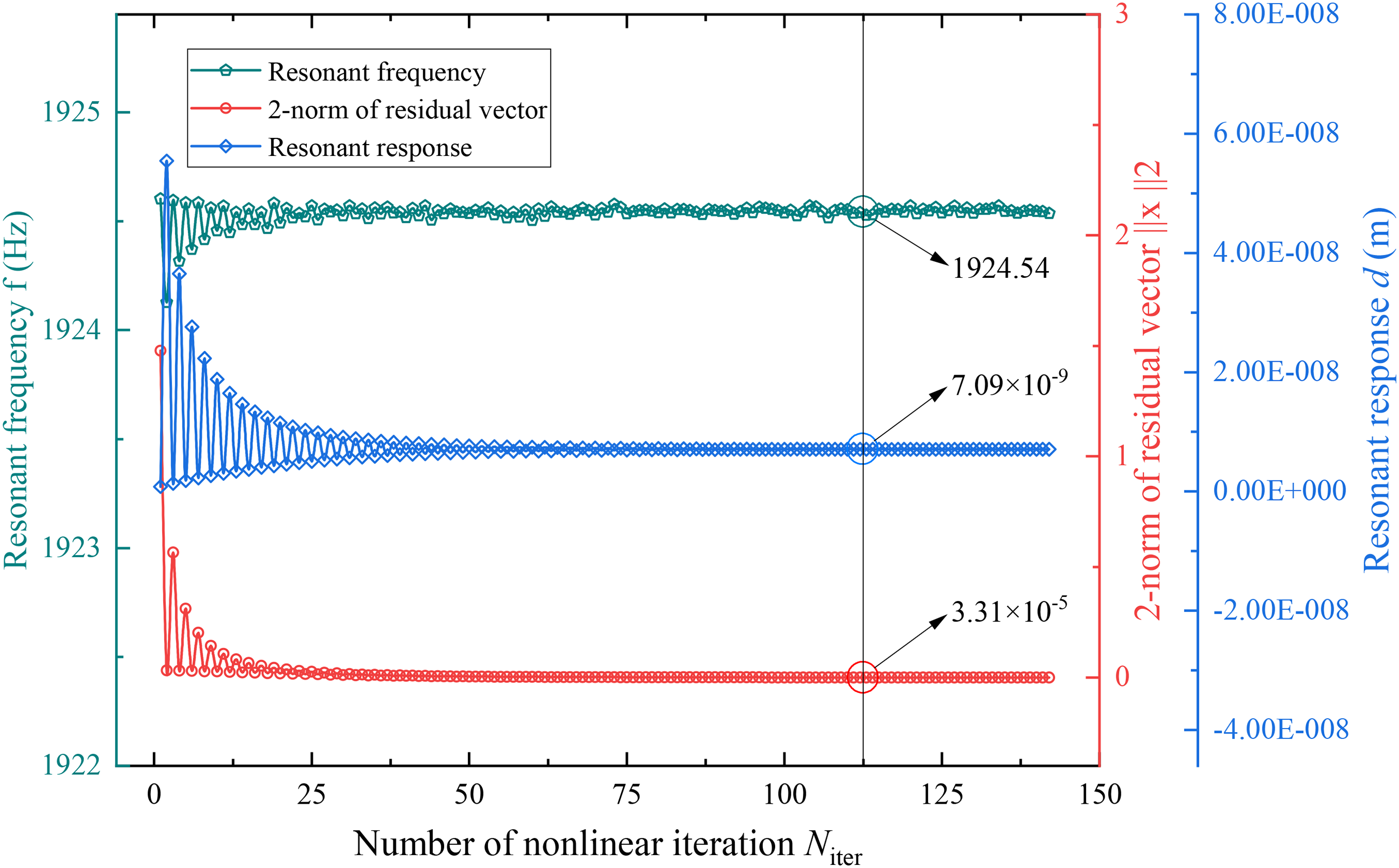
Convergence analysis of the parametric domain decomposition method.
Results and discussions
Since the existing applications of the modified domain decomposition method in solving the nonlinear vibration of the composite hard-coating cylindrical shells are still at a relatively superficial level, and lack of understanding of the domain decomposition mechanism, a detailed and comprehensive performance evaluation of this method is conducted for ease of achieving sufficient precision. The adapted material and geometric parameters of the composite hard-coating cylindrical shell are listed in Tables 1 and 2.
Material parameters of the composite hard-coating cylindrical shell.

Geometric parameters of the composite hard-coating cylindrical shell.

Further validation of the present semi-analytical model
Considering the study on forced vibration of the composite hard-coating cylindrical shell under clamped boundary conditions is seldom reported in existing literature, the calculated natural frequencies with corresponding modal shapes are compared with the FEM results based on ABAQUS v6.13, to further demonstrate the validity of the present model as well as the vibration characteristics of the shell, as shown in Figure 5.
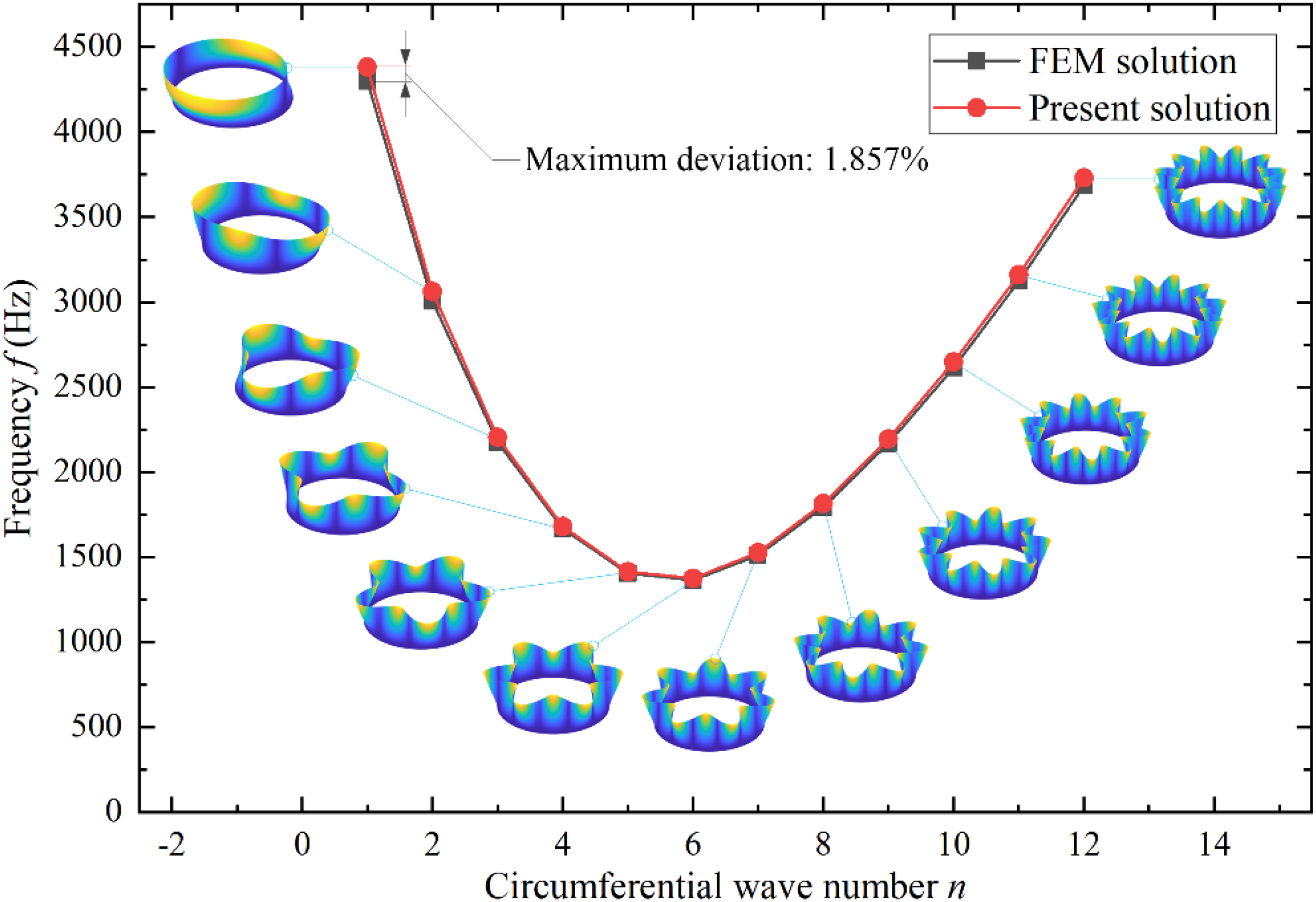
Natural frequencies and mode shapes of the composite hard-coating cylindrical shell.
The above results indicate that the maximum deviation between the natural frequencies calculated by FEM and present models is within 1.857%, and the calculated peak number of the first 12 mode shapes of the shell is exactly consistent with the given circumferential wave number. Thus, the comparison results provide further validation of the present semi-analytical model.
Influence of segment number on the resonant response
Owing to the cylindrical-shell-shaped configuration of the composite hard-coating structure, the inherently complicated modal shape makes the resonant response and equivalent strain of the coating layer show a significant difference along the axial and circumferential directions. Hence, under the assumption of constant equivalent strain in each separate coating segment, the segment number in different directions would inevitably have an impact on the calculating precision of the nonlinear results.
In view of the background above, the effects of segment number along the axial and circumferential directions on the nonlinear vibration characteristics are investigated. The case with constant segment width and varied segment length, as well as the case with constant segment length and varied segment width are listed in Table 3.
Adapted axial and circumferential segment numbers for the investigated two cases.

The influence of circumferential segment numbers with constant segment length on the resonant response under different circumferential wave numbers is shown in Figure 6. From Figure 6 we can see that the resonant response is sensitive to the circumferential segment number. The resonant responses under circumferential wave numbers n = 1 and n = 2 increase gradually with the increasing circumferential segment number and then quickly level off. Conversely, the resonant responses for n = 3–12 decrease with the increase of the circumferential segment number and then quickly level off as a whole. Results indicate that there exists an optimum value for the circumferential segment number with constant segment length to achieve the exact value of resonant response under different circumferential wave numbers.

Influence of circumferential segment number on the resonant response under different circumferential wave numbers.
The influence of axial segment number with constant segment width on the resonant response under different circumferential wave numbers is shown in Figure 7. From Figure 7, it can be found that the resonant response under different circumferential wave numbers remains largely the same with the increasing axial segment number, suggesting that the effect of axial segment number on the resonant response is weak comparatively. The above results demonstrate that the variation of the circumferential segment number has a greater impact on the resonant response than the axial segment number. Moreover, a good balance can be achieved between the calculation accuracy and efficiency by adjusting the appropriate circumferential segment number. The optimum circumferential segment number in the present study is suggested to Nθ = 70 at the conditions of Nx = 10.

Influence of axial segment number on the resonant response under different circumferential wave numbers.
Influence of segment number on the equivalent strain
The equivalent strain of the coating segment directly determines nonlinear strength of forced vibration of the composite hard-coating cylindrical shell. Thus, exploring the influence of the segment number on the equivalent strain is beneficial to clarify the mentioned domain decomposition mechanism. Taking the circumferential wave number n = 8 for example, the influence of axial segment number with constant segment width on the equivalent strain along the initial shell longitude line of the coating layer is shown in Figure 8. As can be seen from Figure 8, there is high consistency between the distributions of axial equivalent strain under different axial segment numbers, indicating the weak impact effect of the axial segment number on the axial distribution of the equivalent strain of the composite cylindrical shell. Since the value of the equivalent strain of the coating layer would directly act on the nonlinear resonant response of the shell, it can be concluded that the variation of axial segment number with constant segment width can not effectively improve the accuracy of the resonant results.

Influence of axial segment number on the equivalent strain along the initial shell longitude line of the coating layer.
Taking the circumferential wave number n = 8 for example, the influence of the circumferential segment number on the equivalent strain along the top shell latitude line of the coating layer is shown in Figure 9. It can be seen that the maximum value of equivalent strain decreases first and then became stable with the increase of the circumferential segment number. Fewer circumferential segment numbers would result in a larger equivalent strain of the coating layer of the shell, further causing bad solution accuracy of the resonant response. The result shows that the local strain varies as the cosine function of the circumferential segment number, exactly corresponding to the circumferential wave number of the shell mode shape. Moreover, with the increase of the circumferential segment number, the wave number of the mentioned cosine function above gradually increases from 2 to 8, and then remains stable. Likewise, the maximum value of the equivalent strain gradually declines until stabilized, while the amplitude of the equivalent strain varies in the opposite. Hence it gives a conclusion that the circumferential segment number of the coating layer has a great impact on the nonlinear resonant response of the composite hard-coating cylindrical shell.

Influence of circumferential segment number on the equivalent strain along the top shell latitude line of the coating layer.
Furthermore, due to the geometrical characteristics of the studied thin-walled short cylindrical shell, only one axial wave can be excited by the base sinusoidal acceleration load within the specific frequency range, and yet each circumferential mode shape of the shell is scarcely influenced and can be completely excited. The axial and circumferential wave numbers are important to the axial and circumferential equivalent strain distributions as well as the axial and circumferential equivalent strain gradients. Owing to the axial wave number m = 1, the variation gradient of axial equivalent strain is relatively small, thus the nonlinear resonant response of the hard-coating cylindrical shell is insensitive to the axial segment number as indicated in Figure 7. By comparison, the variation gradient of circumferential equivalent strain presents certain degree of diversity, which probably explains why the nonlinear resonant response of the shell is sensitive to the circumferential segment number. It is a fact that only enough circumferential segment numbers can achieve sufficient accuracy of the nonlinear solution.
Conclusions
In this paper, a parametric domain decomposition method is developed to facilitate self-performance evaluation in nonlinear vibration analysis of the composite hard-coating cylindrical shell. Moreover, in order to avoid a mass of redundant computation of the segment stiffness and material damping matrices during performance evaluation, a specialized preprocessing scheme is designed by pre-establishing the parametric analytical expressions and total matrix databases. Then the effects of axial and circumferential segment numbers on the nonlinear resonant response and equivalent strain are studied for further understanding domain decomposition mechanism. The following conclusions are obtained:
The resonant response is sensitive to the circumferential segment number but weakly affected by the axial segment number. There exists an optimum value for the circumferential segment number to achieve the exact value of resonant response under different circumferential wave numbers. The optimum circumferential segment number in the present study is suggested to Nθ = 70, which can achieve good calculation accuracy and efficiency. Highly consistency is shown for the distributions of axial equivalent strain under different axial segment numbers. The variation of axial segment number with constant segment width can not effectively improve the accuracy of the nonlinear resonant results. Fewer circumferential segment numbers would result in larger equivalent strain and bad solution accuracy. The local strain varies as the cosine function of the circumferential segment number, exactly corresponding to the circumferential wave number of the shell mode shape. The axial and circumferential wave numbers are important to the corresponding equivalent strain distributions and gradients. The variation gradient of circumferential equivalent strain presents a certain degree of diversity, which probably explains why the nonlinear resonant response of the shell is sensitive to the circumferential segment number. It is a fact that only enough circumferential segment numbers can achieve sufficient accuracy of the nonlinear solution of the composite hard-coating cylindrical shell.
Footnotes
Declaration of conflicting interests
The authors declared no potential conflicts of interest with respect to the research, authorship, and/or publication of this article.
Funding
The authors disclosed receipt of the following financial support for the research, authorship, and/or publication of this article: This project was supported by the Youth Foundation of Educational Department of Liaoning Province, China (Grant No. 2020LNQN16, LJKQZ20222341) and the Doctoral Scientific Research Starting Foundation Youth Project of Science and Technology Department of Liaoning Province, China (Grant No. 2022-BS-284).

Author biographies
Yue Zhang is a lecture at School of Mechanical Engineering and Automation, University of Science and Technology Liaoning.
Jian Yang is a lecture at School of Mechanical Engineering and Automation, University of Science and Technology Liaoning.
Hua Song is a professor at School of Mechanical Engineering and Automation, University of Science and Technology Liaoning.
Dongtao Xu is an associate professor at School of Mechanical Engineering and Automation, University of Science and Technology Liaoning.
Appendix A. Detailed expressions of the complex-valued stiffness matrix K ^
The detailed expressions of the complex-valued stiffness matrix
Appendix B. Detailed expressions of the mass matrix M
The detailed expressions of the mass matrix