




Abstract
The International Atomic Energy Agency defines a nuclear and radiation accident as an occurrence that leads to the release of radiation causing significant consequences to people, the environment, or the facility. During such an event involving a nuclear reactor, the reactor core is a critical component which when damaged, will lead to the release of significant amounts of radionuclides. Assessment of the radiation effect that emanates from reactor accidents is very paramount when it comes to the safety of people and the environment; whether or not the released radiation causes an exposure rate above the recommended threshold nuclear reactor safety. During safety analysis in the nuclear industry, radiological accident analyses are usually carried out based on hypothetical scenarios. Such assessments mostly define the effect associated with the accident and when and how to apply the appropriate safety measures. In this study, a typical radiological assessment was carried out on the Ghana Research Reactor-1. The study considered the available reactor core inventory, released radionuclides, radiation doses and detailed process of achieving all the aforementioned parameters. Oak Ridge isotope generation-2 was used for core inventory calculations and Hotspot 3.01 was also used to model radionuclides dispersion trajectory and calculate the released doses. Some of the radionuclides that were considered include I-131, Sr-90, Cs-137, and Xe-137. Total effective doses equivalent to released radionuclides, the ground deposition activity and the respiratory time-integrated air concentration were estimated. The maximum total effective doses equivalent value of 5.6 × 10⁻⁹ Sv was estimated to occur at 0.1 km from the point of release. The maximum ground deposition activity was estimated to be 2.5 × 10⁻³ kBq/m3 at a distance of 0.1 km from the release point. All the estimated values were found to be far below the annual regulatory limits of 1 mSv for the general public as stated in IAEA BSS GSR part 3.
Keywords
Introduction
Over the years, most nuclear research reactors around the world are still in operation with or without challenges. During the design phase of these reactors, accident scenarios that can lead to core damage resulting in the release of significant amounts of radionuclides to the environment are considered. Different classes of reactor accidents that can result in core damage include reactivity excursions, blockage of primary coolant flow, and loss of primary coolant among others. 1 An accident involving nuclear radiation is defined by the International Atomic Energy Agency as “an event that leads to significant consequences to people, the environment or the facility.” 2 The impact of nuclear accidents has been a topic for debate leading to in-depth studies in addressing their aftermath.
During the design and simulation of reactor accident analysis, high priority is given to the reactor core. Reactor core damage (or degradation) can trigger several different classes of accidents. It can lead to reactivity excursions, a rise in core temperature, and loss of primary coolant. Some of these accidents are principally initiated by simple human error. 3 This human error could sometimes be intended sabotage or an attack on the facility.
The reactors are provided with emergency safety systems that can reduce the effect during accident conditions. They are designed in such a manner that they can withstand serious environmental conditions. However, these are not designed to cope with the malicious acts of terrorists. Since the terrorist attacks of September 11, a terrorist attack has become a major issue in relation to nuclear reactors. A successful attack on a nuclear reactor by terrorists could have devastating consequences leading to the killing, sickening, or displacement of large numbers of people in the area surrounding the reactor, and causing extensive long-term environmental damage. 4
In a research reactor facility, fewer targets are only needed to be attacked by saboteurs to achieve core damage by the use of explosives delivered by hand, vehicle bombs, missiles, and small aircraft to blow out the core. The events of September 11, 2001 have raised the red flag over the possibility of terrorist attacks on nuclear facilities. Since terrorism has become a major social concern worldwide, the possibility of terrorist attacks on any nuclear facility anywhere in the world without exception to Ghana Research Reactor-1 (GHARR-1) cannot be ruled out. 1 The threat of terrorists’ sabotage or attack on GHARR-1 can cause a release of radioactivity and must be given much attention considering the current threat of terrorist attacks on Ghana's neighboring countries. 5
The objective of this paper is to assess a radiological consequence considering a hypothetical accident scenario using GHARR-1 as a case study. A Monte Carlo N-particle transport (MCNP) code and Oak Ridge isotope generation-2 (ORIGEN2) code for source-term calculation is been employed for analysis as discussed in the “Theory” and “Source term analysis” sections. An atmospheric dispersion code, Hotspot computer code, which is based on Gaussian model is employed to define the dispersion trajectory and dose estimations. 6 The Hotspot code estimates the total effective dose equivalent (TEDE), ground deposition activity, respiratory time-integrated air concentration and the total committed effective dose equivalent (CEDE). These estimations are necessary because the major release of radioactive material to the environment can potentially cause health effects and other socioeconomic consequences. The health effects and socioeconomic impacts on affected populations can be considerably reduced by appropriate protective measures. Radiation monitoring provides important information for emergency management, decision making, and protection of the public.
Brief description of GHARR-1
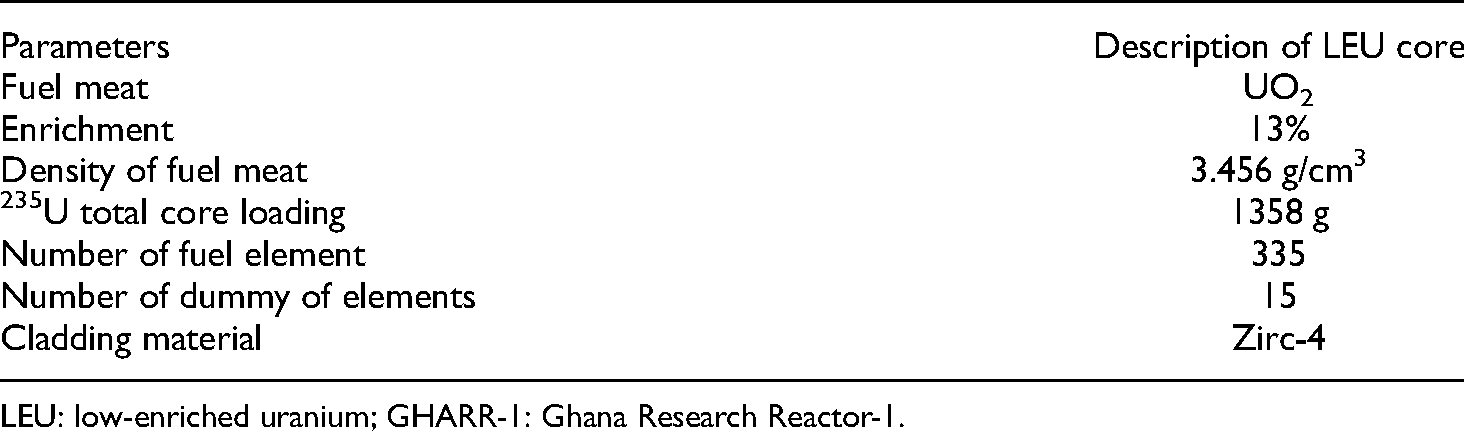
The GHARR-1 is a commercial version of the Miniature Neutron Source Reactor (MNSR) and belongs to the class of tank-in-pool reactors. 7 The thermal power of the facility is 34 kW with a corresponding peak thermal neutron flux of 1.0 × 10¹² n/cm2·s. For fresh core, its cold clean excess reactivity is 4 mk. Moderation is achieved by natural convection using water. Presently, the GHARR-1 core consists of low enriched uranium (LEU) fuel elements (UO2 alloyed) arranged in 10 concentric rings around a central control rod guide tube, which houses the reactor's only control rod. The control rod's reactivity worth is 7 mk, providing a core shutdown margin of 3 mk. The core has a low critical mass of 1.358 kg. The relative negative temperature coefficient of reactivity has the capability of enhancing its inherent features for safety. Due to its inherent safety features, stability of flux and moderate cost, the MNSR has enormous application in various fields of science particularly in the determination of trace elements in matrices of biological and environmental samples, 8 soil fertility studies and geochemical mapping. Figure 1 shows a schematic diagram of GHARR-1 configuration while Table 1 gives a detailed composition of the fuel meat for the LEU core of GHARR-1. A detailed description of the reactor is presented elsewhere. 9

Vertical cross-section of Ghana Research Reactor-1 (GHARR-1) reactor.
Composition of the fuel meat for LEU core of GHARR-1.
LEU: low-enriched uranium; GHARR-1: Ghana Research Reactor-1.
Theory
MCNP theory
This study employs computational neutronic and atmospheric dispersion codes for nuclear reactor core depletion analysis and dose estimation. MCNP was used for calculating the neutron flux and reaction rate. The calculation of neutron-induced activities requires as a first step, knowledge of the spatial and energy distributions of the neutron flux throughout the system. The neutron flux is then used to determine the individual reaction rates of the parent radionuclides whose daughters give rise to the ionizing radiations. These reaction rates are then used to obtain the level of activity per unit weight of the parent element according to the reactor irradiation history and the subsequent decay time. The inventory calculation requires the input of component averaged neutron fluxes together with specific material compositions and activation cross-sections. The MCNP general mathematical expression for time-dependent linear Boltzman transport equation is as follows:



Source-term analysis
ORIGEN2.1 is a neutronic computer-modeled one-group depletion and radioactive decay code developed at the Oak Ridge National Laboratory (ORNL). The code was used for the depletion analysis to study the burn-up of the reactor fuel and the number of radionuclides and their activities present in the core.
10
The code was chosen due to its faster convergence factor and performance of calculations on all possible fission products along the chain.
11
In general; the mathematical expression is as follows.
The dispersion model analysis
Hotspot code was used to carry out the dispersion trajectory analysis. The Hotspot code is a health physics code created by the Lawrence Livermore National Laboratory. It provides health physics personnel with a fast, field-portable calculation tool for evaluating accidents involving radioactive materials.
12
The atmospheric dispersion models used by HotSpot software are a first-order approximation of the radiation effects associated with the short-term (less than a few hours) atmospheric discharge of radioactive materials. They are designed for near-surface releases, short-range (<10 km) dispersion, and short-term (<24 h) emission in unobstructed terrains and simple meteorological conditions. The merit of employing a Hotspot code in this study is that the code is capable of estimating detailed accident conditions, transport of radionuclides and dose calculation after the accident through the use of detailed physical models. One main reason why Hotspot code is more useful to researchers in the accident assessment field is the ability for the system code to perform both transport and diffusion models for radiological releases. At close-in to the release point, the straight-line Gaussian plume model is adopted while for further away distance from the release point, the code switches to a Lagrangian puff model.
13
Figure 2 shows the geometry of a Gaussian plume. The Hotspot code is a first-order approximation of the radiation effects associated with the atmospheric release of radioactive materials. The mathematical expression employed in the Gaussian plume model is as follows.

Geometry of a Gaussian plume.
Materials and method
The IAEA TECDOC-400 provides a general approach and safety recommendations guiding principles for all nuclear research reactors on methods and practices for source term assessment and its radiological effects. The guidelines recommend a multi-step approach which includes the following: (a) reactor core fission product inventory calculation; (b) selection of hypothesized initiating event and ascertaining the effects of the accident; (c) reactor core damage and its assumptions associated with the initiating event; (d) source-term derivation from reactor core damage to the external environment; (e) definition of meteorological parameters used for calculating the doses; (f) calculation of doses for the accident sequence and for every weather situation; (g) estimates of radiological effect outside the reactor facility building. Figure 3 shows the flow diagram of the steps followed in this study. 14
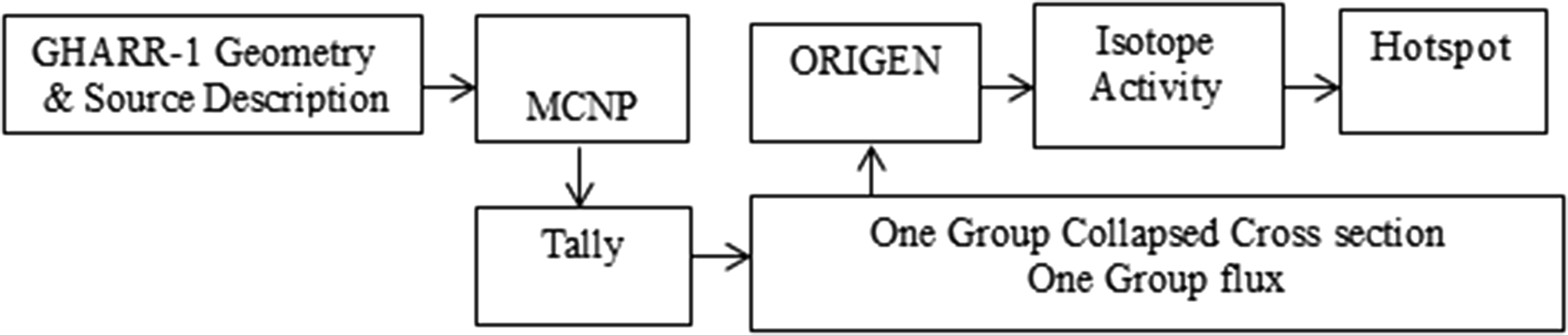
Flow diagram for MCNP/ORIGEN and hotspot methodology. MCNP: Monte Carlo N-particle transport; ORIGEN: Oak Ridge isotope generation-2.
Meteorological conditions at the site of GHARR-1
The GHARR-1 facility is at the site of the Ghana Atomic Energy Commission (GAEC). GAEC is located at the north-western part of Accra, the capital city of Ghana at longitude 5° 40′ N and latitude 0° 13′ W. Within a radius of 400 m in the GHARR-1 site are located the administration building and various laboratories of GAEC. Site meteorological data collected from the Ghana Meteorological Agency database and the GAEC weather station were analyzed. The cup anemometer was used for monthly data collection and analysis for 16 directional sectors Observations from different wind roses showed that the predominant direction is the West (W), which occurs for 66.6% of the total time of the day. South West and South-South West directions also have 16.6% of occurrence each respectively. In the dominant wind direction, the records indicate that the maximum wind speed is 6.7 m/s occurs in the month of August The annual average wind speed of 4.1 m/s was observed. 15 Atmospheric stability classification is required to quantify the dispersion capabilities of the ambient atmosphere in the air quality models for concentration predictions. Data were processed from mean daily wind speeds considering the solar insolation (sun high in the sky). It is observed that stability class B is predominant with 50% of occurrence, followed by class C with 33.3%, and class A with 16.7% for a 10-year period, 2010–2020. Table 2, shows meteorological criteria used in this study to describe the Pasquill–Gifford atmospheric stability classes.
Pasquill–Gifford atmospheric stability classes.

Source term
The study was carried out by estimating the possible radionuclides and their respective activity in the LEU fuel using the ORIGEN code. Key parts of the input deck include the nuclide identity, composition of the nuclide, and the results desirable as well as specific neutron and gamma energies desirable. The input deck was also set up to track the photon production rate in 39 energy groups. The average burnup, flux, and specific power for irradiation were calculated. The required neutron flux and relative power were specified for irradiation of a single interval. Decay of a single interval was also specified. The power history of GHARR-1 used was 17 kW. It was assumed to operate for 6 hours a day, 4 days a week, 4 weeks a month and 11 months in a year. A cumulative number of operating days was used. The decay time in steps of 10 was used in order to monitor the short-lived radionuclides. The average of running power, especially the historic operation was determined and used. At the end of life of the fuel cycle, finer detail depletion is desirable but the historic operation would have lost its entire short-lived isotope; hence coarse detail depletion is more convenient (40 years, 10 months, 10 weeks, 1 week and the last 5 days to the core removal). The flux spectrum of the reactor which was obtained from a pre-processed cross-section from MCNP was used.
Accidental release scenario
Non-state actors cannot mostly manufacture their own nuclear material, hence attacking a facility where high enriched uranium (HEU) or LEU fuel is housed is a potential means to obtain the materials necessary to build a nuclear device as a radiological dispersal device or a radiological exposure device. In other cases, they do that just for retaliation or when their demands are not met from a political point of view. In this study, a hypothetical accident scenario was assumed; that a well-trained and heavily equipped terrorist attacker with a help of insiders (Facility security personnel) at the entrance of the facility. They posed as a security installation company that has been tasked by the facility engineer to install a closed-circuit television (CCTV) camera at the facility. With the help of the information given by the insider, they were able to locate all the emergency auxiliaries of the facility. The attackers turned on the emergency ventilation system and the gas purged system of the reactor. They went ahead to disengage the CCTV camera and open the cover of the reactor vessel. They installed a well-designed explosive of a reasonable quantity in the reactor vessel which was later exploded at a certain predetermined time after they have left the facility. It is assumed that the explosion resulted in the release of some radioactive materials from the fuel to the containment/reactor building. The gas purge system failed because it was tampered with by the attackers which resulted in fission product being released through the ventilation exhaust vent. Radioactive nuclides from the exploded reactor core escaped through the stack in the form of gas and particulate and then dispersed into the atmosphere.
Evaluation of radiation dose
Some important isotopic inventory that was based on the health and environmental consequence was selected after the core depletion analysis. 16 Four out of the many isotopes namely, I-131, Sr-90, Cs-137, and Xe-137 were selected for the studies based on the detrimental effect they can cause to human health and environment. When large amounts of the radioisotopes mentioned above are released into the environment; they can affect the food chain by either falling onto the surface of foods like fruits and vegetables or animal feed and into water bodies as deposits from the atmosphere or through contaminated rainwater. These radionuclides can also accumulate in rivers and seas, affecting fish and other seafood. Once in the environment, radioactive material can also be absorbed into food as it is taken up by plants, seafood or ingested by animals.17,18 The study evaluated the risk for short-term releases of radionuclides. The accident source term for the GHARR-1 LEU fuel is shown in Table 3. Radioactive nuclide inventories were estimated for material groups, i.e., activation products, actinides and daughters, and fission products.
Some selected radionuclide inventory in the low-enriched uranium (LEU) core at reactor shutdown.
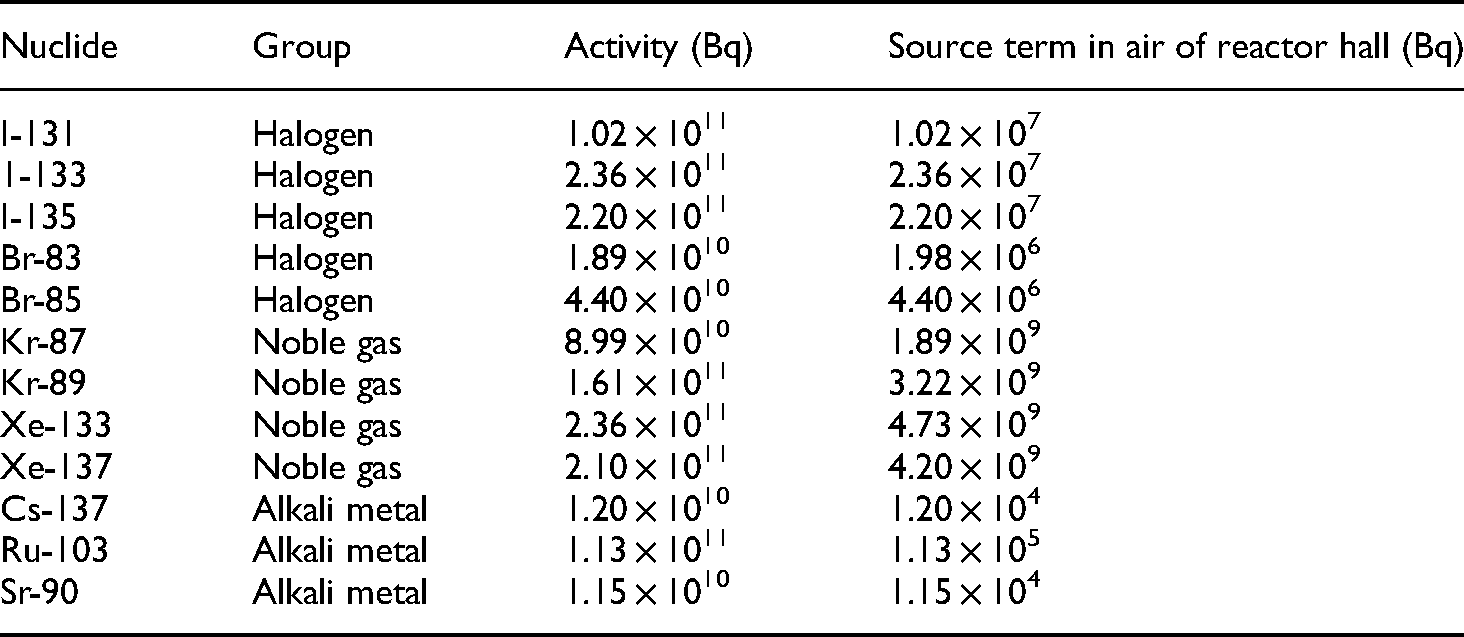
The isotopes generated from the output of the depletion code were used as part of the input deck of the Hotspot atmospheric dispersion code for radiological dose calculations. The release fraction is the number of radionuclides released from primary confinement in dispersible form. Release fractions established in technical information document (TID 14844) to allow calculation of doses for comparison with 10 CFR 100, the Nuclear Regulatory Commission's (NRC's) regulations, on “Reactor Site Criteria,” which provides a benchmark for doses from radioiodines and other radionuclides released to the atmosphere was adopted for the studies. 19 Moreover, the source term for radionuclides in the air of the reactor hall is determined as the estimated inventory of fuel rod with maximum U235 burnup period: the transfer factor from fuel material to the matrix material, the transfer factor from matrix material to water, and the transfer factor from water to air. However, since specific factors for each of these transfers are not available, a combined factor for the transfer of fission products from the fuel matrix material to the air of the reactor building was adopted. 20 In setting up the Hotspot code input deck, the Hotspot code source term model unit was modified to correspond to the activity of the radionuclide generated in the ORIGEN2 code. A file was created in the Hotspot code for the mixture of all the selected radionuclides of interest to be simulated. For the theoretical modeling of wet deposition in many applications, the Hotspot code simply combines the rainout and washout and treats it as a single removal process. The precipitation coefficient values of rain rate of 0.5 mm/h and a rainout coefficient of 0.0001 /s were specified. For dry deposition, the HotSpot code uses a source-depletion algorithm to adjust the air concentration in the plume. Subsequently, plume rise information was specified. In the meteorology unit of the Hotspot code; the wind speed, wind direction and the atmospheric stability class were also specified as well as the coordinated location designations. The setup model unit provided input for site topography and source geometry specification. Table 4 shows the plume raise input parameters in the Hotspot code.
Plume rise input parameters.

Result and discussion
TEDE results and analysis
The radiological characterization of radiation doses for the sum of four selected radionuclides were estimated using the site-specific meteorological conditions and taking into account the contribution of four radionuclides, which were considered important for plume dose calculations. Dry and wet weather conditions for two atmospheric stability classes, A and C have been considered in this study. The atmospheric dispersion and airborne radionuclide concentrations after the described hypothetical accident were calculated using the Hotspot code. The Hotspot code estimates the TEDE which consists of both internal and external dose equivalents for the body resulting from the release of radionuclides during the accident over 24 h time-integrated period. The study does not consider radiation exposures that will exceed levels where tissue effects (or acute radiation damages) may occur, therefore late or stochastic effects were not considered in their assessment. Thus, TEDE is the computational summation of both effective dose equivalent and the total CEDE. The TEDE, the ground deposition activity and the respiratory time-integrated air concentration were estimated as a function of downwind distance as presented in Table 5. At a time of less than one second the maximum TEDE, respiratory time-integrated air concentration and the ground deposition activity of 5.6 × 10⁻⁹ Sv, 3.1 × 10⁵ Bq-sec/m3 and 1.4 × 10⁻³ kBq/m2, respectively, at the downwind distance of 0.1 km for stability class A for dry weather was observed at an arrival time of 0.1 s for the selected radionuclides. At the 1 km downwind distance, TEDE, respiratory time-integrated air concentration and the ground deposition activity of 1.2 × 10⁻¹⁰ Sv, 3.8 × 10³ Bq-sec/m3 and 7.8 × 10⁻⁵ kBq/m2 are respectively observed at an arrival time of 0.5 s for the selected radionuclides.
Downwind distance and other plume parameters for stability class A for dry weather.

These results indicate that no worse initiating accident with this type of LEU reactor core will have a threat to human activities within and beyond its physical borders. In comparison with earlier studies,21, 22, 23 it can be seen that the above-estimated radionuclides and their respective doses for the postulated design basis accident and atmospheric transport calculation remain within and far below the acceptable regulatory limits of 1 mSv per year. The results were in good agreement with other researchers.
These dose levels would be received by an individual standing at ground level that remained within the plume coverage for the entire period of cloud passage. Multiple pathways are available for radiation absorption. For example, TEDE includes the plume passage inhalation and submersion and ground shine.
The TEDE contour plot distributions under the plume are shown in Figures 4 and 5 for stability classes A and C for dry weather and in wet weather. The contour distribution is shown in Figure 4(a) shows the stability class A dry weather condition; three zones with the areas of 0.03, 0.32, and 2.4 km2 have been marked with a dose of 1.0 × 10⁻⁹, 1.0 × 10⁻¹⁰, and 1.0 × 10⁻¹¹ Sv, respectively. For the same stability class A but for wet weather conditions as shown in Figure 4(b), the three zones had a distance of 0.029, 0.25, and 1.4 km2, respectively, with the dose values the same as the wet weather condition. Also, in Figure 5(a) for stability class C for dry weather, three zones with areas 0.063, 0.70, and 8.2 km2 have been marked with 1.0 × 10⁻⁹, 1.0 × 10⁻¹⁰, and 1.0 × 10⁻¹¹ Sv, respectively. For the same stability class C but for wet weather conditions as shown in Figure 5(b) the three zones with areas 0.049, 0.44, and 2.3 km2 have been marked, respectively, with the dose same as stability class A. The TEDE contour plots results indicate that for both dry and wet deposition considering their respective inner, middle, and outer; the doses are quite similar except for the downwind distances which have some variance. The results indicate that either dry or wet weather the TEDE contour plume effect poses marginal effect under slightly or very unstable conditions.
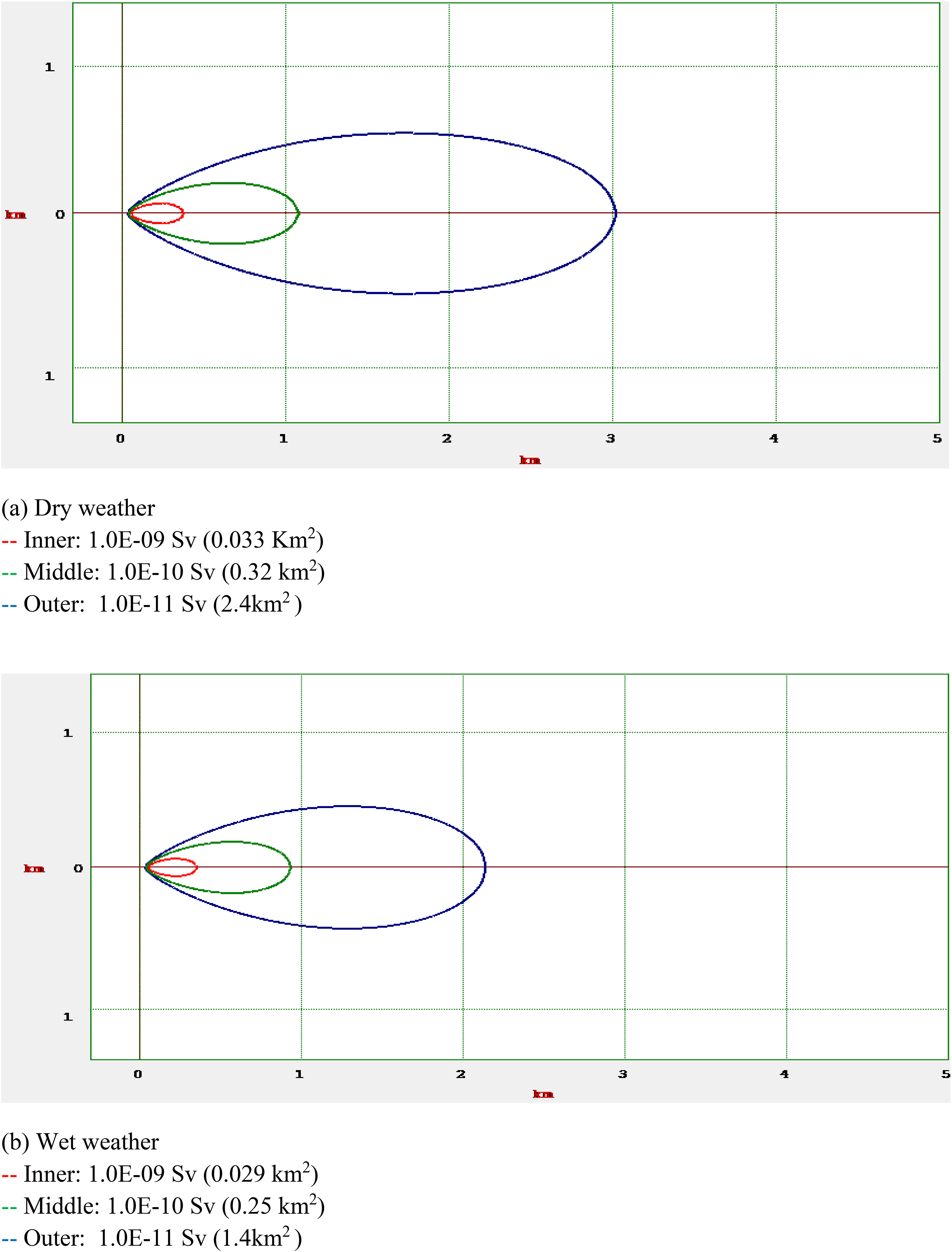
Total effective doses equivalent (TEDE) contour plot Pasquill stability class A.

Total effective doses equivalent (TEDE) contour plot Pasquill stability class C.
The red-colored zone depicts a higher dose risk for personnel and population; the green and blue zone are less risky compared with the red area. The contour TEDE values at distances of 0.03 km and beyond where public occupation is likely to be found are far below the annual regulatory limits of 1 mSv for the public even in the event of a worst-case accident scenario as proposed by ICRP 103.24,25
Figure 6 shows the ground deposition plume contour modeling for stability classes A and C for wet weather. The ground deposition for both classes A and C indicates a significant increase. In the Hotspot code option for wet deposition; the code models the effect of precipitation by exponentially decreasing the radionuclide concentrations. The washout results in less fraction of pollutants being left in the plume as it travels further.

Ground deposition plume contour plot for Pasquill stability classes A and C wet weather.
Figures 7 and 8 show plume centerline plots for the TEDE in sievert (Sv) as a function of downwind distance in kilometers (km) for stability classes A and C, respectively, in both dry and wet weathers. The maximum dose value for stability classes A and C at a distance of 0.1 km is 1.0 × 10⁻⁹ Sv, respectively. The TEDE first increases with increasing downwind distance reach the maximum value and then decreases. Furthermore, it was observed that in the wet deposition the washout effect decreased the plume concentration of the pollutant and restricts the pollutant from traveling further away from the point of release.

Plume centerline total effective doses equivalent (TEDE) as a function of downwind distance for Pasquill stability class A.

Plume centerline total effective doses equivalent (TEDE) as a function of downwind distance for Pasquill stability class C.
Ground deposition activity distribution as a function of downwind distance for stability class A for dry and wet weather is shown in Figure 9. The maximum dry weather ground deposition activity of 1.0 × 10⁻³ kBq/m3 occurred at about 0.5 km. For wet weather conditions, a maximum of 1.0 × 10² kBq/m3 was estimated at a distance of 0.01 km. This indicates that the impact of precipitation on the dispersion of radioactive cloud is more significant on the surface of the ground as deposition increase with wet weather in comparison with dry weather.

Ground deposition activity as a function of downwind distance for stability class A for ground-level release.
Figure 10 shows the plume centerline ground deposition for stability class C for dry and wet weather conditions. Estimated maximum deposition activity values are obtained within a few seconds at various short distances such as the distance of 0.01 km, a maximum deposition activity of 1.0 × 10⁻³ kBq/m3 was estimated. However, for wet weather for the same stability class C activity of 1 × 10³ kBq/m3 was observed at a distance of 0.01 km. From the wet weather conditions, it was observed that the indirect effect of precipitation causes mostly the pollutant to increase the pollution concentration at the point of release.

Ground deposition activity as a function of downwind distance for stability class C for ground-level release.
Organ CEDE results and analysis
Figure 11 shows the CEDE distribution for different organs as a result of the release of four radionuclides as a function of downwind distance for stability class A in dry weather conditions. In Hotspot also, CEDE is calculated by the traditional method, that is by integrating the committed dose equivalents throughout 50 years for different tissues and organs of the body, and an appropriate multiplication of tissue weighting factor, (WT) has been used for each committed dose equivalent. All the target organ CEDE plots are having a similar Gaussian trend, as they deplete with distance from receptor location. In the order of magnitude, the organ with the highest CEDE value is the thyroid followed by skin, red marrow and surface bone of about 8.4 × 10⁻⁸, 4.0 × 10⁻⁸, 3.0 × 10⁻⁹, and 5.5 × 10⁻⁹ Sv, respectively, at a downwind distance of 0.1 km. It can be deduced that these organs are more radiosensitive to the radionuclides emitted as a result of the accident.

Organ committed effective dose equivalent (CEDE) profile due to release of four selected nuclides for Pasquill stability class A.
Following the resultant release of the four radionuclides, it can be seen that the major radionuclide contributing to the CEDE is I-131. Figure 12 shows organ CEDE profile due to Sr-90 on surface bone, skin, red marrow and thyroid for dry weather release. The maximum CEDE is 2.30 × 10⁻¹⁰ followed by 1.00 × 10⁻¹⁰ Sv for surface bone and red marrow, respectively, at a distance of 0.1 km. It shows that surface bone is more sensitive to Sr-90 than the other organs.
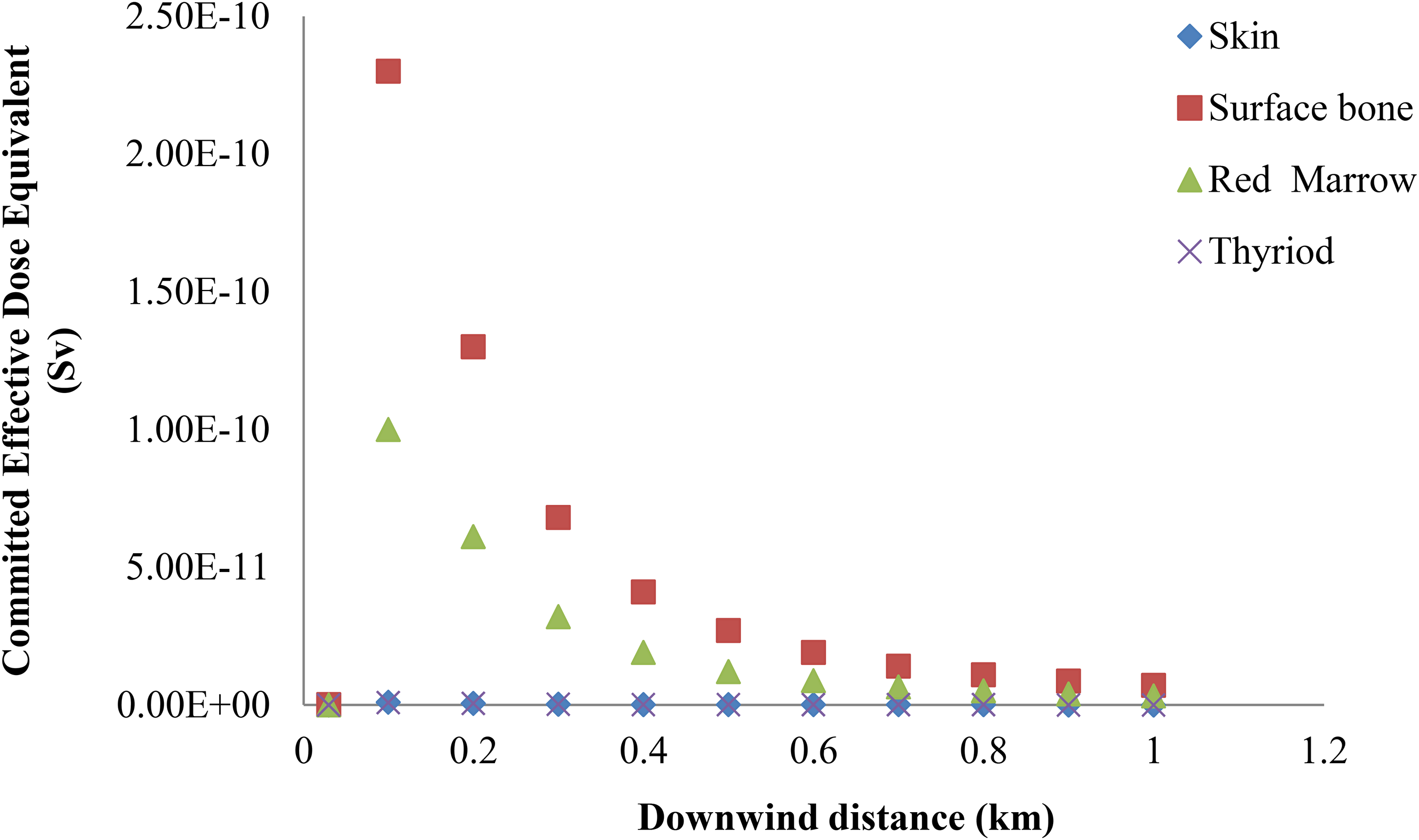
Organ committed effective dose equivalent (CEDE) profile due to Sr-90 release for Pasquill stability class A.
Figure 13 shows the CEDE profile as a function of downwind distance for the impact of 1-131 on the skin tissue, surface bone, red marrow and thyroid for dry weather release. The result shows that the most sensitive organ to receive much CEDE dose from I-131 is the surface bone gland which had an estimated maximum dose of 4.8 × 10⁻⁸ Sv at a distance of about 0.2 km. The rest of the organs show far less sensitivity to the releases of I-131.

Organ committed effective dose equivalent (CEDE) profile due to I-131 release for Pasquill stability class A.
Figures 14 and 15 show the CEDE profile as a function of downwind distance for the release of Cs-137 and Xe-137 on the skin tissue, red marrow, surface bone and thyroid gland. The result for Cs-137 shows that the skin has a high affinity with a CEDE estimated maximum value of 4.0 × 10⁻⁸ Sv followed by surface bone. However, red marrow and thyroid glands showed very low sensitivity. The maximum CEDE estimated value for the release of Xe-137 is 2.7 × 10⁻¹² Sv at 0.1 km. The organ most sensitive is red marrow followed by surface bone and thyroid as the skin showed less affinity to the release of Cs-137. These radionuclides undergo diverse chemical reactions when they enter the human body, thus indicating major and serious health issues. Hence; it is important to institute protective actions to avoid inhalation and ingestion of these radionuclides during nuclear accidents. It is also recommended that authority for decision-making and for protective actions implement sheltering, evacuation and the administration of stable iodine prophylaxis that can protect specifically against internal exposure from inhalation and ingestion of radioiodine.

Organ committed effective dose equivalent (CEDE) profile due to Cs-137 release for Pasquill stability class A.

Organ committed effective dose equivalent (CEDE) profile due to Xe-137 release for Pasquill stability class A.
Conclusions
An assessment of a radiological consequence considering a hypothetical accident scenario using GHARR-1 as a case study has been performed. In assessing the radiological consequence of GHARR-1, neutronic codes and atmospheric dispersion modeling code base on the site-specific meteorological conditions were employed. The TEDE, the respiratory time-integrated air concentration and the ground deposition activity are estimated. The maximum TEDE value of 5.6 × 10⁻⁹ Sv was estimated while the maximum dry weather ground deposition activity of 1.0 × 10⁻³ kBq/m2 which corresponds to 0.1 km for stability class A was also estimated. An estimated maximum ground deposition activity of 1.0 × 10³ kBq/m2 in stability class C for the same modeling parameters, but in wet weather deposition was observed. It was observed that the major radionuclide contributing to CEDE for resultant release of all four radionuclides is I-131, and the most radiosensitive organs are the thyroid, followed by skin, surface bone and red marrow. The results further show that for the individual release of I-131, Sr-90, Xe-137, and Cs-137, the organs that were more sensitive to radiation were thyroid, surface bone, gland, skin, and red marrow, respectively. The results were in good agreement with other researchers. The estimated TEDE is below the allowable maximum public annual dose limit of 1.0 mSv proposed by ICRP 103 and in IAEA GSR part 3. It is recommended to take protective measures to avoid inhalation and ingestion in the event of accidents since these radionuclides could be detrimental to the health and safety of humans and the environment. The radiological data provided in this study can be analyzed and incorporated as a well-defined provision for safety management during a terrorist induced accident at the GHARR-1 facility.
