



Abstract
In this research, the electro-osmotic effects are highlighted for a blood-based hybrid nanofluid flow across an artery infected with multiple stenosis. The artery has permeable walls together with slip boundary effects. The slip and permeable boundary conditions model the more realistic blood flow problems. The governing equations of the problem are converted into non-dimensional form by introducing adequate dimensionless variables and acquired the exact solutions. The detailed study of heat transfer is given by Joule heating and viscous dissipation effects. The disorder of fluid flow is investigated by the mathematical study of entropy generation. Analytically attained solutions are examined graphically for both symmetric and non-symmetric shapes of stenosis. Streamlines are analyzed for varying values of flow rate Q and electro-osmotic parameter m. The flow velocity has smallest values on the axis of channel and gets higher value near the boundary walls. The temperature profile delineates opposite behavior to the velocity, and it is parabolic in nature. The velocity reduces towards the non-uniform stenosis except for electroosmotic parameter m. The temperature has larger magnitude in the case of anti-symmetric stenosis. Moreover, the stability of velocity solution is also analyzed.
Introduction
Blood flow is restricted across stenosed arteries that are damaged. This stenosis develops as a result of plaque buildup on the artery walls caused by fats and oils. An artery affected by stenosis terribly may have multiple stenosis. Due to the existence of multiple stenosis the blood artery narrows, and it limits the blood flow across it. The analysis of this kind of stenotic artery has recently picked the curiosity of many researchers. In large vessels, blood depicts Newtonian behavior as well as it shows non-Newtonian behavior while flowing through small vessels.1–5 The examination of blood flow across a stenotic vessel is crucial due to the characteristics of blood circulation and mechanical properties of the walls of the vessel. The blood flow across a stenotic artery enables us to understand the flow behavior via diseased blood vessel and locate the position of stenosis on the vessels wall. Ponalagusamy 6 was the first who had described the behavior of blood flowing through an artery affected by stenosis in his doctoral dissertation. The transient blood flow across tapering tubes is described by using power law model. 7 The mathematical analysis of non-Newtonian fluid through a channel is given by Varshney et al. 8 The study of carbon nanotubes through an artery damaged by several stenosis, seeing the case of changing viscosity is presented by Nadeem et al. 9 Saleem et al. 10 studied blood flowing via an artery damaged by stenosis having catheter and blood clot in the middle of channel. The transient blood flow across a stenosed artery is examined by Hisham et al. 11 Kadhim et al. studied the influence of non-Newtonian model on properties of blood flow through a left coronary artery with presence of different double stenosis. 12 Jamil et al. described the effects of magnetic Casson blood flow in an inclined multi-stenosed artery by using Caputo-Fabrizio fractional derivative. 13
The nanofluid is the kind of fluids that consists of nanometer sized particles (known as nanoparticle) in the base fluids. The base fluid containing two or more nanoparticles is called hybrid nanofluid. These nanoparticles are scattered in base fluid for improving its thermal efficiency. Turcu et al. 14 disclosed the production of hybrid nano-composite particles. Akbar et al. 15 evaluated the CNT flow inside a channel with a sinusoidally vibrating wall. Theoretical investigation of Jeffrey nanofluid flow across an oscillating stretching sheet with an unsteady oblique stagnation point is given by Awan et al. 16 Heat and mass transfer examination of CNT-based nanofluid and hybrid nanofluid over various geometries is given by Upreti et al.17,18 Rathore and Srikanth provided the mathematical study of transport phenomena of blood nanofluid in a diseased artery subjected to catheterization. 19 Karami and Nadooshan examined the power law nanofluid through tapered artery based on consistent couple stress theory. 20
The electroosmotic flow is a flow caused on account of an electric field applied over a channel and electric double layer (EDL) existence at boundary walls. Reuss 21 first reported on the electroosmotic flow study, and he demonstrated the flow of water across a plug of clay by applying a proper electric voltage. The electroosmotic flow is used for DNA analysis, and it has a lot of applications in medicine for cure of illnesses like sickle cells, drugs delivery, cellular anomalies. 22 It is also applied for separation techniques like separation of plasma from the blood and utilized in biological agent detectors. Using the Debye-Hunkel assumption, Afonso et al. 23 investigated the electrokinetic and pressure driven flow of fluid having viscous and elastic properties. Zhao and Yang 24 studied electro-osmotic flow on a nanoscale, where they investigated electro-osmotic influences on a power law fluid across a micro channel. Ferras et al. 25 examined viscous fluid flow through an annular region with electro-osmotic effects. Nadeem et al. 26 probed the electro-osmotic flow of the Bingham plastic fluid across a channel with very small length. Awan et al. 27 analyzed the flow of an Oldroyd-B fluid flowing among parallel plates. Salman et al. 28 studied non-Newtonian flow behavior of blood through arteries affected by several stenosis and electroosmotic effects. Akram et al. analyzed the electroosmosis augmented MHD peristaltic transport of SWCNTs suspension in aqueous media. 29 Sridhar and Ramesh studied peristaltic activity of thermally radiative magneto-nanofluid with electroosmosis and entropy analysis. 30
For describing the disorder of whole system, many researchers have been studying the entropy analysis mathematically. Akbar et al. 31 presented peristaltic flow with thermal conductivity of nanofluid and gave brief entropy analysis. Zhang et al. 32 explained entropy generation of blood flowing across tapered arteries filled with nanoparticles. The hybrid nanofluid flow through sinusoidally deforming channel is mathematically studied by Hayat et al. 33 Riaz et al. presented the entropy analysis for cilia-generated motion of Cu-blood flow of nanofluid in an annulus. 34 Abbas et al. gave the analysis of entropy generation on peristaltic phenomena of MHD slip flow of viscous fluid in diverging tube. 35
The current research is about the study of more realistic problem of the blood flow across a diseased artery. We have studied the flow nature of blood-based hybrid nano fluid through a diseased artery with permeable boundary wall and harmed by multiple stenosis. The fluid flows through the conduit due to the application of electro-osmotic effect and subjected with slip effects. The single-wall and multi-wall carbon nanotubes are taken as nanoparticles in the blood. The transfer of heat is studied in detail by considering the Joule heating effect. Exact solutions are found for mathematical equations by using Mathematica. Moreover, these results are explained in detail graphically. In order to observe the disorder of system, the entropy generation is studied. The flow behavior is also explained by plotting streamlines.
The mesh diagrams for this interesting arterial geometry are also included by Figure 1(a)–1(c) given as

Geometry of problem. (a) Mesh diagram of symmetric stenosis. (b) Mesh diagram of non-symmetric stenosis. (c) Mesh diagram displaying corner mesh view.
Mathematical modeling
The electro-osmotic flow of hybrid nanofluid through an artery harmed with several stenosis is considered. The hybrid nanofluid consists of blood as base fluid with single and multi-wall CNT in it. The mathematical expression for multiple stenosis wall geometry in dimensional form is given as
36














Exact solution
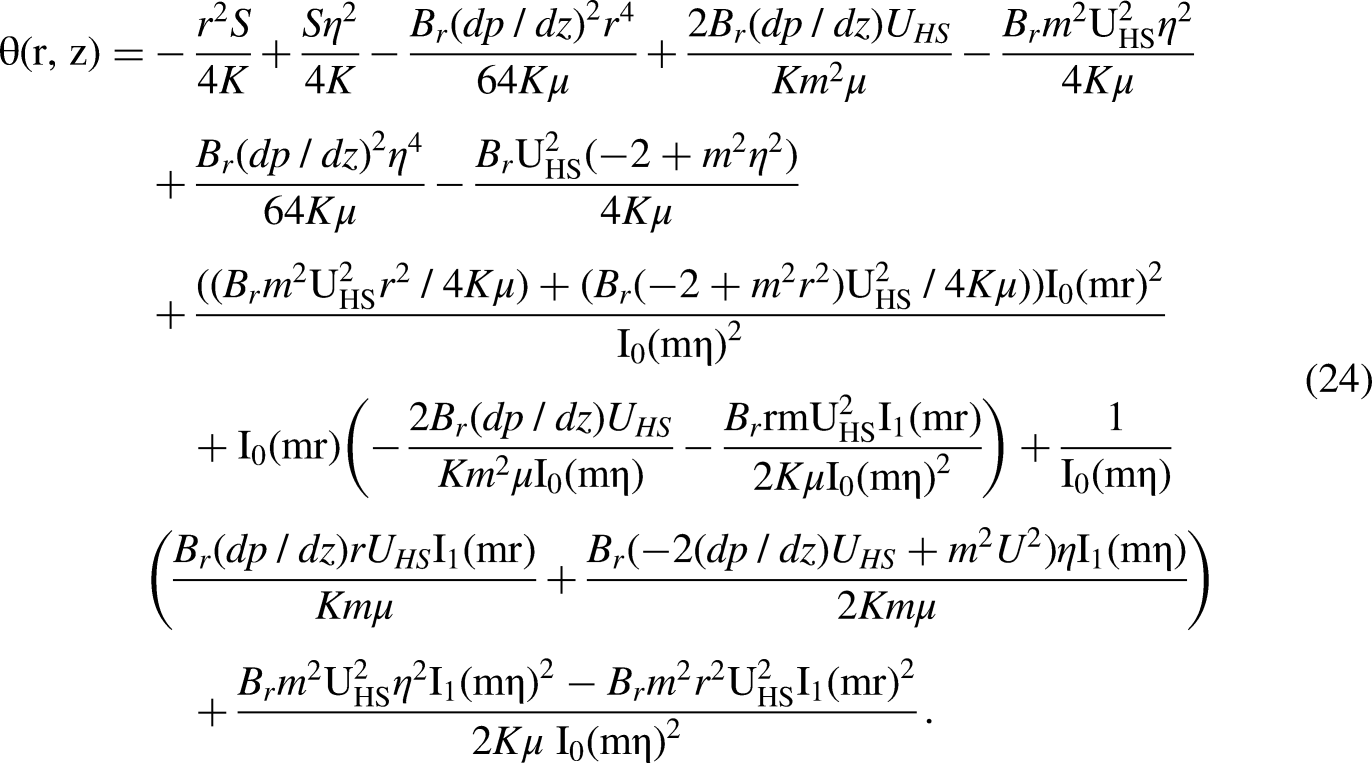
The axial velocity of flow can be expressed mathematically as

The volume flow rate is evaluated by using



Thermo-physical characteristics of base fluid and nanoparticles.

Hybrid nanofluid Model. 39

Entropy analysis
The mathematical expression in dimensional form is given as
40


Furthermore, the ratio of entropy because of conduction to the total entropy is known as Bejan number,
41

Results and discussion
This section includes the graphical explanation of analytical results attained in above portion. The influences of different physical parameters on the behavior of flow are inspected. The changes in behavior of flow for symmetric shape of multiple stenosis (i.e. n = 2) and anti-symmetric shape of multiple stenosis (i.e. n = 6) are also discussed. The graphs are plotted by computer coding on Mathematica 12. In Figures 2–7, the graphs are plotted for velocity
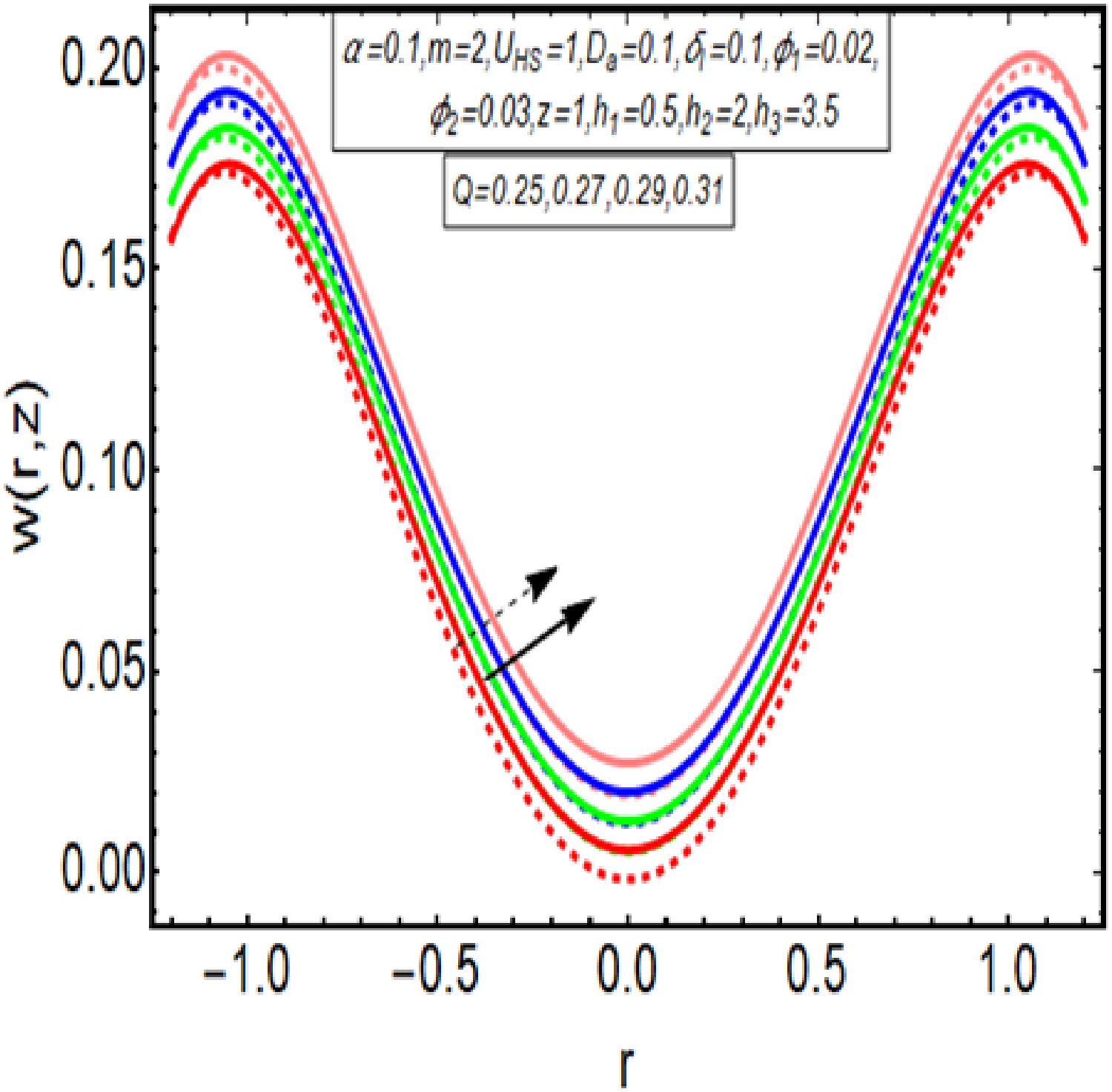
Velocity profile for Q.

Velocity profile for m.

Velocity profile for

Velocity profile for

Velocity profile for

Velocity profile for
Figures 8–13 provide the consequences of dependence of the wall shear stress on different physical parameters. It makes clear from Figure 8 that the wall shear stress
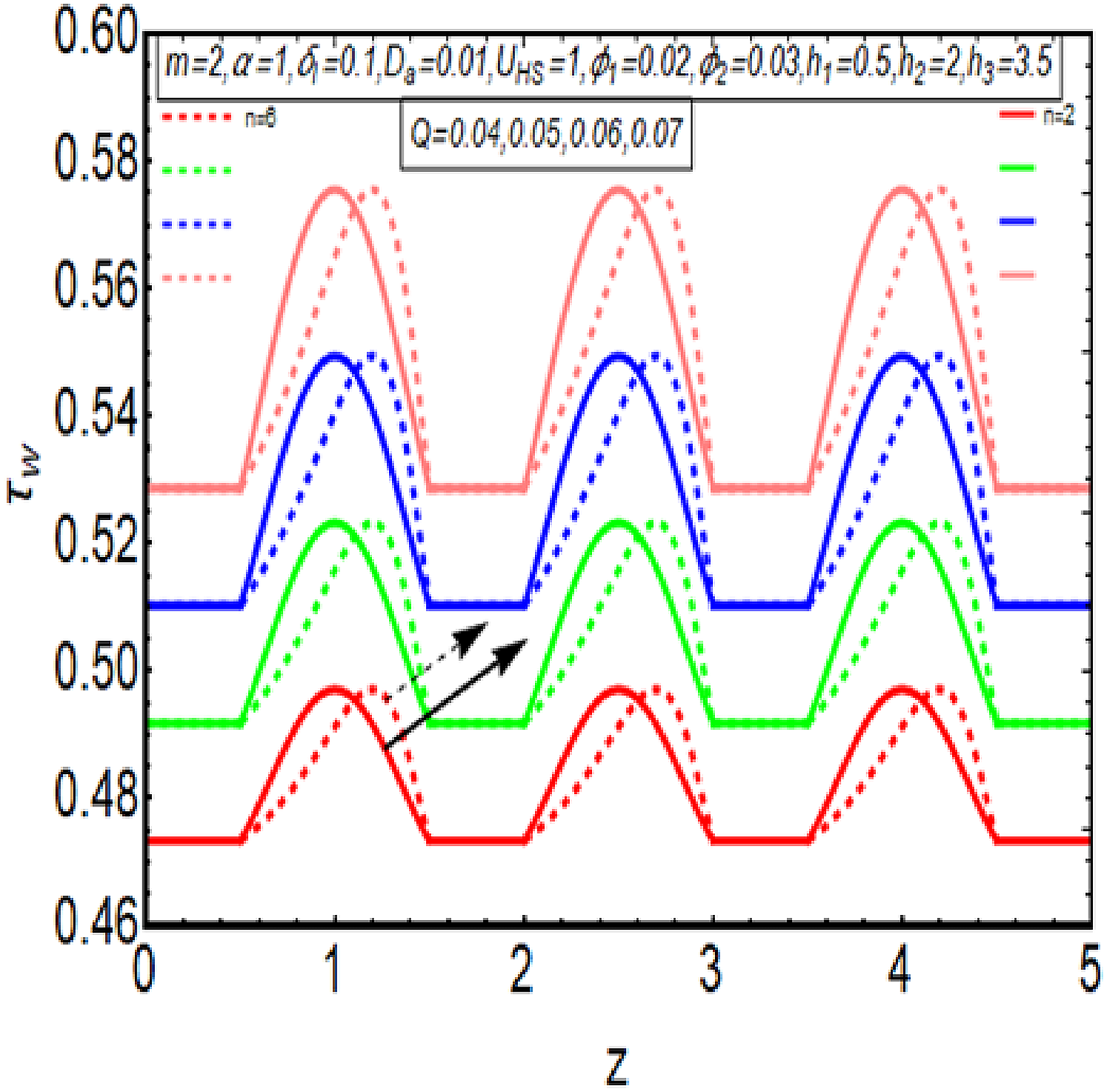
Shear stress for Q.

Shear stress for

Shear stress for m.

Shear stress for

Shear stress for
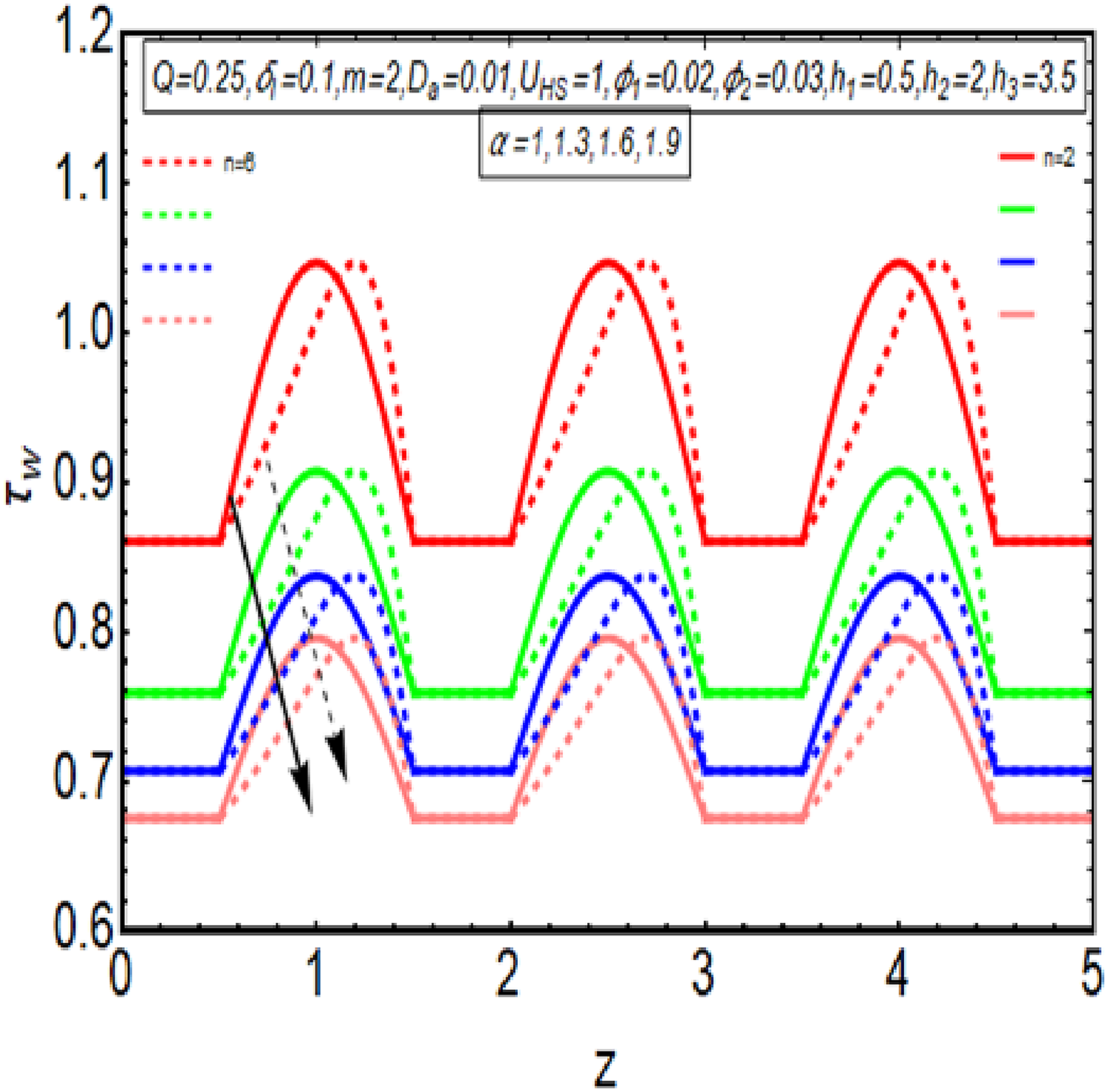
Shear stress for
Figures 14–19 give graphical representation of the temperature profile for several involved parameters. Figure 14 provides details about the temperature profile for increasing flow rate. It shows that the temperature enhances for rapid flow of fluid and having maximum altitude at the center of the channel. It begins to descend from center towards walls and vanishes at the boundary. Figure 15 demonstrates that temperature graph gets height for the larger values of

Temperature profile for Q.

Temperature profile for
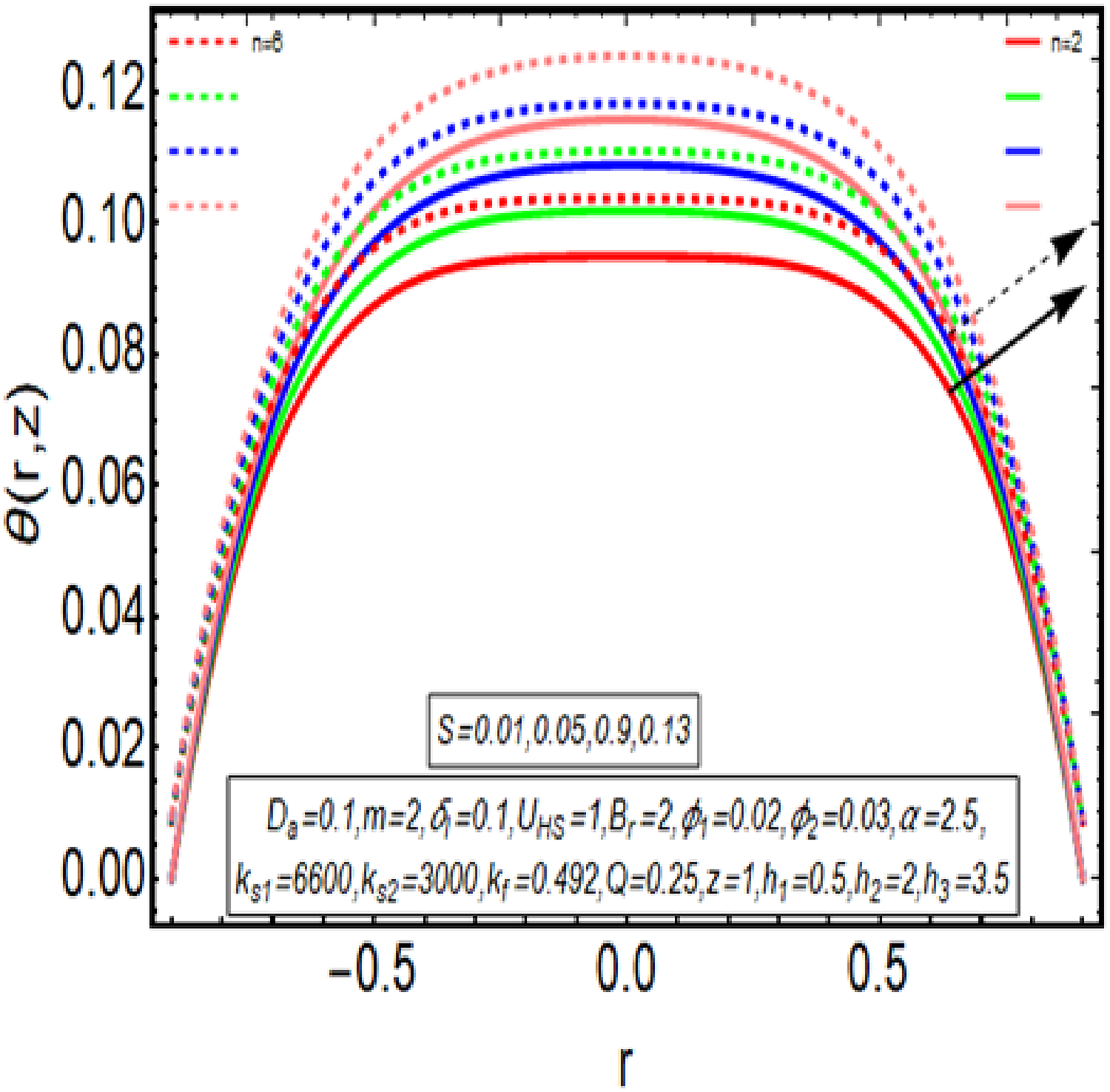
Temperature profile for S.

Temperature profile for
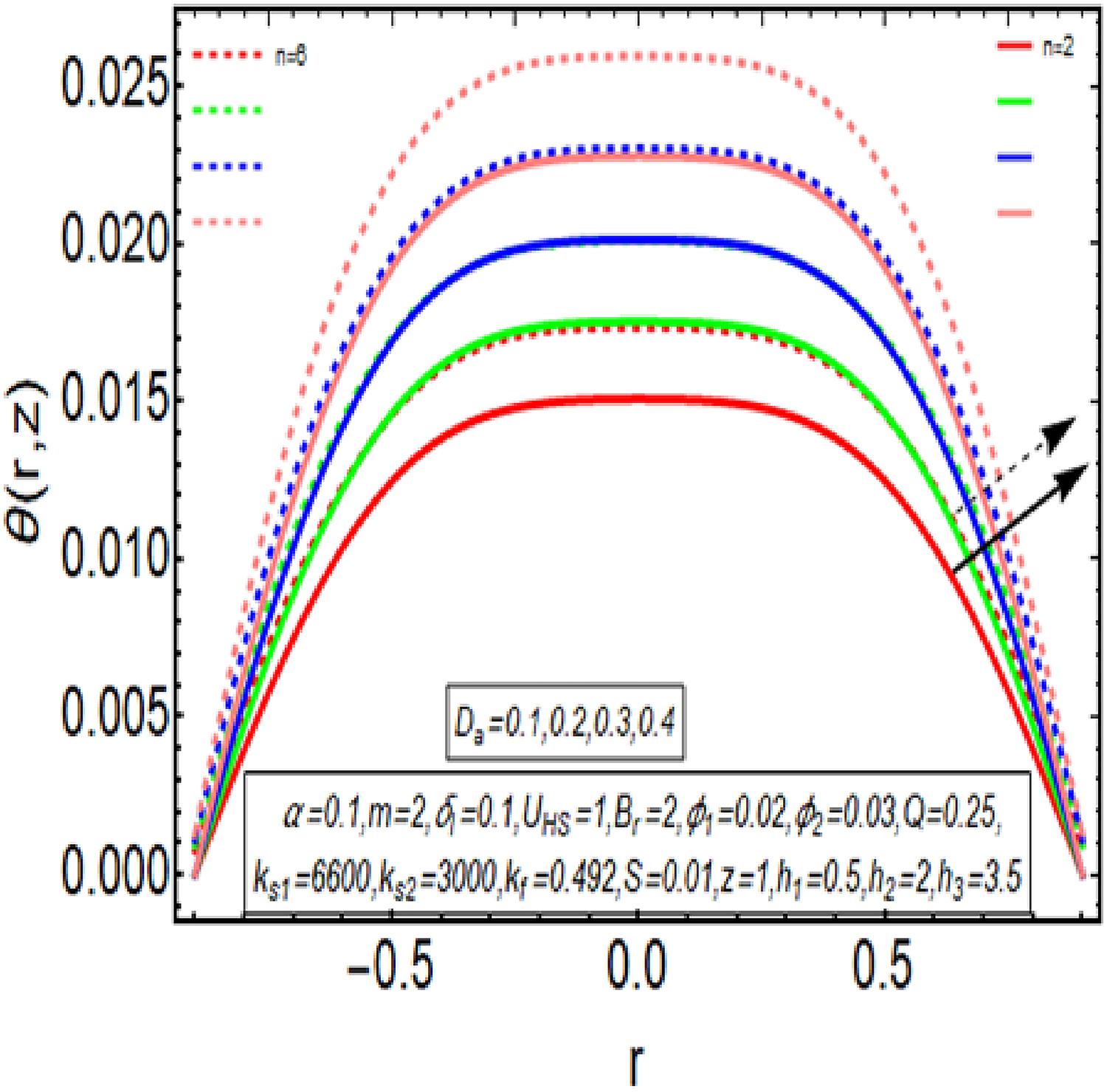
Temperature profile for
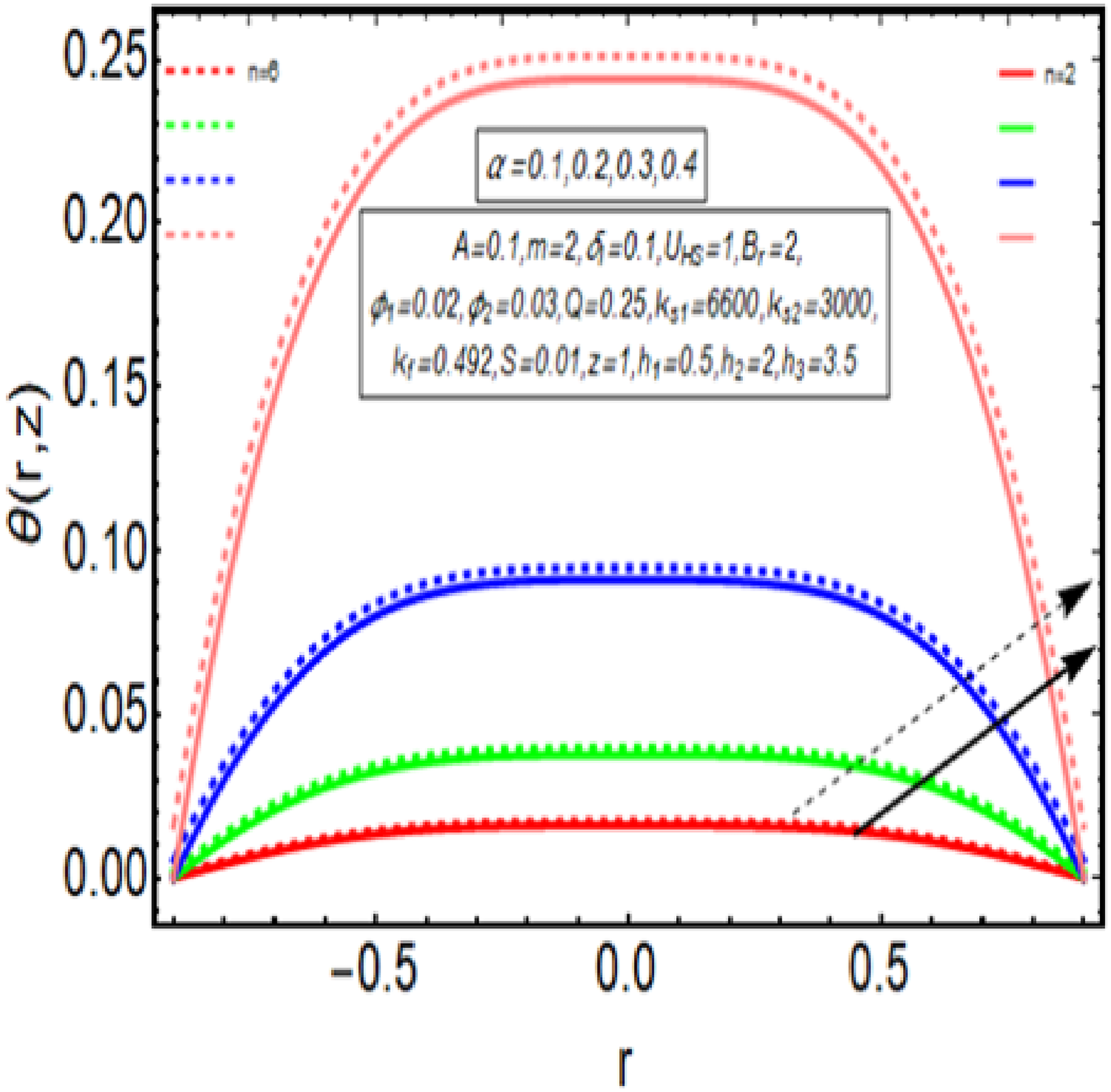
Temperature profile for
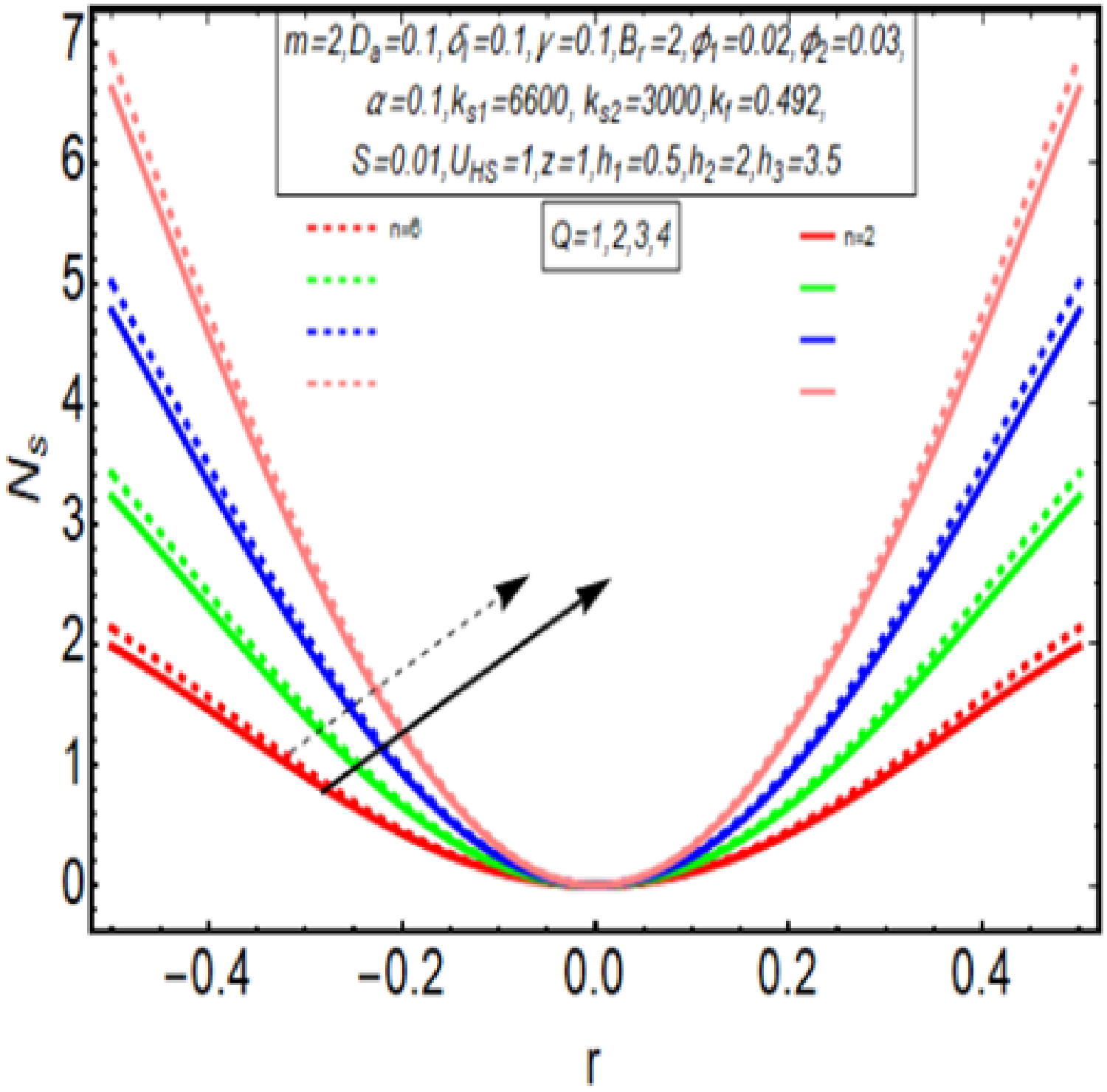
Entropy for Q.

Entropy for

Entropy for m.
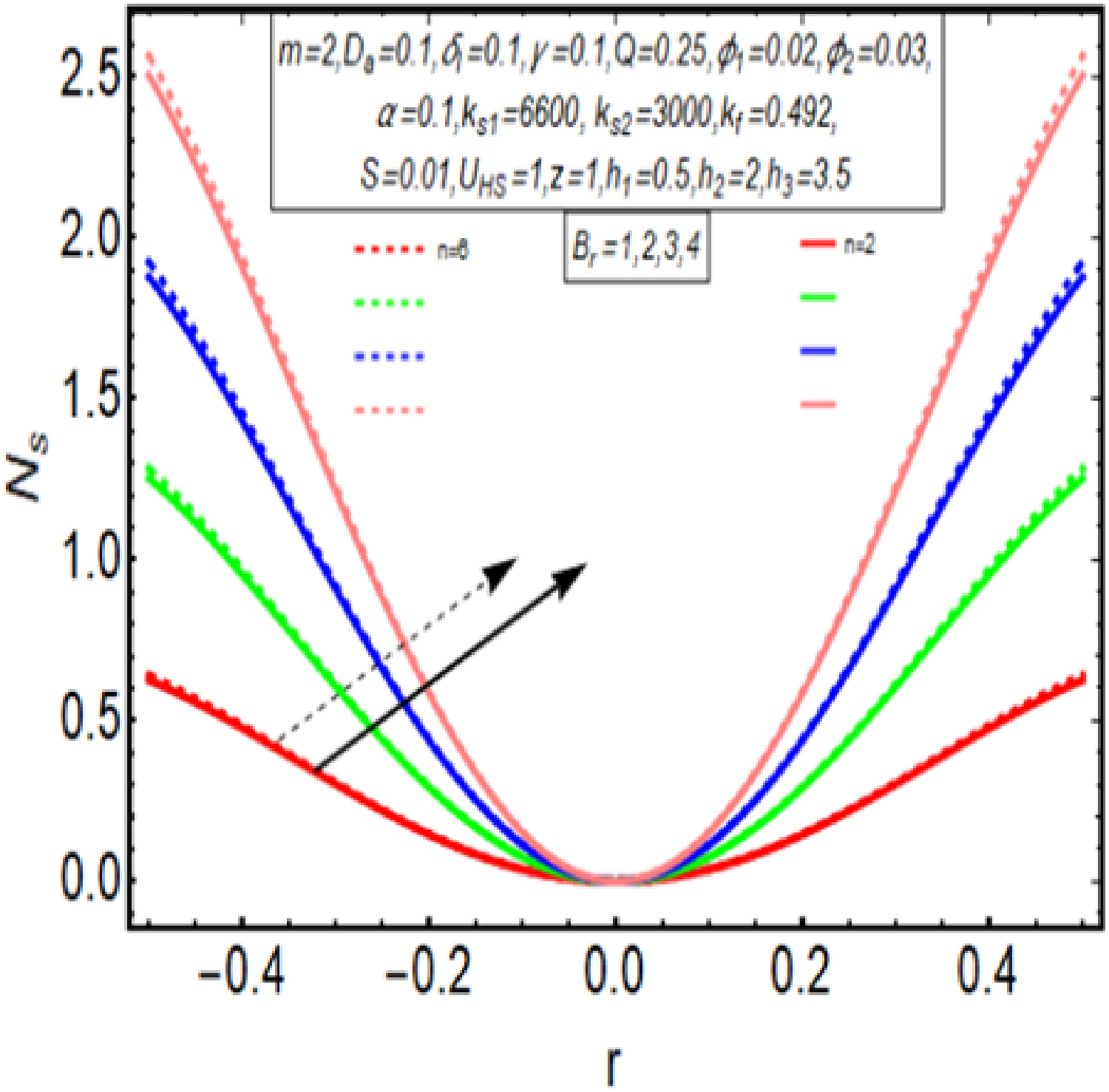
Entropy for

Entropy for
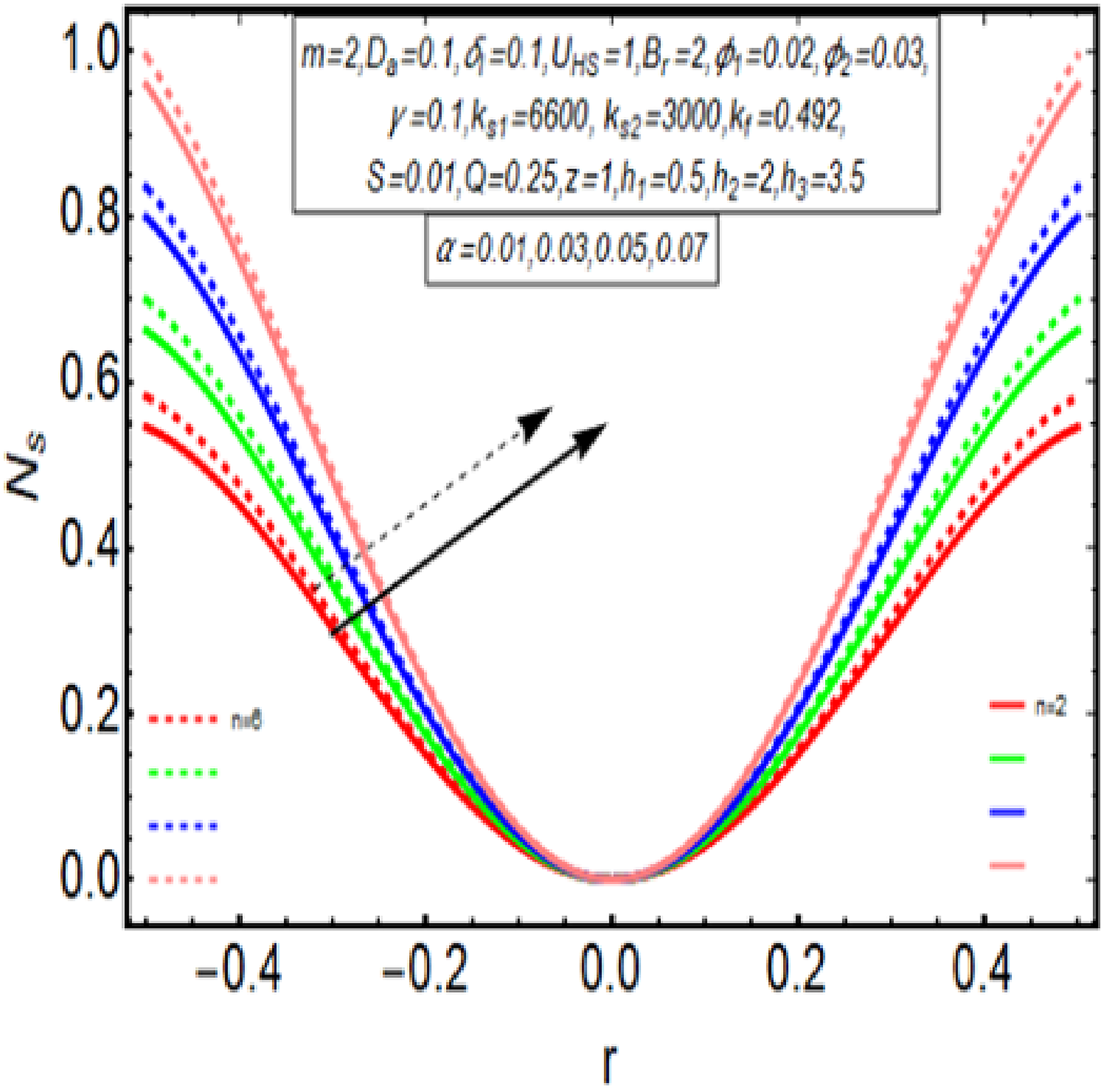
Entropy for

Entropy for
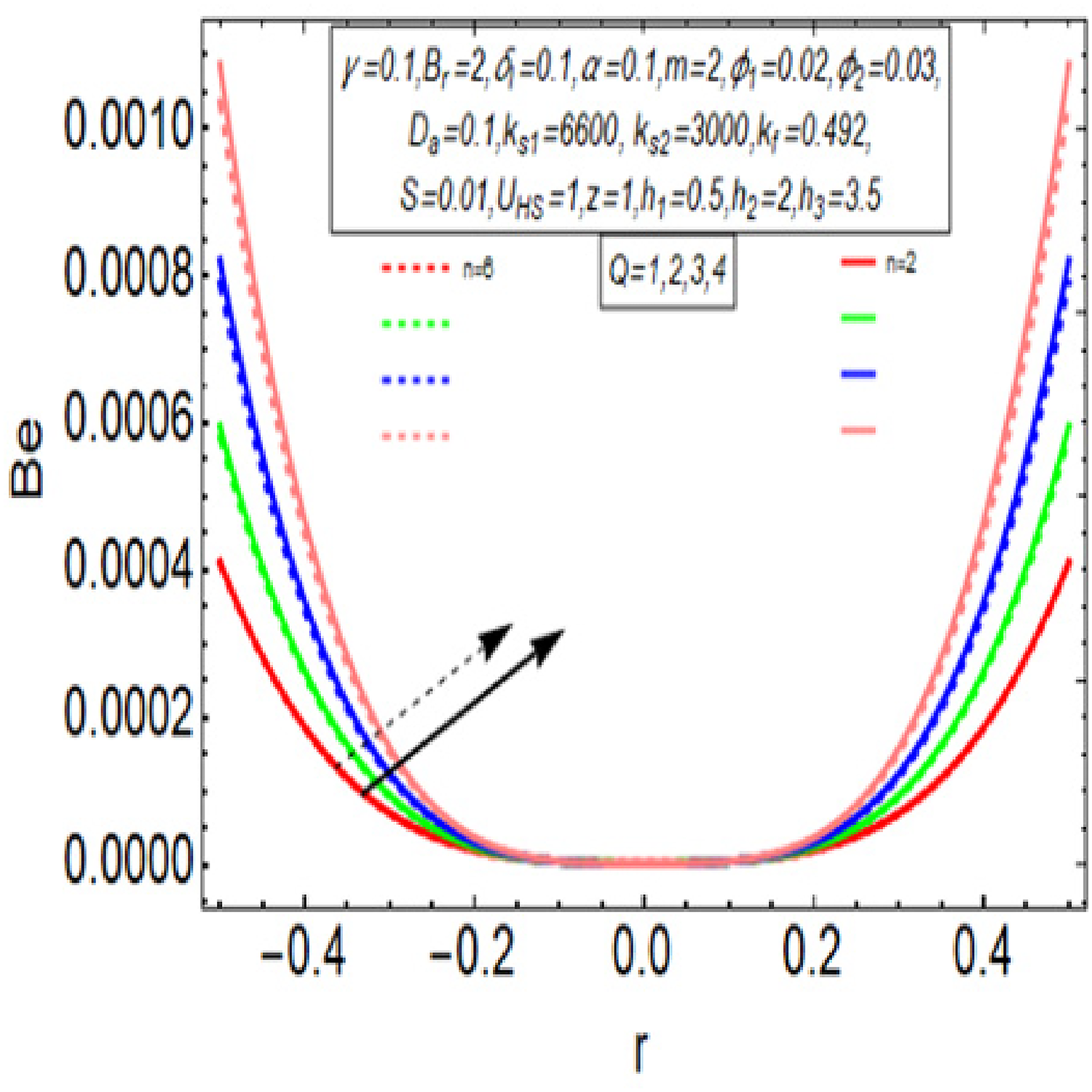
Be plot for Q.

Be plot for
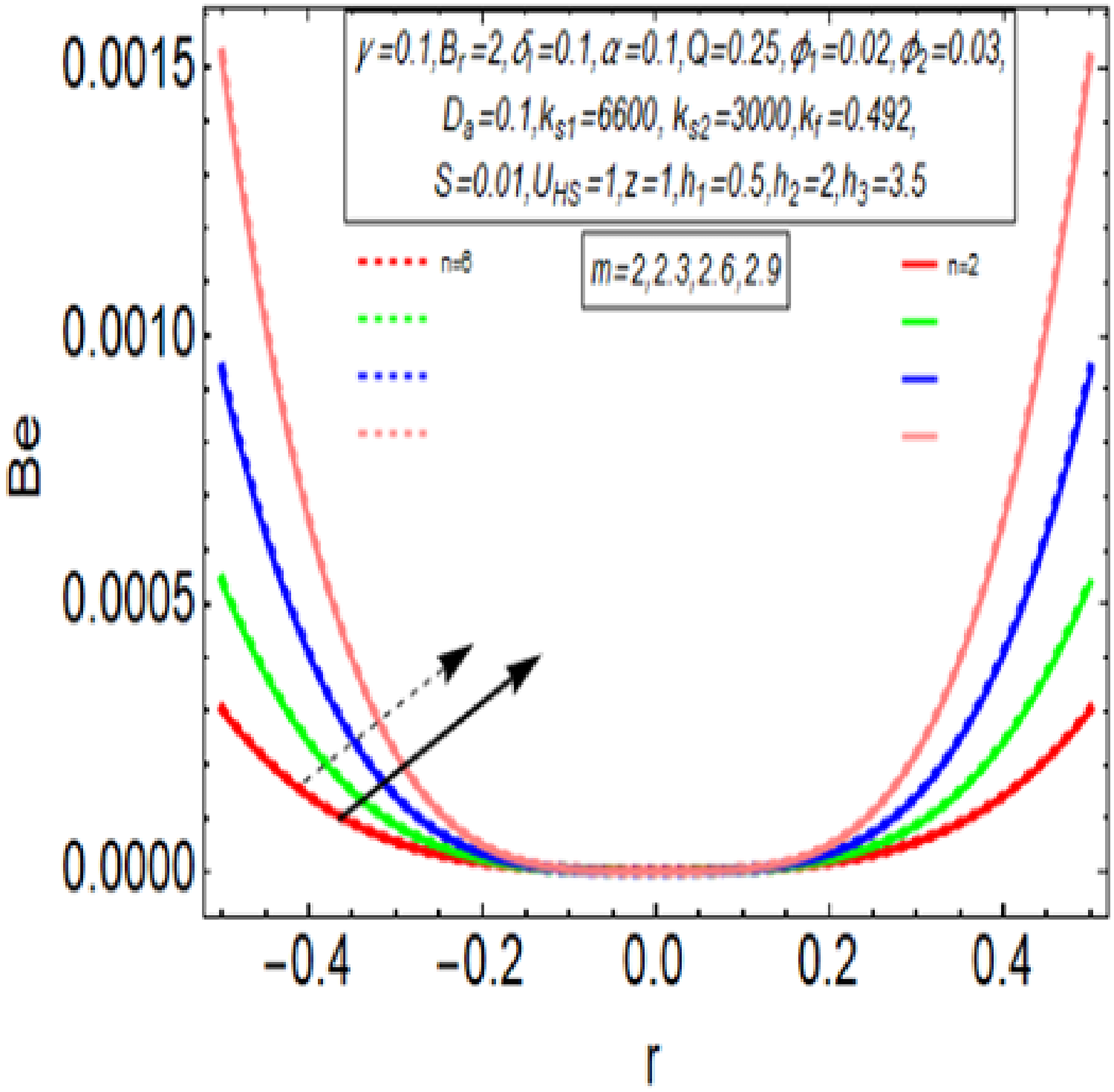
Be plot for m.

Be plot for

Be plot for

Be plot for

Be plot for γ.
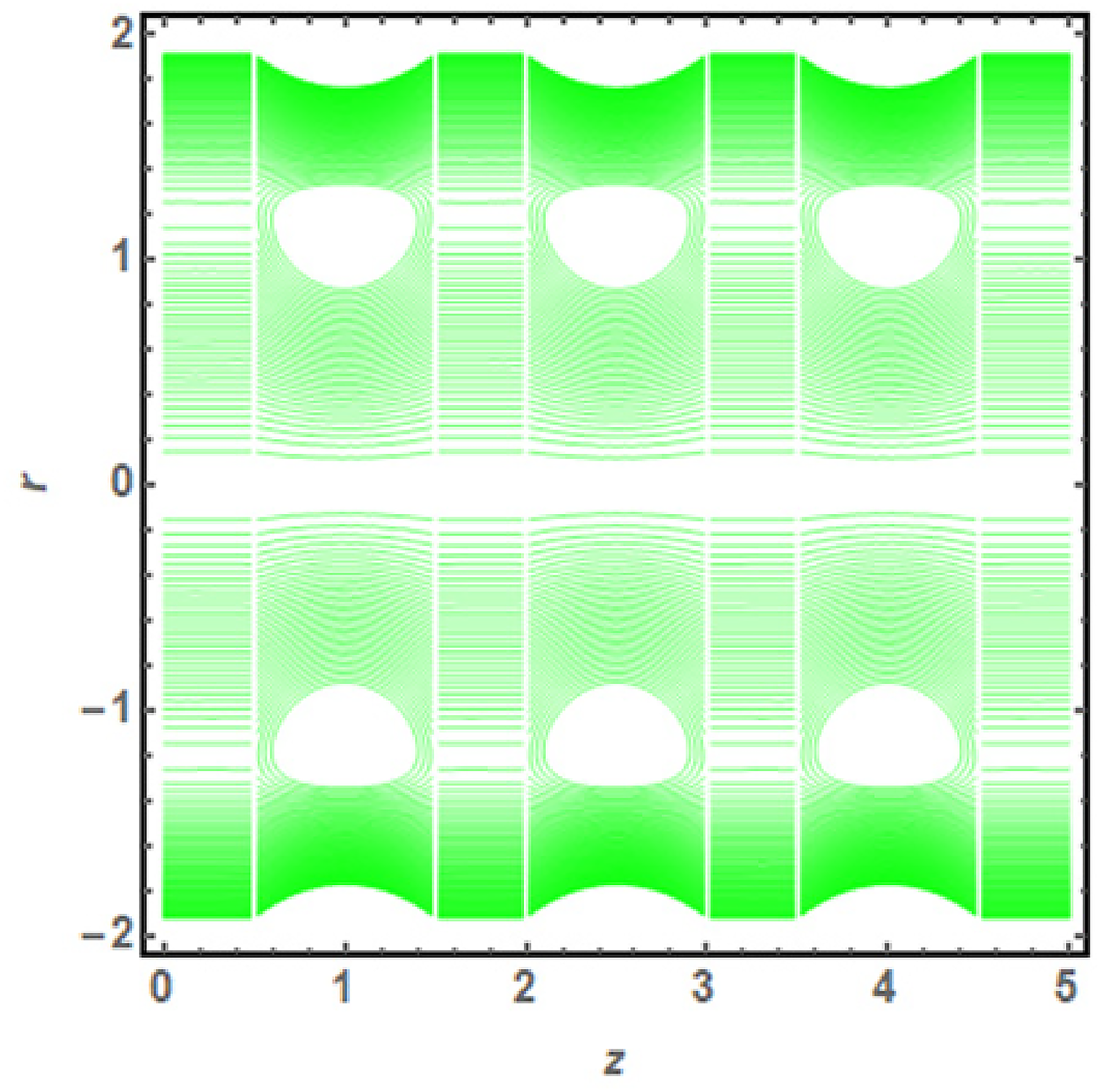
Streamline for Q = 1, n = 2.
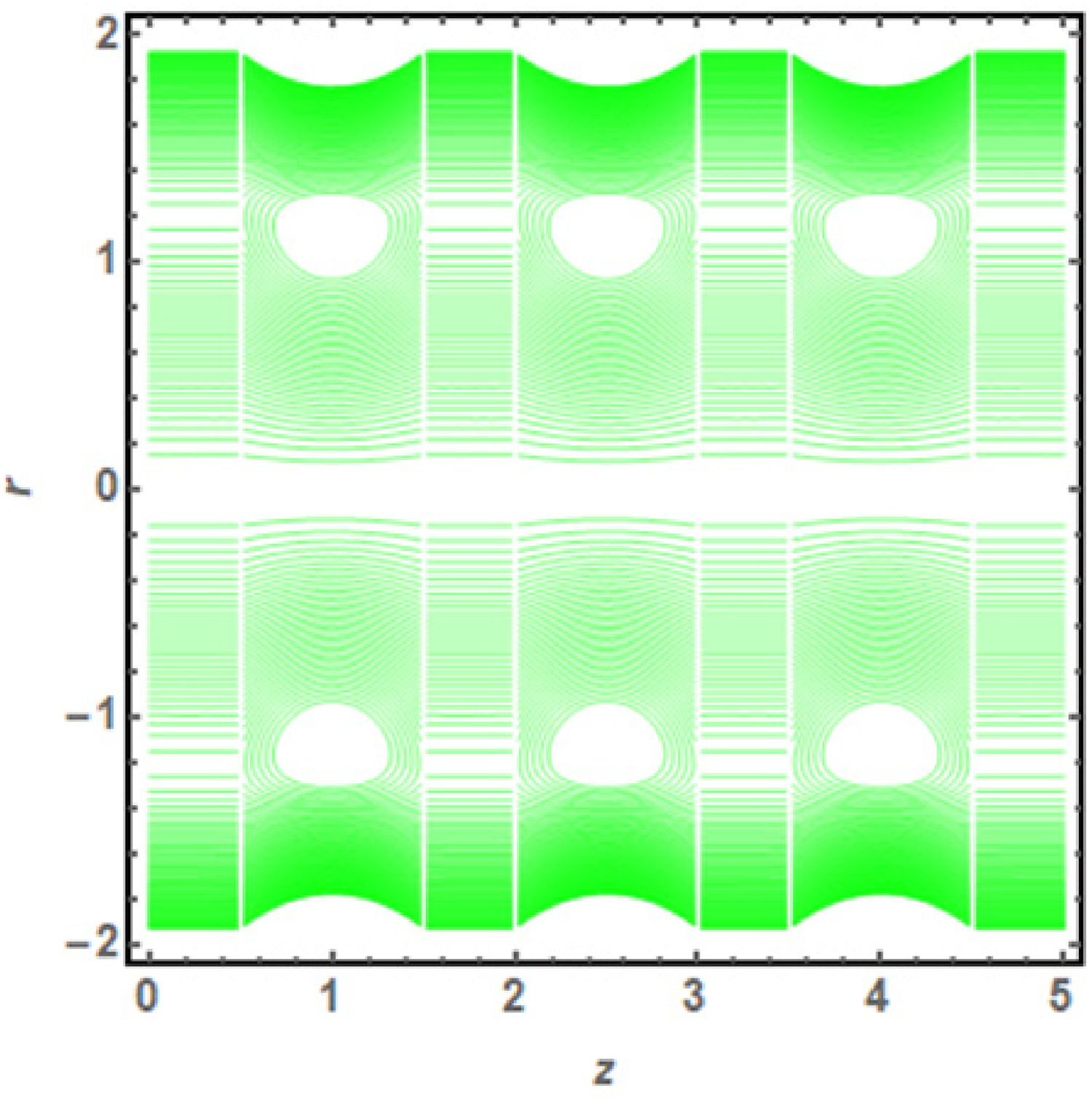
Streamline for Q = 2, n = 2.

Streamline for Q = 1.3, n = 6.

Streamline for Q = 1.5, n = 6.
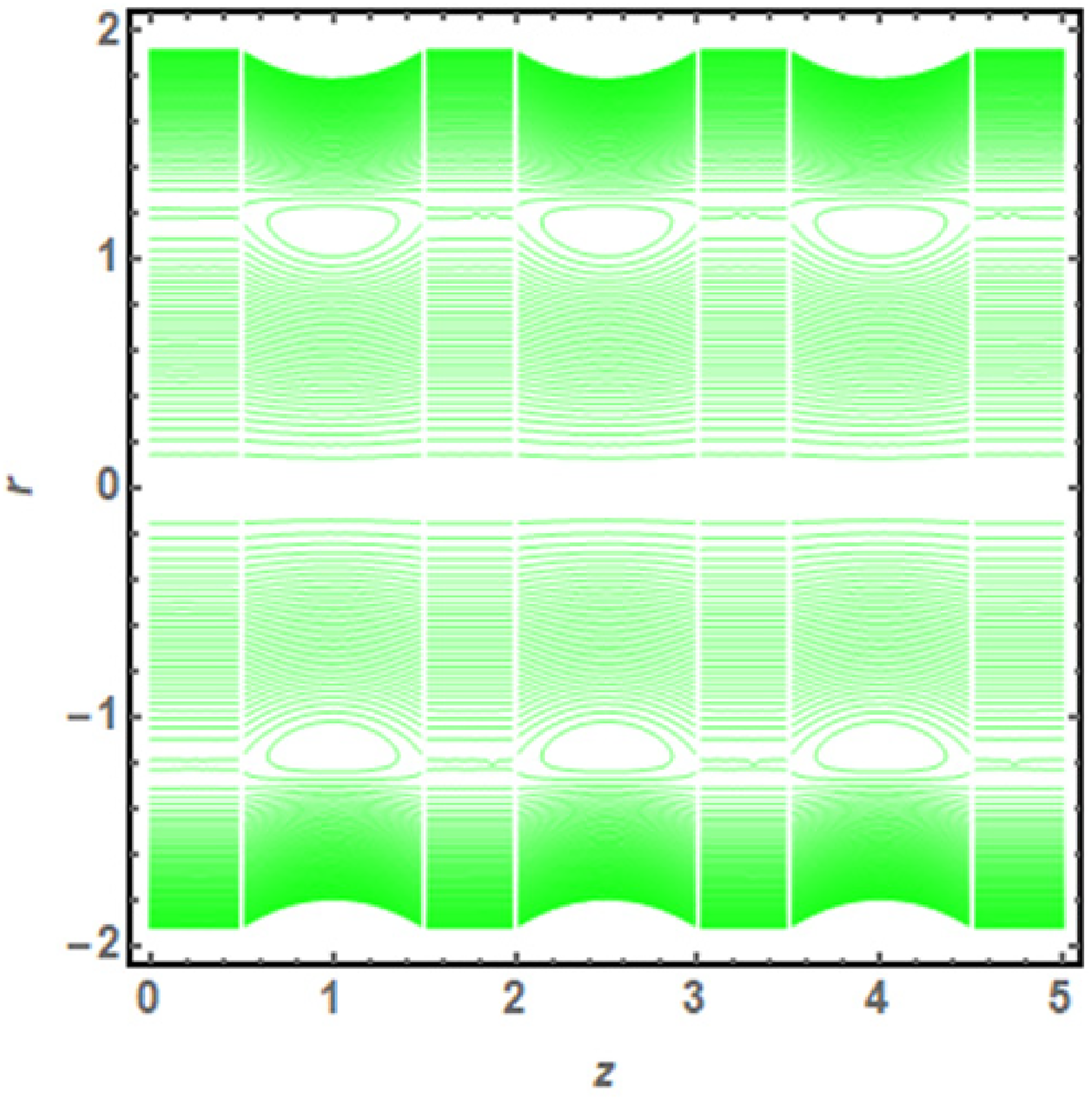
Streamline for m = 2, n = 2.

Streamline for m = 3, n = 2.

Streamline for m = 2, n = 6.
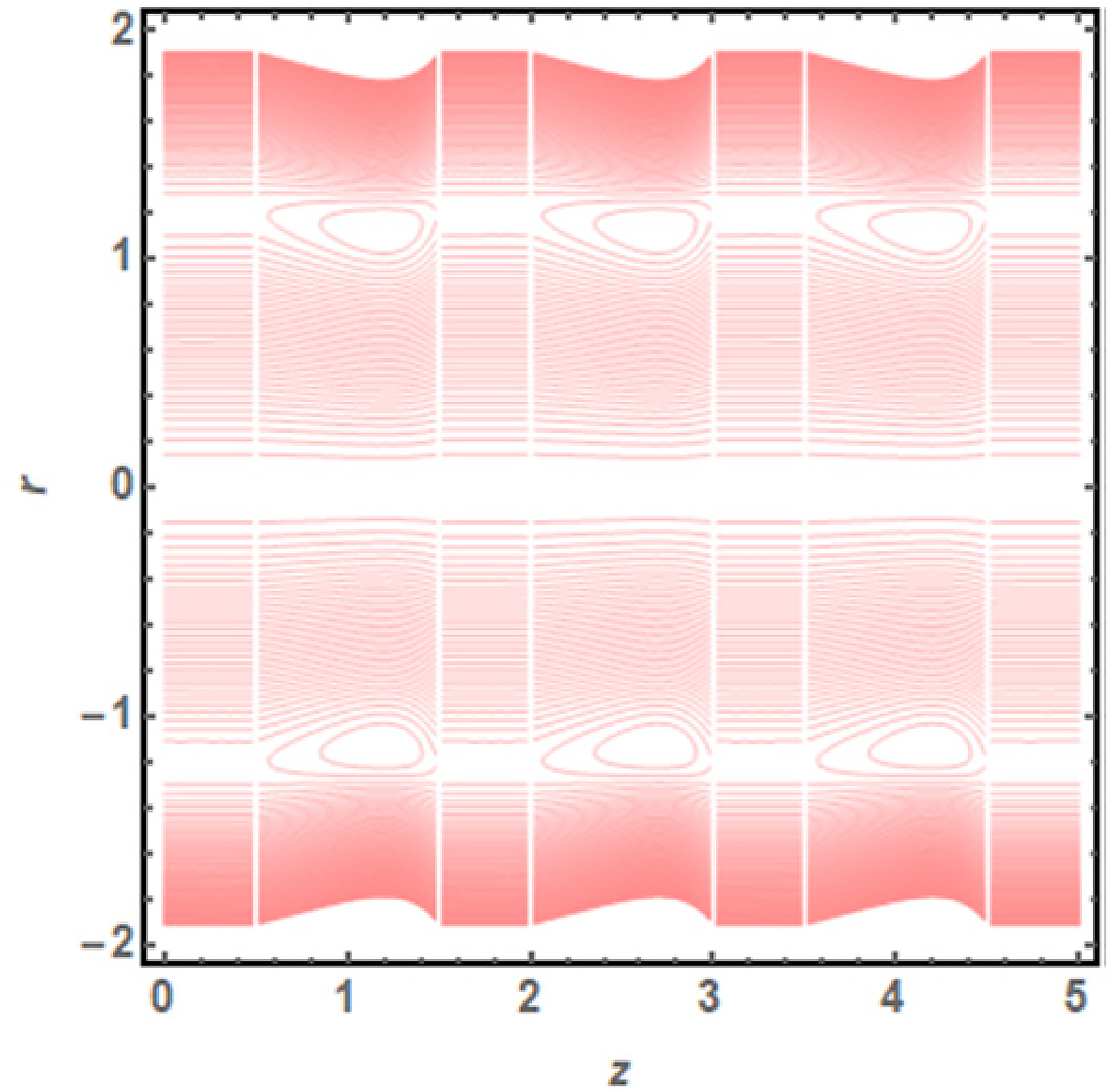
Streamline for m = 3, n = 6.
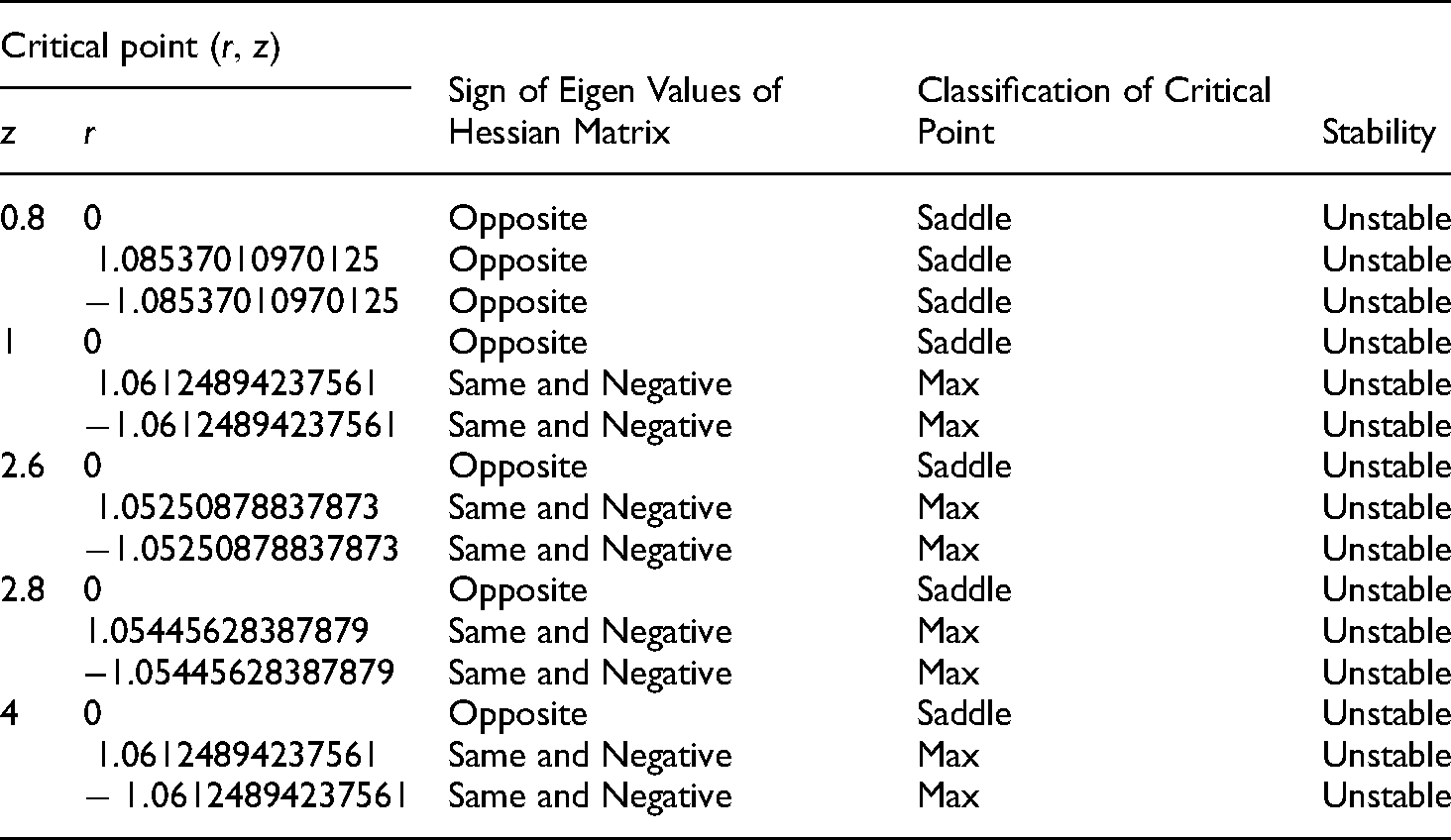
Stability analysis
The stability of solution for velocity of blood flow 
Tables 3 and 4 It depicts that
Behavior of velocity at critical points for

Behavior of velocity at critical points for
Conclusion
The flow behavior of hybrid nanofluid through an artery harmed by several stenosis is examined mathematically. The symmetric and anti-symmetric shapes of stenosis are included in this examination. The main findings of this study are
The fluid moves quickly through the artery for increasing height of stenosis, The fluid flow slows down for higher values of slip parameter, Darcy number and electro-osmotic parameter near the axis, but its behavior reverses near the walls. The flow velocity shows axisymmetric behavior. Temperature has larger magnitude towards the axis of channel, and it vanishes on the boundary. Temperature rises rapidly for the symmetric shape of stenosis than the non-symmetric shape. Entropy analysis elucidates the lowest disorder near the mean of channel. It increases along the radial axis and gets higher towards the walls.
Footnotes
Declaration of conflicting interests
The author(s) declared no potential conflicts of interest with respect to the research, authorship, and/or publication of this article.
Funding
The author(s) received no financial support for the research, authorship, and/or publication of this article.

Author biographies
Muhammad Hasnain Shahzad is a PhD Scholar at Department of Mathematics, University of the Punjab Lahore. His field of research is applied mathematics and computational fluid dynamics. He is working under the supervision of Dr Aziz Ullah Awan.
Dr Aziz Ullah Awan is an Associate Professor at Department of Mathematics, University of the Punjab Lahore. He has published many quality research articles in the field of applied Mathematics.
Salman Akhtar is a PhD research fellow at Department of Mathematics, Quaid-i-Azam University Islamabad. He has published many research articles under the supervision of Prof. Dr. Sohail Nadeem.
Dr. Sohail Nadeem is Professor of Mathematics at Quaid-i-Azam University Islamabad. His contribution to the field of applied Mathematics is recognized at national and international level. He has produced a good number of PhD students. Also, he is serving as editor of various well reputed international journals.