




Abstract
In this study, cycle-skipping was investigated for a natural gas engine which has single cylinder, unsupercharged with 1.16 L volume and spark ignition. Additionally, inlet manifold air was switched off during cycle-skipping to minimize pumping losses. Thus, cycle-skipping strategy was carried out, and its effects on emission and engine performance were investigated. Indicated mean effective pressure, indicated efficiency, specific emissions (CO, HC, and NOX) and combustion characteristics (in-cylinder pressure and rate of heat release) were investigated in the study. As a result of performed study, it is predicted that a significant improvement can be achieved in indicated thermal efficiency as 22.8% and 13.4% by different cycle-skipping strategies. However, there is not a continuous change in emissions for different cycle-skipping strategies. While CO and NOX emissions increased in 3N1S (three normal, one cycle-skip) condition, HC emissions decreased in accordance with normal condition. For both cycle-skipping strategies, all the emissions have an increase in accordance with normal condition. In 3N1S and 2N1S (two normal, one cycle-skip) cycle skip engine operating conditions, compared to engine operating under normal condition, CO emissions increased by 14.7 and 51.7 times, respectively. In terms of HC emissions, while emission values decreased by 27.8% under 3N1S operating conditions, they increased by 67.2% under 2N1S operating conditions. Finally, in 3N1S and 2N1S cycle skip engine operating conditions, NOx emissions increased by 3.7 and 6.9 times, respectively, compared to normal operating condition. Another significant result of this study is that peak in-cylinder pressure increased as the cycle-skipping rate increased.
Introduction
Today, number of electrical vehicles and technological improvements based on this technology increasing rapidly. Each year, new electrical vehicle models have been released. An electric vehicle uses an electric motor instead of internal combustion engine. Additionally, hybrid vehicles are important alternatives that use both internal combustion engine and electric motor. However, there are still new improvements for conventional internal combustion engines.
Investigation of alternative fuels in internal combustion engines, improvements in emissions and fuel combustion with different control strategies have been an attractive subject for researchers for years. 1 Some researchers have focused on alternative fuel powered engines, while other researchers have aimed to improve performance and emissions with the different cycle and control strategies.
Cycle-skipping strategies have been applied by different researchers for years. It is possible to achieve lower fuel consumption rates by using different cycle-skipping strategies. 2 However, cycle-skipping strategies have some negative effects on emissions. In the evaluation of cycle-skipping strategies, one must make analyses both technically and environmentally.
In internal combustion engines, less fuel consumption can be achieved by reducing pumping losses at partial loads using the cycle-skipping method. 3 In the literature, there are some experimental and numerical studies on cycle-skipping strategies.
In the performed study, cycle-skipping was worked for a natural gas fueled internal combustion engine with single cylinder unlike many studies in literature. Additionally, intake air was switched off with the help of solenoid valve that placed into the intake manifold. Both solenoid valves in intake manifold and control unit of internal combustion engine were controlled with the microcontroller based electronic unit developed by our project team. In the literature, there are hardly any studies in which pumping losses are minimized by cutting off the suction air during the cycle skipping. In addition, in the study we aimed to carry out, it was desired to run the engine in a higher efficiency area by using the kinetic energy stored by the engine on the flywheel, and a single-cylinder engine operation was deliberately performed to observe this effect. It is foreseen that running the engine under cycle skip conditions especially under very low partial load conditions will provide an extra advantage. In this study, effects of cycle-skipping on engine performance (IMEP, indicated thermal efficiency), emissions (CO, HC, and NOX) and ignition characteristics (in-cylinder pressure and rate of heat release) were examined in detail.
Literature investigation
Cycle-skipping strategies have been applied for internal combustion engines for the aim of reducing fuel consumption and improving the emissions. In all of the studies, a decrease in fuel consumption was achieved. However, there are different results on the change of emissions. In addition, minimizing pumping losses by shutting off the induction air during the cycle skipping operation in the engine wasn’t worked enough. The few publications in the literature in which the intake air is turned off during the cycle skipping are summarized below. Kutlar et al. 1 studied the cycle-skipping method for one cylinder spark ignition engine. They developed a test system to evaluate cycle-skipping method on brake specific fuel consumption. They found that brake specific fuel consumption decreased about 11% at partial loads and engine may work at lower idle speed (about 45%) without any stability problem. In another study, Baykara et al. 3 studied the cycle-skipping method with a valve-control mechanism for spark ignition engines experimentally. They concluded that cycle-skipping method is useful for fuel consumption reduction at partial loads. The brake specific fuel consumption decreased about 14% and 26% at lower and higher loads, respectively. However, total HC emissions significantly increased by cycle-skipping method which is different from the study the earlier study. 2 On the other hand, some researchers, worked to cycle skipping strategies in a single cylinder engine. An experimental study was conducted to evaluate cycle-skipping method on pumping for internal combustion engines. 2 They investigated three different cycle-skipping modes on specific fuel consumption and exhaust emissions. They obtained significant improvements on brake specific fuel consumptions (4.3%), CO emissions (39%), and HC emissions (12.1%).
In some other studies, the effect of cycle skipping using a camless engine in a multi-cylinder engine was investigated. Liu and Chang 4 carried out another study for valve seating which is the biggest obstacle to the widespread use of camless valvetrains. Desired trajectory was observed to limit the valve seating velocity and PID current control was ensured with holding force. Additionally, valve seating performance was validated experimentally. It was concluded that there was an excellent valve seating performance. Fan et al. 5 studied on using electromagnetic valve train in camless engines which have advantages in terms of fuel economy and engine performance in both low and high load engine. They concluded that electromagnetic valve train and engine performance increase by ensuring the optimal exhaust valve opening motion. Hu et al. 6 worked on four new valve strategies with moving coil electromagnetic valve train; two strategies were used to trap of exhaust gas, one strategy was used to trap fresh air, one strategy was used to keep open of exhaust valve. They used GT Power in the analyses. According to the obtained results, they concluded that fuel economy improved by 10%–23%.
In some other studies, engine performance and mission changes during cycle skipping were examined by changing the valve timing. A numerical study was performed to evaluate cycle-skipping method with variable valve timing strategy. 7 They aimed to get decrease in the emissions. They applied different strategies and obtained significant improvements on NOX emissions up to 39.4%. Abas et al. 8 investigated the cycle-skipping method on fuel consumption and emissions at partial loads experimentally. They concluded that CO2 emissions reduced up to 5.7% and HC emissions reduced up to 6.8% at an idle speed. Lui and Chang 9 used precise motion control method to carry out valve actuation with electromagnetic valve actuator. They mentioned an improvement for fuel consumption, torque, and emissions. Desired valve motion have ensured with tested simulations which occur with feedback control linearization of non-linear electromagnetic valve actuator system. Atashkari et al. 10 carried out a study that valve-timing was optimized by using a group method of data handling (GMDH) type neural network and evolutionary algorithms firstly. Then, valve timing was optimized by using multi-objective non-dominated sorting genetic algorithm. It was concluded that there was better results can be obtained with GMDH. Liu et al. 11 carried out a study for the investigation of five valve spark ignition engine by running with asynchronous valve timing and synchronous valve timing. They analyzed it by using Computational Fluid Dynamic simulation method in terms of fuel economy and emissions. According to the obtained results, they have concluded that there is a significant improvement in the emissions and fuel consumption by choosing the proper valve timing method. Some researchers, also examined different valve timing values using the mathematical model. Sher and Bar-Kohany 12 were studied on a model which was developed for spark ignition engines with exhaust opening, intake opening and intake closing times by examining the valve timing strategies. According to the obtained results, engine power and brake specific fuel consumption were reduced by 6% and 13% by using the variable valve timing, respectively.
Some researchers performed cycle skipping studies by deactivating the cylinder in multi-cylinder engines. Chien et al. 13 performed a study on an engine with eight cylinders and 6.2 L volume. Firstly, they made 1D model of the engine by using current test data, then, they set up the cycle-skipping model with Simulink to model cylinder deactivation. They made experimental and theoretical comparisons for the cases with and without cycle-skipping by determining a dynamic cycle-skipping methodology depending on the torque demand. The most significant result of this study is that cycle-skipping achieved 32% improvement in net specific fuel consumption compared to normally running V8 engine. Some researchers have examined the effect of cycle circumvention in multi-cylinder bus engines. Frailey et al. 14 worked on passenger transport buses, and they loaded two buses with the same vehicle characteristics, one with powered with diesel engine and the other one powered with compressed natural gas (CNG), with a chassis dynamometer. They conducted the tests with American central road cycle. In the natural gas case, NOX emissions decreased by %58, PM emissions decreased by 98%, CO emissions decreased by 84% and THC emissions increased by 117%. They made a comparison for fuel consumption in miles per equivalent gallon (mpg) for diesel and miles per gallon for the CNG case. They found that17% less miles was obtained for CNG case. They stated that maintenance costs for diesel buses were more (54%) than the CNG buses. In another study, Ortiz-Soto et al. 15 carried out a study for Audi EA888 Gen. 3B 2.01 engine. They tried lean burn and dynamic cycle-skipping methods in the homogeneously charged engine, and they examined their effects on fuel combustion, exhaust emission, and vehicle usage. They compared them by making tests according to the various driving cycles. They commented that CO2 emissions are better than DSF and lean burn mixture compared to the base engine. However, time recovery can increase by %9.7 while using both dynamic cycle-skipping and lean burning at the same.
In some studies, cycle skipping strategies in multi-cylinder automotive engines have been studied. Van Ess et al. 16 carried out a study for Volkswagen gasoline and 1.8 L volume engine with four cylinder. They worked cycle-skipping methods by performing valve and cylinder deactivation. Firstly, they made the 1D model of engine using GT-SUITE program and verified the model using the earlier test results they obtained. 5 They stated that the simulation and test results were similar, accordingly. Cycle-skipping provided an improvement in specific fuel consumption close to 1.1% while CO emissions decreased by 46% and CO2 emissions increased by 1.9%. In some studies carried out with multi-cylinder automotive engines, NVH study was carried out with cylinder deactivation. Yar et al. 17 examined the effect of cylinder deactivation method which provides a significant improvement for fuel economy, noise, vibration, and harshness. They analyzed the results of NVH by deactivating one and two cylinders of the four cylinders inline gasoline engine with the model they developed. In some studies, different control methods were used for cylinder deactivation and it was concluded that there may be an improvement in fuel consumption as a result. Ritzmann et al. 18 carried out a study with a control-oriented discrete-event model, cylinder deactivation process, and cylinder reactivation process. It was concluded that fuel consumption may increase instantaneously according to the normal operating conditions. However, an improvement in fuel consumption was achieved with a few seconds or longer operation in the fuel-efficient deactivated cylinder model. Again, in some studies, variable valve timing and cylinder deactivation methods were used. Zhao et al. 19 applied cylinder deactivation and variable valve timing strategies in the four cylinder SI engine. The pumping loss decreased, and fuel economy improved. They concluded that the proposed method is more suitable for low speeds and urban driving conditions.
In many studies in the literature, studies have been carried out in the form of cylinder deactivation in multi-cylinder engines. The study in which the cycle skipping strategy was examined in a single cylinder engine and the intake air was completely turned off could not go beyond a few in the literature. In the study carried out, in a single cylinder engine, cycle skipping strategies at partial loads were examined by minimizing pumping losses by turning off the intake air of the engine.
Materials and methods
Test engine
For the experimental studies, 1.16 L, four stroke, naturally aspirated, gas injected, natural gas type, spark ignition test engine was used. Although the engine is normally compression ignition type engine, it was transformed into a spark ignition type engine by our project team. For this purpose, electronic gas throttle, electronic ignition, row type gas injectors, and two inductive sensors were installed on the internal combustion engine. Test engine specifications are given in Table 1.
Test engine specifications.

Testing set
Eddy-current (APICOM FR50) type professional engine dynamometer was used during the experimental tests. Dynamometer has PID control system, and it can be loaded as cycle based and load based and both load and speed cycle based. In addition, emissions were measured by Bosch BEA 060-5 gas analyzer. Kistler 6250C type pressure sensor was used to measure the combustion chamber pressure of engine. Kistler charge amplifier was used in the tests. In-cylinder pressure data were gathered by Teledyne T3DSO1104 four channel oscilloscope. The flow measurements were obtained by Newflow TLF series mass gas flow meter that is calibrated for natural gas. Experimental results were collected by National Instruments data collection system and Labview software. Picture and schematic of testing unit are given in Figure 1.

(a) Picture of testing set and (b) schematic view of testing set.
Design of experiment
Three separate cases were tested in this study. The first case is normal working conditions (Normal), the second case is three normal one cycle-skipping (3N1S) working conditions, and the third case is two normal one cycle-skipping (2N1S) working conditions. Summary of studies are given in Table 2. All the test were performed for 1100 rpm. Engine was adjusted to constant brake load as 1.6 kW. Under normal, 3N1S and 2N1S engine operating conditions, the ignition advance was adjusted as 20°, 21°, and 22° BTDC, respectively, so as to give the maximum torque value. Engine load was fixed with PID controlled dynamometer and all tests were done according to the regime temperatures. Also, the accuracies of the measurements and uncertainties are given in Table 3.
Design of experiment.

Accuracy and uncertainty analysis of test setup.

Intake air and control units
In the performed study, as seen from the Figure 2, a lot of gas injectors were placed on the intake manifold, and the electronic control unit developed by our project team was used. The gas injectors were turned off during the cycle-skipping, and the intake air was cut off. The schematic view of the self-developed electronic control unit was seen in Figure 3. The self-developed ECU cuts the air intake by closing the gas injectors during the cycle skipping, by receiving a signal from the main ECU. Additionally, the engine’s control unit was developed by our project team, and the gas injectors were kept closed during the cycle-skipping, so that natural gas was not sprayed into the cylinder. Thus, the cycle-skipping was applied by cut off both fuel and air intake simultaneously.

View of (a) gas injectors have placed in intake manifold and (b) the electronic control unit.

Schematic view of the self-developed electronic control unit.
Results and discussion
The cycle-skipping strategies were performed for a single cylindered, spark ignition type, naturally aspirated, four stroke spark ignition engine. Normal working condition (N), three Normal one cycle-skipping condition (3N1S) and two Normal one cycle-skipping condition (2N1S) cases were tested. All engine tests were performed by selecting the optimum ignition advance at 1100 rpm fixed engine speed, 1.6 kW partial engine load and maximum brake torque ignition advance (respectively 20°, 21°, and 22° for 3N1S and 2N1S engine operating conditions, respectively). Inlet of intake air was cut off with gas injectors which were placed on the intake manifold, so the pumping losses were minimized. Indicated mean effective pressure (IMEP), indicated thermal efficiency, specific CO emission, specific HC emission, specific NOX emission, in-cylinder pressure, and heat release rate values represented comparatively.
Indicated mean effective pressure
The indicated mean effective pressure values are presented in Figure 4. According to the obtained results, it is concluded that IMEP value increases with the use of cycle-skipping strategy. The reason is that, the power cannot be obtained due to the no ignition during the cycle-skipping. Therefore, in the cycle-skipping scenarios, more the fuel is directed into the cylinder and in-cylinder pressure value increase in the cycles with positive power output. In the experimental studies, as the cycle-skipping rate increases, consumption of fuel in cycles increases where the combustion controlled by the electronic control unit. In this study, although the same power has taken as indicated under all operating conditions, the IMEP values for normal, 3N1S and 2N1S operating conditions were obtained as 3.45, 4.48, and 5.11 bar, respectively. An improvement of 29.8% and 48.1% was observed in 3N1S and 2N1S engine operating conditions, respectively, compared to normal operating condition. Baykara et al., 3 considering that the in-cylinder pressures increased with cycle skipping, it was seen that the increase in IMEP values as the cycle skip amount increased, had similar results.

The comparison of indicated mean effective pressure.
Indicated efficiency
Indicated thermal efficiency for the performed study are given in Figure 5. According to results, the indicated efficiency of engine in normal condition, 3N1S condition and 2N1S condition were calculated as 23.66%, 29.06%, and 26.83%, respectively. In 3N1S and 2N1S engine operating conditions, 22.8% and 13.4% improvement was observed in the indicated thermal efficiency value, respectively. The indicated efficiency increases significantly with the increase rate of the cycle-skipping (3N1S). The indicated efficiency decreases for the 2N1S condition. However, this value is quite high according to the normal conditions. The most important reason for the mentioned result is to work with a richer mixture and higher load in order to obtain the same power with the cycle-skipping and to remove burnt gases in a better way with the cycle-skipping. In addition, in cycle skip engine operating conditions, combustion, and thermal efficiency are also improved, as the engine operates under higher load conditions in fired cycles. Kutlar et al. 1 found the similar results in terms of fuel consumption and thermal efficiency.

The comparison of indicated efficiency.
CO emissions
Specific CO emissions for this study are given in Figure 6. According to the results, CO emissions of the engine in normal condition, 3N1S condition and 2N1S condition were measured as 2.2, 34.6, and 115.9 g/kWh, respectively. In 3N1S and 2N1S cycle skip engine operating conditions, compared to engine operating under normal condition, CO emissions increased by 14.7 and 51.7 times, respectively. It was determined that CO emissions increase while the cycle-skipping rate increases. The rich mixture is formed by increasing the amount of fuel sprayed to the cylinders per unit cycle to obtain same power with cycle-skipping.

The comparison of CO emission values.
HC emissions
Specific HC emissions for the performed study are given in Figure 7. According to the results, HC emissions of engine in normal condition, 3N1S condition and 2N1S condition were measured as 0.61, 0.44, and 1.02 g/kWh, respectively. In terms of HC emissions, while emission values decreased by 27.8% under 3N1S operating conditions, they increased by 67.2% under 2N1S operating conditions. In the cycle skipping strategy, the residual gases from the previous cycle are discharged from the exhaust in the non-fueled cycle, ensuring that no residual-gas remains under normal cycle conditions, thus reducing the HC emission. HC emissions decrease for the case of 3N1S while they increase for the case of 2N1S as against to normal working conditions. It is predicted that the reason of reducing HC emissions is the excessive enrichment of the engine. The results of Yüksek et al. 2 are similar with the results of 3N1S engine operating conditions. However, HC emissions have increased due to the formation of excessively rich mixture in 2N1S operating conditions.
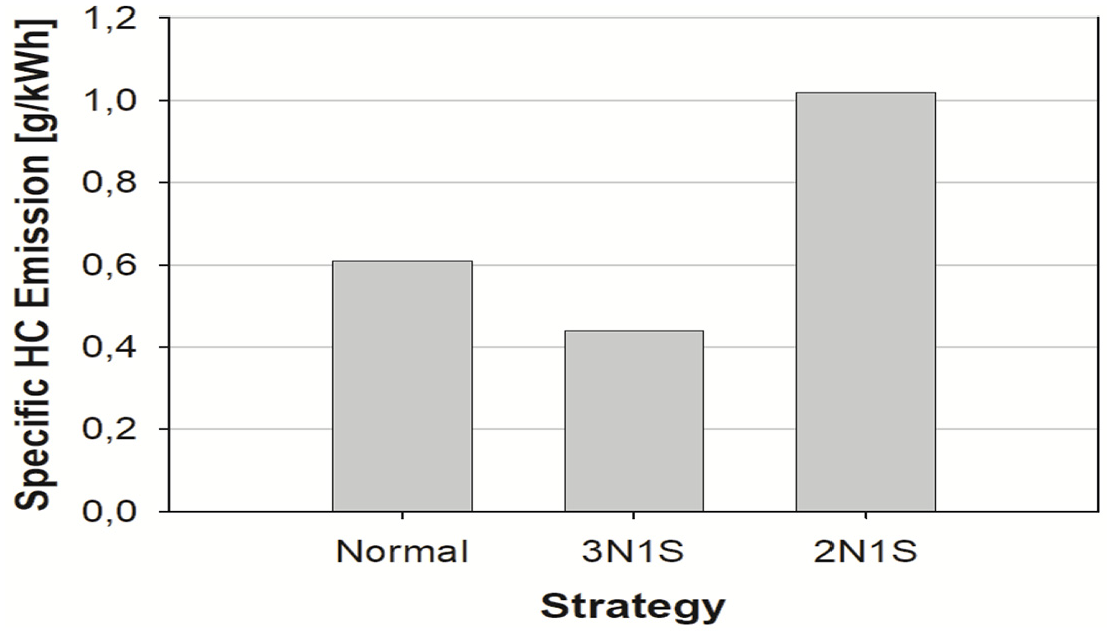
The comparison of HC emission values.
NOX emissions
Specific NOX emissions are given in Figure 8. According to the results, NOX emissions of engine in normal condition, 3N1S condition and 2N1S condition were measured as 0.20, 0.93, and 1.59 g/kWh, respectively. It was determined that NOX emissions increase while the cycle-skipping rate increases. To obtain the same power, more fuel is injected into the cylinder and the pressure inside the cylinder increases. In 3N1S and 2N1S cycle skip engine operating conditions, NOX emissions increased by 3.7 and 6.9 times, respectively, compared to normal operating condition. Baykara et al. 3 found similar results in terms of NOX emissions. The reasons for the increase in NOX emissions in the study carried out are the improvement of combustion efficiency in cycle skipping conditions, the increase in cylinder temperatures and the increase of residual gases with cycle skipping, and better combustion efficiency by increasing oxygen availability. In addition, the increased in-cylinder pressure data proves this.

The comparison of NOx emission values.
In-cylinder pressure
The results for the obtained in-cylinder pressure values are given in Figure 9(a) to (c). In addition, the indicated mean effective pressure values for each cycle are given on the same graph. In the obtained results, the peak in-cylinder pressure data in the cycle and the indicated mean effective pressure data increase as the cycle-skipping rate increases. In the partial load engine conditions and the cycle-skipping engine conditions, fuel consumption increases. In the cycle-skipping operating mode which has richer mixture under higher loads in the cycles with combustion, in-cylinder pressure values and thermal efficiency of engine increase. Average peak in-cylinder pressure values were measured as 19.6, 19.8, and 20.3 bar under normal, 3N1S and 2N1S engine operating conditions, respectively. From the results, an increase of 1.0% and 3.6% was observed in 3N1S and 2N1S engine operating conditions. The results obtained, Baykara et al. 3 shows similarities with the results obtained in terms of in-cylinder pressure data. In addition, the increase in NOX emissions confirms this situation.

(a) In-cylinder pressure at normal engine operation, (b) in-cylinder pressure at 3N1S engine operation, and (c) in-cylinder pressure at 2N1S engine operation.
Rate of heat release
Heat release rate at normal engine operation, heat release data rate at 3N1S engine operation condition and heat release rate at 2N1S engine operation condition are shown in Figure 10. For the partial load and cycle-skipping working conditions, fuel consumption increases. For the cycle-skipping conditions in which operation occurs with richer mixture, the in-cylinder pressure values and the heat release rate increase. For the partial load and cycle-skipping conditions, the in-cylinder pressure and the torque values increase in cycles with combustion. Therefore, it is concluded that the engine operates in the working areas with higher combustion efficiency and thermal efficiency in the engine map. Maximum heat release rate values were measured as 26.2, 49.3, and 64.1 J/°CA for normal, 3N1S and 2N1S engine operating conditions, respectively. In 3N1S and 2N1S engine operating conditions, increase of 88.2% and 144.7% were observed, respectively, compared to normal operating conditions. The results obtained, Baykara et al. 3 shows similarity in terms of the maximum heat release rate results obtained.

(a) Heat release rate at normal engine operation, (b) heat release rate at 3N1S engine operation, and (c) heat release rate at 2N1S engine operation.
Combustion analysis
Fuel combustion characteristic and thermal characteristic are examined in Table 4 below. As a result of the work performed, as the cycle skipping amount increased, the fuel amount per fired cycle value, which gives the amount of fuel sent to the cylinders per cycle, increased. Also, while induced thermal efficiency reaches the highest value in 3N1S condition, it has been determined that there is a decrease in combustion efficiency in 3N1S condition, although higher thermal efficiency is achieved in 2N1S condition than normal motor operating condition. Combustion efficiency was approximated by using CO and HC emission measurements and equation (1). 20

where,
Summary of combustion and thermal characteristics of the experiments.
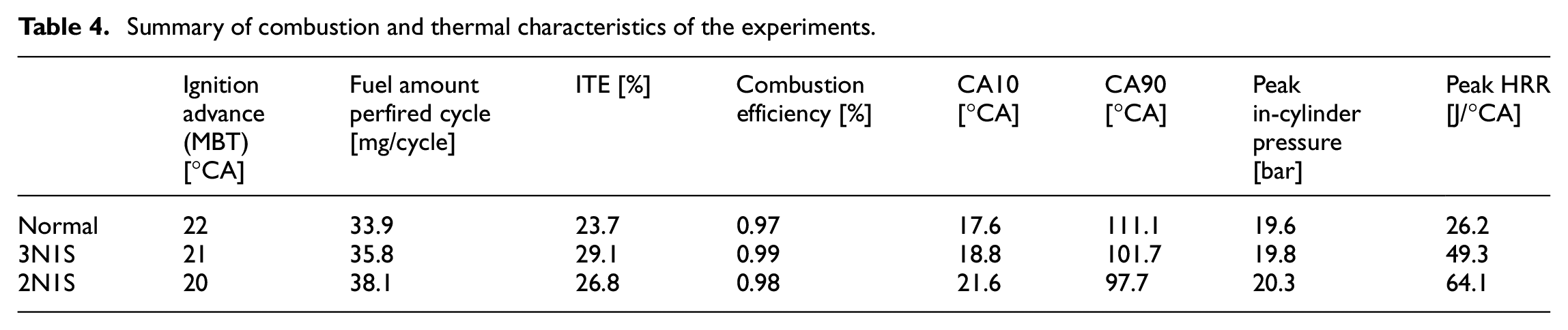
On the other hand, it is concluded that as the amount of cycle skipping increases, the amount of peak in-cylinder pressure and the amount of peak heat release rate increase. At the same time, although the CA10 value increases, the CA90 value decreases significantly, resulting in higher thermal efficiency and higher combustion efficiency by sending more fuel into the cylinder in the firing cycles. This situation proves that the peak in-cylinder pressure values and peak heat release rate values increase with the increase of the cycle jump amount.
Conclusion
Single cylindered, natural gas fueled, unsupercharged, spark ignition engine is used under normal, 3N1S and 2N1S conditions with the intake air cut off during the cycle-skipping. Cycle-skipping strategy allows a novel reduction in the fuel combustion of the spark ignition engine while it causes a slight increase in the emissions in general. Additionally, in-cylinder pressure increases with the increase of thermal efficiency and combustion efficiency. Emissions may be controlled by applying after-treatment methods. The IMEP, indicated efficiency, CO, HC, and NOX emissions, in-cylinder pressure and heat release rate were calculated. The obtained results are summarized as below:
In this study, although the same power is taken as indicated under all operating conditions, the IMEP values for normal, 3N1S and 2N1S operating conditions were obtained as 3.45, 4.48, and 5.11 bar, respectively.
The indicated efficiency increases as 22.8% and 13.4% for 3N1S and 2N1S operation conditions compared to the normal conditions, respectively.
Specific CO emissions of engine in normal condition, 3N1S condition and 2N1S condition were calculated as 2.2, 34.6, and 115.9 g/kWh, respectively.
Specific HC emissions of engine in normal condition, 3N1S condition and 2N1S condition were measured as 0.61, 0.44, and 1.02 g/kWh, respectively.
Specific NOX emissions of engine in normal condition, 3N1S condition and 2N1S condition were measured as 0.20, 0.93, and 1.59 g/kWh, respectively.
As the cycle-skipping rate increases, the peak in-cylinder pressure where the combustion occur and the indicated mean effective pressure increase.
Footnotes
Acknowledgements
The authors are also indebted to Erin Motor A.Ş for due to laboratory use and all other support.
Declaration of conflicting interests
The author(s) declared no potential conflicts of interest with respect to the research, authorship, and/or publication of this article.
Funding
The author(s) disclosed receipt of the following financial support for the research, authorship, and/or publication of this article: This research was supported by TUBITAK (Scientific and Technological Research Council of Turkey) with 1511 project. Project Number: 1209017. The fourth author of the manuscript has been financially supported by TUBITAK (Scientific and Technological Research Council of Turkey) 2228-B program. This work was also supported by Yildiz Technical University Scientific Research Projects Coordination Unit. Project Number: FBA-2019-3606.
