



Abstract
Wing gate turnstiles are widely used in airports, subway stations, railway stations, movie theaters, parks, etc., and influence the pedestrian evacuation greatly while accidents happen. Thus, doing some researches on how to improve the evacuation speed for wing gate turnstiles are meaningful and necessary. In response to this issue, the influences of the wing gate turnstiles on pedestrian evacuation are investigated by pathfinder in this paper. Pathfinder is an agent-based egress simulator that uses steering behaviors to model occupant motion. First of all, by Pathfinder, two evacuation models with flat-shaped and wedge-shaped hosts wing gate turnstiles, respectively, are established, and the simulations of pedestrian evacuation are carried out by computer. The results show the evacuation speed obtained by the wedge-shaped host is faster than that obtained by the flat-shaped host. Moreover, the longest evacuation time is obtained when the channels’ width is 90 cm, and the shortest is obtained when the channels’ width is 51.4 cm. For a small number of evacuees, the evacuation time is mainly influenced by the original distributions of the evacuees, however, as the number of the evacuees increases, the evacuation time is mainly influenced by the number of the evacuees. Furthermore, the wing gate turnstiles with widened hosts can get less evacuation time no matter whether the hosts are flat-shaped or wedge-shaped, however, the evacuation-time-saved rate obtained by wedge-shaped host is much higher than that obtained by flat-shaped host. Then, the influences of the wedge angle on the pedestrian evacuation are discussed, and the optimal wedge angle is obtained. The obtained results can not only provide helps for managers to evacuate crowds under emergency, but also offer some assistances for designers to design those gate turnstiles or building exits.
Introduction
Wing gate turnstiles, one kind of the channel management equipments, are mainly used in pedestrian channel management. With the characteristics of fast opening, safety, and convenience, it is an ideal management and diversion equipment for pedestrians with high frequency access, and widely used in airports, subway stations, railway stations, movie theaters, parks, etc.1–3 Although the wing gate turnstile can save manpower and material resources, and improve work efficiency, it can also influence the pedestrian evacuation greatly while accidents happen. Figures 1 and 2 show the congestions are formed due to the bottleneck effect of the wing gate turnstiles. During the past several decades, due to fire, explosion, terrorist attack, etc., some casualties were already caused in those railway station, subway station, airport, movie theater, etc. For example, on February 27, 2019, 20 people were killed and 40 injured in the fire at the railway station in Cairo, Egypt. On February 5, 2015, a fire accident happened in Yiwu Mall in Huidong County, Guangdong Province of China, which resulted in 17 people dying in the cinema on the fourth floor. Some more accidents can be found in Prager et al. 4 and Galea et al. 5

A bottleneck formed by wing gate turnstiles in the evacuation route.
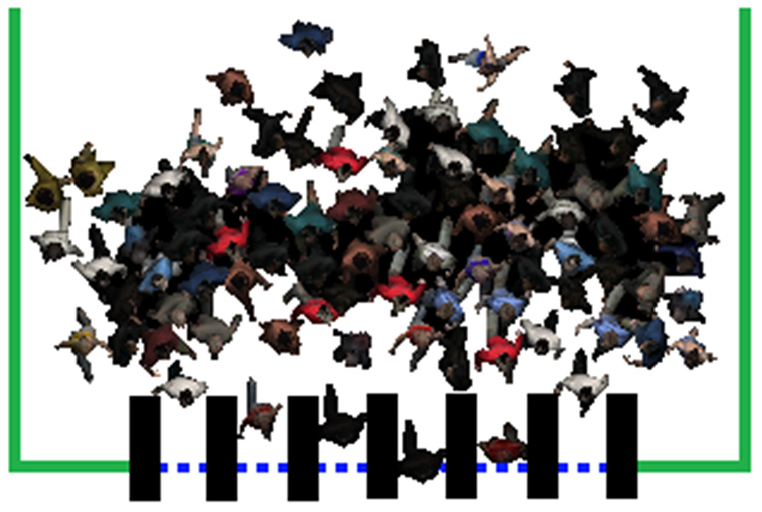
A simulation result for an exit with wing gate turnstiles.
When accidents happen, improving the pedestrian flow rates at those bottlenecks on the evacuation routes to make sure most of the occupants can be evacuated in time can decrease the losses of life and property obviously, and this issue attracted lots of attention during the past several decades. For example, by doing some simulations by computer, Helbing et al. 6 demonstrated the escape rate of crowds under panic conditions is enhanced if an obstacle is asymmetrically placed on the upstream side of an narrow exit. Then, based on Helbing’s achievement, Shi et al. 7 did some laboratory experiments with human participants to examine the effect of different geometrical layouts at the exit toward the pedestrian flow. Some more results about this issue can also be found in the works.8–11
Furthermore, some existing papers discussed the influences of those exits’ positions and structures on pedestrian evacuation. For example, Dong et al. 12 investigated the influences of the aisles on the evacuation process of students from a classroom. Based on utilizing the evacuation software Pathfinder, Ding et al. 13 discussed the influences of the exits on pedestrian evacuation. Song et al. 14 improved a cellular automata (CA) model by quantifying the evacuation process with three basic forces. The readers can also refer to the works15–18 for some more results in this issue. Moreover, some modeling methods, such as, social force model,19,20 CA model,21–23 floor field model,24–26 the lattice gas model,27,28 fuzzy visual field, 29 etc., were developed and applied in the pedestrian evacuation. Some softwares, such as, EVAC,30,31 FDS,32,33 EGRESS, 34 Pathfinder,35–37 etc., were also improved for realizing those evacuation simulations.
However, to the best of the authors’ knowledge, the influences of wing gate turnstiles on pedestrian evacuation still haven’t been fully investigated. How to design or arrange those wing gate turnstiles such that their influences on the evacuation speed are less is important and meaningful, obviously. This is the main motivation of this paper. By considering this issue, this paper will do some simulations to reveal the influences of wing gate turnstiles on pedestrian evacuation. According to the requirement of the simulation, two evacuation models with flat-shaped and wedge-shaped hosts, respectively, are established, and the different volume, widths and wedge angles of those wing gate turnstiles are considered. The main contributions of this paper include three aspects: (1)Two types of hosts for the wing gate turnstiles are considered, and it is obtained that the evacuation speed obtained by the wedge-shaped host is faster than that obtained by the flat-shaped host. Moreover, the longest evacuation time is obtained when the channels’ width is 90 cm, and the shortest is obtained when the channels’ width is 51.4 cm. (2) According to the proposed models, it is gotten that the wing gate turnstiles with widened hosts can get less evacuation time no matter whether the hosts are flat-shaped or wedge-shaped, however, the evacuation-time-saved rate obtained by wedge-shaped host is much higher than that obtained by flat-shaped host. (3) The influences of the wedge angles on the pedestrian evacuation are discussed, and the optimal wedge angle is obtained. Furthermore, the obtained results can be expected to provide helps for managers to evacuate crowds under emergency, and offer some assistances for designers to design those gate turnstiles or building exits.
Model formulation
In this section, a building architecture with wing gate turnstiles is given. Considering the focus of this paper is to show the influences of the wing gate turnstiles on pedestrian evacuation, thus, the internal structure of the evacuated region is not considered. Furthermore, the characters of the occupants adopted to do the simulation are provided.
Simulated building architecture
The wing gate turnstiles considered in this paper are shown in Figure 3. When a person moves into a channel of the wing gate turnstiles, the wings of the corresponding gate turnstile will move into their hosts and open the channel for him (her) to pass through. When he (she) passes the channel completely, the wings will return to the hindered zero position automatically. Moreover, the wing gate turnstile can be set to be long-term opening, and during the evacuation, the wing gate turnstiles are assumed to be open no matter whether there are some people passing through or not. The hosts of the wing gate turnstiles used in the simulation are shown in Figure 4, which include two types: one, shown in Figure 4(a), is flat-shaped host (corresponding to Case 1), and the other, shown in Figure 4(b), is wedge-shaped host (corresponding to Case 2), where L1 and L2 are the widths of the hosts and channels, respectively, and ∠β is the angles of the wedge-shaped hosts. In order to show the influences of the wing gate turnstiles on pedestrian evacuation, it is assumed that the widths of the channels can be adjusted according to the requirement of the simulation, and the widths of the hosts equal to half of the channels’ width, that is, L1 = L2/2, and all hosts have a same length 1.5 m.
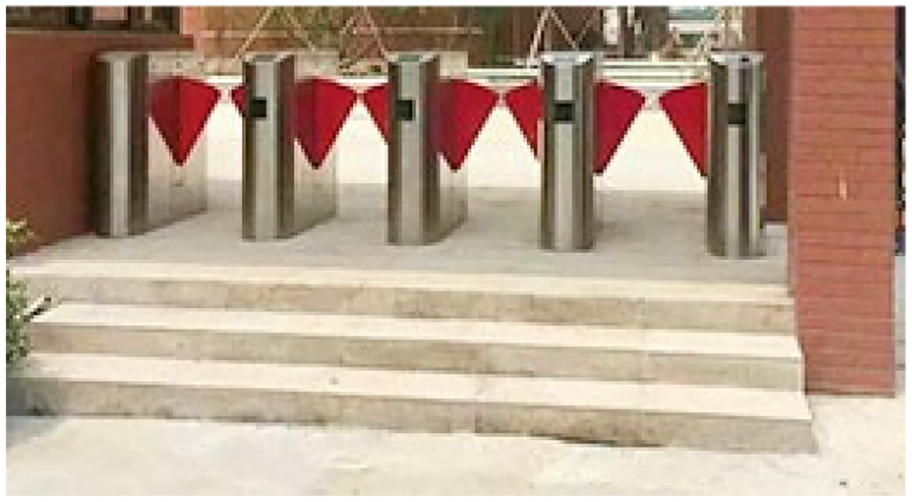
Wing gate turnstiles.
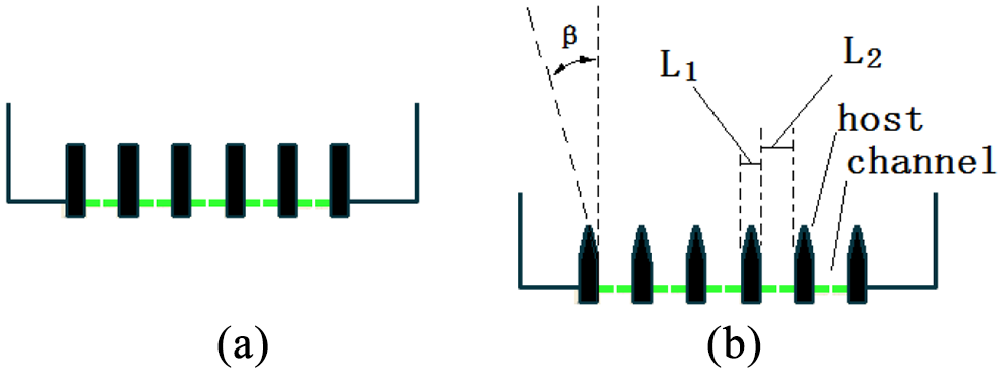
The structures of the wing gate turnstiles: (a) flat-shaped host (Case 1) and (b) wedge-shaped host (Case 2).
The evacuated region is shown in Figure 5. The main region, a 10 m × 14 m platform, is used to accommodate the evacuees at the beginning of the evacuation. There is a 3 m × 9 m landing connected to the main region, and the landing has the wing gate turnstiles, whose widths can be adjusted according to the requirement of the simulation. Assume the total width of the channels is 360 cm, then, five cases (51.4 × 7, 60 × 6, 72 × 5, 90 × 4, 120 × 3, 180 × 2) are given to do the simulations, where 51.4 × 7 means there are 7 channels, and the width of each channel is 51.4 cm. 60 × 6, 72 × 5, 90 × 4, 120 × 3, and 180 × 2 have a similar meaning with 51.4 × 7.

The evacuated region.
Occupants in the architecture
The occupants are all non-connected individuals and not constrained by groups. Using a point to represent an evacuee is unreasonable, thus, the circles with different diameters are adopted to represent those evacuees. The diameters follow a uniform distribution from 35 to 42 cm to add the essential factor of different body sizes. The maximum moving speed of the evacuees is chosen as 1.19 m/s, the reduction factor is chosen as 0.7 to reduce the diameter to resolve the congestion, and the comfort distance of the evacuees is 8 cm. The initial orientations of the evacuees follow a uniform distribution from 0° to 360°. All evacuees are assumed to react instantly at the beginning of the evacuation, thus, response time is not considered in this paper. The acceleration is calculated with the following equations:

where
Explicit Euler integration is then used to calculate the velocity and position of each occupant for the next time step from their steering acceleration. The velocity and position are calculated as follows:

where
Path generation
At the start of the simulation, each occupant generates a path that the occupant will later use to move toward the exit. The A* search algorithm 39 and the triangulated navigation mesh are used to generate this path. The resulting path is represented as a series of points on edges of mesh triangles. These points will create a jagged path to the occupant’s goal. A variation on a technique known as string pulling 40 is used to smooth out this jagged path. This will re-align the points so that the resulting path only bends at the corner of obstructions but remains at least the occupant’s radius away from those obstructions. Examples of these final points, called waypoints, are shown in Figure 6, which shows the projected path of an occupant in a simple rectangular room. The occupant is standing in the lower-left corner and plans to exit out the lower-right corner. The navigation mesh is shown by the thin lines that form triangles inside the rectangular area. An obstruction prevents the occupant from walking straight to the exit. The planned path of the occupant is shown as the dark line and the waypoints are shown as circles. A waypoint is generated for each edge that intersects the path. 38

An occupant’s planned path with waypoints shown.
When moving along a path, five steps are taken: (1) Two waypoints are defined: (a) a current waypoint that is initially the furthest waypoint that the occupant can see and reach without contacting any obstructions, and (b) a next waypoint that is defined by viewing from the current waypoint (seen and reached without contact of obstructions). (2) The occupant attempts to update their current waypoint to the next waypoint. This can be accomplished if the occupant can move in a straight line from their current position to the next waypoint without encountering any obstructions or if they arrive within a certain tolerance of their current waypoint. For SFPE mode this tolerance is nearly zero because there is not restriction on overlapping occupants, so occupants are expected to reach each waypoint exactly. For steering mode this tolerance is 1 m because occupants are expected to veer off their paths somewhat when steering away from other occupants and obstructions. (3) The occupant checks for the need to re-path. Occupants must re-path if they cannot see a straight line to their current waypoint or if they deviate more than 1 m from their current predicted path. (4) A seek curve is generated to define his desired motion. (5) The occupant attempts to move along the tangent to his current seek curve.
Simulation results
In this study, simulations with some specific numbers of evacuees are performed. The evacuees are generated and distributed in the 10 m × 14 m platform randomly. Then, the evacuees move to the wing gate turnstiles simultaneously without any time delay. When an evacuee passes through the wing gate turnstiles, his (her) evacuation is finished, and when all the evacuees pass through the wing gate turnstiles, the whole evacuation is finished. The time spent from the beginning to the end of the evacuation is the total evacuation time (TET). The numbers of the evacuees are given as 50, 100, 200, 300, 400 in each scenario. In order to increase the reliability of the obtained results, each simulation is repeated 10 times, and the mean total evacuation time (MTET) is adopted to evaluate the evacuation time. After doing simulation by computer, the MTETs of the evacuations with 50, 100, 200, 300, and 400 evacuees, respectively, are shown in Table 1, and the curves of the evacuation times with the channels’ widths of the wing gate turnstiles are plotted in Figure 7, where 50(C1) means it is Case 1 with 50 evacuees, and the others have similar meanings. From Table 1 and Figure 7, it is shown that, with the same number of evacuees, Case 2 can achieve lower MTETs than Case 1, that is, compared with flat-shaped host, wedge-shaped host can improve the evacuation speed. Furthermore, when the number of the evacuees is more than 200, the longest evacuation times are obtained while the channels’ width is 90 cm, and the shortest evacuation times are achieved while the channels’ width is 51.4 cm. Moreover, while the channels’ width is less than 90 cm, the evacuation time increases along with the increase of the channels’ width; while the channels’ width is more than 90 cm, the evacuation time decreases along with the increase of the channels’ width. However, when the number of the evacuees is 50 or 100, the evacuation time has not a fixed relationship with the channels’ width. After observing the evacuation process, it is obtained that, while the number of the evacuees is less than 100, the MTET is mainly influenced by the distributions of the evacuees. However, when the number of the evacuees is more than 200, the MTET is mainly influenced by the number of evacuees.
The MTETs of the evacuations with 50, 100, 200, 300, and 400 evacuees (unit: s).


The curves of the evacuation time with the channels’ width of the wing gate turnstiles.
The former analysis shows, compared with the flat-shaped host, the wedge-shaped host can achieve faster evacuation speed. Then, let’s come back to see the evacuation process. Figure 8 shows two evacuation instants for the scenarios with the parameter 60 × 6. In Figure 8(a), the channels 5 and 6 are blocked by the evacuees 1–4, and almost no person can pass through the two channels in this time; in Figure 8(b), although the channels 5 and 6 are blocked by evacuees 5–7, there are still some persons can pass through the two channels. Thus, that the wedge-shaped host can achieve a faster evacuation speed than flat-shaped host is reasonable and general.

The evacuation instants for the scenarios with the parameter 60 × 6: (a) flat-shaped host and (b) wedge-shaped host.
When the channels’ width is 90 cm, the curves of the evacuation time with the number of the evacuees are plotted in Figure 9, which shows the evacuation times increase along with the increase of the number of the evacuees. After doing a linear fitting, a linear function y = 0.2469x + 5.2989 is obtained for the curve of 90 × 4(C1), and the value of R2 is 0.9993; a linear function y = 0.2208x + 6.0629 is obtained for the curve of 90 × 4(C2), and the value of R2 is 0.9990, that is, there is a linear relationship between the evacuation times and the number of the evacuees. Furthermore, compared with Case 1, the evacuation superiority obtained in Case 2 is becoming more and more obvious along with the increase of the number of the evacuees.
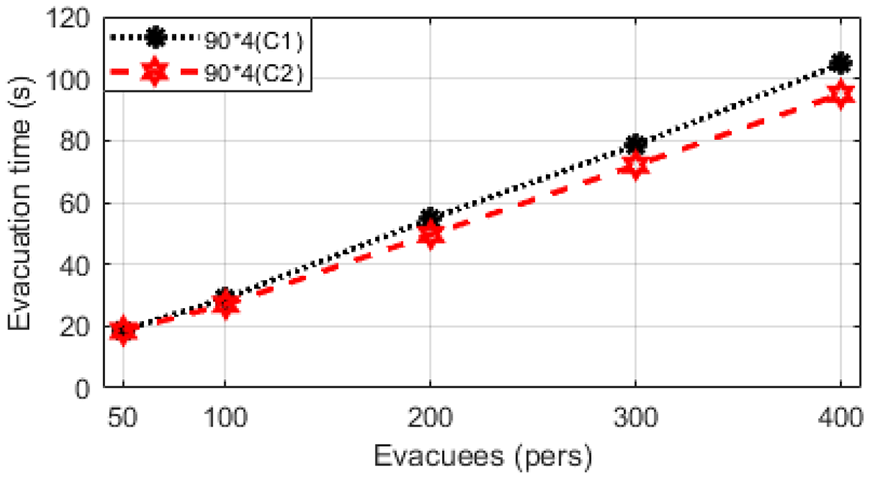
The evacuation time with the number of the evacuees (L2 = 90 cm).
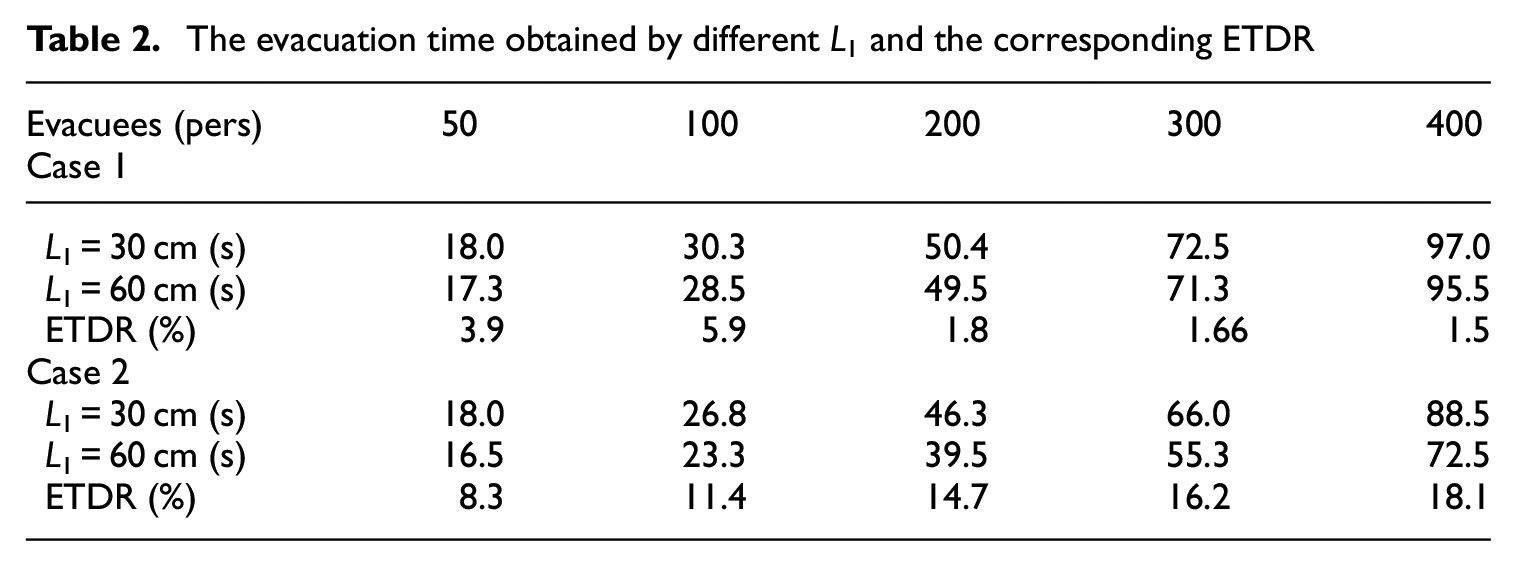
Then, consider the influences of L1 on the evacuation. There are two scenarios (L1 = 30 cm and L1 = 60 cm) are considered. Moreover, assume L2 = 60 cm and the number of the channels is 6. After doing the simulation, the obtained evacuation times are given in Table 2, which shows, compared with the scenario with L1 = 30 cm, the scenario with L1 = 60 cm can achieve less evacuation times no matter in Case 1 or 2. However, the evacuation-time-decreased rate (ETDR) obtained in Case 2 is much higher than that obtained in Case 1. For example, when the number of the evacuees is 400, the ETDR is (88.5–72.5)/88.5 = 18.1% in Case 2, however, Case 1 only gets (97.0–95.5)/97 = 1.5%. The curves of the evacuation time with the number of the evacuees are plotted in Figure 10, which also shows that the evacuation times increase linearly with the number of the evacuees, and in case 2, the more the number of the evacuees is, the more the evacuation superiority obtained by L1 = 60 will be. That is, in Case 2, increasing the value of L1 can speed up the evacuation, effectively.
The evacuation time obtained by different L1 and the corresponding ETDR

The curves of the evacuation time with the number of the evacuees for different values of L1.
Then, the influences of ∠β on the evacuation time is considered. Assume L1 = L2 = 60 cm, and the number of the channels is 6. Several special angles (0°, 10°, 15°, 20°, 25°, 30°, 40°, 90°) of ∠β are chosen to do the simulation. After doing simulation by computer, the evacuation times obtained with different numbers of the evacuees are shown in Table 3, and the curves of evacuation time with ∠β for different numbers of evacuees are plotted in Figure 11. From the Table 3 and Figure 11, it can be obtained that when the number of the evacuees is <100, the influence of ∠β on the evacuation time is not evident. However, the difference among the evacuation times obtained by different ∠β increases with the increase of the number of the evacuees. For example, when the number of evacuees is 400, the longest evacuation time 95.5 s is obtained with ∠β = 0°, and the shortest evacuation time70.8 s is obtained with ∠β = 15°. All in all, when the number of the evacuees is enough, the value of ∠β can influence the evacuation time, greatly, and when ∠β = 0° and 15°, the longest and shortest evacuation times can be achieved, respectively.
The evacuation times for wedge-shaped wing gate turnstile with different ∠β.


The curves of evacuation time with ∠β for different numbers of the evacuees.
Conclusion
The influences of the wing gate turnstiles on pedestrian evacuation are investigated in this paper based on simulation. According to the requirement of the simulation, the agent-based evacuation model is established by Pathfinder. By assuming the total width of the channels is 360 cm, five cases (51.4 × 7, 60 × 6, 72 × 5, 90 × 4, 120 × 3, 180 × 2) of the wing gate turnstiles are given to do the simulation. The results indicate that, compared with flat-shaped host, wedge-shaped host can improve the evacuation speed, greatly. Furthermore, the longest evacuation time is obtained while the channels’ width is 90 cm, and the shortest evacuation time is achieved while the channels’ width is 51.4 cm. For a small number of evacuees, the evacuation time is mainly influenced by the original distributions of the evacuees, however, as the number of the evacuees increases, it becomes to be mainly influenced by the number of the evacuees, and there is a linear relationship between the evacuation time and the number of the evacuees. Furthermore, compared with Case 1, the evacuation superiority of Case 2 is more and more obvious along with the increase of the number of the evacuees. Then, the influences of L1 on the evacuation time is considered. Compared with the scenario with L1 = 30 cm, the scenario with L1 = 60 cm can achieve less evacuation time no matter in Case 1 or 2. In Case 2, the more the number of the evacuees is, the higher the evacuation-time-saved rate will be. However, the evacuation speed improvement obtained in Case 1 is not obvious, and it is not to do with the number of evacuees. Then, the influences of ∠β on the evacuation time is considered. It is obtained that when the number of the evacuees is less than 100, the influences of ∠β on the evacuation time is not evident. However, the influences become more and more obvious as the number of the evacuees increases and ∠β = 15° can achieve the shortest evacuation time. The obtained results can not only provide helps for managers to evacuate crowds under emergency, but also offer some assistances for designers to design those gate turnstiles or building exits. Furthermore, the proposed results can be of great interest to a wide variety of pedestrian evacuation areas, where wing gate turnstiles or similar exits are encountered. However, there are still some further investigations, such as the effects of obstructions or psychological factors on evacuation, field evacuation experiment, etc., that are not contained in this paper, and they will be the authors’ future work.
Footnotes
Declaration of conflicting interests
The author(s) declared no potential conflicts of interest with respect to the research, authorship, and/or publication of this article.
Funding
The author(s) disclosed receipt of the following financial support for the research, authorship, and/or publication of this article: This research was supported by project of National Natural Science Foundations of China (nos. 61763015 and 71540041), project of Jiangxi Provincial Natural Science Foundation of China (nos. 20202BABL202011), The authors would like to thank anonymous reviewers for their valuable comments and suggestions.
