



Abstract
There are a very limited number of reports studying on the dynamic response and injuries of pedestrian head in the scenarios with head hitting windshield. This study aims to investigate the significant factors that affect the dynamic response and injuries of pedestrian head through finite element–multi-body coupling simulations. Two finite element vehicle models and two multi-body pedestrian human models were used to build the coupling simulations. Orthogonal experimental design and analysis of variance were used for parameter combination and data analysis. This study demonstrated that the dynamic response of pedestrian head and HIC15 were strongly associated with collision speed and pedestrian orientation. Vehicle type had a significant influence on the dynamic response of pedestrian head and HIC15, while there was no significant relationship between the dynamic response of pedestrian head and HIC15 and the size of pedestrian human models. Collision speed, pedestrian orientation, and vehicle type should be prioritized over the other collision parameters in the study of head injury mechanism and reconstruction of vehicle–pedestrian collisions in the scenarios with head hitting windshield.
Introduction
Pedestrians are common victims of traffic accidents in China, and pedestrian fatalities account for nearly a quarter of deaths in traffic accidents. 1 While the number of automobiles is increasing rapidly at present. As a result, the incidence of traffic-related pedestrian deaths also increases every year. So, researches on vehicle–pedestrian crash reconstructions and pedestrian injury biomechanics are still hot topics of concern. Head is the most vulnerable part of pedestrians in a collision, and skull-brain injuries and head-neck injuries are important reason for their death. Researchers found that vehicle type, collision speed, pedestrian gait, and walking speed could affect pedestrian head injuries.2–5 Geometry and material of vehicle front end and pedestrian orientation were also believed to affect pedestrian head injuries as well.6–8 Thus, pedestrian head injuries are most likely to be concerned in vehicle–pedestrian crashes. Meanwhile, the dynamic response of pedestrian head has an important role in studying reconstructions of vehicle–pedestrian crashes and mechanism of pedestrian head injuries. But it should be noted and emphasized that most of the conclusions took scenarios (pedestrian head in contact with bonnet, A pillar, windshield, and windshield frame) into account together at present.2–8 Conclusion was drawn that the head injury risk of head–windshield frame impacts and head–A pillar impacts was significantly higher than that of head–windshield impacts and head–bonnet impacts,9–14 whereas parameter sensitivity on the head dynamic response and injuries of various scenarios above remains unclear. Here, we set out to investigate the scenario with head hitting windshield.
Currently, there are two common solutions for vehicle–pedestrian crash simulations: finite element (FE) method based on LS-DYNA and analytical method of multi-body (MB) system based on the mathematical dynamic model (MADYMO). The FE method can simulate deformations of vehicles and human body structures,15,16 but it is not easy to adjust pedestrian gait and its computing cost is typically high. The MB system analysis technique can play a good numerical stability and computational efficiency of human models.17,18 However, it cannot simulate the pedestrian injuries under large deformations of vehicle front end. In order to investigate the significant factors affecting the dynamic response and injuries of pedestrian head in the scenarios with head hitting windshield, the FE vehicles–MB human models coupled impacts were simulated and analyzed in this study, which combined the merits of both simulation methods at the same time.19–21
Materials and methods
Coupling methods and models
In process of coupling simulation calculation, vehicle models and pedestrian human models were run at LS-DYNA platform and MADYMO platform separately. LS-DYNA solver and MADYMO solver would exchange information such as contact force and contact position in real time. Contact force was transmitted from the former to the latter, and the latter sent information such as contact position back to the former. Then deformations of vehicle parts at the LS-DYNA platform, Head Injury Criterion (HIC15) and response of pedestrian human models at the MADYMO platform would be calculated separately.
FE vehicle models of a sedan and a minivan were taken in this research, and both models had been verified by collision tests and numerical simulations.22,23 For better understanding and detailed analysis, we selected vehicle model structures that may be touched by pedestrian human models as the remained parts and that may be deformed as the coupled parts. By comparing head impactor accelerations during impact tests versus simulations, in terms of the force response, the vehicle models simplified were close to the real ones (see Table 1 and Figure 1). The 5% and 50% ellipsoid pedestrian human models developed by the Netherlands Organisation for Applied Science Research (TNO) were selected as pedestrian human models in this research. Keywords (CONTROL_COUPLING and CONTACT_COUPLING) were used to unify units and set vehicle–pedestrian contacts. Contact algorithms CONTACT_FORCE_CHAR and CONTACT_AUTOMATIC_SURFACE_TO_SURFACE were applied to vehicle–pedestrian contacts and tires–ground contacts in simulations separately. Collision speed (vehicle velocity) was loaded into the forward direction of vehicle models. The coefficient of friction between pedestrian human models and vehicle models was set at 0.3, and the coefficient of friction between pedestrian human models and ground models was set at 0.6. 24 Both the vehicle models and pedestrian human models were loaded with gravity. The coupling simulation time was set to 200 ms. The diagrams of coupling simulation models constructed by the vehicle models and pedestrian human models are shown in Figure 2.
Main model parameters and settings of impact tests and simulations.


Comparison of head impactor accelerations during impact tests versus simulations: (a) windshield (sedan), (b) hood (sedan), (c) windshield (minivan), and (d) hood (minivan).

Diagrams of coupling simulation models.
Parameter design of simulations
According to the literature materials and research needs,9,25,26 impact area of bonnet (A_B), collision speed (S_V), walking speed of pedestrian (S_P), pedestrian gait (G_P), and pedestrian orientation (O_P) were chosen as the simulation parameters. Orthogonal experimental design was used to analyze the influence of multiple factors on the peak value of head linear velocity (H_Vp), peak value of head linear acceleration (H_Lacp), peak value of head angular velocity (H_Ap), peak value of head angular acceleration (H_Accp), and HIC15. Each parameter contained four levels and the values are shown in Table 2. The orthogonal table L16(45) was selected in this study without considering interaction between factors. 27 The calculation files of coupling simulations were adjusted according to the simulation parameters above and the values are shown in Table 3.
Parameter levels.

Orthogonal table L16(45).

Analysis of variance
The data extracted from coupling simulation results were tested for normality and homogeneity of variance first. If the data obeyed normal distribution with the same variance, it would be analyzed using one-factor or multi-factor one-way analysis of variance. Otherwise, the Kruskal–Wallis nonparametric test would be performed on it. In this study, all statistical analyses were performed using MATLAB2014a, and p values <0.05 were considered statistically significant.
Results
Collision analysis for vehicle models–pedestrian human models
For situations where two vehicle models impacted two human models separately, the postures of human models and locations of head in contact with the sedan under various parameter levels are shown in Figures 3 and 4. Animation results showed that the lower and middle parts of windshield were the main parts where the head of the 5% human model hit the sedan. The middle and upper parts of windshield were the main parts where the head of the 50% human model hit the sedan. The middle part of windshield was the main part where the head of the 5% human model hit the minivan. The upper part of windshield was the main part where the head of the 50% human model hit the minivan.

Postures of human models in contact with vehicle models under various parameter levels: (a) sedan—5% pedestrian human model, (b) sedan—50% pedestrian human model, (c) minivan—5% pedestrian human model, and (d) minivan—50% pedestrian human model.
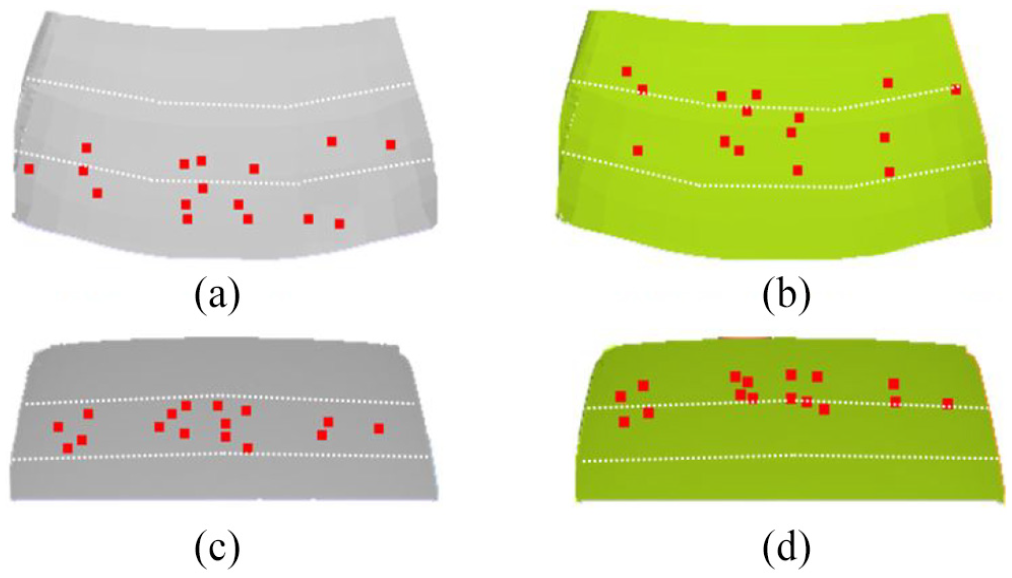
Locations of head in contact with vehicle models under various parameter levels: (a) sedan—5% pedestrian human model, (b) sedan—50% pedestrian human model, (c) minivan—5% pedestrian human model, and (d) minivan—50% pedestrian human model.
According to Table 4, as for sedan—5% pedestrian human model impacts, the peak value of head linear acceleration, peak value of head angular velocity, and peak value of head angular acceleration were strongly associated with collision speed, and the peak value of head linear velocity and HIC15 were strongly associated with collision speed and pedestrian orientation. As for sedan—50% pedestrian human model impacts, the peak value of head linear acceleration, peak value of head angular velocity, and peak value of head angular acceleration were strongly associated with collision speed; the peak value of head linear velocity was strongly associated with collision speed and pedestrian orientation; and HIC15 was strongly associated with collision speed, pedestrian orientation, and impact area of bonnet. As for minivan—5% pedestrian human model impacts, the peak value of head linear velocity and peak value of head linear acceleration were strongly associated with collision speed, the peak value of head angular velocity was strongly associated with pedestrian orientation, and the peak value of head angular acceleration and HIC15 were strongly associated with collision speed and pedestrian orientation. As for minivan—50% pedestrian human model impacts, the peak value of head linear velocity was strongly associated with collision speed; the peak value of head linear acceleration was strongly associated with the impact area of bonnet, collision speed, and pedestrian orientation; the peak value of head angular velocity was strongly associated with the impact area of bonnet, collision speed, pedestrian gait, and pedestrian orientation; the peak value of head angular acceleration was strongly associated with the impact area of bonnet, collision speed, walking speed of pedestrian, pedestrian gait, and pedestrian orientation; and the peak value of head angular acceleration and HIC15 were strongly associated with collision speed and pedestrian orientation.
ANOVA tables of collision analysis for vehicle models–pedestrian human models.

Effect of human model size on the head dynamic response and HIC15
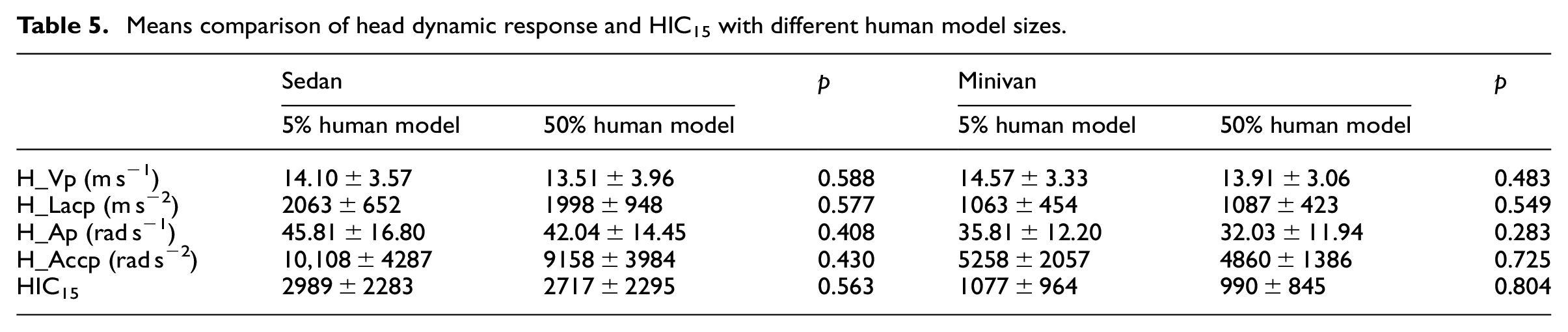
For both the vehicle models, the size of pedestrian human models had no significant effect on the peak value of head linear velocity, peak value of head linear acceleration, peak value of head angular velocity, peak value of head angular acceleration, and HIC15 (see Table 5).
Means comparison of head dynamic response and HIC15 with different human model sizes.
Effect of vehicle type on the head dynamic response and HIC15
For both the pedestrian human models, the vehicle type had a significant effect on the peak value of head linear acceleration, peak value of head angular velocity, peak value of head angular acceleration, and HIC15 (see Table 6).
Means comparison of head dynamic response and HIC15 with different vehicle types.

Discussion
Collision speed and collision angle are the two most common parameters used to study the dynamic response of head in pedestrian crash scenarios. However, linear and angular acceleration information are not paid enough attention in present studies, which are crucial for study on mechanism of pedestrian head injuries.28–32 Therefore, in this research, we pay attention not only to the speed information of pedestrian head–vehicle impacts, but also to the acceleration information. On the other hand, most conclusions of the vehicle–pedestrian studies were drawn by taking situations (pedestrian head in contact with bonnet, A pillar, windshield, and windshield frame) into account together, which made it difficult to obtain analysis results as accurately as possible. Considering the characteristic of head–windshield impacts in vehicle–pedestrian collisions is more regular than that of head–bonnet impacts, head–A pillar impacts, and head–windshield frame impacts, this study focuses on the dynamic response and injuries of pedestrian head in the scenarios with head hitting windshield.
That impact speed could affect the severity of pedestrian head injury has been confirmed in many studies.4,33–36 However, there are fewer reports concerning the role of pedestrian orientation. Liu et al. 37 reported that pedestrian orientation could affect the severity of head injuries in car–pedestrian collisions. Tamura 38 and Qi et al. 39 reported that pedestrian orientation could affect the severity of head injuries in van–pedestrian collisions. Our study was carried out by analyzing collisions between the sedan and the 5% pedestrian human model, collisions between the sedan and the 50% pedestrian human model, collisions between the minivan and the 5% pedestrian human model, and collisions between the minivan and the 50% pedestrian human model. The results showed that collision speed and pedestrian orientation were the two most important parameters affecting the dynamic response of pedestrian head (peak value of head linear velocity, peak value of head linear acceleration, peak value of head angular velocity, peak value of head angular acceleration), and they were the two most important parameters affecting the HIC15 as well. In the course of collisions between vehicles and pedestrians, collision speed would affect the transferred energy from the vehicles to the pedestrians, especially the head, and the effect of pedestrian orientation was mainly achieved through the physical connection which existed force response difference in various directions between head and neck.
Pedestrian size (height and weight) has received more and more attention in pedestrian collision researches. Meanwhile, researchers are mainly focused on the relationship between pedestrian height, weight, and HIC15. Liu et al. 40 reported that an increase in the weight and height would result in an increase in the head injuries (HIC15). However, Hui 41 pointed out that the short had a higher risk of head injuries than the tall. The study of Zhen 42 showed that with increasing height, the severity of pedestrian head injuries (HIC15) decreased. In our research, the effects of pedestrian size on the head dynamic response and HIC15 were found that, as to the sedan and the minivan, pedestrian size had no significant influence on the peak value of head linear velocity, peak value of head linear acceleration, peak value of head angular velocity, and peak value of head angular acceleration. In addition, pedestrian size had no significant influence on HIC15, which was inconsistent with the above findings.40–42 It was worth noting that there were two head–vehicle collision scenarios, head–bonnet contact, and head–windshield contact, analyzed together in these studies.40–42 However, head–windshield contact was the only case of head–vehicle collision scenarios in our research. Therefore, the relationship between pedestrian size and the dynamic response and injuries of pedestrian head under different collision situations and the parametric study that clarifies the effect of pedestrian size and vehicle type on pedestrian head injuries are worthy of further exploration.
That vehicle type would affect the severity of pedestrian head injuries have been widely recognized.12,35,36,43–46 In this research, the effects of the vehicle type on the head dynamic response and HIC15 were found that, as to the 5% pedestrian human model and the 50% pedestrian human model, vehicle type had a significant influence on the HIC15. Furthermore, we observed a significant relationship between vehicle type and the peak value of head linear acceleration, peak value of head angular velocity, and peak value of head angular acceleration. The effects of vehicle type could be caused by the difference in stiffness, shape, and weight between the sedan and minivan. The shape might have a great influence on the head movement distance before contacting the vehicles, and the stiffness and weight might have a great influence on the transferred energy from the vehicles to the pedestrians, especially the head.
It has to be stated that the conclusions of this study apply for the particular vehicle types and pedestrian sizes used in the coupling simulations. Also, the vehicle was considered with zero acceleration, deceleration, and steering angle. Better windshield and engine hood models should be considered as well.47–51 Consideration of these factors mentioned above might produce more reliable results, which is a very noteworthy content of further research.
Conclusion
Most conclusions of the vehicle–pedestrian studies were drawn by considering multiple situations together, which made it difficult to obtain analysis results as accurately as possible. Our study should be a starting point to explore the parameter sensitivity of pedestrian head dynamic response and injuries in the scenarios with head hitting windshield, adding a new dimension to our understanding of vehicle–pedestrian collisions and assisting the researchers and analysts in studying mechanism of head injuries better. Coupling simulations are carried out to obtain the analysis data, which combines the advantages of the FE method and the MB system analysis technology, 52 and orthogonal experimental design and analysis of variance are used to explore the influence factors. This study has found collision speed and pedestrian orientation to be the two most important parameters affecting the dynamic response of pedestrian head (peak value of head linear velocity, peak value of head linear acceleration, peak value of head angular velocity, peak value of head angular acceleration) and HIC15. Our results further demonstrate the significant relationship between vehicle type and HIC15. In addition, we observed a significant relationship between vehicle type and the peak value of head linear acceleration, peak value of head angular velocity, and peak value of head angular acceleration. The effects of pedestrian size on the head dynamic response and HIC15 were found that, as to the sedan and the minivan, pedestrian size had no significant influence on the peak value of head linear velocity, peak value of head linear acceleration, peak value of head angular velocity, peak value of head angular acceleration, and HIC15. It was pointed out that the relationship between pedestrian size and the dynamic response and injuries of pedestrian head under different collision situations are worthy of further exploration.
Footnotes
Author contributions
W.L. and Z.Y. conceived of and designed the experiments. W.L., A.D., K.L., and J.Q. performed the experiments, collected, and cleaned the data. W.L., L.F., and H.J. analyzed the data, interpreted the findings, and wrote the paper. All authors have read and approved the final manuscript.
Declaration of conflicting interests
The author(s) declared no potential conflicts of interest with respect to the research, authorship, and/or publication of this article.
Funding
The author(s) disclosed receipt of the following financial support for the research, authorship, and/or publication of this article: This work was financially supported by the National Key Research and Development Program of China (project number: 2016YFC0800702, 2016YFC0800702-3).
