



Abstract
With the aim of enhancing both reliability and fatigue life of gasket, this study combines finite element analysis, orthogonal experimental design, dynamically-guided multi-objective optimization, and the non-dominated sorting genetic algorithm with elitist strategy to optimize the geometric parameters of the cylinder gasket. The finite element method was used to analyze the temperature field, thermal-mechanical coupling stress field, and deformation of cylinder gasket. The calculation results were experimentally validated by measured temperature data, and comparison results show that the maximum error between calculated value and experiment value is 7.1%, which is acceptable in engineering problems. Based on above results and orthogonal experiment design method, the effects of five factors, including diameter of combustion chamber circle, diameter of coolant flow hole, length of the insulation zone between third and fourth cylinders, thickness of gasket, and bolt preload, on three indexes: temperature, stress, and deformation of gasket, were examined in depth. Through the variance analysis of the results, three important factors were identified to proceed later calculation. The dynamically guided multi-objective optimization strategy and the non-dominated sorting genetic algorithm were effectively used and combined to determine the optimal geometric parameters of cylinder gasket. Furthermore, calculation results suggest that temperature, stress, and deformation of the optimized cylinder gasket have been improved by 27.88 K, 16.84 MPa, and 0.0542 mm, respectively when compared with the origin object, which shows the excellent performance of gasket optimization and effectiveness of the proposed optimization strategy.
Introduction
In diesel engine, the cylinder gasket is vital for ensuring reliable sealing and stable operation. During operation, cylinder gasket is not only exposed to high-temperature gas scouring but also undergone extrusion due to internal forces generated by the cylinder head and body as well as the bolt preload, which will result in a severe working environment to it. The area in gasket located between the cooling channel and combustion chamber must be able to withstand large amount of heat transferred from high-temperature gas to coolant. In addition, this area is exposed to extremely high pressures from the combustion chamber and high forces generated by the bolt preload continuously throughout its working lifespan. Thus, the cylinder gasket often suffers from fatigue damage and creep failure. Detailed knowledge of temperature, stress, and deformation condition of gasket can significantly contribute to the safe and reliable operation of it, thereby enhance the overall reliability and performance of the engine. Therefore, it is necessary to investigate and optimize the working state of cylinder gasket in depth in order to guarantee the reliability and service life of the engine.
There are many researches focused on gasket and its thermal and mechanical condition. Fang et al. 1 used finite element method to study various components of the gasoline engine, including the cylinder gasket, and investigated the effects of various operating conditions on the sealing performance of the engine. Abid et al. 2 come up with an optimal strategy for the bolt of gasket used in the flanged pipe joint. In order to make the values of exact preload and the target force to be more closed, they used the method of torque and stretch control, and they also considered the industrial standard and adopted an optimization algorithm. Wang et al. 3 conducted experiment to investigate the polymers of the gasket which is used for sealing. The methods and equipment they used are math equation calculation, law of thermodynamics calculation, scanning electron microscope and sensors. Results show that when working at high pressure, the water-swelling rubber perform better than other materials and structures. Tan et al. 4 investigated the properties of gasket working in waterproofing situation. They investigated the influence of compression pressure, swelling situation, and saline environments on gasket. Results show that water-swelling polyurethane is much better than the water-swelling rubber when working at complex submarine condition. Yang et al. 5 analyzed the gasket in the hydraulic system and founded out the reason why gasket will fall failure after working a short time. They figured out this problem by macroscopic and microscopic analysis and come up with a method to prevent the failure. To date, most researches in this area have solely focused on the sealing performance of the cylinder gasket, whereas the temperature stress field, deformation, and fatigue life of the cylinder gasket are rarely studied.
There are many practical and efficient optimization methods applied in the engineering problems, which are artificial neural network, 6 gray wolf optimizer algorithm, 7 deep learning neural network, 8 artificial bee colony, 9 fuzzy optimization, 10 imperialist competition algorithm, 11 hybridized whale optimization algorithm, 12 particle swarm algorithm, 13 response surface method 14 and so on.
There are also many researches focus on the orthogonal experiment,15–18 Multi-objective optimization for engineering problems,19–21 crashworthiness,22–24 sheet metal forming,25,26 composite structure27–29 and et al.
In this study, the finite element method is combined with orthogonal experiment design, dynamically guided multi-objective optimization, and non-dominated sorting genetic algorithm to geometrically optimize the working state of cylinder gasket. This study is organized as follows: In Section 1, temperature field, thermal-mechanical coupling stress field, and deformation of the cylinder gasket were analyzed using the finite element method. Hardness plug experiment was conducted to verify the accuracy of calculation results. In Section 2, the effect of five factors on thermal and mechanical load of cylinder gasket was calculated through orthogonal experimental design and three of five factors were identified as core factors, which have more influence on the thermal and mechanical load of gasket. Section 3 combined dynamically guided multi-objective optimization with the non-dominated sorting genetic algorithm to determine the optimal geometric parameters of the cylinder gasket.
Analysis of temperature field and stress field of cylinder gasket
As the most important sealing component of diesel engine, gasket provides a reliable seal at the junction between the cylinder head and cylinder body under bolt preload, and is particularly critical for sealing the combustion chamber and cooling channel. Based on a well-established working process model of diesel engine, boundary conditions for the temperature field and thermal-mechanical coupling stress field of the gasket were calculated. According to experimental measurements, the bolt preload of the engine was 153.8 kN.
The material properties of gasket is presented in Table 1.
Material properties of gasket.
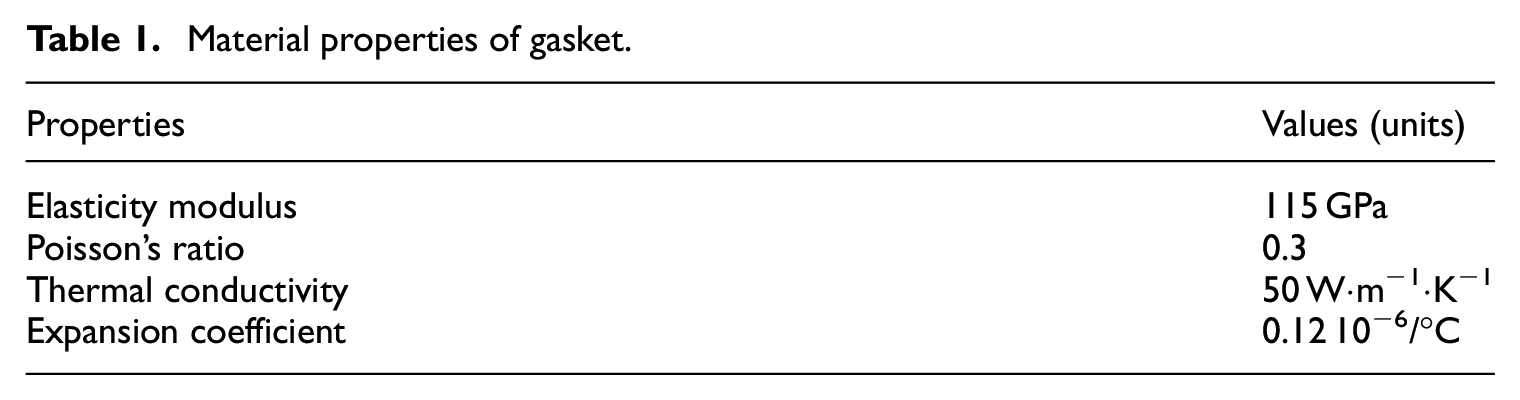
Figure 1 displays the temperature field of cylinder gasket. From which it can be observed that the maximum temperature of the gasket was 534.16 K, and occurred on the area between third and fourth cylinders in contact with the combustion chamber, while the lowest temperature was 365.52 K and occurred near the coolant channel. Overall, the temperature of the gasket was not too high, however, the temperature gradient was large. Since the gasket material is soft, deformation conditions of cylinder gasket are important to consider.

Temperature field of cylinder gasket.
In order to validate the simulation results, the temperature of the cylinder gasket was measured under actual operating condition. Since the cylinder gasket is located between the cylinder body and cover, only the area outside the diesel can be measured without disassembling the engine. The temperature experiment of the cylinder gasket is illustrated in Figure 2.

Experiment equipment in the diesel engine.
Figure 3 shows the detailed arrangement of measurement points.

Arrangement of measurement points in cylinder gasket.
The parameters of experiment equipment is listed in Table 2.
The accuracy and specification of each device.

Experimental values and calculated data for the gasket temperature are compared in Figure 4.

Comparison of experimental and calculated data.
According to Figure 4, maximum error between the experimental values and calculated results was 7.1%, suggesting that the model satisfies the precision requirements of engineering calculations. 30
Figure 5 displays the thermal-mechanical coupling stress field of the cylinder gasket at the moment corresponding to maximum pressure in the first cylinder. The maximum thermal-mechanical coupling stress was 246.17 MPa, and occurred around the coolant channel of the first cylinder. The effect of maximum pressure in the cylinder gasket was only restricted to the region around the first cylinder, suggesting that the bolt preload and interaction between the cylinder head and body impose adequate fixation and support for the gasket.

Distribution of thermal-mechanical coupling stress of cylinder gasket.
Figure 6 illustrates the deformation condition of the cylinder gasket. The maximum deformation of the gasket (0.3771 mm) occurred in the area around the first and sixth cylinders. Moreover, deformation increases steadily from the center to both sides of gasket.

Deformation condition of cylinder gasket.
By analyzing the temperature, coupling stress and deformation of gasket, it can be concluded that thermal-mechanical coupling stress in the area between the combustion chamber and coolant flow hole were great, and large deformation can be observed on both sides of the gasket. In addition, since the gasket material is relatively soft and flexible, the gasket can easily suffer fatigue failure. Next, orthogonal experiment design and a multi-objective optimization method are presented for optimizing the geometric parameters of cylinder gasket.
Analysis of cylinder gasket based on orthogonal experiment
In this section, the orthogonal experiment design 31 and statistical analysis are adopted to analyze the influence of geometric parameters on thermal mechanical conditions of gasket combined with finite element method.
Experimental design
By analyzing the calculation results, the temperature was found to be highest around the combustion chamber circle, stress was greatest in the region between the combustion chamber circle and coolant flow hole, while poor thermal conditions arose between the third and fourth cylinders. Therefore, Five factors, namely, diameter of combustion chamber circle (factor A), diameter of coolant flow hole (factor B), length of the insulation zone between third and fourth cylinders (factor C), thickness of gasket (factor D), and bolt preload (factor E), were selected for optimization. Table 3 lists the different levels adopted for each factor.
Factor levels used in orthogonal experiments.

The orthogonal experiments includes five factors and each factor was assigned five levels for analysis. Accordingly,
Experimental plans of

Statistical analysis of experimental results
Using the finite element model established in Section 2 and orthogonal experiment plan, the maximum temperature
Since optimal results of three indexes appeared in different groups of experiments, effects of the various factors cannot be assessed according only to the above results and the results must be further analyzed, as shown in Table 5. In the Tables 1 to 5 represent the sum of corresponding values of Levels 1–5 of each factor, “MAX” and “MIN” denote maximum and minimum values of 5 values in the same column, and “R” denotes the difference between “MAX” and “MIN.”
Further analysis of calculated results.

From Table 5, it can be observed that factor A and factor D have a significant influence on the deformation of gasket, whereas factor B greatly affects the stress of gasket and factor D significantly affects the gasket temperature.
Variance Analysis of experimental results
By analyzing the variance of experimental results, we can determine whether the differences among experimental results are due to the factor’s differences or to the experimental error. The sum of square deviations is defined as equation (1).

where
The degree of freedom corresponding to the sum of squared deviations of the factor can be calculated as equation (2).

After the sum of squared deviations is calculated for each factor, the total error sum of squares can be written as equation (3).

According to the definition 32 :

Therefore, the error sum of squares can be expressed as equation (5).

Then, the mean squared value can be calculated as equation (6).

If
ANOVA results for indexes.

As shown in Table 6, factor D (thickness of gasket) has a significant effect on temperature, with an F-value of 2.331; factor B (diameter of coolant flow hole) greatly influences stress, with an F-value of 3.018; and factor E (bolt preload) significantly influences deformation, with an F-value of 2.5. Different factors have significant effects on temperature, pressure, and deformation; therefore, it can be concluded based on results of the orthogonal experiment that factor B, D, and E are the core factors for optimizing the gasket geometric parameters and we can ignore the effects of other factors. Next, according to the results of orthogonal experiments, a multi-objective optimization method is introduced for exploring the optimal geometric parameters of gasket.
Multi-objective optimization of cylinder gasket
At present, main multi-objective optimization algorithms are used for acquiring the optimal solution set on the whole Pareto frontier, which is highly useful for decision makers who lack related experience or data support. However, for decision makers with previous experience or suitable relevant data, these optimization methods are not always efficient and economical. Therefore, we need the multi-objective optimization methods 33 that consider decision maker’s preferences to optimize the gasket, which can save on computational resources by obtaining the Pareto solution set of the preference solution set more rapidly and effectively.
Establishment of objective function
The elitist non-dominated sorting genetic algorithm version II (NSGA-II)
34
was applied for conducting the multi-objective optimization on three indexes:
For this calculation, the fitness function was selected as equation (7).

where f denotes the fitness function (smaller f is better);
Dynamically guided optimization strategy
During the actual computation process, the optimization is mainly controlled by parameters


where


Main operating procedure
During operation, the optimization strategy was performed using NSGA-II. The flowchart of algorithm is showed as Figure 7.

Flowchart of NSGA-II.
The detailed steps of NSGA-II are listed as follows.
Step 1: Initialize the program.
Step 2: Set
Step 3: Calculate the fitness of each individual in the population and define order i of each individual as well as the aggregation distance according to the fitness degree and the dominance relation.
Step 4: Obtain
Step 5: Obtain
Step 6: Calculate
Step 7: Conduct non-dominated sorting of the individuals in
Step 8: Execute
Step 9: Finish the loop.
During actual operation, the minimum values of
Values of factors used in multi-objective optimization.

To avoid the effects of different types of data on the results, all data were normalized before the optimization according to the equation (13).

where
Results and analysis
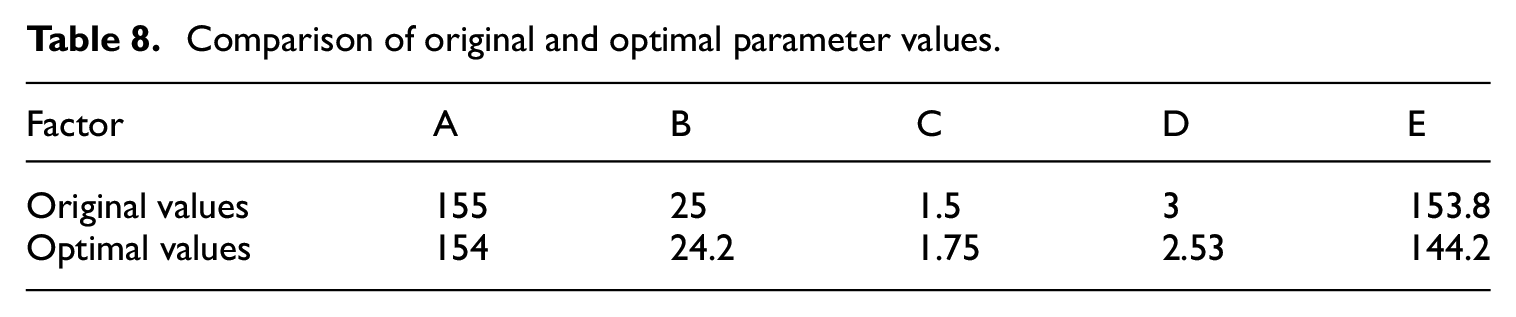
Optimal factors of the cylinder gasket were determined using the proposed dynamically guided optimization strategy and non-dominated sorting genetic algorithm. The original and optimized factor values are compared in Table 8.
Comparison of original and optimal parameter values.
Figures 8 to 10 show the temperature, thermal-mechanical coupling stress fields and deformation of the optimized gasket, respectively.

Temperature field of gasket after optimization.

Thermal-mechanical coupling stress field of gasket after optimization.

Deformation of gasket after optimization.
Table 9 compares the
Comparison of indexes before and after the optimization.

Conclusions
This study combined orthogonal experimental design, dynamically guided multi-objective optimization, and a non-dominated sorting genetic algorithm to optimize the geometrical structure of cylinder gasket in diesel engine based on three evaluation indexes: maximum temperature, maximum stress, and maximum deformation. The main conclusions are summarized below.
This paper analyzed the thermal and mechanical load conditions of the cylinder gasket using finite element method, and validated the accuracy of calculation results using the diesel temperature experiment. Results show that maximum temperature of the gasket was 534.16 K, maximum thermal-mechanical coupling stress was 246.17 MPa and maximum deformation is 0.3771 mm. The weak areas of gasket is the sections that thermal-mechanical coupling stress and deformation are relatively high, and are located in the areas between combustion chamber and coolant flow hole.
The maximum temperature, stress and deformation of gasket were selected as working status indexes based on the orthogonal experiment design and finite element method. Results show that the thickness of gasket, diameter of coolant flow hole and the bolt preload has significant impacts on temperature, stress and deformation of gasket; therefore, set these three factors as the core factors in the following calculation.
By combining the dynamically guided optimization strategy and non-dominated sorting genetic algorithm, a multi-objective optimization was performed on geometric model of gasket and the optimal geometric factors of gasket were determined. According to the calculation results: diameter of combustion circle should change from 155 to 154 mm, diameter of coolant flow hole should change from 25 to 24.2 mm, length of the insulation zone between third and fourth cylinders should change from 15 to 17.5 mm, thickness of gasket should change from 3 to 2.53 mm, and bolt preload should change from 153.8 to 144.2 mm. After optimization, temperature, stress, and deformation of the optimized cylinder gasket have been improved by 27.88 K, 16.84 MPa, and 0.0542 mm, respectively when compared with the origin object, thus demonstrating the good performance of the optimization and validating the effectiveness of the algorithm.
Footnotes
Appendix
Notation

| Nomenclature | Units | Illustrate |
|---|---|---|
| K | Maximum temperature of gasket | |
| MPa | Maximum coupling stress of gasket | |
| mm | Maximum deformation of gasket | |
| Sum of square deviations | ||
|
|
Degree of freedom | |
|
|
Mean squared value | |
|
|
Number of objectives | |
|
|
Reference point | |
|
|
i-th component of the reference point | |
|
|
Current operational generation | |
|
|
Total number of operational generations | |
|
|
Nonnegative constant |
Declaration of conflicting interests
The author(s) declared no potential conflicts of interest with respect to the research, authorship, and/or publication of this article.
Funding
The author(s) received no financial support for the research, authorship, and/or publication of this article.
