



Abstract
Particle gradation and water content are important factors affecting shear strength of soil. However, due to chemical cementation and molecular attraction, loess particles commonly stick together forming conglomerations. Till date, the superposition effect of water content and conglomeration gradation on loess shear strength has rarely been studied and undeniably requires further systematic explorations and development. In this study, loess samples were prepared with three conglomeration gradations and five water contents, and the direct shear tests were systematically performed. The shear strength of sample 1 (continuous conglomeration gradation) was found to be the best, followed by sample 2 (large size conglomerations), and sample 3 (small size conglomerations). The difference of samples’ shear strength decreased with increasing water content, and almost closed to zero when water content was 20%. The cohesion of samples first increased and then decreased with increasing water content, the maximum cohesion occurred at 10% water content. The internal friction angles decreased with increasing water content, and reached similar minimum values when the water content was 15%. The increased percentage values of cohesion and internal friction angle caused by conglomeration gradation are in the range of 33.2%–42.1% and 9.8%–32.5%, respectively. Finally, the empirical formulas for water content-cohesion and water content-internal friction angle of different conglomeration gradations samples were established, and the calculated values are in good agreement with test data. The effect of loess conglomeration gradation on shear strength decreased with increasing water content. When the water content was less than 15%, using a good conglomeration graduation could effectively improve loss shear strength.
Introduction
Loess is widely distributed around the world, and its total area around the world is approximately 13 million km2, accounting for 9.3% of the global land area. Loess has a loose structure that is easily damaged by shear forces under the action of water or an external load.1–3 Shear strength is an important material property of soil, which is affected by numerous factors, in particular, water content and particle size distribution significantly affect the soil shear strength.4–8
The shear strength of remolded compacted loess increases with increasing dry density and decreases with increasing water content. 9 Previous experimental studies showed that water content has a significant effect on soil cohesion and internal friction angle.10–13 For instance, Ji 14 found that loess shear strength and cohesion showed a trend, which first increased and then decreased with increasing water content and shear rate, and the trend curve shape was basically a quadratic polynomial. The excessive water content exerts an adverse effect on loess shear strength.15,16 Zhang et al., 17 Lian et al., 18 and Xie et al. 19 showed that deformation and strength of unsaturated loess varied significantly with water content variation. Gaaver 20 and Naema 21 found that increasing water content could weaken the connection between soil particles and reduce the soil strength. Yates et al. 22 found that the loess shear strength was controlled by a combination of particle bonding and negative pore pressure. The above-mentioned studies show that water content is an important factor affecting loess shear strength.
Particle size distribution is a significant engineering property of geotechnical materials. 23 The particle size and gradation have an important effect on the shear strength of soils.24,25 For example, Wang et al. 26 found that with the increase in the coarse particle content, sand shear strength index and friction coefficient first decreased and then increased. Yang et al. 27 showed that soil samples from different particle size groups exhibited different intergranular pores at the same dry density, resulting in different shear strengths. Li et al. 28 explored the effect of coarse-grained soil particle shape on shear strength. Sharma et al. 29 reported that soil load carrying capacity primarily depends on particle size distribution, water content, and compaction state of granular soil. Furthermore, many other scholars have also studied the effect of particle arrangement and distribution on soil shear strength.30–33 The related studies indicate that the particle gradation significantly affects the shear behavior of soil.
Owing to chemical cementation and molecular attraction in loess, particles commonly gather together and appear in the form of conglomerations. 34 In case of loess, the original cohesion is formed from the molecular gravity of the soil particles, and the reinforcement cohesion is formed from the cementitious substances (gypsum, carbonate, etc.) between the particles.35,36 Zhang et al. 37 found that the soil conglomerations were able to enhance the interlocking of the compacted loess and improve the shear strength. Although loess conglomerations are closely related to shear strength, most of the current research on loess conglomerations focuses on agriculture, primarily exploring the effects of soil conglomerations on crop planting capacity.38–40 Only a few studies focus on the relationship between loess conglomerations and loess shear strength.
Water content and gradation are important factors affecting soil shear strength. However, most research of soil gradation is primarily focused on soil particles, but less on soil conglomeration. Moreover, the influence of water content on loess conglomerations and the superposition effect of water content and conglomerations on loess shear strength have rarely been studied. Therefore, in this study, loess samples were prepared according to three conglomeration gradations and five water contents. Direct shear tests were performed on these soil samples to investigate the effects of water content and conglomeration gradation on loess shear strength.
Test materials and methods
Test materials
The loess sample used in the test was taken from a construction site in the southern suburbs of Xi’an city, Northwest China. The loess deposits are mainly composed of late Pleistocene Q3 loess, which is of the same soil type, with uniform material and no impurities. The distinct features of loess include the presence of macropores, a loose structure, and columnar jointing. Loess particles commonly stick together forming conglomerations (Figure 1).

Loess conglomerations.
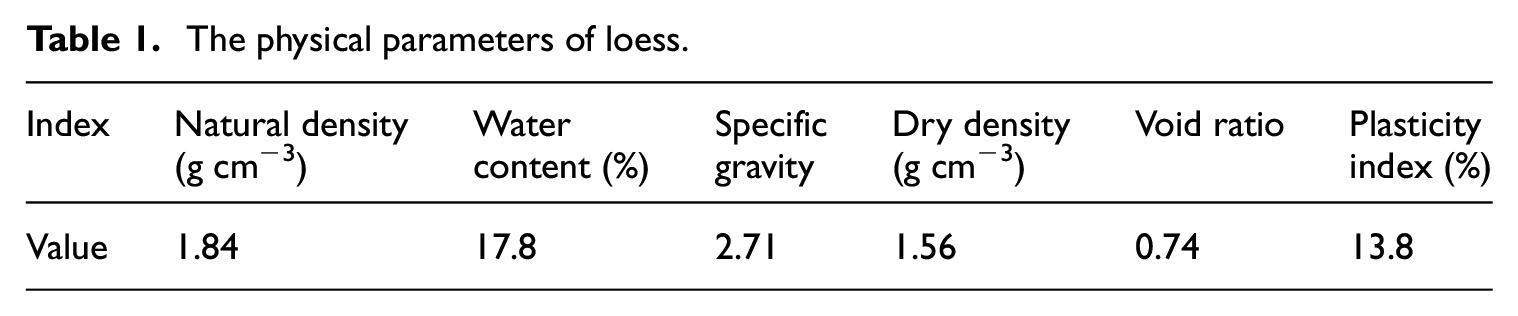
In this study, the tests were carried out in accordance with the Specification of Soil Test (SL237-1999) 41 and Standard for Geotechnical Testing Method (GB/T50123-2019). 42 The physical properties of original loess including water content, dry density, void ratio, saturation, specific gravity, and plasticity index are presented in Table 1.
The physical parameters of loess.
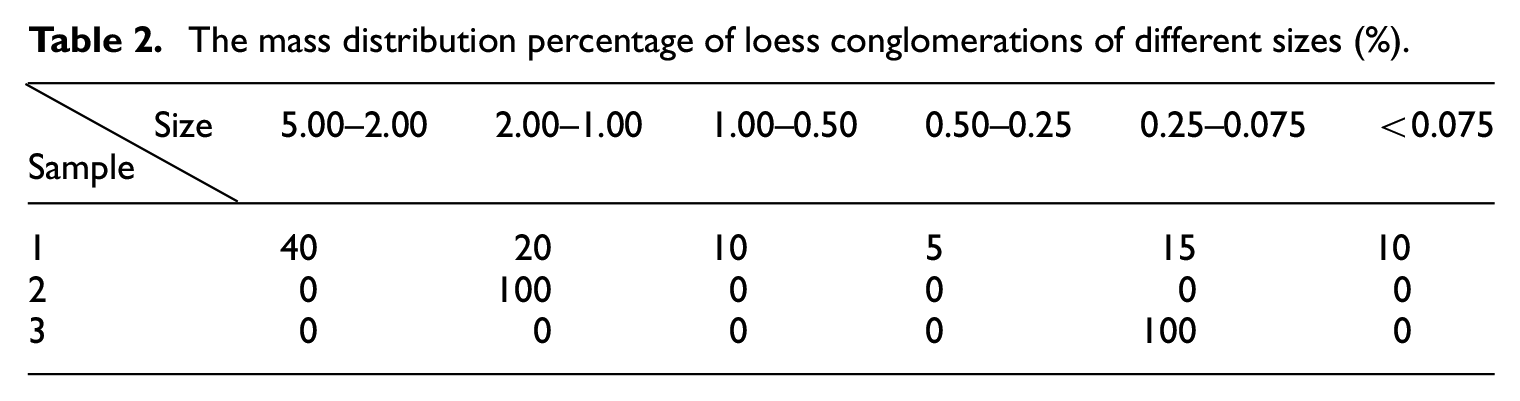
The natural loess was crushed and filtered through a 5.0 mm screen mesh to remove larger undesirable impurities. The loess was dried at 105°C and then sieved using a standard sieve. Three types of samples with different conglomeration gradations were designed. For convenience, the samples with continuous conglomeration gradation, large size conglomeration gradation, and small size conglomeration gradation are named as sample 1, sample 2, and sample 3, respectively (Table 2).
The mass distribution percentage of loess conglomerations of different sizes (%).
Uniformity coefficient
For dry soil with different gradations, water was added to prepare samples with a water content of 0%, 5%, 10%, 15%, and 20%, respectively. The water was mixed evenly after being added to the dry soil. The difference between the measured water content and set water content should not be greater than 1%. Soil samples with different water content were put into plastic bags, which were then placed in a moisturizing vessel for 24 h. Finally, the ring knife samples with diameter of 61.8 mm and height of 20 mm based on the dry density of 1.5 g cm−3 were obtained by the static pressure method (Figure 2).
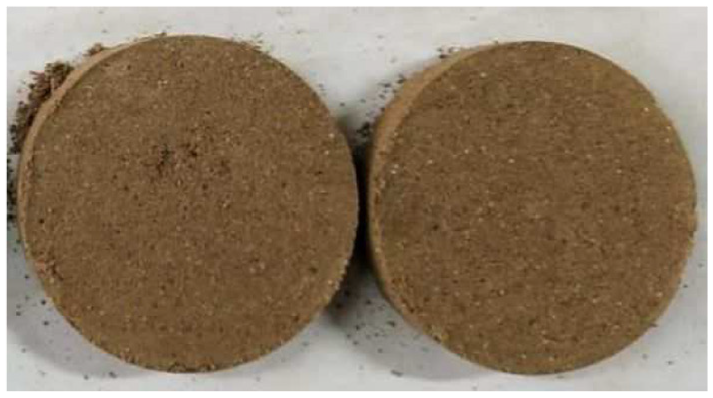
The samples for the tests.
Test methods
A ZJ fully automatic strain control type direct shear instrument was used for the direct shear test (Figure 3). The vertical pressure was 100, 200, 300, and 400 kPa. The test type involved quick direct shear with a shear speed of 0.8 mm min−1.
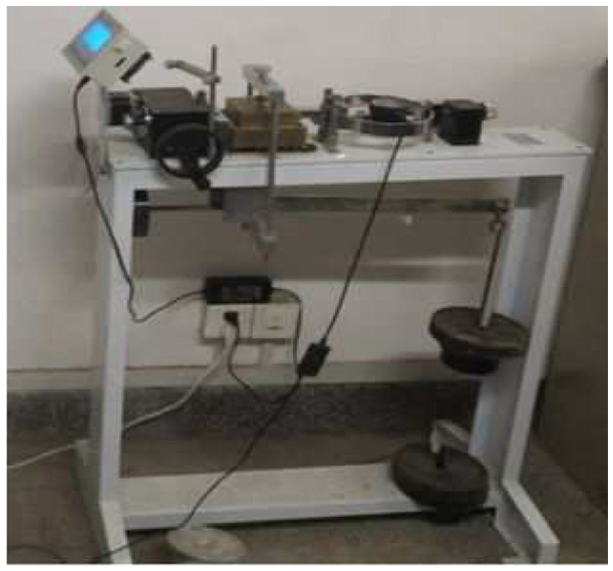
ZJ fully automatic strain control type direct shear instrument.
Test results and analysis
Shear strength envelopes of loess samples
Direct shear tests were carried out on loess samples with three conglomeration gradations and five water contents of 0%, 5%, 10%, 15%, and 20%. The shear strength of each sample at different water contents is shown in Figure 3.
The effect of conglomeration gradation on the loess shear strength envelope is significant in the dry state (Figure 4). The continuous gradation sample 1 shows the largest shear strength, sample 2 with a large conglomeration size exhibits moderate shear strength, and sample 3 with a small conglomeration size acquires the lowest shear strength. At smaller vertical pressures, the difference in shear strength caused by conglomeration gradation is not significant. In contrast, at larger vertical pressure, the difference is significant. With increasing water content, the shear strength envelopes of samples 1, 2, and 3 become closer. When water content is 20%, the shear strength envelopes of each sample almost coincide. Therefore, the effect of conglomeration gradation on loess shear strength decreases with increasing water content. When water content is 20%, the effect of conglomeration gradation on shear strength is small.

Shear strength envelope of samples with different conglomeration gradations and different water contents: (a) 0%, (b) 5%, (c) 10%, (d) 15%, and (e) 20%.
Soluble salts and colloids are important factors in the formation of loess conglomerations. Water dissolves these soluble salts and colloids, and the more the water in the loess, the more significant the dissolution. Therefore, increasing water content leads to the reduction or even disappearance of the connection among conglomerations. At low water content, there is less water in the soil, and the dissolution is not significant. The shear strength of samples with different conglomeration gradation is different. In contrast, when the water content is high, the water in the soil increases and the dissolution becomes significant. In this case, dissolution causes loess conglomerations to break into fine particles and causes different initial conglomeration gradations to become similar, which endows the samples with similar shear strengths. Moreover, water exists in loess in different forms, and the influence of water forms on loess engineering properties is different. The bound water is tightly adsorbed on the particle surface due to the electric field formed by charged particles. The water film thickness also has a significant effect on the shear strength among particles. Free water primarily exists in pores, and its effect on loess engineering properties is primarily manifested by its capillary action. When water content is low, the water in the loess is primarily bound water; however, as water content increases, the amount of free water increases. Therefore, water content has a significant impact on soil engineering properties.
Considering that cohesion and internal friction angle are the primary indicators of loess shear strength, in order to further study the effect of conglomeration gradation on loess shear strength, a detailed analysis and discussion of these two indicators are presented in the subsequent study.
Relationship between cohesion and water content of different conglomeration gradation samples
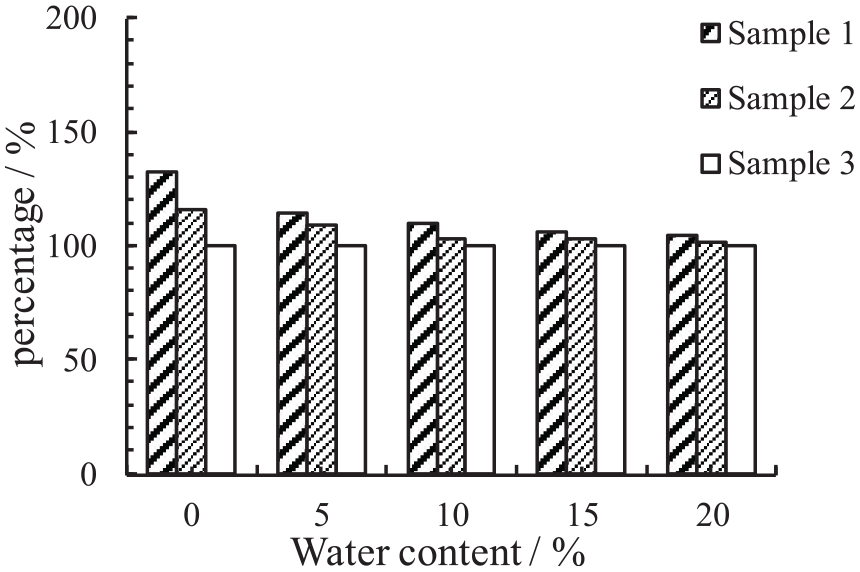
The relationship between cohesion and water content for samples with different loess conglomeration gradation is shown in Figure 5. The test data are connected with a smooth curve. The curve is a parabola with downward opening, which is defined by a quadratic function. If the cohesion of sample 3 is regarded as 100%, the relative percentage of cohesion of each sample is shown in Figure 6. The cohesion of each sample reaches the maximum when water content is approximately 10%. For water content below 10%, the cohesion increases with the increase in the water content. However, when water content is greater than 10%, the cohesion decreases rapidly with increasing water content. In general, the cohesion of sample 1 is significantly greater than those of samples 2 and 3. The cohesion of sample 2 is slightly larger than that of sample 3, and the difference between the two is relatively small. The cohesion difference of samples 1, 2, and 3 is small when the water content is 0% and 20%. The difference is large when the water content is 5%–15%, and the relative percentages of sample 1 are 133.2%–142.1% compared to sample 3. The increase percentage of cohesion caused by conglomeration gradation is 33.2%–42.1%. Therefore, the influence of conglomeration gradation on sample cohesion is significantly related to the water content.

Relationship between cohesion and water content for different conglomeration gradation samples.

Relative percentage of cohesion of different conglomeration gradation samples.
Previous studies on cohesion indicate that, for saturated soil, only the true cohesion is considered. In contrast, for unsaturated soil, the cohesion includes the true cohesion and the apparent cohesion. The apparent cohesion is closely related to the suction of soil. It is difficult to measure the variation of soil suction at any time in the experiment; therefore, in this study, the true cohesion was not distinguished from the apparent cohesion, but discussed as a whole. In the future, more experiments can be carried out to further discuss and analyze the true cohesion and apparent cohesion.
There are complex reasons for the effect of conglomeration gradation on loess cohesion. From a microscopic perspective, various interactive forces, including solidification force, occlusion force, and frictional force caused by the mutual movement of soil particles, occur among loess conglomerations. The main reason for these forces is curing cohesion. The magnitude of curing cohesion depends on the amount of cementation among the conglomerations. Soil particles are connected with colloids such as clay minerals, free oxides, carbonates, and organic matter, and this cementation occurs in the presence of water. When soil water content is low, the minerals, free oxides, and other materials present in between the soil particles cannot be well connected together due to the lack of water. The particles cannot be fully cemented, resulting in a small curing force. This situation is the same for loess samples with different conglomeration gradations. Therefore, when water content is relatively low, the cohesion of samples with different conglomeration gradations is small and similar. When water content continuously increases, the cementing substances gradually play a greater role, and the solidifying force among the soil particles leads to the increase in the cohesion. However, when the water content is too large, these cementing substances gradually dissolve in water, and the cementing effect gradually disappears, resulting in a continuous decrease in cohesion. With the dissolution of the cementing substances, the salt concentration of water near the soil particles also increases, and the resulting osmotic pressure causes the particles to repel each other. When an external load is applied, the greater water pressure caused by the increasing free water in the soil also causes the particles to separate. The combined effect of the above-mentioned factors causes the cohesive force to first increase and then decrease with increasing water content.
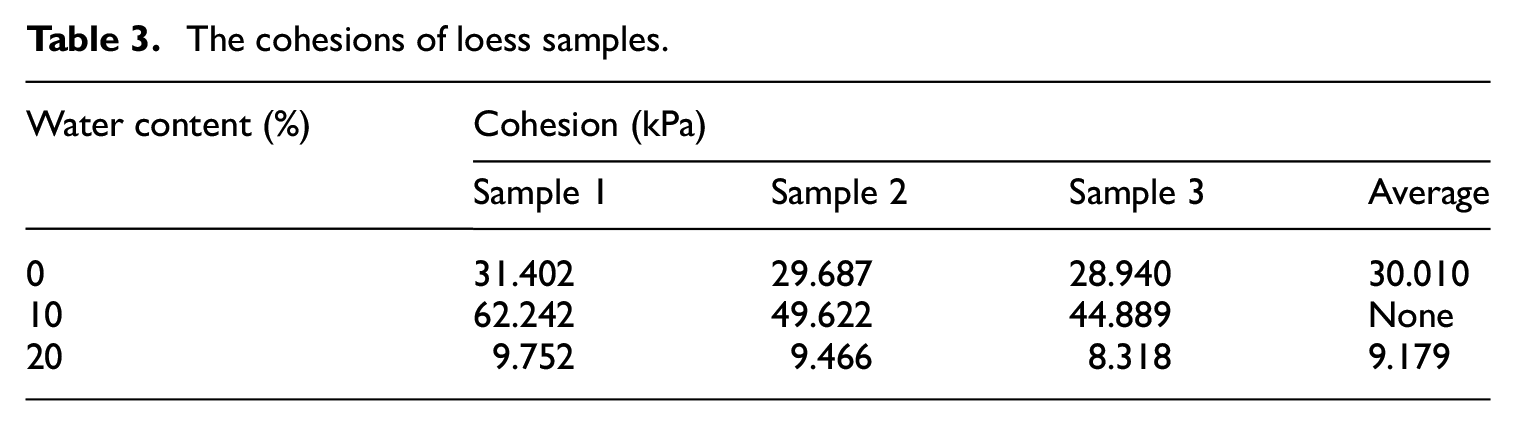
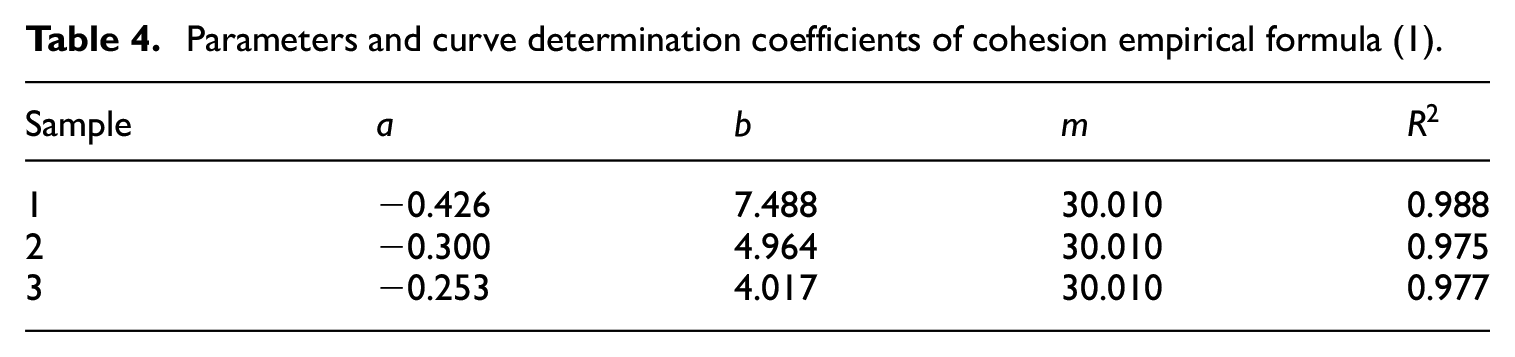
The relationship curve between the cohesion and the water content of each sample shows a characteristic of a quadratic function (Figure 4). For loess samples with different conglomeration gradations, the relationship between cohesion and water content is given by formula (1):

where
The cohesions of loess samples.
Parameters and curve determination coefficients of cohesion empirical formula (1).

Comparison of test data and calculated curve for cohesion of different conglomeration gradation samples.
The test data are in good agreement with the calculated curves (Table 4 and Figure 7). The determination coefficient is high and formula (1) can accurately reflect the relationship between the cohesion and water content of loess samples with different conglomeration gradations. Formula (1) only needs three cohesion values at 0%, 10%, and 20% water content. The cohesion of different conglomeration gradation samples at 0% and 20% water content is almost the same, thus the measured cohesions of any conglomeration gradation sample at 0% and 20% water content can also be used for other conglomeration gradation samples. Therefore, for any other conglomeration gradation sample, formula 1 can be obtained by simply measuring the cohesion at 10% water content.
Relationship between internal friction angle and water content of different conglomeration gradation samples
The relationship between the internal friction angle and water content of samples with different conglomeration gradations is shown in Figure 8. The test data are connected using a smooth curve. The curve is parabola with an upward opening, which is defined by using a quadratic function. If the internal friction angle of sample 3 is regarded as 100%, the relative percentage of internal friction angle of each sample is shown in Figure 9. The internal friction angle of each sample is maximized when the water content is 0%, which decreases with increasing water content. When the water content is approximately 15%, the internal friction angle is minimized and is very similar among the various samples. When water content increases to 20%, the internal friction angle increases slightly; however, the values are still similar for the various samples. In general, the internal friction angle of sample 1 is significantly larger than those of samples 2 and 3, while the internal friction angle of sample 2 is slightly larger than that of sample 3. The internal friction angles of samples 1, 2, and 3 show a large difference when water content is less than 10% and almost coincide when water content is either 15% or 20%. The relative percentages of sample 1 are 109.8%–132.5% compared to sample 3 when the water content is 0%–10%. The increase percentage of internal friction angle caused by conglomeration gradation is 9.8%–32.5%. Therefore, the influence of conglomeration gradation on sample internal friction angle is closely related to water content. Comparative analysis of Figures 6 and 7 reveals that the relative percentage difference of cohesion is greater than that of internal friction angle, which indicates that the influence of conglomeration gradation and water content on cohesion is more significant than that of internal friction angle.

Relationship between internal friction angle and water content for different conglomeration gradation samples.
Relative percentage of internal friction angle of different conglomeration gradation samples.
Internal friction angle reflects the soil friction characteristics, including the friction on the surface of the soil particles and the inlaying force between the soil particles. Sample 1 shows continuous conglomeration gradation and good friction performance because large, medium, and small conglomerations are inlaid with each other and tightly fitted. Owing to loading, the large conglomerations in sample 2 are broken into medium and small conglomerations, which improves the gradation of sample 2 and provides a medium friction performance. 43 The small conglomerations in sample 3 are difficult to break into smaller conglomerations; therefore, the conglomeration size is roughly uniform, the inlay is not firm, the inlaying force is weak, and the friction performance is the lowest. Thus, the internal friction angle of sample 1 is the best, followed by samples 2 and 3.
Internal friction angle reflects the soil friction characteristics, including the friction on the surface of the soil particles and the inlaying force between the soil particles. Sample 1 shows continuous conglomeration gradation and good friction performance because large, medium, and small conglomerations are inlaid with each other and tightly fitted. Owing to loading, the large conglomerations in sample 2 are broken into medium and small conglomerations, which improves the gradation of sample 2 and provides a medium friction performance. 43 The small conglomerations in sample 3 are difficult to break into smaller conglomerations; therefore, the conglomeration size is roughly uniform, the inlay is not firm, the inlaying force is weak, and the friction performance is the lowest. Thus, the internal friction angle of sample 1 is the best, followed by samples 2 and 3.
With the increase in the water content, on the one hand, the water film on the soil particles thickens, producing a lubricating effect and reducing friction among the particles; on the other hand, loess conglomerations break into small particles, increasing the number of contact points between particles and increasing friction. The change in internal friction angle of the sample is due to the combined effect of these two factors. When water content increases from 0% to 15%, water gathers on particle surfaces forming water films. The water amount is small; therefore, the disintegration of soil conglomerations due to water immersion is less. As a result, the decrease in friction caused by water film lubrication is more significant, and the internal friction angle decreases overall. When water content reaches 15%, the water around the particles is nearly saturated and no longer increases. The water film thickness tends to be stable, and the effect of water film lubrication on friction becomes constant. However, the free water within the soil pores continues to increase, weakening and eventually breaking the internal connections within conglomerations. The broken conglomerations cause the contact points between soil particles to increase, resulting in a slight increase in internal friction angle. Moreover, increasing water in the soil also dissolves the salt in the conglomerations. The generated osmotic pressure then causes repulsion among soil particles, which causes the normal stress among soil particles and the friction to decrease. The salt content in the soil is constant. When the water content is greater than 15%, more water in the soil dilutes the salt concentration, reducing the repulsive force between soil particles, and the friction is slightly increased. The increase in internal friction angle is relatively small; therefore, the effect of conglomeration breakage and dilution of salt concentration on internal friction angle is relatively weak. Increased water breaks conglomerations, causing the gradation of each sample to become progressively more similar. Therefore, after the water content reaches 15%, the internal friction angle of each sample becomes very similar. With increasing water content, the internal friction angle of each sample first decreases, and then holds constant at the same value.
According to literature, different scholars have provided different research results on the internal friction angle. Some scholars speculated that the water content of soil has little influence on the internal friction angle; in contrast, some scholars showed that the water content can really influences the internal friction angle (Dong et al., 44 Yan et al., 45 Chang 46 ). In this study, the test results showed that the friction angle of loess could be affected by water content, which may be related to the following reasons: On the one hand, with the increase of water content, the friction decreases due to the lubrication of water, which makes sliding between soil particles easier, and the internal friction angle of the soil also becomes smaller. On the other hand, the matric suction of unsaturated soil decreases with the increase of water content. The matric suction makes the soil particles close to each other, which helps to enhance the friction effect among particles. The explanation of this issue is rather complicated, and more in-depth analysis and discussion should be carried out in the future.
The relationship between internal friction angle and water content for samples with different conglomeration gradations can be reflected by using a quadratic function curve (Figure 8). The relationship between internal friction angle and water content is given by formula (2):

where
Internal friction angles of loess samples.

Parameters and curve determination coefficients for the internal friction angle empirical formula (2).


Comparison of test data and calculated curve for internal friction angle of different conglomeration gradation samples.
The calculation curve of the empirical formula is in good agreement with the test data (Figure 10 and Table 6). The determination coefficient is high, and the formula can accurately reflect the relationship between internal friction angle and water content for samples with different conglomeration gradations. Formula (2) only needs internal friction angle values at 0%, 15%, and 20% water content. The internal friction angle of samples at 15% and 20% water content is almost the same; therefore, as long as the values of these two internal friction angles of any one conglomeration gradation sample are obtained, then it is not necessary to measure these two internal friction angles for other conglomeration gradation sample. Only the internal friction angle at 0% water content needs to be measured for the empirical formula (2) for another conglomeration gradation sample.
Comparison and analysis of calculated shear strength and test data
According to the empirical formulas (1) and (2), the cohesion and internal friction angle of different loess conglomeration gradation samples can be calculated (Table 7). The calculation formula for the soil shear strength envelope is:

Cohesion

By using formula (3), the shear strength envelope of the loess sample can be calculated from the cohesion and internal friction angles listed in Table 7. The test data and the respective calculated shear strength envelope are plotted in Figure 11 for comparison. The values of determination coefficient

Comparison of test data and calculated shear strength envelopes of different conglomeration gradation samples: (a) sample 1, (b) sample 2, and (c) sample 3.
The calculation curve is in good agreement with the test data, the determination coefficient is high, and formula (3) can accurately reflect the shear strength of the soil sample (Figure 11 and Table 7). Therefore, in actual engineering practice, the cohesion and internal friction angle of soil samples can be calculated by using formulas (1) and (2), and the shear strength envelope of the sample can be obtained from formula (3). In this way, the loess shear strength of samples with different conglomeration gradations and water content can be accurately predicted and calculated.
As reflected in this study, the conglomeration and water content of unsaturated loess can affect its shear strength, which is closely related to the suction of unsaturated loess. 47 For cohesion, the adsorption strength caused by suction enhances the total adhesion among soil particles. In case of internal friction angle, the connection force among soil particles caused by suction increases, which also leads to more significant friction among soil particles. The suction is closely related to water content. When the water content changes, the suction also changes, and affects the shear strength of soil through the cohesion and internal friction angle. From the perspective of soil conglomerations, the different soil conglomerations can change the size and distribution of soil pore, which can affect the suction. Moreover, the particles of the soil stick and gather together to form conglomerations. The conglomerations have cementation structure and are closer to the undisturbed soil in nature, and the strength of conglomeration is higher than that of the remolded soil. Addition of structural conglomerations into the remolded soil can endow the remolded soil with a certain cementation structure, so as to improve the soil strength. Therefore, the water content and aggregates affect the shear strength of unsaturated soil. These related and potential research topics are complex and interesting, and worthy of further study in the future.
Conclusion
This contribution primarily examines the effect of conglomeration gradation on loess shear strength under different water content. The following conclusions can be drawn from the study:
For the three sample types, the continuous conglomeration gradation sample 1 shows the highest shear strength, followed by the large conglomeration gradation sample 2 and small conglomeration gradation sample 3. The difference in shear strength among these three samples decreases with increasing water content. When water content is 20%, the shear strength envelopes of the three samples coincide.
The cohesion of the three samples first increases and then decreases with increasing water content and reaches the maximum when the water content is 10%. When water content is 0% and 20%, the cohesion of the three samples is almost similar. The internal friction angle of three samples decreases with increasing water content and reaches the minimum for the water content of 15%, and the values are almost the same. When water content is 20%, the internal friction angle of the three samples slightly increases; however, the values are still basically the same. The cohesion and internal friction angle of sample 1 are the largest, followed by sample 2 and sample 3. The increased percentage values of cohesion and internal friction angle caused by conglomeration gradation are in the range of 33.2%–42.1% and 9.8%–32.5%, respectively. The influence of conglomeration gradation and water content on cohesion is more significant than that of internal friction angle. The interpretation of test results is related to factors such as the dissolution of cementite, conglomeration breakage, water film thickness, and salt concentration in the loess.
According to the test data, the empirical formulas of water content-cohesion and water content-internal friction angle for different loess conglomeration gradation samples are established. The loess shear strength of samples with different conglomeration gradations and different water content can be calculated by using the cohesion and internal friction angle obtained from the empirical formula. Calculated values from the formula are in good agreement with the test data, and the established formula can reflect the influence of conglomeration gradation and water content on loess cohesion, internal friction angle, and shear strength.
In general, in practical engineering, when loess water content is greater than 15%, the effect of conglomerations on shear strength is relatively small. When loess water content is less than 15%, in particular, in relatively dry conditions, the effect of loess conglomerations on shear strength is significant, and using a good conglomeration gradation can effectively improve loess shear strength.
Footnotes
Author contributions
Conceptualization: Dequan Kong; Data curation: Chenkai Zhao; Investigation: Jiumei Dai and Tijian Dong; Methodology: Dequan Kong; Supervision: Dequan Kong and Rong Wan; Validation: Weiheng Ni, Jiang Gao, and Tianchen Wang; Writing—original draft: Chenkai Zhao; Writing—review and editing: Dequan Kong and Rong Wan.
Declaration of conflicting interests
The author(s) declared no potential conflicts of interest with respect to the research, authorship, and/or publication of this article.
Funding
The author(s) disclosed receipt of the following financial support for the research, authorship, and/or publication of this article: This work was supported by the Natural Science Foundation of Shaanxi Province (Grant no. 2020JM-235); Shaanxi Postdoctoral Research Funding Project (Grant no. 2017BSHEDZZ114); The State Key Laboratory Open Project for Green Building in Western China (Grant no. LSKF201905); Science and Technology Planning Project of Yulin Technology Division (Grant no. 214028170376); and Students Innovation and Entrepreneurship Training Program of Chang’an University (Grant no. 201910710109, 201910710173).
