



Abstract
Previous studies show that the indoor environment quality (IEQ) of buildings directly affects human health and comfort. This study aims to predict the change of indoor parameters at the next moment under the influences of the current indoor climate and outdoor climate and control the IEQ parameters based on the human thermal adaption in advance. We combine the simulation and the mathematical method to establish the office building model with air-conditioning and lighting systems and construct the bilinear model of the IEQ parameters and control variables. Unknown parameters are identified using the experimental method. Model predictive control (MPC) based on human thermal comfort is discussed by considering human thermal adaptation, and the neutral temperature is calculated through the dynamic relationship between outdoor and indoor temperatures. Results show that the temperature setpoint is adjusted in accordance with human adaptability, and the air-conditioning, fan, and lighting systems are controlled via MPC. The usage time of air-conditioning and light is reduced, and thus, energy is saved.
Introduction
With the rapid growth of the economy, an increasing number of researchers has been focusing on the IEQ of buildings in the past two decades. IEQ includes four elements: thermal comfort, acoustic comfort, indoor air quality, and visual comfort. 1 In the southern part of China, some office buildings are cooled by air-conditioning units in summer; doors and windows are frequently closed due to the hot weather. 2 Although the thermal environment is guaranteed, indoor air quality is seriously reduced. Research has shown that the longer building occupants stay in an indoor environment, the higher their risk of experiencing certain health problems, such as fatigue, headache, and irritation. 3 Poor indoor air quality and thermal comfort frequently cause such types of health impairments. 4 However, opening window ventilation will not only affect indoor thermal comfort but will also increase cooling load, resulting in energy waste. Moreover, the adjustment of air-conditioning units mostly adopts coarse methods, setting constant temperature, and humidity as the control target. This condition disregards the capability of the human body to adapt to a thermal environment, and thus, produces a series of problems. Firstly, failure to the use of outdoor climate results in energy waste. Secondly, long-term exposure to an environment with constant temperature and humidity reduces the ability of people to adapt to the environment. 5 Therefore, the primary problem in the study of IEQ control and optimization is ensuring good IEQ whilst reducing energy consumption.
Traditional air-conditioning and lighting systems use classical control methods, such as those involving “on” and “off” (P), proportional-integral (PI), and proportional-integral-derivative (PID) controllers, which are easy to implement but are unable to control moving processes with time delays. Besides, adjusting these controllers to set a comfortable temperature and illumination range is cumbersome and time-consuming. Once a parameter exceeds the set range, the controller will turn on for adjustment. Although the procedure is simple, the condition of the indoor environment will continue to rise (or fall) beyond the comfort range for a certain period due to the lag of the physical environment of the building. These methods do not fully utilize the favorable influence of outdoor climate. In addition, some intelligent methods such as fuzzy control and artificial neural network control not only involve deterministic mathematical models but also nonmathematical generalized models and mixed models. However, these methods require learning and reasoning based on data-driven or embedded expert knowledge. Therefore, the MPC method is highly suited for precision industrial production. Indoor parameters can be controlled better within the comfortable range by predicting how indoor parameters will change at the next moment under the influences of the current indoor climate and outdoor climate, and thus, regulation is turned on in advance. Simultaneously, the favorable effects of outdoor climate change on the indoor environment can be fully utilized and adverse effects can be compensated in advance, effectively reducing energy consumption.
In the 1960s and 1970s, the concept of MPC appeared in the literature. However, it was not until the 1980s that MPC was introduced into the process industry. Overall, the evolution of the program can be divided into three stages according to the degree of technological development. At present, MPC based on classical control strategy has attracted the attention of researchers in the field of energy-saving buildings. Although MPC strategies have been used in process control for decades, they are only recently applied to building automation.6–9 The MPC strategy has the advantage of considering the future forecast of outdoor temperature, solar radiation and occupancy rate, equipment, weather, and cost in the design of control system which can provide the required level of thermal comfort.10,11 Serale et al. 12 introduced a common dictionary and taxonomy that provide a common ground to all engineering disciplines involved in building design and control. The potential benefits of MPC application in improving energy efficiency in buildings were highlighted. To date, MPC has also been applied successfully to other applications related to building controls. However, those studies have not discussed the dynamics between buildings and ventilating and air-conditioning systems.
MPC can predict a building’s reaction to alternative control schemes, and different control scenarios can be evaluated based on suitable objective functions to create a control state space based on a building’s performance space. 13 MPC aims to optimize a sequence of manipulated variable modifications that are influenced by a prediction horizon by using a process model. 14
When constraints are described correctly and the model is formulated sufficiently and precisely, the control results will be accurate. Black box, gray box, and physical modeling methods are frequently available. In black-box modeling, self-learning methods, such as reinforcement learning or neural networks are widely used without any particular building thermal process but with certain limitations.15,16 (I) The reliability of the training data of a neural network will considerably affect the accuracy of the model. (II) The algorithm cannot exceed the limit of its experience. The use of a physical method to build a model allows for a good understanding of the causal relationship amongst various building components, climatic conditions, and control strategies, but requires substantial computation and specific expertise. In the present work, we adopt the concept of gray box modeling to establish a predictive control model based on physical analysis and black box modeling. The gray box model is between the physical model and the black-box model. It focuses on problems in which the knowledge background is not completely clear. In general, fully extracting regular information and knowledge through training is difficult.
IEQ involves numerous factors. This study preliminarily focuses on key variables that are important for determining human thermal comforts, such as temperature, air quality, and visual comfort. Meanwhile, the limitation of this research is that although it examines the feasibility of IEQ control based on neutral temperature, whether such control can satisfy the comfort of indoor personnel in actual systems has not been investigated.
Description of the building and the control system
Description of the building
Natural ventilation is a common ventilation and cooling method for office buildings. Although building rooms have high personnel density during summer, the zones are not large, and heat and humidity loads exhibit considerable differences. Buildings still use air-conditioning units to adjust indoor temperature and ensure indoor thermal comfort. Meanwhile, light-emitting diode (LED) lamps are used to adjust illumination in indoor working zones. An office is selected as the research object in the current study. The length, width, and height of the office are 7.2, 7.5, and 3 m, respectively. The south window/wall and west window/wall ratios are 30% and 40%, respectively. The east and north sides do not have windows. The number of staff in the zone is controlled by seven or eight people. The load density of the equipment is 20 W·
Description of control system
Figure 1 shows the control system’s block diagram for IEQ.

The control systems block diagram.
In Figure 1, a model is utilized to predict the output based on past input and the proposed optimal future control signals. These signals are calculated using an optimizer by considering the objective function, constraints, and future errors, for a determined horizon. Then, the predicted output is compared with the reference trajectory and the error is calculated. The cycling process is continued until minimal error is obtained. In Figure 1,

where
The state-space representation of the predictive model is as follows,

where
The variables are defined as follows:

where
To our knowledge, IEQ includes thermal comfort, acoustic comfort, indoor air quality, and visual comfort. This study preliminarily focuses on key variables that are important for determining human thermal comfort, such as indoor temperature (

Outdoor climate will certainly affect the indoor environment and thus the state variable (

The setpoint state variable (

where
Establishment and identification of the prediction model
Establishment of the prediction model19,20
Figure 1 shows that the environment variables at time

where
The bilinear model has different forms based on each environmental variable. The variables are analyzed as follows.
The indoor temperature at time

where
Indoor

where
Indoor illumination at time

where
In matrix form, equation (10) may be rewritten as equation (11).

where
Thus, from equations (8), (9), and (11), the system is developed into a bilinear model with the following form:

where G and H form a


Identification of the prediction model
In this study, IEQ is described using a bilinear model. The model structure is identified, and a system identification method should be applied to determine the unknown parameters. Least squares identification is used to determine the related parameters because of its high accuracy.
21
The experimental data are obtained through simulation. Outdoor climate parameters are obtained from the National Weather Service website. During the experiment, the air-conditioning, fan, and light controls are simplified. For air-conditioning control, the air volume is constant, and the air-conditioning setting temperature is adjusted from
The sampling parameters of temperature and
In the estimation and identification processes, the controller is increased from the minimum to the maximum values at a 10% step length to cover all cases, and the previous process is repeated in the next 24 h. Figure 2 shows the curve of the air-conditioning opening and denotes the corresponding temperature.

Curve of the air-conditioning opening and the corresponding temperature.

Indoor personnel produces
Figure 3 presents the curve of the fan opening and the corresponding

Curve of the fan opening and the corresponding CO2 concentration.

The average
For lighting control, the light system exhibits no direct relationship with the model of other parameters. We consider one lighting system of the building with M = 12 luminaires and sensors arranged in a
Validation of the predictive model
Validation data from different periods ensure the applicability and reliability of the model in reflecting changes in environmental parameters. The data acquisition process of temperature and
Based on the identification results, the indoor temperature model is described for specific building characteristics by using equation (15).

Figure 4 depicts the predicted and real values of indoor temperature and air-conditioning opening.

Temperature model with the air-conditioning system.
The determination coefficient is 0.689, and the root-mean-square error (RMSE) is 0.685. The predicted values closely follow the real values, as shown in Figure 4.
Based on the identification results, the indoor

Figure 5 presents the predicted and real values of
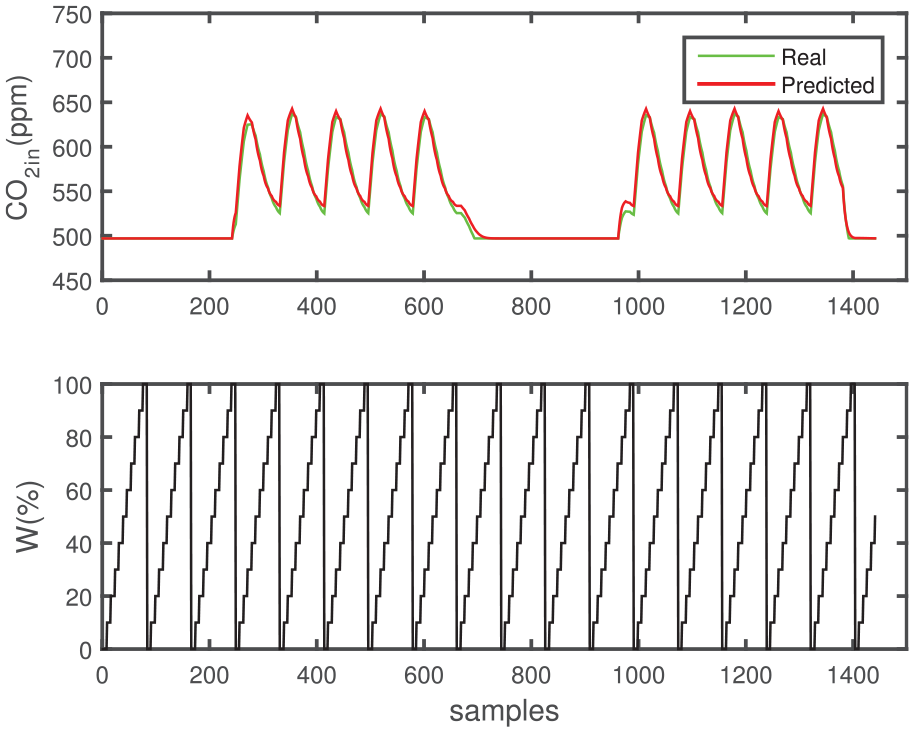
The determination coefficient is 0.955, and the RMSE is
Based on the identification results, the indoor light model is described for the specific building characteristics by using equation (17).

where P is the matrix for illuminance gain. The values of P and D are obtained through measurement. The specific parameters are not provided.
Model identification is performed separately for temperature and

Illumination model with the lighting system.
Control algorithm using constrained optimization
In the optimization framework, the cost function is provided by equation (18). The predicted horizon is based on a large number of simulation experiments. Different predicted horizons are tested under the same simulation conditions, and the obtained data are compared to get better control results when it is equal to a certain value.

where

At iteration

where

On the basis of the standard, indoor

The weight matrices V and I are related to the set point. The weight values are selected to achieve normalization amongst the environmental variables. The average

The I matrix represents the weight of the actuator’s energy consumption. The energy consumption of the fan is small compared with that of the air-conditioning. 22 The I matrix is set as equation (24).

where
Control system based on thermal comfort
Thermal comfort
The primary reason for building energy consumption is to overcome unfavorable climatic conditions. To ensure human thermal comfort, equipment must be used to control the environment. The results show that the thermal comfort of occupants is affected by their thermal experience, and the acceptable temperature range of humans is wider than the specifications.23,24 The predicted mean vote (PMV) thermal comfort model is widely used. 25 However, the comfort range of this model is narrow, and the influences of time and space on thermal environment parameters are not considered. People are regarded as passive receivers of the external environment, and PMV disregards the interaction between humans and the environment, that is, human adaptability. A thermal comfort model is designed to predict the temperature in which occupants are comfortable. Model establishment relies on substantial data collection and research. The thermal comfort temperature involved in thermal comfort studies is frequently called neutral temperature. Neutral temperature refers to the most moderate temperature of humans in theory. It reflects their most comfortable heat balance. The key environmental variable that affects thermal adaptability is the climate factor, particularly outdoor temperature. A large number of local and overseas scholars have conducted studies on the relationship between neutral and outdoor temperatures. Humphreys found that neutral temperature is related to outdoor climate conditions. A thermal adaptation model was then established, that is, the linear relationship between neutral and outdoor temperatures, which is presented by equation (25). 25

Liu et al. 26 performed statistical analyses in four representative cities in China and concluded that the linear relationship between the neutral temperature of humans and outdoor air temperature in the cold regions of China is represented by equation (26).

The establishment of the model presents the relationship between the outdoor and neutral temperatures. This model emphasizes the timing of a comfortable setting in a resident, and the change of outdoor temperature will affect the neutral temperature at every moment.
In terms of lighting control, the illumination of ordinary offices should not be less than 300 lx in accordance with the national standard, and that of sophisticated offices should not be less than 500 lx. Studies have shown that users may require different illumination levels, and a lighting system that caters to these varying needs can enhance user satisfaction and productivity. In our study, we consider personal control in which light sensor setpoint are modified to satisfy the personal control requests of users for illumination. The expected illumination can be selected in accordance with the actual situation.
Establishment of control simulation system
In this section, the control method based on thermal adaptation is studied. The control algorithm is MPC. The reference trajectory can be tracked accurately by pre-controlling the environmental variable and calculating the control input of the system by using the rolling optimization method.
Simulation verification is performed by combining TRNSYS, DIALux, and MATLAB. The model components in TRNSYS and DIALux are relatively accurate. Most of the cold and heat source equipment modules are included after installing. Another accurate cold and heat source simulation system can be obtained by connecting each component in a certain order. However, the control components in TRNSYS are relatively small, and thus, TRNSYS provides a Type 155 module for running M files by using MATLAB’s remarkable numeric computing and data processing capabilities to perform real-time control and off-line data processing. 27 By combining the competent simulation function of TRNSYS with the numerical calculation function of MATLAB, the advantages of the two software are realized.
The current study uses TRNSYS and MATLAB for simulation and verification because of the limitation of the conditions.
In Figure 7, Type 966 module is used for indoor temperature control, Type 111b module is utilized for indoor air control, Type 648 module is adopted for air mixing, Type 155 module is applied to establish a connection between TRNSYS and MATLAB, Type 15-2 module is called the weather file, and Type 24 is the integration module for integrating air and fan power into the systems energy. Control signal data, energy consumption data, indoor and outdoor temperatures, and

Simulation environment.
Simulation results and analysis
Control performance
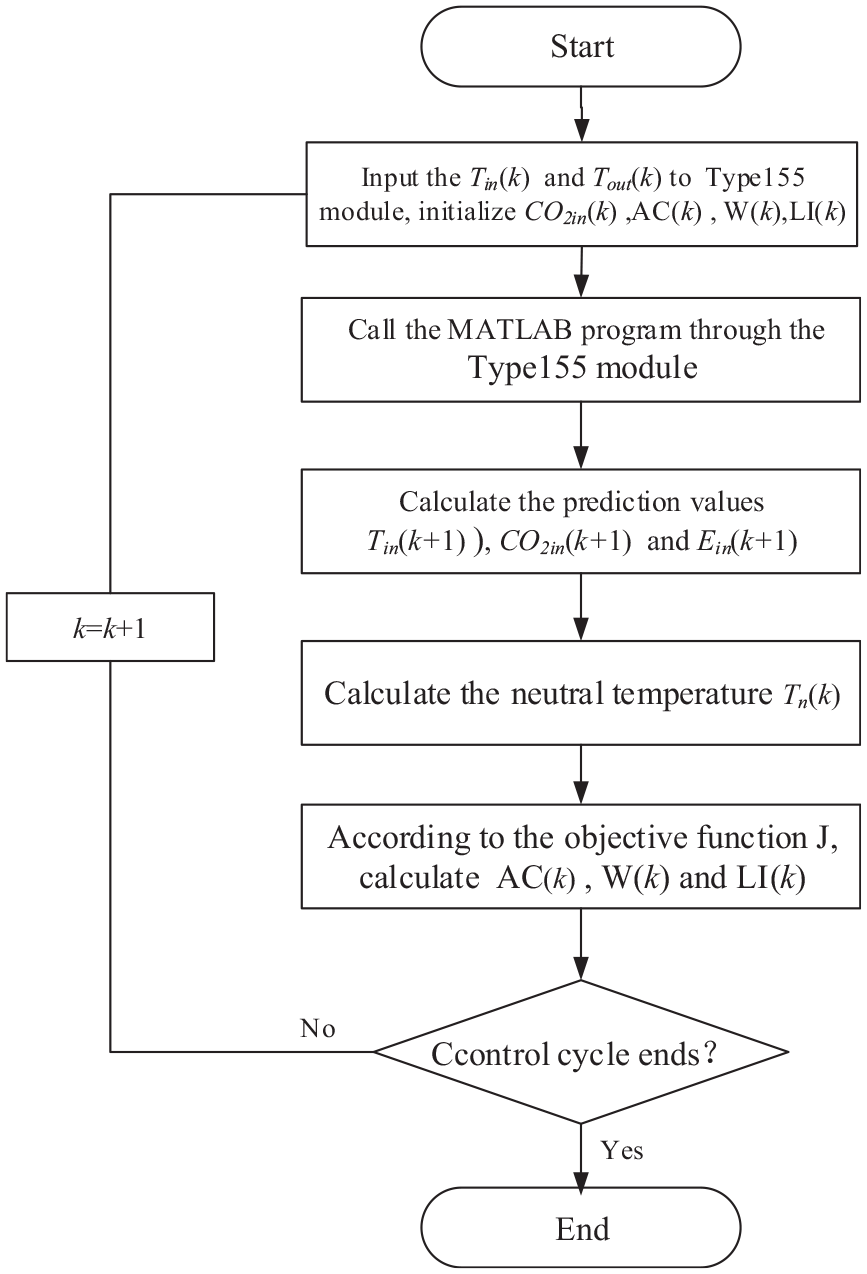
Figure 8 shows the flow the chart of simulation.The steps are as follows:
Flow chart of the simulation.
Step 1: The office simulation model is established by using TRNSYS and set up the parameters of building characteristics, such as building size, wall material, and ventilation permeability. Then the model of air-conditioning and fan control system is established to form a simulation experiment environment. 28
Step 2: Indoor temperature
Step 3: The MATLAB program is run through Type 155 module. The M file under the specified path is opened.
Step 4: Neutral temperature
Step 5: Time is assessed to determine if it is a working time through equations (8) and (9) by calculating the prediction values
Step 6: The control variables
Step 7: The control variables
Step 8: If the current time does not belong to the working time, then the air-conditioning, fan, and LED systems are closed, that is,
Step 9: The control signal is implemented on the corresponding equipment (air-conditioning, fan, and LED systems) through the Type 155 module. The simulation of the thermal environment of the building is completed in TRNSYS and DIALux.
Step 10: When the software completes the simulation of a step time, the previous loop is repeated until the end of the simulation time.
Simulation is completed in TRNSYS under the same time and weather conditions. Figures 9 to 11 present the first experimental results, which are obtained without considering human thermal adaptation. In Figure 9, the red line is the set point temperature for a fixed value of

Control results of indoor temperature with fixed setpoint.

Control results of
Figure 11 shows the error with a fixed setpoint (local enlarged drawing).

Error with fixed setpoint (local enlarged drawing).
In Figure 10, the red line denotes the set point of
Figures 12 to 14 present the results of the second experiment (human thermal adaptability is considered); that is, setpoint temperature and illumination are variable (neutral temperature). In Figure 12, the red line denotes the setpoint temperature for a fixed value of

Control results of indoor temperature with dynamic control.

Control results of CO2 concentration with dynamic control.

Control results of indoor illumination with dynamic control.
In Figure 13, the red line indicates the set point of
Figure 14 shows that the illumination of all the work areas is greater than or equal to the set illuminance value. The illumination of working zones 3, 4, and 5 are considerably greater than expected. Moreover, the illumination contribution of daylight is significantly higher than the expected illumination because the working space is close to the window. In this case, nine lights are closed and only one light is opened. In certain fixed illumination settings with special scenarios, occupancy sensors can be used to monitor whether a working zone is occupied. If the zone is not occupied, then the illumination in this area is set to 0 and returned to the controller.
Figures 12 to 14 show that the thermal adaptation-based predictive control reduces the usage time of the air-conditioning, fan, and LED systems, decreases energy consumption, and increases the human bodys thermal adaptation. Moreover, human health is ensured under the conditions of comfort and energy saving.
Comparison of energy consumptions
We compare energy consumptions under dynamic control (setting values with outdoor weather adjustment) on the basis of human thermal adaptation and under fixed control (setpoint temperature is
Power consumptions under dynamic and fixed controls are compared. As shown in Figure 15, dynamic control based on thermal adaptation is more energy-efficient than fixed control. In June, July, and August, dynamic control saves 6%, 17%, and 8% more energy than fixed control, respectively. July is the hottest month in summer, and thus, the greatest energy-saving potential occurs during this month. Dynamic control increases the set temperature range. For example, when outdoor temperature is

Energy consumption in different control methods.
The energy consumption of the air-conditioning system will be reduced by 6% for each increase in the set indoor temperature of
Discussion
In this study, a bilinear model-based predictive control is utilized to achieve optimum indoor environmental conditions while minimizing energy costs. A bilinear modeling procedure is selected because it is the simplest extension of linear modeling and it exhibits simplicity in calculating prediction algorithms. On the basis of bilinear model incorporation and identification, MPC is applied to control IEQ by considering human thermal adaptation through MATLAB and TRNSYS simulations. The results show that the performance of the controllers is satisfactory, and the optimum solutions are selected based on energy consumption and set point proximity by satisfying the performance index J.
Compared with fixed setpoint control, the control that considers the users thermal adaptability can provide better environmental quality. In this control mode, humans are not passive receivers of a given thermal environment, but active participants in human-environment interaction. Meanwhile, the thermally adaptive control mode exhibits higher energy-saving potential on the basis of ensuring indoor environmental satisfaction. This control technology provides a new concept for the intelligent control of the indoor environment of buildings. However, it should be emphasized that IEQ involves many factors, and this study considers temperature, air quality, and light intensity. Other factors, such as humidity and noise, are not considered. The effects of these factors on the comfort of personnel and how they can be controlled require further research in the future. This study focuses on the feasibility of IEQ control based on neutral temperature. However, whether such control can meet the comfort of indoor personnel in actual systems remains to be investigated through the use of questionnaires. In the model identification stage, the system is to collect numerous data through experiments. A reasonable experimental design is frequently difficult to achieve, and thus, such a technique is challenging to apply in practical engineering.
Our next research will focus on the application of the proposed technique to a real building and the evaluation of its energy-saving potential on the basis of long-term operation.
Conclusions
In this paper, an MPC system is designed for intelligent control of the indoor environment. The MPC system has exhibited its ability in controlling a complicated building system. Thermal adaptation is also applied to find the optimal solution for achieving the maximum comfort level in the presence of energy shortage. According to the results from the case study, MPC has shown to be useful for maintaining the high comfort level in a building environment when the total energy supply is in a shortage. In future work, the application of this method in the practical engineering field will be further explored.
Footnotes
Authors’ note
The data sets generated and analyzed in the current study are not publicly available due to the sensitive and identifiable nature of our qualitative data. However, are available from the corresponding author upon reasonable request.
Declaration of conflicting interests
The author(s) declared no potential conflicts of interest with respect to the research, authorship, and/or publication of this article.
Funding
The author(s) disclosed receipt of the following financial support for the research, authorship, and/or publication of this article: This work was supported in part by grants from the National Natural Science Foundation of China under grant nos. 61803279 and 61672371, the Open Foundation of the Suzhou Smart City Research Institute of Suzhou University of Science and Technology, and Jiangsu Provincial Department of Housing and Urban-Rural Development under grant nos. 2018ZD189 and 2017ZD253.
