



Abstract
Drug-induced liver injury (DILI) is one of the common adverse drug reactions and the leading cause of drug development attritions, black box warnings, and post-marketing withdrawals. Current biomarkers are suboptimal in detecting DILI and predicting its outcome. This study aimed to quantitatively and qualitatively investigate the research trends on DILI biomarkers using bibliometric analysis. All relevant publications were extracted from the Web of Science database. An online analysis platform of literature metrology, bibliographic item co-occurrence matrix builder, and CiteSpace software were used to analyze the publication trends. CitNetExplorer was used to construct direct citation networks and VOSviewer was used to analyze the keywords and research hotspots. We found a total of 485 publications related to DILI biomarkers published from 1991 to 2020. Toxicological Sciences had been the most popular journal in this field over the past 30 years. The USA maintained a top position worldwide and provided a pivotal influence, followed by China. Among all the institutions, the University of Liverpool was regarded as a leader for research collaboration. Moreover, Professors Paul B. Watkins and Tsuyoshi Yokoi made great achievements in topic area. We analyzed the citation networks and keywords, therefore identified five and six research hotspot clusters, respectively. We considered the publication information regarding different countries/regions, organizations, authors, journals, et al. by summarizing the literature on DILI biomarkers over the past 30 years. Notably, the subject of DILI biomarkers is an active area of research. In addition, the investigation and discovery of novel promising biomarkers such as microRNAs, keratin18, and bile acids will be future developing hotspots.
Introduction
Drug-induced liver injury (DILI) refers to a type of liver injury driven by various prescription or nonprescription drugs, Traditional Chinese Medicine (TCM), healthcare products, and dietary supplements.1,2 DILI poses a serious threat to patients, which has replaced viral hepatitis as the most frequent causes of acute liver failure and liver transplantations.2,3 While the pace of mechanisms and risk factors involved in DILI remains brisk, advances in predicting and treatment of DILI seems slow by comparison. 4 On the other hand, al comparison. 4 On the other hand, although all drugs have undergone strict safety toxicology tests before market, an increasing number of drugs have been found to cause liver damage (http://livertox.nih.gov/), and liver toxicity often results in the termination of drug development at the clinical stage or withdrawal of a drug from the market. 5
In a clinical setting, the detection of biomarkers provides a means for disease diagnosis, prognosis, and monitoring therapeutic outcomes. 6 The current methods for diagnosis of DILI, such as blood biochemistry parameters including alanine aminotransferase (ALT), alkaline phosphatase (ALP), and aspartate aminotransferase (AST) are imperfect in providing an specific and sensitive diagnosis. 7 Novel biomarkers capable of providing an accurate early diagnosis or predicting the disease progress for DILI still require further mining.
Bibliometrics, as a branch of informatics, is an analytical method that involves mathematics and statistics. By comparing quantitative (i.e. number of published items, h-index, impact factor, or citation rate) and qualitative factors (i.e. characteristics and features of the authors, organizations and countries/regions, topics), it is possible to delineate the outline, sketch the development over time, locate the citation burst references, and explore the future trend of a specific research topic. 8 Bibliometric method has already been applied to medical and health science related areas such as coronavirus research, 9 cancer research, 10 tuberculosis, 11 and liver diseases.12–14 The metrology characteristics of publications can be analyzed quantitatively and qualitatively based on the Web of Science Core Collection (WoSCC) database, the world’s original citation index for scientific, and scholarly research. However, there was no literature of bibliometric analysis on DILI biomarkers at present.
The clinical utility phase of biomarker development follows successful completion of biomarker discovery, analytical validation of the biomarker assay, and clinical qualification of the biomarker. To date, no potential DILI biomarkers have been methodologically validated by other omics or metabolic pathways as well as large clinical samples, and the predictive ability of the analytical platform is not yet fully understood. This research attempts to demonstrate the current state and analyze the global trends of biomarkers associated research in diagnosis and management of DILI.
Methods
In order to focus on the topic, both Medical Subject Headings (MeSH) terms and its entry terms in PubMed, which was developed by the National Center for Biotechnology Information (NCBI) of National Library of Medicine (NLM) were combined before the retrieval. A total of 708 articles were retrieved with the criteria of TOPIC: (“DILI” or (“drug induced” and (“liver injur*” or “liver disease*” or “hepatiti*” or “liver toxi*”)) or (“drug induced liver” and (“injur*” or “disease*” or “hepatiti*” or “toxi*”))) AND TOPIC: (“Biomarker*” or “marker*”). The final 485 articles were included by Refined: [excluding] DOCUMENT TYPES: (Editorial Material or Letter or Book Chapter or Review or Proceedings Paper or Correction or Note or Meeting Abstract or Early Access). Indexes=SCI-EXPANDED Timespan=All years. The full records and cited references, citation reports, as well as journals of all eligible articles were obtained and tabulated on April 28, 2020.
The mapping soft tools take scientific literature as an input and generate visual representative analysis. CiteSpace is an optimal tool for collaboration network analysis to connect all kinds of publication characteristics that was founded by Chaomei Chen (http://cluster.ischool.drexel.edu/∼cchen/citespace/download/). 15 It can also obtain references and keywords with high citations to reveal the intellectual landscape and detect recent frontiers. In our research, burst detection was performed in CiteSpace (5.5.R2 edition) under the JAVA support to calculate the citation burst values of all eligible articles with the setting of time slice as 1 year. Besides, VOSviewer is well suited for analyzing large-scale bibliographical data and for constructing maps based on network data. 16 It can sort keywords into different clusters based on co-occurrence analysis, and color them at the same time according to time course. More recently, an application called CitNetExplorer was developed that has similar functionality though presents more flexibility in analyzing large-scale citation networks. 17 According to the visualization of similarities, distance-based mapping technique, which was used in CitNetExplorer and VOSviewer, could reflect the strength of the relation between the items. CitNetExplorer (1.0.0 edition) was used to construct direct citation networks of the algorithmic historiography with the settings: the number of publications was set to 50 based on their citations score, the clustering resolution was set to 1.00 based on citation links. The visualizations of 50 articles in six clusters, and each marked drill down clusters were shown. VOSviewer (1.6.14 edition) was applied to create the co-words visualization with the settings: minimum number of a keyword (including the “author keywords” labeled by authors and the “keywords plus” provided by journals) occurred eight times, plural and singular words, abbreviation and full name were combined for data cleaning. Top 99 high frequency keywords out of the total 2610 were shown.
Results
Publication outputs
Figure 1 showed the annual publications and annual citations on DILI biomarkers from 1991 to 2020. The first paper was published in 1991, both the most productive and cited year was 2019 with 65 records and 2188 cited times, respectively. The annual outputs did not exceed 10 until 2009, and exceeded 20 in the past decade.

Annual publications and annual citations on DILI and biomarker from 1991 to 2020. The bar represents the annual publications, while the curve shows the annual citations.
Journals
Journal Citation Report (JCR) profiles summarize a journal’s position in the network of scholarly communications, including the impact factor (IF), category, rank, and quartile (Q). In total, 485 articles were published in 222 journals. Table 1 listed the top 10 productive journals on DILI biomarkers from 1991 to 2020. Toxicological Sciences ranked first with the records of 34, the highest h-index of 17. Hepatology possessed both the highest total citations of 2209 and the highest average citations of 138.06. Journal of Hepatology had the highest IF of 18.946 in 2018. The top 10 journals were distributed in three main categories: Toxicology, Gastroenterology & Hepatology, and Pharmacology & Pharmacy. Clinical Pharmacology Therapeutics and the three journals previously mentioned were all first-quartile journals of their own categories.
Top 10 productive journals on DILI and biomarker from 1991 to 2020.
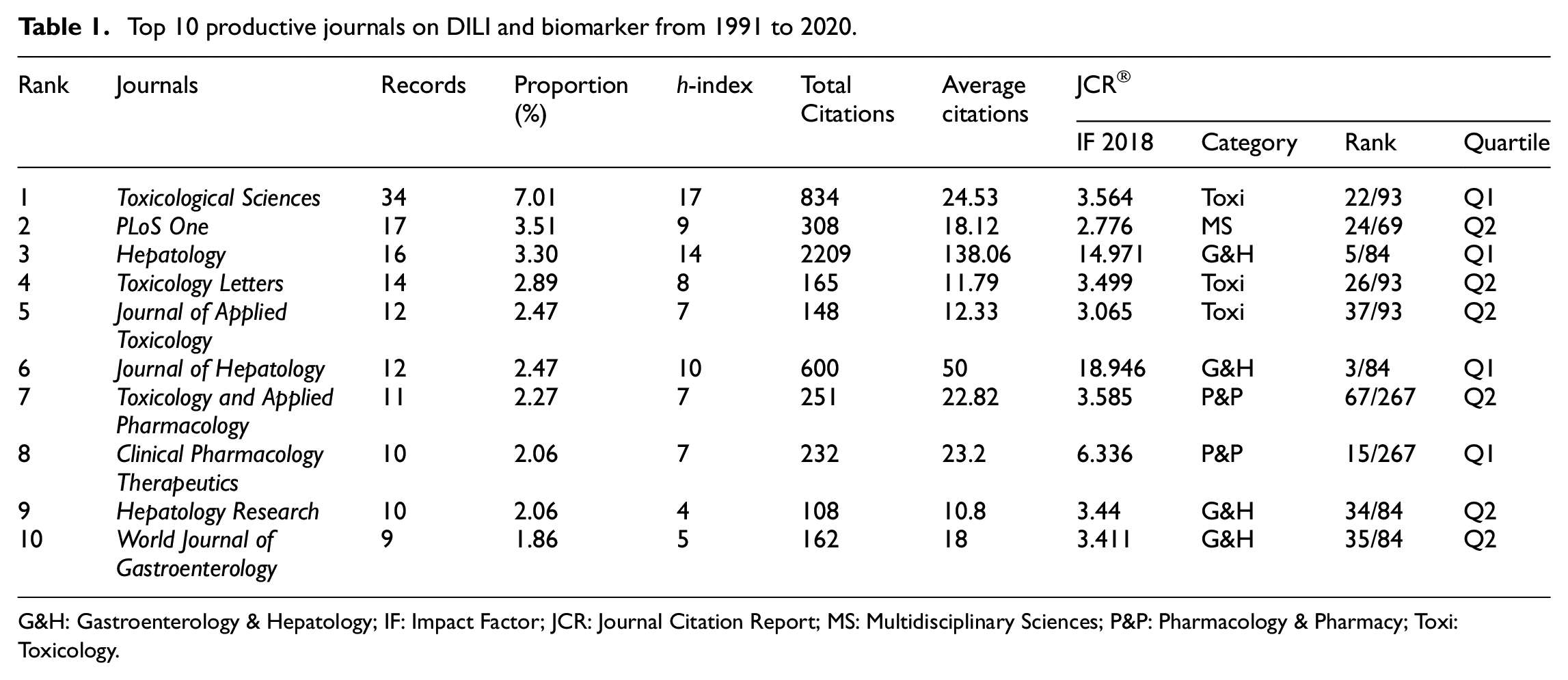
G&H: Gastroenterology & Hepatology; IF: Impact Factor; JCR: Journal Citation Report; MS: Multidisciplinary Sciences; P&P: Pharmacology & Pharmacy; Toxi: Toxicology.
Countries/regions, organizations and authors
Table 2 showed the top five productive countries/regions, organizations, and authors on DILI biomarkers from 1991 to 2020. Top five countries/regions published 385 papers accounting for 79.38%. USA led the research with 157 publications, and highest h-index of 41, total citations of 7134. England got the highest average citations of 52.76 among the 58 countries/regions. Top five organizations published 86 papers accounting for 17.73%. University of Liverpool and University of North Carolina ranked co-first both with 20 records. University of Liverpool got the highest h-index of 14 and total citations of 1828 while University of Michigan got the highest average citations of 49.47 among the 947 organizations. Top five authors published 84 papers accounting for 17.32%. Paul B. Watkins took the top position with 29 records, highest h-index of 17, while B. Kevin Park from University of Liverpool had both the highest total citations of 1460 and the highest average citations of 112.31 among the 3042 authors.
Top five productive countries/regions, organizations and authors on DILI and biomarker from 1991 to 2020.

Burst references
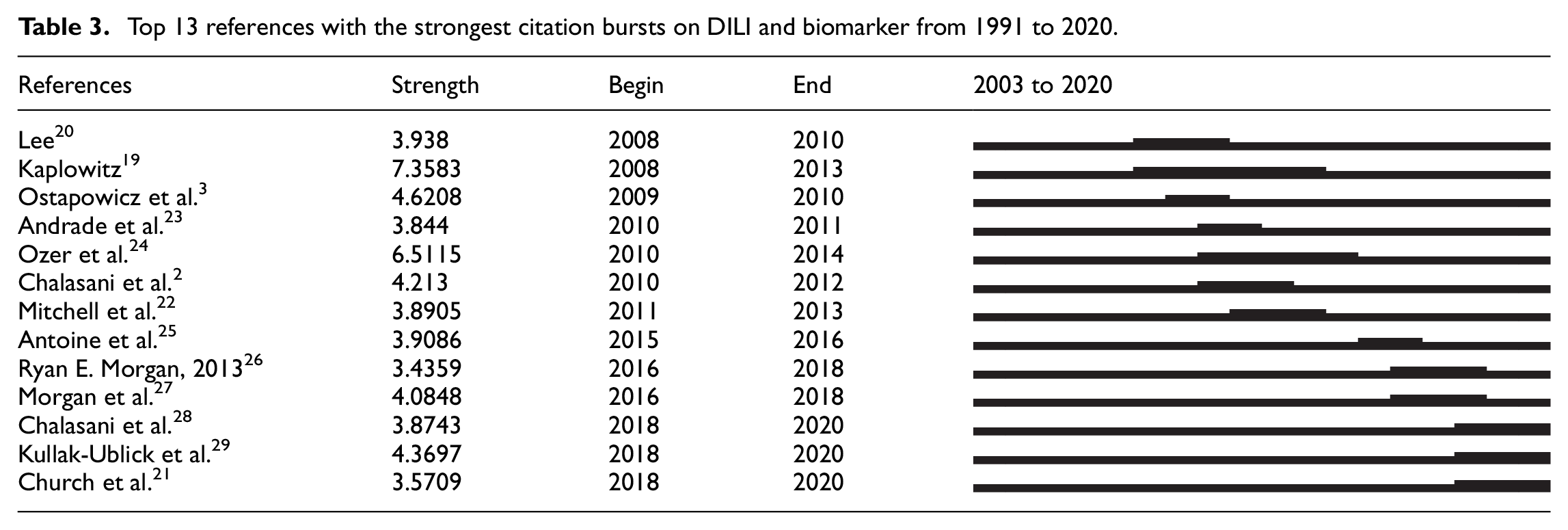
Citation burst is defined as the rapid occurrence of network data in certain periods. 18 Table 3 exhibited the top 13 citation bursts. Kaplowitz 19 got the strongest burst strength of 7.3583 and the longest burst timespan of 5 years. Two references by Kaplowitz and Lee 20 together consisted the earliest burst occurred in 2008. Due to the online early access, Church’s et al. 21 latest burst article entitled “candidate biomarkers for the diagnosis and prognosis of drug-induced liver injury: an international collaborative effort” was cited by other scholars since 2018 even before it officially published in 2019. The seventh article in the citation burst list was titled “Circulating microRNAs as stable blood-based markers for cancer detection.” 22 The article itself was beside the point of DILI. However, the biomarker research is mainly concentrated in oncology field, so the new progress of tumor biomarkers provided meaningful hints to biomarkers in other fields. Therefore, prementioned article set a precedent for serum and plasma microRNAs as DILI biomarkers.
Top 13 references with the strongest citation bursts on DILI and biomarker from 1991 to 2020.
Citation networks
Visualization of the citation networks were shown in Figure 2. Cluster I (Figure 2(b)) was the largest group with a total of 110 articles. Publications of Wang (CS = 56), Lewis (CS = 47), and Ozer (CS = 36) were in this cluster. Researches in this cluster are mainly related to emerging serum biomarkers, circulating microRNAs (such as miR-122) are particularly prominent. The earliest cited article in this subdivision was published by Georgina Meneses-Lorente et al. 30 There was a total of 80 articles in cluster II (Figure 2(c)), including publications of Daly (CS = 28), Bjornsson (CS = 21), and Reuben (CS = 19), which mainly focused on the susceptibility of specific genotype to drug induced hepatic injury. For example, Daly et al. 31 discovered that HLA-B*5701 genotype is a major determinant of DILI due to flucloxacillin. Researchers in this category contained considerable clinical studies investigating the prognostic markers and outcome of severe DILI. The earliest cited article in this subgroup was publication by Aithal et al. 32 Cluster III (Figure 2(d)) included 38 articles, comprising publications of Antoine (CS = 12) and Steuerwald (CS = 10). Most of them were basic studies demonstrating the mechanisms and animal models of DILI. Recent researches emphatically discussed the circulating serum protein/cytokines, metabolic activation, inflammation reactions, oxidative phosphorylation, and immune responses. Twenty articles compose Cluster IV (Figure 2(e)), publications of Yamazaki (CS = 10) and Luo (CS = 7) were in this cluster. This subgroup highlights the importance of bile acid homeostasis/bile salt export pump/bile acids transporters/cholestasis in DILI. Similar to cluster III, Cluster V (Figure 2(f)) mainly concerned about the pathogenesis of DILI, but it focused on epigenetic modification (such as DNA methylation), ER stress, oxidative stress, and mitochondrial function. Besides, Zhang (CS = 4) was the most important contributor in this cluster.

Visualization of the citation networks on DILI and biomarker from 1991 to 2020. As labeled with the last name of the first author, circles indicate publications, while squares indicate marked publications with high citation score (SC) in each cluster. The vertical axis and colors represent the publication year and the clusters, respectively. Curved lines indicate citation relations. The closer of two circles/squares, the closer two publications are to each other. The subheadings are the common themes of corresponding cluster: (a) citation networks of merged cluster I to V, (b) citation networks of cluster I, (c) citation networks of cluster II, (d) citation networks of cluster III, (e) citation networks of cluster IV, and (f) citation networks of cluster V.
Co-words
The top 99 occurrence co-words overlay visualization on DILI and biomarker from 1991 to 2020 were shown in Figure 3. The six clusters were marked by the translucent background from red, green, blue, yellow, purple to cyan color. Cluster I was mainly around major adverse drug reactions, in addition to the retrieve terms, “liver injury” (freq = 40) occurred most, while “adverse reactions” (avg = 2017) occurred latest. Cluster II was mainly related to pathogenic factors, “hepatotoxicity” (freq = 163), “expression” (freq = 63), “acetaminophen” (freq = 39) occurred most, while “damage” (avg = 2016) occurred latest. Cluster III, Cluster IV, and Cluster VI were mainly around pathogenesis of DILI, “toxicity” (freq = 64) and “mechanisms” (freq = 45) occurred most, while “model” and “inflammation” (avg = 2016) occurred latest in cluster III; “oxidative stress” (freq = 50) occurred most, while “inhibition” (avg = 2017), “acetaminophen-induced hepatotoxicity,”“activation” and “antioxidant” (avg = 2016) occurred latest in cluster IV; “induced liver-injury” (freq = 76) and “metabolism” (freq = 39) occurred most, while “bile acids” and “transporters” (avg = 2017), “pharmacokinetics,”“intrahepatic cholestasis” and “salt export pump” (avg = 2016) occurred latest in cluster VI. Cluster V was mainly about liver disease, “disease” (freq = 39) occurred most, while management (avg = 2016) occurred latest in cluster V.

Keywords co-occurrence overlay visualization on DILI and biomarker from 1991 to 2020. Each dot represents a keyword, in which, the rainbow color of a keyword shows the average (avg), publication year, from blue (farther year) to red (recent year), while the translucent red, green, blue to yellow, purple to cayan background descripts the six clusters. The larger label and circle were according with the higher frequency (freq) of a keyword, while the closer distance was according with the stronger correlation of two keywords.
Discussion
During the present information explosion, researchers are often concerned with how to manage and obtain knowledge on a certain field. In this article, bibliometrics was used to quantitatively and intuitively analyze global publication trends and research hotspots of DILI biomarkers. This is the first report to use bibliometric indicators, visualization information techniques to reveal the knowledge map of the development, evolution, and major concerns of the topic.
The publication amount in a research area can reflect the productivity and development of the topic over the year. 33 The development of biomarker research in DILI over the past 30 years was a sustainably and stably increasing process, as implicated in our study. The total number of articles per year did not exceed single digits before 2009, and after then, the field is continually expanding seeing close to 70 new publications in 2019. Whether this number will continue to increase, stay steady, or decline is yet to be seen; however, the increasing trend looks promising.
Popular journals in a research area during a certain period can be easily identified and can provide a reliable reference for scientific researchers. 34 Furthermore, core journals provide a significant amount of information, which is helpful, especially when searching for documents or submitting research achievements.35,36 Among the popular journals in which biomarkers of DILI-related articles were published, specialist journals such as Toxicological Sciences, Hepatology, Toxicology Letters, Journal of Applied Toxicology and Toxicology, and Applied Pharmacology aim to cater to a restricted audience, and this may be a major determining factor in the popularity of primary research articles. Conversely, PLoS One aims to cater to a diverse audience. For example, the readership probably includes a larger proportion of lay people than specialist journals, and this may be a major determining factor in the popularity of narrative reviews and editorials. These are the basis for researchers to consider related issues.
By tracking important institutions, authors, and journals, researchers can quickly understand the state of research in this area. A number of national/regional studies on research productivity have been conducted in recent years, primarily in order to help judge the science policy of a country/region and thereby adjust their science funding. 37 China is the only developing country among the top five high-productive countries/regions, and its publications are characterized by high in amount, but low in h-index, total citations, and average citations. The USA and England seem to have superior conditions for basic medical research or clinical trials, which include adequate funding, advanced equipment, and professional researchers. However, recent trends in developing countries, especially in China, policies and circumstances have shifted, leading to increased support for scientific research, suggesting that China will become more significant players in the future. Besides, this phenomenon is partly due to China is the main consumer of herbal remedies. Plenty of drugs have been found to induce liver injury, including non-steroidal anti-inflammatory drugs (acetaminophen, diclofenac, lumiracoxib, ibuprofen, naproxen, aspirin, etc.),3,28 antimicrobials (isoniazid, amoxicillin–clavulanate, minocycline, nitrofurantoin, sulfonamides, azithromycin, ciprofloxacin, levofloxacin, cefazolin, etc.), central nervous system agents,2,38 insulin sensitizing agents (troglitazone), 19 immunomodulators (thioguanine, lapatinib, pazopanib, gemtuzumab, interferon beta, busulfan, floxuridine, flutamide, infliximab, etc.), herbal and dietary supplements (polygonum multiflorum, camellia sinensis, lycopodium serratum, ephedra, sho-saiko-to, dai-saiko-to, ganoderma lucidum, etc.). 38 However, herbal and dietary supplements related cases account for a large proportion.28,38
Strength and duration represent two important attributes of a citation burst. Articles with citation bursts received particular attention from associated academic circles in a certain period. According to the burst articles, novel promising biomarkers include miR-122, high mobility group box-1 protein, keratin 18,25,29 bile acid homeostasis,26,27 serum F protein, arginase I, glutathione S-transferase alpha, sorbitol dehydrogenase, glutamate dehydrogenase, paraxonase, malate dehydrogenase, purine nucleoside phosphorylase,21,24 macrophage colony-stimulating factor receptor 1, osteopontin.21,29 This is not completely consistent with some recent reviews.38,39 This discrepancy reflects the advantages of bibliometrics, evaluating articles not only through the publication time and impact factors, but also through citation networks. Therefore, all researcher may obtain relatively objective information through bibliometrics, while reviews are influenced by many researcher’ own opinions, which requires higher requirements for authors to integrate and identify information.
Citation networks provide valuable information for tracing the historical development of scientific knowledge. While, keywords co-occurrence networks provide fundamental research topics. It partially overlaps with citation networks, both of them could provide collaboration networks and evolutions on a particular field, however, keywords co-occurrence networks can also provide research topics. For instance, cluster I in Figure 3 mainly corresponds to cluster II in Figure 2; cluster II, III and IV in Figure 3, and cluster III, V in Figure 3 are all about the mechanisms of DILI, cluster V in Figure 3 corresponds to cluster I in Figure 2, and cluster VI in Figure 3 corresponds to cluster IV in Figure 2. Comparing keywords co-occurrence network analysis with citation networks analysis can further clarify the keywords and keyword pairs that often appear in segmentation research, and can view the progress and overarching trends of the field from a development perspective. As for susceptible people, much attention was paid to autoimmune before, and now more attention is paid to genotype. About the role of bile acid or cholesterol in DILI, more focus was given to glutathione in the early years, while the current hotspots are the bile salt export pump and bile acid homeostasis. Concerning biomarker candidates, early studies mainly attempted to find candidate biomarkers in the rat model, however recent research is more about isolating human circulating microRNAs and trying to discover cross-species serum biomarkers. In terms of pathological mechanisms, oxidative stress, and inflammation are the most up-to-date topics in current years.
DILI will remain a major public health concern in the coming years due to the increasing use of herbal and dietary supplements, especially in aging and overweight population. 40 Although traditional liver parameters have been applied to the diagnosis of DILI, the lack of specific and sensitive biomarkers poses a major limitation, and thus accurate prediction of the subsequent clinical course remains a significant challenge. 38 The main problems in DILI biomarkers are as follows: firstly, no biomarkers are related to a specific type of drug. Future investigations should also examine the use of certain drugs in high risk populations to detect early liver injury, in an attempt to provide appropriate treatment and prevention. Besides, the current DILI researches are largely concentrated in preclinical phase, with clinical transformation requiring significantly more time to extensive analysis to complete. Finally, many scholars believed that greatest benefit would be achieved by simultaneously combining the scoring systems and those biomarkers, however, we need to consider the economy and accessibility, cumbersome procedures are bound to affect his popularity. Although there exist many problems mentioned above, our analysis reveals that scientists are still actively exploring the uncharted territory of biomarkers in DILI research. We expect to see more breakthroughs in biomarkers and improvement in diagnosis and clinical management of DILI in the near future.
Limitations
In order to ensure a high-quality bibliometric analysis, we only recruited papers published in journals recorded in WoS, which has to pay a price that a considerable amount of papers published in non-SCI journals. Especially, the vast amount of herbal treatment literature is published in Chinese. To compensate this pitfall, another study aiming to systemically analyze the non-SCI papers is needed to make a thorough overview on papers related with DILI biomarkers from bibliometric point of view.
Conclusions
We assessed the publication information regarding different countries/regions, organizations, authors, journals, et al. and analyzed the research hotspots of the DILI biomarkers over the past 30 years based on these studies. To conclude, the present analysis suggests that the obviously rapid growth of the articles in recent years appears to be associated with the accelerating interests in DILI. Toxicological Sciences, Journal of Hepatology, and Hepatology are the most influential journals. Among the research hotspots of DILI biomarkers, serum biomarkers such as microRNAs, K18, and histological markers like HMGB1 are attracting ever-growing attention. Meantime, bile acid hemostasis plays an important role in DILI susceptibility. In addition, mitochondrial function, oxidative stress, inflammation, immunity, metabolic activation, and epigenetic change might play major roles in the pathogenesis of DILI. With the research on prospective cohort study booming, more sensitive and specific biomarkers that could be used in diagnosis and management of DILI will be expected in the near future.
Supplemental Material
sj-docx-1-sci-10.1177_00368504211000535 – Supplemental material for Global publication trends and hotspots of molecular biomarkers in DILI from 1991 to 2020: A 30-year bibliometric analysis
Supplemental material, sj-docx-1-sci-10.1177_00368504211000535 for Global publication trends and hotspots of molecular biomarkers in DILI from 1991 to 2020: A 30-year bibliometric analysis by Mingnan Cao, Li Wang, Lin Zhang and Jingli Duan in Science Progress
Footnotes
Acknowledgements
The authors thank Jingxuan Wu at Department of Pharmacy, Beijing Friendship Hospital, Capital Medical University for proofreading of the manuscript.
Declaration of conflicting interests
The author(s) declared no potential conflicts of interest with respect to the research, authorship, and/or publication of this article.
Funding
The author(s) disclosed receipt of the following financial support for the research, authorship, and/or publication of this article: This work was supported by Project of Shaoxing Medical Key Discipline Construction Plan (No: 2019SZD06).

Supplemental material
Supplemental material for this article is available online.
Author biographies
References
Supplementary Material
Please find the following supplemental material available below.
For Open Access articles published under a Creative Commons License, all supplemental material carries the same license as the article it is associated with.
For non-Open Access articles published, all supplemental material carries a non-exclusive license, and permission requests for re-use of supplemental material or any part of supplemental material shall be sent directly to the copyright owner as specified in the copyright notice associated with the article.
